
 Since the dawn of the internet age, there has been no shortage of stories about hackers, malware-peddling malcontents, online scams and identity theft. Add to that the growing consensus that wars in the future will be fought online through “cyberwarfare divisions”, and you can understand why such positive statements once made about the internet – like how it would bring the world together and create “a global village” – would seem incredibly naive now.
However, despite the prevalence of hacking and cyberwarfare-related fear, very few people have actually experienced what it is like. After all, the effects of hacking are mostly invisible to the untrained eye, with the exception of very-high-profile database breaches. Now, though, a security company has produced a fascinating geographic map that shows global hacking attempts in real-time. And of course, the ongoing battle between US and Chinese forces accounts for much of it.
 The real-time map, maintained by the Norse security company, shows who’s hacking who and what attack vectors are being used. The data is sourced from a network of “honeypot” servers – essentially a juicy-looking target that turns out to be a trap -maintained by Norse, rather than real-world data from the Pentagon, Google, or other high-profile hacking targets. The Norse website has some info about its “honeynet,” but it’s understandably quite sparse on actual technical details.
If you watch the map for a little while, it’s clear that most attacks originate in either China or the US, and that the US is by far the largest target for hack attacks. You can also see that the type of hack used, indicated by the target port, is rather varied. Microsoft-DS (the port used for Windows file sharing) is still one of the top targets , but DNS, SSH, and HTTP are all very popular too. CrazzyNet and Black Ice – two common Windows backdoor programs often used by script kiddies and criminals – is also sure to pop up.
 On occasion, the map is likely to show a big burst of coordinated attacks coming from China and directed towards the US. And while it is difficult to blame these attacks directly on the Chinese government (as they are adept at routing their attacks through other servers) government and independent researchers are confident the majority of these attacks are being directed by the People’s Liberation Army’s Unit 61398 – aka. the PLA’s cyberwarfare division.
A lot of hacks originate in the US, too, but their targets are much more varied. And in cases where Chinese facilities (or other nations that are nominally identified as hostile to the US) you can bet that the US Cyber Command at Fort Meade is behind the lot of them. But the map is still limited in that it uses Norse’s own honeypot operations to identify these attacks, and it therefore cannot be said with absolute certainty that real attacks happen in the same fashion.
 But a general picture of the size and shape of global hacking and cyberwarfare can be divined by looking at the stats. Back in 2012, the US DOD reported that it was the target of 10 million cyber attacks per day. Likewise, the National Nuclear Security Administration says it saw 10 million attacks per day in 2012. In 2013, BP’s CEO said it sees 50,000 cyber attacks per day, and the UK reported around 120,000 attacks per day back in 2011.
While the extent and purpose of these attacks certainly varies, it is pretty clear that hacking and cyberwarfare is a global problem and something that governments, corporations, and institutions need to pay attention to. Last year, the Obama administration’s announced that it would not sit idly by in the face of stepped up attacks from China. However, the subsequent testimony and document leaks by Snowden showed that the US has been conducting its own attacks the entire time (and even beforehand).
And such is the nature of war, regardless of the context or the weapons used. States rattle their swords claiming they will not tolerate aggression, but there is always a fine line between maintaining one’s defenses and escalating a situation to the point that mutual destruction becomes inevitable. Perhaps the people who are currently fighting this alleged cyberwar should look to the past – specifically to the First World War and the Cold War – to see just how effective “arms races” are!
Source: extremetech.com, map.ipviking.com

 As Hernan explained on his website:


 In the teaser video, things open up on historic route 66. A Harley drives by, only it doesn’t sound like a Harley. It’s quieter, more like the jet engine of a very small plane. Over the summer, Harley-Davidson will take the new LiveWire bike on a 30-city tour of the U.S. to get customer feedback. Richlen has extended an invite to anyone who doubts the power of the bike to come on out try the bike for themselves. The real test, he says, is in the twist of the throttle:
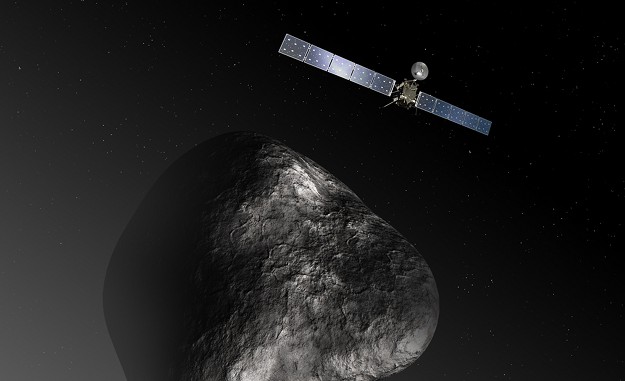 Space exploration is a booming industry these days. Between NASA, the ESA, Roscosmos, the CSA, and the federal space agencies of India and China, there’s just no shortage of exciting missions aimed at improving our understanding of our Solar System or the universe at large. In recent months, two such missions have been making the news; one of which (led by the ESA) is now underway, while the other (belonging to NASA) is fast-approaching.

 Named in honor of the Rosetta Stone – the a basalt slab that helped linguists crack ancient Egyptian – Rosetta is expected to provide the most detailed information about what comets look like up close (as well as inside and out). Similarly, the lander, Philae, is named after the island in the Nile where the stone was discovered. Together, they will help scientists shed light on the early history of our Solar System by examining one of its oldest inhabitants.
 EFT-1 will take the form of an unmanned test flight, with the Orion spacecraft being controlled entirely by a flight control team from NASA’s Kennedy Space Center located in Florida. One vital component to be tested is the Launch Abort System (LAS), which in essence is a fail-safe required to protect astronauts should anything go wrong during the initial launch phase. Designed to encapsulate the crew module in the event of a failure on the launch pad, the LAS thrusters will fire and carry the Orion away from danger.
 The final aspect of EFT-1 will be the observation of the parachute deployment system. Assuming the LAS has successfully jettisoned from the crew module following launch, the majority of Orion’s stopping power will be provided by the deploying of two drogue parachutes, followed shortly thereafter by three enormous primary parachutes, with the combined effect of slowing the spacecraft to 1/1000th of its initial re-entry speed.
 NASA staff on the ground will be nervously monitoring several key aspects of the proving mission, with the help of 1,200 additional sensors geared towards detecting vibration and temperature stress, while taking detailed measurements of event timing. Furthermore, cameras are set to be mounted aboard Orion to capture the action at key separation points, as well as views out of the windows of the capsule, and a live shot of the parachutes as they deploy (hopefully).


 Initial measurements at this site with the element-identifying alpha particle X-ray spectrometer at the end of Opportunity’s arm indicate that bright-toned veins in the rock contain calcium sulfate. Scientists deduce this mineral was deposited as water moved through fractures on Endeavour’s rim. The rover found similar veins of calcium sulfate farther north along the rim while investigating there earlier last month.


 Stories by Williams