Episode Twenty-Six of Stories from Space, “The Copernican Revolution,” is Now Live

Episode Twenty-Six of Stories from Space, “The Copernican Revolution,” is Now Live

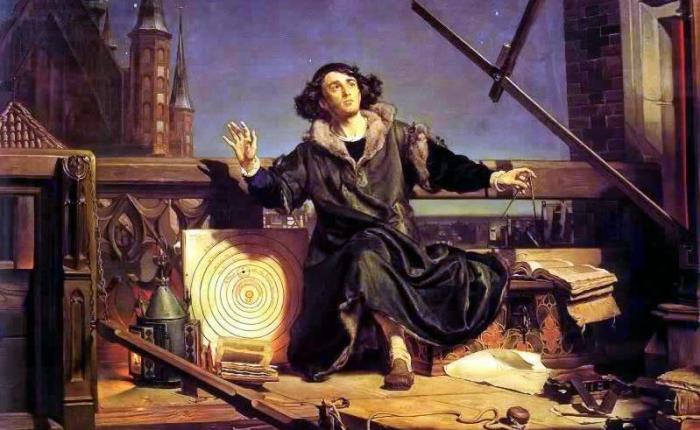
This week’s episode focuses on the life and times of Nicolaus Copernicus, the famed Renaissance Polish astronomer who proposed the heliocentric model of the Universe. The details of this model were presented in his magnum opus, On the Revolutions of the Heavenly Spheres, which Copernicus had published in 1543 when he was on his deathbed. While Copernicus is a household name and the basics of his model are well-known, the story of how he came to his grand realization is less well-known.

The heliocentric model was inspired by thousands of years of observations and calculations by astronomers. These included several pre-Socratic Greek texts lost to Europeans (but preserved by Muslim scholars) and scholars from West Asia, Iran, India, and Al-Andalus (Spain before the Reconquista). These sources contradicted the prevailing models of Aristotle and Ptolemy, both of whom were considered canon in Europe and Eurasia.

By synthesizing these observations with his own calculations, Copernicus showed how Earth and the other planets orbited the Sun, how the Moon orbited Earth, and how Earth rotated. In short, he synthesized and crystallized one of the most profound scientific discoveries ever made, one that was thousands of years in the making. And in so doing, he forever revolutionized our understanding of the cosmos and our place in it.

In fact, his observation that the Sun was NOT at the center of the Universe began a long process where humans began to realize that neither they nor Earth were unique in the cosmos. As Sagan put it: “One of the distinctions and triumphs of the advance of science has been the deprovincialization of our worldview.” Because of Copernicus’s role in this, the scientific axiom that states that humanity is NOT in a special or privileged position to view the cosmos is known as the Copernican Principle.

Where to Listen:

Episode Twenty-Five of Stories from Space is now Live!

Episode Twenty-Five of Stories from Space is now Live!

This week, I had the privilege of chatting with famed physicist, author, NASA technologist, and interstellar travel expert Les Johnson. In addition to discussing the challenges of mounting human-rated missions to interstellar space, we talked about his science fiction writing – which includes multiple novels and anthologies. He’s also been a contributor and the chief editor of several collections that combine SF short stories with scientific essays, like Going Interstellar and Stellaris: People of the Stars.

We also talked about the upcoming anthology, The Ross 248 Project, which is available for pre-order through Baen Publishing and Simon & Schuster. This book explores how human beings could one day travel to rocky planets that orbit Red Dwarf suns and how these planets could be terraformed to make them habitable for Earth organisms (including us). I had the honor of contributing an essay to this anthology, “Under a Crimson Sun,” which explores potential terraforming strategies and was inspired by a series I wrote for Universe Today (The Definitive Guide to Terraforming). Follow the links below to check it out!

Where to Listen:

Episode Twenty-Four of Stories from Space is now Live!

Episode Twenty-Four of Stories from Space is now Live!

This week’s episode is a homage to one of the greatest science fiction authors and science communicators of all time: Arthur C. Clarke. In addition to his writing and research, Clarke was a noted futurist who made many famous predictions about the future. His ability to anticipate technological advancements and the effect they would have on society earned him the nickname “Prophet of the Space Age.”

The subject of his predictions and what he got right or wrong is something I’ve been examining since I read the novelization of 2001: A Space Odyssey a few decades ago. While there were many details that he got wrong and had to ret-con in later books, he was eerily right about many things. These included communication satellites, the internet, spaceplanes, commercial spaceflight, and orbital space stations. Follow the links below to hear more!

Where to Listen:

Episode Twenty-Three of Stories from Space is now Live!

Episode Twenty-Three of Stories from Space is now Live!

For this week’s episode, I sat down with Dr. Alex Ellery, a professor of Mechanical and Aerospace Engineering at Carleton University – which happens to be my alma mater (Go Ravens!) Dr. Ellery has written extensively about a subject that is near and dear to the heart of SETI researchers – Von Neumann Probes! For those unfamiliar, the concept is named in honor of famed scientist and engineer John Von Neumann (1903-1957).

In a series of lectures and his posthumously-published book, Theory of Self Reproducing Automata, he described machines that could harvest raw materials and produce exact copies of themselves. Over time, this notion has merged with ideas like nanotechnology and additive manufacturing (3-D printing) to become an idea for space exploration. And as SETI reminds us, if we can think of it, someone else has likely created it already.

Since the 1970s, Von Neumann probes have become a focal point in the ongoing debate about the existence of extraterrestrial intelligence (aka. the Fermi Paradox). The argument goes like this: if an advanced civilization were out there, we’d see evidence of self-replicating probes by now. This argument has led to all kinds of speculation and theories, and you can bet that Ellery and I got into them with gusto! Follow the links below to have a listen!

Where to Listen: