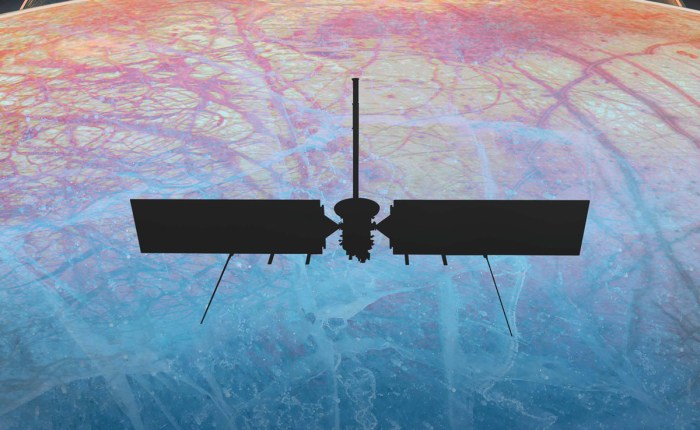
Episode 64 of SfS – “The Europa Clipper Mission: A Conversation with Dr. Steve Vance” – is now Live!

Episode 64 of SfS – “The Europa Clipper Mission: A Conversation with Dr. Steve Vance” – is now Live!

In this week’s episode, I had the good fortune to sit down with NASA scientist and astrobiologist Dr. Steve Vance so we could talk about NASA’s upcoming Europa Clipper mission. This mission, which was decades in the making, will launch this coming October, sending a spacecraft to Jupiter to explore its satellite Europa. Ever since the Voyager probes flew past Jupiter and its moons in 1979, scientists have speculated that there might be an ocean beneath this moon’s icy crust.

The mission will arrive around Jupiter by 2030, where it will begin making flybys of Europa and studying its surface with an advanced suite of instruments. Among its objectives are the characterization of Europa’s surface, investigating surface plume activity, and determining the existence and chemistry of its interior ocean. Another major objective is the search for potential biosignatures, indications that this interior ocean may harbor life!

We got into all of that and a number of other things – including Europa’s depiction in Arthur C. Clarke’s famed Space Odyssey series. As Vance told me during our chat, Clarke played a role in the mission planning, and (contrary to the monoliths told humanity in his stories) we do have permission to “attempt a landing there.”

Where to Listen:

Episode 63 of SfS – “The Rare Earth Hypothesis” – is now Live!

Episode 63 of SfS – “The Rare Earth Hypothesis” – is now Live!

This week’s episode revisits the Fermi Paradox, the question that launched a thousand scientific papers! To recap, this paradox takes its name from Erico Fermi, the physicist who helped build the first nuclear reactor and one of the scientists who worked on the Manhattan Project. In 1950, during a lunchtime conversation with colleagues, Fermi famously asked: “Where is everybody?” (aka. where are all the aliens?)

One proposed resolution is the idea that the conditions for life are far more stringent than we think. When it comes to astrobiology, scientists tend to be optimistic, thinking that rocky planets with fluffy atmospheres that orbit within their suns’ habitable zones have everything they need to give rise to life. But using Earth as a template, things like plate tectonics, a large moon, a large gas giant in the outer reaches of the system, and other factors may be necessary.

If this is true, then life (and, by extension, intelligent life) is likely to be rarer than previously thought. Perhaps that’s why we’re not hearing from any of them! Check out the links below to hear more.

Where to Listen: