Snow Crash!

Snow Crash!

You know how everyone has a set of favorite authors, people that they feel inspired them more than anyone else? Some people are lucky and have just one. Others, the “well-read” type, can name about ten, twenty or more! Me? I guess I’m lucky in that that list comes down to about five names. For me, that list includes George Orwell, Aldous Huxley, Frank Herbert, William Gibson, and Neal Stephenson.

Like many people I know, I enjoy Stephenson’s books because they are entertaining and interesting, but also because he inspires thought. Upon writing this, I’ve read Snow Crash, The Diamond Age, Cryptonomicon, and just started Anathema. And I can honestly say that each one is a timely creation, combining a cutting-edge knowledge of technology and computer science with a profound sense of history, politics, anthropology, and philosophy.

So, I thought it high time that I actually review one of his books, and what better place to start than with his first big hit, Snow Crash! Although it was his third book to date, released in 1992 and preceded by The Big U and Zodiac, it was arguably this book that established his reputation and put him on the radar of every fan of the post-cyberpunk genre.

Snow Crash:
The story takes place in Los Angeles during the early 21st century. The United States has effectively disintegrated, the vast majority of society now living in privatized areas known as “franchulates” (which are clearly meant to satirize gated communities) and the federal government maintaining islands of influence in between it all. Enter into this world Hiro Protagonist, a comically named freelance hacker/swordfighter, who lives in a storage closet and spends much of his free time in the virtual environment known as the Metaverse.

After an abortive delivery working for Uncle Enzo’s Pizza, he meets a young woman named Y.T. (short for Yours Truly) who works for a the “Kourier” delivery company. In this day, couriers get around by riding high-tech skateboards and “pooning” (i.e. harpooning) their way through traffic. After making Hiro’s delivery for him, she becomes a personal friend of Uncle Enzo himself, a friendship which proves lucrative as the story goes on. Since she also saved his butt, Hiro and her decide to become partners in the “intelligence business”, meaning they now work together to obtain and sell information through the CIC (Central Intelligence Company, the leftovers of the CIA).

Things begin to get interesting when Hiro becomes aware of a new pseudo-narcotic that is making the rounds in the Metaverse. It’s called Snow Crash, the use of which causes anyone’s system to crash and emit total static (hence the name). In the real world, a hard version of the drug is making the rounds which alters the minds of users and causes them to utter some kind of “glossolalia” – i.e. speaking in tongues – and become disconnected from reality. Upon investigating, Hiro and Y.T. learn that the drugs are being distributed by a chain of Pentecostal churches known as “Reverend Wayne’s Pearly Gates”, which is owned by software magnate L. Bob Rife.

Rife is currently at sea and in possession of the USS Enterprise, which has become part of a massive flotilla of ships that makes periodic crossings from Asia-Pacific to North America. Apparently, everyone on board is infected with this virus as well, the people speaking in strange, monosyllabic tongues whenever they are interviewed. After being encouraged to look into this by his Catholic and linguist ex-girlfriend, Juanita Marquez, Hiro begins to uncover that Rife is at the center of Snow Crash and what his plan is. Essentially, it relates back to the mythology of ancient Sumer when the myth of Babel took place (language becoming confounded and splintered).

According to Stephenson, Sumerian is to modern languages what binary is to programming languages. It affects the user at a far more basic level than acquired/programming language. Unlike modern language, Sumerian was rooted in the brain stem and its culture was ruled and controlled via “me”, the human equivalent of software which contains the rules and procedures for various cultural activity (harvesting grains, baking bread, making beer, etc.). The keepers of these important documents were priests referred to as “en”; some of them, like the god/semi-historical-figure Enki, could write new me, making them the equivalent of programmers or hackers.

In any case, the connection between past and present is demonstrated when Hiro learns how the ancient goddess Ashera created a dangerous biolinguistic virus that infected all peoples. This virus was stopped by Enki, another god, who used his skills as a “neurolinguistic hacker” to create an inoculating “nam-shub”, an anti-virus, that would protect humanity by destroying its ability to use and respond to the Sumerian tongue.

It was this creation, a modern take on the Babel myth, that created modern language as we know it today. However, Asherah’s meta-virus did not disappear entirely, as the “Cult of Asherah” continued to spread it by means of cult prostitutes who spread it through sex and the breast-feeding of orphaned infants. This is turn was countered by the ancient Hebrew priests, men who quashed the cult of Ashera and introduced sanitized, reproducible information with their written testaments.

Furthermore, Hiro learns that Rife has been sponsoring archaeological expeditions to the Sumerian city of Eridu, and has found enough information on the Sumerian tongue to reconstruct it and use it to work his will on humanity. He has also found the nam-shub of Enki, which he is protecting at all costs since it can counter the virus. After making their way to the Raft with the help of the Mafia, Hiro and Y.T. set about trying to find the Enki tablet so Hiro can upload its nam-shub to the Metaverse.

However, their efforts are frustrated somewhat by the presence of Raven, a massive Aleut freelancer who is in possession of his own thermonuclear weapon (which he acquired from a Russian sub and intends to use on America). He is helping Rife because of a score he wants to settle, being the child of people who endured exposure to two nuclear bombs (Hiroshima and nuclear testing in the Aleutians).

In the end, Hiro engages Raven in a virtual battle in the Metaverse while Y.T., Uncle Enzo and his men are forced to take down Bob Rife. Hiro manages to successfully upload the “nam-shub” of Enki, the world is saved, and Rife is brought down. There is also a brief side story of a budding romantic relationship between Y.T. and Raven, but that doesn’t work out in the end. She’s a young girl, he’s a homicidal, giant maniac… what can you do? Also, Hiro gets back together with Juanita and just about everyone lives happily ever after.

Strengths:
In a previous post, I believe I compared Gibson’s Virtual Light, the first book in the Bridge Trilogy, to this story, and for good reason. Both stories took place in an America where the country had become Balkanized, marked by privatization, major corporations and weird religious sects. The themes of hyperinflation, hard-living, overcrowding and urban sprawl were also consistent. And finally, the main characters – one a freelance agent and the other a delivery girl – were virtually identical.

However, when it comes right down to it, Stephenson’s take on the whole thing was better. His mix of satirical wit and social commentary was far more effective at critiquing the process whereby America is becoming increasingly privatized and polarized in terms of wealth and power. His fictional money, “Ed Meeses” and “Gippers” – the trillion and very rare quadrillion dollar note – were a nice very touch; and his use of “franchulates” in the story, a clear reference to gated communities, was nothing short of brilliant. His concept for the Metaverse, a virtual environment contained in cyberpace, and the spread of computer viruses also predicted several developments that would be taking place with the World Wide Web up to a decade later.

On top of all that, Stephenson managed to weave a great deal of history, philosophy and a fascinating take on neuro-linguistics into the story. Essentially, he demonstrated how human language and programming language are similar, when viewed in the right light – language is to the human brain what software is to the hardware. In addition, the story was replete with clever tidbits of history – WWII, the Vietnam War, nuclear testing, Biblical myths – and some rather hilarious twists and plot devices. “Reason”, a miniature Gatling gun used by the Mafia as a heavy-duty persuader, takes the cake for me (“I’m sure they’ll listen to Reason”)

Weaknesses:
However, it was also the mythological elements of this story which kind of brought it down in a way. While the allegorical similarities between programming language and spoken language was fascinating – as was the exploration of its biological and psychological aspects – one could not help but feel that the line between literal and figurative was being overstepped. In short, the idea was brilliant when considered from a metaphorical perspective – i.e. that the Babel myth might accord to some primordial event whereby language and human psychology became more complex.

However, the story is clearly presented in literal terms, the reader being told point blank that there really was an Tower of Babel-type event just a few thousand years ago that confounded our language, that made us what we are today and beforehand we were all slaves to social programming. Kind of seems a bit odd, but that’s Stephenson’s thing, using satire that is at once brilliant and at the same time a bit hokey. One can never tell where one ends and the other begins.

The only other weakness, and this is something Stephenson is a bit notorious for, is the ending. Stephenson himself laments that this is something he’s become known for, largely because he feels that its a jinx that’s haunted his subsequent work. Basically, he writes odd endings, ones that feel cut off and sudden. In Snow Crash, that is certainly the case. After a long chase scene, which ends when Rife’s helicopter is brought down by a dozen Kourier harpoons, Y.T. simply says goodbye to Raven (flips him the bird) and then calls her mom to tell her she’s coming home.

An additional chapter where Hiro gets to meet up with his friends in the Metaverse and reunites with Juanita would have been a good addition. Much was made of how his friends, hackers like him, were being specifically targeted by Snow Crash since they were the biggest threat to Rife’s plans. Given all that, it would have been nice to show how they all came through the crisis, not to mention a final romantic scene between Hiro and his ex. Similarly, it would have been nice to see Y.T. actually make it home, her give her usual reassurances to her worried mother (who works for the feds), and for her to see her romantically challenged boyfriend, maybe realize he was okay after all the time she spent with Raven. Just saying…

But overall, Snow Crash was an awesome read and a real tour de force for me. I highly recommend it to anyone who’s a fan of cyberpunk, post-cyberpunk, or is just intrigued by history, hacking, computer science, and gritty science fiction. It’s got it all, and some pretty cool departures for the philosophically inclined along the way!

Hunters of Dune, part II

Hunters of Dune, part II

Okay, now that I’ve managed to sum up the book, let’s get down to why it sucked! In addition to the usual weakness one can expect out of a book by these two – bad characters, bad story, cliches, and a general feeling of exploitation – there were several other glaring points. As usual, I’ve tried to break them down as succinctly as possible, going from best to worst.

1. Sequel Complex:
As I’m sure I’ve said before, the Preludes and Legends series suffered from an unmistakable sense of duty. I.e. the story was brought down by the voluminous amount of page time that was dedicated to origins stories and explanations that really had little or nothing to do with the main plot. In this book, things were turned around slightly. Instead of explaining where everything came from, the duo dedicated all kinds of page time and chapters to explaining where everything went.

Examples abounds, but here are just a few that come to mind. In the early chapters, much is made of the differences between the BG’s and HM’s and how they were having a hard time getting along. This was best demonstrated by Murbella’s chief companions, one a BG, the other an HM (for the life of me, I can’t remember their names!). Point is, after many chapters of doing the “odd couple” thing, the HM woman suddenly kills the BG woman, Murbella forces her to take on the other’s memories, and the thread is dropped.

Another example comes in the form of Uxtal and his efforts with the HM’s. After having several chapters dedicated to him and his attempts at recreating axlotl tanks so he can make gholas, artificial spice, and the raising of the Baron Harkonnen ghola, he is killed and fed to a farmer’s sligs. If the early chapters that featured him were any indication, it was that he was supposed to be a main character. However, once he serves his purpose, he’s cast aside and the thread that took place from his POV dies. Just another victim of Brian and KJA’s writing style!

And finally, there’s the many, many chapters dedicated in the beginning designed to flesh out every single detail about the gholas, the Face Dancers efforts to infiltrate the Old Empire, and the the war between the Sisterhood and the HM holdouts. For the most part, these chapters feel like pure filler, giving us a slew of boring details that could have been left in the background and do nothing to build towards the climax.

2. Weak Writing:
Brian and KJA are known for their wooden dialogue and one-dimensional characters. But in Hunters, as with the Preludes series, things were not nearly as bad as they were with the Legends series. One can infer from this that wherever Frank’s original characters and notes were available and the duo didn’t have to rely on their own instincts, everything read much better. However, some examples of crappy writing still crept into this book and it really showed!

Take the part of the book where the Paul and Chani gholas are talking and falling back into love. Seriously, the dialogue was so weak and sappy that I was honestly reminded of the terrible love scene from Attack of the Clones! “I love you. I have always loved you. Time cannot separate us,” is literally the type of dialogue that occurs here. Who the hell talks like this? Also, consider the chapter where Sheeana decides to ride one of their captive sandworms in front of a Futar. The purpose, apparently, was to impress the half man, half felines, in order to earn their loyalty and get information from them about the Handlers (who they are, etc). It responds by saying “You better than Handlers!” And thenceforth, they become their loyal protectors. Weak!

Another glaring example is the many, many references to what is referred to as the Outside Enemy (this is actually how it appears in the text). In Chapterhouse, we are made aware that the HM’s were themselves fleeing from something, and that was why they had returned to the Old Empire and were seeking to obtain the BG’s secrets. However, at no point where they referred to as the Outside Enemy. What’s more, this is such a lame name for an enemy. Hell, it’s not even a name, it’s a basic description! It as if they had found a footnote in Frank’s notes where he described the threat in these words and decided that this was how they were going to reference it from thence forth. I’m not sure if that’s weak or just plain lazy.

And finally, there is the addition of the Phibian creatures – a race of man-fish hybrids that are basically the aquatic versions of Futars. Aside from making a brief appearance in the story, they serve no purpose and seem to only exist because Brian and KJA thought they were a cool idea. This novel and its sequel, Sandworms, abound with examples of this, things that Frank made no mention of and seem completely at odds with his original vision, but made it in because the authors seemed to think they were cool. The fact that these terms now show up in Dune terminology is both sad and discouraging!

3. Weak Plot:
As all the previous examples will attest, this story suffered from the problem of making the reader wade through a slow-buildup packed with extraneous detail and poor writing before it finally got to the climax. But by the time it arrives, the entire pace of the book changed and important revelations are simply dropped in or rushed through in a desire to get to the halfway point before all the real action starts (which takes place in book II). And in truth, I was able to endure all the weakness thanks to the anticipation factor; I hung on in the hopes that something big was going to be revealed soon!

In fact, its not until the Ithaca and its crew discover the planet that’s been cloaked by a no-field that things begin to feel like they’re picking up. Finally, we are handed the first bit of hard evidence that the threat the HM’s were fleeing was a plague that left their world’s sterilized and deserted. However, they deduce so quickly that this planet was destroyed by a terrible plague after chancing upon an abandoned library and picking up one shred of document. C’mon man! Show us some mass graves, show us some hospitals filled with dead people, show us some signs that there was a terrible holocaust! This is important stuff, don’t just have them figure it out and then take off!

What’s more, no good reason is ever given for why the Face Dancers (and their machine masters) need gholas of Paul and the Baron. It is merely said that the former is “necessary” for the “Enemy’s” calculations, i.e. to help them take over the universe. As for the Baron, no real reason is given beyond saying he’s useful too. But its pretty clear its just so they can bring back the old characters and give them a final run. And of course its obvious from the get go, even without the extremely strong hints they give, that the Ithaca’s Paul and the Face Dancers “Paolo” are going to meet up and battle it out. Wow, a battle between the hero and his evil twin! Nothing cliche or obvious about that!

The same holds true for the Ithaca’s own gholas. In their case too, Duncan, Sheeana and the rest simply decide to start making them because they figure they might be “useful”. But if Duncan is already the new Kwisatz Haderach, what do they need to be resurrecting Paul and Leto for? What reason, for that matter, do they have for creating the others aside from bringing all the old crowd back and giving them a big sendoff? I get the sentimental appeal, but it really wasn’t necessary or even plausible to be resurrecting so many old characters. What was the point of killing them off if they’re all just going to be back before the end?

And let’s not forget what Daniel said at the end of Chapterhouse when Marty mentioned how Scytale had that nullentropy tube full of ghola cells and asks why he let them get away. “Didn’t let them…,” he replies. “Gholas. He’s welcome to them.” In other words, it sounds like the old man and woman were not the slightest bit threatened by the Ithaca and its ability to create gholas, nor do they seem to have any particular use for them themselves. So why would they go to the trouble of creating their own? Like most things in this book, it doesn’t fit with Frank’s original work.

4. Tie-ins:
A major flaw in this series, one which I hear many a fan complain about bitterly, is the fact that Brian and KJA felt compelled to write their own characters into the story. Not only is there no reason for them to be included, they are shoved into the story with all the subtlety of a square peg being rammed into a round hole.

For example, we are told that Scytale’s nullentropy tube, which he carries in his chest, contains the dead cells of all the series’ major figures. This includes Paul, Leto II, Jessica, Chani, Stilgar, Duke Leto, the Baron, Duncan, Thufir, Gurney, et al. In essence, the tube is the means to create gholas of all of history’s greats. But in Hunters, Brian and KJA decided to amend this list to include Xavier Harkonnen and Serena Butler. These two characters did not exist in the original series and were not mentioned once in Chapterhouse when the ghola tube was first described. So really, throwing them in was just a shout out to their own work, which seems crass.

Also, in the course of exploring her “Other Memory” Murbella comes across the memories and personality of Serena Butler. Aside from making this brief appearance in the story, she serves no purpose other than mentioning that she knows a thing or two about wars. This did not fit with the story at all seeing as how Serena is never mentioned in any of the original books, and really served no purpose other than as a reference to the duo’s work yet again. Brian and KJA even tactitly admitted this by writing that Murbella had no idea who Serena was or how she was related to her. Her voice, much like her inclusion in the story, appears out of nowhere and then promptly disappears.

Another tie-in comes in the form of the “Oracle of Time”, a Guild Navigator who never appeared in any of the original books. Initially, it seems that she is a descendent of the “Oracle of Infinity”, the patron saint of Navigators who first appeared in Dune: House Corrino, but by the end it is revealed that she in fact Norma Cenva (a character of the Legends series). In short, she was yet another character from Brian and KJA’s shoddy prequels who was thrown into the mix to draw attention to their own work.

Her character plays a central role in this story and its sequel, unlike Xavier or Serena; however, her appearance is rendered completely implausible because of the simple fact that she made absolutely no appearances in any of the original novels. If she comes to us from the Legends series, then she’s been around for over 15,000 years, right? So where has she been all this time, and if she’s an oracle, why the hell didn’t Paul or Leto notice her in the course of their prescient sweeps? Surely the existence of another prescient being, aside from the regular navigators, would have sent up some red flags for them! But again, this was not done for the sake of consistency or plausibility, it was done solely so the duo could write their own work into Frank’s story.

5. Wrong Again!:
As I mentioned before in my reviews of the Dune prequels, one can’t help but get the feeling that these guys completely misunderstood what Frank was going for. In the Legends series, for example, we are presented with a vision of the Butlerian Jihad that involves free humans battling it out with robots for the sake of freedom and survival (a la The Terminator franchise). Not only did it seem like Brian and KJA were relying on a ton of cheap sci-fi concepts to create this series, there was absolutely no indication in the original novels that the Jihad was anything like this. Consider this definition taken from Terminology of the Imperium, the glossary for the original Dune novel:

JIHAD, BUTLERIAN: (see also Great Revolt) — the crusade against computers, thinking machines, and conscious robots begun in 201 B.G. and concluded in 108 B.G. Its chief commandment remains in the O.C. Bible as “Thou shalt not make a machine in the likeness of a human mind.”

When one looks up Great Revolt, it simply refers back to the other definition.

GREAT REVOLT: common term for the Butlerian Jihad (See Jihad, Butlerian)

Not a lot to go on there, but notice the complete lack of any mention of cymecks, evil robots, or hive minds enslaving humanity. Also, there is no indication that this “Jihad” was a war in the literal sense. If anything, it sounds like a metaphor for a moral crusade against a specific kind of technology, a Luddite rebellion in other words. In God Emperor of Dune, Leto II explained the Jihad further:

“The target of the Jihad was a machine-attitude as much as the machines,” Leto said. “Humans had set those machines to usurp our sense of beauty, our necessary selfdom out of which we make living judgments. Naturally, the machines were destroyed.”

Once again, sounds like Frank was talking about a war in the metaphorical sense, that humanity’s “slavery” to machines constituted a willingness to let them handle our decisions, not slavery in the literal sense. So in addition to the Brian and KJA’s books reading like pulp sci-fi crap, it also seemed to completely miss the point of what the Jihad was all about.

The same is true in Hunters of Dune. Essentially, we are expected to believe that the old man and woman, the people who represent the threat the Honored Matres were fleeing, were in fact the evil robots from the prequels. Not only did this seem like a blatant and wholly transparent attempt to tie the ending back to their own work, it also seemed like it completely missed the mark! At the end of Chapterhouse, Frank Herbert strongly implied that the old couple were in fact Face Dancers. Consider the following conversation that occurred between the old man and woman, Daniel and Marty:

“[Tleilaxu Masters] have such a hard time accepting that Face Dancers can be independent of them.” “I don’t see why. It’s a natural consequence. They gave us the power to absorb the memories and experiences of other people. Gather enough of those and…” “It’s personas we take, Marty.” “Whatever. The Masters should’ve known we would gather enough of them one day to make our own decisions about our own future.”

Notice the key words here: “US”, “WE”, “OUR”. Why use the plural, when referring to Face Dancers, if they were in fact robots in disguise (uh-oh, I sense another franchise being ripped off here!)? In addition, all kinds of hints were dropped in Heretics and Chapterhouse that alluded to the possibility that Face Dancers were evolving beyond their master’s control. And, to top it all off, there’s the part in Chapterhouse when Duncan is confronted with the image of the old man and woman where he draws the following conclusion about them:

“That thought aroused Idaho’s suspicions because now he recognized the familiarity. They looked somewhat like Face Dancers, even to the pug noses … And if they were Face Dancers, they were not Scytale’s Face Dancers. Those two people behind the shimmering net belonged to no one but themselves.”

See? Face Dancers, clearly. And clearly of a variety that had learned how to stand on their own two feet and had their own agenda, whatever that was. Turning them into Omnius and Erasmus, who were not part of the Face Dancers but LEADING them, was nothing short of forced and inaccurate. It also makes no sense, seeing as how the Face Dancers were supposed to have evolved beyond the control of their masters. Why the hell would they throw off the shackles of the Tleilaxu only to enlist with the robots? And what reason could they possibly have for wanting to see humanity, of which they are essentially a part, annihilated?

And I am certainly not the only one who sees the inconsistency in all this. Consider the following statement by author William F. Touponce from his 1988 book entitled Frank Herbert:

“Herbert gives us a segment narrated from their point of view only at the very end of the novel. They are offshoots of the Tleilaxu Face Dancers sent out in the Scattering and have become almost godlike because of their capacity to assume the persona of whoever they kill — and they have been doing this for centuries, capturing Mentats and Tleilaxu Masters and whatever else they could assimilate, until now they play with whole planets and civilizations. They are weirdly benign when they first appear in the visions of Duncan Idaho as a calm elderly couple working in a flower garden, trying to capture him in their net…”

Similarly, in an August 2007 review of Sandworms of Dune, John C. Snider of SciFiDimensions.com argued that it “doesn’t fit” or “add up” that Frank Herbert’s Daniel and Marty are the “malevolent” thinking machines Brian Herbert and Anderson created in their Legends of Dune prequel novels. I, and many fans besides are inclined to agree. For starters, how could Frank have planned to end the series with characters he didn’t even create? Repeatedly, Brian and KJA have stated that they based Hunters and Sandworms on Frank’s “copious notes” and outlines, but they also claimed that when it came to the Butlerian Jihad, Frank had left no real notes behind, so the two had to rely on their own imaginations to come up with the story.

In short, Omnius and Erasmus were the creation of Brian and KJA, not Frank. Making them the villains at the end not only didn’t fit, it was also a clear attempt to put their own indelible stamp on Frank’s series. And that, in addition to being cynical and exploitative, just seems like a big ol’ middle finger to both Frank and his fans!

Some Final Words:
When Brian and KJA began releasing the books of the Preludes series, they made it abundantly clear that they would concluding the franchise by creating Dune 7. What’s more, they insisted that they were writing it based on Frank’s original notes, of which there were many! In spite of all the accusations to the contrary, they continue to make this claim, stating that the series ended precisely how the elder Herbert had intended. However, given the content, the writing style, and the completely unlikely ending, there is no way this can be true.

For one, the entire saga ends with characters that Frank Herbert had no involvement in creating. Norma Cenva, Erasmus, Omnius – these were all the independent creations of the Brian and KJA. What’s more, the story they concocted blatantly contradicted Frank’s own work. You can say you were following the master’s plan all you like, but when the end result is loaded with references to your own stories and the whole thing reads like nothing he would ever produce, people are going to know you’re lying through your teeth!

However, what’s become clear to many over the past few years is that KJA is the real driving force behind their collaboration. In addition to the McDune books reading more like his work, the sheer number of books released since the two teamed up is more in keeping with his quick, prolific style. At this juncture, it seems clear to many that Brian’s only real role in the duo is contributing ideas and making sure the name Herbert appears on the cover. I honestly feel guilty when doing these reviews and including Brian’s name in any indictments or criticisms. Sure, he might be drinking from the cup, but that doesn’t mean he’s not being used and abused! Rather than criticize him, I want to urge him to ditch the leech that’s been sucking him and his father’s legacy dry!

Okay, that’s about what I thought of Hunters of Dune and the partnership of Brian and KJA. I shall return, just as soon as I summon up the strength to actually (gulp!) read Sandworms of Dune in full. Not an easy task, but someone has to warn others to stay away! And you really can’t criticize if you’re not willing to read… This is gonna suck, I just know it! Until next time!

Hunters of Dune, a review

Hunters of Dune, a review

Oh boy, it’s finally here! After years of waiting and having to endure those horrible prequels, the long-awaited conclusion is finally here! Yes, that’s what I thought when I first heard the news. After years of making us wait and spend our hard earned money on a sleuth of teaser prequels and filler, Brian Herbert and KJA (or as I like to call him, NOT FRANK HERBERT!) finally delivered on their promise and released the damn Dune 7 novel!

Like most fans, I had been waiting years for that day. Ever since KJA and Brian got together and announced that they would be releasing Dune 7, a book which Frank had apparently been working on shortly before he died, I was understandably excited. It was just a few years before this announcement that I had finally worked my way to the end of the Dune series (Chapterhouse: Dune) only to find that it ended on a cliffhanger note with numerous loose ends.

For example, what was this mysterious enemy that the Honored Matres were fleeing? Who were the old man and woman from Duncan’s visions? What was Duncan’s role in all this; i.e. was he the new Kwisatz Haderach or something even greater? And above all, was this all the result of Leto’s vision, or were the main characters finally free of the Tyrant’s “Golden Path”? These and other questions I wanted answered, and after many years of waiting, I kinda felt entitled!

Needless to say, the anticipation I felt was rivaled only by the disappointment, but that didn’t occur until the very end when the answers were revealed. There was plenty of material to disappoint in between, but I was able to endure all that so long as I got see how it all ended. I’ve said all this before, so I shan’t waste any more time with it here. Let me get to the specifics of the story and why it was such a horrible, crass, and cynical novel that left Dune fans everywhere disappointed and angry.

Hunters of Dune:
As fans of Dune are no doubt aware, this book was part I in a two part collection that was meant to tie up the series. While this novel didn’t end, it did tie up most of the threads Frank had laid down in Chapterhouse and predicted what the ultimate ending would be. It is for this reason that this book is arguably more important than its follow-up Sandwords of Dune. This book established what the conclusion would be, the other one was mere filler, seeing the threads through to their conclusion and giving every character a final farewell.

Plot Synopsis:
The story picks up three years after the events in Chapterhouse: Dune, with Duncan and the crew of the Ithaca trying to find their way in an alternate universe, hoping to stay ahead of the old man and woman. However, there efforts are upset when Duncan is spoken to telepathically by a mysterious character known as the “Oracle of Time”, a Guild agent who then plucks him from his current location and brings him back to the known universe. The old man and women realize he’s returned, and immediately begin trying to catch him in their tachyon net again.

Meanwhile, back on Chapterhouse, Murbella is continuing with her efforts to bring the Bene Gesserit and Honored Matres together in preparation for the coming war. In addition, she is approached by the Guild who are desperate for spice now that Chapterhouse is the last known source of melange. Given their past support for the Honored Matres, Murbella is loath to help them, but manages to leverage their future loyalty in exchange for not cutting them off completely. In the meantime, the Guild is in contact with the Ixians, who are busy developing a machine that will take the place of a Guild Navigator. Unbeknownst to them, Face Dancers have already infiltrated Ix and are now dealing directly with the Guild.

The Face Dancers are essentially doing this all over the Old Empire, infiltrating worlds and replacing key people with their own copies. Having replaced the last of the Tleilaxu masters with their own copies, their leader Khrone now focuses on infiltrating the HM’s. They do this by putting Uxtal in the custody of Hellica, the new leader of the HM’s. In exchange for sparing his life, Hellica demands that he teach them the secret of axlotl tanks. In addition, Uxtal’s tasks include creating a ghola of the Baron Harkonnen and Paul for Daniel and Marty’s purposes. The reason for this is because the old man and woman feel they will be “useful”, especially Paul who’s prescience will be intrinsic to their “calculations”.

A third reason for his research into axlotl tanks is to create a Waff ghola so he can obtain the secret of making artificial melange (a secret thought to be lost with the destruction of the Tleilaxu Masters). This will come in handy for the Guild Navigators, who are looking for an alternative to the Sisterhood’s source. However, they are unaware that Scytale – the last surviving Tleilaxu master – has already given said secret to the crew of the Ithaca. They in turn are generating it using their own tanks for their own use, seeing as how the sandworms they have aboard are not yet mature.

In addition, Scytale has revealed the existence of the nullentropy tube with the ghola cells he’s kept hidden to Duncan and the Ithaca crew. He does this in exchange for the creation of a Scytale ghola, one which replace him when he dies, which is getting closer. Duncan, Sheeana and Miles all decide that it would also be in their best interests to start cloning all the other people in this tube – Paul, Leto II, Chani, Stilgar, etc. – because apparently, “they will prove useful”. Over the course of the next few years, they begin to give birth to and rear these gholas, one by one.

In the meantime, Murbella’s forces continue to consolidate their hold over more and more of the Old Empire, flushing out HM’s and adding their weapons and resources to their own. This includes the so-called “Devastators”, some kind of super weapon that can sterilize an entire planet. Murbella also begins searching her “Other Memory” in order to find the answers she needs; namely, where the Honored Matres came from and who their enemy is. She learns in the course of this that the HM’s are the descendents of Tleilaxu women who were freed with the help of Fish Speakers and Bene Gesserit’s from the Scattering. Hence why the HM’s seem hellbent on wiping out the Tleilaxu. There’s also the brief and needless scene where she converses with Serena Butler, figurehead of the Butlerian Jihad.

Shortly thereafter, the Sisterhood attack Ix, and Hellica, and Uxtal all die in the process. Waff however, escapes and finds refuge with the Guild, promising them the secret to breeding their own sandworms instead of artificial melange. Meanwhile, the Ithaca stumbled onto a planet that is concealed by a no-field. They find that the place was sterilized by a deadly plague, and after a very brief exploratory mission, they realize that it was this same plague that the Honored Matres were fleeing. Shortly thereafter, they come upon the planet of the Handlers, which they learn are in fact Face Dancers. In the course of trying to return the Futars to the surface, a boarding party attacks them and they are forced to flee, but some make it aboard.

And finally, through “Other Memory”, Murbella realizes the true identity of the old man and woman. Apparently, they’re the evil robots Omnius and Erasmus, who survived the Butlerian Jihad by sending probes into deep space. They reveal themselves shortly thereafter when their ships are marshaled and start heading into the Old Empire to attack. It is also revealed that the “Oracle of Time” is none other than Norma Cenva, who’s been alive and hidden for 15,000 years and has come out to fight this war. The story ends on the cliffhanger note, if it could be called one, and is one of the biggest disappointments in the history of literature…

More to follow in part two, coming up soon!

More Reviews

Some more reviews are in! Again, these are just for the free samples I’ve made available on a couple of ebook sites, but that’s what they’re there for! Besides, feedback always matters to me and I take it seriously wherever it comes from. For the sake of the commentators anonymity, I’ve also substituted their full names with initials. Here’s what people said:

Source:
K.K from free-ebooks.com writes:
“I enjoyed reading this, but was a bit distracted by the number of mistakes. Please have someone edit this book. Ta”

*Good advice. The free version of Source remains the most unpolished version I have. I’ll get right on it!

K.Z.F. from Authonomy.com writes:
“interesting start, I like the setting a lot”

*Hope that feeling lasts, the setting kind of jumps around after the beginning!

Liability:
B.A. from free-ebooks.com writes:
“It’s a well conceived and beautifully delivered novel. I wish it has more pages for a more lasting reading.”

At the same site, J. D. writes:
“Good story. Gets you wrapped up in the action right away and doesn’t stop till the end.”

and T.P. writes:
“Dont look behind you when you read this novel, they may be watching you. thoroughly enjoyable reading.”

*All good. Especially the part about expanding it. I was told, frankly and helpfully by a fellow author that the story needed more action. I shall deliver!

No comments from Obooko.com, but Source has been given five stars from three reviewers, Smartbomb‘s been given five stars from two, and Liability five stars from one.

Sickness, more Alternate History, and some coming reviews…

Sickness, more Alternate History, and some coming reviews…

I hate being sick! Whenever the seasons change for me, I tend to come down with one of those colds that comes on hard and takes forever to leave. Well, this Fall season has been a double whammy, seems I’ve gotten sick twice in the last four weeks, which has meant a month of convalescing I could totally do without! But at least its given me time to ponder future writing projects.

For starters, I had an idea for an alternate history novel of my own. Its been something I’ve been interested in of late, as my reviews of Man in the High Castle, Fatherland and Guns of the South will attest. Reviewing Rabbletown by Mr. Attwood also gave me another push; somehow reading other people’s work always inspires me to write more of my own. And if there’s one thing I learned from reading other works of historical fiction, it is that there are two basic trends to every story.

1. History diverges due to key events happening just a little bit differently.
2. Ultimately, things converge again and familiar patterns reassert themselves.

Or, to put it mathematically, H = (Ce + Ha) / Env, where H is history, Ce is the Confluence of Events, Ha is human agency and Env is environmental (i.e. external) mitigating factors. Alteration of one (i.e. human agency) is what allows for divergence, but in the end, the other factors assert themselves and balance is restored. Okay, I totally made that up and it was unbelievably geeky! But also kinda cool, right? Ah whatever, my idea:

Red Sky At Night:

A working title, but one which was suggested to me by the maestra of title work (hi Katrina!) And given the title, one might suspect that Communism and/or Communists are the focus. They would be right! My story deals with a question that I’ve been pondering for a long time and with all the fiction I’ve read of late, stuff that deals with similar questions and “what ifs”, I began to turn it into an idea. In short, my story is based on the question of what would have happened had Leon Trotsky come to be leader of the Soviet Union instead of Stalin?

To be fair, this question has been asked by generations of historians and communists alike, particularly the latter group who wanted to distance themselves from Stalin after the full weight of his crimes and megalomania had been exposed. But for historians, the question is more academic, motivating by genuine interest instead of personal beliefs. Overall, they are simply interested in whether or not Trotsky would have been any gentler, or the course of Soviet history any different, had he been in charge.

But first, a little preamble. You see, it is one of the great questions of history why Trotsky did not disavow Stalin when he had the chance. Before his death, Vladimir Ilyich Ilyanov (aka. Lenin) wrote in his “Final Will and Testament” that Stalin was a rude, ruthless man who should never be allowed to have power. Trotsky was seen as the natural successor, and this Will could have shattered Stalin’s support. Stalin’s allies helped him to prevent the Will from being revealed at the 12th Party Congress; however, at the 13th, Trotsky could have revealed it to the Party and done irreperable harm to Stalin’s reputation. Instead, he made conciliatory speech that was intended to heal the rift between himself and Stalin’s followers.

However, this did not prevent Trotsky from being ejected from the Party, put into exile and murdered some years later. So the question of why – why DIDN’T Trotsky denounce Stalin when he had the chance? – has never been successfully answered. We can assume any number of things, but it is at this point irrelevant. The real question, as far as my idea is concerned, is what would have happened had he gone through with it? And that’s where things get fun… if you’re a history geek anyway!

For one, Trotsky wouldn’t have launched Stalin’s crash industrialization programs (aka. the Five Year Plans) in the later 20’s. In all likelihood, he would have continued Lenin’s New Economic Policy (NEP, which allowed for a degree of privatization) and when the big economic crisis loomed, have appointed Bukharin to deal with it (as opposed to purging him as Stalin did). This would have led to the slow recovery of the Soviet economy, and when the Great Depression hit in 1929, Russia would have continued to be spared the worst ravages of it while similarly showing signs of growth.

In addition, the Communists in China would not have been cut off as they had been by Stalin in the 1920’s. Chiang Kai-shek would have continued to fight them, but there would have been no massacre, meaning the Chinese communists would have been stronger and in a better position to dictate terms to Chiang when the Japanese invaded in the late 20’s. As a result, the Japanese army would have encountered stiffer, unified resistance as it fought its way south years later.

Similarly, in Europe, when the Nazi’s come to power in 33, Trotsky would have thrown his country’s support behind the German Social Democrats and would have committed the Comintern (Communist International Organization) to fighting Hitler once he seized power. Over the course of the next few years, during the re-militarizing of the Rhineland, the Anschluss, the Spanish Civil War, and the Sudenten crisis, Russia would have been the most outspoken advocate for resistance.

This had the effect of inspiring people from other nations, particularly France, England and Czechoslovakia, into doing the same, often in defiance of their own governments who sought accommodation. Combined with the fact that Russia’s heavily regulated economy had avoided the scourges of the Depression, these acts of support would convince many foreign nationals of the need to stand with Russia. And without Stalin’s own paranoia and megalomania to discredit and embarrass the Soviet Union and its supporters, these efforts were far more successful.

Finally, after years of advocating Collective Security through the United Nations, Trotsky’s Foreign Commissar – Maxim Litvinov – saw his efforts to create an anti-fascist alliance comes together. During the Sudeten Crisis of 38, Hitler found himself being resisted on all sides. France declared that it would mobilize to help the Czechs since Russia was promising the same. Britain, fearing a Communist victory in the next election, mobilized to pressure Poland and Romania to come to a right of passage agreement with Russia, rather than pressuring Czech president Benes to concede the Sudetenland to Germany. As a result, Hitler was overruled by his own commanders and forced to stand down.

Hilter was unable to recover from this political setback, and when Germany similarly suffered an economic recession a year later, his support dwindled further. By the end of 1939, he found himself ousted from power and the SPD was restored. Mussolini and Franco, one-time allies of Hitler’s, were also brought to heal, the Italian dictator going as far as to relinquish his countries control of Abyssinia (Ethiopia) and remove all his troops from the Balkans. In Asia, Japan also found itself without a friend and was forced to withdraw from the Chinese mainland. Europe and the world celebrated as it seemed that the aggressors had been contained and another world war had been averted.

But this jubilant mood did not last long. Without World War II and the post-war reconstruction to stimulate the economies of the western nations, the Depression continued for several more years. The post-war population boom similarly did not take place. Instead, Europe and the Anglosphere witnessed slow recovery as nations on the continent resorted to increasingly socialist measures to address their economic woes and closer trade ties were established with Russia. Russia, now enjoying cordial ties to most European nations, similarly began to open its economy and its borders to foreign investment and tourism. By the late 40’s, most economies had pulled out of the Depression through a combination of social programs and regulated trade.

This had the added effect of creating a rift between the Continent and Britain, a country that prided itself on its free markets and traditional liberal approach. As socialism began to take root from Lisbon to Vladivostok, Britain sought new alliances to protect its way of life. They found it in the US, which was once again experiencing a Red Scare and cracking down on communists, labor leaders and protesters. Together, they created a secret alliance to protect their mutual interests and continued to eye the Continent with suspicion.

Relations were further strained when in the 1950’s, India began to demand independence. Without the threat of Hitler, the British government had never come to an agreement with Ghandi for the sake of independence. What’s more, agitation on behalf of Europe’s new socialist organizations became a constant source of irritation. Though France was loath to give up its own Empire, pressure from the League and its own populace was mounting. In time, France gave up trying to work with Britain to find a common solution, began disbanding its own empire and urged Britain to do the same. Britain refused and held on to its possessions, but by the early 60’s, virtually every French speaking colony was free and joined the League of Nations.

Which brings me to the opening of my story. It is the early 60’s, the world is divided between two major blocs – the League of Nations and the Anglo-American Alliance – and in between are dozens of nations that are either neutral or part of one or the others sphere of influence. Relations between the two sides are strained as competition for markets, alliances and weapons have reached a tipping point, and some are beginning to fear the possibility of open war. Within this talk of war are even more frightening rumors that both sides are researching advanced technologies – rockets, jet engines, super computers, and even (God forbid!) atomic weapons…

So as you can see, history unfolded quite differently due to the presence of one man instead of another. However, in time, the familiar patterns reasserted themselves. While World War II did not take place from 39-45, it does appear on the horizon by 1960. While there was no Cold War to speak of after 45′ between two nuclear-armed superpowers, a state of detente exists between two similar global powers by the late 50’s with the prospect of a nuclear war by the early 60’s.

That’s all I got for now. More to follow just as soon as Data Miners is complete and my others ideas have panned out. That’s the fun thing about alternate histories though isn’t it? Since they have to do with past events, no one can ever accuse you of not being “current”, right? Who knows? If its successful, I might even write a sequel, Red Sky At Morning, about the aftermath. Thank you honey (my wife) for THAT title idea!

Coming Reviews:

On top of that, tackling “McDune” franchise in a more comprehensive way inspired me to do a more in-depth review of both the Legends and Hunters/Sandworms of Dune series. I’ve shellacked the latter ones before, but I’d like nothing better than giving them a good, specific thrashing! Fans of the elder Herbert, unite and hear me shellack! So, in the coming weeks, I hope to do a review of Hunters, the Machine Crusade, and possibly the Battle of Corrin and Sandworms as well. And since I’m almost finished with the A Song of Fire and Ice series (i.e. Game of Thrones, etc) I might publish some thoughts on them too. Can’t wait for season two of the miniseries! Go Starks! Screw the Lannisters!

P.S. for those who don’t know, Katrina runs a fun and fascinating website named Were You Wondering? She even lets me contribute for some reason… Here’s the link:
wereyouwondering.com

And don’t forget to support Wikipedia! Free flow of information! Fight the power!
Support Wikipedia

Rabbletown: Life in these United Christian States of Holy America, by Randy Attwood

Rabbletown: Life in these United Christian States of Holy America, by Randy Attwood

Hello and welcome to the first literary review I have had the honor of doing for a fellow author! On the docket for today, a sci-fi, near future dystopian work known as Rabbletown: Life in these United Christian States of Holy America, by Randy Attwood. Awhile back, this author and his work came to my attention by way of my writers group. Like many of us, Randy has been writing for many years, had an idea and manuscript that was just awaiting completion, and which he recently finished and made available as an ebook and paperback (see links below for info on where to find it).

Author Bio: Randy is a retired journalist, but also worked as the director of university relations for Kentucky University medical center and as the media relations officer for the Nelson-Atkins Museum of Art in Kansas City. He retired in 2010 and now dedicates himself to his writing. He has several titles to date, and Rabbletown is (far as I can tell) the flagship of his fleet.

Plot Synopsis: The story takes place in a dystopian future, circa 2084, where the US has become a fundamentalist state (as the name clearly implies). The how and why of this are explained in the preamble, where ongoing tension between the US and Middle East eventually turn nuclear and result in the full scale devastation of both. Whereas the United States bombs Iran and environs into oblivion using its ICBM’s, the various nation-states and terrorist organizations strike back using backpack nukes and dirty bombs until most US major cities are ruined.

What emerges is, predictably, a renewed Dark Ages where civil authorities are replaced by religious ones, the Evangelical movement becomes the dominant political force in America, and Jews, Muslims and Catholics are either suppressed or eradicated. The president of the US is known as the Pastor President, and all offices (governor, mayor, etc) are also required to take on the title of pastor before their rank. Each president is named in honor of famous Evangelists; the current president is Jerry Falwell V, his VP is Pat Robertson.

In addition to demonstrating their lineage from these current media figures, this is also a clear and delicious stab at the Christian Right and its political machinations! Other names of note include Cheney – a former member of the regime who is languishing in jail after an attempted coup – thus ensuring that the political right are also included in this indictment. What’s more, the civil authorities are known as Inquisitors, who are naturally the enforcers of religious law, extract confessions through torture and regularly stone those who sin.

Foreign policy is similarly medieval in this day and age. Whereas the US has become a Christian Republic, there is talk of the “Caliphate”, presumably a united Arab world, where Christian and Muslim soldiers fight for control of Jerusalem once again. It is hinted in the story that this “Crusade” is not real, merely a political tool that the Pastor Presidents use from time to time to drum up support. Still, the purpose of having it is clear. Whereas politics in the US are now dominated by religion, so to is their view of the world.

In any case, what follows is a story of how one town – Rabbletown, Kansas (a borough of Topeka) – is working to create the country’s greatest Cathedral in preparation for a visit from the Pastor President. The main characters, the Mason Bob Crowley, his wife Cheryl, Pastor Governor Jerry Johnson IV, Healer Elmer, Father Superior Robert, Friar Francis and Pastor Teacher Harold, give us a inside view of life in this future Kansas town, presenting it from various angles and providing exposition of how society works. Their particular POV’s are also important when a seminal development takes place, the appearance of a boy who has a knack for quoting Bible verses and seems somehow… “touched” by the Lord. This boy is none other than Bobby Crowley, the son of Mason Bob.

(Spoiler Alert!): The story begins to truly come together after a series of holy events takes place involving Bobby and a routine stoning. Everyone, from the President to the boy’s father, becomes swept up in a frenzy after news of it spreads, the authorities condemning it as the work of Satan while others proclaim the boy to be Christ reborn. Repression and division follow, with the so-called holy authorities becoming very much the enemy of those who appear chosen and righteous. Needless to say, the allegory is clear. In time, the division between the authorities and believers reaches (ahem!) Biblical proportions, in a scene that very much resembles that of Jerusalem during the time of Jesus.

Weaknesses: It is this last part which fell short for me. Given the background and nature of the story, one would get the impression that religion is being cast in a negative light, or at least that it is being mocked for its current excesses and abuses. However, the story also seems to be making the point that religion will be the source of salvation. While this would seem like a keen observation about the duality of faith – the line between salvation and condemnation being so fine – it also makes for an unbelievable ending. Whereas the question of Bobby’s holiness would have seemed best if left vague and metaphorical, there is no doubt about it in the story. Bobby is literally divine, his nature and purpose a force of righteous redemption.

There are some other weaknesses, such as the relevant facts being presented in a matter-of-fact way that leaves the reader feeling spoon fed. The dialogue also comes off as expository and forced at times, something you wouldn’t expect to hear from real people no matter how politically conscious they are. And the intro gives us a full dose of the background which leaves the reader feeling less inclined to read and discover for themselves what’s already happened, what has led the characters to their current situation. And the ending, well its a little predictable given all the Biblical allusions. However, these are hardly fatal and don’t really take away from the overall plot. Really, its just the ending that felt like it misfired.

Strengths: Overall, the story has all the elements of good satire: corruption, decay, selfishness and power mongering; with small, shining lights of redemption amidst it all. The bit about people’s daily lives and how they turn to their PPC’s (Personal Pastor Counselor) is also quite ingenious, predicting the emergence of an internet-based personal religious counseling. The mock history, particularly the part about the Catholic Accommodation was also a stroke a fine art (I shan’t describe, read it yourself!).

And above all, the mockery of the Evangelical movement and its political ambitions feels quite apt. For what can be said about people who seem to think that its a good idea to combine religion and politics, and have little to no qualms about condemning their “liberal” adversaries and all the “undesirables” of society? If they got their wish, would it really resemble anything other than Taliban-style medievalism?

Hence, I recommend Rabbtletown for those people looking for a dystopian read with a religious twist. It’s clever, fun, and a short read which will inspire thought. And, given some tweaking and a little expansion, it could even be a bestseller someday! Hey, you gotta have faith (ba pa ra pum pum!).

Alternate Histories…

When it comes to science fiction, alternate histories are a special kind of sub-genre. They explore the what ifs of history, challenge our notions of inevitability, and open up whole worlds based on what could have been. They are a source of fantasy and speculation on the one hand, offering the reader a chance to explore endless possibilities, and realism on the other, showing how a drastically different world can be entirely plausible.

Some might ask why this sort of thing would be considered sci-fi at all. Why not simply file it under the heading of historical fiction next to all those recreations or Dan Brown novels (Ha! Take that, Brown!)? Well, the answer is that, like time travel novels, there is a scientific basis for this kind of story. I’m sure everyone’s familiar with the Multiverse or Alternate Universes hypothesis. In essence, these theories arise out of quantum mechanics as well as pure fantasy, positing that there may be an unlimited number of alternate universes in which all possible realities have been realized.

So really, creating a world where things unfolded differently from our own is not only fun and creative, its also a relatively scientific approach. Who’s to say that this world doesn’t exist somewhere out there, in a different dimension of the universe as a separate quantum reality? Hell, there may very well be countless such realities paralleling our own. And imagining how and why things unfolded differently in any one of them is what makes them fun!

All that being said, let me get into some prime examples of Alternate History and what was good about them. For starters, the classic tale by Philip K. Dick and the world where the Allies LOST the Second World War.

Man In The High Castle:
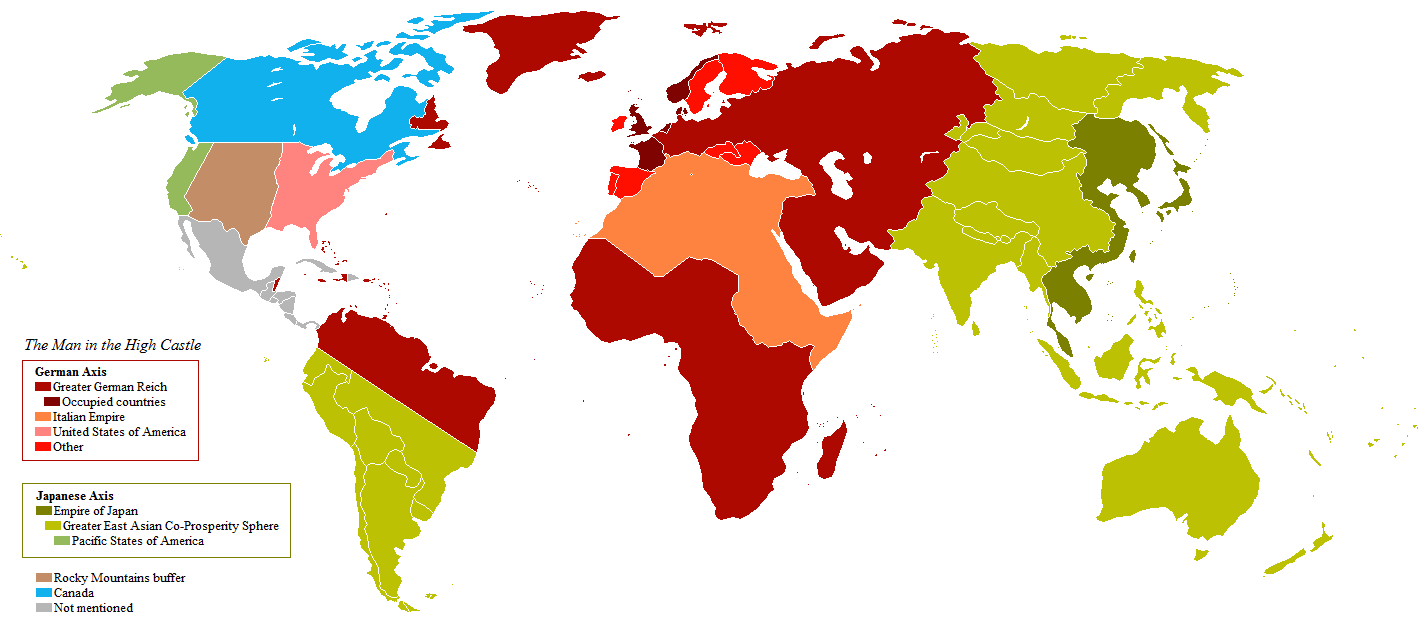
This story takes place in the US during the 1960’s where a different kind of Cold War is brewing between two superpowers. But unlike the world that WE know, in this world those superpowers are Japan and Germany. After losing the Second World War, the US was divided between these two powers, a loose federation of Midwestern states is currently unoccupied between them, and Jews, Africans and other “undesirables” have all but been exterminated. The rest of the world is similarly divided, falling into either the Greater German Reich, the Japanese Empire, the Greater East Asia Co-Prosperity Sphere, or the Italian Empire.

Man In The High Castle, Map

The reasons for this are made clear throughout. For one, the assassination attempt of FDR by Giuseppe Zangara’s in 1933 was successful. As a result, the US experienced a weak string of governments led by FDR’s VP John Nance Garner and then Republican John W. Bricker. Without FDR’s leadership, America never recovered from the Great Depression and was unable to offer military assistance to Britain and Russia or defend itself against Japan when WWII broke out. As a result, the Axis powers won and the US itself was conquered and divided by 1948.

In the world which resulted, the Mediterranean has also been drained, Africa has been sterilized through the worst manifestation of the Reich’s human experiments, and the Reich is sending people to the Moon and further into space. Technology has advanced quicker within the Reich, but at a tremendous cost in human terms, and the resulting impact on the Reich’s culture is evident everywhere. Madness and mass murder have become a permanent part of their psychology, which is part of the reason why they are planning on war again. The Japanese sphere is much more peaceful and phlegmatic by comparison, but technologically less advanced. In any coming conflict, they will be at a disadvantage and they know it!

Enter into this world a series of characters who represent the various facets of society. There’s the Japanese Trade missioner in San Francisco, Nobusuke Tagomi, Mr. Baynes, a Captain in Reich Naval Counter-Intelligence who poses as a Swedish Industrialist, Frank Frink, a secret Jew who is trying to start a jewelry business with his partner, Wyndam-Mason, an industrialist and the former boss of Frink, Robert Childan, an American antiquities dealer who sells his wares to Japanese customers who are interested in owning examples of pre-war Americana, and Juliana Frink, a Judo instructor and Frank’s ex-wife.

In the course of the story, we find that Baynes is traveling to San Francisco to meet with Tagomi, ostensibly as part of a trade mission, but really to deliver a warning. Germany is gearing up for war with Japan and plans on using nukes! Mason introduces the subject of the book known as The Grasshopper Lies Heavy, an alternate history that deals with the subject of how WWII could have been won. Frink and his partner begin manufacturing jewelry in the hopes of selling it through Childan, who does good business with antiquities but finds that innovative new things are not appealing to his Japanese customer base. And finally, we see that Juliana, after hooking up with a Reich secret agent, is traveling to middle America to find the author of Grasshopper, a man known by his signature – “Man In The High Castle”. The Reich wants this man dead, for obvious reasons.

By books end, Juliana kills the German agent once she discovers his identity and finds the man for herself. She learns that, in spite of the mystery surrounding him, he is actually a perfectly normal man who was inspired to create something groundbreaking. His inspiration for the book apparently came from the Oracle, an aspect of the I Ching which people use to ordain the future (and which plays a central role in this story). How he applies the Oracle to past events is never fully explained, but the point is clear. By book’s end Juliana realizes that they are living in the wrong reality. Germany and Japan were meant to have lost the war and the history was meant to unfold differently.

While difficult to follow at times, mainly because of the sort of stream of consciousness way PKD writes, this book was fascinating and is the perfect example of an alternate history. The plot device of the book, itself an alternate history, illustrates beautifully how history unfolded differently in this alternate universe and spares the reader from having to read through an intro that explains how it all happened. And aside from some debatable scenarios, like the draining of the Mediterranean, most of what goes on in it seems highly plausible.

Fatherland:
Another example of an alternate history in which the Axis once again won World War II, but did not conquer the New World. In addition to being a novel, it was a adapted into a TV movie starring Rutger Hauer, Miranda Richardson and Peter Vaughan. The author, Robert Harris, has done many works of historical fiction, including Enigma (also adapted into a movie), the Roman historical novel of Pompeii, and a trilogy centered on Cicero (Imperium, Lustra, and Conspirata). And though Fatherland does resemble Man in the High Castle in many respects, it is arguably more realistic and novel in its approach.

The story opens in the Greater German Reich in 1965 after a murder has taken place. Investigating this murder is Xavier March (played by Rutger Hauer in the movie), an investigator working for the Kriminalpolizei (Kripo). The victim is a high-ranking Nazi named Josef Bühler, and his death was meant to look like an accident. As he investigates further, he finds that Bühler’s death is linked to several deaths of high-ranking Nazis who lived through the war. In each case, their deaths are made to look like accidents.

At the same time, Charlotte “Charlie” Maguire, an American journalist, has come to the Reich to witness Adolf Hitler’s 75th birthday. This event is also being used by the Reich to heal the rift between the US and Germany, as there has been a state of detente between the two since Second World War. While in Germany, she is slipped a package from a stranger containing details about Bühler and begins looking into it herself. In time, March and Maguire meet up and begin exchanging information, hoping to discover the truth behind all the deaths.

In time, they come to uncover that the deaths are part of a cover-up conspiracy whereby the planners of the Holocaust are being eliminated one by one. This is being done in preparation for the meeting between Hitler and Josheph P. Kennedy (the president of the US in this story), basically to ensure that Germany’s crimes don’t get in the way of a new alliance. When the Gestapo get wind of their discovery, March is arrested and tortured, but Maquire escapes and heads for Switzerland with the proof they’ve found.

March is eventually freed with the help of the chief of Kripo, but quickly realizes his rescue was staged so he might lead them to Macquire. He instead heads for Auschwitz, which has been dismantled since the war, looking for some indication of what went on there. He soon finds bricks in the undergrowth, indicating the existence of old structures. Satisfied that it was real, he pulls out his gun and prepares for the inevitable.

The story not only does a good job of postulating what would have happened had Germany won the war (i.e. the Holocaust would have been covered up and disavowed by later generations in order to protect Germany’s reputation), but also on how this victory came to be. In addition to Reinhard Heydrich (the chief of Reich security during WWII) surviving his assassination attempt in 1942, the Germans also learned that the British had cracked their Enigma codes and changed them, thus being able to successfully cut off Britain with their U-boa ts and starve it into submission by ’44. In the East, the Germans also manage to defeat the Russians in the Caucasus in 42′, thus securing the Baku oil fields, cutting off Moscow from supply and finishing them off by 43′.

With victory in Europe complete, they then begin testing their own nuclear weapons and developing “V-3” intercontinental rockets by 46′. However, the US wins in the Pacific and drops their own nukes on Japan, ending the war there and leading to a state of Cold War between the US and Germany. Thus, in this alternate world, it is the US and Germany that are the global, nuclear superpowers rather than the US and USSR. The story also ends on a cliffhanger note, leaving the reader to wonder if war breaks out between the US and Germany and whether or not the main characters survive.

However, not all alternate histories revolve around WWII or even recent events. Some go much farther back in time, tackling pivotal events like the “discovery” of the New World, or the fall of Rome, or, in the case of Harry Turtledove, the outcome of the American Civil War. This is an especially good example of alternate history because of its apparent plausibility.

Guns of the South:
In this story, historian Harry Turtledove explores the very real possibility of what would have happened had the South won the war. It involves some South African ultra-nationalists (Afrikaner Weerstandsbeweging) traveling back in time to supply Robert E Lee’s army with AK-47’s and nitroglycerine tablets (to treat Lee’s heart condition), thus ensuring a Southern victory at Gettysburg and in the 1864 campaign. The motives for this aid are made clear in the course of the story when Lee finally questions the helpful men who’s accents and technology they find strange and intriguing.

In essence, the leader of the time travelers (known as the AWB, the anglicized version of which is “America Will Break”) tells Lee that in 2014, where they have come from, white supremacy has not endured and that in South Africa by their time, blacks have eclipsed whites as the dominant power. They feel that the only way white supremacy will survive is if the American South won the Civil War, thus ensuring that it would have a home in the US in the future. Lee accepts their help, and the Confederates eventually win the Civil War and the Union, England and France are forced to recognize the CSA.

What follows this is not only intriguing but highly plausible. Lee becomes president of the new south and abolishes slavery, in keeping with his views and the reality of the post-war situation. Not only is slavery untenable from a moral standpoint in his view, Lee knows that forcing former slaves to return to the plantations will only lead to violence and spur on black guerrillas who are now operating throughout the Confederacy. At his inauguration however, men from the AWB attempt to kill him with Uzis and end up murdering his wife, VP and several dignitaries. Lee then seizes their HQ and finds many more things from the future (like lightbulbs and books about the marginalization of racism in the future). He then successfully uses these books to convince his congressmen that slavery is obsolete and must be condemned. Abolition is thus passed in the South without incident.

The story ends with the Union, angered by British recognition and support of the South, invading Canada. Also, Lee is made aware of the fact that they are developing their own version of the AK-47 in case of future war. However, he remains convinced that the CSA will maintain its technological advantage, and will in time catch up with the North in terms of industry and be able to defend itself if worse comes to worse.

Having completed this one volume, Turtledove went on to create ELEVEN more books in the series, drawing out this alternate history thread and creating a very plausible timeline in the end. To sum it succinctly, the US enjoys mostly peaceful relations with the CSA for about fifty years, but angry over England and France’s support of the CSA, aligns itself with the new power in Europe at the end of the end of the 19th century – The German Empire! As the alliances take shape in the early 20th century, it’s Germany, Austria-Hungary and the USA versus Britain, France, Russia and the CSA. Neat huh? One can see without much effort how this will shake things up!

In the US too, politics change as the Republican Party is blamed for losing the war. It disappears and Lincoln, himself despised, ends up joining the Socialist Party, the only rival to the Democrats. With America and Germany as allies, cultural changes occur as well, such as fine mustaches becoming all the rage. This is in reference to Kaiser Wilhelm who was renowned for having a bushy soup strainer on his upper lip!

But its the wars where the real change occurs. When World War I comes around, America is immediately involved and the stalemate of trench warfare is seen running across the Mississippi river and also between Canada – part of the British empire – and the northern US. The black former slaves of the Confederacy, freed by President Robert E. Lee in the 1880s but then left to rot, rise in a Communist-backed revolt in 1915 but are ruthlessly crushed. In the end, the US army conquers Canada in 1917 with the use of tanks and breaks through the Confederate lines in Kentucky and Virginia. Russia is similarly brought out of the war by a revolution in this timeline, but not a Communist one. The US navy then turns its attention to Britain and puts up a blockage with starves it into submission. The USA and Germany have won the war.

Also similar to real history, the victorious powers impose harsh peace terms on the losers, complete with territorial losses, “war guilt” clauses, reparations, and disarmament. Politics thus become radicalised in the defeated powers – Britain, France and the Confederacy – and fascist parties gain control in all of them. The Second World War then arrives on schedule after a demagogue who is voted in in the CSA who resembles Hitler, though his hatred is aimed not at Jews but at blacks. The war opens with a Confederate blitzkrieg into Ohio that almost cuts the US in half, but in time, the weight of numbers begins to swing the balance the other way. Much like in the real WWII, the death camps run by the Freedom Party to exterminate the South’s blacks continue to run full blast, even as their armies are in full retreat.

Both sides are also racing for nuclear weapons, and some are used in the end – but Germany and the USA have more of them than Britain and the CSA, so the victors in the First World War win once again. And this time, the Confederacy is fully occupied and formally abolished. The United States is reunited after generations of disunity, but a genuine reunification will not come for many generations, if at all.

Thus, while some small changes in historical events led to some rather cataclysmic changes in Turtledove’s story, things pretty much meet up with real history in the end and come to resemble the world as we know it today. Russia is not Communist, and the Cold War of the post-WWII era is markedly different, but the general outlines are the same. So in a way, his story is just like PKD’s and Harris’ in that things diverge in the beginning but come back to what we, the readers, interpret as the normal course of history in the end. Hmmm, one might construe that their is a point in all this, a lesson if you will. And in that, they’d be right!

The Lesson of Alternate History(?):
This humble narrator would suggest that if there is a lesson to be learned from Alternate Histories, it is that the force of history is a powerful, weighty thing and that while small changes can have a big impact, the general pattern reasserts itself before too long. At least, that is what the authors in question appear to be saying. In PKD’s Castle, the story ends with the character of Juliana Frink realizing that Germany and Japan lost the war and that the author of the alternate history book wrote it for just that reason. Fatherland ends with every indication that the Holocaust will be revealed and that the US and Germany will remain enemies. And Turtledove’s Guns of the South, though it takes about half a billion words to get there, ends with WWI and II playing out pretty much the same as they did in real life.

But as I’m sure someone wise might have said (might have just been me!), books tell us far more about the author than the subject. It could be that history is a chaotic arbitrary process and the idea that it will meet up with us or overcome obstacles that are artificially put in place is an illusion. For all we know, causation and inevitability are things we impose based on a false consciousness, that we believe we are where we are meant to be because we have to. That idea is often explored in alternate history as well, where the characters believe that their own timelines are the “right” one and that if tampering took place, it was for ill. However, the stories always seem to end with things going back to the way they were meant to be. Everyone’s happy, or at least, a sense of balance is restored.

Either way, it tells us much about ourselves, doesn’t it? We are creatures who like to tamper with things, who like to ask “what if” and experiment with the natural order. But in the end, we also depend on that order and want to know that it will unfold as its meant to. Whether its an illusion or its real, its one of the many things without which, we would be lost!

Sidenote: Shameless plug, but it so happens I wrote some articles on the subjects of the multiverse and alternate universes. They are available at Universe Today.com, here are the links:

Multiverse Theory
Altnernate Universe

Legends of Dune Prequels

Last time around, I made a big deal about prequels and why they aren’t so good. And of course, the Dune prequels were featured pretty prominently in that post. However, what I came to realize shortly after writing it was that I’ve never dedicated a post to the prequel work of Brian Herbert and Kevin J Anderson and explained what it was that was so disappointing about them. Nowhere was this more apparent for me than with their Legends of Dune series, the hackish trilogy that was supposed to detail the seminal background event known as the Butlerian Jihad.

Sure, they’ve come up here and there in my rants, always in the context of how they effectively raped Frank Herbert’s legacy. But today I feel like zeroing in, applying the rules I devised for why these prequels fall short, and mentioning a few other things that bothered me to no end about them. So, without further ado, here’s the The Butlerian Jihad, the first book in the Legends of Dune series and one of several unoriginal Dune-raping series they created and why it sucked!

Dune, The Bulterian Jihad:
In my previous post, I outlined four basic reasons for why prequels can and often do suck. As I said, they are by no means scientific or the result of expertise, just my own observations. However, when it comes to the Dune books of Brian Herbert and KJA, they certainly do apply. Hell, it was the act of wading through their books that I was able to come up with these rules in the first place. They were: 1. No Surprises, 2. Sense of Duty, 3. Less is More and 4. Denying the Audience the use of their Imagination.

These things ran like a vein throughout the works of Brian and KJA, but were by no means the only problem with their books. In addition, there were also the problems of cardboard cut-out characters, heavily contrived plot twists, cliches, and an undeniable feeling of exploitation. Add to that some truly bad writing and the fact that the story felt like a complete misrepresentation of Herbert’s ideas and you can begin to see why Dune fans found these books so offensive. As one of them, I’m happy to ran about this whenever and wherever possible. So here goes!

1. Bad Characters
In the Preludes to Dune series, this problem was not so pronounced, nor was it a huge problem in the Dune sequels (Hunters of Dune and Sandworms of Dune). But in the Legends of Dune series, it was palatable! The characters were so one-dimensional, so predictable and so exaggerated that they became downright annoying to read. And of course, their dialogue was so wooden I thought I was sitting through that horrible “love scene” from Attack of the Clones. This was a clear indication that where the elder Herbert’s own characters and notes were not available, the two authors had to rely on their own instincts and took the cheap route.

Examples! Legends of Dune revolves around the characters of Serena Butler, Vorian Atreides, and Xavier Harkonnen on the side of good, Erasmus, Omnius and Agamemnon on the side of evil, and Iblis Ginjo, Tio Holtzmann and a host of others somewhere in the middle. And in each case, they are horribly over-the-top, too good, or too evil to stand. In addition, bad dialogue and writing counts for a lot. Even the characters who are not robots speak as if they are, their traits and attributes are openly announced, and nothing beyond their topical persona’s are ever revealed.

On the one hand, Serena Butler is a crusader for the abolitionist cause and a tireless leader for free humanity. After dedicating herself to ridding the free worlds of slavery, she then selflessly volunteers to lead a mission to liberate Geidi Prime (later home of House Harkonnen) when its clear her people think its a suicide mission. Afterwards, she becomes a willing figurehead in the holy war against the machines and puts aside the love of two men in order to be an effective leader. You might think this is just her public persona, but that’s all she’s got going on. Seriously, she has no other character traits beyond being the perfect heroine!

As if she wasn’t bad enough, you also get Xavier Harkonnen, a warrior who believes in endless self-sacrifice just like her, the perfect hero to her heroine. The entire series is filled with his rallying of troops, leading them into the fray, and coming to the rescue. All the while, he naturally struggles with his love for Serena, which is repeatedly frustrated due to the needs of the war. Vorian, on the other hand, is meant to be the Han Solo type, the bad boy who stands in contrast to Xavier’s good boy. But in this too, he is horribly predictable. Whereas Xavier is the honor and nobility hero, he is the daring and risky dude who also becomes a real ladies man. And of course, he loves Serena too, creating a predictable love triangle that somehow doesn’t manage to create a shred of conflict or complication.

Okay, now for the bad guys! Well… let’s start with the absurdly named Omnius, the machine hive-mind that runs things. He has little character to speak of, being a machine, but nevertheless fits the ideal of the evil, calculating AI perfectly. Naturally, he doesn’t understand humans, but hates them enough to want to kill them in droves. And of course he would like nothing better than to bring the whole universe under his “Synchronized” control (aka. he wants to conquer the universe). Clearly, KJA and Brian thought they were doing something clever here, using an unfeeling machine to explore the human condition. But really, the character and material felt like it was ripped right from reruns of Star Trek!

Erasmus, his only free-thinking AI companion, is similarly one-dimensional and stereotypical. He conducts “experiments” to better understand humanity, because of course he doesn’t understand them either. But the really weak character trait comes through with just how evil he is! In just about all cases, his experiments amount to senseless murder, flaying people, using their organs to make art, and studying their reactions with interest when he arbitrarily decides to kill someone. Oh, and did I mention he also murders Serena’ baby (and gives her a hysterectomy) once he becomes jealous of how much time she was spending with him? Seriously, Evil the Cat is not a good archetype to model your characters on!

Agamemnon and his Titans are also very evil, but in their case, a machine-like mentality can hardly be blamed. In addition to murdering billions of people in their drive for power, they hate free humanity, consider them vermin, and will stop at nothing to obliterate them. Naturally, they hate their machine masters too, but not nearly as much as their non-Cymeck brethren. Why, you might ask. Well, beyond saying that they were appalled by humanity’s decadence and reliance on machines, no reason is given. And it seems like a pretty weak reason to reprogram said machines to take over the universe and enslave everybody.

Really, if they were appalled by dependency on machinery, why not simply shut the machines down? Furthermore, if they were so bothered by how dependent people had come to be, what’s with all the machine enhancements they got going on? Each and every “Cymeck” in this story has cheated death by putting their brains inside of massive cybernetic housings. That sound like the actions of someone who doesn’t like machine dependency? Really, the only reason to do what they did (i.e. murder billions and try to take over the universe) would be because they were total sociopaths or megalomaniacs – i.e. really, REALLY evil! But don’t expect any logic from this story, mainly we are to accept that they are evil and move on.

And finally, Holtzman, who is supposed to be the brilliant inventor who created the Holtzman drive (the FTL drive that powers Guild Highliners), is a petty, greedy man who stole his inventions from his assistant, Norma Cenva. She, naturally, was a brilliant but naive girl who was always smarter than him, but continually got the short end of the stick. Iblis Ginjo is a slave leader who masterminds the rebellion on Earth, and becomes the sleazy defacto leader of the Jihad through wheeling and dealing that makes the reader feel enmity towards him.

Whoo! That was long, but I believe my point is clear. Basically, the characters were so simple and their purpose so obvious that it genuinely felt like the authors were trying to force an emotional reaction. The only thing worse was when they were trying to make us think, which were similarly so obvious that it just felt insulting! More on that later…

2. Contrived Plot:
The examples are too numerous to count, but I shall try to stick to the big ones and ignore the rest. First, in the preamble to the story, we are told that the Titans (the evil Cymeck people) took over the known universe by reprogramming all the thinking machines so they’d be able to control them. Okay, that seems a bit unlikely, but whatever. A dozen hackers managed to take over trillions of peoples lives by reprogramming the machines they were dependent on, whatever. But the real weakness was in the motivation. Why did they do this? Because they were upset with how dependent humanity had come to be on them. Meh, I’ve already said how this was stupid so I shant go into it any further.

But another weakness which comes to mind is this: if these “Titans” were so good with programming machines, how is that they let the big brainy AI (aka. Omnius) turn the tables on them? Didn’t they think it would be wise to program it with some safeguards, kind of like Azimov’s Three Laws? Not rocket science, you just make sure you tell the machines they can’t turn on their handlers. Simple! God, two crappy points and its still just the preamble! Moving on…

Next, the main character of Vorian Atreides breaks from his father and the Cymecks in the course of the book, which was a big turning point in the plot. But the reasons are just so… flaccid! After being a loyal and doting son for many decades, he decides to betray his father and his heritage in order to aid free humanity. Why? Because of one conversation with Serena Butler in which she suggests that he check out what his father’s done in his lifetime. Vorian explains that he’s read Agamemnon’s memoirs several times, but Serena recommends he check out Omnius’ own records, the ones which are not subject to distortion and personal bias. So he does, sees the undistorted truth, experiences a crisis for about five seconds, and then makes the decision to defect. Yes, this life-shattering experience, finding out his father is a mass murderer, is not followed by any denial, anger, or shooting of the messenger. He just accepts what he sees and turns his back on everything he’s believed in up until this point because of one conversation. Weak…

Also, the slave rebellion on Earth, the thing that touches off the whole Jihad, had some rather dubious inspiration. For starters, the humans knew of no organized resistance until Erasmus decided to make a bet with Omnius. He believed that humans could be inspired to revolt against their miserable lives if they were just given a glimmer of hope. So he began circulating letters claiming to be from “the resistance” to key people. When Iblis Ginjo got one, he decides to join and starts stockpiling weapons. Oh, and he manages to do this without the machines noticing. So, when the revolt begins, they have his weapons to fight with.

Where to start? For starters, are we really to believe that a coldly rational, superior AI would risk an open rebellion simply because of a BET? How stupid are they? Also, how was Ginjo able to acquire all these weapons without them ever noticing? Erasmus knew who he sent the letters to, did he not think it would be wise to monitor what they did afterwards? Sure, they claim that Ginjo explained his curious imports by saying that he had to requisition added materials to meet his construction quotas and managed to hide the weapons amongst them. Again I’d have to ask, how stupid are these machine masters of theirs?

Ah, but there’s more. Iblis gets further inspiration when he consults a Cogitor (see below) and asks it if a human resistance really exists. It replies that “anything is possible.” Of course, that’s how it answered all his questions, in keeping with the idea that Cogitors are somehow vague, ethereal beings. And yet, Ginjo gets the feeling that this answer was somehow loaded with subtext and implication. Yes, that’s how this part of the story was written. He gets a totally vague answer and assumes it means something truly meaningful, and thats all the inspiration he needs to start running guns and risking his life!

The rebellion is then fully incited when Erasmus – as mentioned earlier – kills Serena’s baby out of jealousy. This is especially hard to believe, and KJA and Brian even tacitly admitted as much in book two. Throughout the book, we are told that Earth is a slave planet where unspeakable horrors take place and the people are too miserable and beaten down to do anything about it. And yet, the death of one child causes billions of people to rise up and risk total obliteration. And they are able to do it because one slave master, motivated by a phony message – which was itself the result of a wager – was able to smuggle tons of weapons past the robot masters. Somehow, this just doesn’t seem like a likely explanation for a game-changing, cataclysmic event!

Finally, the climax of the story comes when the good guys decide that the best way to strike at Omnius is to nuke Earth. Yes, they’ve been debating for generations how to beat the machines… and apparently this is what they’ve come up with. “Really?” I wanted to say. This is how humanity triumphed over the evil machine menace, go nuclear? No startling new technology, no brilliant new strategy? If that’s all it would take, why didn’t they do it before? Well, according to the book, its because the idea seemed immoral to them. One dissenting character even asks, “Are you suggesting we become as bad as Omnius?” “No,” replies Xavier. “I’m suggesting we become WORSE than Omnius!” Wow. That… was… AWFUL!

Oh, it also at this point that they explain the origins of the name Butlerian “jihad”. On the Senate floor, once they have decided to nuke Earth, they openly say that in order to be effective, this must be more than a war. It must be a HOLY WAR. And that’s how the Butlerian Jihad got started! It was NOT the result of long term developments, changes, and forced adaptations. It was a decision made suddenly and deliberately. They just said in the thick of the moment, “Hey, lets call this a jihad! That sounds cool! Okay, jihad it is!” Not to nitpick, but as a historian I can tell you, this shit don’t happen! People don’t suddenly look around and say, “Hey, its the Enlightenment! Hey, its the Renaissance! Hey, its World War One!” These names are applied posthumously, usually by historians who are looking for labels to describe general phenomena.

I know, who the hell cares right? Point is, this more than anything is a clear demonstration of how contrived these stories are. Its as if the authors set out not to tell a story but to explain how everything happened and felt horribly compelled to do so. Remember point #2 of why prequels suck, aka. Sense of Duty? This is what inspired it, people!

3. Cliches:
What I especially loved about this book (dripping sarcasm implied) was the evil cyborg robots, named Cymecks. There’s an especially Herbertian plot device, a pulp sci-fi concept with a name that combines Cyborg and Mechanized (in case it wasn’t obvious enough already!) Even more fun was the Cogitors (play on the word Cognition), the disembodied brains of acetic thinkers who decided to achieve some measure of immortality by placing their brains in talks so they could live out their days just thinking. Hmmm, evil cyborgs and disembodied brains, where have I heard about these before? Every crappy bit of pulp sci-fi there is, that’s where!

Ah yes, and Serena Butler, the Virgin Mary meet Joan of Arc. As I said, she’s a war leader on the one hand and a holy icon on the other. This might have been a good angle, how she must maintain the illusion of purity (hence, no lovers), but it was squandered by the fact that in the story, she really IS a pure character! Selfless, dedicated and infinitely compassionate, she leads humanity and dies for them without a though for herself. Gag! As for the men who love her – Xavier and Vorian – they are perfect cliches as well. The one is the stalwart, perfect hero who never shies away from self-sacrifice, the other a Han Solo rip-off who’s bad boy charm barely conceals the fact that he too is excessively noble.

Then there’s the slavish robots! We are told well in advance that the whole Jihad was between free humans and thinking machines. And yet, aside from Erasmus, not a single robot thinks for themselves. They are all slaved to Omnius, the big, evil hive mind with a name that seems stolen out of the pages of a sci-fi comic or an episode of Buck Rogers. And if his name is not enough, the concept of a hive-mind who hates mankind and wants to conquer the universe is a similarly bland, overdone cliche that no respectable sci-fi author would touch with a hundred foot pole!

Which brings me to one group of characters I haven’t even mentioned yet – the Sorceresses of Rossak! These women, who boast the ability to conduct electricity, levitate, and have various other “magic” powers, are supposed to be the precursors of the Bene Gesserit. Wow… Okay, first of all, this is a perfect example of shit sci-fi; the kind of stuff you’d expect from Star Wars or an X-Men movie, but not DUNE! Second, last I checked, the Bene Gesserit were never able to shoot electricity from their fingertips or magically levitate! All their powers had to do with mental abilities like prescience and truthsense, which came from the spice. So really, where did these women get all these freakish abilities? In the course of reading this, I seriously expected someone to say “Feel the Force!” Of course, none of this is explained and no attempts are made to ground these characters in any sense of realism. It’s just another bad cliche in a book chock full of them!

Brian and KJA admitted that to create the Legends series, they had to rely on their own imaginations because Frank had not left detailed notes. However, it did not seem like they were relying on their own imaginations nearly as much as a conglomeration of bad ideas taken from B movies, TV shows and comics. Seriously, all these ideas have been done to death! This is not in keeping with Herbert at all, who not only created something original but highly plausible.

4. Exploitation:
All throughout this book and the others in the series, one can’t help but feel that the authors are deliberately and shamelessly exploiting Herbert’s legacy. Its no secret that Frank was a hugely influential author who left behind an enduring legacy and millions of fans. Each and every one of them was eager to see how the Dune saga wrapped up, and couldn’t help but wonder what the events in the story’s deep background were all about. It’s little wonder then why these two paired up and decided to pick up the mantle.

On the surface, that might have seemed like a noble and brave thing to do. However, the calculated way in which they went about it clearly demonstrated there were ulterior motives at work. To begin, they didn’t tackle the Dune 7 project first, the one that they claimed Herbert had left “copious notes” for. Instead, they returned us to the universe and the characters we were already familiar with with some teaser prequels. They then moved on to the earlier prequels, books that did not wrap up the series but covered the deep background instead. Here again, it seemed like we were being toyed with! Only then, after all those prequels, did they finally decided to tackle the conclusion, and they even managed to draw THAT one out by putting it into two volumes instead of one. As if all that wasn’t enough, there’s those terrible interquels that have “cash-in again” written all over them. I tell ya, it never ends!

In short, it was obvious what they were doing. Getting audiences hooked with some quick and easy books that took place right before events in the main novel, then pulling them in deeper with some stories that went further back, and only then doing what they promised which was finishing the damn saga off! And when that finally came, it was a horribly transparent ending that had nothing in common with Herbert’s work but tied shamelessly back to their own so-called contributions. As much as I disliked these books, I couldn’t help but feel sorry for these men, especially Brian. He above all set out to take on his father’s legacy, but somewhere along the line he took a wrong turn and ended up in cash-in junction where legions of his fathers loyal fans were waiting and demanding their money back!

5. Prequel Complex:
To finish, I’d like to refer back to rule one in why prequels suck. In short, these books really didn’t contain anything new. Just about every reference to places was meant to refer back to something in the original story, every characters was meant to tie to someone in the original text, and every development was meant to forecast how the universe we were familiar with came to be. It all felt forced, contrived, and quite unnatural. For one, things don’t get created all in one lifetime, as all the inventions and schools which exist in the original Dune universe were in this series.

Literally everything, from the Mentats, Guild, Foldspace technology, spice harvesting, the Fremen, the Ginaz swordmasters, the Tleilaxu, the Bene Gesserit, etc, were created within the pages of this series and then went on to exist (virtually unchanged) for ten thousand years! All I wanted to say in the course of reading this was, “that’s not how things happen!” Things are not created in one instant and then endure for ten thousand years, they develop gradually and change over time. Forecasting how things came to be is one thing, but completely explaining them just deepens the sense of duty and contrivance from which prequels suffer. Again, rule two man! RULE TWO!

6. Wrongness of the Whole Thing!:
Added to this was the undeniable feeling that they got it all wrong. In Herbert’s original stories, references to the Butlerian Jihad were few and far between. But when it did come up, Herbert clearly indicated that the rebellion was driven by people who’s lives were becoming dominated by machines and a machine mentality. By that, one gets the impression that the jihad was not a war in the literal sense but a moral crusade to rid the universe of something that was increasingly seen as immoral. In accordance, the “enslavement” of humanity seemed metaphorical, that it was really just a sense of dependency that the jihadis were fighting.

At no point was it even hinted at that the jihad was a war between evil machines and free humans, or that humans won it by nuking every thinking machine out of existence. But that was clearly Brian and KJA’s interpretation – that the “enslavement” of humans by machines was meant literally and the war was some super-righteous titanic struggle. Clearly, subtlety means nothing to these two, either that or they just didn’t see the cash value in telling a story that boasted a little irony and nuance. Instead, they opted for a cliched story of good vs. evil with a rah rah ending that would make even Michael Bay’s eyes roll.

Such an ending did not seem at all in keeping with Herbert’s legacy, that of realistic and hard sci-fi. It was much more in keeping with the work of KJA, a man who is famous for writing fan-fiction and pulp sci-fi, a man whose won only one award for his writing and it was for kid lit (A Golden Duck!). So really, putting the name Dune on this book was more of a legality or formality than anything else. In the end, its not a Herbert tale, its a KJA tale with the name Herbert attached. And as I’ve said many times before in reference to Dune, raping the legacy of a great and venerated man for the sake of your own fame or financial gain isn’t cool!

Okay, think I definitely said enough about that book. I mean, how many ways can you possibly say a story is crap? I found six but I can still think of material that’s just looking for a proper category to plug it into. Suffice it to say, the story was bad and I strongly recommend that fans of Herbert stay away from it at all costs. Those who haven’t need to be warned, and those who have already, let me just say that I feel your pain! And speaking of pain, I shall be back with volume two in this terrible saga, The Machine Crusade. Wish me luck…

Of Prequels And Why They Suck…

Of Prequels And Why They Suck…

Looking back, I’ve noticed a sort of thread running through some of the posts I’ve made. And in truth, this thing was quite influential when it came to what inspired me to write science fiction in the first place. It began with the infamous Star Wars prequels, the movies which ruined what used to be a very influential and nostalgic franchise. It was then reinforced by the odious Dune prequels, which tarnished the legacy that inspired me to write science fiction in the first place. Since then, I’ve noticed these same elements at work in any prequel I’ve chanced upon and the lessons only seem to get more concrete.

While I’m no expert on the fine art of writing, be it science fiction or anything other genre, by the time I started doing it I was pretty clear on what I wanted to create. Basically, I wanted to write something I would enjoy, something that emulated the greats I had come to know and admire. But when it came to what I DIDN’T want to do, I found prequels summed up a lot of it succinctly (especially the aforementioned examples). I’m sure I mentioned as much in previous posts, but today, I thought I might speak to these things specifically; outline why prequels can – and often do – suck!

1. No Surprises:
Whether it was the Star Wars prequels, X Men Origins: Wolverine, the Legends of Dune series, or anything else prequel-oriented, there was one undeniable problem they all had in common: we already knew what was going to happen. By stories end, we know that the characters are going to become whatever it is they were in the original story, and we know who’s going to live and who’s going to die. In some cases, we even know how, so there really are no surprises. The only real purpose of a prequel is to fill in the background, explain HOW things happened and how the characters and story we are familiar with came to be.

For example, in Star Wars, we know that Anakin becomes Darth Vader, that Palpatine is the villain and will take over the Republic, and that Amidala will give birth to Luke and Leia before dying. There are a host of other details which the more nerdy among us were familiar with as well, and we were all drawn to theaters back in 1999 hoping to see how they played out. But in the end, when all was said and done, I don’t think any of us came away satisfied. Seeing how things happened when you already know what will happen just seems to make for a disappointing experience.

2. Sense of Duty:
Another thing that brings down a prequel is the fact that things MUST be explained. In short, the writer, director, author, etc. has a list of things which need to be covered before the end. These things have to fall within an established framework – i.e. what has already been established by the original story – and cannot contradict or be inconsistent with them. So really, in addition to having a story where there really are no surprises, you also get a story where things have to proceed in an established fashion and often seem heavily contrived. The end result is not what would feel natural based on the story so far but based on what needs to happen for the sake of the original story.

X-Men Origins will suffice as an example here. In this movie, the story had to show where Wolverine came from, how he and his brother (Sabretooth) had their falling out, and how his memory got erased. The result was actually pretty weak, in my opinion. Basically, Colonel Striker shot him in the head with Adamantium bullets, which he knew wouldn’t kill him but would erase his memory. Now, how did he know ahead of time that that would be the effect it would have? Second, why do that instead of lobbing a rocket-propelled grenade at him? Simple, because the story required it. Wolverine is supposed to be an amnesiac in the first movie, so this movie had to show how.

And while were on the subject, why didn’t Wolverine’s girlfriend kill Striker at the end when she had the chance? The woman had suggestive powers and had the man in her grasp, so why not tell him to march off a cliff? Again, because the story demanded it. Striker needed to live to see movie two, so instead she said some fluff about how she’d be no better than him and just told him to take a walk until his feet bled and he fell from exhaustion. I can’t speak for everyone, but personally, I was disappointed.

3. Less Is More
A lot of people insist that when it comes to back stories and background, the less we know, the better. After all, wasn’t Darth Vader scarier before we knew that he was once portrayed by Hayden Christensen? Wasn’t he a lot more menacing before he cried over the loss of Padme? I know for a fact that I’m not alone when I say that the whole “NOOOOOOO!” scene at the end of Revenge of the Sith brought him down in my eyes. What was once a titanic force of badassery was transformed into a whiney, bitchy child through the simple act of fashioning an origins story.

To use a non-prequel example, consider the Batman franchise. In the Tim Burton version, we got to see the Joker’s origin story, but in the Christopher Nolan version, we got nothing. And frankly, wasn’t Ledger’s updated take on the Joker much more scary than Nicholson’s because of it? Sure, his dialogue and acting were spot on at capturing the insanity and terror of the laughing psychotic killer, but wasn’t part of that assured by the fact that we had NO IDEA who he was or where he came from? The origins stories that he told – “wanna know how I got these scars?” – and how they kept changing was part of what made him so effective. As the audience, we wanted to know, how DID he get those scars? Why IS he so crazy? But by denying us this, I think we were kept wanting and we respected the movie more for it.

The same is true of Batman himself. In Burton’s, we got an exact reversal of what happened with the Joker. Aside from the fact that his parents were murdered, apparently by a young Jack Napier (who would go on to become the Joker), we knew nothing about him. Where he got his skills from, his equipment, and how he got started. This served to make him a much more mysterious character which in turn made him more interesting. In Burton’s Batman, he was the focal point whereas the Joker was his nemesis. But in Nolan’s updated version of The Dark Knight, the Joker was undoubtedly the focus while Batman was just the hero trying to stop him. I’d say what he knew – or in this case, didn’t know – about them was central to that.

4. The Audience’s Imagination Is The Writer’s Greatest Weapon:
I believe it was the famous photographer Duane Michals who said “I believe in the imagination. What I cannot see is infinitely more important than what I can see.” Okay, I Googled that, sue me! But the man had a point, and it applies doubly to movies since they too are a visual medium. What the readers and/or an audience can imagine based on snippets of a story is infinitely more powerful than what they can be shown with a few hundred pages of text or a two hour movie. This is why less is more. By giving the audience less to work with, they have more freedom to imagine and create. If you tell them what happened, detail for detail, then they have nothing except for what you’ve given them.

This, I think, is precisely why prequels are so often a disappointment, at least in my estimation. I’ve always considered myself to be an imaginative person. Given a blank canvas, or one with just a few details, I can create just about anything. And I’m hardly alone in that fact. Imagination is something everyone has – to varying degrees, sure – but it’s part of what makes us human and gives our lives meaning. Being able to express our inner life makes us happy, and there are few things more hurtful and insulting than having someone mock or dismiss that creativity. It’s also one of the cornerstones of a free society, the freedom to create and not be persecuted for it.

So it’s little wonder then why people are drawn to movies where books they’ve read are being adapted to film, or to prequels, where things that have been previously alluded to are acted out. People go to see them because they want to know if it will bear any resemblance to what they themselves imagined. Or, they go because they just want to see what the director’s own vision was. Either way, when you get around to seeing it for yourself, is it not a letdown no matter what? Isn’t that the real reason why people who’ve read the book constantly insist that the movie isn’t as good? That certainly seemed to be the consensus amongst LOTR geeks. And I should know; by The Two Towers, I was one of them! And isn’t that the real reason why the Star Wars prequels sucked as much as they did? We, the fans and audiences are active participants and create out of what we are given. Being told point blank what happened removes half the fun of it!

Some Tips For Writing:
Well, that’s all I got for now. Except to say that if someone is hoping to do a prequel, there are certain tips that I’ve come up with that can help. These are by no means established rules, just the result of my own amateur experience and observations. For one, a writer should take care not to give too much away when writing background. As always, less is more. It’s enough to let the background stay in the background and focus on the story. The more the reader/audience has to work with, the better. That way, when you are writing out the back story, you have much more freedom to work with, and don’t have to worry about staying within boundaries.

Second, a good idea is to write things out ahead of time. When I was thinking up Legacies, I began by writing out an outline for the entire background of the story. I didn’t do this because I was one day planning on writing a whole franchise worth of books, prequels included, but because I just wanted the story to be tight and know where everything fit. But because of that, I was able to pen several short stories that took place before the first novel. Rarely were the main characters and plot lines from that novel the focus of these stories, but they did serve as a solid backdrop which helped to advance things.

But don’t take my word on that, consider Lucas himself. He thought up the entire plot for Star Wars trilogy before making the first movie in the franchise, thus he knew exactly what he wanted to do ahead of time. Sure, he made changes and was forced to adapt along the way, but the end result benefited from this foresight. However, when it came to the prequels, he had only the bare bones to work with, and began writing each movie independently of shooting it. And it certainly showed, didn’t it? Rather than feeling like an ongoing story, each movie was a self-contained tale that was full of duty and contrivances. Nuff said? Plan ahead!

Last, but not least, remember that a story, ANY story, needs to tell its own tale. It cannot be written for the sake of filling in another. Its a bit of a vague point, I know, but a writer’s mentality is important when it comes to the creative process. At no point can you be thinking, “this needs to be explained, that needs to be explained”. It needs to be, “this is a story that needs to be told”. Every character has an interesting back story, and stories are living, organic things. They change over time, grow, and eventually die. Showing how they got to where they were going needs to be interesting and told with sincerity. So forget the duty, focus on the events and what made them interesting. If in the end its not a story that you yourself would enjoy, then don’t tell it! Simple as that…

28 Days Later…

Hello all! In honor of Halloween, I thought I’d jump ahead on my review list again and cover a zombie flick! And not just any zombie flick, a good, scary and even poignant thriller known as 28 Days Later! Not only is this movie a cult favorite, its also a films that got in on the ground floor of this new zombie craze.

Yes, for some reason, zombie movies have been pretty popular in the new millennium. Maybe it’s a retro thing, but it seems that within the last ten years, there have been a plethora of writers/directors who have breathed new life into this old movie genre. After 28 Days was released in 2002, it was followed by the Resident Evil movie, House of the Dead in 2003 (another video game adaptation), the remake of Dawn of the Dead (2004), Shaun of the Dead, Doom (2005), Slither (2006), The Zombie Diaries, I Am Omega (2007), I Am Legend, Day of the Dead (2008, another remake), followed by Quarantine, Zombieland in 2009, and the list goes on. In fact, I’m not even taking the time to mention all the sequels and lesser known titles that came between these ones!

The point is, whereas in previous decades, people could expect a low-budget zombie movie at least once a year, since 2000, there have been multiple entries every year, sometimes as many as a dozen! And with this explosion in titles, there’s been some variety to how zombies were presented as well. Whereas in the old zombie classics, zombies were slow witted and slow moving – literally the walking dead – in new movies and re-imaginings, zombies were fast moving and sometimes highly intelligent. In fact, there’s even a neat table over at Yahoo movies that places zombie films within the context of these two criteria:

How Dangerous Is A Zombie?

If one were to use that table to discuss this movie, the zombies would be placed on the high end of both speed and intelligence, making them VERY dangerous. And, as I will mention soon enough, their take on the creatures was also quite realistic, at least when compared to other franchises. Okay, get comfortable and be ready to get scared, its horror movie time!

(Background—>):
Compared to most horror films, 28 Days had a relatively fair budget of about 5 million pounds or 7 million US$ (based on the 2002 rate of exchange). It’s overall gross, however, was over 82.7 million dollars, and it even spawned a graphic novel and a sequel (haven’t seen or read them yet, but working on it ;)). In addition, the movie was the result of collaboration between writer Alex Garland and esteemed British director Daniel Boyle, whose film credits include Shallow Grave, Trainspotting, Sunshine,Slumdog Millionaire and The Beach (which Garland also wrote).

The film was also well received by audiences and critics, earning itself several awards for direction, cinematography and acting in both Europe and the US in the process. It was even placed on two top 100 and one top 20 list as one of the best horror movies of all time. In addition to its direction and acting, critics praised it for its story, allegory and humanistic elements. In short, the movie went in with a modest budget and limited fanfare, but came out a cult hit and a commercial success. Little wonder why its seen as one of the best movies of the genre, people love underdogs as much as they do hidden gems!

(Content—>):
28 Days Later essentially begins with an act of activism, where some well-meaning animal rights people storm into an animal testing facility and try to free some chimpanzees who are undergoing weird tests. In the course of the break-in, one of the doctors tries to stop them, saying that the chimps are infected with “rage”. This opening kind of seemed hokey to me at first, but afterward I came to see how effective it was. We get a brief prologue that tells us how things began, but which doesn’t weight us down with long-winded or unlikely explanations.

This is always a challenge in zombie movies, explaining how and why the dead are up and walking. In this case, they chose to go with a virus that was like super-rabies, making the infected extremely violent and spreading through the exchange of bodily fluids. Kind of brilliant if you think about it, explains all the zombie-like behavior while still being somewhat plausible. Of course, they are basically saying that animal rights activists will be responsible for the apocalypse, but who cares? It’s fiction!

We then cut to a hospital where the main character – a bike courier named Jim (Cillian Murphy*) – wakes up from a coma and realizes he’s all alone (for some reason, we get a full-frontal shot of his junk here too!) He then gets up and begins to look for answers and food, finding only abandoned buildings and empty streets. After making his way out into central London, he quickly realizes something terrible must have happened. All the missing signs and news pinups about the “End of Days” seem to attest to that. Naturally, he travels to a church where he finds pews filled with corpses, and one survivor, who for some reason seems to want to bite him…

*People may remember Murphy as The Scare Crow in Batman Begins and The Dark Knight.

But of course, he is narrowly saved by two healthy people – a woman named Selena (Naomi Harris) and her friend – who explain to him what’s been going on. Here too, the exposition was kept mercifully brief, the two basically telling him that a virus has devastated the country and that its spread through blood, bites, etc. He agrees to team up with them, but only if they can swing by his house, as he needs to know if his parents are still alive. Naturally, they are not, and infected people soon attack them. Selena’s friend is bitten in the process, and she is forced to kill him. Jim is upset by this, but Selena explains that this is how it is now. Needless sentiment lead to hesitation, which in turn leads to death. Now Selena and Jim are alone to wander the streets looking for other survivors.

Their search brings them to an apartment building where a father and daughter are holed up, and using Christmas lights to attract other survivors. A desperate chase follows as they are forced to run up the stairs as the infected chase them. But eventually they get to the landing where the father, Frank (Brendon Gleeson), is waiting for them in full riot gear! After beating down the infected, he lets them in and they meet his daughter, Hanna (Megan Burns), and begin swapping plans. It seems Frank has a radio and from their high elevation, they’ve been able to picking up a military radio transmission coming from Manchester that tells of a cure, food and shelter. The four of them make plans to go there straightaway.

Getting there is an adventure to be sure, the four having to flee from infected as they get out of the city and there being a few pacing scenes along the way. But eventually, they arrive to find the town of Manchester on fire, and that the transmission is coming from a military base nearby. However, the base appears to be deserted, the only inhabitants being infected crows and bodies. What follows is a heart wrenching scene where Frank gets a drop of blood in his eye and begins to change. He has just enough time to tell his daughter that he loves her before they realize he’s been infected and he goes bat-shit crazy! That’s when the army men reveal themselves and open fire on Frank!

They are then taken to the base’s main compound where the CO, Major Henry West (Christopher Eccleston), welcomes them. Jim and Selena are cautiously optimistic now that they have some protection and a roof over their head, but Hannah is understandably bitter. Her father is dead, after all, and these men were responsible. In the course of the next few days, the Major shows Jim their set up and explains what they’re doing. Seems they’ve been luring the infected to the compound and then killing them with bullets and landmines. They’ve also been keeping a live one for study so they can see how long they survive without the ability to feed. This one they call Mailer, since he was once one of them…

However, things go awry when a few things become clear. For one, the boys seem to like Selena, and are quite pushy on that fact. When Jim tries to intervene to keep them off her, the Major explains that his mens’ sanity has been hanging by a thread and he’s had to make promises to keep their morale from collapsing and them from offing themselves. In short, he promised them women… Suddenly, the signal, the one that lured them in with promises of safety, food and a cure makes perfect sense. The Major and his men, who think the world has gone to hell, are looking to create their own little society here, and need breeding stock! Jim resists, as does one of the soldiers, and the Major orders that they be shot.

While Selena and Hannah are forced to don dresses and prepare for an evening of rape, Jim manages to give the soldiers the slip and runs off. Before the other soldier is shot, he gives Jim some words of encouragement. The Major and the others insist the world is dying, he says, but he’s seen planes going overhead and thinks that’s a pretty strong indication that the carnage must be reserved to Britain. Jim takes some hope from this too, and begins to hatch a plan. He returns to the abandoned outpost where they first met the Major’s men and sets off the siren. This lures the Major and some of his troops, as they know that the siren will draw unwanted attention. When they show up, Jim manages to kill some of them, with the help of some infected, of course.

Back at the base, Selena sets Hanna free and is cornered by one of the soldiers who is about to rape her. However, Jim has returned to the base at this point and unleashes Mailer on them. While he creates all kinds of carnage, Jim manages to break in and kill the soldier who was going to rape Selena with his bare hands. Selena thinks he’s been infected too and is prepared to kill him, but hesitates just long enough to realize he’s clean. We quickly realize that she’s in love with Jim now, as she showed no hesitation when killing her old companion. The two kiss and reunite with Hannah, and all three commandeer a vehicle outside and prepare to drive off.

However, Major West is waiting for them and shoots Jim in the stomach. But Mailer shows up in time to grab West before he can shoot anyone else, and Hannah drives while Selena tends to Jim’s wound. The three then drive to a hospital where Selena tends to his wounds in a frantic montage of quick cut-scenes. Then, after being in a coma for another 28 days, Jim wakes up and finds that he’s recovering in bed, this time in some remote cottage. The three of them are now in the countryside where Hannah and Selena have prepared a massive cloth banner that spells out HELLO. Jim is now awake just in time to help them deploy it and to see a Finnish fighter jet fly overhead. The movie ends with Selena asking sarcastically, “Do you think he saw us this time?”

(Synopsis—>):
Apparently, Boyle and Garland also came up with a number of alternate endings as well, two of which were filmed and a third which never made it past storyboard. In the first, which was meant to be the original ending, Jim dies in the hospital, leaving Selena and Hannah to carry on. However, this ending was rejected after some test screening audiences said it was “too bleak”. Though the scene was meant to convey that the two ladies survived, audiences believed they were marching off to certain death. The second alternate ending included the rescue banner at the very end, but without Jim being present, so as to show that the ladies made it without him.

A third, which never made it past storyboard, was a radical departure. In this one, Jim, Selena, Hannah and Frank converge on a medical facility rather than a military base, the same one where the infected apes escaped from at the beginning. Frank is still infected, but it turns out that there is a cure available here. Unfortunately, the doctor at the base informs them that the cure consists of a full blood transfusion, and only Jim is a blood match. He therefore sacrifices himself to save Frank, and the movie ends. This ending was rejected by Boyle and Garland though, since they realized it was unrealistic. In essence, if an infection can spread through even a drop of blood, no amount of transfusing would work!

While they didn’t go with the ending they wanted, the movie still conveyed the same message all around. In it, we are given a pretty realistic take on zombies, one which ties in with the dangers of epidemics and how modern, industrial societies are vulnerable to infectious diseases. In addition, we get a story that’s chock full of allegory about the human condition. Whereas some people survive by becoming selfish and doing whatever they have to to go on – in Selena’s case, cutting all ties, in the Major’s case, promising his men women – ultimately, people are redeemed through acts of self-sacrifice and empathy.

Frank shows this through his abundant sense of generosity and how he’ll do anything to make sure his daughter survives. Selena demonstrates this by saving Jim and Hannah, allowing herself to care for them even though she’s presumably become hardened and only cares about staying alive. And of course, Jim demonstrates this by putting himself in danger to save Selena and Hannah, even though it nearly costs him his life. And of course, the three make it in the end only by mutual dependency and love. There’s even the bit about the rogue soldier who would rather die than give in to hopelessness and take part in a gang rape.

And that’s the movie. Simple, scary, effective and entertaining! It’s rare that a movie will come along that can cover all these bases, but this one managed to do it quite well. Its also a reminder that within the realm of low-budget cinema, there are some genuine gems waiting to be found. Hell, one could even make the case that low budgets are essential to the success of some movies. It ensures that there aren’t any over-the-top special effects to make it look fake, or a sense of mass appeal to water down the plot. And it just goes to show you what can happen when good acting, writing and direction come together!

28 Days Later
Entertainment Value: 8.5/10
Plot: 9/10
Direction: 9/10
Total: 9/10