ESA’s Rosetta Mission Lands on Comet!

Rosetta_and_Philae_at_comet_node_full_imageOne hundred years ago, Europeans were engaged in the most brutal, inhuman struggle in history – one that saw millions of people killed and entire countrysides devastated. Today, Europeans stood together, hand in hand, to witness the momentous occasion of the Philae Lander setting down on the 67P/Churyumov-Gerasimenko comet. Not only was history made in this one act, it put a whole lot of history into perspective.

And my good friends over at Universe Today have been covering this news in a very as-it-happens fashion. So have countless other news sources all over the planet, and for good reason. This is the first time human beings have ever landed a robotic rover on a comet’s surface. Due to the high-speed, transitory nature of these celestial bodies, we’ve been forced to sit back and watch up until now.

Mars_comet_flybyIn fact, comets have been around for billions of years and date back to a time when the Solar System was still in its early stages of formation. For human beings, the sight of a comet in the night sky was often seen as a bad omen. For example, the presence of Halley’s Comet in the Inner Solar System is still believed by many to be a bringer of doom. During it’s last appearance in 1986, it became the first comet be observed in detail by spacecraft.

But with the Rosetta space mission, we finally have the opportunity to study the surface of a comet in detail, and up close! Who knows what mysteries lie beneath that icy surface. Most likely, there’s a whole lot of dust that is billions of years old and can tell us things about what our Solar System looked like way back when. But you never know…

Nice to know that humanity has made some progress in the past century.

Are You a Writer-in-Waiting?

sb10067155f-001A little while ago, I was having a conversation with a colleague about my writing. I found myself trying to describe what I was before I made the decision to go the indie route. And the term that came to me was “writing-in-waiting”. At the time, it was just something I came up with in an attempt to be cheeky. But it actually summed up what my problem was for all the years that I toiled away in anonymity.

And truth be told, it applies to a whole lot of aspiring writers I’ve talked to over the years. What do you call yourself when you’re a writer who has a manuscript, but is stuck in the “what do I do now” phase? These are not the same people have an idea in their head and are undecided on what to do about it. Those people are “aspiring writers”, people who haven’t made the big leap yet.

novels“Writer’s-in-waiting”, on the other hand, describes the people who have taken that leap, put the pen to paper and given their idea life, but aren’t sure what to do next.  I do believe every independent writer has gone through this phase at one point or another. Somehow, the concept of publishing your own works just doesn’t come naturally. We all still believe that there’s a publisher out there who will give us our “big break”.

You know what I’m talking about, right? The cash advance, the contract, the royalties, and all kinds of promotion and publicity. But alas, this is a very hard thing to come by, and it seems to be getting harder all the time. Lucky for us, the very things that are making it harder to get a publishing deal are also providing us with the tool to publish, promote and publicize ourselves.

But I digress. Does this description, a “writer-in-waiting” describe you? If so, the good news is that there are plenty of people who’ve taken that next step and can let you know how and where to make it. And even though there is no such thing as a “big break” anymore, or at least a very slim chance of one, there’s plenty of opportunity for people with an idea and the will to take it public.

Reciprocity – The Deets

self-aware-colonyHey again, all. I find myself with some spare time for the first time in awhile. So I thought I might take a moment to share an idea I’ve been working with, in a bit more detail. Last post I made, I talked about the bare bones of a story I am working on known as Reciprocity, the successor to the story known as Apocrypha. But as it turns out, there are a lot of details to that story idea that I still want to share and get people’s opinion on.

You might say this is a story that I am particularly serious about. Should it work out, it would be my break from both space-opera sci-fi and zombie fiction. A foray into the world of hard-hitting social commentary and speculative science fiction.

The Story:
So the year is 2030. The world is reeling from the effects of widespread drought, wildfires, coastal storms, flooding, and population displacement. At the same time, a revolution is taking place in terms of computing, robotics, biomachinery, and artificial intelligence. As a result, the world’s population finds itself being pulled in two different directions – between a future of scarcity and the promise of plenty.

space-solar-headSpace exploration continues as private aerospace and space agencies all race to put boots on Mars, a settlement on the Moon, and lay claim to the resources of the Solar System. India, China, the US, the EU, Russia, Argentina, Brazil, and Iran are all taking part now – using robotic probes and rovers to telexplore the System and prospect asteroids. Humanity’s future as an interplanetary species seems all but guaranteed at this point.

Meanwhile, a new global balance of power is shaping up. While the US and the EU struggle with food and fuel shortages, Russia remains firmly in the grips of quasi-fascist interests, having spurned the idea of globalization and amicable relations with NATO and the EU in favor of its Collective Security Treaty, which in recent years has expanded to include Iran, Afghanistan and Pakistan.

shanghai_towerMeanwhile, China is going through a period of transition. After the fall of Communism in 2023, the Chinese state is lurching between the forces of reform and ultra-nationalism, and no one is sure which side it will fall on. The economy has largely recovered, but the divide between rich and poor is all too apparent. And given the sense of listless frustration and angst, there is fear that a skilled politician could exploit it all too well.

It’s an era of uncertainty, high hopes and renewed Cold War.

The MacGuffin:
The central item of the story is a cybervirus known as Baoying, a quantum-decryption algorithm that was designed by Unit 61398 in the early 2020’s to take down America’s quantum networks in the event of open war. When the Party fell from power, the Unit was dissolved and the virus itself was destroyed. However, rumors persisted that one or more copies still exist…

MatrixBackgroundNotable Characters:
For this ensemble to work, it had to represent a good cross-section of the world that will be, with all its national, social and economic boundaries represented. And so I came up with the following people, individuals who find themselves on different sides of what’s right, and are all their own mix of good, bad, and ambiguous.

William Harding: A privileged high school senior with an big of a drug problem who lives in Port Coquitlam, just outside of the Pacific Northwest megalopolis of Cascadia. Like many people his age, he carries all his personal computing in the form of implants. However, a kidnapping and a close brush with death suddenly expand his worldview. Being at the mercy of others and deprived of his hardware, he realizes that his lifestyle have shielded him from the real world.

Amy Dixon: A young refugee who has moved to Cascadia from the American South. Her socioeconomic status places her and her family at the fringes of society, and she is determined to change their fortunes by plying her talents and being the first in her family to get a comprehensive education.

Climate_ChangeFernie Dixon: Amy’s brother, a twenty-something year-old man who lives away from her and claims to be a software developer. In reality, he is a member of the local Aryan Brotherhood, one of many gangs that run rampant in the outlying districts of the city. Not a true believer like his “brothers”, he seeks money and power so he can give his sister the opportunities he knows she deserves.

Shen Zhou: A former Lieutenant in the People’s Liberation Army and member of Unit 61398 during the Cyberwars of the late teens. After the fall of Communism, he did not ingratiate himself to the new government and was accused of spying for foreign interests. As  result, he left the country to pursue his own agenda, which places him in the cross hairs of both the new regime and western governments.

artificial-intelligenceArthur Banks: A major industrialist and part-owner of Harding Enterprises, a high-tech multinational that specializes in quantum computing and the development of artificial intelligence. For years, Banks and his associates have been working on a project known as QuaSI – a Quantum-based Sentient Intelligence that would revolutionize the world and usher in the Technological Singularity.

Rhianna Sanchez: Commander of Joint Task Force 2, an elite unit attached to National Security Agency’s Cyberwarfare Division. For years, she and her task force have been charged with locating terror cells that are engaged in private cyberwarfare with the US and its allies. And Shen Zhou, a suspected terrorist with many troubling connections, gets on their radar after a mysterious kidnapping and high-profile cyberintrusion coincide.

And that about covers the particulars. Naturally, there are a lot of other details, but I haven’t got all day and neither do you fine folks 😉 In any case, the idea is in the queue and its getting updated regularly. But I don’t plan to have it finished until I’ve polished off Oscar Mike, Arrivals, and a bunch of other projects first!

Aerospace Travel: Los Angeles to Tokyo in One Hour

spaceshiptwo_flightGiven my busy schedule of late, some stories have been sitting in my stack for some time and I haven’t been able to write about them. But one’s like this are too cool to pass up, so here’s a belated acknowledgement. It seems that Virgin Galactic, having now demonstrated its ability to conduct aerospace tourism, has decided to enter into phase two of its plans for the future: aerospace travel!

In the scenario they are proposing, their planes would fly customers from Los Angeles to Tokyo, and the transit would take one hour. The takeoff system would be similar to the midair launch the company uses now with the SpaceShipTwo. Basically, a large plane flies the spacecraft off the ground, drops it in midair, a hybrid rocket engine ignites, and the spacecraft ascends into lower orbit.

spaceshiptwo-2nd-flight-2A system like this would allow patrons to fly from the West Coast to Japan in an hour, or from the United Kingdom to Australia in two hours. This is according to statements made by Virgin Galactic’s CEO, George Whitesides, back in September at a company event at New York City’s Museum of Natural History:

You can imagine a SpaceShipThree or a SpaceShipFour going outside the atmosphere, then coming back down outside an urban area and landing. We don’t have to accept the status quo. We can imagine a vehicle using liquid oxygen or liquid hydrogen to get us across the Pacific in an hour. You could do that.

For those following Branson’s exploits, this announcement should come as no surprise. For years, he has been attempting to create a supersonic airline of his own. But when a paradigm-shifting idea like “point-to-point suborbital space transportation” becomes possible, he began to sets his sights a little higher (so to speak).

Spaceshiptwo-580x256Naturally, there are a few things that need to be worked out and tested before that’s possible, but it’s entirely within the realm of possibility. In fact, the European Space Agency has been researching the idea and claimed that SpaceShipOne and SpaceShipTwo are the most promising space launch mechanisms they’ve seen to date.

Naturally, there is the nagging question of cost. If aerospace travel does become feasible, who exactly will be able to afford it? So far, Virgin Galactic’s suborbital spaceflight have attracted hundreds of customers, but at a cost of $250,000 per head. It seems unlikely that these same people would pay a quarter of a million dollars just to travel halfway around the world. And some experts maintain that the industry will fail strictly because of the costs involved.

space-trip-klmDerek Webber, is one such person. As the executive director of Spaceport Associates, he wrote a paper in 2008 that explored the idea:

Credible market studies have not been done, or at least published. The optimum technical design has not been established. The ground infrastructure is not in place… Price levels are uncertain. It is not even clear whether such flights are best characterized as tourism or as transportation; whether the passengers would be primarily tourists or business persons on urgent trips.

Nevertheless, these doubts are doing nothing to stem the flow of investment and research being made by aerospace organizations and companies. For years, KLM Royal Dutch Airlines – the national air carrier of the Netherlands – has been developing a rocket-powered sub-orbital craft of its own. California-based XCOR Aerospace also has the Lynx – a hypersonic plane that could fly between New York and Tokyo in just 90 minutes.

XCORReaction Engines Limited is also developing the Skylon hypersonic engine for commercial spacecraft, much in the same way that Boeing and NASA are  developing the X-37B space plane. While these efforts are aimed at creating reusable spacecraft that could deploy satellites and deliver crew and supplies into orbit, they are also laying the groundwork for commercial transportation that takes people into orbit.

Meanwhile, DARPA and the US Marine Corps have been working on developing their own point-to-point rockets for delivering supplies and people for roughly a decade now and the Federal Aviation Administration’s 2010 report noted that:

[the] potential for the rapid global transport of passengers and the fast distribution of goods and services make point-to-point transportation an attractive space technology concept worth exploiting.

So while a price breakdown may be lacking, and the expected costs limiting, the technology is still in its infancy and it seems likely that the future of transportation lies in space. Beyond rapid transit and space tourism, it may very well be how airlines ferry people to and from their destinations in the not-too-distant future.

Source: motherboard.vice.com

Rebooting An Idea – Reciprocity

future-city3For awhile now, I’ve been tinkering with a story idea known as Apocrypha. It first came to me back in 2009 when I decided to move away from space opera and into more hard science fiction. I even decided to relaunch the idea a few months back, which would be the second time I decided to reboot the idea. And now, I’m rebooting it yet again, but with one major change.

Basically, I’ve re-conceived the plot to focus on a world set in 2030, where China’s Communist system has collapsed, Russia continues to exist as a semi-fascist state, the internet of things is in full swing, and several different forces are competing for control over which direction the future takes. Some want to rehash old rivalries, while others want to bring about a revolution in computing that will dissolve all boundaries.

shanghai_towerThe name of the new story is Reciprocity, which is taken from the Chinese concept of Bao Ying. I chose this as a name because while researching Chinese ancestral religion, I came across a central theme which states that the fate of all human beings is determined by cosmic reciprocity.

The concept of Bao Ying is also expressed as follows in various Zhou-Dynasty texts:

On the doer of good, heaven sends down all blessings, and on the doer of evil, he sends down all calamities.

This belief incorporates two separate elements:

  1. Ming yun: which loosely translated, means personal destiny. Whereas ming is “life” or “right”, the word yun defines “circumstance” and “individual choice”. In the Chinese ancestral faith, it is perceived as something both fixed (bound by fate) and flexible (implying choice and free will).
  2. Yuan fen: which means “fateful coincidence”, describing good and bad possibilities and potential relationships. Here too, the elements of fate and choice intersect, with good and bad casualties being assigned usually to one or the other.

Both concepts are linked, because what appears on the surface to be chance events (for better or worse), are part of the deeper rhythm that shapes personal life based on how destiny is directed. Given the fact that I thought the story should focus on China, this concept spoke to me.

cyber_virusOriginally, Apocrypha was all about a group of apocalyptic terrorists who have ties to various anti-modernist, anti-western groups who try to use a Chinese cyber-virus named Hǔnluàn (Chinese for chaos) to accomplish their goals. However, this idea wasn’t panning out in a few ways. Mainly, the antagonists didn’t seem believable to me, especially where their motivations are concerned.

But after talking it over with a friend and neighbor, I came to realize that the real focus of the story was China – or rather, how the aftermath of Maoism would affect the country and the global balance of power. In this sense, the antagonists were much more believable if they themselves were Chinese ex-pats, people who were unhappy with the current world order and wanted to change it.

Unit-61398-Chinese-Army-Hacking-Jobs-With-Great-BenefitsBorrowing from Russia’s post-Communist experience, I basically foresee China going through many of the same problems in the near future. First, the state would find itself under a great deal of pressure due to ongoing demands for reform, pro-democracy protests, and the memory of Tienanmen Square. And I also imagine the health effects of air pollution and cancer farms would also add to the resistance.

But by the 2020s, I expect that the country will also be reeling from the effects of drought, famine, and the destruction of water tables. And then there would be the collapse of the economy caused by the implosion of the real estate bubble – a very likely possibility – which would end the Party’s long history of buying loyalty with economic growth. At that point, the Party would officially fall under the weight of its own corruption, bankruptcy and failure.

phoenix-towers-worlds-tallest-wuhan-china-designboom-01Ten years later, China would find itself in a state of serious change and facing an ambiguous future. On the one hand, it would remain a major power economically and militarily, but would still be suffering from lingering environmental damage and uneven development. As a result, it would find itself vulnerable to quasi-fascist politicians looking to exploit people’s uncertainty and funnel it towards a revisionist agenda.

I think you’ll agree, this idea makes way more sense than its predecessor. What’s more, it would give me a chance to cover a big angle I was looking at, which was the involvement of former members of the People’s Liberation Army Cyberwarfare Division (aka. Unit 61398). Assuming that said people were out a job in the not-too-distant future, they would be seriously upset and willing to help in a malicious plot.

What do you think? Too political? Or does it have potential?

New Articles and Apologies

solar1Let’s start with the apologies. I’m very sorry for the prolonged absence of late, and I trust that people actually noticed I haven’t been around 😉 But both my day and my side job have both been very busy and have left me mentally and physically taxed by the end of the day. However, I do have things to show for it, mainly in the form of a new list of articles that were recently published on both Universe Today and HeroX.

I’ve taken to posting the new entries on their respective pages (over on the right there). However, if you’re like me, you don’t bother to check these out much and would rather be notified if something new is happening. And the way I see it, a post now and again that contains the links to all the latest is something people won’t mind hearing about (as opposed to being notified every time one does!)

So here they are, in order of publication:

  • Small Spacecraft Ejected from ISS Will Provide Same-Day, On-Demand Delivery – Basically, the ISS is getting a small fleet of return vehicles that will allow them to deliver samples back to Earth in less than 24 hours. This will help research and experiments quite a bit, and could also open the way for commercial use of the ISS’s National Lab.
  • Make a Deal for Land on the Moon – This one was not only fun to write, it contains a cautionary tale worth sharing. No matter what some realtors may tell you, there’s absolutely no way to buy land on the Moon… yet! However, given the way that commercial aerospace and space industries are heating up, this may soon change.
  • HeroX News: The Promise of Solar Power – This is probably the longest article I’ve written for either publication of late. It deals with recent innovations that are causing solar power to break its own the efficiency limits and usher in an age of renewable energy. And none too soon either!

Some New Articles from HeroX

fusion-quotepanel-reactorI know, I promised I would stop doing this. But the other publication I started writing for – HeroX – now has two new articles written by yours truly. Luckily, I have now added pages for both this website and Universe Today so you can see any news ones that have been added to the queue. If you feel like it, that is 😉

My most recent article for HeroX was about the promise of cold fusion, which is getting very close to realization. In the past few years, a number of developments have been made that is making the technology more practical, more cost-effective, and even more compact.

https://herox.com/news/134-is-fusion-the-way-of-the-future/

And here is my first installment for HeroX, which deals with the burgeoning trend of flying cars. Sure, they may be fourteen years late – weren’t we promised flying cars by the 21st century? – and they still aren’t quite affordable. But progress is being made!

https://herox.com/news/133-the-case-for-flying-cars/

Latest Articles Over At Universe Today!

center_universe2As the title would suggest, my third and fourth articles have just been published over at Universe Today. First off, let me assure people that I plan to post a link to UT in the near future so I don’t feel the need to do this every time a new article comes out. But since this is still a new experience to me, I naturally feel the need to share whenever a new one is published.

The first of the two, which was published on Monday, deals with a recent determination made about the source of the Moon’s water. This is based on research conducted by scientists over at the National Museum of Natural History in Paris. Back in 2009, India’s Chandrayaa-1 probe conducted a near-infrared survey of the Moon during a flyby that showed signs of surface water.

moon_waterAfter years of speculation that claimed that the surface water – which exists strictly in icy form – was deposited there by meteors and comets, the National Museum team concluded that its actually formed by solar wind interacting with oxygen in the Moon’s surface dust. Quite the odd little occurrence; but then again, even Mercury appears to have icy spots on it’s molten surface.

www.universetoday.com/115215/water-on-the-moon-was-blown-in-by-solar-wind/

The second is about a recent collaboration between NASA and SpaceX. While the latter was testing their Falcon 9 rockets, NASA filmed the performance using Infrared cameras. The information gleamed from this is helping SpaceX to develop their reusable rocket, but will also help NASA to figure out how they will land habitats and heavy equipment on the surface of Mars.

NASA_thermal1Sort of a win-win scenario, one that shows how the public and private sector are working together like never before to make the future of space exploration happen. And it’s another indication of just how serious NASA and its partners are in making a mission to Mars a reality.

www.universetoday.com/115408/how-nasa-and-spacex-are-working-together-to-land-on-mars/

Feel free to check them out, and stay tuned for the next subject of interest: Dark Matter Emanating From The Sun!

The Fate of Humanity

the-futureWelcome to the world of tomorroooooow! Or more precisely, to many possible scenarios that humanity could face as it steps into the future. Perhaps it’s been all this talk of late about the future of humanity, how space exploration and colonization may be the only way to ensure our survival. Or it could be I’m just recalling what a friend of mine – Chris A. Jackson – wrote with his “Flash in the Pan” piece – a short that consequently inspired me to write the novel Source.

Either way, I’ve been thinking about the likely future scenarios and thought I should include it alongside the Timeline of the Future. After all, once cannot predict the course of the future as much as predict possible outcomes and paths, and trust that the one they believe in the most will come true. So, borrowing from the same format Chris used, here are a few potential fates, listed from worst to best – or least to most advanced.

1. Humanrien:
extinctionDue to the runaway effects of Climate Change during the 21st/22nd centuries, the Earth is now a desolate shadow of its once-great self. Humanity is non-existent, as are many other species of mammals, avians, reptiles, and insects. And it is predicted that the process will continue into the foreseeable future, until such time as the atmosphere becomes a poisoned, sulfuric vapor and the ground nothing more than windswept ashes and molten metal.

One thing is clear though: the Earth will never recover, and humanity’s failure to seed other planets with life and maintain a sustainable existence on Earth has led to its extinction. The universe shrugs and carries on…

2. Post-Apocalyptic:
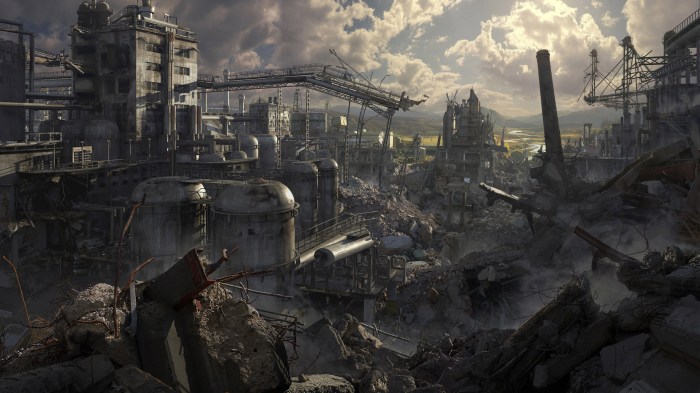
post-apocalypticWhether it is due to nuclear war, a bio-engineered plague, or some kind of “nanocaust”, civilization as we know it has come to an end. All major cities lie in ruin and are populated only marauders and street gangs, the more peaceful-minded people having fled to the countryside long ago. In scattered locations along major rivers, coastlines, or within small pockets of land, tiny communities have formed and eke out an existence from the surrounding countryside.

At this point, it is unclear if humanity will recover or remain at the level of a pre-industrial civilization forever. One thing seems clear, that humanity will not go extinct just yet. With so many pockets spread across the entire planet, no single fate could claim all of them anytime soon. At least, one can hope that it won’t.

3. Dog Days:
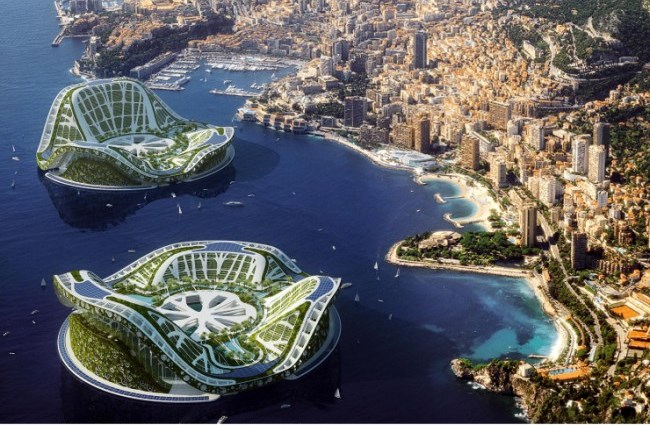
arcology_lillypadThe world continues to endure recession as resource shortages, high food prices, and diminishing space for real estate continue to plague the global economy. Fuel prices remain high, and opposition to new drilling and oil and natural gas extraction are being blamed. Add to that the crushing burdens of displacement and flooding that is costing governments billions of dollars a year, and you have life as we know it.

The smart money appears to be in offshore real-estate, where Lillypad cities and Arcologies are being built along the coastlines of the world. Already, habitats have been built in Boston, New York, New Orleans, Tokyo, Shanghai, Hong Kong and the south of France, and more are expected in the coming years. These are the most promising solution of what to do about the constant flooding and damage being caused by rising tides and increased coastal storms.

In these largely self-contained cities, those who can afford space intend to wait out the worst. It is expected that by the mid-point of the 22nd century, virtually all major ocean-front cities will be abandoned and those that sit on major waterways will be protected by huge levies. Farmland will also be virtually non-existent except within the Polar Belts, which means the people living in the most populous regions of the world will either have to migrate or die.

No one knows how the world’s 9 billion will endure in that time, but for the roughly 100 million living at sea, it’s not a going concern.

4. Technological Plateau:

computer_chip4Computers have reached a threshold of speed and processing power. Despite the discovery of graphene, the use of optical components, and the development of quantum computing/internet principles, it now seems that machines are as smart as they will ever be. That is to say, they are only slightly more intelligent than humans, and still can’t seem to beat the Turing Test with any consistency.

It seems the long awaited-for explosion in learning and intelligence predicted by Von Neumann, Kurzweil and Vinge seems to have fallen flat. That being said, life is getting better. With all the advances turned towards finding solutions to humanity’s problems, alternative energy, medicine, cybernetics and space exploration are still growing apace; just not as fast or awesomely as people in the previous century had hoped.

Missions to Mars have been mounted, but a colony on that world is still a long ways away. A settlement on the Moon has been built, but mainly to monitor the research and solar energy concerns that exist there. And the problem of global food shortages and CO2 emissions is steadily declining. It seems that the words “sane planning, sensible tomorrow” have come to characterize humanity’s existence. Which is good… not great, but good.

Humanity’s greatest expectations may have yielded some disappointment, but everyone agrees that things could have been a hell of a lot worse!

5. The Green Revolution:
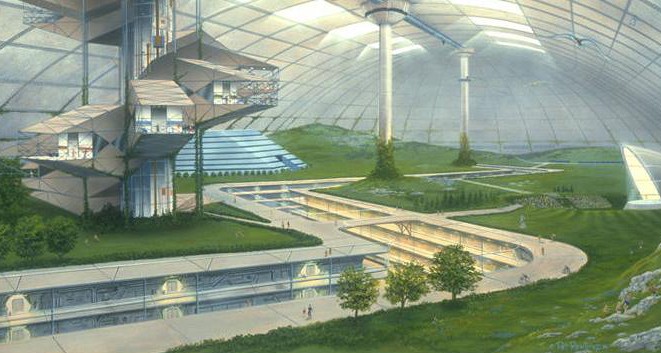
MarsGreenhouse2The global population has reached 10 billion. But the good news is, its been that way for several decades. Thanks to smart housing, hydroponics and urban farms, hunger and malnutrition have been eliminated. The needs of the Earth’s people are also being met by a combination of wind, solar, tidal, geothermal and fusion power. And though space is not exactly at a premium, there is little want for housing anymore.

Additive manufacturing, biomanufacturing and nanomanufacturing have all led to an explosion in how public spaces are built and administered. Though it has led to the elimination of human construction and skilled labor, the process is much safer, cleaner, efficient, and has ensured that anything built within the past half-century is harmonious with the surrounding environment.

This explosion is geological engineering is due in part to settlement efforts on Mars and the terraforming of Venus. Building a liveable environment on one and transforming the acidic atmosphere on the other have helped humanity to test key technologies and processes used to end global warming and rehabilitate the seas and soil here on Earth. Over 100,000 people now call themselves “Martian”, and an additional 10,000 Venusians are expected before long.

Colonization is an especially attractive prospect for those who feel that Earth is too crowded, too conservative, and lacking in personal space…

6. Intrepid Explorers:
spacex-icarus-670Humanity has successfully colonized Mars, Venus, and is busy settling the many moons of the outer Solar System. Current population statistics indicate that over 50 billion people now live on a dozen worlds, and many are feeling the itch for adventure. With deep-space exploration now practical, thanks to the development of the Alcubierre Warp Drive, many missions have been mounted to explore and colonizing neighboring star systems.

These include Earth’s immediate neighbor, Alpha Centauri, but also the viable star systems of Tau Ceti, Kapteyn, Gliese 581, Kepler 62, HD 85512, and many more. With so many Earth-like, potentially habitable planets in the near-universe and now within our reach, nothing seems to stand between us and the dream of an interstellar human race. Mission to find extra-terrestrial intelligence are even being plotted.

This is one prospect humanity both anticipates and fears. While it is clear that no sentient life exists within the local group of star systems, our exploration of the cosmos has just begun. And if our ongoing scientific surveys have proven anything, it is that the conditions for life exist within many star systems and on many worlds. No telling when we might find one that has produced life of comparable complexity to our own, but time will tell.

One can only imagine what they will look like. One can only imagine if they are more or less advanced than us. And most importantly, one can only hope that they will be friendly…

7. Post-Humanity:
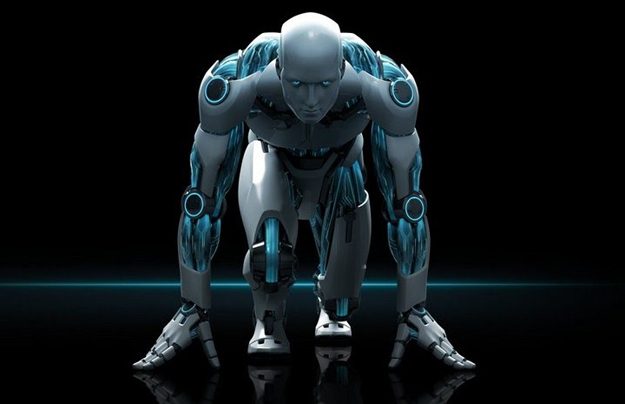
artificial-intelligence1Cybernetics, biotechnology, and nanotechnology have led to an era of enhancement where virtually every human being has evolved beyond its biological limitations. Advanced medicine, digital sentience and cryonics have prolonged life indefinitely, and when someone is facing death, they can preserve their neural patterns or their brain for all time by simply uploading or placing it into stasis.

Both of these options have made deep-space exploration a reality. Preserved human beings launch themselves towards expoplanets, while the neural uploads of explorers spend decades or even centuries traveling between solar systems aboard tiny spaceships. Space penetrators are fired in all directions to telexplore the most distant worlds, with the information being beamed back to Earth via quantum communications.

It is an age of posts – post-scarcity, post-mortality, and post-humansim. Despite the existence of two billion organics who have minimal enhancement, there appears to be no stopping the trend. And with the breakneck pace at which life moves around them, it is expected that the unenhanced – “organics” as they are often known – will migrate outward to Europa, Ganymede, Titan, Oberon, and the many space habitats that dot the outer Solar System.

Presumably, they will mount their own space exploration in the coming decades to find new homes abroad in interstellar space, where their kind can expect not to be swept aside by the unstoppable tide of progress.

8. Star Children:
nanomachineryEarth is no more. The Sun is now a mottled, of its old self. Surrounding by many layers of computronium, our parent star has gone from being the source of all light and energy in our solar system to the energy source that powers the giant Dyson Swarm at the center of our universe. Within this giant Matrioshka Brain, trillions of human minds live out an existence as quantum-state neural patterns, living indefinitely in simulated realities.

Within the outer Solar System and beyond lie billions more, enhanced trans and post-humans who have opted for an “Earthly” existence amongst the planets and stars. However, life seems somewhat limited out in those parts, very rustic compared to the infinite bandwidth and computational power of inner Solar System. And with this strange dichotomy upon them, the human race suspects that it might have solved the Fermi Paradox.

If other sentient life can be expected to have followed a similar pattern of technological development as the human race, then surely they too have evolved to the point where the majority of their species lives in Dyson Swarms around their parent Sun. Venturing beyond holds little appeal, as it means moving away from the source of bandwidth and becoming isolated. Hopefully, enough of them are adventurous enough to meet humanity partway…

_____

Which will come true? Who’s to say? Whether its apocalyptic destruction or runaway technological evolution, cataclysmic change is expected and could very well threaten our existence. Personally, I’m hoping for something in the scenario 5 and/or 6 range. It would be nice to know that both humanity and the world it originated from will survive the coming centuries!

Bad New from Mars: First Colonists Doomed!

Mars_exploreWith the exploration of Mars continuing apace and a manned missions looming, there has been an explosion of interest in the idea of one day settling the planet. As the non-profit organization known as Mars One can attest, many people are  interested in becoming part of a mission to colonize the Red Planet. In fact, when they first went public, some 200,000 people signed on to become part of the experience.

The fact that the trip would be one-way and that the  plans for getting them there did not yet exist was not an deterrent. But if a recent study from MIT is to be believed, those who choose to go will and have the experience televised will be in for a rather harsh experience. According to a feasibility study produced by researchers at the Institute, the plan has potentially deadly and astronomically expensive flaws.

mars_revelationspaceAfter analyzing the Mars One mission plan, the MIT research group found that the first astronaut would suffocate after 68 days. The other astronauts would die from a combination of starvation, dehydration, or incineration in an oxygen-rich atmosphere. The analysis also concludes that 15 Falcon Heavy launches – costing around $4.5 billion – would be needed to support the first four Mars One crew.

The technology underpinning the mission is rather nebulous; and indeed, that’s where the aerospace researchers at MIT find a number of potentially catastrophic faults. While the technology to set up a colony on Mars does technically exist, most of it is at a very low technology readiness level (TRL) and untested in a Mars-like environment. And the prediction that things will be worked out with time and crowdfunding does not appear to be sufficient.

Mars_one2Mars One will rely heavily on life support and in-situ resource utilization (ISRU) – squeezing water from Martian soil and oxygen from the atmosphere. But these technologies are still a long way off large-scale, industrial use by a nascent human colony on Mars. NASA’s next Mars rover will have an ISRU unit that will make oxygen from the Red Planet’s atmosphere of CO2 – but that rover isn’t scheduled to launch until 2020, just two years before the planned launch of Mars One.

Originally, Mars One’s sign-up list included some 200,000 candidates. That number has now been whittled down to 705 – a fairly even mix of men and women from all over the world, but mostly the US. Several teams of four astronauts (two men, two women) will now be assembled, and training will begin. The current plan is to send a SpaceX Falcon Heavy rocket carrying the first team of four to Mars in 2022 – just eight years from now. 

spaceX-falcon9The whole thing will be televised as a reality TV show, an instrinsic part of the plan since much of the funding is expected to come from media sponsors and advertisers. In the interim, a number of precursor missions – supplies, life-support units, living units, and supply units – will be sent to Mars ahead of the human colonizers. More colonists will be sent fairly rapidly thereafter, with 20 settlers expected by 2033.

The new feasibility study was led by Sydney Do, a PhD candidate at the Massachusetts Institute of Technology who has done similar studies on other space missions. Do and his team ran a computer simulation based on publicly available information about the Mars One plan and the kinds of technologies it would rely on. The researchers entered data about the crew’s age, weight and activities to find out how much food, oxygen and water they would need.

Mars_GreenhouseThey took into account information from Mars One, such as its plan that “food from Earth will only serve as emergency rations” and the astronauts will mainly eat fresh food they grow themselves. The simulation monitored conditions in the Mars One habitat over 26 months – the amount of time between spaceships from Earth that would resupply them – or until the death of a crew member, whichever came first.

The results of their study were presented in a paper at the International Astronomic Union conference in Toronto last month. They suggest that serious changes would need to be made to the plan, which would either call for the astronauts to grow all their plants in a unit isolated from the astronauts’ living space to prevent pressure buildup in the habitats, or import all food from Earth instead of growing it on Mars.

mars_one2The researchers recommend the latter, as importing all the necessary food along with the first wave of colonists (not including the costs of development, operations, communications, and power systems) would cost $4.5 billion and require 15 Falcon 9 Heavy Rockets to transport it. Comparatively, flying all the equipment needed for the astronauts to grow their own food indefinitely which cost roughly $6.3 billion.

On top of all that, Do and his research staff have concluded that the project will not be sustainable financially. While Mars One says each subsequent manned mission will cost $4 billion, Do’s study found that each mission would cost more than the one before, due to the increasing number of spare parts and other supplies needed to support an increasing number of people.

mars_roverNaturally, Mars One replied that they are not deterred by the study. CEO and co-founder Bas Landorp – who helped develop the mission design – said the plan was based on the company’s own studies and feedback from engineers at aerospace companies that make space systems, such as Paragon Space Development and Lockheed Martin. He added that he and his people are “very confident that our budgets, timelines and requirements are feasible”.

In any case, the study does not claim that the plan is bogus, just that it may be overreaching slightly. It’s not unreasonable to think that Mars One could get people to Mars, but the prospects for gradually building a self-sustaining colony is a bit farfetched right now. Clearly, more time is needed to further develop the requisite technologies and study the Martian environment before we start sending people to live there.

Mars_simulationOh well, people can dream can’t they? But the research and development are taking place. And at this point, it’s a foregone conclusion that a manned mission to Mars will be happening, along with additional robot missions. These will help lay the groundwork for eventual settlement. It’s only a question of when that could happen…

Sources: cbc.ca, extremetech.com, web.mit.edu