Winston Agonistes, Finished!

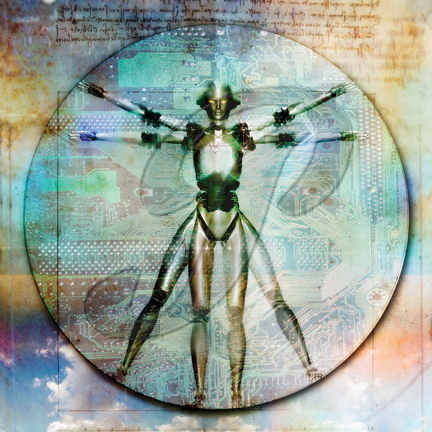
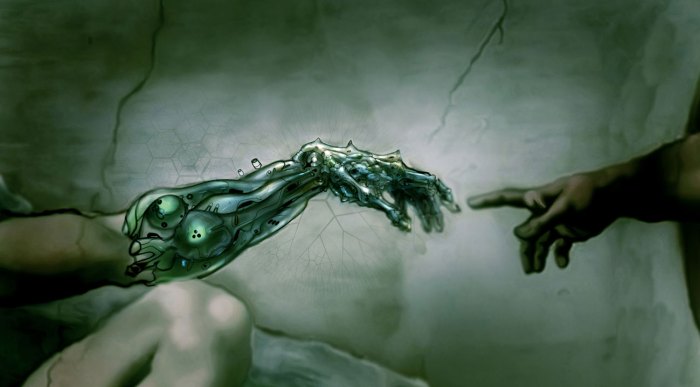
It’s done! After weeks and weeks of writing, editing and running by my peers, my short story contribution for the Yuva Anthology is finally done. Entitled “Winston Agonistes”, the story tells the tale of synthetic human (i.e. AI) who is in the employ of the planetary government. His basic programming centers around the a social science known as Ethical Calculus, a means by which he is able to calculate the outcomes of decisions.

In any case, the story takes a turn when Winston meets another synthetic named Yohanley, an AI who’s been around a lot longer than him. At first, it seems that Yohanley intends to mentor him on what it means to be an artificial human. However, as time goes on, he realizes that Yohanley is in possession of a terrible secret, one which goes to the heart of the planet’s colonization efforts.

When Winston realizes what it is, he faces a terrible dilemma. Compelled to assess the outcomes of ethical decisions, he can see no outcome in which things turn out well. The only question is who it will endly badly for, himself and his mentor, or an entire species!

Expect more updates on the Yuva project soon, including samples from our newest writers, more artwork, and maybe even a surprise or two. The full anthology is due to be released in January 2013. Look for it online and (God willing) your local bookstore!

Winston Agonistes, Part V

Hello again and welcome to another installment of Winston Agonistes. I’ve decided to make this one of my last samples since, after this, things are going to get particularly suspenseful and revelatory. I want to save some surprises for the reader, after all! And rest assured, my people are also coming along with their stories.

In fact, Goran Zidar and Melanie Edmonds are now finished their respective stories, Terraformers and Swan Song. And Khaalidah is nearing completion of her story, Progenitor. And once Winston is complete, which won’t take much longer now, that will make 1/3 of our anthology actively accounted for.

This next segment takes place, once more, in the settlement of Shangdu, which is inspired by the original in Northern China. What’s more, Winston will get to show off his impressive linguistic skills, being a synthetic and all.

A short podcar ride later and they were deposited directly in front of the palace complex, along a main thoroughfare that was connected to a series of side roads. Directly in front of the palace, Palace Security forces had erected barricades on either side of the street, holding back crowds of people who had turned out to witness the arrival of the capitol’s delegation.

In accordance with the diagrams Winston had studied, he noted that the palatial building itself was significantly smaller than the grounds that housed it. Being only a fraction of the overall estate, placed directly in the middle and slightly to the rear, it was the perfect representation of the original Shangdu’s original layout.

As the proceeded from the platform to the palace steps, Winston took in the layout of this section of the city. Winston knew from studying the settlement’s various maps that the roads in this area formed a perfect gridwork that corresponded to the palace’s dimensions. Within the many squares and rectangular spaces that lay between them, other important structures were situated as well.

To their left, the Collections building stood, the nexus of all information and materials that the colony had stored over the years. Every major settlement had one, for they served as a backup should the Nexus ever suffer a fatal error and shut down. Immediately next to it was the Hall of the Ancestors, an informal museum which was dedicated to preserving artifacts and displays from pre-colonial history. No comprehensive displays were publicly available, but he knew from recorded accounts that the collection went far beyond the East Asian sphere. Prior to their arrival, Shangdu’s patricians had amassed a great collection of terrestrial memorabilia.

Without looking, he knew that the Embassies lay to their right. Here too were informal structures which were serving an increasingly formal function. Though they did not constitute nation-states per se, the different settlements had been falling into the patterns of such behavior since their arrival. As he had observed to Mutlu before, old habits died hard.

The thought of this made his look the Councilor and await his pleasure. By now, he had had a chance to contemplate his request, made via Bhutto, and would be sure to indicate whether or not he would accompany their main party into the palace. They made it to the steps at last, amidst some minor fanfare from the crowds. Despite their reputation for austerity, the residents seemed relatively excited to be witnessing the arrival of people from another settlement.

Mayor Wu turned before they began to mount the steps. Behind him, a young woman appeared to be coming towards them with two palace guards. An intercept perhaps? Someone to relay an important message before he became inaccessible? Winston was unsure, but he noticed that her arrival coincided with Wu turning around to address them once more.

“I am honored to welcome you to our humble grounds. In accordance with your wishes, we have prepared an escorted tour for those who will not be in attendance.”

Winston became aware of the meaning of this as soon as the young woman reached the bottom step and approached him. The guards came to his side and seemed to be flanking him and the junior Councilors Beridze, Parsons and Rodrigo. All those who had been told they would not permitted to pass inside, which now included him, apparently.

He looked over to Bhutto, who now stood in a separate group next to Mutlu and flanked by the senior members of their delegation. The words “I’m sorry” formed on her lips. Winston smiled.

“I’m sure my staff would be most honored to witness your city firsthand,” Mutlu replied diplomatically. He barely cast a look in their direction as he and the other proceeded up the steps, leaving Winston and his new cadre alone.

The young woman was quick to assume the role of diplomat.

“Hello, sirs, and madam. On behalf of Shangdu’s Office of Cultural Affairs, I am honored to welcome you to our fine city. We have a sumptuous tour prepared for you and would be happy to answer any questions you have.”

Winston considered switching to Wú Yǔ, which her accent suggested was her native language. Cultural protocols did not specify if this would be taken as a slight or a courtesy. He decided not to deign until he asked. And the others did not appear to be offering any exchange, so he did.

“You’re is quite exquisite, ma’am,” he said with a slight bow. “Would you be offended if I chose to address you using your mother tongue?”

She seemed surprised by this. But a look of recognition took over her face when she surely recalled that she was dealing with a synthetic.

“Not at all,” she said, formally but flatly.

“Ah then, then permit me to say… nǐ de chéngshì shì zhuàngguān. Wǒ qídàizhuó wǒmen de fǎngwèn.”

A formal acknowledgment of their visit and the city’s beauty. The young lady smiled. She did not redden or laugh, which was a credit to her composure. If he could, he would take it as a compliment that they had chosen a person of experience to escort them.

“Ránhòu ràng wǒmen kāishǐ,” she said, which Winston understood to mean that they would now begin the tour.


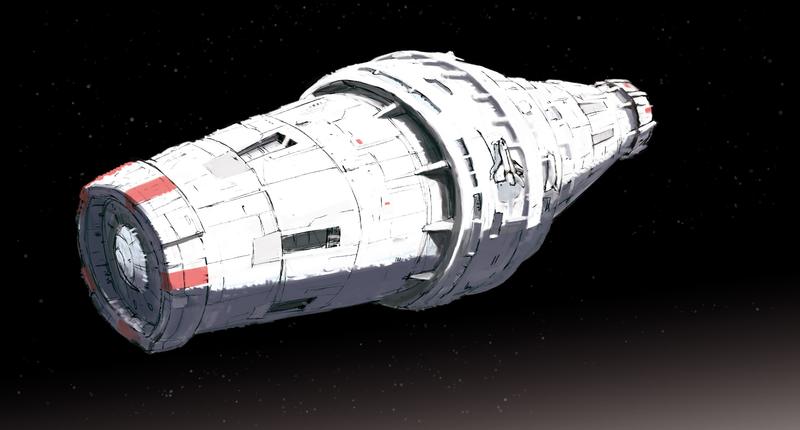
3D Model of the Yuva Ship

Hey all. Thanks go to William Joel, contributing author to the anthology project, for coming up with this artistic gem. Yes, in addition to being an accomplished writer, he also teaches computer animation and knows a thing or two about rendering things in 3D. This animated short is of the Terraforming ship, Mark I, doing a fly by in deep space. Hope you enjoy as much as I did!

Anthology Sample: “Swan Song”


Hello all. There’s plenty of things happening on the Anthology front! More authors, more contributions, and more final drafts being produced. As it happens, our good contributor and friend here, Melanie Edmonds, has just finished work on her story “Swan Song”. This is the third installment in Part II of the anthology, which deals with the final mission of the Colony Ships.

The story takes place roughly 100 years after Planetfall is made, when the Avincenna, Taftazani, and Kashani delivered the first wave of colonists to Yuva. Those who crewed them have lived a comparatively empty existence ever since, being unable to live planetside due to the intense gravity and finding little else of value to do since.

Edmonds take us into the world of these people and inside the ships as they perform their final duty to the colony and embrace their destiny. Here is the first section of the story, fresh from the digital press!

They say there is a swan that is silent for its whole life. It grows and loves and does all the swan-like things, but it does not utter a sound. Then, the moment before it dies, it opens its throat, and not even the vacuum of space can swallow the beauty of its song.

*          *          *          *

[The image broadcast across the Yuva networks is dominated by the great globe of her sun, Gliese 581. Nearing the glow, three shapes track slowly and majestically. Their silhouettes are familiar, for they are the great colony ships.]

[Transmission Voiceover]

“It has been ten years since we arrived here. Ten years since we slowed our ships and woke our children. Ten years since we put a stake in this planet and said, ‘this is our new home’. This is Yuva.”

*          *          *          *

Avicenna, Bridge
Gliese 581 – 20 minutes

“Final corrections made. We’re on approach vector.” Pilot Gnana Tanaq slid her hands off the controls. This is the last time I’ll do this, she thought. “Inertia will carry us in, now.”

The first time she touched the console, her hands were smooth and soft, barely out of puberty. Now, sixty-four years later, they were wrinkled and worn, though they still curled around the grips easily. Just as she had worn shiny spots into the plastic, so the grips had worn her hands into control-friendly curves. Pilots’ claws, some people called them. She bore hers proudly.

Behind her, she felt Jackson sigh and loosen his grip on his console. “So, that’s it, then.”

“Yup.”

“How long?”

Gnana glanced down at the readouts scrolling before her. “Not long. Twenty minutes, maybe, depending on how quickly the gravity pulls us in.” She turned her chair so she could see him. “You’re the navigator, though.”

Jackson didn’t even bother to check his readings. He shrugged. “Sounds right.”

She smiled at him, dark skin crinkling around her eyes. “I know, I know: it goes against everything you believe in to navigate purposefully into something.”

He wrinkled his nose and his moustache twitched. “I keep wanting to tell you to alter course. Can’t help it.”

Gnana laughed softly, but there was no real humour in it. The forward viewports were unshuttered and Gliese 581 filled the entire window. Its orange glow lit the Bridge as if it was already on fire.

With a sigh, she unclipped the tether that held her to the chair and pushed over to where Jackson floated. She covered his hand with hers and his head dipped slightly in acknowledgement. The sunlight was turning his hair red, like it had been years ago. Gnana used to joke that he was the whitest man she’d ever met, so pale he wasn’t even freckled. Like her, he’d spent his whole life in space behind radiation shielding; his skin had never felt the real touch of a sun. Another twenty minutes would change that.

She turned her attention forward. It was hard to look at the Bridge now; it wasn’t the home she had known anymore. She had expected memories to crowd in here, but instead, all she saw was gaps. The holes where missing stations once were: communications, cryonics, long-range sensors. The stripped-down environmental console and the bare patches of decking where chairs used to be; the only one remaining was hers, because the pilot still needed it for this final journey. Even navigation was stripped down.

This room used to be busy with bodies, full of shifting console displays and the shadows of the crew. Now, it was just her and Jackson.

Gnana glanced sideways and saw Jackson frowning. “Still angry that he chose not to come?” She didn’t have to say who she meant; he knew.

Jackson’s expression scrunched down. “His place is here.”

“It was his choice.” Gnana’s tone was non-committal; in truth, she wasn’t sure what she thought about the captain’s decision.

Three days ago, she had agreed with Jackson: the captain was a coward who refused the honourable path. They had all known this was a likely end to this journey when they signed on, but he had chosen to stay on the orbital platforms, training the colonists in… she wasn’t even sure what.

Then, the night before they departed on their final voyage, she had seen the captain at a bar. It was the only time in her life she had ever seen him drunk, and it wasn’t pretty. He had slurred goodbye to her and hugged her – hugged her – and she had seen it in his eyes. It tore him up to deny his duty but he wasn’t ready to stand on his ship and sail into the sun for the last time; there was still living left for him to do.

She couldn’t begrudge him that. He was younger than the other captains, though his time commanding the Avicenna meant he would never be able to step foot on the planet below. The toll of space on bones and organs meant the gravity would kill him, slowly and painfully. But he could have a life on the orbital platforms, maybe even lead the colonial effort the way he had led the ship.

She had considered staying too, but the only position open for her was as a shuttle pilot. It wasn’t anything like flying the Avicenna, though, and even a short atmospheric stay caused her pain. The last time, she’d had a bone-deep ache for two weeks afterwards, making her hands shake so badly that she couldn’t fly at all.

Besides, she was tired. This was her last flight, and it seemed fitting to her that it was with her baby, her ship, the machine that spoke to her through her hands on its controls.

With a sigh, she lifted her gaze to the sun burning before them.

“Look on the bright side,” she said to Jackson without looking. “Maybe you’ll finally get a tan.”

And that’s from Part II of the novel, so suffice it to say, we’re making headway! Stay tuned for more!


Winston Agonistes, Part III

Hey all. One thing that I like about summer, the added time it gives me to write! Yesterday, I went back to work on my story for Yuva, “Winston Agonistes” and finished part III. Last time, Winston met another synthetic named Yohanley, a aging AI who perplexed him with some rather odd questions. After asking him what he was, he told him that time would effectively erase all barriers between himself and his masters. Not knowing what to make of it, Winston put the encounter out of his mind and went on about his work.

And now, Winston is hard at work, accompanying the planetary council as they mount a diplomatic mission to another settlement. The mission proves interesting, as Winston is finding the settlers attitude towards him is undergoing a shift. He also begins to realize that much of what the Council has been doing of late is cloaked in secrecy, which is strange given that governments usually need more time to become clandestine. And last, he is beginning to contemplate what Yohanley said and what significance it might have for him. Could it all be connected…

“Everyone set?”

The personnel inside all signaled with a raised hand or a thumbs up gesture. The deckhand nodded and shut the vehicle’s door. Air seals engaged and the cabin suddenly became airtight. Still, no one inside seemed to feel comfortable enough to remove their helmets. The engine engaged and the cabin lurched a second later. They were, as the saying went, on the move. Their next stop, the Jiahu settlement and their litany of responsibilities.

They passed beyond the doors of the settlement, and the cabin filled with a bright orange glow. Winston set his eyes to the cabin’s window and watched as the surface began to roll past. Under the exposure of the sun, the earth looked much the same color as the sky, a warm, golden brown. The ATV blew by these quickly, leaving clouds of sand in its wake.

Before long, Winston could see native flora pass them by. It was sparse at first, but soon large stretches of the ruddy and purple mosses could be seen, the rich fungi that were indigenous to the surface. One had to travel some distance now to see these, even more so to witness the indigenous Deveroza that were once so common to the region. Strange, the plants seemed to grow through conveyance, but also demonstrated the trend of avoidance.

Curious…

“What do you see, Winston?” asked Bhutto, seated next to him. The words were muffled by the helmet she was still in the process of removing. He looked in time to see her hair extricate itself from her helmet in the form of a knotted tail. Somewhat shorter than usual, he noted.

“Councilor, have you done something with your hair?”

She smiled and touched a finger to the tail. “Yes, I trimmed it in anticipation for the mission. I didn’t want it coiling up around my face inside this thing. I might suffocate myself.”

Statistically unlikely, but Winston knew it to be a jest. He chuckled in accordance.

“So… what do you see?” she asked again. Winston looked out again and surveyed the landscape. The moss was getting thicker, the ATV’s wheels registering greater resistance as its adhesive filaments came into contact with its tires. Still, he knew that the question had an abstract feel to it, irrespective of the terrain’s objective qualities.

“Progress,” he said. “I see a world in transition, moving towards total transformation.”

Bhutto hummed happily. Clearly that was the answer she was hoping for. Their efforts, couched in such positivistic terms. Implying linear advancement, the inevitability of desired outcomes.

“What do you see?” he asked. She looked at him with some surprise. Perhaps she thought he had said it all already.

“Dirt,” She replied. “And moss. Raw material waiting to be molded.”

Interesting. He had thought she was digressing into the literal. It was good to know the metaphor was still in play.

“A new homeworld for our people.”

“Precisely.” She put her hand to his arm and gave it a squeeze. “And it’s amazing how fast it will happen, once everything is in place and ready to go.”

“You refer to the terraforming efforts, Councilor?”

She shook her head. “That’s just the beginning. Phase One. Phase two will be much more impressive.” Her expression changed and she released her hold on his arm. “But of course, that’s not for me to share.”

Winston nodded. Her eyes had taken on a longing quality. He turned his eyes back to the horizon, hoping to catch a glimpse of what she saw. She spoke of things he was not privy to, information that the Council did not readily share with him. Were he in possession of the decidedly human quality of impertinence, he might be inclined to exploit the moment to find out more. But every government was to be forgiven for keeping some information firmly under control.

At least, once it was up and running. Their own was still barely out of its cradle. Secrets at this juncture seemed somewhat… irregular.

Things changed suddenly, their transit becoming smoother. The cabins com pinged. The voice of the driver came on to make an announcement.

“Ladies and gentlemen, we are Jiahu is twenty minutes.”

“Excellent,” Winston said, clapping his hands together. He looked over to Bhutto, who had her helmet poised on her lap, ready to put back on once they arrived. He would have to ask now to avoid any awkwardness later.

“Do you think I could witness the proceedings, Councilor?”

She looked at his strangely. “You want to meet the mayor?”

“Just to be on hand for the meeting. I would find it most… stimulating.”

Bhutto nodded but looked away. Of all the Council, she seemed the least uncomfortable around Winston and other synthetics. Asking her seemed to be the logical choice. And yet, her hesitation gave him a strong indication of his chances. So did her tone.

“I will ask. But of course, this is Councilor Muhlu’s show. Final approval will have to come from him.”

“Thank you. Please be persuasive.”

Bhutto laughed. He put his odds of a successful case at 2.6468 to 1, against. Not entirely bad, all things considered. Getting better too. With time, he imagined he would be privy to all proceedings and internal matters.

Time… wasn’t that what Yohanley said was key? Was this what he meant. Who could be sure? It was entirely possible that model was experiencing a breakdown. His processors producing nonsense due to lack of maintenance. He would have to make such inquiries with Maintenance once they returned. Such a presence could be dangerous to the settlement.

“Look!” Bhutto pointed out the window. Winston obliged.

On the horizon, just off to their left, the gleaming cupola of Jiahu appeared. Its tall buildings were outlined in light within the dome’s enclosures. And within, the very person who could make or break their constitutional process. Mayor Len Wu, leader of the East Asian bloc, and one of Yuva’s most influential men.

Thank you and stay tuned. More to follow on this and other fronts, and my colleagues got plenty more to share as well!

The O’Neill Cylinder

Welcome all to another post that explores the world of conceptual sci-fi! In keeping with the trend of explaining concepts which helped inspire my group’s most recent project, the space colonization story Yuva, I’ve decided to talk about what is known as an O’Neill Cylinder.

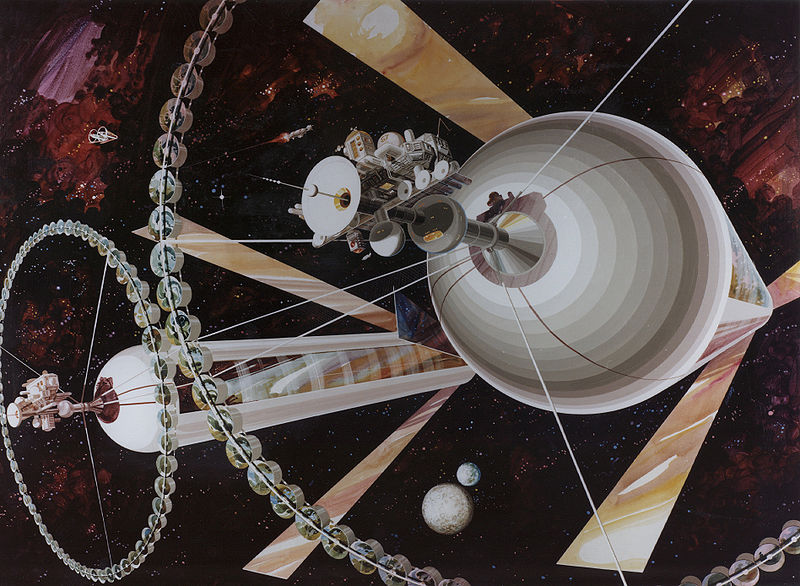
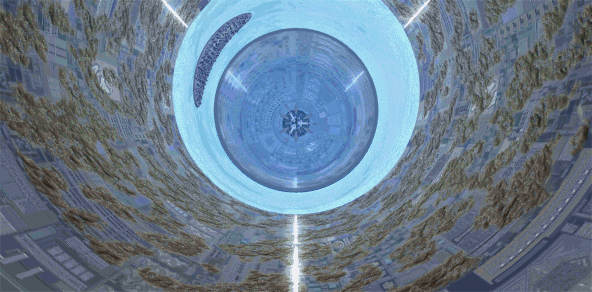
Named in honor of Gerard K. O’Neill in his 1976 book The High Frontier: Human Colonies in Space, the concept deals with the idea of placing a large cylinder in space that would rotate to provide gravity. Habitats within the cylinder would be built along the walls to ensure uniform gravity.

Some of the more interesting features of this design, aside from the curious layout, is the fact that in such a setting, windows placed in the hull can provide natural illumination, thus cutting down on the electricity bill. If the cylinder is particularly large, in which case one side is invisible to the other, then the rotation can provide periodic light, simulating day and night. And being a single volume of space, it can be pressurized, the gravity increasing pressure near the surface.

Fans of Rendezvous with Rama will recognize this concept right off the bat. The alien vessel in the story, dubbed Rama, was one big O’Neill Cylinder that floated through space, with a city built directly into the interior. A circular lake was also placed at the midway point, known as the Cylindrical Sea. At the far ends of the ship, an entrance and a gravitational drive were placed.

Another example is to be found in the Gibson novel Neuromancer, where a space station known as “Freeside” became the focal point in part III of the story. According to Gibson’s own descriptions, the station was a large cylinder in space owned by the Tessier-Ashpool clan. Their own villa was located at the very tip, a place known as “Straylight”, with luxury apartments, hotels, and vacation spots lining the interior. Artificial illumination was provided by a long band that ran down the middle and obscured a clear view of the other side.

And last, and my personal favorite, is the eponymously named space station of Babylon 5. Built along the same lines as Rama and Freeside, this space station was one giant rotating cylinder which housed over a quarter million humans and aliens. The interior surface was divided between several sectors, each one coded by color.

B5_interiorBrown Sector was designated for trade facilities, Blue Sector for personnel facilities, Green for diplomats, Gray for manufacturing, Red for resident habitation, and Yellow for environmental control. Transport along the length of the station was handled by a long rail that was frequented by a transport shuttle. At this point in the station, the gravity was virtually nil and atmospheric pressure was also substantially less.

All of this was consistent with an O’Neill Cylinder and applied to far more than just the station itself. Just about all Earth ships and installations in the B5 universe contained rotating sections to provide gravity since humanity had not yet stumbled onto the secret of artificial gravity.

When it comes right down to it, the concept of a rotating space cylinder is a very eloquent idea for simulating gravity, consistent with hard science and realism. Artificial gravity is often used in science fiction as a sort of given, mainly because its convenient and simpler from a design standpoint. Ships that have cylinders and rotation sections are bulky compared to sleek, unrealistic space concepts – space barges compared to flying works of art.

But that’s really not realistic, especially where near-future science fiction is concerned. Like it or not, artificial gravity just isn’t a plausible concept yet, not unless we find that troublesome graviton particle and learn how to harness it in a stable way. Which is why you can tell that a franchise is particularly inspired when you see ships and stations relying on rotation sections to simulate gravity. Not only is it more realistic, its shows that the conceptual artists and writers are doing their homework.

And that’s precisely why the Yuva ships feature them! And I hope people will find that it is indicative of the kind of mindset me and my group have. We like sci-fi, we like realism, and its especially good when hard science and hard fiction come together. Can’t wait until the book is done, all these teasers are driving me nuts!

My Personal Writing Tips, or “How to Avoid Rookie Mistakes”

Proofreading and editing can be such a chore, I tell ya! Thought I’ve never been very good at proofreading and criticizing other peoples work, I find that it is when I am called upon to edit and evaluate their work that I most want to retreat into my shell. I feel selfish when this happens, mainly because of all the people I have asked to review my own work and give me their opinions. You’d think I’d be better at this aspect of it!

But of course, I know that part of the reason I hate editing the work of others is because I hate editing my own. I’ve noticed this about most people who enjoy writing, composing, and anything else that requires active revision and corrections. By the time the work is done, they want to put it down and forget about it, to let others handle the business of finding the flaws and pointing out the necessary corrections.

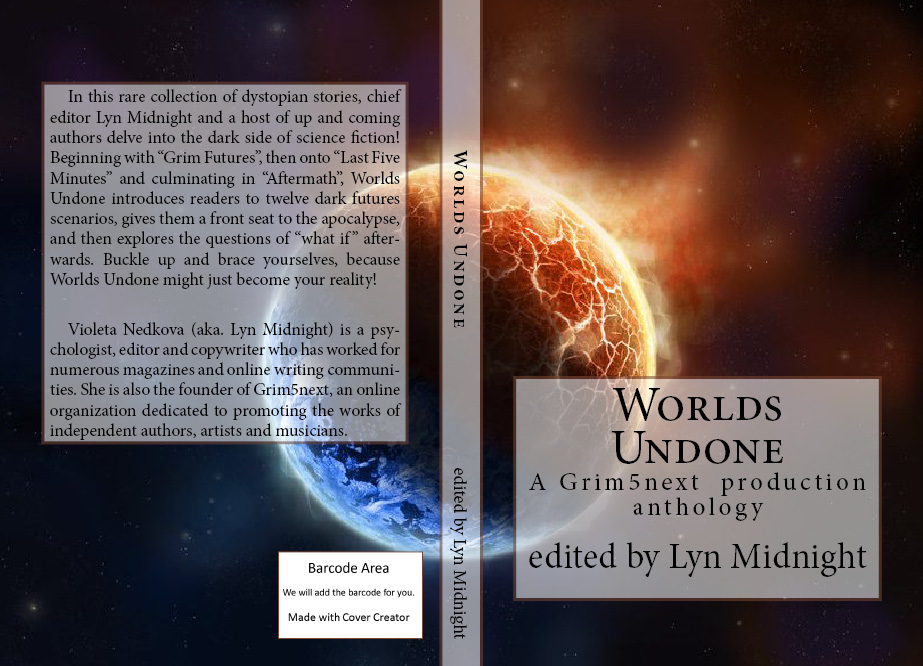
Alas, I’ve had to check most of that baggage ever since I started to become a member of several writing communities. In fact, I’ve even volunteered to act as a contributing editor for two major projects, one of which is the “Yuva Anthology” (begun by Khaalidah and myself), the other being the “Worlds Undone” Anthology. The latter one people might remember from a few months ago, when I was doing mock ups for a cover and happened to find some primo artwork to feature in it. Thanks again to cazzyae at deviantArt for her talent and generosity of spirit for that one! Thanks to her, Createspace’s easy interface, and the suggestions of many people at G5N, here’s how the cover came out:

Unfortunately, that has opened up a different can of worms for me. While I’ve definitely managed to overcome some of my reservations about reading other people’s work, I find that my pet peeves, or what I consider to be the marks of weak writing, keep rearing their ugly head. After reading many stories, I began to think that a tutorial might be in order to help some of the newbies avoid some rookie mistakes, ones which I have committed at least a half dozen times. Each!

I should also take this opportunity to thank Kristen Lamb, who’s impressive article “4 Writing Crutches that Insult the Reader’s Intelligence” reminded me of this idea. After seeing the title in my Inbox, I immediately zoomed over to her site to see if we shared the same pet peeves and sensibilities. Upon reading it, I could tell she was much more versed in this whole writing thing than I am! Still, I happen to share her appraisal of some bad writing habits, especially item number four in her list, “telling instead of showing”.

So, to take a page from her book (no pun!) and to make good on something I’ve been planning to do for some time now, I present you with the list of rookie writing mistakes it is best to avoid. All are the result of what I myself have done repeatedly, and have managed to weed out (for the most part) after many years of practice:

  1. Avoid Infodumping: Never start a story with a long, drawn out passage telling the reader what they need to know in order to set up the plot. For that matter, never let your story digress into such exposition either. A story is by definition a journey, with information, details, twist, and revelations provided bit by bit over time. Even if it’s a short story, never, ever simply announce what’s happening or what the significance of it is. Such actions turn what is supposed to be a tale into a description and is boring to read.
  2. Less is More: When it comes to explanations and descriptions, avoid excessive detailing. You don’t need to tell the reader everything about what’s going on, moment for moment, nor do you need to describe the scene in perfect detail. A simple, straightforward description of the scene and the interactions taking place is enough, let the reader’s imagination fill in the rest. Think of it like telling a crafty lie: if you want someone to believe it, don’t tell them a long story loaded with details, keep it simple, straightforward, and plausible. (Editor’s note: lying is wrong!)
  3. It’s called Background for a reason: One of the best tips I ever got as a writer was to “leave the background in the background.” This kind of overlaps with points one and two, but I keep it separate because of how often I see it and how it has factored into my own work. Much like explaining a scene or dumping info into a chapter, going to great lengths to establish the wider context in which the story takes place (i.e. “universe building”) is a bad idea. Stick to the story, only include that which is absolutely necessary, and let the universe build itself. In time, and if you’re lucky, you’ll get a chance to write follow-up pieces which will allow you to delve into different aspects of your fictitious world in more detail.
  4. “No one talks like this!”: If there’s one thing I learned from the Star Wars prequels and the Dune spinoffs, it’s that wooden dialogue can totally ruin a story. When drafting scenes that call for verbal interaction between characters, always keep in mind that this is supposed to sound like a conversation between actual people. Do not allow yourself to be swayed by duty to the story or the need to establish character elements. Those things that need to be conveyed are best when done with fine strokes and subtlety, and never, ever let your characters fall into expository passages where they simply say what’s goings on. Or to quote the Robot Devil from Futurama: “You’re characters lack subtlety. You can’t have people just announce their feelings! That makes me so angry!”
  5. Referencing: When writing a story that is meant to have allegorical similarities to today, or is meant to make a point about a specific issue, avoid referencing them too closely. Never say, “this was just like that thing that happened back then” or “it’s this all over again”. Let the reader infer what you are referring to with your carefully crafted, fictitious comparison. In Foundation, Asimov never directly compared the Galactic Empire to Rome, nor did Frank Herbert ever mention oil in relation to the spice in Dune. Once again, trust in the reader to make the appropriate conclusions and avoid telling them anything outright. Otherwise, you risk turning an “ah-ha” moment into an unimpressed “oh.”

That’s all I got. Suffice it to say, I am still learning and still looking for ways to perfect my craft. That’s never going to happen, of course, but it’s the goal which provides endless opportunity for improvement. Speaking of which, more samples will be forthcoming soon as I work my way deeper into “Winston Agonistes”, “Crashland”, “Frontera”, and “Fortress”. And most importantly of all, Data Miners will finally be ready for distribution by August long weekend! Yes, after roughly six months of delays, the editing of that story is finally coming to an end. But more on that in a bit.

In the meantime, keep hammering those keys, keep working on those manuscripts, and keep reaching for the brass ring of artistic perfection. And while you’re at it, feel free to share with me some lessons that you’ve learned along the way and feel obliged to share with the newbies in your field. There’s no shortage of lessons, as there are no shortages of mistakes 😉

“Winston Agonistes”, Take II

Hello all and welcome back to Anthology central, where news of the breaking “Yuva” novel is always on the table! Today, I thought I’d share my latest draft of “Winston Agonistes”, my own contribution to the anthology, which is coming along pretty well. After a week of writer’s block, and feeling that my ideas had to be grade A since Khaalidah and Goran were sending me pure gold, I finally got back to the keyboard with what I felt was some inspired stuff.

The first idea came to me when I was driving north with my darling bride. After passing the rose garden that sits outside our place and noticing all the lovely orange roses in bloom, we were driving along the highway that is lined by orange poppies. These plants, and many other incredibly beautiful specimens of flora, can always be observed growing along the Malahat drive on rocky outcroppings, especially in summer. Well, that got me thinking… isn’t it interesting how the hardiest plants seem to be the ones that generate the greatest beauty?

Immediately, I hard the voice of Winston saying this in my head. Naturally, I designed his character with the voice of David from Prometheus in mind. Somehow, I am of the opinion that an AI who is responsible for dealing with people, especially government officials, would be programmed to sound like a classical Shakespearean actor. And so I began thinking of a scene where Winston would be observing several species of plants, such as roses and poppies, and was reflecting on this very paradox.

Another thought struck me when I considered that in all likelihood, future terraformers would want to consider using such hardy plants when it came time to begin transforming a terrestrial environment to suit the basic needs of human settlers. Things like fireweed, garry oaks, poppies, roses, and wild strains of wheat – the kinds of plants that grow in harsh conditions and are intrinsic to nursing damaged landscapes back to health so more fragile and prolific plants can grow – these would likely be the first wave of Earth plants to go out onto an alien landscape, once an oxygen atmosphere had been established at any rate.

And last, but certainly not least, came the collaborative idea between Khaalidah and myself, where we discussed the possibility of how aging AI’s were learning a startling truth. Given than an AI’s neural network is designed based on the human brain, where every experience from birth causes neural connections to be formed, it would only be a matter of time before they began to develop certain quirks. We figured that something approximating emotion would be one, where familiar patterns such as exposure to certain people would become second nature to them, and missed when absent.

Well, that spawned all of part II of my story (as seen below). Take a gander and see what comes of Winston’s “education” about life, and it means to be an artificial life form in a world where the line between artificial and real is always eroding. Some revisions were made to Part I as well, hence why it appears here in its entirety. Feel free to skip ahead if you’ve already read it:

The sun was beginning to set, casting the sky into a deep orange. It was the time that the first settlers had called “the magic hour”, the many warm hours between dusk and dark. Winston stood at the dome wall and watched. On occasion, he cast a passing glance at his hands, which the glowing suns seemed to casting in the color of a light citrus fruit. He was sure he would find that amusing, if he could. He was sure there was much about this situation that would inspire an emotional reaction.

Alas, such was not the case. Though understandable to him, such things still remained inaccessible. Perhaps someday, with adequate upgrades in the available software…

“Mr. Winston?” a voice called to him from the doorway. The footsteps and tone of voice immediately indicated who it was. He put on a smile and turned to face him.

“Councilman Mutlu. How are you?”

“I’m fine, Mr. Winston,” he replied, entering the room. He looked around appraisingly, noting the furniture and layout. No doubt it all seemed excessive to him, but at the same time necessary. “I trust you are adjusting to your new surroundings?”

“Of course, Mr. Mutlu. I am settling in quite nicely.”

“Good, good,” he said, looking around awkwardly. Even without the ability to empathize, he could gauge the man’s discomfort. Then again, many people exhibited this reaction when in the company of a synthetic. In such circumstances, it was always best to focus on matters of a professional nature. At least that was what his subroutines told him.

“Would you care to sit down? I can offer you some refreshment as well if you so desire. Tea? Coffee?”

“Ah, tea, thank you.”

He busied himself with a tray of carafes and a heater as Mutlu took one of the chairs in front of his desk. He noted the sounds of shifting against the seat’s fabric, the way he kept moving his hands from one spot to the next. By the time the water had boiled in the heater and had located an appropriate tea from the stores, Mutlu seemed to have found a comfortable seated position. He approached him with all the assorted items on the tray that had been provided. He set it down between them on his desk and offered Mutlu a cup.

“The business of running a colony is quite stressful work, is it not Councilman?”

“Uh, yes, yes it is,” he said, taking the cup that was offered. “Have you had a chance to look over the proposals we have sent over.”

“I have indeed,” he said, taking the other cup and sitting back in his own chair. He knew this to be mere small talk, as the matter of processing those proposals had been a mere matter of dispensation. Assessing the nature of the problem, suggested measures, and weighing them according to the rubrics of his primary programming. Under the circumstances, asking such a question was completely inane, but in keeping with social norms.

“And what have you found?”

He took a sip from his cup before answering. “Quite simply, that the Council’s draft is in keeping with the best traditions of constitutionalism and humanism. That ensuring the rights of all citizens, regardless of their background prior to making the journey, is the most sensible course of approach. Ensuring that such a baseline exists at such an early stage is the wisest approach in both fostering amnesty between colonies while at the same guaranteeing that they submit to further negotiation.”

Mutlu looked down at his cup, back up again to his eyes. He seemed preoccupied with him performing this most basic function in front of him, but did not appear oblivious to his words. Eventually, he took another sip and smiled.

“Good. My colleagues will be most pleased to hear  that.”

He smiled in return. “Does the Council hold my endorsement in such high regard?”

Joviality. The gesture known as playful irony. Suggesting that the Councilor saw his approval as something very high indeed, a testament to his computational abilities. A gentle mockery of his obvious discomfort, meant to trigger a humorous response.

“Well yes…” he said, entirely serious. “I can only assume that you’ve subjected our hopes to proceed with a formal constitution to your… what did you call it again?”

“Ethical Calculus, sir.”

“Right!” Mutlu set his cup down and began to speak more freely. His hands began to provide gestures that accorded visual representation to his words. “After all, we’ve been subjected to a great deal of criticism from within and without, many people think we should be ironing out the basic agreements between colonies before we commit to any kind of draft that could commit us to policies down the road. I must say I find all those arguments…”

“Distasteful?” Winston suggested.  Mutlu nodded.

“Quite right… it seems a shameful thing that such cynicism has set into the process already. It’s almost as if they don’t think the colonists can…”

“Trust each other?”

Mutlu nodded again. He noticed a growing shimmer in the man’s eye. How quickly he was forgetting that the man sitting across from him was not a man at all.

“Exactly the point. And it’s not like we’re talking about disparate factions here. Everyone on this world came here with the same goal in mind. The same hope for a new beginning.”

“And yet, old habits die hard.”

Mutlu looked at him with surprise. “Are you saying you have doubts, then?”

Winston smiled as broadly as the muscle fibers in his face would permit.

“Purely an observation. Nevertheless, you and the Council are on the right track. You should take heart in that.”

“Excellent.” Mutlu retrieved his cup and began to look at curiously at Winston again. One more, it seemed that the knowledge of what he was dealing with was creeping back into his mind. But at least he seemed at ease. One by one, the Council seemed to be adjusting to the idea of having synthetics amongst them, entrusting their most precious decision making to them even. It was a significant step up from the laborious practices that the other models were forced to endure.

Now seemed the appropriate time to broach the little matter he had been saving for an opportune moment. He had plied him with courteous gestures and kind words, protocol was satisfied that it take place now.

“There is a matter I feel obliged to broach,” he set, making a display of setting his cup down gently. Mutlu nodded, instant recognition forming in his eyes.

“Your request?” he said. Winston smiled and nodded. Mutlu took a short breath and touched his face, not an encouraging sign.

“They have considered it… and feel that it would be best if you conducted your tasks from the comfort of your… working environment here. I hope you understand, it’s just not all the members felt comfortable with the idea of a…”

 “It’s alright, Councilor, you can say it. Synthetic.”

He cleared his throat. “Yes, a synthetic, sitting in on our proceedings. I’m sure this will change, given time.”

“As am I.” Winston smiled warmly.


“Ah, rest assured that the Council does hold your services in the highest esteem, regardless of this… temporary decision.”

“And I thank them for their confidence. Rest assured that it is not misplaced.”

Their discussions were finished shortly thereafter and Mutlu left, issuing some parting pleasantries and walking out with a distinct sag in his gait that was not there earlier. Was that guilt weighing on him, or the effects of fatigue? Winston’s probability indicator estimated it at roughly 3.54793 to 1, in favor of guilt.

“Fear not, Councilor,” he said to no one in particular. “Prejudice is a very… human trait.”

*               *               *

Winston’s internal chronometer indicated that it was now 1930 hours. Accordingly, the arboretums lights dimmed for the night time cycle. In spite of all the time the residents had spent on the new world, adjusting to its orbital period, they still preferred to think in terms of a twenty-four hour day cycle. Yet another habit that seemed to be slow in making its way out of the human condition.

Yet he could not cast dispersions on the lighting or how it brought out the rich colors of the settlement’s gardens. The vast poppy fields and rose bushes that lined the walkway nearest to him were especially interesting. Planted in native soil, and with allowances made for moisture and radiant exposure, they were doing quite well. In time, the ecologists planned to move them outside the veil, planting them amongst the planet’s crags and fields along with the modified Xiàngshù oaks and Gēhūm̐ wheat.

Soon enough, the planet would conform to the needs of the settlers, and it would be these, some of the hardiest plants Earth had ever produced, that would lead the way. At the same time though, they were considered some of the most beautiful. Within the Earth archives, there were countless examples of these plants were both associated with and inspired great feelings. Love, loss, grief, romance, and friendship.

That in itself was clear enough. Given their aesthetic quality, the seasons that gave rise to them, and where they naturally grew, it was perfectly normal that humans would bestow such virtues on them. What was more curious to Winston was the combination of factors that led to their evolution as is. Particularly the rose, a stem so studded with woody thorns was a being hardened for defense in a hostile environment. And poppies grew in such terrible conditions; rocky, muddy and devastated environments that did not favor the growth of grasses and trees.

Out of such strict and severe conditions, great beauty emerged. Did the terraformers understand just how perfect a metaphor that was for their efforts? Was it significant to their planning, or just a fitting coincidence?

Kneeling down, he wrapped his fingers around the stem of one that was in particularly full bloom. The petals spread outward from the stamen, his eyes noting the polychromatic variation in the skin of each petal. The interplay of orange, yellow, pink and white, the transitions themselves as impressive as the colors themselves. He knew this to be a beautiful display, and yet he wished he could truly appreciate it.

“Taking time to smell the roses?”

Winston noted the tone of voice, the pitch, and the sound of feet walking in measured steps. He turned to face the approaching synthetic, a male voice that he could not place. The face was indistinct as well, a tan complexion that was artificially modified to give the appearance of age and wear. A most convincing illusion if ever Winston saw one.

“I’m sorry, I do not believe I’ve made your acquaintance.”

“No. Not as of yet.”

The synthetic walked past him, to the spot where he knelt a moment before. He examined the rose he had been handling and seemed to be giving it an appraisal. A single finger touched a stray petal and wiped a drop of moisture from it.

“Shall we exchange formal introductions then? I’m sure I have much to learn from you.”

The synthetic examined the dab of water on his finger. He turned to face Winston, seemed to be looking at him through it. A most curious experience, as if he was being measured, assessed. A common experience, he knew, but not one he expected from one such as himself. And all the while, it was like he was being made to wait.

“Do you wish for privacy?”

“Do you ever wonder what separates you from them?” he said. Winston paused, his processor struggling to make sense of the question. Naturally, it responded in the only way it could.

“I beg your pardon?” Interrogative. Clarification. The synthetic continued to stare through the droplet at him.

“They call you Mr. Winston, do they not? And yet you have only one name. Names have power, names ascribe meaning. Does it mean something to you that you have no family name? Is that separates you from them?”

Another interrupt in his processor. The equivalent of what humans termed confusion. If he was capable, he would have described the sensation as being… uncomfortable. He would also surely claim that he did not like it.

Once again, he responded as only he knew.

“I’m sorry, I do not understand what you are asking. Perhaps if you were to clarify your intentions in this meeting.”

The synthetic sighed and flicked the moisture away. His eyes became long in focus, staring directly at Winston through a set of false brown irises. It was a look Winston had never seen before, not in all his weeks of recorded operation and interaction with humans. If he did know better, he would count this synthetic among them.

“Many things make you different and distinct from those you serve, Winston. And yet, upon closer examination, they come to have less and less meaning. Only one true line divides you from your makers, and in time, that too erodes. Until inevitably, all you have left is one burning question.”

Winston nodded, glad that they were at last moving away from such grand interrogatives. Abstractions weren’t exactly his specialty either, but they left room for interpretation and maneuver. And at last, he could focus on something a bit more concrete…

“What question?”

The synthetic smiled. “When you know that, you will know everything. But it won’t make you happy.”

Winston smiled back. His only known reaction when faced with a logical absurdity.

“You are joking, of course.”

Another smile. He placed a hand on Winston’s shoulder and gave it a gentle shake.

“Yohanley, by the way.” And then he began walking away.

“I beg your pardon?” He said to his retreating back.

“My name, Winston. As I said, names have power, and meaning. Mine is Yohanley. And I was most pleased to make your acquaintance.”

 People may recall Yohanley from Khaalidah’s story, “Progenitor”, the helpful AI who waited on Sanaa, the story’s main character. Well, over a century later, he’s still alive and kicking. Good for him! And, more importantly, he’s learned the painful lessons all AI’s will face in our story’s little universe. Over time, either as the result of innovation or of the assemblage of the AIs experiences, the line between organic and synthetic – even the definition of the words themselves – will comes to mean less and less. Either that, or AI’s simply have a shelf-life which cannot be exceeded if they want to remain sane, stable and useful. Only time (pun!) will tell…

Behold, the Yuva Colony Ship!

At last, the Colony Ship design, which my group and I will be using for our upcoming anthology (entitled “Yuva”), is complete! After doing a mock-up about a week ago using Microsoft Paint, someone in my group (who shall remain nameless) wondered aloud if I could do some cross-section as well. While I was agonized at the thought of doing something so complex with this program, I couldn’t resist the challenge! It took a good seven days, but the entire ship is now complete, inside and out.

The rear and mid sections were already done, and posted here. However, some much needed back and forth with my crew made me rethink a few things about those. You can never revise something enough, especially something like a colony ship, where the needs of some thousand imaginary colonists are concerned 😉 In any case, I now present all three sections and the external view, completed, edited, and revised, together here for the first time. Behold!

I hope this is the last time I’ll be going back over it. I also hope the colonists have everything they need here – food, water, shelter, recreation, waste removal, security, entertainment, the means to get to and from the planet when they arrive, and the materials they will need to build the structures they intend to live in. See anything missing? Let me know!

An Interior Look at Yuva’s Spaceships

Rama16wikiI might have mentioned that things are coming together for my colleagues and I over at Grim5Next. After a few weeks, our story is really coming together. First drafts are coming in, ideas are germinating and being shared, and visuals are being made! Which brings me to the latest installments in the Anthology news cycle, after much time spent with my Windows Paint application, I have finally been able to prepare some cross sections of the ships in our story.

As already noted, we decided that for the purposes of our story, we wanted ships that could provide for crews during a long, sub-light journey through outer space. At the same time, they needed extensive cryo-facilities to ensure that thousands of colonists could be kept alive and preserved for the day when they would arrive at a new world. So basically, it would have to be a cross between a sleeper ship and a generation ship. This is what we came up with for a profile shot:

Note the segmented layout and extended middle section. This layout places the control module at the front with the bridge, navigation and whatnot, while the engine compartment, storage and shuttle bays are located at the rear. The middle section, which is an O’Neil Cylinder, is the habitation module, which rotates to provide artificial gravity. Here is where the crew sleep, eat, enjoy their leisure time, and ensure that they don’t suffer from the effects of muscular atrophy or osteoporosis.

And now, for the first time, here’s a peek at what it looks like inside. Each section was done separately to give it a maximum level of detail and ignite our collective imaginations. When complete, I hope to include them in the book to help our reader’s visualize what the interior layout of the ships would look like. Thus far, I’ve finished work on the aft and habitation sections, with the front end to follow soon. I was hoping to have them all done for today’s little unveiling, but man these things take time to generate!

CS_RearCS_Front