Buzz Aldrin: Let’s Go to Mars!

Apollo11_Aldrin1This past weekend was the 45th anniversary of the Moon Landing. To mark that occasion, NASA mounted the @ReliveApollo11 twitter campaign, where it recreated every moment of the historic mission by broadcasting updates in “real-time”. In addition to commemorating the greatest moment in space exploration, and one of the greatest moments in history, it also served to draw attention to new efforts that are underway.

Perhaps the greatest of these is one being led by Buzz Aldrin, a living-legend and an ambassador for current and future space missions. For decades now, Aldrin has been acting as a sort of elder statesman lobbying for the exploration of the cosmos. And most recently, he has come out in favor of a mission that is even grander and bolder than the one that saw him set foot on the Moon: putting people on Mars.

mars_spaceXmissionIt’s no secret that NASA has a manned mission planned for 2030. But with space exploration once again garnering the spotlight – thanks in no small part to commercial space companies like SpaceX and Virgin Galactic – Aldrin is pushing for something even more ambitious. Echoing ideas like Mars One, his plan calls for the colonization of Mars by astronauts who would never return to Earth.

To be sure, the spry 84 year-old has been rather busy in the past few years. After going through a very public divorce with his wife 0f 23 years in January of last year, he spent the past few months conducting a publicity blitz on behalf of the 45th anniversary of Apollo 11. In between all that, he has also made several appearances and done interviews in which he stressed the importance of the Martian colonization project.

Mars_OneA few months ago, Aldrin wrote an op-ed piece for Fast Company about innovation and the need for cooperation to make a new generation of space exploration a reality. During a more recent interview, which took place amidst the ongoing crisis in the Ukraine, he once again stressed the importance of cooperation between the United States, Russia, China, and their respective space programs.

As he told Fast Company in the interview:

I think that any historical migration of human beings to establish a permanent presence on another planet requires cooperation from the world together. That can’t be done by America competing with China… Just getting our people back up there is really expensive! We don’t compete but we can do other things close by with robots, which have improved tremendously over the past 45 years (since Apollo 11). You and I haven’t improved all that much, but robots have. We can work together with other nations in design, construction, and making habitats on both the near side and far side of Mars. Then when we eventually have designs, we’ll have the capacity to actually build them.

SLS_launchSimilarly, Aldrin took part in live Google Hangout with Space.com’s managing editor Tariq Malik and executive producer Dave Brody. This took place just eight days before the 25th anniversary of the Landing. During the broadcast, he discussed his experiences as an astronaut, the future of lunar exploration, future missions to Mars and beyond, and even took questions via chatwindow on Google+’s webpage.

At this juncture, its not clear how a colonization mission to Mars would be mounted. While Mars One is certainly interested in the concept, they (much like Inspiration Mars) do not have the necessary funding or all the technical know-how to make things a reality just yet. A possible solution to this could be a partnership program between NASA, the ESA, China, Russia, and other space agencies.

terraformingSuch ideas did inform Kim Stanley Robinson’s seminal novel Red Mars, where an international crew flew to the Red Planet and established the first human settlement that begins the terraforming process. But if international cooperation proves too difficult, perhaps a collaboration between commercial space agencies and federal ones could work. I can see it now: the Elon Musk Martian Dome; the Richard Branson Habitat; or the Gates colony…

With that in mind, I think we should all issue a prayer for international peace and cooperation! And in the meantime, be sure to check out the video of the Google Hangout below. And if you’re interested in reading up on Aldrin’s ideas for a mission to Mars, check out his book, Mission to Mars: My Vision for Space Exploration, which is was published by National Geographic and is available at Amazon or through his website.


Sources:
fastcompany.com, buzzaldrin.com, space.com

News from Mars: Opportunity Still at Work

opportunityAfter ten years in service (when it wasn’t supposed to last longer than nine months), one would think that left for the Opportunity rover to do. And yet, Opportunity is still hard at work, thanks in no small part to its solar panels being their cleanest in years. In its latest research stint, NASA’s decade-old Mars Exploration Rover Opportunity is inspecting a section of crater-rim ridgeline chosen as a priority target due to evidence of a water-related mineral.

Orbital observations of the site by another NASA spacecraft – the Mars Reconnaissance Orbiter (MRO) – found a spectrum with the signature of aluminum bound to oxygen and hydrogen. Researchers regard that signature as a marker for a mineral called montmorillonite, which is in a class of clay minerals (called smectites) that forms when basalt is altered under wet and slightly acidic conditions. The exposure of it extends about 240 meters (800 feet) north to south on the western rim of Endeavour Crater.

Mars_Reconnaissance_OrbiterThe detection was made possible using the MRO’s Compact Reconnaissance Imaging Spectrometer for Mars (CRISM) combined with rover observations some 3 kms (2 miles) north on the crater’s western rim. Rocks exposed there contain evidence for an iron-bearing smectite – called nontronite – as well as for montmorillonite. That site yielded evidence for an ancient environment with water that would have been well-suited for use by microbes, evidence that could boost our understanding of what Mars looked like billions of years ago.

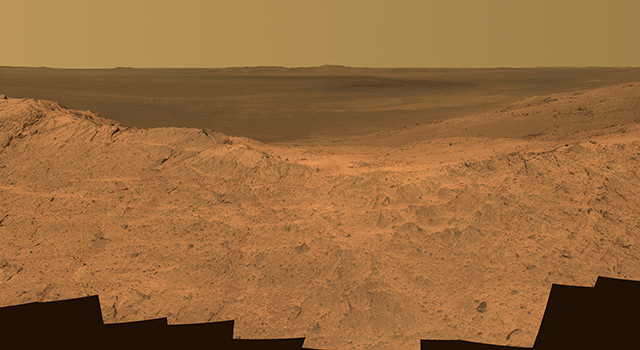
Opportunity reached the northern end of the montmorillonite-bearing exposure last month – a high point known as “Pillinger Point.” Opportunity’s international science team chose that informal name in honor of Colin Pillinger (1943-2014), the British principal investigator for the Beagle 2 project, which attempted to set a research lander on Mars a few weeks before Opportunity landed there in January of 2004.

Beagle 2Opportunity Principal Investigator Steve Squyres, of Cornell University, had this to say about Pillinger:

Colin and his team were trying to get to Mars at the same time that we were, and in some ways they faced even greater challenges than we did. Our team has always had enormous respect for the energy and enthusiasm with which Colin Pillinger undertook the Beagle 2 mission. He will be missed.

Though selected as a science destination, Pillinger Point also offers a scenic vista from atop the western rim of Endeavour Crater, which is about 22 kms (14 miles) in diameter. The picture below shows a section of a color shot taken by Opportunity’s panoramic camera (Pancam) upon arrival. A full-size view of this picture can be seen by going to NASA’s Jet Propulsion Laboratory Mars Exploration Rovers webpage.

Pillinger_pointInitial measurements at this site with the element-identifying alpha particle X-ray spectrometer at the end of Opportunity’s arm indicate that bright-toned veins in the rock contain calcium sulfate. Scientists deduce this mineral was deposited as water moved through fractures on Endeavour’s rim. The rover found similar veins of calcium sulfate farther north along the rim while investigating there earlier last month.


As Opportunity investigated this site and other sites farther south along the rim, the rover had more energy than usual. This was due to the solar cells being in rare form, says Opportunity Project Manager John Callas of NASA’s Jet Propulsion Laboratory:

The solar panels have not been this clean since the first year of the mission. It’s amazing, when you consider that accumulation of dust on the solar panels was originally expected to cause the end of the mission in less than a year. Now it’s as if we’d been a ship out at sea for 10 years and just picked up new provisions at a port of call, topping off our supplies.

Both Opportunity and its rover twin, Spirit, benefited from sporadic dust-cleaning events in past years. However, on the ridge that Opportunity has been navigating since late 2013, winds have removed dust more steadily, day by day, than either rover has experienced elsewhere. The rover’s signs of aging – including a stiff shoulder joint and occasional losses of data – have not grown more troublesome in the past year, and no new symptoms have appeared.

mountsharp_galecraterJPL’s Jennifer Herman, power-subsystem engineer added:

It’s easy to forget that Opportunity is in the middle of a Martian winter right now. Because of the clean solar arrays, clear skies and favorable tilt, there is more energy for operations now than there was any time during the previous three Martian summers. Opportunity is now able to pull scientific all-nighters for three nights in a row — something she hasn’t had the energy to do in years.

During Opportunity’s first decade on Mars and the 2004-2010 career of Spirit, NASA’s Mars Exploration Rover Project yielded a range of findings about wet environmental conditions on ancient Mars – some very acidic, others milder and more conducive to supporting life. These findings have since been supplemented and confirmed by findings by the Curiosity Rover, which hopes to find plenty of clues as to the nature of possible life on Mars when it reaches Mount Sharp later this summer.

Source: sciencedaily.com, marsrovers.jpl.nasa.gov

News from Mars: Martian Water and Earth Organisms

curiosity_peakThis August, the Curiosity Rover will be celebrating its second anniversary of roving around the Red Planet. And ever since it made landfall, Curiosity and the Mars Science Laboratory has repeatedly uncovered signs that Mars was once very like Earth. Basically, it has become undeniable that water once flowed freely over the surface of this barren and uninhabitable world. And this finding, much to the delight of futurists and sci-fi enthusiasts everywhere, is likely to pave the way for human settlement.

Liquid water disappeared from Mars’ surface millions of years ago, leaving behind tantalizing clues about the planet’s ancient past—clues that the MSL has been deciphering for the past 22 months. This began last year when Curiosity found rounded pebbles in the Glenelg region, an indication that a stream once flowed at the site. This was followed by the discovery of rocky outcroppings where the remains of an ancient stream bed consisting of water-worn gravel that was washed down from the rim of Gale Crater.

mountsharp_galecraterThe rover has since moved to a location about 6.5 kilometers (4 miles) away from the Gale Crater landing site, where scientists expect to make even more discoveries. The new location is named Kimberly, after a region of northwestern Australia. As Dawn Sumner, a UC Davis geology professor and co-investigator for NASA’s Mars Science Laboratory team, explained:

Our findings are showing that Mars is a planet that was once a whole lot like Earth. All the rocks we’ve seen on this mission are sediments that have been deposited by water. We’ve found almost no sandstone deposited by wind.

Sumner is working from Curiosity mission control at NASA’s Jet Propulsion Laboratory in Pasadena while on sabbatical from UC Davis, exploring whether the planet ever had an environment capable of supporting microbial life. She is also one of several UC scientists and engineers who have been vital to the success of the Curiosity mission, which is part of NASA’s long-term plan to pave the way for sending astronauts to Mars.

Living-Mars.2In that vein, research continues here on Earth to see exactly what kind of life can survive in the harsh Martian environment. And now,  research suggests that methanogens – among the simplest and oldest organisms on Earth – could survive on Mars. These microorganisms are typically found in swamps and marshes, where they use hydrogen as their energy source and carbon dioxide as their carbon source to produce methane (aka. natural gas).

As an anaerobic bacteria, methanogens don’t require require oxygen or organic nutrients to live, and are non-photosynthetic. Hence, they would be able to exist in sub-surface environments and would therefore be ideal candidates for life on Mars. Rebecca Mickol, a doctoral student in space and planetary sciences at the University of Arkansas, subjected two species of methanogens to Martian conditions to see how they would fair on the Red Planet.

methanogens485These strains included Methanothermobacter wolfeii and Methanobacterium formicicum, both of which survived the Martian freeze-thaw cycles that Mickol replicated in her experiments. This consisted of testing the species for their ability to withstand Martian freeze-thaw cycles that are below the organisms’ ideal growth temperatures. As she explained it:

The surface temperature on Mars varies widely, often ranging between minus 90 degrees Celsius and 27 degrees Celsius over one Martian day. If any life were to exist on Mars right now, it would at least have to survive that temperature range. The survival of these two methanogen species exposed to long-term freeze/thaw cycles suggests methanogens could potentially inhabit the subsurface of Mars.

Mickol conducted the study with Timothy Kral, professor of biological sciences in the Arkansas Center for Space and Planetary Sciences and lead scientist on the project. She presented her work at the 2014 General Meeting of the American Society for Microbiology, which was held from May 17th to 20th in Boston.

maven_atmosphereThe two species were selected because one is a hyperthermophile, meaning it thrives under extremely hot temperatures, and the other is a thermophile, which thrives under warm temperatures. Since the 1990s, Kral has been studying methanogens and examining their ability to survive on Mars. In 2004, scientists discovered methane in the Martian atmosphere, and immediately the question of the source became an important one. According to Kral:

When they made that discovery, we were really excited because you ask the question ‘What’s the source of that methane?. One possibility would be methanogens.

Understanding the makeup of Mars atmosphere and ecology is another major step towards ensuring that life can exist there again someday. From Red Planet, to Blue Planet, to Green Planet… it all begins with a fundamental understanding of what is currently able to withstand the Martian environment. And once this foundation is secured, our ecologists and environmental engineers can begin contemplating what it will take to create a viable atmosphere and sustainable sources of water there someday.

terraformingSources: phys.org, (2)