Once in a while I like to break from sci-fi to honor major political developments or anniversaries. And since I missed out on honoring those who participated in D-Day on June 6th, I refuse to let this one pass without comment as well. As many are no doubt aware, it’s the 200th anniversary of the War of 1812, and in many countries, this occasion is being marked and commemorated. For many people in many nations, not just the historians among us, this war was extremely significant.
But what is most interesting is how it is remembered differently. For Canadians, 1812 was a decisive moment in which the country came together to repel a foreign invasion and declare its nationhood in the face of annexation. For Americans, it is remembered as a largely defensive affair in which a second British attempt at invasion was repulsed. For the the British, it was a largely colonial affair that was designed to distract them from the war on the Continent with Napoleon. And for the First Nations of Canada and the US, it was seen a loss which led to further annexation and loss of sovereignty.
And that’s just the Anglo-American perspective. If we were to set our sights a little farther abroad, we’d notice that people in Russia, Germany, and France also have thoughts of their own to share. For France, 1812 was a major setback in the larger affair known as the Napoleonic Wars. For this stout general/dictator from Sardinia, it was the beginning of the end for his rule and his empire. The Russians accordingly saw it as a great victory against a foreign invader, one which they would exploit in future wars to bolster morale. And for Germany, being forced to fight in Napoleon’s “Grand Armee” was a catalyzing event that helped to rouse national sentiment, ultimately leading to German unification in 1871.
Interesting how history can be relative, isn’t it, depending on who you ask and what their perspective is? But thanks to my own historical studies, I’ve learned much about this war, and can say that they all reflect a certain aspect of truth. In the end, all points of view and how we choose to remember the war tell us much of our national experience of it and confirm that the war was a very large affair that was experienced differently all around the world. I shall be brief, since the real historians are the ones you should be listening to. I just want to offer my humble two cents 😉
The American Perspective:
 In the course of studying American history, I was interested to see just how the War of 1812 was treated. It was no secret to me that the popular American conception is that they won the war – here in Canada we say the exact same thing. But what I did find objectionable was the rather glaring ommissions that seemed to pervade the history textbooks on the subject.
For example, so many of the battles which took place on Canadian soil were not mentioned, the focus being on the battles America won and which happened for the most part on their own soil. These included the Battles of Plattsburgh, Chesapeake Bay, Washington DC, and especially New Orleans.
 And yet, the best explanations I have heard for this come from American historians themselves. As one put it, “Americans, when they chose to remember the war at all, focus on the last year of the war when the battles were defensive in nature”. This, he claimed, is what gives rise to the illusion that America was fighting a defensive war which allowed them to think of it as a victory.
Another historian, who was also a General in the US Army, claimed that it is only in West Point Academy that a full and comprehensive treatment of 1812 is available in the US. Here, he claims, officers in training are taught that 1812 is a perfect example of what NOT to do in a war, namely go to war with overconfidence, an underfunded and staffed army, and a divided country.
And yet another claims that 1812 is America’s first “forgotten war”, beating Vietnam by over a century and a half. I especially liked this take on it since I’m a real proponent of how history repeats itself, just in different settings with different particulars. Seen in this context, 1812 was a less than stellar affair which quickly became overshadowed by the Revolutionary War and the Civil War, both of which were decisive for America and had a far greater impact on their history and development as a nation.
The First Nation Perspective:
 Compared to the other perspectives, this one is by far the most sobering and real. In fact, one could characterize it by saying that this is a case where people were invited to a war, made a big difference, and then were shut out in the cold to be forgotten while the other combatants came to terms and all had their own victory parties. Disgusting really, but it teaches us something about how history frequently screws people over.
For the Cree Nation and the many nations that encompassed the Great Lakes Region, the war began long before 1812. Prior to this, American encroachment led many nations in the Ohio valley to begin to organize and militarize for the sake of defense. Seeing opportunity and common cause in this, the British began arming these nations and making alliances with them, knowing that any invasion northward would effect all. At the forefront of all this was a committed individual named Tecumseh, a Cree leader who was responsible for much of the cultural revival that was setting in and saw potential in an alliance with the British.
When war was declared, Tecumseh and his bands of fighters proved to be the decisive factor in several battles, not the least of which was at Fort Michigan, where they came upon the garrison by way of the river and took the fort with barely any casualties or shots being fired. In time, the collaboration between Brock (the British Commander) and Tecumseh led Brock to give him his overcoat as a personal gift. However, in keeping with his cultural traditions, Tecumseh conferred the honor onto a more senior warrior in his army. Brock was not offended.
During the American invasion of Upper Canada, the Mohawk nation also proved decisive. At the attack on Fitzgibbon, Mohawk warriors mounted a surprise attack on the unsuspecting American army and forced the surrender of over 500 troops. They had been tipped off by a young woman named Laura Secorde, a nurse who had been privy to the American plans while tending to wounded soldiers on Canadian soil.
In just about every subsequent battle on Canadian soil, Cree, Mohawk and Iroquois warriors were intrinsic to the fight. In fact, it would be no exaggeration to say that the presence of these seasoned warriors was often the difference between victory and defeat. Facing overwhelming numbers, the Angl0-Canadian forces were often bolstered by the fact that American troops were frightened of Native warriors, having been subjected to stories about their fearsome, bloodthirsty nature for so long.
 Unfortunately, the war ended for the Cree Nation and Tecumseh during the Battle of Moraviantown (aka. the Battle of the Thames)i n southern Ontario. After the defeat of British naval forces on Lake Erie, British forces were ordered to pull back to where they could be reinforced and resupplied.
However, Tecumseh objected and voted instead to hold the line against the advancing American armies. Though he died and his forces were defeated at Moraviantown, this battle stalled the American forces long enough to give the British and Canadian forces time to regroup. As a result, the Americans were defeated at Lundy’s Lane six months later and the last invasion of Canadian soil was stopped.
The Canadian Perspective:
As I already stated, from the Canadian point of view, 1812 was a decisive war that saw the country come together to repel a foreign invader. This perspective does gloss over the fact that there were divisions between Upper and Lower Canada, that victory was owed in large part to its Native allies, and that Canada was still nominally a colonial possession of the British Empire. However, the perspective still holds true, as Canadian militia were the cornerstone of the small garrison of British regulars. In fact, Brock chose to dress all of his militia in the same red coats as his regulars in order to give the illusion that he had a larger force. This in turn would play a major role in ensuring the cohesion and organization of his forces in the battles to come.
 And to top it off, Canadian forces did succeed in overcoming the odds against a much larger American invasion force. Whether it was the assaults on American border forts in Michigan and along the Great Lakes or defensive actions in Ontario and Quebec, Canadian forces managed to acheive an almost unbroken string of victories.
These included the Battles of Queenstown Heights, where the American forces that had crossed Lake Ontario and set fire to York (modern day Toronto) were defeated. The Battles of Chrysler’s Farm and Chateauguay were also decisive victories which forced the American forces to abandon their St. Lawrence campaign, the planned invasion of Quebec. And finally, Lundy’s Lane, though not a decisive victory, was seen as the final battle in which the invaders were stopped.
All of these experiences served to galvanize national sentiment and helped to inspired demands for reform which would culminate in the Rebellions of 1837. This is especially ironic seeing as how American planners believed that the Upper Canada Loyalists would welcome an American invasion and see it as a chance to throw off British rule. Instead, it inspired Canadians to reject union with the United States and demand a measure of independence on our own terms.
The British Perspective:
 And last, but not least, we have what Merry Ol’ England thought of the whole affair. Far from seeing it as a mere diversion, the British were actually quite invested in what took place on North American soil, even if they did see it as a distraction from Napoleon’s invasion of Russia.
For many years, Britain had been locked in a state of cold war with the US, monitoring the frontier with wary anxiety and taking every opportunity to bolster its defenses, either by supplying Native allies or making sure their were garrisons in Upper and Lower Canada and fleets on the Great Lakes.
Though these were by no means comparable to American forces, they did indicate how seriously the British took the prospect of an American invasion. And in the end, Britain felt pretty good about it’s conduct during the war. Their vaunted General Brock, though he died in the line of duty, organized a stalwart defense of the colonies while the British Navy harassed and assaulted many American ports. Though eventually these invasion attempts were rebuffed, they did meet with some success.
 While Brock and Tecumseh managed to seize a series of key forts in the Great Lakes region and burned Detroit to the ground – in retaliation for the burning of York – they managed to set upon Washington DC and burned it to the ground. This is something which is commemorated extensively on the American side, particularly how a portrait of George Washington was saved before the old White House was set ablaze.
But of course, the defeated attempts at invasion did not go unnoticed either. Whether it was at Plattsburgh, Baltimore or the disastrous assault on New Orleans, it was clear that the war would end with American territorial sovereignty more or less intact. As a result, Britain would walk away from the war undefeated, but without much to show for it.
But of course, that was ultimately the goal in North America, to repulse the American invasion while at the same time ensuring that Napoleon’s defeat on the continent was assured. With the signing of the Treaty of Ghent in 1814, and the war with France now over, Britain breathed a temporary sigh of relief. This would end with Napoleon’s return from Elba, but that too would be resolved with the Battle of Waterloo a year later. For the British, as well as the Americans, 1812 would fade into obscurity, something to be remembered mainly by historians and not popular consciousness.
Final Thoughts:
Well, that’s my limited appraisal of the war. For the full scoop, you really need to check in with the historical recreationists, especially those who maintain the border forts along the Great Lakes region. For example, if you’re in Kingston, best check out Fort Henry. I remember going there as a preteen and thinking just how awesome the whole affair was. Not only do they dress in period costume and tell you much about the history of the fort, they also conduct actual musket and cannon drills just to keep things interesting and authentic.
Also, be sure to do your own research on this and other “forgotten wars” of history. It’s often because they were so instructive that they are allowed to fade into obscurity, mainly because people would like to forget what happened. However, that is how lessons are avoided and convenient lies allowed to permeate. Those familiar with World War I and the legend of the “Stab in the back” will know what I mean by that! Had people not been in such a hurry to forget the carnage and pretend that the war was just a big misunderstanding, or that Germany had been betrayed and not defeated, World War II could very well have been avoided.
And for those veterans who fought in the Vietnam War, as well as those returning from Iraq and Afghanistan (two “forgotten wars” in the making), the lessons of a forgotten war cannot be allowed to go unlearned again. In fact, one could argue that if 1812 were taught in full in schools and academic institutions other than West Point throughout the country, wars like Vietnam and Iraq could have been avoided. When one reads of how men like Jefferson said taking Canada would be “a mere matter of marching”, slogans like “domino effect” and “we’ll be welcomed as liberators” suddenly ring very hollow!
In short, there’s a reason history is full of repeats. All too often, it seems that only a select few are able to discern the patterns and realize that this sort of thing has been done before, usually with disastrous consequences. And my father – who recently visited Europe as part of commemorative trip – would tell you, some people do remembrance right! In Belgium, especially in the town of Ypres, commemorative ceremonies are an almost everyday occurrence. Those who died in the defense of the country and the events which devastated it are solemnly remembered on a regular basis, not just once a year. One would get the impression that these things are important to them!
Okay, that’s enough out of me. Happy anniversary War of 1812. You accomplished much, remind us of much, and really deserve to be honored, regardless of the fact that you fell between the War of Independence and during the Napoleonic Wars. I tell ya, those wars are such attention hogs! In any case, I look forward to 2014 too, when the end of World War I will be commemorated the world over, but especially in Flanders where the people will holding all kinds of celebrations to mark the centennial of the end of the Great War. My wife and I plan to be in attendance. I know my folks will be front row center!
Good day and peace be with you, friends!

 Wouldn’t you know it? Today marks what would have been Alan Turing’s 100th birthday. This man was not only immensely influential in the development of computer science and cryptanalysis, he is also considered the father of Artificial Intelligence. In fact, words like “algorithm” and “computation” are traced to him, as was the development of the “Turing machine” concept which has helped computer scientists to understand the limits of mechanical computation.
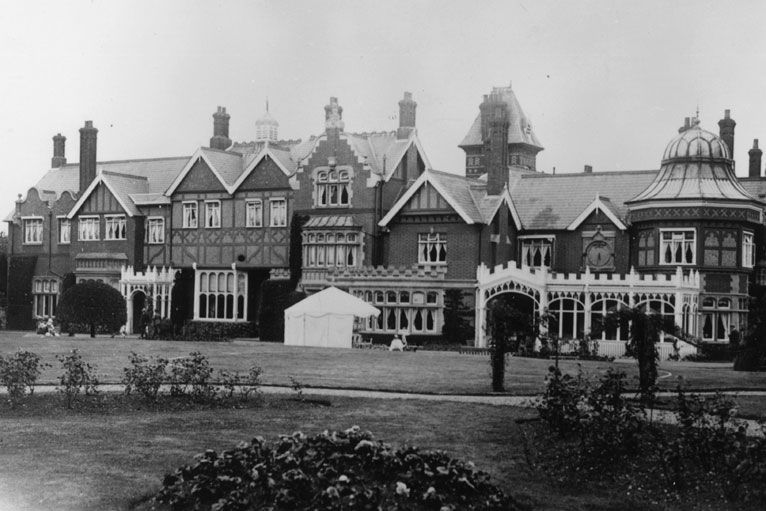 However, his reputation goes far beyond the field of computer science. During World War II, he worked at the Government Code and Cypher School (GCCS) at Bletchley Park, Britain’s codebreaking centre. For a time, he was acting head up Hut 8, the section responsible for breaking the Enigma Code, Germany’s wartime cypher which they used to encrypt all their communications. Were it not for this achievement, the Allies may very well have lost the war.
 Especially in the Atlantic, where German U-boats were causing extensive losses in Allied shipping, Turing’s work proved to be the different between victory and defeat. By knowing the disposition and orders of the German fleet, crucial shipments of food, raw material, weapons and troops were able to make it across the Atlantic and keep Britain in the war. Eventually, the broken codes would also help the Allied navy to hunt down and eviscerate Germany’s fleet of subs.
 In 1948, he joined the Computing Laboratory at Manchester University, where he assisted fellow mathematician and codebreaker Max Newman in the development of the Manchester computers. Their work would eventually yield the world’s first stored-program computer, the world’s first computer to use transistors, and what was the world’s fastest computer at the time of its inauguration (in 1962).
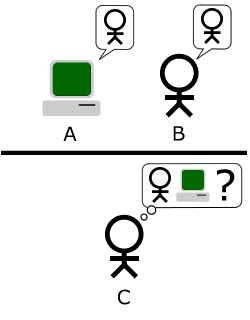 In terms of Artificial Intelligence, Turing proposed that it might be possible one day to create a machine that was capable of replicating the same processes as the human mind. The “Turing Test” was a proposed way of testing this hypothesis, whereby a human test subject and computer would both be subjected to the same questions in a blind test. If the person administering the test could not differentiate between the answers that came from a person or a machine, then the machine could be accurately deemed as an “artificial intelligence”.
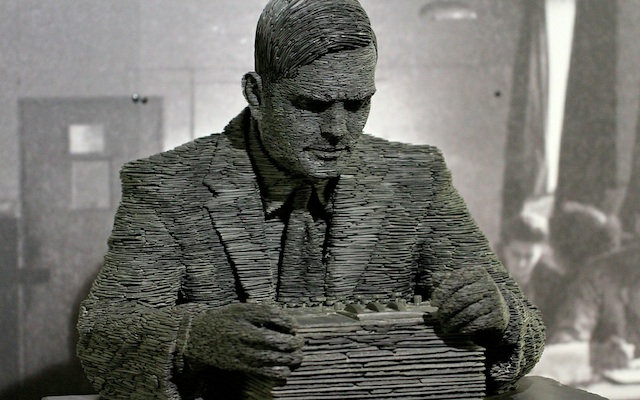 In Manchester, where Turing spent much of his life, many tributes have been in his honor. In 1994, a stretch of the Manchester city intermediate ring road was named “Alan Turing Way” while a bridge carrying this road was widened and renamed the Alan Turing Bridge. In 2001, a statue of Turing was unveiled in Sackville Park, which commemorates his work towards the end of his life. The statue shows Turing sitting on a bench, strategically located between the University of Manchester and the Canal Street gay village.