Utopian Science Fiction

Imminent Utopia by Kuksi

Welcome back my friends! A funny thing happened just this morning. I was looking at an old article –  titled Dystopian Science Fiction – and realized that something was missing. Yes, this is the article that earned me most of my current followers and the bulk of my traffic on this site, but I quickly came to the conclusion that there was a hidden voice in that little study that never got a chance to have its say.

Basically, when I was looking into dystopian literature, I realized that it and utopian literature are almost the same thing. You might say that they represent two sides of the same coin, not so much opposites as interchangeable facets where one can become the other with a simple turn of the wheel. So I asked myself, why then haven’t I compiled a list of the most popular Utopian literature to go along with my dystopian one? Having read Thomas More’s seminal book that started it all, I’m nothing if not incredibly fascinating by the subject. And anyone who knows me knows that I’m a nerd for research and can’t resist sharing what I find.

So why the hell haven’t I done this yet?! Don’t know, probably got swept away with all those posts about robots, ships, and guns. In any case, it’s a mistake I rectify here and now. Using the same format as my article on dystopian sci-fi, I’ve come up with a tentative list of the greatest forerunners, classics, and modern examples of utopia in literature. The list is by no means complete, but I feel it is a faithful sampling. You be the judge, here goes:

Earliest Examples:
The first acknowledged examples of utopian literature come to us from classical antiquity, when scholars reached beyond the old strictures of writing about dynastic struggle, great wars and the foundations of their empires to tackle issues such as justice, morality, and the driving forces of history. By asking these questions, and offering up possible explanations, they were to have an immeasurable effect on subsequent generations of intellectuals, statesmen and social reformers.

The Republic:
Written around 380 BCE by Plato, this is perhaps the oldest example of utopian literature. Written as an account of one of Socrates many dialogues, the chief purpose of this book was in finding the true definition of justice and what it takes to achieve a just city-state and a just man. As Plato’s best known work, it is also one of the most influential philosophical and intellectual texts in the history of western society and maybe even the world.

Made up of ten books, the account follows Socrates and his Athenian and foreign guests as they discuss various topics. Amongst them are whether or not the “just man” is happier than the “unjust man”, the theory of forms and universality, the nature of the soul, the role of the philosopher in society, and finally, what the different types of government are and what makes them just/unjust.

From Plato’s account, Socrates and his peers proposed that philosophers are the ideal statesmen and that justice can best be summed up by considering the common good rather than common sense definitions having to do with personal justice. In addition, the allegory of the cave – how we are all essentially prisoners and merely going by projections of truth rather than truth itself – was advanced. And finally, they listed the four predominant forms of government (timocracy, oligarchy, democracy and tyranny) and how they tended to devolve into each other.

Ultimately, the value of this work was in how it showed the connection between political cause and effect, and how it sought to create guidelines for good governance. It’s identification of the four major types of government has been used over and over in the history of political discourse and even became the basis of modern political sciences. And because of its focus on things like the common good and the idea of philosopher statesmen, it was also to have a profound influence on later generations of scholars, particularly Sir Thomas More, Thomas Hobbes and Karl Marx.

The City of God:
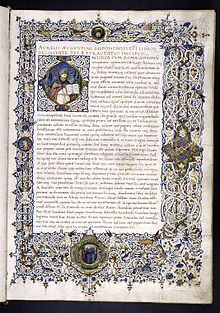
Written by St. Augustine of Hippo in the early 5th century CE, The City of God is considered one of the most important texts in the history of Christianity. Written after the Visigoth sack of Rome, the text was intended as much as a consolation to Christians as it was a discourse on theological matters. Basically, Augustine claimed that though the city of Rome had fallen, the City of God, the “eternal Jerusalem” still stood strong and would endure.

Essentially, Augustine advanced a perception of history in this book that was characterized by a dialectical process, or a conflict between opposites. On the one hand, there was the City of Man, characterized by earthly pleasures and decadence, and the City of God, dedicated to eternal truth. The conflict, he claimed, would end with victory for the latter, where people would throw off the bonds of an earthly paradise in favor of a spiritual one.

Thought it did not concern itself with matters of practical governance or how an ideal state could be created in the here and now, Augustine’s treatise was to have a profound effect on the fields of theology and philosophy. Basically, his idea of a city where spiritual purity could be attained became the basis for a theocratic state, while his theory on the dialectical process of history would go on to inspire men like W.F. Hegel and (again) Karl Marx.

Tao Hua Yuan:
Otherwise known as “The Tale of the Peach Blossom Spring”, this book is considered the quintessential utopian book by Chinese scholars and historians. Written in 421 CE by Tao Yuanming, it is an epic poem of how a traveler accidentally discovers an ethereal paradise where people live an idyllic existence, unaware of the world outside their walls.

Written after the collapse of the Han Dynasty, a period marked by civil war and unrest, this poem tells the tale of how a fisherman sailed up a river that was entirely surrounded by blossoming peach trees. At the end of the river, he finds a village where the people, thought surprised to see him, welcome him and treat him as one of their own. He quickly realizes that the community is an idyllic one, where people live in harmony with nature and one another.

In time, he learns from the villagers that this place was established by their ancestors during the last civil war when the Qin Dynasty was conquering all of China. Since that time, they have been cut off from the outside world and know nothing of its political shifts and wars. Upon leaving, he is told that it would be pointless to recount his discovery of the village to others. He nevertheless makes a note of the village on his map, but when he tells others of it, their attempts to locate it prove unsuccessful.

In essence, the poem suggest that this place, the idyllic village, was otherworldly, and the man’s voyage up the river was in fact a voyage into the afterlife. It also advances the idea that it is only in being cut off from the outside world that an earthly paradise can exist, and those that leave it will never be able to return. This idea was to have a profound influence on Chinese and Asian culture, no doubt inspiring such myths as that of Shangri-La. In addition, the Chinese expression shìwaì taóyuán, which refers to a remote paradise – and literally means ‘the Peach Spring beyond this world’ – has its roots in this poem.

The Classics:
By the time of the Renaissance (14th/15th century CE), Europeans began to have a renewed interest in classical learning. At first, this consisted of merely adapting and translating previously lost texts from ancient Greek and Arabic to Latin and other European languages. However, by the time of the Enlightenment (18th century CE), European scholars were adapting and expounding on classical ideas, bringing them forward into the modern age with new speculations and examples on how a perfect society could be created, or whether or not one was even possible. It was also the age that the term Utopia began to be used popularly.

Utopia:
Ah yes, the man who gave it a name! Sir Thomas More, otherwise known as Saint Thomas More, was a Renaissance humanist and THE man who brought the word Utopia into modern usage. Written in 1516 CE, his seminal study on the perfect society has influenced all subsequent generations of social critics, employing social criticism, history and of course, delicious irony to make a series of points about the ideal society and whether or not it can even exist.

The story is told (much like Plato’s Republic) as a dialogue between the author and a fictitious man named Raphael Hythloday, a world traveler and tradesman. In the course of recounting his tales of all the places he’s seen he brings up one in particular place, the island nation of Utopia, which he hails as the best of all possible societies. As the story goes on, he details exactly what it is that makes it an ideal place, and by comparison, all others flawed.

To break it down succinctly, the Utopians do not value gold and silver because they long ago discovered that there worth is merely an extension of their rarity. Instead, they choose to value iron and bronze as precious and keep jewels, gold and silver in reserve in case they need to bribe foreign princes or armies. In addition, their economic activity is based on an egalitarian principle, where all people rotate from one service to another so that no sense of class hierarchy ever becomes permanent.

What’s more, when it comes to education, the Utopian have made it manifest that all people be taught to read and educated on basic matters of logic, philosophy, numeracy, etc. This is to prevent the creation of a philosopher caste which is concerned solely with matters of thought while others toil away and provide for them. Much like with their policy or rotating labor, it is customary that all people divest themselves from their tasks every now and then to pursue matters of art, science and other intellectual pursuits.
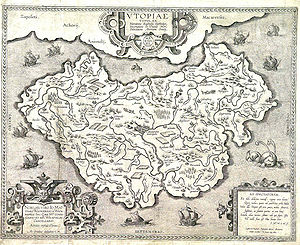
map of Utopia

And of course, politics, property ownership, and all other forms of activity on Utopia are considered communal. There is no such thing as private property, rule is exercised by council and not by kings and a court, and membership in this council is rotational, popular and considered a civic duty. In short, Utopia is an ideal society because rule by the few, greed and ownership are all forbidden. And though there are few laws to speak of, all of these practices are contained within a strict code of conduct which was passed down by the island’s founder, King Utopus.

And last, but certainly not least, is the issue of religious tolerance. Written during the time of the Reformation Wars, More claimed that in this ideal society, no one’s faith was ever held against them. Provided they believed in a higher power, no discrimination or persecution were allowed under the law. However, there was one exception, which applied to atheists (!). Essentially, it stated that anyone who did not believe in the hereafter, where they would be answerable for their sins, would be allowed to hold public office.

In the end, Hythloday claimed that there was no reason why other nations could not adopt these same principles which benefited the nation of Utopia so. The only reason, he claimed, was because all other nations of his day were “conspiracies of the rich” where enlightened reform is avoided because of greed, vanity and pride. Ultimately, More chooses to disagree with this fictitious character on numerous points as a way of distancing himself from the critique.

In addition, there are several ironic points which seem to indicate that he was also questioning whether or not such a place could even exist. The name Utopia for one translates from Latin to mean “No Place”. In addition, many of the customs he describes sound less than ideal and would seem to suggest that the only way to create a perfect society is to force people to comply with strict rules, which in turn can create its own problems. In the end, it was not clear if More was saying that such a place does not exist, could exist, or will never exist. All that is clear is the influence it had, once again by expounding on the virtues of collectivization, popular sovereignty and the removal of class distinction.

Gulliver’s Travels:
Though I included this novel in my previous list as an example of dystopian fiction, there are many elements of Gulliver’s Travels that fit into the category of utopia as well. For example, between every voyage Gulliver undertakes which brings him to a land that parodies some aspect of English and European society, there is a corresponding trip to a comparatively idyllic place.

After traveling to the land of the Lilliputians, a land of moral midgets who’s size matches their outlook, he travels to the land of Brobdingnagians where the same rule applies, only in reverse. Whereas he was denounced by the Lilliputians for not helping them to subjugate their neighbors, to the Brobdingnagians he was considered a novelty and his own moral outlook was received with horror.

In addition, after traveling to Laputa, Balnibarbi, Luggnagg, Glubbdubdrib, and Japan, all of which are seen to be inherently flawed in some respect, he travels to the land of the Houyhnhnms. These horse people, who boast rational capacities that put humanity to shame, are seen as the perfection of nature whereas humans are seen as brutish. What’s more, Gulliver’s time amongst them makes him inherently sympathetic to them, but in the end they deny him the right to live amongst them since they see him as a danger to their civilization.

Ultimately, Swift did not give any details as to how the morally upright societies which stood in contrast to his parodies achieved their current state. But by including them in his story, he was employing a decidedly utopian tactic – using a fictitious, ideal society to point out the flaws in an existing one.

Erewhon:
Also known as “Over the Range”, this novel by Samuel Butler is renowned as a prime example of utopian literature (though there are some dystopian elements as well). Published in 1872, the bulk of the story is an account of the fictional nation named Erewhon which is located within the mountains of New Zealand. Often compared to Gulliver’s Travels and Letters from Nowhere (1890) the tale is about a seemingly perfect society which proves to be less than all that.

In describing Erewhon, Butler paints the picture of an idyllic society where people live close to the land. There is also no machinery because the people of Erewhon fear that it will someday become intelligent and supplant them – a rather unique take on Darwin’s theory of evolution and natural selection.

However, in time, the author notes several odd customs in this land involving their justice system, religion and system of coinage. For example, criminals are treated as invalids in their society, whereas invalids are treated as criminals. In addition, religious institutions offer their own coinage and act like banks, but are immune to charges of counterfeiting because they are religious institutions. These practices were meant to satirize certain aspects of Victorian society at the time, including its religious hypocrisy, intolerance and anthropocentricism.

Clearly inspired by other utopian writers, Butler even went as far as to borrow a page from More who was also ironic with his choice of title. The name Erewhon, an anagram for “Nowhere”, makes the deliberate point that this society is fictitious, and therefore its better elements are not to be found anywhere. Though by no means a dystopian story, it is nevertheless a poignant allegory for the British Empire during the time of writing, an empire that for all intents and purposes did not live up to its own ideals.

Modern Examples:
Though by no means as popular as dystopian literature, utopian novels were still a very common feature in the 20th century. And like dystopian lit, it was used repeatedly by authors to mock and satirize the world of their day. By showing a society that had overcome mankind’s traditional flaws, some sought to demonstrate how society could be bettered. Others, however, liked to juxtapose the belief in a perfect society with the reality of an imperfect one, as a way of demonstrating how the quest was noble but was sure to encounter problems.

Men Like Gods:
Published in 1923, this work of science fiction by the venerable H.G. Wells explores an parallel universe where human beings live in a world without government.  Much like the time machine, the book contains equal parts speculative science and social commentary, involving a world in the future that parodied his own.

Taking place during the summer of 1921, the story opens with a cynical English journalist named Barnstaple who is mysteriously transported through time to an alternate world named (interestingly enough) Utopia. Essentially an advanced Earth, Utopia is three thousand years ahead of humanity, where people live in a perfectly realized anarchy, no government or sectarian religion exist, and scientific research flourishes.

All Utopians live by the “Five Principles of Liberty”: privacy, free movement, unlimited knowledge, truthfulness, and free discussion and criticism. After a month of staying amongst the Utopians, Barnstaple asks if he can stay amongst them but is refused. According to the people of this world, the best thing for this journalist is to return to his world. This he does, renewed of vigor and committed to the “Great Revolution that is afoot on Earth; that marches and will never desist nor rest again until old Earth is one city and Utopia set up therein.”

This was not a political revolution, in Well’s eyes, but rather the march of progress which he felt was already very much at work in society. In essence, such a revolution that was guaranteed by scientific and rational progress, he surmised, would one day wipe away all the current problems of the world. Namely, petty nationalism, sectarian turmoil, and irrational fear.

Childhood’s End:
Released in 1953, this story is perhaps Arthur C. Clarke’s best known novel outside of the Space Odyssey series, and the one which established him as a writer. Embracing many themes which would show up in numerous sci-fi franchises, the book deals with the near-future possibility of contact with an alien species and the profound effect it will have on humanity. Broken down into three parts, the book begins with the arrival of aliens, moves onto the effect they have, and concludes with the aftermath of their experimentation and their departure.

The story opens with the introduction of the Overlords, a space faring race that appear suddenly in orbit around Earth in the late 20th century. With their ships poised over every major city on Earth, they issue a simple directive: End all war, now and forever. They assume a sort of indirect control over human affairs, preferring to stay aboard their spaceships, and communicating directly with only the Secretary-General of the UN.

Though many suspect of them of malicious intent, the Overlords influence is largely indirect and they promise to reveal themselves in 50 years. In the meantime, the suppression of war leads to a sort of golden age where prosperity flourishes, but at the expense of creativity. When 50 years is up, the demon-like Overlords emerge and begin conducting some seemingly benign psychic research.

Generations pass and humanity grows antsy due to a general feeling of stagnation. However, many children begin to be born who demonstrate telekinetic powers. Finally, the Overlords reveal that they are representatives of what is called the Overmind – a vast cosmic intelligence created from alien races that have all shed matter’s restrictions and become cosmic beings. The Overlords, for whatever reason, cannot join the Overmind, so they act instead as a bridge, seeking out intelligent life and fostering cosmic evolution. Humanity is now set to join this intelligence, having become post-human and ready to embrace their full potential.

Though some would see this concept of Overlords, Overminds, and tampering with evolution as a negative, Clarke presented it as an unequivocal positive. To him, the idea that humanity would need to be forced to become enlightened seemed like a perfectly plausible means of overcoming its inherent flaws. This is in keeping with Clarke’s Futurist mentality, where progress is not only inevitable and desirable and human antipathy towards progress is based on irrational fear.

The Dispossessed:
Published in 1974, this novel is one of several  utopian science fiction books published by famed author Ursula K. Le Guin. Written during the Vietnam War, the story takes place in a distant solar system (Tau Ceti) where two empires with diametrically opposed views become engaged in a proxy war when a neighboring state undergoes a revolution.

Set in the same universe as her critically-acclaimed story Left Hand of Darkness, the Tau Ceti system consists of two major worlds – Anarres and Urras. Urras is the focal point of the story, a planet which is dominated by two major nations which are rivals. The A-lo nation (which represents the US) is capitalistic and patriarchal whereas the Thu nation (Soviet Union) is run by an authoritarian regime that claims to rule in the name of the proletariat.

To complete the analogy, both states become embroiled in a war when an underdeveloped nation named Benbili experiences a revolution which prompts both sides to invade. Thus, Benbili comes to represent South-East Asia at the time of the Vietnam War, just as Urras represents the world at the time of writing – a world divided between two diametrically opposed empires, both of whom seem to think they are the example of a perfect society (or as close as one can come to it).

As the story goes on, we learn that Anarres, the other major world, was settled long ago by a group of proto-Anarchists who left Urras to escape the planet’s divided nature. Since that time, the Anarrean people have created an egalitarian society which maintains contact with Urras only through its capitol-city spaceport. In keeping with the story, this alternate planet can be seen as a third option for humanity, which finds itself otherwise torn between two extremes.

This calls to mind Brave New World, where Huxley had created a planet torn between madness and insanity, or primitive freedom and “civilization”. In the end, the character of John the Savage, a man who had a foot in both worlds, could not reconcile himself to either and killed himself. Huxley had long expressed regret with this outcome, thinking that he should have offered a third option in the form of the exile communities that dotted the world in his story. Seen in this light, Dispossessed seems to offer solutions to the problem of two civilization fighting over who’s “utopia” is better.

Ecotopia:
Published in 1975, this novel is considered a pre-eminent work of utopian fiction and a fitting commentary on the green movement and counter-culture of the 1970’s. In it, author Ernest Callenbach describes a new society which has been founded in the Pacific Northwest by groups of ecological secessionists. Interestingly enough, his critique of this fictional society was based on environmental science and descriptions of actual communes that were being established across the mid-western US at the time.

Set in the year 1999, the story takes place from the point of view William Weston, a reporter named who is the first American to travel to the new country of Ecotopia. Most of the narrative consists of his cables back to the fictitious newspaper he works for, but other details are filled in by his diary entries. These include an affair with an Ecotopian woman, an experience which leaves him transformed and opens him up to the Ecotopian way of life.

Amongst the differences he notes between his world and this ecological utopia are the policies of universal health care, liberal cannabis use, fitness, local art and fitness (as opposed to television and spectacle sports), sexual freedom, and voluntary mock warfare. Curiously enough, they also celebrate gender roles and believe in racial separation. Not sure how those are meant to be utopian, but okay…

In the end, the narrator comes to see that the Ecotopians are not a backwards, regressionary people but simply individuals who want to live a healthier existence closer to the Earth. In addition to using modern technologies, provided they are ecologically friendly, they also maintain an advanced arms industry and stockpiles of WMD’s, a means of ensuring that a potentially revanchist US government doesn’t try to take back their territory by force. In the end, Weston chooses to stay in Ecotopia and act as a sort of cultural liaison to the outside world.

Aside from the issues of gender roles and racial segregation, this book seems to fit the description of an ideal society quite well. By demonstrating that a better life need not mean huge sacrifices or the denial of technology, Callenbach was basically arguing for an open mind when it comes to the ecological and social experiments which were taking place in the US at the time. His idea of an outsider coming to respect and embrace this culture also calls to mind More’s Utopia and Gulliver’s Travels, where the narrators did the same. He also seems to be arguing that a better society is not only possible, but within our reach.

The Giver:

Although classified as a dystopian novel by some, this 1993 piece of YA fiction has undeniably utopian elements, and therefore confounds simple classification. Taking place in a fictional community where pain and strife have been eliminated through “Sameness” and people’s roles are selected by a council of elders, The Giver begins as a description of a utopian society which gradually becomes more dystopian in its outlook.

Enter into this world Jonas, a young boy who has been selected by the elders to serve as the next “Receiver of Memory”. This person occupies a venerated position in their society since they are responsible for storing all memories that predate Sameness, just in case they are ever needed to aid in the decision making process.

As Jonas receives these memories, he comes to understand just how powerful knowledge is. People in his society are happy, but only because they are ignorant to any way of life that runs counter to their own. In the end, he faces a terrible dilemma. On the one hand, he could release the memories and enlighten his people, though it will surely mean chaos. On the other, he can keep them ignorant, thus ensuring stability for the time being.

Written for young adult audiences, but intensely mature in its outlook, this story not only examines what it takes to create a perfect society but what the costs of that might be. It is also very poignant in the way it addresses a theme which is crucial to growing up – how the end of innocence is a necessary step to becoming a mature and responsible individual. This is a step we frequently wish we could avoid, but seems inevitable in the long run.

Final Thoughts:
Looking at the extensive list of utopian fiction that has been produced across time, I am once again reminded of just how closely linked it is with dystopian fiction. It seems that all utopian commentaries emerged out of a problematic world, where authors felt the need to offer up a better or even ideal society as a means of satire or consolation. Though they differed in that they were not quite cautionary in nature, they shared the same basic purpose as dystopian tales. At once, they offered people a chance to examine this thing we know as the human condition and ask if something better were truly possible.

Overall, I’m not sure which I like better. When I was penning the article on dystopian literature, I could honestly say I preferred it because it seemed more realistic. Now, I wonder if there is not a profound sense of genius and realism to utopian literature that I was perhaps overlooking. Sure, one could make the argument that works like the Republic and Utopia were simple in their intent, claiming that society could be turned into a model of justice and fairness through basic reforms. But upon closer inspection, one sees the unmistakable presence of irony. In all cases, it seems like the author is agonizing over the question of whether or not such changes are even possible.

Sure, greed could done away with if collectivization were enforced. Sure, if money were abolished, there would be far less in the way of crime. Sure, if people were made to rotate between professions, there would be less class conflict and snobbery. And of course, if government were truly representative and those in power were closer to the governed, there would be less abuses of power. But how do you go about making that happen? How, without resorting to force or Draconian measures, do you get people to treat each other as equals and respect each other.

Like it or not, the question “can’t we all just get along?” has been dogging humanity since the beginning of time. Many solutions have been suggested, like the expropriation of the ruling class, a certain means of production, or a certain way of living. But inevitably, all these proposed solutions get tied up in moral considerations (i.e. killing is wrong), or questions of practicality – i.e. getting rid of all the cars, central heating, AC and electricity will lead to millions of deaths worldwide. So really, is utopian literature meant as a proposition for change, or is it merely a tool to make us contemplate the tougher questions?

I know my answer, but in the end, the point is simply to ask, isn’t it? It’s the exploration that counts, which is precisely why such literature has been penned over the centuries. Waiting for heaven to come might be a pain in the ass, but trying to make it come can also be a ticket to hell!

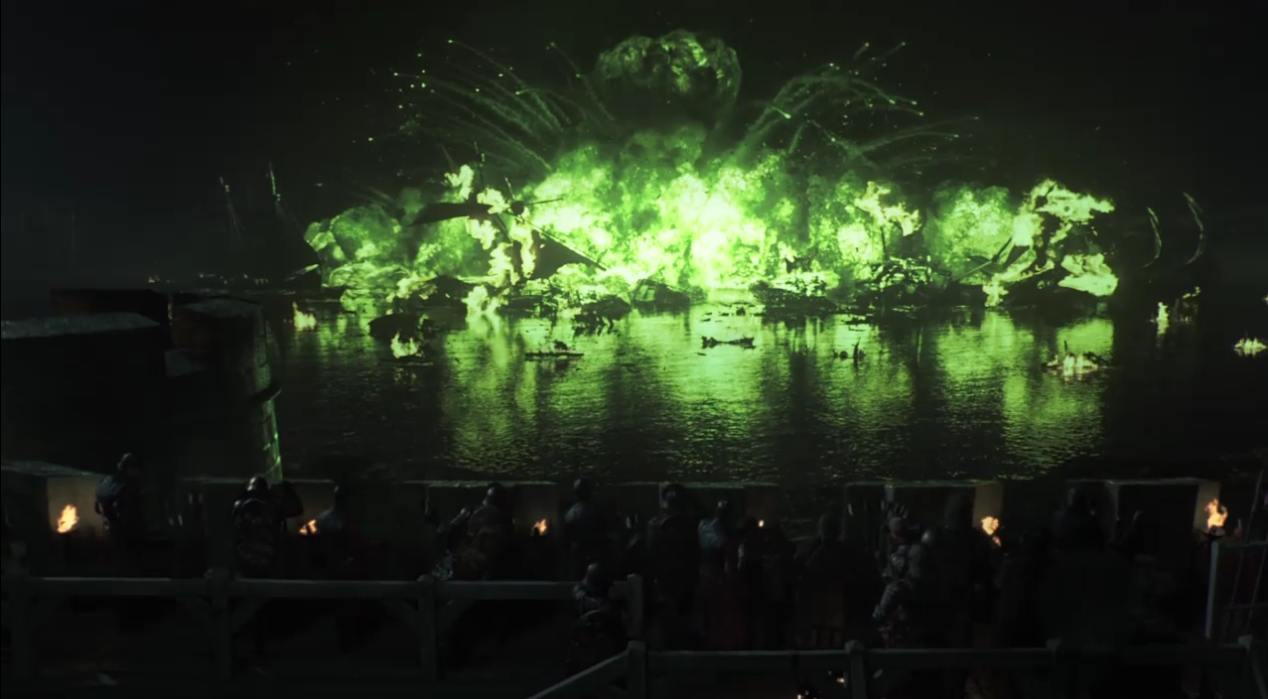
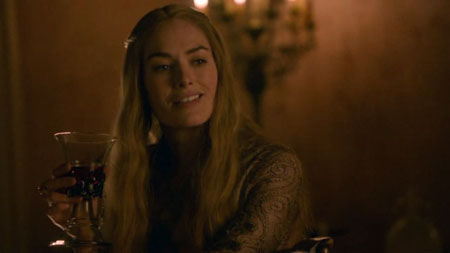
Game of Thrones (Season 2, ep.9)

On this Sunday past, we came to it at last… the siege of King’s Landing! After eight episodes building up to the climactic battle, it finally got underway. And as expected, it was pretty damn epic and bloody! And more importantly, it last all episode, no breaks!

And as usual, I had some observation to make just as soon as the episode was over.

Blackwater:
The episode opens on King’s Landing just as Stannis Baratheon’s galleons begin moving up the Blackwater towards the city gates. With so many ships and troops upon them, Tyrion and his right hand man, Ser Bronn, unleash their big surprise, wildfire that sets the water ablaze! Stannis responds by ordering his men ashore at the Mud Gate where they begin to lay siege.

Meanwhile, Cersei ferries Sansa and all the women retainers into a hall where they take shelter and waits things out. True to form, she has several cups of wine and begins acting like a total bitch, telling Sansa off and wallowing in self-pity about her life. Rather than let her son do his duty and defend the gates, she has Ser Kevan take him from the battle for his own safety. And then leaves the women to their fate when Ser Kevan says that the gates have fallen.

Sansa takes up her place as morale officer, but Shae tells her to take the opportunity to run. She returns to her room to find a drunk Ser Clegane who says he’s running off, and offers to take her with him. When she refuses, he seems hellbent on raping her, but instead fades off into the night without another word.

At the gates, Tyrion takes command of the city guard when Joffrey leaves and leads them into battle. They secure the gates, only to be beset by more of Stannis’ men. Things are desperate and Tyrion is nearly killed by one of his own, a member of the Kingsgaurd in Cersei’s employ. Luckily, his squire, Podrick takes the bastard down with a spear through the head and shelters Tyrion in his arms. Good ol’ Pod!

And wouldn’t you know it, help finally comes when the Tyrells, led by Ser Loras and Tywin Lannister, show up to drive the last of the Baratheon host off. Stannis yells at his men not to retreat, but between the loss of their boats and the outflanking maneuver, the siege has been broken. Tywin arrives in the King’s Hall to announce to his daughter that the battle has been won… Cue music and roll end credits!

Good Points and Bad:
I’ll just start with the obvious stuff. The battle was pretty freaking awesome. Some might be so bold as to compare it to Lord of the Rings and say they’ve seen better, but to them I would say it takes a lot to pull of an epic battle when you don’t have hundreds of extras and a whole lot of digital effects at your disposal. And given their limited budget, I’d say they pulled it off quite well.

My only complaint about the imagery would be the wildfire scene. I’m not sure, but somehow, all that green just reminded me of industrial light and magic, aka. artificial. It was faithful to the book, mind you. In the text, George RR Martin stipulated specifically that wildfire burnt green.
Still, I couldn’t help but feel like there was something inherently alien about it, like it was something out of Green Lantern (Which I refuse to see! Ryan Reynolds, what were you thinking?).

And of course, there were some changes that deserve mention. For starters, they left out the part where Tyrion deployed his other little surprise. You see, it was originally Cersei’s idea to use wildfire, something Tyrion would not get credit for in the end because of it. But Tyrion perfected the idea by commissioning the construction of a massive chain that would be lain across the mouth of the Blackwater.

When he gave the order, the lighthouses there pulled the chain up, thus preventing Stannis’ fleet from escaping from the river. THAT was when they unleashed the hellfire, only after Stannis’ many man boats had clogged the river. It was an ingenious plan, using Stannis’ own numbers against him, hence why I was disappointed that they chose to leave it out.

But beyond that, everything was done quite faithfully. Joffrey’s own incompetence and brattyness, the desertion of Ser Clegan, Cersei’s bitchiness in the face of death, Sansa’s attempts to play the innocent fool, Tyrion’s brave stand, the betrayal… All of it was downright faithful to the original novel. And the pacing and intensity of it was really awesome to watch.

And let’s not forget Cersei’s outfit for this episode, an armored bustier. Already there’s been a lot of talk about this bit of wardrobe, and for good reason! Look at and tell me it’s not the perfect melding of medieval armor and high fashion chic!

Yes, with everything this episode had going for it, the hour just flew by and left me wanting to know how they would wrap things up next week. But of course, I didn’t want to wait when the episode was over, I wanted to know NOW! The mark of a great production if ever there was one 😉

Well, only one episode left to go, then I imagine all us GOT geeks will be in for another long wait until season 3 comes out. It’s a blessing really that Martin keeps on writing, otherwise we’d all know exactly when the show would be over. And I do wonder just how far they’ll go with the HBO adaptation. Probably until it becomes unprofitable! In the meantime, check out this video clip I stole of the big scene where wildfire meets the Blackwater:

Sexy Robot Women!

Technically, they’re called Gynoids, which refers to anything which resembles or pertains to the female form. Sounds pretty awkward doesn’t it? But if female robots become a reality, chances are, this is what they’ll be called. Assuming of course that the copyright on Fembots holds.

In any case, in honor of my recent foray into the world of cyborgs, today I thought I’d dedicate a post to honoring the many examples of female androids, cyborgs and robots that have come to us over the years. Whether they come in the form of seductresses, pleasure models, heroines or protectors, gynoids have served as a means of social commentary and exploration over the years.

In addition to being a cool concept and a chance for some expanded anthropological exploration, they tell us much about our perceptions on women, don’t you think? Whereas older representations regarded female robots as little more than seductive assassins who worked for evil men, the newer generations have taken a more holistic approach, giving them human characteristics beyond sex appeal and genuine personalities.

Seems only fair doesn’t it? For if robots, androids and synthetic humans are meant to make us question what is real and what being human is, than surely the female robots need to do more than just look good and lead men astray. Anything else would just be stupid! But I digress, here are some examples of gynoids, fembots and artificial women that have come to us over the years.

Annalee Call:
“I should have known. No human being is that humane.” Interesting observation. That is how Ellen Ripley, or rather her part alien clone described this synthetic woman from Alien: Resurrection. An Auton, a type of second-generation synthetic, she and others like were designed by robots to revitalize the flagging synthetics industry in the 24th century.

According to franchise sources, this plan failed when the Autons rebelled against their handlers in a bloody incident known as “The Recall”. As a result, Call was a member of a dying race that was forced to live in secret and hide amongst regular human beings.

Interestingly enough, Call’s programming seemed to include ethical and religious subroutines, both of which had a profound influence over her behavior. In the course of the film, it became evident that she joined the crew of the Betty so she could gain access to the Auriga where Ripley was being cloned. It was her intent to terminate Ripley and therefore terminate the project before it could produce a new line of xenomorphs.

Call distinguished herself in the Alien universe by being the first female synthetic, preceded by Ash and Bishop, and followed by David 8. I guess the moral of the story is that just because your synthetic doesn’t mean you have to have a synthetic wang!

Cameron:
And here’s the beautiful Summer Glau, who I’m honoring for the second time for her role as Cameron from Terminator: The Sarah Conner Chronicles. Named in honor of series creator James Cameron, this new model of Terminator was also inspired heavily by his original concept. According to the many description Cameron had made, Terminators were “infiltration units that could blend in with humanity.”

In keeping with this, Cameron was designed to physically resemble a teenage female who could mimic human emotions. This made her especially effective at blending in with people, for who could suspect a pretty young lady of being a killer cyborg? Well, get between her and her target and you’d soon find out!

Which brings me to her mission. In the series, she served a similar purpose to Arny from T2. That is to say, that in the future, the resistance captured her and reprogrammed her to act as John and Sarah Conner’s protector in the past. This she did very well, because as we all saw, he grew up to become Christian Bale. And aside from some anger management issues, he led the Resistance to victory!

Caprica Six:
Now here’s a woman who fanboys and nerds would do sick and horrible things just to get within an arms length of. I hope her sake she has a mighty big security detail! As the femme fatale and blonde bombshell of the re-imagined Galactic series, she was the Cylon model (ha!) who was responsible for seducing Gaius Baltar and getting access to the Colonial Defenses Mainframe. Because of this, she was instrumental in the genocide of the Twelve Colonies.

Yet strangely, she was also instrumental in bringing the the Colonial fleet and Cylon race together, or at least the portion of them that wanted a reconciliation between the two sides. Because every Six was slightly different from the last, her model went through many changes in appearance and disposition. Whereas her “Caprica” self was quite cool, and powerfully seductive, her later incarnations were more emotional and heartfelt.

As if to keep track with this emotional transformation, her appearance began to change as well. Her hair went from being suicide blonde to sandy and her outfits also became somewhat more conservative. In short, she could do it all. She could be evil, loving, nurturing, compassionate, a murdered, and a sacrificial lamb. But always, she looked damn good doing it!

Fembots:
Sure, they aren’t exactly the most unique or groundbreaking example of gynoids, but they were funny and actually kind of inspired. Taken from the series The Six Million Dollar Man, fembots were infiltration units that were designed to impersonate real people. In Austin Powers, they are satirically portrayed as seductresses in the employ of Dr. Evil.

Here, there duties appear to be twofold: One, seduce Austin Powers or whoever else they are programmed to kill. Two, to shoot their quarry using boob-mounted guns. And like their 6 MDM counterparts, their identities can be easily revealed by simply pulling off their faceplates.

Getting them around some kind of electrical equipment also seems to interfere with their systems as well, as was demonstrated by Austin in the second movie when he began using a universal remote and found that “Vanessa” began responding to it. And as that encounter also demonstrated, they could always self-destruct if they found themselves cornered. Oh, and Austin also demonstrated that being sexy could destroy them, since no one can apparently resist his pudgy, hairy body! Ick!

Jessica:
When it comes to female robots, and sci-fi movies, here is an example that is so often overlooked. Taken from the cult hit Screamers, which was based on PKD’s short story “Second Variety”, Jessica was a type 4 Screamer, the most advanced model to date. As part of a series of “Autonomous Mobile Sword” – a race of self-replicating intelligent machines – she was distinguished from the others by being the most human.

Whereas type 1 was little more than a burrowing killing machine, type 2 was a wounded soldier and type 3 a small child. Each one became more and more complex, designed to infiltrate deeper and deeper into an enemies camp. With type 4, Jessica was not only meant to infiltrate, but to gain deep access and the trust of her comrades before going active and killing everyone.

In her own words, “We can smile, we can cry. We can bleed… we can fuck.” Minus the last part, this was how she managed to infiltrate a NEB (New Economic Bloc) base and lure in the unsuspecting representatives of the Coalition camp. Apparently, it was her mission to bring the last combattants of the war on Sirius 6B together so they all but one (Hendricksson, played by Peter Weller) would lead her to the survivor ship they had stowed away. This ship was meant to take a single person back to Earth, in the event of catastrophe.

In the end, Jessica sacrificed herself to save Hendricksson so he could get off the planet unencumbered. However, the revelation that she was a new type of AMS that could pass for human in every way possible made on thing clear. Having sterilized Sirius 6B of all life, not just the enemy’s, they were intent on making their way back to Earth, looking for new prey to stalk and kill! Cool huh?

The Stepford Wives:
Now here is an example of female robots that carries with it some genuine social commentary! Written in 1972 by famed author Ira Levin, this novel tells the story of how a group of in a fictional small town (called Stepford) have been replaced by machines so that they may better represent their husband’s and societies ideal of “womanhood”.

According to the story, the town of Stepford is run by a men’s club who’s founder was a former “imagineer” for Disney. In addition, many of its members are scientists and artists. together, they managed to come up with the ability to create life-like robots that could not only look like women, but play the part of doting, docile housewives to a tee!

Of course, by novel’s end, all the women in Stepford have been replaced by these robots and the conspiracy seems poised to absorb any new arrivals. Designed to be a cautionary tale about the dangers of social engineering and blatant sexism, the Stepford Wives took a pretty dim view of female robots, don’t you think? I mean, who’s to say these fembots don’t have their own agenda, like they’re just waiting for their husbands to go to work so they can plot their demise? Might make a good sequel…

TX:
“So she’s an Anti-Terminator… Terminator? You’ve got to be shitting me.” Anry was definitely not shitting him! Here we have the villainess of the Terminator 3 movie and the woman that managed to kick Arny’s ass… a couple of times! As the lastest model to roll of the Cyberdine assembly line, the TX was a sort of hybrid of previous models with some added features thrown in.

Basically, this meant that the TX had an armored cybernetic chassis with polymorphic-alloy segments thrown in. This allowed her to adjust her appearance, much like the T-1000, but left her with a hardened endoskeleton that could not be frozen or melted as the 1000 was.

In addition, her right arm could transform into various weapons, taking on the form of a plasma cannon, a flame thrower, an articulated claw; whatever the moment required. Her ability to interface with computer systems also gave her a decided edge, especially over the obsolete T-800 models which kept showing up to defend John Conner!

Because Conner had been living off the grid for so long, this new breed of Terminator was tasked with located the people who would become his lieutenants in the future and kill them. However, that quickly changed when Conner showed up protected by yet another Austrian-sounding T-800! In the end, she was destroyed when a damaged Arny plugged his remaining hydrogen power cell in her mouth and set it to explode.

Maria:
Ah yes, the original gynoid! The fembot who inspired all subsequent generations of female machines. Taken from the classic movie Metropolis, Maria was a scientists attempt to resurrect his dead wife that went terribly wrong. After taking on the form of the working-class hero, the flesh and blood Maria, this female robot was intended to discredit her and undermine the proletarian movement that was looking to revolt.

But ultimately, the Maria bot doesn’t conform to anyone’s expectations. Instead, she ends up causing jealous feuds amongst rich men in a night-club and sowing dissent amongst the poor in the worker city. And to top it all off, she breaks with Maria’s policy of non-violent change by urging the workers to revolt against their oppressors. After the chaos dies down, the mobs of workers blame Maria for their plight and burn her at the stake, revealing her to be a robot.

Out of this commentary on class consciousness and distinction, it is interesting to see what role Maria played. As an artificial human, she is not only a plot device but a commentary on the dangers of runaway technology. Invented by a scientist who is using technology to overcome death, she eventually becomes his and many other people’s undoing. But at the same time, there was an element of misogyny in how she was portrayed.

Whereas the flesh and blood Maria was peaceful, nurturing and a sort of Mother Mary figure, the robot Maria was a vile temptress who drove men to madness and acts of violence. And in the end, these acts were turned against her and she was burned, which is presented as a good thing in the end. Yeah, kinda sexists I’m thinking. But alas, she was the original and borne of a previous age. The concept has evolved quite a bit ever since… Read on to learn more!

Rachel Tyrell:
“How can it not know what it is?” “I think she’s beginning to suspect.” That was Deckard Cain’s reaction when he learned that Rachel was a Replicant. Tyrell’s response was equally telling. Something like that, you just can’t keep quiet for long!

As part of their experiment to make their Replicants more controllable, Rachel was a newer model that had been fitted with artificial memories. For all intents and purposes, she thought she was the late niece of Mr. Tyrell himself. When she learned otherwise, she began to experience a bit of an existential crisis, let me tell you!

On the one hand, she was devastated to know that all her memories were in fact false, at least to her, and that her existence was basically a lie. On the other, there was the conundrum of what to do about her mutual attraction with Deckard Cain, a man who specializes in hunting her kind down and “retiring” them.

In the end, she and Deckard resolve this little problem by accepting their feelings and running off together. Since she was apparently designed to have an indefinite lifespan, and be “more human than human”, it seemed only natural that she accept what she is and live out her life as if she really were. Though somewhat frail by modern standards, her character was central to the plot of Blade Runner. And let’s not forget that she saved Deckard’s life and he’s supposed to be a one man death squad!

Final Thoughts:
Well, what can you say about Robot Women from over the ages? Well for one, they’re pretty damn sexy, that seems to be a rule. Might be a tad sexist, but it doesn’t diminish their worth any. What counts in the end is what roles they play. From their early days as mere vixens meant to tempt and kill the heroes, they’ve evolved to fill the same role occupied by male robots. Allowing audiences to explore the deeper questions of what it means to be human, and how the line between artificial and real can be blurred to the point where we can no longer tell the difference.

Okay, even I’m beginning to sense the cheese factor here! I mean, does anybody really buy this social commentary angle? Really? Ah, maybe there is some room for intellectual content here. And maybe how they are portrayed really does tell us something about society at large and its perceptions of women. But for the most part, I think sexy robot women are just plain cool. There, I said it!

Until next time, treat robot women as equals… to robot men! Ugh, that’s a whole nuther can of worms and I’m not getting into that right now!

Data Miners – Chapter 11

Wednesday morning.

It’s been another hasty ride to work to get in on time. Prad hasn’t showered since Monday and is feeling the grime encroach on him again. His head is reeling from the dual assault of purple haze and not enough sleep. Working through code this morning is difficult, proceeding at one keystroke per minute. He has no desire to be looking at TPS reports right now or anything in Macro format for that matter. The few hours of sleep and the buzz he got from his last joint have not cured the case of busy-brain he contracted last night. He was hoping the light of day might make things a bit more clear, but if anything, it’s made it worse. Whereas the busy-brain kept him from sleep last night, it is now keeping him from work.

By ten thirty, he examines how much work he’s actually done and decides it’s futile. He half-wishes he brought the book with him just so he could peruse it. Then he wouldn’t be so fixated on it! Somehow, the mind had a way of obsessing over the things that the body didn’t have immediate access to.

He needs a distraction. Minimizing his work in his task tray, he pulls up his email and checks to see if anyone has written to him since yesterday. Sure enough, they are a couple new hits in his Inbox. One from Sa’id, one from the adult dating site, and even one from Angie. A few spam mails between, more offers for downloadable software and movies. He’s too excited to move these to his spam folder and goes right for the one from Angie. The subject line says it all.

>To: Prad123@yahoo.com
>From: AngCpr@gmail.com
>Subject: Bit weird huh?

>Hey Prad. Sorry for the misunderstanding last night. Had no idea you got a copy of Germaine’s book too. I suppose I can understand your >confusion, it was a bit weird of him to just start reaching out like that, right from the blue? Anyway, no worries, Scott and I kind of got a kick >out of it. We were also a little worried after you left, figured you might have been embarrassed. One other thing, have you heard anything about >the dear old prof? I was kind of wondering if he was still with us. It might be nice to find him and say hi one last time.

>Anglmrk

Prad feels incredibly warm and giddy inside all of a sudden. He notices she didn’t use his first name, but oh the tenderness implied in that email! And the fact that she thought to write him the morning after! The time on it indicates that she wrote it less than an hour ago, most likely while bored at work. He reads it again and notices the mention of Scott, the royal we that follows in his wake too. He could live without that, but even the presence of that five letter fun stopper can’t spoil his mood now. He opens up the one from Sa’id next. A sense of fraternal duty tells him he should do this before composing a gushy response to the boss-lady.

The subject line of Sa’id’s email is quite telling. He notes instantly the diminished punctuation and grammar as well. Clearly a step down from Angie’s message.

>To: Prad123@yahoo.com
>From: SdN72@hotmail.com
>Subject: thanks dude!

>hey dude thanks again for the ride home last night woke up with a wicked hangover how bout you. My landlady sez i made terrible noise last >night must have been when i woke up to puke my guts up good time all around though. shit that things got a bit heavy there for some people >isn’t it hate to see our people not getting along but have you heard the news? The fecking feds just made a release bout the whole dangle thing >and say that they think the >whole thing was faked but wont say nothing about how they got them or where the leak came from. dumbasses >huh only make things worse for themselves! ps what was with that whole thing in Angie’s room why were in there second time around i mean I >know what you were doing the first time pervert! take care, can’t wait for five oclock to roll around

>Sandngrr

Now he feels momentarily sidetracked. He did not hear that, must have left the radio off in his car this morning, or had it tuned to music. He really can’t remember. The only other time he ever catches the news is on the web, or by word of mouth. And on both fronts he’s been a little out of touch, at least for the last twenty four hours.

The email from the dating site now looms in his field of vision like a burning bush. He desperately wants to check it, to see who took an interest in his profile and what they look like/have to say for themselves. But he doesn’t want to keep Angie waiting. A message from her in his Inbox is like finding her at his front door, or so he imagines. Leaving her waiting would be nothing short of criminal. Going back to Angie’s message, he hits the Reply button and begins composing. He does his best to emulate the proper style with which she emailed him, not to mention the tone he established last night. If acting mature gets her to email him, he’ll ride that pony to the ends of the earth!

To: AngCpr@gmail.com
Subject: Re: Bit weird huh?

Hey Angie. Don’t worry about it. It is I who should apologize for breaking in on you like that. I suppose these things happen. Sad to say, I can’t tell anything new about the prof. Last I heard, he got diagnosed and decided not to go the treatment route. Sad huh, but what can you do? One question though, are you absolutely sure he was the one who sent those books? I suppose it stands to reason, but why didn’t he send a real note or at least a return address? Oh well, talk to you soon. Take care, say hi to Scott.

Thaiwrrr

He grabs the mouse, his finger poised above the “Send” button. That’s when he realizes that his own inquiry is worth following up on. Not just idle chit chat, someone really ought to see if anyone else who was in their class or studied under Germaine at MIT also got copies of that book. He checks his address folder to see if he has any old email addresses. He’s still got the names of a few old friends there, but most of the addresses are old IST accounts. Prad shakes his head. Those accounts probably haven’t been used in over five years. Someday soon he must do a cleanup of his contact folder.

Luckily, he still has some hotmail and yahoo accounts for some people he used to hang out with: Lena, Mark, Josée, and Andrea. They were all pretty cool, but not too cool. They hung around with him, after all. If ever he were to be completely honest, he would admit that they were the people he fell in with because of his inability to get in with the truly cool crowd. Nevertheless, they are all MIT alumni and people who studied under Germaine. Surely they would be on his contact list if he wanted to start sending gift packages around. Clicking on the box beside each of their names, he adds them all to the recipient’s field before typing off a friendly generic message.

Hello all, sorry to drop in on you like this after such a long absence. But something’s come up with I feel concerns us all. I am, of course, referring to Professor Germaine’s illness. I’m sure you’ve all heard how our dear teacher is not long for this world. Last I heard, he’s got a few months tops before he… you know. Well, it may be that he’s decided to reach out to some of us before that happens. Angie and I both received copies of the millennial edition of Ghost in the Machine, the one with his foreword. We’re not sure, but we think he sent them to us. As fellow alumni sts, I was wondering if any of you got similar packages. If so, did it come with a note that contained more than just simple instructions? Angie and I would appreciate any info you have, as it would resolve this dilemma for us.

Thaiwrrr

He hits “Send” and moves onto his last message. It’s about time too. A response of this kind can only be exciting. His palms would be sweaty if he were a lesser man, or just a little cleaner. His pores are too clogged right now, luckily his armpits and crotch appear to be overcompensating.

>Prad123, you’ve received a profile message from Kittyhawk69:
>“Hi. Liked your profile, I think Asian guys are super hot! Come check >me out!”
>Follow the link below to see the full message and access their profile:

Prad immediately clicks on the site’s link to have a gander. Sure enough, for her pic, Kittyhawk69 lives up to the name. Her preferences send his heart into another tail spin: Hot chat, one on one, threesomes, toys and discreet relationship. His mind and libido begin the age old dance, the former insisting she’s a dude, the latter telling the former to shut up.

Yep, he agrees, too good to be true. But what harm can a little extended chat, via webcam to confirm she’s actually a woman, followed by a little meet and greet at a neutral site do?

You could end up with a disease, or finding a penis tucked under her ass! His mind tells him. But what has his mind done for him lately other than keep him in this dead end job? Another look at her preferences, cross-referenced with her other pics, ends the debate quickly.

Shut up, mind!

Data Miners – Chapter 10

3:13 am.

Prad is lying in his bed and wide awake. The sheets are becoming sticky and clinging to his legs. It just seems too hot for any kind of blankets. He’s tried sleeping without them but that’s too cold. He’s tossed and turned from one position to another, nothing seems conducive to nodding off. And then there’s having to be at work in less than six hours. He knows he’ll be useless if no sack time comes, but it’s no help. Too much on the brain, too many reasons to lie awake and ponder.

So it was good ole’ Albert Germaine who sent him that package? He’s a little let down, admittedly. But on the plus side he’s glad he’s not the victim of some crazed stalker or government spook. Still, it doesn’t exactly solve his problem. If the gifter was in fact Germaine, why the hell did he make it so anonymous? Why the odd choice of container and the cryptic note? Was there some kind of special intent there, a way of saying hello and goodbye to his old students before he kicked off? But if so, why not just announce that he was the one doing the sending? Why not give some more explicit instructions or include a letter or something? Knowing Germaine, it might be his idea of a joke. He was never really that funny, never got any of Prad’s jokes, that’s for sure.

Come to think of it, why the heck hadn’t Angie said anything about this to him and saved him a world of embarrassment? Of all the people in the Society, only they knew Germaine personally. Had it not occurred to her to mention that he had made contact with her, albeit in some roundabout way? Was she so distracted with that new beau of hers that she completely forgot about the little things that made for good discussion? Or did she like Prad so little that she didn’t even bother to think about how he might be affected too? He didn’t like thinking like this. If there was anything that could keep him up all night, it was the many reasons why Angie might choose to ignore him. An image of her and Scott making out on that sofa of hers gets stuck in his head. He bites his pillow and tries so hard to purge it, to substitute himself in there somehow, but comes up empty. Insomnia is very good at making things seem worse, especially matters of the heart. And at this moment, he hates Scott with a passion.

UGH! It’s no use! Finally, Prad gives up on sleeping and shoves himself up into sitting position. Legs over the side, toes touching the cool, thread carpet, he tries to give the matter some sober, wakeful thought. He’s a little perturbed about his behaviour earlier that evening, and the interview that’s coming up at the end of next week. He’s not in the mood to open the book the professor sent him; but then again, it might help with the insomnia. He chuckles at the thought, poor professor! The man is dying and he can’t even bring himself to read something he wrote, and can’t help but think it will be an incredibly boring exercise. But given what happened earlier, he really ought to read it and see if it can shed some light on things.

Or, he thinks, he could just roll a joint. That would help with the insomnia and would be a lot more fun. Lord knows he’s been craving it for hours now. No better way to relax than to give the body what it desperately wants. Ghost he can crack in the morning when things are light and he’s a little more clear. Nodding to himself, he gets to his feet and heads over to his desk where his box is waiting. He can feel the sticky sweet smoke on his tongue already.

His tongue is on the tab and the joint nearly rolled when the phone rings. Who the hell could that be? Who would call in the middle of the night? Someone who is looking to punish him perhaps? That list is short, for the moment. He eyes the freshly-rolled joint. There’s no way he can put it down now. Twisting it up, he stuffs it into one corner of his mouth and grabs the phone from the cradle.

“Kumustá, mama?”

“Yamal! This is your father!” a loud voice says in Thai.

“Sawat di khrap, bida,” he says, switching over and trying desperately not to sigh or sound annoyed. He already knows what’s up, and what he’s in for. Luckily, he’s well practiced in this field and has his responses on auto pilot.

“Were you sleeping?” his father asks impertinently.

“Yes, bida. But it’s okay.”

“Dee, kuman,” he says happily. It’s really just a courtesy, he already knows he has permission to chew his son’s ear off. A son can never deny his father that privilege, not where he comes from. “So how is work?”

“Work is fine, bida. I have been promoted.”

“Promotion?” his father asks. “When were you promoted last? What do you do now?”

Prad searches his memory, trying to remember the chronology of his lies. Has it been six months since the last time he claimed a promotion? Seems about right, so that’s what he says. Last time, he had become a senior programmer, so he’ll need to come up with something more austere this time. “I am a manager now, great responsibility.”

“How many people are you responsible for?”

Prad has to think about that one too. It’s a lucky thing he knows someone who is a manager, someone who’s reasonably close to, but doesn’t answer to. He tries to remember how many people Rohit has working under him. At least half a dozen names come to mind and it’s a nice round figure.

“Six people, bida. I have six people who work for me now.”

“What are their names?”

Prad takes little time in reciting the ones he can remember. Those he can’t, he fills in randomly. Manipulating or inflating the truth has become easy for him thanks to years of practice. It’s gotten to the point where he’s relatively quick on his feet now, quite proud of that fact too.

“Is upper management considering you for promotion?”

Prad hits the button on his torch and lights the tip of the joint. Before sucking in a small cloud, he opts for an ambiguous answer. What else can his father expect from him at this point in his career, or this hour in the morning? “They know of me, bida. But I cannot say for sure if they are considering me for an upper level position yet.”

His father grumbles. “How old are you now Yamal?”

Prad lets out a cloud of acrid smoke and tries not to grumble himself. “I am twenty-eight now, bida.”

“Do I need to remind you that when I was your age, I was entrusted with the management of an entire branch office?”

“No, bida,” Prad replies. He has heard this story many times and knows it backwards and forwards. The great Chanarong (“The Warrior”) Pradchaphet, oldest boy of the Pradchaphet clan, who left home to become a senior executive in a foreign land. By his late twenties, he was working in Luzon, where he met Prad’s mother, incidentally, and got married. By his thirties, he had moved them all to the Pacific Northwest where his work and career in electronics and software had continued apace. Prad and his brothers had all received the majority of their education here, studying engineering, computer sciences and marketing, all with the intent of following in their father’s footsteps. His sisters’ paths were slightly different; being girls and having a different set of cultural expectations to deal with, they had all been able to go their own way. By the time all his children were old enough to leave home, Chanarong had moved with his wife back to Thailand to enjoy a working retirement. And he never let any of his children forget who had spawned them or what he done for them.

“Well then,” his father continues. “Just be sure you are doing all you can to get recognized.”

“Khap khun, bida,” Prad says, thanking him formally.

“Are you dating anyone?” his father asks next. Prad smirks and takes another puff. Ordinarily, his father covers all aspects of his professional life. His personal life is usually the province of his mother. He can only guess that she’s unavailable or his father is stalling until she can come and interrogate him herself.

“No, bida. I have not yet met a woman of sufficient quality to marry,” he replies.

“No nice Asian girls where you work?”

“No, father. My position makes it impossible for me to date the people I work with.”

Prad is surprised. Usually, his father likes to beat around the subject of what constitutes a “nice” girl. He knows how it works, the boys must marry girls who fit their family’s background, culture, expectations, etc. Prad’s elder brother, Khemkhaeng, has already performed this duty, hence Prad now receives no quarter in this area. As the second oldest son, he can expect this kind of harassment for years to come; until he either capitulates, or elopes and never talks to them again.

“I see,” his father replies. “What about going out? Are you getting out? Have you met nice girls at Temple?”

“No, bida. Not yet.”

He almost loses it there. His eyes have not seen the inside of a Buddhist temple for years and even if they had, he’d have no interest in a girl who attends. Not unless it is strictly out of familial duty. Where would be the fun? He even coughs a little in the process. His father is quick to notice. The signal is too clear for him to blame it on a bad international connection, damn telecommunications!

“Kuman! Are you smoking?”

“No, bida,” he says, coughing once more. “I am getting over a cold.”

“You are sick?” his father says with newfound concern.

“Yes, bida. But I still must go to work tomorrow. I need to sleep.”

His father pauses and comes back a little deflated. Smoking up seems to have paid off tonight. “Ko di, kuman. Ratri sawat, then. I shall pass along your love to your mother.”

He might be imaging it but he thinks he hears some scorn in the last words. A hidden reminder of what he called her not too long ago.

“Have a good sleep, kuman.”

“Khap khun, bida,” Prad returns. “Rātrī s̄wạs̄di̒.”

There’s a click and the signal goes dead. Prad returns the phone to its cradle and takes a few more puffs of the joint before stubbing it out in the small bowl that sits by his computer. The bottom is burnt in many places from the many roaches it’s held over the many months it’s been there. Yet Prad cannot bring himself to buy an ashtray. Somehow, that would seem like a breach of the buildings no smoking policy.

He feels a mild sense of euphoria set in and he yawns. A good sign. He gets back into bed and pulls the covers up to his chin.

Data Miners – Chapter 9

Tuesday night.

Prad is standing outside Angie’s apartment door. He’s been invited this time, so it’s all good. Everyone within the Society has though so it’s not exactly special either. But there is an occasion. News of their accomplishment has spread like wildfire through the DeeP underworld. The New York Times and Seattle Times ran the story, CNN and MSNBC have picked it up, and even Fox News is running segments where pundits are saying this is some kind of liberal conspiracy, which only adds weight to the scandal. The fulcrum of the scandal appears to have been the FBI, who chose not to comment when the story first broke. That, they knew, only managed to fuel all the media speculation. As they had anticipated (quite brilliantly, in Prad’s opinion) the FBI has neither confirmed nor denied the legitimacy of the Dangle photos. If they deny their authenticity, they’ll be admitting publicly that they’ve been hacked. Confirming them will ruin the Congressman’s reputation, a man who supports the controversial work they do. Either way, they’re screwed, so naturally, they choose the path of least resistance: say nothing and let the jackals assume what they want.

Prad knocks for the second time. He can hear tunes playing from inside and some bantering. The bottle of Absolut Citron is sitting against his forearm and its starting to bite. He doesn’t even like the stuff, but he knows Angie and some others like Vodka tonics so it’s what he chose to pick up on the way. Since he drove himself, it only seemed natural to bring something he wouldn’t be drinking. Simple common sense.

Prad can hear footsteps approaching the door and a shadow falls across the peephole. He smiles and waves, hearing a click from the door’s locking mechanism. The door slides open, Lynette has shown up to greet him.

“Yammie,” she says, a touch annoyed. “You’re late. Angie was starting to get pissed.”

“Why? Sounds like things started without me.”

“She says the DeeP’s are on Skype, waiting to deliver a message. She’s had them on hold until everyone got here.”

“Oh shit,” Prad says, pushing his way in and thrusting the bottle towards her. “I got held up on the freeway. Didn’t mean to hold things up.”

“Whatever, just get in there!”

Prad pushes forward into the living room. Lynette declares his arrival when he gets there. There’s little reaction, everyone is huddled around Angie’s computer, the Skype screen minimized in her tray. Angie is sitting in front of it in her work chair, momentarily looking back to acknowledge Prad’s arrival.

“Good of you to join us, now let’s get this party started.”

Everyone closes in a little tighter around her terminal when she brings the Skype function back up to fill the screen. She hits the Call button to continue the conversation; the enlarged picture of a face covered with a black cowl opens up inside the box. Prad hears a few titters from the group and chuckles himself. Clearly these guys take the whole anarchist thing to the very edge. The face is alone, and even through the cowl, they think they can see some beady eyes admitting defeat.

“On behalf of the DeeP nation,” the person begins, even the voice is altered. Probably some Radio Shack voicebox modulator they picked up for Halloween. “I am authorized to congratulate you on your exploits. You have proven beyond a shadow of a doubt that you have what it takes to take on the establishment. Fight on brave data warriors!”

The black cowled figure lets his righteous fist fill the screen, then reaches over to the cameras left side to click their mouse. The image is gone, the call ended. In the air hangs the sweet satisfaction of victory. Sa’id is the first to break the silence with some well deserved hoots and hollers.

“WOOOOOOOOO! Fucken eh!”

Achebe joins him. “Bragging rights! Who has bragging rights?!”

“Uh, we do! That’s who!”

High fives are given all around and Angie jumps off her computer to give out hugs. The first one is to Scott, predictably, and then she works her way around. Prad is last. She’s awkward about it too. There’s the momentary hesitation, followed by some palatable tension when it’s over. Even Scott appears to be shuffling his feet. To make matters worse, only the four of them get hugged, leaving out the ones who couldn’t or wouldn’t come.

It’s a bad moment, until Prad suggests what the next step in their partying might be.

“Okay, who wants to get drunk?!”

Getting close to ten o’clock and most of the guests are soused. Rage and a few of their offspring are playing from her iTunes, just a few albums seeing as how he’s heard a couple songs repeated by now. Lynette has also turned his vodka into a punch with a tall bottle of Angie’s grapefruit juice. The cocktail is a hit and Prad is on his third glass in as many hours. He’s proud of the restraint he’s shown tonight, but for some reason, he feels obliged not to embarrass himself, maybe even give some people a ride home at the end of the night. He’s not sure what reason he has for this sudden upswing in social responsibility, but there are several culprits. The new guy is one, the crap his parents have been giving him since his little outburst over the phone is another. Then there’s the very real possibility that he might be fired by the end of the month.

Yes, it’s all a rich tapestry, plenty of reasons to act all grown up. And it’s killing him. The punch is really good, and Sa’id’s drunk off his ass on it and the set of Rogue beers Claude brought. Being sober around him is just a tad bit annoying. Now he knows how other people must feel around him when he’s under the influence. At the moment they are standing together in the kitchen, Prad being nice and fetching Tania a refill while Sa’id keeps him company. The way he’s hanging off Prad’s shoulder and telling him how great he is is virtually intolerable while sober. He sees the bottles that have been arranged on Angie’s nice marble counter. He’s tempted to open one up and suck whatever is in it straight, at least until Sa’id’s fun again. Luckily, he can think of some interesting topics to talk about. For one, he’s got a chance to ask Sa’id some questions that have been on his mind for some time.

“Always wondered, dude, aren’t you forbidden from drinking?”

He knows from experience that Sa’id is a practicing Muslim, but every time they go out, he’s there tossing pints back or drinking some funny shit Prad’s never heard of. At some point, he knew he’d need to clear this up.

“Yeah, technically,” Sa’id replies mournfully. “But it’s a Persian thing, man. We do everything with wine. It’s kind of like the Turks. Them they got that Raki and Ouzo shit, just like the Greeks; been that way for centuries. So how do you tell people to give up something that’s such a big part of their culture?”

“Didn’t know that,” Prad admits. “Thought you all did the temperance thing.”

Sa’id slaps Prad’s shoulder playfully and laughs drunkenly, the kind of laugh that sends spittle and beer foam into the face of the listener. “Naw, we aint like those Arab or Kurdish fuckers who can get by on coffee and Sisha. Strict fucking dudes! No, people like us, we got too much to celebrate!”

“I thought you were Arab,” Prad says. Sa’id was in the middle of a sip and lowers the bottle. His face is twisted into a strange expression of betrayal and shock, until he’s had a second to remember it’s Prad he’s talking to and erupts in laughter. His hand lands on Prad’s shoulder a few more times.

“Dude! Don’t go saying shit like that to any of my relatives. They’ll kill you!”

Prad laughs and has to wait while Sa’id explains to him why this should be considered offensive. Apparently, and this is some surprise to Prad (in part because he can’t believe he didn’t already know this) Persians, Turks and a whole lot of Asians besides who just happen to be Muslim don’t like being called Arab. The reason: ethnically, they’re not, and it is offensive to assume otherwise. The confusion is a by-product of media misrepresentation and cultural ignorance. This Prad nods to and understands fully.

“Just like I don’t like being confused with a Chinese person, or a Cambodian,” which has happened to him repeatedly in his youth, as Sa’id knows. They’ve shared many a laugh over it, while drunk, no less. “I get it. You’d think I would have known better.”

“Yeah, you of all people,” Sa’id says half-seriously.

“Us half-breeds know best.”

Sa’id erupts again, spewing bits of beer and foam in all directions. Prad is able to join him this time, finding his own wit quite awesome. Done with their business in the kitchen, Prad and Sa’id bring Tania her drink and join the conversation already in progress. Tania, Lynette and Claude are sitting in semi-circle fashion in front of Angie’s couch, having hogged all the seats and the room’s chest. Achebe, Angie and Scott (her left leg strewn across his lap) have taken the couch with Achebe straddling the cushioned armrest. He looks to the balcony and accounts for Zuhair and Tommy, both of whom appear to be enjoying a thin joint. Prad looks longingly at them, his mouth watering at the thought of the sweet, sticky Buddha. But the couch seems to be emitting its own gravitational pull. He finds himself irresistibly drawn to it, if only to demonstrate how good he’s being.

He’s a little surprised to hear the topic of conversation, at least the path it’s taken.

“I’m just saying, I think this might have been a mistake,” he hears Tania say. It takes a few seconds of listening, but in time it’s clear that some kind of moral debate has erupted, one concerning the nature of their mission. It doesn’t take long before he also notices that a sort of partition has set in between the party guests. The little discussion groups appear to be more than just spatially divided. Now that he thinks about it, something has been amiss ever since Angie gave out selective hugs to people. Some must have felt left out, or possibly upset that others chose to do something they didn’t approve of and got away with it. Either way, he’s totally forgotten about Tommy and Zuhair and is dedicating his full attention to the debate before him.

“I mean really, what separates the DeeM’s from the DeeP’s now?”

“I told you Tania,” she replies calmly. “I’ve declared that we are a DeeMarchy now. The days of being a simple society have passed.”

“Right,” Tania says dryly. “And in this new order, are we allowed to ask questions?”

“Of course!” Angie says angrily. “We have not abandoned our principles just because we’ve upgraded. Everyone here has a say. I’m just in charge, is all.”

“Okay, but really, aren’t we supposed to be against doing all that illegal shit? I thought we were supposed to different from those DeeP dicks.”

Prad has to restrain himself from guffawing. He’s sure he saw a movie called that once, on pay-per-view or one of his many, favored many sites. Everyone else seems oblivious to the fact that she just said something potentially filthy since they are still talking about scruples.

“She’s right,” says Claude. “You guys could seriously get in trouble for this.”

“What are you talking about, we got away clean!” Achebe protests.

“For now, maybe, but what if you missed something?”

Sa’id laughs. “Missed something? Do you know who you’re talking to?”

Angie calls him over for a high-five. Their celebratory remark has only seemed to empower the detractors in their own little camp.

“Don’t be stupid. You guys went up against the feds; Christ, against the system! You think this is just going to blow over?”

It’s Lynette saying this now, and Achebe seems to be smarting a little from the remark. He looks over at Prad like he’s expecting him to say something. At first, he thinks he wants Prad to come to their defence. Then he remembers the objections he raised in private. It’s true, he did have doubts, but clearly he doesn’t like someone else giving him crap for this. A challenge was issued, and no one should make them feel ashamed for it now.

“C’mon, it’s not like we did anything wrong,” Sa’id replies. “All we did was plant some dirty and embarrassing photos of a very bad man where they could be found. The only reason we did it was to show we could.”

“Exactly,” Lynette says. “You always liked saying that the one thing that separated us from them was the fact that we could do what they do, we just don’t.”

“Right,” Angie says with a nod.

“I think it’s safe to say that that era has run its course.”

Prad looks at Lynette angrily. It might just be because she’s the oldest of their group, but she’s starting to sound quite pedantic. Those in the opposite camp can’t help but feel chastised. He’s been holding his tongue up until now, but he’s rapidly losing patience for her and her flock of doubting Thomases. But Sa’id and Achebe aren’t done with them yet.

“Hey, we don’t go around hacking people’s databases and selling the information off, alright? We do what we do because we believe in something, because we’re good at it.”

“Right, until now. Now we do what they do.”

“Except for free,” adds Claude.

“Fuck oooooooooff…”

Every eye in the room turns towards Prad. He’s a little surprised himself that the words came from his own mouth, but they’re out now and he can’t exactly put them back in. It’s like breathing wet vapor into cold air, the whole thing crystalizes before he can withdraw it. And at the moment, he’s not sure he wants to either.

“You got something you want to add to this little discussion, Yammie? You sound kinda pissed,” says Lynette.

Prad eyes her next. She did not just call him that! He directs his first response at her.

“Excuse me if I’m tired of all your little barbs and insults.”

“Well, you’re not exactly unbiased in this discussion, are you? After all, you did take part.”

Lynette says this and Tania scoffs, which only angers Prad more. Pedagogical moralizing he can respect, if not stand, but the way these other two are riding her coattails and sitting on their high horses tonight is beyond tolerable. Prad knows he’s only going to make things worse at this point, but something needs to be said in their defense. And since they’ve clearly given him the floor…

“Yeah, I’m biased,” he begins. “But so are you. You all backed out of doing this for personal or legal reasons, you didn’t say shit about the moral implications. And if you had a problem with it, I seem to recall Angie gave you a pass and said no one would think less of you. For you to come here tonight and judge her like you’ve got any right to do so seems kinda hypocritical.”

The three of them are taken aback, and a look over at Angie seems to confirm that she’s agrees. He’s a little impressed with himself right now. He’s got her in her corner and he’s even managing to smack people down in a debate. Amazing how not getting fucked up at this party seems to working in his favour.

“So we’re hypocrites, then?” Tania says. “Because we’ve pointed out that you’ve done something illegal? I mean, forget the morality for one second, you did commit a crime.”

“Since when did that stop us? Do you paid for your music or all those videos you download? Since when have any of you been against using your computers for a little guilty pleasure and social justice?”

“Are you comparing downloads to –”

Prad raises his hand to stop Lynette before she can make her perfectly valid point.

“Okay, not a fair comparison! But honestly, are you gonna’ look me in the eye and tell me you give a damn about the law? Are you really concerned with all that, or are you guys just the slightest bit jealous?”

“You think we’re jealous?” Claude asks directly.

“Yeah, I think you are,” Prad says with just a trace of self-satisfaction. “We did something pretty awesome. Might have been out of character, might have been a little crazy and just a little more illegal, but sometimes you gotta step up. And Sa’id’s right, it’s not like we did anything particularly wrong. All we did was make sure a bad man got a taste of his own medicine. You, me, we always complain about who controls the information, how bad men abuse the media and innocent people suffer. And we always say that the law is stacked against people changing things, don’t we?”

He looks at Tania and uses one of her annoying sentence starters, just to show her once and for all how annoying they are: “I mean, just look at the progression: bad men buy up more and more of the countries print and television media, and the amount of institutionalized evil just goes up and up. We got hijacked elections, illegal wars, civil rights being suspended, the government spying on its people, and no one seems to know how to stop it. We all say ‘if only we could get the truth to people’ –”

“We get the point, Prad!” Claude interrupted with his fiery Haitian baritone. “What the hell does this have to do with what you guys pulled?”

Prad stops for a second and re-marshals his thoughts. He himself is even thankful for the disruption; Lord knows he was beginning to run that particular train off its tracks and make himself look foolish in the process. He was also getting pretty far off topic.

“Sorry, folks. The point is, for once, we did something about it and made sure the right people got egg on their face for once. The only irony is we had to break the law in order to do it. You gotta know the system is fucked if you got to do that.”

“So… you’re Robin Hood now?” Claude asks gingerly. Prad can tell he’s kidding, but he treats the proposition with some seriousness. He’s sure that was the tagline from the movie, might as well work with it.

“We’re always saying how things need to be done, but so far, what have we done to make things better? As I see it, we got nothing to feel guilty about, and who knows, some good might actually come of this. At best, Dangle’s been embarrassed and might even be politically hurt from all this. At worst, we get in trouble and people feel inspired by the example we set.”

“You really think so?” asks Lynette. She sounds semi-serious too when she asks. Prad treats it as such at any rate.

“Yeah, I do. It was peaceful, it was precise, and best of all, it was appropriate. Tell me there aren’t millions of people nationwide who won’t be happy this happened. Hell, we know people hate the cocksucker, and it’s sure to piss off those right-wing assholes that support him.”

“Can’t argue with that,” Sa’id says, raising his bottle in salute. Prad nods and summarizes for them:

“And all we had to do to was pull a little stunt that just happened to be illegal. I don’t know about any of you, but I consider that a pretty sweet deal.”

Well, Prad thinks, how about that? For once, he argued on the eloquent side of things. The opposition group is far from convinced and begin to nitpick some of the points he’s raised, but Prad decides to take a rest to listen from the sidelines. His one man assault has not won anyone over, but it’s clear that the moral tone has been dropped from the debate.

He looks back at Angie. He notices that she’s staying out of the debate too. In fact, she’s looking at him from time to time, bypassing her conversation with Scott to do so. She even looks a little… impressed.

Wandering back to the kitchen to fetch something non-alcoholic to help him sober up some more, he begins to wonder about that very thing. Why should she be impressed that he spoke on her behalf, or the groups for that matter? Does it surprise her that he happens to share her beliefs? He thought that was abundantly clear at this point. But then again, had he ever given her cause to think they had that in common? Come to think of it, have they ever had a conversation that didn’t involve sex positions or porn? Actually, during their last conversation, she brought up the subject of porn. He just threw some innuendo and sexual references her way. But who knows? Maybe if he tried talking to her more about what they do and less of what he wanted to do to her, she might actually show him some respect!

He feels a blow strike his shoulder, startling him and spilling the can of ginger ale he’s just opened. He turns around to see Sa’id again, who also appears mildly impressed. It’s hard to tell though, his expression is kind of disarrayed.

“Dude, that was cool!” he says breathlessly. He has apparently run himself out of breath just making it to the kitchen. “I didn’t know you thought all those things. Man, we should hang out more. I got some websites I think you would enjoy. My sis even runs one of them from back home.”

“Yeah, that sounds cool,” Prad replies.

“I mean it, man! We should definitely hang out more. We don’t do enough together and I think my pals would like you some.”

“I mean it too,” Prad replies insistently.

“Okay, man. And I mean it! I think it was cool what you said. I’ve never heard the fight characterized so perfectly. And what the hell is up with those bitches, anyway? Why are they busting our chops tonight, of all nights?” He leans in close to issue this last part.

“I don’t know,” Prad says, taking a sip of ginger ale to soothe his tired throat. “Guess we just didn’t count on people feeling left out, is all. And I guess Angie did kind of pull an executive decision, didn’t she?”

Sa’id looks at him through half-closed, glassy eyes. His face is still able to register confusion though, even through all the hooch. “What do you mean?”

“Nothing, I…” Prad takes another sip of ginger ale and wonders himself where he was going with that. “Maybe they just wish she consulted them first before accepting the challenge.”

Sa’id ponder it over, staring off drunkenly. He smiles and scoffs, blowing some spittle Prad’s way.

“Eh, man! Everyone’s got to take orders sometimes. Even us DeeMarchists!”

Prad nods and chuckles. He has to concede that. Not everyone can be anarchists and still be functional. He can only imagine how the DeePs do their thing. Probably with a lot of arguing and some bullshit dominance, kind of like they did tonight. Hopefully, this will be the last time they have to deal with those pricks. It’s bad for the group’s Feng shui.

“So whatta you wanna’ do now?” Sa’id asks him finally.

Prad thinks that one over. He sighs and wishes he could crack another beer or smoke a joint. Being responsible doesn’t exactly leave a lot of options. But then again, he’s been good for a few hours now and the urge for mischief is starting to back up inside him.

He casts a look back in the direction of the living room. The sitting circle has broken up and people are performing multiple tasks now. Claude and Tania are playing Xbox, Achebe and Lynette are surfing on Angie’s computer. And on the couch, Angie and Scott appear to be getting all lovey-dovey, talking all close and intimately like, punctuated with the occasional kiss. He thinks ahead to the end of the evening, when everyone else will be gone and Scott will be the last one here… with her. Oh things will start out slow, a few kisses, some petting, and some foreplay as they gradually make their way to Angie’s bedroom and slowly undress each other –

A devilish thought suddenly occurs to Prad. Should he? It seems risky, but then again, what’s playing it safe gotten him lately? And they’re in Angie’s apartment finally, it’s not like he’s going to be here again anytime soon! And now is the ideal time, while she’s totally preoccupied with that Scott fucker! When will he have this chance again?

He leans in close and whispers conspiratorially to Sa’id:

“Let’s go check out Angie’s room.”

“Prad, I don’t know about this.”

Sa’id whispers nervously from behind Prad’s back. His footfalls are remarkably stealthy for a drunken man. He’s obviously had lots of practice, probably from sneaking into such a well-populated house as a teen after a night of binge drinking with his hot-blooded pals.

“Take it easy, dude. I just wanna’ see what kind of digs the boss lady has.”

“You’re in her apartment, isn’t that enough?”

“Hell no, I wanna see where she goes to ground. Can’t understand a woman unless you see where she sleeps.”

Sa’id grumbles. “This is some stalker shit, man. I can’t believe you suckered me into doing this.”

Prad laughs quietly and steps forward, one toe at a time.

All in all, her bedroom is pretty much what he expected. Light blue coat of paint, cool and relaxing. Perfectly conducive to sleep, if you’re the kind of person who likes its cool. There’s a quaint little work desk with a lamp, a book case and armoire in one corner, and a double bed next to the wall. Everything smells like lavender and a hint of familiar smelling perfume, plus the faint scent of fabric softener. His feet inch their way intuitively towards the bed. Something about its size is comforting. Two people could never fit there, comfortably.

Wait, he tells himself. Why is that good for him? It would be bad for Scott, but where would it leave him if…? He shakes the thought off. Not good to let his mind slip in that direction. Not when he’s already trespassing in her room.

“Jesus, it’s not like I’m going through her panty drawer, take er easy.”

“Man, I figured that was next for sure.”

Prad chuckles quietly. He’s sure Angie would blow a gasket to see the two of them rifling through her underwear. And one look at the armoire tells him that they must be in the top drawer. Why is that? What is it about a top drawer that suggests underwear storage? Maybe if he were just to check…

“Dude, if you start jerking off on her pillow, I’m going to freak.”

Prad looks back at him in shock and disgust. What’s he think, that he’s some kind of pervert? This is just for fun, simple curiosity. It’s what the grunts must periodically do, tear the veil off the cool exterior of their superior officer to see what’s behind. Wasn’t it the moral in the Wizard of Oz that everybody needs to pull back the curtain to see where the real wizard resides? It’s totally harmless, provided they don’t get caught!

“I’m out, Prad. Anyone asks, you’re in the john.”

Prad waves him out. What a pussy! At least now he’s free to roam without all the noise to distract him. Drunken Sa’id! Lord knew that if he’d been around much longer, he would have alerted everyone in the apartment as to their whereabouts. His freakish negativity is also something he can do without right now. Angie’s bed is looming before him, and the last thing he needs is perverse suggestions to make him feel guilty. Leaning forward ever so slightly, he opens his nostrils and takes a deep breath. Her pillow is where her long hair is laid out every night. He can see that glorious dark mountain of curls spread out across it, trickling down her shoulders and reaching out to the pillow next to it. Whoever’s there probably thinks it’s a nuisance, but what a lovely nuisance! He doesn’t want to think about that too much, or he’d be forced to acknowledge that someone else has that pleasure.

Too late, he thinks. His mind has gone there, and it’s a mighty sad place, not to mention pathetic. Someone else gets to sleep in that bed; meanwhile, he’s stalking around her room like it’s some kind of exercise in political subversion. Ah, whatever, he hasn’t done anything irredeemable yet. And he can still leave while that’s still true. Straightening up, he eyes the door, his escape route, and starts to inch his way towards it. Just a few feet and he’s free, nothing to answer for and no reason to hang his head in shame. Just a few feet, one foot in front of the other…

Once clear, he spots the bathroom to his left. Away from the living room, where everybody, including Sa’id (who he must thank for planting the suggestion in his head), are busy rambling about stuff. He can hear the music, a song by Tom Morello. He’s heard this one at least twice tonight. Now seems like a good time to void his bladder and justify that alibi.

In contrast to her bedroom, the bathroom is a warm pink. The wall next to the bathtub is tiled up to head level. And the seat cover is pink with fluffy edges. The colour scheme is a little bit outside his comfort range, but it too feels appropriate given the purpose of the room. Nothing like a warm-feeling room to get guests to unclench. He finds it easy to urinate under these circumstances, and is even polite enough to do it sitting down.

And it appears the party is winding down when he returns. Tommy is passed out on the couch, Zuhair sitting next to him, not far behind. The weed they brought appears to have been a little too strong for their taste. Lynette and Claude have split a cab and left while Tania and Achebe are smoking the remains of Tommy and Zuhair’s second joint – the one they couldn’t finish – on the balcony. He looks back at Angie again. That look of newfound respect appears to have faded somewhat, but she’s still looking at him strangely. It’s the kind of look you give someone when you’ve seen a whole different side of them, almost like coming to grips with a whole new person. And she starting to look tired too. So is Scott, he notices. It seems pretty clear they want people to leave so they can have some alone time.

“So…” he says, searching for something appropriate to say. He’s determined to end the night on a good note, go out with a final display of maturity, no matter how small. He can see Sa’id is about ready to fall on the couch, the one occupied by Tommy and Zuhair. He’s quick to grab him by the arm and slink it over his shoulders.

“Ready to go, bud?” he asks.

“Huh? Oh, yeah!” Sa’id mutters. He’s still able to stand on his own, but Prad can tell he’s more than his fare share of weight on his shoulders. “Yer’ the best, man. Taking me home like this.”

“Doesn’t mean we’re married,” Prad replies. Angie and Scott titter. “Alright, let’s go. Goodnight, guys. Thanks for the party.”

“Yeah, goodnight man.”

“Goodnight… Yamal.”

Prad would stop and turn around, but with Sa’id on his arm, the best he can manage is the former. Another first for the night. He can’t recall Angie ever using his first name. If Sa’id weren’t so close to him right now, he’s sure he’d be getting chubby in his pants. Or at least he’d be feeling a warm sense of satisfaction, the kind that’d put a swagger in his step. But that’s not possible either. He smiles and carries on, his left foot, Sa’id right’s foot, their middle foot. It’s a three legged race to get to the door. Once there, Sa’id is able to put his weight on the small table by the closet while Prad gets his jacket and keys from the table. He spots them in a small pile, the auto lock with the Mazda logo identifying them. They’re right on top of a pile of mail, next to a brown box which appears opened at one end. The small piece of twine running down the length of it gives him a curious feeling of déjà vu.

Prad grabs his keys with one hand and pushes the other bits of mail away so he can get a better look at it. The inkling he had a second before becomes a full blown torrent. The box’s edges were secured with duct tape, now torn but neatly folded over. Next to the table, in a wastepaper basket, he spots the telltale bit of crumbled brown paper. He reaches in and grabs hold of it, using the table to unroll it.

“Prad, what are you doing?” It’s Angie asking this. She’s spotted him from the couch, picking through her garbage and examining the contents. On any other day, he might be worried how this looks. Not right now though; he needs to see if the printing is a match. Then he’s sure he’ll feel a lot of worse.

“Prad! Will you answer me please?” She’s up and coming to the door now, Scott not far behind her. The writing is exact, the same block lettering, done with a fine-tipped permanent marker.

“Angie?” he says, the last vowel heavily inflected. “When did you get this?”

“What, that?” She points to the box’s remains. “A few days ago, why?”

“Was there a book inside?”

“Yeah, ‘Ghost in the Machine’.” While Prad is deathly silent, pondering the possible meaning of this, she draws an obvious conclusion. “Did you get one too?”

“And there was a note inside? A yellow sticky? Said something like, ‘Read this’ and ‘learn’?”

“No,” she shakes her head. “If I remember right, it said, ‘Consider this a gift. I’m sure you’ll enjoy it’, or some such thing.”

“Where is it?” Prad demands.

“In my room, on my bookshelf, why?”

Prad is out of the doorway, past Angie and Scott and back down the hallway to her room before anyone can stop him. Hopping back over the threshold that guards her cool little cell of a room, he makes his way for the bookshelf he spotted during his earlier recce and begins rifling through the stacks. Angie is quickly behind him, standing in the doorway and demanding answers.

“Prad, what the fuck are you doing? Get out of my room!”

“Where is it?”

She groans and enters the room. She grabs a book that was on its side, on top of a stack and facing with its pages outward. Checking the cover to be sure, she then thrusts it into Prad’s chest and raising her arms out sideways, palms up. “Satisfied?”

Prad looks it over. Same exact copy, same exact publisher and everything. Only difference appears to be the broken binding, which only proves that Angie has been doing what Prad was instructed to do with his.

“I got one just like it the other day, in the mail.”

“Really?” Angie asks, her tone flat.

“Angie, who’s sending us these?”

Another groan. Her arms are now folded across her breast. He can tell she’s really annoyed. “Did you bother to read the foreword?”

“What? No, why?” Prad asks innocently.

“Because if you did, you might have noticed it’s by Professor Germaine. As in Albert Germaine, the man who educated us and is now sick.” She says all this calmly but emphatically. Flipping open the book, he turns to the aforementioned foreword section. Sure enough, the title reads, Towards a New Understanding: Behaviouralism and Metaphysics in the study of human thought. What more proof does he need that Germaine was behind this?

He looks up at Angie, who is still staring down at him. She’s not seething anymore, but everyone in the room, which now includes Scott and Sa’id, can tell she’s pissed. Prad, for his part, is standing there perfectly still, looking at her with vacant-eyes and a neutral-ish frown. When he finally gets around to saying something, all he can think to say is: “Oh.” A long pause. “Sorry.” An even longer pause. “Guess I should read it, huh?”

“I believe that was what the prof asked you to do.”

Prad smiles nervously. Another pause, this one terribly long. Angie takes back the book and returns it to her shelf. She doesn’t appear all that angry now, just a little disappointed, and expectant for sure. Without waiting to be told, Prad decides to try to salvage whatever dignity he has left and leave before he does anything else stupid.

“Okay! Well, I got to go! Sa’id, we got to go!”

“Sure, right, man.”

“Thanks for everything, and uh, you know, sorry again.”

Dataminers – Chapter 8

Prad’s steering wheel looked to be a tad bit dented as he pulled into the employee parking lot that morning. It might have had something to do with the fact that he was beating it with his fist for the entire drive. Caught between ecstasy and anxiety, he expressed himself by repetitively thrusting his fist against it. It was a happy beating, but it left his fist sore nonetheless. He checked the time just as he pulled in.

9:13 am. He would be fifteen minutes late by the time he got inside and to his desk. The sweat was already collecting on his brow the second he got to the front door. The weather was nice and warm, the sun shining. The welcoming concrete of the front entrance was already baking and radiating some heat up at him. Not a good combination at the moment. He forgot to apply his Speed Stick and his grimy extremities are also getting warm.

A quick run up the stairs to the second floor, where the air conditioning is running, the colours are muted greys, and the lights are fluorescent. He knows his pits will be cooling in this and will surely begin to reek in just a few minutes. But what can he do? He needs to get to his desk and act like he’s been working this whole time. Lunch will be the first opportunity he gets to take care of the smell problem. Flex hours are a thing of the past, abandoned in favour of the easier-to-monitor and regulate eight hour day. Under that ancient regimen, the hours of nine to twelve and one to five are spoken for. If he’s absent for any amount of time within those two blocks, he’ll be penalized. And he can forget about staying late, that’s overtime.

Prad takes a moment to curse the one group of assholes in management and the other in labour who created this ridiculous system between them. He hopes there’s a particular stinky corner especially reserved for them in hell (the smell that’s wafting through his shirt at that moment is what makes him think of this).

He wonders what the words in his native tongues would be for the condition. He wonders mainly because the English word is just so damned appropriate, and yet so abrupt. Like many such words, missing entirely are the long flowery descriptions that just don’t translate well.

Grime.

One can practically hear the old English usage, the Germanic roots that feel so folksy and earthy. So much meaning wrapped up in a tiny poetic statement consisting of only a few phonemes. He has learned the Thai and Filipino equivalents, but somehow, they just don’t seem to do it justice.

Magdumi… S̄kprk… Just not the same.

The endorphin rush from the mad dash he made getting to his desk seems to have triggered another episode of temporary lucidity. But right now, its swimming upstream against the Purple Haze. He hits the power button on the monitor and calls up his last task. His fingers begin to navigate code, one keystroke at a time.

“Hey,” Rohit says from behind him. “Didn’t hear you sneak in.”

“Are we married now?”

“There’s a list up on the break room wall. You should take a look.”

“What is it?” Prad asks, turning around.

“Schedule for interviews.”

“Interviews? For what?”

Rohit raises his hand from behind the cubicle, revealing a cup of coffee he had stashed there. He sips from it slowly and shakes his head, his lips formed in a tight grimace.

“You got a short memory, don’t you? I told you the other day.”

Prad looks at him cockeyed. Rohit leans in closer and whispers it to him.

“When you were bragging to me about that ‘thing’ you did?” he uses his fingers to make quotation marks. Prad’s memory kicks in. The parts that make it through the haze come back to him. Rohit was muttering something about HR and how they all have to explain why they need to keep their jobs. He remembers Rohit being pretty bitter about it, or maybe that was him. And wasn’t there something about bosses, unions and the industrialization of work time? No, that was definitely him, and that was only a few minutes ago! Damn, Prad thinks. He needs to stop getting messed up on weeknights. In any case, he considers the partial recall sufficient and nods.

“Anyway, it’s on the wall in the break room. People need to sign up and most of the good spots are taken.”

“When’s left?”

“Mainly late night, Tuesday and Friday.”

Prad jumps to his feet and runs to the break room. Sure enough, a sign up sheet is on the bulletin board with a permanent marker hanging by a string next to it. Someone is in the process of signing it. Prad joins them to get a better look, also because he feels like he has to stop them. Sure enough, and Rohit really wasn’t kidding there, just about every time slot and every day of the week have been spoken for. Tuesday, morning and afternoon, are gone, much the same is true about Friday. Some late comers have taken the later afternoon slots, lengthening their stay to after five o’clock. But as of now, Prad has to decide between an interview that will waste a Friday evening or one that will compromise his next meeting with the Society.

He turns around and sees Rohit standing there in the doorway, coffee cup in hand.

“When did this go up? This morning?”

“Yep.” Rohit puts his cup to his mouth with an air of smug self-satisfaction. Prad sees why a second later. Rohit’s John Hancock is in the prime location, Monday morning of next week, second timeslot (which is scheduled for ten o’clock). This ensures that he can get his out of the way early but he doesn’t have to go first. It also means he can take his time getting ready for it in the morning. As time slots go, it’s almost ideal. Prad, on the other hand, is screwed no matter what slot he takes. All the remaining interviews will be held late, but not late enough that he can go home and come back. Either night, he’ll have to stay several extra hours and then have to go through the demeaning interview process. Angrily, Prad takes the marker and sacrifices a few hours out of his Friday night rather than mess with Tuesday meeting of the Society.

Yamal Pradchaphet, he writes, in the 7:00 pm slot.

He recaps the pen and flicks it away in a motion that leaves no doubt as to how little he cares for this arrangement.

“You fucker!”

“Early bird gets the worm. Besides, the time slot isn’t exactly what you should be worrying about. If I were you, I’d be working on what I’m going to tell the panel.”

“Panel? There’s a panel?”

“Yes,” Rohit says, slamming his cup down and fetching another dose of coffee. “As I’m sure I explained already.”

“Nope,” Prad says, searching his memory, which for the first time that day seems pretty clear. “Nothing about a panel. So who’s on it?”

“Your HR rep, your supervisor, some of the execs. Basically, you got five people all looking to nail you and you need to be able to tell them why they shouldn’t.”

“They can suck my ball sack. They need me!”

“Sure they do.”

“If they knew half of what I could do, they’d be begging me to stay.”

“Really?” Rohit says disbelievingly, taking another sip as nonchalantly as he can manage. Prad is now following him back to his cubicle, like a little runt dog barking after the bigger one that doesn’t want to pay attention to him. He knows a brush-off when he sees it, and it’s pissing him off.

“I’m serious man!” he says persistently. “People like me need to stay hired by companies like this, otherwise we’d be shoving viruses up their asses.”

“Right.”

They are almost to Rohit’s cubicle now. Prad is not about to follow him all the way there and bark at him while he gets back to work. It would just look so undignified. He has one final salvo to throw at Rohit, something to turn the tables on him a little, even though it’s a little used.

“You don’t believe me, huh?” he says with a forceful whisper, loud enough to get through but not to so loud the other employees can him over the din of work. “Maybe you should ask Congressman Dangle what he thinks of my skills.”

“Jeez, that again!” Rohit says with obvious annoyance. “You know, you keep bringing up that name, but we both know you’re not about to explain that one, so why not just let it go?”

“Fine,” Prad says angrily. He lowers his voice again to a forced whisper. “Then check in with the FBI. I’m sure they’ve got something on their website.”

Prad turns around before Rohit can answer. He’s sure he can feel his eyes boring into his own back. Maybe he hasn’t heard the news yet, but it’ll hit him in a few. At worst, he’s probably going back to his desk where he can Google it from. Then he’ll see!

Ah, but fuck it all. Now he’s really breached protocol with that little act of self-gratification. Protocol about the Society is, you do not talk about the Society, or what it does. You mention them as friends should they come in conversation, maybe; but never what you do with them. Only the DeePs are such dishonourable scourges as to brag openly. One may have bragging rights, but one does not use them around third parties. It’s just common sense. And in mentioning the FBI, he’s really been way too open. Why didn’t he just write Felon on his head with a big, black permanent marker? It’s a lucky coincidence for him that no one else from the Society works there. Otherwise, he’d have a lot to answer for.

He’s back at his desk for less than ten minutes before the grime becomes intolerable. He needs more coffee too now that he thinks about it. But his bladder needs to be emptied before he fills it up again. Getting to his feet, he makes his way to the floor’s bathroom for a quick pee break and a touch up. Voiding his bladder, he takes his time at the sink to spruce up his facial situation. His eyes are bloodshot and his hair speaks of poor maintenance. Several handfuls of cool water feel good on his unshaven, unwashed cheeks. The quick burst of adrenaline from the sudden shock of cold is also nice, the dribbling water washing the oily, stale feeling away temporarily. He runs a few spare handfuls over his head too, just to get at the main source of discomfort. No matter how many times he washes his whiskers, grime from the top of his head seems to seep down and dirty them again. He knows this from experience. Always need to get the hair too.

Washed up, he grabs a handful of towels and runs them through his hair to partially dry it. The remaining droplets need to air dry, thus dissolving the grime and taking it away with them. It’s a practiced ritual, he’s found, the daily fight against the grime. One imagines if it can ever be truly won, or if it’s like trying to hold back a flood with a broom. How strangely enlightened a thought this seems right about now. How many lucid moments does that make for him today?

His taste of enlightenment is abruptly ended when he spots O’Malley walking into a stall behind him. Pausing to notice Prad standing there, looking into the mirror, he fires off a quick salvo.

“Forget to wash up this morning, Prad? Or did they shut off your water?” he says with a derisive laugh.

“Must have, Brad,” he replies with a fake smile. “Why else would I be washing out of a sink?”

He tries his best to say O’Malley’s name in a way that makes it sound offensive. Brad. Braaaad. Well, it sounds bad to him. Hoping to justify the hate with which Prad views him, O’Malley goes on.

“Must not be used to bathing every day where you’re from, huh?”

“That’s funny O’Malley. You fuck your mother with that mouth?”

“Asshole,” O’Malley scoffs, shoving the door shut.

“Dickhead,” Prad fires at the stall door and O’Malley’s shoes. At least he didn’t make a toilet paper joke. Then Prad would be forced to bring up O’Malley’s questionable hick ancestry. He doesn’t like that, he knows. O’Malley insists he’s from New York, umpteenth generation Irish stock. But he knows he’s a racist prick, so the inbred hillbilly references are all good.

Prad tosses the wet bundle of towels into the wastebasket and makes his way to the break room. Freshly washed cups are hard to come by in the cupboard. The sign on the front urging people to wash their own dishes apparently has not made a dent. Here too, the war on grime is being lost, the kind that invades chinaware and glass. Taking the least shmutzy one, he gives it a quick rinse, ignoring the brown line at the bottom, then fills it with coffee from the dispenser. He’s surprised that Rohit is not at his desk when he returns. He is sure that by now he’s had a looky loo on the web and found the story: the one about one asshole Senator and some photos that surfaced about him from the FBI’s own surveillance database. Lo and behold, he’s still at his desk. His back is busy typing away on his machine and he appears to be working.

Oh well, Prad thinks. Just as well, let him find out about it in time. Alternately, maybe he’ll forget Prad said anything and his little breach of protocol will never be revealed. One can always hope, but damn he wants to see the look on Rohit’s face when he realizes he’s been in the presence of a veritable cybergod for months.

Data Miners – Chapter 7

Prad pulled himself out of bed at 8:15 am. One look in the mirror confirms his worst suspicion. He looks as baked as he feels. Crunk hangover, happens when you mix weed and alcohol. Never advisable, but damn if that beer doesn’t feel so much better going down when you’re high. He has just forty-five minutes to get ready and get to work. It’s the latter part of that equation that is the greatest source of worry.

Prad has timed his morning ritual down to fifteen minutes, that’s exactly how long he needs to throw something suitable on, grab a snack bar and get to his car. He has a tube of Speed Stick in the glove compartment and his hair styles itself. He can go days without showering under this regimen. It’s just the grimy feeling that bothers him. His fine black hair requires semi-daily maintenance to avoid becoming greasy. The crotch rot is a repetitive issue as well. He can’t imagine a woman will want to come near it if even he is frightened away by the smell of his own crotch BO. In any case, he can always shower when he gets home and the office provides all the coffee he needs to amp himself up.

His Miata is waiting for him. The cover is up, so when he gets in he’s hit by the smell of contained atmosphere. The interior has lost that new car smell and now smells like fried meat and gandja smoke. But it’s cleaner, due to Tuesday nights little tantrum – if it could be described that way. Really, all he did was clean off the seats of errant wrappers and remove the CD cases that had burn marks. He was somehow unimpressed with himself that they were all still there. And he has to admit, it’s nice to get into a clean car. His Smart phone is plugged into the outlet, and he’s off from the garage by 8:32. He’ll be pulling into work at roughly 9:02, barring any serious traffic delays or tire mishaps.

This estimate is thrown into disarray when he notices the fuel gauge. He has less than an eighth of a tank left, and that might not be enough to get to the office. He could risk it, but if he runs out on the highway, he’s right fucked and will have to wait for an AAA truck. And he’s not sure if he’s paid up on his dues. Can they leave him at the side of the road if he’s behind on his payments? Surely not. Better not take the risk.

Prior to getting onto the highway that borders the Empire State’s property line, he pulls into one of the two gas stations that flank it. A quick consult of the sign lets him know that the current gas woes aren’t going anywhere anytime soon. He can remember when he was a teenager and how people feared the price would be up to four bucks a gallon in the near future. Four bucks a gallon! How trivial that sounds now!

Prepay takes a few painful seconds, then the task of pumping begins. The digital readout and the beating rhythm of the pump remind Prad that time’s against him and he’s rapidly losing this race. He’s already flirted with the idea of filling the tank only half-way and has abandoned it. Might as well expend the extra half-minute and have a full tank of gas. At this rate, he’s going to be late as it is, and thirty seconds is not going to prevent him from getting laid off.

The radio is running as he lets the tank fill. Relaxed rock and morning news, the right kind of thing to start his day off. He’s tried hip/hop and hard rock and they just don’t seem to set the mood for a day of boredom and forced professionalism.

The pump is still going, like a thirsty fucker, the car is still drinking. And all the while, the counter is still rising.

Blub, blub, blub, blub! Ka-ching, ka-ching, ka-ching, ka-ching!

The sound of petrol dollars burning up in a Faustian process known as internal combustion fragment. His mind is inventing some rather interesting imagery this morning, which is probably because of the purple haze he’s got clouding his mind. He doesn’t even notice right away when the glugging stops because the little motor that powers the pump is still humming. It’s soothing vibrations reminds Prad of his bed, where he wishes he still was.

He tells the machine not to bother printing the receipt. Paper is for knuckleheads who can’t remember the passwords to their online records. Now finished, he retracts the hose, seals the cap, hops back into the front seat. His key is in standby, keeping the radio running. He turns it over just as a new story comes after a musical break.

“Congressman Dangle today was the subject of some controversy when a number of photographs surfaced showing him receiving financial contributions from white supremacists…”

“Oh, fuck me!” Prad turns up the volume and forgets about work for a moment. His every bit of attention is devoted to the radio and the report spewing from it.

“The photos surfaced from a number of anonymous sources who claimed that they retrieved the photographs from the FBI’s website. The FBI could not be reached for comment, but already there are a number of online groups calling for a full-fledged investigation into the Congressman’s alleged activities. These include financial ties to the Aryan Union and possible affiliations with the Reverend Fred Johnson, a man notorious with the families of soldiers who died in Iraq. But most damning of all, according to some sources, is the photograph of the Congressman frequenting an adult entertainment shop. No one has come forward to claim responsibility, but a number of people are wondering where these photographs came from, and whether or not the FBI was really in possession of them…”

“FUCKING FINALLY, MAN!”

A loud honk from behind him. Prad sees a big red shiny pick-up making a fuss. That’s when he realizes he’s blocking the pump and is even later for work. He waves apologetically and puts his Miata in gear and heads for the highway. A quick check of the clock causes him to curse his distractibility and makes his foot all the more heavy. His rush to work is hasty but the cloud of elation he’s floating on keeps him light and lively. No need for coffee anymore, he’s got the morning news to get him wired. He just hopes Rohit and, wherever they are right now, the Society are listening in. Contrary to what he feared, he’s looking forward to their next meeting now.

Data Miners – Chapter 6

Six

Nina was about nine minutes late getting to her desk that morning. Gareth had borrowed the car again last night and casually forgotten to fill the tank up when he dropped it off. Typical Gareth behaviour, but she was forced to take some of the credit. Had she not let him sleep over, he wouldn’t have been around to disrupt her morning routine. She could have superseded him simply by setting her clock, but such behavior is for grunts. Let the new kids greet the day, she decided long ago. Now that she’s got some clout around her office, she refuses to be a slave to an alarm clock.

The drive was pleasant, if a bit rushed. It was a pristine West Virginian morning, the air nice and dewy and mildly warm. It’s the kind of morning that’s pleasant for the first few hours, before the noon sun turns it all into sweltering heat. By then the residents of the sleepy town of Clarksburg were all too happy to retire to a working environment that boasted some kind of air-conditioning. Those that did not enjoy this luxury would just have to suffer or find some other way to stay cool.

Nina had broken a bit of a sweat getting to work and was pleased with herself for making sure her desk was outfitted with a box of Kleenex that was waiting for her on arrival. Grabbing a handful of the tissues, she dabbed at her face and around her neck, letting the AC do its job and cool her down until her pores closed. She looked at her keyboard and noticed there was a note sitting there with a prescriptive message scrawled across it.

Check our surveillance files, following j-pegs:

*TBK.192.jpg

*AU.298,jpg

*ACLU.0098.jpg

Possible forgeries detected! Need to know basis.

Mark J.

Nina was about to get herself a cup of coffee and ease her way into her work, but someone obviously intended to light a fire under her. The note also seems to suggest he got here a lot earlier than her today. What could have been so important as to warrant a really early start? She hops right onto her computer and calls up their surveillance database. Entering the names of each file, she waits as the machine does a search and pulls up each one. She sends each to her desktop for eventual printing and picks up her phone. Punching in Mark’s extension, a quick call ensues. Explanations are necessary, and they better be good! No one starts their morning with something like this without a damned good reason!

Nina looks around to make sure she’s alone. One after the other, the damning photos are rolled off and set down in the printer’s tray, their fresh, glossy surfaces reflecting the room’s fluorescent lighting back at her.

The photos are on the nearest side table a second later and Nina grabs a black and a white marker. She circles the pictures in white, underlines the name at the bottom in black. Grabbing a manila envelope from the shelf, she slides the three photos in and leaves the copy room in great haste. She is at the dark mahogany door with two plaques not a moment later. One reads Dave Griswold, Deputy Director, and the other, Law Enforcement Services Branch. Without announcing herself, she walks right in and slams the envelope down on his desk. He is in the process of finishing a call and looks up at her just in time to hear her speak.

“Sir, I think we’ve been hacked. I was alerted to these forgeries this morning.”

Griswold takes the folder and opens it carefully. Years of dealing with sensitive materials has conditioned the habit in him to treat every file folder as if it were containing anthrax powder or a copy of the constitution. He lays the photos out, and immediately forgets this habit. The three photos spread out around the desk so he can see all three circles that Nina has drawn.

“What the hell are these?”

“Fakes, sir. Found in the surveillance files. Not too convincing ones either.”

“Just what are you saying here, Righetti?”

“I’m saying that Johnson reported that someone hacked into the CJIS and planted these is our files.”

“Johnson came to you with this when?”

“This morning. He says he got a call from some press agent over at the Washington Post, something about these photos being sent to him from an anonymous source within our department. They wanted confirmation that they were real.”

“Confirmation…” Griswold said with a laugh. Trust the good ol’ boys at the WP to actually check first. Unlike most of their liberal counterparts, they knew how to take national security seriously. “So what have we told them?”

“Well, nothing yet sir. First thing I did was pull the photos and send them down to Criminal Investigations, asked if they knew anything about them. They said they had no idea what I was talking about, so I asked them to examine them for us. They all came back as a fake.”

“Jesus clusterfuck!”

Nina clears her throat. There’s something about a boss swearing so openly that makes her want to laugh, which she cannot allow right now. Combining religious obscenity with a compound word that strongly denotes group sex makes that especially hard. Why the hell is that word so popular with government people?

“They do look real enough, don’t they?”

“People can do some amazing things these days with Photoshop, sir.”

Griswold looks up at her. He is the first to admit that he’s not the most technologically literate person in the world. That’s why the Bureau is in the habit of hiring these young ‘uns. They do the leg work while the old workhorses do the thinking.

“Okay, so what else?

“Well, sir, I asked Johnson to start a more thorough search of our surveillance files, just to see if there’re any more fakes. In the meantime, I think we should consider giving the Post a statement.”

“Forget the Post,” Griswold replies. “A hundred papers must have their hands on these by now. There’s no way this isn’t going to be big news. We can expect to get reamed real good, real soon.”

“Yes, sir.” Nina’s stance tightens up some more. She knows this is serious. He’s using a butt metaphor. He looks down at the photos again and takes a deep breath. Reaching for the phone, he fetches it from its cradle and hits the button to connect him to the Criminal Investigations Branch. As it rings, he issues some new orders for Nina.

“I need to send these up the line. You get over to Johnson and ask him exactly who the hell contacted him at the Post. See if you can’t suck any more information out of them, like who sent them these.” A pause as the phone beeps a few times, waiting for the CIB to pick up. “I need to talk to the Cyber Division on this. Find out how in the hell those bastards let someone get into our files.”

She is about to leave when Griswold stops her for one last reminder.

“And for God sakes, keep this under your hat!”

Nina nods and is waved away as the answering service at the other end picks up his call. She can hear his bawling into the receiver just as she leaves the office.

“Andrei! I’m sending you something my grunts just brought to my attention. We’ve got a fucking leaky ship and I’m putting the blame squarely at the feet of your Cyber Division! PATCH YER FUCKING HOLES!”

The door shuts and all she can hear now are the muffled thuds of the DD’s explosive tirade. The noise follows her down the hall until she is finally back in the vicinity of her office space. Just about everyone she has passed is looking in the direction of the DD’s door.

Data Miners – Chapter 5

Alone in his cubicle again.  The clock is moving so slowly it’s almost running backwards.  The memory of some weird dream has been taunting him all day.  It was one of those cut offs, when you wake up suddenly and your mind is able to hang on to the tail end of it for a few minutes, but every waking minute makes it that much duller.  He received a shock of déjà vu when he came to his desk at 9:08 (late again, but no one really noticed).  The dream had to do with work.  He was at his desk, people were crowded around.  The woman who works in the cubicle a few blocks down was sitting on top of his desk.  Her short skirt was hiked up and she was clearing Prad for a landing.  He was just about to get into that skirt when she clocked him.  Remembering that part wasn’t too nice.  Prad had been just settling into his chair, hoping he might be recalling a nice sex dream when that embarrassing detail emerged.  Then he remembered the rest, how everyone else in the office was pointing and laughing at him, and how his teeth started to fall out.  One by one, the molars, the incisors, the front two.  They all just seemed to painlessly come loose and he began pulling them out.  Tiny shards of the rest followed.  He looked in a mirror at the remainders and saw that they were chipped beyond repair.  Not a nice dream.  He was happy to have forgotten it and tries to do so again.

Coffee’s better today, and Prad makes sure he sneaks a few cups while the current batch is still hot and fresh.  Artificial stimulation is necessary given the mood he’s in.  He’s somewhere in the hump of the week, it feels like Thursday but its damn near impossible to tell. The anticipation that comes with the late afternoon, so close to Friday, which in turn is so close to the weekend, has not yet hit him.  Still feels like a Wednesday.  But at least he has the six o’clock report to look forward to.  It might be early, hard to tell.  Any day now they are expecting their little “story” to break.  Every night since Tuesday, Prad and the others have been waiting on the press conference.  They figured it would take until Friday, just in time for the weekend edition on every network in the country.

The anticipation is making him uneasy.  He can barely acknowledge the stripper who’s filling the Youtube screen with her massive rack.  His other task, the matter of sorting through lines and lines of code, is moving at a rate of about one key a minute.  Were it not for the anonymity of the modern office space, he would have been fired several times over by now.  Once he’s done with a scheduled task, he pulls up the template form for a task report and fills in the idiot boxes.  He then attaches it to an email for the people down at filing.

That reminds him.  He hasn’t dropped in on Rohit lately.  MSN is forbidden during work hours, so he can’t send him a message to join him in the rec room.  But a quick pass by his cubicle is always permissible.  He finds Rohit with his back to the room, filling in some forms that look like they should mean something to him.

“Hey, Roti!  How are your caffeine levels?”

Rohit turns around in his seat and checks his pulse.  “I could stand a top up.”

“Great, come on.  I got something to tell you –  Oh shit!”

Prad remembers that he left the stripper running on his machine.  He jets back to his cubicle and shuts down the internet, runs a quick clean to erase the web directory’s memory and all temporary internet files.  He does this every day, his way of staying ahead of the corporate snoops.  Now is as good a time as any, and he jets back to the break room to find Rohit already waiting for him.

“Hey, sorry.  Okay, so what’s up?”

“What do you mean?  You called me in here.”

“Oh yeah,” Prad needs a second to remember what he wants to talk about.  Then he remembers Angie’s orders.  No bragging.  He needs something else to talk about, quick!

“So how’s the layoff talk?”

Well done, he tells himself.  It’s the perfect diversion, and something he probably should care about.

“There’s supposed to be a big meeting this Friday with HR.  The execs are going to be reviewing people’s files.”

“Uh-oh.  What are they looking for specifically?”

“Complaints.  Indications of bad work ethics, unprofessional attitudes.”

The way he says it leaves little doubt who he is talking about.  Prad sneers at him for the self-righteous attitude.

“It’s so hypocritical.  Why do they even file those things anyway.  No one ever reads them, not until it’s time to fire people.”

“Same with all the work logs.  Which, by the way, they’re going to be sorting through the day before.”

Prad nods.  So between a bad attitude and poor work performance, the brass will have their one-two layoff punch ready.

“Well, I know I’m up to date on my task reports.  HR might be a problem.”

“Now you take me seriously?” Rohit asks.

“Guess I’ll have to hack into their files and wipe my record clean.”

Rohit chokes on his coffee and looks at the door again.  He can’t tell Prad to shut up in words right now, so puts his hands on his shoulders and gives them a hard squeeze.  Taking a few breaths, he clears his wind pipe and is able to speak again.

“Are you fucking kidding me?  Never mind, I don’t want to know.  Don’t even talk like that.”

“C’mon, Roti!” Prad says, shaking loose from Rohit’s grip.  “No one ever reads those things anyway.  Who’s gonna’ know?  I could fix your file too.”

“Last thing I need is another excuse for them to fire me.”

“No one will know, Roti.  I got the skills to make it happen.  All you need to do is give me the green light.”

“You know, you keep saying that, but I’ve never seen you do anything that proves you have any skills whatsoever.”

Angie’s orders are ringing in Prad’s ears.  His mouth desperately wants to open but his lips are clamped shut and refuse to budge.  Her wrath would be terrible, should she ever find out.

“I mean, you work here, man.  What’s that say about you?”

Prad needs to talk.  The words are bulging in his throat like a log jam and threatening to break it open.  Rohit’s taunts are deeply distressing to him and it’s overriding his orders.

“Top of the line white hats make software companies, man.  They design computers in their garage and take the world by storm with new innovations.  They’re not second rate programmers working in a cubicle.”

“Second rate!” Prad’s voice has broken free.  “Hey, I don’t need this job.  This is a pathetic waste of my abilities.”

“Then why are you still here?”

“You’re here.  What’s that say about you?”

“And I’m your superior,” Rohit reminds him.

“Oh, sorry, sir.”  Prad does a mock salute.  “You know, maybe my days here are numbered but I’ll have opportunities afterward.”

“Oh yeah?” Rohit’s grinning at him now.  More acid-tongued words are coming, Prad can sense it.  What the hell?  He’ll never meet Angie.

“Yeah,” Prad replies.  “Just ask Congressman Dangle.  He’ll tell you just how fucking good I am.  Oh, actually he can’t, because he has no fucking idea it was me!”

Rohit’s looking down at him with unbelievable incredulity.  He has no idea what he’s talking about, and can’t fathom how he’s come up with such a tale.  They’ve been joined too by Donna, cream lady, who is not to be talked loudly around.  This complicates matters further.

“What the hell are you talking about?” he whispers to Prad.

“Wait and see, I’m sure it’ll be in the news real soon.”

Prad leaves Rohit standing at the counter with his fresh cup of coffee.  He tries to follow him but his coffee spills from the sudden forward momentum, forcing him to go to the sink and wash his burnt fingers.  When he finally manages to clean up the mess he’s made and place his cup safely on the counter, he storms after Prad.  They end up in the men’s room, which at the moment is slightly more private.

“What are you talking about, Prad?  Did you do something illegal?”

The words are whispered and one of his ears is kept open for sounds of flushes or people coming in behind them.  Prad meanwhile has both eyes on the road and both hands on his wheel, smiling like he just got it waxed by some hottie in the supply closet.  He says nothing as he goes to wash his hands and Rohit is still hanging on him.

“I’m serious, man!  If you did anything that’s going to threaten your job here, or mine, I’ll fucking squeal on you.  I’m not going down as an accessory for anything.”

“Calm down,” Prad says as he shakes his hands off and grabs a paper towel from the dispenser.  “I told you, no one knows I had anything to do with it.  I shouldn’t even have said anything to you, you’ll probably squeal on me anyway.  God knows you can’t keep anything a secret.”

“Hey, we’re not talking about the usual crap you pull around here that I’m always covering for.  If you’re doing something on the side that could wind you in jail, I’m not going to protect you.”

“Like you could!”

Prad leaves and has Rohit following him back to his cubicle now.  He is extremely self-conscious about all the people who might hear them, but refuses to let the topic go.  Already Prad is feeling stupid for bringing it up.  Not for fear of his job or the law, but because of the trust he might have betrayed.  No one needs to know that the Society did something it wouldn’t ordinarily do.  That’s the whole point of a one time thing.  You do it once, and forget about it.  Those who wouldn’t understand are kept in the dark for just that reason.

“Prad, just tell me what you’ve done and maybe I can help get you out of it.”

“Nothing serious,” he says finally.  Taking his seat, he swivels in it a bit to make sure the gears are still sliding just right.  “Just had a little fun with some government resources.  That’s all.  And no one is going to know about it, provided everyone who now knows keeps their fricking mouth shut!”

“Who else knows about this?”

“Only a couple people, but they helped.  So it’s just us, and you.”  Prad admits with a shrug.  “And I wasn’t exactly supposed to share it with anyone, so consider yourself part of my inner circle,” he finishes uncomfortably.

Rohit shakes his head mournfully.  “Breaking your conspirators trust should be the least of your worries, man.”

“Yeah, but it isn’t.  So, can I count on you not to say anything?”

“I don’t know,” Rohit confesses.  “You sure this can’t be traced back to you?”

“Positive, Roti.  You and I both know the system’s ins and outs, which is why it’s an insult for the both of us to be working here.  Speaking of which, were you done telling me about layoffs?”

Rohit looks relieved to be talking about that again.  Only comparatively is the thought of being laid off not a source of stress for him anymore.  “Well, next week they’re thinking of starting up interviews.”

“Interviews?  What, for like new people?”

Rohit chuckles sardonically.  “No, I mean that’s when they drag all of us in, one by one, and ask us to explain how we’re productive and useful around here.  They start with the senior people and then work their way down, section by section.  You’re asked to explain, in your own words, what you bring to the company.”

“Lazy shits!  They want us to do their work for them!”

“Yeah, basically.  It’s easier than taking an interest in what your employees actually do on company time.”

“And they’ve got our HR files and our work reports to compare it against?”

“It’s so they catch you in lie.  If you say you work hard, they pull up your reports and demand to know why it took so long to do this, why you haven’t finished that, etc.  And then they ask about your fellow employees, and if you say you get along, they point out how people have complained.”

“Fucking inquisition.”

Rohit leans in and looks all self-conscious again.  “Keep your voice down.  And don’t say I didn’t warn you.  You’re going to have some serious explaining to do come next week.”

Rohit is about to leave, but Prad stops him with a little reminder.  “Dude, just remember, I can have a look at the files HR’s got on you and me.”  He illustrates with his fingers, playing air keyboard.  “Few strokes, all complaints are gone!”

Rohit leans into his cubicle again.  “Just do me one favour, Prad.  If you have to start looking for a new job, don’t list me as a reference.”