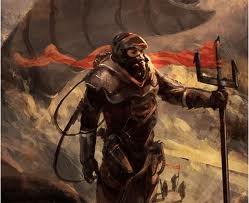
“Fear is the Mind-Killer…”

“Fear is the Mind-Killer…”

Recently, when looking back at the best Dune lines from the miniseries, I forgot all about one, very important one. How could I? It’s only one of the most important lines in the Dune series, one that gets repeated in just about every book. And that line is… The Litany Against Fear! For those who don’t know, this is the invocation the Bene Gesserit’s and the Atreides make in order to ward off fear. And as I’m sure many Dune fans have done (at least I hope so!), I’ve even tried saying it once or twice. Doesn’t really work for me, but then again, it was a long shot at best.

Clearly, the idea behind the Litany is an acknowledgment that fear is dangerous, but also that the only way to overcome it is to embrace it. By allowing it to pass through you, yourself remaining but the fear gone, is to survive. To give in to it is to invite obliteration. Anyhow, the quoted version of this prayer was modified by from its original text by John Harrison for the purposes of adaptation. Here is how it appeared in the miniseries:

“I must not fear. Fear is the mindkiller. I will face my fear. I will let it pass through me. When it is gone, there will be nothing, only I will remain.”

Not bad, but here is how it appeared in full, in the original text of Dune:

“I must not fear. Fear is the mind-killer. Fear is the little-death that brings total obliteration. I will face my fear. I will permit it to pass over me and through me. And when it has gone past I will turn the inner eye to see its path. Where the fear has gone there will be nothing. Only I will remain.

Yep, its about twice as long. And when you’re acting, long speeches tend to make the audience lose interest. Curiously enough, David Lynch used the full text version when making the movie version of Dune. One would think that his time constraints would have made brevity all the more desirable. But then again, he relied on internal monologues to make this speech, as with most other things in his movie. Since the actors didn’t have to stand and deliver, just pull a face and let the voice over do its thing, they could kind of get away with it. And if the audience got bored… well, chances are they were bored to begin with! Or lost, his movie was good like that ;)!
Of Great Sci-Fi (and other non-affliated) Quotes:

alien-worldRecently, I’ve taken to posting quotes by the great science fiction authors on twitter. Most are from the authors I draw the most inspiration from, others are just from people I admire and who offered some wisdom along the way. Like a true nerd, I keep these things in a file on my computer, adding to it every time I find a new one or think up one myself. Might sound odd but I find it useful, it offers fresh inspiration and perspective whenever I’ve hit a wall or am not sure how a piece of writing is turning out. Today, I thought I’d share a few of the gems that have really inspired me over the years. To be fair, some of them are not science-fiction related, or even by authors; they’re just moments of brilliance captured in an utterance. Here are a few:

“We sit atop a sort of anthill of technologies. At the bottom there’s fire, and growing cereal grains, and learning to store cereal – all those things that people have to store edible energy and start building cities. Not that we’re the crown of creation; we are at the crown of technological creation at any given moment.”
-William Gibson during an interview after writing “Pattern Recognition”

“It’s impossible to move, to live, to operate at any level without leaving traces, bits, seemingly meaningless fragments of personal information.”

“The future has already arrived. It’s just not evenly distributed yet.”

“Cyberspace. A consensual hallucination experienced daily by billions of legitimate operators, in every nation, by children being taught mathematical concepts…”

“When I began to write fiction that I knew would be published as science fiction, [and] part of what I brought to it was the critical knowledge that science fiction was always about the period in which it was written.”

“. . . the street finds its own uses for things.”
-Other tidbits from Gibson, who’s nothing if not prolific in his observations!

“The difference between stupid and intelligent people—and this is true whether or not they are well-educated—is that intelligent people can handle subtlety. They are not baffled by ambiguous or even contradictory situations—in fact, they expect them and are apt to become suspicious when things seem overly straightforward.”
-Neal Stephenson, “The Diamond Age”

“Ronald Reagan has a stack of three-by-five cards in his lap. He skids up a new one: “What advice do you, as the youngest American fighting man ever to win both the Navy Cross and the Silver Star, have for any young marines on their way to Guadalcanal?”
Shaftoe doesn’t have to think very long. The memories are still as fresh as last night’s eleventh nightmare: ten plucky Nips in Suicide Charge!
“Just kill the one with the sword first.”
“Ah,” Reagan says, raising his waxed and penciled eyebrows, and cocking his pompadour in Shaftoe’s direction. “Smarrrt–you target them because they’re the officers, right?”
“No, fuckhead!” Shaftoe yells. “You kill ’em because they’ve got fucking swords! You ever had anyone running at you waving a fucking sword?”
-Stephenson, “Cryptonomicon”. One of the funniest written passages I’ve ever read, and fitting because it puts Reagan in his proper, historically accurate place!

“I just think talk of suffering should be left to those who’ve actually suffered.”
-Jack (a First Nations former student I knew. As soon as he said it, I knew that I had just heard one of the smartest things ever said by anybody, anywhere, ever!)

Of Sci-fi and speculative fiction

I love science fiction, always have, always will.  But it’s the kind of science fiction that I love which I think is an important distinction. I’ve always subscribed to the idea that sci-fi comes in two varieties: classic and commercial.  The classical kind is the traditional variety that people take seriously, like H.G Wells, Frank Herbert, Isaac Asimov, Carl Sagan, William Gibson, Neil Stephenson, and Alastair Reynolds (These are just some of my favorites, they are by no means the only authors who were great at establishing sci-fi as a serious literary form.)

Commercial sci-fi, by contrast, is your basic stuff that owes much to the original masters but really didn’t follow in their footsteps.  Star Wars, Star Trek, Star Gate, et al (awful lot of stars in there!) are all examples of this.  This isn’t to say I didn’t like these shows, I grew up on Star Wars after all!  But to be honest, I never really found them particularly inspiring.  In all honesty, when it came to my own writing, they were more an example of what NOT to do.

Also, credit must be given to a friend of mine who once said that science fiction really isn’t a genre at all, it is a vehicle.  A vehicle who’s purpose is to deliver a message.  What that message is and how it is conveyed is what I think differentiates classic sci-fi from the commercial type.  Without a doubt, Frank Herbert’s Dune was the most inspirational work for me in that it delivered so much, and did so in a way that was both profound yet subtle.  He didn’t have muppet-style aliens who’s sole purpose was to reflect on humanity, he wasn’t preachy, his characters weren’t one-dimensional and his plots were never quick and tidy.  Characters were complex, his commentary was challenging, and his universe was rich and developed.

He was one of the greats that got me into writing sci-fi. Originally, back when I was still in school, I thought it might be cool to write a science fiction series.  I always loved drawing futuristic worlds and sci-fi stuff, but mainly I wanted to create my own universe. After reading his series, it occurred to me that I could turn my own ideas into short stories or even a full length novel.  I’ve crafted one full-length, called Legacies, and several shorts that are either set in the same universe or are completely independent. Since that time, I’ve also delved into some work that is a bit more contemporary, set in today’s world but with a sci-fi feel and spin.

The topics I like to cover are human evolution, extinction, exploration, colonization, society, technology, the cutting edge of things, and yes, even extra-terrestrials.  The longer I am here, the more I hope to post and share.  Hope y’all like what I have to offer! Enjoy!