NASA’s 3D Printed Moon Base

ESA_moonbaseSounds like the title of a funky children’s story, doesn’t it? But in fact, it’s actually part of NASA’s plan for building a Lunar base that could one day support inhabitants and make humanity a truly interplanetary species. My thanks to Raven Lunatick for once again beating me to the punch! While I don’t consider myself the jealous type, knowing that my friends and colleagues are in the know before I am on stuff like this always gets me!

In any case, people may recall that back in January of 2013, the European Space Agency announced that it could be possible to build a Lunar Base using 3D printing technology and moon dust. Teaming up with the architecture firm Foster + Partners, they were able to demonstrate that one could fashion entire structures cheaply and quite easily using only regolith, inflatable frames, and 3D printing technology.
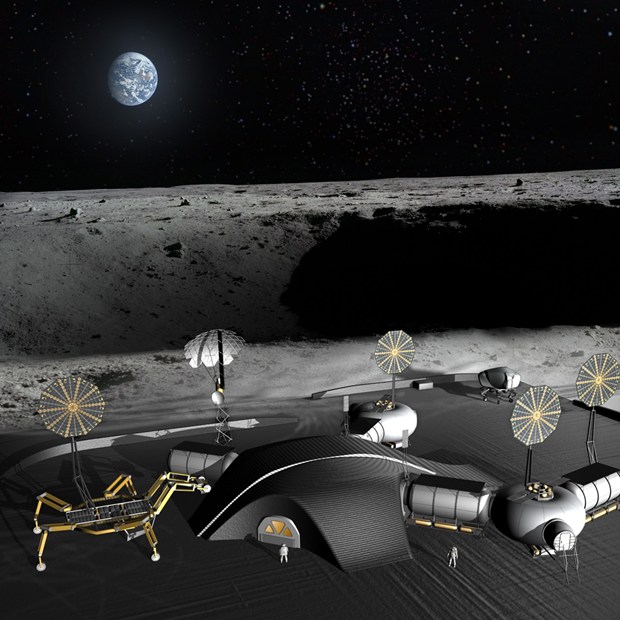
sinterhab2_1And now, it seems that NASA is on board with the idea and is coming up with its own plans for a Lunar base. Much like the ESA’s planned habitat, NASA’s would be located in the Shackleton Crater near the Moon’s south pole, where sunlight (and thus solar energy) is nearly constant due to the Moon’s inclination on the crater’s rim. What’s more, NASA”s plan would also rely on the combination of lunar dust and 3D printing for the sake of construction.

However, the two plans differ in some key respects. For one, NASA’s plan – which goes by the name of SisterHab – is far more ambitious. As a joint research project between space architects Tomas Rousek, Katarina Eriksson and Ondrej Doule and scientists from Nasa’s Jet Propulsion Laboratory (JPL), SinterHab is so-named because it involves sintering lunar dust: heating it up with microwaves to the point where the dust fuses to become a solid, ceramic-like block.

This would mean that bonding agents would not have to be flown to the Moon, which is called for in the ESA’s plan. What’s more, the NASA base would be constructed by a series of giant spider robots designed by JPL Robotics. The prototype version of this mechanical spider is known as the Athlete rover, which despite being a half-size variant of the real thing has already been successfully tested on Earth.
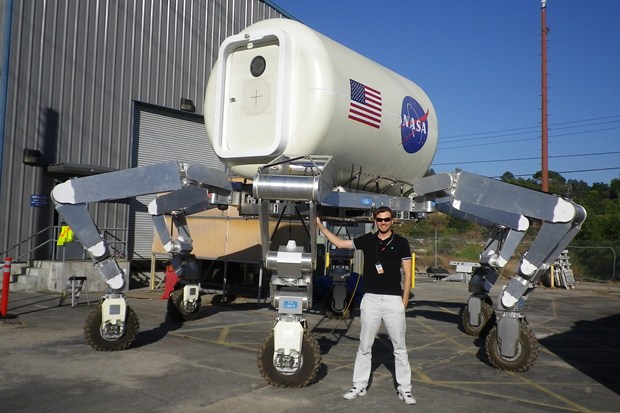
athlete_robotEach one of these robots is human-controlled, has six 8.2m legs with wheels at the end, and comes with a detachable habitable capsule mounted at the top. Each limb has a different function, depending on what the controller is looking to do. For example, it has tools for digging and scooping up soil samples, manipulators for poking around in the soil, and will have a microwave 3D printer mounted on one of the legs for the sake of building the base. It also has 48 3D cameras that stream video to its operator or a remote controlling station.

The immediate advantages to NASA’s plan are pretty clear. Sintering is quite cheap, in terms of power as well as materials, and current estimates claim that an Athlete rover should be able to construct a habitation “bubble” in only two weeks. Another benefit of the process is that astronauts could use it on the surface of the Moon surrounding their base, binding dust and stopping it from clogging their equipment. Moon dust is extremely abrasive, made up of tiny, jagged morcels rather than finely eroded spheres.

sinterhab3Since it was first proposed in 2010 at the International Aeronautical Congress, the concept of SinterHab has been continually refined and updated. In the end, a base built on its specifications will look like a rocky mass of bubbles connected together, with cladding added later. The equilibrium and symmetry afforded in this design not only ensures that grouping will be easy, but will also guarantee the structural integrity and longevity of the structures.

As engineers have known for quite some time, there’s just something about domes and bubble-like structures that were made to last. Ever been to St. Peter’s Basilica in Rome, or the Blue Mosque in Istanbul? Ever looked at a centuries old building with Onion Dome and felt awed by their natural beauty? Well, there’s a  reason they’re still standing! Knowing that we can expect similar beauty and engineering brilliance down the road gives me comfort.

In the meantime, have a gander at the gallery for the proposed SinterHab base, and be sure to check out this video of the Athlete rover in action:

Source: Wired.co.uk, robotics.jpl.nasa.gov

Powered by the Sun: The Future of Solar Energy

Magnificent CME Erupts on the Sun - August 31Researchers continue to work steadily to make the dream of abundant solar energy a reality. And in recent years, a number of ideas and projects have begun to bear fruit. Earlier this year, their was the announcement of a new kind of “peel and stick” solar panel which was quite impressive. Little did I know, this was just the tip of the iceberg.

Since that time, I have come across four very interesting stories that talk about the future of solar power, and I feel the need to share them all! But, not wanting to fill your page with a massive post, I’ve decided to break them down and do a week long segment dedicated to emerging solar technology and its wicked-cool applications. So welcome to the first installment of Powered By The Sun!

spaceX_solararrayThe first story comes to us by way of SpaceX, Deep Space Industries, and other commercial space agencies that are looking to make space-based solar power (SBSP) a reality. For those not familiar with the concept, this involves placing a solar farm in orbit that would then harvest energy from the sun and then beam the resulting electricity back to Earth using microwave- or laser-based wireless power transmission.

Originally described by Isaac Asimov in his short story “Reason”, the concept of an actual space-based solar array was first adopted by NASA in 1974. Since that time, they have been investigating the concept alongside the US Department of Energy as a solution to the problem of meeting Earth’s energy demands, and the cost of establishing a reliable network of arrays here on Earth.

Constructing large arrays on the surface is a prohibitively expensive and inefficient way of gathering power, due largely to weather patterns, seasons, and the day-night cycle which would interfere with reliable solar collection. What’s more, the sunniest parts of the world are quite far from the major centers of demand – i.e. Western Europe, North America, India and East Asia – and at the present time, transmitting energy over that long a distance is virtually impossible.

NASA "Suntower" concept
NASA “Suntower” concept

Compared to that, an orbiting installation like the SBSP would have numerous advantages. Orbiting outside of the Earth’s atmosphere, it would be able to receive about 30% more power from the Sun, would be operational for almost 24 hours per day, and if placed directly above the equator, it wouldn’t be affected by the seasons either. But the biggest benefit of all would be the ability to beam the power directly to whoever needed it.

But of course, cost remains an issue, which is the only reason why NASA hasn’t undertaken to do this already. Over the years, many concepts have been considered over at NASA and other space agencies. But due to the high cost of putting anything in orbit, moving up all the materials required to build a large scale installation was simply not cost effective.

spacex-dragon-capsule-grabbed-by-iss-canadarm-640x424However, that is all set to change. Companies like SpaceX, who have already taken part in commercial space flight (such as the first commercial resupply to the ISS in May of 2012, picture above) are working on finding ways to lower the cost of putting materials and supplies into orbit. Currently, it costs about $20,000 to place a kilogram (2.2lbs) into geostationary orbit (GSO), and about half that for low-Earth orbit (LEO). But SpaceX’s CEO, Elon Musk, has said that he wants to bring the price down to $500 per pound, at which point, things become much more feasible.

And when that happens, there will be no shortage of clients looking to put an SBSP array into orbit. In the wake of the Fukushima accident, the Japanese government announced plans to launch a two-kilometer-wide 1-gigawatt SBSP plant into space. The Russian Space Agency already has a a working 100-kilowatt SBSP prototype, but has not yet announced a launch date. And China, the Earth’s fastest-growing consumer of electricity, plans to put a 100kW SBSP into Low-Earth Orbit by 2025.

space-based-solarpowerMost notably, however, is John Mankins, the CTO of Deep Space Industries and a 25-year NASA vet, who has produced an updated report on the viability of SBSP. His conclusion, in short, is that it should be possible to build a small-scale, pilot solar farm dubbed SPS-ALPHA for $5 billion and a large-scale, multi-kilometer wide power plant for $20 billion. NASA’s funding for SPS-ALPHA dried up last year, but presumably Mankins’ work continues at Deep Space Industries.

Cost and the long-term hazards of having an array in space remain, but considering its long-term importance and the shot in the arm space exploration has received in recent years – i.e. the Curiosity Rover, the proposed L2 Moon outpost, manned missions to Mars by 2030 – we could be looking at the full-scale construction of orbital power plants sometime early in the next decade.

And it won’t be a moment too soon! Considering Earth’s growing population, its escalating impact on the surface, the limits of many proposed alternative fuels, and the fact that we are nowhere near to resolving the problem of Climate Change, space-based solar power may be just what the doctor ordered!

Thanks for reading and stay tuned for the next installment in the Powered By The Sun series!

Source: Extremetech.com

ISS Astronaut Chris Hadfield sings with the Barenaked Ladies!

ISS_Hadfield_BNLFans of The Big Bang Theory, or anyone who has lived in Canada for the last 20 years, ought to be instantly familiar with the Barenaked Ladies. However, what is not common knowledge is that Chris Hadfield, an astronaut aboard the International Space Station, is himself Canadian and apparently, quite the musician! Not only can he sing, he can play the guitar in zero-gravity and even execute some sweet moves. Quite the ensemble!

And in this rare treat, which took place back in February, Hadfield, the Barenaked Ladies, and the Wexford Gleeks children’s choir all collaborated to create the world’s first space-to-earth musical collaboration. The song they sang was an original creation, entitled “I.S.S. (Is Somebody Singing)”, which was commissioned by CBCMusic.ca and The Coalition for Music Education with the Canadian Space Agency to celebrate music education in schools across Canada.

So if you have a few minutes, I recommend you cue up this video, turn the volume up, and enjoy a truly heartwarming and breathtaking song that celebrates Canada, music, planet Earth, and the wonder of looking down at it all from space. It’ll give you goose bumps, I swear!

Pluto’s New Moon to be Named Vulcan

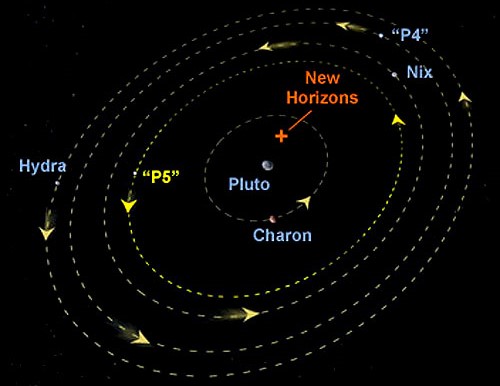
pluto1For roughly a month now, the SETI Institute (Search for Extra-Terrestrial Intelligence) has been holding an online poll – appropriately named Pluto Rocks! – to help them name Pluto’s smallest moons, officially designated P4 and P5. Discovered in 2011 and 2012 respectively, an online poll ran up until the end of February, at which point researcher and co-discoverer Mark Showalter took the names before the International Astronomical Union (IAU) to finalization.

Although there were several choices for for Pluto’s fourth and fifth moon, it was P4 that became the focus of a great deal of attention. Of all the names for this space rock, two top contenders came out on top: Vulcan and Cerberus. Out of a whopping 450,324 people who took part in the poll overall, 174,062 voted for Vulcan, effectively putting it in the top spot. This was perhaps due to a little Twitter intervention by Mr. William Shatner.

Pluto_moon_orbitsWhen the contest began back, it seemed that two camps emerged as the forerunners for naming the rock. On the one hand, there were the Trekkies who seemed determined to name P4 after famed-character Spock’s homeworld. On the other, there those who belong to IAU camp, who favored the classical Greek name of the beast that guarded the entrance to the underworld.

After just a few days in, William Shatner, Mr. James T. Kirk himself, proposed the name Vulcan, and not just because of the connection to his show. In Roman mythology, Pluto (aka Hades in the Greek pantheon) was the God of the underworld and Vulcan was one of his sons. Cerberus might have been more appropriate since this beast was Pluto’s/Hades companion, but the connection still works, and provides a nice little tie-in to one of the most popular science fiction shows of all time.

Pluto-and-VulcanFans and Trekkies worldwide rallied, and as of Feb. 25th, Vulcan had a comfortable lead over Cerberus and Styx, which were vying for the 2nd place position. SETI has now advised that people be patient, as it will take another months or two for the names of the two moons to be finalized and selected. However, barring any major objections or upheavals, I think it’s fair to say that P4 and P5 will henceforth be named Vulcan and Kerberos.

And I have to say, this is fascinating news in more ways than just one. Not only does it demonstrate that our collective knowledge of the outer Solar System is growing. It also demonstrates how henceforth, astronomical studies and cataloging may become a much more democratic affair. Once considered the province of academics and scholars, space exploration may truly be an open field in the future, subject to mass participation.

Oh, and congrats to Mr. Shatner for his enduring influence, to Mr. Nimoy for the shout-out, and to Trekkies the world over for showing what a committed fandom made up of millions of geeks can do! And may all the people who bullied you for your interests and keen intellectual skills consider what a force you’ve become and cower in fear!

More News from Mars… Lots More!

marsIt’s a good thing I’ve come down with a cold and have little to do but sit at my computer. Because in the last week, some very interesting news stories have been piling up that just scream for recognition. And wouldn’t you know it, more than a few have to do with our big red neighbor Mars, that world many human beings will one day think of as home.

The first story comes to us from the Siding Spring Observatory in New South Wales, where noted astronomer Robert McNaught recently sighted an new comet. From his observations, the icy interloper appeared to have originated in the Oort Cloud – a hypothetical cloud surrounding the solar system and containing billions of icy planetesimals that were cast out from our Solar System billions of years ago.

Mars_A1_Latest_2014After news of the discovery was released, the astronomers at the Catalina Sky Survey in Arizona looked back over their observations to find “prerecovery” images of the comet dating back to Dec. 8, 2012. These observations placed the orbital trajectory of the comet – now known as C/2013 A1 – through the orbit of Mars on Oct. 19, 2014. This means, in essence, that this comet could very well strike the Red Planet late next year.

Luckily, NASA’s Jet Propulsion Laboratory has run the calculations and indicated that their close approach data suggests the comet is most likely to make a close pass of the Martian surface. And by close, they mean at roughly 0.0007 AU, or approximately 100,000 kilometers (63,000 miles) from the Martian surface. So in all likelihood, Curiosity and Opportunity will be safe from a serious impact that could turn them into scrap metal!

But of course, predicting its exact trajectory at this time is subject to guess work, and ongoing observations will be needed. No doubt, the predictions will be refined a the next 20 months go by, and we’ll know for sure if this comet plans to miss Mars completely, or slam head-on into the surface at 200,000 km/h (126,000 mph).

Source: news.discover.com, astroblogger.blogspot.ca

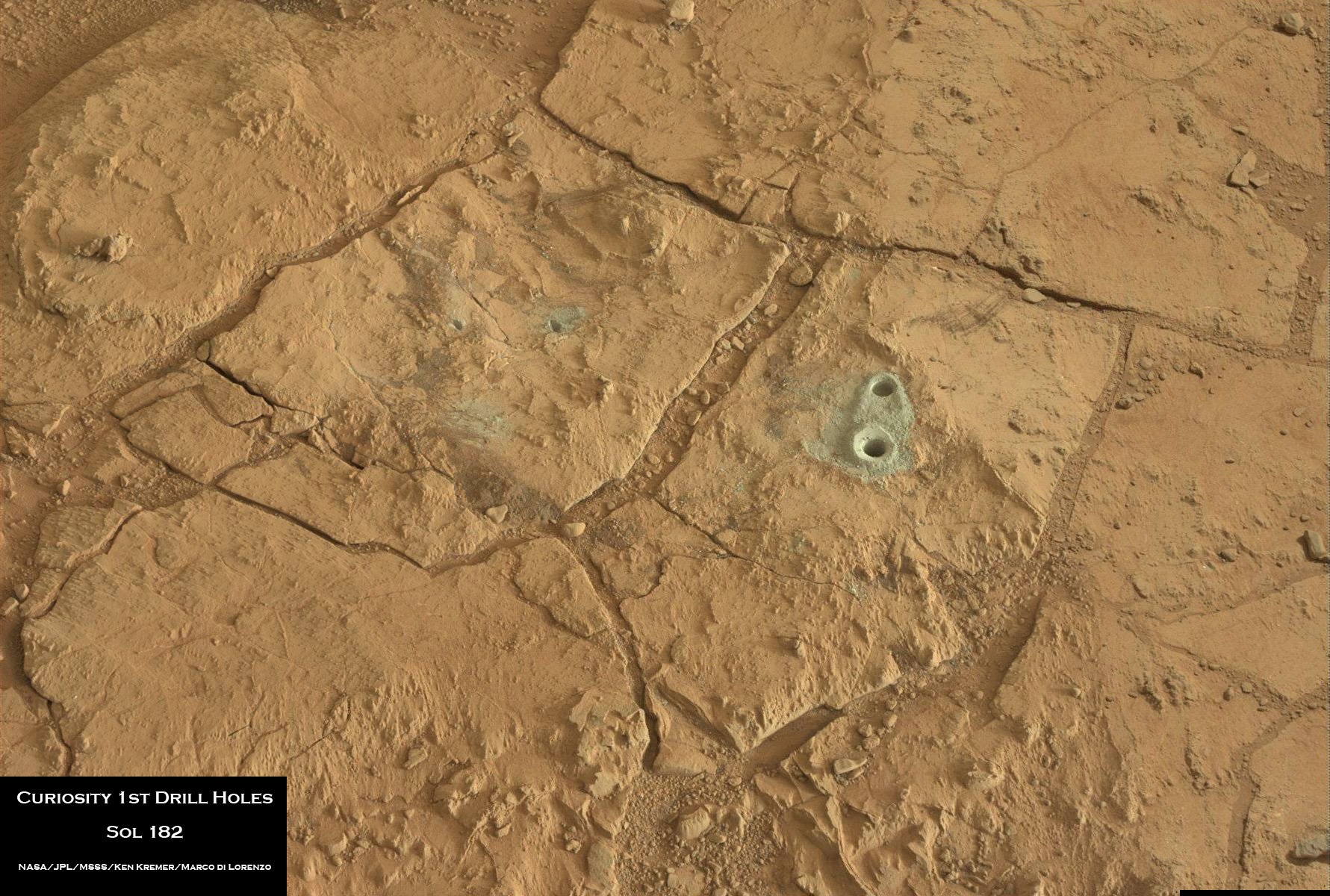
Mars_curiosity_drillingThe second bit of news comes to us from the good-ole Curiosity Rover! Roughly four weeks after conducting the first drilling operation into the Martian surface, the Rover ate its first sample of the grey dust that resulted. The delivery of the two aspiring-sized tablets of dust took place on Feb. 22nd and 23rd respectively after the robotic arm delivered them into the rover’s Chemistry and Mineralogy (CheMin) and Sample Analysis at Mars (SAM) laboratories for analysis. Results expected in two weeks!

Among other things, the results from the analysis are expected to give clues as to what the color change between the red surface and the grey interior means. One theory is that it might be related to different oxidations states of iron that could potentially inform us about the habitability of Mars inside the rover’s Gale Crater landing site.

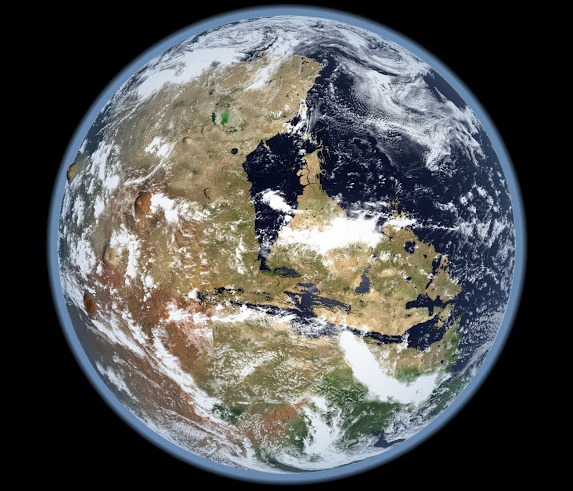
Living-Mars.2At the same time, the Mars Science Laboratory team expects to find further evidence of what life was like in previous geological eras. The Curiosity team believes that the area inside the Gale Crater, known as Yellowknife Bay, experienced repeated exposure to flowing liquid water long ago when Mars was warmer and wetter – and therefore was potentially more hospitable to the possible evolution of life.

The rover will likely remain in the John Klein area for a month or more to obtain a more complete scientific characterization of the area which has seen repeated episodes of flowing water. Eventually, the six-wheeled mega rover will set off on a year long trek to her main destination: the sedimentary layers at the lower reaches of the  5 km (3 mile) high mountain named Mount Sharp.

Source: universetoday.com

mars_hieroglyphsAnd last, but not least by any stretch of the imagination, is the discovery of “hieroglyphs” on the Martian surface. While they might appear like ancient glyphs to the untrained eye, they are in fact evidence of past subsurface water. The images were caught by the HiRISE camera on the Mars Reconnaissance Orbiter as it passed the surface area known as Amazonis Planitia.

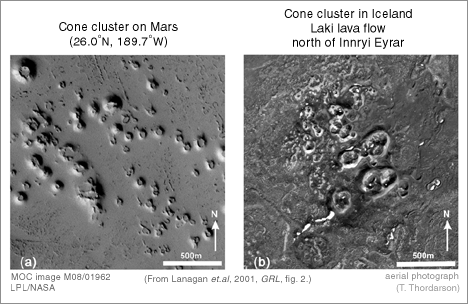
Known as ‘rootless cones,’ these geological features are the result of an explosive interaction of lava with ground ice or water contained within the regolith beneath the flow. Vaporization of the water or ice when the hot lava comes in contact causes an explosive expansion of the water vapor, causing the lava to shoot upward, creating what appears to be a button hole on the surface.

rootlessConesIn the past, Mars scientists have used geological patterns on Earth to make sense of similar ones found on Mars. For example, when the Curiosity Rover discovered veins of hydrated calcium in the rock surface in the Gale Crater, they compared them to similar patterns found in Egypt to determine that they were the result of long-term exposure to water flows. In this case, the rootless cones found in Amazonis Planitia are comparable to those found in Iceland’s Laki Lava Flow (as seen above).

According to Colin Dunas, from the US Geological Survey, the cones are rather large and most likely very old:

“The cones are on the order of a hundred meters across and ten meters high. The age of these specific cones isn’t known. They are on a mid- to late-Amazonian geologic unit, which means that they are young by Martian standards but could be as much as a few hundred million to over a billion years old.”

terraformingOnly time will tell if any subsurface water is still there, and hence usable by future teams of terraformers and settlers. According to Dundas, the odds are not so good of that being the case. Given the surface depth at which the ice was found, not to mention that at the low latitude at which it was found (22 degrees north), shallow ground ice is unstable. Dundas added that since ice stability varies as the obliquity changes, it’s even possible that ice has come and gone repeatedly since the lava erupted.

Too bad. That could have come in really handy for hydroponics, fuel cells, and even restoring surface water to the planet. Guess future generations of Martians will just have to look for their ground and irrigation water elsewhere, huh? Just another challenge of converting the Red Planet to a green one, I guess 😉

Stay tuned for more news Mars. As it stands, there’s plenty to be had! Stick around!

Source: hirise.lpl.arizona.edu, universetoday.com

Origins of Russian Meteor Found!

meteorJust over a week after a meteor exploded across the sky above the Chelyabinsk region of Russia, a group of astronomers published a paper that reconstructs where the rock came from. The men in question were Jorge Zuluaga and Ignacio Ferrin at the University of Antioquia in Medellin, Colombia. And the method they used was quite unconventional, and is perhaps a testament to the age we live in.

Basically, Zuluaga and Ferrin used the many sources of dashboard and security cameras that captured the event on film. Using the trajectories shown in the videos posted on YouTube, the researchers were able to calculate the trajectory of the meteorite as it fell to Earth and use it to reconstruct the orbit of the meteoroid before its fell to Earth and cause the shockwave that damaged buildings and shattered windows.

From their calculations, they were able to determine the height, speed and position of the meteorite as it fell to Earth. According to the team’s paper:

“…the Chelyabinski meteor started to brighten up when it was between 32 and 47 km up in the atmosphere. The velocity of the body predicted by our analysis was between 13 and 19 km/s (relative to the Earth) which encloses the preferred figure of 18 km/s assumed by other researchers.”

They then used software developed by the US Naval Observatory (called NOVAS) and the Naval Observatory Vector Astrometry to calculate the likely orbit. From all this, they came to the preliminary conclusion that the meteorite came from the Apollo class of asteroids, a well-known class of rocks that cross Earth’s orbit.

This conclusion has some worried, since the Apollo group, which orbits the Sun in the vicinity of Venus and Earth, contains over 2000 asteroids that are larger than 1 km in diameter. And considering that this one meteor, which measured between 17 and 20 meters, caused 1491 injuries and damage to over 4000 buildings in the area.

Lucky for us, NASA and every other space agency on the planet has some defensive strategies in mind. And of course, early warning is always the most important aspect of disaster preparedness. In the near future, we can expect some of the proposed observation satellites that will be going up to ensure there will be a better degree of early warning.

Source: universetoday.com

Eyes in the Sky: The Future of Asteroid Defense

asteroid_beltWith the recent passage of DA14 – an asteroid half as large as a football field and packing the power of a hydrogen bomb – and the rather explosive display that occurred above Russian skies, it’s little wonder then why NASA and other space agencies are publicizing various existing and proposed solutions to our “asteroid problem”.

Granted, there really isn’t much of a threat of an asteroid colliding with the Earth in the foreseeable future. And we also know that the meteor that graced the skies over the Urals was unrelated to the DA14 behemoth. But given that an impact could mean an Extinction Level Event, similar to the Cretaceous-Paleogene event that caused the extinction of the dinosaurs, a little planning doesn’t hurt.

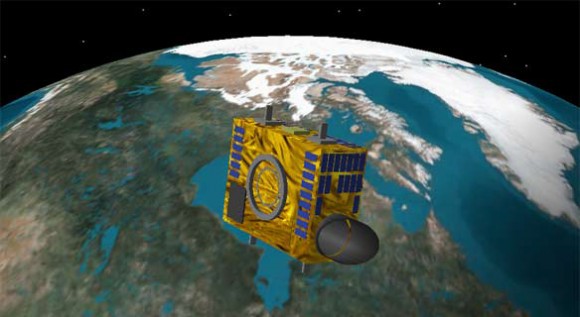
neossat-580x317The first in a series of three existing or proposed designs is the NEOSSat – Short for Near-Earth Object Surveillance Satellite – that was built in Canada and was deployed last week on an Indian rocket with six others. In addition to watching space debris in orbit and tracking their movements, it will also be keeping a sharp eye out for asteroids that may swing by Earth in the future.

AIDA_mission_conceptThen there is the ESA’s proposed Asteroid Impact and Deflection Assessment mission (or AIDA), a group of planetary defense satellites that will are designed to collide with an asteroid, then push it off course. And after two years of planning, research teams from the US and Europe have selected the mission’s target – a so called ‘binary asteroid’ named Didymos – that AIDA will intercept when it passes the Earth by a mere 11 million km in 2022.

The third and final proposed solution is something that sounds ripped from the pages of a science fiction novel. Known as the DE-STAR, or Directed Energy Solar Targeting of Asteroids and exploRation, this satellite is essentially a orbiting laser that would be capable of destroying approaching asteroids 10 times larger than the DA14 and at a distance as far away as the Sun.

NASA_destarProposed by two California scientists – UC Santa Barbara physicist and professor Philip M. Lubin, and Gary B. Hughes, a researcher and professor from California Polytechnic State University – the satellite is designed to harness the power of the sun and convert it into a massive phased array of laser beams that can destroy asteroids that pose a potential threat to Earth. At the same time, it will be capable of changing an asteroid’s orbit – deflecting it away from Earth, or into the Sun.

Feel safer? Well, considering that the odds of Earth getting anytime soon are pretty low, and are likely to fall even farther once we get these rock killers destroyed. Once more, it seems that sane planning and sensible solutions are winning out over doomsday predictions. Good for us!

Interactive Panorama of Curiosity!

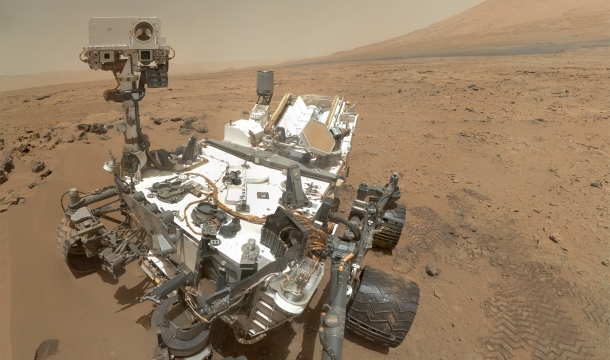
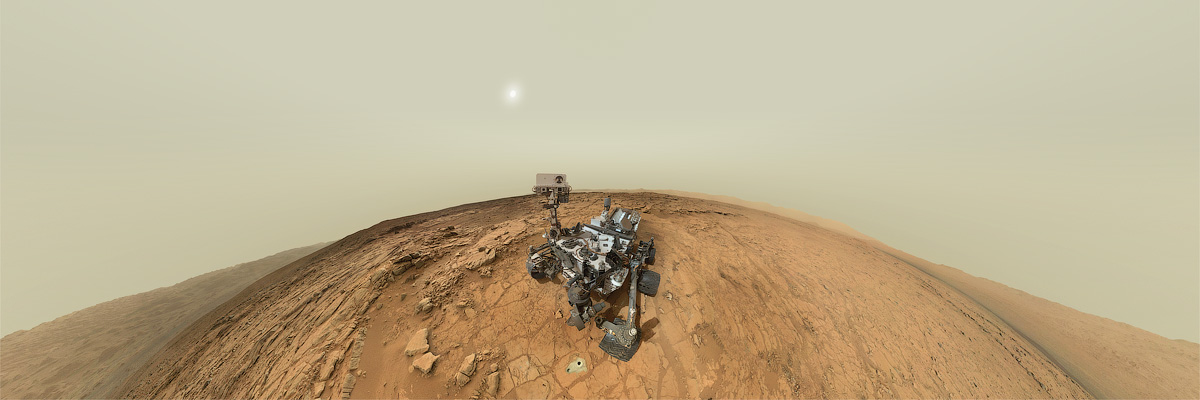
Curiosity_selfportraitThe credit goes to photographer Andrew Bodrov for creating this new and stunning  interactive self-portrait of the Curiosity Rover. Relying on several recent images taken at the “John Klein” drilling sight, he was able to create a full 360-degree panorama. What’s more, the picture is interactive, giving viewers the option of clicking, zooming, and surveying the entire “John Klein” drilling sight.

The mosaic stretches about 30,000 pixels width and includes the self-portrait, which consists of 66 different images (seen above) taken by the rover’s Mars Hand Lens Imager (MAHLI) during the 177th Martian sol, of Curiosity’s work on Mars (Feb. 3, 2013 here on Earth), along with 113 images taken on Sol 170 and an additional 17 images taken on Sol 176.

curiosity_sol-177-1The full and non-interactive photo appears above. If you look closely, you can see the drill holes directly beneath the rover. In addition, the shiny protuberance which was noticed earlier this month. And if you pan around the sky, you get a look at what a typical Martian day looks like, at least in Yellowknife Bay.

Click here to see the panorama and tinker with it some! And stay tuned for more news from the Red Planet!

Source: universetoday.com

NASA Loses Contact With ISS

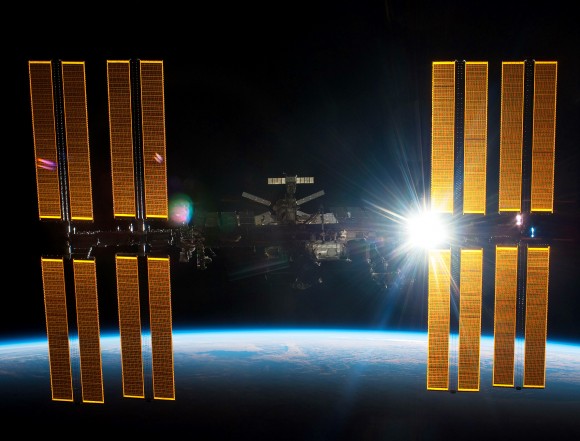
International-Space-Station-ISS-580x441It’s something no one hovering hundreds of kilometers over the Earth ever really wants to experience. Yes, when you floating in a tin can, you’re only connection to the surface being a communications relay, it can be pretty scary when it suddenly stops working. Can’t be much of a picnic for those working Mission Control either, or the families forced to sit idly by and wait for others to figure out what went wrong.

The communications blackout began on Tues, Feb. 19th at 9:45 am EST(15:45 UTC) , and lasted until 11:34 am yesterday (17:34 UTC). So for a good twenty-six hours straight, the ISS was unable to communicate with ground crews, which as anyone can guess caused a bit of a stir. Luckily, it turns out everyone on board the ISS was just fine the whole time, no injuries or space invaders to speak of!

According to a statement filed by NASA, communications were apparently lost when flight controllers in Houston were updating the software onboard the station’s flight computers and one of the station’s data relay systems malfunctioned. The primary computer that controls critical station functions defaulted to a backup computer, but was not allowing the station to communicate with NASA’s Tracking and Data Relay Satellites.

NASA_ISScrewThen, just before 11:00 a.m. EST, flight controllers were able to communicate with the crew once more as the space station flew over Russian ground stations. They then instructed the crew to connect a backup computer to begin the process of restoring communications. Once that was done, Expedition 34 Commander Kevin Ford reported the following:

“Hey, just FYI, the station is still flying straight, everybody is in good shape, or course, and nothing unexpected except lots of caution and warning [alarms]. All the systems look like they are doing just fine.”

According to the Johnson Space Center’s latest Twitter update, the crew is back at work and the crew is taking questions from fans. Click here to see what the crew had to say about the temporary communications blackout and what’s in store for them now.

In an ironic twist, sources have since indicated that Canadian astronaut Chris Hadfield Tweeted the following from the ISS shortly before the blackout took place: “Good Morning, Earth! Today we transition the Space Station’s main computers to a new software load. Nothing could possibly go wrong.” The moral here? Things can always go wrong! And don’t tempt fate, especially when you’re hurling through space, hundreds of kilometers above the Earth.

Source: universetoday.com


Exploring the Universe with Robotic Avatars and Holodecks

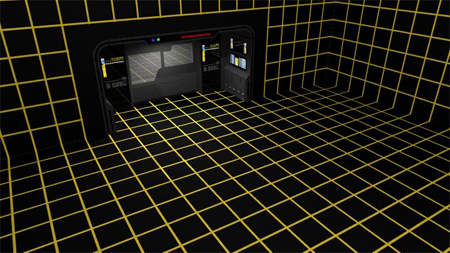
holodeck_nasaSpace exploration is littered with all kinds of hazards. In addition to the danger of dying from decompression, mechanical failures, micro-meteoroids or just crashing into a big ball of rock, there are also the lesser-known problems created by low-gravity, time dilation, and prolonged isolation. Given all that, wouldn’t it just be easier to send probes out to do the legwork, and use virtual technology to experience it back home?

That’s the idea being presented by Dr. Jeff Norris, one of the scientists who works for NASA’s Jet Propulsion Laboratory in Pasadena, California. In a recent presentation that took place at Pax Prime last year – entitled “NASA’s Got Game” – he spoke of the agency’s plans for telexploration – the process of exploring the universe using robotic avatars and holodecks, rather than sending manned flights into deep space.

avatar_imageIn the course of making this presentation, Norris noted several key advantages to this kind of exploration. In addition to being safer and cheaper, its also more readily available. Whereas deep space exploration involving space ships with FTL engines – the Alcubierre Drive they are currently working on – will eventually be available, robot space probes and advanced telecommunications technology are available right now.

At the same time, telexploration is also more democratic. Whereas conventional space travel involves a select few of highly-trained, eminently qualified people witnessing the wonders of the universe, robotic avatars and holographic representations bring the experience home, where millions of people can experience the awe and wonder for themselves. And when you think about it, it’s something we’re already doing, thanks to the current generation of space probes, satellites and – of course! – the Curiosity Rover.

Curiosity_selfportraitBasically, rather than waiting for the warp drive, Norris believes another Star Trek technology – the holodeck – will be the more immediate future of space exploration, one that we won’t have to wait for. Yes, there are more than a few Star Trek motifs going on in this presentation, and a little Avatar too, but that’s to be expected. And as we all know, life can imitate art, and the truth is always stranger than fiction!

Check out the video of the presentation below:


And remember…

holodeck_vegasad