The Future is Here: VR Taste Buds and Google Nose

holodeck_telexOne of the most intriguing and fastest-growing aspects of digital media is the possibilities it offers for augmenting reality. Currently, that means overlaying images or text on top of the real world through the use of display glasses or projectors. But in time, the range of possibilities might expand far beyond the visual range, incorporating the senses of taste and smell.

That’s where devices like the Digital Taste Interface comes into play. Developed by Nimesha Ranasinghe, an electrical engineer and the lead researcher of the team at National University of Singapore, this new technology seeks to combine the worlds of virtual reality and gestation. As Ranasinghe explained it in a recent interview with fastcompany.com:

Gustation is one of the fundamental and essential senses, [yet] it is almost unheard of in Internet communication, mainly due to the absence of digital controllability over the sense of taste. To simulate the sensation of taste digitally, we explored a new methodology which delivers and controls primary taste sensations electronically on the human tongue.

digital_taste_interfaceThe method involves two main modules, the first being a control system which formulates different properties of stimuli – basically, levels of current, frequency, and temperature. These combine to provide thermal changes and electrical stimulation that simulate taste sensations, which are in turn delivered by the second module. This is the tongue interface, which consists of two thin, metal electrodes.

According to Ranasinghe, during the course of clinical trials, subjects reported a range of taste experiences. These ranged from sour, salty and bitter sensations to minty, spicy, and sweet. But to successfully communicate between the control systems and sensors, Ranasinghe and her team created a new language format. Known as the TasteXML (TXML), this software specifies the format of specific taste messages.

digital_taste_interface1While the team is currently in negotiations to make the technology commercially available, there are a few pressing updates in the works for the Digital Taste Interface. The first is a more appealing way to use the tongue sensors, which currently are attached while the mouth is open. To that end, they want an interface that can be held in the mouth, called the digital lollipop because it looks like the candy.

In addition to making the system look more aesthetically pleasing and appetizing, it will also allow for a deeper understanding of how electrical stimulation affects taste sensors on different parts of the tongue. In addition, they also want to incorporate smell and texture into the experience, to further extend the range of sensations and create a truly immersive virtual experience.
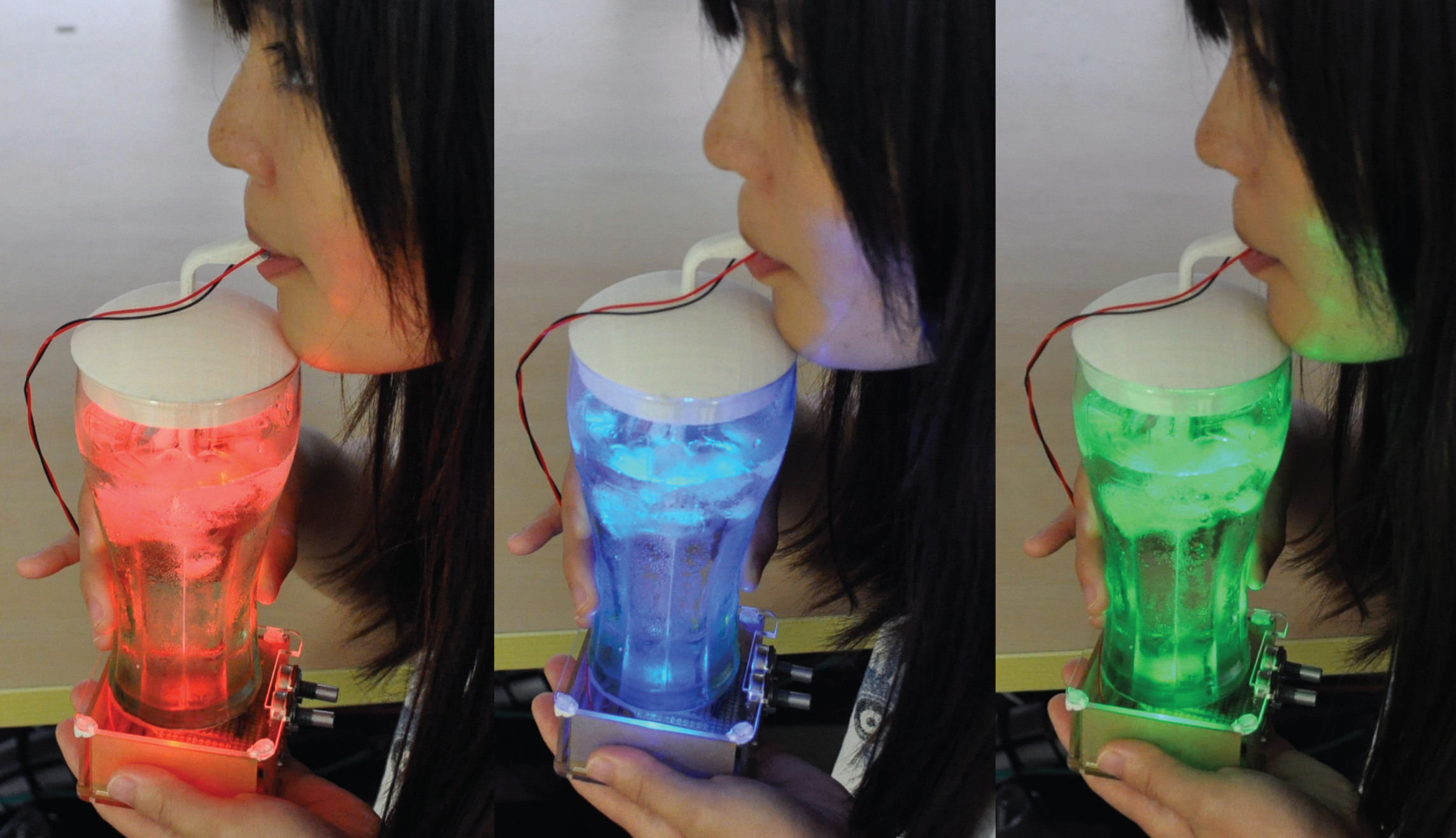
digital_taste_interface2Ultimately, the Digital Taste Interface has many potential benefits and applications, ranging from medical advances to diet regimens and video games. As Ranasinghe explains:

We are exploring different domains such as entertainment (taste changing drink-ware and accessories) and medical (for patients who lost the sense of taste or have a diminished sense of taste). However, our main focus is to introduce the sensation of taste as a digitally controllable media, especially to facilitate virtual and augmented reality domains.

So in the coming years, do not be surprised if virtual simulations come augmented with a full-range of sensory experiences. In addition to being able to interact with simulated environments (i.e. blowing shit up), you may also be able to smell the air, taste the food, and feel like you’re really and truly there. I imagine they won’t even call it virtual reality anymore. More like “alternate reality”!

And of course, there’s a video:


Sources:
fastcompany.com

New Video: Quantum Entanglement Explained

quantum-entanglement1If you’re like most people, the concept of quantum entanglements confuses and perplexes you. But considering its important to quantum science, the future of computing and (maybe, just maybe) space travel, it’s something we should all strive to understand. Luckily, this educational video produced by PHD Comics, and narrated by physicists Jeff Kimble and Chen-Lung Hung, explains it in easy-to-understand terms.

To break it down succinctly, quantum entanglement is the unusual behavior where elementary particles become linked so that when something happens to one, something happens to the other; no matter how far apart they are. This bizarre behavior of particles that become inextricably linked together is what Einstein supposedly called “spooky action at a distance.”

Understanding how this works may very well unlock the mysteries of the universe, shedding light on the unusual behavior of black holes, how gravity interacts with the other fundamental forces and yielding a Grand Unifying Theory/Theory of Everything (TOE)- and even let us circumvent “natural” barriers like the speed of light. So enjoy the video, and be sure to listen carefully. Simplified or not, this is still some pretty heavy stuff!


Source: universetoday.com

The Future is Here: Laser 3D Printing

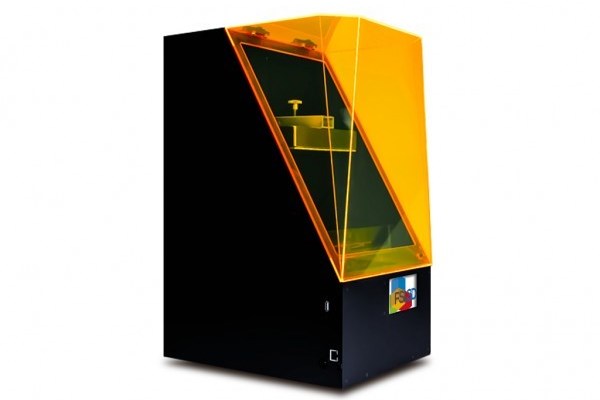
pegasus-touch3D printing has really come into is own in recent years, with the range of applications constantly increasing. However, not all 3D printers or printing methods are the same, ranging from ones that use layered melted plastic to ones that print layers of metal dust, then fuse them with microwave radiation. This range in difference also means that some printers are faster, more accurate, and more expensive than others.

Take the Pegasus Touch as an example. Built by a Las Vegas-based company Full Spectrum Laser (FSL), this desktop 3D printer uses lasers to create objects faster and in finer detail than most other printers in its price range. Available for as little as US$2,000 via a Kickstarter campaign, its performance is claimed to be comparable to machines costing 50 times more.


pegasus-touch-8Instead of building up an object by melting plastic filaments and depositing the liquid like ink from a nozzle, the Pegasus touch uses what’s called laser-based stereolithography (SLA). This consists of using a series of 500 kHz ultraviolet lasers moving at 3,000 mm/sec to solidify curable photopolymer resin. As the object rises out of a vat of resin, the laser focuses on the surface, building up layer after layer with high precision.

To be fair, the technology has been around for many years. What is different with the Pegasus Touch is that FSL has shrunk the printer down and made it more economical. Normally, SLA machines are huge and cost in the order of hundreds of thousands of dollars. The Pegasus Touch, on other hand, measures just 28 x 36 x 57 cm (11 x 14 x 22.5 inches) and costs only a few thousand dollars.

pegasus-touch-4This affordability is due in part to the wide availability of Bluray players has made UC laser diodes much more affordable. In addition, FSL is already adept at making laser cutting and engraving machines, which has allowed the company to base the Pegasus Touch on modelling software and electronics already developed for these machines. This allows the device to operate at tolerances equivalent to a $100,000 machine.

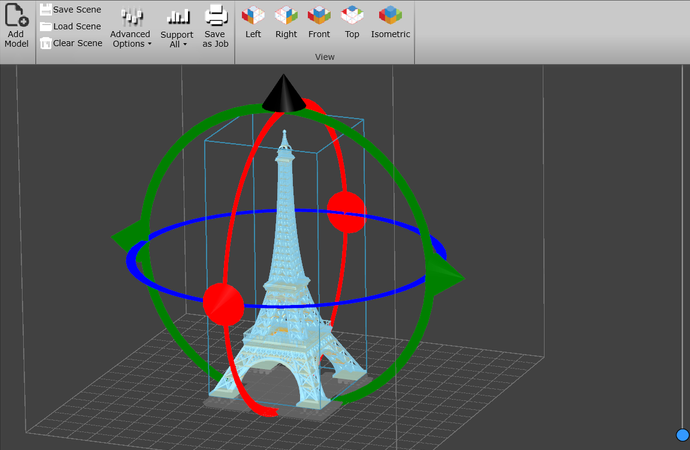
The device also has an on-board 1GHz Linux computer with 512 MB memory that can do much of the 3D processing computation itself, making a connected PC all but unnecessary. There’s also an internet-connected 4.3-in color touchscreen, which allows the user to access open-source models that are printer-ready, plus the machine comes with multi-touch-capable desktop software.

pegasus-touch-3It also has a relatively large build area of approximately 18 x 18 x 23 cm (7 x 7 x 9 inch), which is one of the largest in the consumer 3D printer market. The company also says that the Pegasus Touch is 10 times faster than a filament deposition modelling (FDM) printer, has finer control, and up to six times faster than other SLA printers, and can produces a better and more detailed finish.

The Pegasus Touch’s Kickstarter campaign wrapped up earlier this month and raised a total of $819,535, putting them well above their original goal of $100,000. For those who pledged $2000 or more, the printer was made available for pre-order. When and if it goes on sale, the asking price will be $3,499. Given time, I imagine the technology will improve to use metal and other materials instead of resin.

And of course, there’s a promotional video, showcasing the device at work:


Sources: gizmag.com, kickstarter.com, fsl3d.com

The Future of Warfare: Iron Man is Coming!

iron_man_suitsAccording to a report filed last Tuesday by the US Navy’s top SEAL, the ambitious plan to build a high-tech armored suit for elite commandos has entered a new phase. After years of development, the military is preparing to analyze three new design concepts, and will begin receiving prototypes of these “Iron Man” suits by the summer.

Adm. William McRaven, commander of U.S. Special Operations Command, said the military will receive the prototypes by June. This project, which was started last year, aims to revolutionize the capabilities and protection of Navy SEALs, U.S. Army Special Forces, and other elite commandos who perform some of the U.S.’s most dangerous and violent missions.

TALOSOfficially known as the Tactical Assault Light Operator Suit (TALOS) – named after the Greek automaton made by Zeus to protect Europa – the designs have already been nicknamed the “Iron Man” suit. Obviously, the name is a nod to all the futuristic technology that powers the suit, including a powered exoskeleton, liquid armor, built-in computers and night vision, and the ability to monitor vital signs and apply wound-sealing foam.

However, there’s a catch with the prototypes. According to McRaven, who addressed reporters at a special operations conference in Washington. the prototypes will be unpowered. As it stands, no known means exists to provide a powered armor suit with the kind of electricity it would need without resorting to a gas-powered generator, or connecting the suit to the local grid.

Warrior_Web_Concepts_WideAs he explained, the challenge of finding a way to power a suit that is portable and ergonomic remains:

Obviously if you’re going to put a man in a suit – or a woman in a suit – and be able to walk with that exoskeleton… you’ve got to have power. You can’t have power hooked up to some giant generator.

Essentially, this means that the days of a genuine “Iron Man” suit are still years away. Best-case scenario, the admiral wants the suit to be used in combat situations by August 2018. Still, he also emphasized the “astounding results” that has been observed in the project so far. The prototypes in assembly now will be evaluated, with the results incorporated into the suits the U.S. will eventually deploy to the battlefield.

ghost_recon_future_soldier-1920x1080It’s unclear what the total price of the project may be, but McRaven said he would like to offer a $10 million prize to the winner in a competition. That hasn’t happened yet, but it’s likely the cost of developing the suit would be many times that, most likely ranging into the billion-dollar bracket. But of course, McRaven thinks it will be worth every penny:

That suit, if done correctly, will yield a revolutionary improvement to survivability and capability for U.S. special operators… If we do TALOS right, it will be a huge comparative advantage over our enemies and give the warriors the protection they need in a very demanding environment.

The admiral said the project was inspired by a U.S. special operator who was grieving the loss of a comrade in combat.  Despite more than a decade of war in Iraq and Afghanistan, the U.S. still doesn’t have a way to adequately protect commandos who “take a door,” a reference to the controversial raids that kill and capture insurgents all over the globe.

iron_man_destructionAlready, SOCOM has predicted the suit will include futuristic liquid body armor that hardens when a magnetic field or electrical current is applied. This is the most futuristic aspect of the suit, giving the soldier flexibility, mobility, and providing superior protection against ballistic objects. It also will include wearable computers, communications antennae, and a variety of sensors that link it to its wearer’s brain.

By merging digital technology, wireless access to army communications, GPS satellites and databases, and upgraded targeting and protection into one package, a single commando unit will likely have the combat effectiveness of an entire platoon. And from all indications, it’s only a few years away. I imagine the US Special Forces will see a serious boost in recruitment once the suits are available.

And of course, there’s a concept video provided by the U.S. Army Research, Development and Engineering Command (RDECOM) showing what TALOS has to offer:


Sources: complex.foreignpolicy.com

The Future is Here: The Holodeck Video Trainer

VIPE1A current obsession of military planners is keeping up with the latest in battlefield challenges while also dealing with troop reductions and tightened budgets. Video games are one solution, providing soldiers with  training that does not involve real munitions or loss of equipment. Unfortunately, most of these games do not provide a real-world immersive feel, coming as close to the real thing as possible while still being safe.

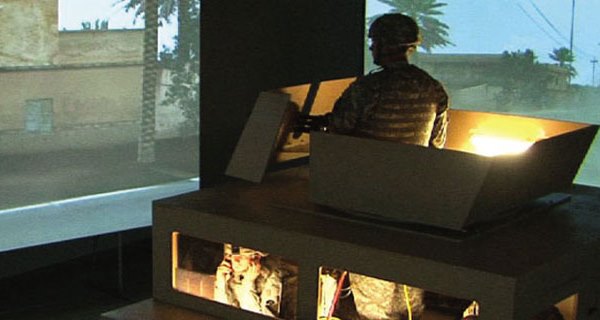
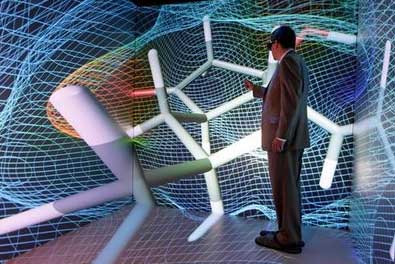
Hence why the the Army Contracting Command enlisted the help of Northrop Grumman this past January to integrate their Virtual Immersive Portable Environment (VIPE) “Holodeck” into the US Army’s training program. Much like the CAVE2, a VR platform created by the Electronic Visualization Laboratory (EVL) at the University of Illinois, this latest holodeck is a step towards fully-realized VR environments.

VIPE_HolodeckUsing commercial, off-the-shelf hardware combined with gaming technology, the VIPE Holodeck virtual training system provides users with a 360 degree, high-fidelity immersive environment with a variety of mission-centric applications. It can support live, virtual and constructive simulation and training exercises including team training, cultural and language training and support for ground, air and remote platform training.

Last year, the VIPE Holodeck took first place in the Federal Virtual Challenge – an annual competition led by the U.S. Army Research Laboratory’s Simulation and Training Technology Center – for the system’s Kinect integration navigation sensor, which gives users the ability to crawl, walk, run, stop, jump, and move side to side in the virtual environment.

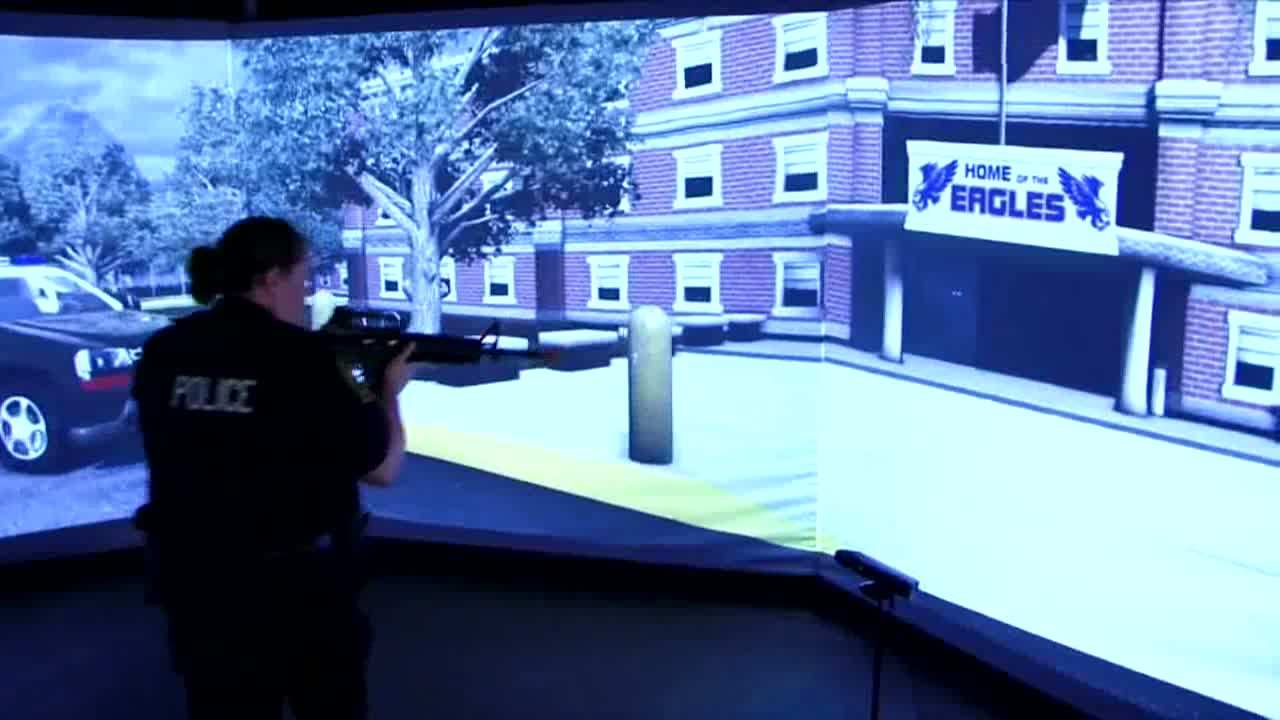
?????????????????????????????????According to Northrop, the VIPE Holodeck moves ahead of other virtual simulators thanks to its advanced situational training, where service members can walk through an area in the replicated virtual environment and prepare for what they may encounter in real life. This works not only for infantry and target practice, but for vehicle drivers and police officers looking to simulate various situations they are likely to encounter.

To enhance that training, operators can drop threats into the environment, including IEDs and enemy shooters, as well as signals that should tip them off to potential threats and see how they respond before they actually find themselves in that situation. This sort of versatile, multi-situational complexity is precisely what the Army is looking for.

VIPE3Brig. Gen. Michael Lundy, deputy commanding general at the Army Combined Arms Center, said during the AUSA Aviation symposium earlier this month:

For us to be able to execute realistic training — good training — we have to be able to bring that operational environment [into the virtual world]. We want to get away from having multiple environments, virtual gaming and instruction, and go to one synthetic environment, get to a lower overhead and integrate the full operations process … according to the common operating picture.

But looking ahead, the applications for this type of technology are virtually (no pun!) limitless, never mind the fact that we are realizing something directly out of Star Trek. Northrop says it’s also exploring options for VIPE as a stepping stone to live-training within the medical field, as well as law enforcement and first responders for situations such as live-shooter or hostage scenarios.

ESO2Immersive virtual reality also figures quite prominently in NASA’s and other space agencies plans for future exploration. Given that manned missions are expensive, time-consuming, and potentially dangerous, mission planners are investigating Telexploration as a possible alternative. Here, orbiters and rovers would transmit visual information in real-time, while VR decks would be used to give the appearance of being on location.

As Ryan Frost, Northrop’s program manager for the VIPE Holodeck, put it:

The great thing about virtual reality and gaming technology [is that] it’s moving so rapidly that really it has endless possibilities that we can do. If you can think it, we can create it, eventually.

And be sure to check out this video from Northrop Grumman showing the VIPE Holodeck in action:


Sources:
wired.com, northropgrumman.com

Biomedical Breakthroughs: Bionerves and Restored Sensation

restoring_mobilityThese days, advances in prosthetic devices, bionic limbs and exoskeletons continue to advance and amaze. Not only are doctors and medical researchers able to restore mobility and sensation to patients suffering from missing limbs, they are now crossing a threshold where they are able to restore these abilities and faculties to patients suffering from partial or total paralysis.

This should come as no surprise, seeing as how the latest biomedical advances – which involve controlling robotic limbs with brain-computer interfacing – offer a very obvious solution for paralyzed individuals. In their case, no robotic limbs or bionic attachments are necessary to restore ambulatory motion since these were not lost. Instead, what is needed is to restore motor control to compensate for the severed nerves.

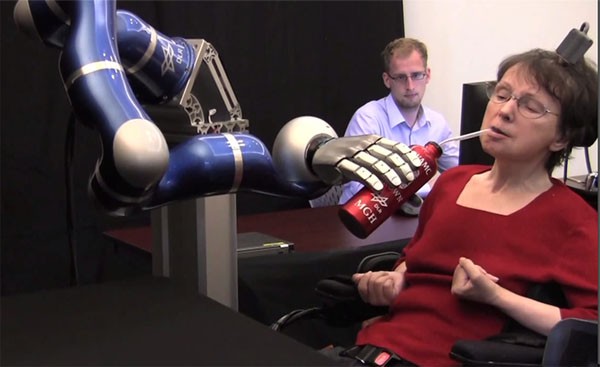
braingate1Thanks to researchers working at Case Western University in Ohio, a way forward is being proposed. Here, a biomedical team is gearing up to combine the Braingate cortical chip, developed at Brown University, with their own Functional Electric Stimulation (FES) platform. Through this combination, they hope to remove robots from the equation entirely and go right to the source.

It has long been known that electrical stimulation can directly control muscles, but attempts to do this in the past artificially has often been inaccurate (and therefore painful and potentially damaging) to the patient. Stimulating the nerves directly using precisely positioned arrays is a much better approach, something that another team at Case Western recently demonstrated thought their “nerve cuff electrode”.

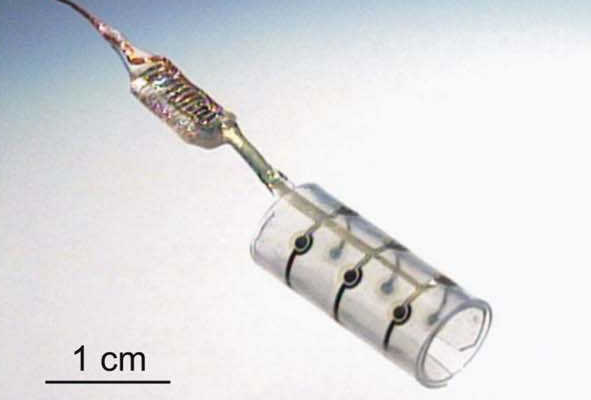
cuff-electrodeThis electrode is a direct stimulation device that is small enough to be placed around small segments of nerve. The Western team used the cuff to provide an interface for sending data from sensors in the hand back to the brain using sensory nerves in the arm. With FES, the same kind of cuff electrode can also be used to stimulate nerves going the other direction, in other words, to the muscles.

The difficulty in such a scheme, is that even if the motor nerves can be physically separated from the sensory nerves and traced to specific muscles, the exact stimulation sequences needed to make a proper movement are hard to find. To achieve this, another group at Case Western has developed a detailed simulation of how different muscles work together to control the arm and hand.

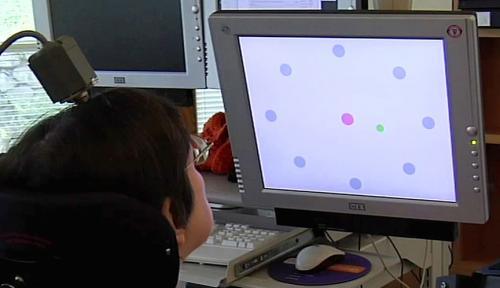
braingate2-img_assist_custom-500x288Their model consists of 138 muscle elements distributed over 29 muscles, which act on 11 joints. The operational procedure is for the patient to watch the image of the virtual arm while they naturally generate neural commands that the BrainGate chip picks up to move the arm. In practice, this means trying to make the virtual arm touch a red spot to make it turn green.

Currently in clinical trials, the Braingate2 chip is being developed with the hope of not only stimulating muscles, but generating the same kinds of feedback and interaction that real muscle movement creates. The eventual plan is that the patient and the control algorithm will learn together in tandem so that a training screen will not be needed at all and a patient will be able to move on their own without calibrating the device.

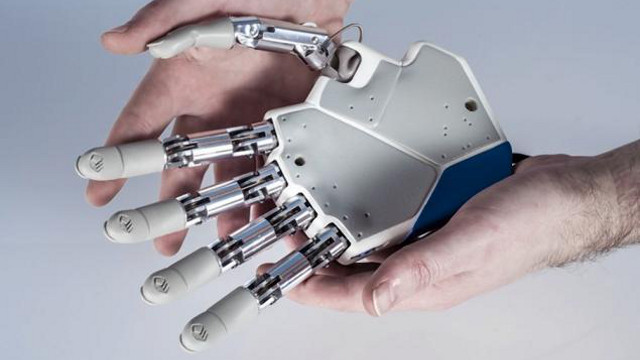
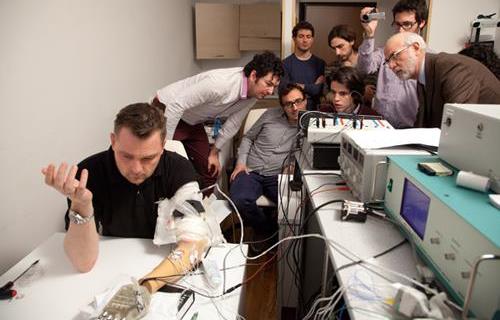
bionic-handBut at the same time, biotech enhancements that are restoring sensation to amputee victims are also improving apace. Consider the bionic hand developed by Silvestro Micerna of the École Polytechnique Fédérale de Lausanne in Switzerland. Unlike previous bionic hands, which rely on electrodes to receive nerve signals to control the hand’s movement, his device sends electronic signals back to simulate the feeling of touch.

Back in February of 2013, Micerna and his research team began testing their bionic hand, and began clinical trials on a volunteer just last month. Their volunteer, a man named Dennis Aabo Sørensen from Denmark, lost his arm in a car accident nine years ago, and has since become the first amputee to experience artificially-induced sensation in real-time.

prosthetic_originalIn a laboratory setting wearing a blindfold and earplugs, Sørensen was able to detect how strongly he was grasping, as well as the shape and consistency of different objects he picked up with his prosthetic. Afterwards, Sørensen described the experience to reporters, saying:

The sensory feedback was incredible. I could feel things that I hadn’t been able to feel in over nine years. When I held an object, I could feel if it was soft or hard, round or square.

The next step will involve miniaturizing the sensory feedback electronics for a portable prosthetic, as well as fine-tuning the sensory technology for better touch resolution and increased awareness about the movement of fingers. They will also need to assess how long the electrodes can remain implanted and functional in the patient’s nervous system, though Micerna’s team is confident that they would last for many years.

bionic-hand-trialMicerna and his team were also quick to point out that Sørensen’s psychological strength was a major asset in the clinical trial. Not only has he been forced to adapt to the loss of his arm nine years ago, he was also extremely willing to face the challenge of having experienced touch again, but for only a short period of time. But as he himself put it:

I was more than happy to volunteer for the clinical trial, not only for myself, but to help other amputees as well… There are two ways you can view this. You can sit in the corner and feel sorry for yourself. Or, you can get up and feel grateful for what you have.

The study was published in the February 5, 2014 edition of Science Translational Medicine, and represents a collaboration called Lifehand 2 between several European universities and hospitals. And although a commercially-available sensory-enhanced prosthetic may still be years away, the study provides the first step towards a fully-realizable bionic hand.

braingate_drinkassistYes, between implantable electronics that can read out brainwaves and nerve impulses, computers programs that are capable of making sense of it all, and robotic limbs that are integrated to these machines and our bodies, the future is looking very interesting indeed. In addition to restoring ambulatory motion and sensation, we could be looking at an age where there is no such thing as “permanent injury”.

And in the meantime, be sure to check out this video of Sørensen’s clinical trial with the EPFL’s bionic hand:


Sources:
extremetech.com, actu.epfl.ch, neurotechnology.com

Papa Zulu – Impending Release!

shutterstock_103Well, the day seems to finally be upon me. After six months of rereading, rewriting, and editing, Papa Zulu is set to be released in about a week’s time. While I was hoping to get it out in time for Valentine’s Day, a bit of deliberate irony on my part, I am pretty sure at this point that I will need a few extra days to make sure everything’s in order.

Wanting to avoid the same mistakes I made last time with early publication, I have opted for the slow road and I hope to maintain that until I’m sure the book is as polished as it can be. Needless to say, I am pretty happy with the end result and it has tested pretty well with those who’ve read it thus far. I’ve also taken the liberty of preparing advance copies for people who have agreed to give it an early review.

papa_zuluNeedless to say, the book picks up where the last left off, bringing new enemies into the fray and revealing new details about this post-apocalyptic world. Consistent with the Three Act Play scenario, the second book is where things go dark, the heroes are put in a harm’s way, and people die! If you want details, you’re going to have to red it…

So as you can imagine, I’m pretty excited! By this time next week, the long wait will be over and the sequel to Whiskey Delta will be published! And maybe then I will be able to get to penning the third installment without thinking I’m getting ahead of myself. In the meantime, I thought I’d share the cover art (above) and the promo trailer (below) one last time:

The Internet of Everything

PrintAll of my recent interesting in the concept known as the “internet of things” has been turning up some interesting results. And it’s not hard to see why really, given all the research, innovation and commercial applications dedicated to making it a reality. And yet, a surprising amount of people seem to be in the dark about what this term means.

Again, not surprising, as high-tech trends tend to be somewhat esoteric, understood by only a select few at first and gradually trickling its way into public consciousness. To break it down, the Internet of Things is a concept where the real world will come to resemble the internet, where digital markers and wireless internet will make reality incredibly accessible and connected.

The-Internet-Of-Things-Smart-WorldThink of it this way: you wake up in the morning and receive instant updates from all of your household devices. You’re fridge tells you how close your food is to its expiration dates, and your thermostat sets itself based on the weather, season, and your habits. On your way to work, you are able to access emails and memos from your office server, and when you’re driving home, you are able to tell the house to warm up and turn the lights on.

All day long, you are able to monitor all of your gadgets and devices because they are all “tagged”, feeding you information on their locations and anything else you need to know in real-time. If you lose something, it alerts you to this fact and tells you where to find it. And if you’re out and about without your vehicle, you can summon it and get it to find its way to you.

InternetOfThings_1024x1448That’s the general idea, creating a “smart world” through the use of networking technology. Now here are some videos too that demonstrate the concept in action. All are from Cisco, the networking IT giant located in San Jose (capitol of Silicon Valley) and are promotional videos, basically showing what the company’s vision is and how they intend to bring it about.

“Circle Story”:
This video, perhaps more than anything, demonstrates how the world of the near future will be interconnected. As the name would suggest, it follows a day in the life of regular folks as they start their day, go to their various jobs, do their shopping, and how the entire process is all part of the same dance. And of course, Cisco showcases how its technology is helping to make it happen.

Curiously though, the people do look kind of bored, don’t they? Subtle social commentary, or were they just being realistic? You decide!


Barcelona Embraces IoE to Create a Smart City:
In this promotional video, we see how the city of Barcelona, Spain is using the concept of the Internet of Everything (IoE) to address the ongoing challenge of urbanization and growth. By embracing the latest in smart technology, Barcelona is becoming a shining example of what Cisco refers to as a “smart city”, much to the company’s delight!

What this consists of is Barcelona connecting its citizens, remote sensors, and all devices contained within to a city-wide WiFi. This in turn is offering people new services, facilitating energy-efficient reforms, and establishing new economic opportunities for the city’s companies and partners, not playing to the city’s reputation for social interaction and connectivity. Check out this video for the details:


The Road to the Internet of Everything:
Last, but not least, is Cisco’s promotional video of what the Internet of Everything is really all about. Intrinsic to the IoE is the fact that by 2020, the physical and digital world will be connected by 50 billion devices and 1 trillion sensors. Meanwhile, billions of electronic embedded devices will transmit terabytes of data, communicating everything from health information to updates at the speed of light.

The result of all this, according to the video, will be an “electronic skin” built on the internet, one which will overlay the world’s existing surface and communicate everything across its vast, virtual space. As we know, this skin is already being laid, but what is still to come is going to be pretty impressive and game-changing. The bottom line being that those that are in the know will be able to reap the benefits more quickly.


You may think these videos are little more than corporate promotion of company services. But if the “internet revolution” has taught us anything, it’s that the current range of technological change is here to stay, and is only going to be getting more pronounced as time goes on. And when it comes to predicting how these things will shape the world of tomorrow, those deeply involved in the development process are certainly worth listening to!

After all, they are helping to build that world, and are doing so because we’re letting them. Best to know what’s coming if you want to know how it’s going to effect you, and if you want to have anything to say about it, right?

The Future of Flight: Morphing Wings

morphing-wingsSince the Wright Brothers developed the world’s first airplane, scientists and aerospace engineers have understood how important airflaps and wing design are to ensuring that a plane is able to achieve lift and land safely. During and after World War II, additional lessons were learned, where the sweep of a wing was found to be central to a plane achieving higher service ceilings and air speed velocities.

Since that time, many notable improvements have been made, but some strictures have remained the same. For example, conventional wings suffer from the problem of being fixed in a single position, which makes some aspects of performance possible but other things extremely difficult. In addition, flaps have remained virtually unchanged over the years, relying on hinged joints that are limited and vulnerable.

flexfoilIn both cases, the answer may lie in flexible and seamless materials, leading to wings that can change shape as needed. Such technology could not only enable better performance, but remove the need for hinges and gears. Towards this end, Michigan-based FlexSys has developed a way to optimize wing aerodynamics with FlexFoil, a seamless variable geometry airfoil system.

In development since 2001, FlexFoil is made from what is described only as “aerospace materials,” and is seamlessly integrated into the trailing edge of the wing. Based on a technology known as “distributed compliance,” the morphing structure integrates actuators and sensors that, according to Flexsys, results in “large deformations in shape morphing with very small strains.”

flexfoil1According to a 2006 paper co-written by mechanical engineer Dr. Sridhar Kota (the FlexFoil’s inventor), the foils are:

optimized to resist deflection under significant external aerodynamic loading and are just as stiff and strong as a conventional flap.

What this translates to in real terms is a tolerance of over 4500 kg (10,000 lbs) in air loads and the ability to distribute pressure more evenly throughout the wing, resulting in less strain in any one area. It is also said to reduce wind noise by up to 40 percent on landing, and to lessen build-up of both ice and debris. But the biggest benefit comes in terms of fuel economy.

flexfoil2When retrofitted onto a wing, FlexFoil can reduce fuel consumption by a claimed 4 to 8 percent, with that number climbing to 12 percent for those wings that are built are the system. What’s more, the technology could be applied to anything that moves relative to a fluid medium, including things like helicopter rotor blades, wind turbine blades, boat rudders, or pump impellers.

FlexFoil was officially introduced to the public this week at the AIAA (American Institute of Aeronautics and Astronautics) SciTech exposition in Washington, DC. Plans call for flight tests to be performed this July at NASA’s Dryden Flight Research Center, where the flaps of a Gulfstream business jet will be replaced with the foils.

Check out this video of the airwing design and what it does here:

morphing-wings1To be fair, this is not the only case of flexible, morphing aircraft in development right now. In fact, NASA has been looking to create a morphing aircraft concept ever since 2001. So far, this has included collaborating with Boeing and the U.S. Air Force to create the Active Aeroelastic Wing (AAW) which was fitted to the F/A-18 Hornet, a multirole combat jet in use with the USAF.

But looking long-term, NASA hopes to create a design for a morphing airplane (pictured above). Known as the 21st Century Aerospace Vehicle, and sometimes nicknamed the Morphing Airplane, the concept includes a variety of smart technologies that could enable inflight configuration changes for optimum flight characteristics, and is an example of biomimetic technology.

morphing-wings2In this case, the biological design being mimicked is that of a bird. Through the use of smart materials that are flexible and can change their shape on command, the 21st Century Aerospace Vehicle is able to shape its wings by extending the tips out and slightly upward to give it optimal lift capability. In this configuration, the inspiration for the aircraft’s wings is most clear (pictured above).

But once airborne, the aircraft needs a wing that is capable of producing less wind resistance while still maintaining lift. This is why the wings, upon reaching and service ceilings in excess of 3000 meters (10,000 feet), the wings then contract inward and sweep back to minimize drag and increase airspeed velocity.
Though this program has yet to bear fruit, it is an exciting proposal, and provides a glimpse of the future.

Be sure to check out NASA’s video of the CAV too, and keep your eyes on the skies. Chances are, jets that utilize smart, morphing surfaces are going to be there soon!


Sources:
gizmag.com
, flexsys.com, nasa.gov

The Walking Dead – Season 4.5 Trailer

the-walking-dead-season-4-posterThe Walking Dead returns this February 9th. And of course, after what happened with the mid season finale, fans are eagerly anticipating what’s coming. And so am I, now that things are back on track and the show is closely mirroring what went on in the original comic. In fact, the caption “Don’t Look Back” is a reference to the last line from Volume 8: Made To Suffer, which was also the last line of the last episode.

Of course, this line has a double meaning, referring to how Rick and Carl needed to abandon the prison with all speed. It’s also a reference to how the two will have to put their grief behind them if they are going to survive in the wilderness now. The other survivors – Daryl Dixon, Tyreese, Michonne, Glenn, Maggie, and the rest – were separated from them, and are facing similar challenges.

Rick_Grimes_Carl_Grimes_-_The_Walking_DeadThis is of course how season 4.5 will open, with the two groups looking for food, shelter and safety. And I anticipate they will meet up with a few people from the Governor’s camp, as some attention was dedicated to how his one-time companions made it out in one piece – such as Tara, and perhaps her sister Lilly. We’ll see how that plays out.

And if I were to make some predictions – based on what they’ve done with the show and from the comics – I think they will find their way back to Morgan, and this time around he will join them. It’s also obvious that the two camps will eventually reunite, but I anticipate that will take several episodes. We all know how they just love to drag things out on the show, don’t we?

For the season finale, I anticipate they will find their way back to Hershel’s farm, and that it will end with the addition of some new characters and a new hope which will put them back on the road again. Can’t be more specific, as that would involve major spoilers! In the meantime, enjoy the new trailer. Hopefully, it will tide us over until next week!