Of Planetkillers!

What is it about doomsday devices that make them simultaneously scary and freakishly cool? Oh, I don’t know. Maybe it’s the fact that they can turn an entire planet into glass, render it completely uninhabitable, or just plain blow it to smithereens? If none of these things do it for you, I suggest you stop reading now, this is what the whole post is about!

Where these ideas come from is a source of debate, but it goes without saying that apocalypticism is part of our collective unconscious. The very concept of the end of the world has worked its way into every world religion and is as intrinsic to our beliefs as creation. And I suppose that it goes without saying that since humanity began to develop weapons that could actually level entire cities, depopulate entire countrysides, or even raze whole continents, that this obsession with the end of days has expanded beyond the spiritual world and has become an everyday preoccupation.

So it’s little wonder then why science fiction writers have taken it upon themselves to come up with concepts of machines that can destroy and sterilize entire worlds. It just seems like the next logical step after anthrax and thermonuclear weapons doesn’t it? And in the course of this, some pretty cool concepts have been thought up. Here are some examples from various popular sci-fi franchises:

The Death Star:
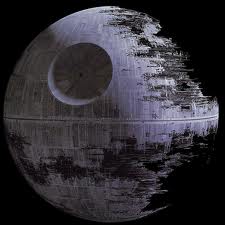
Without a doubt, this planet killer is the best known in the business. Making its first appearance in A New Hope where it destroyed the planet Alderaan, the Death Star was a massive space station that was created to inspire fear and silence all dissent to the Emperor’s rule. At the center of this force of unrivaled terror was a massive, high-powered laser that resembled a huge eye or a massive crater on the station’s surface. A single beam from this weapon was capable of breaking planets apart and obliterating all life on the surface.

Granted, this same station was then destroyed by a ragtag group of Rebel pilots, guys in tiny fighters who knew about a tiny exhaust vent in the side. But its replacement was even more badass! The second Death Star, which appeared in Return of the Jedi boasted a laser that was capable of recharging more quickly between shots and was accurate enough to take out large vessels as well. Before being destroyed by the Rebels at the Battle of Endor, the new Death Star managed to destroy two Mon Calamari cruisers with ease.

But alas, this weapon’s fatal flaw lay in its design. Being so big, small craft were capable of penetrating its defenses and attacking its vulnerable points. In the case of the first incarnation, this involved firing torpedoes into an exhaust port which would then reach the main reactor. In the second version, there were to be no exhaust ports so the station would have no outward vulnerability. But as long as it was still under construction, the station was vulnerable and hence open to attack. And given it’s sheer size and the time it would take to complete just one, that’s a pretty big window! I guess it’s true what they say: the bigger they are…

The Vorlon/Shadow Planet Killers:
In the B5 universe, a few different types of planet killers existed, both of which were the property of the oldest races. Given the amount of energy that would be required to destroy an entire planet, it was reasoned that only ancient races like the Shadows and Vorlons would be capable of constructing such a thing. However, the younger races had their own means of leveling a planet, if not destroying it completely. This involved mass drivers, which the Centauri used in season two to hurl asteroids into the surface of the Narn homeworld, causing massive destruction and forcing the Narn to surrender. But that’s another matter. Here are what the proper examples of planet killers in the B5 universe looked like:
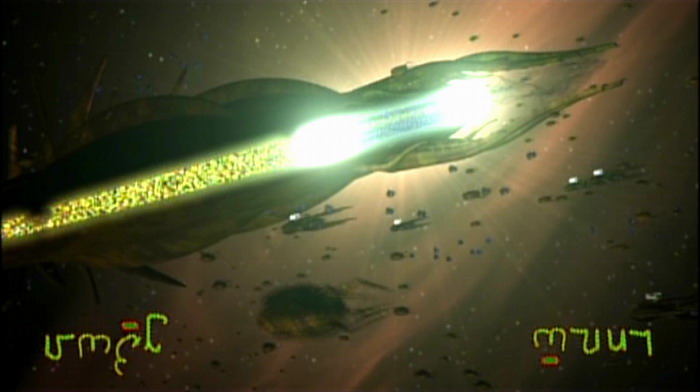
The Vorlon planetkiller was essentially just a massive gun that was built into a ship. The long, flattened spheroid with plenty of tentacle like things would be escorted through space, fly into position around the enemy planet, and then fire a massive energy discharge that would obliterate the entire thing. By comparison, the Shadow’s planetkiller was much more complex, not to mention insidious!
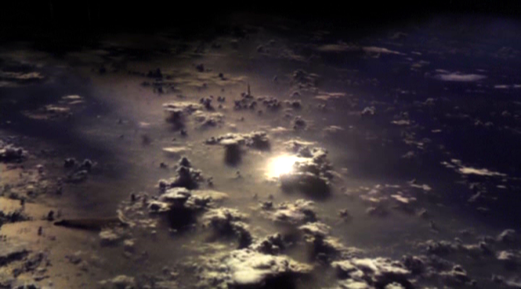
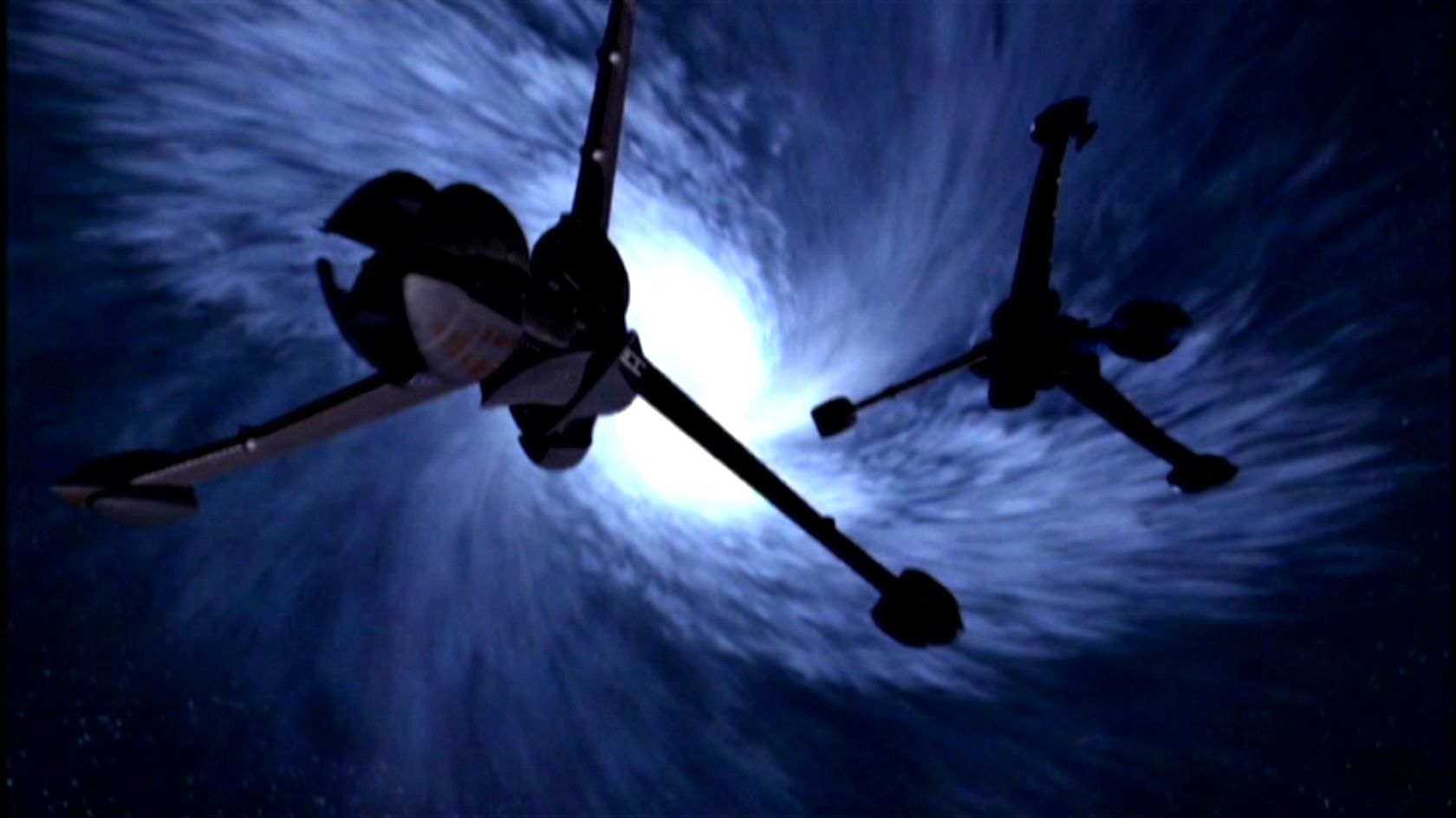
In what appeared to be a massive, black cloud, a Shadows Shroud held a massive buckminsterfullerene-like assembly that would move into position around a planet and then enclose itself around it. The assembly would then unleash a massive swarm of missiles which would bore into the surface and then detonate, releasing a massive thermonuclear payload near the core of the planet which would trigger tectonic activity that would rip the planet apart.

The former planet killer got its fair share of attention in the series proper, where the combined forces of Sheridan and Delenn’s alliance managed to destroy one only by calling in the help of the First Ones. Between all their races, only they possessed the kind of firepower that was needed in order to destroy a ship of that size. Some attention is also given to the Shadow’s Shrouds, but it wasn’t until the TV movie “A Call to Arms” came out that any in-depth explanations of how they worked or how they could be beat ever came up. In this movie, we see for the first time what the internal structure of the Shroud looks like and how the device could be defeated by attacking its nerve center. This alone would not destroy it, but would prematurely trigger it, causing it to unleash all its missiles, which would then impact and destroy the assembly itself.

The Behemoth:
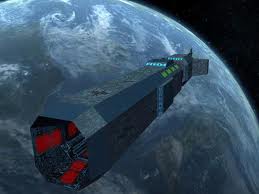
This planet killer comes to us courtesy of the Wing Commander videogame and made its appearance in the third installment in the series. Much like the Vorlon planet killer, the Behemoth was essentially a big gun that was designed to blow up planets by firing a single, concentrated beam directly into its surface. Simple, and effective, were it not for the fact that the weapon suffered from some congenital defects, which included gaps in the shielding array and the fact that it had no defensive mounts anywhere along the hull.

However, given the fact that the Terran Confederation (the good guys in the story) were losing to the Kilrathi Empire (the bad guys), the weapon had to be pressed into service before it was complete. Its intended purpose was to destroy the Kilrathi homeworld, a move which they believed was the only way to win the war outright at that point. Naturally, the vessel was destroyed due to a combination of its weaknesses and high-level treason. However, the good guys still won in the end due to alternate plans and daring-do, so don’t fret!

Unicron:
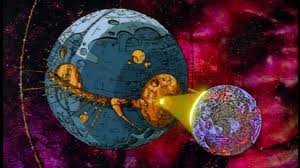
The Transformers franchise was something I enjoyed for many years as a kid. And were it not for Michael Bay, I might have enjoyed it again as a result! But whatever… In the course of telling the story of machines that could transform to hide their true identities, one robot in particular truly stands out. Mainly because of his size! His name is Unicron, a massive machine that can transform from a robot to a planet-sized sphere, and which preys on smaller planets. A pretty cool concept, really, especially for a children’s cartoon! Unlike other planet killer devices though, Unicron was unique in that he was a sentient being, and not a simple machine that was under the control of others. His first and only appearance was in Transformers: The Movie, where he was also destroyed. He did not appear again in the course of the original series, but was mentioned several times, particularly in the CGI-animated spinoff, Beast Wars.

The Doomsday Machine:
Gene Roddenberry weighed in on the planet killer thing back in the late 60’s with his own version of a doomsday weapon. It was known simply as the Doomsday Machine, a massive, lamprey-like device that was capable of consuming entire planets into its massive maw. In the course of the episode where it makes its appearance (episode 35, of the same name), the crew of the Enterprise learns that the machine is drawn to populated worlds which it then destroys and converts into fuel so that it can keep going. The process is entirely automated, the ship itself having destroyed its masters and sterilized its own region of the universe a long time ago.

Airing in the late 60’s, the Doomsday Machine was clearly a commentary on the Cold War and the creation on doomsday weapons which were intended for use as a “deterrent”. In fact, at one point Captain Kirk theorizes that the machine was never intended for use, merely to serve as a instrument to inspire fear in an enemy. However, once it was activated, it ran amok and destroyed its enemies and those who created it. In the end, the crew manages to destroy it by (ironically) letting it ingest a ship which they rig to go thermonuclear once its inside.

Halo Array:
Gamers are no doubt familiar with this one! In the Halo universe, much of the focus is on alien artifacts which were built by a race known as the Forerunners. The Covenant, the alien antagonists in the game, believe them to be holy, particularly the Halo devices which are central to the plot. These devices, it turns out, are “weapons of last resort” which the Forerunners built to sterilize all worlds of sentient life that are within range. Their reason for this have to do with a hostile organism known as the Flood, a parasitic life form that infects sentient organisms and turns them into zombie-like creatures.

Unfortunately, the Forerunners died off shortly after concluding their war with the Flood, leaving the Halos and several other artifacts behind. In time, these were stumbled upon by the Covenant who began to reverse-engineer the devices and used them to advance significantly. In time, the Convenant came to believe that the artifacts had been left behind by a holy race and built a religion and even a theocracy around this belief.

The Halo is apparently the crowning piece of the Convent faith. They believe that activating them will lead them on the “Great Journey” (aka. entrance into the hereafter). However, the main characters in the story quickly learn that this would actually cause the destruction of Earth and every inhabited planet in the sector. Inspired by Larry Niven’s Ringworld series, the concept of the Halo devices and the thematic elements which drive the story (i.e. blind faith, theocracy, evolution and ancient alien artifacts) are all prime examples of classic science fiction. Nice to see that they make their way into the gaming world once in awhile!

The Necromongers:
The Chronicles of Riddick is yet another example of theocracy, apocalypticism, and doomsday devices. Within the context of the story, we have a faction of hostile force known as Necromongers, a faction of humanity that worships death and believes that better world (known as Underverse) lies at the edge of the known universe. Leading them is a man known as the High Marshall, a person who apparently traveled to Underverse and returned half-man, half… something else. No kidding, this is how he’s described in the movie, verbatim!

In any case, in their drive to reach the edge of the universe, the Necromongers conquer, pillage and convert every planet in their path. The final step in this process, before moving on, is the use of a planet-killing device of their own, one which leaves the planet itself intact, but destroys all remaining life on the surface. In short, after they replenish their ranks and bring in fresh converts from the conquered populace, they commit whats called the “Final Protocol” before dusting off. Basically, it involves a series of ships standing up on end and releasing payloads into the air which then explode, unleashing a massive shock wave that kills everything in its path. This process gives literal meaning to the words: “Convert, or fall forever!”

The Inhibitors:
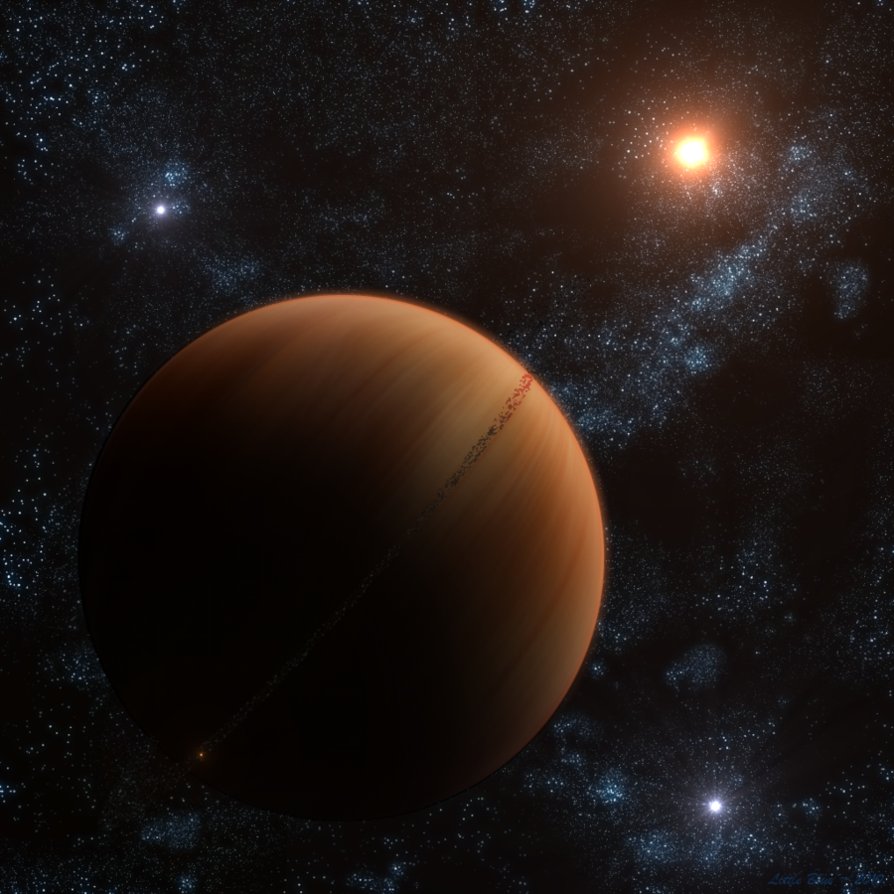
As I final example, I have included one of my personal favorites: the hostile alien species known as the Inhibitors, which come to us from Alastair Reynolds’ Revelation Space universe. According to the first novel in the series, the Inhibitors are all that remains of several ancient alien races which went extinct long ago. These machines, which are semi-intelligent and automated, are programmed to seek out and destroy sentient life.

The reason for their existence apparently has to do with a series of terrible events that are collectively known as the Dawn War. This war was apparently fought by all the earliest sentient races in the Milky Way Galaxy which began shortly after they discovered each other, but which lasted for eons. Finally, what was left of the various races decided to merge their consciousness with a series of specialized machines which they then programmed to ensure that no such wars ever happened again. These machines take the form of tiny black boxes which are capable of multiplying, replicating and seem next to impossible to kill.

Ostensibly, these machines were designed to nip the development of sentient life in the bud by sterilizing any planet that supported a potentially star-faring race. In short, they were meant to inhibit the growth of sentient life, hence their name. However, in books II and III, their motivations are explained further. In addition to wanting to prevent another major war from taking place, the Inhibitors were also concerned about the eventual galactic collision which is scheduled to take place between the Andromeda and Milky Way Galaxies several million years from now. When that happens, our two galaxies will merge, but the consequences for any lifeforms living within either of them will be disastrous.

The only way to prevent this, it is said, is to either ensure the development of a single race that has the requisite technological development to resist the destruction brought on by the collision, or to inhibit the growth of any sentient species until after the collision takes place. Once the collision is complete and the galaxy returns to a state of gravitational equilibrium, life can resume, but not before. Sounds crass, but the way they see it, they are doing sentient beings a favor by making sure they don’t get off the ground, rather than letting them die by the billions when the stars all come crashing together!

In the end, these machines destroy planets through various means. In fact, much attention is given to how the Inhibitors employ a great deal of creativity in designing ways to sterilize worlds. Instead of just parking a giant gun in orbit around a planet or covering with a toxic blanket, they will use the system’s natural resources to construct tools and weapons which they will then use to take planet’s or suns apart, bit by bit. The process can take years, even centuries for them. But they plan ahead, and are very patient…

Ultimately, the Inhibitors are not defeated in the Revelation Space universe, but are beaten back, pushed to the fringes of known space where humanity fights an ongoing fight with them that lasts beyond the final novel in the series. They do this by incorporating technology from other extinct races as well as one’s that have developed extremely clever ways to survive. And like with everything else in Reynold’s universe, it all comes down to technology that is both plausible and fascinating to read about!

Well, that’s about all the planet killing I can stand for now. Sure, there are plenty more examples in the realm of sci-fi, but these are the ones that stand out for me. Plus, if I were to take the time to research and list them all, we’d both be stuck on this one post forever. Remember, it takes longer to write than it does to read! So in keeping with the theme of this post, let me leave you with some words of advice:

No matter what you’ve done, its not the end of the world. Unless it is, in which case, it probably didn’t matter anyway 😉
Of Galactic Empires

Galaxy1Hello again, fellow sci-fi fans! Today, I thought I’d write about something conceptual, something that is intrinsic to so much science fiction and keeps popping up in various forms. It’s something that has appeared in countless serials, novels, tv shows, movies, and RPG’s. I am referring, of course, to the concept of the Galactic Empire, a science fiction trope that has seen many incarnations, but revolves around a singular theme of a political entity that spans the known universe.

Whether it’s a loose federation of humans and aliens spanning many different star systems, or a despotism made up of millions of worlds, all populated by human beings, or something somewhere in the middle, this trope has proven to be one of the most enduring ideas of classic science fiction.

But where exactly did this idea come from? Who was the first to come up with a futuristic, galaxy-spanning polity where millions of star systems and quadrillions of sentient beings all found themselves living underneath one roof?

Asimov’s Foundation Series:

An artists rendering of Trantor

Isaac Asimov is arguably the first science fiction author to use the concept of a galaxy-spanning empire in his literature. Known simply as the Galactic Empire, this organization was the centerpiece of his Foundation series. As fans of the books know, the entire series was built around the idea of the imminent collapse of said empire and how a small band of scientists (led by Hari Seldon) were dedicated to ensuring that the collective knowledge of the universe would be preserved in its absence. The books were based heavily on Gibbon’s History of The Decline and Fall of the Roman Empire, a compendium which explored the various reasons for the collapse of Rome and the resulting Dark Ages.

The universe of the Galactic Empire centered on a planet named Trantor. Based on his descriptions, the planet was covered by a massive urban landscape, every habitable area having been built over in order to accommodate the planet’s huge population. In addition to being the capitol of the Empire, it was also its administrative head, cultural hub, and economic epicenter. Much like Rome of antiquity, it depended heavily on the surrounding territories for food and raw materials in order to sustain itself, and was terribly hit when the Empire began to decline.

However, beyond some passing descriptions of its size, centrality and the problems facing its encapsulated population, not much is said about Trantor or many other worlds of the Galactic Empire. In fact, not much is said about the Empire itself, other than the fact that it has endured for millennia and is on the verge of collapsing. Mainly, the focus in Asimov’s Foundation is on the events that precipitated its fall and the work of the Foundation once that was complete; how they went about the process of restoring civilization in the absence of a central authority. However, the subsequent Foundation novels, which included some prequels, helped to flesh out the Empire further, providing details on member worlds and the events which preceded the development of Hari Seldon’s “psychohistory”.

Frank Herbert’s Dune:

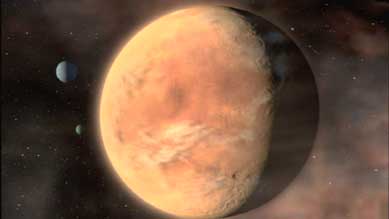
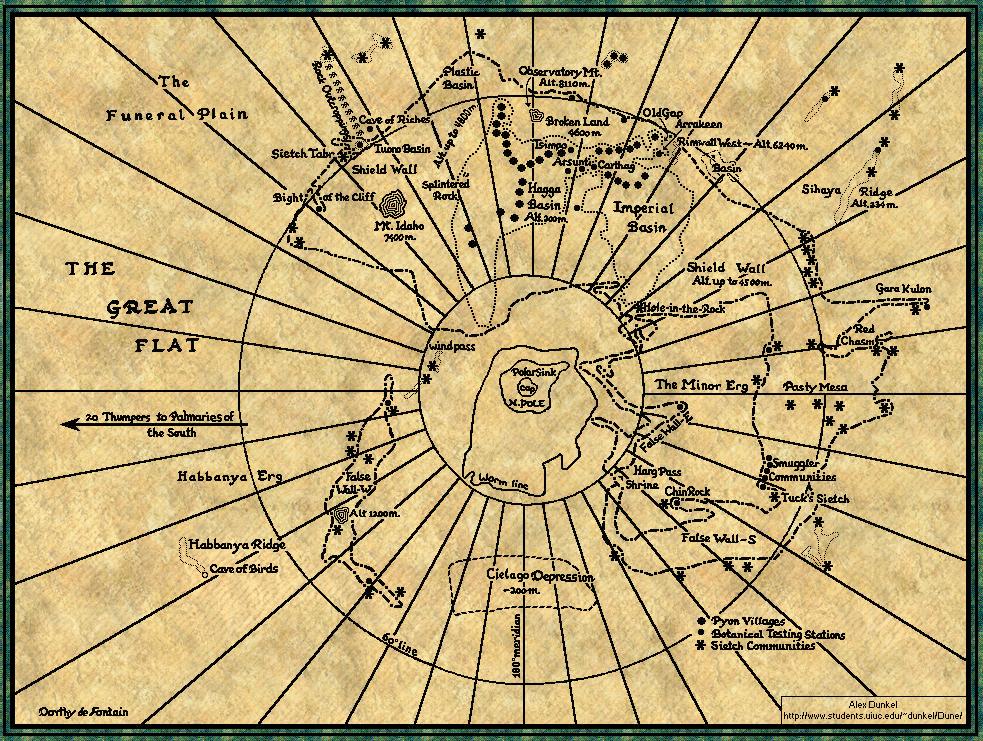
Arrakis (aka. Dune), the main setting of the story

One of the greatest examples of a galactic empire in my opinion. In the first installment of the Dune series, we are made immediately aware that humanity now inhabits the entire galaxy and are ruled from a world called Kaitan by a sovereign known as the Padishah Emperor. However, it is also made clear that while the emperor is the supreme leader, power is shared in a quasi-feudal arrangement between the noble houses (the Landstraad), a corporate entity that controls all economic affairs (CHOAM), and the various guilds (of which the Spacing Guild is arguably the most powerful). In this universe, much attention is given to the breakdown of power, the history of how it came to be, and the various member worlds and houses.

For starters, there is House Corrino, the ruling dynasty of the empire that is centered on Kaitan. Their house once ruled from a planet known as Selusa Secundus, but which has since been reduced to ashes from a nuclear attack and now serves as the emperor’s prison planet (where his elite armies are trained). More important, and central to the story, is House Atreides, the family which rules from an ocean planet named Caladan, but come to inherit the desert planet Arrakis (aka. Dune). Passing attention is also given to Geidi Prime, the industrial world run by House Harkonnen, the nominal villains of the story.

Dune_MapBut by far, the most detailed and developed descriptions are that of the planet Arrakis, where most of the story takes place. Throughout the first novel, the planet’s ecology, native species, and inhabitants (the Fremen) are richly detailed. Given that it is the only world where the spice (an awareness drug the entire universe depends on) is mined, the world is understandably the focal point of the Dune universe. Clearly analogous to oil, the spice is a metaphor for human dependence on a single resource, and the consequences thereof. By taking control of the planet at story’s end and threatening to destroy the spice, Paul Atreides effectively becomes the universe’s new ruler. For as the sayings go: “He who controls the spice, controls the universe”, and “He who can destroy a thing controls that thing.”

Frank Herbert cited a number of influences for his galactic empire. Like Asimov, he relied a great deal on history, particularly that of the Middle East, the Crusades, and a number of feudal societies. At the same time, Herbert became fascinated with ecology, a result of his living in Florence, Oregon where the US Department of Agriculture was using poverty grasses to stabilize the expanding Oregon dunes. The article which he wrote about them, entitled “They Stopped the Moving Sands”  was never completed and only appeared decades later in The Road to Dune. Nevertheless, it was from this combination of real history and ecology, how the living environment affects its inhabitants and shapes history, that the universe of Dune emerged.

Star Wars:

Coruscant, capitol of the Old Republic and Empire

Perhaps the best known example of a galactic empire, which in turn emerged from what Lucas called the Old Republic. When asked about his inspirations, George Lucas claimed that he wanted to create an empire that was as aesthetically and thematically similar to Nazi Germany as possible. This is made abundantly clear when one looks into the back story of how the Empire emerged, how its malevolent dictator (Palpatine, a Sith Lord) rose to power and began launching campaigns to eliminate anyone who stood in his way. In addition, the use of Storm Troopers, the uniforms of the imperial officers, and the appearance of Darth Vader also add visual representation to this.

However, a great deal of antiquity works its way into the Star Wars universe as well. Much like Herbert and Asimov, there is a parallel between the past and the future. The incorporation of royalty, swordfights between Bushido-like warriors, gun-toting smugglers, cantinas, dangerous towns in the middle of the desert, and all the allusions to the “Republic” and “Galactic Senate”, fair and noble institutions which ruled the galaxy before the dark times – all of these are themes taken from ancient Greece, Rome, feudal Japan, medieval Europe, and the Wild West.

Urban sprawl on Coruscant

In any case, at the center of Lucas’ galactic empire lies Coruscant, a planet that was clearly inspired by Trantor. Whereas in the original series, the planet was not shown or even mentioned, it receives a great deal of attention in the Star Wars novelizations, comics, and prequel movies. Much like Trantor, it is a planet that is completely dominated by urban sprawl, literally every corner of it is covered by massive sky-scrapers and multi-leveled buildings.

According to the Star Wars Wiki (Wookiepedia), roughly a trillion humans and aliens live on its surface, which is another detail that is noteworthy about Lucas’ universe. Unlike Foundation or Dune, in Star Wars, the galactic empire includes countless sentient races, though humans do appear to be the dominant species. This racial aspect is something else that is akin to World War II and Nazi Germany.

Whereas the Rebellion is made up of humans and aliens who are struggling for freedom and tolerance, the Empire is composed entirely of humans who believe in their own racial superiority. However, in a tribute to Lucas’ more creative days, not much is said about this divide, the audience is instead left to infer it from the outward appearances and behavior of the characters on screen. However, the idea receives much development in the novelizations, particularly Timothy Zhan’s Thrawn Trilogy.

Star Trek:

Star Fleet Command, in orbit above Earth

Yet another take on the concept of a galactic polity: Gene Roddenberry’s United Federation of Planets. Much like the Empire of Lucas’ own universe, the Federation is made up of hundreds of member worlds and any number of races. But unlike its peers in the Foundation, Dune or Star Wars universes, the Federation only encompasses a small portion of the galaxy – between ten and fifteen percent, depending on where you look in the storyline.

Beyond their range of influence lie several competing or cooperative empires – the Klingons, the Romulans, the Cardasians, the Dominion, and the Borg. Each of these empires represent a threat to the Federation at one time or another in the story, largely because their ideologies are in direct conflict with the Federations policy of peace, multiculturalism and understanding.

This may sound a tad tongue-in-cheek, but it is the main vehicle for the story. In Star Trek, like many other sci-fi franchises, Gene Roddenberry uses alien races as mirrors for the human condition. Whereas in his vision of the future humanity has evolved to overcome the scourges of war, poverty, disease, intolerance and oppression, other races are either less advanced or openly embrace these things.

Negh'varThe Klingons, for example, were the enemies of the Federation because of their commitment to warrior politics. The Romulans are locked  in an ongoing cold war with them because of their belief in their own racial superiority. The Dominion seeks dominance over all “solid” life forms because, as shape shifters, they fear being controlled themselves. And the Borg are an extremely advanced cybernetic race that seeks to “perfect” organic life by merging it – by force, if necessary – with the synthetic. The metaphors are so thick, you could cut them with a knife!

Yes, subtlety was never Roddenberry’s greatest attribute, but the franchise was an open and inclusive one, borrowing freely from other franchises and sci-fi concepts, and incorporating a great deal of fan writing into the actual show itself. And whereas other franchises had firm back-stories and ongoing plots, Star Trek has always been an evolving, ad hoc thing by comparison.

Roddenberry and the producers and writers that took over after his death never did seem to plan that far ahead, and the back story was never hammered out with that much precision. This has allowed for a degree of flexibility, but also comes with the painstaking task of explaining how and why humanity became a utopian society in the first place. But for the most part, the franchise leaves that one vague, arguing that space travel, technology and contact with other sentient races allowed for all of this to happen over time.

Babylon 5:b5-eps3One of my favorite franchises of all time! And possibly one of the most detailed examples of a galactic empire, due largely to the fact that it took shape in the course of the show, instead of just being there in the background from the beginning. Here too, we see a trade off between other franchises, the most similar being Star Trek. In this universe, there is no single galactic empire, but rather a series races that exist is a web of alliances, rivalries and a loose framework of relations.

But as time goes on, many of them come together to form an alliance that is reminiscent of the Federation, though arguably more detailed and pluralistic in its composition. When the show opens, we see that humanity is merely one of many races in the cosmic arena, most of whom are more advanced and older than we are.

The Earth Alliance, as its called, controls only a few colonies, but commands a fair degree of influence thanks to the construction of an important space station in neutral territory. This station (namesake of the show) is known as Babylon 5, aptly named because it is a place of trade, commerce, and the intermixing of peoples and cultures. And much like its namesake, it can be a dangerous and chaotic place, but is nevertheless the focal point of the known universe.

B5_destroyerAccording to the back story, which is explored in depth in the prequel movie “In the Beginning”, the station began as a way of preventing wars based on cultural misunderstandings. Such a war took place between the human race and the Mimbari, a race that is central to the story, ten years prior to the show. After four abortive attempts, the station finally went online and was given the designation of five because it was the fifth incarnation of the project.

Once completed, all major races in the area sent representatives there in order to make sure their interests and concerns were being represented. Chief amongst them was Earth, the Mimbari, the Narns, the Centauri and the Vorlons, who together made up the stations executive council. Beyond them was the “League of Non-Aligned Worlds”, a group made up of fifteen sentient races who were all smaller powers, but together exercise a fair degree of influence over policy.

The Centauri, who were based on the late-period Roman Empire, are a declining power, the once proud rulers of most of the quadrant who have since regressed and are looking to reverse their fortunes. The Narns are their chief rival, a younger race that was previously occupied and brutalized by the Centauri, but who have emerged to become one of the most powerful forces in the quadrant.

B5_season2Based heavily on various revisionists powers of history, they are essentially a race that is familiar with suffering and freely conquers and subjugates others now to ensure that such a thing never happens to them again. The Mimbari, an older and somewhat reclusive race, is nominally committed to peace. But as the war demonstrated, they can easily become a force to be reckoned with given the right provocation. And then there are the Vorlons, a very old and very reclusive race that no one seems to know anything about, but who nevertheless are always there in the background, just watching and waiting…

As the show progresses, we come to see that B5 will actually serve a purpose that is far greater than anyone could have foreseen. It seems that an ancient race, known only as the Shadows, are returning to the known universe. Before they can to invade, however, they must recruit from the younger races and encourage them to make war on their rivals and neighbors. This will sow the seeds of chaos and ensure that their eventual advance will be met with less resistance.

The Vorlons and the Mimbari ambassadors (Kosh and Delenn) are aware of this threat, since their people have faced it before, and begin recruiting the station’s two human commanders (Jeffrey Sinclair and John Sheridan) to help. This proves difficult, as the Shadows appear to have contacts on Earth as well and are backing the power play of Vice President Clarke, an ambitious man who wants to be a dictator. They are also ensuring that the Centauri and Narn go to war with each other as a way of keeping all the other member races preoccupied.

B5_shadow_warHowever, using the station as a rallying point, Sheridan, Sinclair, Delenn and Kosh eventually manage to organize the younger races into a cohesive fighting force to turn back the Shadows. Things become more complicated when they realize that the Vorlons are also the enemy, being involved in a power struggle with the Shadows that goes back eons. However, with the help of other First Ones (very old races) and a commitment to stand on their own, they manage to force both sides to leave the known universe.
In the wake of the war, a new spirit of cooperation and cohesion is formed amongst the younger races, which eventually gives rise to the Interstellar Alliance. This organization is essentially an expanded version of the League, but where members are fully aligned economically and politically and committed to defending each other. This comes in handy when the allies of the Shadows, younger races who are armed with all their old mentors’ gear, come out of hiding and begin to make trouble!

Naturally, the full story is much more complex and I’m not doing it justice, but this is the bare bones of it. Relying on historic examples and countless classic science fiction themes, J. Michael Straczynski establishes a detailed universe where multiple races and political entities eventually come together to form a government that rules the known universe and stands the test of time.

Battletech:

mechwarrior_1Here we have a franchise that had multiple inspirations, according to the creators. The focal point of the franchise is on massive war machines, known as battlemechs, which were apparently inspired by Macross and other anime. However, the creators also came to incorporate a back story that was very European in its outlook, which revolved around the concept of an ongoing war between feudal states.

One could make the case that the Shogunate period of Japan, a time of ongoing civil war, was also a source of inspiration for this story. However, upon familiarizing myself with the background of the series, I couldn’t help but feel that the whole thing had a predominantly Russian feel to it. In addition to the heroic characters being named Alexandr and Nicholas Kerensky, something about the constant feudal warfare and the morally ambiguous nature of humanity in the story seemed analogous to much of Russia’s troubled history.

To break it down succinctly, the story takes place in the 31st century, a time marked by incessant warfare between different clans and worlds, all of which are populated by humans.Terra (as Earth is now called) was once the center of a grand empire known as the Star League. After centuries of conflict, in what is known as the “Succession Wars”, Earth and many its immediate neighbors were rendered damaged or completely uninhabitable.

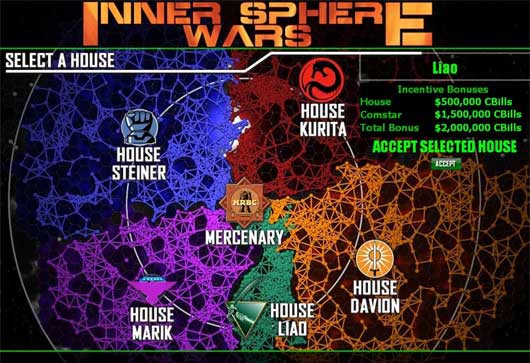
inner_sphere_wars_battletech_01As a result, the focal point of the universe resides within the Inner Sphere, a region that is 500 light years away from Earth and dominated by five Great Houses. The leader of each house claims to be the rightful successor of the Star League, and hence the houses are all known as the Successor States. Outside the Inner Sphere lies the Periphery, a large ring of independent star systems that predate the League and the Successor States, but are inferior to them in terms of technology. Though nominally independent, none of these regions have the ability to stand against the houses of the Inner Sphere, and thus avoid conflict with them whenever possible.

A key feature of the Battletech universe is the absence of sentient species outside of the human race. This serves to make the ongoing warfare more realistic, as well as establishing how the current state of war is a direct extension of earlier rivalries (some dating all the way back to the 20th century). Another interesting feature about this franchise is the fact that humanity has not evolved very far beyond its current state, in spite of the lengthy passage of time.

Again, the constant state of warfare has much to do with this, which has had a slowing and even reversing effect on the technological development of many worlds. In short, the franchise is gritty, realistic, and has a pretty dim view of humanity. In addition, there is a palatable sense that humanity’s best years are behind it, and that barring the appearance of some external threat, humanity will war itself into extinction.

Key Features:
A couple of things stand out about each of these examples of a galactic empire. And for anyone interesting in creating their own, they are considerations which have to be taken into account. All of the previous creators, from Isaac Asimov to Weisman and Babcock, either took a singular approach on these issues, or adopted a combined one. Here they are, as I see them:

Humans and Aliens: This is arguably the most important consideration when developing a sci-fi franchise, especially one where a galactic empire is concerned. The creator must decide, is this going to be a universe where humans and aliens coexist with one another, or is it going to be strictly human? Both options open up a range of possibilities; for example, are humans and aliens living together in harmony in this story, is one subjugated to another, or something else entirely? What’s more, what role will the aliens play? Are they to be the benign, enlightened aliens who teach us “flawed humans” how to be better, or will we be the the species that’s got things figured out and they be allegorical representations of our past, flawed selves? Inevitably, aliens serve as a sort of mirror for the human condition or as examples of past human societies, in any story. There’s simply no way around it, not if we want them to be familiar and relateable.

Utopian/Dystopian: Another very important decision to make when creating a universe is the hue its going to have. In short, is it going to be a bright place or a dark place? Would humanity advance as a result of technology and space exploration, or regress because improved weapons and tools merely meant we could do more harm? Both visions serve their purpose, the one eliciting hope for the future and offering potential solutions to contemporary problems, the other making the point that the human condition is permanent and certain behaviors will never be overcome. However, in my opinion, the most respectable approach is to take the middle road on this. Sci-fi franchises, like those of Straczynski and Alastair Reynolds (creator of the Revelation Space universe) did their best to present humanity as being morally ambiguous. We were neither perfect nor unsalvageable. We simply did our best and tried to make a difference, but would always have our share of flaws.

Space Travel: Almost all galactic empires are agreed on this one front. When it comes to creating a extra-solar empire, one that encompasses hundreds or even thousands of star systems, one needs to be able to travel faster than the speed of light. It might mean contravening the laws of physics (causing Einstein to roll over in his grave!) but you can’t really do it otherwise. Whether it’s by the Alcubierre drive, hyperspace, warp, jump gates, or folding space, all of the aforementioned franchises incorporated some kind of FTL. Without it, humanity would require thousands or even millions of years in order to expand to encompass the known universe, at which point, we’d probably have evolved to the point where we were no longer even human! In addition, the problems of subjective time and perspective would wreak havoc with story lines, continuity, and the like. Better and easier to just say “Here (zoom!) Now there!”

Technology: Following on the heels of FTL is the issue of how technology in general is treated within the universe in question. Will it be the source of man’s betterment and salvation, of their downfall, or something in between? Star Trek is a perfect example of the former approach, set in a future where all hunger, disease, poverty and inequality have been eliminated through the application of technology. Despite the obvious utopianism of this view, the franchise really isn’t that far off if you think about it. If we did have matter replicators, machines that could manufacture food, materials and consumer goods out of simple trace elements, then money, precious metals and other artificial means of measuring wealth would become obsolete. In addition, there’d be no more food shortages or distribution problems to speak of, not as long as everyone had access to this technology. And if fusion power and warp technology were available, then energy would be cheap and abundant and commerce would be rapid and efficient.

However, Roddenberry would often show the downside of this equation by portraying societies in which technology had been allowed to run amok. A good example is an episode in Star Trek TNG where the Enterprise comes upon a planet that is run by an advanced machine named Custodian. The people of the planet have grown entirely dependent on the machine and have long since forgotten how to run and maintain. As a result, they have become sterile due to radiation poisoning and are slowly dying off. Another perfect example is the Borg, a race of cybernetic beings that are constantly expanding and assimilating anything in their path. In terms of aesthetics, they are dark, ugly and sterile, traveling around in ships that look like giant cubes that were slapped together out of toxin-spewing industrial junk. Is there a more perfect metaphor for the seemingly unstoppable march of technological progress, in all its darker aspects?

Asimov’s Foundation series also had a pretty benign view of technology. In his universe, the people of Terminus and other Foundation worlds distinguished themselves from their neighbors through their possession of superior technology and even used it to their advantage wherever possible. In the first novel, for instance, the Foundation’s scientists began to travel to neighboring worlds, places that had the use of nuclear power and began teaching them how to rebuild it. Over time, they became a sort of priestly caste who commanded reverential respect from the locals thanks to all the improvements their inventions brought to their daily lives. When in the first book a warlord from the neighboring planet of Anacreon tries to conquer them, they then respond by cutting off all power to the planet and their forces, and use their status as religious leaders to foment rebellion against him.

However, other franchises have a different take on technology and where it will take us. For example, Battletech tends to look at technology in a darker perspective. In this future, the focus of technological development is overwhelmingly on battlemechs and weapons of war. In addition, the ongoing war in the series has had a negative effect on the development of other forms of technology, particularly the kinds that are beneficial to society as a whole. In short, technology has not corrected for mankind’s flaws because it has failed to remove the greatest cause of war and suffering – i.e. ambition!

Frank Herbert, on the other hand, took what could be construed as a mixed view. Whereas in his universe, instantaneous space travel is possible, energy shields, laser guns and nuclear power are all in existence, the overall effect on humanity has not been progressive. In the first Dune novel, we learn that humanity fought a holy war against thinking machines and automation over ten thousands years prior to the main story (the Butlerian Jihad). The target of the jihad was apparently a machine mentality as much as the machines themselves, and the result was a sort of compact whereby future generations promised never to develop a machine that could take the place of a human being. That, in addition to the invention of energy shields, led to the development of a feudal society where nobles and merchant princes were once again responsible for controlling planetary resources, and where armies went to war using swords and daggers in addition to lasers, slug throwers and missiles.

In subsequent novels, this was developed even further to present a sort of twofold perspective on technology. On the one hand, it is shown as being potentially harmful, where a machine mentality and a society built on unrestricted production of material goods can lead to social chaos and anarchy. Not necessarily because it can be harmful in and of itself, but because it can lead to a situation where humans feel so alienated from themselves and each other that they are willing to regress to something simpler and less free. On the other hand, advanced technology is also shown to have a potentially retrogressive effect as well, forcing people to look backwards for solutions instead of forwards. One can see genuine parallels with history, like how industrial civilization, in spite of all its benefits, led to the rise of fascism and communism because of its atomizing and alienating effects on society. Or how the Japanese of the post-Shogunate period deliberately regressed by destroying their stores of muskets and cannons because they feared that the “coward weapons” were detrimental to the Bushido.

Personally, I thought Herbert’s perspective on things was by far the most brilliant and speculative, packed full of social commentary and irony. It was therefore a source of great disappointment that his successors (Brian Herbert and KJA) chose to present things in a far more myopic light. In the prequels to Dune, particularly the Legends of Dune series, the jihad is shown to be a struggle between advanced machines that have enslaved the human race and the few free human worlds that are locked in a life and death struggle to defeat them. However, in twist that is more contradiction than irony, they find the solution to their problem by using nukes to level every machine planet. The fact that the “free worlds” relied on slave labor to compensate for the loss of automation was somewhat interesting, but would have been far more effective if the enemy machines were not portrayed as purely evil and the protagonists as selfless heroes.

Final Thoughts:
The concept of a galactic empire is something that has a long history and many, many incarnations. But as always, the purpose of it seems to be to expand the focus of the commentary so that as many possible aspects of the human condition can be explored. By placing human beings on hundreds or thousands of planets, authors generally seek to show how different places can give rise to different cultures. This is as true of different parts on the globe as it is for different planets in the universe. In addition, the incorporation of aliens also gives us a chance to explore some of the deeper sociological questions, things that arise out of how we interact with different cultures around the world today. For in the end, all science fiction is really about history and the period in which it is conceived, regardless of it being set in the future. Like all other genres, the real aim is to serve as a vehicle for speculation and investigation, answering questions about who we are and what makes us us.

Whew! I think I got a little tongue and cheek there myself! In any case, I enjoy delving into this conceptual stuff, so I think I’m going to do it more often here. Next time, something a bit lighter and more specific. I was thinking about something along the lines of PLANETKILLERS! Stay tuned!

A Clash of Kings (A Song of Fire and Ice, book II)

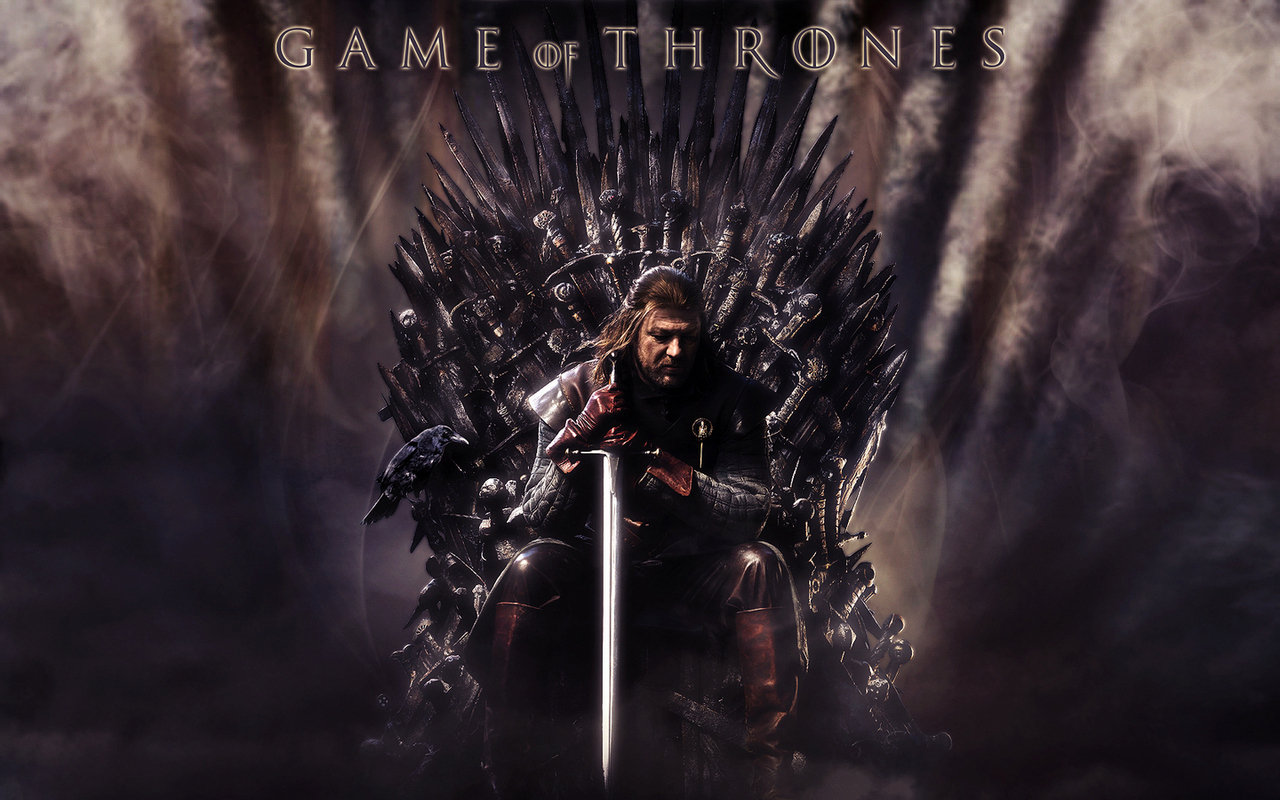
As I’m sure I said in my last post, George R.R. Martin is known to his contemporaries as the “American Tolkien”. This is a fitting comparison for me seeing as how Game of Thrones was something I had no real interest in until after I saw it adapted to screen. It was only after I saw the whole first season, which is book I in the series, that I decided to start reading it and get informed! I’m now on book four in the series and like all GOT geeks, am eagerly awaiting season two which premiers April 1st (This better not be some kind of prank!) But anyway, here is book II in the Song of Fire and Ice series, which is appropriately named:

A Clash of Kings:
As with Lord of the Rings series, I decided to read the second book first, mainly so I could get a head start on all the material that was to come. However, since the series is ongoing, I did not dare wait til I read to the end before going back to cover the original. And I can honestly say that book II improves upon the first, bringing more action, more intrigue, and more fantasy-fiction to the fore. I tell ya, its a rare thing when a sequel actually surpasses the first in a series, but that was to be expected here. Whereas Game Of Thrones set the scene, introducing the major plot threads and building up the action, Clash of Kings incites it all and brings it all to an explosive semi-climax. The most important element of which is the battle at Kings Landing, which I cannot wait to see adapted to the screen!

Plot Synopsis:
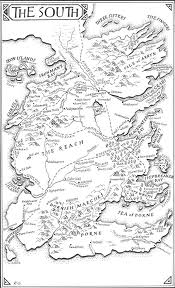
The book opens with a celestial event. A red comet, which goes by various names, has entered the heavens and seems to mean different things to different people. To some, its a portent of evil, but to others, its a sign of impending victory. Picking up where the first book left off, the realm of Westeros finds itself divided between five powers who are now in a state of civil war. In the south, power is divided between Kings Landing, where the Lannisters rule through Joffrey, and Robert Baratheons two brothers – Renly and Stannis. The former now controls the southern area of Highgarden while the latter controls the island Dragonstone. While a Baratheon alliance would surely defeat the Lannisters, the brothers are divided because both are determined to sit the Iron Throne.

While Stannis, the elder, has the better claim to the throne, Renly is the more charismatic of the two. He is just as determined and has a much larger army, but Stannis has a secret weapon which he has yet to unveil: a sorceress named Melisandre, a priestess of Asshai who worships the fire god R’hllor. The cult of R’hllor, which is monotheistic in focus, is quite popular in the East but relatively unheard of in Westeros. To many, her backing of Stannis, whom she sees as the Azor Ahai (prophet of R’hllor) reborn, is merely a power play, a means to introduce her religion to the Seven Kingdom should be triumph in the war. But according to Melisandre, the civil war is merely a prelude to a much greater war against a dark force that has been coming for some time…

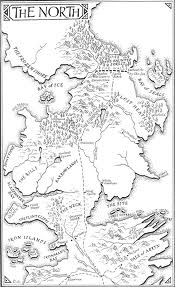
Meanwhile, to the north Robb Stark has been crowned King of the North by his bannermen and continues in his long campaign south. Though they are outnumbered by the Lannisters, they win victory after victory, and soon even Tywin Lannister is forced to move the bulk of his forces south when they hear that King’s Landing is threatened. For the wolf, victory seems possible, but a there are a few complications to his plans. For one, King Joffrey and the Lannisters are still holding Sansa Stark hostage and Arya Stark is still missing (in truth, she and the Night’s Watch recruiter who saved her are moving north with a band of convicts and recruits). The only thing keeping Sansa safe is the fact that Jaime Lannister is in their custody, but he’s proving to be a tricky hostage…

What’s more, the Iron Isles, where Theon Greyjoy hails from, are up in arms. With the wolf marching south and civil war dividing the realm, his father seems intent on carving out his own kingdom in north as well. His daughter is chief amongst his Captains, a fact which annoys Theon to no end. Determined to upstage her, he leads an attack on Winterfell and takes it. In time, Bran Stark and his newfound friends from the Riverlands, who’ve convinced him he’s having prescient dreams, decide to escape to The Wall. Something is up there, it seems, that is calling to Bran. When he flees, Theon decides to stage their murder to avoid the inevitable embarrassment of having lost them.

To the far north, Jon Snow has taken up with the Nights Watch and is with them as they begin a large-scale reconnaissance north of The Wall. Apparently, the Wildlings have been abandoning their villages in droves, moving to a large encampment where a man named Mance Rayder. Apparently, he has declared himself “King-beyond-the-Wall” and plans to lead a united army of Wildlings south to take the lands they have been historically cut off from. In time, it becomes clear that he himself is fleeing something, they very thing that Jon Snow and the Watch have been worrying about. It seems the White Walkers have been getting around, and just about everyone in their path is looking to flee…

To the east, Dany and her host travel across the desert to the great city of Qarth. Once there, Dany becomes the focus of much attention and fascination, given that she travels with three dragons. Despite this, she is unable to raise an army because the only coin she has to barter with is her dragons, which she refuses to give up. When she goes into the House of the Undying, where the warlocks of Qarth reside, she is told that her life is threatened and that she will be betrayed three times. When the warlocks try to attack her, her dragon burns the House down, sparking emnity between her and the Qartheen. An attempt is made on her life at the city harbor, but she is saved by two men – an old warrior named Arstan Whitebeard and a mercenary named Strong Belwas. They were sent by Illyrio, the man who sheltered her and her brother, and join her host. Together, they begin to plot where to travel to next to find her an army.

After a failed meeting between Renly and Stannis, which Catelyn Stark travelled south to host, Renly was killed by a “shadow”. It becomes clear that Stannis’ priestess was involved, because all those who oppose Stannis have a way of winding up dead. As a result, Renly’s former bannermen declare fealty to Stannis and add to his power, and Catelyn is forced to flee north with one of Renly’s staunchest supporters. A woman named Brienne of Tarth, a formidable fighter whom Renly made a knight. They return to Riverrun, the domain of her brother, where Robb is rallying his forces and her father lies dying. Upon her return, she learns of what happened to Winterfell and her two youngest sons and is heartbroken. Between Ned, her ailing father, and now her two boys, it seems everyone she loves is dying.

Back to King’s Landing, Tyrion has taken up the role as Hand of the King. Before him is the challenge of defending the capitol from Stannish Baratheon, who is quickly approaching by land and sea with his combined armies and navy. At the same time, he must cover his ass seeing as how his sister will stop at nothing to do him in. A game of chess ensues, with both sides employing bribes and whatever blackmail and threats they can to gain leverage over the other. For a time, Tyrion seems to have the upper hand, but soon, battle comes to their doorstep, and he must forgo all that to lead the defense of the city.

Meanwhile, Arya is captured while traveling north by men loyal to the Lannisters. The survivors are taken to Harrenhal, a major castle that is currently in Lannister hands, where she is forced to serve as a peasant girl. Her identity remains a secret, but she is forced to endure all kinds of abuse as a serving girl. However, one of the captives who was part of their caravan comes to her and tells her that he owes her three lives for saving him and the lives of his companions. Instead, she uses him to help free a bunch of Stark men who then seize the castle. However, her fortunes do not change much, as she is then forced to act as cup bearer to Roose Bolton who comes to occupy the castle. She escapes shortly thereafter with her old companions and continues north.

Tyrion’s preparations pay off in the end. At sea, the large chain link he had constructed is used to close off the river once Stannis’ fleet enters it. In addition, their forces use a their vast stores of Wildfire he had prepared to set them ablaze once they are trapped. On land, things go a little more poorly, but Tyrion manages to lead a successful defense of the gates and is eventually saved by his father, Tywin. It seems that he travelled to Highgarden before the conflict and enlisted the help of many of Renly’s former bannermen. At just the right time, they perform a flanking maneuver which routs Stannis’ forces and saves King’s Landing. Sensing that he will not die in battle, one of Cersei’s assassins attacks and nearly kills Tyrion. When he wakes up in bed, he finds that Cersei has gained the upper hand on him by preying on their father’s good graces.

North of the Wall, the Black Brothers find a base amongst a ruined tower and begin sending recon forces further north. Jon is part of a force dispatched to the Skirling Pass, where they find the bulk of Rayner’s army massing. In addition to thousands of Wildlings, they see giants, mammoths, and wargs complimenting their force. In time, the Wildlings fall upon them and they are forced to flee. Before they are captured, Qorin asks Jon to betray him when the time comes so that he may infiltrate the Wildling camp and learn their secrets. Jon reluctantly agrees, and when they are cornered, Qorin fights him and lets him win. Jon is now a prisoner of the Wildlings and is reunited with a young Wildling woman that he met and set free earlier. She convinces Rayner to take Jon in, as he himself was once a Black Brother who defected.

Back in Winterfell, Theon finds himself with his back to the wall when Robb dispatches one of his bannermen and an army to remove the Iron Men from Winterfell. All hope seems lost to him, when a new force enters the field and saves his butt. It seems that one of the sellswords who joined him earlier was in fact the Bastard of Bolton, a usurper who fell into disfavor with Robb’s men and was imprisoned in Winterfell. When Theon set him free, he returned to his home, took up the cities army, and returned to save him. However, he quickly betrays Theon, kills him, and orders Winterfell razed…

Strengths/Weaknesses:
As I said before, this book packs some serious action into its binding! After much build-up in the first, the climactic battle of King’s Landing takes place, and it was quite unclear how things were going to go… In fact, much of the book is unpredictable. One gets the impression that the Lannisters are bound to lose well up until the battle finally takes place. In addition, the fate of House Stark is something which is tenuous at best. As always, one can’t get too emotionally attached where the characters of George R.R. Martin is concerned. They tend to die suddenly and haphazardly. However, unlike in book I, none of the major characters die off, just the supporting cast. This I would consider a strength considering that I tend to get sour when people I like get killed!

That being said, there were a number of inexplicable plot twists in this book, so many that it began to feel a little contrived after awhile. For starters, the battle of King’s Landing suddenly turns when all hope seems lost. In itself, that was a pretty good twist, but there were many like it. When it came to the rivalry between Renly and Stannis, it seemed apparent that Renly was destined to win, but then he’s suddenly killed by Melisandre’s shadow, thus completely turning the tide. And then there’s the part where Theon Greyjoy is defending Winterfell. Everything seems said and done when at the last moment, he is saved by the intervention of the Bastard of Bolton, only to then be killed! That’s three major plot twists in one book, and the last one was like a… a compound twist! Kind of grows thin after awhile.

In addition, like all the books in the series, the story can become drawn out and emotionally taxing. It seems that despite whatever hopes the reader might have for a satisfactory resolution, the plot threads just seem destined to go on and on. Whether its Tyrion, Arya, Sansa, Robb, Catelyn, or John, it seems that they are just destined to suffer and endure more and more in the way of bad news. Unless of course the character dies suddenly, but that too is emotionally taxing for the reader! Just once, I would have liked for a character who I sympathize with to be able to put their feet up and say, “Whew! That was tough, but we got through it! Time to relax…”

However, this makes for a more respectable and realistic read all around. More than anything, the book conveys a genuine sense of desperation and discomfort, which is fitting since its about a civil war. These things are not comfortable, especially in a medieval setting! They are dirty, painful, bloody and festering, and the innocent constantly suffer. In all fairness, my feelings on this last note could be the result of the fact that I’m still reading the series, and after four books, all the war and death can get exhausting. However, this does not take away from this particular novel. It’s still awesome, and a very good follow-up to the first. My advice, check it out and then catch the miniseries. That way, you’ll have a frame of reference!

Check out the trailer:
GOT Season 2 Teaser Trailer (Youtube)

Cryptonomicon

Having covered Snow Crash and Diamond Age awhile back, I thought it was time to move on to the third installment in my Neal Stephenson series. Today, for consideration, the historic techno-thriller Cryptonomicon! This story took me close to a year to read, in part due to interruptions, but also because the book is pretty freaking dense! However, the read was not only enjoyable and informative, it was also pretty poignant. As a historian and a sci-fi buff, there was plenty there for me to enjoy and learn from. And for those who enjoy techno-thrillers and dissertations on mathematics, this book is also a page turner! Little wonder then why this novel was dubbed the “ultimate geek novel”.

The name is derived from H.P. Lovecraft’s Necronomicon, a fictitious book that has been referenced numerous times in western literature and pop culture. The name is indicative of the book’s main theme, cryptology, as well as the unofficial manual used by cryptologists during and after World War II. In addition to featuring fictionalized versions of real events, it is also chock-full of fictionalized personalities drawn from history. They include Alan Turing, Albert Einstein, Douglas MacArthur, Winston Churchill, Isoroku Yamamoto, Karl Dönitz, and Ronald Reagan, as well as some highly technical and detailed descriptions of modern cryptography and information security, with discussions of prime numbers, modular arithmetic, and Van Eck phreaking.

Unlike his other novels, Cryptonomicon was much more akin to historical fiction and techno-thriller than actual sci-fi, mainly because its narratives take place in the past and present day. However, this is a bit of an arbitrary designation. As most fans of science fiction know, a story need not take place in the future in order to explore the kinds of themes common to the genre. And really, all science fiction is actually about the time period in which it is written, and actively draws on the past to create a picture of the future. So putting aside the question of where it falls in the literary spectrum for now, allow me to delve into this bad boy and what was good about it!

Synopsis:
The story contains four intertwining plotlines, three of which are set in the Second World War, and a fourth which takes in the late 90’s. The first follows the exploits of a man named Bobby Shaftoe, a decorated Marine who has just survived the battle of Gaudacanal and is being transferred to the OSS’s counterintelligence division. The second follows Lawrence Pritchard Waterhouse, a mathematician and cryptologist working for the joint American and British cryptology unit 2702. This work involves breaking German codes and leads him to several interesting encounters with famous people. including Albert Einstein and Alan Turing. The third involves a Japanese man named Goto Dengo, an Imperial Army officer and a mining engineer who becomes involved in a a secret Axis project to bury looted gold in the Philippines. The fourth and final perspective which takes place in the 90’s centers on Randy Lawrence Waterhouse, an expert programmer working for an IT company (Epiphyte) that is been doing business in the Philippines.

As the story develops, we see Shaftoe become marooned in Finland where he meets up with some unlikely compatriots. The first is a Catholic priest and physician named Enoch Root, who is attached to 2702, while the second is a Kriegsmarine Captain named Günter Bischoff, who is the commanding officer of an experimental rocket-propelled U-Boat. We learn that an alliance has formed between these individuals, mainly because Bischoff, who became marooned in Finland with the rest of them, has learned that the Kriegsmarine has been given the task of smuggling gold to Japan in order to buy their continued cooperation in the war. He and the others decide to work together to get their hands on some, and soon find themselves back in the Philippines. Before the war, Shaftoe had a sweetheart there named Glory, who he has not seen since the Japanese invaded, and whom he is eager to get back to.

Meanwhile, Waterhouse is bounced around the globe in his efforts to break the Axis’ codes. First, he is sent to a fictional island in the English Channel known as Qwghlm (pronounced ???). On this island, the people wear incredibly thick wool sweaters and speak a language that is loosely related to Gaelic, and incredibly hard to understand. He is then sent off to Brisbane, Australia, to work on breaking the Japanese’s codes. While there, he finds a community of Qwghlmians, who he learns are serving as operators for the British. Whereas the US had their “Wind Talkers”, Navaho signal officers who used their native languages to confuse Japanese listeners, the British had Qwghlmians. Here, he falls in love with, and eventually marries, a young woman named Mary cCmndhd.

At the same time, Goto Dengo is nearly drowned when his troop ship is sunk in the South Pacific. He narrowly survives and drifts to an island where he is forced to survive amidst squalor, decay, and a group of Japanese soldiers who are pillaging and raping amongst the natives. In time, he is found by his fellow officers and is sent to the Philippines where he is put to work on the construction of a series of underground caverns. The purpose of these caves is to store the vast amounts of looted gold which is being shipped from Germany since the Germans are now losing the war and fear being overrun. After many years, the caves are completed and the Americans invade, during which time Dengo is reunited with Shaftoe. Having reenlisted with the Marines, Bobby was sent ahead to organize the resistance, and has learned that he has a son. After convincing Dengo to surrender and defect, he heads off for what turns out to be his final mission. Meanwhile, the sub carrying Gunter Bischoff and a hoarded supply of gold runs aground in the Philippines and the crew drown.

Fast forward to 1997, we come to meet Lawrence Waterhouse as he begins his work in the Philippines. Ostensibly, this involves selling Pinoy-grams to migrant Filipinos, a sort of fiber-optic communication system that allows migrants to speak with family instantaneously. However, he soon learns that his friend and CEO of Epiphyte, Avi Halaby, is interested in using this stream of capital to fund the building of a data haven in the nearby (and fictional) island of Kinakuta. At this point, his job description changes to surveying the laying of the underwater fiber optic cables that will run from the Philippines to Kinakuta, a job which leads him to enlists the help of a Vietnam veteran and mariner named Douglas MacArthur Shaftoe and his daughter, America “Amy” Shaftoe. These people, we quickly learn, are the son and granddaughter of Bobby Shaftoe. In addition, on the island of Kinakuta, the company that is contracted to build the underground facility that will house the haven is run by a Japanese man named Goto Furudenendu, who just happens to be the son of Goto Dengo.

Over time, there plans to create a haven free of repression and scrutiny comes under fire from various quarters. At this point, Amy and Doug begin to help Lawrence and his company find an alternative source of revenue – a hidden cache of gold rumored to be at the bottom of a Philippine harbor. They find the gold and have the money they need, but in the course of it, they also uncover the plot involving detachment 2702, the Japanese, the Nazis, and an unbreakable code named Arethusa. This discovery makes them more enemies, people who want the gold for themselves, or just revenge, and things start to get dicey! However, through this they also get to meet an aged Goto Dengo, CEO of the construction company and man who buried the gold. He agrees to show them where the cache is hidden so that it can be repatriated; and with his help, they find it, Randy and Amy get together, the haven is built, and just about everyone lives happily ever after!

Strengths:
From the description alone, I’m thinking people will assume that this story was dense, well-conceived and came together quite nicely. And they would be right!  One thing that is immediately clear about it is how well Stephenson weaves past and present together to create a grand narrative that is chock-full of suspense, intrigue and history. This last element is especially prevalent. I can’t tell you how many historical cameos made it into the novel. Through the character of Randy Waterhouse, Albert Einstein and Alan Turing make an appearance. Through his German counterpart, Rudy von Hacklheber, Hermann Goering makes several. Gunter Bischoff, though he never meets Karl Doenitz in the story, repeatedly references him since it he whom he is blackmailing and gets all his orders from! And through Bobby Shaftoe and Goto Dengo, Douglas MacArthur and Isoroku Yamamoto are also woven into the story.

In addition, the way he brings past and present together is done masterfully through his main characters, all of whom are apparently related. Lawrence Waterhouse is the son of Randy Waterhouse and Mary cCmndhd, Doug and Amy are the and granddaughter of Bobby Shaftoe respectively, and Furudenendu is the son of Goto. Hell, even Lawrence ex-girlfriend ends up shacking up with the son of a character in the story! In this way, the sense of connection between past and present is made more clear, as is the sense that destiny or some kind of long-term plan is being fulfilled. The evolution between cryptology and modern computing, how one grew out of the other, is also made abundantly clear.

Weaknesses:
As more than one critic observed, this book tends to appeal to the techno geeks in the crowd. In fact, that aspect of the novel can be quite oppressive at times. In several parts, the descriptions of mathematical concepts as they apply to various things (even the everyday), can go on and on and on. Two examples come to mind: the equation Randy comes up with to describe the rotation of a bicycle wheel, and the section where Lawrence and his peers are conducting some Van-Eck phreaking email surveillance. I mean really, page after page after page of inane detail! I got that the intent was to be comical in the sheer geekiness of it all, but for the non-geeky, the only way to survive these sections was to skip ahead or just keep reading and pray there was a point in there somewhere. Other than that, the sheer length of the book can feel somewhat stifling, which is why it took me a few months to finish it.

However, this book goes far beyond the mere technical. History buffs, fans of sci-fi and people who just plain like a good, complex and interwoven story will find something to enjoy here. Not only was it a good read, it previewed Stephenson’s ability to combine historical fiction and sci-fi, something he would reprise with the Baroque Cycle trilogy and the more recent Mongoliad, all of which I have yet to read! However, one thing at a time. I have yet to finish Anathem, and I’ve been eyeing Readme with keen interest lately…

Gibson’s Bridge Trilogy

Well, it finally happened. After many interruptions, thanks to other books that made it into my reading pile, I finally capped off Gibson’s Bridge Trilogy with All Tomorrow’s Parties. And as usual, Gibson’s combination of high-tech gadgets, low-tech environments, and an assorted crew of characters are all there in full force. And, interestingly enough, I also noticed some decidedly Gibsonian traits that appear in his other trilogies.

For one, there’s that tendency of his where he switches main characters between the first and second novel, then bring them all together again for the third. And then there is his ability to end a story abruptly and in a way that’s both confusing and a little short on explanations. As you might be able to guess, I had a few problems with this book, but none to write home about. Mainly, I thought it was a fitting and faithful ending to his second trilogy, chock-full of insights, ideas, and cool concepts.

Synopsis:
The novel takes its name from the song of the same name by Velvet Underground, which was apparently inspired by their contact with the Andy Warhol clique. The story opens in a Tokyo subway station, where the character of Colin Laney (the protagonist of Idoru) is now living in an improvised “cardboard city” with other misfits. Inside this assemblage of boxes, he spends all of his time online, following the exploits of a media baron known as Cody Harwood. Consistent with the effects of 5-SB, the drug that gives Laney his ability to discern patterns of information, he has become obsessed with this celebrity figure. However, he also sees that a nodal point is fast approaching, and that Harwood is at the center of it.

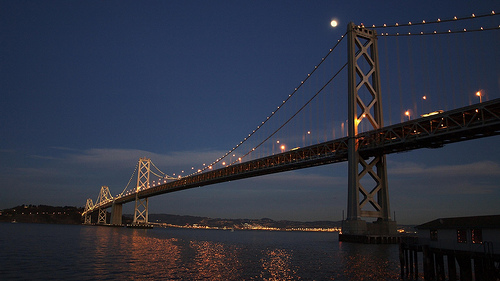
What this node is and what it entails, he cannot say exactly. All he knows for sure is it will change everything, and is set to go down in San Fransisco. To uncover the details of this , and perhaps stop it as well, he enlists help from the people of the Walled City – a virtual environment in cyberspace – Rei Toei (the Idoru), and Berry Rydell (the protagonist from Virtual Light). Meanwhile, Chevette Washington, the bike courier from Virtual Light, is also on her way to the bridge. Her new roommate, a film maker named Tessa, wants to go there so she can do a documentary on the people, how they live, and study the phenomena known as “interstitial places”. Pursued by her jealous ex-boyfriend, she agrees to accompany Tessa and show her around, and maybe reconnect with some of her fellow Bridge dwellers.

In time, and with the help of his hacker friends from the Walled City, Laney learns that Harwood has also taken 5-SB. He too has seen the nodal point approaching, and wants to shape its outcome to his liking. Although it not quite clear what its about, it seems to involve the Lucky Dragon franchise, and their incorporation or nano-assemblers in each of their outlets. In time, Rydell and Chevette arrive on the bridge, which is becoming a tourist attraction, and has a Lucky Dragon located just beyond it, with Rei Toei’s mobile projector. Several men show up and try to kill him, but he is helped unexpectedly by an assassin named Konrad – a man who is ostensibly in Harwood’s employ, but has chosen to switch sides.

After rescuing him from the first assassin, Rydell and Konrad run into Chevette at a club. She takes them her old friend Fontaine’s watch shop, where he and a young boy named Silencio – an apparent mute who is obsessed with researching watches –  take them in. When Harwood is informed that they are holed up and their assassins are dying off, he orders them to set fire to the bridge. Meanwhile, in cyberspace, Laney and his Walled City friends find him and confront him. He manages to escape into the folds, but Rei Toei comes to the little boy and tells him to find a special watch – a task which is in reality a trek to find where Harwood is hiding. They track him down, and he is neutralized.

Laney and Chevette narrowly escape to Skinner’s old hideout at the top of the bridge, where they kill the last of the assassins and wait out the fire. Rescue trucks and airships begin dousing the flames, just in time to save the bulk of the population. Meanwhile, Rei uploads her program to the Lucky Dragon’s database, and when the nanoassemblers go online, they produce endless copies of her! As the nodal point comes and passes, things have changed, though not in the way Harwood wanted, and in a small cardboard box in Tokyo, Laney is found dead by some of his old associates.

Good Points/Weak Points:
Much like its predecessors, this book advances the nanotechnology angle and brings it to an apparent conclusion. In book I, it was nanotech that was meant to be the means through which San Fransico was going to be rebuild after the Little Grande (aka. the Big One). It was also the means through which Tokyo was rebuild after said same earthquake. And many hints were dropped in Idoru that the character of Rei Toei, whose existence is strictly virtual, would be relying on it to manifest herself in reality. Alas, this finally seems to take place in this novel, where Rei uses the nanoassembly units in every Lucky Dragon around the world to produce copies of herself.

In addition, the concept of the nodal point is brought to its climax, where Laney and Harwood, both people who are sensitive to such things, are able to see one which will mean the end of the world. Not in the apocalyptic sense, merely that it will be the end of the world as they know it. From this description it is strongly implied that this will amount to a technological singularity, an event where advancement will speed up to the point where no one can predict the outcome. And given all the mentions of nanotech, it is entirely possible that it will be central to this transformation.

However, as I said earlier, this was not made clear. Much like with everything else at the end, explanations were lacking. What the big change-up involved, how Harwood planned to benefit, and how Silencio prevented that from happening… unclear! And Rei Toei’s involvement, her transformation and what purpose that served, also unclear. In essence, the climax just happens as describes, a few more short (really short) chapters tell what happened to all the characters once it was over, and the story ends. Little epilogue? Little conversation between the main characters explaining what they did and maybe what happened with Rei Toei? People learn the hero’s journey isn’t always an easy one?

Ah, I enjoyed reading it. Like all of Gibson’s work, it did a good job of contrasting high-tech and low, commercial applications and the streets use for them. The disparity of wealth and power also makes it in, as well as the average Joe’s ongoing attempts to subvert and resist it. In the end, Laney (the gifted social outcast), Rydell (the bewildered everyman), and Chevette (the streetwise survivor), all play a role in bringing down a major tycoon who’s only goal is to put himself at the center of the new order. Still, some indication of what that new order was and the meaning behind all his moves would have been nice!

And of course, the Walled City and Rei Toei make it back for their final appearances. Much like in Idoru, they are a shout out to the idea of artificial spaces, artificial constructs, and the line that separates them from that which is physically real. But rather than take a moralistic stance on the issue, Gibson’s approach was clearly towards the anthropological and sociological side of things. Mainly, he sought to show how humanity lives and adapts in an increasingly complex and changing world, and how the process is tied to the issue of control. Whereas everyone is effected by technological change and the social impact it has, it is clear that some are merely adapting whereas others have a degree of control over it.

And as with much of his other works, it is the disparity between the rich and the poor that is most central to Gibson. Whereas the rich occupy the top tier of society in his books, living on the cutting edge of development in comfortable, state of the art environments, the poor wait for development to trickle down to them and use it for their own purposes, meanwhile living in improvised environments made out of what’s available. In the middle, there are the “freelancers” who understand the conspiracies and agendas and do their best to expose them, hoping to do right by all the people who occupy the bottom rungs of society.

Nowhere is this more apparent than in the Bridge itself. Much as with the real life Walled City of Kowloon that inspired it, it all comes down to corporate interests who are trying to destroy, gentrify or commercialize it. Whereas in the first novel, the story revolved around a plot to gentrify San Fransisco through nanotechnology, in the third, those same interests try to demolish the Bridge itself because it is clearly beyond their control. It is only through the know-how and the sacrifice of those who see the larger agenda at work that it is saved, unlike the real Walled City (which was demolished between 1993/4).

It is little wonder then why this trilogy was seen as a sort of graduation for Gibson, moving from cyberpunk themed science-fiction to predictive social commentary. And while we might not be exactly where Gibson put us (2012 and we still don’t have nanomachines dammit!), the ideas he put forth  in this trilogy are still on our minds. These days, people are practically holding their breaths, waiting for the day when an artificial personality will finally be realized and machines small enough to manipulate matter at the atomic level can be built. And when that happens, we can still expect that the effects will be felt unequally. Some people will be living in seamless building made from carbon nanotubes and run by AI’s, others will be living shanty’s, making appliances out of spare parts. Or, to put it as Gibson once said “the future is here, it’s just not widely distributed yet.”

So long Walled City, you will be missed!

Game of Thrones

Or as its known by its literary name, A Song of Fire and Ice. This is the series which inspired the recent HBO series, named after the first novel in the series, and which is apparently destined to keep that name for the duration of the show. After watching the first season, I was inspired to pick up the second book, then I was inspired to buy the Kindle set of all four books. And then the author George RR Martin released the fifth book in the series and two more are planned… Wow. I tell ya, this series could go on forever! But apparently, that’s the thing about these books. As many fans have told me, his work is expected to take the same route as Wheel of Time. Aptly named, because it just keeps rolling on and on and on…

But I digress. A while back I decided I would tackle this series and give it a full review. Having loved the miniseries, I sought to delve into the source material and get a sense of what it was all about. And of course, I wanted to see where the story was going and what would come of all the characters, and I was quite pleased. While Martin’s notorious characteristics as a writer – his level of detail, his willingness to kill of main characters, his ability to really flesh out a storyline – were all abundantly apparent in later installments, I also found examples of his strengths in abundance. These included, but were not limited to, his ability to create rich, engrossing worlds, his drawing on historical sources, his ability to make readers emphasize and identify with characters, and his ability to keep people guessing. I tell ya, nothing about these stories seems predictable! The downside of that last aspect is, people keep dying, and not always the ones you hope will! But in the plus column, it keeps the reader on their toes!

Down to specifics: George RR Martin was already famous before writing A Song of Fire and Ice. During the 1980’s, he worked in Hollywood as a writer for such shows as The Twilight Zone and Beauty and the Beast. His early fantasy novel, The Ice Dragon, became a best-selling children’s novel. However, it was with A Game of Thrones and subsequent novels that his fame as a fantasy author was cemented, earning him the nickname, “The American Tolkien”. This is an appropriate description, given the fact that the depth and breadth of his fantasy novels are rivaled by only The Lord of the Rings. Several differences have been noted, however. For starters, his stories are much more gritty and realistic. Fantasy elements – that is to say, supernatural things like magic, dragons and mythical creatures – appear sparingly and only as the story progresses. And, as I’ve already mentioned twice, he kills his main characters! In short, Martin’s books revolve around realistic human characters and their goings on, with all the sex, violence, betrayal and intrigue that that entails!

The world of George RR Martin is a fictitious world set in a medieval period, hence why it falls into the genre of medieval fantasy. In this world, something transpired long ago known as “The Doom”, which has had the effect of making the seasons longer. Summer and Winter, for reasons no one can explain, last years instead of months. The coming of winter is a time of fear since it means that the White Walkers, a supernatural force from the frozen north, will be returning to threaten the Seven Kingdoms. As the story opens, a particularly long summer is coming to an end, and in the north, dark forces appear to be on the move. Further south, throughout the land known as Westeros, King Robert “the Usurper” is facing a conspiracy within his own Kingdom which could lead to another civil war (the last one is what made him king). Meanwhile, on the nearby continent of Essos, the exiled Targaryens are plotting their return to Westeros. The deposed heir, Viserys Targaryen, is planning on marrying his sister, Daenerys, to a Dothraki warlord named Khal Drogo. This marriage, he hopes, will provide him with the army he needs to return to Westeros and reclaim the Iron Throne.

The first novel thusly opens with these three story lines and ends with all three being poised on a cliffhanger note. At the Wall in the north, the giant ice-barrier that separates the Seven Kingdoms from the north, the Wildlings are apparently fleeing their villages, prompting the Night’s Watch to go and investigate. When only one man returns, he claims to have witness White Walkers, but is executed for desertion. Meanwhile, Lord Eddard Stark, Warden of the North and head of House Stark, is visited by King Robert, the man he helped become king. Robert needs a new Hand of the King, seeing as how his old one, Lord John Arryn, has died suddenly. Ned agrees and travels to King’s Landing to take up the role, and quickly become privy to the conspiracy that took his predecessor. Meanwhile, on the continent, Viserys succeeds in wedding his sister to Khal Drogo, an arrangement which begins to backfire on him when he realizes that Drogo and Daenerys are actually falling in love with each other, and are perhaps planning on cutting him out of the deal.

(Spoiler alert!): Things come together as John Snow, Lord Eddard’s bastard son, joins the Night’s Watch and begins to witness for himself what is happening the North. An attack by wights, the resurrected bodies of people killed by White Walkers, begin attacking the Wall itself. After his own uncle fails to return from a patrol beyond the Wall, Lord Mormont prepares a campaign to go north in force and meet the threat head on. For John, this means turning his back on the troubles of his family to the south. When news reaches him that his father might be in danger and his half-brothers riding to war, he is tempted to desert and ride to their aide. But as a sworn Brother of the Night’s Watch, he is bound by honor to serve until death, even at the expense of his true family.

At King’s Landing, Eddard soon uncovers the conspiracy that claimed the life of John Arryn and even involves an assassination attempted on his own son. It seems that the Queen, Cersei Lannister, is engaged in an incestuous relationship with her brother Jaime, who is one of Robert’s Kingsgaurd. Before he can inform King Robert, Robert is crippled during a hunting expedition and dies shortly thereafter. Eddard is forced to move quickly to ensure that Joffrey, Cersei’s eldest son, does not take the throne. However, his attempts are thwarted when Lord Petyr Baelish, the Master of Coin, betrays him to the Queen. Eddard is executed by the brutal and stupid Joffrey, and his daughter – Sansa, who was betrothed to him – is now his hostage. Ned’s youngest daughter, Arya, escapes with the help of a Night’s Watch brother who disguises her as a boy recruit, and they travel north together. In response to his father’s death Ned’s oldest son, Robb Stark, declares war on the king and mobilizes every house in the north to march on King’s Landing. They are joined from forces to the far south, led by Robert’s brothers, Renly and Stannis who were next in line to the throne. However, rather than declare their fealty to either of Robert’s brothers, Robb’s bannerman declare him “King in the North”, using this war as a pretext to declare independence from the south.

On the continent, Drogo and Daenerys fall in love and she learns that she is pregnant with his heir. This, plus the fact that his sister is able to stand up to him now, leads Viserys to force the issue with Drogo. During a feast, a drunken Viserys threatens Drogo by declaring that he’s taking his sister back and will cut his son to be right out of her belly. Unless of course he gets what he wants, which is the golden crown he covets. Drogo responds by having his men break Viserys’ arm and then hold him down while he prepares a pot of molten gold which he proceeds to pour on Viserys’ head. His promise of “a golden crown” is thus fulfilled! Free of her abusive brother, Daenerys tries to convince Drogo to take the Iron Throne for their son, but Drogo is reluctant, until a would-be assassin sent by Robert’s court tries to poison Daenerys. Enraged, Drogo declares that he will conquer and ravage Westeros, but unfortunately succumbs to a festering wound during combat with one of his own men. Daenerys tries to save him using a slave’s witchcraft, but is betrayed and loses her son as well. Most of the Dothraki move on, and she is left with just a small host, her advisor Jorah Mormont, and the dragon’s eggs he gave her as a wedding gift. When she burns Drogo on a funeral pyre, she walks into the flames with the eggs, and miraculously survives! The Dragonborn, which all Targaryens are said to descend from, are immune to fire, and the eggs hatch to become the first dragons the world has seen in generations. Mormont and her host declare their loyalty to her, the true Dragonborn, and plot to reclaim Westeros with her!

Thus ends book I. And as I said, one can see the influence of real at work almost right away. On the one hand, Westeros is clearly styled on the British Isles, its northern/southern divide clearly an allegory for the divide between the English south, and the Scottish North. The Wall is clearly analogous to Hadrian’s Wall, the barrier that kept the “northern barbarians” at bay during the Roman occupation of Britain, and which serves a similar function in the book. The continent of Essos is also a clear reference to the European mainland, the Dothraki styled on the Huns or Mongols (invading horsemen from the East), whereas the free cities and slave cities are inspired by Asia Minor and its vast, ancient metropolises (more on that in book II). And of course, the royal intrigue, the very concept of the “Game of Thrones” – a reference to the never ending fight to claim the crown – is a fitting rendition of the actual royal intrigues taken from medieval history. Much like real wars of succession, it is loaded with secret alliances, plots, backstabbing, and of course, bloody civil war.

And the miniseries did a very good job of adapting all this to television. Naturally, any adaptation of Martin’s work would be hard pressed to adapt all the interwoven storylines, detail and events that characterize his writing. Still, the HBO miniseries did a pretty good job of getting all the relevant info in, making time for secondary perspectives without moving too far away from the main characters. And of course, there was the shocking scene where Eddard Stark is killed, much to the chagrin of television audiences who don’t expect main characters to die. Yes, that was masterfully done too. I myself was appalled and even angry at first, but respected them all the more for doing it. It’s what’s in the book and you can’t go changing major elements just because the audience might object. I hope they keep this in mind come season two. Rumor has it Jason Momoa is hoping they’ll bring Drogo back from the dead. Clearly he hasn’t read the books!

Furthermore, the casting was SUPERB! Sean Bean, a man who brings a touch of awesomeness to just about everything he does, was perfect as Eddard Stark. Mark Addy was also superb as King Robert, capturing his pudgy, teddy bear exterior and his bitter, angry personality! Lena Headey, of Terminator: The Sarah Conner Chronicles and 300 fame, achieved a sort of perfection in the role of Cersei. I’m telling you, you seriously think she’s an evil bitch after seeing her in this, a tribute to her acting talent! Jason Momoa, who went on to play Conan in the remake of the Schwarzenegger classic, fit the bill perfectly as Khal Drogo. He was brutish, strong, manly and scary, but also endearing and loving at times. A good thing too, since the Conan remake kind of sucked! Emilia Clarke, a relative newcomer to the acting scene, was nevertheless very convincing as Daenarys, capturing both her frailty and quiet strength quite well. And last, but certainly not least, was Peter Dinklage, who played the role of the dwarf Tyrion Lannister to absolute perfection! Seriously, this guy has the best lines of the entire series as the rude, crude, but brilliant and bawdy black sheep of the Lannister clan. You love him, love to hate him, and sympathize with him, even when you’re shaking his head at his antics!

The rest of the cast, which is just too extensive to mention, was similarly awesome. Understandable given the fact that most of them are classically trained actors, people who cut their teeth doing Shakespeare and are therefore accustomed to performing epic roles. I wish I could do them all justice, but like I said, too many to count! I hope its enough just to say they were awesome!

And like most fans of the book and miniseries, I can’t wait for season two. The book was quite spectacular, picking up where book I one left off with war on the horizon and major battle in the works. And word is, cast and crew had a real hard time adapting the damn thing, it was just so epic in scope! But that only ensures that the outcome is likely to be that much more awesome to behold! A Game of Thrones, everybody. Read it, watch it, and then read book II because the series will be back soon! Not soon enough…

Stay tuned for my review of book II, A Clash of Kings, coming up next!

B5, Best Episodes. Final Season

Woo! Finally, I get to the last installment of B5’s best episodes. After eleven posts, I think I’ve finally done this show justice. I tell ya, I didn’t think it was possible to overdose on your favorite show, but just to be safe, I’ll be taking a break from it for the next little while. But first, I have one final season to talk about. The fifth and final season of Babylon 5, where the show reached its grand epilogue and established plot threads that would be picked up in subsequent TV movies and the series Crusade. Granted it didn’t pan out, but what can you do?

Anyway, here are the best episodes, as selected by yours truly…

1. A View from the Gallery:
The entire episode takes place from the point of view of two maintenance workers aboard B5, Mack and . A crisis takes place involving a marauding species named the  who are moving through the sector and attacking everything that moves. As Captain and crew deal with the crisis, Mack and  run about, putting out fires and dealing with the aftermath. In the course of things, they come across Lockley, Sheridan, Delenn, G’Kar, Londo, and just about everybody else and get to play the flies on the wall.

Significance:
This episode was both creative and a big change of pace for the show. Ordinarily, we see things from the perspective of the main characters, the central figures who make the big decisions. This time around, its like watching Rozencrantz and Guildenstern Are Dead, where the secondary characters who do their thing while the main ones carry on with the plot. And while it really didn’t advance the overall plot of the show, it was a fun watch, with lots of action and good dialogue!

Memorable Lines:
Mack: (sees Mack cross himself) When did you get religious?
Bo:
I’m not, just respect, that’s all. Every time we get a red star born out there, somebody’s life ends.

Bo: Sure looks pretty (referring to a White Star)
Mack:
You think?
Bo:
Hell yeah, what do you think?
Mack:
Me? I always thought they looked like plucked chickens. Hey, it’s not my fault they were designed that way.

Byron:(looking at helmet) A fellow of infinite jest, I knew him Horatio.
Mack: It’s Mack, actually.

Byron: At the moment of death there is a passing of energy, an explosion of consciousness. It permeates everything in close proximity… your clothes, jewelry… anything. We can still feel him – what he was, what he did, his hopes, and fears, and expectations. It’s still there for a minutes, then it will disappear… joining him in silence.

Londo: What, are you afraid I won’t come back G’Kar?
G’Kar:
No, afraid you will.
Mack:
(to bo) So… how long you figure they been married?

Mack: Hey, did you see that smile? I mean it was like the sun coming out from behind a cloud.
Bo: I did indeed. Suddenly, I think I understand Sheridan a lot better.
Mack: How do you mean?
Bo: Well, dead or alive, I’d climb my way out of hell and through ten miles of solid rock to see that smile again.

Mack: Bo?
Bo
: Yeah?
Mack
: She remembered my name.
Bo
: Our names.
Mack
: I think I’m in love.
Bo
: She’s married.
Mack
: Eh. We can work something out.

2. In the Kingdom of the Blind:
Londo returns to Centauri Prime and finds that something is amiss. On the one hand, warship production is up, and any and all matters pertaining to military planning are being reclassified so that only the Regent has access to it. In addition, Londo meets with an old friend who tells him that the Regent himself is acting very strangely. After being some hints that he is being controlled by a Keeper, his friend turns up dead shortly thereafter. His death is made to look like a suicide, but Londo doesn’t buy it. Upon further investigation, Londo finds that there is a plot to murder him. The attempt fails however when an unidentified alien intervenes and kills the would-be assassin. Finally, he meets with the Regent who tells him in no uncertain terms that there is an alien influence at work, and that soon enough, he will meet with “them”. In the end, Londo decides to leave, and wonder what the whole deal with their military vessels could be about. The episode ends with a Centauri warship destroying an Brakiri merchant ship.

Back on B5, Byron and the colony of free telepaths aboard the station learn from Lyta that the Vorlons had a hand in engineering them. This news serves to infuriate them seeing as how telepaths had always been told they were special and responsible for their own gifts. Byron decides to blackmail the Alliance council into granting them extradition to a new homeworld since the Alliance is responsible for cleaning up the mess from the Shadow War. This move causes tensions to escalate between the telepaths and the Alliance and violence begins to break out.

Significance:
This episode picks up where things left off in season four, where it was made clear that the Drakh were heading to Centauri Prime to wreak their revenge on the Centauri for betraying them. That revenge appears to involve controlling the Regent and preparing the planet for war against the other Alliance members. The colony of free telepaths and Byron’s own history with the Psi Corps was established in previous episodes. For some time, Sheridan and Captain Lockley have been protecting them from the Psi Cops. However, now that they are blackmailing the council, that protection has now evaporated and its only a matter of time before the Psi Cops close in on them.

Memorable Lines:
Minister Vatelli: (referring to G’Kar) And I see you brought your own entertainment with you! An excellent idea… and quite brave of you to let him so close without keeping him in chains. Perhaps we should change that. Just a few chains to make the others more comfortable before we put him in a cell.
Londo: He is my bodyguard.
Vatelli: Well it’s good to know that his excellencies sense of humor is intact after such a  long voyage.

Regent:You do understand, Jano, that if it were my decision, that I would never let anyone harm you, I would never let anyone hurt you.  If it were my decision… But it’s not my decision, you see (Jano is killed by the Drakh). Not my decision at all!

G’Kar: Tell me, Minister. If i were to strike you, which would you be angry at? The hand that struck you, or the heart that commanded it?… The hand has no choice but to do as it is told. It is the heart that carries the burden. And that heart is dead in both of us, Minister. It died with Cartagia, and it died in me soon after. Besides, everyone knows that the true source of pain is neither the hand nor the heart… it is the mouth. Is it not, Minister?

Garibaldi: Never, ever, ever trust a telepath. I swear to you, I’m gonna have that tattooed inside my eyelids.

Sheridan: But they did it in the wrong way, the inconvenient way.
Delenn: I seem to recall the Earth president saying the same thing to you, after your civil war (leaves).
Sheridan: I hate that she has a memory, don’t you?
Garibaldi: Damned inconvenient!

3. Pheonix Rising:
Bester and the Psi Cops arrive on the station to deal with the colony of rogue telepaths. After a tense standoff where people are killed and Garibaldi and the medlab are taken hostage, Byron kills himself in order to end the crisis. Heartbroken, but vigilant, Lyta takes his place as their leader and pledges to continue the fight he started. “Remember Byron” becomes their motto. While he’s on board, Garibaldi also takes the opportunity to corner Bester and threaten him. He tells him to confess everything he did to him, or he’ll shoot him with his PPG. Bester, refuses, but when Garibaldi tries to kill him, he finds that he can’t pull the trigger. Bester then reveals that he put a neural block on him to ensure that he would never be able to harm him. Between that and the hostage crisis, Garibaldi feels completely helpless and starts drinking again.

Significance:
With Byron dead, Lyta begins to plot the destruction of the Psi Corps, which will lead to the Telepath War that was hinted at in Season 4’s final episode. Garibaldi’s own role in this is assured thanks to Bester, who’s level 12 neural block can only be removed by a telepath of equal or stronger power. When he naturally turns to Lyta for help, she forces him to use his skills and resources to amass money for her cause, and two become unwitting partners.

Memorable Lines:
Bester: Every race to develop telepaths has had to find some way to control them, through laws, religion, drugs, or extermination. We may not be pretty, but we’re a hell of a lot better than the alternatives.

Sheridan: There’s only thing more dangers than Mr. Garibaldi when he’s loud. It’s when he’s dead silent.

Bester: Let me ask you something, Mr. Garibaldi. Purely philosophical question. On a scale of one to ten… how stupid do you think I am, anyway? Do you really think I’d let you run around, knowing what you know, and leave you free to kill me?
Garibaldi: What have you done to me?
Bester: I’ve hit you with an Asimov.

4. Darkness Ascending:
Lise surprises Garibaldi with a visit to B5. She finds that he is drinking and asks him to stop, which he agrees to. However, he finds he cannot maintain that pledge and secretly gets drunk during her time aboard. Meanwhile, Lennier and the Rangers are busy trying to determine who is responsible for the attacks on Alliance shipping. After traces some communications through hyperspace, he witnesses an attack by several Centauri warships on a convoy. He records the whole thing and hands it over to Sheridan, who tells Garibaldi about it since he’s head of Covert Intelligence. Garibaldi asks Lise to leave the station, saying that “barring an act of God”, they will going to war with the Centauri.

Significance:
After much investigation and hints being laid that the Centauri are responsible for the attacks, the Alliance now has the proof it needs. This will serve to isolate the Centauri, trigger a war between them and the Alliance, and thus make them helpless and dependent on the Drakh, which has been their plan all along. Garibaldi’s drinking is also getting out of control and threatening his work and his marriage, which will have consequences as the Alliance finds itself in the midst of a crisis.

Memorable Lines:
Sheridan: Damn it Delenn, I have been working up a good mad all day and I am not about to let you undercut it by agreeing with me.

Londo: You’d think they don’t trust us.
Vir: I don’t think anyone trusts anyone right now, Londo.
Londo: (laughs) You say that like its a bad thing. No one really trusts anyone, Vir. It’s the natural order of things. But up until now, its never interfered with business.

Londo: Gambling no longer has any appeal for me. When every day is a risk, cards and dice are not quite as interesting as they used to be.

Garibaldi: All I know is I am tired of being controlled. Controlled by others, by fear, by my past, by what everybody else expects of me, and its enough! Now this… this is my own private little act of rebellion, yeah. I may not be able to control what other people to do to me but I can at least be in control of what I do to myself.
Lise: So you don’t mind going off the road as long as you’re behind the wheel when it happens, is that it?

Lyta: As I recall, you made me a proposition. If I gave you access to my DNA to help your people develop telepaths, you would see to it that I was… oh, how did you put it? Um, that I would be compensated quite handsomely.
G’Kar: It was either to be a cloning of your genetic material or a… a direct mating. Pity, we never did find out what your pleasure threshold is.

Lyta: Oh, and you mentioned wondering what my pleasure threshold was. I just recently found out… I don’t have one. Have a very, very nice day G’Kar.

Garibaldi: Barring an act of God — and since I don’t believe in God, that kind of narrows the odds a bit — by this time tomorrow, we’re gonna be at war with the Centauri.

5. And All My Dreams, Torn Asunder:
The Alliance holds an emergency council whereby they declare that the Centauri are responsible for the attacks on their shipping. Forced to answer to these allegations, Londo denounces the proof and issues a declaration on behalf of his world. They will not recognize the embargo that is now being placed on them and will challenge it with military force, if necessary. War seems inevitable now, and all sides dig in and prepare for the worst. Sheridan tells Garibaldi to position the White Star fleet to respond and intervene in any conflicts between the Centauri and any of the member worlds.

Zack discovers Garibaldi is drinking and tries to help, but to no avail. Sympathizing and knowing that Garibaldi looked out for him in the past, he agrees not to report him. However, this leads Garibaldi to get drunk and fall asleep at the wheel when the Rangers detect a Centauri fleet challenging the blockade into Drazi space, and a firefight ensues. With the Drazi now demanding blood, Sheridan has no choice but to declare war on the Centauri.

On Centauri Prime, the declaration of war is announced to Londo and the Minister of War tells him that G’Kar, his bodyguard, must be locked away for security reasons. Londo refuses and says that where G’kar goes, he goes, which only manages to get them both locked up! Alone together in a cell, Londo broods that things are spiralling out of control and worries how it will all end.

Significance:
After much build-up, the war between the Alliance and the Centauri is finally happening, as the Drakh had hoped. Outnumbered and outgunned, they are sure to be defeated, which will lead to the devastation of their planet – which was previewed in season three when Sheridan became “unstuck in time”. We also get further indications of Garibaldi’s alcoholism and how it is effecting his job. This, in turn, will lead to his dismissal down the road and Lise’s insistence that he go with her back to Mars where he will begin helping her run Edgar Industries, and massing funds for Lyta’s coming war with the Psi Corps.

Memorable Lines:
Centauri Minister
: Is that why you brought it (G’Kar) along?
Londo
: No, he is still here as my bodyguard, that’s all. Where I go, he goes.
Centauri Minister
: My condolences.
G’Kar
: Thank you. It’s a burden, but I’ve come to accept it.

Centauri Minister: I’m sure you would like to freshen up. Both of you.
G’Kar
: It’s a natural musk. I rather enjoy it.

Londo: Careful minister, we don’t want my companion to get the wrong idea. We don’t normally treat our guests so badly.
G’Kar
: Yes you do.
Londo
: Shut up.

Londo: Where he goes, I go.

Londo: (to G’Kar) Don’t worry. Even one as arrogant as this would not take it upon himself to imprison his own prime minister.
(next scene, Londo and G’Kar are in a prison cell)
Londo
: Shut up.
G’Kar
: I didn’t say anything.

Delenn: We are all born as molecules in the hearts of a billion stars. Molecules that do not understand politics or policies or differences. Over a billion years, we foolish molecules forget who we are and where we came from. In desperate acts of ego, we give ourselves names, fight over lines on maps, and pretend that our light is better than everyone else’s.

6. Movements of Fire and Shadow:
The war between the Alliance and the Centauri is raging, with both sides taking heavy losses. However, according to Vir, the bodies of the Centauri crews that are shot down in Drazi space are not being returned to them. He meets with Franklin and Lyta and asks them if they will investigate for him. Lyta agrees, but only if Vir is willing to pay a substantial sum. They travel to the Drazi homeworld where they find that the ships in question had no crews, but were instead being piloted by Shadow remote devices, which the Drazi were keeping a secret so they could study them. When Sheridan hears of this, he realizes that the Centauri have been set up and tries to fly to the Centauri homeworld to warn them before its too late.

While on her way to Mimbar to discuss a new joint Earth-Mimbari warship program, Delenn’s White Star is attacked by several Centauri vessels and disabled. She and Lennier are the only ones left alive on board and begin to drift. At the same time, the Narn and Drazi agree to a joint mission to attack the Centauri homeworld. This mission is in defiance of Sheridan and the Alliance Council, but after a Centauri remote ship tries to destroy the B5 jump gate, they come to the conclusion that Sheridan doesn’t have the stomach for a real war. They amass a fleet and fly to Centauri, just as Londo escapes from his cell and finds the Regent waiting in his quarters. He tells Londo that his time is almost up, but before he dies, he had only final duty: to shut down the planetary defense network in preparation for the coming attack. Londo runs and tries to stop it, but is helpless to do anything in time. The Narn-Drazi fleet begins bombarding the surface with impunity.

Significance:
The Drakh’s involvement in the war, as well as their use of captured Shadow technology, is revealed. The devastation of Centauri Prime, previewed in season three, now takes place. This will end the war, embitter the Centauri, and make them useful pawns to the Drakh, who need them isolated and angry so that they will allow them to operate from their homeworld. The Regent is also near death, which means Londo will become their puppet soon, something else that was previewed in season three. Sheridan also speaks with Delenn in this episode about creating a new class of warship – a White Star Destroyer. These ships will prove important in the coming Drakh War and are a focal point in the tv movie A Call to Arms and the series Crusade.

Memorable Lines:
Sheridan:
The White Stars are authorized to open fire on any Centauri warship engaged in combat with Alliance vessels. Any hope  of neutrality Babylon 5 had up until now… just went up in smoke!

Vir: As you know, our ships have been in combat with… well, just about everyone really. Our biggest losses have been in Drazi space. They are really good fighters! Not terrific conversationalists and there table manners could make you go blind in one eye but… really tough behind the weapons consoles.

Mollari
: No. I said where you go, I go. It’s become a matter of principle.
G’Kar
: You picked a terrible moment in your social evolution to develop principles. Perhaps you can start with something simpler. The moral equivalent of the opposable thumb, for instance.

G’Kar: I woke up when I thought I heard the expected angry mob coming to storm the palace on your behalf. But it was just you. Did you know that you snore?
Londo: I have to get out of here!
G’Kar: Yes, that’s what I’ve been saying for some time now.
Londo:
No, I have to get out now. I have this feeling… Something is terribly wrong…
G’Kar: You’re at war with everyone in the known universe. Perhaps its that.

Londo: Thank you! Who knew they could make such a stench! Great Maker, I don’t even want to think about it! I couldn’t stay in there a moment longer! And the smell was not the worst of it. It was the burning in my eyes! I think my buttons are melting!

Franklin: He said the room service is good and the food is cheap and… the staff is friendly.
Lyta: Meaning the food stinks, the rooms are small, and the staff will knife you in the back when you’re not looking.
Franklin: Exactly!

7. The Fall of Centauri Prime:
In the midst of the bombardment, Londo finally meets with the Regent and the Drakh leader. They tell him everything – about the destruction of Z’ha’dum, their search for a new homeworld, and their plans to use Centauri Prime as their new base. Londo is made to comply when they tell him that they have placed fusion bombs in the planet’s crust, and will detonate them if he doesn’t become their new puppet. Given the bombardment, they figure no one will notice a few extra craters. He agrees, Londo takes on the Keeper, and becomes Emperor after the Regent dies.

Meanwhile, Delenn’s vessel is found in hyperspace by a Centauri vessel under Drakh command. They are about to attack, but Londo convinces them not to. Thinking they are about to die, Lennier confesses his love, but she pretends not to have heard when the Centauri ship begins towing them to safety. Sheridan lands on Centauri Prime and meets with Londo. He turns over Delenn and Lennier to him, safe and sound. When Sheridan tells him about what he has learned about the Shadow devices, Londo lies and says that the Regent bought them on the black market. He rejects Sheridan’s offer for a rapprochement and is told that Centauri Prime must pay reparations as the instigator of the war. Londo denounces this publicly, but is forced to comply. He says goodbye to them and G’Kar, whom he does not expect to see again until he will die.

Significance:
The war ends and Londo has become emperor, as he has long foreseen. The Drakh are now free to pursue their plans for revenge against the Alliance, and Sheridan and Delenn in particular. While examining one of the Shadow devices, Sheridan, Franklin, and Lyta reflect on how the universe is now full of abandoned technology that is extremely powerful and dangerous, should it fall into the wrong hands. They draw a comparison to Earth after the fall of the Soviet Union, when people feared that Russian nukes might hit the open market. Lyta also reveals that they will one day be admitted to the Vorlon homeworld, which is currently impossible given all the automated defenses that shoot anything down. Though she’s not sure how she knows, she claims it will be one million years before humanity has proven itself ready.

Memorable Lines:
Regent:
They said, ‘the Shadows were our masters. We served them, believed in them, loved them. Then they went away, and left us behind, to escape on our won. But without our masters, who are we? In the end, what are we but –
Drakh:
A shadow of a shadow… an echo of what was?

Drakh: You are now what we need you to be. A beaten, resentful people who will have to rebuild. Who will have to rely on our good graces. Who can be used and guided as we wish to guide you. Perfect ground for us to do our work… quietly… quietly.
Londo: No I will not allow it!
Regent: Yes, you will, as I did. You see, Londo, they learn quickly. They learned from the Shadows and they learned… from you. They’ve planted fusion bombs throughout Centauri Prime. Unless they get what they want, millions of our people will die and the blame with go to the Alliance. In all this bombing, who will notice a few more craters?

Mollari: Isn’t it strange, G’Kar? When we first met I had no power and all the choices I could ever want. And now I have all the power I could ever want and no choices at all. No choice at all.
G’Kar
: Mollari. Understand that I can never forgive your people for what they did to my world. My people can never forgive your people. But I can forgive you.

Lennier: Delenn?
Delenn: Yes?
Lennier: I love you.
Delenn: I know.

Franklin: You ever been out ot the San Diego ruins? Well, I have. The thermonuclear device used by the terrorist to blow up San Diego could be traced right back to the breakup of the Soviet Union in the late 20th century. When they fell, all their weapons ended up in the hands of smaller governments that didn’t understand them, sure as hell couldn’t build them, but were eminently willing to use them. The great thing about war is that it advances technology. Bad thing about war is that most of those technologies are destructive. And once the war is over,t hose weapons are still around.
Lyta: Weapons like us.
Franklin: Yes, weapons like telepaths, and that thing there, and anything else that might have gotten out. Now we know that the Shadows had hundreds of allies working for them and we know that omst of them or all them got out before Z’ha’dum exploded. Now who knows what they took with them, and how much of it is in the hands of people who don’t understand it, couldn’t build it, but are willing to use it?
Sheridan:
The giants have left the playground, but they left their guns behind.

Lyta: The Vorlon homeworld is off limits until we’re ready, until we’ve earned the right to go there… a million years from now. Don’t ask, I don’t know where that came from anymore than you do. I just… know it.

8. Sleeping in Light:
This episode takes place twenty years after Lorien restored Sheridan, when he said Sheridan’s life would finally run out. Realizing his time is coming to an end, Sheridan invites all his old friends to Mimbar for a final dinner with him and Delenn. This includes Garibaldi, Franklin, Ivanova, and Vir. While together, they talk of old times and toast their friends who didn’t live to be with them – Londo, G’Kar, Lennier and Marcus. Sheridan then passes control of the Rangers to Ivanova and says his final goodbye’s to Delenn. He then sets off for B5 to say his goodbye’s there, where he meets Zack who is still working there. Zack tells him that the station is set to be decommissioned, much like Sheridan, it has reached the end of its life, and is about to be scrapped with minimal fanfare.

Sheridan then flies to Coriana 6, the site of their major battle against the Shadows and the Vorlons, and waits to die. Before he does, Lorien appears to him and tells him that they haven’t forgotten him, and that he will pass into the great beyond with them. Sheridan is both intrigued and saddened, since it means he will see what lies beyond, but that he will also never be able to come back. He then disappears in a huge ball of light, saying “the sun’s coming up”. We then are given a final montage, showing how everyone is carrying on with their lives and B5 being demolished. Ivanova gives the closing speech, reflecting on everything B5 taught them, and how Delenn spent the rest of her days watching the sun rise every morning in honor of Sheridan.

Significance:
This tearful farewell to the show was actually filmed at the end of season four, along with the Deconstruction of Falling Stars. At that time, JMA was not sure if season five would be a go and planned to use either this episode or Deconstruction as the finale. In the end, season five got the green light and he was able to use both. In addition to wrapping up the show, this episode provided some strong hints as to the outcome of all the plot threads that were lain down in season five that we wouldn’t get to see. These included the Telepath War, the Drakh War, Londo’s and G’Kars death, and Lennier’s death. In short, we get to see that though there were some bumps after season five, everything turned out okay. The Alliance held together, the known universe experienced peace after the Shadow War, and Sheridan died when Lorien had predicted. We also got to see how Lorien and Sheridan’s old friends amongst the First Ones hadn’t forgotten him and came back to carry him away with them. All of this was the perfect cap to the show, giving us a sort of epilogue/eulogy for the main characters as well as B5, the centerpiece of the show, itself.

Memorable Lines:
Vir
: One time, we were walking through the Alien sector, and we heard this beautiful singing coming from the Pak’Ma’Ra’s quarters.
Sheridan
: They sing?
Franklin
: There’s nothing in the literature about that.
Vir
: Apparently they only ever do it once a year, during their religious period. And we were listening to this singing and I saw a tear run down Londo’s face, and I said, “We should go, this is upsetting you.” But he said no, and we stayed. After the singing was over he turned to me and said, “There are 49 Gods in our Pantheon, Vir. To tell you the truth I’ve never really believed in any of them. But if just one of them exists…then God sings with that voice.”

Sheridan: A toast. To…absent friends. In memory still bright.
Garibaldi
: G’Kar.
Vir
: Londo.
Delenn
: Lennier.
Franklin
: Mar–
Ivanova
: Marcus.

Sheridan: Zack. Ha ha! What the hell are you doing here? I thought you went back to Earth.
Allan
: Yeah, I did. Got bored. Re-upped about six months ago. I figured I’d be here ’til they turn the lights out.

Sheridan: There’s still so much I don’t understand.
Lorien:
As it should be.
Sheridan:
Can I ever come back?
Lorien:
No. This journey has ended. Another begins. Time to rest now.
Sheridan
: Well…look at that…the sun’s coming up…

Ivanova: Babylon 5 was the last of the Babylon stations. There would never be another. It changed the future…and it changed us. It taught us that we have to create the future, or others would do it for us. It showed us that we have to care for one another, because if we don’t, who will? And that true strength sometimes comes from the most…unlikely places. Mostly though, I think it gave us hope—that there can always be new beginnings…even for people like us. As for Delenn, every morning for as long as she lived, Delenn got up before dawn and watched the sun come up.

Woo! All done! Babylon 5 everybody! May it endure, and someday come back and garner a whole new generation of fans. A guy can dream…

Delays!

Well, sorry to say but that double-headed gorgon thing deadlines/editing has reared its ugly head again. Whereas I wanted to have Data Miners all polished and ready to go for the month of January, it seems that other stuff has got in the way and forced me to push the release data back to February. I could release it today if I wanted, but I really, really, want this baby to be typo, error, and inconsistency free. I don’t imagine I need to tell anyone that there is nothing more annoying than finding those nasty little things showing up in a work of print.

So, keep your eyes open for it, and for those people in Ottawa that I promised copies to, don’t worry, they will be ready in time for our trip! In the meantime, check out the covers I made for Amazon and Lulu (the second one is a PDF, just click on it):

Dataminers.Lulu

New Covers up at Lulu.com!

Not too long ago, my hard drive crashed… again. Which naturally wiped out all the lovely covers that I’ve created since launching my site. Which was okey-dokey for me because it gave me the chance to update them. The ones I produced over at Lulu.com were not bad, but hardly the kind of thing that I felt dazzled the eye. So, having rebuild my harddrive from nothing, I managed to turn out some new covers as well for all my ebooks and short stories. Click on the links below to see what they look like now (all PDF files):

Eyes
Turncoat
Vega
Flight

Come by my Author Spotlight at Lulu to have a look-see.  And stay tuned for the release of Data Miners, coming soon to Lulu, Smashwords, Nook, and Amazon Kindle.

Dataminers.Lulucover

Data Miners, now at Authonomy!

Hello! In preparation for Data Miners release on Amazon-Kindle this month, I’ve provided a sample preview, available for free, over at Authonomy.com. Come on by, have a look-see, and if you’re feeling generous, back the book or even rate it! Note that this is just the first five chapters, the purpose of which is to give audiences a preview. If you’re looking for the whole thing, you’ll just have to wait until I’ve finished releasing it, but rest assured, the finished product will be free for a short time as well. Constructive criticism (hell, even harsh criticism) is always welcome!