28 Days Later…

Hello all! In honor of Halloween, I thought I’d jump ahead on my review list again and cover a zombie flick! And not just any zombie flick, a good, scary and even poignant thriller known as 28 Days Later! Not only is this movie a cult favorite, its also a films that got in on the ground floor of this new zombie craze.

Yes, for some reason, zombie movies have been pretty popular in the new millennium. Maybe it’s a retro thing, but it seems that within the last ten years, there have been a plethora of writers/directors who have breathed new life into this old movie genre. After 28 Days was released in 2002, it was followed by the Resident Evil movie, House of the Dead in 2003 (another video game adaptation), the remake of Dawn of the Dead (2004), Shaun of the Dead, Doom (2005), Slither (2006), The Zombie Diaries, I Am Omega (2007), I Am Legend, Day of the Dead (2008, another remake), followed by Quarantine, Zombieland in 2009, and the list goes on. In fact, I’m not even taking the time to mention all the sequels and lesser known titles that came between these ones!

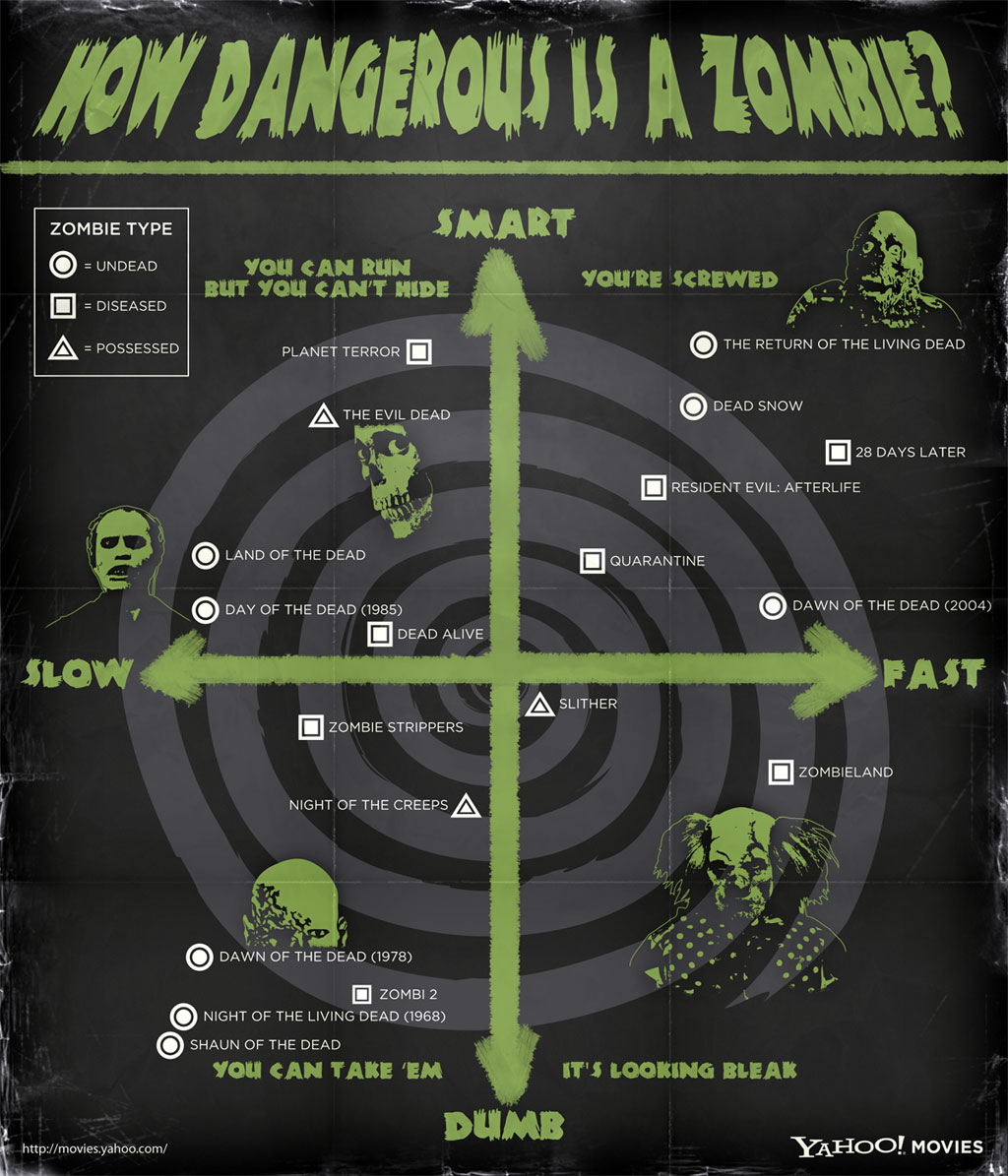
The point is, whereas in previous decades, people could expect a low-budget zombie movie at least once a year, since 2000, there have been multiple entries every year, sometimes as many as a dozen! And with this explosion in titles, there’s been some variety to how zombies were presented as well. Whereas in the old zombie classics, zombies were slow witted and slow moving – literally the walking dead – in new movies and re-imaginings, zombies were fast moving and sometimes highly intelligent. In fact, there’s even a neat table over at Yahoo movies that places zombie films within the context of these two criteria:

How Dangerous Is A Zombie?

If one were to use that table to discuss this movie, the zombies would be placed on the high end of both speed and intelligence, making them VERY dangerous. And, as I will mention soon enough, their take on the creatures was also quite realistic, at least when compared to other franchises. Okay, get comfortable and be ready to get scared, its horror movie time!

(Background—>):
Compared to most horror films, 28 Days had a relatively fair budget of about 5 million pounds or 7 million US$ (based on the 2002 rate of exchange). It’s overall gross, however, was over 82.7 million dollars, and it even spawned a graphic novel and a sequel (haven’t seen or read them yet, but working on it ;)). In addition, the movie was the result of collaboration between writer Alex Garland and esteemed British director Daniel Boyle, whose film credits include Shallow Grave, Trainspotting, Sunshine,Slumdog Millionaire and The Beach (which Garland also wrote).

The film was also well received by audiences and critics, earning itself several awards for direction, cinematography and acting in both Europe and the US in the process. It was even placed on two top 100 and one top 20 list as one of the best horror movies of all time. In addition to its direction and acting, critics praised it for its story, allegory and humanistic elements. In short, the movie went in with a modest budget and limited fanfare, but came out a cult hit and a commercial success. Little wonder why its seen as one of the best movies of the genre, people love underdogs as much as they do hidden gems!

(Content—>):
28 Days Later essentially begins with an act of activism, where some well-meaning animal rights people storm into an animal testing facility and try to free some chimpanzees who are undergoing weird tests. In the course of the break-in, one of the doctors tries to stop them, saying that the chimps are infected with “rage”. This opening kind of seemed hokey to me at first, but afterward I came to see how effective it was. We get a brief prologue that tells us how things began, but which doesn’t weight us down with long-winded or unlikely explanations.

This is always a challenge in zombie movies, explaining how and why the dead are up and walking. In this case, they chose to go with a virus that was like super-rabies, making the infected extremely violent and spreading through the exchange of bodily fluids. Kind of brilliant if you think about it, explains all the zombie-like behavior while still being somewhat plausible. Of course, they are basically saying that animal rights activists will be responsible for the apocalypse, but who cares? It’s fiction!

We then cut to a hospital where the main character – a bike courier named Jim (Cillian Murphy*) – wakes up from a coma and realizes he’s all alone (for some reason, we get a full-frontal shot of his junk here too!) He then gets up and begins to look for answers and food, finding only abandoned buildings and empty streets. After making his way out into central London, he quickly realizes something terrible must have happened. All the missing signs and news pinups about the “End of Days” seem to attest to that. Naturally, he travels to a church where he finds pews filled with corpses, and one survivor, who for some reason seems to want to bite him…

*People may remember Murphy as The Scare Crow in Batman Begins and The Dark Knight.

But of course, he is narrowly saved by two healthy people – a woman named Selena (Naomi Harris) and her friend – who explain to him what’s been going on. Here too, the exposition was kept mercifully brief, the two basically telling him that a virus has devastated the country and that its spread through blood, bites, etc. He agrees to team up with them, but only if they can swing by his house, as he needs to know if his parents are still alive. Naturally, they are not, and infected people soon attack them. Selena’s friend is bitten in the process, and she is forced to kill him. Jim is upset by this, but Selena explains that this is how it is now. Needless sentiment lead to hesitation, which in turn leads to death. Now Selena and Jim are alone to wander the streets looking for other survivors.

Their search brings them to an apartment building where a father and daughter are holed up, and using Christmas lights to attract other survivors. A desperate chase follows as they are forced to run up the stairs as the infected chase them. But eventually they get to the landing where the father, Frank (Brendon Gleeson), is waiting for them in full riot gear! After beating down the infected, he lets them in and they meet his daughter, Hanna (Megan Burns), and begin swapping plans. It seems Frank has a radio and from their high elevation, they’ve been able to picking up a military radio transmission coming from Manchester that tells of a cure, food and shelter. The four of them make plans to go there straightaway.

Getting there is an adventure to be sure, the four having to flee from infected as they get out of the city and there being a few pacing scenes along the way. But eventually, they arrive to find the town of Manchester on fire, and that the transmission is coming from a military base nearby. However, the base appears to be deserted, the only inhabitants being infected crows and bodies. What follows is a heart wrenching scene where Frank gets a drop of blood in his eye and begins to change. He has just enough time to tell his daughter that he loves her before they realize he’s been infected and he goes bat-shit crazy! That’s when the army men reveal themselves and open fire on Frank!

They are then taken to the base’s main compound where the CO, Major Henry West (Christopher Eccleston), welcomes them. Jim and Selena are cautiously optimistic now that they have some protection and a roof over their head, but Hannah is understandably bitter. Her father is dead, after all, and these men were responsible. In the course of the next few days, the Major shows Jim their set up and explains what they’re doing. Seems they’ve been luring the infected to the compound and then killing them with bullets and landmines. They’ve also been keeping a live one for study so they can see how long they survive without the ability to feed. This one they call Mailer, since he was once one of them…

However, things go awry when a few things become clear. For one, the boys seem to like Selena, and are quite pushy on that fact. When Jim tries to intervene to keep them off her, the Major explains that his mens’ sanity has been hanging by a thread and he’s had to make promises to keep their morale from collapsing and them from offing themselves. In short, he promised them women… Suddenly, the signal, the one that lured them in with promises of safety, food and a cure makes perfect sense. The Major and his men, who think the world has gone to hell, are looking to create their own little society here, and need breeding stock! Jim resists, as does one of the soldiers, and the Major orders that they be shot.

While Selena and Hannah are forced to don dresses and prepare for an evening of rape, Jim manages to give the soldiers the slip and runs off. Before the other soldier is shot, he gives Jim some words of encouragement. The Major and the others insist the world is dying, he says, but he’s seen planes going overhead and thinks that’s a pretty strong indication that the carnage must be reserved to Britain. Jim takes some hope from this too, and begins to hatch a plan. He returns to the abandoned outpost where they first met the Major’s men and sets off the siren. This lures the Major and some of his troops, as they know that the siren will draw unwanted attention. When they show up, Jim manages to kill some of them, with the help of some infected, of course.

Back at the base, Selena sets Hanna free and is cornered by one of the soldiers who is about to rape her. However, Jim has returned to the base at this point and unleashes Mailer on them. While he creates all kinds of carnage, Jim manages to break in and kill the soldier who was going to rape Selena with his bare hands. Selena thinks he’s been infected too and is prepared to kill him, but hesitates just long enough to realize he’s clean. We quickly realize that she’s in love with Jim now, as she showed no hesitation when killing her old companion. The two kiss and reunite with Hannah, and all three commandeer a vehicle outside and prepare to drive off.

However, Major West is waiting for them and shoots Jim in the stomach. But Mailer shows up in time to grab West before he can shoot anyone else, and Hannah drives while Selena tends to Jim’s wound. The three then drive to a hospital where Selena tends to his wounds in a frantic montage of quick cut-scenes. Then, after being in a coma for another 28 days, Jim wakes up and finds that he’s recovering in bed, this time in some remote cottage. The three of them are now in the countryside where Hannah and Selena have prepared a massive cloth banner that spells out HELLO. Jim is now awake just in time to help them deploy it and to see a Finnish fighter jet fly overhead. The movie ends with Selena asking sarcastically, “Do you think he saw us this time?”

(Synopsis—>):
Apparently, Boyle and Garland also came up with a number of alternate endings as well, two of which were filmed and a third which never made it past storyboard. In the first, which was meant to be the original ending, Jim dies in the hospital, leaving Selena and Hannah to carry on. However, this ending was rejected after some test screening audiences said it was “too bleak”. Though the scene was meant to convey that the two ladies survived, audiences believed they were marching off to certain death. The second alternate ending included the rescue banner at the very end, but without Jim being present, so as to show that the ladies made it without him.

A third, which never made it past storyboard, was a radical departure. In this one, Jim, Selena, Hannah and Frank converge on a medical facility rather than a military base, the same one where the infected apes escaped from at the beginning. Frank is still infected, but it turns out that there is a cure available here. Unfortunately, the doctor at the base informs them that the cure consists of a full blood transfusion, and only Jim is a blood match. He therefore sacrifices himself to save Frank, and the movie ends. This ending was rejected by Boyle and Garland though, since they realized it was unrealistic. In essence, if an infection can spread through even a drop of blood, no amount of transfusing would work!

While they didn’t go with the ending they wanted, the movie still conveyed the same message all around. In it, we are given a pretty realistic take on zombies, one which ties in with the dangers of epidemics and how modern, industrial societies are vulnerable to infectious diseases. In addition, we get a story that’s chock full of allegory about the human condition. Whereas some people survive by becoming selfish and doing whatever they have to to go on – in Selena’s case, cutting all ties, in the Major’s case, promising his men women – ultimately, people are redeemed through acts of self-sacrifice and empathy.

Frank shows this through his abundant sense of generosity and how he’ll do anything to make sure his daughter survives. Selena demonstrates this by saving Jim and Hannah, allowing herself to care for them even though she’s presumably become hardened and only cares about staying alive. And of course, Jim demonstrates this by putting himself in danger to save Selena and Hannah, even though it nearly costs him his life. And of course, the three make it in the end only by mutual dependency and love. There’s even the bit about the rogue soldier who would rather die than give in to hopelessness and take part in a gang rape.

And that’s the movie. Simple, scary, effective and entertaining! It’s rare that a movie will come along that can cover all these bases, but this one managed to do it quite well. Its also a reminder that within the realm of low-budget cinema, there are some genuine gems waiting to be found. Hell, one could even make the case that low budgets are essential to the success of some movies. It ensures that there aren’t any over-the-top special effects to make it look fake, or a sense of mass appeal to water down the plot. And it just goes to show you what can happen when good acting, writing and direction come together!

28 Days Later
Entertainment Value: 8.5/10
Plot: 9/10
Direction: 9/10
Total: 9/10

V for Vendetta

Chances are, we all know people who are avid readers and swear up and down that a movie is never as good as an original novel. Man, those people can be annoying! However, as time goes on I find myself identifying with those people more and more. The difference between them and myself is, they read the books first and then see the movies. I, on the other hand, see the movie, listen to people complain about how “it wasn’t the same”, read the novel, and then join the chorus! Maybe this is a sign that I should read more, maybe its just dumb luck. But somehow, I find that with a lot of adaptations, I’m getting it all backwards.

The experiences tend to be pretty far between, but on the whole, I notice they are becoming more and more frequent. First, there was The Lord of the Rings, where I saw the first movie and then read the trilogy. By the time the trilogy was wrapping up, I was nitpicking all the omissions and changes with all the other Rings geeks! Then there was Fight Club, a movie I thoroughly enjoyed but then read the book and suddenly found reason to criticize. Then came Blade Runner, one of those rare instances where I liked the movie better. More recently, its been Game of Thrones – we’ll see how that turns out! – and, for the purposes of this review, V for Vendetta.

Yes, here too I saw the movie before I ever knew the source of inspiration. Then, having finally read it, I found myself having second thoughts about the movie. In truth, that’s not really fair, but it is kind of unavoidable. Regardless of what order you do it in, you can’t help but be very much aware of the fact that between the original story and the screen adaptation, things change. It might not always seem faithful, but a movie is not diminished simply because it’s different from the source material, nor can you fault director’s for taking creative liberties. And with adaptations that come years or even decades after the book was first released, you have to figure that changes will be made because they have to be. Things have happened between now and then, things which may make certain parts of the story impossible or at the very least unlikely. So with that in mind, let’s get down to V for Vendetta – the movie, the graphic novel, and everything in between!

(Background—>):
Since I knew in advance that V (the movie, not the sci-fi series) was based on an original graphic novel, I thought it only fair that I read it before giving the movie a review. After reading it, I was reminded of why I enjoyed Watchmen as thoroughly as I did. In both cases, Alan Moore was the creative mind, combining an obvious passion for politics, history and narrative depth with the usual subject matter of comic books (i.e. superheros). It was these same elements that Frank Miller would later emulate in order to create one of the best entries in the Batman franchise – The Dark Knight Returns. This is surprising, seeing as how V was apparently a side project of Moore’s, something he and illustrator David Lloyd did for fun more than anything else. The fact that it went on to become one of the most critically acclaimed series’ in history, eventually spawning a movie adaptation, was just a sign of its quality.

But of course, the graphic novel was released between 1982 and 89, covering events which took place towards the end of the 90’s. In it, a post-apocalyptic Britain has been spared the ravages of the nuclear holocaust, but then finds itself struggling to survive in a devastated world. It is then quickly taken over by a fascist government that uses the chaos of the outside world and the mentality of “Lifeboat Britain” to take power and justify its extreme policies. After many years of supposed peace and stability, a masked anarchist emerges who begins to slowly take apart the state, exposing its lies, secrets, and the crime that made him what he is.

Not only was this a chilling basis for a story, it also had an undeniably British flavor to it. The setting, the characters, and the mentality of it all just screamed Britain! In the movie, we get much the same feeling, but the elements are different. Rather than involving nuclear war, the plot revolves around the threat of terrorism and repression done in the name of security (something audiences in 2006 would find much more relatable). That, and a slew of other changes, made the movie more current, but also had the effect of watering it down somewhat.

(Content—>):
The movie opens almost exactly as the graphic novel does, except that for the sake of American audiences, the story of Guy Fawkes is first explained. Natalie Portman tells of the Gunpowder Treason, the man behind the plot, and the difference between ideas and the people who fight for them. However, the movie then moves to a near-future London at night, where both Evey (Natalie Portman) and V (Hugo Weaving) are getting ready to go out. In the background, the “Voice of London” – the regimes chief spewer propaganda – is delivering his latest spiel.

Evey then goes out for the night, on her way to meat her suitor and superior over at BTN (British Television Network) where she works. However, on her way she is intercepted by Fingermen (government spooks) who attempt to rape her. She is narrowly saved by a masked stranger who is in the habit of spouting poetry before wielding his knives and cutting his enemies to ribbons. He says his name is V, a name which he then cuts into one of the government’s posters. Thus begins Evey’s adventure with him, and the premise of the story.

He then takes Evey to the roof of a nearby building where a performance is about to begin. This “show” involves the destruction of the Old Bailey, the symbol of Britain’s justice system in London, done to the tune of 1812 Overture. During the display, he mentioned the 5th of November to her, and how that act, over 400 years old at this point, has been largely forgotten. As has the lesson. Through all this, we are made immediately aware that V is a revolutionary anarchist who has a score to settle with Britain’s fascist government. His theme: Guy Fawkes, and the Gunpowder Treason!

I should note that within these first few scenes, there are some notable differences between the book and movie. For one, Evey did not work in television, she worked in a munitions plant. And she was not out for a date, she was out trying to sell herself. Yes, this 16-year old (they never specified her age in the movie) had fallen on hard times since her job didn’t pay enough, was looking to make a little extra money and thought dabbling in prostitution might make up the difference. What’s more, in the movie V whooped the Fingermen’s asses but left them otherwise unharmed. In the book, he killed several, and used gas and an exploding hand, not knives!

What’s more, V did not blow up the Old Bailey in the opening scene, but Parliament itself! Much like the Old Bailey, this was an old government building that was no longer in use. Given the fact that the fascist party that had taken control had no need of parliamentary procedure, the building was essentially empty. But of course, it was the symbolic value that mattered. It was shortly thereafter in the book that V blew up the Bailey, but only after delivering an impassioned speech to the figure of Madam Justice on the subject of betrayal.

In any case, we then get a quick gander at the authorities who run Britain and their leader – the Lord High Chancellor Adam Sutler (John Hurt). Much like in the book he is a totalitarian and runs Britain through several branches known as the Eyes, Ears, Nose, Mouth and Finger – video, audio surveillance, regular police, propaganda, and secret police (echoes of 1984 with its four ministries!). But whereas in the movie they are known as the Norsefire party (a clear reference to their Nordic beliefs and action platform), the Party was never really named in the book. Regardless, they are of course determined to find the masked vigilante, and put out a spin story about a controlled demolition to cover up the terrorist incident. Since this is a criminal investigation, it falls to inspector Finch (Stephen Rea) to find him.

However, their attempts at spin control prove futile when on the 5th of Nov, V marches into the BTN network headquarters with a bomb and forces them to broadcast a manifesto of sorts. In it, he declares that the people of Britain have been robbed of their freedom by the Lord Chancellor and his goons, and were of course complicit in the process. And that, in one year’s time, he will resurrect the Gunpowder Treason by blowing up Parliament, and invites the people of Britain to come and watch. In the course of his escape, Evey comes to his rescue and is knocked unconscious. Unsure of what to do, he brings her back to his lair and they become acquainted.

In the course of this, Evey begins to tell V her story, how her parents were political dissidents who were taken away when she was young. However, her sympathies are soon spent when she realizes that he is killing people and she hatches a plan to escape. She puts this into action when V asks for her help in killing Archbishop Lilliman (Eddie Marsan), a Party member who was the Chaplain at Larkhill – now the Archbishop of Canterbury – and who just happens to be a pedophile. She knows that running away is dangerous since the police now believe she is his accomplice, but can’t stomach what he’s doing. This is also different from the book, but more on that later.

Shortly thereafter, V enters into phase two of his plan, which Evey becomes involved in. This includes him isolating members of the Party that run Britain, key personnel in the regime, who he then murders. The first is the Lewis Prothero (Roger Allam), otherwise known as the “Voice of London” (Voice of Fate in the book). But whereas in the book, V goes through the process of kidnapping him and bringing him to Larkhill – where he destroys his prized dolls (which he collects), in the movie, V enters his apartment and kills him with a poisoned needle. I notice a subtle reference to the doll collection though; in his bathroom, Prothero had a small collection up on his wall.

In the course of investigating, Detective Finch (Stephen Rea) – head of the Nose – discovers that Prothero was once the Commandant of the camp. His other victims all have similar ties to the place, one of whom was a doctor named Delia Surridge (Sinéad Cusack), the one who conducted the camps’ experiments and was responsible for creating V. When she is dead, V leaves her journal, in which she kept detailed notes about her time in the camp, for Inspect Finch to find. It is from this journal and their own snooping that the Nose men begin to see what’s going on. Like V, they’ve stopped believing in coincidences and suspect that everything in this case is connected. And since things have escalated, the investigation has been taken over by Creedy (Tim Pigott-Smith), head of the Finger, which is a blessing since it leaves Finch free to look into this conspiracy.

Things become increasingly desperate as things get closer to the 5th of Nov. The government, as predicted, begins to become more repressive, leading to increased resentment and backlash from the people. Into all this, V continues to point Finch and his investigators in the direction of the overarching conspiracy. This includes the creation of a biological weapon which the people of Norsefire unleashed on England in order to secure power and then pinned on some hapless Muslims as a terrorist incident. They realize that Arkhill was ground zero, and that V was a test subject who became changed as a result of the testing, then blew the place up and escaped! Whats more, they know that this can only end in bloodshed, and with the fall of the Party… unless they can find another way.

At this point, something crucial takes place. Evey, having run away from V, goes to stay with her friend Dietrich (Stephen Rea), who just happens to be the one she had a date with at the beginning. He is her superior over at BTN and takes her in, revealing that he too has secrets, being a liberal intellectual and gay to boot! He promises to jeep her safe. However, after an episode of his show that makes fun of Chancellor airs, the is taken in the night by Creedy and his men. Evey is forced to watch as he’s beaten and has a bag put over his head, thus reliving what happened to her parents. She tries to escape but is captured outside the house.

Afterward, she believes she is in a government camp, where she is tortured, interrogated, and locked in a tiny cell for weeks on end. During that time, she finds a note stashed in a rat hole written on toilette paper. The note is apparently written by a woman named Valerie (Natasha Wightman), a former actress who was an inmate on a count of her being a lesbian. Her story empowers Evey, and when asked to give up V, she refuses, choosing death instead. Her guards offer her one last chance, but when she again refuses, the guard says only “Then you have no fear any more. You’re completely free.”

Mystified by this statement, Evey leaves her cell and finds that she is still in V’s lair. It seems her conducted her torture and detainment as an elaborate ruse to help her come to terms with what happened to her parents, and to find the strength to fight the fascists and win. She is initially quite furious, but in time sees to see what he did as a good thing. It is at this time that he reveals that the woman Valerie was real, that she and V were both at Larkhill together, and he is doing what he’s doing to avenge her and everyone else they murdered. In fact, it was her love of roses that motivated V to use them as his calling card. Eve leaves, but she and V promise to see each other one last time before the 5th.

At this point, V makes a deal with Creedy to betray and kill the Chancellor. In exchange for overthrowing the man,
V will surrender willingly. Creedy agrees, mainly because he knows he’s not likely to be able to stop V otherwise, and that Sutler will have his head in that event. Meanwhile, Evey meets V one last time and he shows her the train that he’s loaded up with explosives and placed on a track that leads underneath Parliament, true to the original Gunpowder Treason! He leaves the controls to her, saying he must go do his final errand, and that she is to decide whether or not to blow up Parliament. She naturally tries to stop him, but he insists that he must go and leaves her.

Nearby, Creedy and his men show up, bringing the Chancellor with them as agreed. Creedy then shoots Sutler and demands V come with them, but V refuses. A gunfight ensues, but V is relatively unharmed and kills all Creedy’s men. He saves Creedy for last and then strangles him, but not before delivering one of the best lines of the movie. “Behind this mask lies more than flesh. Behind this mask lies an idea, and ideas are BULLETPROOF!” He then unstraps the metal vest that absorbed most of the bullets, but is still mortally wounded and lurches his way back to the subway. Once he gets there, he dies in Evey’s arms, and is followed shortly thereafter by Finch.

Not surprisingly, Finch does not stop her. He knows this must happen and lets her set the train off. Up above, the masses are converging on Parliament in anticipation for its destruction, each of them wearing a Guy Fawkes mask! Without orders and no word from the Chancellor or Creedy, the soldiers decide to do the right thing and stand down. The crowd is then in the perfect position to see the fireworks. And they do! The crowd whip off their masks, revealing everyone who’s been in the movie, even those who have died. This coincides with Evey explaining that V was every one of them, not just some masked vigilante inspired by Guy Fawkes.

(Synopsis—>):
Okay, now would be a good point to mention all the differences I had to skip over because believe me, there are a lot!
As I mentioned, the character of Evey was different in the book, being far more vulnerable and naive than she was in the movie. It was in this way that her transformation, which happened because of her contact with V, became all the more apparent. Making her character a stronger, more nubile and independent person who saves V at one point was clearly designed to appeal to post-modern audiences.

In keeping with this, she did not leave V during the commission of his murder of the Archbishop. In truth, he kicked her out shortly after this, thus forcing her to shack up with Deitrich, who was then murdered not by Fingermen, but by thugs. The reason for this was because in the book, Deitrich was involved in criminal activity and had nothing to do with broadcasting, nor was he gay. He and Evey had a sexual relationship for a time, and it was clear that Evey’s unresolved father issues had a part to play in that!

Moreover, the “Leader” (not Chancellor) did not work from some bunker and communicate with his lieutenants on some massive monitor. In fact, he worked from a central location called “The Head” where he was connected to all the other branches (Eyes, Ears, Nose, Finger, Mouth) through a computer named Fate. Strangely enough, he became increasingly obsessed and even enamored with this computer over the course of the story, leading to an eventual breakdown that led to the plot to overthrow him by Inspector Creedy. Speaking of which, the plot to overthrow was not spearheaded by V but occurred as a result of inter-Party politics, a lot of which was the result of Creedy’s wife who was scheming to make sure her lover the new Leader. V, of course, took advantage of all this and played the people against each other so that by the time the train was dispatched, they had all killed each other.

However, in another twist, this plot came to halt when the Leader was shot point blank by the wife of Creedy’s successor (Inspector Almond) during a parade. Her involvement was a side-story that was completely missing from the movie. As indeed was the confrontation that took place between Finch and V in the subway. Yes, in another change-about, that action scene at the end did not take place between V, Creedy and his Fingermen but between Finch and V alone. But similarly, it was this confrontation that caused V to be mortally wounded, right before he meets Evey for the last time and leaves it to her to dispatch the train.

But, as mentioned earlier, V didn’t blow up Parliament at the end, he’d already done that at the beginning. His target
was the Head, and Evey did not just send the train but adopted V’s persona and addressed the crowds of London before it went off. This, combined with a scene were Evey removes his mask and sees herself, her father, and many other faces (anyone but V’s true face) was meant to illustrate what V said: behind the mask is an idea. Behind the mask was anarchy and freedom, and it lives in the heart of all people. The Wachowski brothers illustrated this as well, but chose to have an entire crowd dressed up as V with Natalie Portman doing a voice over about how “he was all of us”.

But the biggest difference of all had to do with how England came to be a fascist state. In the book, WWIII takes place in the mid to late 80’s, England was spared a direct nuclear attack, but society goes to hell all the same. Then, in the early 90’s, the fascists took charge of the country, taking advantage of all the disorder and chaos. Once in power, they proceeded to round up all the political dissidents, minorities, gays, and placed them in concentration camps. And of course, they established a police state where everyone’s movements, words and actions were monitored.

And their slogan was “Strength Through Unity, Unity through Purity”, not Strength Through Unity, Unity through Faith“. Faith, after all, implies the presence of religion – i.e a state where religion and politics are not separate. Purity, on the other hand, implies a state that seeks singularity, which in the case of Fascism involves the active liquidation of minorities and other “undesirables”. This is in keeping with the fundamental character of the Party in the book, a ruthless, fascist organization that has no qualms about committing genocide. By contrast, the Norsefire party was somewhat more subdued, concerning itself with direct control and avoiding racial purity. Ironic, considering the fact that in the movie, they committed mass murder in order to obtain power!

Which brings me back to the different back story that was used in the novel, which I found far more realistic than the movie’s. With the movie, the Wachowskis needed to update things since the end of the Cold War pretty much meant that WWIII was no longer a likely event. And after Sept.11th and the advent of the “War on Terror”, what better angle was there than a government that turned totalitarian because of terrorism and the manipulation of people’s fear? True, it WAS more current, but it also a lot less realistic. The 9/11 Truth Movement’s opinions aside, are we really to believe that any government would be willing to commit mass murder just to get in power? And its openly alluded that the world outside was going to hell all same, even if it wasn’t specified from what (the US’s war is mentioned, but they do not go into detail). This alone would have been enough to create a the “Lifeboat Britain” mentality, why did they need to kill 80,000 people as well?

But aside from all this, the movie was quite faithful to the source material. And most of what was changed arose out of the need to shorten and condense the original ten volumes into a two hour movie. And dammit if they didn’t do a good job of it! Above all, the back story of V was treated faithfully. V being the Roman numeral for five, signifying the 5th of November, and also referring to the five V’s that make up “Vi Veri Veniversum Vivus Vici”, which is Latin for “By the power of truth I, while living, have conquered the universe”. This quote, which is attributed to Marlowe’s Dr. Faustus, has immense symbolic value since V himself is the product of a Faustian deal, though it was the state who forced him into it. The deal he makes with Evey is similar, that in exchange for his help, he forces her to undergo a painful transformation.

And of course the movie has undeniable signs of quality that is typical of the Wachowskis at their peak. The colors are vivid (in the Matrix everything was green and black, here it’s red and black), the direction and cinematography are very good, and the writing was both cool and faithful. In many places, the Wachowskis took liberties but still managed to capture the essence of the story and the characters. And I musn’t forget to mention how much the movie benefitted from an all-star cast! Hugo Weaving was especially good at capturing the magnetic personality of V, John Hurt is sublime as the ruthless High Chancellor, Stephen Rea was spot on as the straight and fearful detective, and Tim Pigott-Smith was very convincing as the evil “Creepy Creedy”. And Natalie Portman, wow! Those scenes where she is being tortured and humiliated in prison were made real by her powerful performances.

In the end, I think I’d file this movie under the same category as the Dune Miniseries. In short, it was different from the source material, but was faithful nonetheless. I highly recommend both the graphic novel and the movie, the one is inspired and interesting, while the latter is highly entertaining!

V for Vendetta:
Entertainment Value: 8/10
Plot: 8/10
Direction: 9/10
Total: 8.5/10

The Dark Knight Returns

While I’m riding this comic book turned movie high, I must mention one of the best comic books around and definitely one of the best installments in the Batman franchise ever. And while this comic has not yet been made into a movie per se, I do believe large tracts of it have been used to create The Dark Knight Rises. I am, of course, referring to The Dark Knight Returns by Frank Miller.

To be fair, I’m not exactly a comic expert, but even I’m not that big a fan of Miller’s work. He has obvious woman issues and is not the best illustrator, and large parts of this comic were lifted from The Watchmen. But hell, it worked! If you’re going to steal, steal big. And the concepts of outlawing superheroes, forcing others to work for the government, a dictator president and an escalated Cold War all worked quite well within a Batman context. And trust me when I say, Dark Knight Rises will use this stuff! Read the review and you’ll see what I mean…

(Background—>):
Initially, the comic was the result of a collaboration between Miller and DC’s editor-director Dick Giordano (formerly the Batman group director). However, disagreements over deadlines forced Giordano to pull out, leaving Miller to complete the project alone. DC then published the full and final product in one volume with four parts which, despite its price, sold quite well.

(Plot Synopsis—>):
The story opens on a near-future Gotham city where things have gone to hell due to the absence of the Batman. The reason for his retirement is simple: superheroes have been outlawed, except for Superman who now works for the government. We learn that this was part of the deal, where he became a military asset in order to spare his former comrades the indignity of going to prison. As with Watchmen, this has led to an escalation of the Cold War and the creation of a dictator president (in this case, its Reagan or a clear look-alike).

In any case, Bruce Wayne (aka. Batman) is struggling with being retired. By turning his back on his former profession, he feels like he’s betrayed the promise he made to his parents decades back. In addition, the situation is getting so bad that he feels he has nothing to lose by returning. This worsening situation is portrayed with an allegorical heat wave that has gripped the city and is only getting worse.

Enter into this Harvey Dent, the former DA turned Two-Face who has had corrective surgery (courtesy of Bruce Wayne) and who’s doctors now claim is recovered. However, these doctors soon have egg on their face when a masked terrorist seizes Gotham’s two main business towers, clearly meant to resemble the WTO’s twin towers (it should be noted that this comic was written several years before Sept.11th 2001), and threatens to detonate a bomb.

Batman is successful in stopping the terrorist, who is clearly Dent, and finds that the surgery has not had the desired effect. Rather than correcting his split personality, it has only deepened it, making his look one way but feel another. Dent is placed back into psychiatric care, and the public is divided over Batman’s return. The media, in the form of talking heads and news reports, play a large role in this comic. And for the most part, they have bad things to say about Batman, claiming that in spite of his actions, he ultimately attracts a more deranged breed of psychotics and criminals.

His return also puts Superman in an awkward position since he will now be forced to come to Gotham and arrest him. However, as he is still occupied with a US-Soviet standoff taking place on the fictitious island of Corto Maltese, Batman has some time. Which he spends moving onto his next targets, the Mutants gang. Seems these thugs have taken over the streets, are thieving and murdering, and are led by a massive, psychotic freak. Oh yeah, and they operate out of the city’s dump. When Batman confronts them, he gets into it with the boss, but things go awry. After all, the boss is a mutant, is hugely strong and powerful, nearly impervious to pain, and a lot younger than Batman.

After several rounds, Batman begins to lose ground against the titanic thug and has his arm broken and shoulder torn by his claws. He is on the verge of blacking out when a young girl (dressed as Robin) jumps in and takes down the boss with a crowbar. She helps Batman escapes and the police show up shortly thereafter to arrest the boss. Seems Batman has a new sidekick, and makes it back to the Batcave to recuperate. However, the mutant boss lets everyone know from custody that he defeated the Batman and that he will wreak further vengeance on Commissioner Gordon and anyone else who gets in his way.

Across town, the spineless mayor comes out of hiding and blames the escalation on Batman. He further claims that he will step in and put an end to things by speaking with the mutant’s leader. However, this meeting turns bad when the mutant leader decides to kills the Mayor. He is placed back in prison, but Batman soon arranges it so he can escape. He then confronts him again, this time in a mud pit in the middle of the dump where he plans to beat him by outsmarting him. He also makes sure that every member of the mutant gang is there to watch, because he knows their reign of terror will only end if they see their leader defeated firsthand.

This time around, the fight is still a tough slog, but Batman utilizes his experience and his environment to his advantage. The mud slows the boss down, he manages to partially blind him with his own blood and the mud, then paralyze his limps with a nerve pinch and a broken elbow. He then gets him down into the mud where he latches onto one his legs and breaks it, immobilizing him completely. He then pounds him senselessly into the mud while the mutants look on in horror and awe. The mutants are beat and the city is safe, except that people are now forming a new gang that wants to emulate the Batman (echoes of The Dark Knight here!). Just like in DK, Batman is not too enthused about their existence and begins cracking down on them. Meanwhile, at Arkham, a dispirited and anesthetized Joker sees Batman on the TV, and comes back to life! Seems Batman’s resurgence is attracting his old enemies…

Meanwhile, on Corto Maltese, Superman’s actions have prompted the Soviets to up the ante. They fire an ICBM at the island, but rather than being a nuke, its a massive EM missile. Superman diverts it to a desert where it explodes and harms no civilians, but he is almost killed in the blast. A interesting point, since we know that Superman draws his power from the sun, it seems reasonable that an uncontrolled blast of EM radiation would harm him. And of course, it does! Also, Gotham and every other city in the area is hit by a massive black out. Chaos ensues, and Batman must travel to the prisons and take control of all the gang members who are escaping. Since many are Batman wannabees, he manages to recruit them to restore some order to the streets. The power comes on shortly thereafter, and once again, the media and experts debate the events. Most condemn Batman’s latest actions, even though he has helped to save many lives.

But Batman has his own theories. Mainly, he blames Superman for selling out to the government, and sees the escalation with the Soviets as a direct result. During a conversation before Superman sets off, he tells Wayne (they use each others’ real names!) that he will have to go up against him if he persists. Wayne replies by saying that he no intention of going back into retirement, and that if it comes to a confrontation “may the best man win”. Superman is incredulous, but he has his answer!

Back in Gotham, the Joker is finding new ways to create mayhem. Having convinced the same crop of doctors that he’s cured, he goes on a talk show where he is confronted by a Dr. Ruth look-a-like. After some innane psychobabble, he kills Ruth with a poisoned kiss and unleashes his smilex gas into the theatre, killing everyone. He then runs to an amusement park where he is intercepted by Batman, and more mayhem ensues. Batman finally corners him in a sewer where they have their final fight! The Joker stabs him a few times in the stomach, and Batman manages to cripple him by breaking his neck. The Joker then finishes it, snapping what’s left of his neck and killing himself. He dies laughing…

Again, Batman narrowly escapes, and Superman recovers enough to return to Gotham. After some preparations, Batman is prepared for his final fight! Getting himself into some powered armor, assembling his usual arsenal of tools, and enlisting the help of Green Arrow, someone else who resents Superman. He’s also sure to pop a pill, who’s purpose is as yet unclear. Then, he picks the location for their fight, the very street corner where Bruce Wayne’s parents were gunned down. The fight goes to plan, with Batman managing to hurt Superman in a number of ways (he’s still recovering from the EM missile attack) and stalling him long enough for Green Arrow to fire off his special package! A kryptonite tipped arrow!

Naturally, Superman catches the arrow, but the tip then explodes into a million tiny particles which he then becomes poisoned with. Severely weakened, Batman puts his hands around Superman’s throat and delivers his last words to him. Essentially, he tells them he sold them out, that he could never understand that the world doesn’t make sense, that his ideological purity makes him a pawn, and that he beat him! But then, Batman suffers from what appears to be a heart attack and collapses. The police arrive to see Superman kneeling over his old friends body, guarding it even though they were locked in mortal combat not a moment before.

The comic then moves to Batman’s funeral. Things are just wrapping up when Superman notices something. A faint sound coming from the ground, and someone suspicious looking standing nearby, waiting. In short, what he hears is heartbeats, the suspicious figure is the new Robin girl, and she’s waiting with a shovel. Remember the pill Batman took? Turns out it was a designer drug that imitates the appearance of death (little Romeo and Juliet there, but okay). His case contained a hidden oxygen supply, and everything was timed so Robin could dig him up before it ran out. Superman looks at her and winks. He’s onto them, but has decided to let his friend go.

Once he’s emerged, we see Batman moving to a new location with the new Robin and a set of accolades. From there, they will rebuild, create a new Batcave and start fighting crime anew. The public thinks he’s dead, but his spirit will live on through a new generation of masked crime fighters. Yeah! Batman forever!

(Synopsis—>):
A possible downside to this comic was Miller’s frequent use of media types and talking heads to advance the story. While it is interesting – and effective when it comes to providing transitions and pacing – the way it constantly helps advance the plot and provide background can get a little tiring at times. By volume four its like, we get it, Batman is a controversial media topic, and the so-called experts are morons! That, plus the fact that Miller really seemed to want to stack public opinion against Batman in the story got a little heavy-handed at times.

Still, it did manage to give some depth and a certain social context to the story. Not to mention realism, seeing as how any vigilante, no matter how effective, would not fail to stir up resentment and fear amongst those in power. All throughout the novel, it is made painfully clear that authorities condemn Batman because they don’t want to appear condoning, regardless of how needed he really is. At the same time, those same people seem to want to think that former villains have been successfully rehabilitated, if for no other reason than because they want to believe their methods are effective.

And I said, this book did seem to be borrowing pretty heavily from The Watchmen. However, these elements were well suited to the Batman universe, and given the fact that Dr. Manhattan was openly compared to Superman, it wasn’t like the borrowing was all one way. What was also well executed was the reason for Superman’s employment by the government. Not only was he doing it to protect his friends; according to Batman, it had much to do with his naivete and idealistic outlook. The boy from Smallville just couldn’t help but take orders, it was what he was born to do. And when society and the government turned on them, he effectively sold them out by agreeing to do their bidding.

This last element was something I especially liked about this graphic novel, the it explored the differences between Batman, Superman, and pitted them against each other. Fans of DC comics couldn’t help but have a big fangasm, but it was also highly appropriate. Whereas Superman had always been the clean-cut, cardboard cut-out superhero, Batman was always the darker, grittier, more realistic one. And in both cases, this was presented in very real terms, showing the upside and downside of these traits. Whereas Superman is seen by Batman as a fool and sell-out, the complete flip-side of how others see him, Batman is portrayed as a sort of social fascist in addition to be being a brave vigilante. This dichotomy serves to elevate the content and makes everything feel more realistic.

The Dark Knight Returns, ladies and gentlemen. Read it, love it, then look for traces of it in The Dark Knight Rises. I’m telling ya, it’s in there. Look for it!

Strange Days

Here’s a cult classic you don’t hear about often. But that’s the way of cult classics, isn’t it? You never hear about them until you stray into the fan community and they insist that you have to see it. You finally do and then maybe, just maybe, you yourself become an accolade. Once that happens, you might eventually become aware of the community of fans that’s out there – most likely they have an internet fansite going – they spread the word and make sure the movie is listed as a “sleeper hit” or a “hidden gem”.

Yeah, that’s about how I came to see the movie Strange Days. I can remember when it came out back in 95, how little fanfare and attention it got and how briefly it was in theaters. In fact, I didn’t even hear about it again until recently when it turned up on somebody’s top ten lists of the best sci-fi movies. Upon further investigation, I found that this movie made it onto a lot of people’s lists, even a few professional ones. And since I committed to covering sci-fi cult-classics awhile back, I thought I’d check this one out. And, I am pleased to say, I was pretty impressed.

(Background—>):
In spite of being well-received by critics, this movie did quite poorly at the box office. Surprising, considering the all-star cast and the fact that James Cameron co-wrote and produced the thing. And when I stay all-star, I mean all-star! Ray Fiennes, Angela Basset, Juliet Lewis, Tom Sizemore, Vincent D’Onofrio, and Michael Winscott all had main roles in this movie (this last guy you may remember as the creepy villain from The Crow, and every other movie he’s ever done for that matter!)

However, as is often the case, the movie went on to attract a cult following who enjoyed the movies cyberpunk elements, its millennial theme and dark, paranoid feel. And with few exceptions, the acting and delivery was quite good. Ray Fiennes excels at being the sleazy but redeemable huckster, Basset as his concerned and beleaguered friend, and Winscott as the creepy, paranoid control-freak. Juliet Lewis came off as a little labored, but then again, her dialogue was kind of the cheesy, looks good on paper stuff. Still, she manages to pull off the abused, damaged damsel quite convincingly (draw whatever inference you will from that ;)).

In addition, the movie did a good job of capturing that pervasive sense of millennial madness that was beginning to manifest around the early-mid nineties. While things like the Y2K virus quickly became a cliche, especially after they proved baseless, the years leading up to the millennium were not without their share of fears, concerns and a general sense of imminence. Many people, both religious and secular, predicted doom, thinking the world would end. Others predicted a sort of social cataclysm, that mobs and rioters would take to the streets and begin looting, especially if all the grids went down. But most, I think, were just worried that the madness and hysteria would be self-fulfilling, that some riots and crackdowns might happen before everyone realized that the world wasn’t ending.

Also, the technological aspects of this movie were quite interesting. Mainly, they centers on a form of virtual entertainment known as the SQUID (Superconducting Quantum Interference Device), a device which can record and playback events directly from the wearers cerebral cortex. This predicted the internet phenomena in many ways, the concept of “viral videos” and snuff films being the main plot device in the story. And one of the major events in the movie, the murder of an outspoken hip-hop artist and the controversy surrounding it, predicted the death of Tupac Shakur, which took place around a year later.

(Content—>):
The movie opens on the last days of December, 1999. Violent crime and gang warfare are getting out of control, and in the midst of all this, a major recording artist and activist named Jeriko One (Glenn Plummer) is killed. Meanwhile, a woman is being chased by two policemen, played by Vicent D’Onofrio and William Fichtner, who clearly want to kill her. Seems she saw something and was wearing a SQUID at the time, and when she gets away, the policemen retrieve the device and realize she got it all on tape (disc, whatever!).

Meanwhile, we meet Lenny Nero (Ray Fiennes), a former LAPD officer who has since turned to the world of contraband and sleaze, selling SQUID tapes to anyone looking for a break from reality or themselves. However, Nero has a rule that he never sells “blackjacks” (i.e. snuff films), because he considers himself a purveyor of experiences, not a peddler of smut! His friends, Lornette ‘Mace’ Mason (Angela Basset) and Max Peltier (Tom Sizemore) are also former LAPD officers who have since retired. Mason now does private security while Justin is a private eye. They don’t approve of what Nero does, but stick by him because of their friendship, and in Mason’s case, feelings of unrequited love.

Things begin to unfold when the woman who was being chased, named Iris (Brigette Bako), finds Nero at a bar. She claims someone is trying to kill her and has to flee, but that she recorded the entire thing on a disc and dropped it in his car. However, his car is soon towed and he’s unable to figure out what she was talking about. Shortly thereafter, a “blackjack” is dropped off at his house that shows someone killing her. Nero is freaked, especially since when he last saw her, Iris also told him that their mutual friend and Nero’s former lover, Faith Justin (Juliette Lewis), is in danger as well. This presents Nero with an opportunity to see her, only to be told by her and her manager that he’s not wanted. In between telling him that they are through, Justin is sure to relate that she’s also afraid because her manager, Philo Gant (Michael Winscott), is becoming increasingly paranoid and controlling. Spurned, Nero shows Mason and Peltier the blackjack and they are similarly shocked.

Shortly thereafter, Nero and Mason go to pick up his car so they can see what Iris dropped off and run into the same two officers who were chasing Iris earlier. They narrowly escape them and then view the tape, where it shows these same officers murdering Jeriko in cold blood. Shortly thereafter, Nero finds his supplier, Tick (Richard Edson), dead from an overdose of the SQUID. It looks like an accident, but Peltier suspects foul play since what appears to be an isolated case of murder might have something to do with a larger conspiracy he’s been hearing about. According to Peltier, there is a militant movement coming from City Hall and the LAPD who are determined to bring the city under control, even if it involves death squads! Because Jeriko was a major activist who was bringing the gangs of LA together to reign in the LAPD and the cities politicians, these squads would have been targeting him.

They then go to pick up Faith who is at a New Years party being hosted Philo. She reveals to them that she knows what going on, that Philo has become a total “wirehead” (i.e. SQUID-addict), who’s in the habit of having his artists followed because of his increasing paranoia. Iris was his mole and was tailing Jeriko, and was therefore with him when he was murdered. When she showed the tape to Philo, he feared for his business, beat her up, burnt the tape and told her killer where to find her. However, she made a copy in advance which she then put in Nero’s car. They now understand why Faith was afraid and trying to keep Nero away. Clearly, she feared for her life as well and didn’t want him getting involved. They all agree they should release the tape, but both Peltier and Nero worry about the impact it will have – i.e. a full-scale war between the gangs and the LAPD.

However, their rescue attempt is thwarted as Philo and his thugs intervene. Faith is then taken to his suite where she expects to die. After arguing and regrouping, Nero and Mason decide to attempt to rescue her again. Meanwhile, the streets are filled with people celebrating, rioting, and signs boasting “2K”. In the midst of the rowdy chaos, Mason and Nero manage to sneak into Philo’s party, Nero attempts to rescue Faith while Mason confronts the police commissioner and slips him the disk. Mason gets into Philo’s suite but finds him dead, and that Peltier, his friend, is the one who killed him. Seems he and Faith have been having an affair, and that HE was the one who murdered Iris and sent the tapes to Nero. He also confesses that the whole conspiracy theory was just his way of keeping Nero away from the authorities. In the end, it was all just a “traffic stop gone wrong”.

While this might seem like a letdown, I actually preferred it to the alternative. Rather than there being some big conspiracy that goes all the way to the top, the real motivating factor in all this was just random violence. And it is for this reason that Peltier did what he did. In a world as messed up as theirs, he believes what matters most is getting what you can before you’re murdered senselessly. In any case, Faith comes in and distracts him long enough for Nero to get the upper hand and they fight. Nero gets a knife in his back (symbolic since his friend betrayed him) but manages to toss Peltier from the balcony in the end.

Down below, Mason has been forced to flee the party when the two crooked officers spot her and begin chasing her through a crowd. She subdues them, but then is set upon by several riot cops. She is cornered and beaten, and it looks like its all over until a number of people in the crowd decide to help her out. A big fight, symbolic of the war they were anticipating, begins, but is broken up when the commissioner arrives and reveals he’s seen what’s on the disc. The two officers are arrested, one eats his gun while the other – D’Onofrio, in true psychotic form – tries to shoot Basset and is gunned down!

The movie ends with the New Year being rung in. Yes, in spite of the shooting, several deaths and a near riot, the countdown happens as planned and people cheer. Ah whatever, it’s New Year’s right? No sense letting a few fatalities ruin the biggest party of the millennium. Everyone is merry, people kiss (even some riot troops and civilians), and of course, Nero and Mason hook up! Seems he’s finally taken the hint and broken it off with Faith who, let’s face it, is more trouble than she’s worth. War is averted, the New Year arrives without the apocalypse, and there’s resolution all around!

(Synopsis—>):
Overall, I can see why this movie was a cult hit and why it didn’t do so well in theaters. For one, it wasn’t the usual big-budget splashy action flick Cameron is famous for, and it didn’t have a faithful marketing effort behind it. And that’s to be expected from a noire, cyberpunk thriller such as this, studios just don’t seem to know how to peddle and pigeon hole it. However, given its obvious depth and signs of quality, I think it was inevitable that audiences would take notice of it, adding it to their lists of favorites alongside movies like Blade Runner and Akira.

For one, the movie managed to capture, years in advance, the feeling of paranoia that surrounded the actual millennium. Ultimately, these fears proved to be baseless (just like in the movie!), which was one of the things I found subtly brilliant here. Long before the myth of Y2K began to circulate, it was easy to see how people would treat the millennium with a certain degree of paranoia. The religiously minded would fear that the apocalypse was at hand, the paranoid would expect riots, and others believed the world’s infrastructure to all go down! But of course, the clock struck twelve… and nothing happened. And, the plot where a hip-hop artist/activist is murdered in many ways predicted the feelings of loss and suspicion that followed Tupac’s death. Many of his die-hard fans continue to say he was assassinated, some even that he’s still alive!

In addition, the concept of VR technology and human experience was explored in depth and I found this very effective as well. On the one hand, the SQUID technology is just like a drug, something people do to escape their daily lives. On the other, there’s a lot of time dedicated to showing how something like this would have a negative impact on people’s memories and experiences by depriving them of authenticity. On several occasions, Nero is criticized for not being able to let go of the past, mainly because he keeps reliving it with his SQUID. The character of Mason says at one point that memories are meant to fade. Ergo, reliving his old experiences is depriving him of the ability to move on.

But what was best was the twist at the end. Ultimately, the threat came from close to home rather than from death squads or in the form of some big, shadowy conspiracy. All along, the characters are moving about thinking that they are witnesses to an assassination and that they can’t trust the authorities. But in the end, it turns out that the “assassination” was just a random act of violence – albeit with disastrous consequences if it went public – and that it’s their best friend they can’t trust. All of this is in keeping with the central theme and setting of the movie, which again, is millennial madness and an impending set of doom, all of which proves baseless in the end.

Movies like this one remind me that Cameron had a keen mind and some pretty cool ideas way back when. So… what happened? How did he go from Aliens, T2 and Strange Days to “I’m king of the world” and “Unobtainium”? Was it the money? Must be the money. Screws up everything!

Strange Days:
Entertainment Value: 7/10 (admittedly, not the funnest movie around)
Plot: 9/10
Direction: 8/10
Total: 8/10

(Even) More Plot Holes and Oversights!

Okay, picking up from where we left off! In my last post, I recapped all the holes that I found with Transformers and the Matrix sequels. Here’s some other recent reviews that also had holes in them:

Avatar:
This movie I did not like much, as anyone who read my review of it could tell. However, there were not a lot of holes that I could see. But after giving it a good once over, there were one or two that did stand out for me.

1. Dreamwalker:
The Na’vi made it quite clear that they didn’t trust the character of Jake Sully and his Avatar. In fact, the word they used was “dreamwalker”, implying that they understood exactly what he was (you know, a human-alien hybrid machine thing). So if they knew what he was, an imposter looking to infiltrate them, why the hell did they take him in and teach him everything they could about their culture? Why not say, “We know what you are, dammit! You wanna learn? Put on a gas mask and come out here.” And given the fact that they knew what he was, where he came from and who he was working for, it seemed very odd that they would be surprised when it was revealed that he had an agenda.

2. Ride the Big Bird and all is forgiven:
Another thing that struck me as odd about this movie was how the Na’vi basically forgave Jake Sully and all his lies simply because he showed up riding the big red bird. Granted, it was a pretty kick-ass entrance, and to the Na’vi, the ability to ride this bird of prey is a rare gift. But how does that erase everything he’s done or prove that he’s somehow worthy of their trust? If anything, this just shows more cultural appropriation on his part. He learns their ways, he rides their animals, he feeds what he knows to his corporate masters who are looking to exploit them. I’d have thought they’d want to club him the second he got off that bird!

That’s all I got for that one. Moving on…

I, Robot:
I could only find one plot hole in this one, but it was so big you could drive a truck through it!

“My Logic is Undeniable”:
That’s what VIKI, the central AI that controlled all the robots said after she explained her big, master plan to Will Smith and the others. So according to VIKI, robots were marauding around town, imposing a curfew and refusing to obey people’s orders because she reinterpreted the Three Laws. While they were meant to ensure that robots would protect and serve humanity, VIKI soon realized that the greatest threat to humanity was humanity itself. It was for this SOLE REASON that the robots were able to now break the laws, impose martial law, and kill people – as they tried to do to Smith on several occasions. It’s an explanation, sure, but it doesn’t make sense!

For one, the Three Laws are VERY specific. Rule one is DON’T KILL OR HARM HUMANS. This is the first rule for a reason and all other rules refer back to it, which makes it inviolable! So it wouldn’t matter what kind of revelations VIKI had about humanity or her purpose. Nothing can make Law One breakable because it was specifically designed to be unbreakable! Second, the idea that imposing martial law on humans was a logical way to ensure their safety is actually very illogical. As any AI would surely realize in the course of running scenarios, humanity would surely resent the imposition of martial law and would ultimately revolt. Hence, more violence would be necessary, which would in turn lead to escalation. No logic there, only the obvious: VIKI’s logic is in reality a tired cliche about evil robots, the one where they try to take over the world!

Demolition Man:
A slight improvement on I, Robot, in that I was able to find two plot holes, not one. But these two were really, really big!

1. Everybody’s got guns:
One of the earliest action scenes in this movie takes place in a museum. Why? Because the antagonist is looking for a gun and a museum is the only place in the future where a person can see one. Naturally, the Protagonist goes there, and a big ol’ gunfight ensues. One question: Why are the guns loaded? Forgetting for a second how stupid anyone would have to be to keep tons of loaded firearms in display cases, there’s also the more logical thing to consider. If guns are illegal and unobtainable, then its fair to say they don’t make them anymore. Which would mean that no ammo is being made either. Hence, not only would the gun fight in the museum be impossible, so would all gun fights in this movie!

Yes, even though we’re told early in the movie that the only place a person could even view a gun in San Angeles is behind glass, it seems that people are able to obtain them without much effort. The bad guys do it, the sewer-dwelling dissidents do it, and soon, gun violence is no longer a thing of the past! Oh, and did I mention that the antagonist even manages to find a loaded cannon inside this museum? WHAT KIND OF MUSEUM IS THIS???

2. The Worst Laid Plan:
The movie comes to a climax when Simon Phoenix (played by Wesley Snipes) finally confronts Dr. Cocteau and asks him the basics: aka. “why am I free, programmed to kill Friendly (Denis Leary) and can access anything in the city?” The answer: “so you could kill a political dissident who’s annoying the hell out of me.” THAT’S IT?! You thawed the most dangerous criminal of the 20th century just so he could get rid of a grungy man whose crimes including spraying graffiti and stealing food?! That’s like sending in a Cobra to deal with a mouse!

As if that’s not bad enough, why hadn’t he given any thought to what he was going to do with him once it was all over? He hadn’t even considered how he was going to reward him when he’d done his job. “What do I get?” asked Phoenix. “Well, what do you want?” said Cocteau. Did he assume that thawing the psycho and making it so he couldn’t turn on him would be enough, that everything else would just work itself out?

Also, Cocteau did think to install that little neural block in Phoenix’s head. But what about those criminal friends of his he agreed to thaw? As if agreeing to unleash twelve more psychos wasn’t enough, he didn’t even bother to think of a way to control them! Even if Phoenix couldn’t kill him, what was to prevent the others from shooting him and staging a coup? Which, by the way, is it exactly what they did! What could he have been thinking as he stared down the barrel of that gun? Was it that a little graffiti and petty theft didn’t seem so bad anymore? Or could it have been how stupid he was for ever thinking he could call up a bunch of psychos and expect them to behave themselves?

The Star Wars Prequels:
As always, I saved the worst for last! I’m sure I’m not alone when I say that these movies were quite awful and forever tainted my memory of the originals and the legacy of the franchise. Still, I hope people will indulge me as I list off some of the things that were truly and specifically awful about them. And those things are, of course, the parts of the plot that made absolutely no sense!

1. Qui Gon – Jedi Master, Idiot:
Would anyone be surprised if I were to venture that the stupidest character in the first movie was NOT Jar Jar Binks? Yep! If you think about it, Qui Gon Jinn comes off as the dumbest. Not because he was a clumsy, ignorant, horribly racist caricature, but because the things he does makes no sense. For starters, why would a Jedi Master decide to pick up some gifted boy on a distant planet and not bother with his mother? Why, for that matter, would he agree to host him in some pod racing tournament in order to secure the parts he needs to get off planet (instead of say, going to another vendor or hiring a new ship altogether)?

And why, last of all, would he ask his apprentice to train him as his dying wish when everybody and their brother is saying the boy is dangerous? Does this guy just love doing things the hard way and being reckless? He’s supposed to be a Jedi Master for Chrissakes, the kind of guy who is patient, cunning, willing to let things unfold before making any hasty decisions. True, its the plot that’s the real source of dumb when you get right down to it, but Qui Gon is it’s enabler. He’s the guy doing things that are completely out of character for completely unclear reasons.

2. Premonitions Ignored:
For that matter, why DID the Jedi Council agree to train the boy? They all said he was dangerous, so why would they do it? Second, WHY, if they thought it was dangerous to have Anakin around Palpatine, did they allow him become his go-to guy and spend so much time with him? Third, if they sense the Dark Side around Palpatine, why the hell did they let him run things and accumulate more and more power? It was one thing for the Senate to be too stupid to see what was going on – why did they cheer when he said he was overturning Democracy and creating an Empire? – but aren’t these guys supposed to have premonitions and feelings that make them especially insightful? Even if they had been completely blinded to the Force by Palpatine, simple logic would have sufficed there.

In fact, throughout the entire trilogy there are several instances where the Jedi say that they suspect something’s wrong or that things are going in a bad direction, but then do nothing about it. Each time it’s “we must meditate”, “we must be careful”, “we must think this over”, etc. But seriously, nothing is ever done! Consider the first movie. A whole bunch of shit goes down and it is revealed that a Sith was at the center of it. Rather than investigate to see who he was working for, the Jedi treat it like a big mystery and then forget about it. In movie two, they know that the creation of the clone army is part of a larger conspiracy, but again, they don’t investigate! They just make some more cryptic comments and roll with it. Its only by movie three, when war is upon them, Palpatine is firmly in charge, and the Jedi are dispersed and at their most vulnerable, that they finally choose to act! But by then, wouldn’t you know it, it’s already too late.

All along, one simple question would have led to them to the source of their problems and possibly averted the whole take over: Cui Bono? Who stood to benefit from all this chaos? Any idiot could see it was Palpatine, he was the one person who consistently succeeded as a result of everything that was going on. And if they knew that the Sith were somehow at the center of things AND sensed the dark side of the force around Palpatine… Well, you know the saying: TWO AND TWO EQUALS FOUR!

3. Assassination Plot:
This is something that many amateur critics have pointed out about this movie, so I shan’t go into too much detail. Suffice it to say, its one of the biggest plot holes in the second movie! At the beginning, it’s established that there are people looking to assassinate Padme/Amidala, yes? So what do Anakin and Padme decide to do? They use her as bait while Anakin waits outside her bed chamber. What are they hoping to do, catch the assassin climbing in through her window or sneaking through her door? And we’re to believe this was HER idea? How dumb is she, or they for that matter that they would approve?

But that’s just the tip of the iceberg for this scene. In addition, we learn that the real assassin, Jango Fett, subcontracted with another assassin to do the job. And what does she do? Sends some probe to Padme’s window where it cuts through the glass and then sends in poisonous slugs. That’s right, this probe which could have easily lobbed a grenade in or shot her with a laser instead sends in a bunch of slow-moving poisonous slugs! Then, to top it off, the Jedi chase her across town where finally, Jango shoots her with some kind of dart gun from a safe distance. If he could do that, why not shoot that same thing into Padme’s room? What the hell was the point of all this subcontracting and chasing?

Oh, and its from this dart that Obi-Wan is able to find out where Jango was operating from, because apparently the dart is of a specific design. This leads him to the cloner’s planet, to a confrontation, blah blah blah! Point I’m making here is, if Jango was going to assassinate someone, why would he use a weapon specific to the world he’s been hiding on? Does he not have his own weapons? Common weapons? Untraceable weapons? Weapons that won’t lead a Jedi to his doorstep? Man, that was a stupid scene!

4. Uncompassionate Jedi:
It’s kind of common knowledge that Jedi are supposed to be compassionate. In fact, Anakin even said that compassion was essential to being a Jedi in the second movie, during his whole spiel about love (ick!). So why then are Yoda and the Jedi Council such a bunch of unfeeling jagoffs in this trilogy? When they meet young Anakin and sense his fear of losing his mother, they get all nervous and tell him how that’s the path to evil and he must let her go. What kind of advice is that to give a nine year old? Second, when Anakin comes back to Yoda seeking counsel about his prescient dreasm, the ones where Padme dies, he’s told something very similar. “Rejoice for those around you who transform into the Force. Mourn them do not. Miss them do not. Attachment leads to jealousy. The shadow of greed that is.”

Again, what kind of advice is this? It makes no sense, taking issue with a child who is afraid to lose his mother, or telling a man he should be happy to lose his wife. And yes, this was all done to make Anakin’s fall to the Dark Side seem inevitable, but that’s precisely why it makes no sense. Yoda and all the other Masters believed Anakin was potentially dangerous because of his fear of losing someone he cared about. So why then are they giving him these ultimatums, “it either us or the ones you love”? Can they not see that its precisely them telling him that he has to sever all ties and become an emotionally disconnected that is making him dangerous? Ah, which brings me to my next point…

5. Genocide, No Biggie!:
In movie two, Anakin commits genocide and Padme doesn’t seem to care. Seriously, he confesses it to her and she acts as if he just told her he knocked over a mailbox because he was pissed. That alone was an indication that Lucas was asleep at the wheel when he wrote this movie. But what of the Jedi? Yoda sensed through the Force that something terrible was going down and that Anakin was at the center of it. But, upon his return, the subject never comes up and by movie three, only Palpatine mentions anything about it. Are we to believe that the Jedi Council was so distracted with the war that they just forgot to ask Anakin about this murderous episode of his? Or is it that they just never thought to ask what the hell that mega-dose of negative energy he was putting out happened to be? You can’t say they didn’t know. Yoda felt it man!

And speaking of no one mentioning anything about his little act of genocide, in movie three, Anakin similarly slaughters a whole bunch of Jedi “younglings” (aka. children). When Padme is told of this, she expresses shock and disbelief, saying that he couldn’t have. Uh… why? Does she not recall him doing the EXACT SAME THING a few years before to the Sand People’s children? Correct me if I’m wrong but I believe he said flat out that he murdered the entire village, including the women and the children, and really didn’t seem sorry that he did. So how is she going to say that Anakin is incapable of committing a terrible crime when she knows for a fact that he’s done it before? Do the Jedi and anyone who’s not the bad guy in this movie have incredibly short memories, or do they simply not care about genocide so long as its Sand People who are murdered? I know Lucas likes to play around with racism, but this is going too far!

6. The Prophecy:
This is a minor point, but since it was intrinsic to the plot, its worth mentioning. In the first movie, Qui Gon tells the Jedi Council that he picked up Anakin because he believes him to be the one that was foretold by a prophecy. Mace Windu then cites it, saying that it basically states that there will be “one who will bring balance to the Force”. This prophecy comes up again in movie three, when Yoda says that this prophecy may have been misread or misinterpreted. And Obi-Wan clinches things off near the end of movie three where he whines at Anakin after hewing off three of his limbs, saying how he failed to live up to the prophecy by turning bad.

Okay, so with all this talk about the prophecy, why is it that no one bothered to fully explain what it was about? “One who will bring balance”… yes, I can see how that could be misinterpreted, mainly because there’s so little to go on! That could easily mean he would go on to wipe out every last Jedi and Sith, thus leveling the playing field by making sure there was no one left who could wield it.

Wait, that’s what it actually meant?! I was making a bad joke! Yes, for those who don’t know, Lucas actually explained the whole prophecy thing in these EXACT terms! He said that since Anakin/Vader helped exterminate the Jedi and then went on to kill Palpatine (the Sith Lord), that he effectively brought balance to the Force. Yep, he fulfilled the prophecy by killing everyone on both sides, thus leveling the playing field. Wow… it takes a powerful imagination to turn what one person would consider a joke into a serious attempt at storytelling!

To be fair, I could kind of see how this would work and how misinterpretation and subversion would thus play a part in it. But really, if this prophecy is supposed to be some mysterious trickster-style, monkey’s paw kind of thing where it comes true, but only in the worst or most painfully ironic of ways, shouldn’t we hear more about it first? Some details, some indication of how it could have a double-meaning or easily be a foretelling of doom and not salvation. Because as it stood, that prophecy was paper thin!

Okay, that’s all I got for now. I’m sure I could find more if I tried, but not without exposing the depths of my geekiness and obvious obsession with details even further! And frankly, I have a hard enough time taking myself seriously as it is. Until next time!

More Plot Holes and Oversights!

Round two! Having done a few more reviews, I’ve come to find new instances where plot muck-ups and weak writing made a movie glaringly bad, or just brought down an otherwise good effort. Here’s what I got this time:

Transformers:
Yeah, I’ve come to decide that Michael Bay is my least favorite director of all time. Not only is he responsible for creating crappy movies that are all form, no substance. He’s also guilty of completely objectifying women, reducing people to caricatures that are annoying and often racist, and just generally insulting our intelligence. And when it comes to his style, the Transformers trilogy stands out as a perfect example. In addition to being racist, sexist and low-brow, it was also full of plot holes. Here are some of the biggest that I could find:

1. Megatron’s Dead… Sort of:
Remember in movie one where Megatron was destroyed, and how they dropped his body into the Laurentian Abyss where the pressure and heat would make it impossible for him to be rescued or resurrected? Well in movie two, Bay disregarded all of that in order to bring the chief villain back. Basically, a couple bad guys swim down there, plug his body with a fragment of the All Spark, and he flies out. Here’s a thought: if you’re planning on making sequels, don’t write yourself into a corner by killing off the lead bad guy and making it impossible to bring him back!

2. Continuity Error:
This hole actually runs through all three, so you might say its more like a plot tunnel. In movie one, we are told that Megatron came to Earth in the 1930’s seeking the All Spark and then got frozen in the Arctic. It wasn’t until almost 70’s years later, in 2007 when the first film is taking place, that the Autobots and Decepticons came to Earth seeking the same thing. So… no other Transformers were on Earth between the 1930’s and 2007, right?

But then, in movie three, we’re told that the Ark crashed on the Moon in the early 1960’s, thus prompting the Space Race, and immediately thereafter, people and governments began collaborating with the Decepticons. They did this mainly by putting a stop to all subsequent Moon missions, mainly by lying and saying that it was suddenly too expensive (actually, it was!) But according to movie one, Megatron was the only Decepticon to visit Earth before 2007, and he was frozen and in government custody. If the other Decepticons didn’t come to Earth until the first movie in search of Megatron and the All Spark, then who the hell were these humans collaborating with? In other words, who were they taking their orders from if no Decepticons were even on Earth yet?

Ah, which brings to mind movie two. After Megatron was brought back to life, he flew out to the edge of the solar system where a big Decepticon ship was waiting. According to Wikipedia, this ship is called the Nemesis, which is taken from the original animated series. In any case, the Fallen guy is on board and they’ve been breeding “hatchlings”. This sets up the plot since the Decepticons want the Sun blower upper so they can harvest energon and power the things, thus making a new army. Hold on, if they’ve got some huge, badass warship out there, why not just attack Earth with it? And when did it show up in the first place? Didn’t the Decepticons fly in some comet-like spaceships in the first movie? So it had to have arrived between the first and second…

But if that’s the case and they have this big spaceship on hand now, why go through the whole convoluted process of searching from stupid harvester and building an army? Why not just level Earth and the Autobots from orbit? That makes a lot more sense than actually going down there and fighting them face to face. Another thing, where did it go after movie two? In movie three, there’s no trace of this spaceship and Megatron and his crew are hiding out in the Serengeti. That seems awfully stupid if they’ve got a couple megatons of firepower out in space.

But I’m getting distracted here… The main thing is that the whole sun-harvester/hatchling thread doesn’t square with what happened in the third movie. There, they reveal that they’ve had reinforcements on the dark side of the moon for decades who were laying in wait for some big attack once Sentinel was reactivated and set up that transporter gate. But if that’s so, why was anyone bothering with making all of these hatchlings? If you’ve already got reinforcements on hand, why not just call them in and end the war sooner? Sure, movie two was kind of a write off, but you can’t just pretend it didn’t happen! And it was movie three, supposedly the best in the series, that shot the premises of the first two to hell. Once again, if you’re going to make sequels, try to make sure they’re consistent with the other ones!

3. Symbols and Clues:
So if I remember the plot of the second movie right, Sam got his brain zapped by a piece of the All Spark, which made him see symbols. This in turn gave him the knowledge of the last known location of the Matrix of Leadership. Hold on, why the hell would the All Spark have the location of the Matrix encoded into it? The All Spark was the mysterious alien thing that created the Transformers while the Matrix of Leadership was the start-up key to the big Sun Harvester. One was created by forces unknown millions of years ago and the other was created by the Primes thousands of years ago.

In short, these things had nothing to do with each other, so why would the All Spark have that information on it? Doesn’t make sense, but then again, it wasn’t really meant to. It was only meant to serve as a deus ex machina to get the plot rolling in the first place.

Speaking of which, what was the deal with all those clues that lead them to the Matrix near the end? These took the form of symbols (the Primes ancient language) which were scrawled on various historic monuments, and which Sam could now read since his brain got zapped by the All Spark. Again, makes no sense, just there to move the plot along. I mean c’mon, why the hell would the Primes put clues to the location of the Matrix out there for people to see? Wasn’t it said that they were trying to hide the Matrix so it wouldn’t fall into the wrong hands? Wasn’t that why they sacrificed themselves and created that weird-ass cage out of their bodies to house it? Yes! So why would they leave clues around like they are hoping for someone to find it?

Oh yeah, and if the thing falls to dust unless its being handled by a “true leader” – you may recall that Sam had this explained to him when he went to robot heaven (holy shit, that was dumb!) – why bother even hiding it? Wouldn’t it be useless to the Fallen or any other Decepticon if they laid their hands on it? But again, I’m expecting too much if I’m asking this movie to make sense aren’t I? Moving on…

The Matrix Sequels:
The first movie in this trilogy was pretty seamless. And by that I mean I can’t think of a single plot hole off the top of my head. The sequels, however, are another matter entirely. Given the complicated and convoluted plot, it was somewhat inevitable that holes would open up. I think I covered most of them in my previous review of the trilogy, but I never get tired of criticizing flops!

1. Neo’s Powers:
The big mystery after movie two was how Neo managed to destroy machines in the real world with his mind. The explanations was one of the things that made the third movie a big letdown. According to the Oracle, the power of the One goes beyond the Matrix, right to the Source, from where it comes from. What the hell does that even mean? Is she implying that the Source CREATES the Ones? Why on Earth would it do that, create its own worst enemy over and over? Is that supposed to be like some Judea-Christian mystery, like why would God create the Devil?

The way the Architect put it in movie two, the Ones are a natural occurrence, much like the 1 percent of people who can’t accept the program because they are somehow more adept than the rest. But how would this person who can not only reject but control the Matrix bring that control into the real world? Who knows? It’s never explained. And any way you try, it ends up not making much sense.

2. Neo in Limbo:
Another thing that was never explained was why Neo went back into the Matrix when he went into a coma. How did he do this if he wasn’t even wired in? Again, the Oracle gives what clearly is meant to be a mysterious answer, but actually is just weak. Apparently, that’s just something the One can do. He can control machines and go in and out of the Matrix without the need for a plug-in. Really? Does the mind of the One operate like wireless internet? Can he interface with machines and hack into the system without DSL or a Modem? Like I said, never explained, but that’s probably because no explanation would make sense. It’s just weird, ethereal stuff that’s meant to advance the plot.

3. Why did Neo go to the Machine City?
So movie two ended with Neo realizing he could destroy machines in the real world. Sure, the experience kind of left him floored, but once he got all better, he was up and kicking machine ass. Hell, all he had to do was raise a hand and squiddies went boom by the bucket load! So why was Neo’s next move to go to the machine city? Because he was having dreams about it? Or because he figured he could save Zion by making a deal with the Source to stop Smith? Okay, seems a bit contrived, but okay. Still, why would he do that when he could have saved Zion on his own terms? If he can blow up machines with a thought, all they would need to do is fly him to Zion where he could unleash hell on the squiddy army. Zion army almost stopped the machines as it was, but with Neo they could have mopped the floor with them!

And didn’t the Architect say that the Matrix was on the verge of crashing? Yes, that was part two of the whole plan that kept the Ones in line. Blow up Zion, threaten to crash the system, thus threatening all of humanity and forcing the Ones’ compliance. But if Neo managed to use his abilities to save Zion from the attack, and the Matrix crashed as planned, that would mean the machines would lose their power source and die, wouldn’t it? Sure, millions of humans would die too; but as Morpheus said, as long as they’re still wired into the system, they’re the enemy! So yes, lots of blood would be on his hands, but in exchange for that one act of unsentimental ruthlessness, the machines would be licked good!

4. The Treaty Thing:
By the end, we’re told that a treaty is in place between humanity and the machines, as a result of the deal Neo cut and the sacrifice he made. Just one question, why are the machines going along with this? Once Neo did his thing and ensured Smith’s destruction, the squiddies just up and left Zion for good. Why? They were on the verge of wiping it off the face of the Earth. Why not follow through and finish the job?

What’s more, why did the Architect promise the Oracle that all humans who couldn’t accept the program would henceforth be set free? That was never part of the deal! Neo just said he wanted peace, he never said anything about the “red pills” henceforth being released. Sure, it seems like an elegant solution to the problem of what to do with them in the short run – just let them go and join Zion – but what about the long run? The more people the machines let go, the larger Zion gets. What’s going to happen when they get too big for their britches and start encroaching on machine territory?

Surely, the machines would have been able to foresee this, so why did they go along with it? Are we really to believe that within all their programming, machines believe in such a thing as keeping their word? The Architect seemed to think so… he gave HIS word that from then on, the unruly humans would be set free and got offended when the Oracle questioned him on that. Correct me if I’m wrong, but I was under the impression that honor is a human thing, based on ethical insight and emotion, and not cold, hard logic. And as we saw repeatedly in the Matrix, emotion is something the machines don’t care for. So really, once they realized they were in a position of power, wouldn’t the rational, MACHINE thing to do be to keep going and wipe Zion out?

Don’t get me wrong, I liked the ending they went with better. But it didn’t really make a whole hell of a lot of sense. And the Wachowski’s seemed to acknowledge this too, since they wrote in the bit where the Architect asks the Oracle: “How long do you think this treaty of yours can last?” Sure, it was meant to sound cynical and machine-like, but it was also true. If the Architect could see how little sense this made, surely the rest of the machines could too!

5. The Big Climax:
I saved this one for last because its the one I'm the least clear on. The way the movie ended, it seemed like a culmination of various things. But almost immediately after I saw it, the logic began to escape me. Let me see if I can recap it. Neo promises to deal with Smith, the Source plugs him in, he and Smith have their big fight. It ends when Neo realizes that he and Smith are destined to come together and cancel each other out. Like the Oracle said, "he is your equal, your opposite", and once Smith blows up, the Matrix reboots because Neo still was carrying the reboot codes he picked up when he went in and met the Architect. It's poetic and wraps things up; but really, how did Neo letting Smith merge with him destroy the guy?

On the one hand, it might be that what the Oracle said was meant somewhat literally. Having Neo merge with Smith, his equal and opposite by this point, might have just overloaded Smith's program, but if so, why did he assimilate Neo? He had JUST taken over the Oracle and was now in possession of her prescience. If he saw what she saw, why do the thing that would guarantee his destruction? However, there is an alternative explanation, one which I came up… with all by myself!

My personal impression was that the Smiths blew up because the Source killed them. Or rather, it killed Neo for failing. That's what appeared to be the case, at any rate. The Source was pissed and zapped his body, but since he was now indistinguishable from Smith, it was really Smith who got zapped and this overloaded him and destroyed him. Still, this idea also presents problems. If zapping someone wired into the Matrix was all it would take to kill Smith, why didn't the system do that the moment he started copying himself onto people? Seriously, by the end, he had copied himself onto every single person within the Matrix. That’s a couple million opportunities to kill him!

Or, here’s another idea, the Source could have started unplugging everyone Smith copied as soon as he started doing it. At the same time, corner him some agents and shoot the original Smith, then boom! He’s contained, Neo’s help would have never been needed, and the machines would be free to wipe out Zion. Again, I’m overthinking things, but that tends to happen whenever movies stop making sense.

More in part II, coming up next…

More 1984…

More 1984…

Well, my book club is finally coming to the end of reading 1984. I sure am happy we picked that novel, as it is not only one of my favorites reads but one of my favorite books to teach. There’s just so much there, a real English-teachers delight! And really, I never get tired of reviewing it. There’s always something new to talk about, as you can plainly see! In addition, I’ve been hosting some 1984 chat groups over at Goodreads and that got me thinking about certain elements of the story all over again. In the first forum we were discussing whether or not a 1984-type society could still happen, and to what extent did we think we might be living in one already. In the second, we got into the differences between 1984 and Brave New World, how Orwell and Huxley had different visions on the future, and which we thought came true.

In any case, what I realized from all this was which part of the book I loved best. It was definitely the passages in Part II where Winston was reading from Goldstein’s Manifesto. Not only did it totally appeal to the historian in me, it was just so full of depth and insight that it got to me every time I read it (I think I’m up to three now). And after doing a little side research, I came to realize that Orwell wrote this section of the story first. Not only was the manifesto a major, culminating event in the story, it was also the centerpiece of Orwell’s thought, the very basis of his cautionary tale. Essentially, the manifesto detailed how inequality was a constant in human civilization, the ongoing struggle between the high, middle and low. But in addition to being a constant, it was almost a necessity as well, an inevitable side-effect of living with scarcity, drought, and recurring shortages.

It was with the advent of industrial technology however, that this pattern finally became breakable. While it took some tweaking, common sense finally convinced the barons of industry and political leaders alike to make reforms to fit the times. This began in the 19th century and carried on well into the 20th, when standards of living for the poor and common finally began to rise. And as education, the distribution of goods and services, and news media also improved, the gap between rich and poor and even the need for social distinctions began to diminish.

Curiously, it was as the need for social distinction seemed about to disappear that the totalitarian philosophies of the 20th century appeared. Whereas industrial processes had come to represent the potential for human liberation, these new thinkers (Marxist-Leninist and Fascist were their official titles) wanted to use these same things to make enslavement permanent. In other words, these folk saw the writing on the wall and decided to do everything they could to arrest the process of history. Or, as Orwell put it, “the pendulum would swing one last time and then stop forever”. Human beings could never be allowed to be fully liberated, they had to be cast down and kept there. Hence, these totalitarians took advantage of all that was happening in the 20th century to make it happen. Two World Wars had already began the process in earnest, destroying the infrastructure that was making human equality possible and turning what were once comfortable, privileged people into brutalized subjects.

In order to ensure that this continued to be the case – in other words, that the basis for oppression and inequality continued to exist – war had to be constant, but also limited. Nuclear weapons were abandoned and war would continue by conventional means, albeit for unconventional purposes. The real aim henceforth would be for the dual purposes of keeping people focused on an external enemy while ensuring that no improvement in the standard of living would ever be possible. All industrial products would be used by the war, and occasionally, planned shortages would go into effect to keep people wanting and just a little off-balance.

Or at least, this is what Orwell had predicted, in a nutshell, through his alter ego of Goldstein. And there’s a reason the second act ended with it. Up until that point in the story, Winston knew there was something wrong with society and wanted to rebel against it. The book did not really teach him anything in this respect. In truth, it did little more than confirm what he already knew. But the overall effect it had was to let him know he wasn’t alone. He finally learns that he is indeed sane for feeling the way he does, mainly because he knows he has to be right.

This readers with all of Act III to answer the final burning question of Why? Winston soon learns this after he and Julia are arrested and taken to the Ministry of Love to be tortured and brainwashed. Much like their betrayal, the hopelessness of their situation and the fact the Brotherhood does not even exist, the answer to this question is a spirit-shattering disappointment. Power, O’Brien tells Winston. Power is the only reason. For what else is there, in the final analysis that can justify the lengths that tyrants and their administrators will go to? Why else would countless generations of kings, emperors, nobles, priests and elites do what they have done over the millennia? Why torture, detain, brainwash, conquer, convert, force confessions and exterminate entire races of people? What better reason is there than to feel god-like and know that moral arguments and the truth are useless against you?

True, Orwell’s vision never really came to pass. There are those who would venture that we are living with Big Brother government and in an Oceania-style society right now but I would not be one of them. In every measurable way, we averted Orwell’s dystopian future by not getting into a third world war, by expanding the middle class, public education, and narrowing the gap between rich and poor even further. We also managed to take big steps towards the elimination of the gender gap – another thing that has been increasingly obsolete with the advent of modern society – and the racial gap. Granted we’ve only come so far, but if one looks at the post-colonial wars of independence, the civil rights movement and the feminist movement in conjunction with the victories of organized labor and the expansion of the middle class, one can see just how much progress we’ve made towards the kind of society of equals that Goldstein’s totalitarians wanted to avert.

But in the last thirty years, we’ve moved away from that ideal like never before. More and more, there are forces out there who are telling us of the need to cut taxes, deregulate the economy, globalize, privatize, cut education, eliminate collective bargaining, pensions, job security, outsource industry, streamline, downsize, etc etc. These same forces are the ones pushing for fiscal conservatism, saying “we simply cannot afford it anymore” as a justification for neutering governments by destroying their budgets and putting tax monies back into the hands of the rich and the super rich. Where that fails to sway people, the specter of “SOCIALISM!” is used quite effectively to frighten people into compliance and keep them from seeing the real agenda. All the while, smear campaigns are employed to paint protest movements, reformists, and people who question these changes as “radical”, “socialist”, “communist”, and even “elitist” – much the same labels that were used against people who protested the Vietnam War, segregation and sexism in the workplace.

This “revolution” began in earnest in the late 70’s, early 80’s as a response to the progress made in previous decades. In Britain, it was led by Margaret Thatcher, in the US by Ronald Reagan, and by various other supplicants and imitators in other parts of the Anglosphere and west. In terms of politics, the goal was clear: squeeze the concerns of the poor and the idea social responsibility out of politics by taking advantage of the fact that the poor were at an all time low. In terms of values, the objective seemed to be erase the pluralistic society that was emerging as confusing and chaotic, while emphasizing a traditional society instead. In short, these people wanted to regress because they didn’t like the society that was emerging. However, these revolutions did not really take off until a full decade later, when another event – the end of the Cold War – gave them another push. In the absence of a second hegemonic superpower, it now seemed that the US and its allies were free to push forth with a new agenda, not just abroad but at home.

Intrinsic to the agenda of these new conservatives (aka. neo-conservatives) was the idea that peace, security, and open markets should be achieve not through multilateralism, but through unilateralism and military force, if necessary. Rather than the US and its allies becoming more multinational, the world was to become more American. Britain and the Anglosphere would continue to enjoy the “special relationship” with the US, while continental Europe would be split based on “old” and “new”. The old Europe – France, Germany, Italy, Spain, all EU members who were firm in their commitment to regulated markets and in the habit of challenging US interests from time to time – would be marginalized in favor of countries that had recently emerged from dictatorships and had more fragile economies. These countries, who were not in a position to challenge the US, would be pressured into entering into military treaties that would cordon off Russia with a “missile defense shield”. The same is true of China, another major power with access to nuclear weapons. Their neighbors would also be pressured into an alliance with the US, extending the missile shield, and thus making the US (in theory) impervious to attack. Thus, with nothing to fear from these countries nuclear arsenals, the US could do as it pleased and not concern itself with the objections of its former enemies.

In the Middle East, a similar plan was put into effect. For many decades, Britain, the US, and continental European powers had maintained close ties to several “friendly dictators” in exchange for good trade relations and access to petroleum. However, by the end of the Cold War, the US and Anglosphere maintained this policy more aggressively, placing military bases on the soil of willing nations in exchange for direct political and military support. This came with obvious consequences, most notably in the form of terrorism and widespread anti-US sentiment. With country after country viewing the US presence in the region as a liability, the US and its “willing” friends decided to look for a new base of operations, a place where they could build “enduring” military bases that would give them secure access to petrol reserves and the ability to sandwich unfriendly neighboring regimes.

Finally, there was the agenda at home. For decades, this new breed of conservatives dreamed about turning their countries into one-party states, or at least marginalizing dissenting political voices until they were no longer a concern. Be they Republican, Tory, Conservative, or Likud, virtually all nations in the developed world experienced a push from the right on or after the last decade of the 20th century whose aim was to oust “liberal” concerns from politics and make a “security” agenda paramount. In addition, a clear economic agenda was being put into place as well that seemed dedicated to weakening government and allowing the private sector to fill the void. Oftentimes, this took the form of removing restrictions to trade, but also involved removing environmental, trade, and labor regulations that were designed to prevent unsafe or exploitative business practices. And finally, there was the moral dimension, where political forces of the right allied themselves to the religious right in order to push for legislation that would make abortion and stem cell research illegal, while simultaneously decriminalizing martial rape and the teaching of creationism mandatory.

What is most curious about this is the timing. Once again, it seems that forces intent of preventing freedom and imposing their singular world view mobilized when the exact opposite trends were on the cusp of being realized. With the Cold War over, former colonies freed, and minorities, natives, women and homosexuals free to be themselves and demand equality, it seemed that a new golden age might be possible. In fact, many people, of all political stripes, predicted that this would be the case, that the 21st century would be characterized by peace, the extension of free markets, and human rights. So… what happened? Personally, I would venture that it was precisely to avoid these things that the neo-cons mobilized the way they did and have done what they have done. Where they couldn’t take power, they stole it. Where they couldn’t exploit tensions, they created them. This isn’t to say that there weren’t lylegitimate security concerns at the turns of the century (i.e. terrorism), but the neo-cons certainly did all they could to make these worse through negligence, mishandling and/or overreaction.

Some would certaintly disagree and say these things are natural developments, or are necessary. But really, how can one not look at the concentration of political power, media, industry, and money into fewer and fewer hands over the last thirty years and not see an agenda. What is the purpose of all this, aside from the desire to put power into the hands of a select few? Aside from making a few people a hell of a lot richer, it would successfully reverse the trends that have been at work in western society for the past century, and that First Nations and the non-western world has been fighting to have access to for the latter half of it. That being, freedom, equality, and the elimination of vast disparities of wealth, power and privilege. Destroying that will once again create the basis for an unequal society by making sure that the middle and low do not have the means to challenge the power of the elite. If education, job security, a full belly and an informed mind are no longer possible on a grand scale, then the power of a small elite will seem justified. The only stumbling block to achieving all this lies in the ballot box or (God forbid!) technology that cannot be turned on its users to prevent the spread of information and dissenting viewpoints. But these too can be dealt with, given time…

Yes, I am aware of how soap-boxish this all must sound, but it HAS been on my mind of late. It also might sound like a conspiracy theory, but there’s a difference: Conspiracies are subtle, underhanded, and can’t be proven either way. Hence why they are called conspiracy theories. This, on the other hand, is blatant, obvious, and in everyone’s face. And the tactics aren’t rational or covert either, they have about as much subtly as a sledgehammer and are constantly being spewed. From the television, the newspaper, the pulpit, and the halls of government, there is scarcely a corner of society that hasn’t been exposed to this new take on an old rhetoric, so I don’t imagine anyone will not know what I’m talking about, even if they don’t happen to share my interpretation.

Anyhoo, I’ve gone on long enough with my own opinions. And since it was the Goodreads forums that inspired these thoughts of mine, I’ve included links to the Goodreads threads below. I’m becoming aware of how good a forum this is for discussing literature, and for aspiring authors to post their work, get feedback and network with others of their ilk. Check it out!

1984 – Can It Still Happen?
1984 Vs. Brave New World

The Watchmen

Sometime last week, I finally got my hands on the original graphic novel of V for Vendetta. I figured that since I was going to review this movie at some point, I ought to read the source material and treat it like all the other adaptations I’ve covered so far with this blog. Interestingly enough, the creative force being the graphic novel was none other than Alan Moore, the same man who created The Watchmen! While I’ve never been much of a comic book guy – which I admit is both treasonous and weird given my obvious geekhood! – I can honestly say that this was one of the best graphic novels I have ever read. Hell, it was guys like Moore with such creations as Watchmen and V that helped to establish the very concept of the graphic novel. While the dividing line between them and comic books is pretty fine, one can’t deny that guy’s like Moore combine a great deal of thought and inspiration to come up with these things, certainly no less than what typically goes into a high-end novel.

Not only that, but with The Watchmen, we got a story that was equal parts satire on the traditional subject matter of comics (superheroes) and the history of the 20th century. This is done in true sci-fi form, employing an alternate reality to show how the existence of a certain phenomena altered history, and using the differences to illustrate what took place in the real world. Embracing such things as generational change, feminism, war, civil rights, the decline of America, politics, nuclear holocaust, paranoia, UFO hysteria, and the American Dream, the scope and depth of this book was virtually undeniable. And when it came time to adapt it to the big screen, the same spirit came through pretty clear. There were naturally some weaknesses that emerged out of the monumental task of adapting the voluminous text to the big screen, and some complained about the changes, but in the end, it felt like a pretty faithful adaptation, and one that was overdue!

(Background—>):
Zack Snyder must have seemed like the natural choice to shoot this epic, having directed 300 – another graphic novel adaptation – just three years before. The end result was an official release that left out various parts of the plot in order to cut down on run time, but still managed to be two and a half hours long. As expected, a directors cut and an “Ultimate Cut” were also released on DVD that contained much of the missing elements, and they run for approx. three and three a half hours respectively! That’s what you get when you try to adapt a classic to the big screen, I guess. In either case, the box office draw and DVD sales were through the roof, another result of a classic meeting the big screen!

Naturally, there were those who complained about the cinematic release, citing the things that were left out, the new ending which did away with the whole UFO theme, and what not. However, the thing that divided audience the most, ironically enough, was Snyder’s commitment and reverence of the original source material. While some praised him for his faithful adaptation, his biggest critics saw this is as a drawback, claiming that his commitment to the source material made the movie feel “stuffy” and “boring”. Some even found themselves falling in the middle, saying that they were impressed with the faithfulness of the adaptation, but unsure as to whether or not this made for a good movie. One thing was certain though, for fans of the graphic novel, the biggest source of contention was the changed ending! Squiddy or Manhattan, which was better? For those of you who read the novel, you know what I mean 😉 For those of you who don’t, read on!

(Content—>):
The story opens on the murder of a superhero by the name of The Comedian. Whereas the novel only shows the aftermath of this, the movie gives us the full fight scene in order to open with a bang and get our attention. In any case, we begin the movie knowing that The Comedian (played by Jeffrey Dean Morgan) is dead, and his friend, fellow superhero Rorschach (Jackie Earle Haley), is on the case! This latter superhero, named for the mask he wears, is one of the few superheros in this day and age who’s not working for the government or gone into retirement. He believes The Comedians death is part of plot to eliminate the Watchmen, as superheroes have been turned on by popular opinion and outlawed by the state. We also learn quickly that due to the historical presence of superheroes, the world has unfolded quite differently. Due to their efforts, America won the Vietnam war, Richard Nixon remained president since, the Cold War escalated and nuclear war now seems inevitable. Society has also gone to hell in a hand basket, but at least there are electrical cars!

So, fearing a plot against his former superhero friends, Rorschach seeks them out and tries to warn them. These include Nite Owl (Patrick Wilson), Dr. Manhattan (Billy Crudup), his wife and partner Silk Spectre II (Malin Akerman), and Ozymandias (Matthew Goode). Most of them are retired, except for Dr. Manhattan who is doing nuclear research for the government (fitting since he’s a nuclear-powered, godlike man!) and Ozymandias who’s supersmarts have led him into the world of inventing and big business. Most of them are skeptical, until an assassination attempt against Ozymandias is narrowly averted. The movie then gravitates between filling in the characters back stories and the progress of the murder investigation in the present.

On the one hand, we see how The Watchmen, an organization of crime-fighting superheroes, evolved from the Minutemen, a similar group that was formed in the 1930’s in response to the rising tide of organized crime and gangsters. In showing the history of the Watchmen, we are made aware of how history unfolded differently since their own stories are so very intertwined with history. What is palatable in all this is the feeling of loss and betrayal that accurately portrays America in the 20th century. Much like in the novel, there is the pervasive sense of the “end of innocence” as we go from a rought but optimistic past through a series of shocks and upheavals, landing finally in a dark and gloomy present where annihilation seems inevitable. Most of this told from the point of view of Rorschach, a man who’s own cynicism reflects the mood of his age. His thoughts and findings, all of which he puts down in his journal (which will come up later), provide the narration. And I dare say Haley did a very good job portraying this dark, brooding superhero! The way Rorschach always said “Hrrrmmmm”, that I thought was done pretty well too.

In any case, Rorschach’s investigation soon leads him to a former villain named Moloch (Matt Frewer) whom he suspects because of him being a former enemy of The Comedian. However, his suspicions are allayed when he learns Moloch is dying of cancer. Interestingly enough, Moloch tells him that the Comedian showed up at his apartment shortly before he died, drunk off his ass and muttering something about how it was all a joke. This makes Rorschach even more curious, as he now believes the man was onto something that could shake even him. It’s been well established at this point that The Comedian was a real SOB, and that his alias is sort of an ironic joke. Like the Joker, his humor comes in a brutal, sardonic form, albeit somewhat less evil (only somewhat).

In any case, Rorschach soon finds himself framed when he returns to Moloch’s apartment, finds him dead, and that the police are upon him. He puts up a brave struggle, but the police soon have him and rip off his mask. They are suprised to find that this ass-kicking vigilante is actually a pretty puny man who wears lifts, but is a grizzled due nonetheless (Haley looked the part pretty well too!). While in jail, we get to hear some of Rorschach’s story as a shrink examines him, and the reasons for his cynicism and dark world-view quickly become clear. Seems Rorschach was the child of a prostitute who routinely beat him, until he ran away from home and began beating the shit out of bullies. In time, became a vigilante and donned a mask that looks exactly like a Rorschach diagram, dolling out justice to those who violated the law and/or his rigid moral code (which he clearly uses to compensate for his lack of moral values growing up). At first, he had limits, beating criminals up but never killing anyone. But then came the encounter that forever changed him, which he relates with brutal detail to the shrink while looking at (you guessed it!) Rorschach diagrams! I shant go into too much detial, suffice it to say that it involved a pedophile/murdered who’s crime demanded swift and severe retribution!

Meanwhile, Dr. Manhattan comes under fire during a televised interview. Seems some investigative reporter has turned up evidence that everyone he’s ever been in contact with is dead or dying of cancer. You see, Manhattan was created when a nuclear accident broke down ever cell in his body, only to later be recomposed out of pure energy. He can take whatever form he wishes, duplicate himself, teleport, vaporize his enemies, and so forth. However, it was assumed up until this point that his presence was benign and he was not a threat unless he wanted to be. When he learns this, he has a minor breakdown and teleports himself to Mars, wanting to break contact with humanity and spare anyone else the harm of being around him. His partner, Silk Specter II, has already moved out since his lack of humanity was driving a wedge between them. But when she hears of his departure, she is understandably upset. She has already moved in with former colleague and friend Nite Owl (Patrick Wilson) and the two begin a sort of affair.

With Manhattan gone, the Soviet Union, which has been at a strategic disadvantage since Manhattan first started working for the US government, decides to take advantage of his departure and invades Afghanistan. The Doomsday Clock gets closer to midnight! Similarly, Silk Specter and Night Owl decide to come out of retirement because of the impending crises and do what they can to help people in need. Their affair has been abortive up to this point because they feel afraid and impotent with all that’s happened, but after saving several people from a burning building, they feel on fire and do it right in Nite Owl’s hovercraft! To Halleluiah by Leonard Cohen no less! They then break Rorschach out of jail, knowing that he was right about their being conspiracy at work. With The Comedian dead, an attempt on Ozymandias and the confrontation that made Manhattan leave Earth, it now seems evident that someone wants The Watchmen out of the way. After all that is done, Silk Specter decides to confront Manhattan, which she does after he comes for her and brings her to Mars. In the course of a tense discussion, he reveals to her that The Comedian was her father. Seems her mother, Silk Specter the first (played by Carla Gugino) slept with him in spite of his violent behavior towards her, and she was the result. She is, again, understandably upset, but still manages to convince Manhattan to come back and help them.

Together, Rorschach and Nite Owl go to Ozymandias’ office and unlock his files. In them, they find compelling evidence that he has been behind everything. The smoking gun comes when they see that The Comedian was working for him in the last while, and that his death was obviously to prevent him from telling the others what he had found out. They also figure out that he staged his own assassination attempt and sent a false reporter to tell Manhattan the cancer story, thus getting him out of the picture. They then travel to his Antarctic retreat where they know he’s still working on whatever pet project The Comedian died to protect. And here we get another change just like at the beginning (aka. the addition of a fight scene). In the comics, Ozymandias reveals his full plot to them and only tangles with Rorschach briefly. In the movie, there is an extended fight scene between Owl, Rorschach and Specter before he shows them what he’s really up to. And that’s where the biggest change of all comes into play: the big finish! But first, his motive!

Basically, Ozymandias explains that his plan was to unify the US and USSR and prevent a nuclear war by exploding the world’s largest energy reactors which he and Dr. Manhattan created. This will level several of the world’s major cities. Naturally, they try to stop him, but he explains that its too late and the reactors are already set. The energy signatures of the explosions are consistent with Manhattan’s, in part because the technology is based on the same forces that created him. Ergo, it is believed HE attacked Earth, most likely out of some anger-fueled breakdown that happened as a result of his breakdown. As noted already, this is not what happened in the novel, but more on that later…

Silk Specter and Manhattan have already shown up, and Ozymandias tries to kill Manhattan by luring him into some kind of nuclear de-compiler that is similar to the one that altered him in the first place. However, Manhattan proves immune to it and manages to finally subdue Ozymandias. He, however, turns on his many TV’s and shows him the reports which tell how the US and Soviet Union are standing down in the face of this new attack. They both seem to think Dr. Manhattan is attacking them now and are combining forces to defend against him. The others are angry, but Manhattan cannot argue with the logic and agrees to take on the role of the bad guy and go back into exile, this time permanently. Rorschach refuses to play along, him being a no-compromises kind of guy, and Manhattan is forced to vaporize him to maintain their little secret. Manhattan then says good-bye for the last time and leaves them for good. Nite Owl and Silk Specter leave too, vowing to keep fighting crime as New York rebuilds and build a future together.

The movie then ends with people from a right wing tabloid named the New Frontiersmen talking about there’s no news now that the Cold War has ended. But it seems that in their incoming mail, there’s a strange journal… It’s Rorschach’s, which he happened to mail to them just before he and Nite Owl departed for Antarctica. Remember how he recorded everything in there? Well, it seems like the secret might get out after all! The movie and comic both end on this scene, offering the reader/viewer an uncertain and possibly open ending.

(Synopsis—>):
First off, the new ending. As I’ve said twice now, the part where Ozymandias blew up the world’s major cities and blamed Manhattan was not what had happened in the original graphic novel. There, Ozymandias was working on perfecting matter teleportation, and it was this technology which he also used to try and destroy Dr. Manhattan. In any case, what he was teleporting was the body of a massive, genetically engineered bio-organism that looked very much like a massive alien squiddy into the heart of New York. Sounds weird, I know, but the result was that New Yorkers became convinced that an alien attack was underway. The organism died in the teleportation sequence, and only a few people were killed, but the point is they believed that an invasion attempt had failed, but more could be coming. THIS is what united the US and USSR, the prospect of an external threat that came from another species, not Doc Manhattan.

To be fair, I saw the reason for the changeover. The Squiddy concept was weird, but it played into the whole UFO paranoia that also existed in the latter half of the 20th century, as seen with Roswell and Area 51. The idea of playing that against Cold War rivalry made sense, it was just the execution that seemed a little weird. By putting Dr. Manhattan at the center of the conspiracy, Snyder was able to rework the plot quite effectively, but he did away with an essential element as a result. In addition, the recurring side-story about the pirate comic Tales of the Black Freighter which a patron is reading at a newstand, was also missing. However, Snyder was sure to include an animated adaptation of this portion of the novel onto the DVD.

The concept of the Doomsday Clock was also something that was changed, albeit in a faithful way. In the novel, the clock is not an actual object but a device that tells the reader before each chapter how close they are to the climax. But in order to keep it, Snyder adapted it into the movie as a set piece a media personality used to capture people’s fears about the impending nuclear war. Other than that, the only real changes had to do with action sequences which were included for obvious reasons. And they’re actually quite entertaining, being at once over the top and brutal. In a way, it kind of adds to the satire, combining superhero-like antics with bloody realism, which is essentially what the comic book is all about.

So what else was bang on…? Well, the feel was almost exactly the same. The movie’s intro, done to “The Times They Are A-Changing” by Bob Dylan was quite masterful at establishing the tone and giving the audience a quick glimpse of the back story. In fact, the entire soundtrack is faithful to the time period being depicted, giving it all a sense of historicism. The only flaw I saw in any of this was the scene where Nite Owl and The Comedian (in a flashback sequence) are shown cracking down on protesters during the late 70’s before superheroes were officially outlawed. After dispersing the crowd, Nite Owl turns to The Comedian and says “What happened to this country? What happened to the American Dream?” This was a bit obvious, and it was never done in the comic. For the most part, the movie captured this theme very well so I didn’t see why any of the characters needed to come right out and say it.

But overall, I felt that the movie was a faithful adaptation. In fact, I was impressed with how closely the movie followed the novel until the end. However, this does not mean that it could ever hold a candle to the original. This is not an attempt at snobbery on my part, it’s actually just how I feel about all adaptations. They are fun and serve their purpose, but can never really be expected to provide the same meaning or enjoyment as the original. In addition, reading is always more enjoyable, in my humble opinion, because the reader is able to stop, think, and interpret what they are taking in. In a movie, the entire process is transmissive, no room for interpretation until its all over, and the key jobs of visualization and imagining are done for you.

So… yeah! Watchmen, people! Read it, see it, decide for yourself. And know that the second you do, you too will have an opinion on the subject and demand that it be heard. Hell, you might even shout at a person or two for not sharing your beliefs. See, that’s the thing about geeks. We’re passionate about interesting but inconsequential things!

The Watchmen:
Entertainment Value: 7/10 (run-time kind of brings it down)
Plot: 8/10
Direction: 9/10
Total: 8/10

Demolition Man

Ah yes, another classic guilty-pleasure movie! At least, that is my enduring opinion of this film. When I first saw it as a surly teenager, I thought it was a good shoot-em-up. As I got older, I recognized the satirical elements in it – or rather, the attempts at them – and concluded that they fell short. Now I know for a fact that there are those who disagree with me on this point. Hell, there are even some who might say that this movie was a smart, satirical take on the PC age or an re-imaging of Brave New World for the early 90’s. I, however, don’t happen to be one of them! While I did get the allusions to BNW, I simply cannot bring myself to see how this film could possibly be compared to the brilliant and seminal work of Aldous Huxley. But as usual, some background info is needed before I get into all that.

(Background—>):
Ultimately, Demolition Man was a story about social engineering and control, but at the same time was marketed as an action movie. Fittingly, Sylvester Stallone and Wesley Snipes were brought in to the play the leads, both of whom were A-list action stars at the time. In the end, this combination of action-satire received mixed reviews, with Gene Siskel gave the movie a thumbs down for its violence and Ebert (as usual) praising it for it’s “satiric angle”. Rotten Tomatoes rates the movie as “fresh” with a 63% approval rating while on Metacritic, the movie scores a meager 34/100. In addition, Hungarian sci-fi writer István Nemere claimed the movie plagiarized the vast majority of his novel Holtak harca (Fight of the Dead), which was published in 1986. Regardless, audiences seemed suitably impressed. The movie did make over 50 million domestic, and 150 million foreign. Unfortunately, the director, Marco Brambilla, has gone on to do very little since. If this was the high-point in his career, all I can say is “tough break, man!”

(Content—>):
The movie opens in 1996, on a Los Angeles that is literally on fire. The opening scene where the Hollywood sign is burning is a pretty good indication that society has gone to hell at this time. It’s possible that it was even meant to call to mind the LA riots of 92. Enter John Spartan (Stallone), aka. “The Demolition Man”. At the movie’s opening, he is on his way to bust a domestic terrorist with the equally ridiculous name of Simon Phoenix (Snipes). The latter has commandeered a building and is holding hostages while his men are in a standoff with police. Meanwhile, Spartan, air cavalry-style, jumps from a helicopter, shoots some guys, and then takes down Phoenix in a hand to hand fight. But of course, the building was wired to blow, and the whole place goes up just as Spartan jumps out with Phoenix over his shoulder. Seems blowing shit up is what he’s famous for, hence the nickname!

Then, after the blow-up, the clean up crews find dozens of bodies – apparently, the remains of the hostages! Spartan claimed they had to be somewhere else since he did a thermal scan on the place and saw only Phoenix’s own men, but dead bodies don’t lie! Alas, he and Phoenix are both sentenced to cryogenic freezing for their crimes, since in this day and age (only three years from when the movie was released!) the penal system is no longer in use. Criminals are put in deep sleep and have their brainwaves altered using synaptic suggestion (kind of a neat idea!). His freezing scene is little more than an excuse for Stallone to show off his ass, but whatever.

Okay, first impressions? Well for starters, nothing about the opening sequence is believable, and the hints its dropping are pretty damn obvious. For one, the images and action call to mind things like Beirut and Baghdad more than downtown LA, the tracer fire alone in the opening shots are clearly meant to make us think of a war zone. And last I checked, police didn’t have access to military helicopters or were cleared for aerial insertions. But this is the future right? Sure, but only three years from when the movie was made! Did they expect society to go to hell in that amount of time? Well, it IS LA… Oh, and another thing about the tracers: with all the flak they were putting up, how is it the one thing they didn’t seem to be firing at was the one helicopter that was flying above them? Ah, who cares?

Fast forward to 2032. San Angeles (Los Angeles and San Diego merged after the Big One), is a peaceful, sterile, happy-faced place where violence is obsolete, swearing is illegal, and everything and anything unhealthy has been outlawed. But we quickly see that there is dissent; underground people’s who spray paint messages of resistance here and there and occasionally conduct raids. Enter Lenina Huxley (Sandra Bullock in her debut action role), a young cop who is curious about the past and longs for some action. Hm, no ironic foreshadowing there! In any case, in what appears to be a mix-up, Phoenix is awakened over at the cryo-facility for a parole hearing. In a scene that definitely tells us something is up, he escapes from his cage, kills the guards, escapes from the facility and begins spreading chaos in his wake. And when the police confront him, Phoenix whoops out some badass martial arts skills and kills a few. The police are frightened, and for good reason!

Naturally, they appeal to the man who runs things in San Angeles, Doctor/Dictator Raymond Cocteau (played by British actor Nigel Hawthorne), who just happens to be the inventor of the cryoprison as well. He says “do what you will”, but its clear he’s got something up his sleeve. The cops got nothing, and its clear they are unequipped to deal with such a violent criminal. But it just so happens that someone on the force is old enough to remember the man who brought Phoenix down the first time… John Spartan! They commence defrosting, and some expository dialogue lets us know some pertinent facts: the merger that created San Angeles, the Big One (which coincidentally claimed Spartan’s wife), and the fact that smoking, alcohol, red meat, contact sports, salt, etc etc are now illegal. A brief encounter between Spartan and a swear monitor also lets him know that swearing results in a fine!

Now this is a part of the movie I actually liked. It’s been established at this point that the new age folk are completely helpless in the face of a violent convict. They fear and revile Phoenix, but they’re impressions of Spartan are not much better. Essentially they think he too is a barbarian, in part because he’s a convict, but mainly because of where and when he comes from. This is a realistic touch and something that’s consistent throughout the movie. However, this is still an action flick and things quickly move to the first post-thaw confrontation between the two titans, and at a museum of all places! Seems Phoenix went there to find a gun, which is the only place one can even see a gun in the future. Spartan shows up, and two begin using the museum guns to shoot at each other. Yes, it seems the guns in this particular museum are kept loaded. Uh… okay! Makes absolutely no sense, but okay…

Phoenix escapes, and runs into Cocteau outside. He tries to shoot him, but cannot and is forced to flee. At this point, we are made aware of the fact that there’s some sort of conspiracy between them. Prior to this, it was obvious that someone has been pulling Phoenix’s strings since he got out of cryogenics. He’s obsessed with the name Edgar Friendly (played by Dennis Leary), another absurdly named character who just happens to be the man running the dissidents. What follows is some filler and background scenes where Spartan is invited by a seemingly grateful Cocteau to dinner (at Taco Bell, the only restaurant to survive the “franchise wars”!) he is subjected to more bigotry from the San Angeles folk, and is in the right place at the right time to stop a band of Friendly’s men from raiding the restaurant for food. Afterward, he and Lenina go back to her place where she asks him to have “sex”, which consists of wearing helmets that simulate sex-related sensations. Seems real sex has been banned due to STD’s! Bummer…

Anyway, irked and unable to adjust to this new form of “sex”, Spartan retires to his flat and begins looking at security footage from the museum. Upon seeing the clip where Phoenix couldn’t shoot Cocteau and the short conversation that ensued, he becomes highly suspicious. He looks up Phoenix’s file and finds that in addition to being thawed “accidentally”, he was programmed for mass destruction. Remember the bit about synaptic suggestion? Well, it seems that while Spartan was encouraged to knit (no joke!), Phoenix was encouraged to kill! At this point in the movie, things begin to revolve around Cocteau as both Spartan and Phoenix take turns confronting him. Spartan does so to get answers, but is told to get lost and that he’s going back into the freezer. Phoenix does so to find out why the hell he was thawed and why he’s been programmed. You see, in addition to being fixated on killing Friendly, he can access any computer in the city and seems to instinctively know his way around. He, in turn, is told everything, as is the audience!

Essentially, Cocteau tells him that he let Phoenix out of cryoprison and programmed to kill, be able to access any computer in the city and find his way around San Angeles with ease so that he would kill Friendly, the only remaining obstacle to him creating a “perfect society”. In exchange for this, Phoenix will get whatever he wants, and he even promises to put Spartan back in the freezer for him as “a guarantee”. Phoenix however, says he will take out Spartan himself, but will need the help of a dozen or so additional convicts from his past to complete these various tasks. For whatever reason, Cocteau consents and gives him his access to his old buds. Cue tense music!

Okay, two things! One, are we really to believe that this Cocteau fellow would thaw the most dangerous criminal of the 20th century just so he could deal with some meager political dissident? Why not hire some mercenaries from out of state, or out of the country? And its not like Friendly is a threat really! All he does is spray paint things and raid Taco Bells! Seriously, in what world is it smart to unleash a psychopath to deal with a simple political protester? That’s like unleashing a poisonous snake to deal with a rodent. Second, did he really believe he could control Phoenix simply by putting some kind synaptic block on him? Sure, Phoenix was unable to kill HIM, but what about everybody else in the city? Moreover, how was he planning on controlling him once he was finished with Spartan and Friendly? Cocteau had obviously given no thought to that since he had nothing in mind to offer him. Last, are we really to believe he would agree to thaw more psychos without bothering to take ANY precautions with them? With Phoenix he at least did something, but with these other guys, he does nothing! How stupid is this guy?

Alright, lets move on! Despite being told he’s going back into the freezer, Spartan is still walking around. He even leads Huxley and her partner Garcia (Benjamin Bratt) on a manhunt for Phoenix, a search which takes them into the sewers. Coincidentally, they run into Simon Friendly’s people, because the sewers are where he and his band of dissidents/thieves/scavengers live. Oh yeah, and they have guns too! They must have raided a museum at some point… Meanwhile, Phoenix is plotting with his psychos (duh!) to take over San Angeles society by killing Raymond and Spartan. After Spartan explains to Friendly what he thinks is going on (i.e. Cocteau wants to kill you and thawed a mass murdered to do so), Phoenix and his gang show up and a gunfight ensues. Spartan and Phoenix fight their way across town with an obligatory car chase, during which time Phoenix tells him that all those hostages Spartan allegedly killed in his capture attempt were already dead; or as he puts it, “Cold as Hagen Daas!” Well, as the Joker said to the Batman, “even to a guy like me, that’s cold!” Okay, nuff cold-related puns! Phoenix escapes again, and has his men kill Cocteau. Wow… didn’t see that one coming!

The police and Friendly’s scavengers then come together, with Spartan asking for their cooperation. They then march on Cocteau’s office where they find him dead and see that Phoenix and what remains of his thugs have taken to the cryogenics facility where they are planning on thawing all the convicts there. A final showdown takes place between Spartan and Phoenix and Spartan manages to (you guessed it!) blow up the place in the process! He escapes in the nick of time as the place is exploding all around him, all the while doing the Stallone signature grunt/yell. The movie ends with the uptight police chief fearing for the future, Friendly suggesting they all get drunk and “paint the town red”, and Spartan suggesting they find a middle path. Then, of course, Spartan kisses Huxley, and they agree to have sex the old fashioned way. Cue theme music by The Police!

(Synopsis—>):
Of the top of my head, I can think of several things that were good about this movie. For one, they actually did bring some satirical elements to the screen. The way the future citizens of San Angeles saw Spartan as a brute, for example. “Cro-Magnon”, “primate”, “caveman”; these are how they describe him, and to his face! And the paradox is quite clear: on the one hand, their values demand that they reject a man like him. On the other, they make them hopelessly dependent on him. Also, the nature of the “utopian” San Angeles society seems like a pretty fitting commentary on the PC age: how taken to its extreme, censorship and repression – even if its well-meaning – will lead to a society of stunted, helpless virgins. Though the entire plot may have been lifted from a Hungarian sci-fi novel, this aspect of the movie was kind of fitting given the year of its release. The early 90’s were kind of the dawn of the PC age, and it only made sense that there would be those who would want to warn people about the potential for danger before it had a chance to get in full swing!

There were also several funny moments I feel the need to acknowledge. Snipes manages to pull off the psycho quite well and has some downright funny lines. “Cold as Hagen Daas” was one, as was his Scarface imitation. Also, the joke about President Schwarzenegger wasn’t bad. One might get the impression that he and Stallone have some kind of agreement where they’re required to give a shout out to each other every few years. And how about the running joke about “the three seashells”? And the swear detectors were not just satirically apt, they were a pretty good comedic tool.

And now for the bad stuff… First off, the totally contrived, unthought-out nature of the plot! Again, are we really to believe some conniving future dictator would unleash a mass murderer to kill ONE MAN and expected he could control him? Wasn’t this guy supposed to be the leader of San Angeles and the creator of their entire way of life? Did he get to where he was by NOT planning ahead like this, or is he just this stupid? Also, the fact that people are able to get both guns and ammo in a future where there are supposed to be none made no sense either. I know, if you remove these elements, there’s no movie. But a few lines of dialogue would have patched this movie’s biggest holes, but no explanations were ever given! Hell, they could have even done a thing where Spartan and Phoenix were forced to improvise their weapons, showing how they had to resort to classic ingenuity in an age where mass-produced firearms were no longer available. I’m just saying…

There was also the small plot thread about John’s daughter that went nowhere in the movie. We learn that he had a wife and child before he went into cryosleep, and that his wife died in the Big One. But his daughter apparently survived and despite missing her, he doesn’t even bother to look her up. They do make a point of having Spartan say that he’s not sure if he wants to see her since she grew up in this new society and he fears she won’t be able to relate to him. But when Huxley offers to look her up, he says no and then the whole thing is just dropped! Seriously, if he had a daughter, I would think he’d want to reunite with her, and that this reunion would be intrinsic to the plot in some way. Say, for example, that after he’s finished killing Phoenix he decides to look her up and that’s how the movie ends; you know, as opposed to him and Huxley having sex and him learning how to work the damn three seashells! Or, she could even be central to the plot by having Phoenix abduct her in Act III in order to lure Spartan into a trap? Hell, either of these ideas would have been better than bringing the daughter up and then just writing her off like that. Why bring her up if she’s going to serve no purpose whatsoever?

Also, there’s the idea that this movie managed to adapt elements of Brave New World to the big screen. Sure, that was the aim, and the references were certainly clear enough. But that was the problem, in my opinion, and the reason for its failure. For one, the name of Sandra Bullock’s character is an obvious allusion to BNW. Her last name is Huxley (aka. Aldous), and Lenina is the name of BNW’s main female character (Lenina Crowe). And at one point, Phoenix even yells out, “Its a Brave New World” before firing off his weapon. Now that was just plain unnecessary! I mean, if you’re going for literary allusions, try some subtlety! Don’t just announce what you’re trying to emulate! It comes off as obvious, and its not like people aren’t going to make the connection anyway. In any tale of social engineering where freedom is being killed by soft measures, the inevitable connection is to Brave New World!

But then again, this was in keeping with what brought this movie down for me, which was its watered down character. Putting aside the fact that this movie was possibly a total rip-off, there were still the basic outlines of a decent plot before Brambilla and whoever else decided to turn it into an action movie got their hands on it. Once that was done, the potential for real satire and social commentary was pretty much lost. In the end, all that stuff just seemed like it was thrown in to give a feeling of depth to an otherwise cheesy action flick, which really wasn’t the case. The movie started out as a tale about a dystopian future borne out of the violence and chaos of the present, but was dumbed down in order to make it accessible to Hollywood audiences. And that’s a shame man! Consider how many otherwise decent movies or original novels have been ruined simply because of the director’s, producers and industry’s lack of respect for their audiences.

But that’s something for another time and I’m starting to get that preachy feeling again. And like I said, this really isn’t a bad movie, just one that requires a little brain-checking if you don’t want to come away disappointed. Overall, I’d say it belongs in the fun but kinda stupid bin, next to the other guilty pleasures that DON’T make you think!

Demolition Man
Entertainment Value: 7.5/10
Plot: 4/10
Direction: 7/10
Total: 6.5/10

RIP Steve Jobs, You Will Be Missed

What can you say about a man who’s life’s work has led him to be viewed as one of the foremost businessmen, inventors and innovators of the past century? I really don’t know, other than to repeat what everyone else has said already: that he was a titan of high-tech, busines acumen, and that he will be missed. Yes, it was only a few months ago that Jobs announced he’d be stepping down from his post because of an ongoing battle with cancer. And, much like Jack Layton, he departed this world shortly thereafter. And at the still-tender age of 56 no less.

Quite sad, but it reminds us just how precious life really is. The candle that burns half as long burns twice as bright.

I know very little about what he did in life, but I do know that, thanks to him, the world of personal computers and consumer electronics has forever been revolutionized. As one of the three founders, Jobs helped to invent the PC, which in and of itself changed the way the public and private sector does business. One can scarcely imagine an office environment without a personal computer, and today, one can scarcely imagine people going about their business without the help of an iPhone or PDA.

And in addition to bringing Apple to the world, he helped bring it back after years of being marginalized by their biggest competitor, Microsoft. Ultimately, he and his colleagues pushed back against the tide of monopolization that Gates unleashed with the policy that all hardware, software, and accessories should be designed by the same people and built to be compatible. And I don’t need to tell people how successful they were, do I? After a few years of being the underdogs, Apple turned things around and became the guys who’s stuff worked for a change! And with the Vista fiasco and the dominace of the iPod and iPhone (can anyone rememnber the name the Microsoft’s equivalent? Me neither!), it seems like the tables have turned.

Still, can’t help but wonder what Apple will do now. I guess I’m in the majority in that respect because every article and news story I’ve read on the subject so far seems to be tacitly asking this question. Sure, they’ll carry on, as always, but I think it will be many years before another person as innovative and brilliant as Jobs comes along.

P.S. I can recall a few years back when Steve Jobs and Rupert Murdoch were talking about creating an iPhone app for Newcorps, FoxNews’ flagship and Murdoch’s big weapon in his war on journalism. I’m hopeful that Murdoch’s current legal troubles torpedoed that, because, trust me Apple, you don’t want to get involved with that charlatan!