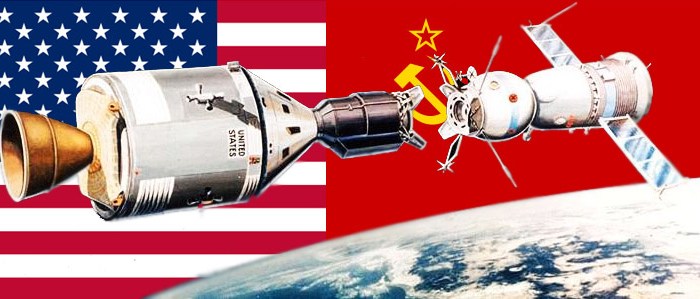
Episode 86 of SfS – The Space Race – is now Live!

Episode 86 of SfS – The Space Race – is now Live!

Welcome back! This week’s episode is all about the origins and evolution of the American and Soviet space programs—in other words, the Space Race! As I mentioned in previous episodes, these programs began as an effort to research rocket technology to deliver nuclear warheads. However, a parallel struggle began as both the U.S. and the Soviets realized the benefits of reaching space. Considering the atmosphere of the Cold War, which was as much about ideology as it was about weapons, they also considered it a matter of national prestige to “get their first!”

The Soviets achieved an early lead, sending the first satellite to space (Sputnik-1) in 1958. They also got their first with the first man to space in 1963 (Gagarin) and the first woman to space in 1964 (Valentina Tereshkova) with the Vostok Program. NASA caught up with the Mercury program, which sent the first American astronauts to space (the Mercury Seven), but the Soviets were still maintaining an early lead. That would change as NASA launched the Gemini program, demonstrating that they could spend extended periods there.

The stage was set for the Apollo Program, which would decide the Space Race once and for all and forever alter the course of history. Of course, that epic story has to wait for Part II of the episode, coming soon!

Where to Listen:

Episode 80 of SfS – Indigenous Astronomy: The Aztecs – is now Live!

Episode 80 of SfS – Indigenous Astronomy: The Aztecs – is now Live!

In this week’s episode, I returned to the ongoing series on Indigenous Astronomy with a look at the Aztec Empire and its traditions. Like all Mesoamerican cultures, the Aztecs had a rich astronomical and cosmological tradition that was as complex as anything created by the Babylonians, Greeks, Indians, Chinese, and others. In fact, their traditions demonstrate the type of universality that observations of the heavens inspire.

To the Aztecs, the movements of the Sun, the Moon, and the visible planets were seen as evidence of a cosmic order. Every activity they performed during the year was dictated by this order and even influenced their urban planning. In addition, they followed two calendars: a 365-day solar calendar (xiuhpōhualli) and a 260-day ritual calendar (tōnalpōhualli). Every 52 years, these calendars would coincide, which was seen as the end of a historical cycle.

What is also very interesting is the number of ignorant misconceptions about the Aztecs that have endured until this day. These include but are not limited to the belief that the Aztecs were an illiterate culture, that they lacked the wheel, and that they engaged in ritual cannibalism. This last myth has been especially hard to shake and seems to have been assumed about many Indigenous cultures all across the Americas – including the Anasazi, Inca, and most cultures in North America.

In any case, I hope this episode proves enlightening to all who hear it and inspires them as it inspired me while researching and recording it. Check out the links below to learn more…

Where to Listen:

Episode 69 of SfS – Rendezvousing with an Interstellar Object (with Dr. Alan Stern) – is now live!

Episode 69 of SfS – Rendezvousing with an Interstellar Object (with Dr. Alan Stern) – is now live!

Hello all, it’s been a while, I know. Life has been crazy lately. Luckily, I’ve managed to find the time to podcast again. For this latest episode, I had a conversation with Dr. Alan Stern, an astrophysicist from the Southwest Research Institute (SwRI) and the Principal Investigator of NASA’s New Horizons mission. In a recent paper, Stern and his colleagues performed a concept study for an Interstellar Object Explorer (IOE), a mission that could rendezvous with interstellar objects (ISO).

In 2017, the first-ever ISO detected passed through our system – ‘Oumuamua – leaving astronomers intrigued and baffled. Based on the available data, the object defied classification, leading to some rather exotic explanations! Two years later, a second ISO (2I/Borisov) was detected, which was clearly identified as an interstellar comet. In the near future, the Vera C. Rubin Observatory will become operational and will begin detecting dozens of ISOs a year.

Hence the desire for a spacecraft that could rendezvous with the next ISO that graces us. As Stern and I discuss, an IOE mission could have profound implications for astronomy, cosmology, and astrobiology. Studying ISOs would tell us a great deal about other star systems without actually having to go there. And if just a tiny fraction of those happened to be debris from an extraterrestrial civilization, as Prof. Loeb has suggested, the implications would be astronomical (no pun!)

Check out the links below to hear the entire conversation…

Where to Listen:

“The Moonlight”: China’s Hills get the Mega-City Treatment

moonlightArtist Yang Yongliang recently unveiled a new series of picture art in the gallery at the Galerie Paris-Beijing. In The Moonlight series,  he depicts China’s rolling hills in a hyper-futuristic context. With The Moonlight series, he combines his skills in traditional Chinese artistry with a little “urban romance”, adding a sprawling, shimmering megalopolis to the traditional setting and motifs.

Having studied traditional Chinese painting and calligraphy at the Shanghai Fine Arts Institute, Yang has long shown a preference for art that juxtaposes the natural with the man-made. As you scroll through the collection, you notice close ups of the cliff-scaling domiciles, crisscrossed patterns of roads, and even what appears to be cranes standing on mountain tops.

silentvalleyAnd of course, this is just the latest in a long line of Yang’s classic-modern masterpieces. In fact, Moonlight is quite similar to his earlier piece, The Silent Valley, where we see a woman in a white silk robe looking at hills in the distance. In two pictures, we see those hills are alive with brilliant lights, a clear indication of habitation.

moonlight2And then there’s Bowl of Taipei, where the Taiwanese mega-city – situated again on mountainous terrain – is depicted as a small island contained within a bowl. Resembling a world within a world, the clouds that wrap the hillside estates and waterfalls look very much like steam wafting up from a hot bowl of noodles!

Follow the links below to take a gander at the collection. And if you should find yourself in Paris, Brussels or Beijing in the near future, the show will be running from March 14th to April 27th of this year.

Source: IO9, thiscoloassal.com