The Blue Martian Sunset

Ever since the Curiosity rover landed, NASA had been awash with new photos of the Martian landscape. Naturally, most have been black and white picks of the oxidized soil immediately around the rover’s landing area. But more have been arriving lately that show a feature unique to Mars. That feature is the Blue Sunset.

Scientists working for NASA claim that this phenomena is due to the particulate matter that is present in the Martian atmosphere. This red dust – which is composed of oxidized minerals, mainly iron – is what gives Mars its distinct color, but also provides for a fractal effect which shifts light towards the blue end of the spectrum. The same basic principle is true for sunsets seen from Earth, where our oxygen and nitrogen and ozone atmosphere causes the light to shift to the red end of the spectrum.

These patterns of Red Shift and Blue Shift are actually a very common element when it comes to astronomy. When observing galaxies in the night sky, scientists are able to tell that they are moving away because the light that they emit, and which is intercepted by our telescopes is shifted to the red end of the spectrum. Based on how much shift is occurring, scientists are bale to measure just how fast they are moving, relative to us.

When it comes time to hurl some objects into space ourselves, such as interstellar space craft, we can expect to see some of this close up. Out there, relativistic effects caused by high speeds will make the stars ahead of the ship look reddish, while stars seen to the rear will appear blue. Cool how that works huh?

To illustrate this Blue Sunset, NASA has released a compilation, time-elapse video which was taken two years ago by the Exploration Rover. It shows the sun setting in full, all the while emitting that cool, blue glow. Enjoy and stay tuned for more news on the Martian front!

Virtual Mars Rover Landing Party!

As you all may know, the Curiosity Rover is on its way to Mars and due to land in just a few days. And it just so happens that my buddy and mentor, Fraser Cain of Universe Today, is hosting a virtual party to mark the event. He and his crew will be in Pasadena for the event, surrounded by NASA officials and people in the know and conducting interviews, while the rest of us will be able to watch through live video.

This is an historic occasion and I for one feel privileged that I know someone who has inside access 😉 Below is a copy of the original invitation inviting people to come by Google+ to join in the party. It promises to be a very informative time so I highly recommend people check it out any way they can. I also included the link to the NASA simulation (the shortened one this time) which shows what the deployment of the Curiosity Rover will look like. Enjoy!

“To celebrate the landing of NASA’s Curiosity Rover – the Mars Science Laboratory – we’ll be running a special live hangout. 

In conjunction with +CosmoQuest. We’ll have all your favorite space/astronomy journalists on hand to discuss the mission in depth, and celebrate the landing live, when it happens.

Over the course of this 4-hour Google+ Hangout on Air, we’ll interview members of the Curiosity team live in the hangout, as well as other special guests from the +The Planetary Society and the +SETI Institute.

+Scott Lewis and +Amy Shira Teitel will be on location at the Jet Propulsion Laboratory to interview members of the engineering team, and show you what it’s like to be at NASA during this amazing moment.”

Astronomers Confirms The Existence of Habitable Exoplanets!

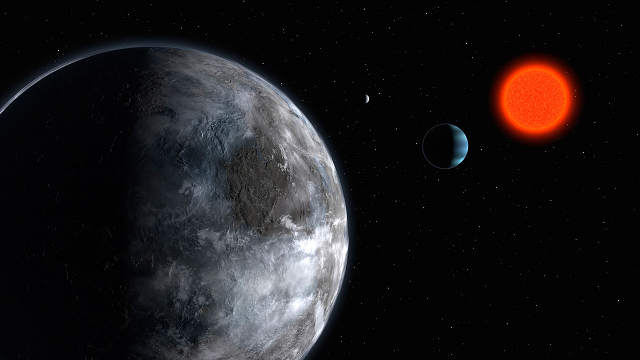
Wow! It’s fun and amazing when things line up like this. According to IO9, astronomers have confirmed that there are two exoplanets that may be habitable, which will come in handy when the human race begins looking for new planets to colonize. Officially, these planets are known as Gliese 581 g and c, which orbit a star system located roughly 20 light years from Earth.

Can you say coincidence? By now, just about everyone who reads my blog knows that myself and a group of writers are hard at work producing an anthology about the colonization of a distant world in the not-too-distant future. Well guess where it’s set? Gliese 581-freaking-g! That’s where! Yes, in the course of researching realistic locations for our story, Mr. Goran Zidar suggested we use this star system seeing as how it is known to have a system of planets.

After doing our due diligence, we learned that two planets are deemed habitable by human standards, Gliese 581 g and c. And of the two, g is the prime candidate for settlement, being the closest in mass, surface temperature and gravity to Earth. Yes, with a little terraforming, this planet could be hosting a settled population withing a few generations.

I love it when fiction and real life come together like this! Granted, this “news” isn’t exactly new. In fact, Gliese has been in on astronomers radar for quite some time, and has been dubbed “Zarmina” by scientists. But it’s new to us. And frankly, I like our choice of name better. Yeah, Yuva sounds so much more palatable than Zarmina, doesn’t it? I think so…

Upcoming Mars Landing

I recently came across this story on CBC’s Quirks and Quarks, a science show dealing with all things science and tech related. Somehow, with the recent passing of Bradbury, Canada’s 145th birthday, and my obsession with colonization, this story just spoke to me on so many levels. For those who’ve been monitoring the news or NASA’s regular updates on their website, the Curiosity rover is on its way to Mars and is schedules to land on August 5th.This Martian rover is slated to roam the surface for years, looking for signs of life. And it just so happens that this vehicle carries a special Canadian instrument.

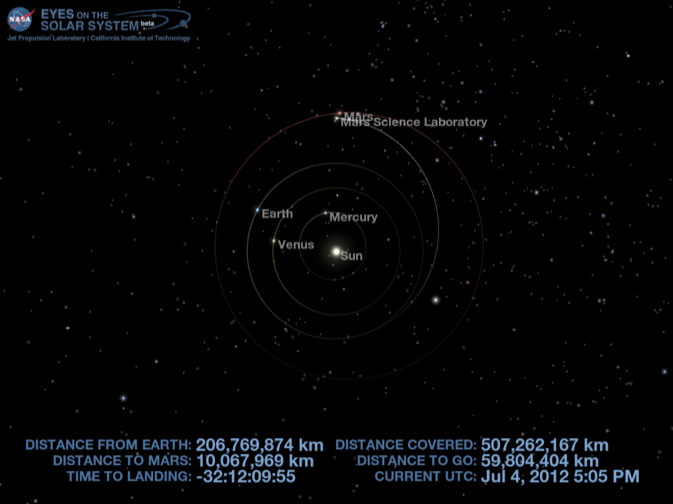
Curiosity’s position and distance to Mars as of July 4th, 2012 (NASA)

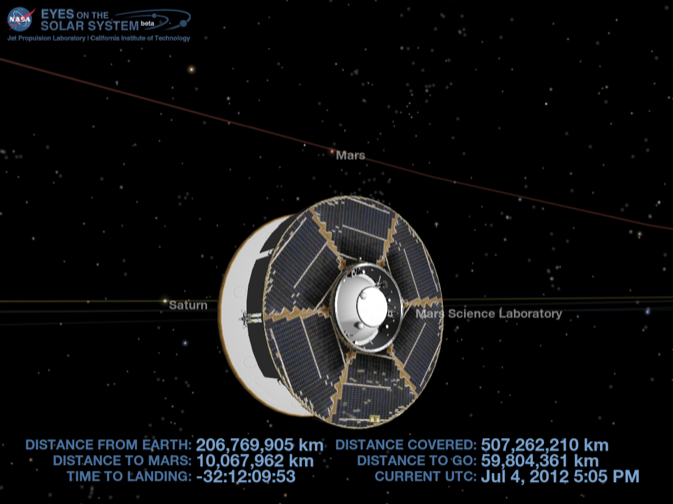
The Curiosity spacecraft, artists rendition (NASA)

Once it arrives, the Curiosity, the largest rover ever sent to Mars, will execute the most complicated powered landing, in the roughest area, that a robotic lander has ever attempted on Mars. The landing site is the Gale Crater, 155 kilometres across, with a mountain rising 5 km from its centre. Curiosity is aiming for a pinpoint landing on the crater floor, right at the base of the mountain. Once there, it will begin by exploring the lower slopes of the mountain (named Mt. Sharp after a NASA geologist) and spend the next two years looking for signs of ancient water activity and possible Martian life.

The Gale Crater, the landing point indicated with a black oval (NASA)

Here’s where the Canadian technology comes in. In the course of conducting its analyses of the surface, one of the instruments that it will use is a an Alpha Particle X-Ray Spectrometer. This device was built by a team of scientists at the University of Guelph, Ontario, with Dr.Ralf Gellert acting as the principle investigator. With the help of this an other instruments and on-board mini-laboratory, the Curiosity will analyze soil samples to look for chemical signatures of past or present life.

As many people know, this elusive search has been ongoing, ever since astronomers first looked at Mars through telescopes and thought they saw artificial canals. Those hopes were quickly dashed when more detailed analyses indicated that the planet was sterile and the atmosphere too thin to support life as we know it. But once rovers began to be sent and soil samples examined, the hope of finding life once again became a matter of hard science. Though there might not be little green men dwelling on the surface, or in underground facilities, life of a sort does appear to exist within the Red Planet’s oxidized soil.

On top of all that, this information will prove useful in helping scientists to determine whether or not Mars could be terraformed to suit human needs. If that should prove to be the case, then Mars may very well become our home away from home in the not too distant future. Bradbury certainly thought as much, and look how popular he became 😉

The landing, and results it produces over the next two years, are sure to be exciting! In the meantime, check out this computer-simulation of Curiosity’s landing, as produced by NASA:

Once in a lifetime view of Venus

There are stellar events which take place once in a lifetime. The arrival of Haley’s Comet, the alignment of three or more planets, and as of yesterday, the passage of Venus across the face of the Sun. According to astronomers, this event will not happen for another 105 years. So for those of us who lucky enough to see it, this really is a once in a lifetime event

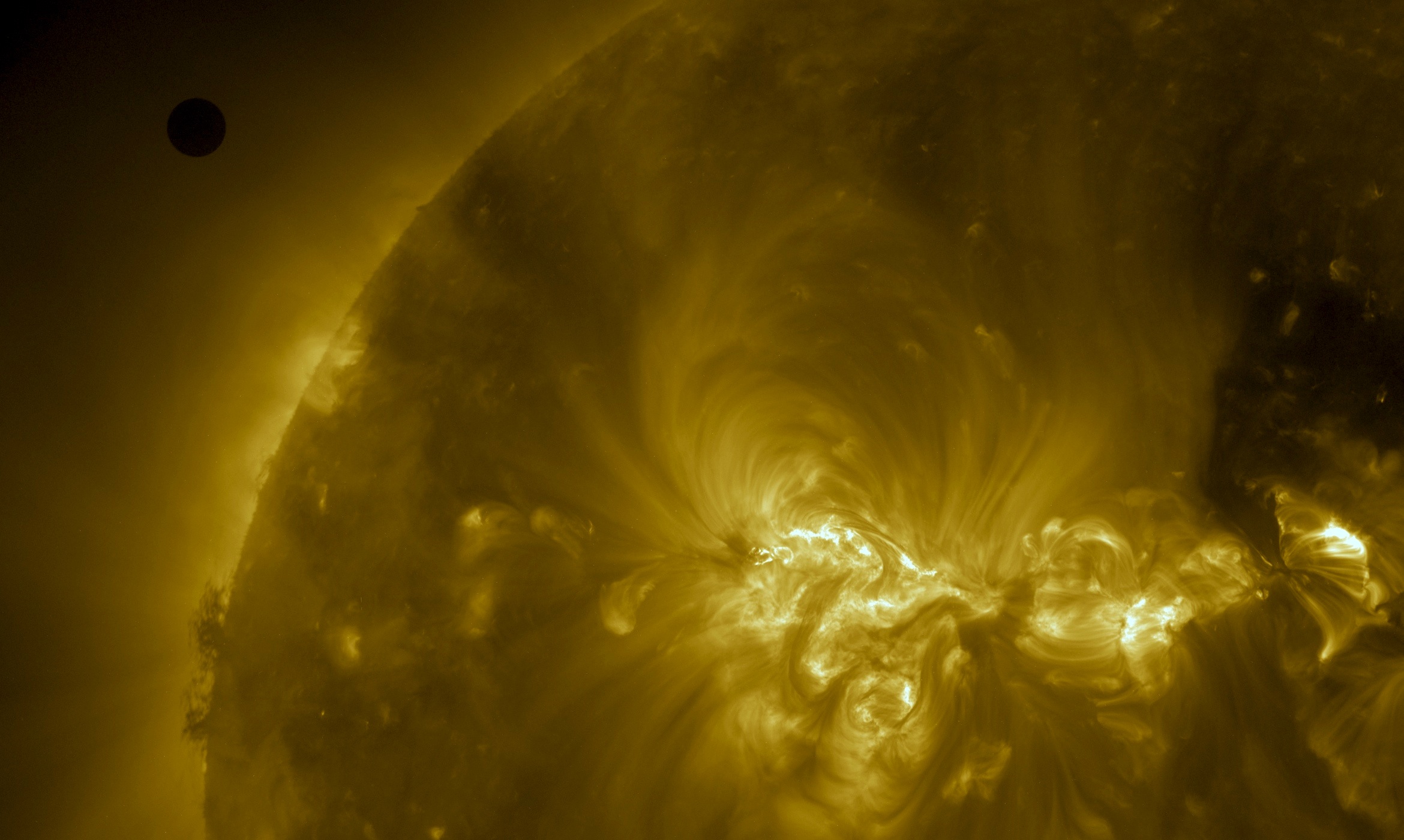
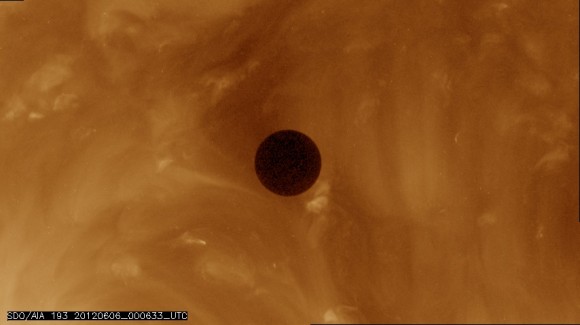
News of this has junior astronomers scrambling to get a glimpse, and the web is already buzzing from the first photos to be uploaded. The one featured at top comes from the orbiting satellite known as the Solar Dynamics Observatory, courtesy of NASA, and is the first views of Venus passing in front of the Sun’s Corona. The second, featured below, is from the same satellite and is a close up of the planet as it begins to move across the face of the sun.

But by far the most impressive images come from NASA live’s feed which captured Venus’ early passage from the depths of space into the Sun’s corona. Captured with a AIA 171 wavelength channel (that’s 171 angstrom, extreme ultraviolet) one thing which really stands out are the coronal loops. These are the extended arcs which reach up from the surface of the Sun, where plasma moves along magnetic field lines. The brightest visible spots are the locations where the magnetic field s exceptionally strong near the surface.

This second video comes from NASA’s ESA SOHO spacecraft, which tracked the planets approach before SDO took over and began tracking it across the Sun. Images and feeds are still coming in and can be expected to do for some time. For those people in Hawaii, Alaska and South Korea, the view of the passage is expected to be ideal since it will coincide with their daylight hours. Those of us on this side of the world will just have to be content with what we can catch! I recommend everyone get out back with some protective eyewear – don’t stare directly into the Sun! – and see what they can see. Once in a lifetime people!

The Annular Eclipse!

I was so sad to learn I had missed it. But there’s been no shortage of people across the planet who not only witnessed it but managed to capture the whole thing on video. And here is one of the better videos of this recurring, but no less spectacular, celestial event. Compiled by Astrophotographer Ted Judah, the video shows his views of the May 20th, 2012 annular solar eclipse from Sundial Bridge in Redding, California.

Not only was he able to shoot the whole thing for a retrospective, the guy was also kind enough to let passersby use his telescope so he could share his love of astronomy with them. And the production value of the video itself is really awesome and includes music, fast-framing, and several views of the eclipse as it happened. But don’t take my word for it, check it out!

Universe Today

Hey all. Just wanted to take a minute to publicize a very cool website that deals in all things science, especially astronomy, physics, and the planets. Not only is it a very cool place to pick up some additional knowledge, its also my part-time employer. If you’ve any interest in reading a brief but educational article on a wide range of subjects, just enter my name “Matt Williams” or click around. You’re sure to find something that tickles your fancy!

Universe Today