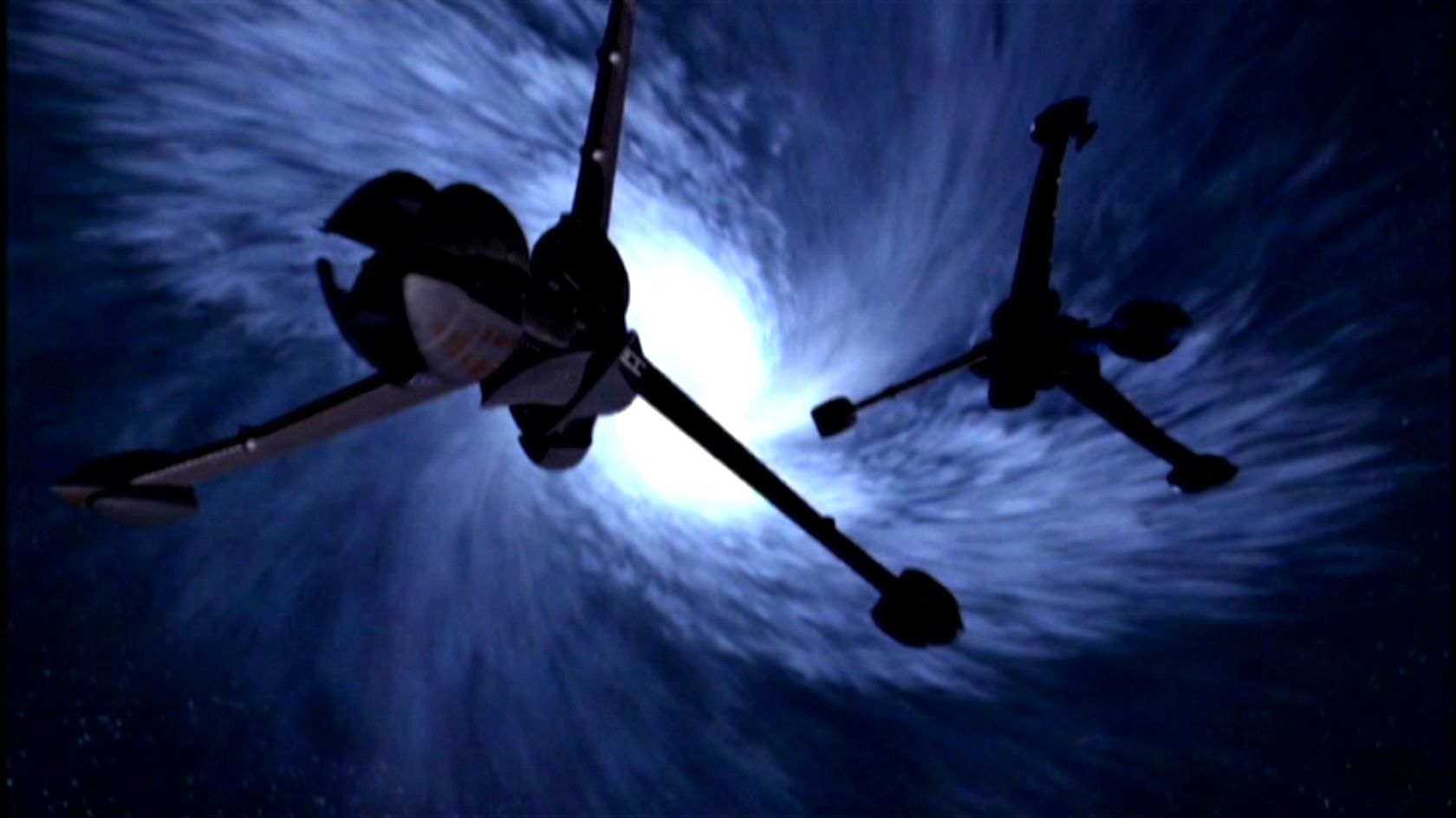
Even More Cool Ships!

Dang it, this is fast growing into a theme of its own, outgrowing the whole “conceptual” thing by leaps and bounds! But there are always more contenders, and people have been nice enough to leave suggestions with me. So the list must go on, taking into account more spaceships, aircraft an assorted vehicles that come to us from a variety of franchises. Some are fast, some are scary, some are just really, really neat to look at! But they all have one thing in common, they are all cool!

Here’s the latest, as assembled by me and with the help of some helpful suggestions!

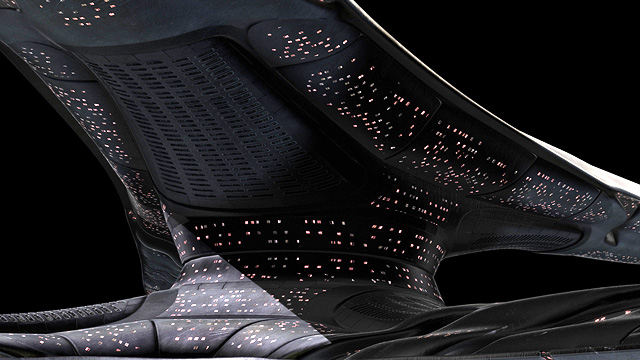
Cylon Base Ship:
cylon_basestarIn my first post, I mentioned the Galactica and how it had evolved from its original self to become the aged but enduring vessel that we saw in the new series. Well, when it came to the Cylons, the artists seemed to go in the opposite direction. Rather than making the Cylon Base Ships less advanced-looking, they opted instead for designs that looked sleeker, updated and more organic.

This was in keeping with the updated concept of the Cylon race. Whereas in the original series, the Cylons were slow, lumbering robots who simply followed orders and sounded very machine-like, the new Cylons were fully organic beings that could easily pass for humans.

The Centurions, much like their predecessors, remained loyal robots, but were also a hell of lot more streamlined and dynamic in appearance. The Base Stars were said to be constructed out of a cartilage-like material that was soft and organic, but became solid and super-tensile once it hardened. And of course, the Cylon Raiders were themselves equipped with organic parts, living brain tissue inside a metal hull.

Of course, the new Base Ships were downgraded in one respect. Much like the Galactica, the new designers decided to forgo the idea of lasers for something a little more realistic. In the case of the Cylons, this meant missiles instead of flak guns and cannons. However, everything else was significantly more advanced than the original, including the appearance and the scientific foundation on which it rested. Basically, the new Base Ships looked organic because they were organic. Instead of being built in a shipyard, they were grown in them. That’s some advanced shit right there!

All of this were quite ingeniously attributed to technological evolution. The old Base Star and Centurion designs were said to have been what the Cylons looked like during the previous war. Toasters was the term used to describe them, given their chrome exteriors and campy-retro look. Their new designs were the result of over twenty years of progress, going from constructions of metal and silicate materials to biometric tissue which was grown in vats. A very cool concept, and in keeping with the latest updates in the fields of science and science fiction 😉

The Discovery:

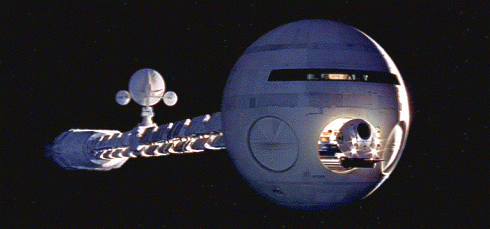
Discovery, front view

Cue classical music soundtrack! The Discovery is sailing by… in excruciatingly slow motion! Yes, I’m sure I speak for all those who have seen 2001: A Space Odyssey when I say that the story was brilliant, the cinematography superb, but dammit, did they have to do so many long, drawn out space sequences? Well, as someone very wise said, this movie was made back when people still had attention spans!

But on the plus side, the long sequences allowed audiences to truly appreciate the design and concept of this ship, and many others in the film. In what can only be described as a caterpillar (or ball and chain) type design, the Discovery was originally designed for cargo hauling, but was converted to deep-space exploration when Earth scientists needed to mount a manned mission to Jupiter in a hurry.

One can see without much effort how these concepts overlapped in the design. Being made up of many segments, the spine of the ship was clearly designed to hold detachable cargo pods, whereas the crew and navigation team would hold up in the spherical section at the front. Once converted, this frontal section was given pod-bay doors, a compliment of small explorer craft, and a large scanner array mounted along the dorsal section. The engine compartment at the rear was built for heavy thrust, alluding to the fact that this craft was intended for deep-space missions.

rear view

In addition to all that, the ship came equipped with vast stores of food, cryogenic pods, and an onboard AI known as the HAL 9000. During the better part of its deep space missions, the crew would be kept in cryogenic suspension, HAL would pilot the ship, and they would be thawed once it came close to its destination, or in case an emergency situation arose. Also, its contained rotating sections which would become active once the crew was in a waking state, ensuring that they didn’t succumb to muscular atrophy due to weightlesssness.

Simple, straightforward and technically practical, The Discovery was everything one would expect from the future of space travel, at least from a 1960’s standpoint. And granted, we weren’t exactly building ships like this when 2001 rolled around. But we weren’t exactly fighting the Cold War or discovering aliens on the Moon either. In either case, you’d be hard-pressed to find hard sci-fi like this anywhere today. RIP Arthur C. Clarke. You too, Kubrick! You’re genius is sorely missed!

Draconia 1:
Credit for this one goes to Victor of Victor’s Movie Reviews. Initially, I was hesitant when he suggested I post something from the Buck Roger’s universe, but quickly changed my mind when I saw it. Thanks for the suggestion and the links man! Enjoy this one!

Just to be clear, I got nothing against Buck Rogers, I’m just relatively ignorant about the franchise. And after combing through a couple databases, I’m still pretty ignorant. Whereas I thought this was just a popular movie and tv series from the 80’s, I’ve since learned that its roots go way deeper than all that! Originally, Buck Rogers was a novella named Armaggedon 2419, a dystopian story that appeared in an issue of Amazing Stories in 1928. Since that time, the story has been adapted to comic books, radio, television, and with the success of Star Wars and Battlestar Galactica in the late 70’s and early 80’s, a feature film and a TV spinoff.

Known more popularly as “Buck Rogers in the 25th Century”, it is from this point in the series that this megalithic ship known as a Draconian battleship comes to us. Named in honor of the empire that built it, Draconia 1 was the flagship of the Draconian armada and the flagship of the franchise’s chief protagonist, Princess Ardala. , to conquer Earth and make Buck Rogers her consort. And given its size and imposing nature, I’d say the artists captured these intentions quite perfectly. With a name like Draconi 1, you gotta figure the ship is going to look stern, sharp, and geared up for war!

Earth Force Thunderbolt:
ThunderboltAnother happy contribution from the Babylon 5 universe! An upgraded model that was meant to replace the older Starfury-class fighter, Thunderbolts were two-person aerospace fighters that were had boasted extra firepower, better navigation, updated systems, and the ability to navigate inside atmospheres. Yes, unlike the earlier models, these things could operate in space and in the air.

This was made possible by the addition of extendable airfoils which were attached to the ship’s four engine mounts. In addition, the hard mounts on these wings were capable of holding up to ten missiles. These, combined with its four uni-directional pulse cannons, gave it a serious firepower advantage over its predecessor!

Making their debut in the second season of the show,  the Thunderbolt would play a pivotal role in the Earth Alliance civil war, which broke out shortly thereafter. Thanks to a shipment that arrived on the station before B5 declared its independence, and the addition of several squadrons of defectors from the Earth Force destroyers Alexander and Churchill, Sheridan and his forces were not at a disadvantage when President Clarke’s forces came knocking!

According to the B5 Wiki, the Thunderbolt represented the third incarnation in the Starfury series. In terms of design, they were clearly inspired by their namesake, the P-47, and other WWII aircraft like the P-51 Mustang. In addition, inspiration was probably owed to the F4 Phantom of the Vietnam Era, which also boasted a two-seat configuration and also had the same mouth and bared teeth design on the front. A good thing too, for credit should always be given to the classics!

The Eclipse:
What could be more terrifying than a Super Star Destroyer? THIS, that’s what! And like a Super Star Destroyer, it comes to us from the expanded Star Wars universe. Known as the Eclipse, and taken from the Star Wars: Dark Empire comic series, this vessel was the latest incarnation of Imperial terror technology at its best (or worst)! Originally intended as the resurrected Emperor’s new flagship, the Eclipse II quickly became the symbol of resurrected Imperial might in the comic series, dwarfing even the Executor and all other classes of Super Star Destroyer that preceded her.

Little wonder then why they called it the Eclipse. Park it in orbit over a planet, and boom! Lights out! And much like the Death Stars and Executor-class Super Star Destroyers that preceded her, the Eclipse was nothing short of a vanity project by Emperor Palpatine, its size and awesome power reflecting his megalomania and maniacal ambitions. But regardless of how overcompensating it seemed, this ship was still a behemoth and a real slugger when it came to firepower!

Measuring 17.5 km in length, the Eclipse was absolutely fearsome in terms of its overall displacement, tonnage, and raw firepower. In addition to over 1000 turbolasers, laser cannons, and ion cannons, the ship also came equipped with a superlaser that was mounted on its prow. In essence, this ship was like a mobile Death Star, capable of destroying an entire planet as well as an enemy’s armada. On top of all that, it also came equipped with 50 squadrons of TIE fighters and bombers, 100 tractor beams (the better to capture you with!), and its own gravity-well generators.

These last items are devices which appear quite frequently in the expanded SW universe, usually on Interdictor-class Star Destroyers. Basically, they allow a ship to generate a gravitational field which, when activated, prevents an enemy from jumping to hyperspace. So in addition to being impregnable, this ship could also prevent enemies from withdrawing from a battle. Hmmm, can’t beat her, can’t run away. Not exactly built for a fair fight, was she? But much like her terrifying predecessor, she was eventually destroyed in circumstances which couldn’t help but be embarrassing. I guess the old adages are true: the bigger they are…  etc, and pride cometh before a fall! Or in this case, a really big explosion!

The Nebuchadnezzar:

picture by Aquatium at deviantArt

Now here’s a franchise that hasn’t made the list yet. Taken from the Matrix franchise, the Nebuchadnezzar is a hovercraft and, along with others like her, the primary means of transportation and resistance for the people of Zion. Named after the (in)famous Babylonian Emperor who conquered the Levant, this ship made its first appearance towards the end of Act I, right after Neo was unplugged and had to be rescued.

According to Morpheus, her Captain, the ship is their means for reaching “broadcast depth” in the underground tunnels and hack into the Matrix. Beyond this basic role, it is also a primary defender whenever the sentinels begin to venture too close to Zion. In the first movie, its only means of defense was its EMP. However, in the second and third movie, it was upgraded to include defensive gun turrets.

The second and third movie also introduced many other versions of this hovercraft. Apparently, every ship is unique, each one boasting its own structure, profile, and size; variations on a theme rather than based on a standardized model. Clearly, nobody is Zion believes in assembly lines, at least not where their ships are concerned!

SA-43 Hammerhead:
HammerheadTaken from Space: Above and Beyond, the Hammerhead is an aerospace fighter and the mainstay of the future US Navy and Marine Corps. Named because of its configuration, front and back, this ship is not only cool to look at, but is quite practical from a hard science standpoint.

For example, the front and rear wings are not strictly for artistic purposes. In addition to serving as weapon’s mounts, they are the platform for the ship’s many retro-rockets. In the course of the show’s many action sequences, you always see these ships moving about as if they are truly operating in vacuum. In other words, they don’t swoop around like regular jets or have to roll to turn around. In space, all you got to do is fire your lateral rockets and let your axis spin around!

In terms of armaments, the Hammerhead packs a rather impressive array. A forward mounted laser turret is supplemented by a dual one mounted at the rear, giving the ship a near-360 degree range of fire. It also has hard mounts under its wings for missiles, bombs and rockets. These come in handy when facing down multiple squadrons of smaller, faster, but less heavily armed Chig fighters.

The Excalibur:
excalibur_2Back to the B5 universe yet again! Don’t blame me, they make a lot of cool ships. Anyhoo, this time around, the ship in question is the prototype White Star Destroyer The Excalibur. Designed to be a bigger, heavier version of its predecessor, the Excalibur was similarly based on Vorlon and Mimbari technology, incorporating organic hulls and Mimbari energy weapons.

A joint venture between the Earth Alliance and Mimbari governments, the interior of The Excalibur resembles that of most Earth Force ships. It’s controls are human-friendly, making it a quick study for crews who are used to serving on Earth Force vessels. This came in handy on its maiden voyage, when Sheridan and a crew of EF personnel were forced to commandeer it and its sister ship, The Victory.

It’s weapon consisted of multiple turret mounted beam cannons mounted all over the hull, but concentrated near the front and rear. On top of that, it also boasted a massive energy cannon similar to the kinds found on Vorlon warships. Unfortunately, this weapon was such a drain on the ships power that it could only be fire once in any battle, since its use would result in a systems blackout that could last several minutes. In addition, its ample bays could hold multiple squadrons of Starfuries and Thunderbolts, which were deployed by a pylon that extended from the hull.

In addition to playing a key role in defeating the Drakh, The Excalibur and its crew were also tasked with finding a cure for the plague they viciously unleashed on Earth. Though this spinoff series (Crusade) was cancelled partway through its first season, sources from the expanded universe indicate that it was eventually successful. So in addition to being able to kick some serious ass, this ship was also a capable exploration vessel and a mobile research station.

Spaceball One:
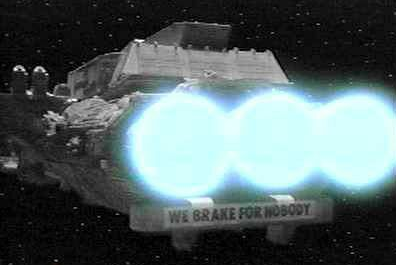
spaceballs6ts4uwDespite odd name and it’s whacky nature, Spaceball One is actually a pretty cool ship! In addition to being able to exceed the speed of light and go both “Ridiculous Speed” and “Ludicrous Speed”, the ship is capable of converting into a giant, robotic maid which, when armed with its megavac, is capable of sucking up an entire planet’s atmosphere. Tell me that aint a terror weapon!

A parody on the Star Destroyers from the very movie it was meant to parody, the design elements of this ship also seemed to pay homage to a few other unlikely sources. One suggested influence is The Discovery from 2001: A Space Odyssey, while another is the Nostromo from Alien. Given the comedic references to both these movies – the alien bursting out of a guy’s chest and performing a little ditty over lunch, or the “plaid” scene in space – this shouldn’t come as a surprise.

Thanks to Rami Ungar for (repeatedly) suggesting this one. We consider the matter closed, please stop sending hate mail! I kid of course, keep sending it! We like to hear from you ;)!

UD4L Cheyenne Dropship:
DropShipLast time, it was the USS Sulaco that made the list as a example of a cool ship from the Alien universe. This time around, I thought I’d look a little closer, specifically to its cargo bays. Because it is here that we find those cool Cheyenne-class dropships, the ones that carry Marines, APC’s, and a f***load of munitions to their targets.

Capable of atmospheric and space flight, the dropships are typically deployed from high orbit and extend their wings once they hit the atmosphere in order to maintain lift.The Cheyenne serves primarily as a troop transport, a role it is well suited for since it can take off and land vertically from unprepared areas.

However, it’s nose mounted gatling gun, weapons pods and large compliment of rockets also mean it can attack in a supporting role, namely as a gunship. Once its deployed its compliment of Marines, typically inside of an M579 Armored Personnel Carrier, it will retire to a safe landing zone or offer active support until all enemies in the area have been suppressed.

X-wing:
X-wing_SWGTCG“The Incom T-65 X-wing is the fighter that killed the Death Star. An almost perfect balance of speed, maneuverability, and defensive shielding make it the fighter of choice for Rogue Squadron.” This is how General Carlist Rieekan described the final entry on my list, the venerable X-wing starfighter!

Based on captured designs and built by specialists who defected to the Alliance, the X-wing played a pivotal role in the Galactic Civil War and would form the backbone of the Alliance’s Starfighter Corps. Possessing deflector shields, a hyperdrive, an R2 astromech for repairs and navigation, and a complement of proton torpedoes, the X-wing allowed the Rebellion to launch raids deep into Imperial space and stand toe to toe with its TIE fighter squadrons.

In addition to providing escort to Alliance vessels and conducting raids on Imperial ships and installations, its long list of accomplishments include destroying the first Death Star, proving cover for escaping Alliance ships after the Battle of Yavin and at the Battle of Hoth, and defeating overwhelming Imperial forces at the Battle of Endor. After the formation of the New Republic, the X-wing would go on to play a pivotal role in many subsequent battles and engagements, mainly against the remnants of the Empire.

Featured heavily in the original movies, the X-wing would also go on to become the only Star Wars fighter to get a videogame named after it! Not bad for the little “snub fighter” that could!

Final Thoughts:
And wouldn’t you know it, it seems I have actually have some insight to offer today. Must be on a count of how many ships I’ve reviewed by now. For starters, I think that while aesthetics and artistry count for a lot, some serious props need to be given for a hard sci-fi foundation. Ships that incorporate realistic features, like retro-rocket mounts, wings that only deploy if you’re expecting atmosphere, and practical hull designs, are usually what make the biggest impact. Not that we don’t all love freaky looking spacecraft, it’s just that dropships, hammerheads and starfuries seem somewhat more plausible than saucer sections and mega-dreadnoughts.

At the same time, its fast becoming clear to me that when it comes to designing cool sci-fi ship concepts, the only limits are those imposed by our own imaginations. Really, there are no rules or strictures when your painting with an open canvass, and sci-fi has always been the perfect forum for venturing into the realm of the implausible and impossible. And given the exponential rate at which technology is progressing, dreaming big doesn’t exactly seem unrealistic anymore. If anything, our dreams seem to be coming true faster than we could have imagined. So really, with the possible exception of FTL, nothing we can imagine right now should seem too farfetched. If anything, we should encourage dreamers to dream!

Until next time, and keep those suggestions coming! And maybe come up with some original designs, I’m feeling in the mood for evaluating something new and inspired here 😉

More Cool Ships

And I’m back with more examples, in part because people had some suggestions but also because I found the last list lacking. I mean, you can’t suggest a concept as big and as awesome as cool science fiction ships and only provide a handful of examples. It’s just not decent! So here’s installment number two in the series, cool ships from various sci-fi franchises and what made them so. Keep in mind that suggestions are always welcome. I’m thinking a third and even fourth list might be necessary 🙂

Alliance Cruiser:
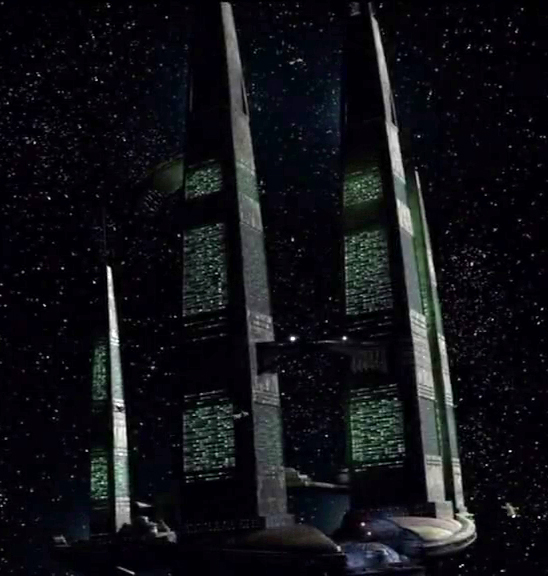
alliance_2Back to the universe of Firefly for another installment! This time around, it’s the Alliance Cruiser that I’ve chosen to talk about. In short, I think the design of this particular ship is quite inspiring. Unlike your average cruisers from other franchises, this ship is not based on the usual seafaring or aerodynamic-ship paradigm. It’s long axis is vertical rather than horizontal, making it a platform instead of a cutter.

In addition to making a lot more sense from a physics standpoint, this design offers many advantages in terms of navigation and defense. Unlike longitudinal designs which are forced to turn around on their long axis, this ship can simply fire thrust from any of its four sides to change course and direction. It’s tall appendages also make it easier for sensors or long-range telescopes to spot things out in space, no blindsides from which to approach on.

Basically, ships like these remind us that spaceships operate in vacuum and are therefore subject to a vastly different set of physical requirements. Since they do not operate in atmospheres, they don’t need to be aerodynamic or sleek like planes. And since they don’t cut across water, they don’t need to have sculpted hulls or prows to part the waves. So why then do a whole slew of spaceships look like aeroplanes or boats?

Simple, it’s a paradigm thing. When we hear ship, we automatically think of airships and seaships since that’s our frame of reference, and our artistic sensibilities naturally follow. But spaceships are a whole ‘nuther ballgame, requiring the ability to withstand inertial pressures instead of drag. So while sleek and streamlined models are cool to look at, they aren’t really the best spaceship design from a technical standpoint.

And in a lot of ways, the Alliance cruiser reminds me of another classic design, that of the Nostromo. Much like the mining vessel from the original Alien movie, it is vertical in design, boasting towers instead of horizontal compartments. It’s size and towering appearance also make it intimidating to behold, illustrating the power and imposing nature of the Alliance itself. Those who crew it tend to be pretty imposing as well, always boarding you and asking question!

Borg Cube:
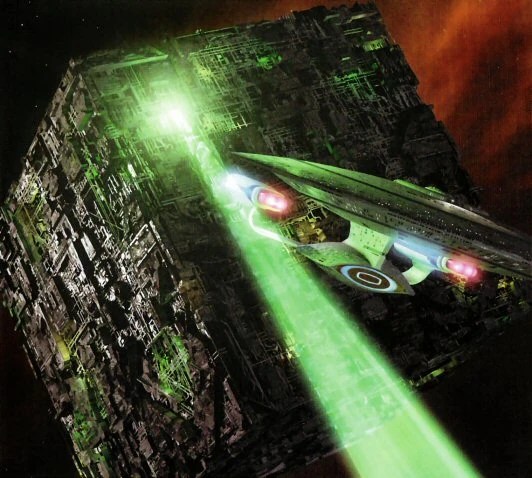
https://i0.wp.com/img2.wikia.nocookie.net/__cb20060721051747/startrek/images/7/76/Borg_cube.jpgHere we have the capital ship of the Borg, the frightening cyborg race from the Star Trek: TNG series that assimilates or crushes everything in its path. Introduced in the second season of the show (episode 42: “Q Who”), this fearsome foe went on to become a recurring element of the show and was even central to the plot of the spinoff Voyager and the movie First Contact. Much like their raison-d’etre, their ships reflected a sort of cold technological rationalism, like something out of a cyberpunk fans wet dream!

The design of the basic cube, which was later supplemented by spheres and upgraded cube designs, is clearly based on a pythagoran aesthetic: nothing frilly, sleek, aerodynamic or even remotely artistic about it. They are simple, utilitarian, and equilateral, a testament to the precise and unsentimental mindset of those who designed it. It’s basic profile also came in handy when taking on multiple enemy ships. By having six sides, each with the same surface area, weapons and tractor beam mounts, the cube had a 360 degree sphere of defense, making it damn near impregnable.

On every occasion when one of these cubes showed up, bad things were known to happen! In their first encounter with one, the Enterprise barely got out in one piece. In the second, 39 ships were destroyed before the Enterprise and her crew were able to trick one into going into sleep mode, which it then responded to by blowing itself up! In the third encounter, which took place in First Contact, several more federation ships were destroyed before Captain Picard was able to use his inside knowledge of the Borg to help the fleet destroy another ship. In all subsequent encounters, future technologies, viruses, trickery, or a combination thereof were needed to overcome the Borg’s technology and singular mindset.

Chig Cruiser:
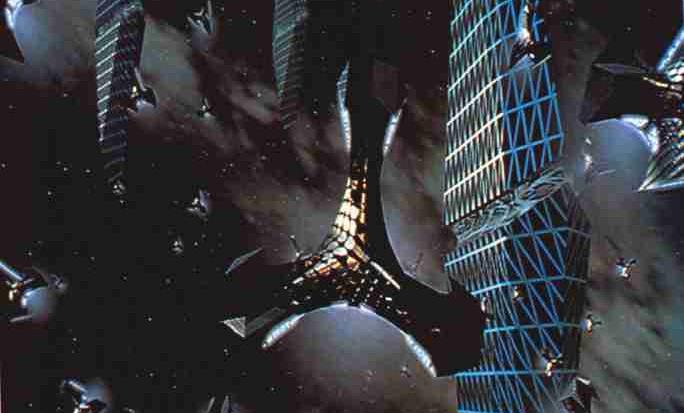
chigMuch like Firefly, this example comes to us from a franchise which was cancelled by the executives over at Fox after its first season. Yes, Space Above and Beyond was yet another sci-fi series which had a lot of promise, but got axed when the execs concluded it wasn’t doing well enough for their liking. What the hell goes on over at Fox anyway?! Does every new show get this kind of treatment, or do Rupert Murdoch’s minions think sci-fi is just inherently liberal?

In any case, the Chig Cruiser was much like the concept for the Chigs themselves. Cool, original, and quite alien in appearance! Basically, the vessels shape can be described as two right triangles attached end to end with the tips removed. The command center appeared to be located in the middle, along with much of its weapons and observation deck. The outer hulls also appear to have been constructed out of the triangular-shaped panels of some alien metal that gave of a peculiar sheen when seen from the right angle.

Like everything else in the series, the concept never really had time to be fully developed. Which is really too bad. Their fighters, encounter suits, and capital ships were all cool to look at, and some explanations as to their utility and even artistic inspirations would have been nice. But what can do? Fox is run by idiots! Rest in peace Space Above and Beyond! You died too young!

Earth Alliance Destroyer:
Thanks to Goran Zidar for suggesting I include this one! And please know that you are alone in thinking that it is cool to behold, Mr. Z 😉 Coming to you from the Babylon 5 universe, source of so many cool ships (see below), the concept for the Earth Alliance Destroyer was nothing short of pragmatic genius. Given that the show boasted dozens of alien races, J.M. Straczynski and his design teams had to come up with countless design concepts that would reflect the multicultural and multiracial tone of the show.

In the case of humanity, Straczynski and his people concluded that the spaceships should look boxy, utilitarian, and should reflect the fact that Earth was one of the less advanced races in the story. As a result, the Earth Alliance Destroyer was built around the concept of a compartmentalized hull with its engines at the rear, a central rotating section (to provide artificial gravity), and a forward section where the bridge, carrier deck and command center would be located. And, as you can plainly see, the end result was quite cool!

While not the most advanced ship in the Galaxy, the Omega-class destroyer was certainly realistic, aesthetically pleasing, and could also holds its own in most firefight situations. And unlike their organic, alien counterparts, these ships were also a lot cooler to watch in battle. Instead of “dying” or breaking apart, they would catch fire and throw off flaming debris, not to mention life pods and floating bodies. Yes, since ships didn’t have energy shields or a lot in the way of armor in the B5 universe, firefights tended to get real serious, real fast! Like I said… realistic!

The Daedalus:
daedalusNext up, and taken from the Stargate universe, is the battlecruiser Daedalus. After appearing in the spinoff show Stargate: Atlantis, this class of vessel (codenamed 304) became the basis for an entire fleet of vessels who’s purpose was to defend Earth from an alien invasion. Based on various alien technologies that were taken from the Goa’uld and Asgard, the Daedalus was the first Earth Battlecruiser and FTL ship ever constructed.

Based on the design of a modern aircraft carrier, the Daedalus bridge and command center were located along the top of the hull at the rear while the forward section contained the ships compliment of fighters and takeoff and landing bays. The ship also contained a hyperdrive which was powered by a Zero Point Module (an alien power source), giving it FTL capabilities.

In terms of armaments and advanced technology, the ship boasted beaming units, shields, multiple rail gun and missile systems, and a compliment of nuclear warheads. Designed to stand up to a potential Gua’old or Or’i invasion, the Daedalus and her kind were built to combine the best that Earth and her alien allies could offer. Yes, if the war came to Earth, we would be ready!

The Executor:
Hello terror! Next up, we have the gargantuan and terrifying Imperial command ship known as The Executor. Who among us can forget that introductory scene in The Empire Strikes Back when a whole fleet of massive Star Destroyers were assembling, only to be suddenly overshadowed by the even larger Executor? Cut to the bridge where we see the terrifying Vader looking out over the fleet, and you begin to see just how big and powerful the empire truly is! Yes, those visuals really gave a sense of size and scale to the bad guys and let us know just how much they meant business!

Commissioned roughly one year after the Battle of Yavin, where the first Death Star was destroyed, the Executor was intended to be a terror weapon, replacing the Death Star as the symbol of Imperial might and badassery! Measuring 19 kilometers in length and bristling with turbolasers, ion guns, multiple tractor beams projectors and a complement of fourteen TIE fighter/bomber squadrons, the Executor was every spacers worst nightmare! No ship in the Alliance was capable of standing toe to toe with it, making a strategic withdrawal an inevitability once it showed up in a theater of battle.

However, during the Battle of Endor, the Alliance was able to destroy it through a combination of strategy and dumb luck. After several Rebel fighters took out the Executor’s shield generators, a single fighter who lost control of his ship crashed directly into the bridge. The Executor then lost control of its helm and was pulled in by the second Death Star’s gravitational field, destroying the ship and causing extensive damage to the Death Star’s outer hull. An ironic death for such a big ship, but at least she went down in a blaze! A big, embarrassing, expensive blaze! I don’t envy the bastards who had to pay the premiums on that one!

Home One:
HomeOneAnother vessel that comes to us from the Star Wars universe, Home One was the mobile headquarters of the Rebel Fleet and the biggest Mon Calamari cruiser in existence. As Admiral Ackbar’s command vessel in the original trilogy, it distinguished itself during the Battle of Endor, during which the Executor and the second Death Star were destroyed.

Like most Mon Calamari cruisers, Home One was cylindrical in design and originally served as a star-liner that got modified for combat. This consisted of equipping it with fighter bays, multiple shield emitters, a reinforced hull, and many turbolaser mounts. It’s revolutionary targeting and computer system also gave it a decided advantage in a firefight with Imperial vessels, which boasted heavier armaments, but lacked the ability to coordinate and amass their firepower as effectively.

The largest bay on Home One was on the starboard side where larger vessels would dock. However, a total of twenty hangers were placed throughout the hull, giving it the ability to carry multiple squadrons of X-wings, A-wings, B-wings and Y-wings. It also boasted a crew of over 5000 personnel and could carry 1,200 troops and 20,000 metric tons of cargo. While most of its systems – especially targeting and navigation – were designed for Mon Calamari use, the ship was crewed by a variety of races, reflecting the multiracial nature of the Alliance.

Lexx:
lexxThough not the prettiest ship in the Galaxy, the Lexx certainly deserves a spot on the Cool Ship list. Much like the show that featured it, it was weird, conceptually skewed,  but still damn original! A planet-destroying bioship by design, the Lexx was clearly inspired by the concept of a giant, wingless dragonfly and was created out of resynthesized proteins that were obtained from confiscated organs. Hmmm, gross!

Originally intended for use by His Divine Shadow, the evil ruler of the Divine Order, the Lexx was essentially a terror weapon that would be capable of destroying whole planets. However, the ship was commandeered in the first episode by the show’s crew – consisting of anti-hero Stanley Tweedle, the sex slave Zev Bellringer, and the Kai, an undead assassin, and the bodiless AI 790 – and became the means through which they traveled the universe looking for a new home.

This journey would take them over 6000 years, since the Lexx does not have FTL capabilities, and the crew would go into cryostasis for much of the voyage. Being sentient as well as organic, the ship was required to feed from time to time in order to maintain the life force which powered it. This could involve landing on a planet and eating organic matter directly, but more often than not, required that it blow up an entire planet and eat the resulting debris afterwards.

In the latter case, this consisted of emitting massive amounts of ionized energy from its “eyes” which was then channeled into the “mouth”. This energy was then fired outward in a planar wave which would intercept and obliterate any planet in its path. The Lexx would then take in the giant rocks and debris from the explosion and feed off of all the organic matter they carried. If not permitted to feed regularly, the Lexx could apparently become quite cranky and agitated, which would prove to be hell for whoever had to interact with it!

Narn Cruiser:
narn02As promised, another cool ship from the B5 universe. And as I said earlier, when it came to producing concepts for alien ships, J.M. Straczynski really had an eye for aesthetics, art, and functionality. Whereas Earth vessels tended to be compartmentalized and practical in nature, other alien races tended to be a bit more flamboyant, a reflection of their particular cultures and levels of technology.

When it came to the Narns, an aggressive but artistic race, their ship designs exemplified this dual nature. Originally a pastoral and peaceful people, the Narns had been brutalized by generations of occupation at the hands of the Centauri and had become quite warlike as a result. Their heavy cruisers, the mainstay of their fleet, were thus powerful and fierce looking, but still managed to achieve an aesthetic quality which brought beauty into the mix.

Boasting two massive beam cannons, several pulse guns and a compliment of space mines, the Narn Heavy Cruiser could take on just about any ship in the Galaxy. Though most were destroyed in the Great War against the Centauri, the ship proved to be effective in numerous engagements, not the least of which were against the Shadows themselves. For example, at the battle of Ragesh 3, two Narn Cruisers combined their beam cannons to seriously damage a Shadow vessel. During the battle in Sector 83, when Sheridan and the White Star Fleet engaged a fleet of Shadows vessels, the Cruiser G’tok managed to assist a pair of White Stars in destroying two Shadow vessels. Quite the accomplishment for this class of vessel!

After the Great War, the Narn regime began rebuilding its fleet, and the Narn Cruiser remained the mainstay of their forces. Several were used during the Alliance war with the Centauri and participated in the assault on Centauri Prime, where its massive compliment of weapons proved quite devastating against the planet’s surface!

Prometheus-Class Assault Vessel:
PrometheusYou know, I’ve never been that big a fan of the Star Trek franchise. But even I have to admit, when these guys do something right, they really do it right! And this ship, the Prometheus Assault Vessel, would be one such example. Much like the USS Defiant from my previous list, this ship demonstrated that when required, Star Fleet could produce ships that really excelled at kicking ass and taking names!

A revolutionary prototype, the Prometheus-Class vessel appeared in a single episode of Voyager where it was being stolen by a bunch of Romulan agents. However, thanks to the combined efforts of the ship’s own holographic surgeon and Voyager’s similarly holographic doctor, the ship was saved and even managed to turn the tables on its Romulan adversaries.

Incorporating advanced phasers, quantum torpedoes, ablative armor and regenerative shields, the biggest surprise the Prometheus had was its multi-vector assault capability. This involved the separation of the ship into multiple modules, much like the USS Enterprise-D would do with its saucer and engine sections. However, in the Prometheus’ case, this resulted in the creation of three semi-independent sections which were capable of unleashing a single, coordinated attack against multiple opponents.

After it was done dispatching all its enemies, it would then come back together, perform repairs as needed, and move on to the next target. And since the ship was programmed with extensive routines, a very small crew was capable of operating it and really only had to speak the requisite commands to get it to kill, kill, kill! Not a bad ship to have in your arsenal!

Shadow Attack Ship:
shadow06“It was jet black. A shade of black so deep your eye just kinda slides off it. And it shimmered when you looked at it. A spider big as death and twice as ugly. And when it flies past, it’s like you hear a scream in your mind.” These were the words Lt. Warren Keffer used to describe a Shadow vessel, right before he died chasing one down. An apt description for a ship that was clearly designed to inspire terror in its enemies, and a reflection of the race that built it.

As my final installment, taken again from the B5 universe, I’ve decided to include the Shadow Attack Ship, which is perhaps the most original and artistic spaceship I have ever seen. Granted, it had some stiff competition given the franchise it is coming from, but in terms of its design, performance, and sheer alien appearance, I can’t think of anything that can top it.

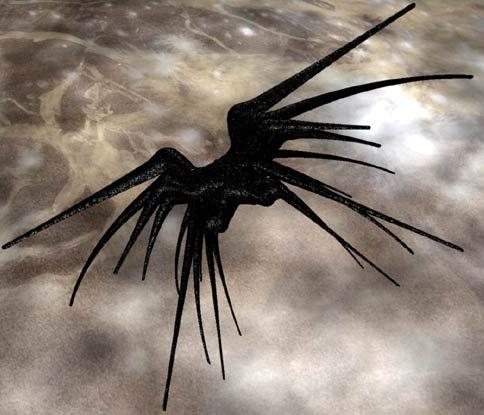
Given the fact that Straczynski and crew were working with the concept of organic technology, the ship was clearly meant to look like a living creature. Apparently, they settled on the combination of an arachnid and a giant octopus for the design, which combined with its jet-black sheen, made it both terrifying to behold and aesthetically awesome! And since every Shadow vessel is a living thing, they required sentient beings to merge with them in order to become active. When inactive, they would lie dormant and could remain operable for thousands of years.

More often than not, the Shadows preferred to use telepaths as drivers since only a telepath was capable of jamming the ship’s central operating system (i.e. a person’s mind). When damaged, the ships would emit a high-pitched screeching noise and often required another ship to merge with them and carry them to safety where they could. Of course, the screech couldn’t be heard through space. As Keffer noted, the sounds it made seemed to take place in the observers mind – aka. it was being telepathically conveyed. Hence, in addition to scaring the shit out of their opponents with their appearance and awesome firepower, these ships also had a calculated psychological edge in battle!

Not that they needed it though. In addition to their speed and firepower, the ship’s organic hulls were also incredibly tough, capable of absorbing tremendous amounts of energy before dying. As Sheridan and his people learned, pulse cannons were virtually useless against the Shadow’s skin, and beam weapons were only capable of killing them when focused on its central region for extended periods of time. On multiple occasions, Sheridan and the Alliance forces were only able to destroy one of these vessels by relying on telepaths to jam them while multiple ships combined their firepower to finish them off.

For the Shadows, the weapon of choice seemed to be the beam cannon that was located in the ship’s “mouth”. This focused, pink-purple beam was capable of slicing through the most hardened of structures and ships, and could reduce an entire colony to rubble in the space of a few seconds. However, the standard Shadow vessels also contained a type of space mine that was capable of c0llapsing hyperspace jump nodes and also carried a compliment of Shadow fighters which they kept embedded in their skin. These appeared to be independent in nature seeing as how they were too small for a person to fit in, and served as a mere screen for the larger vessels to make their attack.

In short, a Shadow vessel was the sort of thing you didn’t stick around to fight unless you had plenty of ships watching your back. Fast, furious, and shit-your-pants scary to look at, if you managed to kill one, you counted yourself amongst the few, the proud, the luckiest sons of bitches in the universe!

Okay, thanks for sticking around for the second installment! I think I have one more in me, but I’ll wait a few days before posting that. In the meantime, be sure to check out this cool chart. It provided me with a couple of ideas during the course of my research:
The ultimate starship size comparison chart

Cool Ships!

God, what an obvious extension of the whole conceptual sci-fi thing, I can’t believe I didn’t think of it sooner! After all, what is a sci-fi franchise without some cool spacefaring vessels? Sometimes, these come in the form of exploratory ships that chart the unknown regions of the galaxy. Sometimes they are battleships which kick ass and don’t do much else. And sometimes they are generational ships, spending decades, centuries or even millennia cruising through space, ferrying people to new star systems and new galaxies.

But whatever their purpose, futuristic vessels are a constant source of enjoyment and interest. A lot of imagination and creativity goes into creating them, and what comes out is often a testament to the allure of speculative sci-fi. Anyway, today I thought I’d explore some choice examples of sci-fi ships and what makes them so cool. Here goes…

Defiant:
Making its debut in Star Trek: DS9, the Defiant became the workhorse of the station and the first line of defense against it’s enemies. Originally designed for combat with the Borg, the Defiant was a prototype for an entire generation of warship. Smaller than most starships, but also faster and boasting very powerful weaponry, the Defiant quickly gained a reputation for being the most dangerous vessel in the quadrant!

Yep, when this ship made its debut, I started watching the show. Every episode that featured space battles with the Defiant were worth watching, in my estimation. Blasting those rapid-fire cannons, firing those quantum torpedoes, blowing up anyone stupid enough to cross it; the Defiant did it all!

It’s prototype version even boasted a cloaking device, something the Federation borrowed from the Romulans so they could slit into Dominion territory once they found out about them. In time, the Defiant was lost, but more of its kind appeared to take up its role. The Valiant, the Sao Paolo, and a host of others were pressed into service as the series went on and the Dominion War became the focal point of the show. Much like their predecessor, these new Defiant-class ships kicked plenty of asses and never went down without a fight. A big, brutal, hard-slogging fight!

Galactica:
This ship is the namesake of the original movie and series and got a makeover for the re-imagining which was released back in 2005. And though her appearance has changed somewhat since the 1970’s when the original movie came out, the Galactica’s role and importance has remained the same. The last surviving Battlestar of the Twelve Colonies, she is the sole protector of the human fleet as it flees the Cylon onslaught and makes its way to an elusive world called Earth… and salvation!

One thing that did change between the old and new series was the sophistication of the design. Whereas in the 1970’s version, the Galactica was a state of the art, modern warship with laser cannons and a full crew, the newer version was an older, outdated vessel with projectile cannons and flak guns that had been retired from active service. As the series opens, we see that the Galactica was being converted into a museum ship that was meant to commemorate the last war against the Cylons which had ended over twenty years ago. It’s crew was skeletal and its senior officers were also due for retirement.

However, all of that changed when the Cylons launched their surprise attack on the Colonies. Being an obsolete vessel which used outdated computers and had no wireless networks, the Galactica was the only ship that wasn’t crippled by the virus the Cylon’s used to disable the Colonial fleet. After hastily equipping themselves with ammunition and some equally outdated Vipers from their showroom, the Galactica was forced into service. But by this time, the war was effectively over, and the Captain and crew dedicated themselves to a new mission: to find the only other human colony in existence (Earth) and begin repopulating their species.

Despite her age, the Galactica could still surprise her enemies when she needed to. Unlike her more modern companions, including the Pegasus which she met in season two, she had a habit of getting out of some rather tight spots. You could say that in the new series, this ship was a metaphor for humanity; aging and endangered, but a survivor nonetheless!

Millennium Falcon:
Here she is, the centerpiece of this list! For what ship is more cool than the Millennium Falcon? I mean really! Sure, she’s not the biggest or the most heavily armed ship on this list, but she is the fastest, nimblest, and she’s definitely got the most character. In some ways, she was almost part of the cast of the original Star Wars series, and I’m sure everyone felt bad for her when she got scuffed up during that last battle in Return of the Jedi ;).

Officially, the Falcon is a modified Corellian transport. Corellia, the planet Han calls home, is renowned for producing good ships in addition to good spacers. They’re fast, sleek, and infinitely modifiable. It’s little wonder then why they are a favorite amongst smugglers. And Corellian spacers especially are known for being very monogamous and loyal when it comes to their ship selection.

Prior to joining the Rebellion, the Falcon was primarily used to smuggle spice from Kessel to other regions of the Galaxy, usually at the behest of Jabba the Hutt. In spite of its speed, the Falcon would occasionally get boarded by Imperial patrols. When this happened, Han and Chewi relied on a secret compartment to stash their goods. However, on one of his final runs, Han was boarded by an Imperial patrol and was forced to ditch his manifest.

Shortly thereafter, Han and Chewi joined the Rebellion and the role of the Falcon changed considerably. Now, it was involved in attack missions, the most notable of which were the assaults on the first and second Death Star. At other times, it continued to do what it did best – fly fast and elude Imperial ships!

Nostalgia for Infinity:
Here we have an interesting ship, which comes to us from the mind of Alastair Reynolds and the Revelation Space universe. Known as a “Lighthugger”, this class of vessel was one which could travel close to the speed of light thanks to its massive “Conjoiner Drives”. These engines, which were attached to the outsides of the ships, relied on a controlled singularity to generate the necessary inertia to push the ship as close to light speed as was physically possible for a vessel of its size.

The crews of these ships were known as “Ultranauts”, or Ultras for short. Typically, these were the kinds of cybernetically enhanced human beings who were capable of interfacing with the ship’s advanced machinery, prolonged space travel and withstanding the inertial stresses caused by near-light speed travel.

In the case of the Nostalgia, the ship was commanded by a Triumvir, three Captains who took turns commanding the ship while it was in deep space and the others were in reefersleep (i.e. cryogenic suspension). This included Ilia Volyova, Sajaki and Hegazi, three Ultras who had taken over after the Captain and ship had succumbed to what was known as the “Melding Plague”. This virus is a key element to the story of RS, being alien in origin and which infects and perverts nanotechnological matter.

In the course of running their various missions to and from the many worlds of the RS universe, the crew came into possession of a series of “Cache Weapons”, missiles and gun platforms which were apparently of Conjoiner design, and were officially known as Hell-class weapons.  As the series progressed, both the Nostalgia, its crew, and these weapons played an increasingly important role in defending the human race from the alien threat of the “Inhibitors” (see Planet Killers, The Inhibitors, for more detail).

Red Dwarf:
The eponymous spaceship from the BBC series, the Red Dwarf – otherwise known as the “giant red trashcan” – was a huge mining vessel measuring 10 km in length, 6.5 km in height, and 5 km in width. Built for mining and owned by the Jupiter Mining Corporation, the ship is immense, largely self-sufficient, and run by an AI named Holly. And for some reason, it has an asteroid embedded in its hull (this is never explained).

In the beginning of the series, a radiation leak killed the entire crew, except for the protagonist Dave Lister, a technician who was apparently in suspended animation at the time. In order to ensure his survival, Lister is kept in suspension by Holly until all the background radiation dissipates, a process which takes over three million years. As a result, Lister wakes up to find that he’s the last living human in existence. His only companions are the hologram of his former bunk-mate Rimmer, and a humanoid feline named Cat who evolved from Lister’s cat (Frankenstein) over three million years that he was asleep.

Over the course of the show, the crew encounters new planets, species and time distortions aboard the Red Dwarf, all the while trying to make their back to Earth. The largely self-sufficient ship takes care of their every need, though it has begun to run out of certain supplies after three million years (including Shake n Vac and all but one After Eight mint!).

Serenity:
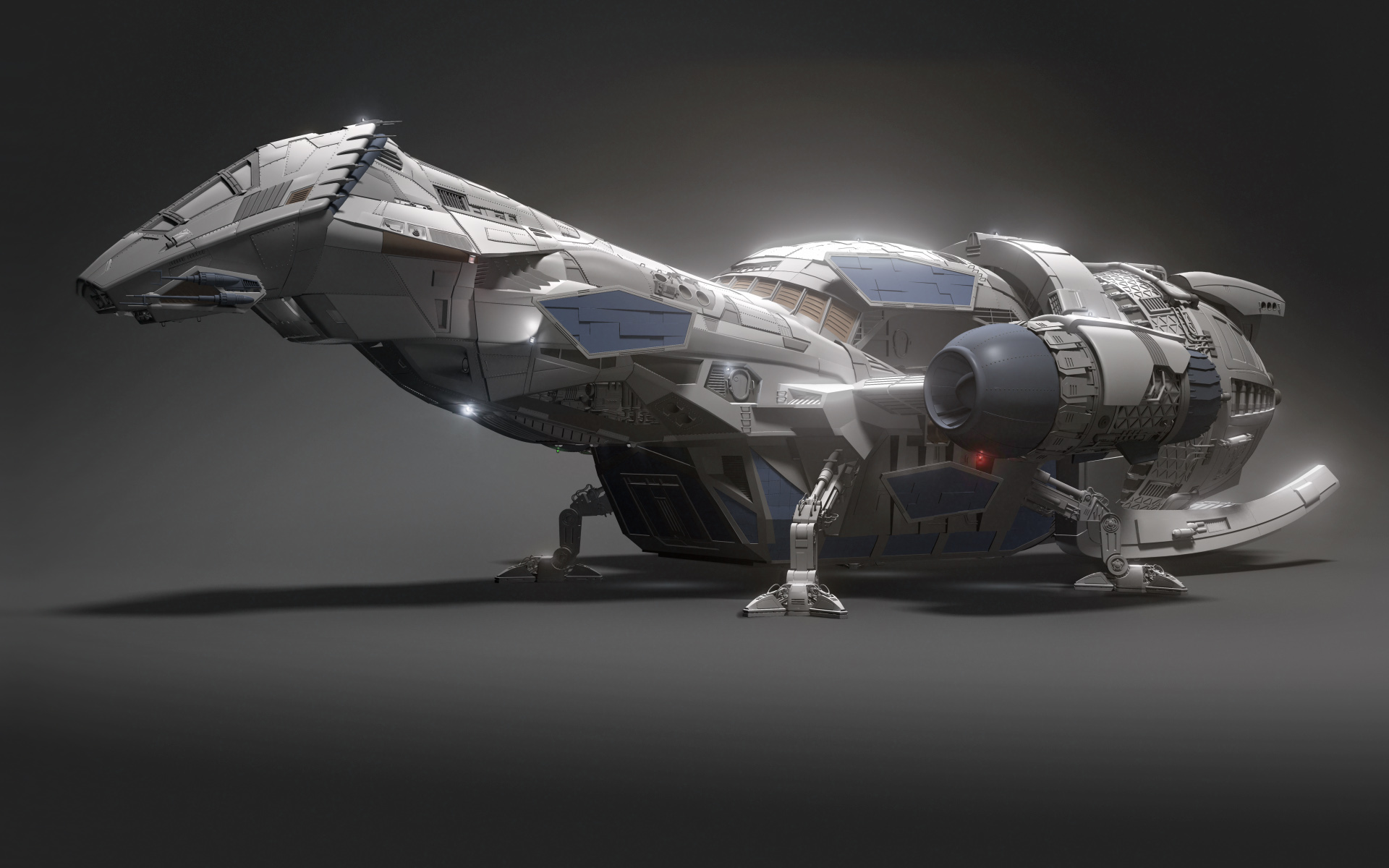
I’ve spent quite a bit of time talking about Firefly as of late, but the list says cool ships so I don’t see how the Serenity can possibly be left off this list! As the centerpiece of the single-season series and the movie, the ship has a long story and a lot of character, much like her crew! Originally designed as a class of cargo freighter, the Firefly is apparently an older model of ship that is no longer in use with the Alliance but remains popular out on the rim.

All references to it in the early episodes indicate that the series is essentially obsolete, but due to their ruggedness, shelf-life and the presence of secret compartments, they remain a popular item amongst smugglers. Hmmm, echoes of the Millennium Falcon there. Nevertheless, as the series progresses, this reputation is illustrated in how Mal and the crew are able to stow illegal goods and how Kaylee is able to keep the ship running under tight conditions with all kinds of improvised repairs. And despite the fact that it is no longer being constructed, most of its parts are still available and easily attainable on the open and black market.

Much like all ships in the Firefly/Serenity universe, the Firefly is apparently a sub-light vessel, incapable of traveling faster than the speed of light. Though unarmed, it is fast and maneuverable in both space and planetary atmospheres. This is made possible by the addition of two external multi-directional thrusters which allow for takeoff, landing, and the occasional crazy Ivan (which the crew pulled in the pilot episode). It also boasts two shuttle pods, which can be used as escape vessels or as secondary transports. Inara, the Companion crewwoman, uses one such pod as her quarters and transport for personal away missions.

The ship also has its own medbay and crew quarters, which is another feature that makes it popular amongst spacers. In fact, the availability of a private room was intrinsic in Mal’s offer to “recruit” Jayne Cobb from another gang, which was illustrated in a flashback sequence during the episode “Out of Gas”. There was even room enough to accommodate River and Simon and Book, which would indicate that the ship contains eight bunks in total. A communal dining area and food processors also see to their needs while not sleeping, gun-slinging, or generally doing something illegal!

USS Sulaco:
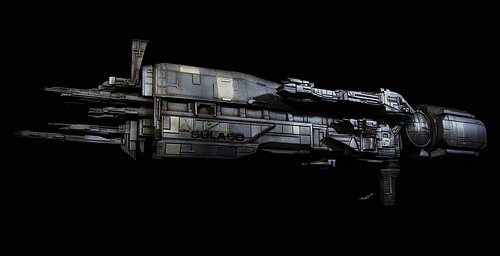
After barely surviving her first encounter with the xenomorph in Alien, Ellen Ripley and a crew of Colonial Marines returned to LV-426 in Aliens to settle the score! The ship that brought them there was none other than the USS Sulaco – a big, bad, military vessel boasting big-ass guns and enough Marine firepower to level an entire colony. Much like the Nostromo, the Sulaco is a reference to the work of Joseph Conrad, writer of Heart of Darkness (significant? Oh, I think so!).

Apparently, the Sulaco is a Conestoga-class warship designed for ferrying Marines to and from conflict areas in the future. While it was only carrying one platoon of Marines and two dropships in the second movie, this class of ship is capable of carrying 20,000 tons of cargo, eight UD4L Cheyenne-class dropships and a crew of 90 personnel (according to other franchise reference material). Hmm, too bad they didn’t pack the Sulaco to capacity, otherwise Ripley would have never had to take matters into her own hands to kill the Queen Alien!

Much like everything else in the Alien franchise, the Sulaco and all other Conestoga-class vessels are built by the Weyland-Yutani corporation, military division. Clearly, their purpose is to enforce the law, hunt down (and capture) xenomorphs, and maintain the peace aboard its many, many colonies. All part of their commitment to “Building Better Worlds” I guess 😉

White Star:
My personal favorite of this list, the coolest and most badass ship to come from the Babylon 5 universe! Fast, small, and boasting incredible firepower, the White Star was the workhorse of the Shadow War, Sheridan’s campaign to liberate Earth, and the early military campaigns of the Interstellar Alliance. In a lot of ways, it is much like the Defiant from the DS9 universe… I do believe they stole the idea from Straczynski!

As a collaboration between the Mimbari and the Vorlons, the White Star ships were partially based on organic technology. This meant that the ship was essentially alive and could heal itself when damaged. In addition, its organic armor was capable of deflecting energy, giving it a sort of shielding which could protect it from anything other than a physical impact.

The ship’s main weapons consisted of pulse cannons and a single beam cannon mounted in the nose. This gave it the ability to pepper targets with rapid fire shots while conducting high-speed maneuvers, and slicing them with focused bursts while on an attack vector.  All of this came in handy when dealing with Shadow vessels, which are notoriously hard to kill! It also proved useful when up against larger, heavier ships like Earth Force cruisers, Drakh vessels, and anything else the known universe could throw at them.

From the initial prototype, the Mimbari would go on to construct thousands of White Star-class vessels which were crewed by the Rangers and members of the Religious Caste. After the formation of the Alliance, Sheridan proposed the creation of a heavier version which culminated in the design of two White Star Destroyers, the Victory and Excalibur. This latter ship was the centerpiece of the spinoff series, Crusade.

Final Thoughts:
Well, that was fun! No final thoughts today, as I really have none to offer. I just really like cool ships! And much like most toys for grown ups, they are made cool by the fact that they are used for some fun purposes – like smuggling, fighting or exploration – and generally boast one or more of the following factors: speed, firepower, special abilities, visual appeal, and maybe some secret compartments. Any or all of these will do, thank you very much. Until next time!

The Alien Graph

The Alien Graph

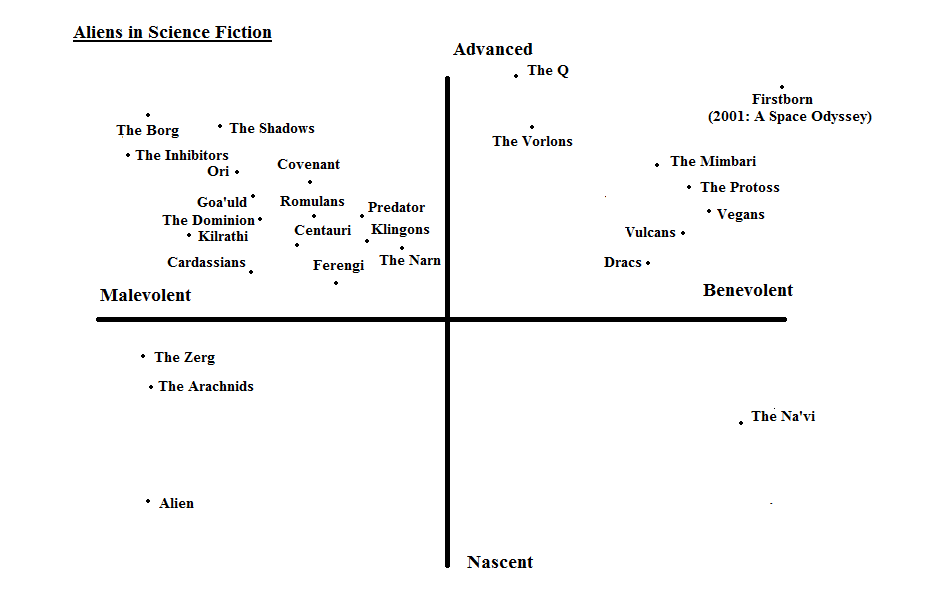
Behold! After a few days of contemplating what I said in the Ancient Aliens post – you know, about how alien’s technology and moral capacity are often interrelated in sci-fi – I realized I needed to put it into graphic form. And as I said in that post, if we are to consider technological advancement as one axis and level of benevolence as another, then the outcome would look something like this:

click to enlarge

The design is based on the Zombie graph that’s been floating around the internet for some time. There, the designer placed different Zombie movies based on two criteria: intelligence and speed. In much the same way, I’ve designed a graph for aliens that is based on two similar criteria: technological advancement and level of friendliness.

I selected aliens that I thought best represented the range of development and behavior in the sci-fi genre. I also included as many franchises as I could think of, just off the top of my head. I certainly wasn’t scientific about it, just relative and to the best of my abilities. And when I was done, I noticed an interesting pattern…

Hostile/Advanced Aliens Rule!:
For example, notice how the vast majority of races from your well-known franchises (Star Trek, B5, Stargate, Star Craft, AvP, Halo, etc) fall into the upper left quadrant. This is the area where malevolence and technological sophistication combine in varying degrees. By contrast, the second largest concentration of races occurs in the advanced/benevolent quadrant, again to varying degrees. Almost no races fall into the nascent (i.e. primitive) quadrants, be they hostile or gentle.

On the one hand, the Xenomorph from Alien and the Arachnids from Starship Troopers both fell into the technologically backward category (technically), and were both classified as malevolent because of their innate hostility to foreign organisms. The Na’vi, from Avatar, were the only alien race that fit the bill for technologically nascent and benevolent. I’m sure there are plenty of examples that could stack this analysis in a different way, but like I said, this was off the top of my head.

The Zerg, I have to admit, were a bit of a conundrum for me. While they are technically a race that does not employ technology per se, they are highly advanced in terms of their biological evolution, to the point where they rely on specialized creatures in the same way that humans rely on machinery. But then again, that’s all for the sake of ensuring that the different factions in the video game are evenly matched. It’s not meant to be a realistic assessment. Much the same is true of the Xenomorphs. While they do not employ tools, fly around in spaceships, or use guns, they are nevertheless an extremely evolved organism that is capable of besting humanity in any contest.

And just to be clear, the middle point of the graph (0,0, where the axes meet) is where humanity stands now in terms of moral behavior and technological development. Sure, some say we’d fall into the evil quadrant, but I tend to believe that humanity is morally ambiguous, neither too good or too evil. Where aliens fall into the spectrum in most sci-fi franchises is meant to reflect this. Much the same is true of technological prowess, where aliens are classified as “advanced” or “primitive” solely in comparison to ourselves.

This all might sound anthropocentric, but that’s the point, isn’t it? These are stories written by human beings for other human beings. All the references, symbols and measuring sticks come from inside us. So in the end, aliens themselves, as represented in our best science fiction, also come from inside ourselves. Their values, their tools, and even their appearances are all constructs of what is familiar and accessible to us. In short, they are merely tools with which we measure ourselves, both morally and technically.

Conclusions:
Well, right off the cuff I’d say the reason we prefer our aliens hostile and advanced is because it makes them seem more threatening and scary that way. Clearly, this makes for a more interesting story. While an alien race that is kind, innocent and backwards can make for an effective tale about the evils of colonialism and imperialism and how one can easily find themselves on the side of evil, these seem to be fewer and farther between. I’d say this is most likely because moral allegories are less intriguing than action dramas. Or maybe just prefer to think of ourselves as the good guys. Let someone else serve as the allegory for evil, selfish and runaway imperialistic behavior!

In addition, there’s the very real possibility that humanity will be making contact with an intelligent life form at some point in the future. And when we do, it’s likely to be the most awe-inspiring and frightening of experiences. When it comes to the unknown, ignorance begets fear and we prefer to err on the side of caution. So it would make sense that whenever we think of aliens, even if its just for the sake of fiction, we would naturally prefer to think of them as both learned and potentially hostile. If indeed aliens serve as a sort of projection for humanity’s own thoughts on itself, than pitching them as potentially hostile beings with advanced technology represents our own fear of the unknown.

In any case, if there is life out there, all these questions will be resolved in the distant future. Hell, maybe even the near-future. If some theorists are to be believed, aliens have already made contact with us and might even be walking among us right now. Granted, most of these people are hanging around the 7/11 with tin foil hats on, but they can’t all be crazy, right?

Cool Guns!

I’m getting hooked on writing conceptual posts, mainly because it gives me the chance to explore a lot different franchises of sci-fi without being too constrained. Not only that, I really like digging into subject matter of finding the common elements; in this case, the stuff that makes cool stuff cool! So far, I’ve covered the concepts of Galactic Empires, Planetkillers and Ancient Aliens. But today, I thought I’d tackle something a little simpler that’s been known to make sci-fi geeks experience collective nerdgasms! Today the topic is: COOL GUNS!

BFG 9000:
Starting off this review right is the BFG (Big F***ing Gun) that comes to us from the Doom universe. Fans of that old franchise know this one by heart, and I’m sure they remember with some nostalgia what it was like firing this thing. Given that Doom was like most first-person shooters, this weapon would turn up late in the game as a way of dealing with the more tenacious evil critters. And it worked! One shot released a big cloud of green plasma which killed everything in the vicinity. Unless it was a boss, in which case, it might take two or three… Apparently, Quake II and Quake III Arena pay homage by including their own version, known as the BFG10K.

“Blow Dryer”:
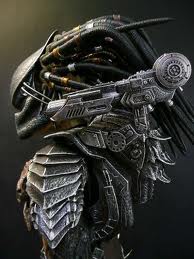
Also known as a “burner” or plasma caster, this weapon was the mainstay of the Predator aliens and is featured in the many movies, comics, video games, and novels of the franchise. Mounted on the shoulder, this weapon would discharge a ball of red-hot plasma into objects, causing damage akin to an explosive device, but with none of the messy shrapnel. Though the standard model is shoulder mounted and aimed using a heads-up-display and laser sight, the Predators in later movies were also known to carry wrist-mounted versions of this weapon as well. Like their claws and wrist bombs, they were embedded in the cuffs and served as a backup. One of these makes an appearance in Predator 2 during the meat locker shoot-out.

BR55 Battle Rifle:
This baby is a Halo universe invention, and is the mainstay of the UNSC infantry. Aesthetically, this rifle is based on several bull-pup assault rifles designs from the modern era, a design which is clearly growing in popularity. Some potential sources for inspiration include the Austrian-made Steyr AUG, the French FAMAS, the British L85, the Belgian F2000, and the experimental PAPOP design. Like all bull-pup rifles, this gun loads from the rear and can cut through Covenant opposition with ease! Even when I’m playing as the Covenant, this was my second favorite weapon to be carrying (the first was either two submachine guns or two pistols, or a combinati0n thereof!)

Blade Runner Gun:
In the classic move Blade Runner, Detective Rick Deckard was responsible for locating and “retiring” replicants. And the weapon he used to do just that is featured here. This is the model of a Blade Runner service revolver, for which little information exists, but whose appearance and performance pretty much speaks for itself. Based on a standard service revolver with several extra bits added on for effect, this gun pretty much screams cyberpunk.

In addition, there are several scenes in the movie where Deckard’s gun turned flesh (artificial though it was) into mush! Recall the scene where Deckard uses this gun to punch several holes in Zhora? Or how about the scene immediately thereafter where Leon is beating the crap out of him, and Rachael manages to save him by using his own weapon? Yeah, whenever this gun was brought out of his holster, some big holes resulted!

Blasters:
When asked about his idea for a “Galactic Empire”, George Lucas said that he wanted to create something that was as aesthetically similar to Nazi Germany as possible. This was reflected in the weapons as well. Numerous guns that were modified and used as props in the movie were based on WWII vintage weapons. The first and most recognizable is Han’s blaster, aka. the DL-44. Based on the German C96 Mauser pistol, this weapon was apparently a popular item amongst smugglers and traders, being very powerful and compact. It was also quick on the draw, which comes in handy when in a bar and looking down the barrel of a bounty hunter’s gun (Han shot first!)

The next was the standard issue blaster used by both the Stormtroopers and the heroes, especially in the first movie during their daring breakout from the Death Star. This blaster, known as the E-11, was based on the Sterling submachine gun of WWII. Simple, consisting of little more than a barel, a handle, and a side-mounted magazine, the gun was easily altered with a few pieces of molded plastic and a scope that made it look suitably futuristic.

The heavier T-21 Blaster Rifle was yet another WWII adaptation. Built around a Lewis machine gun, it was featured in the first movie during the Mos Eisley scene where Stormtroopers were seen walking through the streets searching for Luke and Obi Wan.

Last, there was the DLT-19 Heavy Blaster, the heaviest infantry weapon in the Star Wars franchise. In keeping with his love of WWII kit, Lucas’ set designers used a German MG42 to fashion this one. This blaster appeared aboard the Death Star in the hand of the search party that went over the Millenium Falcon, and again when Chewy commandeered one to take out the remote blasters and cameras in the cell block.

GE M134 Minigun Handheld:
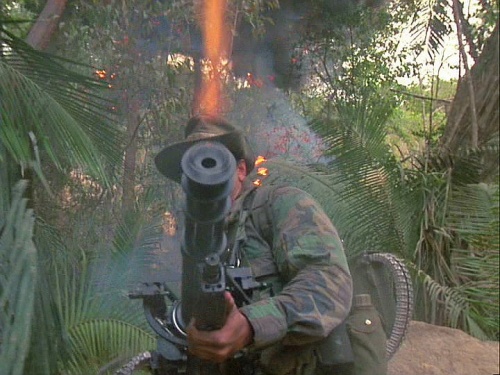
How could I have forgotten this one? I mean really, is there a better visual representation of sheer badassery than the handheld minigun from Predator? Sure, the mere idea of a man carrying a minigun around by hand is so unbelievable its makes me want to laugh out loud. Considering the weight of the weapon, even before you factor in all the ammo, coupled with the killer recoil that no human could withstand – all of this makes the physics totally implausible! But what the heck? It was fun to watch! I can’t imagine anyone not feeling the hair on the back of their neck stand on end as those barrels started whirling and the bullets streamed out, so fast it sounded like a turbine! And I know from talking to actual pilots who’ve seen this baby in action that if you add tracers to the mix, its like watching a laser show. WHURRRRRRRRRRRR! Total carnage!

Grammaton Cleric Pistol:
Though it was not my favorite movie, there were undeniably cool aspects to the movie Equilibrium. One of which was all the cool Gun Kata moves pulled by Christain Bale, Angus Macfadyen, and the other Grammaton Clerics with their special pistols. These guns were clearly souped-up versions of the Beretta 92FS. They clearly fire in both semi-automatic and automatic bursts, and were retrofitted in one scene with impact hammers on the handles.

In addition, some rather curious reloading tricks were devised. One involved arm-rails that would deliver fresh magazines from inside the cleric’s sleeve. Another included magazines that could be balanced upright, which gave the cleric the ability to simply slam his gun down on the fresh magazine once the empty ones had been ejected and go right on shooting. It’s all about rate of fire in this movie, making sure the bullets (and dust) keep flying!

The Lawgiver II:
Also known as the Judge Dredd gun, this pistol is also a modified version of the Beretta 92FS, with molded plastic and LED lights giving it a future-city look. In addition to a rapid-fire setting, the gun also boasts a grenade launcher, signal flare launcher, and a special dual round known as the “double-whammy”. It also has a taser device built into the handle so that only a Judge can operate it, and a DNA tagging system that ensures that every slug fired can be traced back to the person operating it.

M41A Pulse Rifle:

The franchise Alien gave so much to the world of sci-fi geeks, not the least of which came in the form of cool guns. And the Pulse Rifle was arguably the mainstay of that contribution. In fact, it was this gun that inspired entire generations of futuristic weapons, and the name itself has been used many times over to refer to energy and slug-thrower weapons in sci-fi franchises.

This is an important disctintion seeing as how “pulse”, to most sci-fi acolytes, refers to weapons that fire out pulsing beams of energy (most likely plasma). But in this case, it referred to pulses of caseless ammo, big bursts of projectiles that would tear through acid-spewing aliens by the dozen. And let’s no forget the grenade launcher that was attached to the underside, how cool was that? The signature, click-click, BOOM! combination was as pleasing to the ears as it was to the eyes.

But in addition to being just so freaking cool to look at, the amount of creative energy and ingenuity that went into making it was quite impressive. For example, the people in charge of set design wanted a prop that would actually fire, so they built their rifle concept around the M1A1 Thompson submachine gun, a WWII vintage weapon that was small and sturdy enough to get the job done. To simulate the grenade launcher, they attached a cutdown Remington 870 shotgun beneath it and mounted the foregrip of the SPAS 12 shotgun on top of that. Then, they applied pieces of molded plastic and a little LED display to the side to make it look especially badass! Remember that scene where Ripley used it to level that room full of egg’s with the Alien queen inside? Iconic!

M56 Smart Gun:
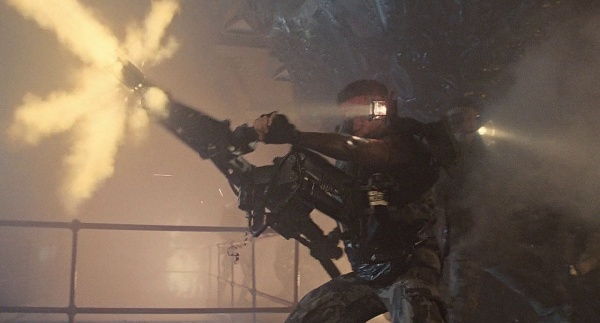
I know, I’m shoving two examples from a single franchise into one post. But I think it’s worth it. And for fans of Aliens and sci-fi junk, you just can’t make a list of cool guns and not include the Smart Gun! Much like the Pulse Rifle, this weapon was the perfect marriage of aesthetics and ingenuity.

To fashion it, the set designers for Aliens used another vintage WWII weapon (like Lucas, they used the German MG42 machinegun) some motorcycle handles, and the arms from a Steadicam mount. The result, once again, was pure badassery! And the name, according to the expanded Aliens universe, comes from the fact that these weapons could aim themselves. Marines would simply employ their eyepieces and helm cameras, and the guns would pick up movement and target it. Oh, and that scene where Vasquez opens fire in the Alien lair… classic! “Let’s roooooock!”

PPG’s:
The PPG, or Phased Plasma Gun, is the standard weapon of security officers and soldiers in the Babylon 5 universe. According to franchise sources, the PPG fires a small charge of superheated helium which retains its shape and small volume via a residual magnetic field. Upon impact with an object, the magnetic field is dissipated and the heat discharged. PPG bolts also cause visible distortion as they travel through air, hence the blurred effects when people in the show fire off their weapons.

The PPG comes in several standard models. First, there’s the service pistol which every security officer and member of station personnel. The heavier rifles are busted out during riots and times of war, along with the vests and riot helmets. In two episodes (S01E20 Babylon Squared and S05E19 Wheel of Fire ) Garibaldi has scenes where he busts out the BFG version.

Reason:
This weapon is both deadly and cheekily-named, and is taken from Neal Stephenson’s smash-hit novel Snow Crash. This picture doesn’t quite do it justice, but its a close approximation. In the novel, Reason was a gatling gun that was the property of Uncle Enzo’s Mafia, an organization that ran a series of franchulates along the west coast of the former US. But unlike your conventional gatler, it fired caseless depleted-uranium slugs, bullets that are incredibly dense and very heavy. Hence, the weapon packed a massive punch and a mad recoil.

During one of the later chapters, Enzo’s men use the gun to take out a pirate yacht while firing from a life raft. A single burst demolished the pirate ship, but the recoil sent their boat about fifty meters in the opposite direction! This scene also had a hilarious set up when the mafiosos first broke it out, saying that if they ran afoul of any privateers, they were sure they’d “listen to Reason.”

Phaser Rifle:
Over the years, Star Trek has been a source of many weapons designs. However, some were arguably more cool than others, at least in my opinion. These came largely from the later spinoffs and movies, in particular DS9 and Voyager. Prior to this, phaser designs were either too boxy, too bulbous, or just too… Buck Rogers-y! When you’re repelling boarders, or on an away mission, one thing you want is a kick-ass weapon to bolster your confidence and inspire fear in your enemies.

These requirements were met by a new model of weapon, known as the type 3 Phaser Rifle. This weapon went through many variations throughout the course of the show. The first design was very boxy-looking, whereas later models tended to be more sleek and menacing (as shown above). Then came a whole new design, known as the Compression Rifle (seen below), which was apparently an even more powerful model. These weapons were specifically created for use on starships where heavy combat was expected, or in times of war.

Final Thoughts:
Man, that was a long list! But that’s the thing with cool ideas, they tend to get around. And as usual, I noticed some key patterns in the mix which I think should be pointed out. In all of these cases, there were apparently two classes  that each weapon fell into.

  1. Directed-Energy Weapons: Arguably the more science-fictiony of the two. These weapons first made their appearance in Saturday morning serials like Buck Rogers from the 1950’s. They come in many forms – ray guns, death rays, beam guns, blasters, laser guns, and phasers – but the core concept is the same. Phased or directed energy, usually in the form of plasma, that is focused into a tight beam and then emitted. The ironic thing is, since the 1950’s, sci-fi franchises have moved away from these seemingly farfetched devices and come to rely on ballistic weapons designs more and more. Meanwhile, Directed Energy Weapons have become more and more feasible, with several prototypes being explored by military contractors today.
  2. Ballistic Weapons: In the context of sci-fi, these often take the form of weapons that use caseless ammunition, electromagnetically-propelled ammunition, or just standard bullets. But in each case, the weapons that use them are adapted to look more futuristic. Interestingly enough, the future seems to be coming sooner than we thought. In just about every developed nation, firearm technologies are being explored under the banner of the “Future Soldier” program. Having studied many of these, I can tell you that they put much of what was shown in Aliens to shame, especially where Heads-Up-Displays and portable computers are concerned! Again, the future seems to be coming sooner than we thought!

Ancient Aliens (Updated)

And I’m back with another conceptual post, hard at work exploring the ideas that run deep in the grand genre that is sci-fi. And this is one that I find particularly cool, mainly because it’s just so freaking existential! I mean what is there that can possibly throw a wrench into our collective anthropomorphism more than knowing that there is sentient life out there that significantly predates our own, especially if we were to find out that they had something to do with our own evolution…?

In some ways, this is a shout out to the “ancient astronauts” theory, which speculates that extra-terrestrials came to Earth long ago and left some evidence of their visit behind. This can be limited to something as basic as a structure or a relic, or can run as deep as having influenced human cultures, religions and technological development. Regardless of whether or not this theory is to be taken literally, it is well represented in the sci-fi community. Here are some examples that I have assembled:

2001: A Space Odyssey:
A classic example of an ancient species, ancient astronauts, and one of my personal favorites! Originally conceived in the form of a screenplay by Arthur C. Clarke and Stanley Kubrick, the concept of the TMA-1 monolith aliens was a central plot element to one of the most groundbreaking science fiction movies of all time. However, owing to Kubrick’s esoteric style, not much was ever made clear about the species that built the monoliths. Luckily, Clarke went on to develop the idea at length in his novelization of the movie and its many sequels.

According to the novel, and ongoing interviews with Kudrick, the beings that built the monoliths were known as the Firstborn – an extremely ancient race that achieved sentience millions of years ago and were exploring the galaxy long before humanity even existed. The monoliths were their means of traveling from star to star, which they did in order to seek out life and help it along. In the course of their travels, they came upon Earth four million years ago and discovered Simians that were on the verge of starvation. By teaching them to expand their diet through hunting and some basic tricks to cultivate their manual dexterity, they ensured not only the survival of higher order primates, but the eventual emergence of humans as a species.

The story of 2001 thus takes place in the near-future (from when it was originally written) where humanity has developed into a star-faring race and colonized the Moon. Not far from this colony, a monolith is discovered buried under millions of years of moon dust. After examining it, to no avail, they discover that it has sent a signal out to Jupiter. The ship Discovery is then dispatched to investigate, where it finds an even larger monolith in orbit around Europa. The mission ends quite mysteriously as David Bowman, the last surviving member of the crew, flies closer to it in a small pod and disappears. Adding to the mystery were his last words: “My God, it’s full of stars!”

In subsequent books, the mystery of Bowman’s disappearance and the nature of the monoliths is made clear. Essentially, the monoliths are alien machines that contain their consciousness, and some are gateways which allow for FTL space travel. Bowman, when he came into contact with the one around Europa, was transformed or downloaded (depending on how you look at it) and became one with the monolith. The reason they are hanging out around Europa is because they are currently working to transform Jupiter into its own star so that life may blossom on Europa (which scientists speculate is already teaming with life underneath its icey shell).

Cool idea! But you see, there’s a snag… Apparently, the First Ones have also been known to weed wherever they’ve sown. What would happen if they came to the conclusion that humanity was too aggressive for its own good, the result of them teaching us how to harness an appetite for killing other animals and members of our own species? This is the premise that is explored in the finale 3001: Final Odyssey, and which was left on a cliffhanger note. Unfortunately, Clarke died in 2008, leaving fan fiction authors to speculate on how this would all play out…

Alien vs. Predator:
Note: this is not a reference to the terrible movie or its even more terrible sequel! No, in this case, I am referring to the wider franchise, as exemplified by its many video games, comics, novelizations, and even the independent (non-crossover) movies. In these cases, we get a glimpse of two races that predate humanity by hundreds of thousands or even millions of years. Their outward characteristics alone make them cool, and they are both pretty badass in their own special ways. But what is especially cool about them is the fact that very little known about them, other than the fact that they are very, very dangerous!

“I admire its purity. A survivor… unclouded by conscience, remorse, or delusions of morality”. That is how the Alien, or Xenomorph in AVP terminology, was described in the very first movie. Their origin is unknown, as is the timeline of their existence and the circumstances of their evolution. However, one thing is clear: on this last note, it must have been something pretty harsh! I mean really, how difficult must life have been on their homeworld for something like the xenomorph to have emerged. They proliferate at an alarming rate, require living being to gestate, and are designed purely for the hunt!

Overall, their race is divided into two symbiotic and interrelated species. First, there are the “Facehuggers”, the spidery creatures that attach themselves to living creatures and implant them with embryos. This in turn gives rise to the “Chestbusters”, the warrior aliens that seek out, kill and capture creatures for the Facehuggers to use. At the top of the pyramid is the Queen, a Chestbuster who has evolved to become the egg-layer who gives birth to more Facehuggers. An interesting chicken and the egg type arrangement, and something which only adds to their mystery!

The Predators, on the other hand, are relatively straightforward. At their core of their society lies a warrior ethic, where each and every male member of their species is trained to be a hunter. In time, hunters accumulates honor and seniority within their culture by attaining as many kills and trophies (i.e. skulls) as possible, preferably from different species. In fact, it is rumored that a single scene from Predator 2, in which an Alien skull appeared in a hunter’s trophy case was the basis for the whole AVP crossover.

In addition, there are also some clear and apparent rules to the hunt. First, each hunter is drawn to arenas of conflict. In the first movie, one chooses a hunt in Central America where a guerrilla war is taking place. In the sequel, one travels to LA during the height of the drug wars. In both cases, the get a sense of their terrain, taking out the easy prey first, and gradually working their way up to the top carnivore. At first, they rely on their advanced weaponry and stealth. But when at last they face off with the strongest prey, they fight them in the open in hand to hand combat.

God knows how long they’ve been doing this. But given their obvious level of technology, its clear they are not exactly recent additions to space race!

The “Ancient Humanoids”:
Now this was one I didn’t much like, but it’s an example of the concept of ancient astronauts nonetheless. And it comes to us courtesy of Star Trek: TNG. from an episode named “The Chase” (episode 146). In it, Picard’s old friend and mentor turns up dead in the course of an expedition which he claims could be the most profound discovery of their time.

After retracing his footsteps, Picard and the Enterprise are joined by three other search parties – one Klingon, one Romulan and one Cardassian – in orbit around a dead planet. When they reach the surface, they find that all the clues lead to a recording left behind by an ancient species. In the recording, the humanoid alien tells them all that they are the progenitors of every sentient race in the quadrant, that their DNA was planted on countless worlds. This is apparently why so many species are humanoid, and means that humanity shares ancestry with all these would-be enemies.

Heartwarming, and kind of cool if it weren’t such a convenient explanation as to why all aliens in the Star Trek franchise are humanoid. This is something that’s always annoyed me about the franchise. It’s not enough that all the aliens speak English and look like people, minus the occasional molded plastic on their faces. But to make matters worse, they always got to make a point of drawing attention to their humanoid forms. So when it came right down to it, this episode felt more like a contrived explanation than a homage. Personally, I would have thought that limited budgets would be the reason, but what do I know? I’m no xenobiologist!

The First Ones:
Another favorite which comes to us courtesy of the Babylon 5 universe. According to the expanded storyline, the First Ones were the first beings to achieve sentience in the Milky Way Galaxy. By the time of the show, most of them had left our corner of the universe in order to explore other galaxies and what lies between them. Only two remains behind, ostensibly to act as shepherds to the younger races. They were known as the Vorlons and the Shadows. However, in time, the two races turned on each other because of their diametrically opposed ideologies.

The Vorlons believed that development and progress came from order. In the course of their long history, they travelled to many worlds inhabited by sentient races and began tampering with their evolution. In each case, they presented themselves as angels, thus ensuring that sentient beings would see them as creatures of light and truth. In addition, they fostered the development of telepaths for use in the coming wars against the Shadows, whom they knew to vulnerable to psionics.

To illustrate this, the Vorlons are often presented as being aloof and rather stodgy figures. In fact, Lyta Alexander, one of the show’s secondary characters, commented that despite their power, the Vorlons are a highly sensitive people who do not react well to change! In the course of the show, they were initially hesitant to commit their forces to fighting the Shadows, they were extremely irked when Kosh (their ambassador to B5) was killed, and when Sheridan went – and presumably died  – at Z’ha’dum, they began destroying entire worlds in the hopes of erasing every trace of the Shadow’s influence.

In addition, their esoteric, mysterious nature was summed up with one question that they would ask anyone who was privileged enough to speak to them: “Who are you?” If ever you found yourself being asked that, odds were you were meant for some higher purpose, one which the Vorlons had a hand in arranging!

The Shadows, by comparison, were much more enabling and  intriguing, even if they were a little… oh, I don’t know, shit-your-pants scary!  In the course of their history, they too traveled to many worlds as ambassadors, encouraging different people and races to embrace their ambitious, darker side and go to war with each other. Whereas the Vorlons asked “Who are you?”, the Shadows big question was “What do you want?” Again, if you found yourself being asked this question, it meant that you were on their radar and they had big plans for you. The proper response to this would be feelings of flattery followed by abject terror.

In any case, whereas the Vorlons believed in order and stability, the Shadows believed that evolution came only through conflict and disorder. This, they reasoned, is what lead to the development of stronger, more advanced races. As Morden, their own representative to B5 said, humanity would never have come so far so fast were they not constantly “at each others’ throats”. Sure, some races had to be sacrificed along the way to make this philosophy work, but that was all for the greater good. In the end, what came out of it was a series of species that were stronger and better than they were before.

This philosophy eventually led them into conflict with the Vorlons as well as several other First Ones. Many younger races found themselves taking sides as well or just getting caught in the middle. In fact, wars between the two sides became a recurring thing, happening every few thousand years. In the last, which took place 10,000 years before the main story, the Shadows were defeated by the last great alliance between the First Ones, most of whom then chose to leave the galaxy. Then, just 1000 years before the events in the show take place, the Shadows were once again defeated by the Vorlons and an alliance of younger races and forced out of the galaxy entirely. However, as the show opens, we quickly learn that the Shadows are once again returning to their old stomping grounds, and the first spot on the tour is a planet known as Z’ha’dum.

This world is doubly significant because it is this planet where another First One – THE first one in fact – is thought to reside. His name is Lorien, and he is the last of his kind and the sole First One outside of the Vorlons and Shadows that is left in galaxy. All of the others have long since abandoned it, leaving the Shadows and Vorlons to their war and all the other races that have chosen to enlist in it. In the end, however, Sheridan, Delenn and the younger races form their own alliance which they use to draw a line against both races. With the help of those First Ones that they are able to reach and enlist the help of, they are successful. After a brief but decisive fight, both races agree to leave the galaxy with Lorien, never to return. In the last episode, when Sheridan is on the verge of death , he is found by Lorien who takes him to the great beyond where the other First Ones now reside.

Like I said, its a personal favorite, mainly because I felt it was so richly detailed and in-depth.

The Forerunners:
Now here is an interesting take on the whole ancient astronauts concept. Whereas in most versions of this idea, aliens make contact with a younger race and influence them for their own purposes, in the Halo universe, things happen in a sort of reverse order. It is established as part of the game’s back story that eons after they died out, the Covenant races came upon the remains of an ancient race which are referred to as the Forerunners. After learning how to reverse-engineer their technology, the Covernant began to merge it with their own and was able to jump thousands of years ahead as a result.

At the same time, they began to develop a religion and even a theocracy based on the Forerunners and what they believed their most important relics to be. These would be the Halo devices, for which the game takes its name. Believing that the Halos were the gateway to the afterlife, or the source of deliverance, the Convenant became obsessed with finding a working Halo and activating it. All of their mythology for the past few thousands years was based on this, and they pursued it with absolute single-mindedness.

So in this way, the Forerunners had a profound impact on the development and beliefs of the Covenant, but not intentionally. Rather than coming to the Convenant while it was still in its infancy and manipulating them for their own purposes, the Covenant instead found them, but only after they were long dead. In addition, they were influenced by their own assumptions about the Forerunners, and not anything they chose to tell them. And in the end, this influence had a near disastrous effect, given that the Halo devices were weapons of mass-MASS destruction and not holy relics. By attempting to activate them, the Covenant very nearly brought about their own extinction, and that of every other sentient race in the quadrant. One would think there was a message in all this about the dangers of blind faith and the dangers of deification or something!

The Goa’uld:
Here is a perfect example of the ancient astronauts theory, so bang on that you’d think it was tailor made to fit the premise! In the Stargate universe, which has expanded considerably over the years, an advanced extra-terrestrial species known as the Goa’uld came to Earth during the neolithic period and had a vast influence on our history. In the original movie, this involved a single alien who took on human form and appointed himself God Emperor over his human subjects. This, in turn, gave rise to the Egyptian civilization, with the alien-god Ra at its apex.

In addition to creating ancient Egypt though, Ra was also revealed to have taken human beings through the Stargate, an means of near-instantaneous interstellar transportation, and established similar civilizations on distant planets. On each of these, the Egyptian motifs of pyramids and the cult of Ra persisted, in some cases for thousands of years. Meanwhile, back at Earth, a revolt unseated Ra and he fled into the cosmos, to be found thousands of years later when humans accessed the Star Gate on Earth.

In the expanded universe, we learn that the Goa’uld were merely one of many races that visited Earth and appeared as gods to humanity because of their advanced technology. But whereas most had benign intentions,  the Goa’uld were concerned solely with establishing slave colonies on many worlds throughout the universe. In addition, their interference extended to other less advanced races as well. As a result, humanity is now faced with the task of preparing to face this and other threats, all of which involve highly advanced races that have visited Earth at one time or another and could very well be hostile.

Although it was not too good a movie (in my opinion), the concept is still a very fertile one! It’s little wonder then why it was made into a series, one which has done quite well for itself. Aliens came before, they may come again… Can we stop them this time. Who knows? Spooky stuff!

The Orions:
In the video game series Master of Orion, there is yet another take on the concepts of ancients aliens. In this turn-based strategy game, players select from different alien races that inhabit the galaxy and begin the process of colonization and expansion. In time, the concept of the Orions comes up. It seems that each race, though they are different and possess varying special abilities, have their own legends about this particular race.

One of the aspects of the game is to find the Orions homeworld, a place full of secret and advanced technology, but which is defended by a powerful robotic starship known as the Guardian. Whoever is able to destroy this ship and land on the planet is the most likely to win the game. This is advisable, seeing as the how the purpose of the whole game is to become the undisputed master of the galaxy – the Master of Orion, as it were 😉

The Xel’naga:
Another example of this concept which comes to us from the gaming world. of which fans of Starcraft will no doubt be instantly familiar with! Translated literally as “Wanders from Afar”, the Xel’naga were apparently a race from a distant galaxy that was concerned with creating the perfect life form. In the course of their lifetime, they apparent “seeded and cultivated thousands of various species” (from the SC game handbook). This included the Protoss and Zerg, two of the major players in the game, and figures pretty prominently in the game’s backstory.

In the case of the Protoss, the Xel’naga thought that they had found beings that possessed “purity of form” and began manipulating them. However, when they revealed themselves to the Protoss, the latter turned on them and they fled. They discovered the Zerg shortly thereafter, a species which they believed possessed “purity of essence”. They began by enhancing them from the small, parasitic larvae that they were, but found that they were too primitive. They therefore developed the Overmind as well to give them purpose and direction, but this only made matters worse. In time, the Zerg found the Xel’naga, who had chosen to remain hidden this time, and consumed them.

In the course of the game, Xel’naga ruins make only one appearance, in the form of an ancient temple which possesses the ability to sterilize the planet of all other species. However, other ruins are apparently featured in one of the game’s novelizations. Otherwise their is no mention of them, their existence merely constituting part of the story’s deep background.

Final Thoughts:
After looking through these and other examples of ancient astronauts, a few things began to stand out. Like I said before, sooner or later aliens serve an anthropological purpose in science fiction. Or to put it another way, they will always play the role of mirror and meter stick. On the one hand, they are the means by which we project aspects of ourselves onto others so we can study them better. On the other, they are means by which we measure our own flaws and development.

But above all, aliens tend to fall into any one of four categories based on where they fit into the moral and technological spectrum. This spectrum, which I made up myself (!), breaks down as follows:

  1. Benevolent/Malevolent: How aliens behave in our favorite franchises and what purpose they serve often has much to do with their basic motivation. In short, are they kind of benevolent, enlightened overseers as envisioned by Arthur C. Clarke in 2001: A Space Odyssey and Childhood’s End, or are they hostile, conquering species as envisioned in War of the Worlds and Invasion of the Body Snatchers? In either case, the alien serve a basic purpose: as a commentary on humanity. Their murderous ways are our murderous ways, their benevolent, technical perfection what we aspire to be. As Nixon is said to have muttered to JFK’s painting: “Men look at you, they see what they want to be. Men look at me, they see what they are.”
  2. Advanced/Nascent: Another important aspect to the aliens in question is their level of technical development. And, interestingly enough, this can have much to do with their moral character. Oftentimes, the aliens in a franchise are both advanced and malevolent, blowing up the White House Independence Day-style or trying to make us one with the Borg! Other times, they are advanced and enlightened, technology and evolution having erased whatever primitive impulses they might have had, but which humanity still possesses. And in other cases still, their are aliens who are less advanced than humanity and are either ethically challenged because they are behind the times, or noble and “untainted” because they haven’t been perverted by civilization’s greed and avarice. It’s a toss up, really, where the benefits and downfalls of technological progress are seen as having an influence on moral and social development.

Again, these are all mere projections, designed to focus attention on moral and ethical dilemmas that arise out of our collective history. Still, it is fun to take these various examples from popular culture and see where they line up on the moral/technological graph. That way we can see where different franchise place their aliens in terms of the overall spectrum.  And like I said at the beginning, its a cool concept. I mean seriously, wouldn’t it be cool if it were actually true? No one can prove aliens didn’t visit Earth thousands or even millions of years ago and mess with our evolution, right? Yeah, it’s not exactly a sound basis for a scientific theory, but a very fertile source for science fiction!

Of Planetkillers!

What is it about doomsday devices that make them simultaneously scary and freakishly cool? Oh, I don’t know. Maybe it’s the fact that they can turn an entire planet into glass, render it completely uninhabitable, or just plain blow it to smithereens? If none of these things do it for you, I suggest you stop reading now, this is what the whole post is about!

Where these ideas come from is a source of debate, but it goes without saying that apocalypticism is part of our collective unconscious. The very concept of the end of the world has worked its way into every world religion and is as intrinsic to our beliefs as creation. And I suppose that it goes without saying that since humanity began to develop weapons that could actually level entire cities, depopulate entire countrysides, or even raze whole continents, that this obsession with the end of days has expanded beyond the spiritual world and has become an everyday preoccupation.

So it’s little wonder then why science fiction writers have taken it upon themselves to come up with concepts of machines that can destroy and sterilize entire worlds. It just seems like the next logical step after anthrax and thermonuclear weapons doesn’t it? And in the course of this, some pretty cool concepts have been thought up. Here are some examples from various popular sci-fi franchises:

The Death Star:
Without a doubt, this planet killer is the best known in the business. Making its first appearance in A New Hope where it destroyed the planet Alderaan, the Death Star was a massive space station that was created to inspire fear and silence all dissent to the Emperor’s rule. At the center of this force of unrivaled terror was a massive, high-powered laser that resembled a huge eye or a massive crater on the station’s surface. A single beam from this weapon was capable of breaking planets apart and obliterating all life on the surface.

Granted, this same station was then destroyed by a ragtag group of Rebel pilots, guys in tiny fighters who knew about a tiny exhaust vent in the side. But its replacement was even more badass! The second Death Star, which appeared in Return of the Jedi boasted a laser that was capable of recharging more quickly between shots and was accurate enough to take out large vessels as well. Before being destroyed by the Rebels at the Battle of Endor, the new Death Star managed to destroy two Mon Calamari cruisers with ease.

But alas, this weapon’s fatal flaw lay in its design. Being so big, small craft were capable of penetrating its defenses and attacking its vulnerable points. In the case of the first incarnation, this involved firing torpedoes into an exhaust port which would then reach the main reactor. In the second version, there were to be no exhaust ports so the station would have no outward vulnerability. But as long as it was still under construction, the station was vulnerable and hence open to attack. And given it’s sheer size and the time it would take to complete just one, that’s a pretty big window! I guess it’s true what they say: the bigger they are…

The Vorlon/Shadow Planet Killers:
In the B5 universe, a few different types of planet killers existed, both of which were the property of the oldest races. Given the amount of energy that would be required to destroy an entire planet, it was reasoned that only ancient races like the Shadows and Vorlons would be capable of constructing such a thing. However, the younger races had their own means of leveling a planet, if not destroying it completely. This involved mass drivers, which the Centauri used in season two to hurl asteroids into the surface of the Narn homeworld, causing massive destruction and forcing the Narn to surrender. But that’s another matter. Here are what the proper examples of planet killers in the B5 universe looked like:

The Vorlon planetkiller was essentially just a massive gun that was built into a ship. The long, flattened spheroid with plenty of tentacle like things would be escorted through space, fly into position around the enemy planet, and then fire a massive energy discharge that would obliterate the entire thing. By comparison, the Shadow’s planetkiller was much more complex, not to mention insidious!

In what appeared to be a massive, black cloud, a Shadows Shroud held a massive buckminsterfullerene-like assembly that would move into position around a planet and then enclose itself around it. The assembly would then unleash a massive swarm of missiles which would bore into the surface and then detonate, releasing a massive thermonuclear payload near the core of the planet which would trigger tectonic activity that would rip the planet apart.

The former planet killer got its fair share of attention in the series proper, where the combined forces of Sheridan and Delenn’s alliance managed to destroy one only by calling in the help of the First Ones. Between all their races, only they possessed the kind of firepower that was needed in order to destroy a ship of that size. Some attention is also given to the Shadow’s Shrouds, but it wasn’t until the TV movie “A Call to Arms” came out that any in-depth explanations of how they worked or how they could be beat ever came up. In this movie, we see for the first time what the internal structure of the Shroud looks like and how the device could be defeated by attacking its nerve center. This alone would not destroy it, but would prematurely trigger it, causing it to unleash all its missiles, which would then impact and destroy the assembly itself.

The Behemoth:
This planet killer comes to us courtesy of the Wing Commander videogame and made its appearance in the third installment in the series. Much like the Vorlon planet killer, the Behemoth was essentially a big gun that was designed to blow up planets by firing a single, concentrated beam directly into its surface. Simple, and effective, were it not for the fact that the weapon suffered from some congenital defects, which included gaps in the shielding array and the fact that it had no defensive mounts anywhere along the hull.

However, given the fact that the Terran Confederation (the good guys in the story) were losing to the Kilrathi Empire (the bad guys), the weapon had to be pressed into service before it was complete. Its intended purpose was to destroy the Kilrathi homeworld, a move which they believed was the only way to win the war outright at that point. Naturally, the vessel was destroyed due to a combination of its weaknesses and high-level treason. However, the good guys still won in the end due to alternate plans and daring-do, so don’t fret!

Unicron:
The Transformers franchise was something I enjoyed for many years as a kid. And were it not for Michael Bay, I might have enjoyed it again as a result! But whatever… In the course of telling the story of machines that could transform to hide their true identities, one robot in particular truly stands out. Mainly because of his size! His name is Unicron, a massive machine that can transform from a robot to a planet-sized sphere, and which preys on smaller planets. A pretty cool concept, really, especially for a children’s cartoon! Unlike other planet killer devices though, Unicron was unique in that he was a sentient being, and not a simple machine that was under the control of others. His first and only appearance was in Transformers: The Movie, where he was also destroyed. He did not appear again in the course of the original series, but was mentioned several times, particularly in the CGI-animated spinoff, Beast Wars.

The Doomsday Machine:
Gene Roddenberry weighed in on the planet killer thing back in the late 60’s with his own version of a doomsday weapon. It was known simply as the Doomsday Machine, a massive, lamprey-like device that was capable of consuming entire planets into its massive maw. In the course of the episode where it makes its appearance (episode 35, of the same name), the crew of the Enterprise learns that the machine is drawn to populated worlds which it then destroys and converts into fuel so that it can keep going. The process is entirely automated, the ship itself having destroyed its masters and sterilized its own region of the universe a long time ago.

Airing in the late 60’s, the Doomsday Machine was clearly a commentary on the Cold War and the creation on doomsday weapons which were intended for use as a “deterrent”. In fact, at one point Captain Kirk theorizes that the machine was never intended for use, merely to serve as a instrument to inspire fear in an enemy. However, once it was activated, it ran amok and destroyed its enemies and those who created it. In the end, the crew manages to destroy it by (ironically) letting it ingest a ship which they rig to go thermonuclear once its inside.

Halo Array:
Gamers are no doubt familiar with this one! In the Halo universe, much of the focus is on alien artifacts which were built by a race known as the Forerunners. The Covenant, the alien antagonists in the game, believe them to be holy, particularly the Halo devices which are central to the plot. These devices, it turns out, are “weapons of last resort” which the Forerunners built to sterilize all worlds of sentient life that are within range. Their reason for this have to do with a hostile organism known as the Flood, a parasitic life form that infects sentient organisms and turns them into zombie-like creatures.

Unfortunately, the Forerunners died off shortly after concluding their war with the Flood, leaving the Halos and several other artifacts behind. In time, these were stumbled upon by the Covenant who began to reverse-engineer the devices and used them to advance significantly. In time, the Convenant came to believe that the artifacts had been left behind by a holy race and built a religion and even a theocracy around this belief.

The Halo is apparently the crowning piece of the Convent faith. They believe that activating them will lead them on the “Great Journey” (aka. entrance into the hereafter). However, the main characters in the story quickly learn that this would actually cause the destruction of Earth and every inhabited planet in the sector. Inspired by Larry Niven’s Ringworld series, the concept of the Halo devices and the thematic elements which drive the story (i.e. blind faith, theocracy, evolution and ancient alien artifacts) are all prime examples of classic science fiction. Nice to see that they make their way into the gaming world once in awhile!

The Necromongers:
The Chronicles of Riddick is yet another example of theocracy, apocalypticism, and doomsday devices. Within the context of the story, we have a faction of hostile force known as Necromongers, a faction of humanity that worships death and believes that better world (known as Underverse) lies at the edge of the known universe. Leading them is a man known as the High Marshall, a person who apparently traveled to Underverse and returned half-man, half… something else. No kidding, this is how he’s described in the movie, verbatim!

In any case, in their drive to reach the edge of the universe, the Necromongers conquer, pillage and convert every planet in their path. The final step in this process, before moving on, is the use of a planet-killing device of their own, one which leaves the planet itself intact, but destroys all remaining life on the surface. In short, after they replenish their ranks and bring in fresh converts from the conquered populace, they commit whats called the “Final Protocol” before dusting off. Basically, it involves a series of ships standing up on end and releasing payloads into the air which then explode, unleashing a massive shock wave that kills everything in its path. This process gives literal meaning to the words: “Convert, or fall forever!”

The Inhibitors:
As I final example, I have included one of my personal favorites: the hostile alien species known as the Inhibitors, which come to us from Alastair Reynolds’ Revelation Space universe. According to the first novel in the series, the Inhibitors are all that remains of several ancient alien races which went extinct long ago. These machines, which are semi-intelligent and automated, are programmed to seek out and destroy sentient life.

The reason for their existence apparently has to do with a series of terrible events that are collectively known as the Dawn War. This war was apparently fought by all the earliest sentient races in the Milky Way Galaxy which began shortly after they discovered each other, but which lasted for eons. Finally, what was left of the various races decided to merge their consciousness with a series of specialized machines which they then programmed to ensure that no such wars ever happened again. These machines take the form of tiny black boxes which are capable of multiplying, replicating and seem next to impossible to kill.

Ostensibly, these machines were designed to nip the development of sentient life in the bud by sterilizing any planet that supported a potentially star-faring race. In short, they were meant to inhibit the growth of sentient life, hence their name. However, in books II and III, their motivations are explained further. In addition to wanting to prevent another major war from taking place, the Inhibitors were also concerned about the eventual galactic collision which is scheduled to take place between the Andromeda and Milky Way Galaxies several million years from now. When that happens, our two galaxies will merge, but the consequences for any lifeforms living within either of them will be disastrous.

The only way to prevent this, it is said, is to either ensure the development of a single race that has the requisite technological development to resist the destruction brought on by the collision, or to inhibit the growth of any sentient species until after the collision takes place. Once the collision is complete and the galaxy returns to a state of gravitational equilibrium, life can resume, but not before. Sounds crass, but the way they see it, they are doing sentient beings a favor by making sure they don’t get off the ground, rather than letting them die by the billions when the stars all come crashing together!

In the end, these machines destroy planets through various means. In fact, much attention is given to how the Inhibitors employ a great deal of creativity in designing ways to sterilize worlds. Instead of just parking a giant gun in orbit around a planet or covering with a toxic blanket, they will use the system’s natural resources to construct tools and weapons which they will then use to take planet’s or suns apart, bit by bit. The process can take years, even centuries for them. But they plan ahead, and are very patient…

Ultimately, the Inhibitors are not defeated in the Revelation Space universe, but are beaten back, pushed to the fringes of known space where humanity fights an ongoing fight with them that lasts beyond the final novel in the series. They do this by incorporating technology from other extinct races as well as one’s that have developed extremely clever ways to survive. And like with everything else in Reynold’s universe, it all comes down to technology that is both plausible and fascinating to read about!

Well, that’s about all the planet killing I can stand for now. Sure, there are plenty more examples in the realm of sci-fi, but these are the ones that stand out for me. Plus, if I were to take the time to research and list them all, we’d both be stuck on this one post forever. Remember, it takes longer to write than it does to read! So in keeping with the theme of this post, let me leave you with some words of advice:

No matter what you’ve done, its not the end of the world. Unless it is, in which case, it probably didn’t matter anyway 😉

Of Galactic Empires

Galaxy1Hello again, fellow sci-fi fans! Today, I thought I’d write about something conceptual, something that is intrinsic to so much science fiction and keeps popping up in various forms. It’s something that has appeared in countless serials, novels, tv shows, movies, and RPG’s. I am referring, of course, to the concept of the Galactic Empire, a science fiction trope that has seen many incarnations, but revolves around a singular theme of a political entity that spans the known universe.

Whether it’s a loose federation of humans and aliens spanning many different star systems, or a despotism made up of millions of worlds, all populated by human beings, or something somewhere in the middle, this trope has proven to be one of the most enduring ideas of classic science fiction.

But where exactly did this idea come from? Who was the first to come up with a futuristic, galaxy-spanning polity where millions of star systems and quadrillions of sentient beings all found themselves living underneath one roof?

Asimov’s Foundation Series:

An artists rendering of Trantor

Isaac Asimov is arguably the first science fiction author to use the concept of a galaxy-spanning empire in his literature. Known simply as the Galactic Empire, this organization was the centerpiece of his Foundation series. As fans of the books know, the entire series was built around the idea of the imminent collapse of said empire and how a small band of scientists (led by Hari Seldon) were dedicated to ensuring that the collective knowledge of the universe would be preserved in its absence. The books were based heavily on Gibbon’s History of The Decline and Fall of the Roman Empire, a compendium which explored the various reasons for the collapse of Rome and the resulting Dark Ages.

The universe of the Galactic Empire centered on a planet named Trantor. Based on his descriptions, the planet was covered by a massive urban landscape, every habitable area having been built over in order to accommodate the planet’s huge population. In addition to being the capitol of the Empire, it was also its administrative head, cultural hub, and economic epicenter. Much like Rome of antiquity, it depended heavily on the surrounding territories for food and raw materials in order to sustain itself, and was terribly hit when the Empire began to decline.

However, beyond some passing descriptions of its size, centrality and the problems facing its encapsulated population, not much is said about Trantor or many other worlds of the Galactic Empire. In fact, not much is said about the Empire itself, other than the fact that it has endured for millennia and is on the verge of collapsing. Mainly, the focus in Asimov’s Foundation is on the events that precipitated its fall and the work of the Foundation once that was complete; how they went about the process of restoring civilization in the absence of a central authority. However, the subsequent Foundation novels, which included some prequels, helped to flesh out the Empire further, providing details on member worlds and the events which preceded the development of Hari Seldon’s “psychohistory”.

Frank Herbert’s Dune:

Arrakis (aka. Dune), the main setting of the story

One of the greatest examples of a galactic empire in my opinion. In the first installment of the Dune series, we are made immediately aware that humanity now inhabits the entire galaxy and are ruled from a world called Kaitan by a sovereign known as the Padishah Emperor. However, it is also made clear that while the emperor is the supreme leader, power is shared in a quasi-feudal arrangement between the noble houses (the Landstraad), a corporate entity that controls all economic affairs (CHOAM), and the various guilds (of which the Spacing Guild is arguably the most powerful). In this universe, much attention is given to the breakdown of power, the history of how it came to be, and the various member worlds and houses.

For starters, there is House Corrino, the ruling dynasty of the empire that is centered on Kaitan. Their house once ruled from a planet known as Selusa Secundus, but which has since been reduced to ashes from a nuclear attack and now serves as the emperor’s prison planet (where his elite armies are trained). More important, and central to the story, is House Atreides, the family which rules from an ocean planet named Caladan, but come to inherit the desert planet Arrakis (aka. Dune). Passing attention is also given to Geidi Prime, the industrial world run by House Harkonnen, the nominal villains of the story.

Dune_MapBut by far, the most detailed and developed descriptions are that of the planet Arrakis, where most of the story takes place. Throughout the first novel, the planet’s ecology, native species, and inhabitants (the Fremen) are richly detailed. Given that it is the only world where the spice (an awareness drug the entire universe depends on) is mined, the world is understandably the focal point of the Dune universe. Clearly analogous to oil, the spice is a metaphor for human dependence on a single resource, and the consequences thereof. By taking control of the planet at story’s end and threatening to destroy the spice, Paul Atreides effectively becomes the universe’s new ruler. For as the sayings go: “He who controls the spice, controls the universe”, and “He who can destroy a thing controls that thing.”

Frank Herbert cited a number of influences for his galactic empire. Like Asimov, he relied a great deal on history, particularly that of the Middle East, the Crusades, and a number of feudal societies. At the same time, Herbert became fascinated with ecology, a result of his living in Florence, Oregon where the US Department of Agriculture was using poverty grasses to stabilize the expanding Oregon dunes. The article which he wrote about them, entitled “They Stopped the Moving Sands”  was never completed and only appeared decades later in The Road to Dune. Nevertheless, it was from this combination of real history and ecology, how the living environment affects its inhabitants and shapes history, that the universe of Dune emerged.

Star Wars:

Coruscant, capitol of the Old Republic and Empire

Perhaps the best known example of a galactic empire, which in turn emerged from what Lucas called the Old Republic. When asked about his inspirations, George Lucas claimed that he wanted to create an empire that was as aesthetically and thematically similar to Nazi Germany as possible. This is made abundantly clear when one looks into the back story of how the Empire emerged, how its malevolent dictator (Palpatine, a Sith Lord) rose to power and began launching campaigns to eliminate anyone who stood in his way. In addition, the use of Storm Troopers, the uniforms of the imperial officers, and the appearance of Darth Vader also add visual representation to this.

However, a great deal of antiquity works its way into the Star Wars universe as well. Much like Herbert and Asimov, there is a parallel between the past and the future. The incorporation of royalty, swordfights between Bushido-like warriors, gun-toting smugglers, cantinas, dangerous towns in the middle of the desert, and all the allusions to the “Republic” and “Galactic Senate”, fair and noble institutions which ruled the galaxy before the dark times – all of these are themes taken from ancient Greece, Rome, feudal Japan, medieval Europe, and the Wild West.

Urban sprawl on Coruscant

In any case, at the center of Lucas’ galactic empire lies Coruscant, a planet that was clearly inspired by Trantor. Whereas in the original series, the planet was not shown or even mentioned, it receives a great deal of attention in the Star Wars novelizations, comics, and prequel movies. Much like Trantor, it is a planet that is completely dominated by urban sprawl, literally every corner of it is covered by massive sky-scrapers and multi-leveled buildings.

According to the Star Wars Wiki (Wookiepedia), roughly a trillion humans and aliens live on its surface, which is another detail that is noteworthy about Lucas’ universe. Unlike Foundation or Dune, in Star Wars, the galactic empire includes countless sentient races, though humans do appear to be the dominant species. This racial aspect is something else that is akin to World War II and Nazi Germany.

Whereas the Rebellion is made up of humans and aliens who are struggling for freedom and tolerance, the Empire is composed entirely of humans who believe in their own racial superiority. However, in a tribute to Lucas’ more creative days, not much is said about this divide, the audience is instead left to infer it from the outward appearances and behavior of the characters on screen. However, the idea receives much development in the novelizations, particularly Timothy Zhan’s Thrawn Trilogy.

Star Trek:

Star Fleet Command, in orbit above Earth

Yet another take on the concept of a galactic polity: Gene Roddenberry’s United Federation of Planets. Much like the Empire of Lucas’ own universe, the Federation is made up of hundreds of member worlds and any number of races. But unlike its peers in the Foundation, Dune or Star Wars universes, the Federation only encompasses a small portion of the galaxy – between ten and fifteen percent, depending on where you look in the storyline.

Beyond their range of influence lie several competing or cooperative empires – the Klingons, the Romulans, the Cardasians, the Dominion, and the Borg. Each of these empires represent a threat to the Federation at one time or another in the story, largely because their ideologies are in direct conflict with the Federations policy of peace, multiculturalism and understanding.

This may sound a tad tongue-in-cheek, but it is the main vehicle for the story. In Star Trek, like many other sci-fi franchises, Gene Roddenberry uses alien races as mirrors for the human condition. Whereas in his vision of the future humanity has evolved to overcome the scourges of war, poverty, disease, intolerance and oppression, other races are either less advanced or openly embrace these things.

Negh'varThe Klingons, for example, were the enemies of the Federation because of their commitment to warrior politics. The Romulans are locked  in an ongoing cold war with them because of their belief in their own racial superiority. The Dominion seeks dominance over all “solid” life forms because, as shape shifters, they fear being controlled themselves. And the Borg are an extremely advanced cybernetic race that seeks to “perfect” organic life by merging it – by force, if necessary – with the synthetic. The metaphors are so thick, you could cut them with a knife!

Yes, subtlety was never Roddenberry’s greatest attribute, but the franchise was an open and inclusive one, borrowing freely from other franchises and sci-fi concepts, and incorporating a great deal of fan writing into the actual show itself. And whereas other franchises had firm back-stories and ongoing plots, Star Trek has always been an evolving, ad hoc thing by comparison.

Roddenberry and the producers and writers that took over after his death never did seem to plan that far ahead, and the back story was never hammered out with that much precision. This has allowed for a degree of flexibility, but also comes with the painstaking task of explaining how and why humanity became a utopian society in the first place. But for the most part, the franchise leaves that one vague, arguing that space travel, technology and contact with other sentient races allowed for all of this to happen over time.

Babylon 5:b5-eps3One of my favorite franchises of all time! And possibly one of the most detailed examples of a galactic empire, due largely to the fact that it took shape in the course of the show, instead of just being there in the background from the beginning. Here too, we see a trade off between other franchises, the most similar being Star Trek. In this universe, there is no single galactic empire, but rather a series races that exist is a web of alliances, rivalries and a loose framework of relations.

But as time goes on, many of them come together to form an alliance that is reminiscent of the Federation, though arguably more detailed and pluralistic in its composition. When the show opens, we see that humanity is merely one of many races in the cosmic arena, most of whom are more advanced and older than we are.

The Earth Alliance, as its called, controls only a few colonies, but commands a fair degree of influence thanks to the construction of an important space station in neutral territory. This station (namesake of the show) is known as Babylon 5, aptly named because it is a place of trade, commerce, and the intermixing of peoples and cultures. And much like its namesake, it can be a dangerous and chaotic place, but is nevertheless the focal point of the known universe.

B5_destroyerAccording to the back story, which is explored in depth in the prequel movie “In the Beginning”, the station began as a way of preventing wars based on cultural misunderstandings. Such a war took place between the human race and the Mimbari, a race that is central to the story, ten years prior to the show. After four abortive attempts, the station finally went online and was given the designation of five because it was the fifth incarnation of the project.

Once completed, all major races in the area sent representatives there in order to make sure their interests and concerns were being represented. Chief amongst them was Earth, the Mimbari, the Narns, the Centauri and the Vorlons, who together made up the stations executive council. Beyond them was the “League of Non-Aligned Worlds”, a group made up of fifteen sentient races who were all smaller powers, but together exercise a fair degree of influence over policy.

The Centauri, who were based on the late-period Roman Empire, are a declining power, the once proud rulers of most of the quadrant who have since regressed and are looking to reverse their fortunes. The Narns are their chief rival, a younger race that was previously occupied and brutalized by the Centauri, but who have emerged to become one of the most powerful forces in the quadrant.

B5_season2Based heavily on various revisionists powers of history, they are essentially a race that is familiar with suffering and freely conquers and subjugates others now to ensure that such a thing never happens to them again. The Mimbari, an older and somewhat reclusive race, is nominally committed to peace. But as the war demonstrated, they can easily become a force to be reckoned with given the right provocation. And then there are the Vorlons, a very old and very reclusive race that no one seems to know anything about, but who nevertheless are always there in the background, just watching and waiting…

As the show progresses, we come to see that B5 will actually serve a purpose that is far greater than anyone could have foreseen. It seems that an ancient race, known only as the Shadows, are returning to the known universe. Before they can to invade, however, they must recruit from the younger races and encourage them to make war on their rivals and neighbors. This will sow the seeds of chaos and ensure that their eventual advance will be met with less resistance.

The Vorlons and the Mimbari ambassadors (Kosh and Delenn) are aware of this threat, since their people have faced it before, and begin recruiting the station’s two human commanders (Jeffrey Sinclair and John Sheridan) to help. This proves difficult, as the Shadows appear to have contacts on Earth as well and are backing the power play of Vice President Clarke, an ambitious man who wants to be a dictator. They are also ensuring that the Centauri and Narn go to war with each other as a way of keeping all the other member races preoccupied.

B5_shadow_warHowever, using the station as a rallying point, Sheridan, Sinclair, Delenn and Kosh eventually manage to organize the younger races into a cohesive fighting force to turn back the Shadows. Things become more complicated when they realize that the Vorlons are also the enemy, being involved in a power struggle with the Shadows that goes back eons. However, with the help of other First Ones (very old races) and a commitment to stand on their own, they manage to force both sides to leave the known universe.

In the wake of the war, a new spirit of cooperation and cohesion is formed amongst the younger races, which eventually gives rise to the Interstellar Alliance. This organization is essentially an expanded version of the League, but where members are fully aligned economically and politically and committed to defending each other. This comes in handy when the allies of the Shadows, younger races who are armed with all their old mentors’ gear, come out of hiding and begin to make trouble!

Naturally, the full story is much more complex and I’m not doing it justice, but this is the bare bones of it. Relying on historic examples and countless classic science fiction themes, J. Michael Straczynski establishes a detailed universe where multiple races and political entities eventually come together to form a government that rules the known universe and stands the test of time.

Battletech:

mechwarrior_1Here we have a franchise that had multiple inspirations, according to the creators. The focal point of the franchise is on massive war machines, known as battlemechs, which were apparently inspired by Macross and other anime. However, the creators also came to incorporate a back story that was very European in its outlook, which revolved around the concept of an ongoing war between feudal states.

One could make the case that the Shogunate period of Japan, a time of ongoing civil war, was also a source of inspiration for this story. However, upon familiarizing myself with the background of the series, I couldn’t help but feel that the whole thing had a predominantly Russian feel to it. In addition to the heroic characters being named Alexandr and Nicholas Kerensky, something about the constant feudal warfare and the morally ambiguous nature of humanity in the story seemed analogous to much of Russia’s troubled history.

To break it down succinctly, the story takes place in the 31st century, a time marked by incessant warfare between different clans and worlds, all of which are populated by humans.Terra (as Earth is now called) was once the center of a grand empire known as the Star League. After centuries of conflict, in what is known as the “Succession Wars”, Earth and many its immediate neighbors were rendered damaged or completely uninhabitable.

inner_sphere_wars_battletech_01As a result, the focal point of the universe resides within the Inner Sphere, a region that is 500 light years away from Earth and dominated by five Great Houses. The leader of each house claims to be the rightful successor of the Star League, and hence the houses are all known as the Successor States. Outside the Inner Sphere lies the Periphery, a large ring of independent star systems that predate the League and the Successor States, but are inferior to them in terms of technology. Though nominally independent, none of these regions have the ability to stand against the houses of the Inner Sphere, and thus avoid conflict with them whenever possible.

A key feature of the Battletech universe is the absence of sentient species outside of the human race. This serves to make the ongoing warfare more realistic, as well as establishing how the current state of war is a direct extension of earlier rivalries (some dating all the way back to the 20th century). Another interesting feature about this franchise is the fact that humanity has not evolved very far beyond its current state, in spite of the lengthy passage of time.

Again, the constant state of warfare has much to do with this, which has had a slowing and even reversing effect on the technological development of many worlds. In short, the franchise is gritty, realistic, and has a pretty dim view of humanity. In addition, there is a palatable sense that humanity’s best years are behind it, and that barring the appearance of some external threat, humanity will war itself into extinction.

Key Features:
A couple of things stand out about each of these examples of a galactic empire. And for anyone interesting in creating their own, they are considerations which have to be taken into account. All of the previous creators, from Isaac Asimov to Weisman and Babcock, either took a singular approach on these issues, or adopted a combined one. Here they are, as I see them:

Humans and Aliens: This is arguably the most important consideration when developing a sci-fi franchise, especially one where a galactic empire is concerned. The creator must decide, is this going to be a universe where humans and aliens coexist with one another, or is it going to be strictly human? Both options open up a range of possibilities; for example, are humans and aliens living together in harmony in this story, is one subjugated to another, or something else entirely? What’s more, what role will the aliens play? Are they to be the benign, enlightened aliens who teach us “flawed humans” how to be better, or will we be the the species that’s got things figured out and they be allegorical representations of our past, flawed selves? Inevitably, aliens serve as a sort of mirror for the human condition or as examples of past human societies, in any story. There’s simply no way around it, not if we want them to be familiar and relateable.

Utopian/Dystopian: Another very important decision to make when creating a universe is the hue its going to have. In short, is it going to be a bright place or a dark place? Would humanity advance as a result of technology and space exploration, or regress because improved weapons and tools merely meant we could do more harm? Both visions serve their purpose, the one eliciting hope for the future and offering potential solutions to contemporary problems, the other making the point that the human condition is permanent and certain behaviors will never be overcome. However, in my opinion, the most respectable approach is to take the middle road on this. Sci-fi franchises, like those of Straczynski and Alastair Reynolds (creator of the Revelation Space universe) did their best to present humanity as being morally ambiguous. We were neither perfect nor unsalvageable. We simply did our best and tried to make a difference, but would always have our share of flaws.

Space Travel: Almost all galactic empires are agreed on this one front. When it comes to creating a extra-solar empire, one that encompasses hundreds or even thousands of star systems, one needs to be able to travel faster than the speed of light. It might mean contravening the laws of physics (causing Einstein to roll over in his grave!) but you can’t really do it otherwise. Whether it’s by the Alcubierre drive, hyperspace, warp, jump gates, or folding space, all of the aforementioned franchises incorporated some kind of FTL. Without it, humanity would require thousands or even millions of years in order to expand to encompass the known universe, at which point, we’d probably have evolved to the point where we were no longer even human! In addition, the problems of subjective time and perspective would wreak havoc with story lines, continuity, and the like. Better and easier to just say “Here (zoom!) Now there!”

Technology: Following on the heels of FTL is the issue of how technology in general is treated within the universe in question. Will it be the source of man’s betterment and salvation, of their downfall, or something in between? Star Trek is a perfect example of the former approach, set in a future where all hunger, disease, poverty and inequality have been eliminated through the application of technology. Despite the obvious utopianism of this view, the franchise really isn’t that far off if you think about it. If we did have matter replicators, machines that could manufacture food, materials and consumer goods out of simple trace elements, then money, precious metals and other artificial means of measuring wealth would become obsolete. In addition, there’d be no more food shortages or distribution problems to speak of, not as long as everyone had access to this technology. And if fusion power and warp technology were available, then energy would be cheap and abundant and commerce would be rapid and efficient.

However, Roddenberry would often show the downside of this equation by portraying societies in which technology had been allowed to run amok. A good example is an episode in Star Trek TNG where the Enterprise comes upon a planet that is run by an advanced machine named Custodian. The people of the planet have grown entirely dependent on the machine and have long since forgotten how to run and maintain. As a result, they have become sterile due to radiation poisoning and are slowly dying off. Another perfect example is the Borg, a race of cybernetic beings that are constantly expanding and assimilating anything in their path. In terms of aesthetics, they are dark, ugly and sterile, traveling around in ships that look like giant cubes that were slapped together out of toxin-spewing industrial junk. Is there a more perfect metaphor for the seemingly unstoppable march of technological progress, in all its darker aspects?

Asimov’s Foundation series also had a pretty benign view of technology. In his universe, the people of Terminus and other Foundation worlds distinguished themselves from their neighbors through their possession of superior technology and even used it to their advantage wherever possible. In the first novel, for instance, the Foundation’s scientists began to travel to neighboring worlds, places that had the use of nuclear power and began teaching them how to rebuild it. Over time, they became a sort of priestly caste who commanded reverential respect from the locals thanks to all the improvements their inventions brought to their daily lives. When in the first book a warlord from the neighboring planet of Anacreon tries to conquer them, they then respond by cutting off all power to the planet and their forces, and use their status as religious leaders to foment rebellion against him.

However, other franchises have a different take on technology and where it will take us. For example, Battletech tends to look at technology in a darker perspective. In this future, the focus of technological development is overwhelmingly on battlemechs and weapons of war. In addition, the ongoing war in the series has had a negative effect on the development of other forms of technology, particularly the kinds that are beneficial to society as a whole. In short, technology has not corrected for mankind’s flaws because it has failed to remove the greatest cause of war and suffering – i.e. ambition!

Frank Herbert, on the other hand, took what could be construed as a mixed view. Whereas in his universe, instantaneous space travel is possible, energy shields, laser guns and nuclear power are all in existence, the overall effect on humanity has not been progressive. In the first Dune novel, we learn that humanity fought a holy war against thinking machines and automation over ten thousands years prior to the main story (the Butlerian Jihad). The target of the jihad was apparently a machine mentality as much as the machines themselves, and the result was a sort of compact whereby future generations promised never to develop a machine that could take the place of a human being. That, in addition to the invention of energy shields, led to the development of a feudal society where nobles and merchant princes were once again responsible for controlling planetary resources, and where armies went to war using swords and daggers in addition to lasers, slug throwers and missiles.

In subsequent novels, this was developed even further to present a sort of twofold perspective on technology. On the one hand, it is shown as being potentially harmful, where a machine mentality and a society built on unrestricted production of material goods can lead to social chaos and anarchy. Not necessarily because it can be harmful in and of itself, but because it can lead to a situation where humans feel so alienated from themselves and each other that they are willing to regress to something simpler and less free. On the other hand, advanced technology is also shown to have a potentially retrogressive effect as well, forcing people to look backwards for solutions instead of forwards. One can see genuine parallels with history, like how industrial civilization, in spite of all its benefits, led to the rise of fascism and communism because of its atomizing and alienating effects on society. Or how the Japanese of the post-Shogunate period deliberately regressed by destroying their stores of muskets and cannons because they feared that the “coward weapons” were detrimental to the Bushido.

Personally, I thought Herbert’s perspective on things was by far the most brilliant and speculative, packed full of social commentary and irony. It was therefore a source of great disappointment that his successors (Brian Herbert and KJA) chose to present things in a far more myopic light. In the prequels to Dune, particularly the Legends of Dune series, the jihad is shown to be a struggle between advanced machines that have enslaved the human race and the few free human worlds that are locked in a life and death struggle to defeat them. However, in twist that is more contradiction than irony, they find the solution to their problem by using nukes to level every machine planet. The fact that the “free worlds” relied on slave labor to compensate for the loss of automation was somewhat interesting, but would have been far more effective if the enemy machines were not portrayed as purely evil and the protagonists as selfless heroes.

Final Thoughts:
The concept of a galactic empire is something that has a long history and many, many incarnations. But as always, the purpose of it seems to be to expand the focus of the commentary so that as many possible aspects of the human condition can be explored. By placing human beings on hundreds or thousands of planets, authors generally seek to show how different places can give rise to different cultures. This is as true of different parts on the globe as it is for different planets in the universe. In addition, the incorporation of aliens also gives us a chance to explore some of the deeper sociological questions, things that arise out of how we interact with different cultures around the world today. For in the end, all science fiction is really about history and the period in which it is conceived, regardless of it being set in the future. Like all other genres, the real aim is to serve as a vehicle for speculation and investigation, answering questions about who we are and what makes us us.

Whew! I think I got a little tongue and cheek there myself! In any case, I enjoy delving into this conceptual stuff, so I think I’m going to do it more often here. Next time, something a bit lighter and more specific. I was thinking about something along the lines of PLANETKILLERS! Stay tuned!

B5, Best Episodes. Final Season

Woo! Finally, I get to the last installment of B5’s best episodes. After eleven posts, I think I’ve finally done this show justice. I tell ya, I didn’t think it was possible to overdose on your favorite show, but just to be safe, I’ll be taking a break from it for the next little while. But first, I have one final season to talk about. The fifth and final season of Babylon 5, where the show reached its grand epilogue and established plot threads that would be picked up in subsequent TV movies and the series Crusade. Granted it didn’t pan out, but what can you do?

Anyway, here are the best episodes, as selected by yours truly…

1. A View from the Gallery:
The entire episode takes place from the point of view of two maintenance workers aboard B5, Mack and . A crisis takes place involving a marauding species named the  who are moving through the sector and attacking everything that moves. As Captain and crew deal with the crisis, Mack and  run about, putting out fires and dealing with the aftermath. In the course of things, they come across Lockley, Sheridan, Delenn, G’Kar, Londo, and just about everybody else and get to play the flies on the wall.

Significance:
This episode was both creative and a big change of pace for the show. Ordinarily, we see things from the perspective of the main characters, the central figures who make the big decisions. This time around, its like watching Rozencrantz and Guildenstern Are Dead, where the secondary characters who do their thing while the main ones carry on with the plot. And while it really didn’t advance the overall plot of the show, it was a fun watch, with lots of action and good dialogue!

Memorable Lines:
Mack: (sees Mack cross himself) When did you get religious?
Bo:
I’m not, just respect, that’s all. Every time we get a red star born out there, somebody’s life ends.

Bo: Sure looks pretty (referring to a White Star)
Mack:
You think?
Bo:
Hell yeah, what do you think?
Mack:
Me? I always thought they looked like plucked chickens. Hey, it’s not my fault they were designed that way.

Byron:(looking at helmet) A fellow of infinite jest, I knew him Horatio.
Mack: It’s Mack, actually.

Byron: At the moment of death there is a passing of energy, an explosion of consciousness. It permeates everything in close proximity… your clothes, jewelry… anything. We can still feel him – what he was, what he did, his hopes, and fears, and expectations. It’s still there for a minutes, then it will disappear… joining him in silence.

Londo: What, are you afraid I won’t come back G’Kar?
G’Kar:
No, afraid you will.
Mack:
(to bo) So… how long you figure they been married?

Mack: Hey, did you see that smile? I mean it was like the sun coming out from behind a cloud.
Bo: I did indeed. Suddenly, I think I understand Sheridan a lot better.
Mack: How do you mean?
Bo: Well, dead or alive, I’d climb my way out of hell and through ten miles of solid rock to see that smile again.

Mack: Bo?
Bo
: Yeah?
Mack
: She remembered my name.
Bo
: Our names.
Mack
: I think I’m in love.
Bo
: She’s married.
Mack
: Eh. We can work something out.

2. In the Kingdom of the Blind:
Londo returns to Centauri Prime and finds that something is amiss. On the one hand, warship production is up, and any and all matters pertaining to military planning are being reclassified so that only the Regent has access to it. In addition, Londo meets with an old friend who tells him that the Regent himself is acting very strangely. After being some hints that he is being controlled by a Keeper, his friend turns up dead shortly thereafter. His death is made to look like a suicide, but Londo doesn’t buy it. Upon further investigation, Londo finds that there is a plot to murder him. The attempt fails however when an unidentified alien intervenes and kills the would-be assassin. Finally, he meets with the Regent who tells him in no uncertain terms that there is an alien influence at work, and that soon enough, he will meet with “them”. In the end, Londo decides to leave, and wonder what the whole deal with their military vessels could be about. The episode ends with a Centauri warship destroying an Brakiri merchant ship.

Back on B5, Byron and the colony of free telepaths aboard the station learn from Lyta that the Vorlons had a hand in engineering them. This news serves to infuriate them seeing as how telepaths had always been told they were special and responsible for their own gifts. Byron decides to blackmail the Alliance council into granting them extradition to a new homeworld since the Alliance is responsible for cleaning up the mess from the Shadow War. This move causes tensions to escalate between the telepaths and the Alliance and violence begins to break out.

Significance:
This episode picks up where things left off in season four, where it was made clear that the Drakh were heading to Centauri Prime to wreak their revenge on the Centauri for betraying them. That revenge appears to involve controlling the Regent and preparing the planet for war against the other Alliance members. The colony of free telepaths and Byron’s own history with the Psi Corps was established in previous episodes. For some time, Sheridan and Captain Lockley have been protecting them from the Psi Cops. However, now that they are blackmailing the council, that protection has now evaporated and its only a matter of time before the Psi Cops close in on them.

Memorable Lines:
Minister Vatelli: (referring to G’Kar) And I see you brought your own entertainment with you! An excellent idea… and quite brave of you to let him so close without keeping him in chains. Perhaps we should change that. Just a few chains to make the others more comfortable before we put him in a cell.
Londo: He is my bodyguard.
Vatelli: Well it’s good to know that his excellencies sense of humor is intact after such a  long voyage.

Regent:You do understand, Jano, that if it were my decision, that I would never let anyone harm you, I would never let anyone hurt you.  If it were my decision… But it’s not my decision, you see (Jano is killed by the Drakh). Not my decision at all!

G’Kar: Tell me, Minister. If i were to strike you, which would you be angry at? The hand that struck you, or the heart that commanded it?… The hand has no choice but to do as it is told. It is the heart that carries the burden. And that heart is dead in both of us, Minister. It died with Cartagia, and it died in me soon after. Besides, everyone knows that the true source of pain is neither the hand nor the heart… it is the mouth. Is it not, Minister?

Garibaldi: Never, ever, ever trust a telepath. I swear to you, I’m gonna have that tattooed inside my eyelids.

Sheridan: But they did it in the wrong way, the inconvenient way.
Delenn: I seem to recall the Earth president saying the same thing to you, after your civil war (leaves).
Sheridan: I hate that she has a memory, don’t you?
Garibaldi: Damned inconvenient!

3. Pheonix Rising:
Bester and the Psi Cops arrive on the station to deal with the colony of rogue telepaths. After a tense standoff where people are killed and Garibaldi and the medlab are taken hostage, Byron kills himself in order to end the crisis. Heartbroken, but vigilant, Lyta takes his place as their leader and pledges to continue the fight he started. “Remember Byron” becomes their motto. While he’s on board, Garibaldi also takes the opportunity to corner Bester and threaten him. He tells him to confess everything he did to him, or he’ll shoot him with his PPG. Bester, refuses, but when Garibaldi tries to kill him, he finds that he can’t pull the trigger. Bester then reveals that he put a neural block on him to ensure that he would never be able to harm him. Between that and the hostage crisis, Garibaldi feels completely helpless and starts drinking again.

Significance:
With Byron dead, Lyta begins to plot the destruction of the Psi Corps, which will lead to the Telepath War that was hinted at in Season 4’s final episode. Garibaldi’s own role in this is assured thanks to Bester, who’s level 12 neural block can only be removed by a telepath of equal or stronger power. When he naturally turns to Lyta for help, she forces him to use his skills and resources to amass money for her cause, and two become unwitting partners.

Memorable Lines:
Bester: Every race to develop telepaths has had to find some way to control them, through laws, religion, drugs, or extermination. We may not be pretty, but we’re a hell of a lot better than the alternatives.

Sheridan: There’s only thing more dangers than Mr. Garibaldi when he’s loud. It’s when he’s dead silent.

Bester: Let me ask you something, Mr. Garibaldi. Purely philosophical question. On a scale of one to ten… how stupid do you think I am, anyway? Do you really think I’d let you run around, knowing what you know, and leave you free to kill me?
Garibaldi: What have you done to me?
Bester: I’ve hit you with an Asimov.

4. Darkness Ascending:
Lise surprises Garibaldi with a visit to B5. She finds that he is drinking and asks him to stop, which he agrees to. However, he finds he cannot maintain that pledge and secretly gets drunk during her time aboard. Meanwhile, Lennier and the Rangers are busy trying to determine who is responsible for the attacks on Alliance shipping. After traces some communications through hyperspace, he witnesses an attack by several Centauri warships on a convoy. He records the whole thing and hands it over to Sheridan, who tells Garibaldi about it since he’s head of Covert Intelligence. Garibaldi asks Lise to leave the station, saying that “barring an act of God”, they will going to war with the Centauri.

Significance:
After much investigation and hints being laid that the Centauri are responsible for the attacks, the Alliance now has the proof it needs. This will serve to isolate the Centauri, trigger a war between them and the Alliance, and thus make them helpless and dependent on the Drakh, which has been their plan all along. Garibaldi’s drinking is also getting out of control and threatening his work and his marriage, which will have consequences as the Alliance finds itself in the midst of a crisis.

Memorable Lines:
Sheridan: Damn it Delenn, I have been working up a good mad all day and I am not about to let you undercut it by agreeing with me.

Londo: You’d think they don’t trust us.
Vir: I don’t think anyone trusts anyone right now, Londo.
Londo: (laughs) You say that like its a bad thing. No one really trusts anyone, Vir. It’s the natural order of things. But up until now, its never interfered with business.

Londo: Gambling no longer has any appeal for me. When every day is a risk, cards and dice are not quite as interesting as they used to be.

Garibaldi: All I know is I am tired of being controlled. Controlled by others, by fear, by my past, by what everybody else expects of me, and its enough! Now this… this is my own private little act of rebellion, yeah. I may not be able to control what other people to do to me but I can at least be in control of what I do to myself.
Lise: So you don’t mind going off the road as long as you’re behind the wheel when it happens, is that it?

Lyta: As I recall, you made me a proposition. If I gave you access to my DNA to help your people develop telepaths, you would see to it that I was… oh, how did you put it? Um, that I would be compensated quite handsomely.
G’Kar: It was either to be a cloning of your genetic material or a… a direct mating. Pity, we never did find out what your pleasure threshold is.

Lyta: Oh, and you mentioned wondering what my pleasure threshold was. I just recently found out… I don’t have one. Have a very, very nice day G’Kar.

Garibaldi: Barring an act of God — and since I don’t believe in God, that kind of narrows the odds a bit — by this time tomorrow, we’re gonna be at war with the Centauri.

5. And All My Dreams, Torn Asunder:
The Alliance holds an emergency council whereby they declare that the Centauri are responsible for the attacks on their shipping. Forced to answer to these allegations, Londo denounces the proof and issues a declaration on behalf of his world. They will not recognize the embargo that is now being placed on them and will challenge it with military force, if necessary. War seems inevitable now, and all sides dig in and prepare for the worst. Sheridan tells Garibaldi to position the White Star fleet to respond and intervene in any conflicts between the Centauri and any of the member worlds.

Zack discovers Garibaldi is drinking and tries to help, but to no avail. Sympathizing and knowing that Garibaldi looked out for him in the past, he agrees not to report him. However, this leads Garibaldi to get drunk and fall asleep at the wheel when the Rangers detect a Centauri fleet challenging the blockade into Drazi space, and a firefight ensues. With the Drazi now demanding blood, Sheridan has no choice but to declare war on the Centauri.

On Centauri Prime, the declaration of war is announced to Londo and the Minister of War tells him that G’Kar, his bodyguard, must be locked away for security reasons. Londo refuses and says that where G’kar goes, he goes, which only manages to get them both locked up! Alone together in a cell, Londo broods that things are spiralling out of control and worries how it will all end.

Significance:
After much build-up, the war between the Alliance and the Centauri is finally happening, as the Drakh had hoped. Outnumbered and outgunned, they are sure to be defeated, which will lead to the devastation of their planet – which was previewed in season three when Sheridan became “unstuck in time”. We also get further indications of Garibaldi’s alcoholism and how it is effecting his job. This, in turn, will lead to his dismissal down the road and Lise’s insistence that he go with her back to Mars where he will begin helping her run Edgar Industries, and massing funds for Lyta’s coming war with the Psi Corps.

Memorable Lines:
Centauri Minister
: Is that why you brought it (G’Kar) along?
Londo
: No, he is still here as my bodyguard, that’s all. Where I go, he goes.
Centauri Minister
: My condolences.
G’Kar
: Thank you. It’s a burden, but I’ve come to accept it.

Centauri Minister: I’m sure you would like to freshen up. Both of you.
G’Kar
: It’s a natural musk. I rather enjoy it.

Londo: Careful minister, we don’t want my companion to get the wrong idea. We don’t normally treat our guests so badly.
G’Kar
: Yes you do.
Londo
: Shut up.

Londo: Where he goes, I go.

Londo: (to G’Kar) Don’t worry. Even one as arrogant as this would not take it upon himself to imprison his own prime minister.
(next scene, Londo and G’Kar are in a prison cell)
Londo
: Shut up.
G’Kar
: I didn’t say anything.

Delenn: We are all born as molecules in the hearts of a billion stars. Molecules that do not understand politics or policies or differences. Over a billion years, we foolish molecules forget who we are and where we came from. In desperate acts of ego, we give ourselves names, fight over lines on maps, and pretend that our light is better than everyone else’s.

6. Movements of Fire and Shadow:
The war between the Alliance and the Centauri is raging, with both sides taking heavy losses. However, according to Vir, the bodies of the Centauri crews that are shot down in Drazi space are not being returned to them. He meets with Franklin and Lyta and asks them if they will investigate for him. Lyta agrees, but only if Vir is willing to pay a substantial sum. They travel to the Drazi homeworld where they find that the ships in question had no crews, but were instead being piloted by Shadow remote devices, which the Drazi were keeping a secret so they could study them. When Sheridan hears of this, he realizes that the Centauri have been set up and tries to fly to the Centauri homeworld to warn them before its too late.

While on her way to Mimbar to discuss a new joint Earth-Mimbari warship program, Delenn’s White Star is attacked by several Centauri vessels and disabled. She and Lennier are the only ones left alive on board and begin to drift. At the same time, the Narn and Drazi agree to a joint mission to attack the Centauri homeworld. This mission is in defiance of Sheridan and the Alliance Council, but after a Centauri remote ship tries to destroy the B5 jump gate, they come to the conclusion that Sheridan doesn’t have the stomach for a real war. They amass a fleet and fly to Centauri, just as Londo escapes from his cell and finds the Regent waiting in his quarters. He tells Londo that his time is almost up, but before he dies, he had only final duty: to shut down the planetary defense network in preparation for the coming attack. Londo runs and tries to stop it, but is helpless to do anything in time. The Narn-Drazi fleet begins bombarding the surface with impunity.

Significance:
The Drakh’s involvement in the war, as well as their use of captured Shadow technology, is revealed. The devastation of Centauri Prime, previewed in season three, now takes place. This will end the war, embitter the Centauri, and make them useful pawns to the Drakh, who need them isolated and angry so that they will allow them to operate from their homeworld. The Regent is also near death, which means Londo will become their puppet soon, something else that was previewed in season three. Sheridan also speaks with Delenn in this episode about creating a new class of warship – a White Star Destroyer. These ships will prove important in the coming Drakh War and are a focal point in the tv movie A Call to Arms and the series Crusade.

Memorable Lines:
Sheridan:
The White Stars are authorized to open fire on any Centauri warship engaged in combat with Alliance vessels. Any hope  of neutrality Babylon 5 had up until now… just went up in smoke!

Vir: As you know, our ships have been in combat with… well, just about everyone really. Our biggest losses have been in Drazi space. They are really good fighters! Not terrific conversationalists and there table manners could make you go blind in one eye but… really tough behind the weapons consoles.

Mollari
: No. I said where you go, I go. It’s become a matter of principle.
G’Kar
: You picked a terrible moment in your social evolution to develop principles. Perhaps you can start with something simpler. The moral equivalent of the opposable thumb, for instance.

G’Kar: I woke up when I thought I heard the expected angry mob coming to storm the palace on your behalf. But it was just you. Did you know that you snore?
Londo: I have to get out of here!
G’Kar: Yes, that’s what I’ve been saying for some time now.
Londo:
No, I have to get out now. I have this feeling… Something is terribly wrong…
G’Kar: You’re at war with everyone in the known universe. Perhaps its that.

Londo: Thank you! Who knew they could make such a stench! Great Maker, I don’t even want to think about it! I couldn’t stay in there a moment longer! And the smell was not the worst of it. It was the burning in my eyes! I think my buttons are melting!

Franklin: He said the room service is good and the food is cheap and… the staff is friendly.
Lyta: Meaning the food stinks, the rooms are small, and the staff will knife you in the back when you’re not looking.
Franklin: Exactly!

7. The Fall of Centauri Prime:
In the midst of the bombardment, Londo finally meets with the Regent and the Drakh leader. They tell him everything – about the destruction of Z’ha’dum, their search for a new homeworld, and their plans to use Centauri Prime as their new base. Londo is made to comply when they tell him that they have placed fusion bombs in the planet’s crust, and will detonate them if he doesn’t become their new puppet. Given the bombardment, they figure no one will notice a few extra craters. He agrees, Londo takes on the Keeper, and becomes Emperor after the Regent dies.

Meanwhile, Delenn’s vessel is found in hyperspace by a Centauri vessel under Drakh command. They are about to attack, but Londo convinces them not to. Thinking they are about to die, Lennier confesses his love, but she pretends not to have heard when the Centauri ship begins towing them to safety. Sheridan lands on Centauri Prime and meets with Londo. He turns over Delenn and Lennier to him, safe and sound. When Sheridan tells him about what he has learned about the Shadow devices, Londo lies and says that the Regent bought them on the black market. He rejects Sheridan’s offer for a rapprochement and is told that Centauri Prime must pay reparations as the instigator of the war. Londo denounces this publicly, but is forced to comply. He says goodbye to them and G’Kar, whom he does not expect to see again until he will die.

Significance:
The war ends and Londo has become emperor, as he has long foreseen. The Drakh are now free to pursue their plans for revenge against the Alliance, and Sheridan and Delenn in particular. While examining one of the Shadow devices, Sheridan, Franklin, and Lyta reflect on how the universe is now full of abandoned technology that is extremely powerful and dangerous, should it fall into the wrong hands. They draw a comparison to Earth after the fall of the Soviet Union, when people feared that Russian nukes might hit the open market. Lyta also reveals that they will one day be admitted to the Vorlon homeworld, which is currently impossible given all the automated defenses that shoot anything down. Though she’s not sure how she knows, she claims it will be one million years before humanity has proven itself ready.

Memorable Lines:
Regent:
They said, ‘the Shadows were our masters. We served them, believed in them, loved them. Then they went away, and left us behind, to escape on our won. But without our masters, who are we? In the end, what are we but –
Drakh:
A shadow of a shadow… an echo of what was?

Drakh: You are now what we need you to be. A beaten, resentful people who will have to rebuild. Who will have to rely on our good graces. Who can be used and guided as we wish to guide you. Perfect ground for us to do our work… quietly… quietly.
Londo: No I will not allow it!
Regent: Yes, you will, as I did. You see, Londo, they learn quickly. They learned from the Shadows and they learned… from you. They’ve planted fusion bombs throughout Centauri Prime. Unless they get what they want, millions of our people will die and the blame with go to the Alliance. In all this bombing, who will notice a few more craters?

Mollari: Isn’t it strange, G’Kar? When we first met I had no power and all the choices I could ever want. And now I have all the power I could ever want and no choices at all. No choice at all.
G’Kar
: Mollari. Understand that I can never forgive your people for what they did to my world. My people can never forgive your people. But I can forgive you.

Lennier: Delenn?
Delenn: Yes?
Lennier: I love you.
Delenn: I know.

Franklin: You ever been out ot the San Diego ruins? Well, I have. The thermonuclear device used by the terrorist to blow up San Diego could be traced right back to the breakup of the Soviet Union in the late 20th century. When they fell, all their weapons ended up in the hands of smaller governments that didn’t understand them, sure as hell couldn’t build them, but were eminently willing to use them. The great thing about war is that it advances technology. Bad thing about war is that most of those technologies are destructive. And once the war is over,t hose weapons are still around.
Lyta: Weapons like us.
Franklin: Yes, weapons like telepaths, and that thing there, and anything else that might have gotten out. Now we know that the Shadows had hundreds of allies working for them and we know that omst of them or all them got out before Z’ha’dum exploded. Now who knows what they took with them, and how much of it is in the hands of people who don’t understand it, couldn’t build it, but are willing to use it?
Sheridan:
The giants have left the playground, but they left their guns behind.

Lyta: The Vorlon homeworld is off limits until we’re ready, until we’ve earned the right to go there… a million years from now. Don’t ask, I don’t know where that came from anymore than you do. I just… know it.

8. Sleeping in Light:
This episode takes place twenty years after Lorien restored Sheridan, when he said Sheridan’s life would finally run out. Realizing his time is coming to an end, Sheridan invites all his old friends to Mimbar for a final dinner with him and Delenn. This includes Garibaldi, Franklin, Ivanova, and Vir. While together, they talk of old times and toast their friends who didn’t live to be with them – Londo, G’Kar, Lennier and Marcus. Sheridan then passes control of the Rangers to Ivanova and says his final goodbye’s to Delenn. He then sets off for B5 to say his goodbye’s there, where he meets Zack who is still working there. Zack tells him that the station is set to be decommissioned, much like Sheridan, it has reached the end of its life, and is about to be scrapped with minimal fanfare.

Sheridan then flies to Coriana 6, the site of their major battle against the Shadows and the Vorlons, and waits to die. Before he does, Lorien appears to him and tells him that they haven’t forgotten him, and that he will pass into the great beyond with them. Sheridan is both intrigued and saddened, since it means he will see what lies beyond, but that he will also never be able to come back. He then disappears in a huge ball of light, saying “the sun’s coming up”. We then are given a final montage, showing how everyone is carrying on with their lives and B5 being demolished. Ivanova gives the closing speech, reflecting on everything B5 taught them, and how Delenn spent the rest of her days watching the sun rise every morning in honor of Sheridan.

Significance:
This tearful farewell to the show was actually filmed at the end of season four, along with the Deconstruction of Falling Stars. At that time, JMA was not sure if season five would be a go and planned to use either this episode or Deconstruction as the finale. In the end, season five got the green light and he was able to use both. In addition to wrapping up the show, this episode provided some strong hints as to the outcome of all the plot threads that were lain down in season five that we wouldn’t get to see. These included the Telepath War, the Drakh War, Londo’s and G’Kars death, and Lennier’s death. In short, we get to see that though there were some bumps after season five, everything turned out okay. The Alliance held together, the known universe experienced peace after the Shadow War, and Sheridan died when Lorien had predicted. We also got to see how Lorien and Sheridan’s old friends amongst the First Ones hadn’t forgotten him and came back to carry him away with them. All of this was the perfect cap to the show, giving us a sort of epilogue/eulogy for the main characters as well as B5, the centerpiece of the show, itself.

Memorable Lines:
Vir
: One time, we were walking through the Alien sector, and we heard this beautiful singing coming from the Pak’Ma’Ra’s quarters.
Sheridan
: They sing?
Franklin
: There’s nothing in the literature about that.
Vir
: Apparently they only ever do it once a year, during their religious period. And we were listening to this singing and I saw a tear run down Londo’s face, and I said, “We should go, this is upsetting you.” But he said no, and we stayed. After the singing was over he turned to me and said, “There are 49 Gods in our Pantheon, Vir. To tell you the truth I’ve never really believed in any of them. But if just one of them exists…then God sings with that voice.”

Sheridan: A toast. To…absent friends. In memory still bright.
Garibaldi
: G’Kar.
Vir
: Londo.
Delenn
: Lennier.
Franklin
: Mar–
Ivanova
: Marcus.

Sheridan: Zack. Ha ha! What the hell are you doing here? I thought you went back to Earth.
Allan
: Yeah, I did. Got bored. Re-upped about six months ago. I figured I’d be here ’til they turn the lights out.

Sheridan: There’s still so much I don’t understand.
Lorien:
As it should be.
Sheridan:
Can I ever come back?
Lorien:
No. This journey has ended. Another begins. Time to rest now.
Sheridan
: Well…look at that…the sun’s coming up…

Ivanova: Babylon 5 was the last of the Babylon stations. There would never be another. It changed the future…and it changed us. It taught us that we have to create the future, or others would do it for us. It showed us that we have to care for one another, because if we don’t, who will? And that true strength sometimes comes from the most…unlikely places. Mostly though, I think it gave us hope—that there can always be new beginnings…even for people like us. As for Delenn, every morning for as long as she lived, Delenn got up before dawn and watched the sun come up.

Woo! All done! Babylon 5 everybody! May it endure, and someday come back and garner a whole new generation of fans. A guy can dream…

B5, Season 4 Best Episodes

1. The Hour of the Wolf:
A week has passed since Sheridan presumably died at Z’ha’dum. Ivanova is now in command of the station, and both her and Delenn are grieving. G’Kar meanwhile is focusing his inquiries on finding Garibaldi, who he feels has been forgotten in the midst of things. Holding the Alliance together is proving difficult, and Delenn receives no help from the new Vorlon ambassador. He simply tells her that their plans have changed, and that they will do nothing to hold the alliance together or investigate the death of Sheridan.

Delenn, Ivanova and Lyta take a White Star and fly to Z’ha’dum hoping to find some trace of Sheridan. However, they receive no signal from the surface and are forced to leave when the Shadows begin invading their minds. Meanwhile, Londo ventures to Centauri Prime and discovers that the new Emperor, Cartagia, is a madman and has made a deal with the Shadows. In exchange for an island to base their ships, he expects certain “favors”, namely that they will make him a god. In his mind, the destruction of his world seems a small price to pay. Londo is shocked and appalled, but is told to keep quiet, since anyone who speaks out against the new emperor has a way of disappearing…

Finally, we see Sheridan, who appears to have survived and is holed up in a cave somewhere on the planet. A strange alien named Lorien comes to him and asks to join him.

Significance:
Picking up where the season finale left off, we learn that Sheridan appears to have survived, in some form, on Z’ha’dum. We also learn that he is not alone. And with the damage caused to their homeworld by Sheridan, the Shadows have begun moving their fleet away from Z’ha’dum, using their allies’ worlds and colonies as bases for their ships. Ivanova, Delenn and Lyta try to determine if Sheridan is really dead. Ever since Sheridan’s demise at Z’ha’dum, it seems the alliance is determined to fall apart. The Vorlons no longer seem to care about him or what becomes of the alliance. Like the Shadows, their plans seem to have changed…

Londo returns home to Centauri Prime to take up his role as advisor to the royal court, and finds that the Shadows have struck a deal with the new Emperor. He is clearly insane since he believes the Shadows to be gods, and that they will confer godhood on him in exchange for his help. He also doesn’t seem to care that many of his people will die because of it and has anyone who speaks out against him killed. Londo begins to conspire with Vir to remove him.

Memorable Lines:
Morden:
Based on our warm relations of the past, my associates asked for you as our liaison to the royal court.
Londo:
I don’t care. I won’t do it!
Morden:
Of course you will, Mollari. Because you’re drawn to power. Because you’re my friend. Because you’re afraid of what someone else might do in your place.

Delenn: He’s bled for you, worked for you – for me, for everyone here. If you turn away from him now, if you abandon him to die on Z’ha’dum, I will have no more respect left for you. Do you understand?
Vorlon: Respect… is irrelevant.

G’Kar: (looking at a picture of Daffy Duck) I was studying this image. Is it one of his household gods?
Zack
: That’s Daf—Yeah, well, in a way I suppose it is. It’s sort of the Egyptian god of frustration.
G’Kar
: Most appropriate!

Ivanova: Have you ever heard of the hour of the wolf? My father told me about it. It’s the time between three and four in the morning. You can’t sleep, and all you can see is the troubles and the problems and the ways that your life should’ve gone but didn’t. All you can hear is the sound of your own heart. I’ve been living in the hour of the wolf for seven days, Lyta. Seven days. The wolf and I are now on a first-name basis.

Ivanova: Lennier, get us the hell out of here!
Lennier: Initiating “getting the hell out of here” maneuver.

Vir: Does anyone else know?
Londo: Vir… when you are mad you say these things the same way that you and I talk about the weather! Of course the others know, but they are afraid to move against him. Whoever does so will almost certainly be killed.
Vir: That would be a drawback.
Londo: These creatures must be driven away before it’s too late. We must stop Cartagia, no matter the cost.
Vir: “The cost?” That would be the dying thing, right?

2. Whatever Happened to Mr. Garibaldi:
The alliance has broken apart as each member race has decided to return home and bolster their defenses. After seeing a recording of Sheridan talking about his love for her and the dark times they are facing, she is inspired. Calling on the Rangers, she decides that they will mount an attack on Z’ha’dum using the White Star fleet, a move which she hopes will rally the other races and get them back on an offensive footing.

G’Kar leaves B5 in order to pursue his search for Garibaldi. Marcus accompanies him, but the two are unable to prevent Centauri agents from closing in on them and taking G’Kar. He is brought to the Centauri royal court and presented to Londo as a gift. However, Londo decides to make a deal with G’Kar. In exchange for his help in bringing down Cartagia, he agrees to free Narn forever.

Sheridan continues to speak with Lorien, and learns that he is in fact dead and caught in time. Lorien appears to be a First One himself, and used his abilities to pull Sheridan out of time before the moment of his death. He will restore Sheridan’s life, but only if he can find something “worth living for”. Sheridan finds it in Delenn and is brought back to life.

Significance:
Sheridan learns that Lorien is “the” First One, an alien who has been alive for billions of years and knows all about the Shadows, the Vorlons and their ongoing war. Apparently, Z’ha’dum is significant to the Shadows because it has served as his home for eons, and Kosh knew he would be there, hence why he told Sheridan to jump. Apparenlty, Lorien is capable of restoring life, and will do so for Sheridan, but only if he can find something worth living for and not simply reasons not to die. The restoration of his life means Sheridan has a limited time to live, and his love for Delenn is what saves him. Both of these will prove very significant in the coming seasons and the series’ conclusion. He also learns for the first time that Kosh is inside him, hence why he has been hearing Kosh’s voice and experiencing visions of him since he died.

The alliance is beginning to fall apart as member races decide to pull their forces back and trust in the fiction that the Shadows can be appeased or avoided from here on out. Delenn plans to mount an attack on Z’ha’dum in order to rally them, a move which will be condemned by them later on. We also get our glimpse of Garibaldi since he disappeared, and its apparent that he is being held captive and psychologically tortured. G’Kar sets out to find him, is captured, and is thus in the perfect place to strike a deal with Mollari for the liberation of his home world. This is the second time the two have worked together for mutual gain, and it will go a long way towards establishing their relationship, which will in turn lead to the creation of the Interstellar Alliance and the liberation of Earth.

Memorable Lines:
Lorien: It’s easy to find something worth dying for. Do you have anything worth living for?

Lorien: Words have meaning. And Names have power. The universe began with a word, you know. But which came first? The word or the thought behind the word?

Cartagia: And you… have you anything to say?
G’Kar: Do you, by any chance, happen to know where Mr. Garibaldi might be?
Cartagia: …Who?

Voice: What happened after you left Babylon 5?
Garibaldi: I told you I don’t remember!
Voice: What happened after…
Michael Garibaldi: I said I don’t remember!
Voice: What happened?
Garibaldi: (rips up chair, starts smashing the lights) I don’t – remember – ANYTHING!

G’Kar: You didn’t ask the price for my cooperation.
Londo: You’re not exactly in a position to bargain, G’Kar.
G’Kar: Neither are you. You want my help for the sake of your people. I will give it, for the sake of my own. If I remove the monster from your throne, you will remove the monster from my world. Leave Narn… set my world free. Promise me this, and I will do as you ask.
Londo: You have my word.

Sheridan: There’s a war on out there! If we don’t do something, billions of poeple will die. Now DOn’t you care about that.
Lorien:
Yes, of course I care. It’s a terrible thing when your children fight. I warned the others but they did not listen. They never listen.
Sheridan:
You’re… children?
Lorien:
Metaphorically speaking. Those who came after me. Children, younger siblings.
Sheridan:
How… long have you been here?
Lorien: A long time… so long. I was old when the molecules of your world joined and called themselves land and sea and fish… and man.
Sheridan: You’re one of the First Ones.
Lorien: No, not one of the First Ones. I AM the First One.

Lorien: Did you know you have a Vorlon inside you? Part of one anyway.
Sheridan:
Kosh!
Lorien:
Is that it’s name? I think I met it, long ago… They can break off pieces of their consciousness and put it into other organisms. It allows them to travel hidden through the galaxy, using others as their eyes and ears. Kosh is in you…

Sheridan: What if I fall. How will I know if you’ll catch me?
Lorien: I caught you before.
Sheridan: What if I die?
Lorien: I cannot create life but I can breathe on the remaining embers. It may not work.
Sheridan: But I can hope.
Lorien: Hope is all we have.
Lorien: Do you have anything worth living for?
Delenn: Sleep now. I will watch and catch you if you should fall.
Sheridan: Delenn!

3. The Summoning:
Garibaldi suddenly and mysteriously appears aboard a smuggler’s ship not far from B5. After shooting the ship down, a squadron of Starfuries, led by Zack, retrieve his life pod and bring him back to the station. When he wakes up, he claims he remembers nothing, but flashes in his mind seem to indicate that he was being interrogated and tortured psychologically. The ease which he appeared leaves Zack wondering if something is amiss, but for all intents and purposes, Garibaldi appears to be okay.

Ivanova and Marcus take out a White Star to begin looking for First Ones again in the hopes of getting more support for their upcoming attack on Z’ha’dum. While on patrol, they discover a “pocket” of hyperspace where a massive Vorlon fleet is stationed and waiting to mount an attack. On Centauri Prime, Cartagia’s torture of G’Kar continues, and he is planning on killing him unless he gets what he wants (which is for G’Kar to scream in pain). Londo urges G’Kar to give him what he wants. Facing death during a rather brutal session of torture, G’Kar finally concedes and screams aloud.

Delenn is told that the League worlds are preparing to publicly oppose her decision to attack Z’ha’dum. She comes to the meeting and tries to argue reason, but is censored by the League members. They claim that Sheridan is dead, that no one survives Z’ha’dum, and are shocked to see Sheridan enter. He and Lorien arrived shortly before the meeting began, taking Lorien’s ship back from Z’ha’dum. Shocked and inspired by his sudden appearance, Sheridan is able to rouse the League members to recommit to their alliance.

Afterward, he convenes his senior officers and tells them what the Shadows and Lorien told him. In short, the Vorlons and the Shadows have been waging a limited war for millennia, competing to see who’s way is right. Ivanova and Marcus arrive shortly after to tell them of the fleet they sighting in hyperspace. Shortly after spotting it, the fleet destroyed an entire planet just to get one Shadow base. The war has now escalated, with both sides targeting any place the other has influence.

Significance:
Garibaldi returns to B5 and doesn’t remember his capture or his torture, though it becomes clear he’s changed somehow. Sheridan returns to Babylon 5 and convinces the alliance to hold together. In addiution, he tells them the truth about the war, how the Vorlons and Shadows have been fighting each other for influence for millenia and how he plans to end it. The Vorlons begin attacking entire worlds where the Shadows have influence, hoping to end their control over other races once and for all.

Memorable Lines:
Vir: Londo? Remember what I said before about “there must be another way”? I was wrong. Kill him!

Vorlon: (torturing Lyta) Would you know my thoughts… WOULD YOU?!

G’Kar: We do not oblige conquers. If I give him what he wants… if I beg for mercy, cry out, I would no longer be a Narn.
Londo: And if you’re dead, are you still a Narn then? No, you will food for Cartagia’s pets, and you’re people are still prisoners! They too are no longer Narns, only slaves. And then dead slaves! Is that what you want, G’Kar?

Marcus: I suppose so. Ah… I want this thing to go right. I want it to be special.
Ivanova: Oh. A romantic! I don’t think I’ve felt that way since the first time!
Marcus: That’s what I’m talking about.
Ivanova: You mean you don’t… you haven’t…?
Marcus: Yes.
Ivanova: You’re a…?
Marcus: Exactly.
Ivanova: With anyone?
Marcus: Never met the right person before.
Ivanova: Wow. I thought the First Ones were rare!

Delenn: You are acting out of fear!
Hayek Ambassador: And you’re acting out of grief and loss! If Sheridan has died then why not the rest of us? Sheridan died trying to attack Z’ha’dum. No one who goes there comes back alive!
(Sheridan walks in)
Drazi Ambassador: Captain! We’re sorry… we thought you were dead!
Sheridan: I was. I’m better now.

Sheridan: The ambassador is correct. I’ve went to Z’ha’dum.I’ve seen the face of the enemy. They’re not gods, and they’re not indestructible. I fought them and I’ve killed many of them! And I’ve survived… There is a way out of this, a way to stop this insanity once and for all. Delenn’s fleet is a start. Now we have to build on it. Together, we will form the largest fleet in history. Not just for a batlle, but to change the shape of the galaxy. Not just for ourselves, but for our children… and our children’s children. You tell you’re governments that the only man to survive Z’ha’dum sends this message: we can end this, not just for now, not just for the next thousands years, but forever! I stand before you as living proof that it can be done! We can fight and we can win, but only if we do it together! Can I count on you? Can I COUNT ON YOU? WILL YOU STAND TOGETHER?!

Delenn: I thought I’d never see you again.
Sheridan: I’ll never leave you, Delenn. Not if the whole universe stood between us.

4. Falling Towards Apotheosis:
Garibaldi begins to show signs of odd behavior, which includes paranoia and a general distrust of Sheridan and Lorien. Sheridan begins to put a plan in motion to mount an attack on both sides, but first, they need to remove the Vorlon ambassador. This involves Lyta telling him that a human is carrying Kosh, something she knows he will not tolerate. While following her, he is caught in a trap and his encounter suit is destroyed.

However, they are unable to stop the alien itself, which is a specter of pure energy, but Kosh soon emerges from Sheridan and the two Vorlons kill each other. Lorien restores Sheridan again, but tells Delenn shorlty thereafter that his ability to restore life is limited. Sheridan will die in twenty years. Delenn is understandably upset, but Sheridan assures her its enough time. He proposes in the hopes of making the most of the time they have left.

On Centauri Prime, Londo begins to put his own plan into motion. He proposes to Cartagia that they travel to Narn to publicly try and execute G’Kar, but his real purpose is to lure him away from the royal court where he will be vulnerable. Before they leave, Cartagia orders his guards to pluck out one G’Kars eyes to punish his defiance.

Significance:
The Shadows begin striking back at world’s where the Vorlons have influence, and both side’s planet killers are introduced. Both sides will be employing planet killers during the final battle of the war and this will intrinsic to how it unfolds.  The Vorlon on board the station is destroyed, thanks to Kosh who finally reveals himself. Sheridan once again restored by Lorien and tells Delenn that he only has twenty years to live and proposes to her.

Londo learns that Cartagia plans to let Centauri Prime be destroyed, as the price for his ascendancy to godhood. He also learns that a Vorlon fleet is heading for Centauri Prime, thus hastening his plans to kill him. He convinces Cartagia to travel to Narn to execute G’Kar there publicly, a move which will make him vulnerable and their plans to oust that much easier. G’Kar’s eyes is plucked out, fulfilling the vision Londo has of a one-eyed G’Kar killing him in the future.

Memorable Lines:
Lorien: You heard?
Sheridan: I heard.
Lorien: They need to believe.
Sheridan: Not in me.
Lorien: You can’t save them all.
Sheridan: I can try.
Lorien: You’ll fail.
Sheridan: We’ll see.

Cartagia: You and I, Mollari… we will turn Centauri Prime into an inauguration pyre to commemorate my ascension into godhood. The fire of our world will light my way… If I become a god, how will our world survive without me? I cannot just abandon it, that would be cruel, and anyone who followed me would obviously be inferior. Best to put them out of their misery. I will take it all with me in spirit. Don’t send the ships! Let it burn, Mollari… let it all end in fire!

Garibaldi: That is a hell of a lot of ships.
Ivanova: And more on the way. The captain wants the biggest fleet in history if we’re gonna end this war. The way things are shaping up out there it looks like he just might get it.
Garibaldi: And then what?
Ivanova: And then what what?
Garibaldi: Well if we lose, there is no “then what”, and if we win, what next? We’re still renegades. I don’t think there’s anybody left on this side of the galactic core we haven’t already honked off. We can’t go home. Sometimes I don’t know which scares me more, winning or losing.
Ivanova: God, I thought I was depressing.

Sheridan: It’s an Earth custom. See, you give someone you love an engagement ring as kind of down payment for another ring. The kind you exchange when you get married. I don’t know when we will be able to get around to that part of it. We may not survive the next two weeks, but I wanted you to have this and to know that whatever time I have left, I want to spend it with you.

Lorien: I cannot create life. Only the universe can do that. I can only extend, enhance. There is no magic, nothing spiritual about it. Only the application of energies, healing and rebuilding cells… I did the best I could. I gave him back a portion of his life but… only a portion.
Delenn: How long?
Lorien: In human terms, barring injury and illness, perhaps twenty years. But no more than that… And then, one day, he will simply… stop.

5. The Long Night:
The Shadows begin retaliating against the Vorlons, using their own planet-killers shrouds to destroy any planet where the Vorlons have influence. Sheridan and his staff pour over the two sides strategy and wonder why neither side is attacking the other’s home planet. Instead, they seem to focusing on attacking each others’ allies. They receive word where the next battle will take place, a planet named Coriana 6 with six billion inhabitants.

Sheridan arranges a plan with the alliance war council. They will mass their fleet at Coriana 6 to stop the Vorlon advance, and plans to arrange for the Shadows to be there as well. After dancing around each other since the war began, he hopes to force a confrontation that will force out the truth. He arranges for a copy of their plans to protect Coriana 6 to fall into Shadow hands, and asks Ivanova to resume looking for First Ones so they will have added support when the time comes.

Londo puts his conspiracy in motion. He arranges for G’Kar to break free of his bonds during his trial, and asks that he create a diversion long enough for Vir and Londo to kill him with a poison needle. Everything appears to be working, until Londo learns that Cartagia had G’Kar’s bonds replaced. G’Kar breaks them anyway and causes pandemonium, and in the confusion, Londo is set to kill him. However, Vir is forced to do it when Cartagia begins assaulting Londo.

Vir is traumatized by the act, but is soothed when Londo tells him he’s a good man who did what was needed. Londo fulfills his promise to G’Kar and convinces his people to leave the planet and never come back. The Narns begin to celebrate, and even ask G’Kar to become their new leader. He refuses, claiming he doesn’t want to be a dictator, and plans to return to B5.

Sheridan mobilizes the fleet and they make for Coriana 6.

Significance:
Sheridan and the alliance prepare for their counter-attack, which is to take place where the Vorlons will strike next – Coriana 6. He arranges for the Shadows to be there as well so that they can force a general engagement, a move which he hopes will expose the truth and convince both sides that their charade is over. On Narn, Cartagia is assassinated by Londo and Vir and the two hurry back to Centauri Prime to remove all traces of Shadow influence before the Vorlons can attack. Since G’Kar did his part, Londo delivers on his promise to liberate Narn. Londo and G’Kar’s role in saving their two planets will lead to both of them becoming heroes amongst their people. Londo will become Emperor (as he foresaw) and G’Kar will become a religious icon. Given the outcome of this, neither of them will be too happy about it!

Memorable Lines:
Londo: Great Maker! Your eye! Cartagia?
G’Kar: My eye offended him. Doesn’t matter. I can see things now that were invisible to me before. An empty eye sees through to an empty heart.

Ivanova: It’s like two giants fighting in a sandbox. They don’t even care who’s getting stepped on anymore.

Garibaldi: It’s all hit and run stuff. They come in with just firepower to protect their planet killers and then blow everything to hell and jump out again… Meanwhile, they’re using these attacks to keep the other side off balance, soften em up. What I don’t understand is, why don’t they just attack each others homeworld?

Garibaldi: (referring to a Shadow planet-killer) Anyone want to tell me how the hell we’re supposed to stop that?

Vir: Don’t you understand? I’ve never done anything like this before! I close my eyes and I always see his face! …Don’t you know that all I ever wanted was a good job. Small title, nothing fancy. A wife I could love… maybe even one that could love someone like me. I never wanted to be here! I never wanted to know the things that I know or to do… to do the things that I’ve done.

Londo: I remember when you first arrived on Babylon 5. You were so… full of life, innocent. I was not kind to you. I treated you poorly. I think that I did that because I was envious of you. Envious that you had come so far and were still… innocent, in your way… I cannot tell you that your pain will ever go away. I cannot tell you that you will ever forget his face. I can only tell you that it was necessary. You may have helped to save our people. You did a hard thing, but you still have your heart, and your heart is a good one… And for that, I find that I still envy you.

Sheridan: Now they’ve been dancing around each other ever since this turned into a shooting war. Taking out support systems, colonies, destroying supply lines… They’ve been avoiding direct confrontation and I think I know why.
Delenn: We are going to force the issue by making sure the Shadows are there when the Vorlons come out.
Sheridan: If they want Armageddon, then by God, let’s give it to them!

Sheridan: When I took command of Babylon 5 I found a note on my desk. Someone had left it there for me. It was a poem by Tennyson. I still remember the last part of it: “Though we are not now of that strength, Which in old days moved earth and heaven, That which we are, we are. One equal temper of heroic hearts, Made weak by time and fate, But strong in will, To strive, to seek, To find and not to yield.”

6. Into the Fire:
Ivanova succeeds in finding the last of the First Ones, and with Lorien’s help, convinces them to go to Coriana 6 to fight alongside them. Meanwhile, Sheridan and the fleet are mounting attacks on Vorlon facilities so they can slow their advance long enough to get their forces into position. Once they’ve destroyed a listening post, he joins up with the fleet and they proceed to the Coriana system. Once they are all in position, they set up their tactical nukes as mines, and wait…

Back on Centauri Prime, Londo is busy trying to remove all traces of Shadow influence. In the course of things, he is told by one of the Ministers that while investigating Adira’ death, he learned the truth about who killed her. In order to protect their alliance, Cartagia ordered the Minister to stay quiet about it. Now that Cartagia is dead, he tells him that Morden was responsible. Londo is outraged and meets with Morden shortly thereafter. He tells him to remove his ships. Morden refuses, forcing Londo to blow up the island. He then sentences Morden to die, but not before Morden warns him that even if the Shadows, they have allies who will punish him for what he’s done.

At Coriana, the Vorlon and Shadow fleets arrive simultaneously and begin attacking each other. Initially, they ignore Sheridan’s fleet, but that changes when Sheridan begins setting off the nukes. Ivanova shows up in time to join the fight, and all hell breaks loose as a three-way battle ensues! Sheridan issues several pleas to the Vorlons to leave the planet alone, but to no avail. The Vorlon planet killer gets in range, and Sheridan is forced to call in the First Ones. They arrive and destroy it, which prompts the Vorlons to call in all their reinforcements.

Londo tells Vir he has sent the Vorlons word that he’s removed all traces of Shadow influence and expects they will turn back. However, Vir tells him that he, one of the Shadow’s chief agents, is still there, just as the Vorlon fleet appears in orbit. Londo orders Vir to kill him, but he is saved when the Vorlon fleet gets the order to redeploy to Coriana 6. They are saved!

After they learn that the Vorlons are getting reinforcements, Lyta is taken over by the Vorlons and puts Sheridan into a psychic trance where he will be able to talk directly to them. She puts Delenn in a similar one with the Shadows, and both are forced to listen as they make their cases again. They are told that they must choose sides, but reply that they won’t be pawns in it anymore and have decided to make their own way. The Shadows and Vorlons both claim that they will continue to fight and die because there is no other way. They then realize that Lorien has been listening in on their conversation and has been letting the the rest of the fleet do the same.

Realizing that their agenda has been revealed, the Shadows pull their planet killing shroud over the fleet and threaten to destroy Delenn and Sheridan’s ship. However, other ships begin moving in and shielding it from incoming missiles. They tell them its over, and Lorien tells them its time to leave and let the younger races find their own way. He agrees to come with them though so they will not be alone. Both sides leave, as does Lorien, and the fleet returns to B5.

Delenn and Sheridan celebrate together and reflect on how the universe now feel different that the First Ones have gone forever. Sheridan says that it feels like some of the magic is gone, but Delenn replies that now they “make their own magic”.

Significance:
The battle at Coriana 6 is won, thanks to the alliance making a stand against both the Vorlons and the Shadows. Both decide to leave the galaxy, thus ending the time of the First Ones and beginning the Third Age, where the younger races will begin to forge their own destinies. This victory is the first step towards the creation of the Interstellar Alliance, something that Delenn told Sheridan (when he visited the future) would last a thousand years but come at a terrible price. Londo learns the truth about Adira’s death and executes Morden to save Centauri Prime. Like G’Kar, he returns to B5 to reprise his role as representative of his race.

Memorable Lines:
Lyta Alexander: I’ve heard that some of the Vorlons would be within striking distance of Centauri Prime about the same time we reach Coriana 6. So… why are we here instead of there?
Marcus Cole: 6 billion lives on Coriana. 3 billion lives on Centauri Prime. We have enough ships to make a stand at one of them, so which do you choose? It’s numbers – cold, unsympathetic numbers. Let’s just hope we pulled enough of the Vorlons away to give the Centauri a chance, or if they’ve gotten rid of any Shadow influences by now. Otherwise, I wouldn’t give you 2 cents for their chances.

Lorien: I am the last, and…I was the first.
Ivanova: I have to admit, I’m a little bit skeptical about that.
Lorien: Skepticism is the language of the mind. What does your heart tell you?
Ivanova: My heart and I don’t speak anymore.
Lorien: So I’ve noticed.

Lorien: We lived too long… seen too much. To live on as we have is to leave behind joy, and love, and companionship, because we know it to be transitory, of the moment. We know it will turn to ash. Only those whose lives are brief can imagine that love…is eternal. You should embrace that remarkable illusion. It may be the greatest gift your race has ever received.

Sheridan: Morning gentlemen, this is your wake up call.
Lyta: Captain?
Sheridan: Hmmm?
Lyta: They’re pissed.

Londo: I will have to have that painted over, I suppose.
Morden: You’re insane!
Londo: On any other day, Mr. Morden, you would be wrong. today? Today is a very different day! One last time, remove your ships!
Morden: No. You don’t frighten us Mollari. If you go up against our ships, you’ll lose!
Londo: Yes, you’re ships are very impressive in the air, or in space. But at this moment, they are on the ground.
Morden: Alright… they’re on the ground. But they can sense an approaching ship miles away. So what are you going to do, Mollari? Blow up the island?
Londo: Actually… now that you mention it (holds up a detonator)

Morden: You just made a mistake, Londo! Even if my associates lose this war, they have allies! They’ll make sure Centauri Prime pays the price for what you’ve done today!
Londo: What I have done? Oh, Mr. Morden… I haven’t even started with you yet!

Marcus: Did we just win?
Ivanova: Don’t jinx it.

Sheridan: It’s a new age, Delenn. A third age.
Delenn: Why third?
Sheridan: Well, we began in chaos, too primitive to make our own decisions. Then we were manipulated by forces from outside that thought they knew what was best for us. And now, – Now we’re finally standing on our own.

Delenn: Strange. The galaxy seems somehow smaller now that the First Ones are gone forever.
Sheridan: Feels like the magic’s gone.
Delenn: No. Not gone. Now we make our own magic. Now we create our own legends. Now we build the future. Now we stop…
Sheridan: Being afraid… of Shadows.

7. Epiphanies:
The war is over and all over B5, people are celebrating. However, back at Earth, Clark has decided to mount a new campaign against B5. Having lost his support with the Shadows, he’s now determined to bring Sheridan down in the hopes it will break the back of the resistance. Having been apprised of his plans, Bester travels to B5 to warn the captain. Phase one of the program involves propaganda, whereas phase two will involve a planned attack on a nearby station and making it look like B5 was responsible. In exchange, Bester wants to travel to Z’ha’dum to find something that will help them cure the telepaths the Shadows took from the Psi Corps, including the woman he loves.

Ivanova and a wing of B5’s Starfuries travel to the nearby station and take out the Psi Corps fighter wing that is attempting the attack. While in transit, Bester tells Lyta that he knows the Vorlons changed her and tries to convince her to come home. Sheridan and the others arrive at Z’ha’dum to see if being evacuated, and then watch it explode. Afterward, Sheridan confronts Lyta and tells her he knows she was responsible for setting off the destruction sequence, which she does not deny

Garibaldi resigns his commission and becomes a freelance investigator. G’Kar is examined by Franklin and offered a prosthetic eye.

Significance:
Garibaldi’s surprise retirement comes after he gets a strange transmission from an unknown source. This, plus the flashbacks he keeps having, is another indication that someone is pulling his strings. In time, his career as a freelancer and growing opposition to Sheridan and his policies will bring him into the service of Bill Edgars, an industrialist who has his own plans to bring Clark down and who wants to stop Sheridan from doing it his way.

Memorable Lines:
Sheridan:
Captain’s personal log: the Shadow War is over. We won. But I can’t stop thinking about what it cost us and how much work is still ahead of us. Then again, maybe the doc’s right. Embrace the moment. In the end, it’s all we have. Trouble will come, in it’s own time, it always does. But that’s tomorrow. Give me today and I will be happy.

G’Kar: I have seen what power does, and I have seen what power costs. The one is never equal to the other.

Londo: Tired? No, don’t be absurd. Why, the Emperor himself said I would only be allowed to leave over his dead body. I thought, “Well, how strange. Mr. Allan said I would only be allowed back onto Babylon 5 over his dead body.” With my busy schedule I’m afraid I can only accommodate so many requests. I’m sorry, Mr. Allan, but I’m afraid you’ll simply have to wait your turn!
Zack
: The only reason that guy is still alive is that half the time I don’t know what the hell he’s talking about. The other half, I wish I didn’t.

Bester: Ms. Alexander has no business being here. She’s a blip! By all rights, I should arrest her and take her back with me.
Sheridan
: Oh, you could do that. And I could nail your head to the table, set fire to it, and feed your charred remains to the Pak’ma’ra. But…it’s an imperfect world, and we never get exactly what we want. So get used to it!

Bester: Whatever’s happened to you, you have a moral obligation to share it with the Corps, Lyta. The Corps is Mother, the Corps is Father.
Lyta
: In that case, Mr. Bester…I’m an orphan.

Bester: (referring to Z’ha’dum) Is that it? It looks like hell
Sheridan: That’s about right.

Sheridan: I was just thinking about those ships we saw leaving Z’Ha’Dum. Delenn called them the allies of the Shadows, dark servants. We don’t know what they took when they left, where they’re going or what they plan to do… I just wish I knew where they were going.

8. Lines of Communication:
Clark’s campaign against B5 continues and Sheridan decides to counter by creating the “Voice of the Resistance”, a broadcast dedicated to bringing people the truth about Clark’s regime and the war against him. Sheridan sends Marcus and Franklin on to Mars to coordinate plans with the resistance there. They have learned that the Shadows are involved when they pull one of their monitoring devices off a member of the resistance.

Delenn goes off to investigate attacks on shipping lines and discovers that it is being perpetrated by the Drahk, one of the Shadows allies. One of her caste has tried to arrange an alliance with them due to growing tensions between the warrior and religious castes back at home. Delenn and her escort of White Stars engage the Drakh ships and destroy them, and she realizes she must return home to deal with the situation.

Significance:
The “Voice of the Resistance” is the first step towards the liberation of Earth for Sheridan and his alliance. As is the discovery of the Drakh, who’s attacks on shipping lines will force Sheridan to use the White Star fleet to patrol the other races borders. In exchange for this aid, Sheridan is able to gain their cooperation when the time comes to launch his campaign to overthrow Clark. The discovery of the Drakh is also the first time that the fabled “allies of the shadows” are seen since the destruction of Z’ha’dum. Now that they know who and where Delenn and the others are, they will surely be looking for a chance to strike back at them.

Memorable Lines:
Sheridan:
You have a face people trust.
Ivanova: I’d rather have a face people fear.
Sheridan: That too!

Sheridan: Why not come up with a way to turn the war room into- I don’t know, – The Voice of the Resistance! Susan, during World War II, the French Resistance used to go on the air for one hour a night, always from a different location, broadcasting the *real* news about the war. Providing intelligence for the resistance fighters, encouraging Germans to defect. Well, why can’t we do the same thing here?
Ivanova: Why do I get the ugly suspicion that you’re volunteering me for this job?
Sheridan: I accept your offer!

Marcus
: Touch passion when it comes your way, Stephen. It’s rare enough as it is. Don’t walk away when it calls you by name.

Franklin: Look, I was just helping her out of a difficult situation, that’s all…
Marcus Cole: Fifty credits says that’s not all she wants you to help her out of.

Delenn: Before the war, Dukhat wanted to know more about your people, so I began studying your history. I came to the conclusion that of all the races we had encountered, humans were the most dangerous. Because humans form communities. And from that diversity comes a strength that no single race can withstand. That is your strength. And it is that which makes you dangerous.

Sheridan: I’m tired, Delenn. Sometimes I feel as if I’ve been carrying this station on my back and crawling through broken glass for three years.

9. Rumours, Bargains and Lies:
Due to the increase in raids perpetrated by raiders and Drakh, Sheridan decides to use the White Star fleet to patrol League worlds. However, knowing it will be difficult to convince them to accept this, he decides to trick them into thinking there is an impending threat and that he’s withholding information from them. In the end, they demand that he put his ship’s in their borders, give him full authority to run them and will assist in larger operations with their own fleet.

Civil war breaks out on Mimbar. Delenn meets with Neroon to discuss an alliance so that they can end it before it destroys their society. He agrees, and an attempt to kill everyone on board their ship is narrowly averted by Lennier. Neroon leaves the ship and appears to be betraying them, reporting back to his leader that their plans for war should proceed and that religious caste will easily be beaten.

Significance:
Sheridan’s decision to use the White Star fleet to partol the borders of the League worlds will be of great importance in getting the League to sign on to his campaign to liberate Earth. It also provides a blueprint for the Alliance which will be formed shortly thereafter. The way he goes about tricking them into allowing this is also one of the funniest things in the show’s history! This episodes definitely has some of the best lines of the series, most of which belong to Londo.

Delenn’s decision to unite with Neroon to end the civil war on Mimbari will also have long-term consequences. Although it appears that he is betraying her, their overall plan is to trick the leader of the warrior caste in demonstrated he doesn’t have the integrity to lead their people. This allows Delenn to reform the Grey Council later on, but this time stack it with members of the Worker Caste so that religion and warrior codes won’t be determining policy anymore.

Memorable Lines:
Sheridan: I can’t confirm that.
Drazi Ambassador
: But you’re not denying it either.
Sheridan
: But not denying it doesn’t make it true any more than not confirming it makes it false. – Are you with me so far?
Drazi Ambassador
: I’m not sure.
Sheridan
: Ambassador, there are so many things in the universe that are and so many things that aren’t. If I were to take the time to deny all the things that aren’t, we’d be here for centuries, wouldn’t we?

Londo: Well, Captain, you will forgive me if I appear a bit slow. I have studied your race quite a bit and there are still several aspects of your psychology I don’t understand. A place called Winchester Mansion with stairs that don’t go anywhere… something called Country and Western… and the less said about the comedy team of Reebo and Zooty the better. However –
Sheridan: You don’t like Reebo and Zooty? They’re hysterical!
Londo: Are they? I’m sorry, I apparently mistook you for a human with some taste and sensibility. After that last broadcast, everywhere I went on the station, someone was going “Zooty? Zoot zoot!” at me!
Sheridan: That was a great routine!
Londo: I didn’t get it!
Sheridan: Not my problem!
Londo: My point, if you will allow me to make it, is that there is much about the human mind that I don’t understand. So perhaps you will explain to me how allowing your ships to patrol the border of Centauri space will inspire the rest of the League to do the same if I can’t even tell them that we are doing it!
Sheridan: Londo… trust me. (turns to leave) Zooty! Zoot zoot!

Londo: I told you, I have no idea what you are talking about!
Drazi: These White Star ships were seen on your borders, Ambassador! Our pilots –
Londo: You’re pilots – you’re pilots should have their eyes examined. I don’t know how they see out of them anyway. Tiny, beady, squinty little things aren’t they? …No the maker has not been kind to you. Must be terrible trying to fly at night without running into entire planets!
Drazi: Are you saying the Centauri do not know what ships are patrolling their borders?
Londo: Of course WE know! The Maker has given us great, big yes and great big scanners and great big… Well that is no concern of yours. Look, isn’t there someone else you can harass? My life is already so full of joy as it is!

Ivanova: First, one brief announcement. I just wanted to mention for those who have asked that… absolutely nothing whatsoever happened today in sector eighty-three by nine by twelve. I repeat, nothing happened… please remain calm.

10. No Surrender, No Retreat:
After a brutal attack on civilians, Sheridan decides to finally mount a military campaign to liberate Earth. Their first target is Proxima III, a border colony that has been resisting the institution of martial law for some time. After securing the cooperation of the League, Sheridan dispatches the White Star fleet to the planet and begins taking on the Earth Alliance destroyers stationed there. After a pitch battle, he is able to convince some of the Captains to join him in his campaign while placing the other’s under arrest.

Back on B5, Londo approaches G’Kar and suggests a joint declaration on behalf of their two worlds. Much like how they were the first to support Sheridan’s decision to use the White Star fleet to patrol their borders, Londo suggest that they declare their open support for Sheridan and his efforts in the hopes that the rest of the League will follow. G’Kar initially refuses, but decides to take Londo up on his offer.

Significance:
Sheridan’s campaign to liberate Earth begins and he immediately has defectors who choose to join him in bringing down Clark. In time, this will lead to Garibaldi’s betrayal of him, his realization of what Bester did to him, intervention by the League, and Sheridan’s ultimate rescue and successful liberation of Earth. In addition, this epsiode gets top marks for intensity and kick-ass action!

Memorable Lines:
Sheridan:
Captain’s personal log. Septeber 2, 2261. Enough is enough.

Vir: I don’t always like the way Londo does things, and…well, me and most civilized worlds, but…you know, sometimes he’s right. So I force myself to give him the benefit of the doubt.

Sheridan: Sorry to call you together at this early hour, but we don’t have a lot of time. – Commander.
Ivanova: For the last month or so ships from Babylon 5 have been patrolling the borders of your governments. Since we’ve been protecting you from Raiders and border skirmishes the number of incidences has decreased by 70 percent. May we assume that you are all happy with this arrangement?
Sheridan: Good, because now there’s a price tag…

G’Kar: During their war with the Minbari, I supervised arms sales to Earth. They promised to held us when we needed them. But where was Earth when our borders were being attacked? Where was Earth when the Shadows were rampaging across our territories? They did nothing! We owe them nothing in return.

Corwin: So from now on, I guess the operational phrase is “trust no one”.
Ivanova:
No. Trust Ivanova. Trust yourself. Anyone else? Shoot ’em.

Sheridan: The hostiles might be splitting up so they can be with both groups, to keep them in line.
Cole
: Unless they’re all hostile, and some are just more hostile than others.
Sheridan
: Thank you for the ray of sunshine, Marcus. Next time I feel the need to be depressed, I’ll remember to give you a call.

11. Face of the Enemy:
Sheridan’s campaign continues. The fighting is growing more desperate the closer they are getting to Earth. After a tense battle, he has a reunion with his old ship, the Agamemnon, who’s Captain and crew have decided to join them. On Mars, Lyta and Franklin meet with the resistance again and present them with some strange cargo: a shipment of Psi Corps telepaths that they took from the Shadows. They learn that the resistance is hostile to telepaths because Clark’s forces are using them to conduct interrogations.

Meanwhile, Garibaldi is told by Edgars that if he wants to know everything about his plans, he must turn Sheridan in. He contacts Sheridan and tells him they have his father and lures him into a trap. Tranquilizing him, he is taken by Earth agents into custody. Ivanova takes command of the fleet and decides to press on. Garibaldi returns to Edgar’s compound and learns the truth. Edgar’s has developed a plague that effects only telepaths, as well as the cure. The point of the disease is to control telepaths, which are the key to Clark’s power and the real threat.

Once he’s heard everything, Garibaldi sets off a trace device and meets with Bester. Clearly, he’s under telepathic control, and shares the details of Edgar’s plans. In exchange, Bester tells Garibaldi exactly what happened to him after the Shadows took him. Apparently, he was in the custody of the Psi Corps where they conditioned him to make him more paranoid so he would turn on Sheridan. As a bonus, he also enlisted with Edgars and uncovered another Shadow plot, aside from Clark’s bid for power, to keep human telepaths under control. He leaves Garibaldi alive who, now free of his influence, realizes what he has done.

Significance:
Sheridan is captured by officers loyal to Clark and Garibaldi learns the truth about his capture. Hints are also given as to what the Telepath War will be about, which takes place later in the franchise’s storyline. We also see just how deep the Shadows agenda went with Earth, how in addition to using Clark to sow the seeds of chaos, they were also hoping to neutralize the Psi Corps which they knew to be a threat to them.

Memorable Lines:
Ivanova:
Commander’s personal log. The war to liberate Earth and her colonies continues. We have more Earth ships on our side than ever before but the battles are becoming more desperate the closer we get to home.

Edgars: The truth will be revealed in a couple of days. How many people can say that?
Garibaldi
: I don’t know. But I think the last guy got thirty pieces of silver for the same job.

Edgars: If information is power, then telepaths are the greatest threat to freedom we’ve ever seen. We have to deal with that, or face the very real possibility of our own extinction… This vial does contain a cure Mr. Garibaldi. It took my people three years to develop it. Almost as long as it took us to develop the virus itself…

Wade: It’s the tyranny of evolution. Sooner or later, you have a species that will have a genetic or technological advantage and that species will always conquer a species without that advantage. Carthage, the triumph of the Homo sapiens over the Neanderthal showed us that. Now what do we have? We have Homo superior versus Homo sapiens. On a level playing field, Homo superior wins every time.
Garibaldi:
Unless we cheat.

Ivanova: What’s going on? You all look like a Pak’ma’ra just ate your cat.

Bester: I knew there were forced out there with plans for my telepaths but this… I had no idea. The sheer scope of it… This virus that kills only telepaths, I bet good money its Shadow technology. They probably got it to him through third parties, helped his people work out the details. We both know that telepaths were a threat to the Shadows, one they wouldn’t mind eliminating. It’s ingenious really… they played Clark’s bid for power on one side, and Edgar’s fear of telepaths on the other. Leaving us in the middle… controlled… or dead.

12. Between the Darkness and the Light:
Sheridan is still being tortured in an Earth facility. After setting out to find them, Garibaldi is captured by the Mars resistance. Thanks to Lyta’s telepathic abilities, he is able to convince them that Bester was using him. He, Lyta and Franklin then set off to rescue Sheridan. Given that ISN and Clark’s government are hailing him as a hero, Garibaldi is able to learn where Sheridan is being held and are able to pull him out of the prison facility. Shaken and weakened, he is nevertheless alive and able to resume command. At the same time, Delenn discovers that the League has come together to support Sheridan. Building on Londo and G’Kar’s declaration, they have decided to offer military aid to his fleet.

Ivanova presses on towards Earth at the head of the fleet. She learns from one of the defecting officers that an elite destroyer group is waiting for them just outside of Mars. Taking the White Star fleet ahead, they encounter a fleet of hybrid destroyers that have been merged with Shadow technology. After a difficult fight, they destroy the group, but Ivanova is severely injured after their ship collides with a piece of debris. Sheridan is brought back to the fleet just in time to see her before they send her back to B5 for emergency treatment. Sheridan takes command of the Agamemnon to lead the final push to Earth.

Significance:
The results of Earth Force’s own use of Shadow technology is finally revealed. The battle scene which takes place here is one of the coolest of the season, perhaps the show! Though she is victorious in breaking their counter-attack, Ivanova is seriously injured and is expected to die. And now that Sheridan has been rescued and is back in command of the fleet, it seems that nothing can stop them from liberating Earth.

Memorable Lines:
Lyta
: Michael, if I do a deep scan, it could damage you.
Garibaldi
: And if you don’t, they’re gonna kill me. Now, a headache I can get over. I’m not sure I’m gonna get over being dead anytime soon.

Franklin: Michael are you alright?
Garibaldi:
I just realized, I need a whole lot more fiber in my diet.

Garibaldi: (checking canteen) Okay, who gulped? Somebody gulped. We have got a long way to go. We’re supposed to sip, not gulp.
Franklin
: I didn’t gulp.
Lyta
: I sipped.
Garibaldi
: (to Lyta) You I believe.
Franklin
: What? Why do you believe her and not me?
Garibaldi
: Because when you lie, it’s all over your face. She’s a better liar than you are.
Lyta
: Thank you. Wait a minute! What do you mean I’m a good liar?

Ivanova: Who am I? I am Susan Ivanova, Commander. Daughter of Andre and Sophie Ivanov. I am the right hand of vengeance and the boot that is going to kick your sorry ass all the way back to Earth, sweetheart! I am death incarnate, and the last living thing that you will ever see. God sent me.

13. Endgame:
Sheridan and the fleet head for Earth. In their way is the largest massing of Earth destroyers since the Battle of the Line, under the command of Sheridan’s old colleague, General Robert Lefcourt. In order to bypass them, Sheridan’s plan involving the telepaths is put underway. After taking over a series of bases on the surface, the altered telepaths are shipped to the destroyers. Once they awaken, they begin to merge with the destroyer’s machinery which disables most of them. The White Star fleet then jumps in to disable those ships that are still functional.

Sheridan and the fleet move on to Earth. After announcing their intent, Clark sets Earth’s defense satellites to obliterate the surface and commits suicide. Members of the Earth Senate take over his office and send word to Sheridan. His fleet begin taking down the satellites, but it looks like the Agamemnon will have to sacrifice itself to destroy the last of them. However, Lefcourt’s ship jumps in in time to destroy it and saves Sheridan’s life. With the war now over, Sheridan goes to Earth to await judgement for his actions.

Significance:
After much build-up, the telepaths that Sheridan and his people intercepted and have been studying are finally used to help end the civil war. Realizing he’s going to lose, Clark commits suicide and shows just how insane he is when he tries to initiate a “scorched earth” policy, using Earth’s own defensive satellites. Sheridan’s victory over Clark’s forces signals the end of the campaign to liberate Earth and the beginning of Earth’s entry into the Interstellar Alliance. Also, Marcus learns about the technology that can save Ivanova and sacrifices his own life to save her. This will in turn convince Ivanova to leave B5.

Memorable Lines:
Marcus:
She would want to be here for the battle, conscious or otherwise.
Delenn:
I know. But we must do what’s best for her.
Marcus:
She’s dying. What is there to do?
Delenn:
Make her comfortable in her last hours. We cannot do that here. On Babylon 5, they will see to all her needs – as long as she has them.

Marcus: Look, Sheridan practically came back from the dead! We’ve all been through six kinds of hell in the last few years. Don’t tell me there’s nothing we can do!

Lefcourt: Sheridan was one of my students back at the academy. I taught him everything he knows. I know how he thinks, I know how he fights, and to tell you the truth, I’ve always admired him. And now I’m going to have to kill him, and his ship, and everyone around him. It’s a terrible day, Charlie. I wish I’d never lived to see it.

Resistance member: You can’t form a jump point inside the atmosphere, not this close! They’ll plow right into the ground, they’ll tear this whole place apart!
Garibaldi: Well you can if you got location information accurate to a few feet. And I just made sure they got it.
Franklin:
Well, I assume that you wokred out that whole longitude, latitude thing. I – I know you get confused sometimes.
Garibaldi: You’re right – your right, I keep mixing them up. I got it right! Well… I think I got it right. Okay, which goes vertically, longitude or latitude? 

Lefcourt: Engineering. This is General Lefcourt. In case you hadn’t noticed, the enemy just pulled our shorts over our head and tied them in a knot. You will get this ship under control ASAP or I will come down there and skin the hide off every last one of you!

Sheridan: This is Captain John Sheridan. We are here on the authority of a multi-planetary force, that can no longer stand by and watch one of their greatest allies falling into darkness and despair. We are here on behalf of the thousands of civilians murdered under orders from the current administration, who have no one else to speak for them, and on behalf of the EarthForce units that have joined us to oppose the tyranny that has darkened Earth, ever since President Santiago was assassinated three years ago. We are here to place President Clark under arrest, to disband Nightwatch, and return our government to the hands of her people. We know that many in the government have wanted to act, but have been intimidated by threats of retaliation against your families, your friends. You are not alone anymore. We call upon you to rise up and do what’s right! We have drawn their forces away from Earth and disabled them. The time to act is now! This is not the voice of treason. These are your sons, your daughters, whose loyalties have never wavered, whose beliefs in this alliance has [sic] forced us to take extraordinary means! For justice, for peace, for the future…we have come home!

Lefcourt: Sorry for the delay, Captain. But we had some trouble on Mars. You might’ve heard something about it.
Sheridan:
Well, my apologies, General. We were only doing our jobs.
Lefcourt:
Though you’ll have to stand before a Board of Inquiry on this one Sheridan… still… Welcome home John… Welcome.

Marcus: (as he’s giving his life energy to Ivanova) I love you.

14. The Deconstruction of Falling Stars:
Sheridan and Delenn return to B5 to get married and begin working on the Interstellar Alliance. After the ceremonies take place, Sheridan wonders aloud if they will be remembered for what they’ve started. The episode then jumps ahead to show historical records of how he, Delenn and the ISA are remembered, 100 years, 500 years, 1000 years, and 1 million years into the future. Through this, we are given glimpses of events that are still to come, such as the Telepath War, the Second Earth Alliance Civil War, the Great Burn, the rebuilding that takes place under the watchful eye of the Rangers, and when humanity leaves Earth to settle in another corner of the Galaxy.

Ultimately, the recordings are part of a grand archive humanity is creating to honor Sheridan, Delenn, and the people who made B5’s mission a reality. The being responsible for compiling them turns out to be a human who is very much like a Vorlon now, a being of energy who lives inside an encounter suit, who then leaves Earth in a Ranger ship shortly before the Sun goes supernova. We then Shierdan and Delenn lying in bed, Sheridan saying that future generations probably won’t remember them, but Delenn assuring him that they did what they did because it was right and that history will take care of it itself.

The season ends with the words: DEDICATED TO ALL THE PEOPLE WHO PREDICTED THAT THE BABYLON PROJECT WOULD FAIL IN ITS MISSION. FAITH MANAGES.

Significance:
This show was apparently intended as a potential series ender, should season five never make it to production. By giving us glimpses of the future, it established some key elements in the deep storyline and wrapped up everything from the previous seasons. Delenn and Sheridan get married, some more wars transpire, the Alliance endures until another civil war devastates Earth, humanity rebuilds and eventually visits the Vorlon homeworld (as Lyta told them they would), and in one way or another, it is all because of B5, Delenn, Sheridan, and all the others who played a role in wining the Shadow War and creating the ISA. I can honestly say the episode was one of the more sentimental of the series, and in many ways was a better ending than the actual final episode, though I’m glad they did get to make the final season!

Memorable Lines:
Londo
: So Doctor…who died?
Franklin
: What are you talking about?
Londo
: Among my people this is how we celebrate state funerals. Our marriage ceremonies are solemn, sober. Moments of reflection…also regret, disagreement, argument and mutual recrimination. Once you know it can’t get any worse you can sit back and enjoy the marriage. But to start with something like this? No, it is a very bad sign for the future.
Londo
: Perhaps it is something I said?
G’Kar
: Perhaps it is everything you say.

Garibaldi: The funny thing about being a holographic record is is that you don’t really exist except in patterns of light, shadow, information. And I happen to have a knack for breaking system codes. So while you were downloading the new world order into me, I was watching the system work. I know where it comes in, and I know where it comes out. And I just sent out our entire conversation. Broadcast the whole damn thing. So… as of right now, the enemy knows what you have in mind, Danny. Now from your recrods they’re actually a lot more humanitarian than you are so they’ll probably just target your military bases and research facilities. Hell, their missiles are probably halfway here by now.
Daniel:
You’re lying!
Garibaldi: 
(alarm goes off) Holograms don’t lie, Danny boy.
Daniel: Computer, end simulation… END SIMULATION!
Garibaldi: Whoops, guess the system is busy!  This little lab of yours, this isn’t by any chance located on a military base is it?
Daniel:
NO! (runs out)
Garibaldi:
(looks at the others) Rest easy, friends. Rest easy.

Brother Alwyn: We will rebuild the Earth, though it take us another two thousand years. But this time, we will build it better… Alwyn, Anla-shok, Earth Sector, end report. We live for the one, we die for the one.

Exeter: This is how the world ends, swallowed in fire, but not in darkness. You will live on. The voice of all our ancestors, the voice of our fathers and our mothers to the last generation. We created the world we think you would’ve wished for us. And now we leave the cradle for the last time.

Sheridan: …and I was wondering if they will remember us in hundred years from now or a thousand. And I figure probably not.
Delenn
: But it does not matter. We did what we did because it was right and not to be remembered. And history will attend to itself. It always does.