Dystopia – Final Word

Well, after many, many suggestions on how my list of dystopian franchises could be augmented – this mainly consisted of poeple asking me “what about (blank)?” – I decided there were a few that I really couldn’t proceed without mentioning. This will be my last tour of the dystopia factory, lord knows that place gets depressing after awhile! But one thing at a time. Here’s my final installment in dystopian science fiction series, a hybrid list of novels, graphic novels, and movies!

A Clockwork Orange:
This dystopian novella was originally written in 1962 and was adapted into film by the great Kubrick almost a decade later. In addition, it was adapted into play after the author realized he didn’t like how the adapted movie ended. Having experienced all three, I can tell you that the movie was probably the best. In addition to the rather ingenious ideas presented by Anthony Burgess, it also benefited from Kubrick’s directorial genius and the superb acting of Malcolm McDowell.

Set in the not-too-distant future, the story revolves around a British youth named Alex who is growing up in a world permeated by youth violence. He is the leader of a group of thugs known as “The Droogs”, young men who go about committing acts of “ultra-violence” which consists of them beating up homeless people, random strangers and other gangs, as well as committing theft and gang rape.

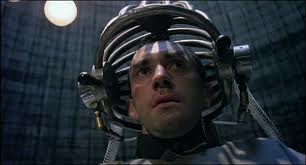
In time, Alex and his friends go to far (even for them!) and an innocent woman is murdered during a break-in. His friends, who are already angry over his bullying and strong arming of them, decide to betray him and leave him to the police. Once in prison, Alex decides to cut his sentence short by undergoing a radical government experiment – an artificially created conscience through Pavlovian conditioning!

The result of this conditioning is that Alex is no longer capable of committing any acts of violence. In fact, even the mere thought of violence produces a reaction so strong that he breaks down and is overwhelmed by nausea. This renders him benign, but also helpless. And in time, all his past crimes begin to catch up with him and he is nearly killed. Once he wakes up in the hospital, he discovers the conditioning has worn off, and he can either resume his old ways, or strike out on a new path…

Another interesting side effect of the conditioning is that he can no longer listen to Beethoven without getting sick either. This has to be one of the most curious and intriguing scenes in the movie, where a restrained and helpless Alex begs the doctors to turn off the symphony because he can’t stand the idea of not being able to listen to it. Much like everything else he does, it speaks volumes of his sociopathic nature.

Ultimately, the movie differed from the novel in that the final chapter was omitted. Immediately before this, we see how Alex is now freed from the conditioning. He also seems intent on blaming the current government, which will oust them from power. But beyond that it not quite clear what’s going to happen. However, the following chapter shows how Alex has realized, independently, that he doesn’t want to live a life of violence anymore. Human freedom, he’s determined, is the ability to make choices for oneself, free of persuasion and operate conditioning.

As I said, I truly think the movie was an improvement on the novel, which is a rare thing with adaptations. Still, it is was in the film that the point of the story really came through, thanks to Kubrick’s usual attention to detail and subtlety. Whether it was through those long, close-up shots of McDowell and his crazy eyes, the combination of wide angle action shots in slow motion, or the way that it played to the tune of Beethoven, you really got a sense of the odd combination of genius and madness that is the anti-hero Alex. The reliance on white, sterile settings also helped to punctuate the sociopathic nature of the story – how underneath the veneer of domesticity, brutality and violence can exist! And last, by leaving the ending a mystery, the moral was more ambiguous, which made for a far more effective dystopian feel!

A Scanner Darkly:
Next up, we have Philip K Dicks seminal novel about drug abuse, self-destruction and the various hypocrisies arising out of America’s war on drugs. In this near-future scenario, which takes place in California in 1994 (seventeen years after it was written), a new drug has hit the streets known as Substance D – or SD, which stands for Slow Death. This powerful hallucinogenic is a great high, is violently addictive, and can render users brain damaged after too much use and abuse. And as a result of its popularity and impact, society is gradually becoming a full-blown police state, where cameras – or “Scanners” – are on every street corner and in the home of every suspected dealer.

Written from the point of view of an undercover narcotics agent, the story follows his descent into addiction and his eventual inability to tell reality from fantasy. Through repeated use of Substance D, he gradually becomes brain damaged himself, is released from the police department, and must go to a privately run recovery-center known as “New-Path”. There, he discovers that these centers, which operate like franchises, are actually growing the plant that Substance D is synthesized from. An interesting twist in which we learn that the people profiting from the side effects are the one’s providing the drugs. A stab at strong-arm governments or the pharmaceuticals industry, perhaps?

For the sake of adapting the movie to film, director Richard Linklater shot the entire thing digitally and then had it animated through the use of interpolated rotoscope. The effect of this was to render every single image in a vivid, almost cartoon-like format, which could only be interpreted as an attempt to mimic the effects of hallucinogens. This animation also came in handy with the rendering of the “scramble suit”, a sort of cloak-like device that PKD invented to ensure that undercover agents in his story could completely disguise their appearance, voice, and any other identifying characteristics.

In addition to being science fiction genius, these cloaks were a clear allegory to the anonymity of undercover agents and a faceless system of justice. While responsible for infiltrating and busting up the narcotics subculture, PKD clearly understood that this sort of profession can lead to an identity crisis, especially if the agents in question find themselves using drugs and becoming over-sympathetic to the people they are spying on. This, of course, is precisely what happens to the main character in the story!

In short, the novel was a commentary on the dangers of recreational drug use, but also on the reasons for why such subcultures come into existence in the first place. In addition to ruining lives and causing crime, repression, domestic surveillance, and other extra-legal practices can become quite commonplace. All of this mirrored PKD’s own experiences with the drug subculture and the law, which is why he dedicated the book to all the friends he had who succumbed to drug abuse and died as a result. Very sad!

And let’s not forget the name, a play on the words from the Biblical passage, 1 Corinthians 13:12 : “Through a mirror darkly.” In this day and age, where “scanners” are the means for monitoring society and police officers spend hours looking at their feeds, the scanner has become a sort of means through which people attempt to gaze into other peoples’ souls. But, as with the Biblical passage, this title is meant to refer to how, when we look at the problems of drug use in our society, we are seeing it all through a haze, the result of our own prejudices and preconceptions.

Akira:
How the hell did I forget this one last time? I mean seriously, this is one of my favorite movies and one of the most inspired Mangas of all time! Not only that, it’s a pretty good example of a dystopian franchise. And yet, I forgot it! WHAT THE HELL WAS I THINKING?! But enough self-flagellation, I came here to talk about Akira! So, here goes…

In 1988, famed Japanese writer, director and comic book creator Katsuhiro Otomo undertook the rather monumental task of adapting his Manga series Akira to the big screen. Though some predicted that a two hour movie could never do justice to the six-volume series he had written, most fans were pretty pleased with the end product. And the critical response was quite favorable as well, with the film being credited for its intense visualizations, cyberpunk theme, its post-apocalyptic feel, and the exploration of some rather heavy existential questions.

To break it down succinctly, Akira takes place in Neo-Tokyo, a massive urban center that was literally build up from the ruins of the original. According to the story’s background, WWIII took place in 1989, and after twenty years of rebuilding, the world once again appears to be one the brink. However, as we come to learn, the destruction of Tokyo was not the result of the nuclear holocaust per se. It’s destruction merely heralded it in after the world witnessed the city’s obliteration, assumed it to have been the result of a nuclear attack, and starting shooting their missiles at each other. The real cause was a phenomena known as “Akira”, an evolutionary leap that scientists had been studying and lost control of…

Quite the story, but what I loved most about the adapted movie and the manga on which it was based was the level of detail. Set in 2019 (the same year as Blade Runner, coincidentally!) this series incorporated a lot of concepts which made for a far more intricate and interesting tale. First off, there’s the concept of a post-apocalyptic generation that is filled with unrest and angst, having grown up in a world permeated by the horrors of nuclear war. Second, there’s the ever-present element of gang warfare that has sprung up amidst the social decay. Third, there’s a government slouching towards dictatorship in response to all the protests, unrest and chaos that is consuming the city.

Into all this, you get a secret military project in which the Akira phenomena is once again being studied. Though motivated by a desire to control it and prevent what happened last time from happening again, it seems that history is destined to repeat itself. Once again, the survivors must crawl from the wreckage and rebuild, their only hope being that somehow, they will get it right next time… A genuine dystopian commentary if ever I heard one!

But what was also so awesome about the series, at least to me, was the underlying sense of realism and tension. You really got the sense that Otomo was tapping into the Zeitgeist with this one, relating how after decades of rebuilding through hard work and conformity, Japan was on the verge of some kind of social transformation. Much like in real life, the characters of the story have been through a nuclear holocaust and have had to crawl their way back from the brink, and a sense of “awakening” is one everybody’s lips and they are just waiting for it to manifest.

A clear allusion to post-war Japan where the country had been bombed to cinders and was left shattered and confused! Not to the mention the post-war sense of uniformity where politicians, corporations and Zaibatsu did their best to repress the youth movements and demands for social reform. Well, that was my impression at any rate, others have their own. But that’s another thing that worked so well about Akira. It is multi- layered and highly abstract, relying on background, visuals and settings to tell the story rather than mere dialogue. In many ways, it calls to mind such classics as 2001, Clockwork Orange, and other Kubrick masterpieces.

Children of Men:
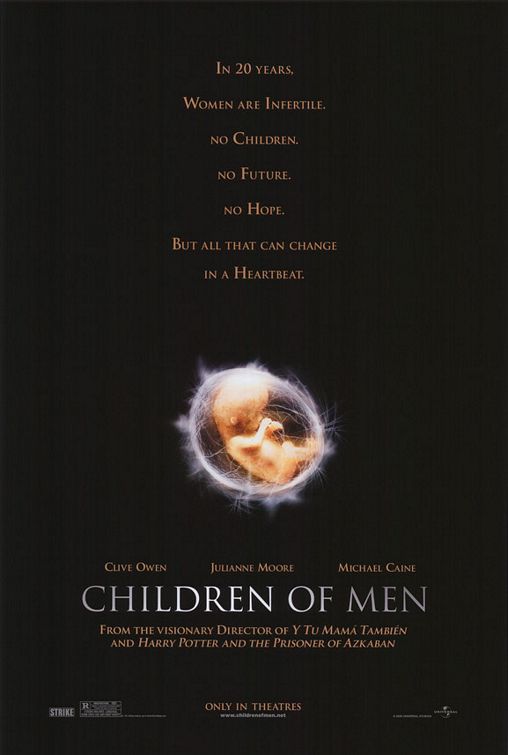
Made famous by the 2006 adaptation starring Clive Owen, this dystopian science fiction story was originally written by author P.D. James in 1992. The movie was only loosely based on the original text, but most of the particulars remained the same. Set in Britain during the early 21st century, the story takes place in a world where several subsequent generations have suffered from infertility and population growth has dropped down to zero. The current generation, the last to be born, are known as “Omegas” and are a lost people.

What’s more, the growing chaos of the outside world has also led to the creation of a dictatorial government at home. This is due largely to the fact that people have lost all interest in politics, but also because the outside world has become chaotic due to the infertility crisis. Much like in V for Vendetta, the concept of “Lifeboat Britain” makes an appearance in this story and acts as one of the main driving forces for the plot.
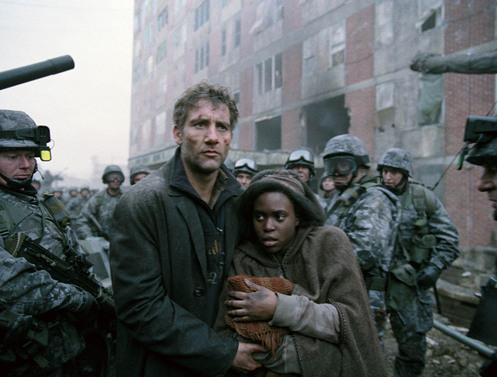
In any case, this also leads to the birth of a resistance which wants to end the governments tyrannical control over society, and which comes to involve the main character and his closest friends. In time, the plot comes to revolve around a single woman who is apparently pregnant. Whereas some of the rebels want to smuggle her out of Britain and hand her over to the international Human Project, others want to use her as a pawn in their war against the government. It thus falls to the main character to smuggle her out, protecting her from resistance fighters and the military alike.

Naturally, the movie drew on all the novels strongest points, showing how society had effectively decayed once childbirth effectively ended. It also portrayed the consequences of impending extinction very well – chaos, withdrawal, tyranny, etc. However, when it came time to adapt it to the screen, Mexican film director Alfonso Cuaron (who brought us such hits as A Little Princess, Y Tu Mama Tambien, and Harry Potter and the Prisoner of Azkaban), also used a variety of visual techniques and sets to convey the right mood.

For example, most of the sets were designed to look like near-future versions of today. In Cuaron’s estimation, all technological progress would have ceased once the implications of the crisis had fully hit, hence all cars, structures, weapons and gadgets were only slightly altered, or used sans modification. So while the billboards, newspapers and signs were all updated and carried messages appropriate for the period, cars, guns and other assorted background pieces looked entirely familiar.

In addition, much of the movie is shot in such a way so that the images are grey and the light effect seems piercing. This conveys a general mood of drab sadness, which is very accurate considering the setting! Last, Cuaron and his camera crews made many continuous action shots using wide angle lenses in order to capture a sense of crisis and how it effected so many people. Never was there a sequence in which you only saw the main actors and their immediate surroundings. The focus, like the scope of the story, was big and far-reaching.

Ghost in the Shell:
Much like Akira, this franchise comes to us by way of Japan and is cyberpunk-themed. In addition, it also came in the form of a manga, then onto a film, but with a television series to follow. And in many respects, it qualifies as dystopian, given that it took place in a dark future where technology has forever blurred the line between what is real and what is artificial. In addition, it also tapped into several cyberpunk trends which would prove to be quite apt (i.e. cyberspace).

Again, this story takes place in Japan in the early 21st century, a time when cybernetic enhancements and technological progress have seriously altered society. The main character is named Motoko Kusanagi, a member of a covert operations division of the Japanese National Public Safety Commission known as Section 9. She is affectionately known as “Major” given her previous position with the Japanese Self-Defense Forces. And did I mention she’s a cyborg? Yes, aside from her brain and parts of her spinal cord, she is almost entirely machine, and this plays into the story quite often.

In addition to facing external threats, Kusanagi and her companions also face conflicts that arise out of their own nature. These deal largely with issues relating to their own humanity, whether or not a person and their memories can even be considered real anymore if they have been replaced by digital or cybernetic enhancements. These questions were explored in depth in the movie, where events revolve around a sentient program that was developed by the government, but which has since gone rogue and is seeking an independent existence.

However, another thing that makes Ghost in the Shell a possible candidate for the category of dystopia is the setting. Whether it was the manga, the movie, or the television series, the look and feel of the world in which it takes place is quite telling. Always there is a dirty, gritty, and artificial quality to it all, calling to mind The Sprawl, Mega City One, and Neo-Tokyo.

As in these settings, things look futuristic, but also rustic, poor and improvised, hinting at extensive overcrowding and poverty amidst all the advanced technology. This is a central element to cyberpunk, or so I’m told. In addition to being futuristic, it also anticipates dystopia, being of the opinion that this “advancement” has come at quite a cost in human terms.

Logan’s Run:
Considered by many to be a classic dystopian story, Logan’s Run takes place in a 22st century society where age and consumption are strictly curtailed to ensure that a population explosion – like the one experience in the year 2000 – never happens again. In addition, society is controlled by a computer that runs the global infrastructure and makes sure that the all the dictates of population and age control are obeyed.
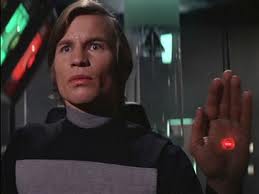
In any case, the story revolves around this concept of an age ceiling, where people are monitored by a “palm flower” that changes color every seven years. When they reach 21 – on a person’s Lastday – the crystal turns black and they are expected to report to a “Sleepshop” where they will be executed. Those who refuse to perform this final duty are known as “Runners”, and it falls to “Deep Sleep Operatives” (aka. Sandmen) to track down and terminate these people.

The main character – Logan 3 – is one such operative. On his own Lastday, he is charged with infiltrated the underground railroad of Runners and finding the place they call “Sanctuary”. This is a place where they are able to live out their lives without having to worry about society’s dictates and controls. However, in time, Logan comes to sympathize with these people, due largely to the influence of a woman named Jessica 6. In the end, the two make plans to escape together for Sanctuary, which turns out to be a colony on Mars.

Right off the bat, some additional elements can be seen here. In addition to the concepts of Malthusian controls and ageism, there is also the timeless commentary on how rationalization and regimentation can lead to inhumanity and repression. Much like in We or Anthem (by Ayn Rand), people do not have names as much as designations. All life is monitored and controlled by a central computer, and it is made clear towards the end that the computer is in fact breaking down. I can remember this last theme appearing in an episode of Star Trek TNG, where a planet of advanced people are beginning to die off because their “Custodian” is malfunctioning and no one knows how to fix it.

Metropolis:
A true classic of both film and expressionist art, this movie also has the added (and perhaps dubious) honor of being a classic of dystopian science fiction! Created in Weimar Germany in 1927 by Fritz Lang, this movie tells the story of a dystopian future where society is ruled by elites who live in vast tower complexes and the workers lives in the recesses of the city far below them where they operate the machinery that powers it all.

This physical divide serves to mirror the main focus of the story, which is on class distinction and the gap between rich and poor. To illustrate this artistic vision, director Fritz Lang relied on a combination of Gothic, classical, modern and even Biblical architecture. In an interview, Fritz claimed that his choices for the set design were based largely on his first trip to New York where he witnessed skyscrapers for the first time. In addition, the central building of the futuristic city was based on Brueghel’s 1563 painting of the Tower of Babel (right>).

The theme of class conflict is further illustrated by the fact that the workers who live in the bowels of the city are also responsible for maintaining the machinery that makes the city run. One is immediately reminded of H.G. Wells’ The Time Machine and the divide between the Morlocks and the Eloi. This comes through even more when the workers decide to revolt and begin ransacking the neighborhoods of the elites. Ultimately, it is only through the love of the two main characters – Freder and Mariah – that the gulf between the two is sealed and order is restored, a fitting commentary on how society must come together in order to survive and achieve social justice.
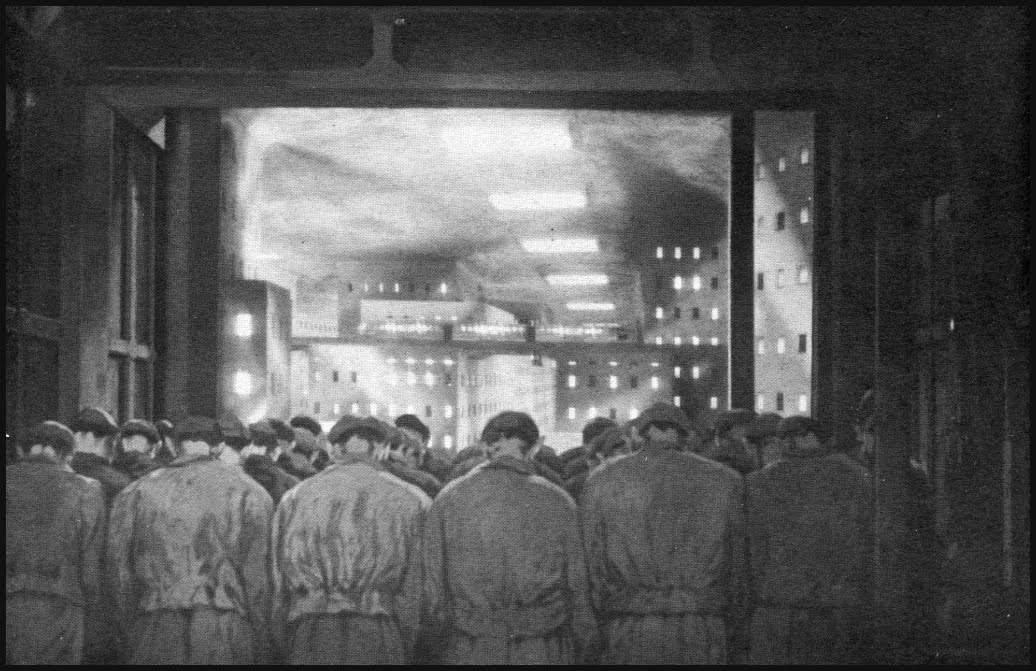
In another act of blatant symbolism, we learn early on in the movie that the workers have taken to congregating in a series of tunnels that run under the city. It is here that they meet with Maria, their inspirational leader, and makes plans to change society. So in addition to tall, Babel-like buildings illustrated the gap between rich and poor, we have workers who are literally meeting underground! Wow…
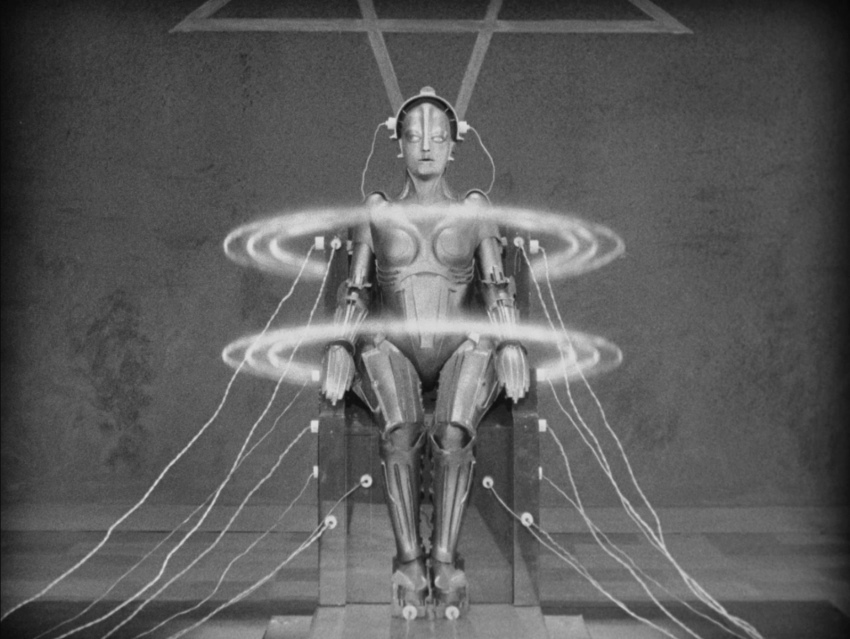
In addition, several other dystopian elements weave their way into the story. The line between artifice and reality also makes an appearance in the form of the robot which the movie is best known for. This robot was created by Rotwang, a scientist who is in the service of the main character’s father – Joh Fredersen, the master of the city. Apparently, this robot is able to take human form and was created to replace his late wife. Once this robot was released into the city, she began sowing chaos amongst men who begin to lust after her, and is the very reason the workers began revolting in the first place. She even causes the character of Rotwang to go insane when he can no longer distinguish between the robot and the woman she’s impersonating.

Neuromancer/Sprawl Trilogy:
Gibson is one of the undisputed master’s of cyberpunk and future noire lit and it was this novel – Neuromancer – that started it all for him. In it, he coined the terms cyberspace, the matrix, and practically invented an entire genre of Gothic, techno-noire terminology which would go on to inspire several generations of writers. His work is often compared to Blade Runner given the similar focus on urban sprawl, cybernetic enhancements, the disparity between rich and poor, and the dark imagery it calls to mind.

The first installment in the “Sprawl Trilogy”, this book takes place in the BAMA – the Boston-Atlanta Metropolitan Axis (aka. The Sprawl). In this world of the 21st century, cyberspace jockeys or cowboys use their “decks” – i.e. consoles – to hack into corporate databases and steal information. The purpose is, as always, to sell off the information to the highest bidder, usually another corporate power. In addition, guerrilla tactics and domestic terrorism are often used to get employees out of their contracts, seeing as how most companies have no intention of ever letting their talent go!

picture by Maxim-Lysak on deviantArt

Also, there is the massive gulf that exists between the rich and the poor in these novels. Whereas the main characters tend to live in overcrowded tenements and dirty neighborhoods, the rich enjoy opulent conditions and control entire parts of the world. In addition, the richest clans, such as the Tessier-Ashpools and Vireks, actively use cloning and clinical immortality to cheat death, and often live in orbital colonies that they have exclusive rights to. Much like in his “Bigend Trilogy”, much attention is dedicated to the transformative power of wealth and how it affords one better access to the latest in technology.

But always, the focus is on the street. Here, jockeys, freelancers and Yakuza agents are at work, pulling jobs so they can buy themselves the latest enhancements and the newest gear. In the case of Molly Millions, a freelance lady-ninja, this includes razor nails that extend from her fingertips. In the case of Yakuza enforcer from the short-story (and movie) Johnny Mnemonic, it consists of a filament of monomolecular razor wire hidden inside his thumb. For others, it might consist of artificial limbs, new organs, implants of some kind. Whatever ya need, they got it in the Sprawl. If not, you go to Chiba City or Singapore, chances are it was made there anyway!

*Interesting  Fact: according to Gibson, Blade Runner came out when he was still tinkering with the manuscript for this novel. After seeing it, he nearly threw the manuscript out because he was afraid Ridley Scott had pre-empted him! Funny how things work out, huh?

Final Thoughts:
Gee, there really isn’t much more to say is there? One thing I have noticed is that much of modern dystopia comes to us in the form of the cyberpunk genre. Though the definition of cyberpunk appears to constantly be evolving, it is generally acknowledged that it is a postmodern form of science fiction that combines “high tech and low life.” Having sorted through several modern examples of dystopian sci-fi, I can say that this is certainly an apt description.

In essence, it assumed that the presence of high tech would entail the emergence of a dystopian society, that the endless march of progress would lead to the destruction of the environment, the devaluing of human life, the elimination of privacy, and the line between real and fake. This last aspect was especially important, embracing cybernetics, virtual reality, and things like cloning and clinical mortality. Since the 1980’s, all of these notions have infiltrated science fiction movies, television, and have even become cliches to some extent.

This genre has given rise to new kinds of science fiction as well. For example, it is generally acknowledged that a sub genre known as post-cyberpunk emerged in the 1990’s which broke away from its predecessor in one key respect. Whereas it too focused on the rise of technology, it did not anticipate dystopia as part of the process. This is best exemplified by books such as Neal Stephenson’s The Diamond Age, a 21st century bildungsroman which predicted vast social and political changes as a result of nanotechnology.

Other sub genres that have emerged in recent years include “Steampunk”, a literary form that combines Victorian era technologies with the punk genres noire sensibilities. Other derivatives include Dieselpunk, Nanopunk, Biopunk, and even fantasy-punk crossovers like Elfpunk. Yes, like most things in the post modern era, it seems that literary genres are becoming fragmented and tribalistic!

But alas, I still feel the need to ask the question, what’s happened to dystopian literature of late? In my initial post, I got a lot of people asking me if I could include some more modern examples. You know, stuff that’s come out since 1984 and The Handmaids Tale. But unfortunately, what I’ve found tends to be more of the same. Just about every example of dystopian fiction appears to draw its inspiration from such handy classics as the one’s I’ve already mentioned, or is in some way traceable to them. Does this mean that we’ve hit bottom on the whole genre, or could it just be we’ve moved away from it for the time being?

Well, I recently learned from an article on IO9 that Neal Stephenson himself stated that science fiction needed to stop being so pessimistic and had to start getting inspirational again. Perhaps he’s onto something… Maybe we’ve gone too far with the whole cautionary tale and need to steer things back towards a brighter future, urging people on with common sense and technological solutions rather than laments. Maybe we need to let them know that such problems as world hunger, overpopulation, pollution, climate change, poverty, war, licentiousness and greed can all be overcome.

Then again, I’m working on a couple dystopian tales right now… Is it too much to ask that this craze last just a few years longer?

Thanks to all who’ve written in and “liked” my dystopian series! Hope to see y’all again soon as I get into ore cheerful things…

Dystopia in Popular Culture

Picking up where I left off last time, I thought I’d get into some examples of how dystopian fiction has influenced popular culture. And given all the feedback I got on my previous post, I also wanted to incorporate some suggested titles as well. But, just to be clear, I still haven’t read Hunger Games, so please don’t ask about it!

Alright, so last time, I mentioned just about every examples of dystopian literature I could find. From the earliest examples of Candide and Gulliver’s Travellers, onto the more modern interpretations of The Time Machine and We, and culminating with classics like BNW and 1984, I essentially ended before I could get into how these novels have had an influence on film and other media. In addition to inspiring the written words, these classics have inspired an entire culture of iconography, symbolism and motifs.

Not surprising, really. Every work of dystopian fiction and satire has sought to create images in the reader’s mind, using highly specific descriptions in order to paint a scene and inspire the right mood. Whenever these novels have been adapted to film, or directors were simply trying to convey similar themes, the task of properly conveying it all visually has always been a hefty one. The same is true for graphic novels and any other visual medium. So today, just for fun, and perhaps to complete my romp through the realm of this inspired genre, here are some examples of dystopia in modern media:

Blade Runner:
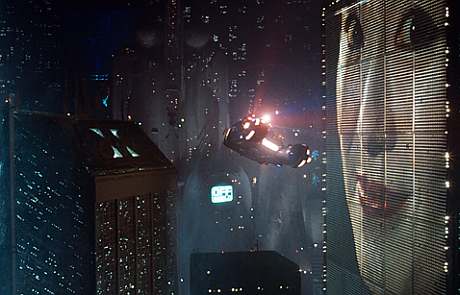
Granted, Blade Runner was based on Philip K Dick’s Do Android Dream of Electric Sheep?, a dystopian story in some respects, but not in the same way that the movie was. Whereas the novel took place in a post-apocalyptic Los Angeles (circa 2019) which is sparsely populated and where a living animal is seen as a status symbol. In the movie, the year and location are the same, but the setting is starkly different. Here, it is a stuffy, polluted, mega-city made up of massive skyscrapers and giant animated billboards, where the streets are dirty and packed with people who spoke a strange dialect known as Cityspeak (check out my post on Cityspeak for on that).

And what made it all so awesome, aside from the plot, was the attention to detail. Director Ridley Scott, the same man who brought us Aliens, brought his usual artistic touch and a team of first-grade set designers to the table. Overall, they produced some pretty awesome concepts, ones which are still being praised to this day. Here are just a few:

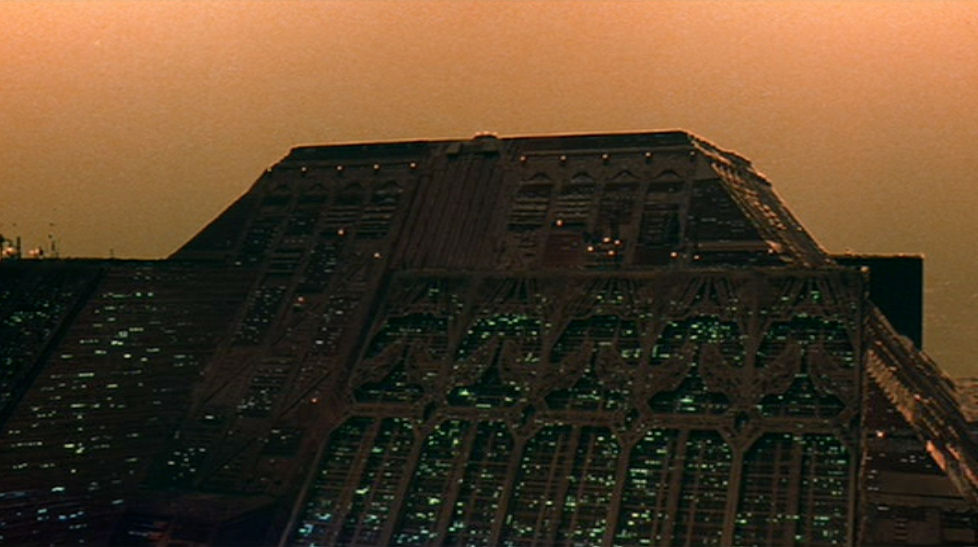
The Tyrell Corp. building, which was kind of the focal point of the movie. Early on, we get a birds-eye view of it as Detective Deckard Cain (Harrison Ford) is being flown there in a Spinner (flying car). Later on, the leader of the Replicant party, Roy Batty, travels there as well seeking answers to some of life’s most basic questions.

For starters, the building is clearly based on a the design of a Ziggurat, the breed of ancient Babylon temple that inspired such legends as the “Tower of Babel”, and which serves as a clear representation for the almost godlike power Tyrell wields. The interior design, with its large columns, soft lighting, candles, an owl (a possible reference to Athena’s owl) and the way Tyrell can block out the sun at will all serve to further illustrate this point. That scene near the end where is dressed in lavish white robes also seemed pretty symbolic, I’d say!

And for those who read 1984, there is a possible encoded reference to the four ministries as well- Truth, Peace, Love, and Plenty – all of which were pyramid-like in design. Coincidence? Who knows? All that matter is when it comes to massive structures that harken back to ancient Egypt and Mesapotamia, the symbolic value is clear. Much like the civilizations that built them, these things stood for power and dominion, both over lesser subjects and the afterlife itself. They were the ruler’s way of achieving immortality by creating something that embodied their power and would stand the test of time. As Shelley said in his poem “Ozymandias”: “Look on my works, ye mighty, and despair!”

And when it comes right down to it, this old-world kind of mentality, updated for the modern age, is indispensable to any dystopian story: Absolute power, wielded by the few over the many and represented in conspicuous and obvious ways! In many cases, it comes in the form of totalitarian governments (a la The Party) who runs things with an iron fist and build massive government buildings to remind everyone of who’s in charge. But in other cases, it takes the form or corporate dominance, where the wealthy rule society like feudal barons while the rest live like serfs. And much like their bureaucratic peers, they choose to lord this by building lavish buildings to themselves and covering themselves with ornate symbols!

Another trademark bit of dystopian set design were the massive skyscrapers, complete with giant video-billboards. No doubt, these too were designed to give the impression of the control corporations had over the people of LA in the future. As if regular sized billboards ads weren’t enough, (or televised, print, bench, flier, blimp, and radio ads) now it seemed that corporate monopolies were splastering their logo’s on screens the size of buildings!

And just to make it realistic, Ridley Scott and his designers were also sure to use logos that were already big in the early 80′s and seemed destined to get bigger – Atari, Coca Cola, Pan Am Air, Cuisinart, Bell System. But interestingly enough, all of these companies suffered heavy losses after the movie’s release. The phenomena came to be known as the “Blade Runner Curse”. Strange, one would think audiences began associating them with dark imagery or something ;)

But personally, I think one of the most effective aspects of the movie’s look and feel came through in the construction of the streets. Here, Scott’s design team made sure that every shot was crammed full of people who whore plastic jumpers, dark glasses, cool headgear, and carried what looked like umbrellas with neon handles. Then came the street vendors who peddled food or exotic pets in the same neighborhoods, facades that were ashen grey in color, and all kinds of neon signs written in various languages. It painted quite the scene, one which can only be described by the words “Future Noire”.

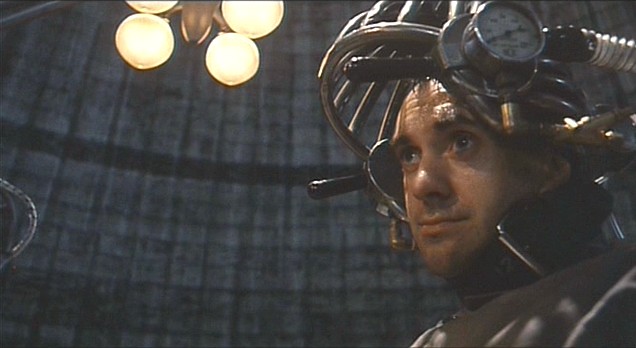
Brazil: 
Directed by Terry Gilliam, an old-time member of the comedy troupe Monty Python and director of such movies as The Adventures of Baron Munchausen, The Fisher King and 12 Monkeys, Brazil was a rather humorous take on the classic 1984. In it, we are presented with a dystopian society that is ruled by a totalitarian regime, but which is buffoonish and incompetent rather than exacting and brutal.

In addition, the people in this world are also overly-dependent on machinery which is rather unreliable and poorly maintained. And last of all, there is the main character of Sam Lowry, a low-level government employee who works in a mind-numbing government job, lives in a small apartment, and is having prescient dreams about a woman and a man in mask who is torturing him.

The movie shared many plot and thematic elements with 1984, but much of its genius comes through in the set design and direction. Given that the aim of the movie was to present a world in which the machinery is as undependable as the bureaucracy, Gilliam decided to go with a look that would call to mind the kind of over-the-top aesthetics of past sci-fi films. While everything was admittedly grey, dark, and shot in wide and tilted angles, there was also a sort of comic, retro feel to the whole thing. This helped to establish the central premise of the movie, in which incompetence and mind-drudging inefficiency were what was destroying humanity, not a specific agenda.

In addition, Gillian had much to say about artifice and vanity in this film. Lowry’s mother, who plays an important role in the plot, is obsessed with plastic surgery which she hopes will make her look younger. Towards the end of the movie, Lowry dreams that his mother is attending the funeral of a friend who died as a result of too many invasive procedures. And in what can only be described as an moment of oedipal confusion, his mother even looks like Jill, the much younger woman he has fallen in love with!

An interesting take on 1984 isn’t it? Rather than following a philosophy like the one espoused by O’Brien, where the Party wields absolute control over reality and people’s minds, want to eliminate all emotion except hatred, and has destroyed any activities that do not serve their interests, the totalitarian regime in Brazil is instead motivated by laziness and a desire to cover its own ass. Not being wrong literally means more to them than the lives of their citizens. What better commentary is there on a bureaucratized society?

Judge Dredd:
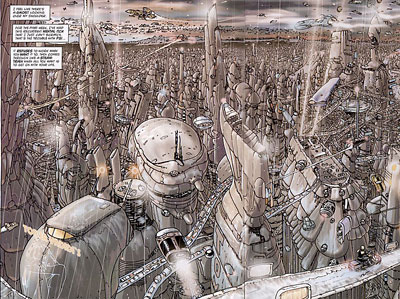
Yes, the movie didn’t so well, and the script and plot were so simplistic that Stallone himself called it a “no-brainer”. But that doesn’t change the fact that the source material is actually one of the better graphic novels in existence, especially when it comes to depth and irony. Set in a post-apocalyptic world of the not-too-distant future, the comics take place for the most part inside “Mega City One”, one of several megalopolis’s that have sprung up in the US after a nuclear war which left it and Soviet Union utterly devastated.

Within this city, just about everything is automated and unemployment is almost universal. Every city block contains over fifty-thousand people, amounting to a population of about 400 million people per city. Due to overcrowding, massive unemployment and uncontrollable violence, the leaders of this future society created a quasi-fascist justice system whereby individual “Street Judges” (policemen) were charged with dispensing judgement and punishment on site. This had a stabilizing effect on society, but the problems remain…

Automatically, one can see a few things at work here. For starters, there’s the Hobbesian idea of man in the state of nature; how because of nuclear war, life became “nasty, brutish and short” and a tyrannical system was needed to put things back in order. In addition, there’s the whole “who polices the police?” side of things, where audiences naturally fear that the judges will abuse their power or fight to the death to hang onto it.

And last, there is the very real sociological concept of the “megalopolis”, the Northeastern mega city running from Virginia to Maine which was originally coined by French geographer Jean Gottmann. In the course of the comic’s history, it is made clear that Mega City One was not actually designed, but grew out of natural urban sprawl that predated the nuclear war. It was only after the war that it became a self-contained place where automation, unemployment and chaos become so rampant.

Now one might also get the impression that this was all meant to illustrate some preachy, “we made a mistake” kind of message (which is in fact what happened in the movie). But in truth, these issues are presented with a fair degree of subtly and irony in the graphic novel.

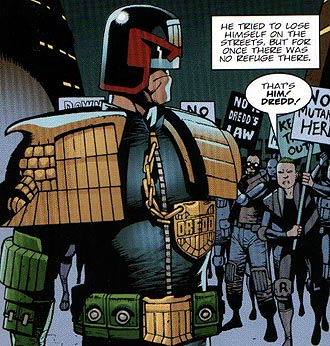
Knowing full well how his audience would react to fascist symbols and ideology, John Wager (creator) presented readers with a story that is loaded with both. For starters, the Judge’s symbol is an eagle, which bears a striking resemblance to the Nazi black eagle. The Judge’s uniform is also highly ornate and calls to mind the classical imperial motifs of Centurions and Gladiators. And the fact that Dredd’s face is never seen can only be seen as highly indicative. He’s a faceless law-giver, much like Stormtroopers or the SS.

What’s more, the people who sport these symbols and preach these values are presented as heroes. Judge Dredd, for all intents and purposes, is a social fascist who is bereft of  sentimentality, doubt or remorse over what he does. Unlike the other Judges, there’s no crime he won’t ignore, and he never stops for more than ten minutes at a time to rest in a sleep chamber, then he’s back on the job. He also has little sympathy for people who believe in enlightened reform or who criticize the Street Judges for their abuses of power.

The purpose of this always seemed to be for the sake of ironic social commentary. Rather than condemning the Judges and the system they represent (or endorsing them) we are meant to see how – under the right circumstances – something like this could very well happen!

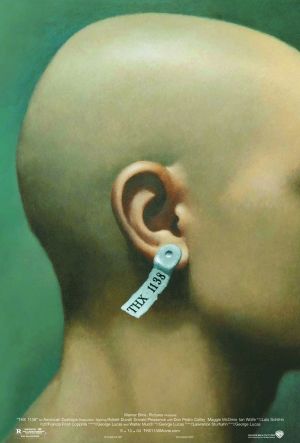
THX 1138:
You know, its movies like this that remind us all that there was a time that George Lucas had talent, when he cared about thing like plots and inspired story-telling, and not special effects and merchandizing. But I’ll leave my riffs about the Star Wars prequels for another day. Right now, I will admit that there is plenty about this directorial debut worth praising, and not the least of which was the faithful dystopian tone it struck.

Set in a dystopian future where the human race is required by law to take drugs that suppress emotion and sexual desires, are controlled by android police, and all inhabitants worship a godlike being known as OMM 0910, the story is clearly a commentary on how rationalization and automation threatened to destroy humanity. In addition, there are clear and obvious parallels to novels like We, Brave New World and 1984.

For example, the people in this future are all given designations instead of names, the state sanctioned religion is reminiscent of Big Brother, and the mandatory use of mind altering drugs calls to mind Soma. And of course, the stark, clinical portrayal of society in the future is very similar to descriptions of the One State and Oceania in We and 1984. And let’s not forget the scene were android police torture and abuse the main character? Tell me that didn’t come directly out of the scenes where Winston was languishing in the Ministry of Love!

And of course the overall moral of the story, that love is precious and will fight the odds against the forces of cold rationality, this too was practically lifted from Orwell’s and Zamyatin ‘s classics! This is not a criticism, mind you. If anything, Lucas demonstrated a keen ability to adopt freely from novels and franchises in a way that really worked. Much as he would do with Star Wars just a few years later, he seemed to know where to borrow from and how to put it all together!

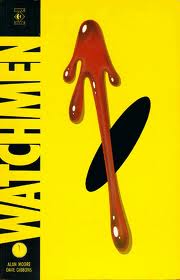
The Watchmen:
Now this was one of my favorite graphic novels of all time. Lucky for me, it also falls into the realm of dystopian fiction, hence I can talk about it here! In addition to taking place in an alternate universe, the setting is one which is quite dark and gritty. Set in the 1980′s, which is the same period in which it was written, the story is of an alternate reality where the existence of superheroes has caused history to diverge quite a bit from our own. Technically, superheroes have been in existence for many decades, which helps to give the story a real sense of historicity.

However, it was with the service of superheroes in actual wars and government programs that caused history to shift. Beginning with Doctor Manhattan’s intervention in Vietnam and culminating in the development of cheap, renewable energy by Ozymandias (with Manhattan’s help), the Cold War took an unexpected turn. Russia was systematically beaten back to the point where it was becoming desperate and nuclear war seemed inevitable. Meanwhile, society began to decay as war began to occupy more and more of society’s attention and the inner cities were neglected and left to rot.

Told for the point of view of Rorschach, a borderline social fascist with deep-seated issues, the darkness and impending sense of doom really come through! As he investigates the death of the Comedian, a fellow superhero who’s death incites the whole plot, we learn how both he, the Watchmen, and society came to be the way it is. His own tragic story, and that of the Comedians, serves to illustrate how the American Dream failed and cynicism and fear took over.

But of course, the point with dystopian stories is not just to speculate, but to make a point about the time in which it was written. Looked at from this angle, the Watchmen was really telling us about the real world of the 1980′s, a world which had come very far since the post-war era in terms of technological, social and cultural development. And like many other cultural commentaries, a sense of failure and betrayal is at work. What happened to the post-war dream? What happened to the American Dream? How did poverty, crime, licentiousness and cynicism become so rampant? From Rorschach point of view, the Cold War is largely to blame, but so is human nature. And given that he is such a dark and messed up character, I don’t think his opinions were meant to be taken too seriously!

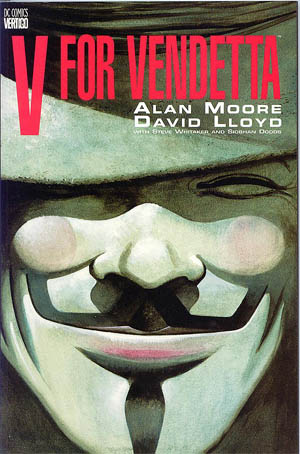
V for Vendetta:
Yet another awesome graphic novel, and one which also inspired a hit movie adaptation. A piece of speculative fiction, this series was produced in the 1980′s and was set in a near-future dystopian England. Over the years, this series’ thematic elements and symbolism have been compared to 1984. However, in truth, the story has much more in common with The Iron Heel and It Can’t Happen Here, by Sinclair Lewis (which should have made my list of dystopian literature, dammit!) In these two novels, especially the latter, a fascist regime takes power by appealing to the people’s sense of moral purity and a desire for order, and in the end the people got more than they bargained for!

But alas, the story in the comic book version involves nuclear war and the transformation of the UK into “lifeboat Britain”. Given that the movie was made in the early 2000′s, the story had to be updated somewhat. There, the focus shifted to terrorism and the exploitation of fear – echoes of The Handmaids Tale and “Loose Change” there, but I digress. After being passed over by the nuclear holocaust, Britain found itself being flooded with refugees and victims of the war. Bit by bit, authoritarian measures were put into place to deal with the crisis, until eventually, the fascist government of Norsefire took over, and that’s when the real changes happened!

They’re motto: “Strength Through Purity, Purity through Faith” pretty much sums it up! In addition to pushing a religious agenda, they were also very much concerned with purging British society or minorities and “undesirables”. A police state was put into place where a series of departments – the Eyes, Ears, Mouth, and Hands – were tasked with controlling and monitoring all aspects of society. The Eyes handled surveillance, the Ears listened to people’s by tapping their phones and bugging their homes, the Mouth disseminated propaganda, and the Hands investigated criminal activity. And of course all minorities, be they racial minorities, homosexuals, or just political dissidents, were sent to concentration camps where they were exterminated and experimented on.

Into all this enters the character of V, an anarchist revolutionary who is the product of one camp’s twisted experiments. As a result of their invasive procedures, he became an enigmatic genius/amnesiac with a serious chip on his shoulder who is now on a quest to pay the government back for its crimes. His famous disguise, the Guy Fawkes mask and robes of black and red, are as intrinsic to establishing his character as his monologues and affinity for blowing up government buildings!

Judging by the color scheme alone, one immediately can tell that this man is an anarchist by his use of the color black (or anarcho-syndicalist seeing as how he combines it with red). The mask is a further indication of this, given that Guy Fawkes was a radical who tried to blow up parliament because he believes any vestige of government to be anathema to freedom. So in the end, we can see that this a man who wants to bring down the system and is reaching into Britain’s forgotten past to resurrect the idea of civil liberty.

In contrast, Norsefire’s logo was pretty straightforward too. In the comic, Norsefire represented itself on its “motivational posters” with a set of white wings with a space in the middle that was in the shape of a cross, and behind it lay flames. This is obviously meant to conjure up images of religious propriety, or holy war, and of action, all of which are clear allusions to fascist and religious-right iconography. It was also meant, in my opinion, to call to mind Britain’s Action Party, a fascist political group that played a small but influential role in British political life during the 1970′s.

In any case, one can see several staples of dystopia at work in this series, hence why it earned a loyal following and garnered so much critical acclaim. In addition to the idea of a nuclear war breeding totalitarian regime in Britain (right out of 1984), of “Lifeboat Britain” giving rise to a fascist regime (which may have helped to inspire the novel Children of Men) and countless allusions to Nazism and how it really could take root in Britain – which calls to mind Orwell’s essay “England Your England” where he basically asserted that it couldn’t.

Final Thoughts:
Wow, this sort of stuff makes me feel head-heavy and tired! It seems that when you get into a subject as rich as dystopian literature and its various offshoots, there’s no shortage of material! But I think I’ve learned something from all of this and it’s important that I get it right. So bear with me…

As I said in my last post, utopian literature predates dystopian by a couple centuries at least. And I also focused on the differences between the two, how utopian lit shows our failures by using a prefect society as a comparison while dystopian societies show the logical outcome of our most worrisome flaws. However, I’ve now come to think that the issue is far more complicated than all that. For starters, one can find elements of the former in the latter and vice-versa. What’s more, utopian novels and treatises were often loaded with irony, at times truncated themselves to make the point that perfect societies were not so perfect, or perhaps unattainable.

On the other hand, all dystopian novels take as their starting point the idea of a failed utopia. Whether it was a willful lie (as O’Brien revealed in 1984) or an attempt at perfection gone wrong, all dystopians arose out of attempt to create a “perfect society”. In the case of the classics written after the 18th century, the inspiration for this is clear. Beginning with the French Revolution, then the Russian, and countless other revolutions who’s aim was to radically transform society, it seemed that every attempt to create “real equality” and an “earthly paradise” was doomed to result in tyranny and abuse. Sometimes horribly so!

But the earlier utopian writers didn’t have these failed social experiments to point to. In their case, saying that utopias were unattainable would have had to have been purely philosophical. And examples abound! The very word Utopia, for example, is Greek for “no-place”. And the narrator of this book, the man who is an apparent specialist on this fabled society, is named Raphael Hythloday. This last name has a Greek root which loosely translates to “expert in nonsense”. Samuel Butler, another utopian writer, named his fictional society Erewhon, which is simply “Nowhere” written backwards. In addition, in his “perfect” society, people are punished for being sick and treated for criminal behavior, an inversion of the usual procedure!

I guess its like the dividing line between heaven and hell, or revelation and madness. Somehow, the line is fine, and one misstep can take you from one to the other in the blink of an eye! And, as with everything else, we carry these things with us  and project them wherever we go. Well… that was deep! Stay tuned, I’m sure to have something more cheerful for next time!

Dystopian Science Fiction

Lately, I’ve been feeling kind of dystopian! Perhaps it’s the fact that I’m working on an anthology of dark science fiction with some fellow writer’s over at Goodreads (called Writer’s Worth). Or it might just be that this seemed like the next logical step in the whole “conceptual science fiction” thing. Regardless, when it comes to the future, sci-fi writers love to speculate, and it usually takes one of two forms. Either humanity lives in a utopian society, where technology, time, and evolution have ferreted out our various weaknesses. Or, we live in a dystopian world, where humanity has either brought itself to the brink of annihilation or is living in dark, polluted, and overpopulated environments, the result of excess and environmental degradation.

As with all things science fiction, the aim here is to use speculative worlds of the future to offer commentary on today. As William Gibson, himself a dark future writer, once said: “Science fiction [is] always about the period in which it was written.” So today, I thought I would acknowledge some truly classic examples of dystopian literature and the books that started it all. Here they are:

Earliest Examples

Dystopian literature, contrary to popular conception, did not begin in the 20th century with Brave New World. In fact, one can find examples going as far back as the Enlightenment when philosophers and scholars used fictional contexts to illustrate the weaknesses of society and how they might be reformed. And, in many ways, this form of social critique borrowed from Utopian literature, a genre that takes its name from Thomas More’s seminal book that describes a perfect fictional society.

But where More and earlier writers (such as Plato and St. Augustine) used perfect civilizations to parody contemporary society, this newer breed of authors used dark ones to do the same. In short, Utopian literature showed society how it could be, dystopian literature as it was.

Candide:
A true classic, though it is sometimes difficult to classify this work as a true dystopian work of fiction. For one, it is set in the contemporary world, not in a fictionalized society, and revolves around the life of a fictional character who travels from one region to the next, seeking to answer the fundamental question of whether or not this is “the best of all possible worlds”. However, this book remains one of the principal sources of inspiration for science fiction writers when constructing fictional worlds for the sake of satirizing their own.

Published in 1755 by the critic and philosopher Voltaire, the story was inspired by the 1755 Lisbon Earthquake and the church’s and Leibnizian’s attempts to rationalize it. At the beginning, Candide – the main character whose name means “optimism” – lives a sheltered existence where he is busy studying and living with his friends and companions. However, this existence is quickly interrupted by the arrival of war, and Candide and his companions are forced to travel from place to place, witnessing all the problems of the world.

These include war, slavery, rape, imperialism, abuse of power, and exploitation, which they observe as the story takes them from Europe to the Middle East to the Americas. Eventually, they return home and reflect on all they have seen and whether or not this is “the best of all possible worlds”. They conclude that it is not, but offer a resolution by saying that “we must cultivate our garden”.

Gulliver’s Travels:
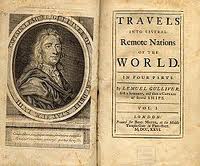
Another classic example that is often considered a combination of utopian and dystopian novels. This is because the plot involves the travels of one man – Gulliver, whose name is a play on the world gullible – whose journey takes him through many fictional worlds where life is either perfect or tragically flawed in various ways. However, since the purpose of these worlds is to parody English society in his day, it is often included as an early example of satiric literature that falls into the utopian, dystopian, and science fiction camps.

The story involves four journeys where Gulliver travels to several fictional societies and records what he sees for posterity. The first voyage takes him to the land of the Lilliputians, a race of tiny people whose morals match their physical size. After some rather brief descriptions of how these people select their leaders (limbo tournaments and other stupid games), we learn that they are a parody of the British system of parliament.

His second voyage takes him to a place that is the polar opposite of the first. Here, in the land of the Brobdingnagians, he is presented with giants whose physical size mirrors their moral outlook. They consider Gulliver to be a curious specimen, whose descriptions of his country disgust them. In the end, they consider him a cute sideshow attraction and refuse his offer of technological advances (like gunpowder). Gulliver then leaves, thinking the people are out of their minds, but ironically states that he withheld the worse about England out of a desire to save face.

His next voyage involves a little “island-hopping”, first to the flying city of Laputa, an island nation where technological pursuits are followed without a single regard for the consequences. He then detours to another island, Glubbdubdrib, where he visits a magician’s dwelling and discusses history with the ghosts of historical figures.

Then onto Luggnagg, where he encounters the struldbrugs – an unfortunate race of people who are immortal but frozen in old age, with all the infirmities that come with it. Gulliver then reaches Japan, which is in the grips of the post-war Shogunate period, where he is narrowly excused from taking part in an anti-Christian display that all foreigners were forced to perform at the time (stepping on the symbol of the Cross).

His final voyage before going home takes him country of the Houyhnhnms, a race of horse-people who see themselves as “the perfection of nature” and who rule over the race of Yahoos – deformed humans who exist in their basest form. Gulliver joins them and comes to adopt their view of humanity – that of base creatures that use reason only to advance their own appetites. However, they soon come to see him as a Yahoo and expel him from their civilization. In the end, Gulliver returns home to regal his family of his adventures but finds that he cannot relate to them anymore. His journeys have filled him with a sense of misanthropy that he cannot ignore.

Throughout the narrative, Swift’s point seems abundantly clear. Each voyage to a fictitious world serves as a means to parody a different element of British society and civilization in general. And ultimately, Gulliver serves as the perfect narrator, in that his ignorance and naivety allow him to absorb the lessons of the journey in a way that is both ironic and sufficiently detached. Can’t just hand the reader the moral, after all! Gotta make them work for it!

The Time Machine:
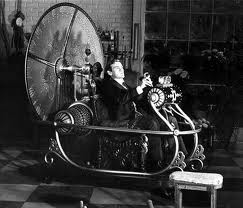
Published in 1895, this science fiction novella inspired countless adaptations and popularized the very idea of time travel. In addition to introducing readers to the concept of time as the fourth dimension and temporal paradoxes, H.G. Wells also had some interesting social commentary to share. In this story, the narrator – known only as The Traveller – recounts to a bunch of dinner guests how he used a time machine to travel to the year 802, 701 A.D. where he witnessed a strange culture made up of two distinct peoples.

On the one hand, there were the Eloi,  a society of elegant, beautiful people who live in futuristic (but deteriorating) buildings and do no work. Attempts to communicate with them prove difficult since they seem to possess no innate curiosity or discipline. He assumes that they are a communistic society who have used technology to conquer nature and evolved (or devolved) to a point where strength and intellect are no longer necessary to survive.

However, this changes when he comes face to face with a separate race of ape-like troglodytes who live in underground enclaves and surface only at night. Within their dwellings, he discovers the machinery and industry that makes the above-ground paradise possible. He then realizes that the human race has evolved into two species: the leisured class of the ineffectual Eloi, and the downtrodden working classes that have devolved into the brutish Morlocks. In the course of searching the Morlock enclave, he learns that they also feed on the Eloi from time to time. His revised analysis is that their relationship is not a benign one, but one characterized by animosity and the occasional act of kidnapping and cannibalism.

Is there not a more perfect vision of industrial society or class conflict? Written within the context of turn of the century England, where discrepancies in wealth, class conflict, and demands for reform were commonplace, this book was clearly intended to explore social models in addition to scientific ideas. And the commentary was quite effective if you ask me…

The Iron Heel:
This dystopian work was written by Jack London, the same man who wrote the classic Call of the Wild, and was released in 1908. A clear expression of London’s own socialist beliefs, the novel is set in the distant future when a socialist utopia – known as the Brotherhood of Man – has finally been created. Overall, the plot revolves around the “Everhard Manuscript”, a testament that details the lives of the story’s two main protagonists and which takes place between 1912 to 1932 in the US. The work is known for its big “spoiler”, letting readers know outright that the protagonists die in the course of their pursuits, but that their efforts are rewarded by providing inspiration to later generations who succeed where they fail.

In the course of this speculative story, we learn that an oligarchy – the Oligarchs or “Iron Heel” – has seized power in the US by bankrupting the middle class and reducing farmers to a state of serfdom. Once in power, they maintained order through a combination of preferential treatment and control over the military. After a failed revolt (the First Revolt) takes place, preparations are underway for a second which is expected to succeed in restoring the Republic. Unfortunately, it too fails and the protagonists are killed. However, centuries later, when their Manuscript is discovered, the Oligarchy has been unseated and a debt is being acknowledged to these characters and their actions.

Thus, London speculates that a socialist society would someday emerge in the US, but only after centuries of dominance by oligarchs who would come to power by decimating the middle class, controlling trade unions, and transforming the military into a mercenary front. His main characters, though condemned to death in the present, will be vindicated in the distant future when humanity will, at last, overcome its greedy tendencies and usher in a state based on equality and fraternity. Apparently, this novel inspired such greats as George Orwell, but not in the way you think. Whereas London chose to offer his readers a sense of consolation by showing them everything turned out okay in the distant future, Orwell chose to take the hopeless route to make his point!

We:
The story takes place in the distant future, roughly one thousand years after the One State conquered the entire world. After years of living in a perfectly synchronized, rational, and orderly world, the people of the One State are busy constructing a ship (the Integral) that will export their way of life to extra-terrestrial worlds. Published in 1921, and written by Yevgeny Zamyatin, the story was clearly inspired by life in post-revolutionary Russia, with its commitment to “scientific Marxism, but was also a commentary on the deification of reason at the expense of feeling and emotion.

The story is told from the point of view of D-503, chief engineer of the Integral who is keeping a journal which he intends to be taken on the voyage. As we learn in the course of the novel, everyone in the One State lives in glass apartments that are monitored by secret police known as the Bureau of Guardians. All sex is conducted strictly for reproductive purposes and cannot be done without state sanction. However, the main character soon comes into contact with a woman named I-330, a liberated woman who flirts with him, smokes, and drinks alcohol without regard for the law.

In time, he learns that I-330 is a member of a revolutionary order known as MEPHI which is committed to bringing down the One State. While accompanying her to the Ancient House, a building notable for being the only opaque structure in the One State where objects of historic and aesthetic importance are preserved, he is escorted through a series of tunnels to the world outside the Green Wall which surrounds the city-state. There, D-503 meets the inhabitants of the outside world – humans whose bodies are covered with animal fur. The aim of the MEPHI is to destroy the Green Wall and reunite the citizens of the One State with the outside world.

In his last entry, D-503 relates that he has undergone an operation that is mandated for all citizens of the One State. Similar to a lobotomy, this operation involved targeted x-rays that eliminate all emotion and imagination from the human brain. Afterward, D-503 informs on I-330 and MEPHI but is surprised how she refuses to inform on her compatriots once she is captured. People beyond the wall even succeed toward the story’s end in breaching a part of the Green Wall, thus ending the story on an uncertain note.

The Classics

And now we move on to the dystopian classics that are most widely known, that have inspired the most adaptations and sub-genres of noir fiction. Although updated many times over for the 20th century, these dystopian novels share many characteristics with their predecessors. In addition to timeless social commentary, they also asked the difficult question of what it would take to set humanity free.

Whereas some chose to confront this question directly and offer resolutions, other authors chose to leave the question open or chose to offer nothing in the way of consolation. Perhaps they thought their stories more educational this way, or perhaps they could merely think of none. Who’s to say? All I know is their works were inspired!

In addition to parodying the worst aspects of scientific rationalism, imperialism and the notion of progress, the story also went on to inspire some of the greatest satires ever known. In addition, many of its more esoteric elements have appeared in countless novels and films over the years, most notably the concepts of encapsulating walls, secret museums, government-sanctioned breeding, and machine-based programming.

Brave New World:
There’s scarcely a high school student who hasn’t read this famous work of dystopian fiction! And although Aldous Huxley denied ever reading We, his novel nevertheless shared several elements with it. For instance, his story was set in the World State where all reproduction is carried out through a system of eugenics. In addition, several “Savage Reservations” exist beyond the veil of civilization, where people live a dirty, natural existence. But ultimately, Huxley’s aim was to comment on American and Western civilization of the early 20th century, a civilization where leisure and enjoyment were becoming the dominant means of social control.

This last aspect was the overwhelming focus of the novel. In the World State, all people are bred for specific roles. Alphas are the intellectuals and leaders of society, Betas handle high-level bureaucratic tasks, Deltas handle skilled labor, Gammas unskilled labor, and Epsilons menial tasks. Therefore, all vestiges of class conflict and generational conflict have been eliminated from society.

But to further ensure social control, all citizens are sleep-conditioned from a young age to obey the World State and follow its rules. These include the use of Soma, a perfectly legal and safe designer drug that cures all emotional ales, promiscuous sex habits, and “feelies” (movies that simulate sensation).

In the end, the story comes to a climax as two of the main characters, Bernard Marx and Lina Crowe, go to a savage reservation and find a lost child named John. His mother was apparently a citizen of the World State who became lost in the reservation and was forced to stay after she learned she was pregnant. Having experienced nothing but alienation and abuse as a “savage”, John agrees to go with Bernard and Lina back to “civilization.

However, he quickly realizes he doesn’t fit into their world either and expresses disdain for its excesses and controls. Eventually, the people who sympathize with him are sent into exile and he is forced to flee himself. But in the end, he finds that he cannot escape the people of the World State and commits suicide, a tragic act that symbolizes the inability of the individual to find a resolution between insanity and barbarity.

Overall, Huxley’s BNW was a commentary on a number of scientific developments which, under the right circumstances, could be used to deprive humanity of their freedom. In many ways, this was a commentary on how the expanding fields of psychology and the social sciences were being used to find ways to ensure the cooperation of citizens and ensure good work habits.

Nowhere was this more apparent than in factories and in the creation of “assembly-line discipline”, which was exemplified by how the people of the World State revered Henry Ford. In addition to performing eugenics on an assembly-line apparatus, the people worship Ford and cross themselves with a T (a reference to his model T car).

But above all, Huxley seemed to be asking the larger question of what is to be done about the process we know as civilization. If it was inimical to freedom, with all its rational, sterile, and domesticated luggage, and the alternative  – a dirty, superstitious, and painful existence – was not preferable either, then what was the solution?

In the end, he offered no solution, allowing the reader to ponder this themselves. In his follow-up essay, Brave New World Revisited, he expressed some remorse over this fact and claimed that he wished he had offered a third option in the form of the exile communities – people who had found their own way through enlightened moderation.

1984:
Ah yes, the book that did it all! It warned us of the future, taught us the terminology of tyranny, and educated us on the use of “newspeak”, “doublethink” and “thoughtcrime”. Where would dystopian literature be today were it not for George Orwell and his massively influential satire on totalitarianism? True, Orwell’s work was entirely original; in fact, he thoroughly acknowledged a debt to authors like H.G. Wells and Yevgeny Zamyatin. But it was how he synthesized the various elements of dystopia, combining them with his own original thoughts and observations, and crystallized it all so coherently that led to his popularity.

But I digress. Set in the not-too-distant future of 1984 (Orwell completed the book in 48 and supposedly just flipped the digits), the story takes place from the point of view of an Outer Party member named Winston Smith. Winston lives in London, in a time when England has been renamed Airstrip One and is part of a major state known as Oceania. As the book opens, Oceania finds itself at war with the rival state of Eurasia, though not long ago it was at war with Eastasia and will be so again. As a member of the Ministry of Truth, Winston’s job is that of a censor. Whenever the enemy changes, whenever the Party alters its policies, whenever a person disappears, or the Party just feels the need to rewrite something about the past, men like Winston are charged with destroying and altering documentation to make it fit.

Ultimately, the story involves Winston’s own quest for truth. Living in the constant, shifting lie that is life in the totalitarian state of Oceania, he seeks knowledge of how life was before the revolution; before the Party took control before objective reality become meaningless. He also meets a woman named Julia with whom he begins an affair and rediscovers love.

However, in time the two are captured and taken to the Ministry of Love, where they are tortured, brainwashed, and made to turn on each other. In the end, Winston accepts the Party’s version of reality, simply because he discovers he has no choice. His tragic end is made all the more tragic by the implicit knowledge that he will soon be killed as well.

For discerning fans of science fiction and dystopian literature, the brilliance of 1984 was not so much in how the totalitarian state of the future is run but how it came to be. According to the Goldstein Manifesto, which is the centerpiece of the novel, World War III took place sometime in the 1950s and ended in a stalemate, all sides having become convinced of the futility of nuclear war.

Shortly thereafter, totalitarian revolutionaries with similar ideologies took power all over the planet. In time, they became the three major states of Oceania, Eurasia, and Eastasia, whose boundaries were a natural extension of the post-war spheres of influence.

Also interesting is Orwell’s speculation on how these totalitarian ideologies came to be in the first place. In short, he speculates that dominance by a small group of elites has been an unbroken pattern in human history. In the past, this arrangement seemed natural, even somewhat desirable due to poverty, scarcity, and a general lack of education.

However, it was within the context of the 20th century, at a time when industrial technology and availability of resources had virtually eliminated the need for social distinction, that the most vehement totalitarians had emerged. Unlike the elites of the past, these ones had no illusions about their aims or their methods. As the antagonist, O’Brien, says “The Party seeks power entirely for its own sake… Power is not a means; it is an end. One does not establish a dictatorship in order to safeguard a revolution; one makes the revolution in order to establish the dictatorship.”

This message still resonates with us today. Even though western civilization did technically dodge the bullet of WWIII and does not resemble the world of 1984 in the strictest sense, the cautionary nature of Orwell’s critique remains. Even if the particulars of how 1984 came to be didn’t happen, the message remains the same: human freedom – meaning the freedom to live, love, and think freely – is the most precious thing we have. Beware those who would deprive you of it for your own safety or in exchange for some earthly utopia, for surely they will themselves to be your master! There is also an ongoing debate about which came true, 1984 or BNW, with the consensus being that it was Huxley’s dystopian vision that seemed more accurate. However, the jury is still out, and the debate is ongoing…

Fahrenheit 451:
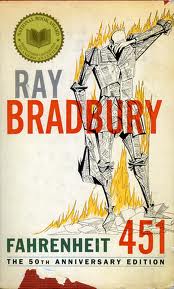
Here is yet another dystopian novel that has become somewhat of a staple in the industry. In Bradbury’s vision of the future, society is permeated by mindless leisure and decadence. Virtually all forms of literature have been banned, and local “firemen” are responsible for enforcing the ban. Wherever illegal literature is found, firemen are responsible for arriving on the scene and putting them to the flame. Yes, in a world where all houses are fireproof, firemen are no longer responsible for putting fires out, but for starting them!

In the course of the story, the main character – a fireman named Guy Montag – begins to become intrigued with literature and discovers a sort of magic within it that is missing from his world. In addition, Guy is told by his boss that society became this way willingly. Perhaps out of fear, perhaps out of sloth, they chose convenience, ease, and gratuity over subtly, thought and reflection. In time, Guy’s choices make him a fugitive and he is forced to flee and seek refuge with other people who insist on keeping and reading books. It is also made clear that nuclear war is looming, which may provide some explanation as to how society came to be the way it is.

In this way, the book has a lot in common with both 1984 and Brave New World. On the one hand, there is active censorship and repression through the destruction of books and the criminalization of reading. On the other hand, it seems as though the people in Bradbury’s world surrendered these freedoms willingly. It is a fitting commentary on American society of the latter half of the 20th century, where entertainment and convenience seemed like the greatest threats to independent thought and learning. This, in turn, could easily form the basis of dictatorship. As we all know, a docile, narcotized society is an easily controlled one!

The Handmaid’s Tale:
Here is another novel that few people get through high school without being forced to read, especially in Canada. But there’s a reason for that. Much like 1984, BNW, and F451, The Handmaid’s Tale is a classical dystopian narrative that has remained relevant despite the passage of time. In this story, the US has been dissolved and replaced by a theocracy known as the Republic of Gilead. In this state, women have been stripped of all rights in accordance with Old Testament and Christian theocracy. The head of this state is known as the Commander, the chief religious-military officer of the state.

The story is told from the point of view of a handmaid, a woman whose sole purpose is to breed with the ruling class. Her name is Offred, which is a patronym of “Of Fred”, in honor of the man she serves. Like all handmaidens, her worth is determined by her ability to procreate. And on this, her third assignment, she must get pregnant if she doesn’t want to be discarded. This time around, her assignment is to the Commander himself, a man who quickly becomes infatuated with her.

Over time, the infatuation leads to sex that is done as much for pleasure as procreation, and he begins to expose her to aspects of culture that have long been outlawed (like fashion magazines, cosmetics, and reading). She even learns of a Mayday resistance that is concerned with overthrowing Gilead, and that the Commander’s driver is apparently a member.

In the end, Offred is denounced by the Commander’s wife when she learns of their “affair”. Nick orders men from “The Eyes” (i.e. secret police) to come and take her away. However, he privately intimates that these are actually men from the resistance who are going to take her to freedom. The story ends with Offred stepping into the van, unsure of what her fate will be. In an epilogue, we learn that the story we have been told is a collection of tapes that were discovered many generations later after Gilead fell and a new, more equal society re-emerged. This collection is being presented by academics at a lecture, and is known as “The Handmaid’s Tale”.

In addition to touching on the key issues of reproductive rights, feminism, and totalitarianism, The Handmaid’s Tale presents readers with the age-old scenario of the rise of a dictatorship in the US. Apparently, the military-theological forces who run Gilead in the future seized power shortly after a staged terrorist attack that was blamed on Islamic terrorists. In the name of restoring order and ending the decline of their country, the “Sons of Jacob” seized power and disbanded the constitution. Under the twin guises of nationalism and religious orthodoxy, the new rulers rebuilt society along the lines of Old Testament-inspired social and religious orthodoxy.

This angle is not only plausible but historically relevant. For as Sinclair Lewis said back in 1936 “When fascism comes to America, it will be wrapped in the flag and carrying a cross.” This is paraphrased from his actual, more lengthy comments. But his essential point is the same. If a  tyranny emerged in the US, he reasoned, it would do so by insisting that it was religiously right and that it was intent on protecting people’s freedoms, not revoking them.

In addition, the angle where an Islamic terrorist attack spawned the takeover? Tell me that’s not relevant to Americans today! Though written in 1985, Margaret Atwood’s dystopian scenario received a shot of credibility thanks to eight years of the Bush administration, a government that claimed religious orthodoxy and used security as justification for questionable wars and many repressive policies.

Final Thoughts:
After years of reading dystopian literature, I have begun to notice certain things. For starters, it is clear why they are grouped with science fiction. In all cases, they are set in alternate universes or distant future scenarios, but the point is to offer commentary on the world of today. And in the end, utopian and dystopian satires are inextricably linked, even if the former predates the latter by several centuries.

Whereas Utopian literature was clearly meant to offer a better world as a foil for the world the writers were living, dystopian literature offers up a dark future as a warning. And in each case, these worlds very much resemble our own, the only real difference being a matter of degree or a catalyzing event. This is why there is a focus in dystopian literature on explanations of how things came to be the way they are. In many cases, this would involve a series of predictable events: WWIII, a terrorist attack, more overpopulation and pollution, an economic crisis, or a natural disaster.

And in the end, the message is clear: whether it is by fear, poverty, or the manipulation of critical circumstances, power is handed over to people who will deliberately abuse it. Their mandate is clear and their outlook is the exact same as any tyrant who has ever existed. But the important thing to note is that it is given. Never in dystopian literature do tyrants simply take power. Much like in real life, true totalitarianism in these novels depends upon the willingness of people to exchange their freedom for food, safety, or stability. And in all cases, they inevitably experience buyer’s remorse!

Quicknote: Since getting “freshly pressed”, a lot of people have written in and asked me about my thoughts on “The Hunger Games”. Sorry to say, haven’t read it so I can’t offer any commentary. I will however be commenting on a number of more modern dystopian franchises, specifically examples found in film and other media, in my next post. Stay tuned, hopefully, something you like will pop there!

More 1984…

More 1984…

Well, my book club is finally coming to the end of reading 1984. I sure am happy we picked that novel, as it is not only one of my favorites reads but one of my favorite books to teach. There’s just so much there, a real English-teachers delight! And really, I never get tired of reviewing it. There’s always something new to talk about, as you can plainly see! In addition, I’ve been hosting some 1984 chat groups over at Goodreads and that got me thinking about certain elements of the story all over again. In the first forum we were discussing whether or not a 1984-type society could still happen, and to what extent did we think we might be living in one already. In the second, we got into the differences between 1984 and Brave New World, how Orwell and Huxley had different visions on the future, and which we thought came true.

In any case, what I realized from all this was which part of the book I loved best. It was definitely the passages in Part II where Winston was reading from Goldstein’s Manifesto. Not only did it totally appeal to the historian in me, it was just so full of depth and insight that it got to me every time I read it (I think I’m up to three now). And after doing a little side research, I came to realize that Orwell wrote this section of the story first. Not only was the manifesto a major, culminating event in the story, it was also the centerpiece of Orwell’s thought, the very basis of his cautionary tale. Essentially, the manifesto detailed how inequality was a constant in human civilization, the ongoing struggle between the high, middle and low. But in addition to being a constant, it was almost a necessity as well, an inevitable side-effect of living with scarcity, drought, and recurring shortages.

It was with the advent of industrial technology however, that this pattern finally became breakable. While it took some tweaking, common sense finally convinced the barons of industry and political leaders alike to make reforms to fit the times. This began in the 19th century and carried on well into the 20th, when standards of living for the poor and common finally began to rise. And as education, the distribution of goods and services, and news media also improved, the gap between rich and poor and even the need for social distinctions began to diminish.

Curiously, it was as the need for social distinction seemed about to disappear that the totalitarian philosophies of the 20th century appeared. Whereas industrial processes had come to represent the potential for human liberation, these new thinkers (Marxist-Leninist and Fascist were their official titles) wanted to use these same things to make enslavement permanent. In other words, these folk saw the writing on the wall and decided to do everything they could to arrest the process of history. Or, as Orwell put it, “the pendulum would swing one last time and then stop forever”. Human beings could never be allowed to be fully liberated, they had to be cast down and kept there. Hence, these totalitarians took advantage of all that was happening in the 20th century to make it happen. Two World Wars had already began the process in earnest, destroying the infrastructure that was making human equality possible and turning what were once comfortable, privileged people into brutalized subjects.

In order to ensure that this continued to be the case – in other words, that the basis for oppression and inequality continued to exist – war had to be constant, but also limited. Nuclear weapons were abandoned and war would continue by conventional means, albeit for unconventional purposes. The real aim henceforth would be for the dual purposes of keeping people focused on an external enemy while ensuring that no improvement in the standard of living would ever be possible. All industrial products would be used by the war, and occasionally, planned shortages would go into effect to keep people wanting and just a little off-balance.

Or at least, this is what Orwell had predicted, in a nutshell, through his alter ego of Goldstein. And there’s a reason the second act ended with it. Up until that point in the story, Winston knew there was something wrong with society and wanted to rebel against it. The book did not really teach him anything in this respect. In truth, it did little more than confirm what he already knew. But the overall effect it had was to let him know he wasn’t alone. He finally learns that he is indeed sane for feeling the way he does, mainly because he knows he has to be right.

This readers with all of Act III to answer the final burning question of Why? Winston soon learns this after he and Julia are arrested and taken to the Ministry of Love to be tortured and brainwashed. Much like their betrayal, the hopelessness of their situation and the fact the Brotherhood does not even exist, the answer to this question is a spirit-shattering disappointment. Power, O’Brien tells Winston. Power is the only reason. For what else is there, in the final analysis that can justify the lengths that tyrants and their administrators will go to? Why else would countless generations of kings, emperors, nobles, priests and elites do what they have done over the millennia? Why torture, detain, brainwash, conquer, convert, force confessions and exterminate entire races of people? What better reason is there than to feel god-like and know that moral arguments and the truth are useless against you?

True, Orwell’s vision never really came to pass. There are those who would venture that we are living with Big Brother government and in an Oceania-style society right now but I would not be one of them. In every measurable way, we averted Orwell’s dystopian future by not getting into a third world war, by expanding the middle class, public education, and narrowing the gap between rich and poor even further. We also managed to take big steps towards the elimination of the gender gap – another thing that has been increasingly obsolete with the advent of modern society – and the racial gap. Granted we’ve only come so far, but if one looks at the post-colonial wars of independence, the civil rights movement and the feminist movement in conjunction with the victories of organized labor and the expansion of the middle class, one can see just how much progress we’ve made towards the kind of society of equals that Goldstein’s totalitarians wanted to avert.

But in the last thirty years, we’ve moved away from that ideal like never before. More and more, there are forces out there who are telling us of the need to cut taxes, deregulate the economy, globalize, privatize, cut education, eliminate collective bargaining, pensions, job security, outsource industry, streamline, downsize, etc etc. These same forces are the ones pushing for fiscal conservatism, saying “we simply cannot afford it anymore” as a justification for neutering governments by destroying their budgets and putting tax monies back into the hands of the rich and the super rich. Where that fails to sway people, the specter of “SOCIALISM!” is used quite effectively to frighten people into compliance and keep them from seeing the real agenda. All the while, smear campaigns are employed to paint protest movements, reformists, and people who question these changes as “radical”, “socialist”, “communist”, and even “elitist” – much the same labels that were used against people who protested the Vietnam War, segregation and sexism in the workplace.

This “revolution” began in earnest in the late 70’s, early 80’s as a response to the progress made in previous decades. In Britain, it was led by Margaret Thatcher, in the US by Ronald Reagan, and by various other supplicants and imitators in other parts of the Anglosphere and west. In terms of politics, the goal was clear: squeeze the concerns of the poor and the idea social responsibility out of politics by taking advantage of the fact that the poor were at an all time low. In terms of values, the objective seemed to be erase the pluralistic society that was emerging as confusing and chaotic, while emphasizing a traditional society instead. In short, these people wanted to regress because they didn’t like the society that was emerging. However, these revolutions did not really take off until a full decade later, when another event – the end of the Cold War – gave them another push. In the absence of a second hegemonic superpower, it now seemed that the US and its allies were free to push forth with a new agenda, not just abroad but at home.

Intrinsic to the agenda of these new conservatives (aka. neo-conservatives) was the idea that peace, security, and open markets should be achieve not through multilateralism, but through unilateralism and military force, if necessary. Rather than the US and its allies becoming more multinational, the world was to become more American. Britain and the Anglosphere would continue to enjoy the “special relationship” with the US, while continental Europe would be split based on “old” and “new”. The old Europe – France, Germany, Italy, Spain, all EU members who were firm in their commitment to regulated markets and in the habit of challenging US interests from time to time – would be marginalized in favor of countries that had recently emerged from dictatorships and had more fragile economies. These countries, who were not in a position to challenge the US, would be pressured into entering into military treaties that would cordon off Russia with a “missile defense shield”. The same is true of China, another major power with access to nuclear weapons. Their neighbors would also be pressured into an alliance with the US, extending the missile shield, and thus making the US (in theory) impervious to attack. Thus, with nothing to fear from these countries nuclear arsenals, the US could do as it pleased and not concern itself with the objections of its former enemies.

In the Middle East, a similar plan was put into effect. For many decades, Britain, the US, and continental European powers had maintained close ties to several “friendly dictators” in exchange for good trade relations and access to petroleum. However, by the end of the Cold War, the US and Anglosphere maintained this policy more aggressively, placing military bases on the soil of willing nations in exchange for direct political and military support. This came with obvious consequences, most notably in the form of terrorism and widespread anti-US sentiment. With country after country viewing the US presence in the region as a liability, the US and its “willing” friends decided to look for a new base of operations, a place where they could build “enduring” military bases that would give them secure access to petrol reserves and the ability to sandwich unfriendly neighboring regimes.

Finally, there was the agenda at home. For decades, this new breed of conservatives dreamed about turning their countries into one-party states, or at least marginalizing dissenting political voices until they were no longer a concern. Be they Republican, Tory, Conservative, or Likud, virtually all nations in the developed world experienced a push from the right on or after the last decade of the 20th century whose aim was to oust “liberal” concerns from politics and make a “security” agenda paramount. In addition, a clear economic agenda was being put into place as well that seemed dedicated to weakening government and allowing the private sector to fill the void. Oftentimes, this took the form of removing restrictions to trade, but also involved removing environmental, trade, and labor regulations that were designed to prevent unsafe or exploitative business practices. And finally, there was the moral dimension, where political forces of the right allied themselves to the religious right in order to push for legislation that would make abortion and stem cell research illegal, while simultaneously decriminalizing martial rape and the teaching of creationism mandatory.

What is most curious about this is the timing. Once again, it seems that forces intent of preventing freedom and imposing their singular world view mobilized when the exact opposite trends were on the cusp of being realized. With the Cold War over, former colonies freed, and minorities, natives, women and homosexuals free to be themselves and demand equality, it seemed that a new golden age might be possible. In fact, many people, of all political stripes, predicted that this would be the case, that the 21st century would be characterized by peace, the extension of free markets, and human rights. So… what happened? Personally, I would venture that it was precisely to avoid these things that the neo-cons mobilized the way they did and have done what they have done. Where they couldn’t take power, they stole it. Where they couldn’t exploit tensions, they created them. This isn’t to say that there weren’t lylegitimate security concerns at the turns of the century (i.e. terrorism), but the neo-cons certainly did all they could to make these worse through negligence, mishandling and/or overreaction.

Some would certaintly disagree and say these things are natural developments, or are necessary. But really, how can one not look at the concentration of political power, media, industry, and money into fewer and fewer hands over the last thirty years and not see an agenda. What is the purpose of all this, aside from the desire to put power into the hands of a select few? Aside from making a few people a hell of a lot richer, it would successfully reverse the trends that have been at work in western society for the past century, and that First Nations and the non-western world has been fighting to have access to for the latter half of it. That being, freedom, equality, and the elimination of vast disparities of wealth, power and privilege. Destroying that will once again create the basis for an unequal society by making sure that the middle and low do not have the means to challenge the power of the elite. If education, job security, a full belly and an informed mind are no longer possible on a grand scale, then the power of a small elite will seem justified. The only stumbling block to achieving all this lies in the ballot box or (God forbid!) technology that cannot be turned on its users to prevent the spread of information and dissenting viewpoints. But these too can be dealt with, given time…

Yes, I am aware of how soap-boxish this all must sound, but it HAS been on my mind of late. It also might sound like a conspiracy theory, but there’s a difference: Conspiracies are subtle, underhanded, and can’t be proven either way. Hence why they are called conspiracy theories. This, on the other hand, is blatant, obvious, and in everyone’s face. And the tactics aren’t rational or covert either, they have about as much subtly as a sledgehammer and are constantly being spewed. From the television, the newspaper, the pulpit, and the halls of government, there is scarcely a corner of society that hasn’t been exposed to this new take on an old rhetoric, so I don’t imagine anyone will not know what I’m talking about, even if they don’t happen to share my interpretation.

Anyhoo, I’ve gone on long enough with my own opinions. And since it was the Goodreads forums that inspired these thoughts of mine, I’ve included links to the Goodreads threads below. I’m becoming aware of how good a forum this is for discussing literature, and for aspiring authors to post their work, get feedback and network with others of their ilk. Check it out!

1984 – Can It Still Happen?
1984 Vs. Brave New World

Demolition Man

Ah yes, another classic guilty-pleasure movie! At least, that is my enduring opinion of this film. When I first saw it as a surly teenager, I thought it was a good shoot-em-up. As I got older, I recognized the satirical elements in it – or rather, the attempts at them – and concluded that they fell short. Now I know for a fact that there are those who disagree with me on this point. Hell, there are even some who might say that this movie was a smart, satirical take on the PC age or an re-imaging of Brave New World for the early 90’s. I, however, don’t happen to be one of them! While I did get the allusions to BNW, I simply cannot bring myself to see how this film could possibly be compared to the brilliant and seminal work of Aldous Huxley. But as usual, some background info is needed before I get into all that.

(Background—>):
Ultimately, Demolition Man was a story about social engineering and control, but at the same time was marketed as an action movie. Fittingly, Sylvester Stallone and Wesley Snipes were brought in to the play the leads, both of whom were A-list action stars at the time. In the end, this combination of action-satire received mixed reviews, with Gene Siskel gave the movie a thumbs down for its violence and Ebert (as usual) praising it for it’s “satiric angle”. Rotten Tomatoes rates the movie as “fresh” with a 63% approval rating while on Metacritic, the movie scores a meager 34/100. In addition, Hungarian sci-fi writer István Nemere claimed the movie plagiarized the vast majority of his novel Holtak harca (Fight of the Dead), which was published in 1986. Regardless, audiences seemed suitably impressed. The movie did make over 50 million domestic, and 150 million foreign. Unfortunately, the director, Marco Brambilla, has gone on to do very little since. If this was the high-point in his career, all I can say is “tough break, man!”

(Content—>):
The movie opens in 1996, on a Los Angeles that is literally on fire. The opening scene where the Hollywood sign is burning is a pretty good indication that society has gone to hell at this time. It’s possible that it was even meant to call to mind the LA riots of 92. Enter John Spartan (Stallone), aka. “The Demolition Man”. At the movie’s opening, he is on his way to bust a domestic terrorist with the equally ridiculous name of Simon Phoenix (Snipes). The latter has commandeered a building and is holding hostages while his men are in a standoff with police. Meanwhile, Spartan, air cavalry-style, jumps from a helicopter, shoots some guys, and then takes down Phoenix in a hand to hand fight. But of course, the building was wired to blow, and the whole place goes up just as Spartan jumps out with Phoenix over his shoulder. Seems blowing shit up is what he’s famous for, hence the nickname!

Then, after the blow-up, the clean up crews find dozens of bodies – apparently, the remains of the hostages! Spartan claimed they had to be somewhere else since he did a thermal scan on the place and saw only Phoenix’s own men, but dead bodies don’t lie! Alas, he and Phoenix are both sentenced to cryogenic freezing for their crimes, since in this day and age (only three years from when the movie was released!) the penal system is no longer in use. Criminals are put in deep sleep and have their brainwaves altered using synaptic suggestion (kind of a neat idea!). His freezing scene is little more than an excuse for Stallone to show off his ass, but whatever.

Okay, first impressions? Well for starters, nothing about the opening sequence is believable, and the hints its dropping are pretty damn obvious. For one, the images and action call to mind things like Beirut and Baghdad more than downtown LA, the tracer fire alone in the opening shots are clearly meant to make us think of a war zone. And last I checked, police didn’t have access to military helicopters or were cleared for aerial insertions. But this is the future right? Sure, but only three years from when the movie was made! Did they expect society to go to hell in that amount of time? Well, it IS LA… Oh, and another thing about the tracers: with all the flak they were putting up, how is it the one thing they didn’t seem to be firing at was the one helicopter that was flying above them? Ah, who cares?

Fast forward to 2032. San Angeles (Los Angeles and San Diego merged after the Big One), is a peaceful, sterile, happy-faced place where violence is obsolete, swearing is illegal, and everything and anything unhealthy has been outlawed. But we quickly see that there is dissent; underground people’s who spray paint messages of resistance here and there and occasionally conduct raids. Enter Lenina Huxley (Sandra Bullock in her debut action role), a young cop who is curious about the past and longs for some action. Hm, no ironic foreshadowing there! In any case, in what appears to be a mix-up, Phoenix is awakened over at the cryo-facility for a parole hearing. In a scene that definitely tells us something is up, he escapes from his cage, kills the guards, escapes from the facility and begins spreading chaos in his wake. And when the police confront him, Phoenix whoops out some badass martial arts skills and kills a few. The police are frightened, and for good reason!

Naturally, they appeal to the man who runs things in San Angeles, Doctor/Dictator Raymond Cocteau (played by British actor Nigel Hawthorne), who just happens to be the inventor of the cryoprison as well. He says “do what you will”, but its clear he’s got something up his sleeve. The cops got nothing, and its clear they are unequipped to deal with such a violent criminal. But it just so happens that someone on the force is old enough to remember the man who brought Phoenix down the first time… John Spartan! They commence defrosting, and some expository dialogue lets us know some pertinent facts: the merger that created San Angeles, the Big One (which coincidentally claimed Spartan’s wife), and the fact that smoking, alcohol, red meat, contact sports, salt, etc etc are now illegal. A brief encounter between Spartan and a swear monitor also lets him know that swearing results in a fine!

Now this is a part of the movie I actually liked. It’s been established at this point that the new age folk are completely helpless in the face of a violent convict. They fear and revile Phoenix, but they’re impressions of Spartan are not much better. Essentially they think he too is a barbarian, in part because he’s a convict, but mainly because of where and when he comes from. This is a realistic touch and something that’s consistent throughout the movie. However, this is still an action flick and things quickly move to the first post-thaw confrontation between the two titans, and at a museum of all places! Seems Phoenix went there to find a gun, which is the only place one can even see a gun in the future. Spartan shows up, and two begin using the museum guns to shoot at each other. Yes, it seems the guns in this particular museum are kept loaded. Uh… okay! Makes absolutely no sense, but okay…

Phoenix escapes, and runs into Cocteau outside. He tries to shoot him, but cannot and is forced to flee. At this point, we are made aware of the fact that there’s some sort of conspiracy between them. Prior to this, it was obvious that someone has been pulling Phoenix’s strings since he got out of cryogenics. He’s obsessed with the name Edgar Friendly (played by Dennis Leary), another absurdly named character who just happens to be the man running the dissidents. What follows is some filler and background scenes where Spartan is invited by a seemingly grateful Cocteau to dinner (at Taco Bell, the only restaurant to survive the “franchise wars”!) he is subjected to more bigotry from the San Angeles folk, and is in the right place at the right time to stop a band of Friendly’s men from raiding the restaurant for food. Afterward, he and Lenina go back to her place where she asks him to have “sex”, which consists of wearing helmets that simulate sex-related sensations. Seems real sex has been banned due to STD’s! Bummer…

Anyway, irked and unable to adjust to this new form of “sex”, Spartan retires to his flat and begins looking at security footage from the museum. Upon seeing the clip where Phoenix couldn’t shoot Cocteau and the short conversation that ensued, he becomes highly suspicious. He looks up Phoenix’s file and finds that in addition to being thawed “accidentally”, he was programmed for mass destruction. Remember the bit about synaptic suggestion? Well, it seems that while Spartan was encouraged to knit (no joke!), Phoenix was encouraged to kill! At this point in the movie, things begin to revolve around Cocteau as both Spartan and Phoenix take turns confronting him. Spartan does so to get answers, but is told to get lost and that he’s going back into the freezer. Phoenix does so to find out why the hell he was thawed and why he’s been programmed. You see, in addition to being fixated on killing Friendly, he can access any computer in the city and seems to instinctively know his way around. He, in turn, is told everything, as is the audience!

Essentially, Cocteau tells him that he let Phoenix out of cryoprison and programmed to kill, be able to access any computer in the city and find his way around San Angeles with ease so that he would kill Friendly, the only remaining obstacle to him creating a “perfect society”. In exchange for this, Phoenix will get whatever he wants, and he even promises to put Spartan back in the freezer for him as “a guarantee”. Phoenix however, says he will take out Spartan himself, but will need the help of a dozen or so additional convicts from his past to complete these various tasks. For whatever reason, Cocteau consents and gives him his access to his old buds. Cue tense music!

Okay, two things! One, are we really to believe that this Cocteau fellow would thaw the most dangerous criminal of the 20th century just so he could deal with some meager political dissident? Why not hire some mercenaries from out of state, or out of the country? And its not like Friendly is a threat really! All he does is spray paint things and raid Taco Bells! Seriously, in what world is it smart to unleash a psychopath to deal with a simple political protester? That’s like unleashing a poisonous snake to deal with a rodent. Second, did he really believe he could control Phoenix simply by putting some kind synaptic block on him? Sure, Phoenix was unable to kill HIM, but what about everybody else in the city? Moreover, how was he planning on controlling him once he was finished with Spartan and Friendly? Cocteau had obviously given no thought to that since he had nothing in mind to offer him. Last, are we really to believe he would agree to thaw more psychos without bothering to take ANY precautions with them? With Phoenix he at least did something, but with these other guys, he does nothing! How stupid is this guy?

Alright, lets move on! Despite being told he’s going back into the freezer, Spartan is still walking around. He even leads Huxley and her partner Garcia (Benjamin Bratt) on a manhunt for Phoenix, a search which takes them into the sewers. Coincidentally, they run into Simon Friendly’s people, because the sewers are where he and his band of dissidents/thieves/scavengers live. Oh yeah, and they have guns too! They must have raided a museum at some point… Meanwhile, Phoenix is plotting with his psychos (duh!) to take over San Angeles society by killing Raymond and Spartan. After Spartan explains to Friendly what he thinks is going on (i.e. Cocteau wants to kill you and thawed a mass murdered to do so), Phoenix and his gang show up and a gunfight ensues. Spartan and Phoenix fight their way across town with an obligatory car chase, during which time Phoenix tells him that all those hostages Spartan allegedly killed in his capture attempt were already dead; or as he puts it, “Cold as Hagen Daas!” Well, as the Joker said to the Batman, “even to a guy like me, that’s cold!” Okay, nuff cold-related puns! Phoenix escapes again, and has his men kill Cocteau. Wow… didn’t see that one coming!

The police and Friendly’s scavengers then come together, with Spartan asking for their cooperation. They then march on Cocteau’s office where they find him dead and see that Phoenix and what remains of his thugs have taken to the cryogenics facility where they are planning on thawing all the convicts there. A final showdown takes place between Spartan and Phoenix and Spartan manages to (you guessed it!) blow up the place in the process! He escapes in the nick of time as the place is exploding all around him, all the while doing the Stallone signature grunt/yell. The movie ends with the uptight police chief fearing for the future, Friendly suggesting they all get drunk and “paint the town red”, and Spartan suggesting they find a middle path. Then, of course, Spartan kisses Huxley, and they agree to have sex the old fashioned way. Cue theme music by The Police!

(Synopsis—>):
Of the top of my head, I can think of several things that were good about this movie. For one, they actually did bring some satirical elements to the screen. The way the future citizens of San Angeles saw Spartan as a brute, for example. “Cro-Magnon”, “primate”, “caveman”; these are how they describe him, and to his face! And the paradox is quite clear: on the one hand, their values demand that they reject a man like him. On the other, they make them hopelessly dependent on him. Also, the nature of the “utopian” San Angeles society seems like a pretty fitting commentary on the PC age: how taken to its extreme, censorship and repression – even if its well-meaning – will lead to a society of stunted, helpless virgins. Though the entire plot may have been lifted from a Hungarian sci-fi novel, this aspect of the movie was kind of fitting given the year of its release. The early 90’s were kind of the dawn of the PC age, and it only made sense that there would be those who would want to warn people about the potential for danger before it had a chance to get in full swing!

There were also several funny moments I feel the need to acknowledge. Snipes manages to pull off the psycho quite well and has some downright funny lines. “Cold as Hagen Daas” was one, as was his Scarface imitation. Also, the joke about President Schwarzenegger wasn’t bad. One might get the impression that he and Stallone have some kind of agreement where they’re required to give a shout out to each other every few years. And how about the running joke about “the three seashells”? And the swear detectors were not just satirically apt, they were a pretty good comedic tool.

And now for the bad stuff… First off, the totally contrived, unthought-out nature of the plot! Again, are we really to believe some conniving future dictator would unleash a mass murderer to kill ONE MAN and expected he could control him? Wasn’t this guy supposed to be the leader of San Angeles and the creator of their entire way of life? Did he get to where he was by NOT planning ahead like this, or is he just this stupid? Also, the fact that people are able to get both guns and ammo in a future where there are supposed to be none made no sense either. I know, if you remove these elements, there’s no movie. But a few lines of dialogue would have patched this movie’s biggest holes, but no explanations were ever given! Hell, they could have even done a thing where Spartan and Phoenix were forced to improvise their weapons, showing how they had to resort to classic ingenuity in an age where mass-produced firearms were no longer available. I’m just saying…

There was also the small plot thread about John’s daughter that went nowhere in the movie. We learn that he had a wife and child before he went into cryosleep, and that his wife died in the Big One. But his daughter apparently survived and despite missing her, he doesn’t even bother to look her up. They do make a point of having Spartan say that he’s not sure if he wants to see her since she grew up in this new society and he fears she won’t be able to relate to him. But when Huxley offers to look her up, he says no and then the whole thing is just dropped! Seriously, if he had a daughter, I would think he’d want to reunite with her, and that this reunion would be intrinsic to the plot in some way. Say, for example, that after he’s finished killing Phoenix he decides to look her up and that’s how the movie ends; you know, as opposed to him and Huxley having sex and him learning how to work the damn three seashells! Or, she could even be central to the plot by having Phoenix abduct her in Act III in order to lure Spartan into a trap? Hell, either of these ideas would have been better than bringing the daughter up and then just writing her off like that. Why bring her up if she’s going to serve no purpose whatsoever?

Also, there’s the idea that this movie managed to adapt elements of Brave New World to the big screen. Sure, that was the aim, and the references were certainly clear enough. But that was the problem, in my opinion, and the reason for its failure. For one, the name of Sandra Bullock’s character is an obvious allusion to BNW. Her last name is Huxley (aka. Aldous), and Lenina is the name of BNW’s main female character (Lenina Crowe). And at one point, Phoenix even yells out, “Its a Brave New World” before firing off his weapon. Now that was just plain unnecessary! I mean, if you’re going for literary allusions, try some subtlety! Don’t just announce what you’re trying to emulate! It comes off as obvious, and its not like people aren’t going to make the connection anyway. In any tale of social engineering where freedom is being killed by soft measures, the inevitable connection is to Brave New World!

But then again, this was in keeping with what brought this movie down for me, which was its watered down character. Putting aside the fact that this movie was possibly a total rip-off, there were still the basic outlines of a decent plot before Brambilla and whoever else decided to turn it into an action movie got their hands on it. Once that was done, the potential for real satire and social commentary was pretty much lost. In the end, all that stuff just seemed like it was thrown in to give a feeling of depth to an otherwise cheesy action flick, which really wasn’t the case. The movie started out as a tale about a dystopian future borne out of the violence and chaos of the present, but was dumbed down in order to make it accessible to Hollywood audiences. And that’s a shame man! Consider how many otherwise decent movies or original novels have been ruined simply because of the director’s, producers and industry’s lack of respect for their audiences.

But that’s something for another time and I’m starting to get that preachy feeling again. And like I said, this really isn’t a bad movie, just one that requires a little brain-checking if you don’t want to come away disappointed. Overall, I’d say it belongs in the fun but kinda stupid bin, next to the other guilty pleasures that DON’T make you think!

Demolition Man
Entertainment Value: 7.5/10
Plot: 4/10
Direction: 7/10
Total: 6.5/10

Debate on Goodreads

As I am an avid fan of all things 1984, and an incurable instigator of debate, I decided to start a thread over on Goodreads about one of the biggest questions associated with it. In short, Can it Still Happen? I deliberately and connivingly selected this topic for the very reason that it brings up a ton of particulars, like why and how it happened in the book, why it didn’t happen in real life (although some think it did!), and what conditions are necessary to establish a permanent dictatorship that will arrest history. Already, people are getting into Huxley’s vision of the future and debating whether or not that proved more accurate, so naturally I’m directing them here since I asked just that question: 1984 vs. Brave New World

Here the thread for the discussion, already getting popular: Goodreads – 1984, Can it Still Happen?

Equilibrium

Equilibrium

And we’re back! I tell ya, I’m mentally burnt from reviewing so many classics that I actually enjoyed! But I guess that’s to be expected. Somehow, its just easier to burn and mock bad movies, as opposed to dissecting and delving into movies with real themes, plots, memorable characters and complex messages. And I have covered a few movies in the last while that I had mostly good things to say about. So its about time I got back to bashing something worthy of it! Yeah, that seems about right. Here’s Equilibrium!

Now I already know that I’m stepping on some toes just by implying that this movie was fluff. As it turns out, Equilibrium is a cult-classic with its own dedicated fansite. That’s right, people actually came together and created a website strictly for fans of this 1984-ripoff. Go check it out, its actually pretty respectable: Equilibrium Fans

That shouldn’t come as a big surprise, people love an underdog after all! And considering the bashing it took and how little money it made, its little wonder why its fans would be so dedicated…

(Background—>)
Yes, as already noted, this movie did very poorly at the box office, grossing just over five million dollars, which was roughly a quarter of the movie’s budget. And it was generally panned by critics, earning only 37 percent on Rotten Tomatoes and a metascore of only 33 out of 100 on Metacritic. Little surprise. The general consensus amongst critics was that the movie was a rip-off, a “reheated mishmash of other sci-fi movies” as one review put it. Or, as the NY Times claimed, that it borrowed heavily from such classics as Fahrenheit 451, Nineteen Eighty-Four, Brave New World, and other science-fiction classics. Roger Ebert was the only one to be gentle, giving the film 3 out of 4 stars and saying that “Equilibrium would be a mindless action picture, except that it has a mind. It doesn’t do a lot of deep thinking, but unlike many futuristic combos of sf and f/x, it does make a statement”.

On the other hand, the movie did manage to attract a cult following that saw all this “borrowing” as signs of quality, who enjoyed the combination of action and sci-fi/satirical elements. But regardless of whether it was seen as a weakness or a sign of quality, the fact remains: Equilibrium borrowed HEAVILY from many sci-fi classics, particularly 1984, and tried to repackage them into an action movie riddled with plot holes, contrivances and topped off with a happy ending. You either loved it or hated it, and I personally thought it was pretty damn funny!

(Content—>)
So the movie opens with scenes of destruction and debacle, telling us that humanity was brought to the brink of annihilation by what was clearly WWIII. In response, a new order was formed, this one dedicated to creating a perfect society through the eradication of human emotion. Hmm, interesting spin on the 1984 concept (not to mention F451 and Brave New World!) So apparently, the civilized people live in a walled city called Libria (obvious reference to the movies title and their value system), the rest live in the “Nethers” where emotion is still practiced. The people of Libria take a drug named Prozium which “eliminates the highs and lows” of emotion (thinking they just mashed the words Prozac and Valium together) and the law is enforced by people called “Grammaton Clerics” who go out and arrest “sense offenders”. Oh, and the religious/political leader of this world is known as the “Father”. He’s the guy who founded the Librian philosophy and leads the state through the “Tetragrammaton Council”, even thought no one sees him except on big huge TV screens making his famous speeches.

Okay, first impressions… Obvious! For one, we have some clear satire on the culture of pharmaceuticals, the pills people pop when they are manic or depressed. Except here, you pop one to cure it all! Echoes of Soma, hello Brave New World! Then we have the Grammaton Clerics who go out and arrest “sense offenders”… They ARE the Thought Police, “sense offense” IS thought crime, and the way they burn the people’s houses and possessions out in the Nethers is every bit what happens in F451. Oh yeah, and the Father is totally Big Brother, and its already pretty clear he doesn’t even exist! And the religious angle is also very clear. The name Tetragrammaton for example, which is Greek for “a word having four letters, is clearly a reference to the Hebrew name of the God of Israel (YHWH). And the Grammaton Clerics, need I say more? Essentially, what they are trying to say is that the philosophy of unemotion has been elevated to the status of holy canon, making it unquestionable and the state’s authority total.

But the action is still pretty cool. For example, in the opening sequence after the intro, we see John Preston (Christian Bale) – cleric extraordinaire – go into a Nether compound. There, he shoots up an entire room of people after jump-kicking the door down and sliding into a room full of gunmen. Seems this is an example of what’s called the “Gun Kata” (or as some people called it “Gun Fu”), where clerics get into the middle of a crowd of hostiles and do a gun dance, inflicting maximum damage on the maximum amount of targets. After clearing this place out, they uncover a cache of art (sense offense materials) and burn them. We also see his partner, Errol Partridge (Sean Bean), steals a book from the scene by WB Yeats and claims he’s turning it in to be destroyed. But you totally know he isn’t! The man is clearly a “sense offender” (dammit, that sounds like sex offender when you say it fast!). Preston quickly realizes this and meets up with him in an abandoned church in the Nethers. There, they have a chat about why he’s chosen to break the law, forsake his career, and condemn himself to death. Bean claims that the price of emotion is a “cost I would pay gladly”. Not sure where that quote is from. Closest thing I could find was “I’ll gladly pay you Tuesday for a hamburger today” by Wimpy, the hamburger addict from Popeye.

Then, in a move that isn’t totally contrived, Preston accidentally breaks his last vial of Prozium and the clinic is closed so he can’t restock. That’s right, an elite cleric lets his stock of mind-altering drugs run out and the factory just happened to be closed so… yeah, he’s screwed until they open again! Then, wouldn’t you know it, he begins to experience emotions and finds the awakening quite appealing (and disturbing because he now feels remorse for killing his ex-partner!) Alas, he has to hide his emotions now because he gets a new partner, some career-minded dude named Brandt who is clearly gunning for the spot of top cleric. Preston’s kids, like something out of children of the corn, are also pretty suspicious (echoes of the Spies from ’84), so he has to be careful at home as well. Only place that’s totally private and safe is the few inches that lay inside his head (’84!)

Oh yeah, we also learn a few things in the course of this that also make little sense. One, Preston had a wife that was arrested and incinerated because SHE was a sense offender. When he meets with Dupont (Angus MacFadyen), the head of the Council under the Father, he is asked how this could have happened. How does an elite cleric, best in the business, NOT notice sense offense in his own home? He replies that he himself has never been able to figure that out. Well, that makes all of us! That and the death of his partner clearly tell us that he’s going rogue real soon! Oh yeah, we also learn that there’s an Underground apparently that operates within Libria. But unlike in 1984, this resistance ACTUALLY exists and literally lives underground. Its now Preston’s job, with his new partner, to find this group and eliminate them.

They then do a mission together where they find a new batch of people in the Nethers, one of them the enigmatic Mary O’Brien (Emily Watson) who has a cache of classical music and antiques. After saving her life, Preston goes through her stuff and has a deep, emotional moment as he listens to some Mozart. This is right out of ’84 again, where Winston found an antique shop in London and was totally enamored by everything he saw in the place. Preston than commits the same act that Partridge did in the beginning, pocketing a book and claiming he was going to get rid of it himself. He then rescues a dog because (holy evil Batman!) dogs are illegal and are have to be put down. He tries to let the dog loose at the edge of town, but that ends badly when a bunch of police show up and he’s forced to kill them using some of funky, acrobatic, Gun Kata moves! Also, in the course of interrogating O’Brien, he finds himself falling in love with her. We learn in the course of things that this lovely red-headed “sense offender” knew Partridge and led him down the path of sense offense in the first place. She’s slated to die now, and he’s obviously not too happy about it.

Shortly thereafter, Dupont summons him again to talk to him about his suspicious behavior. Convinced that Preston is not telling him the truth, he slams his fist down on the table and yells “DON’T LIE TO ME!” Uh, hello? Isn’t emotion supposed to not exist for these people? And this is just the first instance of this kind of plot oversight. Afterward, while practicing what appears to be truncheon Kata, Brandt comes in and starts fighting with Preston and he lets a lot of emotions fly. For one, he keeps smiling! Second, he taunts him by telling him that since some cops turned up dead (his work), there’s going to be a big offensive in the Nethers and all sense offenders will be wiped out on site. No more arrests are processing! Last, he seems disappointed when he looses their match. And these people are suspicious of HIM? No wonder he never suspected his wife, the man’s been surrounded by sense offenders all this time and he can’t even tell! (Still sounds like sex offenders to me!)

So he rides along on one such assault, sees lots of people die and feels bad about it. Then he tries to rescue some hideaways, but Brandt finds him and orders him to kill them. He even hands him his gun to do it. He says “no, you do it”, and hands him his gun back. As if Brandt’s suspicions weren’t already confirmed, he then catches him as he runs out of the “processing center” (where O’Brien has just been incinerated) where he breaks down and start to cry right there in the street. Arrested, Preston has his ass dragged before Dupont (again!) where Brandt tells on him and says that he’s the one who shot those officers. Strangely, Preston doesn’t seem too afraid because, you see, forensics can match bullets to a specific gun. Turns out, the gun used to kill those officers was Brandt’s! We then get a quick flashback to where Preston was handing Brandt back his gun while they were together in the Nethers. Brandt is then hauled off, claiming (screaming, in fact) that he has no feelings. Okay, two things here: One, that whole gun switcheroo happened AFTER he killed those cops. How could he have shot them with Brandt’s gun if he didn’t even have his hands on it yet? This is a major plothole! How could it have gone unnoticed?! Second, Brandt once again is blatantly demonstrating emotion. How is no one noticing this?

Regardless, Preston now seems to have gained Dupont’s trust, so he’s sent on a special mission to infiltrate the Underground. Seems right up his alley, since he’s already decided to become an offender himself. But before that can happen, he must rush home and get rid of the cache of Prozium that he hasn’t been taking. He gets home and rips off the bathroom mirror (he’s been hiding them inside the wall) and is confronted by his son who tells him he needs to do a better job of stashing his vials. His son then smiles! Turns out, his kids are sense offenders too, have been ever since their mother was incinerated! How sweet… Whoa, hang on here! You’re telling me that this guy’s KIDS have been offenders for years now and HE NEVER NOTICED?! What kind of cleric is this guy? First his wife, then his kids, then his partner??? Didn’t he say near the beginning that the key to his success as a cleric was being able to get inside the head of sense offenders? How can he be suspected of being a sense offender when he’s the only one in Libria who HASN’T been sense offending this whole time?

After this close shave, he goes to the Underground and begins plotting with them. Seems they have a plan: they will stage their surrender, Preston will get the credit for the arrest and, as a reward, a chance to meet the Father. He will assassinate him while their people attack the Prozium factory. With the shipments shut down, the people will experience emotions again and rise up against the system. Ah, but there’s a snag! Turns out, as he gets there, that the Tetrarchy have other plans. They sit him down, hook him to a polygraph, and then reveal that he’s been had! Brandt is alive, it seems, and it was all a set-up! And then a video of the Father, which suddenly turns into Dupont, comes on to address him lets him in on the double-cross. The Father (like we didn’t already know) has been dead for years and Dupont has been the real head of state since that time. Oh, and that whole thing of sending him to find the Underground? Part of the set-up! You see, they could tell he was a potential offender, and figured they could use him to locate the resistance and get their hands on them. Letting him beat Brandt was just a ruse so he would feel comfortable and able to fulfill his purpose.

Yeah, this isn’t totally contrived either! According to Dupont, they were looking for an infiltrator to get into the Underground, someone who could think and feel like they did, but who wasn’t aware of it yet. Now how the hell is that supposed to work? This guy couldn’t even spot his own wife and children, and he’s supposed to be an elite cleric AND a latent sense offender? Second of all… what are they, psychic? If he was the perfect candidate for knowing how sense offenders worked, why screw him over? Last, but certainly not least, the only reason he started offending was an unlikely accident! Remember, he broke his last vial and the Prozium factory was closed? Or did they set that up too? Once again, we have a climax where the bad guys somehow foresaw everything, how everything proceeded based on their designs, even though there’s no way they could have planned this without being psychic. Whatever, it’s not supposed to make sense, it’s just supposed to tie everything up into a nice little package!

In any case, Dupont tells him to surrender without incident, but Preston isn’t about to! His polygraph levels go flat, he breaks out the sleeve-guns, and starts blowing everyone away! Yeah, this is another pretty cool action scene, but that doesn’t prevent it from being totally stupid too! I mean, how did he get those guns past the guards? Also, he makes such short work of them that the fight isn’t even suspenseful. A few bullets, a few cuts with his Katana, and everyone’s dead. His ultra-fast fight with Brandt is especially bad; not once did their swords even cross! It was just, swipe, swipe, swipe, and Brandt’s face falls off! No joke! He then takes down Dupont in a Gun Kata fight, but not before Dupont begs for his life, confessing that he himself is a sense offender (he “feels” he says). But Preston kills him anyway, quoting that killing him is “a cost I would gladly pay”. So even Dupont is a sense offender, huh? No surprises there, he’s done enough emoting to put William Shatner to shame! But I guess this was meant to be in keeping with the whole 1984 motif, where the rulers are total hypocrites who don’t follow their own rules.

Anyway, the Underground then attacks the Prozium factory, killing all the guards with ridiculous ease, and then proceeds to blow the place up. The movie then ends with a closeup of Preston’s eye as he sheds a single tear. And that’s not the only piece of blatant symbolism before the movie ends. There’s also the part where Preston wipes his bloody fingers on one of the TV’s boasting the Father’s image, right before he blows this and every other screen in the building away (somehow, this shuts down every screen in the city). So between that and the destruction of the Prozium factory, the system is now in ruins and the people of Libria free to feel. Yaaaay, the sense offenders won! (STILL sounds like sex offenders!)

(Synopsis—>)
I think I better start with what I actually liked about this movie since that is a much shorter list. Yes, some of the action scenes were cool, but Kurt Wimmer (who wrote AND directed this movie) has a thing for action sequences where people die way too quickly. Again and again, we see people sprayed with bullets, tons of dust flying, and dozens of people dropping in the same second. The scene at the end where the Underground is storming the government buildings is the worst of the lot, entire squads of guards drop in seconds as untrained resistance fighters shoot at them. What kind of guards are these? Whoops, supposed to be covering the good stuff here… Okay, the classic sci-fi bits were also cool at times – like how people in the Nethers stockpile whatever emotional materials they can (art, literature, music), and how the clerics are required by law to confiscate and burn them. But here too, things get unbelievably hokey! At the beginning, for example, it turns out that the rogue house was keeping priceless pieces of objets d’art hidden in the floor, which included the (REAL) Mona Lisa! Are you kidding me?

Damn it, did it again! Okay, uh… the shooting locations, which included the Olympic Stadium in Berlin and the subway station under the Reichstag building. Yeah, the way they worked their sets into these locations, that was pretty cool. And the direction wasn’t bad. The camera work, casting and acting weren’t bad either… except for Taye Diggs, who smiles way too much (you’re supposed to be emotionless, dude!) The Gun Kata was neat, and the whole “sense offender” rating system (EC-10, which has to do with the MPAA’s emotional content rating system) was kind of clever as well. Last, there was the clerical/religious angle, which was kind of cool and ironic since the state is supposed to be a society of pure reason, free of emotion, and these terms can’t help but make one think of faith – something inherently irrational.

But other than THAT, this movie sucked! The plot was totally contrived, it was riddled with plot holes, some of them glaring (i.e. the gun switch), and the ending was so totally over the top it was ridiculous! Sure, some of us were encouraged that the good guys won, unlike in the real 1984, but that didn’t make it any more believable or respectable. In fact, it really just felt like Wimmer ripped off some respectable sci-fi classics, splashed them together with a cheesy action plot and called it a movie. I’m reminded of Demolition Man, and the less said about his other flop, Ultraviolet, the better! Uh oh, I’m sensing more bad reviews to come… Equilibrium, folks! Not bad if you’re looking for a guilty pleasure, check your brain at the door!

Equilibrium:
Entertainment Value: 7/10
Plot: 3/10
Direction: 6/10
Total: 5.5/10

1984: the year that wasn’t (Phew!)

1984_John_HurtTo finish off this review of the two great satires that encapsulated the 20th century: 1984, George Orwell’s dystopian vision of a totalitarian future. As I’ve said many times in the course of this thread, there has been an ongoing debate as to which vision of the future came true, and it appears that Huxley’s was the one that proved to be more accurate. But as I said in the previous post, the era in which the books were written had much to do with their divergence of opinion. And ultimately, it was the course of history that proved Orwell wrong and vindicated Huxley. But then again, his book was a cautionary tale, something that was not meant to come true, right? Damn straight, so let’s move on…

And as I also spoke about in the previous post (at great length), Brave New World was written within the context of the 1920’s as a satire on Fordism, commercialism, mass-consumption, leisure, propaganda, and the American Way. Beginning in the early 20th century, shorter hours and better pay, coupled with aggressive marketing strategies that targeted the working class, were used to tame an increasingly unmanageable workforce, not to mention immigrants. In addition, it ensured the creation of a new consumer base, on that could fuel ongoing economic growth and industrial expansion. Win-win! Well, sort of… Then, as now, the most effective way to steer workers away from radical organizations and immigrants away from their traditional cultures was seen to be the combination of nationalism and commercialism, consumption advertised as a way to achieve the American Dream of prosperity and acceptance.

IngsocBut by Orwell’s time, a new demon had emerged that threatened to extinguish human freedom. The roaring twenties, a time when bribing the workers seemed both enlightened and possible, ended abruptly with Black Tuesday and the crash of the New York Stock Exchange. Mass unemployment, desperation, drought; all these led to the radicalization of society and the rise of totalitarian ideologies. For the first time since the Age of Revolution, human beings appeared willing to surrender their freedom in exchange for security and a better life. And with Liberal-Democracy largely discredited, people needed a new philosophy to look to for solutions. On the one hand, many intellectuals and workers found a likely candidate in the Soviet Union, the home of Marxist-Leninism and the global crusade against capitalism. On the other, people began to turn to a strange new – but no less radical – philosophy known as fascism. This polarization tore many countries apart, with different segments of society turning on each other to the point of civil war. This trend continued well into, and even after, World War II. The Age of Extremes was born!

Which brings us to George Orwell, an intellectual and writer who turned to socialism at a young age and saw it as the means to cure the ills of traditional liberal-democratic society. After years of championing reform in England, he joined the international brigades and went off to fight in the Spanish Civil War. Like many intellectuals who looked favorably to the Russian example, he quickly became disillusioned with Soviet Communism, witnessing firsthand its methods and motivations in the field. The Great Purges, in addition to leading to the death of millions of Russians, had the effect of alienating countless intellectuals who had turned to Russia for inspiration over the years. Those who had visited Russia were especially appalled. The liquidation of the Kulaks, the Show Trials, the Great Terror, the constant purging of political dissidents; all of this convinced people just how precious human freedom was, and how flawed social theories that promised utopia truly were.the_blitzDuring the war, Orwell became further disillusioned by the growing trend of authoritarianism in his own and other democratic countries. While he initially approved of the process of “socializing” the economy, a necessity in a time of total war, it soon became clear to him that the process of censoring information, controlling industry, and using war as a means to keep the population united and compliant could lead to totalitarianism at home. These themes were all central to 1984, a book that takes place in a futuristic London that very much resembles London during the time of “The Blitz”. And just like in World War II, England (renamed Airstrip One, part of the global state of Oceania) is at war with another global power named Eurasia. The war dominates the lives of the people, with all aspects of society being slaved towards the need for victory. Industry, security, information, education, and even record keeping; all of these are controlled by The Party, Orwell’s satirical rendition of the Communist Party of the Soviet Union, the only power in the one-party state that has been in power as long as anyone can remember.

In the novel, society is rigidly divided between the Inner Party, the executive branch who’s membership is secret, the Outer Party that is made up of bureaucrats and government workers, and the Proles, the proletariat who have no power or any understanding of how it is exercised. Four institutions dominate Oceania, the Ministry of Love (responsible for breaking the will of dissidents), the Ministry of Truth (responsible for misinformation and propaganda) and the Ministry of Peace (responsible for war), and the Ministry of Plenty (Responsible for rationing and controlled shortages). In keeping with this contradictory appraisal of all things, the three slogans which embody the state’s power are “War is Peace, Freedom is Slavery, Ignorance is Strength”. And above all else, the ever-watchful state is embodied by “Big Brother”, a frightening yet somehow comforting caricature who represents the police state, depicted as a man with cold, dark eyes and a big, black mustache (echoes of Joseph Stalin and the cult of personality).

ministry_of_truthAll of these institutions, the entire agenda of the party, is clearly dedicated to preserving its own power and the total control they have over people’s lives. The war is ongoing, the shortages and fear it inspires constant. Propaganda and monitoring, which includes telescreens and the “Moment of Hate” are inescapable. No one has a moment’s peace or privacy. The people are taught that the war has always been, and with always the same enemy, regardless of the fact that the enemy frequently changes. Thanks to the Party’s control over information, no one knows whats really happening or whether or not a war is even taking place beyond their borders. Thanks to the Party’s censorship of all records, no one knows the true course of history or how they got to where they are. When a person is purged, they simply disappear, and no one knows if they ever really existed thanks to the Party’s control of all census data. Hell, thanks to the Party, no one even knows if it is 1984 at all…

Enter the main character, Winston, a man who remembers something of what life was like before the revolutions and the ongoing war. He is searching for answers, a search which leads him to his love Julia, a woman who actually enjoys sex, contrary to what women are taught in Oceania. The two then meet up with a man named O’Brien, a member of the Inner Party who is apparently a member of the resistance as well. In Oceania, the resistance is a clandestine group that is led by a figure known as Goldstein, a man who embodies all things evil and treasonous as far as the state is concerned (echoes of the Nazi campaign against “The Jew”). Through O’Brien, Winston and Julia are given a taste of freedom and a copy of Goldstein’s manifesto which explains how the Party seized and exercises power. Satisfied with the who, the what, the where and when of it all, Winston is left with only one question: why? Why did the Party take power, why do they exercise it so brutally and repressively, and why do they want force humanity to live a constant state of war and fear? There has to be a reason, right? Right?

ministry_of_loveWell, as it turns out, there is. In the end, Winston and Julia are betrayed and sent to the Ministry of Love. Winston soon meets O’Brien again, and realizes he’s been had, that there is no resistance, and that O’Brien and the Inner Party were the ones who wrote Goldstein’s manifesto. After being tortured and forced to confess his treason, Winston is given the answer he seeks. The Party, O’Brien claims, is interested in power, power for its own ends, the power to tear up minds and remake them however they see fit. The main difference between the Party and others like it in the past is that the Party has no illusions of why it does what it does. Then, to complete the process of torture and brainwashing, O’Brien and the Ministry of Love force Winston to betray Julia rather than undergo his worst fear (in Winston’s case, being eaten alive by rats). When its all over, Winston ends up at the same cafe he saw in an old photograph, one which he was previously ordered to destroy. In this photo, some old Party members who were purged were seen sitting after clearly being tortured, and right before they were killed. In this way, we know that Winston is about to die, but not before he says good-bye to Julia, they confess that they sold each other out under the pressure of torture, and he undergoes the terrifying transformation to become what the Party wants him to be: a loyal and loving servant of Big Brother.

I tell ya, this book scared the crap out of me when I first read it! It was so gripping that I read the bulk of it in two sittings, (something unheard of for me) and took its many lessons to heart. Foremost amongst these was the message that human freedom is precious, that empathy and feeling are what make us human, and that the last thing we should do with our minds is surrender them to those who promise us deliverance from our suffering and an earthly paradise. I am thus far relieved that his predictions did not come true, for it is how 1984 came to be that is very important, and often overlooked in my opinion. In essence, Orwell feared that the process of total war would continue well into a third world war, that society would be destroyed by nuclear bombs and then overthrown by radical revolutions, and that the world would descend into a series of totalitarian regimes that had learned from the failures of others and could therefore not be overthrown as the others had. But lucky for us, World War III didn’t happen (yet), democratization and socialization spread in western nations, and the Cold War ended. Fears of a totalitarian future have been renewed since 9/11 and the “War on Terror”, but these fears have served to demonstrate how important and enduring Orwell’s vision was.

George-OrwellIn a way, Orwell was a more effective satirist than Huxley in that his vision did not come true. Which, after all, was why he wrote it, wasn’t it? The whole point of cautionary tales is that people avoid what they’re being cautioned about, right? RIGHT? Well yeah! Orwell sought to warn the people of his day what could very well be coming, what could come from the scourges of total war, the desire for security, revolutionary justice, and putting one’s faith in ideologies that promise an earthly utopia. In many respects, its a credit to him that people have to turn to Huxley’s vision to identify the sources of their oppression. It means he did his job!

So thank you George Orwell, and rest in peace knowing that the world is still safe from 1984… so far!

Brave New World Revisited

As a follow-up to my last post, I wanted to delve into the two great satire-epics in more detail. First up, the satire that came true: Brave New World! And as the title says, I would also like to include a little commentary on the thoughtful essay that capped off his thoughts about his magnum opus, its reception, its enduring legacy, and the themes it addressed. There were so many, so where do I begin?

For starters, the central premise in his work: that humanity would be controlled through amusement and pleasure, not fear or brutality. Without a doubt, his commentary was based on the age in which it was written (American society of the 1920’s), an age in which amusement was seen as the cure to all social ills. It might even ventured that if he wrote it a little later, say, during the 30’s and 40’s during the age of totalitarianism and total war, he might have thought differently. One could make this case, but whether by circumstance or design, he ended up being right. In the post-war era, with the death of Soviet Communism, the extension of democracy and the growth of the middle class throughout the industrialized world, it seemed that the forces of repression would need to be more creative if they were going to control the hearts of minds of the people. And, in many respects, they succeeded. With the advent of television, mass advertising, mass consumption, deregulation, globalization, outsourcing, the decline of job security, unions, public broadcasting, and the concentration of industry and information into fewer and fewer hands, personal freedom once again appears to be threatened by the forces of repression and conformity. In fact, in many ways, life today is beginning to resemble life in the 1920’s when Huxley wrote his book. Funky coincidence huh?

But enough background! Let’s get specific. Brave New World opens on the facility where selective breeding takes place under the watchful eye of Mustaffa Mond, one of the ten leaders of the world and the Director of Hatcheries and Conditioning. It is quickly made clear that in Huxley’s world, the World State as its known, all people are predetermined before they are even born. Those who do manual labor are specifically designed for it, their size, physical and intellectual capacities tailored to that purpose. Alphas are the top of the line people, tailored for intellectual work and management, Gammas and Epsilon’s perform the most menial tasks, and Betas and Deltas do all the stuff in between (middle-management and processing, I guess!) In this way, class conflict and expectations are eliminated, no one can feel unhappy with their vocation because they can expect nothing better, and to just to make sure readers are catching on to the subtlety of this assembly-line birthing process, the people in this future revere Henry Ford and cross their chest with a large T when uttering his name. Henry Ford, the man who invented the assembly line and the concept of unskilled labor, who reduced his workers to cogs in the machine, and then bought their loyalty by cutting their hours and increasing their pay. Some saw these as enlightened reforms and Ford as humanitarian; but other, smarter people, saw it for what it was: an attempt at making his workers passive consumers! And what was good for Ford was good for all industrial giants, America soon followed suit and the age of plenty was born! A fitting social commentary, but I’m getting off track here.

Another element that is used to control society are “Feelies”, and like many things in the novel, it took some historical context to teach me the true genius of this concept. You see, at the turn of the century, the relatively new phenomena known as motion pictures were called “movies” (get it?). When sound was incorporated, the term “talkies” came to be used. Sensing the trend, Huxley came up with the idea of “Feelies”, films where the audience were wired into the theater so they could feel everything happening to the actors. Clever! And then there’s the designer drug Soma, a chemically non-addictive substance that people are actually encouraged to use, the process of which is known as “going on holiday”. Whenever people are frustrated, sad, depressed, anxious, restless, or angry, they are encouraged through conditioning and slogans to take their Soma and bliss out. Echoes of antidepressants perhaps? Speaking of conditioning, Huxley sought to portray the forces of commercialism by once again taking things to the next level. In addition to signs, radio jingles, and pervasive ads, people are conditioned from an early age through sleep conditioning to consume, use Soma, and follow the rules of the World State. One such rule is that everyone belongs to everyone else, including in the Biblical sense. Yes, in this world, promiscuity is encouraged and orgies are commonplace, all to keep people satisfied and avoid the pitfalls of monogamous relationships, which include jealousy, infidelity, and crimes of passion.

Thanks to all these measures, society is kept controlled and everyone is happy. Well, almost (here comes the plot!) Enter into this world an Alpha named Bernard Marx (recalling the venerable Karl) who is unhappy with society since he does not fit in. His discontent with all things is often blamed on the fact that he is a bit stunted and maladjusted, the result of a mistake rumored to have happened while he was still in the test tube. His partner Lenina (as far as that is possible in a promiscuous society) is more the traditional sort, and the object of desire for multiple main characters. Together, they visit a Reservation, where the so-called Savages who do not belong to the world state reside. Here, they meet John, the lovechild of a former Alpha who got knocked up and was forced to live out her life on a Reservation in former Mexico. When they find him and speak of their world, which he knows about only through stories his mother told him, he decides to return with them. But, much to his chagrin, he does not fit in in this Brave New World either. Lenina and he are incapable of forging a relationship, despite mutual attraction, because of their different values. In John’s world, his views on love having been shaped largely by Shakespeare and traditional “Savage” values, love is monogamous and righteous. In Lenina’s, love is free and cheap, and to be shared openly.

By the end, all the non-conformists are forced to leave, Bernard and his free-thinking friend are forced to live in exile. Lenina goes back to the world she knows, having been rejected and even beaten by John, and John exiles himself to the countryside to live a simple life. But the forces of civilization won’t leave him alone, they chase him to his new dwelling at an abandoned lighthouse and demand he entertain them. Things get a little violet, the crowd is doused in Soma gas (a standard tactic during a riotous event in the World State), and John and the people engage in a drugged-inspired orgy. When he wakes up, he’s overcome with guilt, realizes he will never be left alone, and hangs himself. A sad and fitting ending, the boy who could not function in either the “civilized” or free world resorting to the only out he can think of. Between barbarism and insanity, death appears to be the only option.

In hindsight, Huxley said that he wished he could go back and revise Brave New World, offer some third options and potential solutions other than suicide. For example, he hoped that the idea of the colony of exiles could have been developed more, where free-thinking people could have come up with some solutions to the problems of insanity and barbarism, civilization and its discontents. But arguably, this way was much more effective. In the end, the point of how a “utopian society” crushes the will of sensitive, thinking individuals, how it does not suffer challengers or people do not see eye to eye with it. And lets not forget that good art needs to frighten and offend sometimes in order to make its point. Letting people down easy just waters down the message. At least I think so. So writers remorse aside, I’d say Huxley’s vision was well-rendered in his book and needs no revisions.

And its ingenious really, regardless of whether or not history has proven his vision to be the more accurate one. Because in truth, the totalitarian age, if it taught us anything, was that human beings cannot be forced into anything for long. In order for people to surrender their freedom, they need to be made to do so willingly, and that takes fear and/or the promise of something better. In addition, it also taught us that totalitarian regimes can only truly thrive in underdeveloped corners of the world where they benefit from ignorance, poverty, and a long history of abuse. And even then, they cannot last indefinitely. Modern, developed countries that boast high rates of literacy and take things like mass media for granted require a more subtle approach when it comes to tyranny and social control. Power can never be exercised by a single man, woman or institution, and it cannot be overt. It must take place behind the scenes, where prying eyes cannot easily go, and excesses and abuses cannot easily be proven. Similarly, punishment must be equally subtle, meted out in ways that are either covert or even appear to be benign or beneficial (aka. therapy, mental hospitals, doping, etc). And above all, measures must be taken to ensure that citizens are kept happy, or at least that the majority are kept happy while the rest are kept marginalized and divided. And last of all, there has to be ways to channel or dissuade discontent. Campaigns and institutions that put a happy face on bad things are a good example, as are offices that give the illusion of making a difference or fighting the system, when in fact they are serving it.

Brave New World, ladies and gentlemen! Not as good a read as 1984, but definitely more accurate and prophetic in terms of its vision. Take that, Henry Ford! You and your little Model T too!

1984 vs. Brave New World

Whenever I’m confronted by a virtual bookshelf or asked to list my favorite authors, I always make sure that George Orwell and Aldous Huxley are ranked among the top 10. Both of these men were immensely influential for me, inspiring not only my love of literature but also my desire to write. In that, I am hardly alone. Literally millions of people list these men as major influences, claiming that 1984 and/or Brave New World had a huge impact on their personal and/or intellectual development. It is probably for these reasons that I love teaching them so much, they’re just so chock full of all the elements a literary teacher likes to get into! Picture a quarry full of gold nuggets, one that never runs out and pays out for every new person who’s willing to mine it, and you’ve got a good idea of what these books are like.

Geez, was that sycophantic enough for ya? Okay, both books have their share of weakness too, and while I must admit that 1984 was certainly better structured and more serious than Brave New World, arguably it is the latter which proved to be more accurate. This is another aspect of these two books which has helped to establish their timeless nature: both are distopian visions of the future, both are works of satire that – like all works of satire – were set in the future but were really about the times in which they were written. And, most importantly, both were extremely critical of the day and age they were written in, addressing the many ways in which freedom was being suppressed. But since their approaches and their visions contrasted heavily , future generations were left to debate: which came true?

Huxley sought to answer this question himself in his essay “Brave New World Revisited”. Naturally, he thought that it was his vision that proved more accurate, but of course he’d say that! It was his vision! He also had the advantage in that Orwell had died shortly after writing his magnum opus so he wasn’t exactly around to rebut. But alas, Huxley’s contemporaries and subsequent generations of scholars tend to agree with him. Between a future where humanity is controlled by a series of brutal dictatorships who suppress free thought and control their citizens through the destruction of language, the rewriting of history, and the constant manipulation of emotions, and a future where humanity belongs to a global state where people are made compliant through pleasure and conditioning, it is arguably the latter which came true. The jury is still out, and the trial never ends, but right here, right now, Huxley’s vision is still taking the lead.

Of course, a few years ago, proponents of the 1984 school of thought believed the odds might have been tipped in Orwell’s favor thanks to the rise of the Bush administration, Afghanistan and Iraq, domestic spying and the controlled paranoia of orange alerts and patriotic orthodoxy. However, with the worsening situation in Iraq, Hurricane Katrina, and a series of blatant scandals, each one a “slow-bleed” on Bush’s approval rating, those fears were put to rest. With every passing month after the 2004 election, it seemed that Bush’s “War on Terror”, which many believed to be little more than a justification for waging war on American civil liberties or launching a global neo-con agenda, was doomed to fail. So once again, the pendulum swung back to Huxley. Thank God too! I don’t know about you, but between Feelies and Soma on the one hand and he Thought Police and Room 101, I’ll take being amused to death over being brutalized to death any day!

Naturally, the debate shall continue, most likely well into the “information age”, a time in which new ways and opportunities for encouraging social cohesion or suppressing human freedom will present themselves. But it is such a good debate isn’t it? Not only is it fun, from an intellectual standpoint anyway, but it also forces us to confront the ways in which our personal, intellectual, and creative freedoms are not being addressed, by circumstance or design. It forces us to take stock of our society and think of ways with which we could address the ways in which our governments and even we as a people fall short. It forces us to think for ourselves, which, I don’t know about you, but to me seems to be the point of these novels in the first place. For it is only in individual thought and the freedom to do so that any kind of social control or attempts to make us compliant fail. Well, that and armed rebellion, but this way is much cleaner, I think you’ll agree!