 Back with another conceptual post, this time about something which I’ve been pretty invested in lately. And it comes from the same general universe inhabited by cyberpunk and dystopian sci-fi. And that thing is the concept of the “Mega City”. As I’m sure I’ve said before, this is not only a very cool concept right out of modern science fiction, its also a genuine sociological and geographical theory.
In fact, it was a French geographer named Jean Gottmann who coined the term “megalopolis” in his 1961 book Megalopolis: The Urbanized Northeastern Seaboard of the United States. He used this term to describe the massive urban region which extended from the suburbs of Boston to those of Washington D.C. The concept quickly caught on, resulting in names like “BosWash” and “Northeast Megalopolis” when referring to the urban sprawl, and igniting the imaginations of science fiction writers and geographical planners.
However, in recent decades, this same concept has been extended to refer to several other “megalopolis'” as well. And not just in the US; such regions have been noticed developing in Canada, Mexico, Europe, East and South Asia. Wherever one urban center appears to be converging with another, through urban sprawl, connecting townships, and major highways, the roots of mega-cities are being laid!
First off, here are some more examples from North America, grouped from North to South, East to West:
Boston-Washington Megalopolis: As already noted, this baby inspired the concept of a megalopolis thanks to the post-war boom and growth of urban centers along the Eastern Seaboard of the US. In addition to having several major urban centers and ports closely linked by major transportation routes, some of the largest suburban developments in North America exist in this region, which have allowed for these major cities to converge by a very noticeable degree. All told, roughly forty-tw0 million people live in the BosWash according to a year 2000 census with projected estimates for 45 million by 2025.
Quebec-Windsor Corridor: Looking at the nearly unbroken urban landscape which stretches from Quebec city and the Outaouis region all the way down to Windsor on Lake Erie, one could easily get the impression that a mega-city existed throughout these regions, and was merely distributed in a long line because of geographic necessity. Embracing the St.Laurence River corridor and the National Capital Region and Southern Great Lakes Region, the Quebec-Windsor Megalopolis includes such urban centers as Quebec, Montreal, Ottawa, Toronto, Hamilton, London and Winsor and boasts a population of roughly 18 million (as of 2000) and is expected to reach 21 million by 2025.
The Great Lakes Region: An alternative to the Quebec-Windsor megalopolis, which is based entirely in Canada, this megalopolis is based around the Great Lakes region and includes urban centers in in the Midwestern US, the Southern Ontario area of Canada, and parts of Pennsylvania, New York, and Quebec. The region officially extends from the Milwaukee–Chicago to the Detroit–Toronto corridor, and includes Buffalo, Cincinnati, Cleveland, Columbus, Dayton, Grand Rapids, Indianapolis, Louisville, Ottawa, Rochester, and Toledo. The region had an estimated population of 54 million, as of the 2000 Census and is expected to reach about 65 million by the year 2025.
Piedmont-Atlantic: the Southern US megalopolis, running from Charlotte, North Carolina to Memphis, Tenessee, and embracing the urban regions of Atlanta, Birmingham, Chattanooga, Columbia, and everything in between. Its population as of 2000 was estimated at a modest 15 million, at least by mega-city standards. However, it is expected to reach a good twenty million or more by 2025.
Florida: Named in honor of the fact that all its urban centers are located squarely in the state of Florida, this megalopolis incorporates the urban centers of Coral Springs, Fort Lauderdale, Jacksonville, Miami, Orlando, St. Petersburg, Tallahassee, and Tampa and has also has a relatively modest population of 15 million with expectations to reach 21 and a half by the quarter century.
Texas Triangle and the Gulf Coast: Here are two megalopolis’ that are often considered separately, but which have already converged as far their boundaries are concerned. Thus I think it’s fitting that they be considered as one. From the east, the mega-city range embraces Pensacola and Mobile and extends south and west, with New Orleans in the middle and Corpus Christi at the southernmost tip. However, at the western edge, it then extents north-west, incorporating Houston, Dallas, Fort Worth, Oklahoma City, San Antonio, Tulsa, and Wichita. Considered as one, this region boasts a hefty 28 million inhabitants and is expected to reach as high as 40 million in the near future.
 So-Cal: Fans of Demolition Man ought to know this one right off the bat (if not, see below). Otherwise known as Southern California range, this region encompasses the north-south coastline and the urban regions of greater Los Angeles, San Diego, Anaheim, Tijuana, and Bakersfield, but also reaches eastward to include Las Vegas. It’s overall populated was posted at 25 million in 2000 with a projected expectation of 35 million by 2025.
No-Cal: Comparatively small next to its southern cousin, the Northern California Megapolitan region is still an impressive specimen. Reaching both north-south along the coast, and east-west into the interior, this region encompasses the cities of San Jose, San Francisco, Santa Rosa, Stockton, Fresno, and Sacramento. It’s total population, circa 2000, was estimated at roughly 13 million and is expected to reach close to 17 and a half by 2025.
Cascadia:Named in honor of the Cascade Mountain Range, this mega-city, like the mountains extends from north to south and incorporates the urban centers of British Columbia and the states of Washington and Oregon. Beginning with Vancouver and Victoria in Canada and reaching south to include Bellingham, Everett, Seattle, Tacoma, Olympia and Portland in the south, the region hosts a modest 10 million inhabitants and is expected to actually recede in population! Fans of space and coastal weather, travel here! You will crushed anywhere else!

The World at Large:
 Blue Banana: Also known as the “European Megalopolis” or “European Backbone”, this hypothetical mega-cityscape reaches across Western Europe. Stretching along a south to north-east axis (thus forming the shape of a banana), the region runs from Milan in Italy through Southern Germany and the Low Countries and ends in northern Wales. In terms of major cities, the corridor includes Milan, Genoa, Venice, Munich, Luxembourg, Frankfurt, Brussels, London, Manchester and Leeds. It’s total population, hang onto your hats, is estimated at 92.4 million people!
Greater Mexico City: The most populous metropolitan region in the Americas, embracing the entire metropolitan area of the “Valley of Mexico” and boasting a population of over 21 million, according to a 2009 survey conducted by National Population Council of Mexico. Although it does not embrace multiple urban centers, its large landmass and density are characteristic or a mega-city.
Indo- Gangetic Plain: Also known as the “Northern Indian River Plain”, referring to its geographic boundary in Northern India along the Indus and Ganges river basins. The area is traditionally very dense due to its fertile soil and strategic locations between river basins, the Himalayan mountain chain to the east, and the Iranian plateau to the west. In terms of urban centers, this corridor extends between Pakistan and India to Bangladesh and includes the cities of Karachi, Faisalabad, Islamabad, Lahore, Delhi, Kanpur, Dhaka, and Kolkata. Overall, roughly 1 billion people – 1/7th of the world’s total population – live in this region, making it the most population dense area in the world!
Pearl River Delta: Located in Guangdong province in the People’s Republic of China, the Pearl River Delta is one of the most densely urbanised regions in the world and one of the main hubs of China’s economic growth. This is due largely to the fact that such coastal centers as Hong Kong, Guangzhou, Shenzhen, Kowloon City, and Macua are all located in this relatively small region. In addition to these tightly packed urban centers, suburban developments have led to many geographers to think of the area as a single mega-city. According to the United Nations Human Settlements Programme, the overall population of the delta region is estimated at 120 million people, and growing fast!
 Taiheiyo Belt: Over to Japan, where densely populated urban centers have been a fact of life for nearly half a century. Translated literally, the term “Taiheiyo beruto” means Pacific Belt, referring to the series of linked metropolises that are nestled on Japan’s western shores. Officially, the region extends from greater Utsonomiya in the north, through to Tokyo harbor, then follows the coastline circuitously through Yokohama, Nagoya, Kyoto, Osaka, Hiroshima, Yamaguchi, and ends at Saga on the southern island of Satsuma. These areas account for the bulk of Japan’s population, its industrial base, and its major economic centers. In addition, it packs a population of 83 million into a very narrow corridor.
Yangtze River Delta: Also known as the Golden Triangle of the Yangtze, this megalopolitan region has much in common with its cousin on the Pearl River. Here again, we see a bunch of urban centers built along one of the traditional river routes that are clustered around the mouth of it. In addition, this area also accounts for a very large and growing portion of China’s economic and industrial infrastructure. Linked by high-speed rail, major highways, bridges, and urban sprawl, this region unites the cities of Shanghai, Nanjing, Hangzhou, Suzhou, Wuxi, and a whole lot of others! In total, roughly 100 million people live in this densely packed area in addition to its many farms, factories, and transportation hubs; which, in conjunction with its location at the mouth of the Yangtze, makes it the leading cause of maritime pollution in the Pacific Ocean.
Examples in fiction:
Mega-City One: Taken from the graphic novel of Judge Dredd, MC-1 is the setting of the majority of the series. According to the series’ background info, MC-1 grew naturally out of urban sprawl between all the major cities of the East Coast US. It was only officially made into the dark, overcrowded and heavily encapsulated place that one sees in the comics after WWIII took place. It’s current population in the series is estimated at over 400 million, the majority of whom lives in massive apartment blocks that house 50,000 people apiece. And of course, just about everything is automated, all resources (including food!) are recycled, and unemployment is almost universal. Other mega-cities are mentioned in the series as well, including Mega-City Two, which encompasses the greater urban sprawl of Southern California.
Metropolis: Not to be confused with the setting for Superman, this city was the focal point for events in the classic movie of the same name. When asked where he got the idea for such a world, director Fritz Lang said that he was inspired by his first glimpse of the New York city skyline. While traveling there by ship in 1924, he saw skyscrapers for the first time, and these left quite the impression on him. This was evidenced in his conception for a massive future city where buildings were designed to look like artistic representations of the Tower of Babel, the rich lived on high in the sun and the workers lived in the dark depth below.
No-Cal/So-Cal: The setting of Gibson’s Bridge Trilogy, in which California had split into two regions, the one centering around the greater San Fransisco region in the north, and the other around the LA region in the south. Most events in the story take place in San Francisco, particularly the Golden Gate Bridge, which has become a home for indigents and squatters (hence the name of the trilogy).
San Angeles: The setting for the movie Demolition Man, in which a cryogenicaly frozen LA police officer is woken up in 2032 and told that it is now called San Angeles, which resulted from the merger of Los Angeles, Santa Barabara and San Diego after the “Big One” Earthquake of 2010 leveled most of LA and Southern California.
The Sprawl: Otherwise known as the BAMA, or Boston-Atlanta Metropolitan Axis, this mega-city serves as the setting of Neuromancer, Count Zero and Mona Lisa Overdrive by William Gibson. But unlike the Boston-Washington megalopolis which is likely to have inspired it, this axis extends as far south as Atlanta and is contained beneath a series of geodesic domes.
Conclusions?:
For starters, one can see without the need for much imagination where the concept for “Metropolis”, “Mega-City One”, “San Angeles”, and “The Sprawl” came from. For the last century, at least, megalopolis’ have been slowly becoming a reality, and this in turn has been reflected in our literature. And when it comes to dystopian science fiction, what could be more dark and gritty than a big, overcrowded cityscape? Especially one where differences in wealth and modern technology make everything just a little more interesting and dangerous? Like most people, I can’t imagine ever wanting to live in such a world, but damn if I don’t want to read about it from time to time!

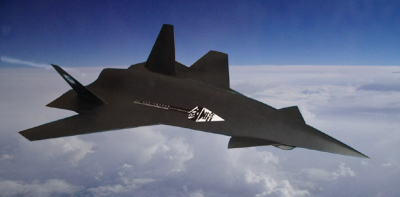 Twice a year, China showcases the latest in military technology at a show held in Zhuhai city, in the Guangdong province. During the last show, held in November, a series of new unmanned aerial vehicle,s most of which bore a striking resemblance to the American drones that have been conducting attacks in Afghanistan and Pakistan for the past few years. Naturally, observers in the west were rather concerned with the wider implications.
 In response, the Defense Science Board released an unclassified report in they claimed: “In a worrisome trend, China has ramped up research in recent years faster than any other country. It displayed its first unmanned system model at the Zhuhai air show five years ago, and now every major manufacturer for the Chinese military has a research center devoted to unmanned systems.”
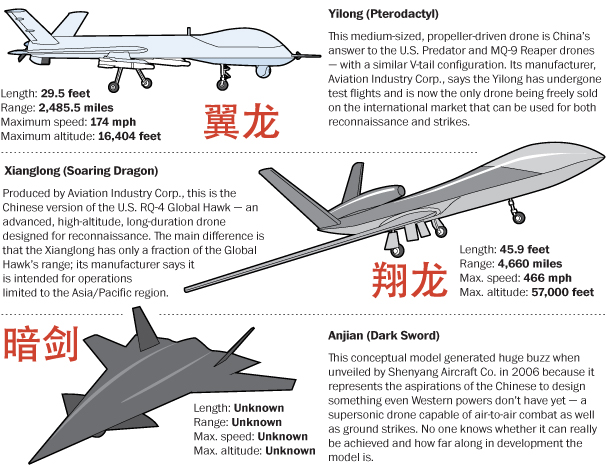 Two Chinese models on display at the Zhuhai show — the CH-4 and the Wing Loong, or Pterodactyl — appeared to be clones of the Reaper and Predator drones that are fixtures in the U.S. arsenal. A larger drone, the Xianglong, or Soaring Dragon, is a long-range, high-altitude model that would seem to be a cousin of the RQ-4 Global Hawk.


 Stories by Williams