
 No doubt about it, 2001: A Space Odyssey was one of the coolest, most memorable, and enduring movies I ever saw. Strange, considering there wasn’t that much dialogue in the film, and some would say that not much happened. But that’s the thing about Kubrick movies, they are very subtextual. And of course, Clarke’s involvement can not be minimized. But I’m here to talk about Clarke specifically, and the many books that came out of this screenplay that he and Kubrick created.
For starters, the books were quite different from the original movie. They contained only trace elements of the fear and intense awe that were there in the original movie. In fact, Clarke can be accused of being quite dry, in my opinion, his books somewhat technocratic and devoid of a lot of the complex emotions human beings are known to have. In fact, I was generally disappointed with the ending he wrote, how astronaut Frank Bowman was perfectly okay being whisked millions of light years away from home and transformed into the “Star Child”.
 One would think that a person’s psyche would shatter under the strain of knowing that they were being transported across the universe, never to see home again. One would also think that a process of metamorphosis, whereby a human being was being forced to leave behind their corporeal body in favor of some higher form, would be absolutely terrifying. One would think that, but nope!
Still, Odyssey’s main strength lay in its scientific explorations of a future world as well its explorations of extra-terrestrial intelligence. The idea of an alien race that was so advanced and evolved that it had effectively left its bodies behind was groundbreaking, as was the idea of a monolith. The perfectly proportional shape, rectangles laid out in a ratio of 1:2:3; much better than bulky spaceships and little green men I must say!
Also, the story introduced the world to Hal, the AI who, thanks its exposure to human intrigue, becomes homicidal, all the while with that perfect, clinical manner of his! Frightening as he was in the movie, the book contained more depth and drew out the conflict between him and Bowman. In the end, Hal tried to decompress the ship when he realized he had lost control of the mission, which was much more effective than the rather truncated flow of events that happened in the original screenplay.
 2010: Odyssey Two, was similarly interesting. In this installment, a second mission is mounted to discern what came of the first. They discover the ship, reactive Hal, and learn that the secrecy surrounding contact with the Monolith was what drove him nuts and was the real purpose of the original mission. Ultimately, it is realized that the alien presence around Jupiter has to do with the moon of Europa, which was featured prominently in the original story because of new discoveries being made about the planet at the time.
For those who don’t know, it is widely believed that life exists beneath Europa’s outer crust, composed of ice and rock, since the oceans that lie beneath are warm from Jupiter’s intense radiation and magnetic field. As a case of art imitating life, Clarke decided that in his second book, the reason for the monolith’s presence around Europa – facilitators, if not creators, of life – was to help the natural process of life along.
 By turning Jupiter into a second star – scientists have long known that the gas giant could have become a star if things had happened marginally different in our solar system – Europa’s ice crust melted, atmosphere formed, and life was able to crawl from its oceans. The book also reintroduced Bowman to the story, who is now a living entity inside the monolith around Europa.
After communicating with the crew, letting them know that “something wonderful” is about to happen and they need to leave, he disappears, only to show up near the end and invite HAL (who’s about to die when Jupiter goes Nova) to come with him. By the end of the story, Bowman and HAL, speaking from the Monolith, warn humanity never to go to Europa. The monolith’s experiment in life is to flourish freely there, they advise, without human interference.
 In the movie adaptation, there’s also a saccharine bit about how the Cold War powers should live in peace, but that was thrown in there for the sake of the 80’s audiences who were still dealing with the Cold War. Much like most of the US-Soviet competition that characterized the movie, it never made it into the original book.
Then, years later, Clarke wrote Odyssey Three, his third installment in the series. Set in 2061, this book was again inspired by real events, the return to the Solar System of Comet Halley. Since it was not scheduled to return until 2061, he set the book in that year and began writing about a mission to go study it up close, during which time they will be doing a flyby of Europa. So Floyd, the main character of book II, a “celebrity guest”, goes on this mission with a new crew.
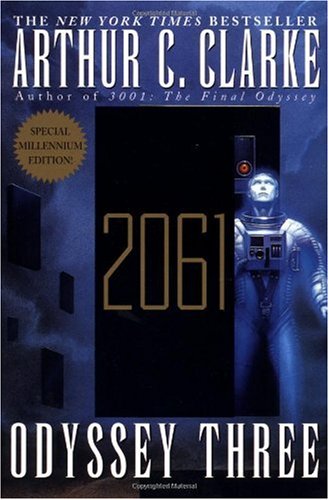 The main purpose is to investigate Halley’s comet, but the main story thread picks up when scientists on Earth and nearby Ganymede notice a new mountain that has formed on Europa (“Mount Zeus) which cannot be a volcano because of its asymmetrical nature. For reasons that are never fully-explained, the mission is hijacked and the crew become stranded on Europa.
During a rescue attempt, Floyd’s son, Bowman’s grandson, and the Afrikaaner character see the monolith on Europa and a wreck of a Chinese ship that tried to investigate earlier, in defiance of the monolith’s warnings. They see the monolith and the mountain confirm that it is, in fact, a giant diamond, a piece of Jupiter that broke off when it went nova and landed on the moon. All of this is consistent with scientific articles of the time that said that Pluto and Neptune had diamond cores, the result of carbon compression, and that the same was probably true of Jupiter.
In the end, the crew is rescued, Bowman makes an appearance in the dreams of a few people, and they come to realize that his consciousness now resides inside the monolith. The mountain also disappears beneath the surface of Europa’s ice. From all this, it is now clear that Europa is evolving, that Bowman and HAL are still alive in some form, and that a monolith is there, acting as guardian and watchman to the whole process.
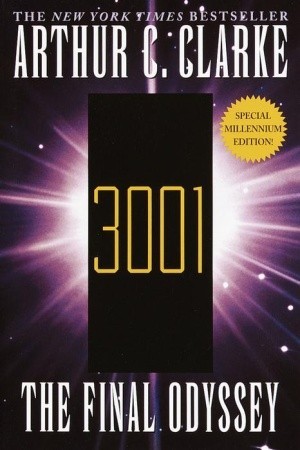 Then, to finish things, Clarke wrote 3001: The Final Odyssey. This book I read when I was about twenty, at a time when my literary and critical reading skills were being honed by some seriously awesome teachers and course loads. Perhaps because of this, or because Clarke changed things up drastically in the last book, I was very disappointed.
Quick synopsis, the character of Frank Poole, the astronaut who was killed by HAL in book I, is brought back. His body floats back into the Solar System after having done a circuitous route to the outer rim, and since it’s 3001, they are able to revive him. The first half of the book is then spent showing Poole how different the future is, revising Clarke’s predictions about stuff that happened in the book 2001 but not in real life, deals with all kinds of millennial themes (since the book was written just a few years shy of 2000 and is set just after the third millennium), and asserts the rather weak conclusion that a person from 2001 would have little trouble adapting to life in 3001, as opposed to someone from 1001 adapting to 2001.
Why? Because by 2001, most things that will become a reality by 3001 would be being postulated. Now this I found weak for a few reasons. First, it assumes that what we predict will be taking in 3001 actually will. It assumes that progress is a completely linear thing, that history is devoid of repeats or regression, and is generally an example of Clarke’s technocratic mindset. It also manages to gloss over the fact that Clarke was wrong about most of his predictions for 2001.
For one, the Cold War didn’t continue into the future, commercial space travel was not invented, there were no colonies on the moon, and there were no exploratory missions to the rim of known space. These he attempted to minimize by saying that these things were at least in the planning stages. Yeah! In the same way that a trip to the Moon was in the planning stages during H.G. Wells time, but that didn’t make it close!
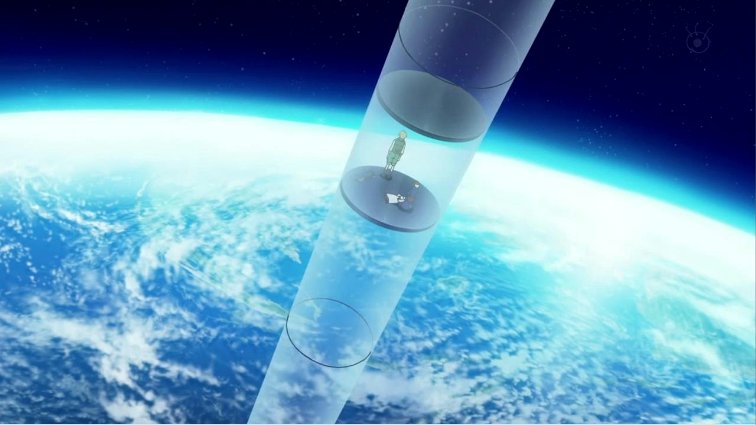 Another major disappointment of the first half is the fact that the technological innovations he mentions look like they were ripped directly from Star Trek! For one, they have holodecks (or a close approximation)! They have brain caps they wear that download information directly into your brain. And (this one was my favorite!) genetically engineered dinosaurs that do manual labor! …WHAT??? Are you freaking kidding me?!
To make that worse, he throws in a bit about Poole was surprised to see this, even though he saw all the “Jurassic movies” as a kid. This, along with several other pop-culture references in the first half, made we want to gag! To be fair, its hard to write a book about the near future, especially over and over while the actual future is taking place. But these kind of revisions, penciling in the things that happened in real life, is just annoying! If anything, the real historical record should be minimized in the background.
Much like his talk of all the scientific feats that didn’t happen, it was probably something that should have been tacitly dealt with, but not talked so much about. Oh, and of course, his comments on religion. The way Clarke saw it, humanity had created a universal church in the future after the fall of Christianity. He figured that at some point in the future, the Vatican would open up its archives and it would subsequently fall in the same way the Kremlin did when it did the same. Are you kidding me?
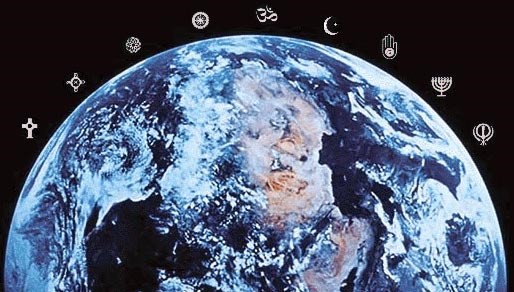 Sure, its a neat parallel, but everyone already knows the church’s crimes, they’ve been documented endlessly. And the archives aren’t exactly sealed, they’re just not open to the general public. So what would opening them to the public really change? Furthermore, to suggest that humanity could do away with faith because technology meant it no longer needed it is both shallow and naive. It’s the same kind of dogmatic thinking that goes into fundamentalism, that asserts that humanity can’t live without religion because it would be totally lost without all its dogmatic signposts and explanations.
My own theory, humanity’s need for faith, as with everything else, is ambiguous and will not be subject to any one influence. Chances are, we will never outlive our need for spirituality, but that does not mean we can’t live without specific institutions. And we will NEVER be able to invent some bland, universal, all-inclusive faith. Not that we won’t attempt to, but chances are it will fail.
But I digress… the second half of the book deals with Poole deciding that he wants to go to Europa to see what became of HAL and his old colleague. So he goes, and unlike other ships that have tried and failed, he makes it. Then comes more disappointments, Frank and HAL are not transcendent entities as was suggested in previous books. They are merely downloads, digital copies of their original selves preserved inside the monolith – which isn’t a conscious being but is itself a computer. BORING!
 After all that talk about intelligence and reaching the next great leap in cosmic evolution, this is what it all turned out to be? Bits and bytes in some big storage machine? And then there was the status of the Europan’s. Basically, that too, contrary to the hopes inspired by previous books, hasn’t gone so well. The Europan’s chemical and biological makeup, it is revealed, does not inspire confidence. The lifeforms are too basic, too slow and stodgy, to ever evolve into dynamic intelligent beings it seems.
So humanity won’t have counterparts then, children from the “other sun” to deal with in the future? ‘Nuther big letdown man! Well, the book wasn’t over so I went on reading. After all this slow build-up, we finally come to the climax of the story. Turns out, the monoliths are coming back to the Solar System. Why? The last transmissions they sent out were over 900 years ago, back when humanity was contemplating its own nuclear annihilation and breaking the quarantine on Europa.
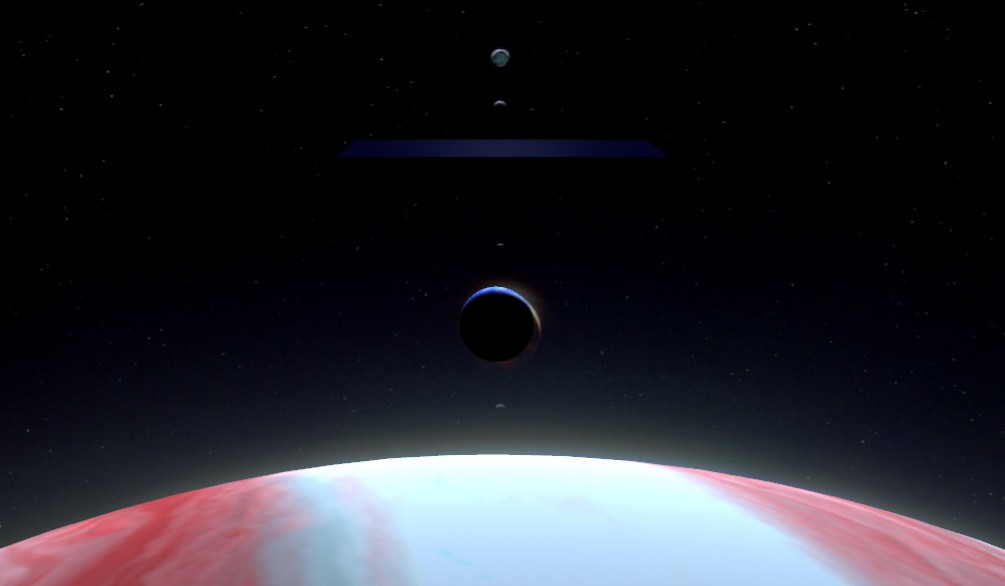 This causes the monoliths to conclude that humanity is too aggressive, an experiment gone wrong. So… humanity needs to prepare. They look at all weapons they have in their arsenal, but could possibly stop the monolith’s, a race eon’s older? They opt for a computer virus, another attempt by Clarke to pay homage to the time in which he was writing. They download the virus into the monolith on Europa in the hopes that it will transfer it to the others that are on their way.
Frank and HAL are meanwhile stored in a data crystal to preserve their identities, and before everything hits the fan, it all stops. The monolith’s get the virus, doesn’t really effect them, but they see that humanity has changed since they last saw them and decide to give them more time. Kind of a letdown. The final words, that humanity is still young and their God “still a child”, and they will be granted a reprieve until “The Last Days” were kind of chilling, but it still felt like an abortive climax.
Thus ended the Odyssey series. Some attempts have been made to keep it going by fan-fiction authors, but the less said about them, the better. Nothing worse than fan-fic’s who try to keep a series going after its creator retired it (see Dune and it’s Descendants for more on this point!). And while I was disappointed with the ending, I do think the series was very enjoyable and worthwhile overall.
 Some of the concepts, transcendence, ancient species, directed cosmic evolution, were all picked up on by some of the best sci-fi minds, not the least of which were J Michael Straczynski (creator of Babylon 5) and Katsuhiro Otomo (creator of the cyberpunk anime Akira). Where he was weak was in his fundamental understanding of human beings and history; how he felt that people are mere subjects to technological evolution and would continue to progress on a linear pattern. Human beings are certainly affected by technological change, but that change is not altogether positive.
In fact, the changes it engenders are often negative and lead to backlash and rejection as a result. Far from replacing religion, technology is often seen as a substitute religion, inspiring the same kind of mindless devotion as fundamentalism, or encouraging people to revert to simple beliefs in the hope of being delivered from its cold rationality. These are the kinds of things I would hope for in any investigation of the future, the social as well as technological upheaval and how they were connected, or at least a balanced look at these kinds of issues.
But Clarke is not that type of guy, he’s a futurist so it’s naive of me to expect it from him. In the end, he got me thinking, both in tune with his thoughts and against them, so I have to be thankful. In the end, that’s what good author does, gets your mind going and your blood pumping. And he left an enduring legacy, many titles to his credit and millions of people inspired by his word, so I say kudos to him! Thanks for all the memories and inspired thoughts, Mr. Clarke. Hope you found a quiet place amongst the stars now that you’ve transcended that final barrier. Rest in peace, Star Child!


 Stories by Williams