Alternate Histories…

When it comes to science fiction, alternate histories are a special kind of sub-genre. They explore the what ifs of history, challenge our notions of inevitability, and open up whole worlds based on what could have been. They are a source of fantasy and speculation on the one hand, offering the reader a chance to explore endless possibilities, and realism on the other, showing how a drastically different world can be entirely plausible.

Some might ask why this sort of thing would be considered sci-fi at all. Why not simply file it under the heading of historical fiction next to all those recreations or Dan Brown novels (Ha! Take that, Brown!)? Well, the answer is that, like time travel novels, there is a scientific basis for this kind of story. I’m sure everyone’s familiar with the Multiverse or Alternate Universes hypothesis. In essence, these theories arise out of quantum mechanics as well as pure fantasy, positing that there may be an unlimited number of alternate universes in which all possible realities have been realized.

So really, creating a world where things unfolded differently from our own is not only fun and creative, its also a relatively scientific approach. Who’s to say that this world doesn’t exist somewhere out there, in a different dimension of the universe as a separate quantum reality? Hell, there may very well be countless such realities paralleling our own. And imagining how and why things unfolded differently in any one of them is what makes them fun!

All that being said, let me get into some prime examples of Alternate History and what was good about them. For starters, the classic tale by Philip K. Dick and the world where the Allies LOST the Second World War.

Man In The High Castle:
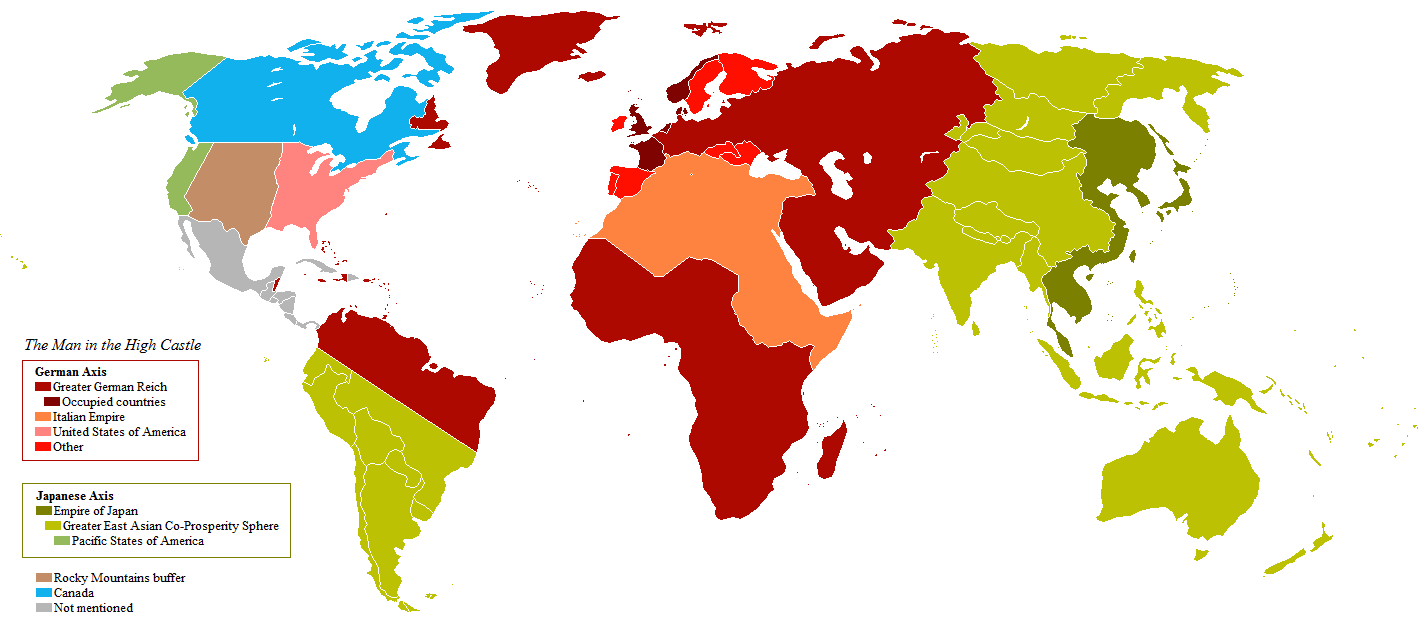
This story takes place in the US during the 1960’s where a different kind of Cold War is brewing between two superpowers. But unlike the world that WE know, in this world those superpowers are Japan and Germany. After losing the Second World War, the US was divided between these two powers, a loose federation of Midwestern states is currently unoccupied between them, and Jews, Africans and other “undesirables” have all but been exterminated. The rest of the world is similarly divided, falling into either the Greater German Reich, the Japanese Empire, the Greater East Asia Co-Prosperity Sphere, or the Italian Empire.

Man In The High Castle, Map

The reasons for this are made clear throughout. For one, the assassination attempt of FDR by Giuseppe Zangara’s in 1933 was successful. As a result, the US experienced a weak string of governments led by FDR’s VP John Nance Garner and then Republican John W. Bricker. Without FDR’s leadership, America never recovered from the Great Depression and was unable to offer military assistance to Britain and Russia or defend itself against Japan when WWII broke out. As a result, the Axis powers won and the US itself was conquered and divided by 1948.

In the world which resulted, the Mediterranean has also been drained, Africa has been sterilized through the worst manifestation of the Reich’s human experiments, and the Reich is sending people to the Moon and further into space. Technology has advanced quicker within the Reich, but at a tremendous cost in human terms, and the resulting impact on the Reich’s culture is evident everywhere. Madness and mass murder have become a permanent part of their psychology, which is part of the reason why they are planning on war again. The Japanese sphere is much more peaceful and phlegmatic by comparison, but technologically less advanced. In any coming conflict, they will be at a disadvantage and they know it!

Enter into this world a series of characters who represent the various facets of society. There’s the Japanese Trade missioner in San Francisco, Nobusuke Tagomi, Mr. Baynes, a Captain in Reich Naval Counter-Intelligence who poses as a Swedish Industrialist, Frank Frink, a secret Jew who is trying to start a jewelry business with his partner, Wyndam-Mason, an industrialist and the former boss of Frink, Robert Childan, an American antiquities dealer who sells his wares to Japanese customers who are interested in owning examples of pre-war Americana, and Juliana Frink, a Judo instructor and Frank’s ex-wife.

In the course of the story, we find that Baynes is traveling to San Francisco to meet with Tagomi, ostensibly as part of a trade mission, but really to deliver a warning. Germany is gearing up for war with Japan and plans on using nukes! Mason introduces the subject of the book known as The Grasshopper Lies Heavy, an alternate history that deals with the subject of how WWII could have been won. Frink and his partner begin manufacturing jewelry in the hopes of selling it through Childan, who does good business with antiquities but finds that innovative new things are not appealing to his Japanese customer base. And finally, we see that Juliana, after hooking up with a Reich secret agent, is traveling to middle America to find the author of Grasshopper, a man known by his signature – “Man In The High Castle”. The Reich wants this man dead, for obvious reasons.

By books end, Juliana kills the German agent once she discovers his identity and finds the man for herself. She learns that, in spite of the mystery surrounding him, he is actually a perfectly normal man who was inspired to create something groundbreaking. His inspiration for the book apparently came from the Oracle, an aspect of the I Ching which people use to ordain the future (and which plays a central role in this story). How he applies the Oracle to past events is never fully explained, but the point is clear. By book’s end Juliana realizes that they are living in the wrong reality. Germany and Japan were meant to have lost the war and the history was meant to unfold differently.

While difficult to follow at times, mainly because of the sort of stream of consciousness way PKD writes, this book was fascinating and is the perfect example of an alternate history. The plot device of the book, itself an alternate history, illustrates beautifully how history unfolded differently in this alternate universe and spares the reader from having to read through an intro that explains how it all happened. And aside from some debatable scenarios, like the draining of the Mediterranean, most of what goes on in it seems highly plausible.

Fatherland:
Another example of an alternate history in which the Axis once again won World War II, but did not conquer the New World. In addition to being a novel, it was a adapted into a TV movie starring Rutger Hauer, Miranda Richardson and Peter Vaughan. The author, Robert Harris, has done many works of historical fiction, including Enigma (also adapted into a movie), the Roman historical novel of Pompeii, and a trilogy centered on Cicero (Imperium, Lustra, and Conspirata). And though Fatherland does resemble Man in the High Castle in many respects, it is arguably more realistic and novel in its approach.

The story opens in the Greater German Reich in 1965 after a murder has taken place. Investigating this murder is Xavier March (played by Rutger Hauer in the movie), an investigator working for the Kriminalpolizei (Kripo). The victim is a high-ranking Nazi named Josef Bühler, and his death was meant to look like an accident. As he investigates further, he finds that Bühler’s death is linked to several deaths of high-ranking Nazis who lived through the war. In each case, their deaths are made to look like accidents.

At the same time, Charlotte “Charlie” Maguire, an American journalist, has come to the Reich to witness Adolf Hitler’s 75th birthday. This event is also being used by the Reich to heal the rift between the US and Germany, as there has been a state of detente between the two since Second World War. While in Germany, she is slipped a package from a stranger containing details about Bühler and begins looking into it herself. In time, March and Maguire meet up and begin exchanging information, hoping to discover the truth behind all the deaths.

In time, they come to uncover that the deaths are part of a cover-up conspiracy whereby the planners of the Holocaust are being eliminated one by one. This is being done in preparation for the meeting between Hitler and Josheph P. Kennedy (the president of the US in this story), basically to ensure that Germany’s crimes don’t get in the way of a new alliance. When the Gestapo get wind of their discovery, March is arrested and tortured, but Maquire escapes and heads for Switzerland with the proof they’ve found.

March is eventually freed with the help of the chief of Kripo, but quickly realizes his rescue was staged so he might lead them to Macquire. He instead heads for Auschwitz, which has been dismantled since the war, looking for some indication of what went on there. He soon finds bricks in the undergrowth, indicating the existence of old structures. Satisfied that it was real, he pulls out his gun and prepares for the inevitable.

The story not only does a good job of postulating what would have happened had Germany won the war (i.e. the Holocaust would have been covered up and disavowed by later generations in order to protect Germany’s reputation), but also on how this victory came to be. In addition to Reinhard Heydrich (the chief of Reich security during WWII) surviving his assassination attempt in 1942, the Germans also learned that the British had cracked their Enigma codes and changed them, thus being able to successfully cut off Britain with their U-boa ts and starve it into submission by ’44. In the East, the Germans also manage to defeat the Russians in the Caucasus in 42′, thus securing the Baku oil fields, cutting off Moscow from supply and finishing them off by 43′.

With victory in Europe complete, they then begin testing their own nuclear weapons and developing “V-3” intercontinental rockets by 46′. However, the US wins in the Pacific and drops their own nukes on Japan, ending the war there and leading to a state of Cold War between the US and Germany. Thus, in this alternate world, it is the US and Germany that are the global, nuclear superpowers rather than the US and USSR. The story also ends on a cliffhanger note, leaving the reader to wonder if war breaks out between the US and Germany and whether or not the main characters survive.

However, not all alternate histories revolve around WWII or even recent events. Some go much farther back in time, tackling pivotal events like the “discovery” of the New World, or the fall of Rome, or, in the case of Harry Turtledove, the outcome of the American Civil War. This is an especially good example of alternate history because of its apparent plausibility.

Guns of the South:
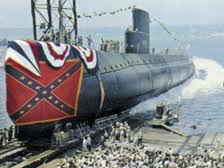
In this story, historian Harry Turtledove explores the very real possibility of what would have happened had the South won the war. It involves some South African ultra-nationalists (Afrikaner Weerstandsbeweging) traveling back in time to supply Robert E Lee’s army with AK-47’s and nitroglycerine tablets (to treat Lee’s heart condition), thus ensuring a Southern victory at Gettysburg and in the 1864 campaign. The motives for this aid are made clear in the course of the story when Lee finally questions the helpful men who’s accents and technology they find strange and intriguing.

In essence, the leader of the time travelers (known as the AWB, the anglicized version of which is “America Will Break”) tells Lee that in 2014, where they have come from, white supremacy has not endured and that in South Africa by their time, blacks have eclipsed whites as the dominant power. They feel that the only way white supremacy will survive is if the American South won the Civil War, thus ensuring that it would have a home in the US in the future. Lee accepts their help, and the Confederates eventually win the Civil War and the Union, England and France are forced to recognize the CSA.

What follows this is not only intriguing but highly plausible. Lee becomes president of the new south and abolishes slavery, in keeping with his views and the reality of the post-war situation. Not only is slavery untenable from a moral standpoint in his view, Lee knows that forcing former slaves to return to the plantations will only lead to violence and spur on black guerrillas who are now operating throughout the Confederacy. At his inauguration however, men from the AWB attempt to kill him with Uzis and end up murdering his wife, VP and several dignitaries. Lee then seizes their HQ and finds many more things from the future (like lightbulbs and books about the marginalization of racism in the future). He then successfully uses these books to convince his congressmen that slavery is obsolete and must be condemned. Abolition is thus passed in the South without incident.

The story ends with the Union, angered by British recognition and support of the South, invading Canada. Also, Lee is made aware of the fact that they are developing their own version of the AK-47 in case of future war. However, he remains convinced that the CSA will maintain its technological advantage, and will in time catch up with the North in terms of industry and be able to defend itself if worse comes to worse.

Having completed this one volume, Turtledove went on to create ELEVEN more books in the series, drawing out this alternate history thread and creating a very plausible timeline in the end. To sum it succinctly, the US enjoys mostly peaceful relations with the CSA for about fifty years, but angry over England and France’s support of the CSA, aligns itself with the new power in Europe at the end of the end of the 19th century – The German Empire! As the alliances take shape in the early 20th century, it’s Germany, Austria-Hungary and the USA versus Britain, France, Russia and the CSA. Neat huh? One can see without much effort how this will shake things up!

In the US too, politics change as the Republican Party is blamed for losing the war. It disappears and Lincoln, himself despised, ends up joining the Socialist Party, the only rival to the Democrats. With America and Germany as allies, cultural changes occur as well, such as fine mustaches becoming all the rage. This is in reference to Kaiser Wilhelm who was renowned for having a bushy soup strainer on his upper lip!

But its the wars where the real change occurs. When World War I comes around, America is immediately involved and the stalemate of trench warfare is seen running across the Mississippi river and also between Canada – part of the British empire – and the northern US. The black former slaves of the Confederacy, freed by President Robert E. Lee in the 1880s but then left to rot, rise in a Communist-backed revolt in 1915 but are ruthlessly crushed. In the end, the US army conquers Canada in 1917 with the use of tanks and breaks through the Confederate lines in Kentucky and Virginia. Russia is similarly brought out of the war by a revolution in this timeline, but not a Communist one. The US navy then turns its attention to Britain and puts up a blockage with starves it into submission. The USA and Germany have won the war.

Also similar to real history, the victorious powers impose harsh peace terms on the losers, complete with territorial losses, “war guilt” clauses, reparations, and disarmament. Politics thus become radicalised in the defeated powers – Britain, France and the Confederacy – and fascist parties gain control in all of them. The Second World War then arrives on schedule after a demagogue who is voted in in the CSA who resembles Hitler, though his hatred is aimed not at Jews but at blacks. The war opens with a Confederate blitzkrieg into Ohio that almost cuts the US in half, but in time, the weight of numbers begins to swing the balance the other way. Much like in the real WWII, the death camps run by the Freedom Party to exterminate the South’s blacks continue to run full blast, even as their armies are in full retreat.

Both sides are also racing for nuclear weapons, and some are used in the end – but Germany and the USA have more of them than Britain and the CSA, so the victors in the First World War win once again. And this time, the Confederacy is fully occupied and formally abolished. The United States is reunited after generations of disunity, but a genuine reunification will not come for many generations, if at all.

Thus, while some small changes in historical events led to some rather cataclysmic changes in Turtledove’s story, things pretty much meet up with real history in the end and come to resemble the world as we know it today. Russia is not Communist, and the Cold War of the post-WWII era is markedly different, but the general outlines are the same. So in a way, his story is just like PKD’s and Harris’ in that things diverge in the beginning but come back to what we, the readers, interpret as the normal course of history in the end. Hmmm, one might construe that their is a point in all this, a lesson if you will. And in that, they’d be right!

The Lesson of Alternate History(?):
This humble narrator would suggest that if there is a lesson to be learned from Alternate Histories, it is that the force of history is a powerful, weighty thing and that while small changes can have a big impact, the general pattern reasserts itself before too long. At least, that is what the authors in question appear to be saying. In PKD’s Castle, the story ends with the character of Juliana Frink realizing that Germany and Japan lost the war and that the author of the alternate history book wrote it for just that reason. Fatherland ends with every indication that the Holocaust will be revealed and that the US and Germany will remain enemies. And Turtledove’s Guns of the South, though it takes about half a billion words to get there, ends with WWI and II playing out pretty much the same as they did in real life.

But as I’m sure someone wise might have said (might have just been me!), books tell us far more about the author than the subject. It could be that history is a chaotic arbitrary process and the idea that it will meet up with us or overcome obstacles that are artificially put in place is an illusion. For all we know, causation and inevitability are things we impose based on a false consciousness, that we believe we are where we are meant to be because we have to. That idea is often explored in alternate history as well, where the characters believe that their own timelines are the “right” one and that if tampering took place, it was for ill. However, the stories always seem to end with things going back to the way they were meant to be. Everyone’s happy, or at least, a sense of balance is restored.

Either way, it tells us much about ourselves, doesn’t it? We are creatures who like to tamper with things, who like to ask “what if” and experiment with the natural order. But in the end, we also depend on that order and want to know that it will unfold as its meant to. Whether its an illusion or its real, its one of the many things without which, we would be lost!

Sidenote: Shameless plug, but it so happens I wrote some articles on the subjects of the multiverse and alternate universes. They are available at Universe Today.com, here are the links:

Multiverse Theory
Altnernate Universe

The Dark Knight Returns

While I’m riding this comic book turned movie high, I must mention one of the best comic books around and definitely one of the best installments in the Batman franchise ever. And while this comic has not yet been made into a movie per se, I do believe large tracts of it have been used to create The Dark Knight Rises. I am, of course, referring to The Dark Knight Returns by Frank Miller.

To be fair, I’m not exactly a comic expert, but even I’m not that big a fan of Miller’s work. He has obvious woman issues and is not the best illustrator, and large parts of this comic were lifted from The Watchmen. But hell, it worked! If you’re going to steal, steal big. And the concepts of outlawing superheroes, forcing others to work for the government, a dictator president and an escalated Cold War all worked quite well within a Batman context. And trust me when I say, Dark Knight Rises will use this stuff! Read the review and you’ll see what I mean…

(Background—>):
Initially, the comic was the result of a collaboration between Miller and DC’s editor-director Dick Giordano (formerly the Batman group director). However, disagreements over deadlines forced Giordano to pull out, leaving Miller to complete the project alone. DC then published the full and final product in one volume with four parts which, despite its price, sold quite well.

(Plot Synopsis—>):
The story opens on a near-future Gotham city where things have gone to hell due to the absence of the Batman. The reason for his retirement is simple: superheroes have been outlawed, except for Superman who now works for the government. We learn that this was part of the deal, where he became a military asset in order to spare his former comrades the indignity of going to prison. As with Watchmen, this has led to an escalation of the Cold War and the creation of a dictator president (in this case, its Reagan or a clear look-alike).

In any case, Bruce Wayne (aka. Batman) is struggling with being retired. By turning his back on his former profession, he feels like he’s betrayed the promise he made to his parents decades back. In addition, the situation is getting so bad that he feels he has nothing to lose by returning. This worsening situation is portrayed with an allegorical heat wave that has gripped the city and is only getting worse.

Enter into this Harvey Dent, the former DA turned Two-Face who has had corrective surgery (courtesy of Bruce Wayne) and who’s doctors now claim is recovered. However, these doctors soon have egg on their face when a masked terrorist seizes Gotham’s two main business towers, clearly meant to resemble the WTO’s twin towers (it should be noted that this comic was written several years before Sept.11th 2001), and threatens to detonate a bomb.

Batman is successful in stopping the terrorist, who is clearly Dent, and finds that the surgery has not had the desired effect. Rather than correcting his split personality, it has only deepened it, making his look one way but feel another. Dent is placed back into psychiatric care, and the public is divided over Batman’s return. The media, in the form of talking heads and news reports, play a large role in this comic. And for the most part, they have bad things to say about Batman, claiming that in spite of his actions, he ultimately attracts a more deranged breed of psychotics and criminals.

His return also puts Superman in an awkward position since he will now be forced to come to Gotham and arrest him. However, as he is still occupied with a US-Soviet standoff taking place on the fictitious island of Corto Maltese, Batman has some time. Which he spends moving onto his next targets, the Mutants gang. Seems these thugs have taken over the streets, are thieving and murdering, and are led by a massive, psychotic freak. Oh yeah, and they operate out of the city’s dump. When Batman confronts them, he gets into it with the boss, but things go awry. After all, the boss is a mutant, is hugely strong and powerful, nearly impervious to pain, and a lot younger than Batman.

After several rounds, Batman begins to lose ground against the titanic thug and has his arm broken and shoulder torn by his claws. He is on the verge of blacking out when a young girl (dressed as Robin) jumps in and takes down the boss with a crowbar. She helps Batman escapes and the police show up shortly thereafter to arrest the boss. Seems Batman has a new sidekick, and makes it back to the Batcave to recuperate. However, the mutant boss lets everyone know from custody that he defeated the Batman and that he will wreak further vengeance on Commissioner Gordon and anyone else who gets in his way.

Across town, the spineless mayor comes out of hiding and blames the escalation on Batman. He further claims that he will step in and put an end to things by speaking with the mutant’s leader. However, this meeting turns bad when the mutant leader decides to kills the Mayor. He is placed back in prison, but Batman soon arranges it so he can escape. He then confronts him again, this time in a mud pit in the middle of the dump where he plans to beat him by outsmarting him. He also makes sure that every member of the mutant gang is there to watch, because he knows their reign of terror will only end if they see their leader defeated firsthand.

This time around, the fight is still a tough slog, but Batman utilizes his experience and his environment to his advantage. The mud slows the boss down, he manages to partially blind him with his own blood and the mud, then paralyze his limps with a nerve pinch and a broken elbow. He then gets him down into the mud where he latches onto one his legs and breaks it, immobilizing him completely. He then pounds him senselessly into the mud while the mutants look on in horror and awe. The mutants are beat and the city is safe, except that people are now forming a new gang that wants to emulate the Batman (echoes of The Dark Knight here!). Just like in DK, Batman is not too enthused about their existence and begins cracking down on them. Meanwhile, at Arkham, a dispirited and anesthetized Joker sees Batman on the TV, and comes back to life! Seems Batman’s resurgence is attracting his old enemies…

Meanwhile, on Corto Maltese, Superman’s actions have prompted the Soviets to up the ante. They fire an ICBM at the island, but rather than being a nuke, its a massive EM missile. Superman diverts it to a desert where it explodes and harms no civilians, but he is almost killed in the blast. A interesting point, since we know that Superman draws his power from the sun, it seems reasonable that an uncontrolled blast of EM radiation would harm him. And of course, it does! Also, Gotham and every other city in the area is hit by a massive black out. Chaos ensues, and Batman must travel to the prisons and take control of all the gang members who are escaping. Since many are Batman wannabees, he manages to recruit them to restore some order to the streets. The power comes on shortly thereafter, and once again, the media and experts debate the events. Most condemn Batman’s latest actions, even though he has helped to save many lives.

But Batman has his own theories. Mainly, he blames Superman for selling out to the government, and sees the escalation with the Soviets as a direct result. During a conversation before Superman sets off, he tells Wayne (they use each others’ real names!) that he will have to go up against him if he persists. Wayne replies by saying that he no intention of going back into retirement, and that if it comes to a confrontation “may the best man win”. Superman is incredulous, but he has his answer!

Back in Gotham, the Joker is finding new ways to create mayhem. Having convinced the same crop of doctors that he’s cured, he goes on a talk show where he is confronted by a Dr. Ruth look-a-like. After some innane psychobabble, he kills Ruth with a poisoned kiss and unleashes his smilex gas into the theatre, killing everyone. He then runs to an amusement park where he is intercepted by Batman, and more mayhem ensues. Batman finally corners him in a sewer where they have their final fight! The Joker stabs him a few times in the stomach, and Batman manages to cripple him by breaking his neck. The Joker then finishes it, snapping what’s left of his neck and killing himself. He dies laughing…

Again, Batman narrowly escapes, and Superman recovers enough to return to Gotham. After some preparations, Batman is prepared for his final fight! Getting himself into some powered armor, assembling his usual arsenal of tools, and enlisting the help of Green Arrow, someone else who resents Superman. He’s also sure to pop a pill, who’s purpose is as yet unclear. Then, he picks the location for their fight, the very street corner where Bruce Wayne’s parents were gunned down. The fight goes to plan, with Batman managing to hurt Superman in a number of ways (he’s still recovering from the EM missile attack) and stalling him long enough for Green Arrow to fire off his special package! A kryptonite tipped arrow!

Naturally, Superman catches the arrow, but the tip then explodes into a million tiny particles which he then becomes poisoned with. Severely weakened, Batman puts his hands around Superman’s throat and delivers his last words to him. Essentially, he tells them he sold them out, that he could never understand that the world doesn’t make sense, that his ideological purity makes him a pawn, and that he beat him! But then, Batman suffers from what appears to be a heart attack and collapses. The police arrive to see Superman kneeling over his old friends body, guarding it even though they were locked in mortal combat not a moment before.

The comic then moves to Batman’s funeral. Things are just wrapping up when Superman notices something. A faint sound coming from the ground, and someone suspicious looking standing nearby, waiting. In short, what he hears is heartbeats, the suspicious figure is the new Robin girl, and she’s waiting with a shovel. Remember the pill Batman took? Turns out it was a designer drug that imitates the appearance of death (little Romeo and Juliet there, but okay). His case contained a hidden oxygen supply, and everything was timed so Robin could dig him up before it ran out. Superman looks at her and winks. He’s onto them, but has decided to let his friend go.

Once he’s emerged, we see Batman moving to a new location with the new Robin and a set of accolades. From there, they will rebuild, create a new Batcave and start fighting crime anew. The public thinks he’s dead, but his spirit will live on through a new generation of masked crime fighters. Yeah! Batman forever!

(Synopsis—>):
A possible downside to this comic was Miller’s frequent use of media types and talking heads to advance the story. While it is interesting – and effective when it comes to providing transitions and pacing – the way it constantly helps advance the plot and provide background can get a little tiring at times. By volume four its like, we get it, Batman is a controversial media topic, and the so-called experts are morons! That, plus the fact that Miller really seemed to want to stack public opinion against Batman in the story got a little heavy-handed at times.

Still, it did manage to give some depth and a certain social context to the story. Not to mention realism, seeing as how any vigilante, no matter how effective, would not fail to stir up resentment and fear amongst those in power. All throughout the novel, it is made painfully clear that authorities condemn Batman because they don’t want to appear condoning, regardless of how needed he really is. At the same time, those same people seem to want to think that former villains have been successfully rehabilitated, if for no other reason than because they want to believe their methods are effective.

And I said, this book did seem to be borrowing pretty heavily from The Watchmen. However, these elements were well suited to the Batman universe, and given the fact that Dr. Manhattan was openly compared to Superman, it wasn’t like the borrowing was all one way. What was also well executed was the reason for Superman’s employment by the government. Not only was he doing it to protect his friends; according to Batman, it had much to do with his naivete and idealistic outlook. The boy from Smallville just couldn’t help but take orders, it was what he was born to do. And when society and the government turned on them, he effectively sold them out by agreeing to do their bidding.

This last element was something I especially liked about this graphic novel, the it explored the differences between Batman, Superman, and pitted them against each other. Fans of DC comics couldn’t help but have a big fangasm, but it was also highly appropriate. Whereas Superman had always been the clean-cut, cardboard cut-out superhero, Batman was always the darker, grittier, more realistic one. And in both cases, this was presented in very real terms, showing the upside and downside of these traits. Whereas Superman is seen by Batman as a fool and sell-out, the complete flip-side of how others see him, Batman is portrayed as a sort of social fascist in addition to be being a brave vigilante. This dichotomy serves to elevate the content and makes everything feel more realistic.

The Dark Knight Returns, ladies and gentlemen. Read it, love it, then look for traces of it in The Dark Knight Rises. I’m telling ya, it’s in there. Look for it!

The Watchmen

Sometime last week, I finally got my hands on the original graphic novel of V for Vendetta. I figured that since I was going to review this movie at some point, I ought to read the source material and treat it like all the other adaptations I’ve covered so far with this blog. Interestingly enough, the creative force being the graphic novel was none other than Alan Moore, the same man who created The Watchmen! While I’ve never been much of a comic book guy – which I admit is both treasonous and weird given my obvious geekhood! – I can honestly say that this was one of the best graphic novels I have ever read. Hell, it was guys like Moore with such creations as Watchmen and V that helped to establish the very concept of the graphic novel. While the dividing line between them and comic books is pretty fine, one can’t deny that guy’s like Moore combine a great deal of thought and inspiration to come up with these things, certainly no less than what typically goes into a high-end novel.

Not only that, but with The Watchmen, we got a story that was equal parts satire on the traditional subject matter of comics (superheroes) and the history of the 20th century. This is done in true sci-fi form, employing an alternate reality to show how the existence of a certain phenomena altered history, and using the differences to illustrate what took place in the real world. Embracing such things as generational change, feminism, war, civil rights, the decline of America, politics, nuclear holocaust, paranoia, UFO hysteria, and the American Dream, the scope and depth of this book was virtually undeniable. And when it came time to adapt it to the big screen, the same spirit came through pretty clear. There were naturally some weaknesses that emerged out of the monumental task of adapting the voluminous text to the big screen, and some complained about the changes, but in the end, it felt like a pretty faithful adaptation, and one that was overdue!

(Background—>):
Zack Snyder must have seemed like the natural choice to shoot this epic, having directed 300 – another graphic novel adaptation – just three years before. The end result was an official release that left out various parts of the plot in order to cut down on run time, but still managed to be two and a half hours long. As expected, a directors cut and an “Ultimate Cut” were also released on DVD that contained much of the missing elements, and they run for approx. three and three a half hours respectively! That’s what you get when you try to adapt a classic to the big screen, I guess. In either case, the box office draw and DVD sales were through the roof, another result of a classic meeting the big screen!

Naturally, there were those who complained about the cinematic release, citing the things that were left out, the new ending which did away with the whole UFO theme, and what not. However, the thing that divided audience the most, ironically enough, was Snyder’s commitment and reverence of the original source material. While some praised him for his faithful adaptation, his biggest critics saw this is as a drawback, claiming that his commitment to the source material made the movie feel “stuffy” and “boring”. Some even found themselves falling in the middle, saying that they were impressed with the faithfulness of the adaptation, but unsure as to whether or not this made for a good movie. One thing was certain though, for fans of the graphic novel, the biggest source of contention was the changed ending! Squiddy or Manhattan, which was better? For those of you who read the novel, you know what I mean 😉 For those of you who don’t, read on!

(Content—>):
The story opens on the murder of a superhero by the name of The Comedian. Whereas the novel only shows the aftermath of this, the movie gives us the full fight scene in order to open with a bang and get our attention. In any case, we begin the movie knowing that The Comedian (played by Jeffrey Dean Morgan) is dead, and his friend, fellow superhero Rorschach (Jackie Earle Haley), is on the case! This latter superhero, named for the mask he wears, is one of the few superheros in this day and age who’s not working for the government or gone into retirement. He believes The Comedians death is part of plot to eliminate the Watchmen, as superheroes have been turned on by popular opinion and outlawed by the state. We also learn quickly that due to the historical presence of superheroes, the world has unfolded quite differently. Due to their efforts, America won the Vietnam war, Richard Nixon remained president since, the Cold War escalated and nuclear war now seems inevitable. Society has also gone to hell in a hand basket, but at least there are electrical cars!

So, fearing a plot against his former superhero friends, Rorschach seeks them out and tries to warn them. These include Nite Owl (Patrick Wilson), Dr. Manhattan (Billy Crudup), his wife and partner Silk Spectre II (Malin Akerman), and Ozymandias (Matthew Goode). Most of them are retired, except for Dr. Manhattan who is doing nuclear research for the government (fitting since he’s a nuclear-powered, godlike man!) and Ozymandias who’s supersmarts have led him into the world of inventing and big business. Most of them are skeptical, until an assassination attempt against Ozymandias is narrowly averted. The movie then gravitates between filling in the characters back stories and the progress of the murder investigation in the present.

On the one hand, we see how The Watchmen, an organization of crime-fighting superheroes, evolved from the Minutemen, a similar group that was formed in the 1930’s in response to the rising tide of organized crime and gangsters. In showing the history of the Watchmen, we are made aware of how history unfolded differently since their own stories are so very intertwined with history. What is palatable in all this is the feeling of loss and betrayal that accurately portrays America in the 20th century. Much like in the novel, there is the pervasive sense of the “end of innocence” as we go from a rought but optimistic past through a series of shocks and upheavals, landing finally in a dark and gloomy present where annihilation seems inevitable. Most of this told from the point of view of Rorschach, a man who’s own cynicism reflects the mood of his age. His thoughts and findings, all of which he puts down in his journal (which will come up later), provide the narration. And I dare say Haley did a very good job portraying this dark, brooding superhero! The way Rorschach always said “Hrrrmmmm”, that I thought was done pretty well too.

In any case, Rorschach’s investigation soon leads him to a former villain named Moloch (Matt Frewer) whom he suspects because of him being a former enemy of The Comedian. However, his suspicions are allayed when he learns Moloch is dying of cancer. Interestingly enough, Moloch tells him that the Comedian showed up at his apartment shortly before he died, drunk off his ass and muttering something about how it was all a joke. This makes Rorschach even more curious, as he now believes the man was onto something that could shake even him. It’s been well established at this point that The Comedian was a real SOB, and that his alias is sort of an ironic joke. Like the Joker, his humor comes in a brutal, sardonic form, albeit somewhat less evil (only somewhat).

In any case, Rorschach soon finds himself framed when he returns to Moloch’s apartment, finds him dead, and that the police are upon him. He puts up a brave struggle, but the police soon have him and rip off his mask. They are suprised to find that this ass-kicking vigilante is actually a pretty puny man who wears lifts, but is a grizzled due nonetheless (Haley looked the part pretty well too!). While in jail, we get to hear some of Rorschach’s story as a shrink examines him, and the reasons for his cynicism and dark world-view quickly become clear. Seems Rorschach was the child of a prostitute who routinely beat him, until he ran away from home and began beating the shit out of bullies. In time, became a vigilante and donned a mask that looks exactly like a Rorschach diagram, dolling out justice to those who violated the law and/or his rigid moral code (which he clearly uses to compensate for his lack of moral values growing up). At first, he had limits, beating criminals up but never killing anyone. But then came the encounter that forever changed him, which he relates with brutal detail to the shrink while looking at (you guessed it!) Rorschach diagrams! I shant go into too much detial, suffice it to say that it involved a pedophile/murdered who’s crime demanded swift and severe retribution!

Meanwhile, Dr. Manhattan comes under fire during a televised interview. Seems some investigative reporter has turned up evidence that everyone he’s ever been in contact with is dead or dying of cancer. You see, Manhattan was created when a nuclear accident broke down ever cell in his body, only to later be recomposed out of pure energy. He can take whatever form he wishes, duplicate himself, teleport, vaporize his enemies, and so forth. However, it was assumed up until this point that his presence was benign and he was not a threat unless he wanted to be. When he learns this, he has a minor breakdown and teleports himself to Mars, wanting to break contact with humanity and spare anyone else the harm of being around him. His partner, Silk Specter II, has already moved out since his lack of humanity was driving a wedge between them. But when she hears of his departure, she is understandably upset. She has already moved in with former colleague and friend Nite Owl (Patrick Wilson) and the two begin a sort of affair.

With Manhattan gone, the Soviet Union, which has been at a strategic disadvantage since Manhattan first started working for the US government, decides to take advantage of his departure and invades Afghanistan. The Doomsday Clock gets closer to midnight! Similarly, Silk Specter and Night Owl decide to come out of retirement because of the impending crises and do what they can to help people in need. Their affair has been abortive up to this point because they feel afraid and impotent with all that’s happened, but after saving several people from a burning building, they feel on fire and do it right in Nite Owl’s hovercraft! To Halleluiah by Leonard Cohen no less! They then break Rorschach out of jail, knowing that he was right about their being conspiracy at work. With The Comedian dead, an attempt on Ozymandias and the confrontation that made Manhattan leave Earth, it now seems evident that someone wants The Watchmen out of the way. After all that is done, Silk Specter decides to confront Manhattan, which she does after he comes for her and brings her to Mars. In the course of a tense discussion, he reveals to her that The Comedian was her father. Seems her mother, Silk Specter the first (played by Carla Gugino) slept with him in spite of his violent behavior towards her, and she was the result. She is, again, understandably upset, but still manages to convince Manhattan to come back and help them.

Together, Rorschach and Nite Owl go to Ozymandias’ office and unlock his files. In them, they find compelling evidence that he has been behind everything. The smoking gun comes when they see that The Comedian was working for him in the last while, and that his death was obviously to prevent him from telling the others what he had found out. They also figure out that he staged his own assassination attempt and sent a false reporter to tell Manhattan the cancer story, thus getting him out of the picture. They then travel to his Antarctic retreat where they know he’s still working on whatever pet project The Comedian died to protect. And here we get another change just like at the beginning (aka. the addition of a fight scene). In the comics, Ozymandias reveals his full plot to them and only tangles with Rorschach briefly. In the movie, there is an extended fight scene between Owl, Rorschach and Specter before he shows them what he’s really up to. And that’s where the biggest change of all comes into play: the big finish! But first, his motive!

Basically, Ozymandias explains that his plan was to unify the US and USSR and prevent a nuclear war by exploding the world’s largest energy reactors which he and Dr. Manhattan created. This will level several of the world’s major cities. Naturally, they try to stop him, but he explains that its too late and the reactors are already set. The energy signatures of the explosions are consistent with Manhattan’s, in part because the technology is based on the same forces that created him. Ergo, it is believed HE attacked Earth, most likely out of some anger-fueled breakdown that happened as a result of his breakdown. As noted already, this is not what happened in the novel, but more on that later…

Silk Specter and Manhattan have already shown up, and Ozymandias tries to kill Manhattan by luring him into some kind of nuclear de-compiler that is similar to the one that altered him in the first place. However, Manhattan proves immune to it and manages to finally subdue Ozymandias. He, however, turns on his many TV’s and shows him the reports which tell how the US and Soviet Union are standing down in the face of this new attack. They both seem to think Dr. Manhattan is attacking them now and are combining forces to defend against him. The others are angry, but Manhattan cannot argue with the logic and agrees to take on the role of the bad guy and go back into exile, this time permanently. Rorschach refuses to play along, him being a no-compromises kind of guy, and Manhattan is forced to vaporize him to maintain their little secret. Manhattan then says good-bye for the last time and leaves them for good. Nite Owl and Silk Specter leave too, vowing to keep fighting crime as New York rebuilds and build a future together.

The movie then ends with people from a right wing tabloid named the New Frontiersmen talking about there’s no news now that the Cold War has ended. But it seems that in their incoming mail, there’s a strange journal… It’s Rorschach’s, which he happened to mail to them just before he and Nite Owl departed for Antarctica. Remember how he recorded everything in there? Well, it seems like the secret might get out after all! The movie and comic both end on this scene, offering the reader/viewer an uncertain and possibly open ending.

(Synopsis—>):
First off, the new ending. As I’ve said twice now, the part where Ozymandias blew up the world’s major cities and blamed Manhattan was not what had happened in the original graphic novel. There, Ozymandias was working on perfecting matter teleportation, and it was this technology which he also used to try and destroy Dr. Manhattan. In any case, what he was teleporting was the body of a massive, genetically engineered bio-organism that looked very much like a massive alien squiddy into the heart of New York. Sounds weird, I know, but the result was that New Yorkers became convinced that an alien attack was underway. The organism died in the teleportation sequence, and only a few people were killed, but the point is they believed that an invasion attempt had failed, but more could be coming. THIS is what united the US and USSR, the prospect of an external threat that came from another species, not Doc Manhattan.

To be fair, I saw the reason for the changeover. The Squiddy concept was weird, but it played into the whole UFO paranoia that also existed in the latter half of the 20th century, as seen with Roswell and Area 51. The idea of playing that against Cold War rivalry made sense, it was just the execution that seemed a little weird. By putting Dr. Manhattan at the center of the conspiracy, Snyder was able to rework the plot quite effectively, but he did away with an essential element as a result. In addition, the recurring side-story about the pirate comic Tales of the Black Freighter which a patron is reading at a newstand, was also missing. However, Snyder was sure to include an animated adaptation of this portion of the novel onto the DVD.

The concept of the Doomsday Clock was also something that was changed, albeit in a faithful way. In the novel, the clock is not an actual object but a device that tells the reader before each chapter how close they are to the climax. But in order to keep it, Snyder adapted it into the movie as a set piece a media personality used to capture people’s fears about the impending nuclear war. Other than that, the only real changes had to do with action sequences which were included for obvious reasons. And they’re actually quite entertaining, being at once over the top and brutal. In a way, it kind of adds to the satire, combining superhero-like antics with bloody realism, which is essentially what the comic book is all about.

So what else was bang on…? Well, the feel was almost exactly the same. The movie’s intro, done to “The Times They Are A-Changing” by Bob Dylan was quite masterful at establishing the tone and giving the audience a quick glimpse of the back story. In fact, the entire soundtrack is faithful to the time period being depicted, giving it all a sense of historicism. The only flaw I saw in any of this was the scene where Nite Owl and The Comedian (in a flashback sequence) are shown cracking down on protesters during the late 70’s before superheroes were officially outlawed. After dispersing the crowd, Nite Owl turns to The Comedian and says “What happened to this country? What happened to the American Dream?” This was a bit obvious, and it was never done in the comic. For the most part, the movie captured this theme very well so I didn’t see why any of the characters needed to come right out and say it.

But overall, I felt that the movie was a faithful adaptation. In fact, I was impressed with how closely the movie followed the novel until the end. However, this does not mean that it could ever hold a candle to the original. This is not an attempt at snobbery on my part, it’s actually just how I feel about all adaptations. They are fun and serve their purpose, but can never really be expected to provide the same meaning or enjoyment as the original. In addition, reading is always more enjoyable, in my humble opinion, because the reader is able to stop, think, and interpret what they are taking in. In a movie, the entire process is transmissive, no room for interpretation until its all over, and the key jobs of visualization and imagining are done for you.

So… yeah! Watchmen, people! Read it, see it, decide for yourself. And know that the second you do, you too will have an opinion on the subject and demand that it be heard. Hell, you might even shout at a person or two for not sharing your beliefs. See, that’s the thing about geeks. We’re passionate about interesting but inconsequential things!

The Watchmen:
Entertainment Value: 7/10 (run-time kind of brings it down)
Plot: 8/10
Direction: 9/10
Total: 8/10

2001: A Space Odyssey

Once more, a movie that was both a novel and a screenplay. But, unlike others I reviewed (Blade Runner, Dune), Space Odyssey was actually a movie that was later novelized. Not the cheap, dime-store novelizations that seek to cash in on the movies’ success mind you. No, this was a case of collaboration, where a scientist-turned-writer (Arthur C Clarke) collaborated with a filmmaker (Stanley Kubrick) to produce a movie, with the former writing the novel version simultaneously, but which was released after. And the combination worked pretty well, if I do say so myself! Clarke offered up the hard science and futurism while Kubrick brought the cinematic vision and directorial talent. But to be honest and fair about it, the novel was just not as good. I say that with all love and respect for Clarke, may he rest in peace. But that’s just the way I felt, having seen the movie and read the book. Whereas the movie was raw and emotional when it needed to be, capturing the awe and terror of space exploration and the unknown, Clarke approached these things with a sort of stoic detachment. And whereas the movie was a bit more complex in its depiction of technology and artificial intelligence, Clarke’s views were much more straightforward. But that was to be expected. Clarke was a futurist, after all, seeing humanity as perfectible through progress and the scientific method. Things like human nature, emotion, instinct and the fallibility of science were not really things that showed up on his radar much.

But that’s something for the literary reviews. Right now, it’s the movie that need dissecting. So once more, lets get into this sci-fi, cinematic classic and see why it was such a big hit.

(Background—>)
Even though it received mixed reviews when first released, 2001 has gone on to become one of the highest ranked movies of all time. Fans, the Academy Awards, and numerous polls place it in the top 10, with the Moving Arts Journal going as far as to rank it the number one movie of all time in 2010. Its visual style and its classical score, along with its thematic breadth and scientific realism, make it a favorite of movie-goers, critics and cinema cultists alike. And time doesn’t appear to have diminished this much. Of all Kubrick’s films, 2001 is often ranked as his greatest accomplishment, though there has been no shortage of competition for the top slot! For Clarke, the novels that followed the movie’s release were largely responsible for him being rocketed to fame as one of the “Big Three” of science fiction, alongside Robert A. Heinlein and Isaac Asimov. In addition, the success of the original novel Clarke to pen three sequels, 2010: Odyssey Two, 2061: Odyssey Three, and 3001: The Final Odyssey, the first of which was also made into a movie (for a more in-depth look at these novels, see my review, Clarke and his Odysseys)

(Content—>)
The film opens with the classic score, playing in front of planet Earth during a sunrise. I don’t imagine I need to tell anyone what a powerful opening this is. We see the planet Earth from space, is all its glory, and the music instantly captures the feeling of awe and wonder that defines the film. We then cut to the African desert, during what is referred to as “The Dawn of Man”, where a tribe of herbivorous apes are foraging for food in a hostile landscape. Through a series of images, we get a pretty clear view of their world and how they are struggling to survive in their harsh environment. All of their time is dedicated to foraging for food and water, they are in a constant state of competition with other animals and other tribes of simians (not to mention being preyed upon by hungry leopards!) However, their world changes forever when they wake up one morning and find that something in their environment has changed: a tall, black monolith has appeared out of nowhere and now sits in the middle of their encampment. Naturally, they begin to freak out and throw things at it, crying out loud and generally panicking in its presence. Slowly, they come to accept its presence and even begin to run their hands along its smooth surface, realizing that it does not pose them any immediate harm.

And I got to say, this scene was masterfully done! It’s perhaps the first example of everything the movie does right. The reactions of the actors playing the simians is perfect. How they initially panic and only slowly, very slowly, begin to calm down and even become intrigued by the monolith. The music also serves to heighten the feeling of uncertainty to the point where little is happening on screen, but we known in our hearts that something terribly significant is really going on. This music comes up again later in the movie, illustrating a direct parallel between when man’s early ancestors encountered the unknown in their own world and modern humans do the same with space exploration. It’s scary and exhilarating all at once.

Shortly thereafter, we see the simians going about their business as usual. But then, while picking amongst a set of dry bones, one of the tribe has a searing burst of revelation. Picking up what looks like an animal femur, he begins to realize (slowly, of course) that he can club things with it. As the scene picks up, the music reaching a crescendo, we get the same sort of feeling as when the apes encountered the monolith, except in reverse. What begins as a sort of tame display mounts until the ape is overcome with feeling, thrashing and smashing everything around him. And then, the camera cutting between the bones and a falling animal, we see him applying the lesson by killing another animal with it! That night, the tribe eats meat, and the transition from herbivores to omnivores has begun. We also see a frightening scene the next day, as a rival group of simians encounters them at a watering hole. But whereas the two groups would just shout at each other until one retreated, this time an ape is killed. The bone-carrying ape has passed on the lesson of the club to his kin, and they take turn beating their rival until he’s dead. The scene ends with a silent moment as the ape tosses the bone in the air, it swirls around and around, falling ever towards Earth… And then boom! The bone becomes a satellite, and the skies have become space in orbit around planet Earth.

Where do I begin? Once again, the sheer amount of significance in this scene. We are given, sans dialogue and through a series of brief but poignant scenes, a glimpse at how humanity came to evolve. From being herbivores who had to claw and scratch for every inch to omnivores who asserted control over their environment through the use of tools. And what accounted for this leap? A simple act of deductive reasoning, but clearly, higher forces appear to have played a part… Oooooo! Yes, that’s the impression we are meant to have, that the sudden appearance of the monolith and how it coincided with a jump start in evolution was no coincidence. But since there is no dialogue, all of this is going on in our minds, and it was bloody effective!

Cue part II, named TMA-1. The story begins to unfold then as we get some shots of life in orbit around Earth, aboard the international space station, and then moving through a drawn out montage to the Moon. This is perhaps one weakness in the movie, the many scenes that seem to go on and on, classically scored and containing no dialogue. They are pleasant, and you get an obvious sense of scope and breadth from them, but for the most part… they’re kinda boring. But as I realized when I first watched it, the movie was made in a time when people actually had attention spans! In addition, the idea is to give us a glimpse of the future which is both cheery and wonderful, showing how far we’ve come and how technology has made so much possible. They also pace the movie between its more dramatic bits, where there’s meaningful interaction or drawn out scenes where everything is tense and dramatic. In any case, as I said, the story unfolds. We are told in no uncertain terms that the Cold War is still on, that the Americans have a colony on the moon that is being quarantined and the Russians suspect something is up.

We then see Doctor Heywood Floyd, chairman of the National Council of Astronautics (a futuristic version of NASA) travel to the Moon where he discusses with his peers how the quarantine story is not holding up, followed by another, though comparatively brief, scene where he is being shuttled out to the surface so he (and the audience) can see exactly what it is they are hiding. Some dialogue serves to fill in the blanks, explaining what the real situation is around the colony and what TMA-1 stands for. Basically, they’ve found an object which appears to have been “purposefully buried” millions of years ago. Its designation is “Tycho Magnetic Anomaly-1”. Everything becomes clear when they set down and begin walking around the excavation in space suits, and we see that what they’ve uncovered is in fact a monolith, one that is identical to the monolith encountered by the apes… I’m getting the tinglies! I should also not that this scene is a perfect example of the movie’s scientific realism. Not a trace of sound is heard as the astronauts are busy walking about, save for their breathing and the rumpling of space suits. This is in keeping with the physics in the vacuum of space, no atmosphere equals no sound. But then, each of them is momentarily deafened by a huge burst of radio-static that sets their teeth on edge! When it passes, they all look tellingly at the monolith…

Cut ahead to Part III, which is named Jupiter Mission. Here we see the spacecraft Odyssey for the first time as it slowly passes beyond the reaches of the inner solar system on its way to Jupiter. The crew are just waking up and David Bowman, one of the pilots, is busy jogging around the ship’s centrifugal section. His counterpart, Frank Poole, is also up and about soon, and the two are going through some expository things. This includes an interview which they are watching, newscasters back at Earth having sent questions and taken their answers while editing out the time delay. The interview features as segment where they talk to the ship’s computer, HAL 9000, they eerily calm-voiced robot with the red camera eyes. He seems like a swell guy, and boasts that like all 9000 series models, he is error-free. Can you say foreshadowing? We get treated to some more exposition as HAL discusses some misgivings he has about the mission to David, mainly over the amount of secrecy and how its official purpose doesn’t add up.

And then, to get the plot rolling again, HAL announces that he’s found a malfunction in the ship’s main array. The pilots look it over and determine there’s no problem, and the folks back at Earth say the same. Apparently, HAL has made an error! While discussing their options in the privacy of one of the shuttle pods, Bowman and Poole decide that it might be best to shut HAL down and go on without him. But HAL can see them, and reads their lips. We get a nice, big closeup of his big red eye… and are worried! As well we should be, because when Poole goes out to put the array back together, his pod suddenly turns on him. Bowman is then summoned to one of the ship’s terminals and sees a video feed of Poole flying off into space, his oxygen hose broken and his body flailing. He then jumps into another pod, forgetting his helmet, and sails off to rescue Frank’s body. But when he returns to the ship, HAL refused to let him in. “I’m sorry Dave, but I cannot do that…” he says, a line that lives on in infamy! So Bowman decides to take a huge risk and open the ship’s secondary airlock, where he then blows out the pod’s door and is catapulted into the ship’s airlock. Before he can be sucked out again, he grabs hold of the controls and seals himself shut and re-pressurizes the room. While this might sound a tad far-fetched, it was actually very realistic. For one, there’s no sound until air starts flooding back into the airlock. Second, Poole’s body is tossed about like a rag doll by the explosive decompression and he barely survives it (clearly they used a real one).

Strapping into a spacesuit, Bowman then stalks around the ship while HAL tries to “reason” with him. Basically, he’s doing the sanitized, stoic version of begging for his life, and he’s right to because Bowman’s first stop is HAL’s circuit room. Slowly, HAL begins to shut down as David pulls more and more of his components out. A frightening scene, as we are basically witnessing the AI’s version of being lobotomized. As its happening, he keeps saying “I can feel my mind going…” until he finally breaks down and begins singing “Daisy” in a faltering voice. When Bowman is finally done, one of the monitors come on with a transmission from Earth. As if there could be a worse time, the true nature of the mission is now being explained. Seems the monolith on the moon was sending out a transmission, and its destination… Jupiter!

Thus begins the final part of the movie. The title is certainly indicative: Jupiter and Beyond the Infinite. This entire section is strictly visuals, that same frightening music in the background, and not a touch of dialogue. The entire climax is told with the special effects and facial expressions, conveying incredible awe, wonder, and terror. Thankfully, Clarke’s novel version told audiences what they needed to know. Essentially, Bowman has arrived within the vicinity of Jupiter’s Jovian moons, and found yet another monolith! This one is bigger, much, much bigger. And it appears to be moving around in response to his presence. When he gets close to it in one of the Discovery’s pods, it pulls up horizontally, its black profile disappearing into the dark of space. The camera then pans upwards, and a visual light show begins. We are told in the novel, and the second movie, that Bowman’s last words before “disappearing” were: “My God, its full of stars!” Like I said, no utterances in the movie, Bowman simply seems to have entered the monolith and is shooting through space and time. We get several stills of his face frozen in looks of terror, the colors becoming vivid and changing drastically with each frame. He also seems to be seeing incredible things, things that the audience can only guess at. But, for my money, he appears to be witnessing the birth of stars, the formations of planets, and the beginnings of life itself. In technicolor!

Finally, the light show ends and Bowman appears to be hovering over what appears to be an alien landscape. The colors are still psychedelic, but everything returns to a normal chromatic pattern when he finds himself inside a some kind of living space. At first, he’s himself, in his spacesuit walking around. He then sees himself change into an older man, eating a meal at the table, then transitions to the bed where he is a very old man and clearly near death. He then looks up and sees himself as a child still in the womb. More curious visuals the audience is left to puzzle over. Is he witnessing his own lifespan, or is this a metaphor for his death and rebirth as something new? According to the novel, the latter appears to be the case. He’s not sure why or even how, but making contact with the monolith has changed him. He’s become The Star Child, and he can see home from where he now sits. Earth, the moon, the stars, and the entire cosmos. Much like the apes who had undergone a great change in their own time, he too has achieved a cosmic leap in evolution, all because of his contact with an artifact that no one can even begin to understand.

(Synopsis—>)
As I’ve said before, this movie was masterfully done in the way it relied on visuals and music to tell the story. This was not always easy considering how complex the material was and how deep the themes ran. Almost without words, Kubrick and Clarke told said volumes about human evolution, consciousness, evolution, technology, and artificial intelligence. And it all ran together, in spite of what you might think. HAL’s malfunction was no stray commentary on the dangers of AI. If anything, it was a commentary on the dangers of intelligence, as personified by the apes who suddenly became very violent once they learned how to use basic tools. Bowman’s death and transformation was also a commentary on this process of evolution, how it can be painful and sometimes might involves a great deal of loss. And last, but certainly not least, there is the awe and wonder of it all. Nothing frightens more than the unknown, and nothing fails to inspire us more. But always there is danger in peaking around those corners. And what better way to personify this danger than through a big, black, monolith? Yep, I tell ya, those towering, featureless shapes still inspire fear and intrigue for me today. As does the classical store! If you haven’t seen it, do so. And for the love of God, do it sober! You need to be clear of mind to appreciate all the nuances of this movie. Never mind that it was made in 1968 and many people were high when they first saw it!

2001: A Space Odyssey:
Entertainment Value: 7/10 (bit slow, can be incomprehensible at times too)
Plot: 10/10 (oh yeah!)
Direction: 10/10 (double oh yeah!)
Total: 9/10