Episode 109 of Stories from Space is Live!

Episode 109 of Stories from Space is Live!

In this latest episode, I discuss the Standard Model of Cosmology, how scientists arrived at it, and how recent discoveries are causing some to question whether or not it is correct. To break it down, it is known as the Lambda Cold Dark Matter (ΛCDM) model, which basically combines the following theories.

  • The Big Bang: The theory that the Universe expanded from an initial state in which all matter was in hot, dense state (c’mon, you know the tune!) Evidence for this theory includes the Cosmic Microwave Background (CMB), the abundance of light elements (hydrogen, helium, etc.), the large-scale structure of the Universe, and cosmic expansion (see below).
  • Special Relativity: Einstein’s famous theory (E=mc2) that asserts that matter and energy are equivalent and how space and time are part of a four-dimensional framework in which the speed of light is constant and cannot be exceeded.
  • General Relativity: The extended generalized version of Einstein’s famous theory, which asserts that mass alters the curvature of spacetime.
  • Dark Matter: The theory that the majority of matter in the Universe is made up of a mysterious mass that doesn’t interact with normal matter in visible light.
  • Cosmological Constant: Also known as the Hubble-Lemaitre Constant (colloquially referred to as “Dark Energy”), wherein 68% of the cosmos is made up of energy that counteracts the force of gravity.

Over the past 120 years, these theories have come together to create the ΛCDM model of the Universe. For decades, scientists have been hoping to get a look at the very early Universe (less than 1 billion years after the Big Bang) to test this theory. When Webb finally provided the first observations of this period in cosmic history, what astronomers saw challenged many of the assumptions inherent in this model. Check out the episode below to learn more…

Where to Listen:

Episode 72 of SfS – The Gift of Gravitational Lensing (with Dr. Slava Turyshev) – is now Live!

Episode 72 of SfS – The Gift of Gravitational Lensing (with Dr. Slava Turyshev) – is now Live!

This week, my guest was Russian-American physicist Dr. Slava Turyshev, a Senior Research Scientist, Technologist, and Project Manager at NASA’s Jet Propulsion Laboratory. Dr. Turyshev has spent years studying the phenomenon known as gravitational lenses, a consequence of General Relativity, where massive objects amplify and alter the path of light from more distant objects. Astronomers have used this phenomenon to study objects that would otherwise be very difficult to see, including some of the farthest galaxies in the Universe.

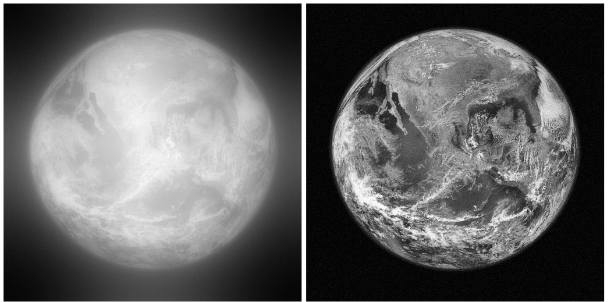
In recent years, Turyshev has published numerous studies advocating for a space telescope that would travel to the focal region of our Sun’s Gravitational Lens (SGL). Once there, it could conduct the most detailed astronomical studies ever, which includes taking extremely high-resolution images of exoplanets. In fact, astronomers predict that an SGL telescope could take pictures of exoplanets that would have the same resolution as images of Earth taken from high orbit (see below).

Toth H. & Turyshev, S.G.

Not only that, but Turyshev predicts that gravitational lenses could also be used for communications from one star system to another. These ideas could lead to an “interstellar internet,” which could be how advanced civilizations keep in touch in our galaxy. Perhaps this is why we haven’t found evidence of any extraterrestrial civilizations: they are routing all their calls through a gravitational lens network, and we aren’t hooked up to it yet!

Where to Listen:

Episode 60 of Stories from Space – The Dark Universe – is now Live!

Episode 60 of Stories from Space – The Dark Universe – is now Live!

This week was a bit of a treat for me personally since I got to delve into something really astrophysical and theoretical! To break it down, in 1916, Einstein placed the finishing touches on his Theory of General Relativity (GR), which explained how gravity alters the curvature of spacetime, matter and energy are equivalent, and time and space are one. His theory was confirmed almost immediately, but by the 1950s and 60s, astronomers finally had the telescopes they needed to really test GR!

Ah, but there was a snag! When observing massive galaxies, astronomers noticed that their rotational curves suggested there was a lot more mass out there than what they could see. This led to the speculation that the Universe was filled with a mysterious invisible mass (“Dark Matter”) that interacted with “normal matter” only through gravity. The existence of this mass was needed for GR to be correct, which had been confirmed nine ways from Sunday by this point.

In the 1990s, the Hubble Space Telescope provided the most breathtaking and deep images of the cosmos. The primary mission of this observatory was to test Hubble’s Law – i.e., that the Universe is in a state of expansion. When looking back through space and time upwards of 10 billion light-years (or more), astronomers hit another snag. Essentially, the rate at which the cosmos was expanding (the Hubble Metric) was speeding up over time!

This led to speculation that Einstein’s theory about a force that “held back gravity” – the Cosmological Constant, which he described as the “biggest blunder of his career” – was actually correct. This unknown force, “Dark Energy,” became another mysterious phenomenon scientists needed to include in their cosmological models. To this day, neither has been confirmed directly. But next-generation telescopes are coming that could resolve this mystery.

Where to Listen: