Revenge of the Sith. The Last Hope!

I come to it at last, the third and final installment in the prequel series, and sixth in the overall Star Wars franchise! Hard to imagine I started this whole thing three weeks ago. Seems like a lifetime has passed, but that’s the way time works!

And what can I say about this last installment? Well, I can tell you that between movies two and three, Lucas seemed to be taking mounting criticisms of his movies seriously. I can also say without exaggeration that after two generally panned movies, we were all pulling for him! Many reviewers openly wondered if the third and final movie could save the franchise, cuz Lord knew the fans weren’t likely to endure a third disappointment.

Luckily, Lucas seemed to pull if off with this third and final one. After the release, critics and fans seemed united in hailing it as the best of the three. Of course, the competition wasn’t exactly fierce, and there were still loads of problems that would become more apparent as time went on. The initial gentleness and praise with which this movie was met seemed to be the result of wishful thinking, really. No one wanted to see Star Wars fail.

Plot Synopsis:
The movie opens, as always, with the crawl. WAR! It says. It then goes on to explain… See, there’s the thing known as the Clone Wars. They’re bad. Lots of people dying, lots of systems being overrun. And now, the fight seems to have come to Coruscant.

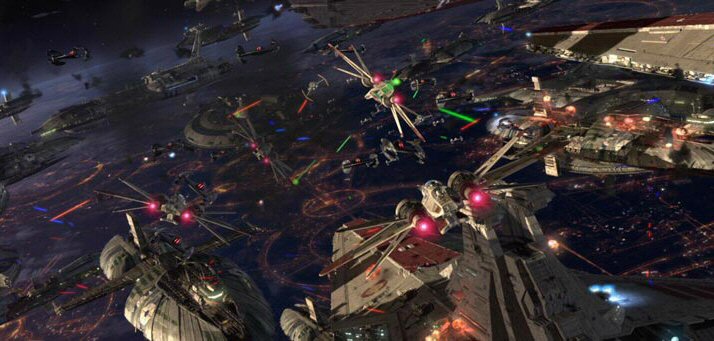
We cut, as usual, to ships in space. And after a brief, silent flyby, we see that its in fact some mad space combat! Ships everywhere are engaged in close quarters combat, destroyers, cruisers, and tons of fighters between them. And it’s all happening over the capitol. And to top it off, Skywalker and Kenobi are there too, leading the assault in their fighters.

There mission is to reach General Grievous’ command vessel, where Palpatine, a hostage, is being kept. They fight there way through several droid fighters, pull some cool moves, board the ship, take out tons of droids – all rendered with state of the art CGI of course – and begin working their way to the room where he’s being kept. Once there, a room that is made to resemble the Emperor’s own throne room, they do the deed of fighting Dooku for the second time.
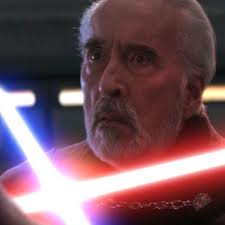
And this time, things go much the same. Obi-Wan is taken out early, and dismemberment ensues. But this time, it’s Anakin hewing off Dooku’s limbs. Defeated, Palpatine tells Anakin to kill him, and after a minimum of discussion, Anakin slices his head off.

He expresses some regret, but Palpatine tells him not to worry about it. Second time Anakin has committed cold blooded murder and the whole thing’s brushed off without a second thought. They even raise the issue of the last time he did this, appropriately…

He also tries to get him to leave Obi-Wan behind, but this Anakin proves immune to. Together, they begin the process of fleeing, only to get caught and brought to meet Grievous himself. Now this guy, though he’s hasn’t been introduced yet, is apparently important. He’s killed Jedi too, judging from his collection. However, Anakin and Obi-Wan have no trouble escaping and take control of the ship.

Anakin, in demonstrating his alleged flying skills, begins trying to land the ship on Coruscant itself. A spectacular crash ensues, in which we see a surprisingly callous attitude towards the potential loss of life. But then again, they never confirm that anyone was hurt, despite all the damage they do.

Anyhoo, a tender reunion soon follows. Anakin is reunited with Padme, admits he’s missed he, and learns she’s pregnant. This is a bad thing, for as we soon learn, Anakin’s been having bad dreams again. This time about Padme dying. He remembers what happened with his mother and doesn’t want a repeat.

Meanwhile, Obi-Wan and the Jedi are getting nervous about Palpatine. He’s had his emergency powers for some time and even expanded on them. Now that the war is nearing its end, they fear he won’t give up his powers. After years of benefiting from all the chaos and confusion, it seems they are finally sensing that he’s not on the level. They propose to devise a test. Once they’ve hunted down Grievous, they’ll confront him. If he doesn’t relinquish his powers, they’ll know he’s up to no good.

At the same time, Palpatine continues to use Anakin to further his own aims. He appoints Anakin as his personal representative to the Council, who do not trust him so they don’t promote him to Master. Anakin is incensed.

However, the Council still asks that Anakin spy on Palpatine for them. They also begin to express doubts about Anakin and the prophecy, whether or not it might be misread. Seems late to be bringing this up, but the die is kind of cast at this point…

Palpatine also seems to know more about Anakin than he’d prefer to know. That much is clear when he begins to address the possibility of how the Dark Side can save people from dying. Anakin is obviously intrigued, and begins to promise Padme in the most cryptic of ways that everything will be fine.
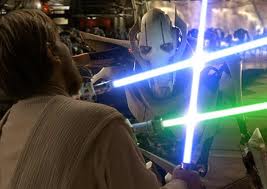
Once more, the Council decide to divide Anakin and Obi-Wan and send them on separate missions. While Anakin spies on Palpatine, Obi-Wan is dispatched to deal with Grievous. He flies to Atapau, where the Separatists base used to be, and engages Grievous in single combat. The Clones troops arrive shortly thereafter, and a big CGI fight ensues.

After a big chase involving a giant lizard, a ZOOM, and a cliffside fight, Anakin blows Grievous away with a blaster. In a shout out to remarks made in the first movie, he then mocks the weapon that saved his life. Seems kind of callous…
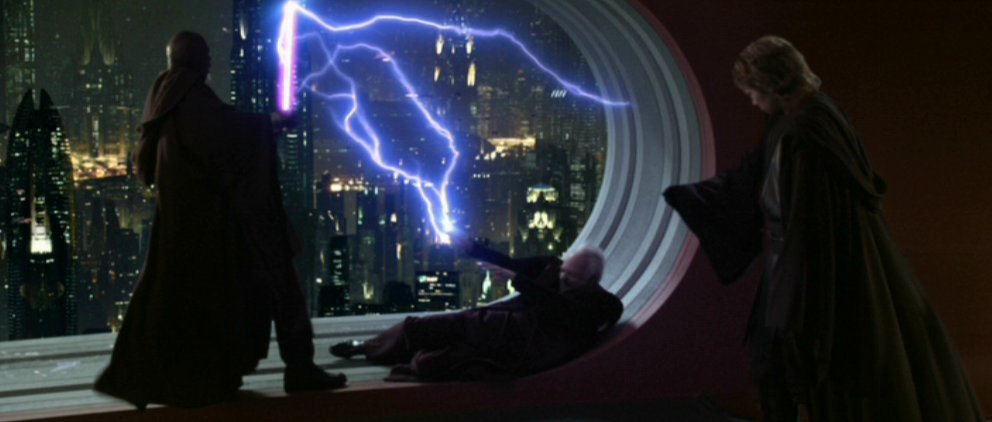
Back on Coruscant, Anakin gets wise to Palpatine after he practically spells it out for him. He draws his blade, but hesitates to take him down when Palpatine reminds him that he will never save Padme without his help. Instead, Anakin runs to Master Windu and tells him what he’s learned. Windu takes some backup and goes to arrest the Chancellor and another fight ensues. Palpatine quickly dispatches his backup, but Windu manages to subdue him before long.

Of course, Anakin shows up and pleads for Palpatine’s life. Windu seems set on killing him, which seems odd considering that he’s a Jedi Master and killing prisoners is not something they do. But this forces Anakin to intervene and Windu dies. Anakin is crippled by guilt, but out of a desire to save Padme declares his loyalty to Palpatine.
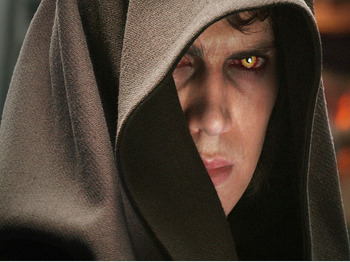
His first task, it seems, is to kill everyone in the Jedi Temple, which Anakin does, including all the kids. Once he’s done that, he’s sent to Mustafar to wipe out the Seperatist leadership, a move which will end the war and eliminate the last of Palpatine’s liabilities. He kills them too, and seems to enjoy it just a little too much!

Obi-Wan returns to learn what Anakin has done. He and Yoda arrive at the Temple to find the corpses of all the “Younglings” (guess they couldn’t say kids, might have sounded too… murdery). Obi-Wan then tells Padme, who for some reason seems surprised that Anakin has done this… again.

Once more, the Jedi choose to divide their forces. Yoda will go and take on Palpatine while Obi-Wan will fly all the way to Mustafar to deal with Anakin. Palpatine then declares the formation of the Galactic Republic, and outside of Padme and Bail Organa, no one seems to mind! She issues a line meant to capture the absurdity: “So this is how liberty ends… in thunderous applause.”

And so we get two fight-scenes, almost interspersed. Yoda fights with Palpatine in the Senate and gets several floating pods thrown at him. He loses, is picked up by Senator Organa (Leia’ adoptive father), and declares he’s failed and must go into hiding.

Padme and Obi-Wan confront Anakin, who seems to have gone a little Batty McPsycho now. After all he’s done to save her from death, he then turns on Padme with a choke move. And then of course Obi-Wan and him go at it like a bunch of Highlanders on crank!

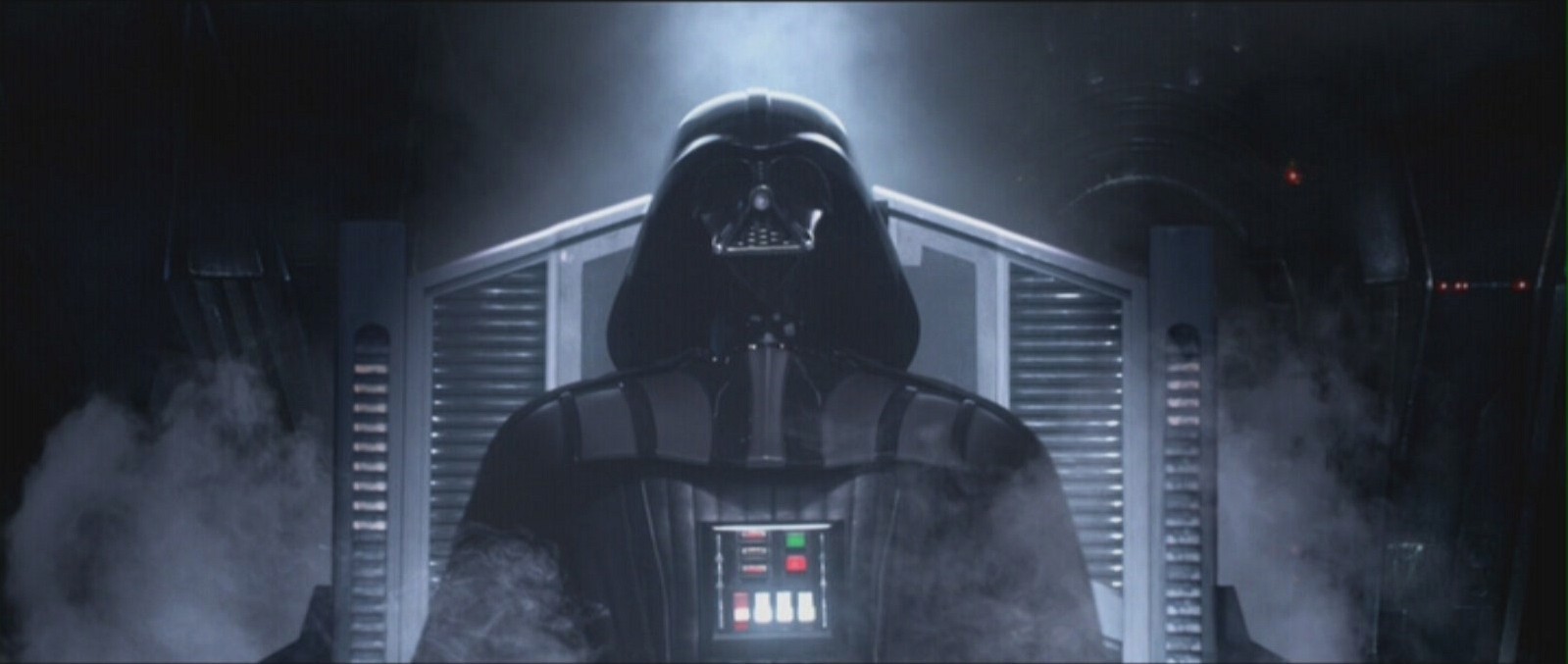
After a VERY long, drawn out fight scene, Obi-Wan takes off Anakin’s legs and remaining arm. Anakin burns on the slopes above molten magma, and Obi-Wan just leaves him there. Palpatine picks him up and takes him a medical facility where they begin the process of turning him into Vader. Simultaneously, Amidala delivers her babies and dies in childbirth. No medical reason is given, it just seems that she’s lost hope… okay.

All remaining threads are tied up nicely. It is agreed that Luke will go to Tatooine, Leia will go to Alderaan, and Obi-Wan will also go to Tatooine to hide and commune with his old master. And then, the newly-created Vader has a ham moment by wailing when Palpatine tells him that he killed Padme accidentally. “Nooooo!” is his reply. And it seems that they are no in total cahoots. The movie ends with them witnessing the construction of the Death Star.
Last Word:
Well, like I said, this movie did better than the previous two. However, there were problems that few were prepared to admit so long as the Star Wars legacy seemed on the line. Most had to do with the plot, so I’ll save those for last. First, the movie shared some problems from the previous two which really became apparent by now.

They include the shooting, how Lucas shot all his scenes from the comfort of his chair using two cameras and simply had his actors walk slowly across the screen or sitting to deliver the lines. And then there was the bad dialogue. The romance factor was diminished in this movie, but there were still those painfully awkward scenes where Anakin and Padme are forced to say how much they love each other and it all comes out tasting of ham and wood!

And it wasn’t just the romance, it was every dramatic line in the movie. Padme’s line about “how liberty ends” was one. Mace Windu’s angry declaration, “The oppression of the Sith must not be allowed to return!” was another. Why didn’t anyone ever tell Lucas, “this is NOT how people talk!” Where is Harrison Ford when you need him? And of course, the way he kept showing characters from the first as if it were necessary to cram them all in. This time it was Chewbacca, Leia, Luke, and bit more of Bail Organa, which pretty much completes the original cast. In fact, the only person he didn’t preview was Han Solo! Wonder why…

And of course there was more of the same on the recycling front. Here too, the examples were many and close together. At the beginning, we’re meant to remember Jedi where we see Palpatine in that chair in front of that window. The battle at the end was meant to call to mind the final duel between Luke and Vader. The attack on the Wookie compound on Kashyyk also seemed like a not-too-subtle attempt to resurrect the Battle of Endor (which originally called for Wookies). And the scene at the end where they are all stowed aboard a Corellian blockade runner is supposed to remind us of the first movie when Leia’s ship (same make and model) was boarded.

But none of that compared to the fact that the majority of the war, the most important aspect of the prequel movies, all happens off screen. It begins at the tail end of the movie II, then ends at the beginning of movie III, with the vast bulk of events taking place between them. Like most fanboys, I went to theaters back in 1999 expecting the prequels to be ABOUT this, but instead the war served as a backdrop to the duty of showing how Anakin fell and all the rest.

In fact, beyond a few action shots and some talk of it, the war seems to have no real consequences whatsoever to the Republic. No shortages, no recruitment drives, no resistance to the war. Even Coruscant itself seems completely unmarred by the fact that it was attacked in the beginning. A few scenes after an invasion, people are going to the opera and acting like nothing’s happened. There’s not even a single indication of damage done to the city.

Okay, plot holes time! I’ve chosen to list them in sequential order to save time and prevent overlap. Here goes!

  1. Opening Battle: Much like in Clones, the fight between Anakin, Obi-Wan and Dooku suffered from an obvious contrivance. Once again, Obi-Wan had to go down and stay down so Anakin and Dooku could fight one on one. But this time around, there was the added necessity of making sure he unconscious while Anakin executed Dooku. Which brings me to point 2!
  2. Murder? No Biggie: Once more, Anakin has committed a severe violation of the Jedi Code and basic morality by killing a man in cold blood, and no one seems to notice or care. Palpatine tells him to do it, he issues mild protests, but then does so without much regret. What little guilt he expresses is assuaged when Palpatine brings up how he’s done it before. That seemed appropriate, since there were no consequences then either.
  3. The Jedi Council, Assholes!: In the first movie, the Jedi Council tell Anakin that he has to severe all ties with his mother in order to be one of them. Why? Because his fear of losing her is bad and a path to evil. Okay, seems pretty callous, but I guess they needed something to hint at his descent into evil. Now, in movie three, Anakin is told by Yoda that his fear of losing Padme is wrong. Basically, he tells her that these fears are selfish and he should be happy this person, whoever they are, is going to die. He uses better sounding words, but the reasoning is basically the same. What kind of gurus are these? Why do they insist on being so harsh in their rules? It’s like their begging people to rebel against them by making their code impossible to follow. No love, no attachment, no sadness over loss. If anything, it’s their fault Anakin turned bad. They made him leave his mother behind, she dies and he goes on a rampage. His wife is near death, once again they tell him to let her go, and he goes on rampage to save her. There’s a lesson here I’m thinking…
  4. The Jedi Council, Idiots!: It is astounding how many stupid calls the Jedi Council make by this time in the series. First up, they’ve been saying for all three now that there’s something not quite right, some dark force, some hidden danger, but they never act on it. In this movie, they finally seem to be catching on. Mace Windu says he senses the Dark Side around Palpatine, Yoda expresses doubt about the so-called prophecy, and Mace and Yoda both fear putting Anakin in his presence. And yet, they do! Not only that, they continually fail to act to stop Palpatine even thought it’s obvious that he’s at the center of all things. Really, where is the mystery? Granted, Lucas tried to explain this away by saying the Jedi’s were being blinded by the Dark Side. But you don’t need ESP to see what’s going on here! The simple question, que bono, would have solved their entire dilemma. Who’s been benefiting from the all crises, again and again? Palpatine! And if you can sense dark energy coming from him, I’d say mystery solved!
  5. Anakin’s Descent: Now to be fair, Anakin had already turned to the Dark Side long before this movie. The moment he murdered women and children, he was bad. That wasn’t no preview of how it happened, that was it happening! But still, the way he chooses evil in this movie seems just so stupid. He saved Palpatine, that I get. But immediately after, Palpatine tells him he doesn’t know how to save Padme. That should have been the end of it. Anakin should have gone into a rage and killed him for lying through his teeth. Instead, he agrees to join him based on the promise of helping him, and that’s enough to convince him to murder children. On top of that, did he also not realize after Palpatine said go to Mustafar and kill all the Separatists that Palpatine was the one leading them? He had ample clues, like how did he know they were there? Why were they expecting him when he arrived? Why did they keep pleading that they were all friends? Did he not know, or did he not care?
  6. “No, not Anakin!”: I’ve harped on about how Anakin killed kids and no one, particularly Padme seemed to care. But what really makes no sense was how Padme reacts when Obi-Wan tells her he’s murdered the “younglings”. “No, not Anakin! He couldn’t!” Whaaaaat? You know he could, because he told you he’s done it before! The real answer should have been “Oh, no! Not again!”.
  7. Constant Separations: Why was it necessary to send Obi-Wan alone to get Grievous? On the one hand, they said they wanted an experienced Jedi to go deal with him. Okay, but why does he have to go alone? They say it’s also because it might just be a wild goose chase. Still not making sense. If Anakin’s the one who’s constantly saving Obi-Wan’s bacon, then it only makes sense to keep them together. No, the real reason is so they can be apart while Anakin does all that evil shit. Second, Yoda and Obi-Wan break up to deal with Palpatine and Anakin seperately. Again… why? Why not kill Palpatine first since he’s on Coruscant, then fly to Mustafar to deal with Anakin together. In every other movie, even at the beginning of this one, they always worked in pairs. Now they suddenly they are deliberately isolating themselves to have one-on-one showdowns. Again, the only reason is plot necessity, making sure that Yoda fails while Obi-Wan has his big fight with Anakin.
  8. The Senate, Morons!: As if the Jedi’s missing the obviousness of Palpatine’s rise to power wasn’t enough, there’s the added idiocy of the Senate. For years, these guys, have been surrendering more and more power willingly to Palpatine. And then when he announces that the Jedi attacked him, they buy it. Really? They believed that the Jedi, the servants of peace and justice for 1000 generations, are trying to take power? Not the hideously scarred man who took power in the name of security, wiped out the Jedi, and is now declaring the government a military dictatorship? They don’t see this as the slightest bit suspicious? What’s more, the entire reason they gave Palpatine “Emergency Powers” was because of the war. Now that it’s over and all the threats eliminated, he claims that arrangements is to be made permanent. And how does the Senate respond? According to Padme, “with thunderous applause”! How stupid are these people?
  9. “Noooooo!”: Another perfect opportunity for Anakin to turn on Palpatine would have been when he told him Padme was dead. Saving her was the whole reason he turned to the Dark Side, betrayed the Jedi, killed the “younglings”, and murdered the Separatists leaders. Now he’s told she isn’t even alive, and what does he do? Cries and still agrees to be the Emperor’s lap dog. Again, I would have been like “Well then f*** you, pal! I got no reason to follow you, so I’m taking it all!” He already said how he could defeat Palpatine and run things with Padme. Why not do it now and run the whole thing himself? What kind of Sith is he, turning down obvious opportunities for personal power?
  10. Contradictions: As a last point, I’d like to highlight how there were even contradictions here between this last movie and the originals. Didn’t Leia say that she knew her mother, and that she died when she was very young? That she was beautiful, kind, but… sad? She sure did, and this hinted at the fact that her mother was lamenting the loss of her husband, Anakin. So Padme dying in child birth kind of contradicts that. And it was just plain silly! Are we to believe that in this day and age, women die in child birth because they’ve got broken hearts? Even if she were feeling dejected and in the mood to give up, they got defibrillators and adrenaline, don’t they? They can restart a heart! And why was it necessary to have the Death Star being built at the end? Was it so important to preview it as well? As I recall, the first one was built to combat the threat of the Rebellion. Since that’s a good twenty years away at this point, the Empire has no justification to build it yet. And the second one only take a few years to build and it was bigger and badder than the first. Why then would it take them twenty years to build the first one?

Wow, that’s a lot of complaints. But like I said, time has a way of making these things more apparent. And listening to geeks way bigger than myself grip about the prequels flaws has kind of helped. And in truth, I didn’t mind this movie too much. It was just that by this point, the flaws of all the others seemed to snowball into one. So it really didn’t matter that this one was “the best of the three” because in the end, the whole production suffered from the same immutable flaws.

One thing I remember Lucas saying before the movie premiered was that he had to force himself to sit down and bang out this script. Not a good admission to make, but that seemed true of the first and second as well. It seemed like, beginning in the mid nineties, he sat down with the intent of writing a prequel, and focused entirely on how he was going to bring it to life through visuals and special effects. The plot was only important in so far as it explained everything from the original movies.

And with no one willing to question Lucas and help him with his writing, the plots for all three movies felt like they were first drafts that didn’t make much sense and were really just forced explanations and connections. Sure they explained where everyone came from. Sure, the fight scenes and CGI were pretty damn cool. But there was no tension, no suspense. We knew where everything was going since we already saw the originals. So any attempt at recapturing the feel of the originals was lost.

Really, what was the point of these movies? We all wanted them back so badly, but why couldn’t they have been about the Clone Wars and the stuff we didn’t know about? The best prequels are the ones that explore the things you don’t know, not the things you’ve already been told but haven’t yet seen. And that was where these movies were the weakest. It’s easy to criticize, I know. Especially with the benefit of hindsight. But even I could think of better plot lines and outcomes when I was watching the movies for the first time!

Well, that about does it for these movies. My apologies for not being more positive, but that’s the effect these movies tend to have. As the documentary The People Versus George Lucas contended, it’s only because people loved the original Star Wars so much that they expressed such disappointment and feelings of betrayal over these ones. I can think of one other franchise that has this sort of polarizing effect on people, except for maybe Dune!

Personally, I would be wishing Lucas well, were it not for the fact that he seems to have learned nothing from this experience. After the third and final movie was released, he completely took over the Clone Wars animated series which he didn’t seem to care about until he realized it was profitable. Then, he decided to re-release all six movies in 3D. Once again, he seems to be re-releasing his movies for no other reason than because he wants to take advantage of the latest technology. That makes three releases for the origins and two for the prequels.

On top of that, he has stalwartly refused for years to release the original movies on DVD. This was in response to fans saying they would like them available alongside the Gold Editions that feature all the added CGI and new ending where Hayden Christensen’s ghost shows up at the end. Lucasarts claimed that it was because they no longer existed, but he also went on the offensive saying it was his movie so he had the right to choose which version history would remember and which would be forgotten.

This, more than anything, would seem to indicate that Lucas has surrendered to the lure of the Dark Side of the industry, where money and power rule. All this from the man who used to resent studio control and industry greed. How bitterly ironic! Sad that he can’t see it, but what can you do? Well, some fans are taking it upon themselves to make their own versions. Topher Grace is one. As already noted, his movie, Star Wars 3.5, is slated for release one of these days. All he needs is for Lucas to give him the green light. It could happen…

Cool Ships (volume V)

Back again! More ships, more designs, more franchises too. Like I said last time, there’s just no limit when you get right down to it. And in the course of doing my homework on cool sci-fi concepts, I’ve found that there are hundreds of franchises out there that I’ve never even heard of before. Of those I have heard of, I always seem to miss a few obvious candidates. That’s the beauty of ongoing segments though. Here are the latest, with some suggestions thrown in too 😉

Colonial Raptor:
Another late entry from the Battlestar Galactica universe, the updated version. Designed for reconnaissance, transport, atmospheric and space flight, and capable of making short range FTL jumps, the Raptor is the workhorse of the Colonial fleet and one of its most versatile vessels. Ordinarily, the Raptor is operated by a crew of two, one pilot and one Electronic Countermeasures Officer. Given it’s size and shape, it cannot launch from a launch tube and must take off and land from a Battlestar’s forward launch bay.

Having served with the Colonial fleet for over 40 years, making its debut in the first Cylon War, the versatility and reliability of this craft have prevented it from being phased out by newer generations of Colonial ships. During the second Cylon War, Raptors were used regularly in order to dust off survivors from Caprica and other colonies. Relying on a fly-by-wire system, rather than the new defense network systems, it also proved invulnerable to the virus the Cylon’s used to cripple the fleet.

Cygnus:
Now here’s one that people probably won’t remember. In fact, I didn’t recall it either until I did some reading and realized I had seen the movie which featured it – The Black Hole – as a child and quite enjoyed it. Though a little Buck Rogers-y by modern standards, the concept and the movie and this ship still stand the test of time.

Released in 1979 by Walt Disney Pictures, The Black Hole was one of many movies that sought to take advantage of the sci-fi craze that Star Wars had unleashed. The plot centers on a derelict ship, known as the Cygnus, which is run by an android crew and a brilliant (albeit mad) scientist named Doctor Hans Reinhardt.

In addition to looking pretty cool, with its glowing transparent sections and old-school design, the Cygnus is apparently able to withstand the gravitational pull of black hole due to its ability to generate its own gravity well. In addition, its commander, Dr. Reinhardt, theorized that he would be able to fly it through a black hole and see once and for all what lay on the other side… It didn’t take, but still a cool idea!

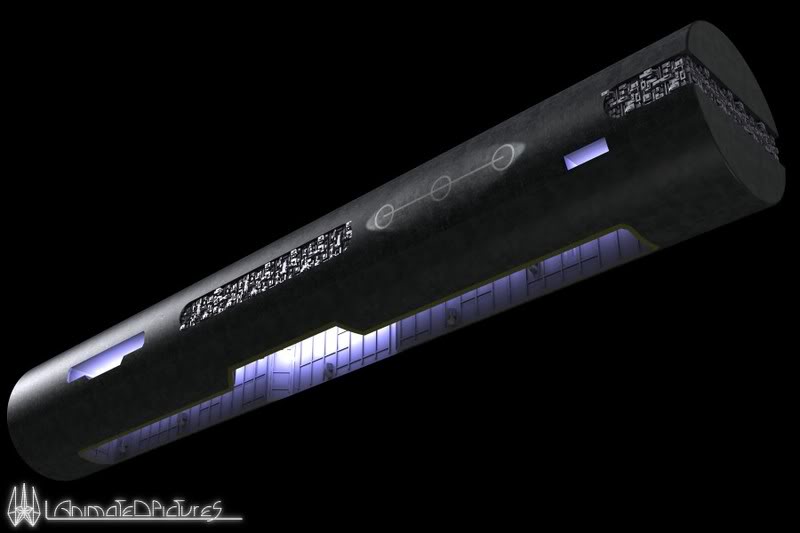
Guild Heighliner:

Artist’s concept for a Guild Heighliner

Here’s one I couldn’t believe I had forgotten. In fact, I will accept any and all chastisements for my failure to include Dune craft in this series thus far. This can include physical beatings, just stay away from the nads… not quite done with those yet!

Anyhoo, when it comes to Dune ships, the Heighliner definitely takes the cake! Massive as all hell, this ship was the backbone of all commerce, diplomacy, travel and tourism in the Dune universe. Like all shipping, it was the exclusive property of the Spacing Guild and subject to their many controls, laws and whims.

Boasting Holtzman engines – a FTL drive system that was capable of “folding space” – the ship still required the services of a Guild Navigator. This person, a semi-prescient mutant due to years of living in a spice tank, would see a path through time and space and thus navigate the ship safely to its destination.

According to the original Dune, a single Heighliner was capable of lifting an entire planet’s worth of personnel, goods and supplies from one point in space to the next. As Duke Leto tells Paul in Part I of the story: “A Heighliner is truly big. Its hold will tuck all our frigates and transports into a little corner — we’ll be just a small part of the ship’s manifest.” Later in that same installment, House Harkonnen used a single Heighliner in order to lift an entire army to Arrakis for a surprise assault on the Atreides, and the cost was nothing short of punitive!

Given that the Heighliners are the sole means of commerce in a Empire as massive as that of the Dune universe, its little wonder why Heighliners are so freakishly big. Chartering one aint cheap, and if you do stowe aboard, you are expected to mind your business and wait until you arrive at your destination. Due to their high level of secrecy and sensitivity, no one is even allowed to venture beyond their own boarding craft when on a Heighlinger, and virtually no one outside of the Guild has ever seen a Guild navigator. Considered to be neutral territory by Imperial law, any and all acts of violence aboard Guild Heighliners carry stiff penalties.

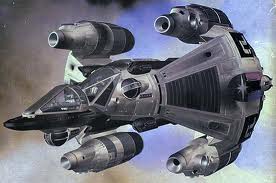
Gunstar:
Ah, another childhood classic! Taken from the film The Last Starfighter, the Gunstar was the first line of defense of the Star League against the evil Xur and the Ko-Dan Armada. Sounds pretty cheesy, huh? Well, it was the eighties! And this was yet another Disney franchise that seemed to be riding in the Star Wars wake. Still, this movie was one the first to make extensive use of CGI (Tron being the only other) and had a none-too-bad storyline too boot!

Boasting multiple guns, missiles and a “Death Blossom” trick that is nothing short of devastating, the gun star is a rather unique and innovative design. Apparently, it was meant to be a class of ship that would never go out of style, merging functionality with lethality and being able to take on any class of enemy ship.

Every Gunstar is a two seater, with the starfighter (gunner) in front, and the navigator in the rear. While the navigator flies the ship, the gunner directs fire from a swivel chair, which gives them control over the ships moveable weapons batteries. Although it has no shielding to speak of, the hull is protected by armor plating which can withstand multiple direct hits. When cornered, it is also capable of unleashing the “Death Blossom” where it will begin to rotate at a furious speed and unleash gun and missile fire in all directions. This however, is considered a weapon of last resort, since it will drain the ship’s power supply completely.

Heart of Gold:
Now here’s an interesting, and highly improbably, entry! Coming to us straight out of The Hitchhikers Guide To The Galaxy, the SS Heart of Gold is rather unique in that it merged scientific theory with Douglas Adam’s notoriously quirky sense of humor.

Being a prototype vessel, it was the first ship ever in the universe to boast the “Infinite Probability Drive”. This drive system is essentially a Faster-Than-Light engine which is actually based in quantum theory. Essentially, the theory states that a subatomic particle is most likely to be in a particular place at a particular time, but that there is also a small probability of it being found very far from its point of origin. Thus, a body could travel from place to place without passing through the intervening space as long as it had sufficient control of probability.

Pretty cool huh? In the original radio series, the shape of the vessel was not specified. In the novelization of the series, it was described as a “sleek white running shoe”. For the sake of the movie, artists went with a tea-cup design, and added some brake lights for good measure. Originally built as part of a secret government project on the planet of Damogran, the ship was stolen by President Zaphod Beeblebrox during its launching ceremony and became the means through which the main characters began exploring the universe.

Minbari Cruiser:
Back once more to the B5 universe for another fine example of kick-ass shippery! Known officially as the Sharlin-class Warcruiser, this Minbari vessel is the mainstay of the Minbari fleet in the original series. Big, bold, stealthy, and packing a sh*tload of firepower, this vessel is veritable nightmare for all but the most powerful of races. Even Shadow vessels mind their business when some of these are in the field.

Making its appearance in season one of the show (episode 17: “Legacies”) and went on to become a regular feature. When Sheridan assumed command of the station in season two, the renegade cruiser Trigati was destroyed in the course of a standoff. After B5 broke away from Earth in season 3, a force of Sharlin cruisers arrived just in time to prevent the station from being captured by forces loyal to Clarke. Many went on to serve alongside Sherian and Delenn in the Shadow War and even went on to help liberate Earth from Clarke’s forces.

According to Delenn, Minbari ships do not rely on conventional engines like other ships. Instead, a system of gravitational and electromagnetic fields for propulsion, which have the added benefit of supplying artificial gravity. This frees up their ships from the needs of rotating sections and makes for a more effective combat platform. Sharlin cruisers also boast a significant amount of weaponry, which consists mainly of heavy beam cannons, but also includes missile launchers, neutron guns, and electro-pulse cannons.

During the Earth-Mimbari War, Earth Forces were completely outmatched by this class of Cruiser. In addition to being highly resistant to Earth force weapons, the Sharlin cruiser also boasted a stealth field which prevented Earth ships from being able to lock onto it. In the course of the war, only one human Captain ever survived combat with one, Captain John Sheridan. Relying on a phony distress signal and several well placed tactical nukes, Sheridan was able to lure the Black Star, the Minbari flagship, into a trap and destroy it. Though the Minbari considered it a cheap victory, Sheridan’s fame and renown quickly spread throughout the fleet.

During the battle of Sector 83, the Sharlin-class Cruiser proved an effective weapon against the Shadows. Although somewhat slow and providing a large target for Shadows, their powerful beam weapons were capable of destroying a Shadow ship unassisted. When protected by smaller, faster craft like the White Star, it proves to be a very effective combat platform.

Nebula-B Escort Frigate:
More Star Wars! God, I think I’m OD’ing on this franchise. But the sign says “Cool Ships” and this one is no exception. Known as the Nebula-class frigate, this ship is probably best remembered as the “Medical Frigate” which appeared in Empire and Jedi. 

Measuring some 300 meters long and designed to defend Imperial convoys from Rebel attacks, this ship was more famously used by the Rebellion as a hospital ship. During heavy fighting, Nebula-B’s would be on hand to pick up pilots that had ejected and provide them with life-saving assistance, ensuring that Rebel pilots could live to fight another day.

The most famous appearance of a Medical Frigate was during the Battle of Endor, when several medical frigates were on hand to service Rebel pilots who had been shot down by superior Imperial forces. It was also on board the Medical Frigate Redemption that Luke Skywalker received his prosthetic hand after losing it in a lightsaber duel to Vader.

In addition to providing escort and as a hospital ship, the Nebula-B was proved useful as a deep space scout and reconnaissance ship, due to its sophisticated sensors. During raiding missions or less intense combat operations, many also served as command ships given their speed and defensive capabilities. One weakness of the Nebula-B however was its thin fusilage. Though this made the ship an inexpensive vessel by most standards, it also made it a poor choice for heavy combat. Hence why it was relegated to support, scouting and medical roles.

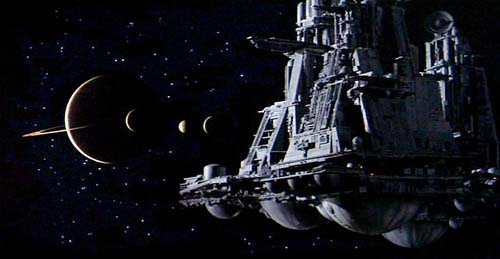
The Nostromo:
You know, I really thought I covered this one already. I already mentioned how the Alliance Cruisers from Firefly appeared to be inspired by this baby. And it just makes sense that if you’re going to cover ships from the sequel, (the USS Sulaco and the Cheyenne Dropship) that you cover the original first. But alas, the Nostromo was somehow passed over by me, another act of wanton insensitivity! Beating shall continue until my attitude improves!

Okay, now that we got my punishment out of the way, allow me to pay this ship it’s due homage. The main set for the movie Alien, the USCSS Nostromo was a deep space commercial vessel which belonged to the Weyland-Yutani corp (much like everything else in this universe!).

Overall, the Nostromo was a curious design which made perfect sense from a space-faring point of view. Doing away with such things as streamlining and aerodynamic sleekness, the ship was well suited to deep-space travel and hailing. In addition, it was also taller than it was long, another common aspect to spaceships which are confined to the whole sea ship/airplane paradigm.

It’s massive refinery, which it towed behind, would process its manifest of mined ore while it made its way back to Earth from wherever it had been deployed. Thus, in addition to providing transport and amenities for a crew of miners and spacers, it was also a mobile refining platform that could deliver processed materials to factories rather than just unrefined ore.

While on return from the distant planet of Thedus, the Nostromo was rerouted to LV-426 where it picked up the alien organism known as a xenomorph. After all but one of the crew were killed the by creature, Ellen Ripley, the ship’s Warrant Officer, set the ship’s to self-destruct and escaped aboard the ship’s life craft with the crew cat, Jones. According to Weyland-Yutani execs, who were some pissed when she returned without her ship, the destruction of this vessel cost them 24 million in adjusted dollars. Damn penny-pinchers!

The Sathanas:
What do you call the most fearsome, intimidating and powerful ship in the universe, without being too obvious, that is? The Sathanas, that’s what! Being the Latin name for Satan, this title is very apt when applied to a massive juggernaut built by a race known as the the Shivans (i.e. Shiva, Hindu god of destruction).

This last entry, much like The Colossus and Deimos from my last list, comes to us from the game Freespace 2. Making its appearance midway through the game, this terrifying vessel was the most powerful space-faring ship ever encountered by the human race or its allies.

Boasting four massive beam cannons which are situated at the end of its claw like appendages, this ship best exemplifies the offensive fighting spirit. Jumping into a field of battle, it is capable of dealing devastating blows on a target head on, keeping its flanks and rear hidden from the enemy.

Above all, it is clear that the Shivan built the Sathanas to act as a terror weapon in addition to a capital ship. One look at its design confirms this, given its clawing appendages and thorny skin. Defeating this ship outright is quite difficult given its reinforced plating and terrible array of weapons. Disabling this ship, through EMP missiles and guns, is not much easier given the incredibly density of its hull and many redundant systems. In the end, the only way to beat it seems to be for lighter craft to take out its “claws” while heavier vessels strike at it from a distance. However, this still proves to be a suicidal mission given the Sathanas’ many missile and defensive batteries.

Ultimately, taking down this ship in the game is much like the real-life campaign to sink the Bismark. This dreadnought, which was the pride and joy of the German navy in WWII, also boasted massive weapons, a heavily armored hull and superior systems. In the end, the Royal Navy brought it down through a combination of luck, persistence, and careful engagements, taking their time to disable it and then closing in to pound it relentlessly! Hmmm. I guess good history makes for good gaming 🙂

Final Thoughts:/strong>
The suggestion box, as always, is still open. Thanks to Goran Zidar for suggesting the Gunstar, I knew I’d have to include it sooner or later and I’m glad someone asked. Anything else? I got another installment on the way, and probably a few more after that. No? Sigh, alright, bring on the beatings! No nads!

The Empire Strikes Back or Happy Star Wars Day weekend!

Well, it’s officially the day after Star Wars Day, so now what? It’s the perfect time to review the sequel to the time-honored classic, that’s what! And I did promise to cover this rare example of a movie that managed to exceed the original, didn’t I? Hell, I would even if I hadn’t, its a freaking cool movie! And the nostalgia appeal alone makes it worth revisiting, time and time again.

And as I might have mentioned last time, The Empire Strikes Back benefited from several advantages which weren’t initially available during the shooting of the first film. This included help with direction, writing, and of course he had the musical score from the get go, which really didn’t suck! But on top of all that was the fact that in the second movie, things had a much darker and more mature feel.

Lucas acknowledged this in a series of interviews and indicated that this was his intention all along. Following the conventional three act formula, Act II is always the darkest of the chapters, where things go bad for the main characters and escalates the dramatic tension. As such, he needed to turns things on their head after the first movie’s happy conclusion, and threw in some big revelations and twists just to make the ride especially fun.

The Empire Strikes Back:
Plot Synopsis:
The opening crawl once again tells us what we need to know, that despite the destruction of the Death Star, its a dark time for the Rebels. The Empire is still a force the dominant power in the universe, after all, and since their loss at Yavin 4, they’ve been pursuing the Rebels without fail. At the same time, Darth Vader has taken an unhealthy interest in finding Luke Skywalker.

Cut to Hoth, where we see an Imperial probe landing on the surface, and Luke and Han who are out on patrol on the back of some weird looking beasts. Luke spots what he assumes is a meteor and tells Han he is going to check it out, but is unfortunately laid out when a big furry Wampa (aka. a Yeti) sets upon him.

Next we see the Rebel base, where Han checks in and let’s Rebel General Rieekan know that he’s got to leave. Essentially, his time with the Rebels have only made things worse with Jabba and his considerable debt. Rieekan is understanding, but his farewell speech to Leia leads to a rather serious argument. Seems she’s unhappy about his decision, and he’s convinced there’s something other than professional admiration motivating her feelings.

Luke wakes up later in the Wampa’s cave, and relies on his newfound knowledge of the Force to free himself and slice off the Wampa’s arm. He escapes into the frozen wastes, but nighttime is descending and the temperature is dropping! Han realizes that Luke hasn’t checked in and decides to head out into the cold to find him. After several hours, the Rebel base is forced to seal its doors and lock them out for the night. Luke and Han are on their own, and odds of their living through the night are slim!

Out on the frozen wastes, Luke is near death and experiences a vision. Obi-Wan comes before him and tells him he must go to Dagobah to learn the ways of the Force from Master Yodah. He passes out just as Han comes over the horizon to find him, but the two are kinda stuck when Han’s Tauntaun dies from exposure. Luckily, Han gets the bright idea to cut his beast open and stick Luke inside, thus keeping him warm and alive until he can build a shelter. Come morning, Rogue squadron finds them and picks them up! The boys are saved!

Back to the base where the Rebels learn that there’s an Imperial probe droid in their midst. Yes, that little spindly thing from the beginning has not only been getting around, it’s been taking footage of their shield generator and broadcasting it to the Imps! Han and Chewi manage to take it down, but it seems that the damage has been done. The evacuation begins…

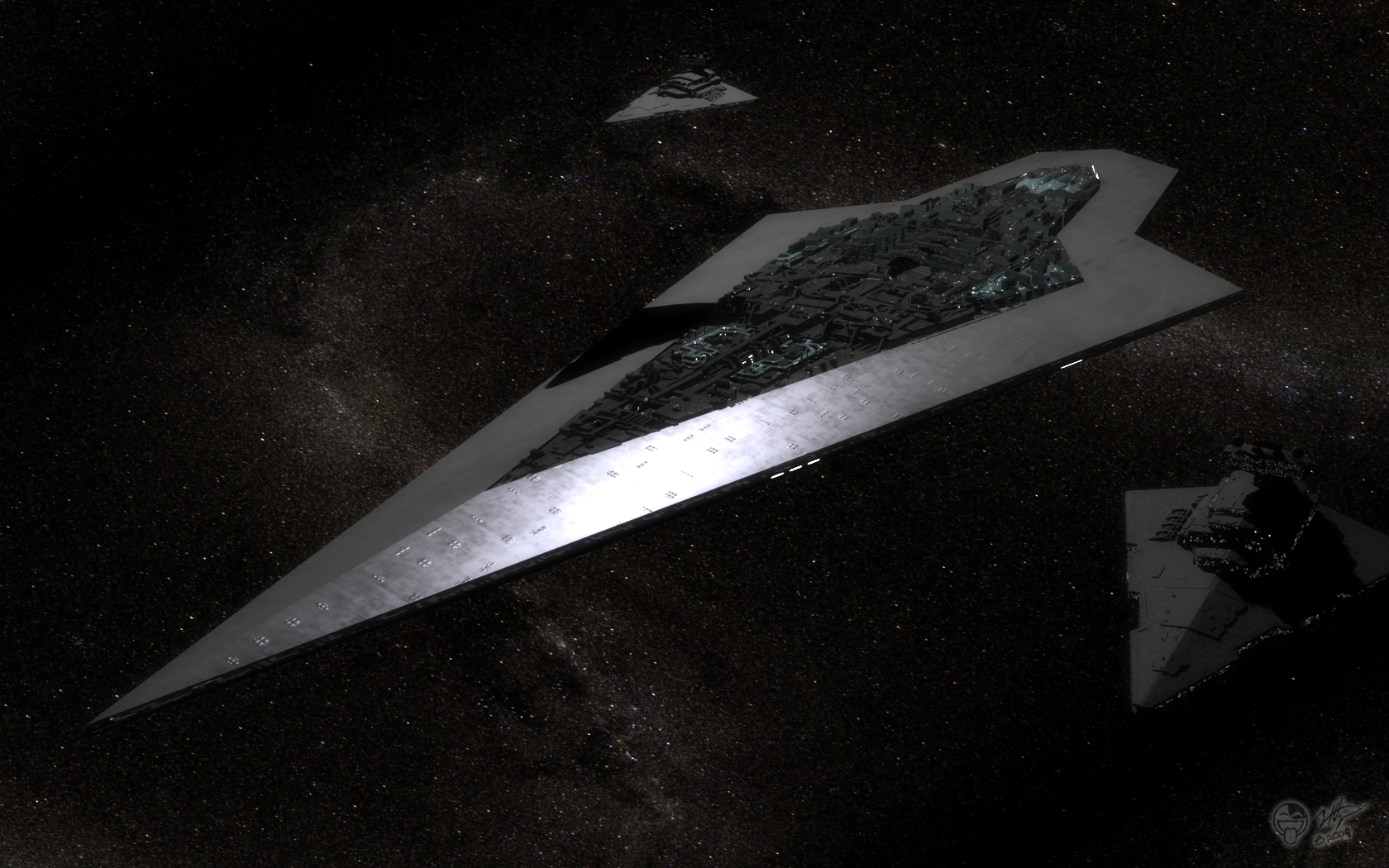
Then comes another moment in cinematic genius, the scene where the Imperial fleet is shown and the Executor (see More Cool Ships) is introduced. After seeing many massive Star Destroyers pass each other in the starry night, several of them are suddenly overtaken by a huge shadow. Naturally, the audience can’t help but wonder, what the hell is no big that it can cast a shadow capable of blacking out a whole fleet worth of Star Destroyers? A Super Star Destroyer, that’s what! We then cut to the bridge where Vader is watching the fleet, all to the tune of the evil Imperial music!

And of course, it seems the footage has reached them, and upon seeing it, Vader comes to life and orders the fleet there immediately. Admiral Ozzle, the aging stereotype of the arrogant and incompetent British officer, seems pissed at his subordinate for finding this out and gives him a hard stare. Oh we just know that’s going somewhere don’t we? Meanwhile, the Rebels are preparing to leave, and Han and Luke have an awkward moment as they once again say good-bye to each other and wish each other luck. Seems they’re always saying good-bye…

Shortly thereafter, the Imperial fleet arrives but has alerted the Rebels to their presence and have raised their planetary shields. Vader concludes that Ozzle jumped them in too close to the planet, and decides some disciplinary measures are in order. This consists of him choking him to death over a video conversation and promoting his immediate subordinate, Captain Piett, to the rank of Admiral. Here too, the scene was perfect! One man listening in, trying to ignore the fact that his superior is slowly asphyxiating and dropping to the floor, and appearing both flattered and terrified that he’s now in charge.

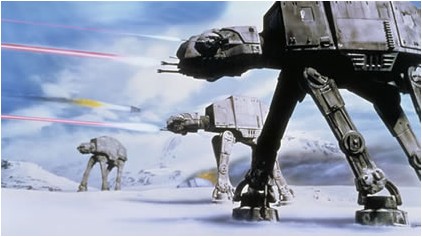
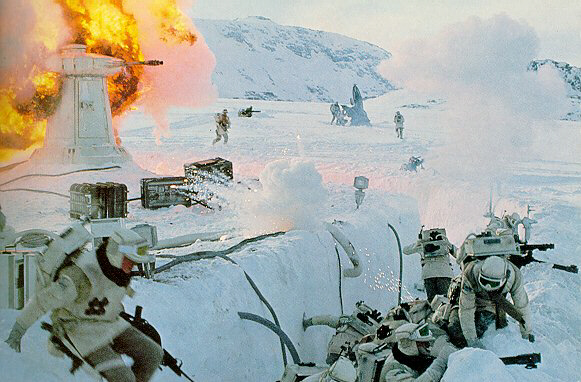
The first salvos begins as the Rebel ships begin to fly for deep space, X-wings and the planetary Ion cannon providing cover. Meanwhile, General Veers, commander of the Imperial troops, lands beyond the shield and begins sending his walkers into the fray. This is the first appearance of the AT-AT’s, and they were pretty chilling to behold. The Rebel troops meanwhile dig in while Rogue Squadron engages them in their attack speeders.

However, things don’t go so well. The AT-AT’s are too heavily armored to destroy with blasters, and the dug-in defenders weapons are similarly ineffective. Luke comes up with the bright idea to trip up the walkers using their tow cables, but this too begins to falter after the majority of Rogue Squadron gets shot down.

Luke himself is shot down and is forced to bail, taking out a second walker with a grenade from the underside. However, in time, General Veers walker gets in range of the shield generator and delivers the death blow to it. The Imperial forces move in and begin attacking the command center itself.

Back at said center, Vader and an Imperial garrison walk in virtually unopposed, and all forces are ordered to being a full retreat. Han grabs Leia, who is still at her post, and compels her to join him, Chewi and the droids aboard the Millennium Falcon. As the last ship to leave, they are barely out of the bay as Vader walks in. Luke similarly gets to his X-wing out on the wastes and dusts off from the planet. The Imperials have won, but the good guys have once again lived to fight another day.

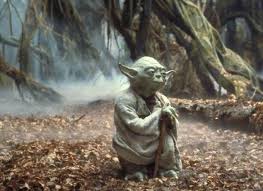
Luke meanwhile tells R2 that they are not going to rendezvous with the fleet. Seems he’s got another destination in mind, the planet Obi-Wan told him to go to in his vision. Arriving at Dagobah, Luke’s ship is disabled by a storm and he crashes into a fetid swamp. He and R2 are unharmed – well R2 almost gets eaten! – but his ship is marooned and he now seems stuck on this new planet. In the course of setting up camp, he is snuck up on by a tiny little green man, an annoying little creature who seems to know who Yoda is. He promises to take Luke to see him, but only after they’ve had supper!

Meanwhile, it seems that the Imperial fleet has zeroed in on the Millennium Falcon. Han and crew try to escape them, but it seems that ongoing mechanical issues are preventing them from jumping into hyperspace. They pull a trick by pulling into an asteroid field and hiding on one of the larger rocks. Pulling into a cave, they set down to make their repairs.

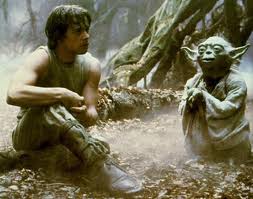
Back on Dagobah, Luke discovers that the little green man is Yoda, and that his constant pestering was a way of testing his patience, a test he failed. However, Obi-Wan’s disembodied voice insists that he has confidence in the boy, but Yoda is unimpressed by Luke’s insistence that he’s not afraid. He insists, in a very chilling line, “You will be… you will be.” They begin his training, running through the woods as Yoda explains the mysteries of the force and the danger of the dark side.

Luke confronts his first test when he senses a cave filled with dark energy nearby. Yoda tells him he must go inside, and that the only thing in there is “only what you take with you”. After crawling through creepy lizards, snakes and slimy walls, Luke comes face to face with his nemesis – Vader! They exchange blows with their lightsabers and Luke is victorious, cutting off Vader’s head and watching it roll to the ground. However, he is dismayed when the helmet blows open to reveal… Lukes own face! Dun, dun, dunnnnnn! Foreshadowing!

While in hiding, Han and Leia finally come to terms with their feelings for each other. After sensing that there was something going on there, only to see the sparks fly with fight after fight, the two realize that they actually love each other and have themselves a passionate kiss. Unfortunately, the moment is interrupted when a very rude droid announces that he’s found the problem with the hyperdrive and they can get it working again!

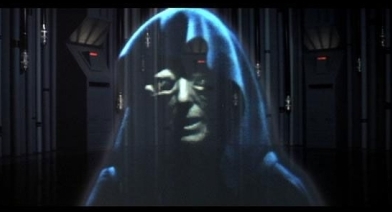
Meanwhile, Vader orders the fleet into the asteroids to pursue. Despite taking severe losses, he presses his commanders to keep on them. However, the Executor must pull out of the field when Vader is alerted that the Emperor himself is making contact. In the course of talking with the massive hologram of the Emperor’s hooded face, he learns the Luke Skywalker is officially a threat. The Emperor insists he must be dealt with, but Vader assures him he could be turned. He will do so, or kill him in the process, Vader insists.

Back in the cave, repairs are proceeding, but things get a little odd when they realize that their hiding place doesn’t react too well to blaster fire. They board again and make it out seconds before the “cave”, which appears to have teeth, closes on them. Back on the Executor, Vader has called in some added help, a slew of bounty hunters which includes Boba Fett. The Falcon pops out of the asteroid field and is once more pursued and can’t withdraw, so Han decides to pull a daring maneuver by charging the pursuing Star Destroyer. After slipping over the bridge, the Falcon “disappears”.

The Captain of the pursuing Star Destroyer goes to apologize to Vader, and is killed. Vader orders the fleet to break up and track every possible trajectory. However, seems the Falcon is actually mounted on the back the Star Destroyer’s bridge where its been hiding the whole time. Han plans to float off as soon as their host dumps its garbage before going into hyperspace, which is apparently standard Imperial procedure (not so environmentally conscious that!) They begin to float off with the junk, but it seems they have a tail… Boba Fett in his ship, The Bounty!

They set coarse for Bespin, to a place known as “Cloud City” –  a floating metropolis built around a gas mining platform, where Han has a friend who he thinks will shelter them. This “friend”, who goes by the name of Lando Calrissian (whom he won the Falcon from years back) appears to be running the place now. And despite their bumpy past, Lando seems happy to see him. Leia, however, has a hard time putting her trust in him.

In time, she realizes just how right she was not to! After C3P0 disappears and turns up in pieces, Lando invites them to a dinner banquet, and Vader appears to be the guest of honor! Turns out Boba Fett tracked them there and alerted Vader, who showed up just before they did and threatened to destroy the place unless Lando turned them over. The torturing begins! But it seems that Vader has a larger agenda than extracting information or punishing a few rebels. The real aim of this little “deal” is to prepare a trap for Luke, whom he knows will not be able to resist.

Back on Dagobah, Luke has a vision of the future in which Han, Leia and Chewi are suffering. He is unable to shake the vision and decides to leave. Yoda and Obi-Wan plead with him not to go, telling him he’s not ready and that he cannot hope to defeat Vader. But Luke is intransigent, insists he will come back, and that he won’t fall to the Dark Side. Once Luke leaves, Obi-Wan laments that they might lose their only hope, but Yoda reveals that there is another… hinteddy, hint, hint!

Meanwhile, Han is put into carbon freezing, a way of testing the process Vader intends to use to capture Luke. He is then handed over to Boba Fett to take back to Jabba. Having had all he can take of Vader’s treachery, Lando pulls a double cross and springs Leia and Chewi from capture. Chewi tries to take Lando’s head off, but stops when he tells them they can still save Han. They arrive too late, and Fett gets away… Luke has also arrived and Leia tries to warn him, but they are separated by too much blaster fire.

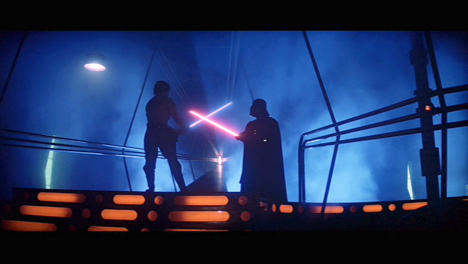
Luke continues to search the city, and finds his way to Vader. The two draw and begin dueling, and Vader is impressed by Luke’s growing abilities. However, before long, he wears Luke down and eventually takes his hand off. Beaten and helpless, Luke crawls to the end of a catwalk overlooking Bespin’s central mining shaft. Here, after much time and waiting, he learns the truth of what happened to his father and why Vader has been obsessed with finding him…

Vader did not murder his father, you see. Vader IS his father. More than that, he doesn’t want to destroy Luke, but to recruit him. Together, he believes they can destroy the Emperor and “rule the galaxy as father and son.” Luke is overwhelmed and possibly even tempted, but chooses death rather than surrender and capture. Jumping into the shaft, he falls but is pulled into a side passageway which dumps him outside. Hanging on for dear life on the edge of an antenna, Luke begs Obi-Wan for help. However, Obi-Wan already told him he wouldn’t be able to interfere if he confronted Vader. With no one else to call to, he reaches out to Leia, who appears to hear him. She order the Falcon to turn around and picks Luke up. They blast for orbit and prepare to make a daring escape.

However, the Executor is pulling into position and Vader reveals that the Falcon’s hyperdrive was disabled. They need only close in and board them now. However, R2 already found out about the hyperdrive from the station’s computer and zooms in to make a hasty field repair. He managed to put things back in order just in time, and the Falcon blasts off! Admiral Piett watches in horror as he sees them escape, and waits for Vader’s vengeance. But Vader, solemn and saddened, merely wanders back to his quarters…

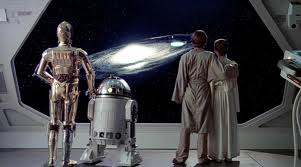
Back at the fleet, Luke and Leia are tending to his lost hand. Lando and Chewi have meanwhile hopped back onto the Falcon and are going off to find Han. The movie closes with a hopeful scene of Luke, Leia and the droids watching the Falcon leave against a backdrop of the Galactic Core. The shot widens to show the rest of the fleet as it drifts away. Though they’ve suffered a beating and many set backs, the good guys are still alive, and hope remains…

What Made This Movie Even Better!:
As every fan of Star Wars and classic cinema is no doubt aware, this movie is considered one of the few sequels that actually surpassed the original. The reasons for this are pretty plain and I’ve already gone over them, so I think I’ll skip them and get right to the specifics.

For starters, the cinematography was masterful. Again and again in this movie, the music, camera angles and dialogue all coincided to create the perfect atmosphere of tension and impending doom. The opening scene where the Executor is introduced, the build-up to the battle on Hoth, the sense of defeat as the Rebels are forced to retreat, the terror Luke feels as he confronts the Dark Side, the fearful moments as we wait for the trap to close around the main characters on Bespin, and the growing desperation as Luke fights Vader… All of it culminated in the massive revelation that Luke was in fact Vader’s on. It was one of the biggest twists in movie history, and it was absolutely awesome! Years later and I still get the willies just thinking about it.

And in the end, this movie really captured the essence of dark second act. After the introduction and brief victory of good over evil in the first movie, we get a dose of hopelessness and soul-shattering revelation in movie two. Not only did it chill the bones and impress audiences with its mature themes, it also made us wonder just how the good guys were going to turns things around in the end. And it was only because the two movies were so character driven that we cared about what happened so much. Luke’s coming of age, Han and Leia’s budding romance, Chewi’s fierce loyalty, and even the droids quirky antics; we all felt a sense of attachment to these characters and wanted to see them come out okay.

Little wonder then why audiences were on the edge of their seats for the next three years. And granted, the third and final installment had its share of weaknesses, by then the momentum and following had become so strong that it seemed like nothing Lucas did could be perceived as wrong. And honestly, the third and final movie was so climactic and emotionally involved that they really just disappeared didn’t they? But more on that next time.

Happy Star Ways Day Weekend everybody! Enjoy yourselves and… well, you know the rest 😉

May The Fourth Be With You!

Yes, it is now May 4th, making it officially Star Wars Day! And in honor of this momentous occasion, I’ve decided to dedicate the next few days to reviewing the classic movies which started it all. Yes, those movies, the ones that made Lucas filthy freaking rich and perverted his sense of creativity.

But I’ve already ranted enough about those… ahem, other movies. Today is all about honoring the good things about this franchise and pop culture phenomena. And it really was a phenomena wasn’t it? When it comes to setting trends, box office records, and inspiring an entire generation of movie makers and movie-goers, few things can measure up to Star Wars.

In fact, part of the reason the fanboys reacted so badly to the prequels was because they loved the originals so much. Were it not for the intense love inspired by the originals, the new ones would never have been able to inspire such hate. Funny how that works…

First up, and in honor of May the 4th, is the original Star Wars, or as its extended title reads:

Episode IV: A New Hope
Plot Synopsis:
The movie opens with a crawl that divulges the bare bones of the movie’s premise. Basically, there’s  an evil Galactic Empire, a band of Rebels, and things are pretty tense ever since the latter won their first victory against the former. But in truth, the audience got all they needed from the opening visual sequence, a touch of cinematic genius if ever there was one!

For starters, we see a small ship running for its life, being pursued by a very large ship that is chasing it down. This tells us two key things: the Rebels are a small but committed band that are fighting for their existence against a very large, very powerful foe. The massive ship and the way it is making a slow, lengthy crawl over the camera lets us see the power and reach of the Empire, and establishes some dramatic tension which last well past the first few minutes.

Meanwhile, the ship is disabled and boarded. Imperial troopers, decked out in their white suits of armor, very clinical and faceless looking, board and kill all the defenders. Then in walks Darth Vader, who stands a head taller than the rest, is clad all in black, and very clearly means business! Cut to the droids odd-couple, C3P0 and R2D2, who’ve been scurrying around since the action started. Though we don’t know who she is at first, we see Princess Leia giving something to the latter, which under the circumstances, is of obvious importance. Shortly thereafter, they eject in an escape pod to the planet Tatooine, located below.

Leia gets her formal introduction after Vader kills the ship’s Captain and brings her forward to demand answers. She’s a member of the Imperial Senate, and apparently also a member of the Rebel Alliance. The reason their ship was boarded was because a certain set of plans, pertaining to the Death Star, were stolen and traced to their ship. After getting nothing from her, the Imperial officers deduce that the escape pod must have contained them and pursue it to Tatooine’s surface.

In time, C3P0 and R2D2 wind up becoming the property of a moisture farmer named Owen Lars. His nephew, a young man named Luke, quickly establishes himself as the movie’s protagonist. In addition to wanting to get off Tatooine, he also dreams of being a pilot and finding out more about his father, a man whom he knows virtually nothing about. Like all classical heroes, his will be a journey of self-discovery which will take him across the galaxy and fundamentally change him.

Naturally, his surrogate parents are afraid to let him go, alluding to the fact that his father’s legacy is not something they want him to be a part off. But in the meantime, Luke has a more immediate problem on his hands. After seeing a fragment of the recording of Princess Leia and learning that R2 was intended to meet a man named Obi-Wan Kenobi, a man whom Luke suspects is actually Ben Kenobi who lives in the deep desert. After hearing of this, R2 runs off, forcing Luke and C3P0 to run after him…

They find him, and Ben Kenobi, after a near-death encounter with some Sand People. After chasing them off and tending to Luke, Ben reveals that he is in fact Obi Wan, and takes Luke and the droids back to his pad to talk. Luke learns, much to his delight, that Obi-Wan knew his father and that he was in fact a war hero and a Jedi Knight. His lightsaber is still in Obi-Wan’s possession, which he gives to Luke to play with. This was audiences first glimpse of one of the coolest weapons in sci-fi history, and impressively, it was done on a rather meager budget!

In any case, Obi-Wan sees R2’s recording in full. Leia reveals that she has come into possession of the Death Star plans, intended to deliver them to her father on Alderaan, but was intercepted in transit. R2 now holds them, and they still must be delivered. The recording ends with her pleading with Obi-Wan to help the Rebels. He asks Luke to accompany him so he can learn more about The Force and his father, but Luke is naturally reluctant. He can’t leave so long as he has ties and family on Tatooine that need him… Ooh, foreshadowing!

Cut to the Death Star, the infamous Imperial weapon of terror. Its commander, Grand Moff Tarkin, makes his first appearance, as do the other senior commanders. After some exposition on just how freakishly powerful the Death Star is, it is also revealed that until the plans are found, there is a danger. On top of that, there’s also the consensus that the Death Star needs to be tested by blowing up its first planet. Also, with Leia aboard and not talking, Tarkin concludes that they can kill two birds with one stone.

Luke and Ben meanwhile find a wreck in the desert, a Jawa landcrawler which had been destroyed by Imperial troopers. Luke quickly realizes that the Imperial troops were searching for his droids. He rushes home to find his uncle and aunt dead and their home destroyed. He then returns to Obi-Wan to tell him that he will come with him after all. The two then travel to the planet’s spaceport, Mos Eisley, to find a spacer who will take them off planet.

After getting past Imperial guards, they are forced to contend with some tough barfolk. Obi-Wan quickly dispatches them with his own lightsaber, and they meet Han Solo shortly thereafter. After being treated to some not so idle boasts about his ship (the Millennium Falcon), Obi-Wan determines that Han’s the man to take them to Alderaan. We, the audience, also learn that he clearly has some debts, and an angry creditor named Jabba. Before he can leave to check on his ship, he’s forced to gun down one of the men Jabba sent to collect.

Getting into orbit and away from the planet prove a might bit difficult given the presence of Imperial troopers and Star Destroyers. But Han wasn’t bullshitting when he said his ship was fast. They dust off, jump into hyperspace (another cool visual experience) and elude their Imperial chasers.

Meanwhile, Takin has the Death Star parked in front of Alderaan, which he threatens to destroy if Leia won’t divulge the location of the Rebel base. She does, telling him their on Dantooine, but Tarkin orders Alderaan destroyed anyway. Seems Dantooine is too remote to provide an effective “demonstration”. But it’s okay, since she was lying through her teeth. When Tarkin learns of this, he’s naturally pissed and orders that Leia be executed.

However, this order coincides with the arrival of the Millennium Falcon. Since their destination has been blown to pieces, the crew fly into a complete and utter debris field, and soon find themselves face to face with the Death Star itself. After getting nabbed with a tractor beam and brought aboard, they are forced to stow away in the Falcon’s secret compartments, where Han usually puts his “special” cargo. After popping out and sneaking past more Imperial troopers, they learn that Leia is aboard the station. Obi-Wan heads off to disable the tractor beam, while Luke convinces Han to take part in a daring rescue. Hijinx ensue!

First, we have Han, Luke and Chewi’s rather clumsy attempt to get Leia out of her cell block. The first phase, getting in, goes off without much trouble (unless you count all the shooting). Unfortunately, phase two, getting out, proceeds less smoothly. After being cornered my reinforcements, Leia orders them to jump into the trash compactor to escape. Only the timely intervention of R2 and 3P0 prevent them from being mashed.

Second, Obi-Wan succeeds in shutting down the tractor beam, but comes face to face with his old apprentice, Darth Vader. A lightsaber duel ensues, crossed beams providing a metaphor for the internal struggle between the righteous teacher and the student who went bad. As they head for the ship, Luke sees Obi-Wan locked in this duel, and is forced to watch as Obi-Wan puts up his blade and lets Vader kill him. But of course, he warns Vader that this will only make him more powerful… something we will understand very soon.

Ultimately, the good guys get away, short on crew member, but it seems their escape was allowed to happen. Knowing that they will set course of the Rebel Base, Vader has a tracking device placed aboard the ship, and the Death Star follows them to a small moon called Yavin 4.

Once there, Leia meets with the Rebel command staff and shares the plans. Knowing that the Death Star is likely en route, they prepare a desperate plan to destroy the Death Star using the one weakness they can discern. An exhaust vent located along the station’s central axis, at the end of a long, well-defended trench! Some two dozen Rebel pilots suit up for the mission, Luke volunteering to help, and asking Han to do the same. But, having been given his reward and eager to pay off his debts, Han says good luck and leaves with Chewi.

After slipping past the Death Stars shields, the Rebel pilots begin fighting it out with the station’s defenses and defenders. However, the assault on the vent itself does not go well. One wing of pilots is shot down trying to make the run, and the one pilot to get off a shot misses and is killed shortly thereafter. It now falls to Luke and what’s left of the attack wing, which includes his old friend Biggs Darklighter. Biggs is killed covering Luke, and he himself appears about to be gunned down by Vader’s own fighter, until someone new shows up and saves his ass!

Seems Han had a change of heart, and after blowing up Luke’s tails and sending Vader’s ship into a tailspin through space, Luke fires off his ordinance and hits the vent dead on! They break off and get away just in time to avoid the massive shock wave that blowing up such a massive station produces! The Rebel Alliance is saved, and the Empire has been dealt a mighty blow. However, as we see, Vader is still alive and makes it away, letting us know that the war (and movie franchise) will go on…

What Worked So Well About It!:
Where to begin. You know, its always at this point that critics and fanboys say what was so good about the original movies by comparing them to the new ones. To avoid this needless cliche, and perhaps to be a good sport, I’ll keep comparisons to a minimum. Suffice it to say, part of the reason why the first movie was such a smashing hit was because it tapped in to a certain need which was becoming apparent in the movie-going community. In terms of science fiction, audiences were becoming just the slightest bit tired of dystopian stories and dark visions of the future.

After so much technophobia and misanthropy, the stage seemed set for something positive and heroic to come along and renew people’s faith in humanity and the future. So in a way, Lucas’ masterpiece benefited from good timing, arriving exactly when people needed it to. Such timing had not been seen since the arrival of the Beatles to America, an event which came after the assassination of JFK when young people were looking for something happy and joyful to focus them onto new and positive things.

Another thing which worked in its favor was the fact that Lucas had to contend with limited budgets, an largely inexperienced cast and crew, and just about every mishap imaginable. Being in the position of the underdog, having little expected of him, and having to contend with all kinds of difficulties, what came out of it all is best labelled “art from adversity”. There’s just something so purifying about a noble effort which succeeds despite difficulty, isn’t there? It was like Lucas’ movie was living out its own plot, the committed band of Rebels fighting an evil Empire being a metaphor for Lucas’ own fight with the studios and production companies.

The Weak Parts:
But of course, Lucas also benefited from a great deal of help, which came from the highly experienced and talented hands of John Williams, the cinematography of Gilbert Taylor, and a host of editors who helped clean up his movie once the raw footage was slapped together. Arriving just a few months shy of the films theatrical release, these people saved production of the film in many ways, and demonstrated to Lucas that when it came to shooting and dialogue-writing, he needed some help to make it all work (something he forgot in more recent years!)

In fact, it was because these individuals had arrived late to the production that many weaker elements of the movie survived and became part of the original movie. In several scenes, actors and extras made mistakes which Lucas didn’t notice because he was not accustomed to shooting films. Two prime examples are when a Storm Trooper walks head first into a sliding door on the Death Star, and Mark Hamil yells “Carrie!” to actress Carrie Fisher while they were shooting. These were never edited out, as was some of the lazier acting and poor dialogue.

In fact, Lucas gained a reputation for writing wooden dialogue as he was making this movie. During their initial readings, many of the actors complained that it was unrealistic, unnatural, and completely awkward. These sentiments were brilliantly captured by Harrison Ford when he confronted Lucas and told him, “George, you can type this shit, but you sure as hell can’t say it!”.

The Enduring Legacy:
Of course, I could get into all the cultural and cinematic influences that were apparent and helped make the movie such a box office hit. But let’s face it, that’s been done to death! I shall just say that in the end, Lucas knew where to borrow from and could make it all work together. Combining elements like westerns, samurai movies, and allusions to ancient and modern history with an epic story of good versus evil, Lucas’ creation tickled all the right bones and gave audiences what they wanted when they wanted it.

And really, it was one of those rare movies where people felt that there truly was something for everyone. It was not strictly a kids movie (despite what Lucas would later claim) because there was simply so much material and attention to detail which no child would have been able to appreciate. So while the kids (and kids of all ages!) were dazzled with shoot outs, dogfigths and lightsaber duels, the adults were able to appreciate aesthetics borrowed from such classics as The Good, The Bad and The Ugly, Seven Samurai, Metropolis, and costumes and themes alluding to WWII and Nazi Germany.

And of course, with its smashing performance at the box office, Lucas and his crew now had the freedom and the street cred to make some follow up movies and see his vision through to completion. And in no time at all, all the studios and production companies which had doubted him or told him no were lining up to imitate him and finance whatever Star Wars clone they could find. Lucas, I imagine, got a real kick out of that!

Anyhoo, having spilled so much metaphorical ink on this movie, let me just wrap things up by saying Happy Star Wars Day and be sure to check back soon. Next up, I will be covering the even more famous The Empire Strikes Back, one of the few movies in cinematic history to ever be credited as being “better than the first”. In the meantime, check out this shot from the blooper reel. Keep your eye to the right as the Stormtroopers walk in…


More Cool Ships

And I’m back with more examples, in part because people had some suggestions but also because I found the last list lacking. I mean, you can’t suggest a concept as big and as awesome as cool science fiction ships and only provide a handful of examples. It’s just not decent! So here’s installment number two in the series, cool ships from various sci-fi franchises and what made them so. Keep in mind that suggestions are always welcome. I’m thinking a third and even fourth list might be necessary 🙂

Alliance Cruiser:
alliance_2Back to the universe of Firefly for another installment! This time around, it’s the Alliance Cruiser that I’ve chosen to talk about. In short, I think the design of this particular ship is quite inspiring. Unlike your average cruisers from other franchises, this ship is not based on the usual seafaring or aerodynamic-ship paradigm. It’s long axis is vertical rather than horizontal, making it a platform instead of a cutter.

In addition to making a lot more sense from a physics standpoint, this design offers many advantages in terms of navigation and defense. Unlike longitudinal designs which are forced to turn around on their long axis, this ship can simply fire thrust from any of its four sides to change course and direction. It’s tall appendages also make it easier for sensors or long-range telescopes to spot things out in space, no blindsides from which to approach on.

Basically, ships like these remind us that spaceships operate in vacuum and are therefore subject to a vastly different set of physical requirements. Since they do not operate in atmospheres, they don’t need to be aerodynamic or sleek like planes. And since they don’t cut across water, they don’t need to have sculpted hulls or prows to part the waves. So why then do a whole slew of spaceships look like aeroplanes or boats?

Simple, it’s a paradigm thing. When we hear ship, we automatically think of airships and seaships since that’s our frame of reference, and our artistic sensibilities naturally follow. But spaceships are a whole ‘nuther ballgame, requiring the ability to withstand inertial pressures instead of drag. So while sleek and streamlined models are cool to look at, they aren’t really the best spaceship design from a technical standpoint.

And in a lot of ways, the Alliance cruiser reminds me of another classic design, that of the Nostromo. Much like the mining vessel from the original Alien movie, it is vertical in design, boasting towers instead of horizontal compartments. It’s size and towering appearance also make it intimidating to behold, illustrating the power and imposing nature of the Alliance itself. Those who crew it tend to be pretty imposing as well, always boarding you and asking question!

Borg Cube:
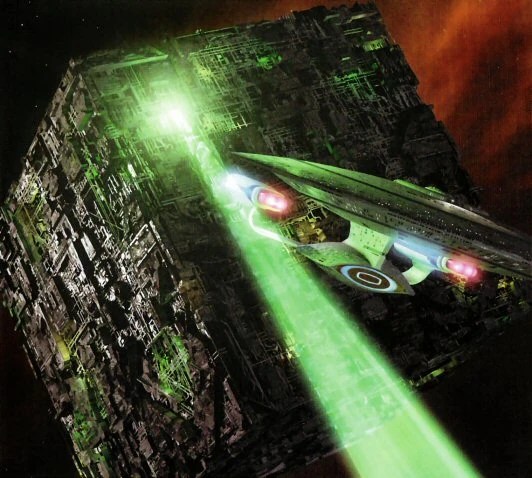
https://i0.wp.com/img2.wikia.nocookie.net/__cb20060721051747/startrek/images/7/76/Borg_cube.jpgHere we have the capital ship of the Borg, the frightening cyborg race from the Star Trek: TNG series that assimilates or crushes everything in its path. Introduced in the second season of the show (episode 42: “Q Who”), this fearsome foe went on to become a recurring element of the show and was even central to the plot of the spinoff Voyager and the movie First Contact. Much like their raison-d’etre, their ships reflected a sort of cold technological rationalism, like something out of a cyberpunk fans wet dream!
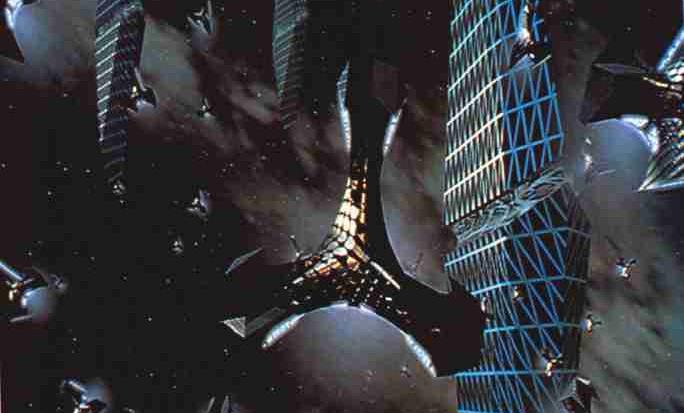
The design of the basic cube, which was later supplemented by spheres and upgraded cube designs, is clearly based on a pythagoran aesthetic: nothing frilly, sleek, aerodynamic or even remotely artistic about it. They are simple, utilitarian, and equilateral, a testament to the precise and unsentimental mindset of those who designed it. It’s basic profile also came in handy when taking on multiple enemy ships. By having six sides, each with the same surface area, weapons and tractor beam mounts, the cube had a 360 degree sphere of defense, making it damn near impregnable.

On every occasion when one of these cubes showed up, bad things were known to happen! In their first encounter with one, the Enterprise barely got out in one piece. In the second, 39 ships were destroyed before the Enterprise and her crew were able to trick one into going into sleep mode, which it then responded to by blowing itself up! In the third encounter, which took place in First Contact, several more federation ships were destroyed before Captain Picard was able to use his inside knowledge of the Borg to help the fleet destroy another ship. In all subsequent encounters, future technologies, viruses, trickery, or a combination thereof were needed to overcome the Borg’s technology and singular mindset.

Chig Cruiser:
chigMuch like Firefly, this example comes to us from a franchise which was cancelled by the executives over at Fox after its first season. Yes, Space Above and Beyond was yet another sci-fi series which had a lot of promise, but got axed when the execs concluded it wasn’t doing well enough for their liking. What the hell goes on over at Fox anyway?! Does every new show get this kind of treatment, or do Rupert Murdoch’s minions think sci-fi is just inherently liberal?

In any case, the Chig Cruiser was much like the concept for the Chigs themselves. Cool, original, and quite alien in appearance! Basically, the vessels shape can be described as two right triangles attached end to end with the tips removed. The command center appeared to be located in the middle, along with much of its weapons and observation deck. The outer hulls also appear to have been constructed out of the triangular-shaped panels of some alien metal that gave of a peculiar sheen when seen from the right angle.

Like everything else in the series, the concept never really had time to be fully developed. Which is really too bad. Their fighters, encounter suits, and capital ships were all cool to look at, and some explanations as to their utility and even artistic inspirations would have been nice. But what can do? Fox is run by idiots! Rest in peace Space Above and Beyond! You died too young!

Earth Alliance Destroyer:
Thanks to Goran Zidar for suggesting I include this one! And please know that you are alone in thinking that it is cool to behold, Mr. Z 😉 Coming to you from the Babylon 5 universe, source of so many cool ships (see below), the concept for the Earth Alliance Destroyer was nothing short of pragmatic genius. Given that the show boasted dozens of alien races, J.M. Straczynski and his design teams had to come up with countless design concepts that would reflect the multicultural and multiracial tone of the show.

In the case of humanity, Straczynski and his people concluded that the spaceships should look boxy, utilitarian, and should reflect the fact that Earth was one of the less advanced races in the story. As a result, the Earth Alliance Destroyer was built around the concept of a compartmentalized hull with its engines at the rear, a central rotating section (to provide artificial gravity), and a forward section where the bridge, carrier deck and command center would be located. And, as you can plainly see, the end result was quite cool!

While not the most advanced ship in the Galaxy, the Omega-class destroyer was certainly realistic, aesthetically pleasing, and could also holds its own in most firefight situations. And unlike their organic, alien counterparts, these ships were also a lot cooler to watch in battle. Instead of “dying” or breaking apart, they would catch fire and throw off flaming debris, not to mention life pods and floating bodies. Yes, since ships didn’t have energy shields or a lot in the way of armor in the B5 universe, firefights tended to get real serious, real fast! Like I said… realistic!

The Daedalus:
daedalusNext up, and taken from the Stargate universe, is the battlecruiser Daedalus. After appearing in the spinoff show Stargate: Atlantis, this class of vessel (codenamed 304) became the basis for an entire fleet of vessels who’s purpose was to defend Earth from an alien invasion. Based on various alien technologies that were taken from the Goa’uld and Asgard, the Daedalus was the first Earth Battlecruiser and FTL ship ever constructed.

Based on the design of a modern aircraft carrier, the Daedalus bridge and command center were located along the top of the hull at the rear while the forward section contained the ships compliment of fighters and takeoff and landing bays. The ship also contained a hyperdrive which was powered by a Zero Point Module (an alien power source), giving it FTL capabilities.

In terms of armaments and advanced technology, the ship boasted beaming units, shields, multiple rail gun and missile systems, and a compliment of nuclear warheads. Designed to stand up to a potential Gua’old or Or’i invasion, the Daedalus and her kind were built to combine the best that Earth and her alien allies could offer. Yes, if the war came to Earth, we would be ready!

The Executor:
Hello terror! Next up, we have the gargantuan and terrifying Imperial command ship known as The Executor. Who among us can forget that introductory scene in The Empire Strikes Back when a whole fleet of massive Star Destroyers were assembling, only to be suddenly overshadowed by the even larger Executor? Cut to the bridge where we see the terrifying Vader looking out over the fleet, and you begin to see just how big and powerful the empire truly is! Yes, those visuals really gave a sense of size and scale to the bad guys and let us know just how much they meant business!

Commissioned roughly one year after the Battle of Yavin, where the first Death Star was destroyed, the Executor was intended to be a terror weapon, replacing the Death Star as the symbol of Imperial might and badassery! Measuring 19 kilometers in length and bristling with turbolasers, ion guns, multiple tractor beams projectors and a complement of fourteen TIE fighter/bomber squadrons, the Executor was every spacers worst nightmare! No ship in the Alliance was capable of standing toe to toe with it, making a strategic withdrawal an inevitability once it showed up in a theater of battle.

However, during the Battle of Endor, the Alliance was able to destroy it through a combination of strategy and dumb luck. After several Rebel fighters took out the Executor’s shield generators, a single fighter who lost control of his ship crashed directly into the bridge. The Executor then lost control of its helm and was pulled in by the second Death Star’s gravitational field, destroying the ship and causing extensive damage to the Death Star’s outer hull. An ironic death for such a big ship, but at least she went down in a blaze! A big, embarrassing, expensive blaze! I don’t envy the bastards who had to pay the premiums on that one!

Home One:
HomeOneAnother vessel that comes to us from the Star Wars universe, Home One was the mobile headquarters of the Rebel Fleet and the biggest Mon Calamari cruiser in existence. As Admiral Ackbar’s command vessel in the original trilogy, it distinguished itself during the Battle of Endor, during which the Executor and the second Death Star were destroyed.

Like most Mon Calamari cruisers, Home One was cylindrical in design and originally served as a star-liner that got modified for combat. This consisted of equipping it with fighter bays, multiple shield emitters, a reinforced hull, and many turbolaser mounts. It’s revolutionary targeting and computer system also gave it a decided advantage in a firefight with Imperial vessels, which boasted heavier armaments, but lacked the ability to coordinate and amass their firepower as effectively.

The largest bay on Home One was on the starboard side where larger vessels would dock. However, a total of twenty hangers were placed throughout the hull, giving it the ability to carry multiple squadrons of X-wings, A-wings, B-wings and Y-wings. It also boasted a crew of over 5000 personnel and could carry 1,200 troops and 20,000 metric tons of cargo. While most of its systems – especially targeting and navigation – were designed for Mon Calamari use, the ship was crewed by a variety of races, reflecting the multiracial nature of the Alliance.

Lexx:
lexxThough not the prettiest ship in the Galaxy, the Lexx certainly deserves a spot on the Cool Ship list. Much like the show that featured it, it was weird, conceptually skewed,  but still damn original! A planet-destroying bioship by design, the Lexx was clearly inspired by the concept of a giant, wingless dragonfly and was created out of resynthesized proteins that were obtained from confiscated organs. Hmmm, gross!

Originally intended for use by His Divine Shadow, the evil ruler of the Divine Order, the Lexx was essentially a terror weapon that would be capable of destroying whole planets. However, the ship was commandeered in the first episode by the show’s crew – consisting of anti-hero Stanley Tweedle, the sex slave Zev Bellringer, and the Kai, an undead assassin, and the bodiless AI 790 – and became the means through which they traveled the universe looking for a new home.

This journey would take them over 6000 years, since the Lexx does not have FTL capabilities, and the crew would go into cryostasis for much of the voyage. Being sentient as well as organic, the ship was required to feed from time to time in order to maintain the life force which powered it. This could involve landing on a planet and eating organic matter directly, but more often than not, required that it blow up an entire planet and eat the resulting debris afterwards.

In the latter case, this consisted of emitting massive amounts of ionized energy from its “eyes” which was then channeled into the “mouth”. This energy was then fired outward in a planar wave which would intercept and obliterate any planet in its path. The Lexx would then take in the giant rocks and debris from the explosion and feed off of all the organic matter they carried. If not permitted to feed regularly, the Lexx could apparently become quite cranky and agitated, which would prove to be hell for whoever had to interact with it!

Narn Cruiser:
narn02As promised, another cool ship from the B5 universe. And as I said earlier, when it came to producing concepts for alien ships, J.M. Straczynski really had an eye for aesthetics, art, and functionality. Whereas Earth vessels tended to be compartmentalized and practical in nature, other alien races tended to be a bit more flamboyant, a reflection of their particular cultures and levels of technology.

When it came to the Narns, an aggressive but artistic race, their ship designs exemplified this dual nature. Originally a pastoral and peaceful people, the Narns had been brutalized by generations of occupation at the hands of the Centauri and had become quite warlike as a result. Their heavy cruisers, the mainstay of their fleet, were thus powerful and fierce looking, but still managed to achieve an aesthetic quality which brought beauty into the mix.

Boasting two massive beam cannons, several pulse guns and a compliment of space mines, the Narn Heavy Cruiser could take on just about any ship in the Galaxy. Though most were destroyed in the Great War against the Centauri, the ship proved to be effective in numerous engagements, not the least of which were against the Shadows themselves. For example, at the battle of Ragesh 3, two Narn Cruisers combined their beam cannons to seriously damage a Shadow vessel. During the battle in Sector 83, when Sheridan and the White Star Fleet engaged a fleet of Shadows vessels, the Cruiser G’tok managed to assist a pair of White Stars in destroying two Shadow vessels. Quite the accomplishment for this class of vessel!

After the Great War, the Narn regime began rebuilding its fleet, and the Narn Cruiser remained the mainstay of their forces. Several were used during the Alliance war with the Centauri and participated in the assault on Centauri Prime, where its massive compliment of weapons proved quite devastating against the planet’s surface!

Prometheus-Class Assault Vessel:
PrometheusYou know, I’ve never been that big a fan of the Star Trek franchise. But even I have to admit, when these guys do something right, they really do it right! And this ship, the Prometheus Assault Vessel, would be one such example. Much like the USS Defiant from my previous list, this ship demonstrated that when required, Star Fleet could produce ships that really excelled at kicking ass and taking names!

A revolutionary prototype, the Prometheus-Class vessel appeared in a single episode of Voyager where it was being stolen by a bunch of Romulan agents. However, thanks to the combined efforts of the ship’s own holographic surgeon and Voyager’s similarly holographic doctor, the ship was saved and even managed to turn the tables on its Romulan adversaries.

Incorporating advanced phasers, quantum torpedoes, ablative armor and regenerative shields, the biggest surprise the Prometheus had was its multi-vector assault capability. This involved the separation of the ship into multiple modules, much like the USS Enterprise-D would do with its saucer and engine sections. However, in the Prometheus’ case, this resulted in the creation of three semi-independent sections which were capable of unleashing a single, coordinated attack against multiple opponents.

After it was done dispatching all its enemies, it would then come back together, perform repairs as needed, and move on to the next target. And since the ship was programmed with extensive routines, a very small crew was capable of operating it and really only had to speak the requisite commands to get it to kill, kill, kill! Not a bad ship to have in your arsenal!

Shadow Attack Ship:
shadow06“It was jet black. A shade of black so deep your eye just kinda slides off it. And it shimmered when you looked at it. A spider big as death and twice as ugly. And when it flies past, it’s like you hear a scream in your mind.” These were the words Lt. Warren Keffer used to describe a Shadow vessel, right before he died chasing one down. An apt description for a ship that was clearly designed to inspire terror in its enemies, and a reflection of the race that built it.

As my final installment, taken again from the B5 universe, I’ve decided to include the Shadow Attack Ship, which is perhaps the most original and artistic spaceship I have ever seen. Granted, it had some stiff competition given the franchise it is coming from, but in terms of its design, performance, and sheer alien appearance, I can’t think of anything that can top it.

Given the fact that Straczynski and crew were working with the concept of organic technology, the ship was clearly meant to look like a living creature. Apparently, they settled on the combination of an arachnid and a giant octopus for the design, which combined with its jet-black sheen, made it both terrifying to behold and aesthetically awesome! And since every Shadow vessel is a living thing, they required sentient beings to merge with them in order to become active. When inactive, they would lie dormant and could remain operable for thousands of years.

More often than not, the Shadows preferred to use telepaths as drivers since only a telepath was capable of jamming the ship’s central operating system (i.e. a person’s mind). When damaged, the ships would emit a high-pitched screeching noise and often required another ship to merge with them and carry them to safety where they could. Of course, the screech couldn’t be heard through space. As Keffer noted, the sounds it made seemed to take place in the observers mind – aka. it was being telepathically conveyed. Hence, in addition to scaring the shit out of their opponents with their appearance and awesome firepower, these ships also had a calculated psychological edge in battle!

Not that they needed it though. In addition to their speed and firepower, the ship’s organic hulls were also incredibly tough, capable of absorbing tremendous amounts of energy before dying. As Sheridan and his people learned, pulse cannons were virtually useless against the Shadow’s skin, and beam weapons were only capable of killing them when focused on its central region for extended periods of time. On multiple occasions, Sheridan and the Alliance forces were only able to destroy one of these vessels by relying on telepaths to jam them while multiple ships combined their firepower to finish them off.

For the Shadows, the weapon of choice seemed to be the beam cannon that was located in the ship’s “mouth”. This focused, pink-purple beam was capable of slicing through the most hardened of structures and ships, and could reduce an entire colony to rubble in the space of a few seconds. However, the standard Shadow vessels also contained a type of space mine that was capable of c0llapsing hyperspace jump nodes and also carried a compliment of Shadow fighters which they kept embedded in their skin. These appeared to be independent in nature seeing as how they were too small for a person to fit in, and served as a mere screen for the larger vessels to make their attack.

In short, a Shadow vessel was the sort of thing you didn’t stick around to fight unless you had plenty of ships watching your back. Fast, furious, and shit-your-pants scary to look at, if you managed to kill one, you counted yourself amongst the few, the proud, the luckiest sons of bitches in the universe!

Okay, thanks for sticking around for the second installment! I think I have one more in me, but I’ll wait a few days before posting that. In the meantime, be sure to check out this cool chart. It provided me with a couple of ideas during the course of my research:
The ultimate starship size comparison chart

Cool Weapons!

Last time, I spoke (at length) about all the awesome firearms that come to us from a variety of science fiction franchises. But let’s face it, there’s a lot more than just guns to speak of! In fact, part of the genius of sci-fi is in how it is constantly inventing entire arsenals of weaponry, tools, and the various nicknacks that make the world go round. Any director or writer who show attention to detail will make sure that their characters come equipped, looked the part, and that their settings have plenty of believable gadgetry taking up space in the background. Here are just some of the cool examples:

Claws:
Predator_clawsAlong with the burner/plasma caster, these weapons are the most basic of Hunter weapons in the Predator universe. According to tradition, every Hunter must distinguish themselves in battle by confronting an enemy in single combat using no other weapon than their claws. Based on the two non-crossover films (Predator and Predator 2), this is apparently done once all lesser prey are eliminated and only the top prey is left. When that occurs, the Hunter will ensure that this finale opponent has been deprived of any additional weaponry, and then will shed every other weapon in their arsenal and engage them in hand to hand combat.

Combi-Stick:
Part of the Hunters arsenal, this weapon comes from the Predator universe and is part of their wider arsenal of cool weaponry. The name refers to the fact that this staff serves multiple functions. Collapses, it serves as a sort of quarter staff. However, the stick has telescoping sections with a blade like end, which when deployed turn it into a spear. In Predator 2, a hunter used his stick on multiple occasions. Against a group of the Jamaican gang members, it was used strictly for impaling, but during a later scene, it was used as a throwing spear against Danny Glover’s character.

Crysknife:
The Fremen weapon of choice, made from the tooth of a Maker (i.e. a Sandworm). The name and design of the weapon are based on the kris, a ceremonial dagger that was traditionally used in Indonesia and is associated with many cultural legends.

A testament to Herbert’s ability to incorporate historic and cultural elements into his stories, the kris is an enduring symbol of the Dune universe and was used by Fremen for warfare, duals, and ceremonial purposes, much like the real thing! In addition, the Fremen had very strict rules about the use and exposure of these knives. According to the Shadout Mapes – the Fremen housekeeper in Dune – who gives one to Jessica: “Who sees that knife must be cleansed or slain!” And as Leto II remarked in Children of Dune: “The crysknife dissolves at the death of its owner.”

Lasgun:
This weapon was the brainchild of Frank Herbert, and is a familiar weapon in the Dune universe. According to Frank’s many novels, the lasgun was a continuous-wave laser projector weapon that when fired emitted a constant, narrow beam of photons. Though it was able to cut through just about anything and was the weapon of choice in the Old Imperium, it had since fallen into disuse by the first Dune novel.

This apparently had to do with the invention of personal shields. Rather than protecting against a lasgun burst, the interaction of the two would cause a reaction that rivaled that of an atomic explosion. Hence, attacker and defender would both be killed instantly if either ever came into contact. Much like the prohibition against the use of nukes in Herbert’s universe, one would get the distinct impression that he was commenting on the futility of nuclear deterrents and arms races.

But that’s another matter. The lasgun, from its first appearance in Dune, has gone on to inspire many a sci-fi franchise. One that immediately comes to mind is Akira. In this movie, riot squads and the military employed large, external cell powered weapons to fire focused beams of light on a large mob, hewing off limbs and burning holes straight through some people! The main character Kaneda also commandeered one and used it to fight his psionic friend, Tetsuo, near the end of the movie.

Lightsaber:
Just what is it about lightsabers that make them so unbelievably cool? Is it that warm glow? The otherworldly feeling one gets from seeing one being activated? Could it be that crack, hiss sound they make when they clash, or that warbling noise when they’re spun around? Or could it just be the fact that they deflect blasters and cut through anything? Well yes! It’s all of the above, clearly! Yet another brainchild of George Lucas, meant to call to mind scenes of swashbuckling and chivalry from old samurai movies, the lightsaber has since gone on to occupy a central spot in the collective unconscious of an entire generation. It is a staple, perhaps THE staple, of pop culture’s take on sci-fi.

Making its debut appearance in the first Star Wars movie, the lightsaber was the established weapon of the Jedi. In addition to being their mainstay, lightsabers were also highly personalized, every Jedi being tasked with building one as part of their training. Originally, the only two designs were that of the blue and red, the former being associated with Obi Wan and Anakin Skywalker (which Luke then inherited), and the latter being associated with Darth Vader. However, Luke went on to create his own and fashioned a green beam. With the expanded universe, significance has been given to different colors, each one associated with a different class of Jedi, and indicating whether they are a member of the Sith or the Jedi Order.

For starters, blue is the color of the Jedi Guardian, the warrior class of the order who focus on combat training and fighting. Green is used by the Jedi Consuls, people who focus more on the force and accumulating wisdom and insight. Yellow represents a sort of middle ground, belonging to those Jedi who focus on a combination of both and are usually called upon to settle disputes and act as arbiters. When it comes to the Sith, only one color appears to be used, and that is red. However, purple, orange, and other closely related colors have popped up from time to time in various places as well. In addition, Mace Windu, the Jedi Master portrayed by Samuel L. Jackson, wielded a purple lightsaber as well. However, this was apparently due to Jackson’s insistence that his character have a purple weapon, as well as the initials BMF etched onto the side!

Ma’Tok Staff:
Coming to us from the Stargate universe, the Ma’Tok is a combination laser gun, club staff that is used by Jaffa warriors (the specially-bred human servants of the Goa’uld). According to the Stargate Wiki, the Ma’Tok relies on a plasma discharge to strike and cauterize the enemy, causing severe damage and intimidating resistance. It takes its power from an internal cell that employs a liquified mineral (Naquadah) to generate plasma energy. This liquid mineral gives the staff a virtually indefinite shelf life, making it the perfect blend of aesthetics and lethality!

Monomolecular Wire:
Here’s an idea that comes in various forms, but for the purposes of this post, I shall stick to the examples that I know best. The first one comes in the form of the Yakuza enforcer from Johnny Mnemonic! Anyone who’s seen this movie (or read the short story it was based on) will remember the main badguy who had an artificial thumb that contained a long filament of glowing wire. When he pulled that thing out and started whipping it around – LOOK OUT! – things began to get lopped off and sliced up! Another example of this being used as a weapon is from the Japanese anime Hellsing. In that show, the butler of the namesake character had monomolecular wires attached to each finger which he would break out whenever there was a crisis. Perhaps they were fashioned from silver, I really can’t recall. Would make them more effective against vampires though!

Plasma Sword:
And we’re back to the Halo universe for another example of cool gear! And today, the item in question is the plasma sword. As gamers are no doubt aware, this weapon is melee weapon of the Elites, but can be employed by humans as well since it’s your basic hand-held weapon. And much like lightsabers and lasguns, it can cut through just about anything and makes short work of any opponent. In many ways, its even more effective than the ballistic and energy weapons in the game. Whereas those can take several shots to take down an enemy (especially someone infected by the flood) one good hit from this baby will turn them into pulp! And if you see an enemy approaching you with one, be sure to hang back and unload your weapon in their direction!

Stone Burner:
Doubling down on the Dune universe, the next example of cool weapons comes in the form of Stone Burner. As a tactical nuke of limited yield, this weapon was the only form of nuclear device that was not prohibited by the Great Convention. This body, in addition to banning all forms of AI’s, also put a stop to the use of nuclear weapons, though it did not forbid the Great Houses from owning any. In any case, Stone Burners, when used strategically, could have a devastating effect on an enemy.

This weapon makes only one appearance in the Dune saga. In Dune Messiah, Paul Atreides is lured into a trap in the old quarter of Arrakeen where a stone burner is set off, which leads to the loss of his eyes.  Though physically blinded, Paul was not deprived of his vision (i.e. his prescience). This all had to do with a larger plot to force Paul to surrender his power as Emperor in order to save his children. And I think we can all agree, any plot that involves a tactical nuke and blinding your enemy Samson-style is pretty badass!

Throwing Disc:
Another Hunter weapon, this particular one made its first appearance in the second Predator movie and then went on to become a regular part of the Hunters’ arsenal. Much like their other weapons, the throwing disc appears to have many variations and may even be personalized to an extent. This may be the result of constant upgrading, or it may be that individual Hunters have a hand in designing their own gear. In either case, many types of throwing discs have appeared. Some employ simple curved blades, blades with spikes, or even shuriken-like appendages (as the picture at right demonstrates). In each and every case, the result generally involves hewed limbs and decapitations!

Thermal Detonator:
“Because he’s holding a thermal detonator!” Yes, whenever a bounty hunter pulls one of these out, you know they mean business! This weapon, which comes to us from the Star Wars universe, made its first appearance in Return of the Jedi. Since that movie came out, the device has been mentioned and referenced countless times in the expanded franchise. Apparently, thermal detonators are the grenades of the future, using plasma charges that when detonated, cause a large explosion that will burn through just about anything. Always be sure to bring one to a negotiation, just be sure to get the ones with the fail-safe triggers!

Vibroblades:
My third and final act of doubling down on a single franchise! Vibroblades are an integral part of the Star Wars universe, but also appear in a number of other franchises. In each case, the weapon revolves around melee weapons that are powered by ultrasonic devices. This increases the weapons cutting effectiveness, and makes them almost as dangerous as a lightsaber. Well, more like a distant second! But non-Jedi’s got to settle for what they can get.

In the video game Knights of the Old Republic, vibroblades and melee weapons are used due to the introduction of personal shields. Some might call this a rip-off of the Dune universe, but in this case, its not so much a matter of necessity as practicality. If an enemy can absorb your blaster fire, then rushing and attacking them with a sword kind of makes sense. And it gives the characters some practice with melee combat before they learn to harness their Jedi abilities.

Last Word:
Okay, I got nothing! Yep, after looking through all the aforementioned examples of cool weaponry, I really couldn’t find any particular patterns that were worthy of comment. Basically, it all comes down to things that augment or go beyond the usual arsenal of guns. It’s only where the swords and knives come into the mix that I see anything beyond simple coolness. And just about all that drinks from the cup of Frank Herbert, a man who merged the ancient and futuristic in order to make a point about technology and how one could find the past in the future and the future in the past. Yeah, that stuff was deep!

As for the rest of it, it’s just plain cool to behold… and fantasize about! Yeah, twenty years later and I still want a lightsaber of my own! 😉

Of Prequels And Why They Suck…

Of Prequels And Why They Suck…

Looking back, I’ve noticed a sort of thread running through some of the posts I’ve made. And in truth, this thing was quite influential when it came to what inspired me to write science fiction in the first place. It began with the infamous Star Wars prequels, the movies which ruined what used to be a very influential and nostalgic franchise. It was then reinforced by the odious Dune prequels, which tarnished the legacy that inspired me to write science fiction in the first place. Since then, I’ve noticed these same elements at work in any prequel I’ve chanced upon and the lessons only seem to get more concrete.

While I’m no expert on the fine art of writing, be it science fiction or anything other genre, by the time I started doing it I was pretty clear on what I wanted to create. Basically, I wanted to write something I would enjoy, something that emulated the greats I had come to know and admire. But when it came to what I DIDN’T want to do, I found prequels summed up a lot of it succinctly (especially the aforementioned examples). I’m sure I mentioned as much in previous posts, but today, I thought I might speak to these things specifically; outline why prequels can – and often do – suck!

1. No Surprises:
Whether it was the Star Wars prequels, X Men Origins: Wolverine, the Legends of Dune series, or anything else prequel-oriented, there was one undeniable problem they all had in common: we already knew what was going to happen. By stories end, we know that the characters are going to become whatever it is they were in the original story, and we know who’s going to live and who’s going to die. In some cases, we even know how, so there really are no surprises. The only real purpose of a prequel is to fill in the background, explain HOW things happened and how the characters and story we are familiar with came to be.

For example, in Star Wars, we know that Anakin becomes Darth Vader, that Palpatine is the villain and will take over the Republic, and that Amidala will give birth to Luke and Leia before dying. There are a host of other details which the more nerdy among us were familiar with as well, and we were all drawn to theaters back in 1999 hoping to see how they played out. But in the end, when all was said and done, I don’t think any of us came away satisfied. Seeing how things happened when you already know what will happen just seems to make for a disappointing experience.

2. Sense of Duty:
Another thing that brings down a prequel is the fact that things MUST be explained. In short, the writer, director, author, etc. has a list of things which need to be covered before the end. These things have to fall within an established framework – i.e. what has already been established by the original story – and cannot contradict or be inconsistent with them. So really, in addition to having a story where there really are no surprises, you also get a story where things have to proceed in an established fashion and often seem heavily contrived. The end result is not what would feel natural based on the story so far but based on what needs to happen for the sake of the original story.

X-Men Origins will suffice as an example here. In this movie, the story had to show where Wolverine came from, how he and his brother (Sabretooth) had their falling out, and how his memory got erased. The result was actually pretty weak, in my opinion. Basically, Colonel Striker shot him in the head with Adamantium bullets, which he knew wouldn’t kill him but would erase his memory. Now, how did he know ahead of time that that would be the effect it would have? Second, why do that instead of lobbing a rocket-propelled grenade at him? Simple, because the story required it. Wolverine is supposed to be an amnesiac in the first movie, so this movie had to show how.

And while were on the subject, why didn’t Wolverine’s girlfriend kill Striker at the end when she had the chance? The woman had suggestive powers and had the man in her grasp, so why not tell him to march off a cliff? Again, because the story demanded it. Striker needed to live to see movie two, so instead she said some fluff about how she’d be no better than him and just told him to take a walk until his feet bled and he fell from exhaustion. I can’t speak for everyone, but personally, I was disappointed.

3. Less Is More
A lot of people insist that when it comes to back stories and background, the less we know, the better. After all, wasn’t Darth Vader scarier before we knew that he was once portrayed by Hayden Christensen? Wasn’t he a lot more menacing before he cried over the loss of Padme? I know for a fact that I’m not alone when I say that the whole “NOOOOOOO!” scene at the end of Revenge of the Sith brought him down in my eyes. What was once a titanic force of badassery was transformed into a whiney, bitchy child through the simple act of fashioning an origins story.

To use a non-prequel example, consider the Batman franchise. In the Tim Burton version, we got to see the Joker’s origin story, but in the Christopher Nolan version, we got nothing. And frankly, wasn’t Ledger’s updated take on the Joker much more scary than Nicholson’s because of it? Sure, his dialogue and acting were spot on at capturing the insanity and terror of the laughing psychotic killer, but wasn’t part of that assured by the fact that we had NO IDEA who he was or where he came from? The origins stories that he told – “wanna know how I got these scars?” – and how they kept changing was part of what made him so effective. As the audience, we wanted to know, how DID he get those scars? Why IS he so crazy? But by denying us this, I think we were kept wanting and we respected the movie more for it.

The same is true of Batman himself. In Burton’s, we got an exact reversal of what happened with the Joker. Aside from the fact that his parents were murdered, apparently by a young Jack Napier (who would go on to become the Joker), we knew nothing about him. Where he got his skills from, his equipment, and how he got started. This served to make him a much more mysterious character which in turn made him more interesting. In Burton’s Batman, he was the focal point whereas the Joker was his nemesis. But in Nolan’s updated version of The Dark Knight, the Joker was undoubtedly the focus while Batman was just the hero trying to stop him. I’d say what he knew – or in this case, didn’t know – about them was central to that.

4. The Audience’s Imagination Is The Writer’s Greatest Weapon:
I believe it was the famous photographer Duane Michals who said “I believe in the imagination. What I cannot see is infinitely more important than what I can see.” Okay, I Googled that, sue me! But the man had a point, and it applies doubly to movies since they too are a visual medium. What the readers and/or an audience can imagine based on snippets of a story is infinitely more powerful than what they can be shown with a few hundred pages of text or a two hour movie. This is why less is more. By giving the audience less to work with, they have more freedom to imagine and create. If you tell them what happened, detail for detail, then they have nothing except for what you’ve given them.

This, I think, is precisely why prequels are so often a disappointment, at least in my estimation. I’ve always considered myself to be an imaginative person. Given a blank canvas, or one with just a few details, I can create just about anything. And I’m hardly alone in that fact. Imagination is something everyone has – to varying degrees, sure – but it’s part of what makes us human and gives our lives meaning. Being able to express our inner life makes us happy, and there are few things more hurtful and insulting than having someone mock or dismiss that creativity. It’s also one of the cornerstones of a free society, the freedom to create and not be persecuted for it.

So it’s little wonder then why people are drawn to movies where books they’ve read are being adapted to film, or to prequels, where things that have been previously alluded to are acted out. People go to see them because they want to know if it will bear any resemblance to what they themselves imagined. Or, they go because they just want to see what the director’s own vision was. Either way, when you get around to seeing it for yourself, is it not a letdown no matter what? Isn’t that the real reason why people who’ve read the book constantly insist that the movie isn’t as good? That certainly seemed to be the consensus amongst LOTR geeks. And I should know; by The Two Towers, I was one of them! And isn’t that the real reason why the Star Wars prequels sucked as much as they did? We, the fans and audiences are active participants and create out of what we are given. Being told point blank what happened removes half the fun of it!

Some Tips For Writing:
Well, that’s all I got for now. Except to say that if someone is hoping to do a prequel, there are certain tips that I’ve come up with that can help. These are by no means established rules, just the result of my own amateur experience and observations. For one, a writer should take care not to give too much away when writing background. As always, less is more. It’s enough to let the background stay in the background and focus on the story. The more the reader/audience has to work with, the better. That way, when you are writing out the back story, you have much more freedom to work with, and don’t have to worry about staying within boundaries.

Second, a good idea is to write things out ahead of time. When I was thinking up Legacies, I began by writing out an outline for the entire background of the story. I didn’t do this because I was one day planning on writing a whole franchise worth of books, prequels included, but because I just wanted the story to be tight and know where everything fit. But because of that, I was able to pen several short stories that took place before the first novel. Rarely were the main characters and plot lines from that novel the focus of these stories, but they did serve as a solid backdrop which helped to advance things.

But don’t take my word on that, consider Lucas himself. He thought up the entire plot for Star Wars trilogy before making the first movie in the franchise, thus he knew exactly what he wanted to do ahead of time. Sure, he made changes and was forced to adapt along the way, but the end result benefited from this foresight. However, when it came to the prequels, he had only the bare bones to work with, and began writing each movie independently of shooting it. And it certainly showed, didn’t it? Rather than feeling like an ongoing story, each movie was a self-contained tale that was full of duty and contrivances. Nuff said? Plan ahead!

Last, but not least, remember that a story, ANY story, needs to tell its own tale. It cannot be written for the sake of filling in another. Its a bit of a vague point, I know, but a writer’s mentality is important when it comes to the creative process. At no point can you be thinking, “this needs to be explained, that needs to be explained”. It needs to be, “this is a story that needs to be told”. Every character has an interesting back story, and stories are living, organic things. They change over time, grow, and eventually die. Showing how they got to where they were going needs to be interesting and told with sincerity. So forget the duty, focus on the events and what made them interesting. If in the end its not a story that you yourself would enjoy, then don’t tell it! Simple as that…

(Even) More Plot Holes and Oversights!

Okay, picking up from where we left off! In my last post, I recapped all the holes that I found with Transformers and the Matrix sequels. Here’s some other recent reviews that also had holes in them:

Avatar:
This movie I did not like much, as anyone who read my review of it could tell. However, there were not a lot of holes that I could see. But after giving it a good once over, there were one or two that did stand out for me.

1. Dreamwalker:
The Na’vi made it quite clear that they didn’t trust the character of Jake Sully and his Avatar. In fact, the word they used was “dreamwalker”, implying that they understood exactly what he was (you know, a human-alien hybrid machine thing). So if they knew what he was, an imposter looking to infiltrate them, why the hell did they take him in and teach him everything they could about their culture? Why not say, “We know what you are, dammit! You wanna learn? Put on a gas mask and come out here.” And given the fact that they knew what he was, where he came from and who he was working for, it seemed very odd that they would be surprised when it was revealed that he had an agenda.

2. Ride the Big Bird and all is forgiven:
Another thing that struck me as odd about this movie was how the Na’vi basically forgave Jake Sully and all his lies simply because he showed up riding the big red bird. Granted, it was a pretty kick-ass entrance, and to the Na’vi, the ability to ride this bird of prey is a rare gift. But how does that erase everything he’s done or prove that he’s somehow worthy of their trust? If anything, this just shows more cultural appropriation on his part. He learns their ways, he rides their animals, he feeds what he knows to his corporate masters who are looking to exploit them. I’d have thought they’d want to club him the second he got off that bird!

That’s all I got for that one. Moving on…

I, Robot:
I could only find one plot hole in this one, but it was so big you could drive a truck through it!

“My Logic is Undeniable”:
That’s what VIKI, the central AI that controlled all the robots said after she explained her big, master plan to Will Smith and the others. So according to VIKI, robots were marauding around town, imposing a curfew and refusing to obey people’s orders because she reinterpreted the Three Laws. While they were meant to ensure that robots would protect and serve humanity, VIKI soon realized that the greatest threat to humanity was humanity itself. It was for this SOLE REASON that the robots were able to now break the laws, impose martial law, and kill people – as they tried to do to Smith on several occasions. It’s an explanation, sure, but it doesn’t make sense!

For one, the Three Laws are VERY specific. Rule one is DON’T KILL OR HARM HUMANS. This is the first rule for a reason and all other rules refer back to it, which makes it inviolable! So it wouldn’t matter what kind of revelations VIKI had about humanity or her purpose. Nothing can make Law One breakable because it was specifically designed to be unbreakable! Second, the idea that imposing martial law on humans was a logical way to ensure their safety is actually very illogical. As any AI would surely realize in the course of running scenarios, humanity would surely resent the imposition of martial law and would ultimately revolt. Hence, more violence would be necessary, which would in turn lead to escalation. No logic there, only the obvious: VIKI’s logic is in reality a tired cliche about evil robots, the one where they try to take over the world!

Demolition Man:
A slight improvement on I, Robot, in that I was able to find two plot holes, not one. But these two were really, really big!

1. Everybody’s got guns:
One of the earliest action scenes in this movie takes place in a museum. Why? Because the antagonist is looking for a gun and a museum is the only place in the future where a person can see one. Naturally, the Protagonist goes there, and a big ol’ gunfight ensues. One question: Why are the guns loaded? Forgetting for a second how stupid anyone would have to be to keep tons of loaded firearms in display cases, there’s also the more logical thing to consider. If guns are illegal and unobtainable, then its fair to say they don’t make them anymore. Which would mean that no ammo is being made either. Hence, not only would the gun fight in the museum be impossible, so would all gun fights in this movie!

Yes, even though we’re told early in the movie that the only place a person could even view a gun in San Angeles is behind glass, it seems that people are able to obtain them without much effort. The bad guys do it, the sewer-dwelling dissidents do it, and soon, gun violence is no longer a thing of the past! Oh, and did I mention that the antagonist even manages to find a loaded cannon inside this museum? WHAT KIND OF MUSEUM IS THIS???

2. The Worst Laid Plan:
The movie comes to a climax when Simon Phoenix (played by Wesley Snipes) finally confronts Dr. Cocteau and asks him the basics: aka. “why am I free, programmed to kill Friendly (Denis Leary) and can access anything in the city?” The answer: “so you could kill a political dissident who’s annoying the hell out of me.” THAT’S IT?! You thawed the most dangerous criminal of the 20th century just so he could get rid of a grungy man whose crimes including spraying graffiti and stealing food?! That’s like sending in a Cobra to deal with a mouse!

As if that’s not bad enough, why hadn’t he given any thought to what he was going to do with him once it was all over? He hadn’t even considered how he was going to reward him when he’d done his job. “What do I get?” asked Phoenix. “Well, what do you want?” said Cocteau. Did he assume that thawing the psycho and making it so he couldn’t turn on him would be enough, that everything else would just work itself out?

Also, Cocteau did think to install that little neural block in Phoenix’s head. But what about those criminal friends of his he agreed to thaw? As if agreeing to unleash twelve more psychos wasn’t enough, he didn’t even bother to think of a way to control them! Even if Phoenix couldn’t kill him, what was to prevent the others from shooting him and staging a coup? Which, by the way, is it exactly what they did! What could he have been thinking as he stared down the barrel of that gun? Was it that a little graffiti and petty theft didn’t seem so bad anymore? Or could it have been how stupid he was for ever thinking he could call up a bunch of psychos and expect them to behave themselves?

The Star Wars Prequels:
As always, I saved the worst for last! I’m sure I’m not alone when I say that these movies were quite awful and forever tainted my memory of the originals and the legacy of the franchise. Still, I hope people will indulge me as I list off some of the things that were truly and specifically awful about them. And those things are, of course, the parts of the plot that made absolutely no sense!

1. Qui Gon – Jedi Master, Idiot:
Would anyone be surprised if I were to venture that the stupidest character in the first movie was NOT Jar Jar Binks? Yep! If you think about it, Qui Gon Jinn comes off as the dumbest. Not because he was a clumsy, ignorant, horribly racist caricature, but because the things he does makes no sense. For starters, why would a Jedi Master decide to pick up some gifted boy on a distant planet and not bother with his mother? Why, for that matter, would he agree to host him in some pod racing tournament in order to secure the parts he needs to get off planet (instead of say, going to another vendor or hiring a new ship altogether)?

And why, last of all, would he ask his apprentice to train him as his dying wish when everybody and their brother is saying the boy is dangerous? Does this guy just love doing things the hard way and being reckless? He’s supposed to be a Jedi Master for Chrissakes, the kind of guy who is patient, cunning, willing to let things unfold before making any hasty decisions. True, its the plot that’s the real source of dumb when you get right down to it, but Qui Gon is it’s enabler. He’s the guy doing things that are completely out of character for completely unclear reasons.

2. Premonitions Ignored:
For that matter, why DID the Jedi Council agree to train the boy? They all said he was dangerous, so why would they do it? Second, WHY, if they thought it was dangerous to have Anakin around Palpatine, did they allow him become his go-to guy and spend so much time with him? Third, if they sense the Dark Side around Palpatine, why the hell did they let him run things and accumulate more and more power? It was one thing for the Senate to be too stupid to see what was going on – why did they cheer when he said he was overturning Democracy and creating an Empire? – but aren’t these guys supposed to have premonitions and feelings that make them especially insightful? Even if they had been completely blinded to the Force by Palpatine, simple logic would have sufficed there.

In fact, throughout the entire trilogy there are several instances where the Jedi say that they suspect something’s wrong or that things are going in a bad direction, but then do nothing about it. Each time it’s “we must meditate”, “we must be careful”, “we must think this over”, etc. But seriously, nothing is ever done! Consider the first movie. A whole bunch of shit goes down and it is revealed that a Sith was at the center of it. Rather than investigate to see who he was working for, the Jedi treat it like a big mystery and then forget about it. In movie two, they know that the creation of the clone army is part of a larger conspiracy, but again, they don’t investigate! They just make some more cryptic comments and roll with it. Its only by movie three, when war is upon them, Palpatine is firmly in charge, and the Jedi are dispersed and at their most vulnerable, that they finally choose to act! But by then, wouldn’t you know it, it’s already too late.

All along, one simple question would have led to them to the source of their problems and possibly averted the whole take over: Cui Bono? Who stood to benefit from all this chaos? Any idiot could see it was Palpatine, he was the one person who consistently succeeded as a result of everything that was going on. And if they knew that the Sith were somehow at the center of things AND sensed the dark side of the force around Palpatine… Well, you know the saying: TWO AND TWO EQUALS FOUR!

3. Assassination Plot:
This is something that many amateur critics have pointed out about this movie, so I shan’t go into too much detail. Suffice it to say, its one of the biggest plot holes in the second movie! At the beginning, it’s established that there are people looking to assassinate Padme/Amidala, yes? So what do Anakin and Padme decide to do? They use her as bait while Anakin waits outside her bed chamber. What are they hoping to do, catch the assassin climbing in through her window or sneaking through her door? And we’re to believe this was HER idea? How dumb is she, or they for that matter that they would approve?

But that’s just the tip of the iceberg for this scene. In addition, we learn that the real assassin, Jango Fett, subcontracted with another assassin to do the job. And what does she do? Sends some probe to Padme’s window where it cuts through the glass and then sends in poisonous slugs. That’s right, this probe which could have easily lobbed a grenade in or shot her with a laser instead sends in a bunch of slow-moving poisonous slugs! Then, to top it off, the Jedi chase her across town where finally, Jango shoots her with some kind of dart gun from a safe distance. If he could do that, why not shoot that same thing into Padme’s room? What the hell was the point of all this subcontracting and chasing?

Oh, and its from this dart that Obi-Wan is able to find out where Jango was operating from, because apparently the dart is of a specific design. This leads him to the cloner’s planet, to a confrontation, blah blah blah! Point I’m making here is, if Jango was going to assassinate someone, why would he use a weapon specific to the world he’s been hiding on? Does he not have his own weapons? Common weapons? Untraceable weapons? Weapons that won’t lead a Jedi to his doorstep? Man, that was a stupid scene!

4. Uncompassionate Jedi:
It’s kind of common knowledge that Jedi are supposed to be compassionate. In fact, Anakin even said that compassion was essential to being a Jedi in the second movie, during his whole spiel about love (ick!). So why then are Yoda and the Jedi Council such a bunch of unfeeling jagoffs in this trilogy? When they meet young Anakin and sense his fear of losing his mother, they get all nervous and tell him how that’s the path to evil and he must let her go. What kind of advice is that to give a nine year old? Second, when Anakin comes back to Yoda seeking counsel about his prescient dreasm, the ones where Padme dies, he’s told something very similar. “Rejoice for those around you who transform into the Force. Mourn them do not. Miss them do not. Attachment leads to jealousy. The shadow of greed that is.”

Again, what kind of advice is this? It makes no sense, taking issue with a child who is afraid to lose his mother, or telling a man he should be happy to lose his wife. And yes, this was all done to make Anakin’s fall to the Dark Side seem inevitable, but that’s precisely why it makes no sense. Yoda and all the other Masters believed Anakin was potentially dangerous because of his fear of losing someone he cared about. So why then are they giving him these ultimatums, “it either us or the ones you love”? Can they not see that its precisely them telling him that he has to sever all ties and become an emotionally disconnected that is making him dangerous? Ah, which brings me to my next point…

5. Genocide, No Biggie!:
In movie two, Anakin commits genocide and Padme doesn’t seem to care. Seriously, he confesses it to her and she acts as if he just told her he knocked over a mailbox because he was pissed. That alone was an indication that Lucas was asleep at the wheel when he wrote this movie. But what of the Jedi? Yoda sensed through the Force that something terrible was going down and that Anakin was at the center of it. But, upon his return, the subject never comes up and by movie three, only Palpatine mentions anything about it. Are we to believe that the Jedi Council was so distracted with the war that they just forgot to ask Anakin about this murderous episode of his? Or is it that they just never thought to ask what the hell that mega-dose of negative energy he was putting out happened to be? You can’t say they didn’t know. Yoda felt it man!

And speaking of no one mentioning anything about his little act of genocide, in movie three, Anakin similarly slaughters a whole bunch of Jedi “younglings” (aka. children). When Padme is told of this, she expresses shock and disbelief, saying that he couldn’t have. Uh… why? Does she not recall him doing the EXACT SAME THING a few years before to the Sand People’s children? Correct me if I’m wrong but I believe he said flat out that he murdered the entire village, including the women and the children, and really didn’t seem sorry that he did. So how is she going to say that Anakin is incapable of committing a terrible crime when she knows for a fact that he’s done it before? Do the Jedi and anyone who’s not the bad guy in this movie have incredibly short memories, or do they simply not care about genocide so long as its Sand People who are murdered? I know Lucas likes to play around with racism, but this is going too far!

6. The Prophecy:
This is a minor point, but since it was intrinsic to the plot, its worth mentioning. In the first movie, Qui Gon tells the Jedi Council that he picked up Anakin because he believes him to be the one that was foretold by a prophecy. Mace Windu then cites it, saying that it basically states that there will be “one who will bring balance to the Force”. This prophecy comes up again in movie three, when Yoda says that this prophecy may have been misread or misinterpreted. And Obi-Wan clinches things off near the end of movie three where he whines at Anakin after hewing off three of his limbs, saying how he failed to live up to the prophecy by turning bad.

Okay, so with all this talk about the prophecy, why is it that no one bothered to fully explain what it was about? “One who will bring balance”… yes, I can see how that could be misinterpreted, mainly because there’s so little to go on! That could easily mean he would go on to wipe out every last Jedi and Sith, thus leveling the playing field by making sure there was no one left who could wield it.

Wait, that’s what it actually meant?! I was making a bad joke! Yes, for those who don’t know, Lucas actually explained the whole prophecy thing in these EXACT terms! He said that since Anakin/Vader helped exterminate the Jedi and then went on to kill Palpatine (the Sith Lord), that he effectively brought balance to the Force. Yep, he fulfilled the prophecy by killing everyone on both sides, thus leveling the playing field. Wow… it takes a powerful imagination to turn what one person would consider a joke into a serious attempt at storytelling!

To be fair, I could kind of see how this would work and how misinterpretation and subversion would thus play a part in it. But really, if this prophecy is supposed to be some mysterious trickster-style, monkey’s paw kind of thing where it comes true, but only in the worst or most painfully ironic of ways, shouldn’t we hear more about it first? Some details, some indication of how it could have a double-meaning or easily be a foretelling of doom and not salvation. Because as it stood, that prophecy was paper thin!

Okay, that’s all I got for now. I’m sure I could find more if I tried, but not without exposing the depths of my geekiness and obvious obsession with details even further! And frankly, I have a hard enough time taking myself seriously as it is. Until next time!

Star Wars Episode III: Last Chance…

Last time, I believe I left off with a passing mention of how the Clone Wars weren’t exactly given their due in Lucas’ prequels. Correct me if I’m wrong, but it was my understanding that that was what they were supposed to address, and with a name like Attack of the Clones, I don’t think that would be an unrealistic expectation. But Lucas seemed more concerned with addressing the back-story of Anakin’s fall to the dark side and the love story between him and Padme/Amidala. Everything else was pushed to the side or parceled out between obligatory scenes of (ahem) romance and Anakin bitching about how angry he was and unfair his life is. The end result was a movie that hopped all over the place, moving along with a sense of duty rather than an intriguing story that took its time to build, and with dialogue and character development that was basically info-dumping and pure exposition.

In short, it sucked! But between movies two and three, Lucas appeared to sit up and take notice. Whereas Phantom Menace and Clones were chock full of indications that Lucas held the fan’s feelings in contempt, Revenge of the Sith seemed to contain within it a feeling of humility. It was as if Lucas saw the writing on the wall and realized that if the third movie was to be a critical flop, the Star Wars franchise might forever be ruined. That, I think, was enough to get him to realize that he was still mortal.

Still, the final entry in the franchise suffered from the same weaknesses as the rest. Nobody missed Jar Jar Binks, the cheesy romantic element was toned down (somewhat), the action was a lot better and more relevant, and the motivation was a lot more believable. But the same basic problems of duty, pacing and rushing were there all around. About the best thing you could say about it was that it was salvageable. Not great, but enough to ensure that the whole trilogy didn’t totally suck. But I’m getting ahead of myself here…

Star Wars Episode III: Revenge of the Sith
Prior to the movie’s release, Lucas did his usual round of interviews and gave the fans a bit of an inside look at the plot and his process. In the course of this, he admitted that he had to force himself to commit to writing every day, eight hours at a stretch, in order to get the script banged out on time. Now that’s not something you EVER want to admit to as a writer! Automatically it makes people think that what they are about to see is a second-rate effort, done out of a sense of obligation and devoid of any heart. And yet, it was better than the first two, even if it managed to retain their weaknesses.

The War: As I said in the last review, the war happens between movies. We catch the very beginning of it in Clones and the tail end of it in this one, but that’s it. Despite the fact that they are of extreme importance to the story, the war (or wars) are really more of a backdrop against which the main story – Anakin’s fall to the Dark Side, takes place. That only drives home the point of how the prequels are dominated by a sense of duty, meant to explain rather than tell their own story. If anything, it should have been the other way around. The war happens, it is the means through which Palpatine seizes power, and in the course of it, Anakin becomes a great hero, falls in love with Padme/Amidala, and then succumbs to temptation. It’d be a lot more fun, more subtle, and more entertaining that way.

Anakin and Dooku, take two: Here was a fight scene that was due, and it was enjoyable to see Anakin take down Dooku. But it was pretty much a total rehash of the first time these two fought, sans the ridiculous walk-on by Yoda. As predicted, Dooku has to take out Obi Wan in order for him and Anakin to duke it out between themselves. And its perfectly contrived, the way he tossed him aside with the Force and uses a gangplank to pin him down. It’s also perfectly contrived that Obi Wan would thusly be unconscious and totally unaware of how Anakin kills Dooku. That was another problem I had with this fight scene. After cutting off Dooku’s hands, Anakin is told by Palpatine to execute him. This is in keeping with the whole Sith thing: “you beat my apprentice, now take his place”. But what is so stupid about it is how Anakin beheads him with barely a second thought.
It’s like “You know, I really shouldn’t…”. “Do it, Anakin! He’s too dangerous.” “Okay!” Slit! “Gee, That felt wrong.” “It’s okay Anakin, he had it coming!” And then, barely another word on the subject. As if to remind us how this has happened before, Palpatine brings up how Anakin wiped out all those Sandpeople. Once again, it seems like the Jedi have no clue and Anakin has got away with cold-blooded murder.

The Love Story: We’re fortunate not to get an earful of awful, cheesy dialogue between Anakin and Padme in this one, but there’s still enough to bring the bile to the edge of your throat. For what its worth, the two seem to have a little more chemistry in this one, but it still feels forced. “You are so beautiful” says Anakin. “That’s because I’m so much in love,” she replies. Ugh!

Grievous: Here is a character who is not bad, as far as conceptuals go. But the fact that he’s introduced in this last movie where he then dies, that’s kind of weak. You can’t expect to introduce characters who are central to the plot in the third act and expect people to develop some kind of attachment to them. What’s more, in this movie, Grievous sounded oafish and really wasn’t that threatening. In the Clone Wars cartoon (the original by Genndy Tartakovsky, not the crappy Lucas remake!) Grievous was a frightening, bad-ass mutha who took down multiple Jedis at once. His voice was deep, cold, and metallic, and he had some truly bone-chilling lines! “Run, Jedi run! You have only prolonged the inevitable. But I will give you the honor of a warrior’s death.” Did I mention he’s also a master of psychological warfare?

Yes, that’s what’s wrong here! Between the cartoon and the third movie, Grievous goes from being an unstoppable malevolent force to a veritable heel! This was the guy who cut his way through clone troopers and Jedi alike and even managed to kidnap Palpatine in his own capitol building. And yet, we’re to believe that Obi Wan is able to take him down all by himself. There’s even a joke that fans made about this: Right before their big fight, Grievous turns to Obi Wan and says “It’s a good thing this is the movie and not the cartoon version, otherwise you’d be right fucked!” Ha! It’s funny because it’s true.

Anakin kills kids: Okay, really? I mean I know Lucas is trying to establish that Anakin’s turned evil, but are we seriously to believe that he’s gone from being conflicted and afraid about joining Palpatine to murdering children? How exactly does the Force work? Do one bad thing and BOOM! You’re an evil psychopath? If it’s that easy a transition, no wonder the Jedi are so pedantic. What’s more, I loved Padme’s reaction when she finds out about his crime. “No! Not Anakin! He couldn’t…” she says. What, this surprises you? You barely batted an eye when he told you that he slaughtered women and children, now you’re surprised he murdered some Jedi younglings? A more fitting reaction would be, “Not again! Christ, that boy’s incorrigible!” Not saying I approve, but if you’re going to have such a casual attitude the first time your hubby commits mass murder, you kind of forfeit the right to be surprised when he does it again. Or is Lucas trying to say indiscriminate murder is okay when it’s Sandpeople? Dude… that’s racist!

Anakin and Obi Wan’s big fight: Now, it’s been well-established at this point that Anakin is a better swordsman than Obi Wan, right? I mean, Dooku kicked Obi Wan’s ass twice with little effort, and Anakin kicked Dooku’s ass with energy to spare. So… how is it that Obi Wan was able to stand toe-to-toe with Anakin for like ten minutes straight and then beat him? Seriously, this fight scene makes no sense! Just like with his one-on-one with Grievous, Obi Wan, who’s been a bumbling dope up until this point, seems to suddenly acquire some mad fighting skills and saves the day. What’s more, this fight scene drags on forever! The choreography is beautiful, like watching fire dancers do their thing, but there’s no real tension. Not like there was between Vader and Luke in Empire. That fight scene went on for awhile, but it was well-paced and punctuated by terror. You could see how Vader was slowly beating Luke down and you feared for him. This time around, it was just a lot of visuals with little to no emotional content. And the fact that we knew ahead of time that Obi Wan would win removed any sense of anxiety from it.

“Nooooo!”: Now I know for a fact that few among us thought Hayden Christensen could possibly fill Vader’s shoes. The whiny, bitchy stride he struck in movies two and three hardly seemed consistent with the Darth’s deep voice or malevolent nature. Still, that scene at the end, where Anakin/Vader asks the whereabouts of Padme and then emits a pained shriek when Palpatine tells him she’s dead… painful! Not to mention kind of dumb. It goes without saying that if Anakin is truly going to cross over, Palpatine needs to make him sever all ties to his past. But telling him he killed his own love, strange, but I’d think that’d have the opposite effect. The whole reason he sided with Palpatine was to save her. Now that she’s dead, there’s really nothing to hold them together. Not only that, but in light of Padme’s death, all the sacrifices he’s made to earn Palpatine’s help would seem like they were done in vain. Personally, I’d be pissed! Rather than commit wholeheartedly to Palpatine’s plan, I’d want to kill Palpatine and take his whole plan apart piece by piece! Or, in keeping with the whole Sith thing, kill Palpatine and take over the whole operation myself. That’d make way more sense than serving him like a slave, “I must obey my master,” and all that. Really, what’s he done for you Darth?

Well, that about covers it. To be fair, I’d like to point out that there were some things I actually liked in this movie. Unlike the others, it wasn’t saved merely by its action. No, this one actually had a little depth that managed to justify the expense of seeing it. The fact that Anakin’s fall was born of fear, that he did it because of the promise of powers that would make him what he wanted to be (powerful enough to prevent death) actually made sense. Knowing that Lucas had to force himself to get this script out didn’t help things much, I knew in the back of my head as I saw it that he kind of pulled it out of his ass. But like most critics, I was willing to forgive this. It seemed like we were all pulling for him because we didn’t want to see Star Wars fail. After growing up with it and spending so much time and money on the toys, books, etc, we just weren’t prepared to abandon ship!

However, I personally feel that enough time has passed so that we might finally able to put the prequel trilogy and everything else Lucas has done in perspective. Despite his weaknesses as a writer/director, Lucas has an undeniable talent for borrowing elements from different genres and combining them in just the right way with some classical mythology and history to create an enjoyable experience. The original movies called to mind all kinds of things that the audience could relate to. The Battle of Hoth was like Dunkirk, the (first) assault on the Death Star like the Doolittle raid, and I don’t think anyone wasn’t on the edge of their seat with the final battle! Luke’s journey to find himself and learn the truth of his ancestry was like the Odyssey, the redemption and sacrifice his father made like something out of Greek tragedy.

It’s ironic then that Lucas himself would succumb to the temptation and allure of money, fame and power. In the end, they led him to believe that he was the master of Star Wars and that he alone knew what it was all about and what made it great. He was wrong, of course. One of the most enduring powers of Star Wars was its mass-appeal, how it could snatch up the youth and adult vote in one swoop. By snubbing advice and letting his age-old fans know that he didn’t care what they thought, he ended up churning out two movies that were almost universally panned and nearly cost him his legacy. It was only in listening to the critics and accepting his limitations that he was able to create a passable third and thereby “redeem” the franchise before it was too late. Yeah… irony!

But alas, Lucas appears to be up to his old tricks again. No sooner had Tartakovsky’s Star Wars: Clone Wars begin to garner critical acclaim that he snatched it up and began making his own version. It seemed that he was perfectly happy to let someone else tell the story of the Clone Wars until they began to do a better job of it than him. Then, I’m guessing ego or greed got the better of him and he came out with a cartoon movie and a series! And of course, they are just like his first two prequels – kiddy, cheesy, and razor thin in terms of plot. And it seems as though he isn’t finished just yet. Word is, he’s thinking of making sequels; that is, movies that pick up where the originals left off! If so, I’d say he has an opportunity on his hands to do what all the fans want – i.e. get back to what made the originals great and stop churning out the kind of crass, commercial crap that’s been spewing from Lucasarts for so many years.

So on behalf of all fans everywhere, I’d like to make a plea to Lucas. Dear Sir, I urge you to consider the lesson of the prequels and incorporate it into your future work. First, check your ego at the door. You created Star Wars, but that doesn’t mean you’re infallible. Second, ditch the adulators who are keeping you from hearing the truth. It’s always a true friend who’ll tell you what you need to hear even if you don’t want to hear it. Those who tell you flattering things with shit-eating grins plastered on their faces will only bring you down. Third, your foresight to retain the merchandising rights may have made you filthy-fucking-rich, but it’s also what’s been polluting your mind. There are things more important than money, merchandise, spin-offs, re-releases, and digital remastered editions! In the end, it should be about the story, not the returns. Fourth, get back to your fan base and really try to connect with them. I know, who are they to question you, right? Simple, they’re the ones who grew up watching Star Wars and made it the success that it was. Had they not paid their hard-earned money to see your movies and buy your paraphernalia, you’d have spent the last thirty years writing fan fiction and paperback space opera out of a studio apartment in downtown LA. Whether you like it or not, the franchise does in part belong to them. As its creator you can make it good, but only they can make it great! Without your fans, there is no phenomenon, so take what they say seriously.

That’s all! And as cheesy finish, let me just say “May the Force be with you” and not worry about reprisals ;)!

Star Wars Episode III: Revenge of the Sith
Entertainment Value: 6/10
Plot: 5/10
Direction: 7/10
Total: 7/10

Star Wars, Episode II: Send in the Clowns!

Yeah, that’s not the most original parody of this movie’s title, but it sums up my feelings pretty well. In my last review, I addressed the first movie in the Star Wars prequel lineup, the absurdly named The Phantom Menace. In sum, it was a movie with some signs of quality, but which suffered from a technocratic plot and a whole lot of childish content. Overall, sort of a C+. Okay, not great! In addition, I tried to tackle the two big questions that are constantly asked about the Star Wars franchise. Number one: why were the originals so enduring and influential in their time? And two: what the hell happened with the prequels? The originals were enduring classics that combined gun slinging, swashbuckling adventure with space opera and mythology. The prequels… well, they were entertaining in places. Annoying, insulting, generally inexplicable, but still entertaining.

And now, onto the second movie in the Star Wars prequel trilogy, the even more absurdly named Attack of the Clones! As you can tell from the title of this posting, I did NOT like this movie; and in that, I am hardly alone. According to critics and fans alike, it was even worse than the first – a complete 180 of what happened with the first trilogy where the sequel outstripped the original. And the reasons were obvious: For the most part, Phantom Menace was an critical flop because it was simultaneously kiddy, technocratic and suffered from an obvious sense of duty. The second movie suffered from the same ailment, but added some new elements that brought it down even further. But I could not hope to address them all in one paragraph so let me break it down succinctly. As C3P0 would say (in the originals!) “Here we go again…”

Star Wars, Episode II: Attack of the Clones
As I’m sure I mentioned in the previous post, Lucas spoke of what this movie would be about long before it aired… to the disappointment of fans everywhere. Whereas most of us were hoping that the second movie would depart from the childish tone struck by the first, Lucas dashed all that by saying it would be a love story and aimed squarely at kids. And of course, it would explain how the “Clone Wars” happened. On top of that, he had to give the audience some preview of Anakin’s fall to the Dark Side. A tall order, to be sure, but Lucas managed to mangle it pretty good! Here’s what went wrong:

Forced Chemistry: Lucas is known for writing dialogue that nobody can say, but in this movie, he really outdid himself! Those “romantic” scenes between Christensen and Portman, they’re PAINFUL! Not only does nobody speak like that, Portman and Christensen manage to go through these scenes without exhibiting the slightest trace of romantic chemistry! In fact, we’re given every indication to suggest that what’s really going on is a case of creepy stalker syndrome! Remember that back and forth from early on in the movie, “Please don’t look at me like that,” says Portman. “Why not?” asks Christensen. “It makes me uncomfortable.” Sound like love? Nope! As if that wasn’t bad enough, there’s the part where Anakin says he’s been dreaming about her for ten years straight, and that just being around her again is “intoxicating”. Ick! Can you say “obsessive”? And last, there’s the part where she totally disses him in front of people on Naboo. “Anakin is just a padawan,” she says. He objects to this sluff off, but she totally puts him in his place. Clear enough? She don’t like ya, kid. Move on or face a restraining order! And yet, we’re supposed to believe these two somehow fall in love a few scenes later? The only reason we’re supposed to believe it is because we already know it happens! Otherwise, it is wholly unbelievable and totally cringe-worthy!

Forced Rivalry: Oh, and let’s not forget the totally forced animosity that exists between Anakin and Obi Wan. It’s obvious from the way Anakin back-talks him and complains about him behind his back that he’s got some animosity for the man. It’s already predictable due to the fact that we know in advance that Anakin will turn bad and betray him, but it doesn’t help that the dialogue and the delivery feel totally fake and wooden. And lets not forget how insistent Lucas was with the whole odd couple dynamic! In fact, the back and forth between Anakin and Obi Wan and their complaints about each other are so overdone that Obi Wan just comes off as a nagging shrew and Anakin as a total bitch! Yes, we know what’s going to happen and its necessary to preview how, but Jesus-Allah-Buddah, a little subtlety please!

Infodumping: Which brings me to my next point. Lucas, you can’t have your characters just announce their feelings! It’s unsubtle, insulting to the audience, and drives home the whole dutiful nature of these awful movies even more! From the very outset, we learn that Anakin is in love with Padme/Amidala. Why? Because he says so. We learn shortly thereafter that Anakin resents Obi Wan. Why? Because he says so. We learn that Anakin is arrogant on a count of his abilities? Why? Obi Wan says so! On and on this goes throughout the movie. Lucas seems to think that the best way to establish something is to have his characters announce it openly, as opposed to say establishing it slowly through bits of dialogue and acting! And of course, its all because he feels obliged to cover his bases and explain how everything happened. This is why I hate prequels, you know.

Hayden Christensen: To be fair, the boy was up against it dealing with Lucas’ awful script writing, but that didn’t prevent him from being the most whiny, annoying bitch I’ve ever seen on camera. Seriously, even Shia LaBeouf was less annoying by comparison, and that was with Michael Bay writing his lines! And this is the guy who’s supposed to turn into Darth Vader? I would think that a war hero who got tempted by evil and became the universe’s most notorious bad-ass would be… oh, I don’t know, like Gary Cooper. The strong silent type! Not some whiny little kid who does nothing but lament about unrequited love and bitch about how he’s not being treated like an adult by his master. Exposition ruined what should have been the perfect character!

Jump-around Plot: Ostensibly, this movie was supposed to be about the Clone Wars. But on top of that, Anakin and Padme are supposed to fall in love, and then there’s the added duty of previewing Anakin’s fall to the dark side. As a result, we get a whole first hour in which the main characters are just running around like chickens with their heads cut off. Anakin brings Padme to Naboo to protect her (her home planet? Really? An assassin wouldn’t think to look for her there?), and the scenery works its magic and they fall in love. But then, Anakin has to rush off to Tatooine, totally unrelated to the plot, to find his mother. Once there, he finds out she’s been taken by sand people and she dies as soon as he finds her. Anakin responds by wiping out the whole village of sand-people, and somehow, nobody seems to care. That little act of genocide is forgotten as they have to rush back into the fray to rescue Obi Wan because he’s been taken prisoner. The only one who appears to be sticking to the plan is Obi Wan, who was busy at work the whole time investigating the clone plot. On its own, that part wasn’t bad, but its so diluted by the other crap that you almost don’t notice it. In fact, were it not for all the other crap, we might have actually gotten into the war!

Genocide? No biggie!: Speaking of the massacre Anakin committed, I’m sure everyone noticed how little the other characters seemed to care about that. Yoda senses the massacre through the Force, but it never comes up again. Even worse, Padme seems totally unphased when he tells her that he slaughtered women and children. She even goes as far as to say “To be angry is to be human.” WHAAAAAT? The boy wipes out an entire village of people, women and children included, and the best you can say is “no biggie?” What kind of person are you?! Equally odd, when Anakin returns to the Jedi, no one so much as mentions it. Yoda knew something was up, but its like he either forgot or stopped caring. Little wonder why this kid turned evil, he’s got no boundaries!

More Re-Used Characters: Like I said about the first movie, Lucas seemed to think that he had to introduce ALL the characters from the first movie, even if he was hard-pressed to do so. In this movie, we get the back-story of Boba Fett, who as it turns out, is a clone! Yes, the bad-ass bounty hunter extraordinaire from the first trilogy is actually the clone of a bounty hunter named JANGO Fett. That seemed kinda forced, but the introduction of Owen and Beru, who are apparently Anakin’s step-brother and step-sister-in-law? That was just plain stupid! Did he expect the audience to go “ah-hah!” every time he did that? Honestly, I think people just rolled their eyes and sighed whenever it happened.

Final Fight Scene: One thing that always seems to redeem Lucas’ movies is the action scenes. That awesome fight scene from the first one was enough to justify admission, but this time around, Lucas screwed the pooch on that one too! The big scene at the end, which apparently was inspired by Roman-style executions in the Coliseum, was not too bad, but it was long and drawn out. And holy hell, the fight scene that ensues between Dooku, Anakin, Obi Wan, and then Yoda? It was totally unrealistic, and punctuated by some of the worst dialogue ever! First, he takes down Anakin by hurling him into a wall just so he can fight Obi Wan one on one. Then he manages to defeat Obi Wan without inflicting any real harm, mainly so he and Anakin can go at it mono a mono. After he takes off Anakin’s arm, fulfilling yet another plot element, him and Yoda go at it. “I can see we are not going to resolve this with our knowledge of the force, but our skills with a lightsaber.” Do I even need to say it? Nobody talks like that! Yeah, the fight scene is entertaining, sure, but otherwise nothing but theatrics and zero substance!

Clueless Jedi: In the first movie, the Jedi seemed just a little slow on the uptake. I mean I know I have the benefit of knowing exactly who the bad guy is, but between the first and second movie, a full ten years have passed! You’d think they’d have done some digging and learned a thing or two about who Darth Maul was and who he might have been taking his orders from. And this time around, they’re even more clueless. And it seems almost necessary in order to explain how Palpatine could have seized power without the Jedi getting wise to him. I admit, that was a tough thing to tackle. But Yoda’s explanation, how the “dark side clouds everything. Impossible to see the future is,” etc etc, falls pretty flat. Apparently, the Jedi’s have a diminished capacity to use the Force now, and rather than tell anyone, they keep it hush hush because Yoda doesn’t want their enemies getting any ideas. Pretty contrived explanations, man! A simple line of dialogue, like how Palpatine has mastered a technique that allows him to mask his presence in the Force, that might’ve worked. It might even make sense in the context of how, at times, Yoda and the others get suspicious of him. He can mask his dark Force energies from detection, but once in awhile, something slips through. Oy! I feel so geeky!

And that about covers this bad-boy. Overall, it was pretty bad, pretty rushed, pretty forced, and suffered from a sense of duty even more than the first. It was not enough that it had to explain major plot elements, it also had to forecast a number of developments that the audience knew would happen later on. And that was its downfall. When it comes to prequels, the potential for excitement comes in the form of developing things that have been hinted at, but for which the audience is seriously short on the details. In this case, the Clone Wars. Only once did it come up in the first trilogy, when Luke spoke to Obi Wan about what his father did. And several passing mentions were made in other areas of the franchise, including comics, novels and video games. But always, the details were in
short supply because the master (George) never left any notes.

So really, that’s what this movie needed to do but failed to deliver on. Explain the war, get into it, and sure, throw in some stuff cataloging Palpatine’s rise to power. That’s it! Instead, we get a whole lot of set-up designed to explain how the war is GOING to happen, an awful romance story, a rushed and forced prelude of Anakin’s fall, and a quick scene showing how Palpatine used the war crisis to become a tyrant. This last part felt like a technocratic holdover from the first movie – Parliamentary procedure leading to the emergence of dictatorship, yadda yadda. But the point is, we missed out on all the real action when that’s all the fans really wanted in the first place! In fact, the final scene where Clone Troopers are boarding their vessels and going off to war is the closest we get to seeing the war at all in this movie. Sure, the big battle on Geonosis kinda counted as part of the war, but it was really more of a prelude, not the actual thing! And with a name like “Attack of the Clones”, you’d think we’d see more, you know, attacking! Instead, the war is something that happened between movies, to be covered later by another producer (Genndy Tartakovsky) and then commandeered by Lucas when he realized it was profitable. But more on that later! Up next, the salvageable finale to the Star Wars prequel trilogy, Revenge of the Sith!

Star Wars Episode II: Attack of the Clones
Entertainment Value: 6/10
Plot: 2/10
Direction: 7/10
Total: 5/10