
Hello and welcome to my Canada Day post! As it is the True North’s national birthday – commemorating the day when the original provinces came together and agreed on Confederation, the first act of national building and quasi-declaration of independence – I thought it fitting that I do a post honoring Canada’s contribution to the field of science fiction. The list is extensive, contrary to what you might you think, and includes some of the most critically acclaimed examples of literature, film and television in this genre. But like most things Canadian, it suffers from a potential lack of recognition. Well, I, as a patriotic (but not nationalistic!) individual, shall do my part to promote. Hell, one day I want to be on this list, so I better make sure people know about it 😉
First up, movies that were filmed, directed and produced right here in Canada, eh!
Scanners (1981):
 This film, directed by David Cronenberg, is considered a cult classic amongst fans of sci-fi and horror alike. In this movie, “Scanners” are people that exhibit powerful telepathic and telekinetic abilities who are being sought out by a corporation named ConSec, a purveyor of weapons and security systems. Ostensibly, their purpose is to register scanners so the public can be protected from them, but it is clear that they have a nefarious agenda as well.
The story revolves around two rogue scanners, the dangerous Darryl Revok (played by Michael Ironside) and the reclusive Cameron Vale (Stephen Lack). After a “demonstration” goes terrible wrong where Revok causes Dr. Ruth – head of ConSec’s scanner section – to explode, ConSec becomes dedicated to finding all rogue scanners and stamping them out. On their radar is Revok, a known and powerful scanner who is a homeless transient, moving from place to place in the hopes of staying ahead of corporate spies.
In the end, Vale finds himself trapped between Revok’s renegade faction on the one side and ConSec’s goons on the other. In the end, he is captured by Revok and learns that they are brothers, that Ruth is their father, and that all scanners are the result of drug trials involving pregnant women and ephemerol. This drug, which was designed to combat morning sickness (echoes of thalidomide), is the same one which they now use to control scanners.
Revok’s plan is to now use a captured shipment of the drug and administer it to countless pregnant women worldwide, thus creating an army of scanners. When he learns of this, Vale and Revok begin to fight each other using their powers. In the end, Vale defeats his brother and then assumes his likeness, thus putting him in charge of the rogue scanners. The story thusly ends on a cliffhanger note, with Vale’s intentions open to speculation.
This movie was not only a cult classic, but very heavily inspired. It’s investigation of psychic abilities, with corporate controllers, rogue telepaths, and drugs used to control them, would all show up in later franchises, particularly Babylon 5. In addition, that head exploding scene is considered an iconic imagine, one which has been referenced many times over on the silver screen. Consider the line from Wayne’s World where Garth appears to be having a nervous breakdown on TV and one of their cronies asks: “Did you see that movie Scanners where the dude’s head exploded?”
Johnny Mnemonic (1995):
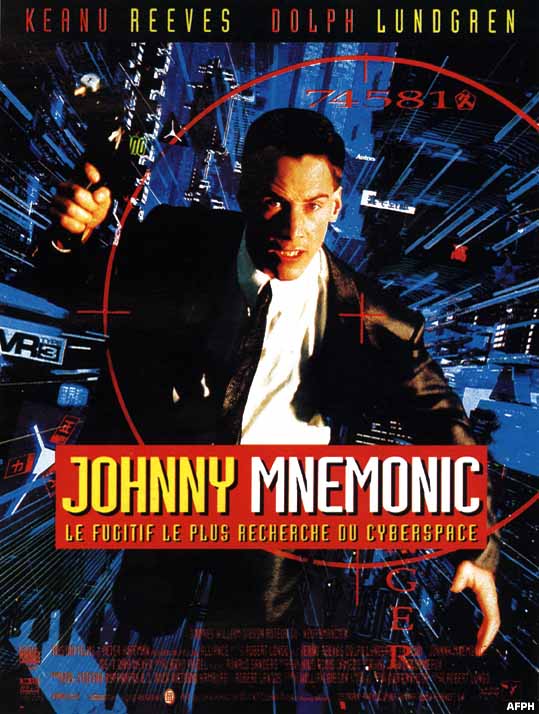 Though it was widely considered one of the worst adaptations in science fiction history, Johnny Mnemonic was nevertheless a faithful representation of William Gibson’s original work (also a Canadian). Set in the “Sprawl” of the 21st century, the story is about a mnemonic courier who uses wetwire implants (i.e. cybernetic brain implants) to carry information around illegally. This is apparently a common practice in the world of the future, where corporate control is absolute and the most precious commodity is information.
Enter into this Johnny (Reaves), a courier who is given a job to carry a package that is twice the size of his capacity. He takes it, knowing the risk it will pose to his brain, because he’s looking for that final payoff which will allow him to have his implants removed and his memory restored. This is something all mnemonic carriers must go through, which is the sacrifice of their own memories in order to make room for all the pirated data they carry.
Quickly, Johnny realizes the package he contains is incredibly valuable, as Yakuza close in and murder his contacts. His own boss betrays him as well, forcing him to turn to a freelance ninja named “Sally Shears” (aka. Molly Millions) for help. Like him, she has enhancements which are beginning to mess with her body, and she recommends they get help from her friend Spider. As a doctor, he is used to dealing with nervous system illnesses, particularly NAS (nervous attenuation syndrome).
When they arrive, Johnny is informed that he is the one who hired him, and that the information he carries comes directly from the pharmaceutical giant Pharma-Kom’s labs. It is nothing less than the cure of NAS, and the company will kill to make sure it doesn’t get it out, seeing as how they make billions off of treatment and will lose out if it is cured. The race is then on for Johnny to download the cure onto the open Net, and with the help of a group of counter-culture fighters named Lo-Tek, they manage to do just that.
Though the movie was generally panned by critics and did quite poorly at the box office, it remains a cult classic to many because of its gritty, cyberpunk feel and faithful adaptation of Gibson’s characteristic themes. It also boasted an all-star cast, which included Keannu Reaves (Canuck!), Dolph Lundgren, Takeshi Kitano, Henry Rollins, Ice-T, Dina Meyer, and Udo Kier. On top of that, it also made use of pioneering special effects to give visual representation to Gibson’s concept of “cyberspace”, the movie also contained all the elements he so loves to include in his stories. Freelancers, Yakuza, mega-corporations, mercenaries, cybernetic enhancements, dirty environments, urban sprawl, hackers and techy geeks. This movie had all that, and is required viewing for fans of Neuromancer and Gibson’s Sprawl Trilogy.
Screamers (1995):
 Here’s a cult classic I keep coming back to of late! Based on Philip K. Dick’s “Second Variety”, Screamers is another adaptation of classic sci-fi which was filmed, directed and financed here in the Great White North. And I mean that literally since most of the filming took place in a quarry in Quebec during the dead of winter. And though the story was updated for the post-Cold War world, set on a distant planet and being a war between corporate interests and quasi-national forces, the basic elements remained much the same.
Taking place in 2078 on a planet known as Sirius 6b, the story revolves around an ongoing war between two factions who are fighting for control of the planet. On the one side is the NEB (New Economic Bloc), a super-corporate entity that controls mining in outer space. On the other is the Alliance, a resistance formed out of the former miners and scientists from the colony.
After the NEB bombarded the planet with nukes, turning it into a radioactive wasteland that is perennially experiencing nuclear winter, the Alliance resorted to creating devices known as the “Autonomous Mobile Sword”, a race of self-replicating machines built by a self-sustaining underground factory. These weapons, which tunnel underground and use high-pitched sonic blasts to paralyze opponents, carry the nickname of “Screamers”.
The story opens when a NEB representative comes to the Alliance bunker offering a ceasefire. After investigating the situation, the Alliance commander JOe Hendricksson (played by Peter Weller, aka. Robocop) realizes that the war still rages back home and no one cares what happens to them anymore. He decides to take the NEB up on their offer to end the fight on Sirius 6b, but during his trip to the NEB bunker, learns that new breeds of Screamers are out there. After meeting with Jessica (Jennifer Rubin), the NEB mercenary commander, they attempt to investigate the Screamer factory and learn that there are in fact four varieties now, each of which is becoming more human!
They make it back to the Alliance bunker, only to see that it too has been overrun. In the end, only Hendrickson and Jessica survive and begin making their way to the emergency escape shuttle hidden in the nearby mountains. Once there, Hendrickson learns that Jessica herself is a Screamer when an identical model of her appears and attacks them. Apparently, she is the fifth variety and the most advanced model to date, one that bleed, cry, imitate human emotions, and even have sex. Jessica sacrifices herself to protect him, and Hendrickson learns that her mission was to find the escape shuttle and go back to Earth where they could be sterilizing it of all life as well.
This was in keeping with the Screamer new mandate which was to destroy all human life, not just their enemies. However, that ended when Jessica became over-sympathetic to Hendrickson and broke with her original programming, thus demonstrating the most human characteristic of all, that of empathy. Hendrickson then takes the shuttle himself and leaves the planet, bound for Earth, and safe in the knowledge that the Screamers will never get off Sirius 6b.
Thought it differed in many ways from the original PKD short story, the thematic nature of the movie was accurate. You have the idea of the Screamers, the automonous, self-replicating and intelligent machines that are left to their own devices and end up turning on their own masters. You have the concept of runaway technology erasing the line between what is real and fake. Thought it ended on a happy note, unlike “Second Variety” where a machine made it off planet, the movie still managed to deliver on its message. And it was pretty damn scary too boot!
Cube (1997):
 Here is another cult-classic that practically created its own sub-genre in science fiction film making. Directed by Vincenzo Natali and produced by the Canadian Film Centre as its first First Feature Project, Cube became an instant hit due to its paranoid, Kafkaesque feel and psychological thriller tone. Set inside a giant (you guessed it) Cube, made up of countless adjoining rooms that are numbered and contain different booby traps, the story revolves around a series of strangers who wake up inside and must find their way out.
What is immediately apparent to all the characters in the story is that they all possess different abilities and share the same story. Each and every one of them was carrying on with their daily lives, only to wake up and find themselves inside a cube-shaped room. None of them know each other or can remember how they got here, but once they found each other, they agree to work together and find the way out.
Amongst the captives is Quentin (Maurice Dean Wint), a charismatic police officer who takes command, Leaven (Nicole deBoer) a young mathematics student, Holloway (Nicky Guadagni), a doctor and conspiracy theorist, and Worth (David Hewlett), a pessimistic man who refuses to talk about himself. Quentin believes they all have a role to play, Holloway believes they are part of a government experiment, Leaven develops a theory that the room’s numbered in prime are the safe ones, and Rennes follows but seems skeptical of their chances.
As they continue, they find that Quentin’s theory about the prime numbered-rooms is flawed. Tensions also begin to rise within the group because of Holloway’s paranoia, Quentin’s controlling behavior, and Worth’s reticence. The group then experiences a bit of a breakdown, during which time Worth finally reveals that he was one of the architects who helped design the Cube. He never knew what it was for or who even commissioned it, the specs merely passed his desk and he added his own insight. He believes that essentially, the Cube created itself, the result of human stupidity and complacency.
However, Leaven concludes from Worth’s description that the numbers might actually be Cartesian coordinates, and the group begins working its way to one of the outer edges. They also come across a mentally challenged boy named Kazan, who Quentin wants to leave behind by Leaven insists they bring. But in time, their efforts prove futile when another feature of the Cube is revealed, the fact that it periodically shifts its rooms around. Another breakdowns occurs as Quentin becomes paranoid and shows his dark side. After a confrontation with Holloway, he lets her fall to her death, thinking she was out to get him.
The group begins to truly fall apart as Quentin’s true nature is revealed. It seems he is a violent man with a penchant for young girls, the reason why his wife left him with their kids. He begins to run the group through bullying and fear. But a ray of hope emerges when Leaven concludes that the numbers are not primes or coordinates by powers of prime numbers. She cannot calculate them, but the mentally challenged boy Kazan – an apparent autistic savant – can. They continue on their way and Worth incapacitates Quentin, who has now gone completely insane.
Eventually, they find their way to the outer edge and prepare to leave, but Worth wonders if it’s worth it considering that there is nothing out there but “boundless human stupidity”. They are about to step out when Quentin sets upon them. Leaven jumps in to help, and the three are pulled back in as the room’s once again shift. Kazan is left alone to walk out into the light of day, free of the Cube.
Where to begin? This story was a masterful piece of psychological thriller and paranoid fantasy! The fact that we never truly learn who built the Cube, what purpose the “test” really served, and the possibility that complacency and ineptitude is what built it not only makes for a mysterious story, but a big, fat existential allegory! For in the end, are we not all prisoners within a giant maze we can’t discern, who’s maker is unknown and who’s purpose in indistinct? Calling to mind Kafka, Sartre and the “Allegory of the Cave” – a la Socrates – these movie was not only a nail-biting thriller but a fittingly dark philosophical commentary.
Last Night (1998):
 Filmed and set in Toronto by writer/actor/director Don McKellar, this apocalyptic sci-fi film tells the story of the last night on Earth, and shows various people choose to spend it. Though the date is not specified, and no explanation is given as to what calamity will be bringing the world to an end, it is made abundantly clear that it will be coming at the stroke of midnight, leaving everyone in the story only a few hours with which to live life to the fullest.
Naturally, the streets are filled with people who have decided to riot, loot and generally wreak havoc. But the main focus of the story is on the lives of various intersecting characters who have chosen to use their time more constructively. One is Patrick (played by McKellar himself), who lost his wife not long ago and is spending the time saying goodbye to family and friends, but who seems to want to spend the last of it alone.
His best friend Craig (Callum Keith Rennie) chooses to spend it in a non-stop sexual marathon as he attempts to fulfill every possible erotic desire he has, not to mention those of his partners. This includes having sex with his former French teacher, a black woman, a virgin, and just about any other scenario he can think of. When Patrick comes to say good-bye, he clumsily tries to encourage him to have sex with him as well. Patrick awkwardly declines, but Craig manages to get a sustained kiss out of him before he goes.
Meanwhile, Sandra (Sandra Oh), who has become stranded in the streets, meets up with Patrick and they get to talking. After realizing their time is short and they have only each other to spend their last hour with, they begin talking and sharing. Many times over, she insists that Patrick open up, saying “make me love you”. They agree to a suicide pact on the roof, listening to “Guantanamera” and drinking wine. In the end, they cannot shoot each other and end their time on the Earth with a heartfelt kiss.
The movie became an instant hit because of its personal nature and the realistic way in which it depicted the end of the world. By not specifying how the world was ending, McKellar kept the focus on the people themselves and how they chose to confront death, bringing out the very best and worst in themselves. While some chose to lose all control and commit murder, others chose to spend it with loves ones, or took a chance on forming new bonds with total strangers.
This last performance, between Sandra Oh and McKellar himself, was the most touching part of the film. We have two people who would never have known each other, both of whom experienced personal tragedy, and who came to experience one brief, shining moment of love – the most life affirming thing of all – before all life ended forever. So sad, yet so poignant. There wasn’t a dry eye in the house!
eXistenZ (1999):
 From the same mind that brought you Scanners (David Cronenberg) comes this twisted psychological thriller about reality and the way technology affects our perception of the world around us. Featuring an all star cast that included Jude Law, Jennifer Jason Leigh, Sarah Polley, Don McKellar and Willem Dafoe, this movie received multiple awards and was well received by critics, though its box office gross was overshadowed somewhat by the release of the Matrix that same year.
Set in the not too distant future where organic game consoles known as “game pods” are all the rage, the story revolves around two game companies – Antenna Research and Cortical Systematics – who are competing to create the best in bioware. At the same time, a group of “realists” – people who are opposed to the technology because it “deforms reality” – are engaged in a guerrilla-style fight with both companies.
Enter into this Allegra Geller (Jennifer Jason Leigh), the greatest game designer in the world who works for Antenna and is testing her latest virtual reality game, eXistenZ. During a seminar, she is shot in the shoulder by a realist using an “organic gun” – a device which can pass through security checkpoints – and the console appears to be damaged. As a result, she must plug in and test it with a trusted person and asks Pikul (Jude Law), the security guard to join her.
As they enter the game, reality becomes increasingly distorted as the two undergo behaviors which seem odd to them but are “consistent with their characters.” At the same time, they are stalked by characters that appear to be Realist fighters who are trying to sabotage them. Geller eventually realizes that they have been double-crossed by the people who installed Pikul’s bioport, the interface which is inserted into a gamer’s lower back, in order to infect and destroy her game. On top of that, Cortical Systems personnel are also inside, looking to copy the game for their own purposes. Pikul then reveals that he is in fact a Realist agent who was sent to kill her. She answers by saying she knew for some time and detonating his bioport.
However, in a finay twist, the two then appear on a stage with the other main players from the game and realize they were all part of a virtual reality game called “tranCendenZ”. This game was being played by the cast, mirroring the first scene, but with electronic devices rather than game pods. The real game designer, Nourish (played by McKellar), feels uneasy because the game started with the assassination of a game designer and had an overall anti-game theme that he suspects originated from the thoughts of one of the testers.
Pikul and Allegra approach him and ask him if he should pay for his “crimes” of deforming reality. As Merle (Sarah Polley), Nourish’s assistant, calls for security, Pikul and Allegra grab hidden pistols and shoot Nourish and Merle to death. As with the other game, the other players appear more frozen than shocked, suggesting that they are still inside. Pikul and Allegra point their guns at another player, who is at first dismayed, but then asks if they are still in the game. Pikul and Allegra don’t know, and the last scene ends with the fear written on their faces.
Much like the Matrix and Inception, this movie was characterized by it’s mind-bending sequences and unpredictable twists, showing how one’s perception of reality can be distorted thanks to the effects of mind-bending technology. But whereas other films chose to delve into the relative aspects of it all or sought to make an existential point about mind control, Cronenberg’s aim was clearly in showing the dangers of such reality-based technologies by equating them with drugs. All throughout the film, the psychoactive nature of the game is played up, showing how the ability to distort reality and tamper with one’s own psyche can be an addictive form of entertainment. The dangers in this are obvious of course, in that one’s ability to tell reality from fantasy will be worn down, leading to potentially fatal consequences.
* * *
Well, that’s movies covered! It will take a few more days to cover the rest, respectively television and literature. These are even more fertile ground than films, so expect some detailed and lengthy posts. I will try to be brief as possible, but this is a tribute to my country of origin so don’t expect any topical treatments. No, sir! In the meantime, Happy Canada Day to all Canucks at home and abroad. Hope you are with the one’s you love and are having a good time. And to you Canada, happy 145th birthday! Cheers!
 Stories by Williams