Welcome to volume 7. Nuff chit chat, let’s get started!
The Blackbird: Starting this list off right is the stealth ship from the updated Galactica universe. Christened the Laura, in honor of President Roslyn, this ship was the brainchild of engineer Galen Tyrol and his deck hands, who decided to build a new fighter from scratch to make up for their losses. Build for speed and skinned with carbon fiber instead of the usual metal, this ship proved to be invisible to both Colonial and Cylon tracking equipment, hence its designation as a stealth ship.
On her maiden voyage, Starbuck flew the Blackbird on an illegal reconnaissance mission to take pictures of the Cylon Resurrection ship that had been pursuing Galactica. The operation was a complete success, with Admiral Cain – the Pegasus’ CO – going as far to say that: “she flew right up their tailpipe and they didn’t even notice”.
As a result of the technical data obtained from this mission, a joint attack was planned between the Galactica and Pegasus to take the RS down. The Blackbird would go on to play a crucial role in this attack, using its stealth abilities to fly within a few meters of the RS and take out its FTL drive with a well-placed missile. Unfortunately, the Blackbird would suffer a fatal collision after performing this duty, and Captain Lee Adama, its pilot for the op, was almost killed.
Corellian Corvette: Another mainstay of both the Rebel and Imperial fleets, this ship made its debut in the opening scene from Star Wars: A New Hope and has been with the franchise ever since. Otherwise known as a “Blockade Runner”, the CR90 corvette embodies the spirit of Corellian ship designs, boasting speed and versatility over size and raw firepower.
Because of its adaptability, another Corellian trademark, the CR90 could serve in a variety of roles. These ran the gambit from such mundane duties as freight hauling, to more dangerous assignments like raids and providing fighter escort. In some cases, they could even take on such high-profile missions as diplomatic envoys, carrying public officials to and from their assignments.
Because of these qualities, the CR90 had a long history of service in the Galaxy, serving in the navies of the Old Republic, the Galactic Empire, the Rebel Alliance, and the New Republic. Even after it was phased out of service, it remained a favorite among smugglers, pirates and smaller navies for some time.
Harbor Ship of Bentus: Here is another feature from the Homeworld universe, the Harbor Ship of the alien race known as the Bentusi. Known for their focus on trade and supplying less advanced races with “short-jump” technology (i.e. FTL), the Bentusi soon found themselves caught in the middle of a series of interstellar conflicts between worlds.
As a result, the Harbor Ship was created, a mothership for the Bentusi fleet that was capable of housing, repairing and deploying smaller vessels. Thought not armed in any official capacity, it is the bulwark of the Bentusi armada and can be found wherever large-scale fleet deployments take place.
From what I can tell, this design was inspired by what historians believe the harbor of Carthage looked like. Much like the Harbor Ship, it was based on a sort of teardrop design, with a long entrance passage giving way to a sort of rotunda. This design, in addition to being aesthetically pleasing, also makes a lot of practical sense, ensuring that multiple ships are able to be serviced in a 360 degree arc rather than a series of enclosed bays.
Ixian No-Ship: Another Dune entry which I failed to acknowledge in previous posts, can you believe it? Well, mistake remedied as of now, here is the No-Ship! Named for the fact that it is capable of shielding itself from prescient vision and other forms of detection, including sight. This all makes the No-Ship the ultimate in stealth technology, and led to its wide adoption by all factions in the Dune universe.
Based on the same technology which powered the No-Chamber, a device which the Ixians used to shield their inventions from Leto II’s prescience, No-Ships would become the mainstay of all fleets after his death. In addition to their stealthy characterisitics, they would also boast another invention that was proposed during the time of Leto II, the Ixian navigation machine. This device, which was capable of limited prescience, was able to guide these ships through foldspace without the need of a Guild navigator.
Much like Guild Heighliners, No-Ships appear to have massive capacities. In Heretics of Dune, the No-Ship which Miles Teg steals from the Honored Matres on Gammu apparently had a Great Hold which measured one kilometer in length. This hold was later used to transport an adult sandworms and several tons of its native sand off of Rakis before the HM’s destroyed it. In Chapterhouse and subsequent books, No-Ships served as the mainstay of the Bene Gesserit fleet as well as with all other factions.
The Pegasus: Battlestar Galactica gave so many cool ship designs that its hard for me to know where to look next. But today, I thought I’d go for the obvious and cover the ultra-modern and behemoth-sized Pegasus, the other Battlestar to survive the destruction of the Twelve Colonies. As with the original, the Pegasus makes an appearance in the re-imagined series. And like everything else, its appearance received an update, as did the tone and nature of its crew.
Although networked like all other modern Colonial ships, the Pegasus survived the assault through sheer luck, having taken its systems down for a diagnostic before the first wave came. Since that time, it’s CO, Admiral Cain, had been fighting a guerrilla style war with the Cylons, attacking their holdings and raiding small convoys in order to keep them off balance.
A mercury-class battlestar, the Pegasus was far more advanced and boasted significantly greater firepower than the Galactica. In addition to its 30 defensive turrets, four heavy cannons, multiple missile launchers and compliment of nukes, its massive bays also hold 10 squadrons of Vipers, as well as dozens of Raptors and support craft. It also carries a series of Viper VII production facilities, meaning that it is capable of replenishing its losses.
With all of these attributes, the arrival of the Pegasus was a great boost to the Colonial fleet, adding a great deal of firepower, manufacturing and many of the latest ships to their arsenal. Nicknamed “The Beast”, the destruction of this ship over New Caprica was considered an immeasurable loss, though its sacrifice was hardly in vain.
Primus-class Battlecruiser: Here we have another installment from the B5 universe, from the Centauri Republic to be specific. Known as the Primus-class Battlecruiser, this baby is renowned for packing firepower and artistic design into one package.
Discernible from its manta ray-like configuration, the Primus remains the mainstay of the Centauri navy even after two centuries of service. Although lightly armored, the ship boasts an impressive array of ion guns, a hyperspace drive, and artificial gravity for its crew.
Making its first appearance in season two of the show (“And Now For a Word”) when televised a standoff occurred outside the station between the Centauri and the Narn. In that battle, the cruiser in question was destroyed, but managed to inflict enough damage that the G’Quon class cruiser also blew up while attempting to make a jump. This demonstrated that the Primus, though an older design, was still capable of standing toe-to-toe with its Narn equivalent.
This encounter was followed up during the season two finale (“The Fall of Night”), when another such cruiser threatened the station when it was discovered that Sheridan was harboring a Narn heavy cruiser. This cruiser managed to inflict serious damage on the station before a squad of Starfuries and the station’s own defenses managed to destroy it.
Primus class cruisers would go on to make several appearances in the course of the show, serving throughout the Narn-Centauri war and even making an appearance during Sheridan’s war to liberate Earth. During the Alliance-Centauri war, these cruisers appeared to have been relegated to defensive duty, leaving offensive operations to the newer and lighter Vorchan-class cruisers.
USS Reliant: Thank you to Victor for suggesting this one. I was wondering if I should go back to the original Star Trek for ideas, and this was just the push I needed to include some. And given that this ship made its appearance in Wrath of Khan, arguably the best of the bunch, I figured it would be the perfect candidate.
A Miranda-class starship, the Reliant possessed capabilities comparable to that of the USS Enterprise. She is best known for being the ship that was charged with investigating planets for the Genesis Project and then being commandeered by Khan Noonien Singh, a warlord from Earth’s Eugenics Wars who had been marooned on the planet for many years.
After commandeering the ship with his people, Khan used the Reliant to seize Genesis and attack the USS Enterprise. During their initial encounter, Khan was able to use surprise to disable and inflict considerable damage. He was only defeated when Spock, using the ship’s prefix code, was able to bring the Reliant’s shields down long enough for the Enterprise to strike back and take out its weapons and warp drive.
During their second confrontation, Kirk was able to lure Khan into the nearby Nebula where neither ship had the tactical advantage. There, the Enterprise was able to outmaneuver the Reliant and crippled her with a series of torpedoes and well placed phaser shots. Rather than face capture, Khan chose to initiate the Genesis’ self destruct sequence and nearly destroyed both ships in the process. The Enterprise narrowly escaped, thanks to Spock’s decision to sacrifice himself to bring the warp engines back on line.
Viscount-class Star Defender: Last on the list is an entry which I’m personally impressed with. Known as a Star Defender, this class of Mon Calamari heavy cruiser comes from the Star Wars universe, and reminds us that not only the Empire was capable of creating some badass ships!
Commissioned during the time of the New Republic at the behest of Admiral Ackbar, the Star Defender was the Alliance’s answer to the Super Star Destroyer and other classes of Imperial terror weapons. Measuring 17 km in length and boasting over 5000 weapons turrets, this ship was more than a match for the Executor, Eclipse and any other vessel of similar size.
Like all Mon Calamari cruisers, this ship was studded with hangars and launch bays and could carry fourteen fighter squadrons, dozens of troops transports and any number of shuttles and support craft. It can also house over 12,000 troops and carries a standard crew of about 70,000. Though production of these vessels stalled due to the diminishing threat posed by the Empire after the Battle of Endor, the Thrawn crisis and the threat posed by the resurrected Emperor and his Eclipse dreadnoughts provided the final push.
Several versions of the Viscount class were commissioned for service over the years, including the Mon Remonda, pictured below.
Okay, that’s seven down. Do I really need to do an eighth? Ha! Just kidding, of course I do. Perhaps I’ll end this series at ten, or maybe it will become one of those things that slows down but never really goes away. As long as people keep suggesting things and I keep having ideas of my own, there’s no real end in sight! See ya next time 😀
Back again! More ships, more designs, more franchises too. Like I said last time, there’s just no limit when you get right down to it. And in the course of doing my homework on cool sci-fi concepts, I’ve found that there are hundreds of franchises out there that I’ve never even heard of before. Of those I have heard of, I always seem to miss a few obvious candidates. That’s the beauty of ongoing segments though. Here are the latest, with some suggestions thrown in too 😉
Colonial Raptor: Another late entry from the Battlestar Galactica universe, the updated version. Designed for reconnaissance, transport, atmospheric and space flight, and capable of making short range FTL jumps, the Raptor is the workhorse of the Colonial fleet and one of its most versatile vessels. Ordinarily, the Raptor is operated by a crew of two, one pilot and one Electronic Countermeasures Officer. Given it’s size and shape, it cannot launch from a launch tube and must take off and land from a Battlestar’s forward launch bay.
Having served with the Colonial fleet for over 40 years, making its debut in the first Cylon War, the versatility and reliability of this craft have prevented it from being phased out by newer generations of Colonial ships. During the second Cylon War, Raptors were used regularly in order to dust off survivors from Caprica and other colonies. Relying on a fly-by-wire system, rather than the new defense network systems, it also proved invulnerable to the virus the Cylon’s used to cripple the fleet.
Cygnus: Now here’s one that people probably won’t remember. In fact, I didn’t recall it either until I did some reading and realized I had seen the movie which featured it – The Black Hole – as a child and quite enjoyed it. Though a little Buck Rogers-y by modern standards, the concept and the movie and this ship still stand the test of time.
Released in 1979 by Walt Disney Pictures, The Black Hole was one of many movies that sought to take advantage of the sci-fi craze that Star Wars had unleashed. The plot centers on a derelict ship, known as the Cygnus, which is run by an android crew and a brilliant (albeit mad) scientist named Doctor Hans Reinhardt.
In addition to looking pretty cool, with its glowing transparent sections and old-school design, the Cygnus is apparently able to withstand the gravitational pull of black hole due to its ability to generate its own gravity well. In addition, its commander, Dr. Reinhardt, theorized that he would be able to fly it through a black hole and see once and for all what lay on the other side… It didn’t take, but still a cool idea!
Guild Heighliner:
Artist’s concept for a Guild Heighliner
Here’s one I couldn’t believe I had forgotten. In fact, I will accept any and all chastisements for my failure to include Dune craft in this series thus far. This can include physical beatings, just stay away from the nads… not quite done with those yet!
Anyhoo, when it comes to Dune ships, the Heighliner definitely takes the cake! Massive as all hell, this ship was the backbone of all commerce, diplomacy, travel and tourism in the Dune universe. Like all shipping, it was the exclusive property of the Spacing Guild and subject to their many controls, laws and whims.
Boasting Holtzman engines – a FTL drive system that was capable of “folding space” – the ship still required the services of a Guild Navigator. This person, a semi-prescient mutant due to years of living in a spice tank, would see a path through time and space and thus navigate the ship safely to its destination.
According to the original Dune, a single Heighliner was capable of lifting an entire planet’s worth of personnel, goods and supplies from one point in space to the next. As Duke Leto tells Paul in Part I of the story: “A Heighliner is truly big. Its hold will tuck all our frigates and transports into a little corner — we’ll be just a small part of the ship’s manifest.” Later in that same installment, House Harkonnen used a single Heighliner in order to lift an entire army to Arrakis for a surprise assault on the Atreides, and the cost was nothing short of punitive!
Given that the Heighliners are the sole means of commerce in a Empire as massive as that of the Dune universe, its little wonder why Heighliners are so freakishly big. Chartering one aint cheap, and if you do stowe aboard, you are expected to mind your business and wait until you arrive at your destination. Due to their high level of secrecy and sensitivity, no one is even allowed to venture beyond their own boarding craft when on a Heighlinger, and virtually no one outside of the Guild has ever seen a Guild navigator. Considered to be neutral territory by Imperial law, any and all acts of violence aboard Guild Heighliners carry stiff penalties.
Gunstar: Ah, another childhood classic! Taken from the film The Last Starfighter, the Gunstar was the first line of defense of the Star League against the evil Xur and the Ko-Dan Armada. Sounds pretty cheesy, huh? Well, it was the eighties! And this was yet another Disney franchise that seemed to be riding in the Star Wars wake. Still, this movie was one the first to make extensive use of CGI (Tron being the only other) and had a none-too-bad storyline too boot!
Boasting multiple guns, missiles and a “Death Blossom” trick that is nothing short of devastating, the gun star is a rather unique and innovative design. Apparently, it was meant to be a class of ship that would never go out of style, merging functionality with lethality and being able to take on any class of enemy ship.
Every Gunstar is a two seater, with the starfighter (gunner) in front, and the navigator in the rear. While the navigator flies the ship, the gunner directs fire from a swivel chair, which gives them control over the ships moveable weapons batteries. Although it has no shielding to speak of, the hull is protected by armor plating which can withstand multiple direct hits. When cornered, it is also capable of unleashing the “Death Blossom” where it will begin to rotate at a furious speed and unleash gun and missile fire in all directions. This however, is considered a weapon of last resort, since it will drain the ship’s power supply completely.
Heart of Gold: Now here’s an interesting, and highly improbably, entry! Coming to us straight out of The Hitchhikers Guide To The Galaxy, the SS Heart of Gold is rather unique in that it merged scientific theory with Douglas Adam’s notoriously quirky sense of humor.
Being a prototype vessel, it was the first ship ever in the universe to boast the “Infinite Probability Drive”. This drive system is essentially a Faster-Than-Light engine which is actually based in quantum theory. Essentially, the theory states that a subatomic particle is most likely to be in a particular place at a particular time, but that there is also a small probability of it being found very far from its point of origin. Thus, a body could travel from place to place without passing through the intervening space as long as it had sufficient control of probability.
Pretty cool huh? In the original radio series, the shape of the vessel was not specified. In the novelization of the series, it was described as a “sleek white running shoe”. For the sake of the movie, artists went with a tea-cup design, and added some brake lights for good measure. Originally built as part of a secret government project on the planet of Damogran, the ship was stolen by President Zaphod Beeblebrox during its launching ceremony and became the means through which the main characters began exploring the universe.
Minbari Cruiser: Back once more to the B5 universe for another fine example of kick-ass shippery! Known officially as the Sharlin-class Warcruiser, this Minbari vessel is the mainstay of the Minbari fleet in the original series. Big, bold, stealthy, and packing a sh*tload of firepower, this vessel is veritable nightmare for all but the most powerful of races. Even Shadow vessels mind their business when some of these are in the field.
Making its appearance in season one of the show (episode 17: “Legacies”) and went on to become a regular feature. When Sheridan assumed command of the station in season two, the renegade cruiser Trigati was destroyed in the course of a standoff. After B5 broke away from Earth in season 3, a force of Sharlin cruisers arrived just in time to prevent the station from being captured by forces loyal to Clarke. Many went on to serve alongside Sherian and Delenn in the Shadow War and even went on to help liberate Earth from Clarke’s forces.
According to Delenn, Minbari ships do not rely on conventional engines like other ships. Instead, a system of gravitational and electromagnetic fields for propulsion, which have the added benefit of supplying artificial gravity. This frees up their ships from the needs of rotating sections and makes for a more effective combat platform. Sharlin cruisers also boast a significant amount of weaponry, which consists mainly of heavy beam cannons, but also includes missile launchers, neutron guns, and electro-pulse cannons.
During the Earth-Mimbari War, Earth Forces were completely outmatched by this class of Cruiser. In addition to being highly resistant to Earth force weapons, the Sharlin cruiser also boasted a stealth field which prevented Earth ships from being able to lock onto it. In the course of the war, only one human Captain ever survived combat with one, Captain John Sheridan. Relying on a phony distress signal and several well placed tactical nukes, Sheridan was able to lure the Black Star, the Minbari flagship, into a trap and destroy it. Though the Minbari considered it a cheap victory, Sheridan’s fame and renown quickly spread throughout the fleet.
During the battle of Sector 83, the Sharlin-class Cruiser proved an effective weapon against the Shadows. Although somewhat slow and providing a large target for Shadows, their powerful beam weapons were capable of destroying a Shadow ship unassisted. When protected by smaller, faster craft like the White Star, it proves to be a very effective combat platform.
Nebula-B Escort Frigate: More Star Wars! God, I think I’m OD’ing on this franchise. But the sign says “Cool Ships” and this one is no exception. Known as the Nebula-class frigate, this ship is probably best remembered as the “Medical Frigate” which appeared in Empire and Jedi.
Measuring some 300 meters long and designed to defend Imperial convoys from Rebel attacks, this ship was more famously used by the Rebellion as a hospital ship. During heavy fighting, Nebula-B’s would be on hand to pick up pilots that had ejected and provide them with life-saving assistance, ensuring that Rebel pilots could live to fight another day.
The most famous appearance of a Medical Frigate was during the Battle of Endor, when several medical frigates were on hand to service Rebel pilots who had been shot down by superior Imperial forces. It was also on board the Medical Frigate Redemption that Luke Skywalker received his prosthetic hand after losing it in a lightsaber duel to Vader.
In addition to providing escort and as a hospital ship, the Nebula-B was proved useful as a deep space scout and reconnaissance ship, due to its sophisticated sensors. During raiding missions or less intense combat operations, many also served as command ships given their speed and defensive capabilities. One weakness of the Nebula-B however was its thin fusilage. Though this made the ship an inexpensive vessel by most standards, it also made it a poor choice for heavy combat. Hence why it was relegated to support, scouting and medical roles.
The Nostromo: You know, I really thought I covered this one already. I already mentioned how the Alliance Cruisers from Firefly appeared to be inspired by this baby. And it just makes sense that if you’re going to cover ships from the sequel, (the USS Sulaco and the Cheyenne Dropship) that you cover the original first. But alas, the Nostromo was somehow passed over by me, another act of wanton insensitivity! Beating shall continue until my attitude improves!
Okay, now that we got my punishment out of the way, allow me to pay this ship it’s due homage. The main set for the movie Alien, the USCSS Nostromo was a deep space commercial vessel which belonged to the Weyland-Yutani corp (much like everything else in this universe!).
Overall, the Nostromo was a curious design which made perfect sense from a space-faring point of view. Doing away with such things as streamlining and aerodynamic sleekness, the ship was well suited to deep-space travel and hailing. In addition, it was also taller than it was long, another common aspect to spaceships which are confined to the whole sea ship/airplane paradigm.
It’s massive refinery, which it towed behind, would process its manifest of mined ore while it made its way back to Earth from wherever it had been deployed. Thus, in addition to providing transport and amenities for a crew of miners and spacers, it was also a mobile refining platform that could deliver processed materials to factories rather than just unrefined ore.
While on return from the distant planet of Thedus, the Nostromo was rerouted to LV-426 where it picked up the alien organism known as a xenomorph. After all but one of the crew were killed the by creature, Ellen Ripley, the ship’s Warrant Officer, set the ship’s to self-destruct and escaped aboard the ship’s life craft with the crew cat, Jones. According to Weyland-Yutani execs, who were some pissed when she returned without her ship, the destruction of this vessel cost them 24 million in adjusted dollars. Damn penny-pinchers!
The Sathanas: What do you call the most fearsome, intimidating and powerful ship in the universe, without being too obvious, that is? The Sathanas, that’s what! Being the Latin name for Satan, this title is very apt when applied to a massive juggernaut built by a race known as the the Shivans (i.e. Shiva, Hindu god of destruction).
This last entry, much like The Colossus and Deimos from my last list, comes to us from the game Freespace 2. Making its appearance midway through the game, this terrifying vessel was the most powerful space-faring ship ever encountered by the human race or its allies.
Boasting four massive beam cannons which are situated at the end of its claw like appendages, this ship best exemplifies the offensive fighting spirit. Jumping into a field of battle, it is capable of dealing devastating blows on a target head on, keeping its flanks and rear hidden from the enemy.
Above all, it is clear that the Shivan built the Sathanas to act as a terror weapon in addition to a capital ship. One look at its design confirms this, given its clawing appendages and thorny skin. Defeating this ship outright is quite difficult given its reinforced plating and terrible array of weapons. Disabling this ship, through EMP missiles and guns, is not much easier given the incredibly density of its hull and many redundant systems. In the end, the only way to beat it seems to be for lighter craft to take out its “claws” while heavier vessels strike at it from a distance. However, this still proves to be a suicidal mission given the Sathanas’ many missile and defensive batteries.
Ultimately, taking down this ship in the game is much like the real-life campaign to sink the Bismark. This dreadnought, which was the pride and joy of the German navy in WWII, also boasted massive weapons, a heavily armored hull and superior systems. In the end, the Royal Navy brought it down through a combination of luck, persistence, and careful engagements, taking their time to disable it and then closing in to pound it relentlessly! Hmmm. I guess good history makes for good gaming 🙂
Final Thoughts:/strong>
The suggestion box, as always, is still open. Thanks to Goran Zidar for suggesting the Gunstar, I knew I’d have to include it sooner or later and I’m glad someone asked. Anything else? I got another installment on the way, and probably a few more after that. No? Sigh, alright, bring on the beatings! No nads!
Hello all and welcome back. Starting today, I thought I’d get into a cheerier aspect of science fiction. Not that I don’t looooove dystopian stuff, but after days and days of romping through endless examples of totalitarian, cyberpunk and just generally dark futures, I thought it might be time for a break. And it just so happened that I had an idea the other day which seemed like the perfect diversion. For those who read my site regularly, you might have noticed I did a long list of conceptual sci-fi posts. Well, today I thought I’d get back into that some.
To break it down, I wanted to do a piece that was dedicated entirely to “Cool Worlds”, an exploration of the various planets, cultures and civilizations science fiction has given us over the years. However, after coming up with just a few candidates, I quickly realized my mistake. There was no way I could possibly list all the best examples in just one post. And if I settled on just a few, then people might start writing in and saying “what about this one? what about that one?”
So rather than do all that, I decided instead to tackle specific franchises, particularly ones that made it into my Galactic Empires post, and address some of the cool worlds that existed within.And what better place to start than with my favorite galactic franchise, one of the most detailed franchises ever to be dreamed up: the venerable Dune!
Anyone who is familiar with Frank Herbert’s six volume series knows that he was pretty damn good at weaving an intricate and finely layered tale. One aspect where this was particularly evident was in his descriptions of the Imperium’s planets. Not only would Frank dedicate a great deal of time and effort to describing what a place was and what significance it held, he would also get into the lesser explored areas of ecology and what impact that had on a planet’s culture. Here are some of the best examples that I could think of, all from his original books:
Arrakis: The focal point of the Dune universe, and the most important planet in the entire franchise. It was here that the spice was manufactured, where Paul Mua’dib came face to face with his destiny, and “The Tyrant” Leto II was born and ruled for three and a half millenia. It was also eradicated when the Honored Matres attacked the Old Imperium, triggering a full-scale war which would lead humanity along the final steps of the “Golden Path”. In short, it was the backdrop for most of the story, and from a storytelling point of view, a very richly detailed place!
Much of what is known about Arrakis’ culture and ecology comes from the appendixes of the first novel where Herbert wrote about the fictitious exploits of Dr. Pardot Kynes, planetary ecologist to the Imperium. However, a great deal more came through in the course of the story once Paul and Jessica find refuge amongst the Fremen and had to learn their ways and secrets in order to survive. Much of this has to do with the spice, the Sandworms of Arrakis, and how the production of the former depended on the life cycle of the latter. They also came to learn about the Fremen’s plans to alter the planet’s ecology using moisture traps and water caches, as well as the careful introduction of plants and grasses to anchor the dunes.
Basically, Arrakis was a desert planet where moisture was the most precious commodity in existence. A fitting paradox, seeing as how the planet’s desert environment was essential to the production of spice – the most precious resource in the known universe. Two things permeated this environment, both of which kept outsiders away and ensured the security of the Fremen who lived in the deep desert. The first were the Sandworms themselves, the predominant life form on the planet. The second, though no less dangerous, were Arrakis’ famous sandstorms.
According to Dr. Yueh, worms measuring up to 450 meters had been captured and studied, but that ones which were larger still had been seen in the deep desert where no citizen of the Imperium had ever ventured. Living beneath the sand, the sandworms would be attracted to rhythmic vibrations coming from the surface. Knowing this, the Fremen were forced to develop a way of walking arrhythmical when forced to do “dune-crossings”. At other times, when they sought to ride the worms, they would plant “thumpers” to draw their attention, and then mount the worms once they came to the surface.
The worms were also the producers of the spice, which they used to fabricate nest for their young (“sand trout”), which would then leave before the nest underwent a chemical reaction, triggering a “spice blow”. Because of their central role in the life cycle of Arrakis, and the fearsome and awesome nature of the creature itself, the Fremen regarded them as godlike creatures. Shai-Hulud, “the old man of the desert”, was the name given to mature worms while “the Maker” referred to the worms role in the production of spice and the life cycle of the planet. Though Zensunni’s by descent, believing in a God that was transcendent, the Fremen still seemed to attribute some degree of divinity to the worms themselves.
Similarly, sandstorms were common to the Deep Desert, and also the reason why the capital city of Arrakeen was built within a protective outcropping of rock known as the “Shield Wall”. According to the expanded universe, sandstorms on Arrakis were electrically charged and could reach up to 500 km/h, powerful enough to destroy vehicles, equipment and strip anyone unlucky enough to be caught outside in one down to their bones! Due to the havoc they played with navigation and harvesting, all activity beyond the Shield Wall had to be timed to ensure that it happened between storms, otherwise harvesters could wind up buried beneath tons of sand.
As expected, the harsh and unforgiving conditions of this planet did much to shape its inhabitants. The “Fremen” as they are called (play on the word Free Men) were what could be expected from a nomadic desert people who were used to oppression. Recluse, mysterious, pragmatic and extremely tough, they were both feared and loathed by an Imperium that knew little about them and could not control them. However, once Paul and Jessica managed to penetrate the Fremen society by proving their worth to them, they began to see that the Fremen were also capable of extreme hospitality, fierce loyalty, great patience and uncompromisingly dedication.
Over the course of the six original novels, Arrakis was transformed from a desert planet into a lush green world, only to then be transformed back again. This had much to do with the plans of the Fremen, but also to Leto II’s “Golden Path”. In the end, it was realized that the spice-producing worms, and even the Fremen themselves, would not survive the ecological transformation, but once Leto died and the worms were reintroduced to the planet, spice production and desertification once again resumed. Knowing that worms were responsible for removing all traces of poisonous water form the planet, the Sisterhood began using some to conduct their own ecological transformations on Chapterhouse after Arrakis was destroyed.
The Fremen themselves had a saying which pretty much encapsulated their world and themselves: “God created Arrakis to train the faithful”.
Caladan: Although comparatively little time was spent detailing this planet, Caladan was nevertheless an important planet in the Dune universe. It was the ancestral home of House Atreides, Paul’s birthplace, and would eventually become the sole property of Jessica after Paul became Emperor and moved his seat to Arrakis.
Based on various descriptions from the original novels and expanded universe, Caladan was an ocean planet with few landmasses to speak of. Because of its relatively mild and agreeable climate, House Atreides was spared the expense of weather control measures. It’s primary exports consisted of biomass, plus the important agricultural produce known as pundi rice. In addition, it also traded in whale fur, gemstones, wine, corals and livestock.
According to Paul’s father, Duke Leto, House Atreides ruled this planet through air and sea power, for obvious reasons. When describing his world to Chani and the Fremen, they were incredulous to know that on some worlds, water was so commonplace that it formed oceans as big as the desert, or that plants could grow so thick that they were impassable.
Clearly, Caladan was meant to serve as a sort of Edenic setting compared to the hostile and rugged landscape of Arrakis. In addition, Paul’s exile into this harsh wilderness after the death of his father could be interpreted as a fall from grace, which he then reconciled when he became the prophet and religious leader of the Fremen and returned in the end to claim the throne. If there’s one thing Dune was known for, its religious allegories!
Chapterhouse: The home of the vaunted Bene Gesserit training facility in the later books of the series. In the original Dune, this facility was located on Wallach IX and had been for some time. However, five thousands years later in Heretics of Dune, the location had been changed to Chapterhouse. In the following and final novel, Chapterhouse: Dune when the Honored Matres began there assault, it was noted that Wallach had fallen to their advance.
According to the descriptions from Heretics and Chapterhouse, this planet was a green and fertile world. However, with the destruction of Rakis (Arrakis in the later novels) and the death of nearly every sandworm in the known universe, the Bene Gesserit began the process of terraforming it into another desert planet where the worms would be able to thrive, thus giving them control over the only source of spice in the universe.
Throughout the latter books in the series, the Bene Gesserit kept the location of this world a secret to protect it from the Honored Matres. They even went so far as to station a fleet of no-ships around the planet to ensure that no one would be able to locate them with prescient ability.
Geidi Prime: The homeworld of House Harkonnen. And if the religious metaphor which I alluded to earlier is to be believed – where Caladan is Eden and Arrakis is the real world- then this place would definitely be hell. In fact, judging by the many descriptions made of this planet and its rulers in the original series, the hellish metaphor is so thick you could cut it with a knife!
In the original Dune, we are given descriptions that emphasize the planet’s industrial nature. Hints are also given that the planet was highly volcanic and covered in wastelands. In addition to its many factories, large arenas were also built in most cities, where gladiator duels were held to entertain the populace. The Baron’s nephew, Feyd-Rathau, would often compete as a way of gaining popularity amongst the people and demonstrating his skill.
Also, in the original and subsequent novels, much is made of the Harkonnen’s sense of brutality and perversion. Whereas the Baron delighted in little boys, whom he would often kill in the course of molesting them, the planet’s artwork and decor often emphasized sex and violence.The Baron’s appearance, which is described as being so “grossly and immensely fat” that he requires an anti-gravity device just to get around. In addition, he described himself as “always hungry”.
In Heretics of Dune, when Miles Teg and the ghola of Duncan Idaho are hiding in an abandoned Harkonnen chamber, they notice an old clock where the hands are figured of a man and woman with over-sized genitalia (when the two hands line up, it looks as though a gruesome sex act is occurring!). When describing the Harkonnen’s, Leto II claimed they were “lovers of sensation”, people who were obsessed with pleasures of the body.
Hmmm, factories, volcanoes, gladiator rings and bodily pleasures? Sounds like something right out of Dante’s Inferno! In the course of adapting the novel to the big screen, David Lynch went to town on this, showing the planet to be dark, polluted and filled with terrifyingly decrepit people, many of whom had undergone hideous types of surgery (i.e. heartplugs). In the miniseries version, similar attempts were made to capture the hellish nature of the place. Here, every set was done in the colors red and black and camera angles were always askew, capturing the dark and twisted nature of the Baron and his family.
Ix: The ninth planet in the star system of Alkalurops, Ix is the home of the technocracy that is responsible for producing the vast majority of the Imperium’s machinery. The name of the planet stems from the misinterpretation of the planet’s designation in Roman numerals.
In the original six novels, we never did get a description of what Ix looks like or what really went on there. For reasons which may have a lot to do with the fact that they are technologists in a universe where technology is morally proscribed, the Ixians appear to be somewhat recluse. However, it was clear that they were responsible for creating the various technologies that were central to the plot.
In God Emperor of Dune, Leto II is found to be recording his thoughts using an illegal device that was manufactured by on Ix. It was also the Ixians who were responsible for breeding Malky, a man who’s purpose was to influence Leto into doubting his own path and purpose. Hwi Noree, who was a sort of polar opposite to Malky, was also created to lure him with her charms. Both individuals were bred inside a “no-chamber”, a special cell that hide what is within from prescient detection. This same technology would later go into created “no-ships” and even larger “no-fields” which could shield entire planets.
Another revelation which came in God Emperor of Dune was the fact that Leto, through his Golden Path, had apparently prevented the Ixians from developing a breed of hunter-seekers which would have completely destroyed humanity. Ultimately, part of his plan was to encourage the development of certain technologies while preventing others. Whereas the hunter-seekers fell into the latter category, machines that could block prescience or replace it (i.e. the machine that could do the job of a navigator) fell into the former.
Kaitain: In the original Dune novel, Kaitain was the seat of power for the Padishah Emperor and the location of the Imperial Court. It was also the homeworld of House Corrino after events on Selusa Secundus forced them to move. All of the guilds, major houses and interests in the known universe maintained a presence here, including the Spacing Guild, the Bene Gesserit, the Ixians, the Tleilaxu, the Landsraad, CHOAM, etc.
After events on Arrakis forced him to intervene, Emperor Shaddam IV relocated the royal palace to Arrakis so that he could oversee the deployment of his armies and ensure the Baron’s cooperation.
Aside from that, not much is mentioned of Kaitain, except for a description of the Golden Lion throne in the original novel’s appendices. Here, it is described as an opulent throne that had been “carved from a single piece of Hagal quartz — blue-green translucency shot through with streaks of yellow fire.”
Selusa Secundus: Once the seat of House Corrino and the Royal Court, this planet became a prison world after it was devastated in a nuclear attack. As a result, the planet’s climate is incredibly harsh and inhospitable, making it the perfect world for the condemned of society. Radiation from the attack still permeates the planet’s climate, and mortality rates amongst prisoners are apparently as high as 60 percent.
However, as is quickly made clear in the first novel and throughout the series, Selusa Secundus also serves as the training grounds for the Emperor’s dreaded Sardaukar army. This is done in secret, though most Houses within the Imperium apparently suspect it. In fact, in the first novel, the Emperor apparently became suspicious when Baron Harkonnen remarked to Count Fenrig that he would use Arrakis to conduct a similar experiment with his own armies. This was meant only in jest, but it did speak to suspicions the Emperor had.
One other person who understood this was Paul. After becoming an exile on Arrakis, he began to learn that his father had similar plans with the Fremen. By making an alliance with the Fremen, people who had been toughened by conditions worse than that on Selusa Secundus, his father would eventually be able to raise an army army that could rival the Sardaukar. Convinced that Paul was their messiah, he put this plan into action and was able to defeat the Emperor’s armies outside of Arrakeen.
After seizing control of the Golden Lion Throne, Paul exiled House Corrino to Selusa Secundus where they remained until events in Children of Dune. It was here that Shaddam’s third daughter, Princess Wensicia, began plotting the assassinate Paul’s twin children and place her own son Farad’n on the throne. When Jessica is forced to flee Arrakis with Duncan, they found shelter here and made their deal with Winsicia. In exchange for marriage between Ghanima and Farad’n, she agreed to teach him in the Bene Gesserit ways.
Beyond that, no mention is made of Selusa Secundus. Much like House Corrino, it seemed this planet was destined to fade into obscurity.
Tleilax: Yet another obscure world to come out of the Dune universe. And much like Ix, very little was said about this planet until late in the series. Nevertheless, it too played a very important role in the Dune universe and a number of key developments and inventions were apparently born here.
The sole planet in the Thalim star system, this world is also the home of the mysterious Bene Tleilax. In addition to being the training ground for “twisted Mentats”, Tleilax is also the home of the elusive axlotl tanks, which are used in the production of gholas. Though most within the Imperium frowned upon these devices, as they did all Tleilaxu inventions, the tanks and gholas in particular were used by just about all factions for the sake of their plotting and machinations.
In Dune Messiah, much is told about the Tleilaxu due to their involvement in a plot to unseat Paul Mua’dib from the Imperial Throne. This included the creation of a Duncan Idaho ghola, which had been programmed to kill Paul once he uttered the key phrase “she’s gone” in reference to his beloved Chani. However, this was soon revealed to be a plot within a plot, where the real intent was to show how the original memories of a ghola could be recovered by forcing them into a situation where their original self would reassert itself in order to fight against operate conditioning.
In God Emperor of Dune, Leto II is shown to be reliant on the Tleilaxu’s axlotl technology because he keeps demanding gholas of Duncan Idaho. For reasons unknown, he insists on having the original Duncan in his court, with his full memory restored. It is later suggested that this was an important part of his breeding program, that Duncan contained a special gene which he needed to bread into his descendents. But whatever his reasons, the Bene Gesserit continued his program and maintained an alliance with the Tleilaxu whereby they would receive gholas of Duncan Idaho so they could try to ascertain his true purpose.
In Heretics of Dune, the sixth incarnation of the Sisterhood’s Duncan Idaho is revealed to be special. Unlike the other incarnations, he has access to the memories of all other Idaho gholas, dating back to the very first who served Pual Mua’dib and all those who served and died at the hands of Leto II. In addition, the Tleilaxu clearly equipped him with the sex techniques of the Honored Matres so that he would be able to turn the tables on them when the time came, resisting their attempts to “imprint him” and imprint himself onto one of them. All of this leads Duncan to the conclusion that he now possesses Kwisatz Haderach-like abilities, which is confirmed in Chapterhouse: Dune when he begins to experience visions of the old man and lady (see below).
Also, in was in Heretics of Dune that readers got their first glimpse of the Tleilaxu homeworld and their society. Prior to this, it was understood that Tleilaxu was master geneticists who had engineered their own version of the Kwisatz Hadderach, but which had apparently committed suicide. It was also shown that they were ruled by a series of “masters”; Master Scytale being the one who participated in the plot in Dune Messiah.
However, what was not revealed was that the Tleilaxu were actually secret Zensunni’s and Sufi’s who maintained strict religious secrecy so as to keep their plans hidden from “powindah” (aka. outsiders). In addition, all masters were clones (not gholas) of their original selves and achieved a sort of immortality this way. This was apparently part of their long-term plan to assert their dominance over the known universe, a plan which was finally hatched in Heretics of Dune and involved the specially-programmed Duncan Idaho ghola.
Also central to the plot of several novels in the original series was the Face Dancer, another invention unique to the Tleilaxu. These were people specially bred to be able to take on the likeness and even the memories of people they were charged with killing and impersonating. Bred to be eunuchs and completely loyal, they were human only in the strictest sense of the word and possessed no identity of their own. However, this changed as the series progressed and it became clear that after millenia of adopting the personas of others, Face Dancers were beginning to develop personalities of their own.
This was apparently the threat the Honored Matres were themselves fleeing and which had forced them back into the universe of the Old Imperium. Throughout Chapterhouse: Dune, Duncan Idaho is haunted by visions of an old man and a woman whom he identifies as free Face Dancers. It is these people who he concludes are responsible for the greater threat they face, and who appear to want to capture him because of his special abilities as well.
Another interesting invention to come out Tleilax was the “slig”, a genetically engineered hybrid which crossed the DNA of a pig with a slug to produce a large, fleshy and slothful creature that is easily harvested for its meat. As was remarked in one of the later books in the series, this animal was considered ugly, even disgusting, due to its multiple mouths and skin that excreted a slimy and noxious residue. However, due to its sweet and terder meat, there were few in the Imperium who did not enjoy having “slig medallions” on their tables.
Final Thoughts:
Before I get into talk of patterns and conclusions, a little disclaimer first. First, there are plenty more worlds in Dune universe that are probably worth mentioning. However, there was no way to include them all without making either breaking this post in two or making it run on forever. Second, I deliberately left out information that did not come from the original six novels. True, there’s plenty more mentioned in the expanded franchise of these and other worlds in the Dune universe, but I wanted to stick to material that Frank himself was known to have written. Anything that comes from the expanded universe is likely to suffer from original though. Funny way of putting I know, but it can be known to dilute or undercut anything the original author themselves established.
Okay! Now that I’ve covered my ass, let me get to what I think about these cool worlds! Well, a few things jumped out at me after I was finished researching this list and gave it a final glance:
1. Frank loved secret societies!: Whether it was the Fremen, the Bene Gesserit, the Bene Tleilax, the Ixians, or the Emperor, the concept of recluse worlds and secrets ran through Frank’s original works like a vein. Clearly, he was a big (and I mean big, big, BIG!) fan of intrigue, secrecy, and societies that were founded on them. This is one of the things that I think made the Dune universe so readable and realistic in tone.
Regardless of their house or faction, it seemed that everybody was looking to get a leg up on someone else and found that the best way to do that was to conduct themselves in secret. Was this a commentary on humanity, the result of living under imperial rule, or the result of the complacency Paul and Leto hoped to rescue humanity from? Who knows, point is, he loved em! I think I smell another post in the wind…
2. Ecology effects people:As already mentioned, Frank paid a great of attention to the link between environments and culture. Whereas the Fremen and their values were clearly the result of their hostile and sparse world, the Atreides had apparently been rendered soft by generations of living on Caladan. House Harkonnen, with all their ugly desires and habits, boasted a world to match. And of course Selusa Secundus and Arrakis both served as the ideal training grounds for elite soldiers because life on both was just so freaking hard!
Well that’s all for now. Stay tuned, I plan to tackle the Star Wars universe next! And more chapters for Data Miners are still on the way…
Last time, I spoke (at length) about all the awesome firearms that come to us from a variety of science fiction franchises. But let’s face it, there’s a lot more than just guns to speak of! In fact, part of the genius of sci-fi is in how it is constantly inventing entire arsenals of weaponry, tools, and the various nicknacks that make the world go round. Any director or writer who show attention to detail will make sure that their characters come equipped, looked the part, and that their settings have plenty of believable gadgetry taking up space in the background. Here are just some of the cool examples:
Claws: Along with the burner/plasma caster, these weapons are the most basic of Hunter weapons in the Predator universe. According to tradition, every Hunter must distinguish themselves in battle by confronting an enemy in single combat using no other weapon than their claws. Based on the two non-crossover films (Predator and Predator 2), this is apparently done once all lesser prey are eliminated and only the top prey is left. When that occurs, the Hunter will ensure that this finale opponent has been deprived of any additional weaponry, and then will shed every other weapon in their arsenal and engage them in hand to hand combat.
Combi-Stick: Part of the Hunters arsenal, this weapon comes from the Predator universe and is part of their wider arsenal of cool weaponry. The name refers to the fact that this staff serves multiple functions. Collapses, it serves as a sort of quarter staff. However, the stick has telescoping sections with a blade like end, which when deployed turn it into a spear. In Predator 2, a hunter used his stick on multiple occasions. Against a group of the Jamaican gang members, it was used strictly for impaling, but during a later scene, it was used as a throwing spear against Danny Glover’s character.
Crysknife: The Fremen weapon of choice, made from the tooth of a Maker (i.e. a Sandworm). The name and design of the weapon are based on the kris, a ceremonial dagger that was traditionally used in Indonesia and is associated with many cultural legends.
A testament to Herbert’s ability to incorporate historic and cultural elements into his stories, the kris is an enduring symbol of the Dune universe and was used by Fremen for warfare, duals, and ceremonial purposes, much like the real thing! In addition, the Fremen had very strict rules about the use and exposure of these knives. According to the Shadout Mapes – the Fremen housekeeper in Dune – who gives one to Jessica: “Who sees that knife must be cleansed or slain!” And as Leto II remarked in Children of Dune: “The crysknife dissolves at the death of its owner.”
Lasgun: This weapon was the brainchild of Frank Herbert, and is a familiar weapon in the Dune universe. According to Frank’s many novels, the lasgun was a continuous-wave laser projector weapon that when fired emitted a constant, narrow beam of photons. Though it was able to cut through just about anything and was the weapon of choice in the Old Imperium, it had since fallen into disuse by the first Dune novel.
This apparently had to do with the invention of personal shields. Rather than protecting against a lasgun burst, the interaction of the two would cause a reaction that rivaled that of an atomic explosion. Hence, attacker and defender would both be killed instantly if either ever came into contact. Much like the prohibition against the use of nukes in Herbert’s universe, one would get the distinct impression that he was commenting on the futility of nuclear deterrents and arms races.
But that’s another matter. The lasgun, from its first appearance in Dune, has gone on to inspire many a sci-fi franchise. One that immediately comes to mind is Akira. In this movie, riot squads and the military employed large, external cell powered weapons to fire focused beams of light on a large mob, hewing off limbs and burning holes straight through some people! The main character Kaneda also commandeered one and used it to fight his psionic friend, Tetsuo, near the end of the movie.
Lightsaber:
Just what is it about lightsabers that make them so unbelievably cool? Is it that warm glow? The otherworldly feeling one gets from seeing one being activated? Could it be that crack, hiss sound they make when they clash, or that warbling noise when they’re spun around? Or could it just be the fact that they deflect blasters and cut through anything? Well yes! It’s all of the above, clearly! Yet another brainchild of George Lucas, meant to call to mind scenes of swashbuckling and chivalry from old samurai movies, the lightsaber has since gone on to occupy a central spot in the collective unconscious of an entire generation. It is a staple, perhaps THE staple, of pop culture’s take on sci-fi.
Making its debut appearance in the first Star Wars movie, the lightsaber was the established weapon of the Jedi. In addition to being their mainstay, lightsabers were also highly personalized, every Jedi being tasked with building one as part of their training. Originally, the only two designs were that of the blue and red, the former being associated with Obi Wan and Anakin Skywalker (which Luke then inherited), and the latter being associated with Darth Vader. However, Luke went on to create his own and fashioned a green beam. With the expanded universe, significance has been given to different colors, each one associated with a different class of Jedi, and indicating whether they are a member of the Sith or the Jedi Order.
For starters, blue is the color of the Jedi Guardian, the warrior class of the order who focus on combat training and fighting. Green is used by the Jedi Consuls, people who focus more on the force and accumulating wisdom and insight. Yellow represents a sort of middle ground, belonging to those Jedi who focus on a combination of both and are usually called upon to settle disputes and act as arbiters. When it comes to the Sith, only one color appears to be used, and that is red. However, purple, orange, and other closely related colors have popped up from time to time in various places as well. In addition, Mace Windu, the Jedi Master portrayed by Samuel L. Jackson, wielded a purple lightsaber as well. However, this was apparently due to Jackson’s insistence that his character have a purple weapon, as well as the initials BMF etched onto the side!
Ma’Tok Staff: Coming to us from the Stargate universe, the Ma’Tok is a combination laser gun, club staff that is used by Jaffa warriors (the specially-bred human servants of the Goa’uld). According to the Stargate Wiki, the Ma’Tok relies on a plasma discharge to strike and cauterize the enemy, causing severe damage and intimidating resistance. It takes its power from an internal cell that employs a liquified mineral (Naquadah) to generate plasma energy. This liquid mineral gives the staff a virtually indefinite shelf life, making it the perfect blend of aesthetics and lethality!
Monomolecular Wire: Here’s an idea that comes in various forms, but for the purposes of this post, I shall stick to the examples that I know best. The first one comes in the form of the Yakuza enforcer from Johnny Mnemonic! Anyone who’s seen this movie (or read the short story it was based on) will remember the main badguy who had an artificial thumb that contained a long filament of glowing wire. When he pulled that thing out and started whipping it around – LOOK OUT! – things began to get lopped off and sliced up! Another example of this being used as a weapon is from the Japanese anime Hellsing. In that show, the butler of the namesake character had monomolecular wires attached to each finger which he would break out whenever there was a crisis. Perhaps they were fashioned from silver, I really can’t recall. Would make them more effective against vampires though!
Plasma Sword: And we’re back to the Halo universe for another example of cool gear! And today, the item in question is the plasma sword. As gamers are no doubt aware, this weapon is melee weapon of the Elites, but can be employed by humans as well since it’s your basic hand-held weapon. And much like lightsabers and lasguns, it can cut through just about anything and makes short work of any opponent. In many ways, its even more effective than the ballistic and energy weapons in the game. Whereas those can take several shots to take down an enemy (especially someone infected by the flood) one good hit from this baby will turn them into pulp! And if you see an enemy approaching you with one, be sure to hang back and unload your weapon in their direction!
Stone Burner: Doubling down on the Dune universe, the next example of cool weapons comes in the form of Stone Burner. As a tactical nuke of limited yield, this weapon was the only form of nuclear device that was not prohibited by the Great Convention. This body, in addition to banning all forms of AI’s, also put a stop to the use of nuclear weapons, though it did not forbid the Great Houses from owning any. In any case, Stone Burners, when used strategically, could have a devastating effect on an enemy.
This weapon makes only one appearance in the Dune saga. In Dune Messiah, Paul Atreides is lured into a trap in the old quarter of Arrakeen where a stone burner is set off, which leads to the loss of his eyes. Though physically blinded, Paul was not deprived of his vision (i.e. his prescience). This all had to do with a larger plot to force Paul to surrender his power as Emperor in order to save his children. And I think we can all agree, any plot that involves a tactical nuke and blinding your enemy Samson-style is pretty badass!
Throwing Disc: Another Hunter weapon, this particular one made its first appearance in the second Predator movie and then went on to become a regular part of the Hunters’ arsenal. Much like their other weapons, the throwing disc appears to have many variations and may even be personalized to an extent. This may be the result of constant upgrading, or it may be that individual Hunters have a hand in designing their own gear. In either case, many types of throwing discs have appeared. Some employ simple curved blades, blades with spikes, or even shuriken-like appendages (as the picture at right demonstrates). In each and every case, the result generally involves hewed limbs and decapitations!
Thermal Detonator: “Because he’s holding a thermal detonator!” Yes, whenever a bounty hunter pulls one of these out, you know they mean business! This weapon, which comes to us from the Star Wars universe, made its first appearance in Return of the Jedi. Since that movie came out, the device has been mentioned and referenced countless times in the expanded franchise. Apparently, thermal detonators are the grenades of the future, using plasma charges that when detonated, cause a large explosion that will burn through just about anything. Always be sure to bring one to a negotiation, just be sure to get the ones with the fail-safe triggers!
Vibroblades: My third and final act of doubling down on a single franchise! Vibroblades are an integral part of the Star Wars universe, but also appear in a number of other franchises. In each case, the weapon revolves around melee weapons that are powered by ultrasonic devices. This increases the weapons cutting effectiveness, and makes them almost as dangerous as a lightsaber. Well, more like a distant second! But non-Jedi’s got to settle for what they can get.
In the video game Knights of the Old Republic, vibroblades and melee weapons are used due to the introduction of personal shields. Some might call this a rip-off of the Dune universe, but in this case, its not so much a matter of necessity as practicality. If an enemy can absorb your blaster fire, then rushing and attacking them with a sword kind of makes sense. And it gives the characters some practice with melee combat before they learn to harness their Jedi abilities.
Last Word:
Okay, I got nothing! Yep, after looking through all the aforementioned examples of cool weaponry, I really couldn’t find any particular patterns that were worthy of comment. Basically, it all comes down to things that augment or go beyond the usual arsenal of guns. It’s only where the swords and knives come into the mix that I see anything beyond simple coolness. And just about all that drinks from the cup of Frank Herbert, a man who merged the ancient and futuristic in order to make a point about technology and how one could find the past in the future and the future in the past. Yeah, that stuff was deep!
As for the rest of it, it’s just plain cool to behold… and fantasize about! Yeah, twenty years later and I still want a lightsaber of my own! 😉
Hello again, fellow sci-fi fans! Today, I thought I’d write about something conceptual, something that is intrinsic to so much science fiction and keeps popping up in various forms. It’s something that has appeared in countless serials, novels, tv shows, movies, and RPG’s. I am referring, of course, to the concept of the Galactic Empire, a science fiction trope that has seen many incarnations, but revolves around a singular theme of a political entity that spans the known universe.
Whether it’s a loose federation of humans and aliens spanning many different star systems, or a despotism made up of millions of worlds, all populated by human beings, or something somewhere in the middle, this trope has proven to be one of the most enduring ideas of classic science fiction.
But where exactly did this idea come from? Who was the first to come up with a futuristic, galaxy-spanning polity where millions of star systems and quadrillions of sentient beings all found themselves living underneath one roof?
Asimov’s Foundation Series:
An artists rendering of Trantor
Isaac Asimov is arguably the first science fiction author to use the concept of a galaxy-spanning empire in his literature. Known simply as the Galactic Empire, this organization was the centerpiece of his Foundation series. As fans of the books know, the entire series was built around the idea of the imminent collapse of said empire and how a small band of scientists (led by Hari Seldon) were dedicated to ensuring that the collective knowledge of the universe would be preserved in its absence. The books were based heavily on Gibbon’s History of The Decline and Fall of the Roman Empire, a compendium which explored the various reasons for the collapse of Rome and the resulting Dark Ages.
The universe of the Galactic Empire centered on a planet named Trantor. Based on his descriptions, the planet was covered by a massive urban landscape, every habitable area having been built over in order to accommodate the planet’s huge population. In addition to being the capitol of the Empire, it was also its administrative head, cultural hub, and economic epicenter. Much like Rome of antiquity, it depended heavily on the surrounding territories for food and raw materials in order to sustain itself, and was terribly hit when the Empire began to decline.
However, beyond some passing descriptions of its size, centrality and the problems facing its encapsulated population, not much is said about Trantor or many other worlds of the Galactic Empire. In fact, not much is said about the Empire itself, other than the fact that it has endured for millennia and is on the verge of collapsing. Mainly, the focus in Asimov’s Foundation is on the events that precipitated its fall and the work of the Foundation once that was complete; how they went about the process of restoring civilization in the absence of a central authority. However, the subsequent Foundation novels, which included some prequels, helped to flesh out the Empire further, providing details on member worlds and the events which preceded the development of Hari Seldon’s “psychohistory”.
Frank Herbert’s Dune:
Arrakis (aka. Dune), the main setting of the story
One of the greatest examples of a galactic empire in my opinion. In the first installment of the Dune series, we are made immediately aware that humanity now inhabits the entire galaxy and are ruled from a world called Kaitan by a sovereign known as the Padishah Emperor. However, it is also made clear that while the emperor is the supreme leader, power is shared in a quasi-feudal arrangement between the noble houses (the Landstraad), a corporate entity that controls all economic affairs (CHOAM), and the various guilds (of which the Spacing Guild is arguably the most powerful). In this universe, much attention is given to the breakdown of power, the history of how it came to be, and the various member worlds and houses.
For starters, there is House Corrino, the ruling dynasty of the empire that is centered on Kaitan. Their house once ruled from a planet known as Selusa Secundus, but which has since been reduced to ashes from a nuclear attack and now serves as the emperor’s prison planet (where his elite armies are trained). More important, and central to the story, is House Atreides, the family which rules from an ocean planet named Caladan, but come to inherit the desert planet Arrakis (aka. Dune). Passing attention is also given to Geidi Prime, the industrial world run by House Harkonnen, the nominal villains of the story.
But by far, the most detailed and developed descriptions are that of the planet Arrakis, where most of the story takes place. Throughout the first novel, the planet’s ecology, native species, and inhabitants (the Fremen) are richly detailed. Given that it is the only world where the spice (an awareness drug the entire universe depends on) is mined, the world is understandably the focal point of the Dune universe. Clearly analogous to oil, the spice is a metaphor for human dependence on a single resource, and the consequences thereof. By taking control of the planet at story’s end and threatening to destroy the spice, Paul Atreides effectively becomes the universe’s new ruler. For as the sayings go: “He who controls the spice, controls the universe”, and “He who can destroy a thing controls that thing.”
Frank Herbert cited a number of influences for his galactic empire. Like Asimov, he relied a great deal on history, particularly that of the Middle East, the Crusades, and a number of feudal societies. At the same time, Herbert became fascinated with ecology, a result of his living in Florence, Oregon where the US Department of Agriculture was using poverty grasses to stabilize the expanding Oregon dunes. The article which he wrote about them, entitled “They Stopped the Moving Sands” was never completed and only appeared decades later in The Road to Dune. Nevertheless, it was from this combination of real history and ecology, how the living environment affects its inhabitants and shapes history, that the universe of Dune emerged.
Star Wars:
Coruscant, capitol of the Old Republic and Empire
Perhaps the best known example of a galactic empire, which in turn emerged from what Lucas called the Old Republic. When asked about his inspirations, George Lucas claimed that he wanted to create an empire that was as aesthetically and thematically similar to Nazi Germany as possible. This is made abundantly clear when one looks into the back story of how the Empire emerged, how its malevolent dictator (Palpatine, a Sith Lord) rose to power and began launching campaigns to eliminate anyone who stood in his way. In addition, the use of Storm Troopers, the uniforms of the imperial officers, and the appearance of Darth Vader also add visual representation to this.
However, a great deal of antiquity works its way into the Star Wars universe as well. Much like Herbert and Asimov, there is a parallel between the past and the future. The incorporation of royalty, swordfights between Bushido-like warriors, gun-toting smugglers, cantinas, dangerous towns in the middle of the desert, and all the allusions to the “Republic” and “Galactic Senate”, fair and noble institutions which ruled the galaxy before the dark times – all of these are themes taken from ancient Greece, Rome, feudal Japan, medieval Europe, and the Wild West.
Urban sprawl on Coruscant
In any case, at the center of Lucas’ galactic empire lies Coruscant, a planet that was clearly inspired by Trantor. Whereas in the original series, the planet was not shown or even mentioned, it receives a great deal of attention in the Star Wars novelizations, comics, and prequel movies. Much like Trantor, it is a planet that is completely dominated by urban sprawl, literally every corner of it is covered by massive sky-scrapers and multi-leveled buildings.
According to the Star Wars Wiki (Wookiepedia), roughly a trillion humans and aliens live on its surface, which is another detail that is noteworthy about Lucas’ universe. Unlike Foundation or Dune, in Star Wars, the galactic empire includes countless sentient races, though humans do appear to be the dominant species. This racial aspect is something else that is akin to World War II and Nazi Germany.
Whereas the Rebellion is made up of humans and aliens who are struggling for freedom and tolerance, the Empire is composed entirely of humans who believe in their own racial superiority. However, in a tribute to Lucas’ more creative days, not much is said about this divide, the audience is instead left to infer it from the outward appearances and behavior of the characters on screen. However, the idea receives much development in the novelizations, particularly Timothy Zhan’s Thrawn Trilogy.
StarTrek:
Star Fleet Command, in orbit above Earth
Yet another take on the concept of a galactic polity: Gene Roddenberry’s United Federation of Planets. Much like the Empire of Lucas’ own universe, the Federation is made up of hundreds of member worlds and any number of races. But unlike its peers in the Foundation, Dune or Star Wars universes, the Federation only encompasses a small portion of the galaxy – between ten and fifteen percent, depending on where you look in the storyline.
Beyond their range of influence lie several competing or cooperative empires – the Klingons, the Romulans, the Cardasians, the Dominion, and the Borg. Each of these empires represent a threat to the Federation at one time or another in the story, largely because their ideologies are in direct conflict with the Federations policy of peace, multiculturalism and understanding.
This may sound a tad tongue-in-cheek, but it is the main vehicle for the story. In Star Trek, like many other sci-fi franchises, Gene Roddenberry uses alien races as mirrors for the human condition. Whereas in his vision of the future humanity has evolved to overcome the scourges of war, poverty, disease, intolerance and oppression, other races are either less advanced or openly embrace these things.
The Klingons, for example, were the enemies of the Federation because of their commitment to warrior politics. The Romulans are locked in an ongoing cold war with them because of their belief in their own racial superiority. The Dominion seeks dominance over all “solid” life forms because, as shape shifters, they fear being controlled themselves. And the Borg are an extremely advanced cybernetic race that seeks to “perfect” organic life by merging it – by force, if necessary – with the synthetic. The metaphors are so thick, you could cut them with a knife!
Yes, subtlety was never Roddenberry’s greatest attribute, but the franchise was an open and inclusive one, borrowing freely from other franchises and sci-fi concepts, and incorporating a great deal of fan writing into the actual show itself. And whereas other franchises had firm back-stories and ongoing plots, Star Trek has always been an evolving, ad hoc thing by comparison.
Roddenberry and the producers and writers that took over after his death never did seem to plan that far ahead, and the back story was never hammered out with that much precision. This has allowed for a degree of flexibility, but also comes with the painstaking task of explaining how and why humanity became a utopian society in the first place. But for the most part, the franchise leaves that one vague, arguing that space travel, technology and contact with other sentient races allowed for all of this to happen over time.
Babylon 5:One of my favorite franchises of all time! And possibly one of the most detailed examples of a galactic empire, due largely to the fact that it took shape in the course of the show, instead of just being there in the background from the beginning. Here too, we see a trade off between other franchises, the most similar being Star Trek. In this universe, there is no single galactic empire, but rather a series races that exist is a web of alliances, rivalries and a loose framework of relations.
But as time goes on, many of them come together to form an alliance that is reminiscent of the Federation, though arguably more detailed and pluralistic in its composition. When the show opens, we see that humanity is merely one of many races in the cosmic arena, most of whom are more advanced and older than we are.
The Earth Alliance, as its called, controls only a few colonies, but commands a fair degree of influence thanks to the construction of an important space station in neutral territory. This station (namesake of the show) is known as Babylon 5, aptly named because it is a place of trade, commerce, and the intermixing of peoples and cultures. And much like its namesake, it can be a dangerous and chaotic place, but is nevertheless the focal point of the known universe.
According to the back story, which is explored in depth in the prequel movie “In the Beginning”, the station began as a way of preventing wars based on cultural misunderstandings. Such a war took place between the human race and the Mimbari, a race that is central to the story, ten years prior to the show. After four abortive attempts, the station finally went online and was given the designation of five because it was the fifth incarnation of the project.
Once completed, all major races in the area sent representatives there in order to make sure their interests and concerns were being represented. Chief amongst them was Earth, the Mimbari, the Narns, the Centauri and the Vorlons, who together made up the stations executive council. Beyond them was the “League of Non-Aligned Worlds”, a group made up of fifteen sentient races who were all smaller powers, but together exercise a fair degree of influence over policy.
The Centauri, who were based on the late-period Roman Empire, are a declining power, the once proud rulers of most of the quadrant who have since regressed and are looking to reverse their fortunes. The Narns are their chief rival, a younger race that was previously occupied and brutalized by the Centauri, but who have emerged to become one of the most powerful forces in the quadrant.
Based heavily on various revisionists powers of history, they are essentially a race that is familiar with suffering and freely conquers and subjugates others now to ensure that such a thing never happens to them again. The Mimbari, an older and somewhat reclusive race, is nominally committed to peace. But as the war demonstrated, they can easily become a force to be reckoned with given the right provocation. And then there are the Vorlons, a very old and very reclusive race that no one seems to know anything about, but who nevertheless are always there in the background, just watching and waiting…
As the show progresses, we come to see that B5 will actually serve a purpose that is far greater than anyone could have foreseen. It seems that an ancient race, known only as the Shadows, are returning to the known universe. Before they can to invade, however, they must recruit from the younger races and encourage them to make war on their rivals and neighbors. This will sow the seeds of chaos and ensure that their eventual advance will be met with less resistance.
The Vorlons and the Mimbari ambassadors (Kosh and Delenn) are aware of this threat, since their people have faced it before, and begin recruiting the station’s two human commanders (Jeffrey Sinclair and John Sheridan) to help. This proves difficult, as the Shadows appear to have contacts on Earth as well and are backing the power play of Vice President Clarke, an ambitious man who wants to be a dictator. They are also ensuring that the Centauri and Narn go to war with each other as a way of keeping all the other member races preoccupied.
However, using the station as a rallying point, Sheridan, Sinclair, Delenn and Kosh eventually manage to organize the younger races into a cohesive fighting force to turn back the Shadows. Things become more complicated when they realize that the Vorlons are also the enemy, being involved in a power struggle with the Shadows that goes back eons. However, with the help of other First Ones (very old races) and a commitment to stand on their own, they manage to force both sides to leave the known universe.
In the wake of the war, a new spirit of cooperation and cohesion is formed amongst the younger races, which eventually gives rise to the Interstellar Alliance. This organization is essentially an expanded version of the League, but where members are fully aligned economically and politically and committed to defending each other. This comes in handy when the allies of the Shadows, younger races who are armed with all their old mentors’ gear, come out of hiding and begin to make trouble!
Naturally, the full story is much more complex and I’m not doing it justice, but this is the bare bones of it. Relying on historic examples and countless classic science fiction themes, J. Michael Straczynski establishes a detailed universe where multiple races and political entities eventually come together to form a government that rules the known universe and stands the test of time.
Battletech:
Here we have a franchise that had multiple inspirations, according to the creators. The focal point of the franchise is on massive war machines, known as battlemechs, which were apparently inspired by Macross and other anime. However, the creators also came to incorporate a back story that was very European in its outlook, which revolved around the concept of an ongoing war between feudal states.
One could make the case that the Shogunate period of Japan, a time of ongoing civil war, was also a source of inspiration for this story. However, upon familiarizing myself with the background of the series, I couldn’t help but feel that the whole thing had a predominantly Russian feel to it. In addition to the heroic characters being named Alexandr and Nicholas Kerensky, something about the constant feudal warfare and the morally ambiguous nature of humanity in the story seemed analogous to much of Russia’s troubled history.
To break it down succinctly, the story takes place in the 31st century, a time marked by incessant warfare between different clans and worlds, all of which are populated by humans.Terra (as Earth is now called) was once the center of a grand empire known as the Star League. After centuries of conflict, in what is known as the “Succession Wars”, Earth and many its immediate neighbors were rendered damaged or completely uninhabitable.
As a result, the focal point of the universe resides within the Inner Sphere, a region that is 500 light years away from Earth and dominated by five Great Houses. The leader of each house claims to be the rightful successor of the Star League, and hence the houses are all known as the Successor States. Outside the Inner Sphere lies the Periphery, a large ring of independent star systems that predate the League and the Successor States, but are inferior to them in terms of technology. Though nominally independent, none of these regions have the ability to stand against the houses of the Inner Sphere, and thus avoid conflict with them whenever possible.
A key feature of the Battletech universe is the absence of sentient species outside of the human race. This serves to make the ongoing warfare more realistic, as well as establishing how the current state of war is a direct extension of earlier rivalries (some dating all the way back to the 20th century). Another interesting feature about this franchise is the fact that humanity has not evolved very far beyond its current state, in spite of the lengthy passage of time.
Again, the constant state of warfare has much to do with this, which has had a slowing and even reversing effect on the technological development of many worlds. In short, the franchise is gritty, realistic, and has a pretty dim view of humanity. In addition, there is a palatable sense that humanity’s best years are behind it, and that barring the appearance of some external threat, humanity will war itself into extinction.
Key Features:
A couple of things stand out about each of these examples of a galactic empire. And for anyone interesting in creating their own, they are considerations which have to be taken into account. All of the previous creators, from Isaac Asimov to Weisman and Babcock, either took a singular approach on these issues, or adopted a combined one. Here they are, as I see them:
Humans and Aliens: This is arguably the most important consideration when developing a sci-fi franchise, especially one where a galactic empire is concerned. The creator must decide, is this going to be a universe where humans and aliens coexist with one another, or is it going to be strictly human? Both options open up a range of possibilities; for example, are humans and aliens living together in harmony in this story, is one subjugated to another, or something else entirely? What’s more, what role will the aliens play? Are they to be the benign, enlightened aliens who teach us “flawed humans” how to be better, or will we be the the species that’s got things figured out and they be allegorical representations of our past, flawed selves? Inevitably, aliens serve as a sort of mirror for the human condition or as examples of past human societies, in any story. There’s simply no way around it, not if we want them to be familiar and relateable.
Utopian/Dystopian: Another very important decision to make when creating a universe is the hue its going to have. In short, is it going to be a bright place or a dark place? Would humanity advance as a result of technology and space exploration, or regress because improved weapons and tools merely meant we could do more harm? Both visions serve their purpose, the one eliciting hope for the future and offering potential solutions to contemporary problems, the other making the point that the human condition is permanent and certain behaviors will never be overcome. However, in my opinion, the most respectable approach is to take the middle road on this. Sci-fi franchises, like those of Straczynski and Alastair Reynolds (creator of the Revelation Space universe) did their best to present humanity as being morally ambiguous. We were neither perfect nor unsalvageable. We simply did our best and tried to make a difference, but would always have our share of flaws.
Space Travel: Almost all galactic empires are agreed on this one front. When it comes to creating a extra-solar empire, one that encompasses hundreds or even thousands of star systems, one needs to be able to travel faster than the speed of light. It might mean contravening the laws of physics (causing Einstein to roll over in his grave!) but you can’t really do it otherwise. Whether it’s by the Alcubierre drive, hyperspace, warp, jump gates, or folding space, all of the aforementioned franchises incorporated some kind of FTL. Without it, humanity would require thousands or even millions of years in order to expand to encompass the known universe, at which point, we’d probably have evolved to the point where we were no longer even human! In addition, the problems of subjective time and perspective would wreak havoc with story lines, continuity, and the like. Better and easier to just say “Here (zoom!) Now there!”
Technology: Following on the heels of FTL is the issue of how technology in general is treated within the universe in question. Will it be the source of man’s betterment and salvation, of their downfall, or something in between? Star Trek is a perfect example of the former approach, set in a future where all hunger, disease, poverty and inequality have been eliminated through the application of technology. Despite the obvious utopianism of this view, the franchise really isn’t that far off if you think about it. If we did have matter replicators, machines that could manufacture food, materials and consumer goods out of simple trace elements, then money, precious metals and other artificial means of measuring wealth would become obsolete. In addition, there’d be no more food shortages or distribution problems to speak of, not as long as everyone had access to this technology. And if fusion power and warp technology were available, then energy would be cheap and abundant and commerce would be rapid and efficient.
However, Roddenberry would often show the downside of this equation by portraying societies in which technology had been allowed to run amok. A good example is an episode in Star Trek TNG where the Enterprise comes upon a planet that is run by an advanced machine named Custodian. The people of the planet have grown entirely dependent on the machine and have long since forgotten how to run and maintain. As a result, they have become sterile due to radiation poisoning and are slowly dying off. Another perfect example is the Borg, a race of cybernetic beings that are constantly expanding and assimilating anything in their path. In terms of aesthetics, they are dark, ugly and sterile, traveling around in ships that look like giant cubes that were slapped together out of toxin-spewing industrial junk. Is there a more perfect metaphor for the seemingly unstoppable march of technological progress, in all its darker aspects?
Asimov’s Foundation series also had a pretty benign view of technology. In his universe, the people of Terminus and other Foundation worlds distinguished themselves from their neighbors through their possession of superior technology and even used it to their advantage wherever possible. In the first novel, for instance, the Foundation’s scientists began to travel to neighboring worlds, places that had the use of nuclear power and began teaching them how to rebuild it. Over time, they became a sort of priestly caste who commanded reverential respect from the locals thanks to all the improvements their inventions brought to their daily lives. When in the first book a warlord from the neighboring planet of Anacreon tries to conquer them, they then respond by cutting off all power to the planet and their forces, and use their status as religious leaders to foment rebellion against him.
However, other franchises have a different take on technology and where it will take us. For example, Battletech tends to look at technology in a darker perspective. In this future, the focus of technological development is overwhelmingly on battlemechs and weapons of war. In addition, the ongoing war in the series has had a negative effect on the development of other forms of technology, particularly the kinds that are beneficial to society as a whole. In short, technology has not corrected for mankind’s flaws because it has failed to remove the greatest cause of war and suffering – i.e. ambition!
Frank Herbert, on the other hand, took what could be construed as a mixed view. Whereas in his universe, instantaneous space travel is possible, energy shields, laser guns and nuclear power are all in existence, the overall effect on humanity has not been progressive. In the first Dune novel, we learn that humanity fought a holy war against thinking machines and automation over ten thousands years prior to the main story (the Butlerian Jihad). The target of the jihad was apparently a machine mentality as much as the machines themselves, and the result was a sort of compact whereby future generations promised never to develop a machine that could take the place of a human being. That, in addition to the invention of energy shields, led to the development of a feudal society where nobles and merchant princes were once again responsible for controlling planetary resources, and where armies went to war using swords and daggers in addition to lasers, slug throwers and missiles.
In subsequent novels, this was developed even further to present a sort of twofold perspective on technology. On the one hand, it is shown as being potentially harmful, where a machine mentality and a society built on unrestricted production of material goods can lead to social chaos and anarchy. Not necessarily because it can be harmful in and of itself, but because it can lead to a situation where humans feel so alienated from themselves and each other that they are willing to regress to something simpler and less free. On the other hand, advanced technology is also shown to have a potentially retrogressive effect as well, forcing people to look backwards for solutions instead of forwards. One can see genuine parallels with history, like how industrial civilization, in spite of all its benefits, led to the rise of fascism and communism because of its atomizing and alienating effects on society. Or how the Japanese of the post-Shogunate period deliberately regressed by destroying their stores of muskets and cannons because they feared that the “coward weapons” were detrimental to the Bushido.
Personally, I thought Herbert’s perspective on things was by far the most brilliant and speculative, packed full of social commentary and irony. It was therefore a source of great disappointment that his successors (Brian Herbert and KJA) chose to present things in a far more myopic light. In the prequels to Dune, particularly the Legends of Dune series, the jihad is shown to be a struggle between advanced machines that have enslaved the human race and the few free human worlds that are locked in a life and death struggle to defeat them. However, in twist that is more contradiction than irony, they find the solution to their problem by using nukes to level every machine planet. The fact that the “free worlds” relied on slave labor to compensate for the loss of automation was somewhat interesting, but would have been far more effective if the enemy machines were not portrayed as purely evil and the protagonists as selfless heroes.
Final Thoughts:
The concept of a galactic empire is something that has a long history and many, many incarnations. But as always, the purpose of it seems to be to expand the focus of the commentary so that as many possible aspects of the human condition can be explored. By placing human beings on hundreds or thousands of planets, authors generally seek to show how different places can give rise to different cultures. This is as true of different parts on the globe as it is for different planets in the universe. In addition, the incorporation of aliens also gives us a chance to explore some of the deeper sociological questions, things that arise out of how we interact with different cultures around the world today. For in the end, all science fiction is really about history and the period in which it is conceived, regardless of it being set in the future. Like all other genres, the real aim is to serve as a vehicle for speculation and investigation, answering questions about who we are and what makes us us.
Whew! I think I got a little tongue and cheek there myself! In any case, I enjoy delving into this conceptual stuff, so I think I’m going to do it more often here. Next time, something a bit lighter and more specific. I was thinking about something along the lines of PLANETKILLERS! Stay tuned!
Okay, yesterday, the conversation I mentioned in the previous post, between myself and KJA (and several of his fans) began. And here’s where it ended just now. All in all, the folks there aren’t bad, their opinions notwithstanding, so I intend to stick around on it and see if I convert anyone! In any case, I more or less got the answers I was looking for. I say more or less because I got some admissions, but they seemed more or less couched in denials and ambiguities. Here’s what I mean…
Kevin’s final response, in reference to my saying that the Butlerian Jihad angle didn’t fit with Dune 7’s ending:
“Matt, Erasmus and Omnius were *our* creations–we have always been clear on that. But before his death Frank Herbert was planning on writing the story of the Butlerian Jihad with Brian, which probably influenced his thinking on tying together the grand finale of Dune 7 with earlier events in the Jihad. Again, you have every right to think it sounds contrived if it doesn’t appeal to you…I thought Isaac Asimov’s later work was a little contrived when he began tying everything together, and I never believed George Lucas meant for Luke and Leia to be brother and sister…But the books are written and published — 18 of them now over the course of more than 60 years, and you need to look at the totality of the story. I wish Frank Herbert had lived long enough to write Dune 7 himself.”
I replied with the following:
“All right then. Thank you Kevin for your honesty and forthcoming-ness (if that’s a word). Rest assured, I do look at the stories as a totality, and they remain the very thing that inspired me to write. I remember reading how Frank inspired you when you were younger and I feel that we have that very thing in common. Hell, he’s the guy who literally wrote the book that made people take sci-fi seriously! And that’s what got me off my ass and made me feel that ideas I had were worthy of putting down. I only hope the reading public feels the same way some day and I have some measure of what you’ve accomplished over the years.”
Hmm, that’s some pretty good bullshit, huh? Well, its largely true, I DO hope to have the same kind of following for my own writing someday. If nothing else, KJA is financially successful and does have fans. I want that, dammit! And of course, KJA does claim Frank as a major inspiration. Personal opinions aside, I thought I’d acknowledge that debt.
He then signed off with this statement:
“Matt, thanks for the civil tone, and if you see some anger in the other posts here, bear in mind that many of the others on Jacurutu have been quite vicious to *anyone* who dares to say they enjoy the new books.”
All I could think to say in reply was:
“Seems to be a controversial topic. Frank would be… intrigued I guess!”
Frankly, that seemed kinder than saying that his work has had a polarizing effect on people. Kind of sounds blamey, even if it is true. And from his point of view, I’m sure its true. There’s plenty of viciousness coming from his side of the aisle too, and I got a fare dose just coming on this forum! But I got a no trolling policy in place and I intend to stand by it.
Overall, what stood out for me in all this was the admissions that were made. Erasmus and Omnius were their inventions, Frank was planning on writing about it, and they established connections throughout their works. This partially explained what I was looking for, but he avoided saying the one thing that would have cinched it for me. He never confirmed nor denied that Frank had left notes that firmly connected the Butlerian Jihad to Dune 7, aka. that he intended to end it with killer robots. But he did seem to be implying that the ending he wrote was the one that Frank intended. So once again, the connection remains tenuous, you either believe it or you don’t.
However, his peeps had their contributions to make as well. The following comes from two such people who sought to show how my proof could be interpreted to support Brian and KJA’s writing who once again said the things that fans of the new books are known to say:
Here’s the first, and arguably, most eloquent:
“Matt, as I’m still a “novice” by not having read EVERYTHING so far published in Dune (although I DO own everything except the biography of Frank that Brian did), I recognize that I’m not really one most would look to for comments on things unread. That being said, I’m just looking at the quotes you mention from Chapterhouse and it seems to me that Frank could easily have been setting up a changeroo on the readers. Examples of previous changeroos are when he changed Paul from Dune to Dune Messiah. Also, he apparently does have this way of doing things “suddenly” as I’ve heard how you go from one page to another to find a planet (Dune itself if I recall correctly not having read that book) has exploded or was destroyed somehow), so him doing something drastically different about characters, and suddenly, from one novel to the next isn’t so out of touch with how he did things. So allow me to break it down based on my understanding of things regarding the end of Chapterhouse and the beginning of Hunters, not having read either one. You quote both: “That thought aroused Idaho’s suspicions because now he recognized the familiarity. They looked somewhat like Face Dancers, even to the pug noses … And if they were Face Dancers, they were not Scytale’s Face Dancers. Those two people behind the shimmering net belonged to no one but themselves.”
and
“[Tleilaxu Masters] have such a hard time accepting that Face Dancers can be independent of them.” “I don’t see why. It’s a natural consequence. They gave us the power to absorb the memories and experiences of other people. Gather enough of those and…” “It’s personas we take, Marty.” “Whatever. The Masters should’ve known we would gather enough of them one day to make our own decisions about our own future.”
As I haven’t read the book, I’ll rely on the verification of others that these are both accurate quotes from Chapterhouse.
Now I will show you how it’s quite possible Frank had intended for them not to be Face Dancers the whole time (regardless of whether he would have ever imagined Omnius and Erasmus up), and I will do it based solely on the quotes you have given.
“Idaho’s suspicions” indicates suspicions from Idaho, not certainty. He is not at all certain that they are Face Dancers although “he recognized the familiarity”.
“if they were Face Dancers” continues to show the uncertainty of this. Idaho is clearly not certain that they are Face Dancers, but “if they were Face Dancers, they were not Scytale’s Face Dancers.”
“Those two people….belonged to no one but themselves” indicates that there wasn’t any allegiance for these two, plus could easily be a foreshadowing to them not even being Face Dancers of any kind.
The second full quote sounds almost like a couple of “superior” people discussing how other “lesser” races look at each other.
“They gave us the power” could indicate the power humans gave machines to begin with and Tleilaxu being humans then that sentence following the comment about Tleilaxu could fit and be a sneaky way that Frank worded things.
“It’s personas we take” could indicate more than what I presume is the usual motif of a Face Dancer. Frank could be indicating that for these two, the “personas” they took were the personas of Face Dancers. Again, not exactly something that is immediately evident from how Frank was telling the story I’ll wager having not read that story yet, but he’s proven his sneakiness in other ways, so this could have all just been his way of foreshadowing things.
As far as Frank not coming up with computers taking over and men having to fight computers, I’ll refer to something Brian Conway told me on the phone one time, and I think Greg Arnold may have mentioned the very novel earlier, and that reference is Frank Herbert has shown in his other writings that machines can be a threat, and it’s always possible that some of his other novels about this could have been “tied together” later as being set before the events of Dune. Imagine if he actually had lived long enough to write a prequel about The Butlerian Jihad, he just may have tied the two series together with that prequel. Again, Brian Conway would be better at explaining that than I am and I hope he has time to join the conversation and add his theory about this for even greater clarification.
As far as you quoting passages Frank wrote about The Butlerian Jihad to disprove the trilogy which Brian and Kevin wrote, I’m not sure your reasoning stands.
You talk about a time period of 93 years which Frank called a “crusade” as nothing more than a rebellion. As if all rebellions never have life or death consequences. And this is one that went on for quite some time, so it’s only natural that things during that time would even escalate at various points along the way.
Even if Frank never meant for “Erasmus” and “Omnius” as specific characters from the beginning of Dune (or even at the end of his own life), when I read Dune for the first time a couple of years back (before then going back and reading The Butlerian Jihad) I got the distinct impression from Frank’s comments about that time that it was more than just humans turning off and then destroying a bunch of robotic butlers that had gone awry. The fact that he used a very war-like word such as “Jihad”, which historically has had religious and war associated with it, told me that there was definitely a story to be told, and I was glad that I had a novel handy to read after I read Dune in order to see how it all unfolded. Of course, that turned out to be a three novel ordeal, but I enjoyed every page of it. ; )
Personally, I’m enjoying both Frank’s original novels as well as what Brian and Kevin have done. I’m looking forward to when I’ve read everything to reading it all over again and breaking things down to have even further understanding as I’ve seen a lot of other fans do. It should be a lot of fun to do that. I know I’m looking forward to the new novel in January, and maybe that will help “connect” things a little better too, between the Butlerian Jihad trilogy and the House trilogy.”
And another:
“Ahhh – I see that House of William aka Matt Williams from Jacurutu is here – Welcome! Your 1st quote ” the crusade against computers, thinking machines, and conscious robots ” does lend it’s self well to the legends series, as do others from the original books. You have to consider that in KJA and BH’s books the Machines have already wrested power away from the Humans that sought to use them as tools to dominate the rest of Humanity, through their own carelessness.
Keep in mind that on other works by FH he used Artificial Consciousness as a creation of humanity that assumes control of humanity (Ship from the Destination:Void series). There is no telling what FH may have done had he lived long enough to finish it himself.”
Sound familiar? Well, they did to me. Every one smacks of the same “let’s stretch the evidence to fit the theory” kind of thing. What surprises me is that Kevin wasn’t making these claims. This could be out of a desire not to explain himself, or because he’s constrained by what he can and cannot admit. If you’re claiming to be working by Frank’s own notes, but also taking great liberties with the material, you gotta keep tight lipped about it!
And I got to admit, not sure how I feel about talking to these people the way I did. Not sure if it was cowardly, brave, disingenuous or honest. All I can say is I wanted to strike a civil tone while still telling what I thought. Hard to do that when you think someone’s work sucks! Either way, I found his overall answers to be only partially revealing, and it kind of confirmed what I suspected. I’m unplacated, but then again, I never expected this to be revelatory. Oh well, fun while it lasted!
It’s a rare treat when you get to confront a person you’ve badmouthed for some time, isn’t it? Just think of James Reston Jr., the American journalist and author who was part of David Frost’s interview team. After years of slamming Nixon with his poison pen, and welcoming the opportunity to do a scathing interview, he got a chance to meet the man face to face. And wouldn’t you know it, he shook the man’s hand and called him “Mr. President”! Yes, somehow it’s hard to be mean to a man in person.
Well, as turns out I had the same opportunity opportunity recently; to speak to a man I’ve been criticizing for quite some time. I am referring, of course, to Kevin J Anderson. After reviewing the Brian Herbert/KJA Dune spinoffs on this site (quite poorly, I might add), I began a thread over at Goodreads dedicated to the Dune finale and what people thought of it. Opinions were mixed, the debate was somewhat heated. But then, one of the contributors, a fan of the new books, advised that I go on over to the Dune Saga site on Facebook to make my opinions known. Naturally, I was a little worried when I noticed KJA himself was the man in charge of this site, and I a little peaved when I noticed that my comments at Goodreads had already garnered some rather harsh criticisms from KJA fans.
Here’s a sample of what some of them said:
“It’s the usual crew that likes to bad mouth Brian and Kevin. I had a suspicion that the guy that started it was with them. One of his posts after they started showing up confirmed that.”
“I don’t even bother adding to these posts and go out of my way to ignore them on sites. These people don’t change and are limited in their ability to separate one writer from another. I wish they would stop reading Dune books or at the very least suffer from a head injury that would make them forget that Dune even existed. That way people that actually enjoy the continued story would not have to stumble upon their adolescent, mindless blabbering. THANK YOU KEVIN AND BRIAN FOR CONTINUING THE STORY FOR US!! I look forward to each new exciting installment of the Dune Saga. I would have been tragic if this story had stopped with Frank.”
“The Talifans return!”
Well, needless to say, I was taken aback and replied in kind. I mean really, Talifans! What nerve!:
“As the person who started that forum, I would like to ask, have you really read the arguments of how these books failed? Because I’ve noticed glaring inconsistencies between the old work and the new, ones that go far beyond “hating” and other things we are accused of. What’s more, I find it ironic for people to say that these are the “same old” complaints. Whenever I hear people defending the new books, its always the same. The “styles” are different, its his son, its bound to be different, but they had notes, etc.
And given the declining sales figures, I’d say its the McDune franchise thats likely to fade away soon.”
Guess who replied? The man himself! Here’s what he said:
“Sorry you don’t like the new books, Matt. The “glaring inconsistencies” the Talifan complain about have all been addressed in the novels, but they don’t–or don’t want to–read very carefully. The fact that they have not attacked the “glaring inconsistencies” in the original Frank Herbert books with the same vehemence seems a bit of a double standard.”
And of course, one of his fans jumped in with a somewhat harsher response:
“Amen Kevin. LOL…They had NOTES….HA…..I cant remember the last time I picked up a published notes at the book store. The notes still need to be fleshed out into stories regardless of what “notes” they may have had. Again since Frank did not write these stories, only provided a guideline, they will be different….you know…because they were not written by Frank…….. But thanks for posting more of the “same ol complaint” That you Trolls always state, notes , timeline, blah blah blah. We who have stuck by the Dune saga and have paid close attention to the story know exactly how each event falls into place. I do strongly encourage you to stop reading Dune books. But that is unlikely to happen because most of you Trolls just like something to constantly complain about. As far as the “McDune” franchise falling away, that is highly unlikely to happen thanks to a strong a loyal fan base. Trolls like you have been spewing that BS for YEARS and look 3 more books are on their way. Yeah the all those Dune New york Times best sellers that Brian and Kevin wrote failed horribly…. Again….I do strongly encourage you to stop reading Dune books, it seams your time would be better spent farming a vill or something.”
Well… needless to say, I felt I was being highly misrepresented. So I took it upon myself to explain what I meant by “inconsistencies” and to set the record straight on being a “troll”.
“First off, let me say thank you Mr. Anderson for responding yourself. I feel honored and in a unique position that I can speak to you directly. Let me first assure you that I didn’t dislike all your books. In fact, I thought that the Preludes series was alright, and I enjoyed Hunters, up until the ending that is. And that is what I mean by glaring inconsistencies. Let me illustrate:
First off, the fact the entire saga ended with the old man and woman being the evil robots from the Jihad. I couldn’t see how this could possibly be the result of Frank’s own notes. I mean really, the whole thing ends with characters from your own prequels? For one, they were clearly Face Dancers, as established by Frank in Chapterhouse. Here’s some evidence to that effect:
First, where Duncan recognizes them in one of his visions:
“That thought aroused Idaho’s suspicions because now he recognized the familiarity. They looked somewhat like Face Dancers, even to the pug noses … And if they were Face Dancers, they were not Scytale’s Face Dancers. Those two people behind the shimmering net belonged to no one but themselves.”
And at the end, where Daniel and Marty describe themselves:
“[Tleilaxu Masters] have such a hard time accepting that Face Dancers can be independent of them.” “I don’t see why. It’s a natural consequence. They gave us the power to absorb the memories and experiences of other people. Gather enough of those and…” “It’s personas we take, Marty.” “Whatever. The Masters should’ve known we would gather enough of them one day to make our own decisions about our own future.”
Clearly, they were Face Dancers. And I’m not the only one who thinks so. Here’s William F. Touponce’s take on the ending, taken from his 1988 book entitled Frank Herbert:
“Herbert gives us a segment narrated from their point of view only at the very end of the novel. They are offshoots of the Tleilaxu Face Dancers sent out in the Scattering and have become almost godlike because of their capacity to assume the persona of whoever they kill — and they have been doing this for centuries, capturing Mentats and Tleilaxu Masters and whatever else they could assimilate, until now they play with whole planets and civilizations. They are weirdly benign when they first appear in the visions of Duncan Idaho as a calm elderly couple working in a flower garden, trying to capture him in their net…”
And finally, in an August 2007 review of Sandworms of Dune, John C. Snider of SciFiDimensions.com argued that it “doesn’t fit” or “add up” that Frank Herbert’s Daniel and Marty are the “malevolent” thinking machines Brian Herbert and Anderson created in their Legends of Dune prequel novels.
That was the glaring inconsistency I mentioned. Not plot holes or things not adding up in your own books. So for those who’ve already posted back and slammed by comment, I’d advice you understand what a person is saying first before you respond in kind.”
Now that I look at it, I notice I say “firstly” a lot. Not good. It looks unprofessional when you repeat yourself. And it looks unprofessional when you – okay, bad joke! Moving on! I was also sure to smack Greg back with a little “taking the high road” approach:
“And to Greg, you’re obvious disdain for us “trolls” notwithstanding, we’re fans like you and we’ve got opinions and points to make. You don’t like it fine, but I’m going to make it, and in the process show a lot more class than you’ve demonstrated thus far.”
All of this is a reiteration of what I said on Goodreads and in my review of Hunters of Dune. I of course left out the criticism of the Butlerian Jihad premise, seeing as how I was already not being brief. This, in turn, garnered some rather civilized comments from the man himself.
“And your own comments notwithstanding, you have to admit that the behavior of many of the “trolls” is vitriolic and insulting. I am not in the business of telling people which books they can or can’t read. If you don’t like the new Dune novels, I hope you’ll try my Seven Suns or some of my other books…or just read something else entirely. Don’t read all twelve of the new Dune books and keep railing about how much you hate them. For months now, the Talifan have been trashing SISTERHOOD OF DUNE, a book that none of them has read.”
Hmm, I notice he used the term “Talifan” too. Makes you wonder if he had a hand in creating it, or is just repeating what his own die-hards say. Either way, getting reamed by anyone isn’t easy so I’ll give him the benefit of the doubt here. Our conversation is ongoing at this point, with other salient issues being raised. In fact, one commenter, a highly civilized person who is a fan of the new books but has also been very polite to me, had a point to offer.
Here it is in its entirety:
“And since Kevin J. Anderson is here for the discussion, perhaps he can confirm or deny my theory I posted on the Goodreads site.
The theory broke down:
Item: Frank left next to nothing in notes for The Butlerian Jihad time which that trilogy was set in.
Item: Frank left a detailed outline for Dune 7 which was turned into two books upon fleshing it out.
Speculation: Brian and Kevin figured out from Frank’s notes on Dune 7 that certain characters were from the era of the Butlerian Jihad which they planned on writing a trilogy about.
Item: The Butlerian Jihad trilogy was published before the two Dune 7 novels were published.
Accusation: Brian and Kevin totally invented everything for The Butlerian Jihad, so therefore: They clearly inserted their own characters into the Dune 7 books.
My theory: It’s the opposite. They took what they could from the Dune 7 books in order to do better foreshadowing when they wrote The Butlerian Jihad trilogy. Therefore, not all characters in that trilogy were “made up” by Brian and Kevin even if they had to create the vast majority of the story involved to support the characters they had found in the notes of Dune 7.”
For non-fans of the Brian and KJA remakes, this is not a new theory. We’ve heard this one before, many times in fact! “The Butlerian Jihad was based on Franks notes, so it wasn’t unnatural for the series to end with characters form it.” This prompted me to reply to it by stating that this theory doesn’t add up. That’s when I posted my argument of how the Butlerian Jihad happened in the Legends series in a way that Frank couldn’t have intended, and how Brian and KJA said Frank left few notes on it so they made most of it up themselves, etc etc.
However, Kevin had this to say in response:
“David, your theory is very insightful. We had the Dune 7 outline from the time we started writing House Atreides and *always* had the final destination in mind; there are details in HOUSE CORRINO and throughout the Legends of Dune trilogy that we planted specifically to take the story and characters where we knew it was supposed to go in HUNTERS & SANDWORMS.”
His theory is insightful… I notice he’s not saying he’s right or wrong. If David had hit it on the head, I would think KJA would be the first to say so. He’s also saying how they “planted” things, but based on what – Frank’s notes, or their own inventions? In short, were they planting stuff for the sake of establishing ties between their own work and the ending ahead of time or was it something Frank left behind? You be the judge!
He also said the following to me about my proof:
“Again, thanks for giving the novels a chance, whether or not you liked all of them. Regarding your issues with Face Dancers and the remnants of the Butlerian Jihad, that was tied together in the books and detailed in Erasmus’s experiments to create the Face Dancers. It’s not my call whether or not you found the explanation or the resolution satisfying, but it’s not inconsistent with the series as a whole.”
Ties together huh?
Interesting, but again, can’t see how that’s what Frank had in mind. And I said as such. Saying Erasmus was experimenting with Face Dancers establishes a connection between Frank’s work and their ending, but does it not seem forced? Again, how could Frank have been planning on introducing robot characters in a final novel that made no appearance beforehand, were ever mentioned or even hinted at? Well, I said as much, and feel a little shmuckish at this point. I tell ya, its hard to say to someone’s face exactly what you think of their work. But as they say, “Nut up or shut up!” And remember, honesty and civility are not mutually exclusive.
I will no doubt have more to post on this as it unfolds. Needless to say, I’m just happy I get a chance to address this man directly, pose all my question directly to him. I mean, how often does someone get to do that? I want to see how he responds to these challenges, as I’m sure do many others!
When I first started doing sci-fi movie reviews, I knew I wanted to tackle Conan sooner or later. It was one of the Fantasy entries I was making room for, and I thought a comparative analysis, old versus new, would be a cool idea. Well, I finally got around to seeing the new one recently, and am all set to pit the original against the remake. I’m not sure if there’s a word for fans of an original beating a remake, but I think the word Fanbashing (which I might have just made up) will suffice! And by that I mean the beating of something BY fans, not the beating OF fans.
Okay, first up, the original version!
Conan The Barbarian(1982):
This movie is a cult favorite for many reasons. On the one hand, it was a pretty good fantasy epic that adapted the long-running comic book series by Robert E. Howard to the big screen. On the other, it was one of Arnold Schwarzenegger’s breakout role. Prior to this, he had spots in B-movies, tv shows, and the cult hit Pumping Iron. After this movie, he would go on to do The Terminator, Predator, Commando, Raw Deal, The Running Man, Twins… in short, every A-movie that he’s known for. But to me, the strength of this movie lies in its direction and storytelling. I tell ya, there are traces of quality and genius that are not commonly acknowledged.
For starters, the casting was superb. Arnie excelled as the brooding, badass known as Conan, James Earl Jones as the hypnotic, charismatic villain Thulsa Doom, Max Von Sydow as the Northman King Osric, and Mako as the narrator/wizard. Hell, even Sandahl Bergman and Gerry Lopez were good as Conan’s love interest and sidekick, Valerie and Subotai. In addition, the story itself was quite creative, weaving epic fantasy and adventure in with real-world history and Nietzschean philosophy.
Despite its small budget and less than pristine production values, you got a real sense that there was a lot of talent and attention to detail went into making this movie. For one, it was directed by John Milius, who’s credits include being the co-writer or director of such movies as Apocalypse Now, Dirty Harry, Red Dawn, Flight of the Intruder, and the HBO series Rome. Oliver Stone (Born of the 4th of July, JFK, Natural Born Killers, Alexander) was also attached as co-writer next to Milnius, and famed producer Raffaella De Laurentiis (Dune, Dragon: The Bruce Lee Story, Dragonheart, and The Forbidden Kingdom) helped produce it. In short, a lot of talent went into the creation of this film, and I personally felt it showed!
For many, this movie is a guilty pleasure, being one of those B-movies that’s fun in spite of being cheesy. But for me, this movie is also a sleeper hit and a true cult classic, being smart in a way that few people recognize.
Plot Synopsis: The movie opens with the famous quote by Friedrich Nietzsche: “That which does not kill us, makes us stronger.” Mako, the famous Japanese-American actor, begins narrating and identifies himself as Conan’s chronicler. He sets the scene by telling us that its the “Hyborian Age”, which takes place “Between the time when the oceans drank Atlantis and the rise of the sons of Aryus…”, meaning somewhere between the mythical pre-historic age and the invasion of the Aryan conquerors into the Mediterranean (ca. 40,000-10,000 BCE).
We are then shown an extended scene where a sword is being forged (an apt metaphor) and Conan’s father explaining to him the Riddle of Steel. This “riddle”, which we are never told, runs like a vein through the movie, something which the viewer is no doubt meant to figure out for themselves. After being told of this riddle and of the war-god Crom, both of which are very important to the Cimmerian people (of which Conan is part) we then see his village being set upon by marauders. After killing everyone in the camp, Conan’s mother attempts to shield him when the leader of these attackers shows himself.
We then get to see the villain make his first appearance. Clad all in black, his green eyes beaming, Thulsa Doom (James Earl Jones) manages to hypnotize Conan’s mother and take her sword from her. He then decapitates her in front of the young Conan and sells the poor into slavery. Conan is thus left with only the vague impression of who these men were, which is taken from their black standard of two snakes standing before a black sun. What is most effective about these scenes is how little dialogue takes place. Everything is conveyed through the visuals, the sense of horror and confusion coming through with glances and music instead of lines and declarations.
The next few scenes catalog Conan’s formative years as a slave: pushing a massive wheel in an open field until he is the only slave left (and six feet of pure muscle!), being thrown into the slave pits to fight for the entertainment of others, and then becoming a warrior schooled in the arts of swordplay, hand to hand combat and letters. In keeping with the movie’s Nietzschean theme, we see Conan growing stronger from all this, his hard labor, life of violence and education forging him like his father’s sword.
But the big inciting event happens when one of the slavers, someone he has known since he was a boy, sets him free. Not knowing where to go, Conan runs into the wilderness and chances upon a burial tomb belonging to an old Cimmerian King. In there, he retrieves a sword which he keeps for himself, and sums up the fortuitous experience with one word. “Crom!” That says it all! In this one encounter, Conan is reminded of his people, what his father taught him, and chooses to retrace his origins and find those people that killed his people.
This journey leads him to another chance encounter with an old witch who tells him of a prophecy. In short, the prophecy speaks of a man who would come, who would be king by his own hand, and who would drive the snakes from the land – you know, basic prophecy stuff. But its this last part that intrigues Conan. Remembering the enemy’s standard, he asks the woman what she knows of these snakes. But as always, there’s a price! In exchange for sleeping with her, she tells Conan that he must go to Shadizar in the land of Zamorra – crossroads of the world (a clear reference to Gomorrah and possibly Babylon) where he will find his answers. Having consumated, she then does the black widow thing, turns into a demon and tries to kill him. Conan narrowly manages to toss her into the fire, and which point she becomes a specter and retreats. “Crom…” he says. Yeah, that’s getting to be a real catch-all at this point.
Onto the next scene, where Conan wakes the next day to set out. But before taking to the wilderness again, he finds an archer named Subotai (modelled on Ghengis Khan general and clearly meant to look like a Mongol archer). He claims to be a thief and offers to help Conan, and the two become fast companions and travel buddies. Over a dinner of wild game, Conan tells Subotai of Crom and the Riddle of Steel. Like all Cimmerians, we learn that Conan must tell Crom what the riddle is when he travels to Valhalla, otherwise he will be tossed out. Again, we are given hints but never told of the significance of this. Much like Conan, it seems this riddle is something we are meant to determine for ourselves. This is definitely one of those points of unappreciated quality I mentioned earlier. The genius is there man, it’s there!
When they arrive, they find a city that lives up to its inspirations – big, walled, decadent, and smelly. Replete with whores, drugs, and tons and tons of vendors. And of course, the snakes, which come in the form of snake cult that worship Set – a snake demon-god that was inspired by actual mythology. They decide to break into the temple, and in the process meet Valeria, a beautiful thief who is also determined to steal from the cult’s richess. The scenes that follow are like something out of Caligula or the Old Testament, people in long robes sacrificing a virgin to a giant snake who lives at the heart of the temple. And of course, plenty of rubies, precious stones, and a giant gem (the Eye of the Serpent) that the snake itself protects.
In any case, Conan, Subotai and Valeria manage to kill the giant snake, thwart the sacrifice and steal the prized jewel, narrowly escaping by jumping off the temple’s high tower. Celebrating their new found riches, Conan and Valeria experience a budding romance, and Conan gives her the prized jewel in the form of a necklace. However, the good times are cut short as Shadizar’s ruler – King Osiric, a northman like Conan – has them arrested and brought before him. They suspect their heads are going to roll, until Osiric tells him their audicity in robbing the temple has earned them his respect. Seems the cult of Set had taken his daughter away from him, and he’s prepared to give them enough jewels to buy a small kingdom if they would kind enough to fetch her back.
Subotai and Valeria would rather cash out now, the latter even telling Conan that she would like to settle down with him now. However, Conan still wants his revenge for what Doom did to his people, and sets off alone. In the course of journeying forth, he comes upon a strange hermit who lives next to an ancient burial ground where the bones of dead warrior have been arranged in battle formation next to standing stones. Seems the hermit is none other than Mako, the wizard who is Conan’s chronicler. After getting acquainted and learning of the location of Set’s followers, Conan is off again, leaving the wizard with the distinct impression that they will meet again, and that he will play an important role in Conan’s sage.
What follows are some rather hilarious scenes as Conan finds his way to the cult and tries to infiltrate them. First, he finds them wandering in the wilderness like a bunch of revellers. One of the priests takes an obvious, and borderline homosexual, interest in him. After asking him to speak in private, Conan then beats the snot out of him and steals his robe. He then travels back to the Temple of Set, dressed in the ridiculous robe, and attempts to pass for a priest. “What do you see in there?” some woman asks as he stares into a pool of water. “Uh… Infinity?” says Conan, which the woman seems to approve of. Then, Doom reveals himself along with his chief followers. Conan recognizes them all from when they murdered his people, and slowly approaches them up the Temple steps. However, during a big speech in which Doom, like a true cult leader, predicts the End Of Days, Conan is attacked, beaten and brought before him. It seems they smelt the intruder…
After getting a lecture on how bad he was for ransacking Doom’s temple in Shadizar, Conan then tells Doom exactly who he is – the boy who survived the massacre of his people, and how has come for revenge. Doom’s response is nothing short of perfect. He admits that he does not remember, that he must have done it in his younger days when he too sought to understand the riddle of steel. However, he explains, he’s found a new power that puts steel to shame: the power of flesh! He demonstrated this by asking an accolade to come to him from the cliffs above, and the accolade jumps to their death! “That is strength, boy! That is power! What is steel compared to the hand that wields it? Look at the strength in your body, the desire in your heart, I gave you this! Such a waste…” He then orders Conan to be crucified, so he can contemplate Doom’s role in making him what he is, and how he squandered it for reasons of revenge.
Conan then dies pinned to a tree, but not before Subotai and Valeria find him and bring him back to the wizard – aka. Mako! He then performs some ritual whereby his spirit is pulled back from the netherworld, and Conan is resurrected. However, they are warned that their will be a price, life for life, etc. But Valeria says she’s willing to risk it because she loves him, which foreshadows what’s to come. The three then set off to invade Doom’s temple and save the princess, but Conan once again has his own plans. In the course of breaking in, they come upon Doom’s men and a big ol’ brawl ensues! Doom is absent from the fight since he morphed into a giant snake and slithered from the room (bit hokey, but okay!). The three then escape with the princess, but Doom makes an appearance on the cliffs above and fires a poisonous arrow/snake into Valeria’s back. She dies, and Conan and Subotai take her body back to the wizard to give it a warriors burial – a big pyre on top of a mound!
Conan, Subotai and the wizard then prepare for an assault, as it is clear that Doom’s men will track them back to the wizard’s home. Turning the standing stones, the warriors remains and every inch of the place into a fortified encampement, Conan then prays to Crom for the first time in years. He asks Crom to grant him revenge, to look upon their valor as they stand against many. He finishes with a line that is both badass and appropriately Conan: “And if you do not listen… then TO HELL WITH YOU!” It takes a special kind of person to tell a god to go to hell, doesn’t it? In any case, battle ensues and its the best part of the movie!
One by one, the bad guys fall as they are either unhorsed by Conan’s sword, shot by Subotai’s arrows, stabbed by the Wizard’s spear, or killed by the booby traps they’ve set up. It all comes down to Conan and Doom’s chief thug, who is wielding Conan’s own father’s sword! Conan is very nearly killed, but is saved at the last second by what appears to be Valeria’s spirit. In keeping with Norse mythology, she appears as a Valkyrie, a warrior spirit since she clearly made it to Valhalla after all! Conan then chops the thug up, breaking his father’s own sword in the process and taking what is left of it back. He then sees Doom ride back to his temple, and decides to use what’s left of his father’s sword for one last duty.
Confronting Doom on the steps of his own temple, Doom tries to pull his hypnotic routine on him. He tells Conan that he is essentially his son, that he made him what he is, and asks him what will he be when Doom is dead. Conan appears to be genuinely falling for it, but then swings his father’s sword around and cuts Doom at the neck! Doom then falls to his knees, where Conan proceeds to hack his head off and toss it down the steps to his followers. He then sets the temple ablaze and marches down the steps and off into the night, Doom’s followers looking on in awe. Conan and Subotai then rides off with the princess, returning to the west to bring her back to her father.
The movie then ends with a picture of an older, bearded Conan sitting on a throne, the epilogue saying that he would go on to become a king himself, as was profesied. But of course, that is another tale 😉
Strengths/Weakness/Impressions:
As I said already, this movie is a personal favorite. One of the best selling points for me was the low-budget, high-quality nature of it. Yes, the production values weren’t the best, and some of the acting was a little B-grade too, but the writing, direction and plot contained unmistakable signs of quality and even touches of genius. Rather than going for a pulp fantasy movie, a la Xena and Hercules, John Milius, Oliver Stone, and Raffaella De Laurentiis seemed committed to creating a story that was grounded in history and realism as well as epic adventure. In this respect, the movie was keeping with Howard’s original vision of the franchise. Howard, like Milnius and Stone, had a passion for history and enjoyed working with settings that were real enough to be credible, but still vague enough to allow him to be inventive while at the same time unconstrained by the pressures of historical accuracy.
But of course, this critique would not be clear without some examples: One, Conan’s people are clearly inspired by Norsemen. They live in wintery forests, wield heavy iron swords and worship the “God in the Mountain” Crom, who is apparently warden of Valhalla and keeper of the Riddle of Steel. Doom’s men, the black riders, were clearly inspired by the Huns – dark riders and conquerors who inspired terror and rode over their enemies. James Earl Jones costumes and appearances were also designed to look as Asiatic as possible, his long hair, green eyes and robes adding to the sense of mystique that surrounded him. It was also a testament to his character that he didn’t speak until well into the movie when he is reintroduced.
Ah yes, and the men that Conan takes up with after becoming a warrior slave were also a clear reference to the Mongols. Their costumes, talk and values are all indicative. Consider the following scene where Conan is in the “Mongol” camp:
Mongol General: “What is best in life?”
Mongol: “The open Steppe, fleet horse, falcons at your wrist, and the wind in your hair.”
General: “Wrong! Conan! What is best in life?”
Conan: “To crush your enemies, see them driven before you, and to hear the lamentation of their women!”
Yep, Mongols clearly! The city of Shadizar in Zamorra was also a brilliant piece of set design, calling to mind all kinds of Orientalist, Arab world and Sodom and Gomorrah type motifs.
But perhaps the biggest strength of the film was the thematic consistency of it. The quote by Nietzsche at the beginning not only previewed the plot, it was present throughout the movie as a constant theme. When Conan confronts Doom near the end, he is confounded by the twist Doom puts on his terrible deeds. Would Conan have really grown up to be the warrior-badass he is were it not for the actions of Doom and his henchmen? Hell, Doom even sounds perfectly sincere when he claims that he MADE Conan what he was, and that Conan would be lost the moment Doom was no more. Rather than being some evil megalomaniac, he seemed to capture the essence of Nietzsche’s amoral philosophy quite perfectly.
And lets not forget the Riddle of Steel, which fits in with this philosophy like one of them round pegs! Though we never are told point blank what it is, enough hints are given as to what it might be all about. For one, steel is strong and formidable, unlike flesh which seems weak by comparison. However, steel is useless without flesh, a mere object that is dependent on the hand that wields it. On the other hand, it could be said that steel is much like people in that it is forged. When it is first extracted from the Earth, raw ore is much like a raw person; but tempered and shaped through constant exposure to extremes and violence, it becomes a deadly instrument, capable of great and terrible things. I tell ya, the metaphor is thick here!
In the end, the worst that can be said about this movie was that it was a tad cheesy, a tad hokey, and that at times a little wooden in terms of its acting. That and the low budget nature of it all, which was quite apparent throughout. But for anyone who doesn’t mind looking a little deeper, this movie had plenty of respectable stuff just waiting to be noticed. And really, it made Arnie’s carreer and probably didn’t hurt Stone’s, Laurentiis’s or Milnius’ either. Granted, the studio then made the horrible mistake of producing Conan the Destroyer and Red Sonja, two horribly dumbed down sequels that did very poorly, but time has been kind to the original. It has made many a list as one of the top sci-fi fantasy cult classics of all time, and even inspired a re-imagining this past year.
But that, as they say with this franchise, is another tale… 😉
Okay, now that I’ve managed to sum up the book, let’s get down to why it sucked! In addition to the usual weakness one can expect out of a book by these two – bad characters, bad story, cliches, and a general feeling of exploitation – there were several other glaring points. As usual, I’ve tried to break them down as succinctly as possible, going from best to worst.
1. Sequel Complex:
As I’m sure I’ve said before, the Preludes and Legends series suffered from an unmistakable sense of duty. I.e. the story was brought down by the voluminous amount of page time that was dedicated to origins stories and explanations that really had little or nothing to do with the main plot. In this book, things were turned around slightly. Instead of explaining where everything came from, the duo dedicated all kinds of page time and chapters to explaining where everything went.
Examples abounds, but here are just a few that come to mind. In the early chapters, much is made of the differences between the BG’s and HM’s and how they were having a hard time getting along. This was best demonstrated by Murbella’s chief companions, one a BG, the other an HM (for the life of me, I can’t remember their names!). Point is, after many chapters of doing the “odd couple” thing, the HM woman suddenly kills the BG woman, Murbella forces her to take on the other’s memories, and the thread is dropped.
Another example comes in the form of Uxtal and his efforts with the HM’s. After having several chapters dedicated to him and his attempts at recreating axlotl tanks so he can make gholas, artificial spice, and the raising of the Baron Harkonnen ghola, he is killed and fed to a farmer’s sligs. If the early chapters that featured him were any indication, it was that he was supposed to be a main character. However, once he serves his purpose, he’s cast aside and the thread that took place from his POV dies. Just another victim of Brian and KJA’s writing style!
And finally, there’s the many, many chapters dedicated in the beginning designed to flesh out every single detail about the gholas, the Face Dancers efforts to infiltrate the Old Empire, and the the war between the Sisterhood and the HM holdouts. For the most part, these chapters feel like pure filler, giving us a slew of boring details that could have been left in the background and do nothing to build towards the climax.
2. Weak Writing:
Brian and KJA are known for their wooden dialogue and one-dimensional characters. But in Hunters, as with the Preludes series, things were not nearly as bad as they were with the Legends series. One can infer from this that wherever Frank’s original characters and notes were available and the duo didn’t have to rely on their own instincts, everything read much better. However, some examples of crappy writing still crept into this book and it really showed!
Take the part of the book where the Paul and Chani gholas are talking and falling back into love. Seriously, the dialogue was so weak and sappy that I was honestly reminded of the terrible love scene from Attack of the Clones! “I love you. I have always loved you. Time cannot separate us,” is literally the type of dialogue that occurs here. Who the hell talks like this? Also, consider the chapter where Sheeana decides to ride one of their captive sandworms in front of a Futar. The purpose, apparently, was to impress the half man, half felines, in order to earn their loyalty and get information from them about the Handlers (who they are, etc). It responds by saying “You better than Handlers!” And thenceforth, they become their loyal protectors. Weak!
Another glaring example is the many, many references to what is referred to as the Outside Enemy (this is actually how it appears in the text). In Chapterhouse, we are made aware that the HM’s were themselves fleeing from something, and that was why they had returned to the Old Empire and were seeking to obtain the BG’s secrets. However, at no point where they referred to as the Outside Enemy. What’s more, this is such a lame name for an enemy. Hell, it’s not even a name, it’s a basic description! It as if they had found a footnote in Frank’s notes where he described the threat in these words and decided that this was how they were going to reference it from thence forth. I’m not sure if that’s weak or just plain lazy.
And finally, there is the addition of the Phibian creatures – a race of man-fish hybrids that are basically the aquatic versions of Futars. Aside from making a brief appearance in the story, they serve no purpose and seem to only exist because Brian and KJA thought they were a cool idea. This novel and its sequel, Sandworms, abound with examples of this, things that Frank made no mention of and seem completely at odds with his original vision, but made it in because the authors seemed to think they were cool. The fact that these terms now show up in Dune terminology is both sad and discouraging!
3. Weak Plot:
As all the previous examples will attest, this story suffered from the problem of making the reader wade through a slow-buildup packed with extraneous detail and poor writing before it finally got to the climax. But by the time it arrives, the entire pace of the book changed and important revelations are simply dropped in or rushed through in a desire to get to the halfway point before all the real action starts (which takes place in book II). And in truth, I was able to endure all the weakness thanks to the anticipation factor; I hung on in the hopes that something big was going to be revealed soon!
In fact, its not until the Ithaca and its crew discover the planet that’s been cloaked by a no-field that things begin to feel like they’re picking up. Finally, we are handed the first bit of hard evidence that the threat the HM’s were fleeing was a plague that left their world’s sterilized and deserted. However, they deduce so quickly that this planet was destroyed by a terrible plague after chancing upon an abandoned library and picking up one shred of document. C’mon man! Show us some mass graves, show us some hospitals filled with dead people, show us some signs that there was a terrible holocaust! This is important stuff, don’t just have them figure it out and then take off!
What’s more, no good reason is ever given for why the Face Dancers (and their machine masters) need gholas of Paul and the Baron. It is merely said that the former is “necessary” for the “Enemy’s” calculations, i.e. to help them take over the universe. As for the Baron, no real reason is given beyond saying he’s useful too. But its pretty clear its just so they can bring back the old characters and give them a final run. And of course its obvious from the get go, even without the extremely strong hints they give, that the Ithaca’s Paul and the Face Dancers “Paolo” are going to meet up and battle it out. Wow, a battle between the hero and his evil twin! Nothing cliche or obvious about that!
The same holds true for the Ithaca’s own gholas. In their case too, Duncan, Sheeana and the rest simply decide to start making them because they figure they might be “useful”. But if Duncan is already the new Kwisatz Haderach, what do they need to be resurrecting Paul and Leto for? What reason, for that matter, do they have for creating the others aside from bringing all the old crowd back and giving them a big sendoff? I get the sentimental appeal, but it really wasn’t necessary or even plausible to be resurrecting so many old characters. What was the point of killing them off if they’re all just going to be back before the end?
And let’s not forget what Daniel said at the end of Chapterhouse when Marty mentioned how Scytale had that nullentropy tube full of ghola cells and asks why he let them get away. “Didn’t let them…,” he replies. “Gholas. He’s welcome to them.” In other words, it sounds like the old man and woman were not the slightest bit threatened by the Ithaca and its ability to create gholas, nor do they seem to have any particular use for them themselves. So why would they go to the trouble of creating their own? Like most things in this book, it doesn’t fit with Frank’s original work.
4. Tie-ins:
A major flaw in this series, one which I hear many a fan complain about bitterly, is the fact that Brian and KJA felt compelled to write their own characters into the story. Not only is there no reason for them to be included, they are shoved into the story with all the subtlety of a square peg being rammed into a round hole.
For example, we are told that Scytale’s nullentropy tube, which he carries in his chest, contains the dead cells of all the series’ major figures. This includes Paul, Leto II, Jessica, Chani, Stilgar, Duke Leto, the Baron, Duncan, Thufir, Gurney, et al. In essence, the tube is the means to create gholas of all of history’s greats. But in Hunters, Brian and KJA decided to amend this list to include Xavier Harkonnen and Serena Butler. These two characters did not exist in the original series and were not mentioned once in Chapterhouse when the ghola tube was first described. So really, throwing them in was just a shout out to their own work, which seems crass.
Also, in the course of exploring her “Other Memory” Murbella comes across the memories and personality of Serena Butler. Aside from making this brief appearance in the story, she serves no purpose other than mentioning that she knows a thing or two about wars. This did not fit with the story at all seeing as how Serena is never mentioned in any of the original books, and really served no purpose other than as a reference to the duo’s work yet again. Brian and KJA even tactitly admitted this by writing that Murbella had no idea who Serena was or how she was related to her. Her voice, much like her inclusion in the story, appears out of nowhere and then promptly disappears.
Another tie-in comes in the form of the “Oracle of Time”, a Guild Navigator who never appeared in any of the original books. Initially, it seems that she is a descendent of the “Oracle of Infinity”, the patron saint of Navigators who first appeared in Dune: House Corrino, but by the end it is revealed that she in fact Norma Cenva (a character of the Legends series). In short, she was yet another character from Brian and KJA’s shoddy prequels who was thrown into the mix to draw attention to their own work.
Her character plays a central role in this story and its sequel, unlike Xavier or Serena; however, her appearance is rendered completely implausible because of the simple fact that she made absolutely no appearances in any of the original novels. If she comes to us from the Legends series, then she’s been around for over 15,000 years, right? So where has she been all this time, and if she’s an oracle, why the hell didn’t Paul or Leto notice her in the course of their prescient sweeps? Surely the existence of another prescient being, aside from the regular navigators, would have sent up some red flags for them! But again, this was not done for the sake of consistency or plausibility, it was done solely so the duo could write their own work into Frank’s story.
5. Wrong Again!:
As I mentioned before in my reviews of the Dune prequels, one can’t help but get the feeling that these guys completely misunderstood what Frank was going for. In the Legends series, for example, we are presented with a vision of the Butlerian Jihad that involves free humans battling it out with robots for the sake of freedom and survival (a la The Terminator franchise). Not only did it seem like Brian and KJA were relying on a ton of cheap sci-fi concepts to create this series, there was absolutely no indication in the original novels that the Jihad was anything like this. Consider this definition taken from Terminology of the Imperium, the glossary for the original Dune novel:
JIHAD, BUTLERIAN: (see also Great Revolt) — the crusade against computers, thinking machines, and conscious robots begun in 201 B.G. and concluded in 108 B.G. Its chief commandment remains in the O.C. Bible as “Thou shalt not make a machine in the likeness of a human mind.”
When one looks up Great Revolt, it simply refers back to the other definition.
GREAT REVOLT: common term for the Butlerian Jihad (See Jihad, Butlerian)
Not a lot to go on there, but notice the complete lack of any mention of cymecks, evil robots, or hive minds enslaving humanity. Also, there is no indication that this “Jihad” was a war in the literal sense. If anything, it sounds like a metaphor for a moral crusade against a specific kind of technology, a Luddite rebellion in other words. In God Emperor of Dune, Leto II explained the Jihad further:
“The target of the Jihad was a machine-attitude as much as the machines,” Leto said. “Humans had set those machines to usurp our sense of beauty, our necessary selfdom out of which we make living judgments. Naturally, the machines were destroyed.”
Once again, sounds like Frank was talking about a war in the metaphorical sense, that humanity’s “slavery” to machines constituted a willingness to let them handle our decisions, not slavery in the literal sense. So in addition to the Brian and KJA’s books reading like pulp sci-fi crap, it also seemed to completely miss the point of what the Jihad was all about.
The same is true in Hunters of Dune. Essentially, we are expected to believe that the old man and woman, the people who represent the threat the Honored Matres were fleeing, were in fact the evil robots from the prequels. Not only did this seem like a blatant and wholly transparent attempt to tie the ending back to their own work, it also seemed like it completely missed the mark! At the end of Chapterhouse, Frank Herbert strongly implied that the old couple were in fact Face Dancers. Consider the following conversation that occurred between the old man and woman, Daniel and Marty:
“[Tleilaxu Masters] have such a hard time accepting that Face Dancers can be independent of them.” “I don’t see why. It’s a natural consequence. They gave us the power to absorb the memories and experiences of other people. Gather enough of those and…” “It’s personas we take, Marty.” “Whatever. The Masters should’ve known we would gather enough of them one day to make our own decisions about our own future.”
Notice the key words here: “US”, “WE”, “OUR”. Why use the plural, when referring to Face Dancers, if they were in fact robots in disguise (uh-oh, I sense another franchise being ripped off here!)? In addition, all kinds of hints were dropped in Heretics and Chapterhouse that alluded to the possibility that Face Dancers were evolving beyond their master’s control. And, to top it all off, there’s the part in Chapterhouse when Duncan is confronted with the image of the old man and woman where he draws the following conclusion about them:
“That thought aroused Idaho’s suspicions because now he recognized the familiarity. They looked somewhat like Face Dancers, even to the pug noses … And if they were Face Dancers, they were not Scytale’s Face Dancers. Those two people behind the shimmering net belonged to no one but themselves.”
See? Face Dancers, clearly. And clearly of a variety that had learned how to stand on their own two feet and had their own agenda, whatever that was. Turning them into Omnius and Erasmus, who were not part of the Face Dancers but LEADING them, was nothing short of forced and inaccurate. It also makes no sense, seeing as how the Face Dancers were supposed to have evolved beyond the control of their masters. Why the hell would they throw off the shackles of the Tleilaxu only to enlist with the robots? And what reason could they possibly have for wanting to see humanity, of which they are essentially a part, annihilated?
And I am certainly not the only one who sees the inconsistency in all this. Consider the following statement by author William F. Touponce from his 1988 book entitled Frank Herbert:
“Herbert gives us a segment narrated from their point of view only at the very end of the novel. They are offshoots of the Tleilaxu Face Dancers sent out in the Scattering and have become almost godlike because of their capacity to assume the persona of whoever they kill — and they have been doing this for centuries, capturing Mentats and Tleilaxu Masters and whatever else they could assimilate, until now they play with whole planets and civilizations. They are weirdly benign when they first appear in the visions of Duncan Idaho as a calm elderly couple working in a flower garden, trying to capture him in their net…”
Similarly, in an August 2007 review of Sandworms of Dune, John C. Snider of SciFiDimensions.com argued that it “doesn’t fit” or “add up” that Frank Herbert’s Daniel and Marty are the “malevolent” thinking machines Brian Herbert and Anderson created in their Legends of Dune prequel novels. I, and many fans besides are inclined to agree. For starters, how could Frank have planned to end the series with characters he didn’t even create? Repeatedly, Brian and KJA have stated that they based Hunters and Sandworms on Frank’s “copious notes” and outlines, but they also claimed that when it came to the Butlerian Jihad, Frank had left no real notes behind, so the two had to rely on their own imaginations to come up with the story.
In short, Omnius and Erasmus were the creation of Brian and KJA, not Frank. Making them the villains at the end not only didn’t fit, it was also a clear attempt to put their own indelible stamp on Frank’s series. And that, in addition to being cynical and exploitative, just seems like a big ol’ middle finger to both Frank and his fans!
Some Final Words:
When Brian and KJA began releasing the books of the Preludes series, they made it abundantly clear that they would concluding the franchise by creating Dune 7. What’s more, they insisted that they were writing it based on Frank’s original notes, of which there were many! In spite of all the accusations to the contrary, they continue to make this claim, stating that the series ended precisely how the elder Herbert had intended. However, given the content, the writing style, and the completely unlikely ending, there is no way this can be true.
For one, the entire saga ends with characters that Frank Herbert had no involvement in creating. Norma Cenva, Erasmus, Omnius – these were all the independent creations of the Brian and KJA. What’s more, the story they concocted blatantly contradicted Frank’s own work. You can say you were following the master’s plan all you like, but when the end result is loaded with references to your own stories and the whole thing reads like nothing he would ever produce, people are going to know you’re lying through your teeth!
However, what’s become clear to many over the past few years is that KJA is the real driving force behind their collaboration. In addition to the McDune books reading more like his work, the sheer number of books released since the two teamed up is more in keeping with his quick, prolific style. At this juncture, it seems clear to many that Brian’s only real role in the duo is contributing ideas and making sure the name Herbert appears on the cover. I honestly feel guilty when doing these reviews and including Brian’s name in any indictments or criticisms. Sure, he might be drinking from the cup, but that doesn’t mean he’s not being used and abused! Rather than criticize him, I want to urge him to ditch the leech that’s been sucking him and his father’s legacy dry!
Okay, that’s about what I thought of Hunters of Dune and the partnership of Brian and KJA. I shall return, just as soon as I summon up the strength to actually (gulp!) read Sandworms of Dune in full. Not an easy task, but someone has to warn others to stay away! And you really can’t criticize if you’re not willing to read… This is gonna suck, I just know it! Until next time!
Oh boy, it’s finally here! After years of waiting and having to endure those horrible prequels, the long-awaited conclusion is finally here! Yes, that’s what I thought when I first heard the news. After years of making us wait and spend our hard earned money on a sleuth of teaser prequels and filler, Brian Herbert and KJA (or as I like to call him, NOT FRANK HERBERT!) finally delivered on their promise and released the damn Dune 7 novel!
Like most fans, I had been waiting years for that day. Ever since KJA and Brian got together and announced that they would be releasing Dune 7, a book which Frank had apparently been working on shortly before he died, I was understandably excited. It was just a few years before this announcement that I had finally worked my way to the end of the Dune series (Chapterhouse: Dune) only to find that it ended on a cliffhanger note with numerous loose ends.
For example, what was this mysterious enemy that the Honored Matres were fleeing? Who were the old man and woman from Duncan’s visions? What was Duncan’s role in all this; i.e. was he the new Kwisatz Haderach or something even greater? And above all, was this all the result of Leto’s vision, or were the main characters finally free of the Tyrant’s “Golden Path”? These and other questions I wanted answered, and after many years of waiting, I kinda felt entitled!
Needless to say, the anticipation I felt was rivaled only by the disappointment, but that didn’t occur until the very end when the answers were revealed. There was plenty of material to disappoint in between, but I was able to endure all that so long as I got see how it all ended. I’ve said all this before, so I shan’t waste any more time with it here. Let me get to the specifics of the story and why it was such a horrible, crass, and cynical novel that left Dune fans everywhere disappointed and angry.
Hunters of Dune:
As fans of Dune are no doubt aware, this book was part I in a two part collection that was meant to tie up the series. While this novel didn’t end, it did tie up most of the threads Frank had laid down in Chapterhouse and predicted what the ultimate ending would be. It is for this reason that this book is arguably more important than its follow-up Sandwords of Dune. This book established what the conclusion would be, the other one was mere filler, seeing the threads through to their conclusion and giving every character a final farewell.
Plot Synopsis:
The story picks up three years after the events in Chapterhouse: Dune, with Duncan and the crew of the Ithaca trying to find their way in an alternate universe, hoping to stay ahead of the old man and woman. However, there efforts are upset when Duncan is spoken to telepathically by a mysterious character known as the “Oracle of Time”, a Guild agent who then plucks him from his current location and brings him back to the known universe. The old man and women realize he’s returned, and immediately begin trying to catch him in their tachyon net again.
Meanwhile, back on Chapterhouse, Murbella is continuing with her efforts to bring the Bene Gesserit and Honored Matres together in preparation for the coming war. In addition, she is approached by the Guild who are desperate for spice now that Chapterhouse is the last known source of melange. Given their past support for the Honored Matres, Murbella is loath to help them, but manages to leverage their future loyalty in exchange for not cutting them off completely. In the meantime, the Guild is in contact with the Ixians, who are busy developing a machine that will take the place of a Guild Navigator. Unbeknownst to them, Face Dancers have already infiltrated Ix and are now dealing directly with the Guild.
The Face Dancers are essentially doing this all over the Old Empire, infiltrating worlds and replacing key people with their own copies. Having replaced the last of the Tleilaxu masters with their own copies, their leader Khrone now focuses on infiltrating the HM’s. They do this by putting Uxtal in the custody of Hellica, the new leader of the HM’s. In exchange for sparing his life, Hellica demands that he teach them the secret of axlotl tanks. In addition, Uxtal’s tasks include creating a ghola of the Baron Harkonnen and Paul for Daniel and Marty’s purposes. The reason for this is because the old man and woman feel they will be “useful”, especially Paul who’s prescience will be intrinsic to their “calculations”.
A third reason for his research into axlotl tanks is to create a Waff ghola so he can obtain the secret of making artificial melange (a secret thought to be lost with the destruction of the Tleilaxu Masters). This will come in handy for the Guild Navigators, who are looking for an alternative to the Sisterhood’s source. However, they are unaware that Scytale – the last surviving Tleilaxu master – has already given said secret to the crew of the Ithaca. They in turn are generating it using their own tanks for their own use, seeing as how the sandworms they have aboard are not yet mature.
In addition, Scytale has revealed the existence of the nullentropy tube with the ghola cells he’s kept hidden to Duncan and the Ithaca crew. He does this in exchange for the creation of a Scytale ghola, one which replace him when he dies, which is getting closer. Duncan, Sheeana and Miles all decide that it would also be in their best interests to start cloning all the other people in this tube – Paul, Leto II, Chani, Stilgar, etc. – because apparently, “they will prove useful”. Over the course of the next few years, they begin to give birth to and rear these gholas, one by one.
In the meantime, Murbella’s forces continue to consolidate their hold over more and more of the Old Empire, flushing out HM’s and adding their weapons and resources to their own. This includes the so-called “Devastators”, some kind of super weapon that can sterilize an entire planet. Murbella also begins searching her “Other Memory” in order to find the answers she needs; namely, where the Honored Matres came from and who their enemy is. She learns in the course of this that the HM’s are the descendents of Tleilaxu women who were freed with the help of Fish Speakers and Bene Gesserit’s from the Scattering. Hence why the HM’s seem hellbent on wiping out the Tleilaxu. There’s also the brief and needless scene where she converses with Serena Butler, figurehead of the Butlerian Jihad.
Shortly thereafter, the Sisterhood attack Ix, and Hellica, and Uxtal all die in the process. Waff however, escapes and finds refuge with the Guild, promising them the secret to breeding their own sandworms instead of artificial melange. Meanwhile, the Ithaca stumbled onto a planet that is concealed by a no-field. They find that the place was sterilized by a deadly plague, and after a very brief exploratory mission, they realize that it was this same plague that the Honored Matres were fleeing. Shortly thereafter, they come upon the planet of the Handlers, which they learn are in fact Face Dancers. In the course of trying to return the Futars to the surface, a boarding party attacks them and they are forced to flee, but some make it aboard.
And finally, through “Other Memory”, Murbella realizes the true identity of the old man and woman. Apparently, they’re the evil robots Omnius and Erasmus, who survived the Butlerian Jihad by sending probes into deep space. They reveal themselves shortly thereafter when their ships are marshaled and start heading into the Old Empire to attack. It is also revealed that the “Oracle of Time” is none other than Norma Cenva, who’s been alive and hidden for 15,000 years and has come out to fight this war. The story ends on the cliffhanger note, if it could be called one, and is one of the biggest disappointments in the history of literature…

 Starting this list off right is the stealth ship from the updated Galactica universe. Christened the Laura, in honor of President Roslyn, this ship was the brainchild of engineer Galen Tyrol and his deck hands, who decided to build a new fighter from scratch to make up for their losses. Build for speed and skinned with carbon fiber instead of the usual metal, this ship proved to be invisible to both Colonial and Cylon tracking equipment, hence its designation as a stealth ship.
 Another mainstay of both the Rebel and Imperial fleets, this ship made its debut in the opening scene from Star Wars: A New Hope and has been with the franchise ever since. Otherwise known as a “Blockade Runner”, the CR90 corvette embodies the spirit of Corellian ship designs, boasting speed and versatility over size and raw firepower.
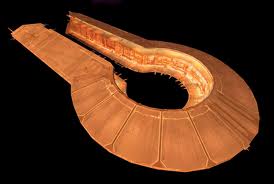 Here is another feature from the Homeworld universe, the Harbor Ship of the alien race known as the Bentusi. Known for their focus on trade and supplying less advanced races with “short-jump” technology (i.e. FTL), the Bentusi soon found themselves caught in the middle of a series of interstellar conflicts between worlds.
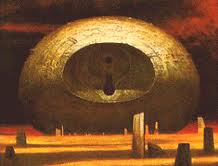 Another Dune entry which I failed to acknowledge in previous posts, can you believe it? Well, mistake remedied as of now, here is the No-Ship! Named for the fact that it is capable of shielding itself from prescient vision and other forms of detection, including sight. This all makes the No-Ship the ultimate in stealth technology, and led to its wide adoption by all factions in the Dune universe.
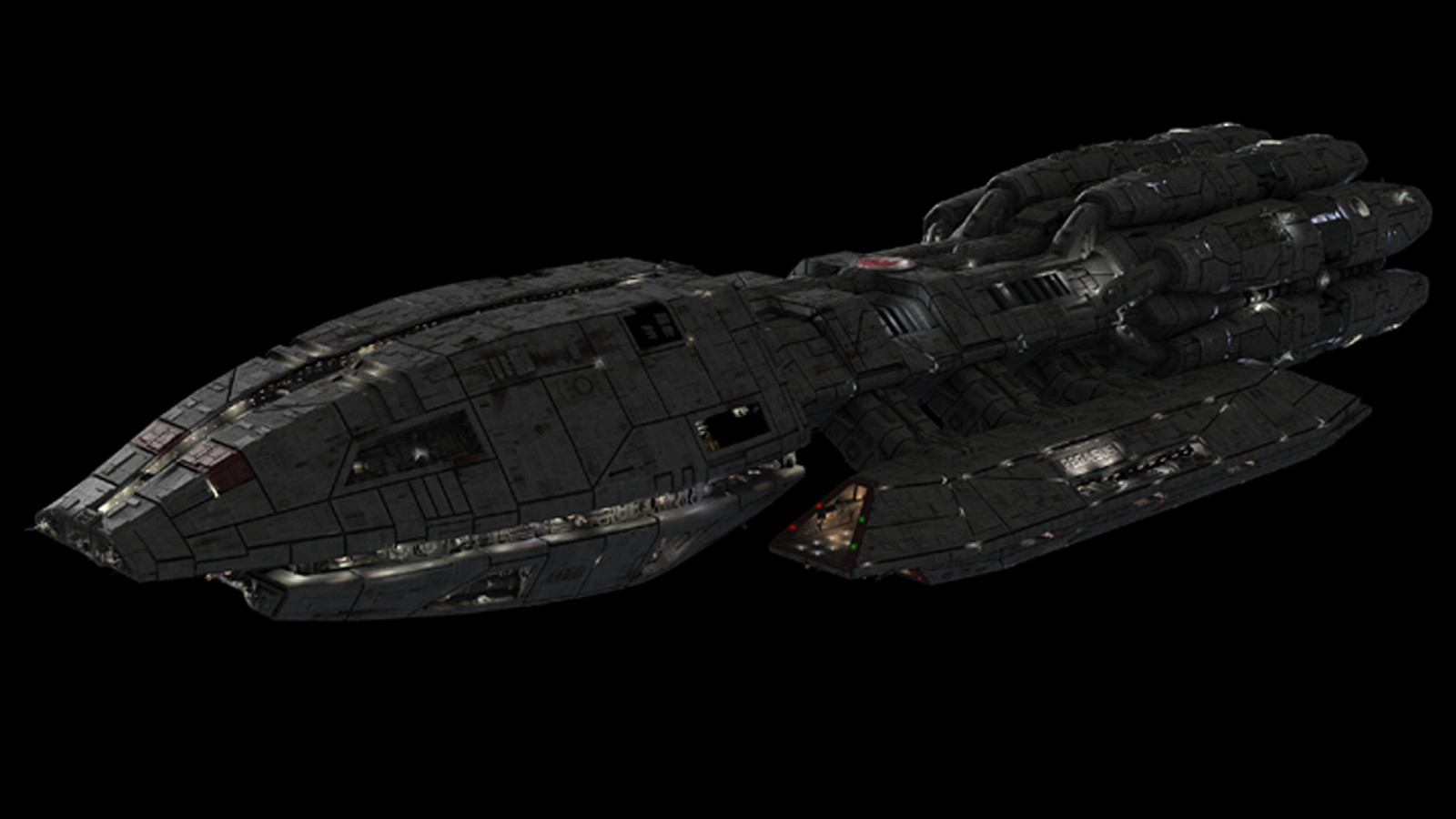 Battlestar Galactica gave so many cool ship designs that its hard for me to know where to look next. But today, I thought I’d go for the obvious and cover the ultra-modern and behemoth-sized Pegasus, the other Battlestar to survive the destruction of the Twelve Colonies. As with the original, the Pegasus makes an appearance in the re-imagined series. And like everything else, its appearance received an update, as did the tone and nature of its crew.
 Here we have another installment from the B5 universe, from the Centauri Republic to be specific. Known as the Primus-class Battlecruiser, this baby is renowned for packing firepower and artistic design into one package.
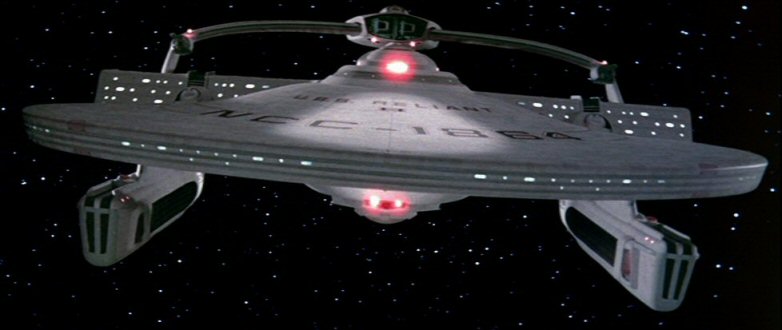 Thank you to Victor for suggesting this one. I was wondering if I should go back to the original Star Trek for ideas, and this was just the push I needed to include some. And given that this ship made its appearance in Wrath of Khan, arguably the best of the bunch, I figured it would be the perfect candidate.
 Last on the list is an entry which I’m personally impressed with. Known as a Star Defender, this class of Mon Calamari heavy cruiser comes from the Star Wars universe, and reminds us that not only the Empire was capable of creating some badass ships!


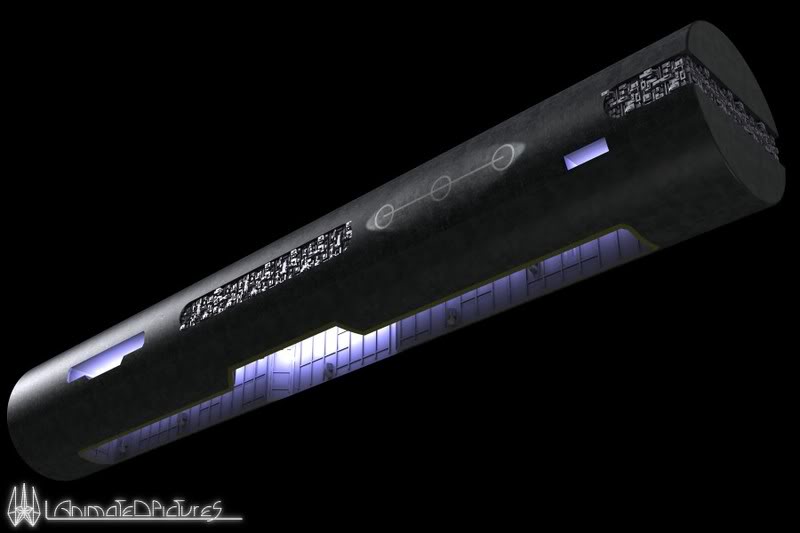
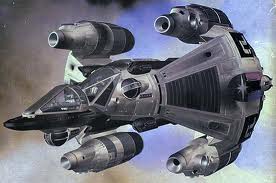


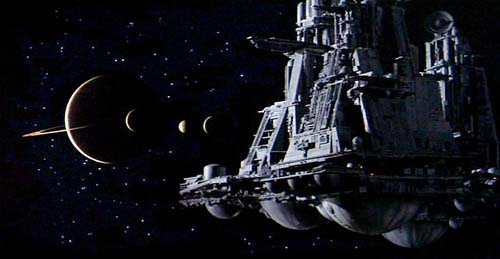




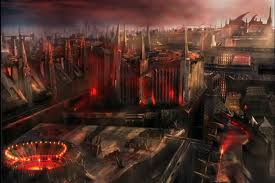


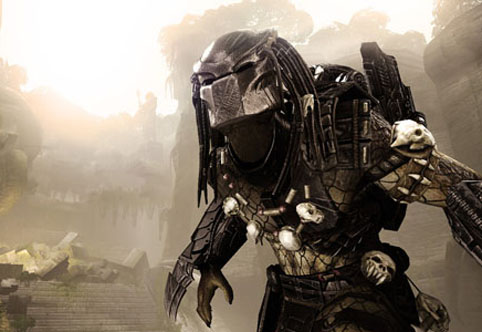







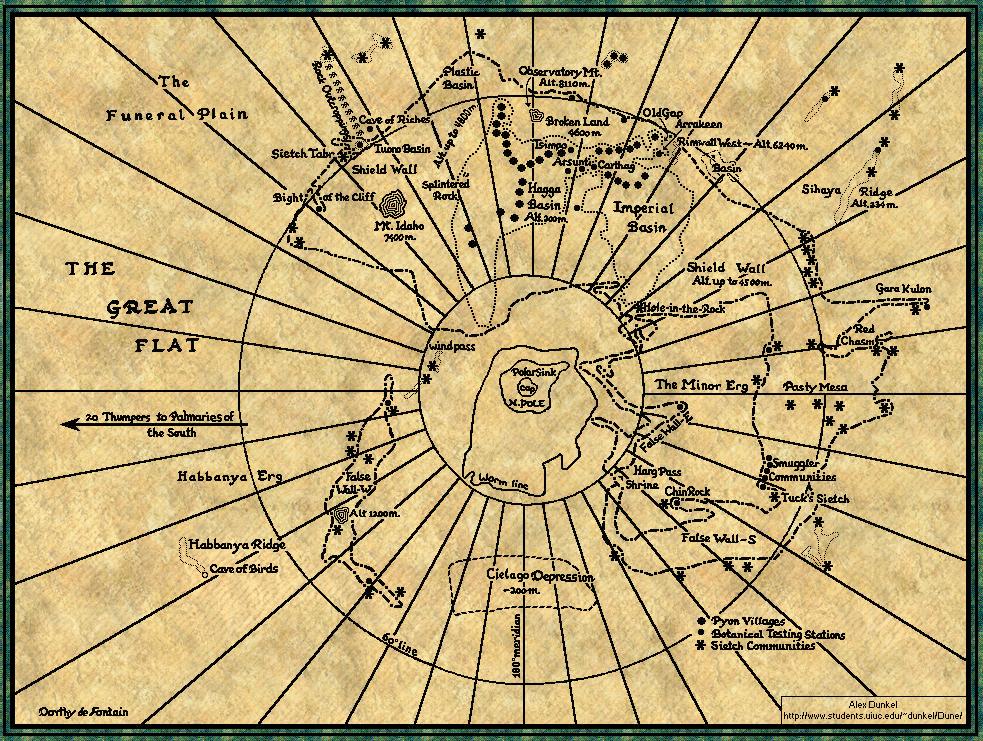


 However, using the station as a rallying point, Sheridan, Sinclair, Delenn and Kosh eventually manage to organize the younger races into a cohesive fighting force to turn back the Shadows. Things become more complicated when they realize that the Vorlons are also the enemy, being involved in a power struggle with the Shadows that goes back eons. However, with the help of other First Ones (very old races) and a commitment to stand on their own, they manage to force both sides to leave the known universe.
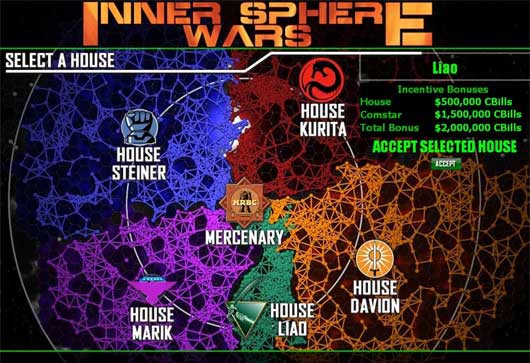

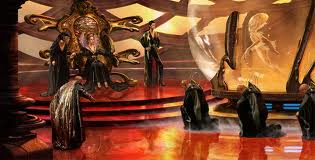
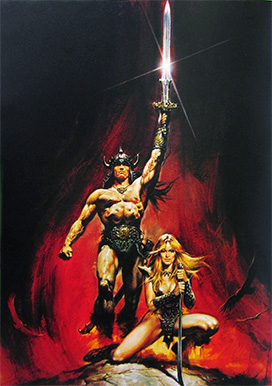

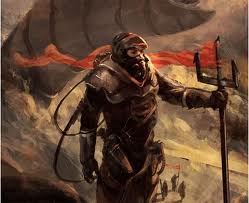
 Stories by Williams