Once more, a movie that was both a novel and a screenplay. But, unlike others I reviewed (Blade Runner, Dune), Space Odyssey was actually a movie that was later novelized. Not the cheap, dime-store novelizations that seek to cash in on the movies’ success mind you. No, this was a case of collaboration, where a scientist-turned-writer (Arthur C Clarke) collaborated with a filmmaker (Stanley Kubrick) to produce a movie, with the former writing the novel version simultaneously, but which was released after. And the combination worked pretty well, if I do say so myself! Clarke offered up the hard science and futurism while Kubrick brought the cinematic vision and directorial talent. But to be honest and fair about it, the novel was just not as good. I say that with all love and respect for Clarke, may he rest in peace. But that’s just the way I felt, having seen the movie and read the book. Whereas the movie was raw and emotional when it needed to be, capturing the awe and terror of space exploration and the unknown, Clarke approached these things with a sort of stoic detachment. And whereas the movie was a bit more complex in its depiction of technology and artificial intelligence, Clarke’s views were much more straightforward. But that was to be expected. Clarke was a futurist, after all, seeing humanity as perfectible through progress and the scientific method. Things like human nature, emotion, instinct and the fallibility of science were not really things that showed up on his radar much.
But that’s something for the literary reviews. Right now, it’s the movie that need dissecting. So once more, lets get into this sci-fi, cinematic classic and see why it was such a big hit.
(Background—>)
Even though it received mixed reviews when first released, 2001 has gone on to become one of the highest ranked movies of all time. Fans, the Academy Awards, and numerous polls place it in the top 10, with the Moving Arts Journal going as far as to rank it the number one movie of all time in 2010. Its visual style and its classical score, along with its thematic breadth and scientific realism, make it a favorite of movie-goers, critics and cinema cultists alike. And time doesn’t appear to have diminished this much. Of all Kubrick’s films, 2001 is often ranked as his greatest accomplishment, though there has been no shortage of competition for the top slot! For Clarke, the novels that followed the movie’s release were largely responsible for him being rocketed to fame as one of the “Big Three” of science fiction, alongside Robert A. Heinlein and Isaac Asimov. In addition, the success of the original novel Clarke to pen three sequels, 2010: Odyssey Two, 2061: Odyssey Three, and 3001: The Final Odyssey, the first of which was also made into a movie (for a more in-depth look at these novels, see my review, Clarke and his Odysseys)
(Content—>)
The film opens with the classic score, playing in front of planet Earth during a sunrise. I don’t imagine I need to tell anyone what a powerful opening this is. We see the planet Earth from space, is all its glory, and the music instantly captures the feeling of awe and wonder that defines the film. We then cut to the African desert, during what is referred to as “The Dawn of Man”, where a tribe of herbivorous apes are foraging for food in a hostile landscape. Through a series of images, we get a pretty clear view of their world and how they are struggling to survive in their harsh environment. All of their time is dedicated to foraging for food and water, they are in a constant state of competition with other animals and other tribes of simians (not to mention being preyed upon by hungry leopards!) However, their world changes forever when they wake up one morning and find that something in their environment has changed: a tall, black monolith has appeared out of nowhere and now sits in the middle of their encampment. Naturally, they begin to freak out and throw things at it, crying out loud and generally panicking in its presence. Slowly, they come to accept its presence and even begin to run their hands along its smooth surface, realizing that it does not pose them any immediate harm.
And I got to say, this scene was masterfully done! It’s perhaps the first example of everything the movie does right. The reactions of the actors playing the simians is perfect. How they initially panic and only slowly, very slowly, begin to calm down and even become intrigued by the monolith. The music also serves to heighten the feeling of uncertainty to the point where little is happening on screen, but we known in our hearts that something terribly significant is really going on. This music comes up again later in the movie, illustrating a direct parallel between when man’s early ancestors encountered the unknown in their own world and modern humans do the same with space exploration. It’s scary and exhilarating all at once.
Shortly thereafter, we see the simians going about their business as usual. But then, while picking amongst a set of dry bones, one of the tribe has a searing burst of revelation. Picking up what looks like an animal femur, he begins to realize (slowly, of course) that he can club things with it. As the scene picks up, the music reaching a crescendo, we get the same sort of feeling as when the apes encountered the monolith, except in reverse. What begins as a sort of tame display mounts until the ape is overcome with feeling, thrashing and smashing everything around him. And then, the camera cutting between the bones and a falling animal, we see him applying the lesson by killing another animal with it! That night, the tribe eats meat, and the transition from herbivores to omnivores has begun. We also see a frightening scene the next day, as a rival group of simians encounters them at a watering hole. But whereas the two groups would just shout at each other until one retreated, this time an ape is killed. The bone-carrying ape has passed on the lesson of the club to his kin, and they take turn beating their rival until he’s dead. The scene ends with a silent moment as the ape tosses the bone in the air, it swirls around and around, falling ever towards Earth… And then boom! The bone becomes a satellite, and the skies have become space in orbit around planet Earth.
Where do I begin? Once again, the sheer amount of significance in this scene. We are given, sans dialogue and through a series of brief but poignant scenes, a glimpse at how humanity came to evolve. From being herbivores who had to claw and scratch for every inch to omnivores who asserted control over their environment through the use of tools. And what accounted for this leap? A simple act of deductive reasoning, but clearly, higher forces appear to have played a part… Oooooo! Yes, that’s the impression we are meant to have, that the sudden appearance of the monolith and how it coincided with a jump start in evolution was no coincidence. But since there is no dialogue, all of this is going on in our minds, and it was bloody effective!
Cue part II, named TMA-1. The story begins to unfold then as we get some shots of life in orbit around Earth, aboard the international space station, and then moving through a drawn out montage to the Moon. This is perhaps one weakness in the movie, the many scenes that seem to go on and on, classically scored and containing no dialogue. They are pleasant, and you get an obvious sense of scope and breadth from them, but for the most part… they’re kinda boring. But as I realized when I first watched it, the movie was made in a time when people actually had attention spans! In addition, the idea is to give us a glimpse of the future which is both cheery and wonderful, showing how far we’ve come and how technology has made so much possible. They also pace the movie between its more dramatic bits, where there’s meaningful interaction or drawn out scenes where everything is tense and dramatic. In any case, as I said, the story unfolds. We are told in no uncertain terms that the Cold War is still on, that the Americans have a colony on the moon that is being quarantined and the Russians suspect something is up.
We then see Doctor Heywood Floyd, chairman of the National Council of Astronautics (a futuristic version of NASA) travel to the Moon where he discusses with his peers how the quarantine story is not holding up, followed by another, though comparatively brief, scene where he is being shuttled out to the surface so he (and the audience) can see exactly what it is they are hiding. Some dialogue serves to fill in the blanks, explaining what the real situation is around the colony and what TMA-1 stands for. Basically, they’ve found an object which appears to have been “purposefully buried” millions of years ago. Its designation is “Tycho Magnetic Anomaly-1”. Everything becomes clear when they set down and begin walking around the excavation in space suits, and we see that what they’ve uncovered is in fact a monolith, one that is identical to the monolith encountered by the apes… I’m getting the tinglies! I should also not that this scene is a perfect example of the movie’s scientific realism. Not a trace of sound is heard as the astronauts are busy walking about, save for their breathing and the rumpling of space suits. This is in keeping with the physics in the vacuum of space, no atmosphere equals no sound. But then, each of them is momentarily deafened by a huge burst of radio-static that sets their teeth on edge! When it passes, they all look tellingly at the monolith…
Cut ahead to Part III, which is named Jupiter Mission. Here we see the spacecraft Odyssey for the first time as it slowly passes beyond the reaches of the inner solar system on its way to Jupiter. The crew are just waking up and David Bowman, one of the pilots, is busy jogging around the ship’s centrifugal section. His counterpart, Frank Poole, is also up and about soon, and the two are going through some expository things. This includes an interview which they are watching, newscasters back at Earth having sent questions and taken their answers while editing out the time delay. The interview features as segment where they talk to the ship’s computer, HAL 9000, they eerily calm-voiced robot with the red camera eyes. He seems like a swell guy, and boasts that like all 9000 series models, he is error-free. Can you say foreshadowing? We get treated to some more exposition as HAL discusses some misgivings he has about the mission to David, mainly over the amount of secrecy and how its official purpose doesn’t add up.
And then, to get the plot rolling again, HAL announces that he’s found a malfunction in the ship’s main array. The pilots look it over and determine there’s no problem, and the folks back at Earth say the same. Apparently, HAL has made an error! While discussing their options in the privacy of one of the shuttle pods, Bowman and Poole decide that it might be best to shut HAL down and go on without him. But HAL can see them, and reads their lips. We get a nice, big closeup of his big red eye… and are worried! As well we should be, because when Poole goes out to put the array back together, his pod suddenly turns on him. Bowman is then summoned to one of the ship’s terminals and sees a video feed of Poole flying off into space, his oxygen hose broken and his body flailing. He then jumps into another pod, forgetting his helmet, and sails off to rescue Frank’s body. But when he returns to the ship, HAL refused to let him in. “I’m sorry Dave, but I cannot do that…” he says, a line that lives on in infamy! So Bowman decides to take a huge risk and open the ship’s secondary airlock, where he then blows out the pod’s door and is catapulted into the ship’s airlock. Before he can be sucked out again, he grabs hold of the controls and seals himself shut and re-pressurizes the room. While this might sound a tad far-fetched, it was actually very realistic. For one, there’s no sound until air starts flooding back into the airlock. Second, Poole’s body is tossed about like a rag doll by the explosive decompression and he barely survives it (clearly they used a real one).
Strapping into a spacesuit, Bowman then stalks around the ship while HAL tries to “reason” with him. Basically, he’s doing the sanitized, stoic version of begging for his life, and he’s right to because Bowman’s first stop is HAL’s circuit room. Slowly, HAL begins to shut down as David pulls more and more of his components out. A frightening scene, as we are basically witnessing the AI’s version of being lobotomized. As its happening, he keeps saying “I can feel my mind going…” until he finally breaks down and begins singing “Daisy” in a faltering voice. When Bowman is finally done, one of the monitors come on with a transmission from Earth. As if there could be a worse time, the true nature of the mission is now being explained. Seems the monolith on the moon was sending out a transmission, and its destination… Jupiter!
Thus begins the final part of the movie. The title is certainly indicative: Jupiter and Beyond the Infinite. This entire section is strictly visuals, that same frightening music in the background, and not a touch of dialogue. The entire climax is told with the special effects and facial expressions, conveying incredible awe, wonder, and terror. Thankfully, Clarke’s novel version told audiences what they needed to know. Essentially, Bowman has arrived within the vicinity of Jupiter’s Jovian moons, and found yet another monolith! This one is bigger, much, much bigger. And it appears to be moving around in response to his presence. When he gets close to it in one of the Discovery’s pods, it pulls up horizontally, its black profile disappearing into the dark of space. The camera then pans upwards, and a visual light show begins. We are told in the novel, and the second movie, that Bowman’s last words before “disappearing” were: “My God, its full of stars!” Like I said, no utterances in the movie, Bowman simply seems to have entered the monolith and is shooting through space and time. We get several stills of his face frozen in looks of terror, the colors becoming vivid and changing drastically with each frame. He also seems to be seeing incredible things, things that the audience can only guess at. But, for my money, he appears to be witnessing the birth of stars, the formations of planets, and the beginnings of life itself. In technicolor!
Finally, the light show ends and Bowman appears to be hovering over what appears to be an alien landscape. The colors are still psychedelic, but everything returns to a normal chromatic pattern when he finds himself inside a some kind of living space. At first, he’s himself, in his spacesuit walking around. He then sees himself change into an older man, eating a meal at the table, then transitions to the bed where he is a very old man and clearly near death. He then looks up and sees himself as a child still in the womb. More curious visuals the audience is left to puzzle over. Is he witnessing his own lifespan, or is this a metaphor for his death and rebirth as something new? According to the novel, the latter appears to be the case. He’s not sure why or even how, but making contact with the monolith has changed him. He’s become The Star Child, and he can see home from where he now sits. Earth, the moon, the stars, and the entire cosmos. Much like the apes who had undergone a great change in their own time, he too has achieved a cosmic leap in evolution, all because of his contact with an artifact that no one can even begin to understand.
(Synopsis—>)
As I’ve said before, this movie was masterfully done in the way it relied on visuals and music to tell the story. This was not always easy considering how complex the material was and how deep the themes ran. Almost without words, Kubrick and Clarke told said volumes about human evolution, consciousness, evolution, technology, and artificial intelligence. And it all ran together, in spite of what you might think. HAL’s malfunction was no stray commentary on the dangers of AI. If anything, it was a commentary on the dangers of intelligence, as personified by the apes who suddenly became very violent once they learned how to use basic tools. Bowman’s death and transformation was also a commentary on this process of evolution, how it can be painful and sometimes might involves a great deal of loss. And last, but certainly not least, there is the awe and wonder of it all. Nothing frightens more than the unknown, and nothing fails to inspire us more. But always there is danger in peaking around those corners. And what better way to personify this danger than through a big, black, monolith? Yep, I tell ya, those towering, featureless shapes still inspire fear and intrigue for me today. As does the classical store! If you haven’t seen it, do so. And for the love of God, do it sober! You need to be clear of mind to appreciate all the nuances of this movie. Never mind that it was made in 1968 and many people were high when they first saw it!
2001: A Space Odyssey:
Entertainment Value: 7/10 (bit slow, can be incomprehensible at times too)
Plot: 10/10 (oh yeah!)
Direction: 10/10 (double oh yeah!)
Total: 9/10

 Mercury is the smallest planet in the Solar System and has the closest proximity to our sun. As a result, it’s one of the most neglected when it comes to scientific study. While Mars, Venus, Jupiter and Saturn have been probed and photographed in exquisite detail during the space age, the closest planet to the Sun has had to make do with a few flybys from the Mariner 10 spacecraft in the early 1970s.
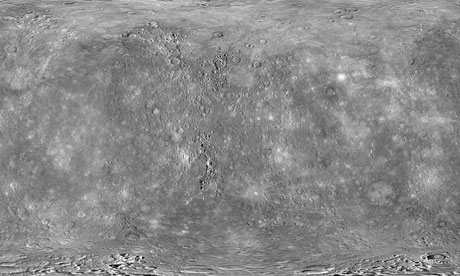 According to David Blewett, a scientist at the Applied Physics Laboratory at Johns Hopkins University and part of the Messenger team, part of the reason it has taken more than 30 years to revisit the planet since the Mariner 10 flybys was because a lack of public interest. Messenger, he claims, has changed all that. Speaking ahead of a briefing on Friday at the annual meeting of the American Association for the Advancement of Science in Boston, Blewett had this say:
 The new global map is an enhanced image that shows the different compositions of rocks on the surface of Mercury by color-coding them. The more orange areas are volcanic plains while the make-up of the rocks in the deep blue areas is unknown. Though Messenger was able to detect an abundance of individual elements on Mercury’s surface – including iron, titanium, sulphur and potassium – without rock samples to study, scientists cannot determine the exact compounds or minerals in which those elements are arranged.

 Stories by Williams