The Future of Transit: Elon Musk’s Hyperloop

hyperloopThe high-speed transit tube. It’s been a staple of science fiction for many years. Remember the tubes cars in Logan’s Run, the elevators in the Jetsons, or the tubes that shoot people around New New York in Futurama? Much like flying cars, they are a feature of a futuristic society that people have been waiting on. And thanks to Elon Musk, it might finally be coming true.

Yes, the same man that brought us the Tesla electric car, PayPal, and SpaceX is now working on a design for a high-speed transit system that works the same way as the pneumatic tube. In a series of statements and documents released yesterday, the billionaire entrepreneur unveiled his concept for a tube that could whisk passengers between Los Angeles and San Francisco in just 30 minutes – half the time it takes an airplane.

hyperloop1In the newly released documents, Musk outlined the basic design, which would consist of a low-pressure steel tube that houses capsules which move back and forth. The aluminum capsules (or pods) would have skis on the bottom containing holes that pump out air, creating an air cushion. They would be propelled forward with magnets found on the skis as well as an electromagnetic pulse generated by a series of electric motors.

Linear electric motors placed at each destination would slow the pods down by absorbing their kinetic energy. That energy would then be put back into battery packs and used to accelerate the next pods, or stored for future use. Solar panels on top of the tubes would also provide energy. The pods, which have room for 28 people each, could leave every 30 seconds – transporting up to 7.4 million people on each route (SF to LA or vice versa).

hyperloop2At 1290 kilometers per hour (800 mph) the above ground Hyperloop system would be dramatically faster than a bullet train or even an airplane. Alongside boats, planes, trains and automobiles, Musk claims that the train would constitute a “fifth form” of transportation. And of course, safety would be paramount, with each pod being spaced apart by 8 km (5 miles), and the system would have an emergency brake.

The system would also be designed to deal with seismic shifts, which are common in California. In order to mitigate earthquake risk, the system would be built on pylons (the tube wouldn’t be rigidly fixed at any point). Adjustable lateral and vertical dampers would be placed inside the pylons to “absorb the small length changes between pylons due to thermal changes, as well as long form subtle height changes.”

hyperloop3What’s more, Musk was sure to play up the comfort value of the ride:

Once you’re traveling the speed you wouldn’t notice the speed at all. It would be really smooth, like you’re riding on a cushion of air. Maximum G-force of about half a G, comparable to what you might feel in an airplane but far less than what you would feel in a rollercoaster. Really quiet.

Musk estimates that price tag per ride would be $20 per person, making the Hyperloop more reasonably priced than train, plane, or automobile. The whole project would cost an estimated $6 billion if it contained “people-only pods,” but would be priced at $10 billion if it had pods for both people and cars.

As it stands, its not entirely clear when the Hyperloop would be up and running. What’s more, its unclear what tole Musk would play in its creation. Since he is currently occupied with developing things like a nationwide Supercharger network for Tesla and launching satellites with SpaceX, he thinks it could be three to four years before a demo could be finished. As for a full system that would run from LA to San Francisco, that could take between seven to ten.

hyperloop4In any event, the concept is open-source, and Musk is calling on inventors, engineers and investors to get involved. Given that it is a rather elegant solution to the problem of transit, such an idea is not likely to remain idle for too long. Originally inspired by the sad state of $70 billion California’s high-speed rail initiative, the Hyperloop could easily prove to be another transportation initiative that is never completed. At the same time, it might prove to be a “leapfrog maneuver”, bypassing lightrail completely and ushering in something better.

It might sound like a fantasy, but Musk has a reputation for making the impossible a reality. What’s more, engineers from both Tesla and SpaceX have been working on the concept for close to a year and some are now dedicated to it full-time. And given that nations like China, India, Russia and the EU are in need of expanded transit systems, don’t be surprised if we see something similar emerging overseas.

And be sure to enjoy this video of the concept, courtesy of Elon Musk and CBC news:


Sources: cbc.ca, fastcoexist.com

Google CEO Wants Land Set Aside for Experimentation

future-city-1Back in May, Google co-founder and CEO Larry Page hosted a rare Q&A session with the attendees of the Google I/O keynote speech. During this time, he gave some rather unfiltered and unabashed answers to some serious questions, one of which was how he and others should focus on reducing negativity and focusing on changing the world.

Page responded by saying that “the pace of change is increasing” and that “we haven’t adapted systems to deal with that.” He was also sure to point out that “not all change is good” and said that we need to build “mechanisms to allow experimentation.” Towards that end, he claimed that an area of the world should be set aside for unregulated scientific experimentation. His exact words were:

There are many exciting things you could do that are illegal or not allowed by regulation. And that’s good, we don’t want to change the world. But maybe we can set aside a part of the world… some safe places where we can try things and not have to deploy to the entire world.

So basically he’s looking for a large chunk of real-estate to conduct beta tests in it. What could possibly go wrong?

detroit_experimentOne rather creative suggestion comes from Roy Klabin of PolicyMic, who suggest that an aging and dilapidated Detroit might be just the locale Page and his associates are looking for. This past week, the city declared bankruptcy, and began offering to sell city assets and eradicate retirement funds to meet its $18 billion debt obligations.

What’s more, he suggests that SpaceX founder Elon Musk, who’s always after innovation, should team up with Google. Between the two giants, there’s more than enough investment capital to pull Detroit out of debt and work to rehabilitate the city’s economy. Hell, with a little work, the city could be transformed back into the industrial hub it once was.

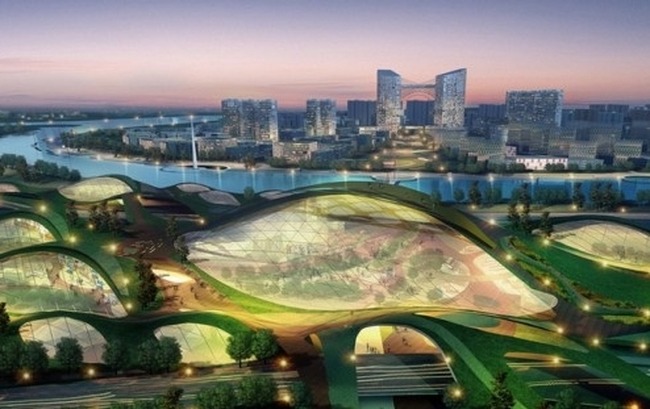
And due to a mass exodus of industry and working people from the city, there is no shortage of space. Already the city is considering converting segments of former urban sprawl into farming and agricultural land. But looking farther afield, Klabin sees no reason why these space couldn’t be made available for advanced construction projects involving arcologies and other sustainable-living structures.

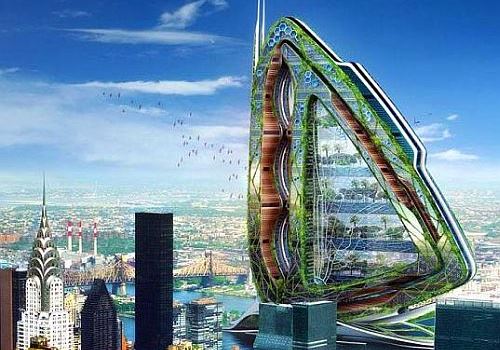
dragonfly-vertical-farm-for-a-future-new-york-1Not a bad idea, really. With cities like Boston, New York, Las Vegas, New Orleans, Moscow, Chendu, Tokyo and Masdar City all proposing or even working towards the creation of arcologies, there’s no reason why the former Industrial Heartland – now known as the “Rust Belt” – shouldn’t be getting in on the action.

Naturally, there are some who would express fear over the idea, not to mention Page’s blunt choice of words. But Page did stress the need for positive change, not aimless experimentation. And future generations will need housing and food, and to be able to provide these things in a way that doesn’t burden their environment the way urban sprawl does. Might as well get a jump on things!

And thanks to what some are calling the “New Industrial Revolution” – a trend that embraces nanofabrication, self-assembling DNA structures, cybernetics, and 3D printing – opportunities exist to rebuild our global economy in a way that is cleaner, more efficient and more sustainable. Anyone with space to offer and an open mind can get in on the ground floor. The only question is, what are they willing to give up?

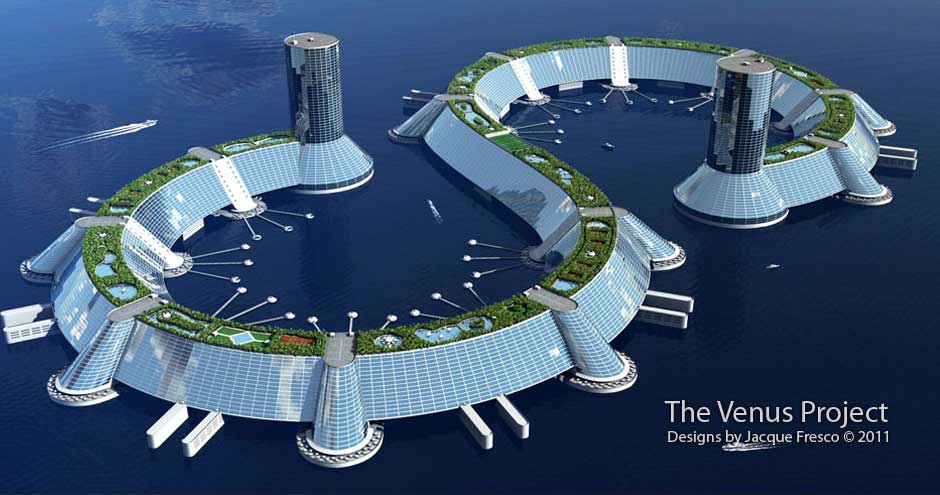
venus_projectThere’s also a precedent here for what is being proposed. The famous American architect and designer Jacque Fresco has been advocating something similar for decades. Believing that society needs to reshape the way it lives, works, and produces, he created the Venus Project – a series of designs for a future living space that would incorporate new technologies, smarter materials and building methods, and alternative forms of energy.

And then there’s the kind of work being proposed by designer Mitchell Joachim and Terreform ONE (Open Network Ecology). And amongst their many proposed design concepts is one where cities use vertical towers filled with energy-creating algae (pictured below) to generate power. But even more ambitious is their plan to “urbaneer” Brooklyn’s Navy Yard by turning natural ecological tissues into viable buildings.

future-city2This concept also calls to mind Arconsanti, the brainchild of architect Paolo Solari, who invented the concept of arcology. His proposed future city began construction back in the 1970 in central Arizona, but remains incomplete. Designed to incorporate such things as 3D architecture, vertical farming, and clean, renewable energy, this unfinished city still stands as the blueprint for Solari’s vision of a future where architecture and ecology could be combined.

What’s more, this kind of innovation and development will come in mighty handy when it comes to time to build colonies on the Moon and Mars. Already, numerous Earth cities and settlements are being considered as possible blueprints for extra-Terran settlement – places like Las Vegas, Dubai, Arviat, Black Rock City and the Pueblos and pre-Columbian New Mexico.

Black Rock City - home to "Burning Man" - shown in a Martian crater
Black Rock City – home to “Burning Man” – shown in a Martian crater

These are all prime examples of cities built to withstand dry, inhospitable environments. As such, sustainability and resource management play a major role in each of their designs. But given the pace at which technology is advancing and the opportunities it presents for high-tech living that is also environmentally friendly, some test models will need to be made.

And building them would also provide an opportunity to test out some of the latest proposed construction methods, one that do away with the brutally inefficient building process and replace it with things like drones, constructive bacteria, additive manufacturing, and advanced computer modelling. At some point, a large-scale project to see how these methods work together will be in order.

Let’s just hope Page’s ideas for a beta-testing settlement doesn’t turn into a modern day Laputa!

And be sure to check out this video from the Venus Project, where Jacque Fresco explains his inspirations and ideas for a future settlement:


Sources:
1.
Elon Musk and Google Should Purchase and Transform a Bankrupt Detroit (http://www.policymic.com/)
2. Larry Page wants to ‘set aside a part of the world’ for unregulated experimentation (theverge.com)

3. Six Earth Cities That Will Provide Blueprints for Martian Settlements (io9.com)
4. The Venus Project (thevenusproject.org)
5. Arcosanti Website (arcosanti.org)
6. Terreform ONE website (terreform.org)

News From Space…X!

spaceX_elonmuskForgive the pun, but it was just too easy! Yes, SpaceX is once again making news with its Grasshopper reusable rocket system, which set the record for highest altitude ascended. On its sixth jump, which took place on June 14th, the rocket made it to a height of 325 meters (1066 feet) above the Earth and remained airborne for a minute and 8 seconds.

With each jump and new record set, Grasshopper and its inventors are bringing the age of affordable, commercial space flight that much closer. Seeing as how the goal is to send a rocket into orbit it and bring it back in one piece, this latest milestone might sound modest. But a quick look at each successive jump clearly shows that the Vertical Takeoff Vertical Landing (VTVL) rocket is making serious progress, and in a short stretch of time.

spacex_grasshopperConsider the first jump which took place in September of 2012, where the rocket reached a height of 1.8 meters (6 feet) and remained aloft for three seconds. Sounds pretty meager, no? But less than two months later, the rocket was able to remain in the air for 8 seconds and reached a height of 5.4 meters (17.7 feet).

On its third run, performed in December of 2012, the rocket got 40 meters (131 feet) into the air, remained there for 29 seconds, and happened to be the first test flight where a cowboy mannequin was strapped to the rocket. On the fourth and fifth try, which were performed in March and April of this year, the rocket reached a height of 80 and then 250 meters (262 and 820 feet), remaining airborne for 34 and then 61 seconds.

Grasshopper-rocketThis not only confirms that the rocket’s progress is exponential when it comes to height, but that its thrust-to-weight ratio has been improving vastly. Another big milestone here was the fact that for the first time, the rocket made use of its full navigation sensor suite with the F9-R closed loop control flight algorithms.

In previous tests, the rocket relied on other rocket sensors which were not as accurate, but this time around, SpaceX was directly controlling the rocket based on these new sensor readings, a move which has increased the level of accuracy in sensing the distance between Grasshopper and the ground.

To quote Nietzsche: “He who would learn to fly one day must first learn to stand and walk.” At this rate, averaging for the total rate of increase, I’d say the Grasshopper should be reaching Low-Earth Orbit (2000 km above sea level) by its 11th or 12th jump. And using the same figures, I figure the jump will be taking place sometime in May 2014. Somebody ought to be organizing a pool!

Source: IO9.com, SpaceX.com

More Plans to Colonize Mars!

mars_lifeFolks may recognize the name SpaceX, the private aerospace company that in May of last year launched a module into space to resupply  the International Space Station. An historic occasion, that was the first time a private spacecraft has has ever docked with the ISS, and signaled a growing trend in the development in commercial space travel. Well, it seems that the company’s founder has more ambitious plans now.

Yes, in a bid to make sure his company is not left behind in any future space endeavors, CEO and billionaire Elon Musk has announced plans to colonize the Red Planet with a population of 80,000. The announcement came back in November at the Royal Aeronautical Society in London, where Musk appeared to receive the Society’s gold medal for helping to advance the commercial space industry.

The first phase of the program, which is contingent on the development of reusable rocket that can take off and land vertically, would start off modestly with only a handful of explorers leaving Earth at a time. To make it happen, SpaceX has already started to work on their next-generation reusable Falcon 9 rocket, known as “Grasshopper”. This rocket has already made two short flights, including one in which it reached a height of 2 meters (6 feet), and another in which it leaped to a height of  5.4 meters (17.7 feet). Small beginnings, as they say!

The projected cost for each colonist looking to make the trip would be roughly $500,000. In short, those who are not rich or extremely adventurous need not apply! What’s more, he estimated that the entire program would cost about $36 billion, an inevitable expense to set up the initial infrastructure and transport. But once that is done, he believes enough people will be interested and find it within their means that the venture will pay for itself.

In an interview with Space.com, Musk’s vision for sending people to Mars was described as follows:

“Accompanying the founders of the new Mars colony would be large amounts of equipment, including machines to produce fertilizer, methane and oxygen from Mars’ atmospheric nitrogen and carbon dioxide and the planet’s subsurface water ice.

“The Red Planet pioneers would also take construction materials to build transparent domes, which when pressurized with Mars’ atmospheric CO2 could grow Earth crops in Martian soil. As the Mars colony became more self sufficient, the big rocket would start to transport more people and fewer supplies and equipment.”

So save your pennies and prepare for the day when tickets go on sale! Hard to say exactly when that will be, but chances are, it will be either feasible or abandoned by 2030. That’s when NASA plans to mount manned missions to the Red Planet. And like I said, men like Musk don’t want to be left behind!

Source: space.com