Castrum Press has just released the Press Kit for The Cronian Incident. Basically, its a rundown of who I am and the book they just published (which bears my name, of course!) For those interested in doing an interview with your’s truly, there are suggested questions and all the relevant info you would need.
Follow the link below to see my interview with It’s Write Now, a book-sharing site that is committed to sharing Kindle ebooks to promote new authors. It was the single-longest interview I’ve ever done, but that was no problem. Lots of interesting questions that really made me ponder and dig deep!
Incidentally, they are also giving away free copies of The Cronian Incident for a limited time. If you’re looking for a hard SF read, get your free copy while you can!
Check out the link below to see my latest interview for The Cronian Incident. This one took place with the good folks at SciFy Shenanigans. This is the author website of JR Handley, a husband and wife writing team that specializes in military science fiction. Be sure to check out their interview antics, and have a look at their novels while you’re there. It’s a pretty bad-ass site!
As the title would suggest, I recently did my second interview on the subject of The Cronian Incident, my first published book which was released a little over a week ago. Check the link below to have a look-see at my interview with fellow-writer and buddy o’ mind, Rami Ungar.
Rami is a connoisseur and writer of the horror/thriller genre. And I think you can agree by perusing his questions, he knows how to give a pretty decent interview. And while you’re there, be sure to check out what he’s up to. He’s got some a large assorted of horror stories that he’s written himself, and he has some thriller stuff in the works!
In preparation for the release of The Cronian Incident, my publisher sent out Advanced Reading Copies (ARC) to a number of influential people that I just happen to know. The first one came in not that long ago from Professor Abraham (Avi) Loeb. Over the years I’ve had the privilege of speaking to him a few times as part of my job with Universe Today. So when the opportunity arose to get some professional opinions on my book, I naturally thought of him.
He graciously accepted, and wrote the following:
“An exciting science fiction adventure into the technological future. An exhilarating read for scientists and fiction lovers alike.”
Not only is Prof. Loeb the Chair of the astronomy department Harvard University, he’s also the Director of the Institute for Theory and Computation, a member of the Harvard-Smithsonian Center for Astrophysics (CfA) and the chairman of the Breakthrough Foundation’s Advisory Board. Basically, he’s part of the organization that is mounting the largest SETI effort to date, and plans to build a laser sail-driven nanocraft that would make it to Alpha Centauri in 20 years.
Just to let people know, the release date for The Cronian Incident is no longer September 15th. The book will now be available to the public (paperback and ebook) on Saturday, September 2nd. That’s this Saturday, so in just two more days!
My first interview concerning the upcoming release of my new book (The Cronian Incident) just went live over at Highland Rogue. This is the personal website of historical fiction author R.A. McCandless. Check it out by following the link:
Expect to hear about more interviews as we get closer to the launch date. And, just so you know, that is still scheduled for mid-September (Sept. 15th, 2017). If all goes as planned, the sequel should following not far behind!
While you’re at Highland Rogue, be sure to check out some of McCandless own works of fiction too!
This is the way my life has been lately. It’s the middle of 2017, and I still haven’t finished recounting a travel story that took place last year! But that’s the kind of busy that I’ve been dealing with lately. It seems that between writing and editing (upcoming book release!), there’s been very little time for anecdotes. But I found my way clear to some free time, so I thought I’d wrap this story up!
So welcome to the final installment of my tale of the Williams family Eurotrip, the 2016 edition! To pick up where I left off, the last leg of our trip involved finishing our tour of Belgium and checking out some of the famous art that was the subject of the story (and film adaptation) Monuments Men. We then paid a visit to The Netherlands, swung back through Belgium, and then stayed in the city of Beauvais (north of Paris) before flying home.
Here are some of the highlights…
Ghent and Bruges:
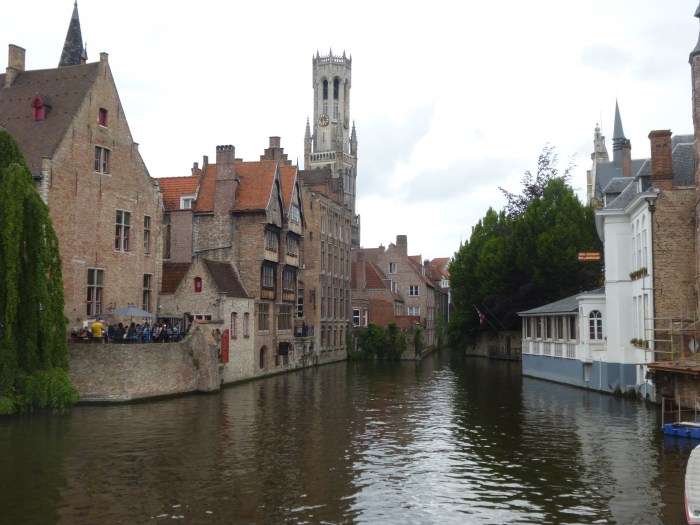
After leaving Ypres, we decided to head to what is, by all accounts, Belgium’s most touristy place – the city of Bruges. This city, which consists of a modern ring surrounding a medieval core, is famous for its canals, breweries, Beer Museum, chocolatiers, and many, many stores! Seriously, people who love shopping would LOVE this town!
One of Bruges many canals, taken from the medieval core of the city
But before stopping there, we swung by what is arguably the less-touristy version of Bruges. Ghent, located not far away and to the northwest, consists of a well-preserved medieval core surrounded by modern burroughs. Much like Bruges, Ghent is famous its canals, medieval and Baroque architecture, and rich history. While there, we stopped for some lunch at a lovely bakery – consisting of baguette sandwiches and apple tarts – and then began wandering to see some of wonderful sites. Some of these were planned, some we just saw along the way.
For instance, after lunch, we walked down the street and saw the “Dulle Griet” (trans. “evil woman”), which is a massive cast-iron cannon that was built in the 15th century and used in the siege of Oudenaarde. Today, it is a historic landmark that sits next to Ghent’s largest river – the Lelle. Speaking of which, we then decided to follow this river as we made our way to planned stop of St. Pavo’s Cathedral. On the way, we got some great pictures of the waterways, a lovely shop with hundreds of different bottles of beer in the window, and the castle of Gravensteen.
We then made our way to St. Bavo’s Cathedral, where the purpose for our visit was waiting for us. This would be the “The Adoration of the Mystic Lamb”, otherwise known as the Ghent Altarpiece. This tableau, which features some of the most detailed religious art from the High Middle Ages, was created by the Flemish artists Hubert and Jan van Eyck in the 15th century. And, as Monuments Men addresses, the altarpiece was stolen by the Nazis during World War II, and repatriated thanks to the efforts of the Allies.
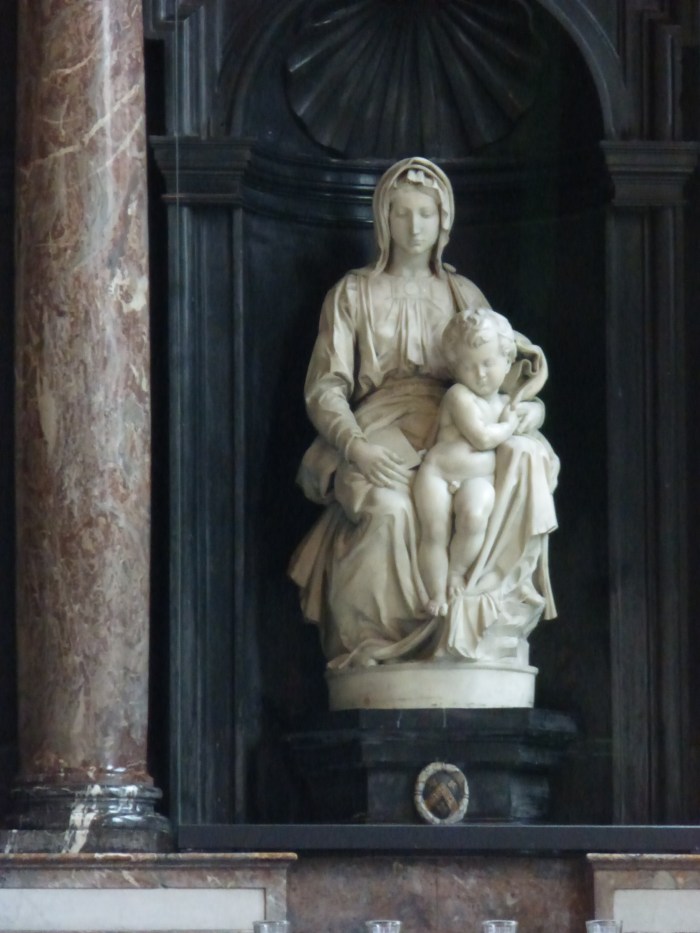
The Bruges Madonna
As you would expect, seeing it means cramming into a small alcove and listening to an audio guide explaining the history of the altarpiece and giving an in-depth description of every image it holds. Once that was done, we packed and drove for Bruges, arriving in the mid-afternoon. After finding our way to Bruge’s medieval core, we dropped our kit at the BandB and grabbed some dinner. The next day, we proceeded to find the Church of our Lady, which is located near the heart of the Medieval core and is the location of the Bruges Madonna.
To give you a quick rundown on the Bruges Madonna, this Rennaissance work of art has had a turbulent history. It was created by none-other than Michaelangelo himself and was bought by a wealthy family of cloth merchants in Bruges. Since its creation, it left the country twice. The first was after the French Revolution when, in 1794, the French army took it as the spoils of war and brought it to Paris. It was returned in 1815 after Napoleon’s defeat at Waterloo. In 1944, the Nazis removed it during their retreat from Belgium. Thanks to the efforts of the Monuments Men, it was retrieved from a hidden cache of stolen art in Austria the following year and again returned to Bruges.
As the days went by, we took in a number of other lovely attractions. These included the many restaurants that dot the canals, the extensive shops – never seen so many ways to get chocolate, waffles, beer, tobacco and french fries! But the coolest thing, after seeing the Madonna, was definitely the Bruges Beer Museum! This edifice is right in the old town square, a medieval building that has several levels dedicated to recounting the city’s long history of brewing. And of course, on the ground floor, there is a bar where lots of samples can be enjoyed.
View from one of the bridges that spans one of Bruges many canals
A tour consists of them giving you a specialized tablet and earphone. You walk around the top two floors, point the tablet at a display, and it reads the icon there. Information and images then flow from your tablet, telling you about an important piece of beer history, and how the town of Bruges featured prominently in it. As one of Belgium’s oldest cities, the town was at the center of a lot of developments, ranging from the rise of Trappist brewing, the birth of brewing as a modern profession, the war years, the resurgence of Belgian brewing, and the rise of craft brewing.
One of the biggest lessons I learned on that visit was the identity of the patron Saint of brewing – St. Bernardus. This medieval Benedictine monk became a local hero when it an epidemic was traced to the town’s water supply. He urged the townspeople to drink beer instead of water, a measure which helped end the outbreak. Today, many Belgian beers are named after him or feature his likeness, which shows him holding a mash paddle – a key brewers instrument that is used for stirring malted grains as they are being boiled.
I learned of several beers while I was there, which included Bruges Zot, a local favorite brewed by the Halve Maan (Half Moon) brewery that takes it name from an old joke that claimed that the people of Bruges were all insane! Speaking of which, one thing we learned after the trip – much to our chagrin! – was that the historic Halve Maan (Half Moon) brewery had just finished work on a beer pipeline! That’s right, this brewery created an underground pipeline so that beer trucks (which are 40 tonnes each and play havoc with the old cobblestone streets) would no longer be making runs. From that point onward, drinking establishments all over town could just hook up to the pipeline and pull the tap! Though we did wonder if people might try to hook up taps of their own along the way 🙂
Check out the video below for more details…
Utretch:
After Belgium, we proceeded into Holland to see this lovely Low Country. We were still tracing World War II routes at this point, and Holland is considered an important pilgrimage for Canadians doing war tours. In September of 1944, six months after the D-Day landings and the Battle of Normandy, the 1st Canadian Army was tasked with pushing the Nazis out of the country.
This they did, though at great cost to themselves. Knowing that defeat was inevitable, the Nazis broke the levies around the Dutch waterways and flooded the countryside. They also fought bitterly to stall the Canadian troops’ advance. But by April of 1945 (just one month before the end of the war), the 1st Canadian Army had completed the liberation of the Netherlands.
Once again, we were staying in a lovely BandB in the city, which took some time to locate! The streets in the area of town we were staying in got a little bendy-curvy and that kind of threw off our GPS. Nevertheless, we found it before long and realized we had much of the place to ourselves.
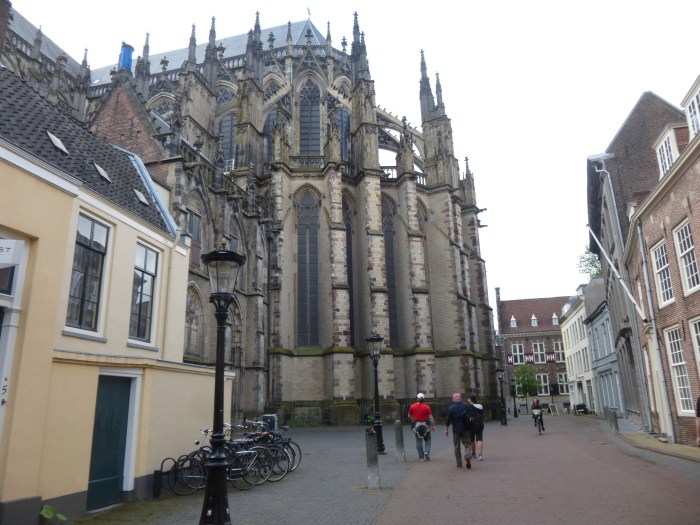
A canal in Utretch
The nice lady who ran the place also had a lovely big, brown dog who came to say hi to us, even though it was having some back issues from running around all day. Again, we unpacked, walked to the main thorough fair (just a few blocks away) and began taking in the sights. We also scoped out places to eat that night and the following morning, and chose a few places to visit in the coming days.
On the first night, we walked across town, taking in the lovely canals and quiet streets. I honestly never saw so many bikes moving along a main street. And the people were quite lovely too. While the signs were very confusing to me (I don’t do Dutch very well!), everybody was fluent in English. We eventually made our way to the lovely St. Michael’s Cathedral, which lies next to the University of Utrecht and across from the famous Dom Tower of Utretch.
For dinner, we ducked into a nearby restaurant called Grand Cafe Lebowski. The name alone is what sold it for us!
St. Michael’s Cathedral, Utretch
The highlight of our visit though was none other than our visit to the Overloon War Museum , one of the largest World War II museums in the country. It is set on the sight of the Battle of Overloon, where Allied and German forces fought in September and October of 1944, just after Operation Market Garden. The museum itself sits in a massive greenspace known as Liberty Park. Many vehicles are situated outside as you make your way towards the entrance. But the biggest attractions are inside!
Basically, after winding your way through numerous displays that explain the lead-up to the war and discuss the major battles, social developments and atrocities of the war, you enter a massive hangar. In there, dozens of Allied and German vehicles sit, just waited for history buffs to drool over them! And while describing what I liked best is a bit like asking someone which of their children they love most, I would have to go with the massive US Army amphibious vehicle that was as tall as a small house, and had tires that were taller than me!
Check out this video that offers a virtual tour of the museum (word of warning, its all in Dutch!). From 1:42 onward, you get to see the inside of the hangar, where all the big vehicles are kept. At precisely the 2:00 mark, you see the huge amphibous craft I was talking about.
Ypres and Beauvais:
After leaving The Netherlands, we started making our way back to France, and stopped again in Ypres for the night. It was nice, and gave us a chance to see our favorite spots again. And while my folks had a quiet evening, Carla and I took the opportunity to walk the streets and sample some lovely Belgian beers. While I drink Belgian beer ALL THE TIME here at home, it has always been fun for me to do it in the land of its birth. Not only is the selection more varied over there, but the price is significantly lower! I tell ya, what for us are fine imported examples of artisinal Trappist beers that date to the High Middle Ages are basically domestic beer for them!
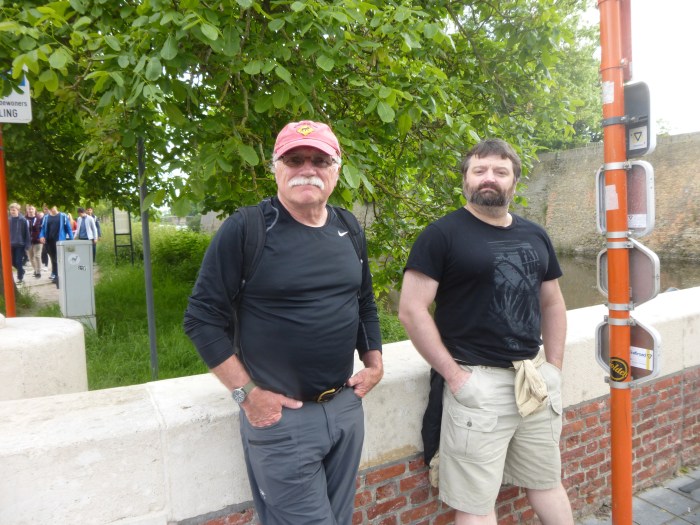
Naturally, we also took this opportunity to go to Menin Gate again and pay our respects. We also got some wonderful pictures of the ceremony, which included the one below of my father and I standing next to each other on the east side of the gate.
My father and I at Menin Gate, Ypres
The next day, we made our way to the last stop in our journey – the city of Beauvais, located just north of Paris. This town was quite charming and an interesting mix of the historic and modern. Our hotel was at a busy intersection, right across from a bloody dance club. And this place was open WELL into the wee hours of the morning and blasting dance music. I tell you, if I never hear the techno remix of Tracy Chapman’s “Fast Car” again, I will die a happy man!
However, we did get so see some nice sights. Once again, we visited the local cathedral – the large and historic Beauvais Cathedral. In addition to having a rather cavernous interior, this building is famous for having had all the small statues that depict the saints removed from its facade. This took place during the French Revolution, when a wave of anti-clerical sentiment was sweeping the country an mobs forcible took all the statues down.
After visiting the Cathedral, we grabbed dinner from a local bakery (baguette sandwiches and some apple tarts, as usual!) and then proceeded back to the hotel. We tried to get a good’s night sleep but, as I said, the damn club across from us was pumping out music until the wee hours of the morning! Somehow, someway, we managed to get a few good hours and then head to Charles de Gaulle International to fly out the next morning!
Beauvais Cathedral
Needless to say, we were quite tired and jetlagged when we got home. And upon our arrival, something very cute happened. Our cat (Jasper), who is most demanding and dedicated to his mommy and daddy, was out at the time. I went to the neighbors house to thank them for looking after him and to retrieve our key. Suddenly, I heard energetic meows coming from the bushes. When I went over, Jasper came running out, mewing happily! After about two weeks of being attended to by his surrogate mother (our neighbor Jen), he was thrilled to see us. Not that he doesn’t love her, but… you know. There’s no substitute for your actual family!
Wow, that took me forever to describe. I guess it was because it was our second major visit, and because it was both very special but also more familiar this time around. And we are planning on going back in 2019, to be part of the 75th anniversary of D-Day and the liberation of France. The focal point of that trip will be going to Juno Beach (where the Canadian Forces landed on D-Day), since that is where the Canadian celebrations will be taking place, and because my aunt is on the board of directors at the Juno Center. It promises to be a major event and should involve several members of my family!
Hey folks! It’s taken me some time, but I am finally getting around to finishing my story of this past year’s Eurotrip. The year of 2016 is rapidly coming to a close, so I really wanted to get this done before New Year’s. After all, this trip marked the centennial of the Battle of the Somme, Beaumont Hamel, and many other World War I events. Leaving it until next year just seemed wrong.
Picking up where I left off, my family and I witnessed some really amazing things during the first week that we were in Normandy. Our visit coincided with the 72nd anniversary of the D-Day and the Liberation of Normandy. And once we had finished witnessing these, visited the D-Day beaches, taking part in the commemorative ceremony at Grangue, and paying our respects to my great-uncle Wilmott, we got in some last-minute visits and started carrying on to Belgium and Holland.
Cabourg:
Our first stop after the ceremony at Grangues was to the town of Cabourg, located on the Normandy coast overlooking the English Channel. This place is famous for being a the favorite hangout of French writer Marcel Proust, and is the home of many waterfront hotels and casinos. Personally, I felt it was a bit Niagra Falls-esque, that is to say, a bit tacky. But we still got in a lovely walk along the waterfront (Promenade Marcel Proust) and enjoyed some lunch at the famous Grand Hotel Cabourg.
Upon returning to Grangues, we packed up and got ready for the next part of our adventure, which included stops in the border towns of Amiens and Albert…
Amiens:
During the Great War (aka. World War I), Amiens found itself being on the front-lines of battle. Between 1914 and 1918, it was occupied by both the Germans and the Allied forces. And the Battle of Amiens (1918) was the beginning of the Hundred Days Offensive, where Allied troops (led by the Canadian Corps) began pushing the Germans out of France completely and back through Belgium. In World War II, it was heavily bombed by the British Air Force and suffered immense damage. After the liberation, the city was rebuilt and has gone on to become a very modern urban environment.
My father outside of the Amiens Cathedral side entrance
Once we arrived, we checked in at a Best Western, located next to a park where a big ol’ monument honoring Charles de Gaulle and the French resistance stood. From there, we set off on foot to the old part of the city to see the Cathedral and take in some of the local culture. The Cathedral Amiens was quite the sight, as it is the tallest classic Gothic churches in France, and is today recognized as a World Heritage Site.
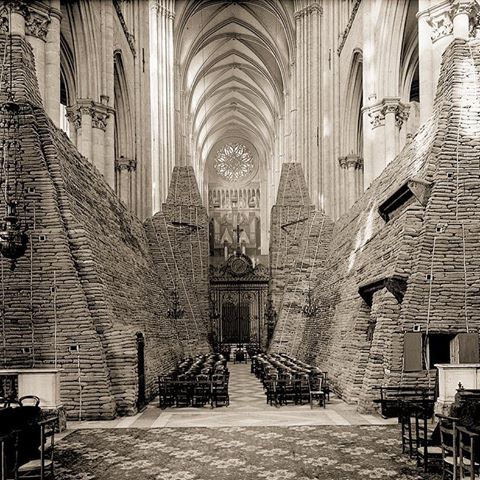
The interior was quite amazing and we took many pictures. We also got treated to images like the one above that showed how the Cathedral was fortified during the war. After a few hours inside, we stepped out into the courtyard and enjoyed some sour ale at a bar sitting right next to it (my wife and folks were not fans of it!) By dinner time, we enjoyed some rather lackluster burgers at another joint that honestly had horse meat on the menu (steak cheval, I kid you not!)
That night, we didn’t all sleep so well. My wife and I had a cramped room that was tucked in the inner corner of the building, and the heat was sweltering. I opened the room’s only window, but she feared a pigeon would fly in (a realistic anxiety, since they seemed to be nesting right outside). As such, we basically tossed and turned and got a very restless sleep. By morning, we weren’t so happy. But we soldiered on to our next destination!
The interior of Amiens Cathedral during World War I
Albert:
After taking our breakfast in the downstairs dining hall and continued on to our destination for the day – the border town of Albert. Here was another historic town that was on the front lines during World War I, specifically during the Battle of the Somme. It also boasts an impressive cathedral – the Basilica of Notre-Dame de Brebières – that saw its share of action as well. And today, it has an impressive WWI museum that is major draw.
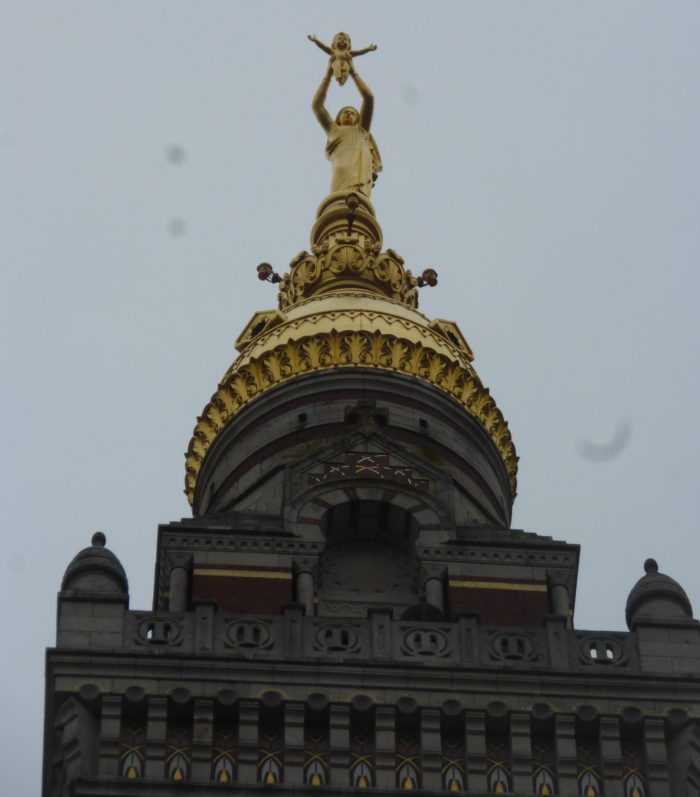
To give you a little history lesson, the Basilica dates back to the 19th century and was built in the Byzantine tradition. Its tower features a gold statue, known as the “Golden Virgin”, which shows the Virgin Mary holding forth a baby Jesus. On January 15th, 1915 – while French, British and German forces were battling for control of the border region – a shell struck the tower and bent it to a near-horizontal position. There it would remain for years to come, and a popular mythology quickly emerged, claiming that whoever knocked it over would be the side that would lose the war.
By the time of the German Spring Offensive of 1918, British shelling destroyed the church. And after the war, like every other town and landmark in the region, the Basilica was rebuilt, complete with the statue of the Golden Virgin on top. Another thing which survived the war was an underground tunnel that sits beneath the cathedral, where wounded were brought when the town was on the front lines. Today, that tunnel serves as a museum, where rooms that sat to the sides of the tunnel are now displays showing equipment and recreated scenes of the war.
The tower of the Basilica of Notre-Dame de Brebières, showing the Virgin Mary and the baby Jesus.
Unfortunately, I have no pictures from the tunnels to post, so my meager descriptions will have to do. For one, despite being brightly painted and well-lit, they retain an undeniable sense of claustrophobia. The entire time I was wandering through them, I felt the oppressive feeling that comes from being underground and there only being a few feet between one wall and the other. This really helps to impress upon you how awful it must have been during the war, when the entire place would have been lit by gas lamps or a few bulbs and it was overcrowded with wounded soldiers, nurses and equipment.
Once you get the other end, there is a lovely shop that sells lots of (what I assume were) historical recreations – helmets, bullets, badges, uniforms. I have heard tell that some people have retrieved various war artifacts from their fields, or have memorabilia lying around the house, and have chosen to sell them. However, the stuff we saw seemed in too good of shape to be a century old.
Speaking of which, we also took this day to visit Beaumont Hamel, the memorial where the Newfoundland Regiment suffered terrible losses during the Battle of the Somme. We had missed the centennial celebrations, which took place a few days before on July 1st, 2016, which was a bit of a blessing. According to the tour guides, the place was packed to capacity, with people even standing in the fields (which are usually off-limits due to worries of there still be unexploded ordinance).
Like last time, before going to the site, we stopped in at Avril’s Tea Room for some eats. This consisted of chocolate milk (the powdered-chocolate mix and milk, which you have to keep stirring if you don’t want a mouth of powder!) and some slices of quiche with bacon (very salty!). Luckily, one of Avril’s cats was doing the rounds and helped me eat some of the bacon bits.
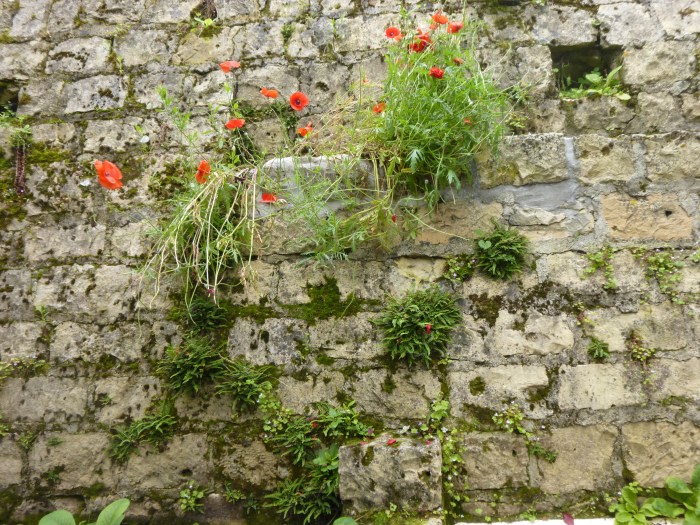
The wall outside the Albert museum, where poppies grow wild!
This was followed by a quick demonstration in a neighboring field, where I showed my parents my latest Taekwon-Do pattern. We all used to train together, and got our Third Degree Black Belts at the same time (1997). However, they quit a few years later and I’ve been training (and keeping them in the loop with occasional demonstrations) ever since. We then visited a farmer’s field that sits next to Beaumont Hamel because my father wanted to see if he could find a crater that he had read about.
Unfortunately, we never found the crater. The field was dense with what we took to be rye and was pretty much impenetrable. And after fearing that were dangerously close to trespassing, we fell back aways and started looking in a plot that was mostly dirt for some shrapnel. As I explained from our last trip, shrapel and unexploded ordinance often turns up in fields throughout Flanders. This, more than monuments and grave sites, lets you know just how totally the landscape was altered by the war years.
And much like the last time we went digging – outside of Langemark cemetery in Belgium – we seriously hit a motherload here! Within minutes of searching, we found several large pieces of metal that bore markings that indicated that they were from an artillery shell. And my father found several shrapnel balls that were still intact! We packed this up in a little bag, and then proceeded to Beaumont Hamel.
My father and I searching for shrapnel in the farmer’s field
As I described it last time, the site is a preserved battlefield. Though it is now grown over with grass, the field still bears the marks of war. As you enter, you see where the British and Newfoundland troops (then part of the Commonwealth and not Canada), were stationed. When you spot the key locations, like the danger tree, and the German lines at the far side of the field, you come to understand how staggeringly wasteful the First World War was. Thousands of men died within the space of a few minutes, and on a stretch of land measuring not much longer than a football field.
We got to see more of it this time, walking from one end to the other. This included all the grave sites and monuments that dot the field, the British and Commonwealth lines, the German lines, and the visitor center. And with this visit complete, we proceeded on to our next (and possibly favorite) destination!
Ypres:
This town is one that captured the hearts of my wife and I after our first visit in 2014. In fact, it would be fair to say it captured my heart long before I visited, thanks to my fathers descriptions of this town, its people and its deep connection to the events of WWI. In fact, I think I spoke so at length of these in my posts about our 2014 visit that I almost feel like nothing more needs to be said.
Psyche! Okay, so we turned up in Ypres midway through our trip. And we checked back into the hotel that served us so well last time. This would be the local Albion, which endeared itself to us in large part because of their awesome breakfasts! I can’t emphasize enough how wonderful a good Belgian breakfast is. Seriously, it combines the best aspects of a French and German breakfast – hard boiled eggs, meats, cheese, muesli, yogurt, croissants, bread and bakes goods, jams and spreads, and lots of butter! And the coffee is none too shabby either!
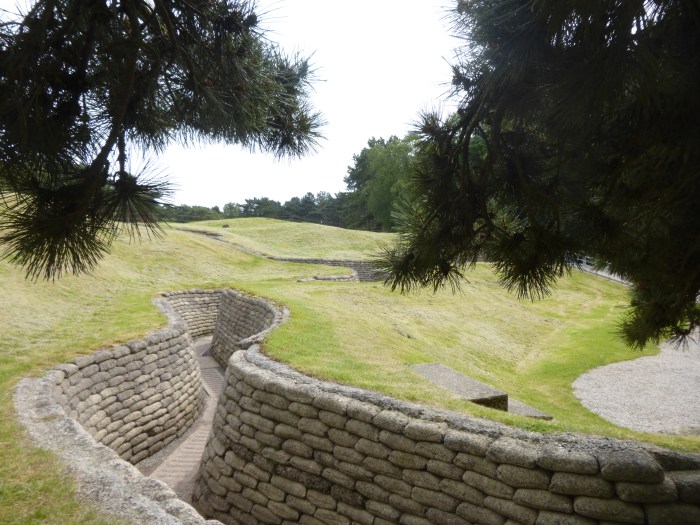
The preserved trench line at Vimy Ridge
We had already laid out which places we wanted to see – the In Flanders Fields Museum, the Menin Gate, the Market Place during Market Day (Saturday), the British Grenadier Bookshop, the medieval walls, and of course the many monuments and cemeteries that are in driving distance from the town.
The wife and I also took the opportunity to go for a job around the wall which guards the old part of town. We had done this the last time we visited – in 2014 – and wanted to see more of it. After running along the part that follows the canal, we ran across the bridge, around the other side through one of the wall’s main gates, and then farther around to the section of the old city that the wall doesn’t encompass.
After that, we had a nice meal near the Cathedral that sits next to the In Flander’s Fields museum, where I discovered a new type of food (Flemish Stew, which is cubed beef is a rich ale gravy, usually served with salad and mashed potatoes) and a new beer (Keizer Karel, a nice Belgian Blond ale), both of which I loved!
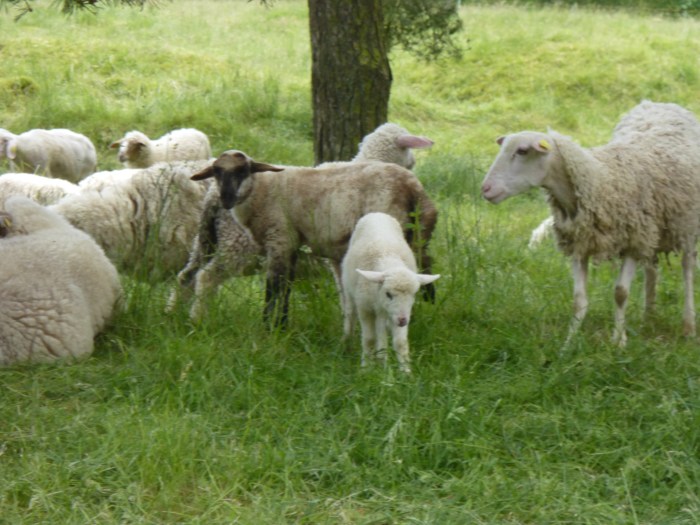
The sheep that grave in Vimy’s fields today
But the greatest jaunt we made was definitely to the Vimy Monument, commemorating the battle of Vimy Ridge in 1917. Visiting this place is tantamount to to a holy pilgrimage for Canadians, as it commemorates the battle that effectively defined Canada as a nation. Once again, we took the underground tour, passing into the tunnels that the Canadian and British used before the battle in an attempt to place mines under the German trenches. As the craters in the region can attest, the resulting explosions were quite large!
One thing I absolutely must include is the story of my mother’s lost purse, and the story of our lunch. I cannot impress upon people enough how excellent French culture is at doing a simple lunch. Pull into any roadside bakery, get yourselves some subs made with French baguettes – they have all kinds of interesting options, from sliced meet to curried chicken or pesto and veggies – and grab some delicious baked goods for desert. This time around, we all got assorted baguette subs and some delicious apple tarts (my mother got a pistachio cream goodie). We bought these before going to the monument and then ate at the picnic area afterwards.
We packed up to leave after all that, got back tot he hotel, and realized my mother left her purse behind. We called the staff at the monument only to find that they were closed for the day. So my folks went back to look for it. As it turns out, there was an RV parked by the picnic area. When my folks returned, the nice couple who owned it (a lovely French Canadian couple) had picked it up and were holding it in case we returned. When they saw my folks, they let them know it was safe and sound and turned it over.
That was a load of my folks minds, let me tell you. They were already dealing with the stress of knowing that one of their beloved cats (Beethoven, their oldest), had broken his leg in an accident (he’s doing fine, btw). With all that complete, we retired back to town for a quiet dinner and a nice sleep. On the next day, we made for our next stop on the tour.
That consisted of seeing locations in central Belgium, Holland, and then our return to France. All of which will be covered in Part the Last!
There’s a potentially Earth-like planet around the closest star to Earth—that’s the space headline that captured the world’s imagination this summer. But here’s something that was easy to forget in all that furor over Proxima Centauri. Our neighboring star doesn’t look anything like the Sun.
We humans have known only one life-sustaining planet in the universe: a green-and-blue globe called Earth. So perhaps we can be forgiven for thinking the ideal ingredients for creating life must resemble what we se here: a bunch of planets around a medium-sized yellow star.
Mind-expanding missions like the Kepler Space Observatory, however, have scientists questioning whether a solar system like ours really is the perfect place to hunt for new Earths and the possibility of life beyond our planet. Lately, astronomers have been taking a closer look at red dwarfs—stars with low mass, low temperatures, and slow rates of fusion.These stars don’t look much like our life-giving Sun, but they make up almost 70 percent of the observable stars in the sky and could survive for trillions of years—far longer than our star.
If we’re going to find life beyond our solar system, many scientists believe it will be orbiting a red dwarf. Here’s why.
Artist’s impression of a sunset seen from the super-Earth Gliese 667 Cc. Credit: ESO
The Alien Worlds of Red Dwarfs
In the past, planet-hunters thought the odds of finding potentially habitable worlds around red dwarfs were quite low. Because of their low mass and temperature, red dwarfs emit just 3 percent as much light as our sun. For an orbiting planet not to freeze into an uninhabitable iceball, it would need to be as close to the star as Mercury is to our Sun. Unfortunately, being so close to a star means the planets probably would be tidally locked, where one side is constantly facing the star and the other side always faces away. Not ideal conditions for creating life.
Red dwarfs are also far less stable compared to larger stars, undergoing sudden rises and drops in the amount of light and heat they emit. This creates big variations in temperature, adding yet another challenge for budding life.
If we’re going to find life beyond our solar system, it will likely be orbiting a red dwarf.
It’s not all bad news, though. Red dwarfs have a considerable advantage over other stars in their incredible lifespans. Our Sun has been around for 4.57 billion years, yet humanity has existed for just 200,000 years. Life takes a long time, and complex life even more so.
Time is one thing red dwarfs have plenty of—they can exist for trillions of years because of their low mass and slow rate of nuclear fusion. Since they’re also so common in our cosmos, the odds of finding planets within that habitable Golidlocks zone is statistically high. For astronomers, the pros are starting to outweigh the cons.
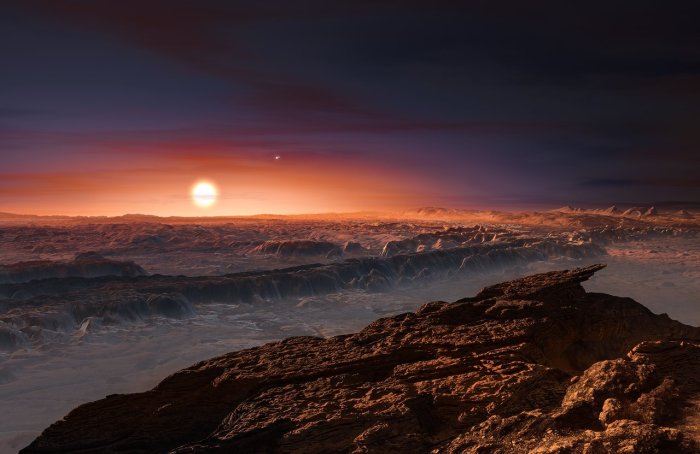
Artist’s impression of what the surface of Proxima b could look like. Credit: ESO
The Case for Going Red
In 2005, astronomers from around the world converged on Mountain View, California, for a workshop sponsored by The Search for Extraterrestrial Intelligence (SETI) where scientists argued the case that red dwarf stars could be the best place to look for aliens. In the end, it comes down to sheer probability. Within 33 light years of Earth there were 240 known red dwarfs at the time, compared to just 21 stars like ours.
Although red dwarfs are hard to find because they’re dim, once they’re spotted it’s much easier to see how many chunks of rock are in orbit. The so-called transit method of finding exoplanets, which the Kepler telescope used to great effect, relies on looking for changes in brightness caused by a planet passing in front of its star. It looks something like this:
Because planets orbiting a red dwarf are likely to hug their stars so tightly, the orbital period is often just a few days long, which makes for pretty good odds of seeing such a transit.
New Worlds Emerge
Since that SETI conference more than a decade ago, oodles of new planets orbiting red dwarfs have been discovered. Between 2005 and 2010, astronomers found six exoplanets orbiting Gliese 581, a red dwarf located about 20 light years from Earth. Two of these planets, Gliese 581-c and -d, lie on the inner and outer edge the star’s habitable zone. Another exoplanet, Gliese 581-g, may also have an orbit fit for habitability (though its existence is still contested).
In 2012, the European Southern Observatory (ESO) published the results of a spectrographic survey that examined 102 red dwarf stars in the Milky Way over the course of six years. They found that red dwarf stars were more likely to have an Earth-like planet orbiting them than a gas giant. Two years later, another ESO study concluded that virtually all red dwarfs in the universe have at least one exoplanet orbiting them. At least a quarter of them have a super-Earth (a planet like ours but slightly bigger) orbiting within their habitable zones.
Artist’s impression of the planet orbiting Proxima Centauri. Credit: ESO/M. Kornmesser
The drumbeat goes on. This past July, researchers from the Harvard Smithsonian Center for Astrophysics (CfA) released a study in which the team calculated the likelihood of Earth-like planets forming within our universe over cosmic timescales, starting with the first stars to form, billions of years ago, and continuing into the distant future. They determined that low-mass red dwarf stars would be more likely than giant stars to maintain a system of planets long enough for life to emerge, and that likelihood only increased with time.
“We considered the likelihood of ‘life as we know it’ to form between the appearance of the first stars and the death of the last stars,” Professor Avi Loeb, a science professor at Harvard University and the lead author on the paper, told PM. ” We found that the likelihood peaks in the distant future around low-mass stars, simply because these stars live much longer than the Sun.”
Other discoveries made in the past five years have also bolstered the case for habitable planets around red dwarf stars with exoplanet candidates around Innes Star, Kepler 42, Gliese 832, Gliese 667, Gliese 3293, and most recently Proxima Centauri. All of these star systems are located relatively close to our own, though still impossibly out of reach with only today’s space-faring technology.
In the coming years, as more exoplanet hunters like the James Webb Telescope and the Transiting Exoplanet Survey Satellite look to the sky, it’s probable that scientists and astronomers will focus much of their efforts on nearby red dwarf stars.
“One of the great discoveries made in the past decade or so is that it seems like there are planets all over the place,” TESS project scientist Stephen Rinehart told PM, “even around these small stars so different from our own.”









 Stories by Williams