Sickness, more Alternate History, and some coming reviews…

Sickness, more Alternate History, and some coming reviews…

I hate being sick! Whenever the seasons change for me, I tend to come down with one of those colds that comes on hard and takes forever to leave. Well, this Fall season has been a double whammy, seems I’ve gotten sick twice in the last four weeks, which has meant a month of convalescing I could totally do without! But at least its given me time to ponder future writing projects.

For starters, I had an idea for an alternate history novel of my own. Its been something I’ve been interested in of late, as my reviews of Man in the High Castle, Fatherland and Guns of the South will attest. Reviewing Rabbletown by Mr. Attwood also gave me another push; somehow reading other people’s work always inspires me to write more of my own. And if there’s one thing I learned from reading other works of historical fiction, it is that there are two basic trends to every story.

1. History diverges due to key events happening just a little bit differently.
2. Ultimately, things converge again and familiar patterns reassert themselves.

Or, to put it mathematically, H = (Ce + Ha) / Env, where H is history, Ce is the Confluence of Events, Ha is human agency and Env is environmental (i.e. external) mitigating factors. Alteration of one (i.e. human agency) is what allows for divergence, but in the end, the other factors assert themselves and balance is restored. Okay, I totally made that up and it was unbelievably geeky! But also kinda cool, right? Ah whatever, my idea:

Red Sky At Night:

A working title, but one which was suggested to me by the maestra of title work (hi Katrina!) And given the title, one might suspect that Communism and/or Communists are the focus. They would be right! My story deals with a question that I’ve been pondering for a long time and with all the fiction I’ve read of late, stuff that deals with similar questions and “what ifs”, I began to turn it into an idea. In short, my story is based on the question of what would have happened had Leon Trotsky come to be leader of the Soviet Union instead of Stalin?

To be fair, this question has been asked by generations of historians and communists alike, particularly the latter group who wanted to distance themselves from Stalin after the full weight of his crimes and megalomania had been exposed. But for historians, the question is more academic, motivating by genuine interest instead of personal beliefs. Overall, they are simply interested in whether or not Trotsky would have been any gentler, or the course of Soviet history any different, had he been in charge.

But first, a little preamble. You see, it is one of the great questions of history why Trotsky did not disavow Stalin when he had the chance. Before his death, Vladimir Ilyich Ilyanov (aka. Lenin) wrote in his “Final Will and Testament” that Stalin was a rude, ruthless man who should never be allowed to have power. Trotsky was seen as the natural successor, and this Will could have shattered Stalin’s support. Stalin’s allies helped him to prevent the Will from being revealed at the 12th Party Congress; however, at the 13th, Trotsky could have revealed it to the Party and done irreperable harm to Stalin’s reputation. Instead, he made conciliatory speech that was intended to heal the rift between himself and Stalin’s followers.

However, this did not prevent Trotsky from being ejected from the Party, put into exile and murdered some years later. So the question of why – why DIDN’T Trotsky denounce Stalin when he had the chance? – has never been successfully answered. We can assume any number of things, but it is at this point irrelevant. The real question, as far as my idea is concerned, is what would have happened had he gone through with it? And that’s where things get fun… if you’re a history geek anyway!

For one, Trotsky wouldn’t have launched Stalin’s crash industrialization programs (aka. the Five Year Plans) in the later 20’s. In all likelihood, he would have continued Lenin’s New Economic Policy (NEP, which allowed for a degree of privatization) and when the big economic crisis loomed, have appointed Bukharin to deal with it (as opposed to purging him as Stalin did). This would have led to the slow recovery of the Soviet economy, and when the Great Depression hit in 1929, Russia would have continued to be spared the worst ravages of it while similarly showing signs of growth.

In addition, the Communists in China would not have been cut off as they had been by Stalin in the 1920’s. Chiang Kai-shek would have continued to fight them, but there would have been no massacre, meaning the Chinese communists would have been stronger and in a better position to dictate terms to Chiang when the Japanese invaded in the late 20’s. As a result, the Japanese army would have encountered stiffer, unified resistance as it fought its way south years later.

Similarly, in Europe, when the Nazi’s come to power in 33, Trotsky would have thrown his country’s support behind the German Social Democrats and would have committed the Comintern (Communist International Organization) to fighting Hitler once he seized power. Over the course of the next few years, during the re-militarizing of the Rhineland, the Anschluss, the Spanish Civil War, and the Sudenten crisis, Russia would have been the most outspoken advocate for resistance.

This had the effect of inspiring people from other nations, particularly France, England and Czechoslovakia, into doing the same, often in defiance of their own governments who sought accommodation. Combined with the fact that Russia’s heavily regulated economy had avoided the scourges of the Depression, these acts of support would convince many foreign nationals of the need to stand with Russia. And without Stalin’s own paranoia and megalomania to discredit and embarrass the Soviet Union and its supporters, these efforts were far more successful.

Finally, after years of advocating Collective Security through the United Nations, Trotsky’s Foreign Commissar – Maxim Litvinov – saw his efforts to create an anti-fascist alliance comes together. During the Sudeten Crisis of 38, Hitler found himself being resisted on all sides. France declared that it would mobilize to help the Czechs since Russia was promising the same. Britain, fearing a Communist victory in the next election, mobilized to pressure Poland and Romania to come to a right of passage agreement with Russia, rather than pressuring Czech president Benes to concede the Sudetenland to Germany. As a result, Hitler was overruled by his own commanders and forced to stand down.

Hilter was unable to recover from this political setback, and when Germany similarly suffered an economic recession a year later, his support dwindled further. By the end of 1939, he found himself ousted from power and the SPD was restored. Mussolini and Franco, one-time allies of Hitler’s, were also brought to heal, the Italian dictator going as far as to relinquish his countries control of Abyssinia (Ethiopia) and remove all his troops from the Balkans. In Asia, Japan also found itself without a friend and was forced to withdraw from the Chinese mainland. Europe and the world celebrated as it seemed that the aggressors had been contained and another world war had been averted.

But this jubilant mood did not last long. Without World War II and the post-war reconstruction to stimulate the economies of the western nations, the Depression continued for several more years. The post-war population boom similarly did not take place. Instead, Europe and the Anglosphere witnessed slow recovery as nations on the continent resorted to increasingly socialist measures to address their economic woes and closer trade ties were established with Russia. Russia, now enjoying cordial ties to most European nations, similarly began to open its economy and its borders to foreign investment and tourism. By the late 40’s, most economies had pulled out of the Depression through a combination of social programs and regulated trade.

This had the added effect of creating a rift between the Continent and Britain, a country that prided itself on its free markets and traditional liberal approach. As socialism began to take root from Lisbon to Vladivostok, Britain sought new alliances to protect its way of life. They found it in the US, which was once again experiencing a Red Scare and cracking down on communists, labor leaders and protesters. Together, they created a secret alliance to protect their mutual interests and continued to eye the Continent with suspicion.

Relations were further strained when in the 1950’s, India began to demand independence. Without the threat of Hitler, the British government had never come to an agreement with Ghandi for the sake of independence. What’s more, agitation on behalf of Europe’s new socialist organizations became a constant source of irritation. Though France was loath to give up its own Empire, pressure from the League and its own populace was mounting. In time, France gave up trying to work with Britain to find a common solution, began disbanding its own empire and urged Britain to do the same. Britain refused and held on to its possessions, but by the early 60’s, virtually every French speaking colony was free and joined the League of Nations.

Which brings me to the opening of my story. It is the early 60’s, the world is divided between two major blocs – the League of Nations and the Anglo-American Alliance – and in between are dozens of nations that are either neutral or part of one or the others sphere of influence. Relations between the two sides are strained as competition for markets, alliances and weapons have reached a tipping point, and some are beginning to fear the possibility of open war. Within this talk of war are even more frightening rumors that both sides are researching advanced technologies – rockets, jet engines, super computers, and even (God forbid!) atomic weapons…

So as you can see, history unfolded quite differently due to the presence of one man instead of another. However, in time, the familiar patterns reasserted themselves. While World War II did not take place from 39-45, it does appear on the horizon by 1960. While there was no Cold War to speak of after 45′ between two nuclear-armed superpowers, a state of detente exists between two similar global powers by the late 50’s with the prospect of a nuclear war by the early 60’s.

That’s all I got for now. More to follow just as soon as Data Miners is complete and my others ideas have panned out. That’s the fun thing about alternate histories though isn’t it? Since they have to do with past events, no one can ever accuse you of not being “current”, right? Who knows? If its successful, I might even write a sequel, Red Sky At Morning, about the aftermath. Thank you honey (my wife) for THAT title idea!

Coming Reviews:

On top of that, tackling “McDune” franchise in a more comprehensive way inspired me to do a more in-depth review of both the Legends and Hunters/Sandworms of Dune series. I’ve shellacked the latter ones before, but I’d like nothing better than giving them a good, specific thrashing! Fans of the elder Herbert, unite and hear me shellack! So, in the coming weeks, I hope to do a review of Hunters, the Machine Crusade, and possibly the Battle of Corrin and Sandworms as well. And since I’m almost finished with the A Song of Fire and Ice series (i.e. Game of Thrones, etc) I might publish some thoughts on them too. Can’t wait for season two of the miniseries! Go Starks! Screw the Lannisters!

P.S. for those who don’t know, Katrina runs a fun and fascinating website named Were You Wondering? She even lets me contribute for some reason… Here’s the link:
wereyouwondering.com

And don’t forget to support Wikipedia! Free flow of information! Fight the power!
Support Wikipedia

Alternate Histories…

When it comes to science fiction, alternate histories are a special kind of sub-genre. They explore the what ifs of history, challenge our notions of inevitability, and open up whole worlds based on what could have been. They are a source of fantasy and speculation on the one hand, offering the reader a chance to explore endless possibilities, and realism on the other, showing how a drastically different world can be entirely plausible.

Some might ask why this sort of thing would be considered sci-fi at all. Why not simply file it under the heading of historical fiction next to all those recreations or Dan Brown novels (Ha! Take that, Brown!)? Well, the answer is that, like time travel novels, there is a scientific basis for this kind of story. I’m sure everyone’s familiar with the Multiverse or Alternate Universes hypothesis. In essence, these theories arise out of quantum mechanics as well as pure fantasy, positing that there may be an unlimited number of alternate universes in which all possible realities have been realized.

So really, creating a world where things unfolded differently from our own is not only fun and creative, its also a relatively scientific approach. Who’s to say that this world doesn’t exist somewhere out there, in a different dimension of the universe as a separate quantum reality? Hell, there may very well be countless such realities paralleling our own. And imagining how and why things unfolded differently in any one of them is what makes them fun!

All that being said, let me get into some prime examples of Alternate History and what was good about them. For starters, the classic tale by Philip K. Dick and the world where the Allies LOST the Second World War.

Man In The High Castle:
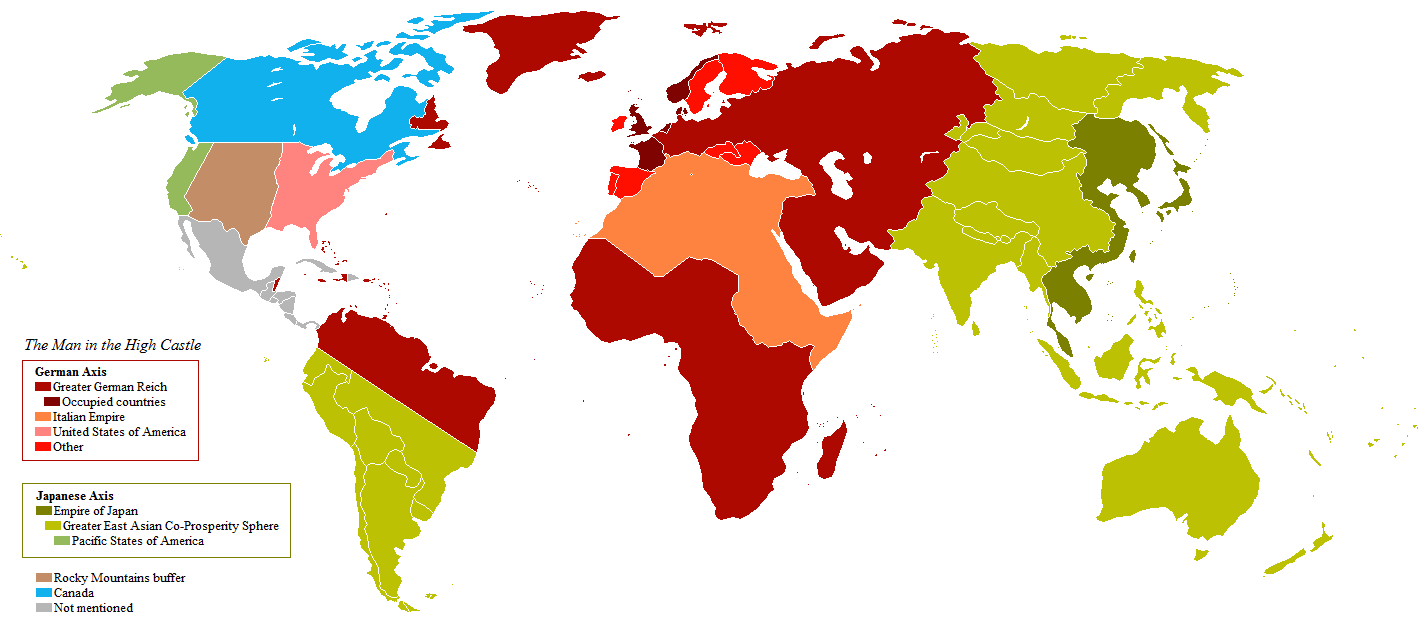
This story takes place in the US during the 1960’s where a different kind of Cold War is brewing between two superpowers. But unlike the world that WE know, in this world those superpowers are Japan and Germany. After losing the Second World War, the US was divided between these two powers, a loose federation of Midwestern states is currently unoccupied between them, and Jews, Africans and other “undesirables” have all but been exterminated. The rest of the world is similarly divided, falling into either the Greater German Reich, the Japanese Empire, the Greater East Asia Co-Prosperity Sphere, or the Italian Empire.

Man In The High Castle, Map

The reasons for this are made clear throughout. For one, the assassination attempt of FDR by Giuseppe Zangara’s in 1933 was successful. As a result, the US experienced a weak string of governments led by FDR’s VP John Nance Garner and then Republican John W. Bricker. Without FDR’s leadership, America never recovered from the Great Depression and was unable to offer military assistance to Britain and Russia or defend itself against Japan when WWII broke out. As a result, the Axis powers won and the US itself was conquered and divided by 1948.

In the world which resulted, the Mediterranean has also been drained, Africa has been sterilized through the worst manifestation of the Reich’s human experiments, and the Reich is sending people to the Moon and further into space. Technology has advanced quicker within the Reich, but at a tremendous cost in human terms, and the resulting impact on the Reich’s culture is evident everywhere. Madness and mass murder have become a permanent part of their psychology, which is part of the reason why they are planning on war again. The Japanese sphere is much more peaceful and phlegmatic by comparison, but technologically less advanced. In any coming conflict, they will be at a disadvantage and they know it!

Enter into this world a series of characters who represent the various facets of society. There’s the Japanese Trade missioner in San Francisco, Nobusuke Tagomi, Mr. Baynes, a Captain in Reich Naval Counter-Intelligence who poses as a Swedish Industrialist, Frank Frink, a secret Jew who is trying to start a jewelry business with his partner, Wyndam-Mason, an industrialist and the former boss of Frink, Robert Childan, an American antiquities dealer who sells his wares to Japanese customers who are interested in owning examples of pre-war Americana, and Juliana Frink, a Judo instructor and Frank’s ex-wife.

In the course of the story, we find that Baynes is traveling to San Francisco to meet with Tagomi, ostensibly as part of a trade mission, but really to deliver a warning. Germany is gearing up for war with Japan and plans on using nukes! Mason introduces the subject of the book known as The Grasshopper Lies Heavy, an alternate history that deals with the subject of how WWII could have been won. Frink and his partner begin manufacturing jewelry in the hopes of selling it through Childan, who does good business with antiquities but finds that innovative new things are not appealing to his Japanese customer base. And finally, we see that Juliana, after hooking up with a Reich secret agent, is traveling to middle America to find the author of Grasshopper, a man known by his signature – “Man In The High Castle”. The Reich wants this man dead, for obvious reasons.

By books end, Juliana kills the German agent once she discovers his identity and finds the man for herself. She learns that, in spite of the mystery surrounding him, he is actually a perfectly normal man who was inspired to create something groundbreaking. His inspiration for the book apparently came from the Oracle, an aspect of the I Ching which people use to ordain the future (and which plays a central role in this story). How he applies the Oracle to past events is never fully explained, but the point is clear. By book’s end Juliana realizes that they are living in the wrong reality. Germany and Japan were meant to have lost the war and the history was meant to unfold differently.

While difficult to follow at times, mainly because of the sort of stream of consciousness way PKD writes, this book was fascinating and is the perfect example of an alternate history. The plot device of the book, itself an alternate history, illustrates beautifully how history unfolded differently in this alternate universe and spares the reader from having to read through an intro that explains how it all happened. And aside from some debatable scenarios, like the draining of the Mediterranean, most of what goes on in it seems highly plausible.

Fatherland:
Another example of an alternate history in which the Axis once again won World War II, but did not conquer the New World. In addition to being a novel, it was a adapted into a TV movie starring Rutger Hauer, Miranda Richardson and Peter Vaughan. The author, Robert Harris, has done many works of historical fiction, including Enigma (also adapted into a movie), the Roman historical novel of Pompeii, and a trilogy centered on Cicero (Imperium, Lustra, and Conspirata). And though Fatherland does resemble Man in the High Castle in many respects, it is arguably more realistic and novel in its approach.

The story opens in the Greater German Reich in 1965 after a murder has taken place. Investigating this murder is Xavier March (played by Rutger Hauer in the movie), an investigator working for the Kriminalpolizei (Kripo). The victim is a high-ranking Nazi named Josef Bühler, and his death was meant to look like an accident. As he investigates further, he finds that Bühler’s death is linked to several deaths of high-ranking Nazis who lived through the war. In each case, their deaths are made to look like accidents.

At the same time, Charlotte “Charlie” Maguire, an American journalist, has come to the Reich to witness Adolf Hitler’s 75th birthday. This event is also being used by the Reich to heal the rift between the US and Germany, as there has been a state of detente between the two since Second World War. While in Germany, she is slipped a package from a stranger containing details about Bühler and begins looking into it herself. In time, March and Maguire meet up and begin exchanging information, hoping to discover the truth behind all the deaths.

In time, they come to uncover that the deaths are part of a cover-up conspiracy whereby the planners of the Holocaust are being eliminated one by one. This is being done in preparation for the meeting between Hitler and Josheph P. Kennedy (the president of the US in this story), basically to ensure that Germany’s crimes don’t get in the way of a new alliance. When the Gestapo get wind of their discovery, March is arrested and tortured, but Maquire escapes and heads for Switzerland with the proof they’ve found.

March is eventually freed with the help of the chief of Kripo, but quickly realizes his rescue was staged so he might lead them to Macquire. He instead heads for Auschwitz, which has been dismantled since the war, looking for some indication of what went on there. He soon finds bricks in the undergrowth, indicating the existence of old structures. Satisfied that it was real, he pulls out his gun and prepares for the inevitable.

The story not only does a good job of postulating what would have happened had Germany won the war (i.e. the Holocaust would have been covered up and disavowed by later generations in order to protect Germany’s reputation), but also on how this victory came to be. In addition to Reinhard Heydrich (the chief of Reich security during WWII) surviving his assassination attempt in 1942, the Germans also learned that the British had cracked their Enigma codes and changed them, thus being able to successfully cut off Britain with their U-boa ts and starve it into submission by ’44. In the East, the Germans also manage to defeat the Russians in the Caucasus in 42′, thus securing the Baku oil fields, cutting off Moscow from supply and finishing them off by 43′.

With victory in Europe complete, they then begin testing their own nuclear weapons and developing “V-3” intercontinental rockets by 46′. However, the US wins in the Pacific and drops their own nukes on Japan, ending the war there and leading to a state of Cold War between the US and Germany. Thus, in this alternate world, it is the US and Germany that are the global, nuclear superpowers rather than the US and USSR. The story also ends on a cliffhanger note, leaving the reader to wonder if war breaks out between the US and Germany and whether or not the main characters survive.

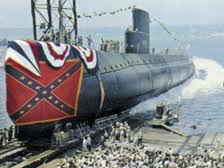
However, not all alternate histories revolve around WWII or even recent events. Some go much farther back in time, tackling pivotal events like the “discovery” of the New World, or the fall of Rome, or, in the case of Harry Turtledove, the outcome of the American Civil War. This is an especially good example of alternate history because of its apparent plausibility.

Guns of the South:
In this story, historian Harry Turtledove explores the very real possibility of what would have happened had the South won the war. It involves some South African ultra-nationalists (Afrikaner Weerstandsbeweging) traveling back in time to supply Robert E Lee’s army with AK-47’s and nitroglycerine tablets (to treat Lee’s heart condition), thus ensuring a Southern victory at Gettysburg and in the 1864 campaign. The motives for this aid are made clear in the course of the story when Lee finally questions the helpful men who’s accents and technology they find strange and intriguing.

In essence, the leader of the time travelers (known as the AWB, the anglicized version of which is “America Will Break”) tells Lee that in 2014, where they have come from, white supremacy has not endured and that in South Africa by their time, blacks have eclipsed whites as the dominant power. They feel that the only way white supremacy will survive is if the American South won the Civil War, thus ensuring that it would have a home in the US in the future. Lee accepts their help, and the Confederates eventually win the Civil War and the Union, England and France are forced to recognize the CSA.

What follows this is not only intriguing but highly plausible. Lee becomes president of the new south and abolishes slavery, in keeping with his views and the reality of the post-war situation. Not only is slavery untenable from a moral standpoint in his view, Lee knows that forcing former slaves to return to the plantations will only lead to violence and spur on black guerrillas who are now operating throughout the Confederacy. At his inauguration however, men from the AWB attempt to kill him with Uzis and end up murdering his wife, VP and several dignitaries. Lee then seizes their HQ and finds many more things from the future (like lightbulbs and books about the marginalization of racism in the future). He then successfully uses these books to convince his congressmen that slavery is obsolete and must be condemned. Abolition is thus passed in the South without incident.

The story ends with the Union, angered by British recognition and support of the South, invading Canada. Also, Lee is made aware of the fact that they are developing their own version of the AK-47 in case of future war. However, he remains convinced that the CSA will maintain its technological advantage, and will in time catch up with the North in terms of industry and be able to defend itself if worse comes to worse.

Having completed this one volume, Turtledove went on to create ELEVEN more books in the series, drawing out this alternate history thread and creating a very plausible timeline in the end. To sum it succinctly, the US enjoys mostly peaceful relations with the CSA for about fifty years, but angry over England and France’s support of the CSA, aligns itself with the new power in Europe at the end of the end of the 19th century – The German Empire! As the alliances take shape in the early 20th century, it’s Germany, Austria-Hungary and the USA versus Britain, France, Russia and the CSA. Neat huh? One can see without much effort how this will shake things up!

In the US too, politics change as the Republican Party is blamed for losing the war. It disappears and Lincoln, himself despised, ends up joining the Socialist Party, the only rival to the Democrats. With America and Germany as allies, cultural changes occur as well, such as fine mustaches becoming all the rage. This is in reference to Kaiser Wilhelm who was renowned for having a bushy soup strainer on his upper lip!

But its the wars where the real change occurs. When World War I comes around, America is immediately involved and the stalemate of trench warfare is seen running across the Mississippi river and also between Canada – part of the British empire – and the northern US. The black former slaves of the Confederacy, freed by President Robert E. Lee in the 1880s but then left to rot, rise in a Communist-backed revolt in 1915 but are ruthlessly crushed. In the end, the US army conquers Canada in 1917 with the use of tanks and breaks through the Confederate lines in Kentucky and Virginia. Russia is similarly brought out of the war by a revolution in this timeline, but not a Communist one. The US navy then turns its attention to Britain and puts up a blockage with starves it into submission. The USA and Germany have won the war.

Also similar to real history, the victorious powers impose harsh peace terms on the losers, complete with territorial losses, “war guilt” clauses, reparations, and disarmament. Politics thus become radicalised in the defeated powers – Britain, France and the Confederacy – and fascist parties gain control in all of them. The Second World War then arrives on schedule after a demagogue who is voted in in the CSA who resembles Hitler, though his hatred is aimed not at Jews but at blacks. The war opens with a Confederate blitzkrieg into Ohio that almost cuts the US in half, but in time, the weight of numbers begins to swing the balance the other way. Much like in the real WWII, the death camps run by the Freedom Party to exterminate the South’s blacks continue to run full blast, even as their armies are in full retreat.

Both sides are also racing for nuclear weapons, and some are used in the end – but Germany and the USA have more of them than Britain and the CSA, so the victors in the First World War win once again. And this time, the Confederacy is fully occupied and formally abolished. The United States is reunited after generations of disunity, but a genuine reunification will not come for many generations, if at all.

Thus, while some small changes in historical events led to some rather cataclysmic changes in Turtledove’s story, things pretty much meet up with real history in the end and come to resemble the world as we know it today. Russia is not Communist, and the Cold War of the post-WWII era is markedly different, but the general outlines are the same. So in a way, his story is just like PKD’s and Harris’ in that things diverge in the beginning but come back to what we, the readers, interpret as the normal course of history in the end. Hmmm, one might construe that their is a point in all this, a lesson if you will. And in that, they’d be right!

The Lesson of Alternate History(?):
This humble narrator would suggest that if there is a lesson to be learned from Alternate Histories, it is that the force of history is a powerful, weighty thing and that while small changes can have a big impact, the general pattern reasserts itself before too long. At least, that is what the authors in question appear to be saying. In PKD’s Castle, the story ends with the character of Juliana Frink realizing that Germany and Japan lost the war and that the author of the alternate history book wrote it for just that reason. Fatherland ends with every indication that the Holocaust will be revealed and that the US and Germany will remain enemies. And Turtledove’s Guns of the South, though it takes about half a billion words to get there, ends with WWI and II playing out pretty much the same as they did in real life.

But as I’m sure someone wise might have said (might have just been me!), books tell us far more about the author than the subject. It could be that history is a chaotic arbitrary process and the idea that it will meet up with us or overcome obstacles that are artificially put in place is an illusion. For all we know, causation and inevitability are things we impose based on a false consciousness, that we believe we are where we are meant to be because we have to. That idea is often explored in alternate history as well, where the characters believe that their own timelines are the “right” one and that if tampering took place, it was for ill. However, the stories always seem to end with things going back to the way they were meant to be. Everyone’s happy, or at least, a sense of balance is restored.

Either way, it tells us much about ourselves, doesn’t it? We are creatures who like to tamper with things, who like to ask “what if” and experiment with the natural order. But in the end, we also depend on that order and want to know that it will unfold as its meant to. Whether its an illusion or its real, its one of the many things without which, we would be lost!

Sidenote: Shameless plug, but it so happens I wrote some articles on the subjects of the multiverse and alternate universes. They are available at Universe Today.com, here are the links:

Multiverse Theory
Altnernate Universe