The Alien Graph

The Alien Graph

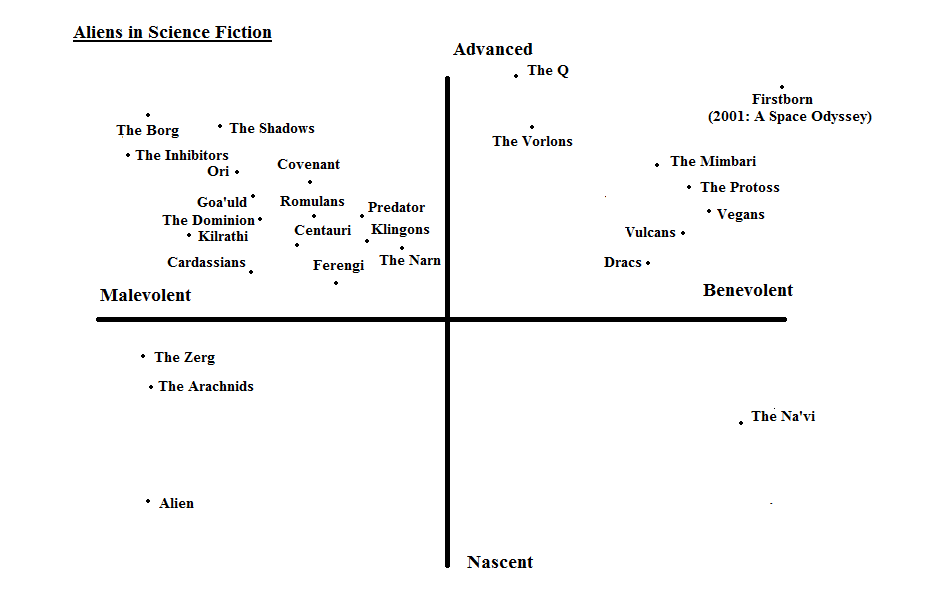
Behold! After a few days of contemplating what I said in the Ancient Aliens post – you know, about how alien’s technology and moral capacity are often interrelated in sci-fi – I realized I needed to put it into graphic form. And as I said in that post, if we are to consider technological advancement as one axis and level of benevolence as another, then the outcome would look something like this:

click to enlarge

The design is based on the Zombie graph that’s been floating around the internet for some time. There, the designer placed different Zombie movies based on two criteria: intelligence and speed. In much the same way, I’ve designed a graph for aliens that is based on two similar criteria: technological advancement and level of friendliness.

I selected aliens that I thought best represented the range of development and behavior in the sci-fi genre. I also included as many franchises as I could think of, just off the top of my head. I certainly wasn’t scientific about it, just relative and to the best of my abilities. And when I was done, I noticed an interesting pattern…

Hostile/Advanced Aliens Rule!:
For example, notice how the vast majority of races from your well-known franchises (Star Trek, B5, Stargate, Star Craft, AvP, Halo, etc) fall into the upper left quadrant. This is the area where malevolence and technological sophistication combine in varying degrees. By contrast, the second largest concentration of races occurs in the advanced/benevolent quadrant, again to varying degrees. Almost no races fall into the nascent (i.e. primitive) quadrants, be they hostile or gentle.

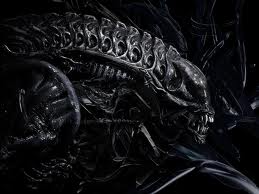
On the one hand, the Xenomorph from Alien and the Arachnids from Starship Troopers both fell into the technologically backward category (technically), and were both classified as malevolent because of their innate hostility to foreign organisms. The Na’vi, from Avatar, were the only alien race that fit the bill for technologically nascent and benevolent. I’m sure there are plenty of examples that could stack this analysis in a different way, but like I said, this was off the top of my head.

The Zerg, I have to admit, were a bit of a conundrum for me. While they are technically a race that does not employ technology per se, they are highly advanced in terms of their biological evolution, to the point where they rely on specialized creatures in the same way that humans rely on machinery. But then again, that’s all for the sake of ensuring that the different factions in the video game are evenly matched. It’s not meant to be a realistic assessment. Much the same is true of the Xenomorphs. While they do not employ tools, fly around in spaceships, or use guns, they are nevertheless an extremely evolved organism that is capable of besting humanity in any contest.

And just to be clear, the middle point of the graph (0,0, where the axes meet) is where humanity stands now in terms of moral behavior and technological development. Sure, some say we’d fall into the evil quadrant, but I tend to believe that humanity is morally ambiguous, neither too good or too evil. Where aliens fall into the spectrum in most sci-fi franchises is meant to reflect this. Much the same is true of technological prowess, where aliens are classified as “advanced” or “primitive” solely in comparison to ourselves.

This all might sound anthropocentric, but that’s the point, isn’t it? These are stories written by human beings for other human beings. All the references, symbols and measuring sticks come from inside us. So in the end, aliens themselves, as represented in our best science fiction, also come from inside ourselves. Their values, their tools, and even their appearances are all constructs of what is familiar and accessible to us. In short, they are merely tools with which we measure ourselves, both morally and technically.

Conclusions:
Well, right off the cuff I’d say the reason we prefer our aliens hostile and advanced is because it makes them seem more threatening and scary that way. Clearly, this makes for a more interesting story. While an alien race that is kind, innocent and backwards can make for an effective tale about the evils of colonialism and imperialism and how one can easily find themselves on the side of evil, these seem to be fewer and farther between. I’d say this is most likely because moral allegories are less intriguing than action dramas. Or maybe just prefer to think of ourselves as the good guys. Let someone else serve as the allegory for evil, selfish and runaway imperialistic behavior!

In addition, there’s the very real possibility that humanity will be making contact with an intelligent life form at some point in the future. And when we do, it’s likely to be the most awe-inspiring and frightening of experiences. When it comes to the unknown, ignorance begets fear and we prefer to err on the side of caution. So it would make sense that whenever we think of aliens, even if its just for the sake of fiction, we would naturally prefer to think of them as both learned and potentially hostile. If indeed aliens serve as a sort of projection for humanity’s own thoughts on itself, than pitching them as potentially hostile beings with advanced technology represents our own fear of the unknown.

In any case, if there is life out there, all these questions will be resolved in the distant future. Hell, maybe even the near-future. If some theorists are to be believed, aliens have already made contact with us and might even be walking among us right now. Granted, most of these people are hanging around the 7/11 with tin foil hats on, but they can’t all be crazy, right?

Cool Guns!

I’m getting hooked on writing conceptual posts, mainly because it gives me the chance to explore a lot different franchises of sci-fi without being too constrained. Not only that, I really like digging into subject matter of finding the common elements; in this case, the stuff that makes cool stuff cool! So far, I’ve covered the concepts of Galactic Empires, Planetkillers and Ancient Aliens. But today, I thought I’d tackle something a little simpler that’s been known to make sci-fi geeks experience collective nerdgasms! Today the topic is: COOL GUNS!

BFG 9000:
Starting off this review right is the BFG (Big F***ing Gun) that comes to us from the Doom universe. Fans of that old franchise know this one by heart, and I’m sure they remember with some nostalgia what it was like firing this thing. Given that Doom was like most first-person shooters, this weapon would turn up late in the game as a way of dealing with the more tenacious evil critters. And it worked! One shot released a big cloud of green plasma which killed everything in the vicinity. Unless it was a boss, in which case, it might take two or three… Apparently, Quake II and Quake III Arena pay homage by including their own version, known as the BFG10K.

“Blow Dryer”:
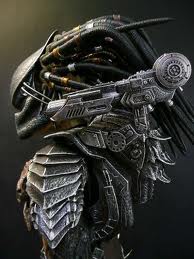
Also known as a “burner” or plasma caster, this weapon was the mainstay of the Predator aliens and is featured in the many movies, comics, video games, and novels of the franchise. Mounted on the shoulder, this weapon would discharge a ball of red-hot plasma into objects, causing damage akin to an explosive device, but with none of the messy shrapnel. Though the standard model is shoulder mounted and aimed using a heads-up-display and laser sight, the Predators in later movies were also known to carry wrist-mounted versions of this weapon as well. Like their claws and wrist bombs, they were embedded in the cuffs and served as a backup. One of these makes an appearance in Predator 2 during the meat locker shoot-out.

BR55 Battle Rifle:
This baby is a Halo universe invention, and is the mainstay of the UNSC infantry. Aesthetically, this rifle is based on several bull-pup assault rifles designs from the modern era, a design which is clearly growing in popularity. Some potential sources for inspiration include the Austrian-made Steyr AUG, the French FAMAS, the British L85, the Belgian F2000, and the experimental PAPOP design. Like all bull-pup rifles, this gun loads from the rear and can cut through Covenant opposition with ease! Even when I’m playing as the Covenant, this was my second favorite weapon to be carrying (the first was either two submachine guns or two pistols, or a combinati0n thereof!)

Blade Runner Gun:
In the classic move Blade Runner, Detective Rick Deckard was responsible for locating and “retiring” replicants. And the weapon he used to do just that is featured here. This is the model of a Blade Runner service revolver, for which little information exists, but whose appearance and performance pretty much speaks for itself. Based on a standard service revolver with several extra bits added on for effect, this gun pretty much screams cyberpunk.

In addition, there are several scenes in the movie where Deckard’s gun turned flesh (artificial though it was) into mush! Recall the scene where Deckard uses this gun to punch several holes in Zhora? Or how about the scene immediately thereafter where Leon is beating the crap out of him, and Rachael manages to save him by using his own weapon? Yeah, whenever this gun was brought out of his holster, some big holes resulted!

Blasters:
When asked about his idea for a “Galactic Empire”, George Lucas said that he wanted to create something that was as aesthetically similar to Nazi Germany as possible. This was reflected in the weapons as well. Numerous guns that were modified and used as props in the movie were based on WWII vintage weapons. The first and most recognizable is Han’s blaster, aka. the DL-44. Based on the German C96 Mauser pistol, this weapon was apparently a popular item amongst smugglers and traders, being very powerful and compact. It was also quick on the draw, which comes in handy when in a bar and looking down the barrel of a bounty hunter’s gun (Han shot first!)

The next was the standard issue blaster used by both the Stormtroopers and the heroes, especially in the first movie during their daring breakout from the Death Star. This blaster, known as the E-11, was based on the Sterling submachine gun of WWII. Simple, consisting of little more than a barel, a handle, and a side-mounted magazine, the gun was easily altered with a few pieces of molded plastic and a scope that made it look suitably futuristic.

The heavier T-21 Blaster Rifle was yet another WWII adaptation. Built around a Lewis machine gun, it was featured in the first movie during the Mos Eisley scene where Stormtroopers were seen walking through the streets searching for Luke and Obi Wan.

Last, there was the DLT-19 Heavy Blaster, the heaviest infantry weapon in the Star Wars franchise. In keeping with his love of WWII kit, Lucas’ set designers used a German MG42 to fashion this one. This blaster appeared aboard the Death Star in the hand of the search party that went over the Millenium Falcon, and again when Chewy commandeered one to take out the remote blasters and cameras in the cell block.

GE M134 Minigun Handheld:
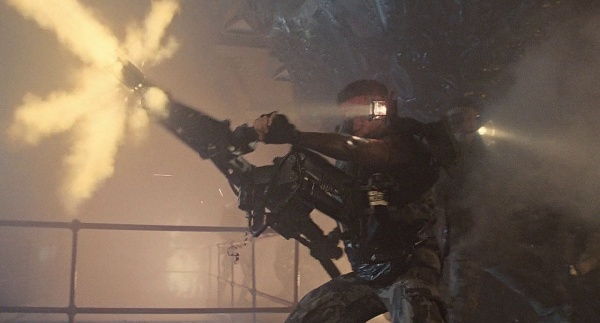
How could I have forgotten this one? I mean really, is there a better visual representation of sheer badassery than the handheld minigun from Predator? Sure, the mere idea of a man carrying a minigun around by hand is so unbelievable its makes me want to laugh out loud. Considering the weight of the weapon, even before you factor in all the ammo, coupled with the killer recoil that no human could withstand – all of this makes the physics totally implausible! But what the heck? It was fun to watch! I can’t imagine anyone not feeling the hair on the back of their neck stand on end as those barrels started whirling and the bullets streamed out, so fast it sounded like a turbine! And I know from talking to actual pilots who’ve seen this baby in action that if you add tracers to the mix, its like watching a laser show. WHURRRRRRRRRRRR! Total carnage!

Grammaton Cleric Pistol:
Though it was not my favorite movie, there were undeniably cool aspects to the movie Equilibrium. One of which was all the cool Gun Kata moves pulled by Christain Bale, Angus Macfadyen, and the other Grammaton Clerics with their special pistols. These guns were clearly souped-up versions of the Beretta 92FS. They clearly fire in both semi-automatic and automatic bursts, and were retrofitted in one scene with impact hammers on the handles.

In addition, some rather curious reloading tricks were devised. One involved arm-rails that would deliver fresh magazines from inside the cleric’s sleeve. Another included magazines that could be balanced upright, which gave the cleric the ability to simply slam his gun down on the fresh magazine once the empty ones had been ejected and go right on shooting. It’s all about rate of fire in this movie, making sure the bullets (and dust) keep flying!

The Lawgiver II:
Also known as the Judge Dredd gun, this pistol is also a modified version of the Beretta 92FS, with molded plastic and LED lights giving it a future-city look. In addition to a rapid-fire setting, the gun also boasts a grenade launcher, signal flare launcher, and a special dual round known as the “double-whammy”. It also has a taser device built into the handle so that only a Judge can operate it, and a DNA tagging system that ensures that every slug fired can be traced back to the person operating it.

M41A Pulse Rifle:

The franchise Alien gave so much to the world of sci-fi geeks, not the least of which came in the form of cool guns. And the Pulse Rifle was arguably the mainstay of that contribution. In fact, it was this gun that inspired entire generations of futuristic weapons, and the name itself has been used many times over to refer to energy and slug-thrower weapons in sci-fi franchises.

This is an important disctintion seeing as how “pulse”, to most sci-fi acolytes, refers to weapons that fire out pulsing beams of energy (most likely plasma). But in this case, it referred to pulses of caseless ammo, big bursts of projectiles that would tear through acid-spewing aliens by the dozen. And let’s no forget the grenade launcher that was attached to the underside, how cool was that? The signature, click-click, BOOM! combination was as pleasing to the ears as it was to the eyes.

But in addition to being just so freaking cool to look at, the amount of creative energy and ingenuity that went into making it was quite impressive. For example, the people in charge of set design wanted a prop that would actually fire, so they built their rifle concept around the M1A1 Thompson submachine gun, a WWII vintage weapon that was small and sturdy enough to get the job done. To simulate the grenade launcher, they attached a cutdown Remington 870 shotgun beneath it and mounted the foregrip of the SPAS 12 shotgun on top of that. Then, they applied pieces of molded plastic and a little LED display to the side to make it look especially badass! Remember that scene where Ripley used it to level that room full of egg’s with the Alien queen inside? Iconic!

M56 Smart Gun:
I know, I’m shoving two examples from a single franchise into one post. But I think it’s worth it. And for fans of Aliens and sci-fi junk, you just can’t make a list of cool guns and not include the Smart Gun! Much like the Pulse Rifle, this weapon was the perfect marriage of aesthetics and ingenuity.

To fashion it, the set designers for Aliens used another vintage WWII weapon (like Lucas, they used the German MG42 machinegun) some motorcycle handles, and the arms from a Steadicam mount. The result, once again, was pure badassery! And the name, according to the expanded Aliens universe, comes from the fact that these weapons could aim themselves. Marines would simply employ their eyepieces and helm cameras, and the guns would pick up movement and target it. Oh, and that scene where Vasquez opens fire in the Alien lair… classic! “Let’s roooooock!”

PPG’s:
The PPG, or Phased Plasma Gun, is the standard weapon of security officers and soldiers in the Babylon 5 universe. According to franchise sources, the PPG fires a small charge of superheated helium which retains its shape and small volume via a residual magnetic field. Upon impact with an object, the magnetic field is dissipated and the heat discharged. PPG bolts also cause visible distortion as they travel through air, hence the blurred effects when people in the show fire off their weapons.

The PPG comes in several standard models. First, there’s the service pistol which every security officer and member of station personnel. The heavier rifles are busted out during riots and times of war, along with the vests and riot helmets. In two episodes (S01E20 Babylon Squared and S05E19 Wheel of Fire ) Garibaldi has scenes where he busts out the BFG version.

Reason:
This weapon is both deadly and cheekily-named, and is taken from Neal Stephenson’s smash-hit novel Snow Crash. This picture doesn’t quite do it justice, but its a close approximation. In the novel, Reason was a gatling gun that was the property of Uncle Enzo’s Mafia, an organization that ran a series of franchulates along the west coast of the former US. But unlike your conventional gatler, it fired caseless depleted-uranium slugs, bullets that are incredibly dense and very heavy. Hence, the weapon packed a massive punch and a mad recoil.

During one of the later chapters, Enzo’s men use the gun to take out a pirate yacht while firing from a life raft. A single burst demolished the pirate ship, but the recoil sent their boat about fifty meters in the opposite direction! This scene also had a hilarious set up when the mafiosos first broke it out, saying that if they ran afoul of any privateers, they were sure they’d “listen to Reason.”

Phaser Rifle:
Over the years, Star Trek has been a source of many weapons designs. However, some were arguably more cool than others, at least in my opinion. These came largely from the later spinoffs and movies, in particular DS9 and Voyager. Prior to this, phaser designs were either too boxy, too bulbous, or just too… Buck Rogers-y! When you’re repelling boarders, or on an away mission, one thing you want is a kick-ass weapon to bolster your confidence and inspire fear in your enemies.

These requirements were met by a new model of weapon, known as the type 3 Phaser Rifle. This weapon went through many variations throughout the course of the show. The first design was very boxy-looking, whereas later models tended to be more sleek and menacing (as shown above). Then came a whole new design, known as the Compression Rifle (seen below), which was apparently an even more powerful model. These weapons were specifically created for use on starships where heavy combat was expected, or in times of war.

Final Thoughts:
Man, that was a long list! But that’s the thing with cool ideas, they tend to get around. And as usual, I noticed some key patterns in the mix which I think should be pointed out. In all of these cases, there were apparently two classes  that each weapon fell into.

  1. Directed-Energy Weapons: Arguably the more science-fictiony of the two. These weapons first made their appearance in Saturday morning serials like Buck Rogers from the 1950’s. They come in many forms – ray guns, death rays, beam guns, blasters, laser guns, and phasers – but the core concept is the same. Phased or directed energy, usually in the form of plasma, that is focused into a tight beam and then emitted. The ironic thing is, since the 1950’s, sci-fi franchises have moved away from these seemingly farfetched devices and come to rely on ballistic weapons designs more and more. Meanwhile, Directed Energy Weapons have become more and more feasible, with several prototypes being explored by military contractors today.
  2. Ballistic Weapons: In the context of sci-fi, these often take the form of weapons that use caseless ammunition, electromagnetically-propelled ammunition, or just standard bullets. But in each case, the weapons that use them are adapted to look more futuristic. Interestingly enough, the future seems to be coming sooner than we thought. In just about every developed nation, firearm technologies are being explored under the banner of the “Future Soldier” program. Having studied many of these, I can tell you that they put much of what was shown in Aliens to shame, especially where Heads-Up-Displays and portable computers are concerned! Again, the future seems to be coming sooner than we thought!

Ancient Aliens (Updated)

And I’m back with another conceptual post, hard at work exploring the ideas that run deep in the grand genre that is sci-fi. And this is one that I find particularly cool, mainly because it’s just so freaking existential! I mean what is there that can possibly throw a wrench into our collective anthropomorphism more than knowing that there is sentient life out there that significantly predates our own, especially if we were to find out that they had something to do with our own evolution…?

In some ways, this is a shout out to the “ancient astronauts” theory, which speculates that extra-terrestrials came to Earth long ago and left some evidence of their visit behind. This can be limited to something as basic as a structure or a relic, or can run as deep as having influenced human cultures, religions and technological development. Regardless of whether or not this theory is to be taken literally, it is well represented in the sci-fi community. Here are some examples that I have assembled:

2001: A Space Odyssey:
A classic example of an ancient species, ancient astronauts, and one of my personal favorites! Originally conceived in the form of a screenplay by Arthur C. Clarke and Stanley Kubrick, the concept of the TMA-1 monolith aliens was a central plot element to one of the most groundbreaking science fiction movies of all time. However, owing to Kubrick’s esoteric style, not much was ever made clear about the species that built the monoliths. Luckily, Clarke went on to develop the idea at length in his novelization of the movie and its many sequels.

According to the novel, and ongoing interviews with Kudrick, the beings that built the monoliths were known as the Firstborn – an extremely ancient race that achieved sentience millions of years ago and were exploring the galaxy long before humanity even existed. The monoliths were their means of traveling from star to star, which they did in order to seek out life and help it along. In the course of their travels, they came upon Earth four million years ago and discovered Simians that were on the verge of starvation. By teaching them to expand their diet through hunting and some basic tricks to cultivate their manual dexterity, they ensured not only the survival of higher order primates, but the eventual emergence of humans as a species.

The story of 2001 thus takes place in the near-future (from when it was originally written) where humanity has developed into a star-faring race and colonized the Moon. Not far from this colony, a monolith is discovered buried under millions of years of moon dust. After examining it, to no avail, they discover that it has sent a signal out to Jupiter. The ship Discovery is then dispatched to investigate, where it finds an even larger monolith in orbit around Europa. The mission ends quite mysteriously as David Bowman, the last surviving member of the crew, flies closer to it in a small pod and disappears. Adding to the mystery were his last words: “My God, it’s full of stars!”

In subsequent books, the mystery of Bowman’s disappearance and the nature of the monoliths is made clear. Essentially, the monoliths are alien machines that contain their consciousness, and some are gateways which allow for FTL space travel. Bowman, when he came into contact with the one around Europa, was transformed or downloaded (depending on how you look at it) and became one with the monolith. The reason they are hanging out around Europa is because they are currently working to transform Jupiter into its own star so that life may blossom on Europa (which scientists speculate is already teaming with life underneath its icey shell).

Cool idea! But you see, there’s a snag… Apparently, the First Ones have also been known to weed wherever they’ve sown. What would happen if they came to the conclusion that humanity was too aggressive for its own good, the result of them teaching us how to harness an appetite for killing other animals and members of our own species? This is the premise that is explored in the finale 3001: Final Odyssey, and which was left on a cliffhanger note. Unfortunately, Clarke died in 2008, leaving fan fiction authors to speculate on how this would all play out…

Alien vs. Predator:
Note: this is not a reference to the terrible movie or its even more terrible sequel! No, in this case, I am referring to the wider franchise, as exemplified by its many video games, comics, novelizations, and even the independent (non-crossover) movies. In these cases, we get a glimpse of two races that predate humanity by hundreds of thousands or even millions of years. Their outward characteristics alone make them cool, and they are both pretty badass in their own special ways. But what is especially cool about them is the fact that very little known about them, other than the fact that they are very, very dangerous!

“I admire its purity. A survivor… unclouded by conscience, remorse, or delusions of morality”. That is how the Alien, or Xenomorph in AVP terminology, was described in the very first movie. Their origin is unknown, as is the timeline of their existence and the circumstances of their evolution. However, one thing is clear: on this last note, it must have been something pretty harsh! I mean really, how difficult must life have been on their homeworld for something like the xenomorph to have emerged. They proliferate at an alarming rate, require living being to gestate, and are designed purely for the hunt!

Overall, their race is divided into two symbiotic and interrelated species. First, there are the “Facehuggers”, the spidery creatures that attach themselves to living creatures and implant them with embryos. This in turn gives rise to the “Chestbusters”, the warrior aliens that seek out, kill and capture creatures for the Facehuggers to use. At the top of the pyramid is the Queen, a Chestbuster who has evolved to become the egg-layer who gives birth to more Facehuggers. An interesting chicken and the egg type arrangement, and something which only adds to their mystery!

The Predators, on the other hand, are relatively straightforward. At their core of their society lies a warrior ethic, where each and every male member of their species is trained to be a hunter. In time, hunters accumulates honor and seniority within their culture by attaining as many kills and trophies (i.e. skulls) as possible, preferably from different species. In fact, it is rumored that a single scene from Predator 2, in which an Alien skull appeared in a hunter’s trophy case was the basis for the whole AVP crossover.

In addition, there are also some clear and apparent rules to the hunt. First, each hunter is drawn to arenas of conflict. In the first movie, one chooses a hunt in Central America where a guerrilla war is taking place. In the sequel, one travels to LA during the height of the drug wars. In both cases, the get a sense of their terrain, taking out the easy prey first, and gradually working their way up to the top carnivore. At first, they rely on their advanced weaponry and stealth. But when at last they face off with the strongest prey, they fight them in the open in hand to hand combat.

God knows how long they’ve been doing this. But given their obvious level of technology, its clear they are not exactly recent additions to space race!

The “Ancient Humanoids”:
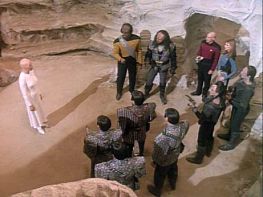
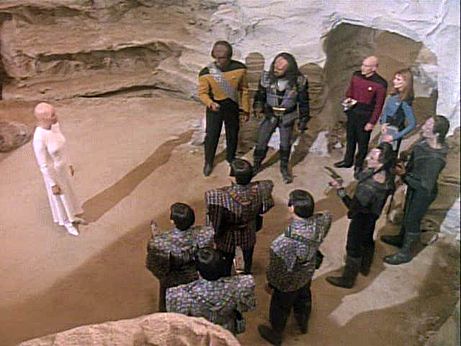
Now this was one I didn’t much like, but it’s an example of the concept of ancient astronauts nonetheless. And it comes to us courtesy of Star Trek: TNG. from an episode named “The Chase” (episode 146). In it, Picard’s old friend and mentor turns up dead in the course of an expedition which he claims could be the most profound discovery of their time.

After retracing his footsteps, Picard and the Enterprise are joined by three other search parties – one Klingon, one Romulan and one Cardassian – in orbit around a dead planet. When they reach the surface, they find that all the clues lead to a recording left behind by an ancient species. In the recording, the humanoid alien tells them all that they are the progenitors of every sentient race in the quadrant, that their DNA was planted on countless worlds. This is apparently why so many species are humanoid, and means that humanity shares ancestry with all these would-be enemies.

Heartwarming, and kind of cool if it weren’t such a convenient explanation as to why all aliens in the Star Trek franchise are humanoid. This is something that’s always annoyed me about the franchise. It’s not enough that all the aliens speak English and look like people, minus the occasional molded plastic on their faces. But to make matters worse, they always got to make a point of drawing attention to their humanoid forms. So when it came right down to it, this episode felt more like a contrived explanation than a homage. Personally, I would have thought that limited budgets would be the reason, but what do I know? I’m no xenobiologist!

The First Ones:
Another favorite which comes to us courtesy of the Babylon 5 universe. According to the expanded storyline, the First Ones were the first beings to achieve sentience in the Milky Way Galaxy. By the time of the show, most of them had left our corner of the universe in order to explore other galaxies and what lies between them. Only two remains behind, ostensibly to act as shepherds to the younger races. They were known as the Vorlons and the Shadows. However, in time, the two races turned on each other because of their diametrically opposed ideologies.

The Vorlons believed that development and progress came from order. In the course of their long history, they travelled to many worlds inhabited by sentient races and began tampering with their evolution. In each case, they presented themselves as angels, thus ensuring that sentient beings would see them as creatures of light and truth. In addition, they fostered the development of telepaths for use in the coming wars against the Shadows, whom they knew to vulnerable to psionics.

To illustrate this, the Vorlons are often presented as being aloof and rather stodgy figures. In fact, Lyta Alexander, one of the show’s secondary characters, commented that despite their power, the Vorlons are a highly sensitive people who do not react well to change! In the course of the show, they were initially hesitant to commit their forces to fighting the Shadows, they were extremely irked when Kosh (their ambassador to B5) was killed, and when Sheridan went – and presumably died  – at Z’ha’dum, they began destroying entire worlds in the hopes of erasing every trace of the Shadow’s influence.

In addition, their esoteric, mysterious nature was summed up with one question that they would ask anyone who was privileged enough to speak to them: “Who are you?” If ever you found yourself being asked that, odds were you were meant for some higher purpose, one which the Vorlons had a hand in arranging!
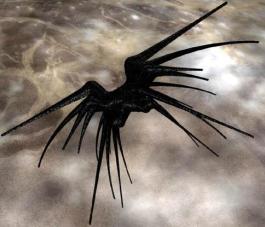
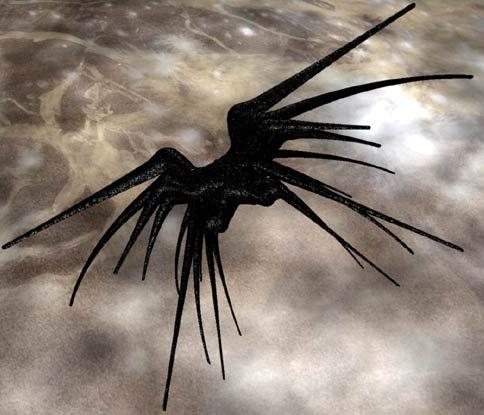
The Shadows, by comparison, were much more enabling and  intriguing, even if they were a little… oh, I don’t know, shit-your-pants scary!  In the course of their history, they too traveled to many worlds as ambassadors, encouraging different people and races to embrace their ambitious, darker side and go to war with each other. Whereas the Vorlons asked “Who are you?”, the Shadows big question was “What do you want?” Again, if you found yourself being asked this question, it meant that you were on their radar and they had big plans for you. The proper response to this would be feelings of flattery followed by abject terror.

In any case, whereas the Vorlons believed in order and stability, the Shadows believed that evolution came only through conflict and disorder. This, they reasoned, is what lead to the development of stronger, more advanced races. As Morden, their own representative to B5 said, humanity would never have come so far so fast were they not constantly “at each others’ throats”. Sure, some races had to be sacrificed along the way to make this philosophy work, but that was all for the greater good. In the end, what came out of it was a series of species that were stronger and better than they were before.

This philosophy eventually led them into conflict with the Vorlons as well as several other First Ones. Many younger races found themselves taking sides as well or just getting caught in the middle. In fact, wars between the two sides became a recurring thing, happening every few thousand years. In the last, which took place 10,000 years before the main story, the Shadows were defeated by the last great alliance between the First Ones, most of whom then chose to leave the galaxy. Then, just 1000 years before the events in the show take place, the Shadows were once again defeated by the Vorlons and an alliance of younger races and forced out of the galaxy entirely. However, as the show opens, we quickly learn that the Shadows are once again returning to their old stomping grounds, and the first spot on the tour is a planet known as Z’ha’dum.

This world is doubly significant because it is this planet where another First One – THE first one in fact – is thought to reside. His name is Lorien, and he is the last of his kind and the sole First One outside of the Vorlons and Shadows that is left in galaxy. All of the others have long since abandoned it, leaving the Shadows and Vorlons to their war and all the other races that have chosen to enlist in it. In the end, however, Sheridan, Delenn and the younger races form their own alliance which they use to draw a line against both races. With the help of those First Ones that they are able to reach and enlist the help of, they are successful. After a brief but decisive fight, both races agree to leave the galaxy with Lorien, never to return. In the last episode, when Sheridan is on the verge of death , he is found by Lorien who takes him to the great beyond where the other First Ones now reside.

Like I said, its a personal favorite, mainly because I felt it was so richly detailed and in-depth.

The Forerunners:
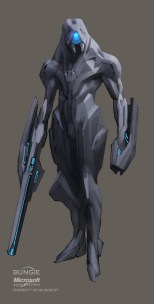
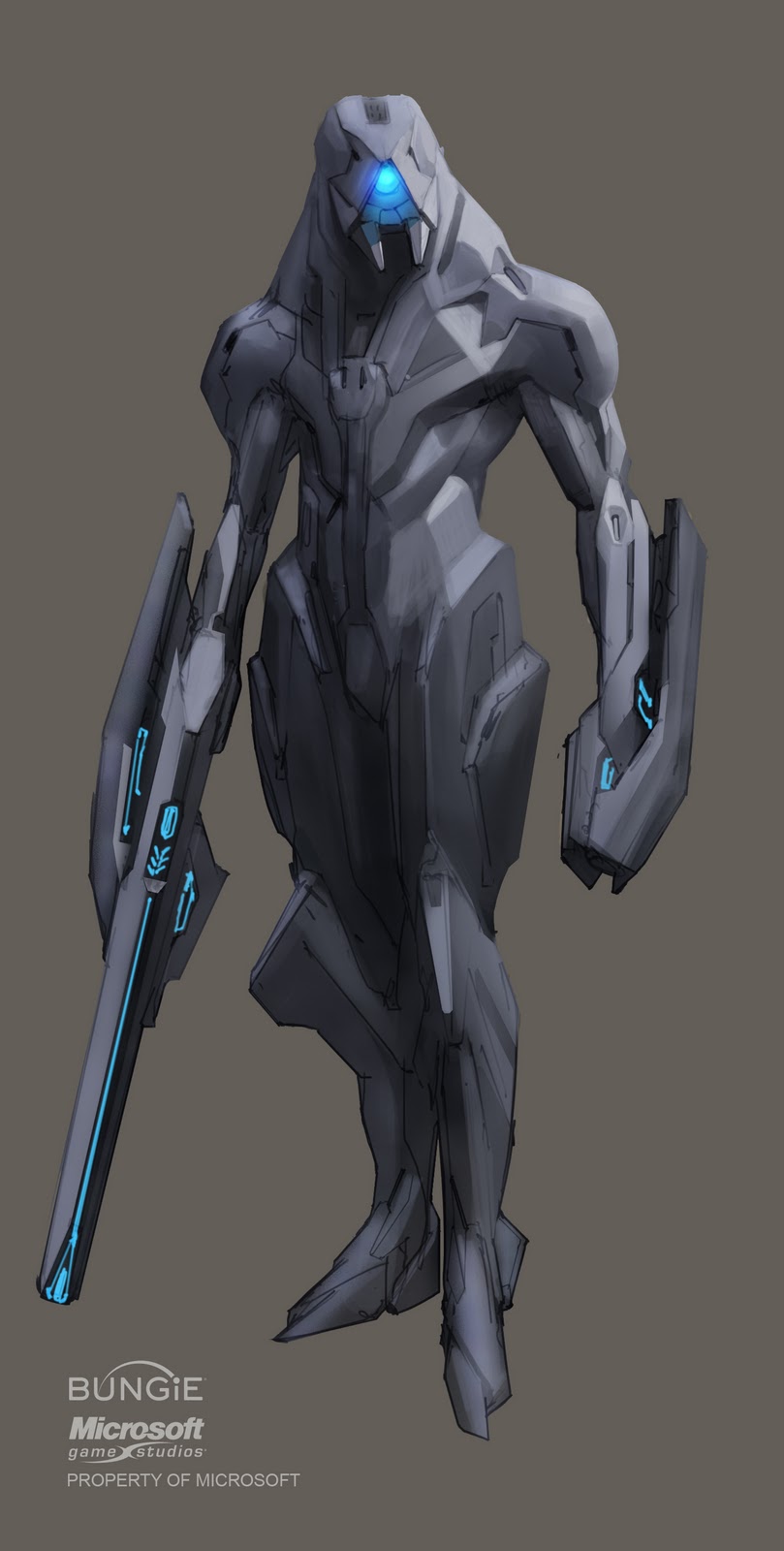
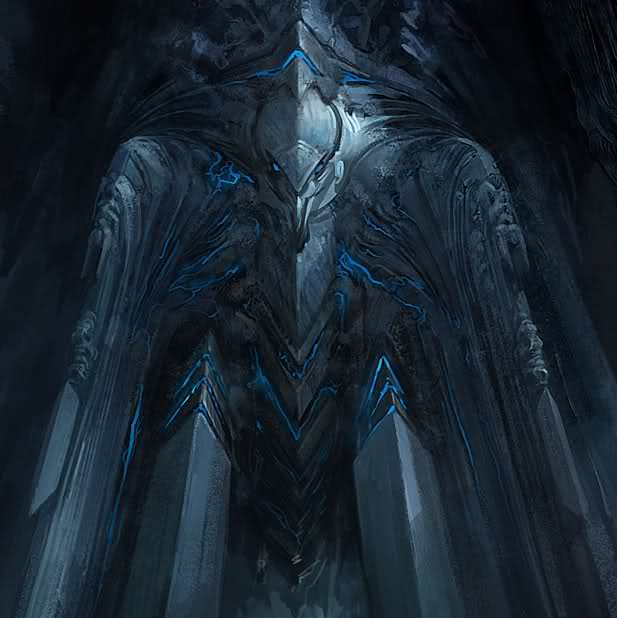
Now here is an interesting take on the whole ancient astronauts concept. Whereas in most versions of this idea, aliens make contact with a younger race and influence them for their own purposes, in the Halo universe, things happen in a sort of reverse order. It is established as part of the game’s back story that eons after they died out, the Covenant races came upon the remains of an ancient race which are referred to as the Forerunners. After learning how to reverse-engineer their technology, the Covernant began to merge it with their own and was able to jump thousands of years ahead as a result.

At the same time, they began to develop a religion and even a theocracy based on the Forerunners and what they believed their most important relics to be. These would be the Halo devices, for which the game takes its name. Believing that the Halos were the gateway to the afterlife, or the source of deliverance, the Convenant became obsessed with finding a working Halo and activating it. All of their mythology for the past few thousands years was based on this, and they pursued it with absolute single-mindedness.

So in this way, the Forerunners had a profound impact on the development and beliefs of the Covenant, but not intentionally. Rather than coming to the Convenant while it was still in its infancy and manipulating them for their own purposes, the Covenant instead found them, but only after they were long dead. In addition, they were influenced by their own assumptions about the Forerunners, and not anything they chose to tell them. And in the end, this influence had a near disastrous effect, given that the Halo devices were weapons of mass-MASS destruction and not holy relics. By attempting to activate them, the Covenant very nearly brought about their own extinction, and that of every other sentient race in the quadrant. One would think there was a message in all this about the dangers of blind faith and the dangers of deification or something!

The Goa’uld:
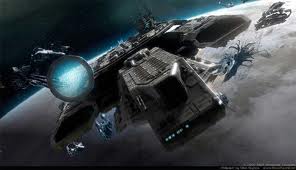
Here is a perfect example of the ancient astronauts theory, so bang on that you’d think it was tailor made to fit the premise! In the Stargate universe, which has expanded considerably over the years, an advanced extra-terrestrial species known as the Goa’uld came to Earth during the neolithic period and had a vast influence on our history. In the original movie, this involved a single alien who took on human form and appointed himself God Emperor over his human subjects. This, in turn, gave rise to the Egyptian civilization, with the alien-god Ra at its apex.

In addition to creating ancient Egypt though, Ra was also revealed to have taken human beings through the Stargate, an means of near-instantaneous interstellar transportation, and established similar civilizations on distant planets. On each of these, the Egyptian motifs of pyramids and the cult of Ra persisted, in some cases for thousands of years. Meanwhile, back at Earth, a revolt unseated Ra and he fled into the cosmos, to be found thousands of years later when humans accessed the Star Gate on Earth.

In the expanded universe, we learn that the Goa’uld were merely one of many races that visited Earth and appeared as gods to humanity because of their advanced technology. But whereas most had benign intentions,  the Goa’uld were concerned solely with establishing slave colonies on many worlds throughout the universe. In addition, their interference extended to other less advanced races as well. As a result, humanity is now faced with the task of preparing to face this and other threats, all of which involve highly advanced races that have visited Earth at one time or another and could very well be hostile.

Although it was not too good a movie (in my opinion), the concept is still a very fertile one! It’s little wonder then why it was made into a series, one which has done quite well for itself. Aliens came before, they may come again… Can we stop them this time. Who knows? Spooky stuff!

The Orions:
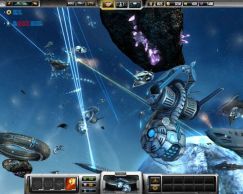
In the video game series Master of Orion, there is yet another take on the concepts of ancients aliens. In this turn-based strategy game, players select from different alien races that inhabit the galaxy and begin the process of colonization and expansion. In time, the concept of the Orions comes up. It seems that each race, though they are different and possess varying special abilities, have their own legends about this particular race.

One of the aspects of the game is to find the Orions homeworld, a place full of secret and advanced technology, but which is defended by a powerful robotic starship known as the Guardian. Whoever is able to destroy this ship and land on the planet is the most likely to win the game. This is advisable, seeing as the how the purpose of the whole game is to become the undisputed master of the galaxy – the Master of Orion, as it were 😉

The Xel’naga:

Another example of this concept which comes to us from the gaming world. of which fans of Starcraft will no doubt be instantly familiar with! Translated literally as “Wanders from Afar”, the Xel’naga were apparently a race from a distant galaxy that was concerned with creating the perfect life form. In the course of their lifetime, they apparent “seeded and cultivated thousands of various species” (from the SC game handbook). This included the Protoss and Zerg, two of the major players in the game, and figures pretty prominently in the game’s backstory.

In the case of the Protoss, the Xel’naga thought that they had found beings that possessed “purity of form” and began manipulating them. However, when they revealed themselves to the Protoss, the latter turned on them and they fled. They discovered the Zerg shortly thereafter, a species which they believed possessed “purity of essence”. They began by enhancing them from the small, parasitic larvae that they were, but found that they were too primitive. They therefore developed the Overmind as well to give them purpose and direction, but this only made matters worse. In time, the Zerg found the Xel’naga, who had chosen to remain hidden this time, and consumed them.

In the course of the game, Xel’naga ruins make only one appearance, in the form of an ancient temple which possesses the ability to sterilize the planet of all other species. However, other ruins are apparently featured in one of the game’s novelizations. Otherwise their is no mention of them, their existence merely constituting part of the story’s deep background.

Final Thoughts:
After looking through these and other examples of ancient astronauts, a few things began to stand out. Like I said before, sooner or later aliens serve an anthropological purpose in science fiction. Or to put it another way, they will always play the role of mirror and meter stick. On the one hand, they are the means by which we project aspects of ourselves onto others so we can study them better. On the other, they are means by which we measure our own flaws and development.

But above all, aliens tend to fall into any one of four categories based on where they fit into the moral and technological spectrum. This spectrum, which I made up myself (!), breaks down as follows:

  1. Benevolent/Malevolent: How aliens behave in our favorite franchises and what purpose they serve often has much to do with their basic motivation. In short, are they kind of benevolent, enlightened overseers as envisioned by Arthur C. Clarke in 2001: A Space Odyssey and Childhood’s End, or are they hostile, conquering species as envisioned in War of the Worlds and Invasion of the Body Snatchers? In either case, the alien serve a basic purpose: as a commentary on humanity. Their murderous ways are our murderous ways, their benevolent, technical perfection what we aspire to be. As Nixon is said to have muttered to JFK’s painting: “Men look at you, they see what they want to be. Men look at me, they see what they are.”
  2. Advanced/Nascent: Another important aspect to the aliens in question is their level of technical development. And, interestingly enough, this can have much to do with their moral character. Oftentimes, the aliens in a franchise are both advanced and malevolent, blowing up the White House Independence Day-style or trying to make us one with the Borg! Other times, they are advanced and enlightened, technology and evolution having erased whatever primitive impulses they might have had, but which humanity still possesses. And in other cases still, their are aliens who are less advanced than humanity and are either ethically challenged because they are behind the times, or noble and “untainted” because they haven’t been perverted by civilization’s greed and avarice. It’s a toss up, really, where the benefits and downfalls of technological progress are seen as having an influence on moral and social development.

Again, these are all mere projections, designed to focus attention on moral and ethical dilemmas that arise out of our collective history. Still, it is fun to take these various examples from popular culture and see where they line up on the moral/technological graph. That way we can see where different franchise place their aliens in terms of the overall spectrum.  And like I said at the beginning, its a cool concept. I mean seriously, wouldn’t it be cool if it were actually true? No one can prove aliens didn’t visit Earth thousands or even millions of years ago and mess with our evolution, right? Yeah, it’s not exactly a sound basis for a scientific theory, but a very fertile source for science fiction!

Of Planetkillers!

What is it about doomsday devices that make them simultaneously scary and freakishly cool? Oh, I don’t know. Maybe it’s the fact that they can turn an entire planet into glass, render it completely uninhabitable, or just plain blow it to smithereens? If none of these things do it for you, I suggest you stop reading now, this is what the whole post is about!

Where these ideas come from is a source of debate, but it goes without saying that apocalypticism is part of our collective unconscious. The very concept of the end of the world has worked its way into every world religion and is as intrinsic to our beliefs as creation. And I suppose that it goes without saying that since humanity began to develop weapons that could actually level entire cities, depopulate entire countrysides, or even raze whole continents, that this obsession with the end of days has expanded beyond the spiritual world and has become an everyday preoccupation.

So it’s little wonder then why science fiction writers have taken it upon themselves to come up with concepts of machines that can destroy and sterilize entire worlds. It just seems like the next logical step after anthrax and thermonuclear weapons doesn’t it? And in the course of this, some pretty cool concepts have been thought up. Here are some examples from various popular sci-fi franchises:

The Death Star:
Without a doubt, this planet killer is the best known in the business. Making its first appearance in A New Hope where it destroyed the planet Alderaan, the Death Star was a massive space station that was created to inspire fear and silence all dissent to the Emperor’s rule. At the center of this force of unrivaled terror was a massive, high-powered laser that resembled a huge eye or a massive crater on the station’s surface. A single beam from this weapon was capable of breaking planets apart and obliterating all life on the surface.

Granted, this same station was then destroyed by a ragtag group of Rebel pilots, guys in tiny fighters who knew about a tiny exhaust vent in the side. But its replacement was even more badass! The second Death Star, which appeared in Return of the Jedi boasted a laser that was capable of recharging more quickly between shots and was accurate enough to take out large vessels as well. Before being destroyed by the Rebels at the Battle of Endor, the new Death Star managed to destroy two Mon Calamari cruisers with ease.

But alas, this weapon’s fatal flaw lay in its design. Being so big, small craft were capable of penetrating its defenses and attacking its vulnerable points. In the case of the first incarnation, this involved firing torpedoes into an exhaust port which would then reach the main reactor. In the second version, there were to be no exhaust ports so the station would have no outward vulnerability. But as long as it was still under construction, the station was vulnerable and hence open to attack. And given it’s sheer size and the time it would take to complete just one, that’s a pretty big window! I guess it’s true what they say: the bigger they are…

The Vorlon/Shadow Planet Killers:
In the B5 universe, a few different types of planet killers existed, both of which were the property of the oldest races. Given the amount of energy that would be required to destroy an entire planet, it was reasoned that only ancient races like the Shadows and Vorlons would be capable of constructing such a thing. However, the younger races had their own means of leveling a planet, if not destroying it completely. This involved mass drivers, which the Centauri used in season two to hurl asteroids into the surface of the Narn homeworld, causing massive destruction and forcing the Narn to surrender. But that’s another matter. Here are what the proper examples of planet killers in the B5 universe looked like:

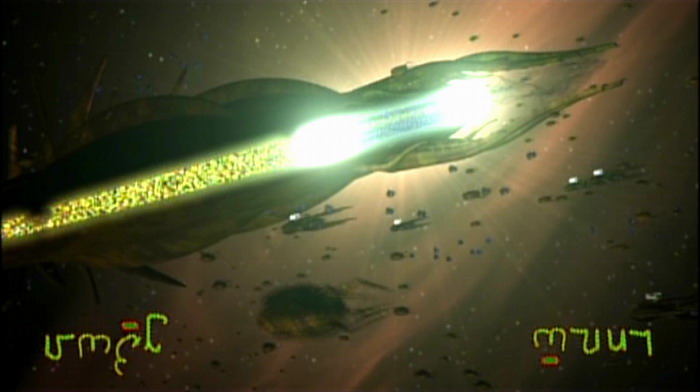
The Vorlon planetkiller was essentially just a massive gun that was built into a ship. The long, flattened spheroid with plenty of tentacle like things would be escorted through space, fly into position around the enemy planet, and then fire a massive energy discharge that would obliterate the entire thing. By comparison, the Shadow’s planetkiller was much more complex, not to mention insidious!

In what appeared to be a massive, black cloud, a Shadows Shroud held a massive buckminsterfullerene-like assembly that would move into position around a planet and then enclose itself around it. The assembly would then unleash a massive swarm of missiles which would bore into the surface and then detonate, releasing a massive thermonuclear payload near the core of the planet which would trigger tectonic activity that would rip the planet apart.

The former planet killer got its fair share of attention in the series proper, where the combined forces of Sheridan and Delenn’s alliance managed to destroy one only by calling in the help of the First Ones. Between all their races, only they possessed the kind of firepower that was needed in order to destroy a ship of that size. Some attention is also given to the Shadow’s Shrouds, but it wasn’t until the TV movie “A Call to Arms” came out that any in-depth explanations of how they worked or how they could be beat ever came up. In this movie, we see for the first time what the internal structure of the Shroud looks like and how the device could be defeated by attacking its nerve center. This alone would not destroy it, but would prematurely trigger it, causing it to unleash all its missiles, which would then impact and destroy the assembly itself.

The Behemoth:
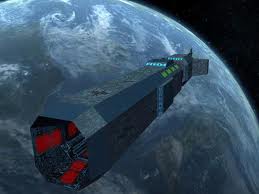
This planet killer comes to us courtesy of the Wing Commander videogame and made its appearance in the third installment in the series. Much like the Vorlon planet killer, the Behemoth was essentially a big gun that was designed to blow up planets by firing a single, concentrated beam directly into its surface. Simple, and effective, were it not for the fact that the weapon suffered from some congenital defects, which included gaps in the shielding array and the fact that it had no defensive mounts anywhere along the hull.

However, given the fact that the Terran Confederation (the good guys in the story) were losing to the Kilrathi Empire (the bad guys), the weapon had to be pressed into service before it was complete. Its intended purpose was to destroy the Kilrathi homeworld, a move which they believed was the only way to win the war outright at that point. Naturally, the vessel was destroyed due to a combination of its weaknesses and high-level treason. However, the good guys still won in the end due to alternate plans and daring-do, so don’t fret!

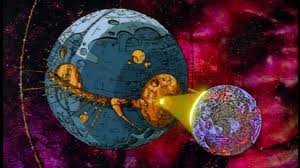
Unicron:
The Transformers franchise was something I enjoyed for many years as a kid. And were it not for Michael Bay, I might have enjoyed it again as a result! But whatever… In the course of telling the story of machines that could transform to hide their true identities, one robot in particular truly stands out. Mainly because of his size! His name is Unicron, a massive machine that can transform from a robot to a planet-sized sphere, and which preys on smaller planets. A pretty cool concept, really, especially for a children’s cartoon! Unlike other planet killer devices though, Unicron was unique in that he was a sentient being, and not a simple machine that was under the control of others. His first and only appearance was in Transformers: The Movie, where he was also destroyed. He did not appear again in the course of the original series, but was mentioned several times, particularly in the CGI-animated spinoff, Beast Wars.

The Doomsday Machine:
Gene Roddenberry weighed in on the planet killer thing back in the late 60’s with his own version of a doomsday weapon. It was known simply as the Doomsday Machine, a massive, lamprey-like device that was capable of consuming entire planets into its massive maw. In the course of the episode where it makes its appearance (episode 35, of the same name), the crew of the Enterprise learns that the machine is drawn to populated worlds which it then destroys and converts into fuel so that it can keep going. The process is entirely automated, the ship itself having destroyed its masters and sterilized its own region of the universe a long time ago.

Airing in the late 60’s, the Doomsday Machine was clearly a commentary on the Cold War and the creation on doomsday weapons which were intended for use as a “deterrent”. In fact, at one point Captain Kirk theorizes that the machine was never intended for use, merely to serve as a instrument to inspire fear in an enemy. However, once it was activated, it ran amok and destroyed its enemies and those who created it. In the end, the crew manages to destroy it by (ironically) letting it ingest a ship which they rig to go thermonuclear once its inside.

Halo Array:
Gamers are no doubt familiar with this one! In the Halo universe, much of the focus is on alien artifacts which were built by a race known as the Forerunners. The Covenant, the alien antagonists in the game, believe them to be holy, particularly the Halo devices which are central to the plot. These devices, it turns out, are “weapons of last resort” which the Forerunners built to sterilize all worlds of sentient life that are within range. Their reason for this have to do with a hostile organism known as the Flood, a parasitic life form that infects sentient organisms and turns them into zombie-like creatures.

Unfortunately, the Forerunners died off shortly after concluding their war with the Flood, leaving the Halos and several other artifacts behind. In time, these were stumbled upon by the Covenant who began to reverse-engineer the devices and used them to advance significantly. In time, the Convenant came to believe that the artifacts had been left behind by a holy race and built a religion and even a theocracy around this belief.

The Halo is apparently the crowning piece of the Convent faith. They believe that activating them will lead them on the “Great Journey” (aka. entrance into the hereafter). However, the main characters in the story quickly learn that this would actually cause the destruction of Earth and every inhabited planet in the sector. Inspired by Larry Niven’s Ringworld series, the concept of the Halo devices and the thematic elements which drive the story (i.e. blind faith, theocracy, evolution and ancient alien artifacts) are all prime examples of classic science fiction. Nice to see that they make their way into the gaming world once in awhile!

The Necromongers:
The Chronicles of Riddick is yet another example of theocracy, apocalypticism, and doomsday devices. Within the context of the story, we have a faction of hostile force known as Necromongers, a faction of humanity that worships death and believes that better world (known as Underverse) lies at the edge of the known universe. Leading them is a man known as the High Marshall, a person who apparently traveled to Underverse and returned half-man, half… something else. No kidding, this is how he’s described in the movie, verbatim!

In any case, in their drive to reach the edge of the universe, the Necromongers conquer, pillage and convert every planet in their path. The final step in this process, before moving on, is the use of a planet-killing device of their own, one which leaves the planet itself intact, but destroys all remaining life on the surface. In short, after they replenish their ranks and bring in fresh converts from the conquered populace, they commit whats called the “Final Protocol” before dusting off. Basically, it involves a series of ships standing up on end and releasing payloads into the air which then explode, unleashing a massive shock wave that kills everything in its path. This process gives literal meaning to the words: “Convert, or fall forever!”

The Inhibitors:
As I final example, I have included one of my personal favorites: the hostile alien species known as the Inhibitors, which come to us from Alastair Reynolds’ Revelation Space universe. According to the first novel in the series, the Inhibitors are all that remains of several ancient alien races which went extinct long ago. These machines, which are semi-intelligent and automated, are programmed to seek out and destroy sentient life.

The reason for their existence apparently has to do with a series of terrible events that are collectively known as the Dawn War. This war was apparently fought by all the earliest sentient races in the Milky Way Galaxy which began shortly after they discovered each other, but which lasted for eons. Finally, what was left of the various races decided to merge their consciousness with a series of specialized machines which they then programmed to ensure that no such wars ever happened again. These machines take the form of tiny black boxes which are capable of multiplying, replicating and seem next to impossible to kill.

Ostensibly, these machines were designed to nip the development of sentient life in the bud by sterilizing any planet that supported a potentially star-faring race. In short, they were meant to inhibit the growth of sentient life, hence their name. However, in books II and III, their motivations are explained further. In addition to wanting to prevent another major war from taking place, the Inhibitors were also concerned about the eventual galactic collision which is scheduled to take place between the Andromeda and Milky Way Galaxies several million years from now. When that happens, our two galaxies will merge, but the consequences for any lifeforms living within either of them will be disastrous.

The only way to prevent this, it is said, is to either ensure the development of a single race that has the requisite technological development to resist the destruction brought on by the collision, or to inhibit the growth of any sentient species until after the collision takes place. Once the collision is complete and the galaxy returns to a state of gravitational equilibrium, life can resume, but not before. Sounds crass, but the way they see it, they are doing sentient beings a favor by making sure they don’t get off the ground, rather than letting them die by the billions when the stars all come crashing together!

In the end, these machines destroy planets through various means. In fact, much attention is given to how the Inhibitors employ a great deal of creativity in designing ways to sterilize worlds. Instead of just parking a giant gun in orbit around a planet or covering with a toxic blanket, they will use the system’s natural resources to construct tools and weapons which they will then use to take planet’s or suns apart, bit by bit. The process can take years, even centuries for them. But they plan ahead, and are very patient…

Ultimately, the Inhibitors are not defeated in the Revelation Space universe, but are beaten back, pushed to the fringes of known space where humanity fights an ongoing fight with them that lasts beyond the final novel in the series. They do this by incorporating technology from other extinct races as well as one’s that have developed extremely clever ways to survive. And like with everything else in Reynold’s universe, it all comes down to technology that is both plausible and fascinating to read about!

Well, that’s about all the planet killing I can stand for now. Sure, there are plenty more examples in the realm of sci-fi, but these are the ones that stand out for me. Plus, if I were to take the time to research and list them all, we’d both be stuck on this one post forever. Remember, it takes longer to write than it does to read! So in keeping with the theme of this post, let me leave you with some words of advice:

No matter what you’ve done, its not the end of the world. Unless it is, in which case, it probably didn’t matter anyway 😉