Remembering Douglas Adams

the-hitchhiker-s-guide-to-the-galaxy-original2Yesterday was the birthday of the late, great science fiction writer and luminary known as Douglas Adams. Had he not passed away in 2001, at the age of forty-one, he  would have been celebrating his sixty-first birthday. Best remembered for his series The Hitchhikers Guide to the Galaxy, Adams greatest accomplishment was arguably his ability to weave comedy and science fiction into one!

And that’s not the easiest thing to do in a genre like science fiction, which is noted for being often bleak, dystopian, or highly technical. Sure, there was plenty that was unintentionally funny, especially in Douglas’ time, but Adams demonstrated that science fiction writing could be both high-minded – incorporating real science and galactic exploration – and irreverent.

So I hope people will join me in wishing the man a belated happy birthday! Though I learned about it too late to acknowledge it on time, I’m sure he wouldn’t mind. The man did have a rich sense of humor, after all!

Biography:

Douglas_adams_portrait_croppedBorn in Cambridge, England in 1952, Adams parents moved to London when he was still a toddler. They divorced five years later, and Adams spent his formative years with his mother in Brentwood, east of London. Receiving his education from the privately run Brentwood School, he was noted for being unusually tall, he also stood out because of his exceptional ability at creative writing.

Some of his earliest writing was published at the school, in the town publication The Brentwoodian, or the school magazine Broadsheet. He also designed the cover of one issue of the latter, and had a letter and short story published nationally in The Eagle, the boys’ comic, in 1965. On the strength of a bravura essay on religious poetry that discussed the Beatles and William Blake, he was awarded a place at St John’s College, Cambridge to read English in 1971 and graduated two years later.

While there, he also attempted to ply his comedic skills and applied to join the Footlights, an invitation-only student comedy club. While he waited to join, he began writing and performing in revues with Will Adams (no relation) and Martin Smith, forming a group called “Adams-Smith-Adams”. By 1973, he managed to become a member of the Footlights until he graduated and moved back to London.

At this point of his life, he was determined to break into television and radio as a writer. This resulted in a brief collaboration between him and Monty Python’s Graham Chapman, and a series of appearances by Adam’s on Flying Circus. At the time though, his writing style did not seem suited to radio or TV comedy, and he was forced to work odd jobs to make ends meet. However, Adams never stopped writing and continued to work towards his masterpiece.

The Hitchhikers Guide to the Galaxy:
HitchHikers-Guide-to-the-Galaxy,-The_8Hitchhiker began in 1977 as a pitch to the BBC radio as a concept for a science-fiction comedy radio series. According to Adams, the idea for the title occurred to him while he lay drunk in a field in Innsbruck, Austria, gazing at the stars. He was carrying a copy of The Hitchhiker’s Guide to Europe, and it occurred to him that “somebody ought to write a Hitchhiker’s Guide to the Galaxy“.

At the same time, Douglas worked on novelizations of his concept, which made producing the series all the more difficult. Not a prodigious writer, Adams was apparently the kind of man who had to be forced to meet deadlines and complete what he started. Despite the difficulties he had, Adams wrote five novels in the series, published in 1979, 1980, 1982, 1984, and 1992.

For the rest of his life, Adams made several attempts to get Hitchhiker adapted into a movie. He did not succeed in his lifetime, but in 1981, the radio series became the basis for a BBC television mini-series and Disney bought the rights in 1998. It was not until 2005, four years after his death, that the screenplay finally got a posthumous re-write by Karey Kirkpatrick, and the resulting movie was released.

hitchhikers_movieOther Works:
Despite Hitchhikers immense popularity, it was by no means Adam’s only literary creation. During the 1980’s, Adams and Mark Carwardine, a noted zoologist, collaborated on a series of BBC broadcasts known as Last Chance to See where they would travel to foreign countries and speak of endangered species.
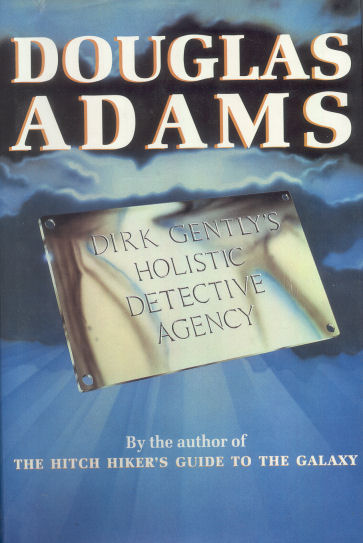
Dirk_Gently_UK_front_coverIn between all this, he wrote the novel Dirk Gently’s Holistic Detective Agency, a humorous detective story which was relesead in 1987. Adams himself described the book as “a kind of ghost-horror-detective-time-travel-romantic-comedy-epic, mainly concerned with mud, music and quantum mechanics.” A sequel, entitled The Long Dark Tea-Time of the Soul, was published a year later. These were entirely original works, Adams’s first since So Long, and Thanks for All the Fish.

In between all of this, Adams also worked with the BBC as a writer on Doctor Who. Altogether, he wrote three Doctor Who serials starring Tom Baker as the Doctor. These included the episodes “The Pirate Planet” (Season 16), “City of Death” (with producer Graham Williams, from an original storyline by writer David Fisher), and Shada (only partially filmed and never filmed).

Legacy:
Adams died in 2001 as a result of a degenerative heart condition and was buried in Highgate Cemetery, North London. After eighteen years of writing, publishing, and broadcasting, he left an indelible mark on science fiction and popular culture. The holiday known as Towel Day – in honor of the sage advice contained in the Guide – takes place every May 25th.
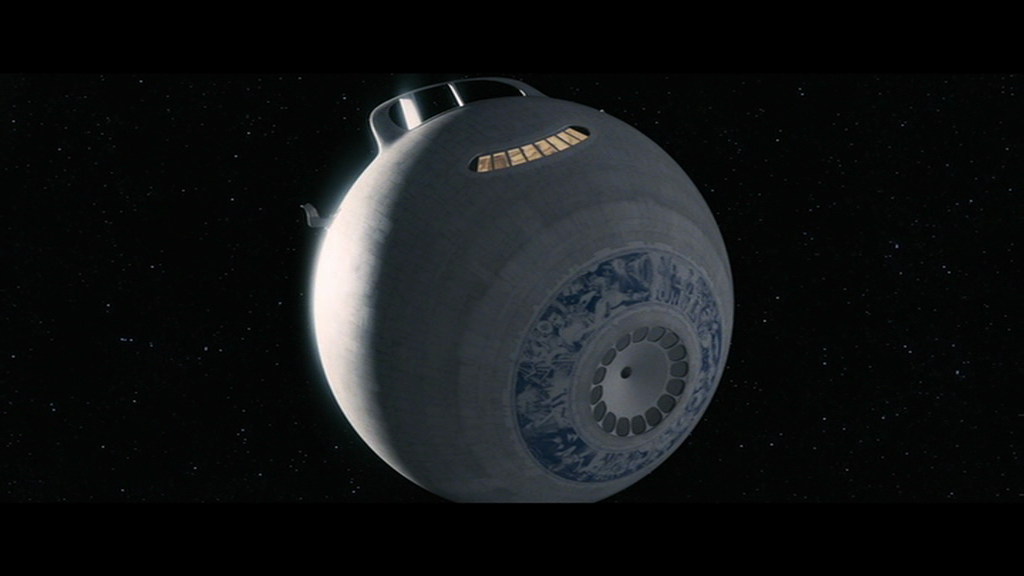
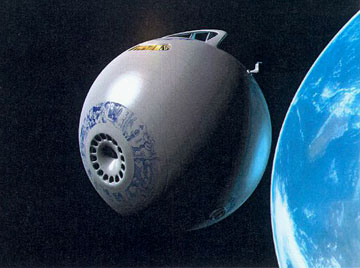
heartofgold_ext2And despite his irreverence and characteristic wit, Adams is also remembered for exploring scientifically plausible ideas. For example, the Heart of Gold – the ship featured in Hitchhiker – is powered by the “Infinite Improbability Drive”. This is an FTL drive system which is based in a particular aspect of quantum theory. Chaos theory also plays an important role in Dirk Gently’s Holistic Detective Agency, where everything, even elements which seem superfluous, turn out to be interconnected with the plot.

towel_dayThe words “Don’t Panic”, also advice contained within the Guide, and the significance thereof are known by any self-respecting geek. Concepts like the “Babel Fish”, the living translation device one inserts in their ear, are also commemorated with programs like Yahoo’s translation program of the same name. Also, in 2011, over 3000 people took part in a public vote to choose the subjects of People’s Plaques in Islington. Adams received 489 votes, and a plaque is due to be erected in his honour.

And just yesterday, to mark his 61st birthday, Google celebrated with an interactive “Google Doodle” which featured a stylized version of the Heart of Gold’s computer console. In addition, the BBC has the text-based Hitchhiker’s Guide to the Galaxy game available to play on their website here. So if you’ve got time and feel like doing something fun to commemorate Adams, just click on the links provided and enjoy!

RIP Douglas Adams. You were a rich soul and a witty, funny, and brilliant man. Like so many before you, you were snatched up too soon and didn’t live long enough to get your proper due!

Of Faster-Than-Light Travel

It’s a popular concept, the fictional technology that could help us break that tricky light barrier. And it’s not hard to see why. The universe is a really, really, REALLY big place! And if we ever want to begin exploring and colonizing our tiny corner of it – and not have to deal with all the relativistic effects of time dilation and long, long waits – we better find a way to move faster.

And this is where various franchises come up with their more creative take on physics and the natural universe. Others, they just present it as a given and avoid any difficult, farfetched, or clumsy explanations. And in the end, we the viewers go along because we know that without it, space travel is going to be one long, tedious, and mind-bendingly complex journey!

Alcubierre Drive:
Proposed by Miguel Alcubierre as a way of resolving Einstein’s field equations, the Alcubierre Drive is an untested by possible way to achieve FTL travel. As opposed to Warp, Foldspace, or most other proposed means of FTL that involve some kind of internal propulsion of jump drive, the Alcubierre Drive is based on the idea of generating a wave that a ship would then “surf” in order to travel.

The creation of this wave would cause the fabric of space ahead of the spacecraft to contract and the space behind it to expand. The ship would then ride this wave inside a region of flat space known as a warp bubble and be carried along as the region itself moves through space. As a result, conventional relativistic effects such as time dilation would not apply in the same way as if the ship itself were moving.

The Alcubierre drive is featured in a few different science fiction genres, mainly those of the “hard” variety. This includes Stephen Baxter’s Ark, M. John Harrison’s novel Light, Warren Ellis and Colleen Doran’s Orbiter, and Ian Douglas’s Star Carrier where it is the primary means of transport.

FTL Drive:
The primary means of interstellar travel in the Battlestar Galactica universe, where every ship larger than a in-system transport is equipped with an FTL drive. How it works is never really explained, but it is clear that the technology is complex and involves a great deal of calculation. This is not only to ensureolve n accurate relocation through space-time, but also to make sure they don’t up jumping too close to a planet, star, or worse, right in the middle of either.

Whereas Colonial ships use their own computers to calculate jumps, Cylon ships rely on the Hybrid. These “machines” are essentially semi-organic computers, and represent the first step in Cylon evolution from pure machines to organic beings. Apparently, the hybrids were more sophisticated than Colonial computers, especially the aging Galactica. Hence, they were able to calculate jumps more quickly and accurately.

Holtzman Drive:
This FTL drive system comes to us from the Dune universe, and is otherwise known as a “Foldspace Engine”. Relying on principles that are not entirely clear to those in the Dune universe, the system involves depositing a ship from one point in space-time to another instantaneously. Though the workings of the drive are never really explained, it is intimated in Chapterhouse: Dune that tachyons are involved.

Another key component in the system is a Guild Navigator, a mutant who has been given natural prescient abilities thanks to constant exposure to spice. Using this prescience, the Navigator “sees” a path through space-time in order to guide the ship safely through. But in time, the Ixians invented a machine that was capable of doing this job as well, thus making the entire process automated and breaking the Guild’s monopoly on spacing.

Hyperspace:
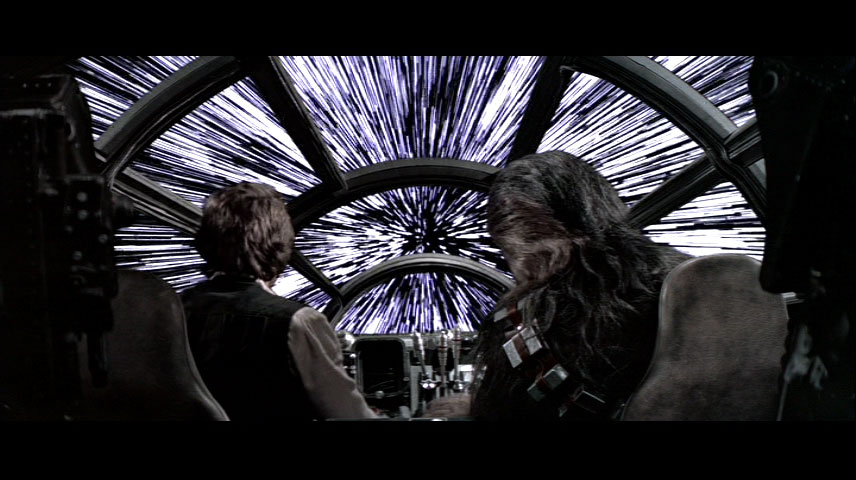
Like the Warp drive, the terms hyperspace and hyperdrive have become staples withing the science fiction community. It’s most popular usage comes from Star Wars where it is the principle means of interstellar travel. Though it is never explained how a hyperdrive works, it is made abundantly clear through a series of visuals in the first and subsequent movies that it involves speeds in excess of the speed of light.

In addition, Han Solo indicated in the original movie that the Falcon’s top speed was “point five past light-speed”, indicating that it can travel 1.5 c. All other references to hyperspace speed factors in the franchise are similar, with velocities given in terms of a decimal point value. As a fast ship, the Falcon can reach point five, whereas most of the larger Imperial and Rebel ships can make only point three or four at most.

Though Star Wars is the most popular example of hyperspace, it is by no means the earliest. The first recorded example was in John Campbell’s “Islands of Space,” which appeared in Amazing Stories in 1931. Arthur C. Clarke’s also mentioned hyperspace in his 1950 story Technical Error. However, the most enduring example comes from Asimov’s Foundation universe, where hyperspace is the principal means of travel in the Galactic Republic. In I, Robot, the invention of the “hyperspatial drive” is the basis of one of the short stories, and was meant to provide a sense of continuity with his earlier Foundation series.

Other franchises that feature the concept of hyperspace include Babylon 5, Homeworld, Macross/Robotech, and Stargate. Combined with Star Wars and the Foundation series, it is the most popular – albeit the most ill-defined -form of FTL in the realm of science fiction.

Infinite Probability Drive:
The perfect mixture of irreverence and science: the Infinite Probability Drive from The Hitchhikers Guide to the Galaxy. This FTL concept is based on a particular perception of quantum theory which states that a subatomic particle is most likely to be in a particular place, such as near the nucleus of an atom, but there is also a small probability of it being found very far from its point of origin.

Thus, a body could travel from place to place without passing through the intervening space if you had sufficient control of probability. According to the Guide, in this way the drive “passes through every conceivable point in every conceivable universe almost simultaneously,” meaning the traveller is “never sure where they’ll end up or even what species they’ll be when they get there” and therefore it’s important to dress accordingly!

Subspace Jump Drive:
Here we have an FTL concept which comes from one of my favorite games of all time, Descent Freespace. Subspace jumps, relying on the drive system of the same name, represent a very quick method of interstellar travel. By relying on subspace “corridors” that run from one point in space-time to another, a ship is able to move quickly from one star system to the next.

The only drawback to this concept is the fact that travel must occur along officially designated “nodes”. These nodes usually pass between large gravitational sources (i.e. between stars systems) but also can exist within a system itself. Virtually all nodes are unstable, existing for mere seconds or minutes at a time. However, nodes which will last for centuries or longer are designated as “stable” and used for transit.

Another favorite franchise which uses a similar concept is the Wing Commander universe. In all versions of the game, particularly Wing Commander: Privateer, interstellar travel comes down to plotting jumps from predesignated points in space. One cannot simply jump from one spot to another provided accurate calculations are made, they have to use the mapped out points or no jump is possible. This, as opposed to hyperspace travel, posits that subspace is a reality that exists only in certain areas of space-time and must be explored before it can be used.

TARDIS:
Officially, the Time and Relative Dimension in Space is a time machine and spacecraft that comes to us from British science fiction television program Doctor Who and its associated spin-offs. Produced by the advanced race known as the Time Lords, an extraterrestrial civilization to which the Doctor belongs, this device that makes his adventures possible.

Basically, a TARDIS gives its pilot the ability to travel to any point in time and any place in the universe. Based on a form of biotechnology which is grown, not assembled, they draw their power primarily from an artificial singularity (i.e. a black hole) known as the “Eye of Harmony”. Other sources of fuel include mercury, specialized crystals and a form of temporal energy.

Each TARDIS is primed with the biological imprint of a Time Lord so that only they can use it. Should anyone else try to commandeer one, it undergoes molecular disintegration and is lots. The interior of a TARDIS is much larger than its exterior, which can blend in with its surroundings using the ship’s “chameleon circuit”. Hence why it appears to outsiders as a phone booth in the series.

Warp Drive:
Possibly the best known form of FTL travel which comes to us from the original Star Trek and its many spinoffs. In addition to being a prime example of fictional FTL travel, it is also perhaps the best explained example.Though said explanation has evolved over time, with contributions being made in the original series, TNG, and the Star Trek technical manual, the basic concept remains the same.

By using a matter/antimatter reactor to create plasma, and by sending this plasma through warp coils, a ship is able to create a warp bubble that will move the craft into subspace and hence exceed the speed of light. Later explanations would go on to add that an anti-matter/matter reaction which powers the two separate nacelles of the ship are what create the displacement field (the aforementioned “bubble”) that allows for warp.

Apparently, Warp 10 is the threshold for warp speed, meaning that it is the point at which a ship reaches infinite speed. Though several mentions are made of ships exceeding this threshold, this was later explained as being the result of different scales. Officially, it is part of the Star Trek canon that no ship is capable of exceeding Warp 10 without outside help. When that occurs, extreme time dilation, such as anti-time, occurs, which can be disastrous for the crew!

In addition to Star Trek, several other franchises have made mention of the Warp Drive. This includes StarCraft, Mass Effect, Starship Troopers, and Doctor Who.

Final Thoughts:
Having looked through all these examples, several things become clear. In fact, it puts me in mind of a clip produced by the Space Network many years ago. Essentially, Space explored the differences between FTL in past and present franchises, connecting them to developments in real science. Whereas Warp and Hyperspace tended to be the earliest examples, based on the idea of simply exceeding the speed of light, thereby breaking the law of physics, later ideas focused on the idea of circumventing them. This required that writers come up with fictional ideas that either relied on astrophysics and quantum theory or exploited the holes within them.

One such way was to use the idea of “wormholes” in space-time, a hypothetical theory that suggests that space is permeated by topological holes that could act as “shortcuts” through space-time. A similar theory is that of subspace, a fictional universe where the normal rules of physics do not apply. Finally, and also in the same vein, is the concept of a controlled singularity, an artificial black hole that can open a rift through space-time and allow a ship to pass from one point in the universe to another.

Explanations as to how these systems would work remains entirely hypothetical and based on shaky science. As always, the purpose here is to allow for interstellar travel and communications that doesn’t take decades or even centuries. Whether or not the physics of it all works is besides the point. Which brings me to two tentative conclusions.

  1. Explanations Need Not Apply: Given the implausible (or at the very least, inexplicable) nature of most FTL concepts, the best sci-fi is likely to be the stuff that doesn’t seek to explain how its FTL system of choice works. I’st simply there and does the job. People hit a button, push a lever, do some calculations, or fly into a jump gate. Then boom! seconds later (or days and weeks) and they find themselves on the other side, light years away and ready to do their mission!
  2. That’s Hard: Given how any story that involves relativistic space travel, where both time dilation and confusing time jumps are necessarily incorporated into the story, only the hardest of hard sci-fi can ever expect to do without warp drives, hyperspace, jump or FTL drives. Any other kind of sci-fi that is looking to be accessible, and therefore commercially successful, will have to involve some kind of FTL or face extinction.

Well, that’s all I got for the time being. In the meantime, keep your eyes on the skies and don’t stop dreaming about how we’re one day going to get out there. For even if we start sending ships beyond our solar system in the near future, it’s going to be well into the distant future before they get anywhere and we start hearing back from them. At least until someone figures out how to get around Einstein’s Theory of Relativity, damn bloody genius! Until then, I’d like to sign off with a tagline:

This has been Matt Williams with another conceptual post. Good night, and happy spacing!