Gibson’s Bridge Trilogy

Well, it finally happened. After many interruptions, thanks to other books that made it into my reading pile, I finally capped off Gibson’s Bridge Trilogy with All Tomorrow’s Parties. And as usual, Gibson’s combination of high-tech gadgets, low-tech environments, and an assorted crew of characters are all there in full force. And, interestingly enough, I also noticed some decidedly Gibsonian traits that appear in his other trilogies.

For one, there’s that tendency of his where he switches main characters between the first and second novel, then bring them all together again for the third. And then there is his ability to end a story abruptly and in a way that’s both confusing and a little short on explanations. As you might be able to guess, I had a few problems with this book, but none to write home about. Mainly, I thought it was a fitting and faithful ending to his second trilogy, chock-full of insights, ideas, and cool concepts.

Synopsis:
The novel takes its name from the song of the same name by Velvet Underground, which was apparently inspired by their contact with the Andy Warhol clique. The story opens in a Tokyo subway station, where the character of Colin Laney (the protagonist of Idoru) is now living in an improvised “cardboard city” with other misfits. Inside this assemblage of boxes, he spends all of his time online, following the exploits of a media baron known as Cody Harwood. Consistent with the effects of 5-SB, the drug that gives Laney his ability to discern patterns of information, he has become obsessed with this celebrity figure. However, he also sees that a nodal point is fast approaching, and that Harwood is at the center of it.

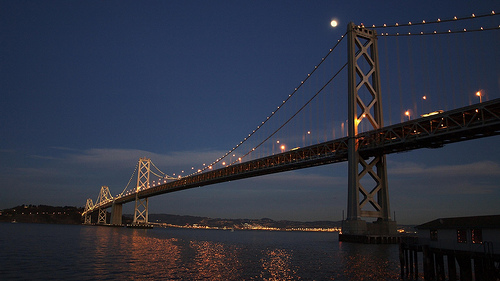
What this node is and what it entails, he cannot say exactly. All he knows for sure is it will change everything, and is set to go down in San Fransisco. To uncover the details of this , and perhaps stop it as well, he enlists help from the people of the Walled City – a virtual environment in cyberspace – Rei Toei (the Idoru), and Berry Rydell (the protagonist from Virtual Light). Meanwhile, Chevette Washington, the bike courier from Virtual Light, is also on her way to the bridge. Her new roommate, a film maker named Tessa, wants to go there so she can do a documentary on the people, how they live, and study the phenomena known as “interstitial places”. Pursued by her jealous ex-boyfriend, she agrees to accompany Tessa and show her around, and maybe reconnect with some of her fellow Bridge dwellers.

In time, and with the help of his hacker friends from the Walled City, Laney learns that Harwood has also taken 5-SB. He too has seen the nodal point approaching, and wants to shape its outcome to his liking. Although it not quite clear what its about, it seems to involve the Lucky Dragon franchise, and their incorporation or nano-assemblers in each of their outlets. In time, Rydell and Chevette arrive on the bridge, which is becoming a tourist attraction, and has a Lucky Dragon located just beyond it, with Rei Toei’s mobile projector. Several men show up and try to kill him, but he is helped unexpectedly by an assassin named Konrad – a man who is ostensibly in Harwood’s employ, but has chosen to switch sides.

After rescuing him from the first assassin, Rydell and Konrad run into Chevette at a club. She takes them her old friend Fontaine’s watch shop, where he and a young boy named Silencio – an apparent mute who is obsessed with researching watches –  take them in. When Harwood is informed that they are holed up and their assassins are dying off, he orders them to set fire to the bridge. Meanwhile, in cyberspace, Laney and his Walled City friends find him and confront him. He manages to escape into the folds, but Rei Toei comes to the little boy and tells him to find a special watch – a task which is in reality a trek to find where Harwood is hiding. They track him down, and he is neutralized.

Laney and Chevette narrowly escape to Skinner’s old hideout at the top of the bridge, where they kill the last of the assassins and wait out the fire. Rescue trucks and airships begin dousing the flames, just in time to save the bulk of the population. Meanwhile, Rei uploads her program to the Lucky Dragon’s database, and when the nanoassemblers go online, they produce endless copies of her! As the nodal point comes and passes, things have changed, though not in the way Harwood wanted, and in a small cardboard box in Tokyo, Laney is found dead by some of his old associates.

Good Points/Weak Points:
Much like its predecessors, this book advances the nanotechnology angle and brings it to an apparent conclusion. In book I, it was nanotech that was meant to be the means through which San Fransico was going to be rebuild after the Little Grande (aka. the Big One). It was also the means through which Tokyo was rebuild after said same earthquake. And many hints were dropped in Idoru that the character of Rei Toei, whose existence is strictly virtual, would be relying on it to manifest herself in reality. Alas, this finally seems to take place in this novel, where Rei uses the nanoassembly units in every Lucky Dragon around the world to produce copies of herself.

In addition, the concept of the nodal point is brought to its climax, where Laney and Harwood, both people who are sensitive to such things, are able to see one which will mean the end of the world. Not in the apocalyptic sense, merely that it will be the end of the world as they know it. From this description it is strongly implied that this will amount to a technological singularity, an event where advancement will speed up to the point where no one can predict the outcome. And given all the mentions of nanotech, it is entirely possible that it will be central to this transformation.

However, as I said earlier, this was not made clear. Much like with everything else at the end, explanations were lacking. What the big change-up involved, how Harwood planned to benefit, and how Silencio prevented that from happening… unclear! And Rei Toei’s involvement, her transformation and what purpose that served, also unclear. In essence, the climax just happens as describes, a few more short (really short) chapters tell what happened to all the characters once it was over, and the story ends. Little epilogue? Little conversation between the main characters explaining what they did and maybe what happened with Rei Toei? People learn the hero’s journey isn’t always an easy one?

Ah, I enjoyed reading it. Like all of Gibson’s work, it did a good job of contrasting high-tech and low, commercial applications and the streets use for them. The disparity of wealth and power also makes it in, as well as the average Joe’s ongoing attempts to subvert and resist it. In the end, Laney (the gifted social outcast), Rydell (the bewildered everyman), and Chevette (the streetwise survivor), all play a role in bringing down a major tycoon who’s only goal is to put himself at the center of the new order. Still, some indication of what that new order was and the meaning behind all his moves would have been nice!

And of course, the Walled City and Rei Toei make it back for their final appearances. Much like in Idoru, they are a shout out to the idea of artificial spaces, artificial constructs, and the line that separates them from that which is physically real. But rather than take a moralistic stance on the issue, Gibson’s approach was clearly towards the anthropological and sociological side of things. Mainly, he sought to show how humanity lives and adapts in an increasingly complex and changing world, and how the process is tied to the issue of control. Whereas everyone is effected by technological change and the social impact it has, it is clear that some are merely adapting whereas others have a degree of control over it.

And as with much of his other works, it is the disparity between the rich and the poor that is most central to Gibson. Whereas the rich occupy the top tier of society in his books, living on the cutting edge of development in comfortable, state of the art environments, the poor wait for development to trickle down to them and use it for their own purposes, meanwhile living in improvised environments made out of what’s available. In the middle, there are the “freelancers” who understand the conspiracies and agendas and do their best to expose them, hoping to do right by all the people who occupy the bottom rungs of society.

Nowhere is this more apparent than in the Bridge itself. Much as with the real life Walled City of Kowloon that inspired it, it all comes down to corporate interests who are trying to destroy, gentrify or commercialize it. Whereas in the first novel, the story revolved around a plot to gentrify San Fransisco through nanotechnology, in the third, those same interests try to demolish the Bridge itself because it is clearly beyond their control. It is only through the know-how and the sacrifice of those who see the larger agenda at work that it is saved, unlike the real Walled City (which was demolished between 1993/4).

It is little wonder then why this trilogy was seen as a sort of graduation for Gibson, moving from cyberpunk themed science-fiction to predictive social commentary. And while we might not be exactly where Gibson put us (2012 and we still don’t have nanomachines dammit!), the ideas he put forth  in this trilogy are still on our minds. These days, people are practically holding their breaths, waiting for the day when an artificial personality will finally be realized and machines small enough to manipulate matter at the atomic level can be built. And when that happens, we can still expect that the effects will be felt unequally. Some people will be living in seamless building made from carbon nanotubes and run by AI’s, others will be living shanty’s, making appliances out of spare parts. Or, to put it as Gibson once said “the future is here, it’s just not widely distributed yet.”

So long Walled City, you will be missed!

Of Great Sci-Fi (and other non-affliated) Quotes:

alien-worldRecently, I’ve taken to posting quotes by the great science fiction authors on twitter. Most are from the authors I draw the most inspiration from, others are just from people I admire and who offered some wisdom along the way. Like a true nerd, I keep these things in a file on my computer, adding to it every time I find a new one or think up one myself. Might sound odd but I find it useful, it offers fresh inspiration and perspective whenever I’ve hit a wall or am not sure how a piece of writing is turning out. Today, I thought I’d share a few of the gems that have really inspired me over the years. To be fair, some of them are not science-fiction related, or even by authors; they’re just moments of brilliance captured in an utterance. Here are a few:

“We sit atop a sort of anthill of technologies. At the bottom there’s fire, and growing cereal grains, and learning to store cereal – all those things that people have to store edible energy and start building cities. Not that we’re the crown of creation; we are at the crown of technological creation at any given moment.”
-William Gibson during an interview after writing “Pattern Recognition”

“It’s impossible to move, to live, to operate at any level without leaving traces, bits, seemingly meaningless fragments of personal information.”

“The future has already arrived. It’s just not evenly distributed yet.”

“Cyberspace. A consensual hallucination experienced daily by billions of legitimate operators, in every nation, by children being taught mathematical concepts…”

“When I began to write fiction that I knew would be published as science fiction, [and] part of what I brought to it was the critical knowledge that science fiction was always about the period in which it was written.”

“. . . the street finds its own uses for things.”
-Other tidbits from Gibson, who’s nothing if not prolific in his observations!

“The difference between stupid and intelligent people—and this is true whether or not they are well-educated—is that intelligent people can handle subtlety. They are not baffled by ambiguous or even contradictory situations—in fact, they expect them and are apt to become suspicious when things seem overly straightforward.”
-Neal Stephenson, “The Diamond Age”

“Ronald Reagan has a stack of three-by-five cards in his lap. He skids up a new one: “What advice do you, as the youngest American fighting man ever to win both the Navy Cross and the Silver Star, have for any young marines on their way to Guadalcanal?”
Shaftoe doesn’t have to think very long. The memories are still as fresh as last night’s eleventh nightmare: ten plucky Nips in Suicide Charge!
“Just kill the one with the sword first.”
“Ah,” Reagan says, raising his waxed and penciled eyebrows, and cocking his pompadour in Shaftoe’s direction. “Smarrrt–you target them because they’re the officers, right?”
“No, fuckhead!” Shaftoe yells. “You kill ’em because they’ve got fucking swords! You ever had anyone running at you waving a fucking sword?”
-Stephenson, “Cryptonomicon”. One of the funniest written passages I’ve ever read, and fitting because it puts Reagan in his proper, historically accurate place!

“I just think talk of suffering should be left to those who’ve actually suffered.”
-Jack (a First Nations former student I knew. As soon as he said it, I knew that I had just heard one of the smartest things ever said by anybody, anywhere, ever!)

Of William Gibson (The Bigend Trilogy)

Not only is he a famous author, he’s also a fellow BCite and the man who literally wrote the book on cyberpunk. Beyond that, his books have been renowned for capturing the zeitgeist of our times, an age characterized by revolutions in information technology and mass media. And I can honestly say that I’ve tried to emulate him in recent years. His Neuromancer was required reading seeing as how I wanted to get into hard sci-fi and he’s a major name. And his latest works also gave me a push in the direction of modern day fiction, dealing with the cutting edge rather than the future.

But… gotta be honest here, these books have been a bit of a disappointment for me. Pattern Recognition, Spook Country, and Zero History are all mainstream bestsellers that did an awful lot to capture the spirit of our age once more, but they all shared elements which I thought were kind of… well, weak. For example, consider the plot set-ups to all three books. All things in this trilogy by Gibson revolve around the enigmatic (and absurdly named) Hubertus Bigend. He’s an advertising magnate who’s always looking for the angles, the hidden agendas, the thing that’s beyond cutting edge, just five minutes away from becoming real. And to investigate these things, he hires freelance contractors, strange people with strange gifts. And that’s what sets the plots in motion every time.

In Pattern Recognition, he recruits Cayce Pollard (pronounced Cay-See), a freelance “coolhunter” who uses her odd intuition to evaluate logos and brand names for companies. Her father was lost in 9/11 (something that Gibson had to include because it occurred while writing it) and this haunts her. In addition to her weird skills (hypersensitivity to iconography) she follows footage on the internet produced by some cinematic genius. Bigend wants the creator found because… he’s curious, he wants their talent, or something like that. So Cayce sets out to find them relying on Bigend’s network, his dime, and her own personal contacts. Her journey takes her from New York, to London, to Tokyo, and finally to Moscow, all the while she’s pursued by a rival and some shadowy agents who’s agenda is not quite clear. In the end, she finds the geniuses in Moscow, the genius is a brain-damaged girl who’s sister takes care of her and puts out the footage as a way of expressing herself. The dark agents pursuing her turn out to be their protectors who just stalked her because they weren’t sure of her, and Bigend’s slightly richer for having uncovered the truth… I guess. Cool idea, weak climax, weird overall point.

Then there was Spook Country. The name alone was telling, alluding to its focus on the paranoia and intrigue of post-9/11 America. In this one, Bigend is back, employing yet another freelance contractor named Hollis Henry (why they couldn’t just bring Cayce back is beyond me, but whatever). This one has no weird intuition, she’s just a former teen singer who’s gone on to become a writer about the industry. He hires her ostensibly to research locative art for some new magazine, a cutting edge technology that is now referred to as “augmented reality”. In the course of this, she discovers that her real mission is to find out who the artist is working for. You see, he’s been using the GPS technology that powers locative art to track a crate that’s been moving around the world for years, passing that info onto some shadowy figure.

So once again, Bigend is curious… When Hollis looks into it, she finds out that the crate is filled with millions that were embezzled from Iraq’s reconstruction fund and the old man tracking it is a former intelligence operative who has a score to settle. He and his crack team are also being tracked by a current intelligence man who uses an addict named Milgrim to track the old man’s operatives by translating their Russian texts (rendered in a language called Volapuk). By the end, the old man and his crew follow the crate to Vancouver and fill it full of hollow point bullets containing radioactive dust. The money is now useless, Hollis is given an exclusive first hand look at it, and returns to Bigend to report on it. Once again, he’s richer for knowing, but has gained nothing else… And all that spy stuff and paranoia? Didn’t really amount to much. Sure there was spy work going on but it was pretty damn subtle, the marginal stuff that goes on at the fringes of the war on terror, not anything central to it. Not what I would expect at all from a book that was trying to make a point about post-9/11 America, in all its paranoid, angry, confused glory.

In the finale, Zero History, which apparently takes it name from the character Milgrim, a man who has no record of his existence for the last ten years (hence, zero history), things are a bit more clear in terms of Bigend’s motivation. However, the overall story was a bit weak, with a name like Zero History and the fact that its the third installment in the series, I was expecting a big send-off, something that went over and above what the first two did. It didn’t seem too much to expect; after all, the first book was a fitting commentary on cyberspace and the sort of tribalism its engendered. The second book upped the ante with a look at espionage and paranoia in post-9/11 America. So who wouldn’t expect that this one would deal with something incrementally bigger and more important? Alas… not so much. But I digress!

In the final installment of the trilogy, Bigend hires Hollis again, paired up with Milgrim, to investigate the origin of some elusive fashion line known as Gabriel Hounds. The reason he wants to do this is because he wants to break into the military-fashion crossover market. Not as silly as it sounds; according to the book, this has been a huge market trend since the Vietnam War and has received new life thanks to the war in Iraq. The culture of war provides life to the fashion industry, swaths of men who buy outfits to look like soldiers, and fashion designers get accustomed to making army gear and end up contracting to the military itself. In the course of their investigation, they learn that one sample they are looking at is the illusive brand named Hounds. These denim products are sold using direct marketing: the dealers show up at prearranged drop points, sell off their merchandise, and then disappear. However, the other sample they come across is being produced by an arms dealer who has a big racket involving former contacts in the military and consulting worlds, and he now sees Bigend as competition. Since he’s a former military man and is into some shady stuff, things begin to get dangerous!

However, the climax is once again the same, with a build-up and then a letdown. Sure the bad guys get beat, but no one dies and no one even gets hurt beyond a simple tasering. Some arrests are made, people hook up, and the world keeps on spinning! There’s also the point of how Bigend’s company appears to be coming apart towards the climax, but in another abortive twist, nothing happens. Bigend is simply declared as being “too big to fail” by the end, and his machinations about being able to see a few minutes into the future appear to have come true thanks to the work of his people. Cool, as a concept, the idea of limited prescience, but like with the other books, it feels like something taped over the plot itself to give it some credibility. Bigend’s main motivation was his curiosity, a contrivance to get the story moving; everything else just feels like justification. Somehow, Bigend has to benefit from all his maneuvering, and developing some kind of system whereby he can predict trends sounds like a good answer. No explanation is forthcoming as to how this works, its just thrown in at the end. Too bad too, as a premise, it’s pretty cool and even kind of worked with the title. Zero History: there is no future, just a constantly evolving present. He who can see just a few minutes ahead and glimpse it in formation will have unimaginable power!

As a third act twist, Gibson does throw one curve ball. Turns out the elusive Hounds designer, whom Hollis finds, is Cayce Pollard herself! Cool, but again, not much comes of it. Hollis says she won’t reveal her, Pollard says she’s not worried, she knows how to deal with Bigend so she’ll be okay when he finds her, and the thread dies! The story then shifts over to the military man and the threat he poses and no word is given to the Hounds for the rest of the story. Odd seeing as how that was central to the plot, but this kind of truncation is common by this installment in the story so I wasn’t surprised. In the plus column, the story does provide some interesting thoughts on resistance to commodification and how the culture of the armed forces trickles down to the street. But seriously, all the fashion stuff gets really suffocating! After a certain point in my reading of it, I couldn’t help but notice the constant mention of clothing, apparel, jackets, etc. Intrinsic to the themes of the novel yes, but I mean, c’mon! Felt like I was reading Sex and the City fan fiction after awhile! Then there was the rather odd attempts to give Bigend character traits beyond his wealth and eccentricities. Aside from an odd fashion sense he has a lust for the Full English breakfast that is mentioned too often in the story, and serves no real purpose that I can see.

Second, there’s the usual Bigend motivation factor. His interest in the marketability of military apparel is one thing, but why would be pay through the nose to get Milgrim clean in this book? Apparently, Bigend likes him because he “notices things” while at the same time is good at going completely unnoticed. For these reasons, he’s decided to pay for rehab in a Swiss clinic and put him on his payroll. Really? All that money just to hire someone who’s only marketable skill is being inconspicuous and observant? Seems more like he just wanted to bring the character back and came up with a small contrivance to fill the point. And of course, there’s Bigend himself. Unlike the previous books, where he just a shadowy figure in the background, by this book he’s grown to the point where he’s kind of like a Bond villain. Gibson even goes as far to say it by the ending, how his purchase of a Russian low-flying craft, the way he had it decked out, and has all the staff dressed like odd caricatures, is Bondian. Doesn’t make it any less weird. Oh, and the fact that he has acquired half of Iceland through a series of business deals and is flying all his staff there on that Russian craft at the end? Bondian!

Overall, what stands out about these books is their similarity to his earlier works, particularly Neuromancer. In this and other works, the story revolves around contractors who are picked up by mysterious men who work behind the scenes or have hidden agendas. But whereas in Neuromancer and other titles belonging to the “Sprawl” and “Bridge” trilogies where you have corporate magnates or mass media forces with clear (and often morally ambiguous) intentions, this time around the agenda of the shadowy person (i.e. Bigend) seems pretty benign and… well, pointless. I mean, why for example is Bigend so obsessed with uncovering all of these mysteries, what’s his motivation? Where’s the profit incentive, the threat to his bottom line? Surely a filthy-rich advertising magnate would have better things to do than spend all kinds of time and money on pet projects that have no purpose other than satisfying his curiosity. In some cases, marginal attention is given to how these things could be of use to him, but curiosity is always the main driving force. Again and again, Bigend’s actions are justified by saying that this is just the kind of guy he is, an eccentric, controlling man who wants to know whats going on around every corner and just happens to be rich enough to make that happen.

To be fair, I get it. I mean how else are you going to set up plots like this, which delve into the mysteries of the everyday world, not sci-fi worlds where anything’s possible because its total fiction and the limits of your imagination are the only constraints you have to deal with? But I would expect that a story would build to a climax, not truncate itself or end up being a letdown for the heroes, not to mention the audience. But then again, Gibson’s work is in details, the story come through more in the subtext than in the goings on of the text itself. And I still love Gibson’s work and owe a rather large debt to him for the inspiration and example he’s provided over the years. So I won’t be avoiding his books in the future; in fact, I’m anxious to see what he’ll do next. Whatever else can be said about this man, he’s good at what he does and manages to always have a keen eye for the things that are just beyond the fringes of the now, the things that are likely to be the cutting edge stuff of tomorrow. One has to wonder how much influence he himself exercises in this regard… Oh well, something for his next book maybe!