
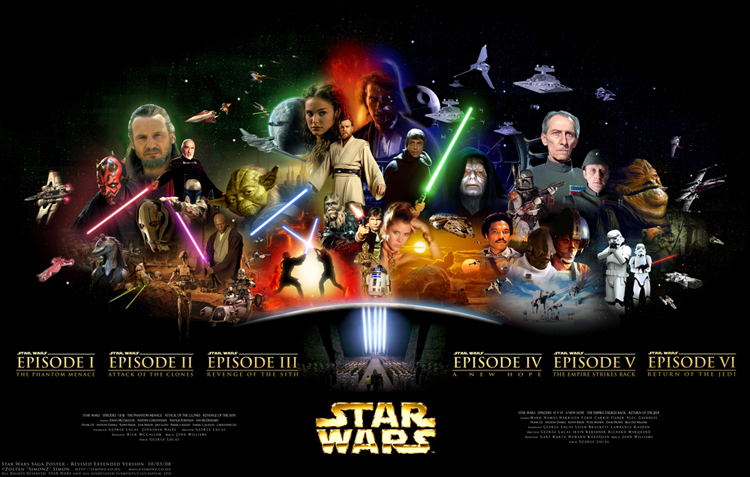
 Hello, welcome to my last installment on the Star Wars franchise in honor of May the 4th. Only took six days, and I still got the final three movies to cover. Not my best work. But as they say, we all have lives. Well, some of us do. For those who have nothing better to do than read what I write I can only say… you poor things!
In any case, I promised when reviewing the originals that I would dedicate at least one post to the Star Wars the prequel trilogy. But one can scarcely do that without getting into the whole Star Wars legacy and addressing questions about Lucas himself and the directions he’s taken. Love them or hate them, the prequels remain a bone of contention for original fanboys and the new generation of acolytes.
To start, I’d like to give a very quick recap of the three movies before saying what was good and bad about them.
The Phantom Menace:
 This movie was without a doubt one of the most anticipated releases in the history of cinema. After years of waiting and hearing that Lucas intended to revisit his universe with some prequel pictures, fans finally got their big break in the summer of 1999. If you’ve seen some of the footage of opening night, where people were lining up around the block, in costume, kissing the floor upon entry, and waving around multicolored lightsabers inside the theater when the movie came on, then you’ve got idea of just how raw and powerful the atmosphere was.
And yet, the Phantom Menace would also go down in history as one of the biggest disappointments of all time. One could easily say that all the build-up made that inevitable. But there were clearly some other factors as well, and people would spend years speculating on them. Of that, more later. First, let’s recap the plot.
The movie opens with the declaration that there is a taxation dispute going on and that the “greedy Trade Federation” has decided to blockade a remote world named Naboo in protest. Sounds a little dry and implausible but okay. We see two Jedis, Obi-Wan and Qui Gonn, being sent to reach a settlement with said Federation.
 But once they get aboard, things get hairy. The Feds destroy their ship, on the orders of some “Phantom” dude who’s clearly manipulating things back home. He orders them to begin an invasion of the planet while he covers their asses in the Galactic Senate. Meanwhile, they try to kill them using poisonous gas and some rather inept robots.
Obi-Wan and Qui Gonn manage to escape, relaying on some sweet combat moves and Jedi springing, stow away on one of the troop transports, and are taken down to the surface. Somehow, they are landed on the other side of planet and must find a way to reach the capitol to “warn the Naboo”. Uh, what good does it do to warn people in the midst of an invasion? And why are they on the other side of the planet if the robots are invading the capitol anyway? Bad navigation console?
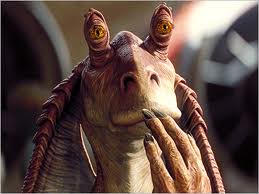 They come across a glaring stereotype named Jar Jar, a bumbling Gungan idiot who tells them his people can help. They swim underwater to the Gungan city where the Boss Nass, through a little force persuation, gives them a pod and lets them take Jar Jar with them, mainly because he owes his life to Qui Gonn (echoes of the Wookie life-debt there). They make it to the capitol and manage to the save the princess, a monotone teenage Geisha named Amidala. Turns out, royalty is elected on this world, and she agrees to go with them to Coruscant to plead their case before the Senate.
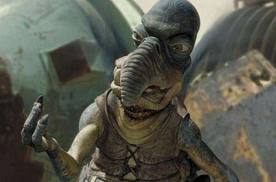 After a daring escape, which is facilitated by R2, they make it to space. However, there hyperdrive is damaged and they must land on nearby Tatooine. Qui Gonn goes off to find a parts dealer and meets another stereotype, an alien named Watto (who might as well be called Shylock given his caricatured appearance and character). He won’t take their credits, and since they don’t have anything to barter with, Qui Gonn concocts a needlessly convoluted scheme.
Yes, instead of simply going to another dealer or hiring a ship (a la Star Wars I), he decides to back Watto’s slave (a boy named Anakin) in a pod race using his ship as collateral. If the boy wins, Watto keeps the money and Qui Gonn gets his parts. But after determining that the boy is force sensitive – via a midichlorian count, one of the biggest let downs ever! – and (according to his mother) the result of immaculate conception, he decides to up the ante. If the boy wins, he gets to take him and the parts with him. For some reason, he seems completely remorseless about seperating the boy from his mother, but whatever.
Oh, and did I mention he built 3P0 – a factory model protocol droid – from spare parts to help his mom around the house? Weird, I thought these things were designed for, you know, protocol, as opposed to doing dishes! But whatever… He meets R2 and the they have immediate chemistry 😉
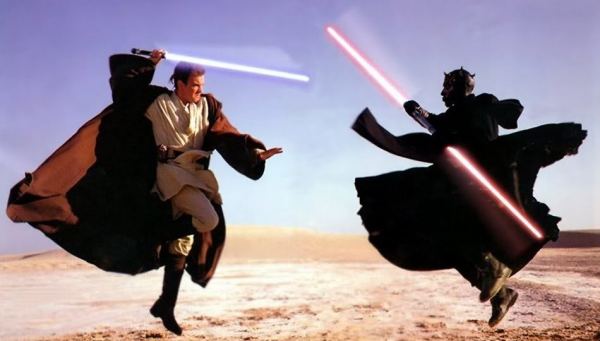 After the big ass pod race, clearly inspired by Ben Hur, Anakin wins using his Force abilities and Qui Gonn has his bounty. Their departure is momentarily interrupted when a Sith named Darth Maul shows up, seeking the princess, and Qui Gonn must fight him. They make it out and head to Coruscant, which is introduced for the first time in the franchise, and begin to attend to all the dry political crap that is waiting for them.
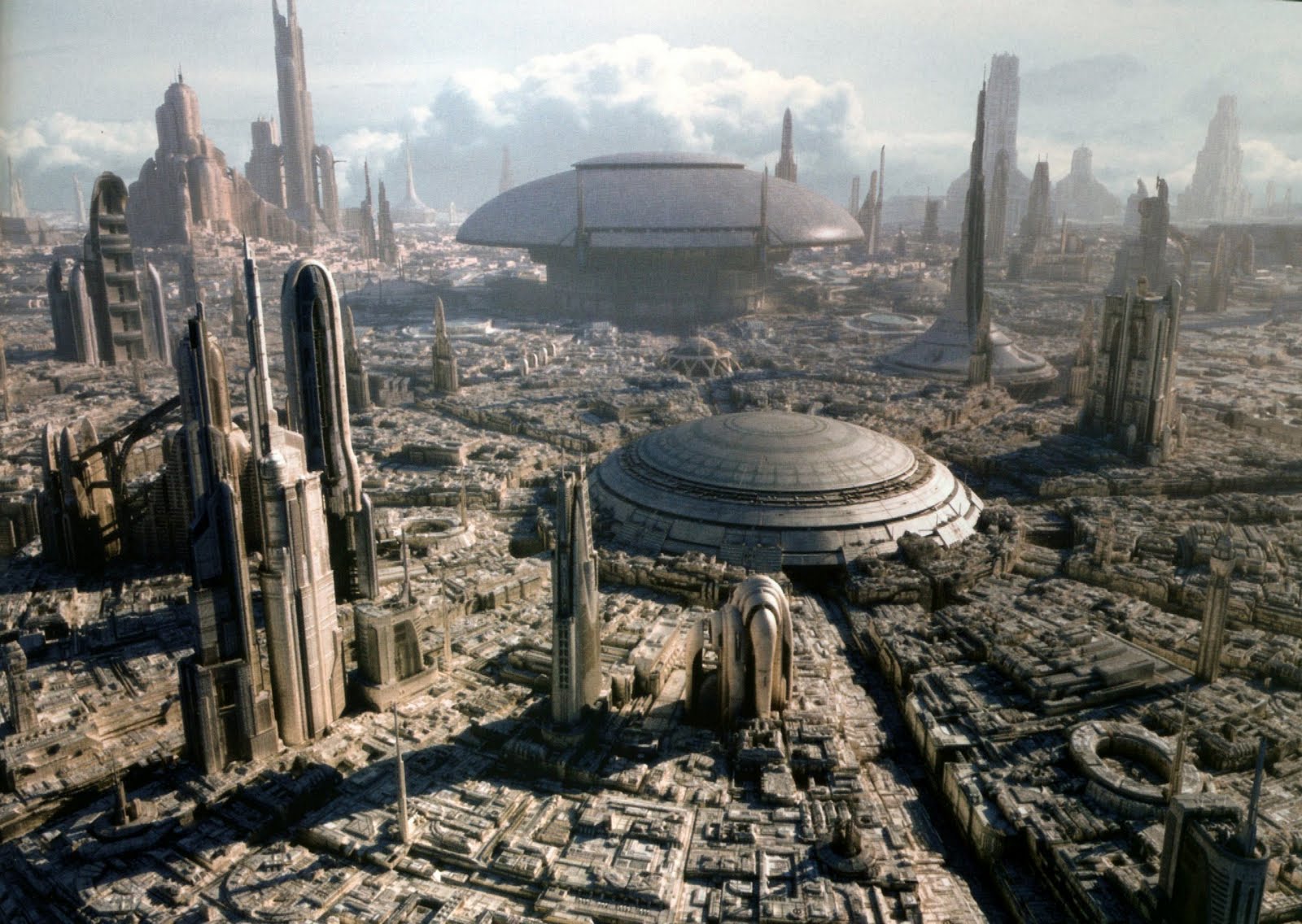 There, Senator Palpatine, representative of Naboo (and the man posing as the “Phantom”) tells them they’re in the thick of it. The Chancellor could force the issue but can’t since he’s been marred by accusations of corruption. Palpatine recommends calling a vote of non-confidence to unseat him so that someone less weak-kneed will take over. After finding nothing but gridlock in the Senate, Amidala concedes and makes the motion. Palpatine is happy, since he (surprise, surprise!) gets nominated!
Meanwhile, the Jedi Council has a look at Anakin, and is worried. It seems his fear of losing his mother is a bad thing, at least according to Yoda. Fear, through commodius viccus, leads to the Dark Side. Seems harsh, but this combined with his age, leads to their decision not to train him. Qui Gonn goes to bat for the little kid, but they are stubborn.
However, things change when Amidala decides she must go back home and the two Jedi are ordered to go with her. For some reason, they take Anakin and his two droids too, and Jar Jar is coming too to provide more slapstick. When they arrive, they begin plotting how their going to overthrow Federation occaption. The Gungans are recruited to help, and agree to lure the droid army into a battle as a feint to leave the capitol open. They decide to make Jar Jar, the idiot they exiled for being clumsy, a General and charge him with leading their attack. …Really?
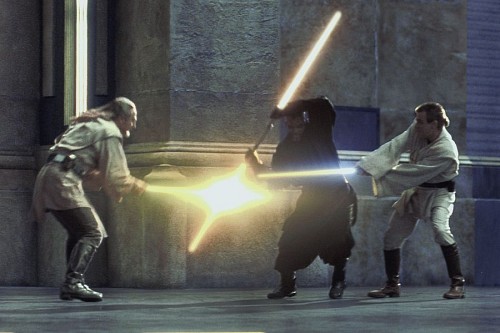 Meanwhile, Amidala, the Jedi and a handful of her security people infiltrate the capitol. After Amidala and her people take the throne room though a little decoy and switch, Qui Gonn and Obi-Wan come face to face with Maul. A brilliant duel ensues, Qui Gonn dies, and Obi-Wan defeats him by pulling a flip and slice routine that frankly, Maul should have been able to prevent. Hell, its the same thing Anakin tries in the third movie and Obi-Wan lopped both legs and one of his arms off! And Maul’s way more badass!
But the really objectionable part comes when Anakin, through sheer dumb luck, ends up commandeering a fighter and flies into orbit with the Naboo fighters to engage the Fed command ship. Those watching couldn’t help but notice that the other ships have all left for some reason, but again, WHATEVER! Anakin, despite the Feds claim that nothing can get through their shields, manages to do just that when he accidentally flies his fighter into their bay and fires some torpedoes into their main reactor. The ship blows up just as Anakin flies out.
 Down below, the Gungans are having a hard time tackling the droid army, and Jar Jar’s constant slapstick and bumbling aren’t helping things much. But somehow, he manages to stay alive, and eventually the destruction of the command ship renders all the droids inoperative. The day is won and the capitol celebrates. The Jedi have a memorial and speculate on how Maul must have had an accomplice, since Sith always work in twos. The camera then pans to Palpatine to let us know, as if we hadn’t figured it out already, that he’s baaaad!
And that’s how the movie ends. With lots of fanfare that calls to mind the medal ceremony of the first movie, we see Gungans, the Princess, Obi-Wan and Anakin all standing on ceremony as people cheer and blow horns. The credits rolled, and audiences everywhere were left speechless…
The Reception:
After the movie finished on opening night, it was like the fans everywhere were going “uh, what just happened?” Seriously, if you watch the documentary footage, you can’t help but notice how underwhelming the mood was once the movie was over, nothing close to the electricity that there was going in. It was as if they’d come to witness the second coming and were forced to watch cheep parlor tricks instead. The critics weren’t too kind either, most giving it mixed reviews based on its weak scripting, the inclusion of Jar Jar, the dry political content, and the saccharine character of Anakin.
However, there were good things about this movie too which did not go unnoticed. Just about everyone acknowledged that the pod race and lightsaber duel were worth the price of admission. But overall, this movie fell far short of expectations. And with the benefit of hindsight, the weaknesses became all the more apparent.
- The plot stunk of duty: This is something that would become more apparent as the trilogy went on. For all three movies, the entire plot seemed like a set-up for a bunch of explanations. This is a weak basis for a story and makes the audience feel like the movie is plodding along out of a sense of duty rather than a desire to tell a story. In the Phantom Menace, the focus was overwhelmingly on explaining how Palpatine got into power, even if that was only a small part of the story. Aside from that and the introduction of Anakin, there was nothing of importance happening elsewhere. I mean seriously, a taxation dispute? A blockade of a remote world? THESE things put the Galactic Republic in turmoil? I know this was all meant to show how inefficient and corrupt the Republic had become in its dying days, but c’mon! Give us something of consequence!
- The plot just plain stunk!: Throughout the first half of the movie, so much happens for which there is no decent explanation. Mainly, audiences just followed it along, waiting to see where it went and only realizing with hindsight that it didn’t make any sense. For starters, why did the Trade Federation agree to this risky scheme when they didn’t even know who they were dealing with? Were they that desperate to getting out of paying their taxes? Second, why was it necessary to fly to the surface to warn the Naboo if they were already being invaded? Third, why did Qui Gonn go through all that trouble just to get some parts? Why not go to another dealer, find a smuggler, agree to pay them ten times what they wanted once they got to Coruscant? Why sponsor a pod race, plot to free a boy, use his force power to manipulate the situation, and ultimately leave the boy’s mother behind in the end? It all seemed so reckless and silly, not what you’d expect from a Jedi Master. What’s more, everybody and their brother was warning him against taking on Anakin, saying they foresaw danger in his training. So why then was he so obsessed with training him, because of that vague prophecy? If this is such an important factor, why weren’t audiences made aware of what that prophecy was? Maybe then we might understand why he was so intent on seeing Anakin become a Jedi and the Council was not. But this was never done, not in this movie or its sequels. And Qui Gonn’s death-bed request that the boy be trained was a pretty weak excuse for the Jedi Council accepting him after all.
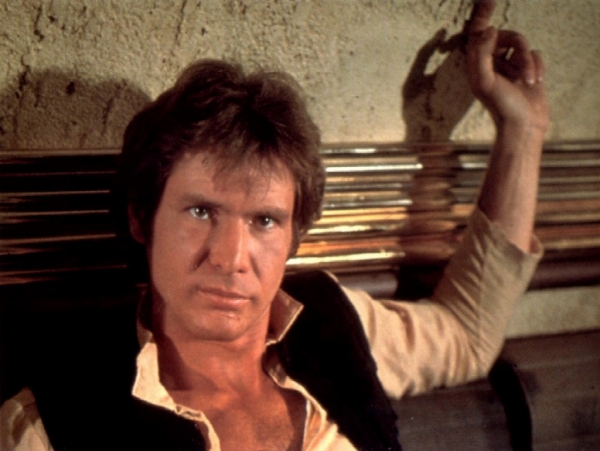
- One-dimensional characters: There’s this hilarious clip over at Red Letter Media where a guy asks a bunch of people to describe characters from the Star Wars universe. The rules are, say stuff about them without mentioning what they look like or what their job is. In the case of the originals, the people selected could say volumes about Han, Luke, Leia, et al. But with the prequels, they couldn’t say jack! There’s a reason for this. Beyond their basic roles, every character in this movie had no real substance or character. Hell, it wasn’t even clear who the main character was. So many people are the focus of the film and doing things to advance the plot that it doesn’t feel like their is a protagonist at all. Ah, which brings me to point 3!
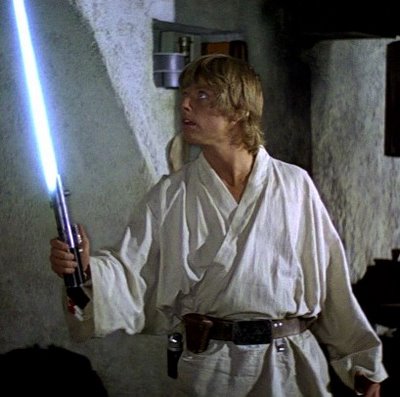
- Who’s the focus here? All good stories have a protagonist. A person’s who’s journey is the focal point of the story and helps the audience to identify with them and become emotionally involved. In the originals, that person was Luke Skywalker. By no means was he the only character, but he was clearly the focus of the story. His own journey of self-discovery was the main driving force of the plot, and his battle with his own demons and his past provided the resolution. In the Phantom Menace, all we get is snap shots of different people doing things to advance the plot towards a resolution, which feels too tidy in the end.
- Too much reliance on CGI: It’s an easy thing to criticize a director for relying on CGI, but when you consider the fact that Lucas managed to capture lightning in a bottle using nothing but stop-motion, animatronics and puppets, you have to wonder why he was so obsessed with using the latest technology. Granted, it allowed him to do things he couldn’t before, but it also limited his shoots and made the movie feel incredibly sterile. In just about every shot in this movie, you don’t have real sets and actors on location. You have actors walking in front of a green screen and looking at hanging lights instead of physically real stand-ins. And no matter how advanced the technology, people will always know what they are seeing isn’t real. And when all the backgrounds look so perfectly glossy, clean and packed to the hilt with digital effects, it all just feel fake.
Some Possible Explanations:
As all fans of the Star Wars franchise are aware of by now, Lucas was never that good at scripting or directing. In fact, it was well known that in the first movie, help needed to be brought in to complete the film. In the second movie, that help was on hand from the beginning and it showed. But by the third, Lucas was clearly back at the helm and making the big decisions. With this in mind, it’s little surprise why the Phantom Menace was the way it was. With the success of the original franchise, Lucas had grown richer and more powerful than anyone thought possible, and with companies like Lucas Arts and Industrial Light and Magic behind him, who the hell is going to question him? He’s George freaking Lucas!
Surely, the man must have thought himself immortal by the late nineties when he began writing the script. All those people who used to tell him what to do or challenge him were now gone, replaced by sycophants and suck ups who grew up idolizing him. And can you blame them? It’s George freaking Lucas! How could the creator of Star Wars be wrong?
Sure, there were plenty of cool action scenes and the new technology was pretty damn effective at letting Lucas do all the things he couldn’t do before. But this was Star Wars, dammit! Where were the classic characters, the epic storytelling, the stuff that went beyond special effects and eye-popping visuals? Part of what made the originals so damn good was the depth that went far beyond the ships, guns, and lightsaber duels.
When you look at the originals, at all the things Lucas wanted to do but got called on, you begin to understand. According to rumor, Luke Skywalker was supposed to be a half-cyborg, Han was supposed to be a green alien, and the dialogue was supposed to be a lot more wooden and cheesy than it turned out to be. But thanks to dedicated professionals who knew how to rely on Lucas’ strengths and help him with his weaknesses, something truly awesome and classic was made.
But, as with most things, this success proved to be the downfall. Like Lucas, we all seemed to think he was solely responsible for the creation of Star Wars. Granted he was, in his own words, “the creator as well as the decider” (a cheesy reference to that awful Bushism), but he was never the sole voice of the project. Literally everybody, from the co-directors, co-writers, and even the actors themselves had a role in helping him to make his movies. Without them, we are left with Lucas as he is, warts and all. And after years of success and a growing obsession with the latest special effects, that’s not a very pretty sight!
Well, that’s what I thought of Phantom Menace. Stay tuned for Attack of the Clones… This aint gonna be pretty! But in the meantime, here’s some funny news. It turns out Topher Grace, who played Eric on That 70’s Show, has made an 85 minute editors cut of the three movies. Follow this link to read more on this interesting and funny story:
http://www.bestweekever.tv/2012-03-07/topher-grace-edits-star-wars-prequels





 Stories by Williams