Worlds of Dune

Hello all and welcome back. Starting today, I thought I’d get into a cheerier aspect of science fiction. Not that I don’t looooove dystopian stuff, but after days and days of romping through endless examples of totalitarian, cyberpunk and just generally dark futures, I thought it might be time for a break. And it just so happened that I had an idea the other day which seemed like the perfect diversion. For those who read my site regularly, you might have noticed I did a long list of conceptual sci-fi posts. Well, today I thought I’d get back into that some.

To break it down, I wanted to do a piece that was dedicated entirely to “Cool Worlds”, an exploration of the various planets, cultures and civilizations science fiction has given us over the years. However, after coming up with just a few candidates, I quickly realized my mistake. There was no way I could possibly list all the best examples in just one post. And if I settled on just a few, then people might start writing in and saying “what about this one? what about that one?”

So rather than do all that, I decided instead to tackle specific franchises, particularly ones that made it into my Galactic Empires post, and address some of the cool worlds that existed within.And what better place to start than with my favorite galactic franchise, one of the most detailed franchises ever to be dreamed up: the venerable Dune!

Anyone who is familiar with Frank Herbert’s six volume series knows that he was pretty damn good at weaving an intricate and finely layered tale. One aspect where this was particularly evident was in his descriptions of the Imperium’s planets. Not only would Frank dedicate a great deal of time and effort to describing what a place was and what significance it held, he would also get into the lesser explored areas of ecology and what impact that had on a planet’s culture. Here are some of the best examples that I could think of, all from his original books:

Arrakis:

The focal point of the Dune universe, and the most important planet in the entire franchise. It was here that the spice was manufactured, where Paul Mua’dib came face to face with his destiny, and “The Tyrant” Leto II was born and ruled for three and a half millenia. It was also eradicated when the Honored Matres attacked the Old Imperium, triggering a full-scale war which would lead humanity along the final steps of the “Golden Path”. In short, it was the backdrop for most of the story, and from a storytelling point of view, a very richly detailed place!

Much of what is known about Arrakis’ culture and ecology comes from the appendixes of the first novel where Herbert wrote about the fictitious exploits of Dr. Pardot Kynes, planetary ecologist to the Imperium. However, a great deal more came through in the course of the story once Paul and Jessica find refuge amongst the Fremen and had to learn their ways and secrets in order to survive. Much of this has to do with the spice, the Sandworms of Arrakis, and how the production of the former depended on the life cycle of the latter. They also came to learn about the Fremen’s plans to alter the planet’s ecology using moisture traps and water caches, as well as the careful introduction of plants and grasses to anchor the dunes.

Basically, Arrakis was a desert planet where moisture was the most precious commodity in existence. A fitting paradox, seeing as how the planet’s desert environment was essential to the production of spice – the most precious resource in the known universe. Two things permeated this environment, both of which kept outsiders away and ensured the security of the Fremen who lived in the deep desert. The first were the Sandworms themselves, the predominant life form on the planet. The second, though no less dangerous, were Arrakis’ famous sandstorms.

According to Dr. Yueh, worms measuring up to 450 meters had been captured and studied, but that ones which were larger still had been seen in the deep desert where no citizen of the Imperium had ever ventured. Living beneath the sand, the sandworms would be attracted to rhythmic vibrations coming from the surface. Knowing this, the Fremen were forced to develop a way of walking arrhythmical when forced to do “dune-crossings”. At other times, when they sought to ride the worms, they would plant “thumpers” to draw their attention, and then mount the worms once they came to the surface.

The worms were also the producers of the spice, which they used to fabricate nest for their young (“sand trout”), which would then leave before the nest underwent a chemical reaction, triggering a “spice blow”. Because of their central role in the life cycle of Arrakis, and the fearsome and awesome nature of the creature itself, the Fremen regarded them as godlike creatures. Shai-Hulud, “the old man of the desert”, was the name given to mature worms while “the Maker” referred to the worms role in the production of spice and the life cycle of the planet. Though Zensunni’s by descent, believing in a God that was transcendent, the Fremen still seemed to attribute some degree of divinity to the worms themselves.

Similarly, sandstorms were common to the Deep Desert, and also the reason why the capital city of Arrakeen was built within a protective outcropping of rock known as the “Shield Wall”. According to the expanded universe, sandstorms on Arrakis were electrically charged and could reach up to 500 km/h, powerful enough to destroy vehicles, equipment and strip anyone unlucky enough to be caught outside in one down to their bones! Due to the havoc they played with navigation and harvesting, all activity beyond the Shield Wall had to be timed to ensure that it happened between storms, otherwise harvesters could wind up buried beneath tons of sand.

As expected, the harsh and unforgiving conditions of this planet did much to shape its inhabitants. The “Fremen” as they are called (play on the word Free Men) were what could be expected from a nomadic desert people who were used to oppression. Recluse, mysterious, pragmatic and extremely tough, they were both feared and loathed by an Imperium that knew little about them and could not control them. However, once Paul and Jessica managed to penetrate the Fremen society by proving their worth to them, they began to see that the Fremen were also capable of extreme hospitality, fierce loyalty, great patience and uncompromisingly dedication.

Over the course of the six original novels, Arrakis was transformed from a desert planet into a lush green world, only to then be transformed back again. This had much to do with the plans of the Fremen, but also to Leto II’s “Golden Path”. In the end, it was realized that the spice-producing worms, and even the Fremen themselves, would not survive the ecological transformation, but once Leto died and the worms were reintroduced to the planet, spice production and desertification once again resumed. Knowing that worms were responsible for removing all traces of poisonous water form the planet, the Sisterhood began using some to conduct their own ecological transformations on Chapterhouse after Arrakis was destroyed.

The Fremen themselves had a saying which pretty much encapsulated their world and themselves: “God created Arrakis to train the faithful”.

Caladan:

Although comparatively little time was spent detailing this planet, Caladan was nevertheless an important planet in the Dune universe. It was the ancestral home of House Atreides, Paul’s birthplace, and would eventually become the sole property of Jessica after Paul became Emperor and moved his seat to Arrakis.

Based on various descriptions from the original novels and expanded universe, Caladan was an ocean planet with few landmasses to speak of.  Because of its relatively mild and agreeable climate, House Atreides was spared the expense of weather control measures. It’s primary exports consisted of biomass, plus the important agricultural produce known as pundi rice. In addition, it also traded in whale fur, gemstones, wine, corals and livestock.

According to Paul’s father, Duke Leto, House Atreides ruled this planet through air and sea power, for obvious reasons. When describing his world to Chani and the Fremen, they were incredulous to know that on some worlds, water was so commonplace that it formed oceans as big as the desert, or that plants could grow so thick that they were impassable.

Clearly, Caladan was meant to serve as a sort of Edenic setting compared to the hostile and rugged landscape of Arrakis. In addition, Paul’s exile into this harsh wilderness after the death of his father could be interpreted as a fall from grace, which he then reconciled when he became the prophet and religious leader of the Fremen and returned in the end to claim the throne. If there’s one thing Dune was known for, its religious allegories!

Chapterhouse:
The home of the vaunted Bene Gesserit training facility in the later books of the series. In the original Dune, this facility was located on Wallach IX and had been for some time. However, five thousands years later in Heretics of Dune, the location had been changed to Chapterhouse. In the following and final novel, Chapterhouse: Dune when the Honored Matres began there assault, it was noted that Wallach had fallen to their advance.

According to the descriptions from Heretics and Chapterhouse, this planet was a green and fertile world. However, with the destruction of Rakis (Arrakis in the later novels) and the death of nearly every sandworm in the known universe, the Bene Gesserit began the process of terraforming it into another desert planet where the worms would be able to thrive, thus giving them control over the only source of spice in the universe.

Throughout the latter books in the series, the Bene Gesserit kept the location of this world a secret to protect it from the Honored Matres. They even went so far as to station a fleet of no-ships around the planet to ensure that no one would be able to locate them with prescient ability.

Geidi Prime:
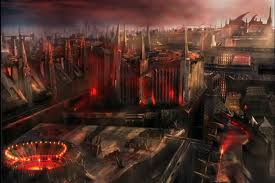
The homeworld of House Harkonnen. And if the religious metaphor which I alluded to earlier is to be believed – where Caladan is Eden and Arrakis is the real world- then this place would definitely be hell. In fact, judging by the many descriptions made of this planet and its rulers in the original series, the hellish metaphor is so thick you could cut it with a knife!

In the original Dune, we are given descriptions that emphasize the planet’s industrial nature. Hints are also given that the planet was highly volcanic and covered in wastelands. In addition to its many factories, large arenas were also built in most cities, where gladiator duels were held to entertain the populace. The Baron’s nephew, Feyd-Rathau, would often compete as a way of gaining popularity amongst the people and demonstrating his skill.

Also, in the original and subsequent novels, much is made of the Harkonnen’s sense of brutality and perversion. Whereas the Baron delighted in little boys, whom he would often kill in the course of molesting them, the planet’s artwork and decor often emphasized sex and violence.The Baron’s appearance, which is described as being so “grossly and immensely fat” that he requires an anti-gravity device just to get around. In addition, he described himself as “always hungry”.

In Heretics of Dune, when Miles Teg and the ghola of Duncan Idaho are hiding in an abandoned Harkonnen chamber, they notice an old clock where the hands are figured of a man and woman with over-sized genitalia (when the two hands line up, it looks as though a gruesome sex act is occurring!). When describing the Harkonnen’s, Leto II claimed they were “lovers of sensation”, people who were obsessed with pleasures of the body.

Hmmm, factories, volcanoes, gladiator rings and bodily pleasures? Sounds like something right out of Dante’s Inferno! In the course of adapting the novel to the big screen, David Lynch went to town on this, showing the planet to be dark, polluted and filled with terrifyingly decrepit people, many of whom had undergone hideous types of surgery (i.e. heartplugs). In the miniseries version, similar attempts were made to capture the hellish nature of the place. Here, every set was done in the colors red and black and camera angles were always askew, capturing the dark and twisted nature of the Baron and his family.

Ix:
The ninth planet in the star system of Alkalurops, Ix is the home of the technocracy that is responsible for producing the vast majority of the Imperium’s machinery. The name of the planet stems from the misinterpretation of the planet’s designation in Roman numerals.

In the original six novels, we never did get a description of what Ix looks like or what really went on there. For reasons which may have a lot to do with the fact that they are technologists in a universe where technology is morally proscribed, the Ixians appear to be somewhat recluse. However, it was clear that they were responsible for creating the various technologies that were central to the plot.

In God Emperor of Dune, Leto II is found to be recording his thoughts using an illegal device that was manufactured by on Ix. It was also the Ixians who were responsible for breeding Malky, a man who’s purpose was to influence Leto into doubting his own path and purpose. Hwi Noree, who was a sort of polar opposite to Malky, was also created to lure him with her charms. Both individuals were bred inside a “no-chamber”, a special cell that hide what is within from prescient detection. This same technology would later go into created “no-ships” and even larger “no-fields” which could shield entire planets.

Another revelation which came in God Emperor of Dune was the fact that Leto, through his Golden Path, had apparently prevented the Ixians from developing a breed of hunter-seekers which would have completely destroyed humanity. Ultimately, part of his plan was to encourage the development of certain technologies while preventing others. Whereas the hunter-seekers fell into the latter category, machines that could block prescience or replace it (i.e. the machine that could do the job of a navigator) fell into the former.

Kaitain:
In the original Dune novel, Kaitain was the seat of power for the Padishah Emperor and the location of the Imperial Court. It was also the homeworld of House Corrino after events on Selusa Secundus forced them to move. All of the guilds, major houses and interests in the known universe maintained a presence here, including the Spacing Guild, the Bene Gesserit, the Ixians, the Tleilaxu, the Landsraad, CHOAM, etc.

After events on Arrakis forced him to intervene, Emperor Shaddam IV relocated the royal palace to Arrakis so that he could oversee the deployment of his armies and ensure the Baron’s cooperation.

Aside from that, not much is mentioned of Kaitain, except for a description of the Golden Lion throne in the original novel’s appendices. Here, it is described as an opulent throne that had been “carved from a single piece of Hagal quartz — blue-green translucency shot through with streaks of yellow fire.”

Selusa Secundus:
Once the seat of House Corrino and the Royal Court, this planet became a prison world after it was devastated in a nuclear attack. As a result, the planet’s climate is incredibly harsh and inhospitable, making it the perfect world for the condemned of society. Radiation from the attack still permeates the planet’s climate, and mortality rates amongst prisoners are apparently as high as 60 percent.

However, as is quickly made clear in the first novel and throughout the series, Selusa Secundus also serves as the training grounds for the Emperor’s dreaded Sardaukar army. This is done in secret, though most Houses within the Imperium apparently suspect it. In fact, in the first novel, the Emperor apparently became suspicious when Baron Harkonnen remarked to Count Fenrig that he would use Arrakis to conduct a similar experiment with his own armies. This was meant only in jest, but it did speak to suspicions the Emperor had.

One other person who understood this was Paul. After becoming an exile on Arrakis, he began to learn that his father had similar plans with the Fremen. By making an alliance with the Fremen, people who had been toughened by conditions worse than that on Selusa Secundus, his father would eventually be able to raise an army army that could rival the Sardaukar. Convinced that Paul was their messiah, he put this plan into action and was able to defeat the Emperor’s armies outside of Arrakeen.

After seizing control of the Golden Lion Throne, Paul exiled House Corrino to Selusa Secundus where they remained until events in Children of Dune. It was here that Shaddam’s third daughter, Princess Wensicia, began plotting the assassinate Paul’s twin children and place her own son Farad’n on the throne. When Jessica is forced to flee Arrakis with Duncan, they found shelter here and made their deal with Winsicia. In exchange for marriage between Ghanima and Farad’n, she agreed to teach him in the Bene Gesserit ways.

Beyond that, no mention is made of Selusa Secundus. Much like House Corrino, it seemed this planet was destined to fade into obscurity.

Tleilax:
Yet another obscure world to come out of the Dune universe. And much like Ix, very little was said about this planet until late in the series. Nevertheless, it too played a very important role in the Dune universe and a number of key developments and inventions were apparently born here.

The sole planet in the Thalim star system, this world is also the home of the mysterious Bene Tleilax. In addition to being the training ground for “twisted Mentats”, Tleilax is also the home of the elusive axlotl tanks, which are used in the production of gholas. Though most within the Imperium frowned upon these devices, as they did all Tleilaxu inventions, the tanks and gholas in particular were used by just about all factions for the sake of their plotting and machinations.

In Dune Messiah, much is told about the Tleilaxu due to their involvement in a plot to unseat Paul Mua’dib from the Imperial Throne. This included the creation of a Duncan Idaho ghola, which had been programmed to kill Paul once he uttered the key phrase “she’s gone” in reference to his beloved Chani. However, this was soon revealed to be a plot within a plot, where the real intent was to show how the original memories of a ghola could be recovered by forcing them into a situation where their original self would reassert itself in order to fight against operate conditioning.

In God Emperor of Dune, Leto II is shown to be reliant on the Tleilaxu’s axlotl technology because he keeps demanding gholas of Duncan Idaho. For reasons unknown, he insists on having the original Duncan in his court, with his full memory restored. It is later suggested that this was an important part of his breeding program, that Duncan contained a special gene which he needed to bread into his descendents. But whatever his reasons, the Bene Gesserit continued his program and maintained an alliance with the Tleilaxu whereby they would receive gholas of Duncan Idaho so they could try to ascertain his true purpose.

In Heretics of Dune, the sixth incarnation of the Sisterhood’s Duncan Idaho is revealed to be special. Unlike the other incarnations, he has access to the memories of all other Idaho gholas, dating back to the very first who served Pual Mua’dib and all those who served and died at the hands of Leto II. In addition, the Tleilaxu clearly equipped him with the sex techniques of the Honored Matres so that he would be able to turn the tables on them when the time came, resisting their attempts to “imprint him” and imprint himself onto one of them. All of this leads Duncan to the conclusion that he now possesses Kwisatz Haderach-like abilities, which is confirmed in Chapterhouse: Dune when he begins to experience visions of the old man and lady (see below).

Also, in was in Heretics of Dune that readers got their first glimpse of the Tleilaxu homeworld and their society. Prior to this, it was understood that Tleilaxu was master geneticists who had engineered their own version of the Kwisatz Hadderach, but which had apparently committed suicide. It was also shown that they were ruled by a series of “masters”; Master Scytale being the one who participated in the plot in Dune Messiah.

However, what was not revealed was that the Tleilaxu were actually secret Zensunni’s and Sufi’s who maintained strict religious secrecy so as to keep their plans hidden from “powindah” (aka. outsiders). In addition, all masters were clones (not gholas) of their original selves and achieved a sort of immortality this way. This was apparently part of their long-term plan to assert their dominance over the known universe, a plan which was finally hatched in Heretics of Dune and involved the specially-programmed Duncan Idaho ghola.

Also central to the plot of several novels in the original series was the Face Dancer, another invention unique to the Tleilaxu. These were people specially bred to be able to take on the likeness and even the memories of people they were charged with killing and impersonating. Bred to be eunuchs and completely loyal, they were human only in the strictest sense of the word and possessed no identity of their own. However, this changed as the series progressed and it became clear that after millenia of adopting the personas of others, Face Dancers were beginning to develop personalities of their own.

This was apparently the threat the Honored Matres were themselves fleeing and which had forced them back into the universe of the Old Imperium. Throughout Chapterhouse: Dune, Duncan Idaho is haunted by visions of an old man and a woman whom he identifies as free Face Dancers. It is these people who he concludes are responsible for the greater threat they face, and who appear to want to capture him because of his special abilities as well.

Another interesting invention to come out Tleilax was the “slig”, a genetically engineered hybrid which crossed the DNA of a pig with a slug to produce a large, fleshy and slothful creature that is easily harvested for its meat. As was remarked in one of the later books in the series, this animal was considered ugly, even disgusting, due to its multiple mouths and skin that excreted a slimy and noxious residue. However, due to its sweet and terder meat, there were few in the Imperium who did not enjoy having “slig medallions” on their tables.

Final Thoughts:
Before I get into talk of patterns and conclusions, a little disclaimer first. First, there are plenty more worlds in Dune universe that are probably worth mentioning. However, there was no way to include them all without making either breaking this post in two or making it run on forever. Second, I deliberately left out information that did not come from the original six novels. True, there’s plenty more mentioned in the expanded franchise of these and other worlds in the Dune universe, but I wanted to stick to material that Frank himself was known to have written. Anything that comes from the expanded universe is likely to suffer from original though. Funny way of putting I know, but it can be known to dilute or undercut anything the original author themselves established.

Okay! Now that I’ve covered my ass, let me get to what I think about these cool worlds! Well, a few things jumped out at me after I was finished researching this list and gave it a final glance:

1. Frank loved secret societies!: Whether it was the Fremen, the Bene Gesserit, the Bene Tleilax, the Ixians, or the Emperor, the concept of recluse worlds and secrets ran through Frank’s original works like a vein. Clearly, he was a big (and I mean big, big, BIG!) fan of intrigue, secrecy, and societies that were founded on them. This is one of the things that I think made the Dune universe so readable and realistic in tone.

Regardless of their house or faction, it seemed that everybody was looking to get a leg up on someone else and found that the best way to do that was to conduct themselves in secret. Was this a commentary on humanity, the result of living under imperial rule, or the result of the complacency Paul and Leto hoped to rescue humanity from? Who knows, point is, he loved em! I think I smell another post in the wind…

2. Ecology effects people: As already mentioned, Frank paid a great of attention to the link between environments and culture. Whereas the Fremen and their values were clearly the result of their hostile and sparse world, the Atreides had apparently been rendered soft by generations of living on Caladan. House Harkonnen, with all their ugly desires and habits, boasted a world to match. And of course Selusa Secundus and Arrakis both served as the ideal training grounds for elite soldiers because life on both was just so freaking hard!

Well that’s all for now. Stay tuned, I plan to tackle the Star Wars universe next! And more chapters for Data Miners are still on the way…

Dune, the miniseries (Part I)

In my previous post, I think I made it pretty clear that the Dune movie was a flop. And I mean this in every sense of the word: commercially, critically – hell, even Lynch distanced himself from it! But that was to be expected, since Dune is just not something that translates into a movie format. There’s simply too much going on, and any fan of the series knows exactly what I’m referring to here. In terms of length, pacing, content, characters, background, detail, depth and commentary, Dune is just too dense to fold into a few hours of footage. As I also stated in my last post. Lynch attempted to address this problem in a number of ways

1.) Prologue: In the original movie, Lynch tried to cover Dune’s extensive background by having Irulan give a breakdown of how the universe works. In the Director’s Cut, he took a different route and went with a narrated preamble (using animated stills) that covered all the major events leading up to the original novel. These included the Butlerian Jihad, the founding of the Guild, the Bene Gesserits, and other secret societies, and then moved on to cover the basics about the Dune universe, such as its feudal structure, the spice, etc. Nothing wrong with either of these, except that they were both kind of awkward. They were a tad expository, and in the case of the animated opening, it went long. (Yeah, yeah, just like my reviews!)

2.) Exposition: In the opening scene, Lynch uses a reworked plotline to help the character of the Emperor set up everything that’s going to happen in the first act. In the subsequent scenes, all the other main characters do the same thing. The Baron and Piter de Vries explain their plan to attack the Atreides to his nephews, and Paul is told the reasons for their move to Arrakis by his mentors. But the problem here was, it all felt too unnatural and clunky. You really got the feeling that someone had read the book and was trying to give a synopsis to the audience, no suspension of disbelief. You can’t make a decent movie if everything feels like there’s a sense of duty behind it, then it’s just boring.

3.) Internal monologues: it goes without saying that you can’t clog up a movie with endless dialogue, especially stuff where characters are just standing around and explaining things in an unnatural way. Some degree of this is understandable, but after awhile, the audience will simply begin saying, “Nobody talks like this! Get on with it!” So Lynch tried using internal speeches, and like I said before, it was annoying as hell! Even after all the expository speeches his characters made, there was still tons of things the audience needed to be told in order to know why stuff was happening or why it was important. And, as I also said before, the movie would have worked better without it. Let the camera and the actors tell the scene, not the little voice on the track!

Okay, at this point I’m thinking anyone reading this is saying “We get it! It didn’t work, move on!” So as I’m sure I’ve said a few times already in the course of this thread, a miniseries was created in 2000 that sought to adapt Dune into a miniseries, one that wouldn’t be hampered by these difficulties. By going with a three part, six-hour format, the creators clearly felt that they would time enough to provide adequate build-up, character and plot development, and make sure that nothing big would be left out or glossed over. And, with some exceptions, they did just that! Even before I read the books, I saw the miniseries and was highly entertained, and even felt that I had been given the complete rundown of everything in the novel. Then, upon reading the novel, I decided that the miniseries was not only faithful to the original material but even improved upon it in some areas. But I’m going long here and I haven’t even got to the good stuff. Nothing worse than a long preamble, right? (Sorry Mr. Lynch, I had to!)

(Background—>)
The miniseries itself was a collaboration between several studios, which included New Amsterdam Entertainment (US), Blixa Film Produktion (Germany), Hallmark Entertainment, and the Sci Fi Channel. Much like the studios involved, the cast was also very international in scope, with actors and actresses from the US, Britain, Germany, Czech Republic, and Italy filling the top roles. These included such big names as William Hurt, Giancarlo Giannini, Ian McNeice, and P.H. Moriarty. It would take me too long to list all the movies these people have been in, but trust me, you’ve seen them! John Harrison, a veteran television writer/director with a tonne of sci-fi, fantasy and horror titles to his credit, was brought in to direct, but also had hand in writing the script. In describing the final product, he claimed that the miniseries was a “faithful interpretation”, in which changes and elements that he had introduced served to elaborate on rather than edit material from the original. Having seen the miniseries and read the novel – in both cases, more than once – I can verify this claim. While their were several differences between the miniseries and the novel, I can honestly say that they worked in its favor. But I can’t really say how without getting into specifics, as well as the differences between this adaptation and Lynch’s failed attempt. So let’s get to it!

(Content—>)
The miniseries opens with a rather brief prologue by Princess Irulan, explaining the significance of Arrakis (Dune) and the spice. We then cut to a quick montage of images that represent a nightmare being experienced by Paul, where we see Arrakis, the carnage that is to come, Chani, and of course, Paul’s father dying. Upon waking, Paul realizes he’s left one of Doctor Yueh’s recordings on, a recording which explains the importance of their move and recaps the balance of power their society rests on. This intro, unlike Lynch’s, provides a brief yet informative snapshot of the Dune universe and what is to come. And unlike the novel or the original movie, the opening scenes are not taking place on Caladan, but on the Guild space liner that will be taking them to Arrakis. I’m not sure why Harrison went with this, but I can say it doesn’t mess up the scenes at all. The setting works, and more importantly, the actors and dialogue are spot on. Paul, and everyone around him, understand that this move is a big deal, that is there is a great deal of danger involved, and that in spite of the fact that it is almost surely a trap, that they have no real choice.

What follows is an altered, but faithful reenactment of the Mother Superior scene. Having come aboard their ship to see Paul, they discuss the subject of his dreams, giving the audience a crucial hint as to how Paul is special (i.e. he’s potentially prescient) as well as some hints of how the story will unfold. From his brief, broken glimpses, Paul can tell that Arrakis holds many things for him. He tells her that he sees desert people chanting his name, terrible wars, and his father dying. The Mother Superior is intrigued, and of course, she conducts the pain box test. Naturally, Paul passes, but storms out in anger, leaving the Mother Superior and Lady Jessica to discuss her defiance to the order. As anyone who’s read the novel knows, Bene Gesserit sisters are under strict orders to produce daughters only, as part of their breeding program, until the eugenics program is complete and one will bear a son. This son, if all goes as planned, will be the Kwisatz Haderach*, their superman who has perfect memory and perfect prescience. So by giving her Duke a son, Jessica has disobeyed the sisterhood, and potentially doomed herself and her son in the process. The Mother Superior says they will suffer for this, not at their hands, but in general. She also says that they will do what they can for the boy, but “for the father, nothing…”, thus letting us know that something’s in the works, that the Bene Gesserit know about it, but appear helpless to stop it. Another thing they do right here, even though its breaking with the novel, is that at no point are the words Kwisatz Haderach mentioned! That’s something Harrison chose to reveal slowly, and in increments instead of giving it away early on.

All of this is starkly different from the original movie and even the novel. It is expository without being preachy or dutiful. If anything, its cool and intriguing, relying on well-honed dialogue that lets us know what’s coming without giving it away. Another change I should mention is Paul’s character. Whereas in the novel and original movie he’s a cheery and positive boy; here, he’s angry, impatient, and resentful, which is what any teenager would be in his situation. In fact, his angst and defiance run through all of Act I, and this is one change I highly approved of, as its far more realistic. Whereas Paul was always portrayed in the novel as the kind of child who never had playmates or a normal childhood but was still well-rounded and upbeat, here we see the realistic outcome of that. He misses his father and Duncan, the closest person he has to a friend, and chooses to take that out on his mother, the Mother Superior, and Gurney when they’re training. It just works!

Then… boom! Cut to Arrakis. Here, we see Duke Leto and Duncan Idaho for the first time as they are talking about the Fremen and their leader, a man named Liet. This is another thing the miniseries did so much better, the fact that they actually went into detail about him instead of glossing over his significance. We are told that he is the quasi-leader of the Fremen, and that Leto wants to find him so they can enlist the help of those Fremen who live in the deep desert. This too is something the miniseries does very well, showing how Leto is concerned with cultivating a relationship with the natives of the deep desert, as he is aware that their abilities and knowledge may be what they need to rule. Like in the novel, this was something that came up again and again, and it was hinted that the Emperor himself was worried over it. Basically, the Fremen of the deep desert are the toughest, meanest badasses in the universe. And while their technology might be limited, their skills are second to none. Therefore, whoever controls Arrakis, has access to what are potentially the best soldiers in the universe. But more on that later…

Several scenes follow, all true to the novel. Paul attends his father’s council meetings where he offers up effective suggestions of how they can run Arrakis and recruit the smugglers. Lady Jessica meets with the household staff, which includes the Shadout Mapes (the head servant) and they slowly learn that she may very well be the mother of their messiah. And of course, Jessica bans the water custom where servants scrounge and sell water and offers a free ration of it to everyone in the city, three times a day. Like everything in this miniseries, things are done slowly, the time being taken to develop things carefully and not drop too much info at once. There is no internal dialogue or characters constantly saying stuff like “oh, the legend, the legend!” when they see Paul or his mother. It is only after many scenes that the issue of Paul messiah-hood is brought up, when people in the streets start saying “Mahdi” in his direction, and Thufir is brought in to explain what the significance of this is to Paul’s father.

This is further exampled during the scenes where Dr. Kynes (who is also secretly Liet) is introduced and takes them out to observe a spice harvester at work. Again, these scene were faithful to the novel without being imitative. Whereas Herbert openly wrote what Kynes and Paul were thinking in the book, the miniseries manages to develop this without the need for internal monologues (even though that would a director’s first choice of how to convey thoughts). Instead, we see through a number of shots how Kynes and Paul they are becoming fascinated with one another. Kynes notices strange things about him, like how he knows how to wear a stillsuit** and understands Fremen ways, while Paul is picking up on the fact that Kynes is clearly a Fremen and is holding back information on Arrakis and the worms. All of this is made clear through simple direction, proper camera work, and dialogue, which makes it much more effective. Then, of course, the scene where the spice harvester is attacked! This, like most special effects in this series, was done through CGI, which was only a marginal improvement on the original.

What follows is a major scene, and one that didn’t make it into the original movie: The dinner banquet. Might not sound important, except that it’s a central part of Act I in the book and because its also the first time we see Princess Irulan in the series. Whereas in the original movie she was just voiceover and a background character, in the miniseries she played a central role and it begins here. Clearly, Harrison and his writers felt that the best way to resolve the ambiguity of her character was to write her in to several key scenes, where she is playing the role of the political pawn, but is actually executing an agenda of her own. This works, because it gives her character a sort of phantom presence, a behind-the-scenes quality that is consistent with her role in the novel. Her inclusion in this scene also works because, during the course of the banquet, she has a chance to talk to Paul. We see how they are similar, how they are both intelligent people who don’t like their worlds, and how this predicts their coming together in a political union by the end. Another thing that makes these scenes work is the skilled acting of Alec Newman (Paul) and Julie Cox (Irulan). You really get the feeling that these two will meet again, that they have a connection that supersedes their loyalty to their houses, and that they are likely to be friends and not lovers. Whereas Irulan is thin, fair and proper, Chani (whom Paul marries) is voluptuous, animated, and dark. Clear case of the platonic versus the sensual here!

While this is all taking place, we cut to the Harkonnen homeworld of Geidi Prime several times so that we can see how the Atreides’ arch-enemies are doing. Ian McNeice, who plays the role of the Baron, gives all of these scenes a dramatic flair that puts them light years ahead of what was done in the original movie. Instead of being revolting and loathsome, he’s graceful, animated, and even effeminate, not to mention entertaining! This is preferable is so many ways because ultimately that’s what makes for a good villain! He might be bad, but audiences will him all the more likeable, the guy they love to hate! There’s also a scene early in Act I where we cut to the royal palace. Here, the Emperor, played by Giancarlo Giannini, speaks about the Atreides and the plot against them, and yes, its not horribly expository either! Not once does he say that he’s sending his Sardaukar to help the Baron in the attack, nor that an attack is even taking place. Instead, he and Count Fenrig simply say that he needs to find a suitable husband for his daughter (Irulan), and that it’s “too bad that Atreides boy won’t be around”. See? Subtle!

Anyhoo, the attack takes place shortly thereafter. We see for the first time (unlike in the novel and movie where it was foretold) that Yueh is in fact the traitor. Here, and here alone, he reveals that he did it because the Baron has his wife and he must see her again, even if she’s already dead. More changes, Thufir is killed in the attack rather than taken prisoner. In the novel, he became the Baron’s new Mentat after Piter is killed by the Duke’s poison-gas tooth. By being his unwilling Mentat, Thufir was at the center of all the Baron’s machinations in the novel. But with him dead, his importance gets minimized. However, this did give the Baron and Feyd an expanded role by making them responsible for all the plotting that takes place between them, thus making them seem smarter and more villainous (more on that later). It is also here that we also see the Baron do some of the best acting in the whole series. We already get to see how his Shakespearean talents and flare steal the show, and how he ends every scene with a rhyming couplet. But here, it’s wonderfully over the top and just plain fun to hear! “I, Baron Vladimir Harkonnen, am the instrument… of his families demise!” “What more proof do you need of what heaven’s intention is? Atreides dead, and Harkonnen lives!” Punctuated, of course, with tons of evil laughter. And best of all, no heart plugs and boys being molested to death! Classy!

Paul and his mother, of course, then make it to safety with the help of Duncan Idaho. And much like in the movie, it feels like he’s killed off way too fast. But at least he made it this far, whereas in the original movie he’s knocked off without ever making a difference. And in the ensuing chase, we also get to see a very important scene which was (you guessed it!) left out of the original. Dr. Kynes, who helps save them by suggesting they flee into the deep desert where the Fremen will protect them, is revealed to be Liet. Paul figures it out when they are in a seitch (a Fremen hideout) and he hears someone mention the name. He explains, intrinsic to the plot arc, that he is not the Fremen’s leader, but more of a guide, who is to stay around until “Mahdi comes”. This helps to illustrate a key element in the story: how the Fremen and the planet’s Imperial ecologists have been working together since the time of Kyne’s father. Ever since the elder Kynes was welcomed into a Fremen community, he busily taught them of how Arrakis’ ecology could be changed, how moisture dens could be created and used to fertilize plants once they had been strategically planted, thus giving rise to a lusher climate. Over time, this idea merged with the legends planted by the Bene Gesserit, of how a messiah would come and lead them to freedom. Paul, and hence the audience, is now beginning to see how these prophecies (self-fulfilling though they may be) are coming true thanks to his arrival. So you can see why this is important, right? Including it only makes sense!

Then, of course, Paul and his mother flee because the enemy is coming. They take to an ornithopter, and fly even deeper into the desert. In order to escape the pursuing Harkonnen planes, they are forced to fly into one of Arrakis’ massive storm. Now this scene I got a problem with, admittedly. “You’re not going in there are you?” “They’d be crazy to follow us!” Yeah, I know David Lynch ripped off the Star Wars franchise, but that doesn’t mean you have to! Okay, then Paul recites the litany against fear, and they go for it! And Part I ends with Irulan quoting from the book, and saying that the saga of Dune is far from over…

Thus ends Act I. And given the length of this review, I shan’t go on! Tune in again tomorrow for Act II, I promise it’ll be shorter!

Endnotes:
*This term is derived from “Kefitzat Haderech”, a Kabbalah term which means “The Way’s Jump”, apparently relating to teleportation. In this context, it means “Shortening of the Way”, referring to the bridging of past, present and future, i.e. prescience.
**A suit that allows the wearer to retain water lost through respiration and perspiration by catching it all in its skin, filtering and processing it, then depositing it in a series of bags the person can draw from.

Dune, the movie (and miniseries)!

Wow… when I first started doing these movie reviews, last week, I knew that at some point I’d have to cover the book-turned-movie that inspired me to write! And truth be told, I actually saw this movie before reading the book. Yes, Dune was just like Lord of the Rings for me, a film that I was drawn to because I knew it was based on a classic. And upon learning that the movie was significantly different from the book, I decided that at some point, I’d check the latter out. However, it was not until years later, with the production of Frank Herbert’s Dune (the six part miniseries that was much more faithful to the novel) that I finally put my money where my mouth was.

Well, you know the rest… sort of. Short version, it inspired me; long version, I read the first three books, had to return them, then read all six… twice over. Guess you could say I liked them, though I got to admit, not as much as some people! Since I first posted my thoughts about Dune and its Descendents, I’ve learned that their are Dune fansites out there where its all they talk about. And boy do they know their stuff! So let me take this opportunity to give a shout out to the good folks at Jacurutu and Hairy Ticks of Dune! Keep up the good work!

I think I also mentioned somewhere that movies based on books, especially where they differed, would get special attention. To make good on this drunken boast, here’s my review of Dune (1984, directed by David Lynch) and Frank Herbert’s Dune (the 2000 miniseries that premiered on the Sci-fi network). First up, Lynch’s adaptation of Herbert’s Magnum Opus!

(Background—>)
Since 1971, six years after Herbert wrote Dune, attempts were made to adapt the novel to film. Several directors tried and failed, among them Arthur P. Jacobs, Alejandro Jodorowsky, and Ridley Scott. However, all came up short. Then, in 1981, the Italian film producer Dino De Laurentis decided to tackle it and brought in relative newcomer David Lynch to direct it. This did not mean that the two did not go through hell to create it though! The movie did not hit the screen until 1984, Lynch distanced himself from the work, saying he was denied final cut privileges, and several versions have been released over the years. The original was a two-hour movie that glossed over much that happened in the book and simplified the plot. A three hour version was also released, but this too was guilty of the same faults (i.e. glossing and simplifying). But then again, how do you do justice to a book that is as dense as Dune while still making it fit into a two hour format? Hell, even a three hour format is pretty damn tight, and Lynch cited pressure and deadlines as a reason for the disappointing final product. So really, its lack of commercial success and mixed reviews are entirely understandable. But, as Nietzsche said, “God is in the details”. So let’s get down to the particulars and see just what made the original flop and the miniseries work.

(Synopsis—>)
The original movie opens with an intro that parallels the novels, but which seems, in a movie format, to be both confusing and misleading. Princess Irulan (played by Virginia Madsen) gives us an overview of the known universe, set to a background of stars. She lets us know what year it is, how her father’s the Emperor of the known universe, and how the spice runs everything. She also introduces the namesake of the movie, the planet where all spice in the universe “flows” from – Arrakis, aka. Dune. Now here is why this is confusing. Aside from this intro, she has voice over lines for the rest of the movie, and one line of dialogue in the opening scene. But otherwise, we don’t hear or see from her until the very end, and even then she’s just a stand-in. A glorified prop. This is faithful to the novel, in which every chapter opens with a quote from her Histories of Muad’Dib and what not, but like I say, doesn’t work here. In a movie, if someone’s doing the intro, you’d expect them to have some kind of role throughout the movie.

Moving on, the original movie then introduces us to the Spacing Guild by having them confront the Emperor about a possible conspiracy they got wind of. They demand that the Emperor explain the key elements to them, which is really just an excuse for some exposition. I should mention that none of this takes place in the original novel, and it feels like a total info dump, especially if you’ve read said novel. There, Herbert took his time to build up the conspiratorial relationship that existed between House Harkonnen and the Emperor and used dialogue to put it into the background, which is something they should have done with the movie. Dropping it on the audience all at once just seems forced. Oh, and once the Emperor is done explaining his conspiracy, the Guild adds their two cents: if Duke Leto Atreides is to die, could he throw in the son as well? Why? They try to explain that later. In the meantime, we are left to wonder for ourselves, and the Emperor even asks this obvious question in an internal monologue. I should note that this ALSO did not happen in the original book. In fact, the Guild never made any demands at all and had nothing to do with the conspiracy that gets Act I rolling. So again, no real need for this, except to set up the truncated, simplified plot they went with. The scene did involve some cool costumes though, not to mention a big, animatronic navigator in a pressure tank; all of which was pretty original since the appearance of navigators was never described in any great detail. But for the most part, this scene is kinda useless. It also sets up the rather annoying and persistent habit this movie has of relying on internal monologues. I’m reminded of Blade Runner, where Scott felt that need to include narration in the theatrical version, something which was left out of the Director’s Cut. And as time has proven, the latter was better, relying on the actors and direction to establish things and convey information instead of just telling the audience what’s going on.

The movie then moves to planet Geidi Prime, the home of the Harkonnen’s. This scene I actually liked, at least until the dialogue really started to flow. The reason was because the sets were actually very cool. They create the kind of dark, fearful atmosphere that you would expect from a director like Lynch. But then, a big expository speech is made in which the Baron (Kenneth McMillan) and Mentat Piter De Vries (Brad Dourif) explain to Feyd (played by Sting!) and his brother “The Beast” Rabban, what their plan is, in painfully simple terms! “We got us a conspiracy here, and nobody can know about it, k?” I mean, c’mon people, a little subtlety! They go over the top just a little to make the Baron look evil here too, like how he’s got disease ridden flesh that a doctor has to lance constantly, or how he molests some boy to death, or how Rabban and Feyd enjoy the spectacle immensely. I mean, we get it, they’re evil. Move on!

Speaking of moving on, we are brought to Caladan next, home of the Atreides. We meet Paul Atreides (Kyle MacLachlan) as he’s brushing up on his planet studies from what appears to be an iPad/audiobook. And of course, more internal monologue is used to tell us what we need to know about these places. And it’s annoying as all hell! “Geidi Prime, home of our enemy…”, “Kaitain, where the Emperor lives…” “Arrakis… Dune… Desert planet…” Then, we get to meet Paul’s tutors, who stand still and stare at Paul long enough for the narration to introduce them all. Really? Why not just freeze frame it, or better yet, NOT have Irulan introduce them? Seriously, it looks like they’re in a stage play and are waiting for the damn chorus to stop talking so they can say their lines. Okay, so there’s Gurney Halleck (Patrick Stewart, aka. Captain Picard), Thufir Hawat (Freddie Jones) and Doctor Yueh (Dean Stockwell, aka. Al from Quantum Leap). More expository dialogue follows as they dump info on Arrakis, the Fremen, the giant Sandworms, the spice, their enemies the Harkonnens, and how they suspect the Emperor’s in league with them. Then we get a quasi-action scene as Paul takes down a robot using a Weirding Module (a gun that relies on sound, already mentioned in the movie). Do I even need to mention that these things were never in the original book? In truth, they are kind of neat, and the settings used for this scene are also lavish, just like the ones used to reconstruct the emperor’s palace and Geidi Prime. But, you kind of get the feeling that they are setting the tone for the rest of the movie at this point, like all the money went into wardrobe and sets and none was left over for decent writers!

After beating up the robot with his Weirding gun, Paul meets up with Duke Leto (Jürgen Prochnow), who tells Paul he’s proud of him and explains how their move will do them good in spite of the danger. Why? Some stuff about how the “sleeper must awaken”. Now of course this is a case of foreshadowing, but even with all the info dumping and internal monologues, its never quite clear what this means, even by the end of the movie. The Lady Jessica is then introduced, Paul gets to meet the Revered Mother, and she tests him with that funky black box that induces pain. This is also in keeping with the novel, as it establishes that Paul might be the Kwisatz Haderach*, and that there is a conspiracy in the works against Paul’s father. Unlike the previous scenes, this one doesn’t feel so info-dumpish. Maybe that’s because its actually pretty close to what was in the novel, so the writers didn’t feel the need to be so expository. But alas, this good scene is followed by a pretty stupid one in which Duncan Idaho (Richard Jordan) is intro’d and Paul says good-bye to him, since he will be going to Arrakis with an advance party to check the place out. What makes this scene stupid? Two lines of dialogue: “May the hand of God be with you,” says Paul. “May the hand of God be with us all,” replies Duncan. Just substitute the word Force and you’ve got a lawsuit on your hands. What the hell! That wasn’t even a subtle attempt at ripping off Star Wars, which was by 1984, the most popular sci-fi franchise of all time! What were they trying to do, cash in on one-liner recognition?

We then cut to the Guild transport ship where we get a special effects montage that is meant to illustrate the mysterious process of how a navigator “folds space”. This, as the novel explains, is an instantaneous form of space travel, which is dependent on navigators who have heightened, spice-induced mental abilities to merge time and space. Whoa! Okay, while the special effects in this scene are not up to current standards, it was still pretty cool. And I did love the models used to create the scene, mainly because you get a real sense of grandeur from them which is what Lynch was clearly going for. In the novel, Herbert emphasized that the Guild ships were really, really big! So kudos for more good set work, David. That’s one thing this movie keeps doing well. Then, cut to Arrakis, where the ship has deposited them safely.

What follows is several scenes in which we see the Duke’s men deploying and settling in. Lady Jessica also meets the Fremen and we find out that they also have legends that involve a Messianic figure that parallel the Bene Gesserit’s. We also get a good long scene where Doctor Kynes (Max Von Sydow), the planetary ecologist, takes them to the desert in an ornithopter and we get to see a worm attack a harvester. Again, kind of cheesy by current standards, but the scene is quite well done and does a pretty good job of conveying Paul’s wonder and the obvious tension over being attacked by a gigantic beast. Then, an attempt is made on Paul’s life, they find booby traps, yadda yadda, yadda. And all the while, Paul becomes more and more entranced with Arrakis, the spice, and his own fate. Then, after ALL that build-up, the Harkonnens and the Emperor finally attack! The combat scene is short, people die, Doctor Yueh betrays the Duke, and Paul and his mother are ushered to safety. Duncan also dies way too soon, having lost the better part of his page time and any involvement he had in making sure Paul and his mother survived. But this was obviously done in order to speed along the movie, which was already going long and had lots to cover still.

Speaking of which, Paul and his mother then find themselves in the desert where they narrowly escape a worm and the Fremen find them. Now this part, mainly the scene where they see the desert Fremen for the first time, I got a problem with for three reasons. First of all, they totally change the reason why Paul takes the name Muad’Dib. Its the name of a desert mouse, not the damn “mouse shadow” that’s on the planet’s second moon! Why’d the movie writers change that anyway? Was the book’s version not messianic enough for ya? The nerve! Second, the acting is wooden, from Stilgar (Everett McGill) to Chani (Sean Young), and just about everyone else in this scene! Everything they say just sounds laughable and cheesy. Third, they speed through it like they’re in a huge rush, which is precisely what the movie does from this point onward! Like I said, its as if they acknowledged that they’ve already spent half the movie on Act I and need to rush through Acts II and III. So from this initial encounter where Paul and his mother are welcome into the tribe, we are rushed to the Fremen’s hideout where they show Paul and his mother one of their moisture traps, the Reverend Mother dies and Jessica take her place (in the process drinking the “Water of Life”** and altering her unborn daughter, Alia), Paul begins teaching the Fremen the “Weirding Way” (still sounds weird!) and they begin their campaign against the Harkonnens, and Paul and Jessica fall in love. Totally, totally rushed! Scene by scene, minimal time is given to establishing the significance of these events, Lynch relying on internal dialogue and narration to relate what the audience needs to know. Even the scene where Paul rides the worm feels rushed, and its got the epic music and a freaking Sandworm!

To make matters even worse, Irulan’s voiceover is cued again and we’re told that Paul then spent the next two years waging war against the Baron’s spice production, Alia grew up way faster than any normal child, and Paul and Chani fell in love. Really? All that just happened, huh? And we’re only an hour and fifteen minutes in? Wow, were making great time! Naturally, the book did this too, but it dedicated plenty of page time filling in those gaps. They didn’t just phone it in! I know, I know, time constraints, but even in the long version, it’s the same. Just a montage of shit blowing up, then we come to the scene where Paul meets Gurney again – whose taken up with some smugglers since the attack – and they join forces. I should also mention that the movie then skips a whole bunch of scenes that took place in the novel and moves right to the part where the Emperor comes to Arrakis to demand answers. He does this, in the movie, because the Guild demanded it of him. Again, not in the damn book! In the book, the Emperor intervenes because the Baron’s incompetence in suppressing the rebellion demanded it, not because the Guild is pissed. Then, we learn why the Guild wants him dead. They say so, and Paul sees it in his dream. They are afraid he’ll drink the “Water of Life”, apparently, because… Well, we’re not sure why at this point. And we’re not even sure why Paul will do it, aside from the fact that we’re told, point blank, that he HAS to. His visions are interrupted, you see, and he needs to take the water of life to regain it and “become what he is meant to be”, or some such prophetic shit!

Anyway, Paul achieves a higher state of awareness after surviving the ordeal, as is demonstrated by a series of watery images and more internal monologue. The truth, he realizes, is that the worms create the spice and the two are interrelated. Duh! But apparently, drinking the water has not just restored his visions but given him control over the worms too. Oh boy! Do I even need to say it? NOT IN THE BOOK! In the original story, Paul drank the water to gain full awareness, which is something every Bene Gesserit sister does and Paul knew he’d have to do sooner or later to see if he was the Kwisatz Hadderach. And he didn’t gain control over the damn worms in the process! What’s more, the Guild didn’t give a shit about any of this, nor did it ever even come up, mainly because they didn’t suspect he would take control over the spice-producing worms in the process. That was all invented by the movie’s writers, and it was pretty damn flaccid, you ask me! It was the simplification I mentioned, and for any fan of the novel (or anyone with half a brain, for that matter) it was a letdown. This, apparently, was what his father was talking about when he said those prophetic words: “The Sleeper must awaken.” Well, seems it has. Makes no sense, but whatever…

So, Paul and the Fremen get a hold of a whole lot of Sandworms and decide to attack the Emperor, who’s arrived on Arrakis in his Imperial fortress. And this climactic action scene is, once again, rushed and pretty sloppy. Lots of tracers and lots of things blowing up, but hardly a satisfying fight scene with the kind of urgency or desperation you’d expect. I mean, I know Paul’s prescient and has already foreseen victory, but that doesn’t mean it should be all one-sided. Then comes the final scene where Paul is dictating terms to the Emperor, a scene which is truncated and underdeveloped by any standard. Yes, he does order the Emperor to abdicate and give him power, which involves marriage to Irulan (who appears in this scene, but says nothing), and yes, he tells off the Mother Superior; all of which is in keeping with the original novel. But nothing is mentioned as to how Paul plans to back up these demands. In the novel, his victory is not complete since the Emperor still has the armies of every noble house sitting in orbit, just waiting for him to say “attack!”. He cannot bring the Emperor and the entire universe to heel until he threatens to destroy the spice, which he knows about because he’s stumbled onto the secret of how water is lethal to the worms. “He who can destroy a thing, controls a thing”, as the novel put it. But in the movie, the Emperor is about to protest until the Guild simply tells him to shut up, because apparently, they “know what he can do”. Uh, mind telling the rest of us? Paul controls the worms, so does that mean he can shut off spice production? Tell the worms to simply stop making it? What?

But all that gets pushed aside so Paul and Feyd (aka. Sting) can have their final knife fight scene. Of course, Paul kills him, and makes his proclamation, also from the novel. “We Fremen have a saying. ‘God created Arrakis to train the faithful’. One cannot go against the word of God’. Then comes the two stupidest parts of the movie, nice that they saved them for last! First, Irulan’s final voiceover of the movie explains that Paul ushered in some kind of golden age. “Where there was war, Paul would bring peace. Where there was hate, he would bring love.” Are you freaking kidding me? I could mention that this is a total perversion of what happened in the novels, where in fact Paul’s reign brought in successive Crusades against the world’s that resisted him, killing billions, but I think I’ll just point out how this makes no sense. For starters, this bringer of peace and love, is this the same guy who just waged a war against the Harkonnens for two years, a war that was based on tons of guerrilla/terrorist-style attacks? The same guy who brought down the Emperor’s army by using a tactical nuke, followed by a full-frontal assault that involved monster-like creatures? Second, just how is this messianic emperor (who happens to have an army of skilled religious zealots at his disposal that see him as a living god and obey his every comomand) going to spread peace and love? Boxes of candy and flowers? Get real! It’s “Do as I say, or freaking die like these other bastards!” Why the hell they even threw this line in in the first place is beyond me! It totally goes against everything the book stood for, which was a sense of historic and humanistic realism. Paul wasn’t no Gandhiesque Jesus figure who loved his enemies and fell on their swords. He was a bass-ass prophet with the toughest army on the block, who smote his enemies hard, fast, and where it hurt! Second, its just plain stupid!

Oh, but I’m forgetting the other stupid thing. Paul makes it rain. Yeah, that’s right. As a demonstration of his powers after he’s killed Feyd and brought everyone to heel, he uses his mind and makes the skies open with tears. Um… what??? What the hell is this, more totally over the top messianic crap? The man is NOT God, in spite of his freaky powers or what his followers think of him. Furthermore, as the extended movie already established (not to mention the novel, many times over), water is poisonous to the worms! This is why Arrakis is a desert planet, for chrissakes! The worms altered the ecology so they could survive. So making it rain would automatically kill all of them and shut down spice production forever! And, as the novel and movie both mentioned, spice is the life blood of EVERYTHING! Without it, people die, and I don’t just mean from the total breakdown of trade, commerce and transport. I mean they start Jonesin’ and freaking die! True, the book did dedicate vast amounts of page time explaining how the Fremen want to alter Arrakis’ ecology so it will be lusher and more hospitable, hence all the moisture traps, but this plan involved centuries of ecological engineering, with great care being given to ensure that some patches of desert would remain so the worse could survive. So not only was it a completely over the top, Ten Commandments-style trick, it also contradicted everything established in the movie – and more importantly, the novel – up until this point.

Ah, screw this! Roll credits!

(Synopsis—>)
Okay, no two ways about it, I didn’t like this movie. Obviously, my love of the original book has much to do with that, but so does my commitment to a well-drawn out, well-written story! And while I liked the sets, the costumes, and felt they did a good job of casting, that’s about as far as my love went. The dialogue moves between wooden and preachy, their are far too many expositions being made, the internal monologues are as annoying as they are persistent, the pace is rushed, and the plot feels like a cut and paste job. Once again, I must acknowledge that time constraints and production difficulties were responsible, but that doesn’t change the fact that it feels like they cut a whole lot of corners in this movie, then pasted on some half-assed plot lines in their place to make it fit and still make sense. Well… not exactly make sense, but you get the point. And I’d be one of the first people to admit that this was inevitable since Dune really can’t be made into a two or even three hour movie, but that doesn’t change the fact that the end result was still pretty bad. Not all bad, mind you. In fact, the first hour or so is actually pretty enjoyable if you don’t know what to expect. But then, it all kind of goes to hell and by the end, you get the feeling even David Lynch was saying it “screw it, roll credits.”

And as was to be expected, the movie was panned by critics and did poorly at the box office. A cult classic like Dune you’d expect to not garner a lot of attention at first, but at least you’d hope it would get the attention of critics and command a cult following. Alas, this movie did neither, and it was for this reason that the miniseries was made some sixteen years later. Essentially, many felt that the Dune franchise, with all its adherents and devoted fans, deserved a second shot at a worthy adaptation. And by opting for a miniseries format – three episodes, two hours each with commercials – they would be able to do it justice. And you know what, they did! But more on that in my next installment…

Dune:
Entertainment Value: 6/10 (good for the first hour, then not so much)
Plot: 3/10 (weaaaaak!)
Direction: 8/10 (nothing wrong with how Lynch shot it!)
Total: 6/10

Endnotes:(your welcome!)
* A superbeing the Bene Gesserit were conspiring to develop through selective breeding. A male that would combine all their powers of genetic memory, prescience, and super-human kills.
** The liquid exhalation of a sandworm that is excreted in the course of their dying, which the Bene Gesserit rely on to achieve higher awareness. The “trial” involves drinking the poisonous water and converting it by using their mental acuity. Those who survive achieve higher awareness, those who fail die.