NASA Sends Mona Lisa to the Moon!

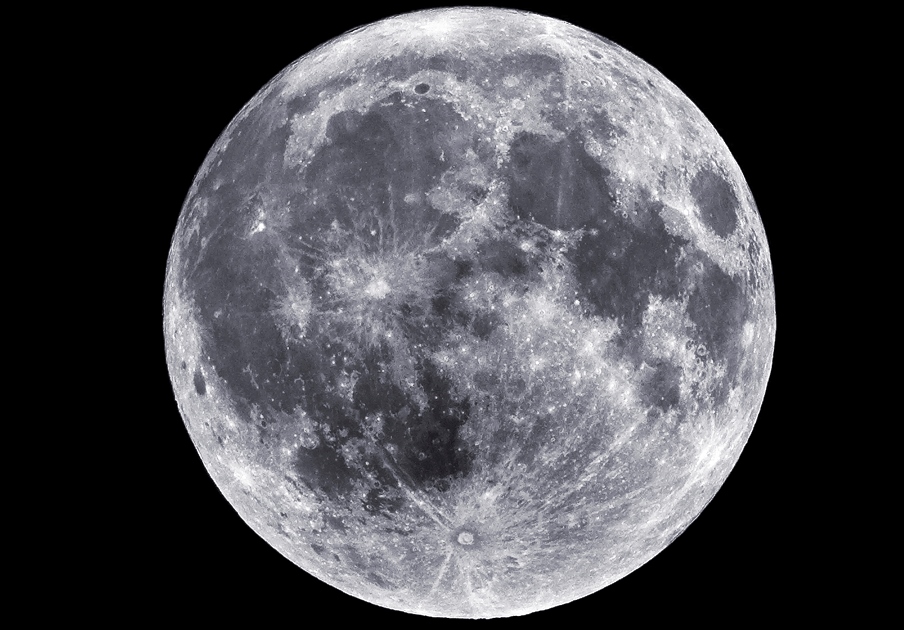
moonIn an effort to demonstrate how laser communications work, and perhaps just to show off a little, a team of NASA engineers shot an image of the Mona Lisa to the moon by piggybacking it on laser pulses. The transmission occurred back in mid-January, and took place between NASA’s Goddard Space Flight Center here on Earth and the Lunar Reconnaissance Orbiter (LRO) some 386,000 km (240,000 miles) away. In addition to showcases how NASA regularly communicated with the orbiter, it also presented a possible means of communicating with a future moon colony.

On any given day, scientists at the Goddard Space Flight Center use what is known as the Next Generation Satellite Laser Ranging Station to track the LRO’s position. Expanding on this, the staff reprogrammed the laser to send the massive work of art in the form of as massive JPEG file. This involved chopping the picture into a 152×200 pixel array, with each pixel assigned a gray-scale value and beamed up one at a time. All told, the process took some time, with image transmission speed clocked at about 300 bits per second.
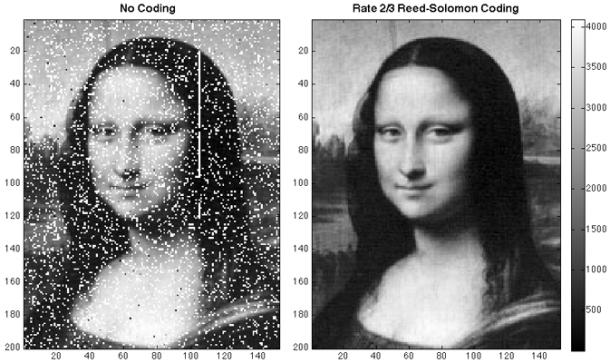
mona_lisa_laserIt then fell to LOLO, the LRO’s Lunar Orbiter Laser Altimeter, to put the Mona Lisa back together based on the arrival times of the pixel data. All the while, LOLA continued to pursue its primary mission of mapping out the lunar terrain. The image was then beamed back to Earth via the LRO’s radio telemetry system, with only minor errors caused by turbulence in the atmosphere.

MIT’s David Smith, head of LOLA, had this to say about the event in a release:

“This is the first time anyone has achieved one-way laser communication at planetary distances. In the near future, this type of simple laser communication might serve as a backup for the radio communication that satellites use. In the more distant future, it may allow communication at higher data rates than present radio links can provide.”

According to NASA, the success of the demonstration could pave the way for lasers to be used for satellite communication, particularly with its Lunar Atmosphere and Dust Environment Explorer (LADEE) mission, which is set to launch this year.

No telling how DaVinci might react to the news of his classic portrait breaching the heavens and being beamed into space. However, given the man’s obvious love of his work and fascination with all things metaphysical and scientific, I think he would have been very happy. Perhaps if his enigmatic masterpiece were to be send into the cosmos as part of the search for extra-terrestrial life too. But that’s another day and another mission!

And be sure to check out the video below from the Goddard SFC explaining the process, courtesy of NASA:

Source: news.cnet.com
Italian Court Convicts Scientists for Failing to Save Lives

hi-italy-earthquake-852In a move that calls to mind the Inquisition, the Scopes Monkey Trial and other cases where science was put on trial by fearful minds, an Italian court made international news in 2012 for charging six seismologists with manslaughter. The verdict was handed down back in October in relation to the deadly earthquake that struck  the Abruzzo region in 2009. This decision has sent ripples through the scientific community, and inspired a fair deal of rancor the world over.

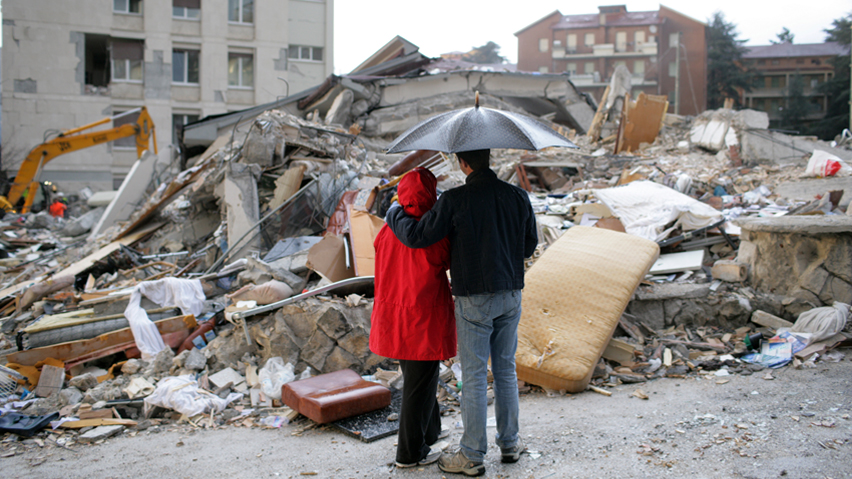
The 6.3-magnitude quake that struck on April 6, 2009 caused the deaths of 309 people and injured about 1,500 others as well as laying waste to most of the buildings in the medieval town of L’Aquila. In the aftermath, six seismologist were put on trial for not giving the public “sufficient warning” about the quake, even though members of their profession the world over insisted that given the current state of technology, their was no way to accurately predict it.

italy-quake-rtr32cThat didn’t fly with the Italian court, which handed a sentence of six years apiece for the scientists after a 13 month-long trial. On the same day, four top Italian disaster experts quit their jobs, saying the ruling will make it impossible for them to perform their duties. And of course, that feeling was echoed far and wide, especially here in Canada where numerous officials lined up to denounce the verdict and express grief over its likely implications.

In an interview with Nature magazine at the outset of the trial last September, Italian prosecutor Fabio Picuti acknowledged that prediction was not (no pun intended) an exact science, replying “I’m not crazy. I know they can’t predict earthquakes.” Meanwhile judge Giuseppe Romano Gargarella, who oversaw the case, said that the defendants “gave inexact, incomplete and contradictory information” about whether a series of small tremors in the six months prior to the 2009 disaster were significant enough to issue a quake warning.

earthquakeSo in reality, the case was not about a failure to predict the quake, but was instead a matter of “risk communication”. As David Ropeik, a journalist for Scientific American‘s online blog, pointed out, that task fell to Bernardo De Bernardinis, a government official who was not a seismologist, and who tried to assuage public concern by glibly suggesting they “relax with a glass of wine”. He and other members of the Great Risks Commission and the national Institute of Geophysics and Volcanology were also tried in the same case. All of these men, according to Ropeik, did a very poor job of communicating the risk to the public.

But even with this distinction being made, between failure to predict and failure to communicate, this verdict still has many people worried. One such person was Gail Atkinson, the Canada Research Chair in Earthquake Hazards and Ground Motions, remarked “It’s a travesty… what it will result in is seismologists and other scientists being afraid to say anything at all.” Another was John Clague, a professor in the department of earth sciences at Simon Fraser University and a member of the Royal Society of Canada. “I just think scientists are going to be reluctant to deal with the problem,” he said, “particularly government scientists. Academics like myself, we’re going to be very guarded about the words we use”, referring to seismology and earthquakes.

In short, if there’s a question of liability, one can expect scientists to be far more careful about what they say, which is going to wreak havoc since science depends upon the accurate transmission of information. This state of mind, for many, calls to mind instances in Italy’s past where scientists were forced to hold their tongues and conceal their research and findings for fear of a public backlash.

vitruvian_man_leonardo_da_vinciThree prominent examples include Leonardo da Vinci, who’s extensive work in biology, anatomy, flight, and physics was documented with backwards writing to conceal it from prying eyes. Another is Galileo Galilee, a man who’s seminal work proving the Heliocentric model of the universe was hindered by the Vatican’s fear that it contradicted church doctrine. And third and last is the Luminati, an organization of Renaissance scientists who were purged for their interests in the natural sciences and mysticism.

So the question remains, are scientists and government panels to be held accountable for failing to predict, or accurately convey potential disasters? Moreover, is this is a case of scientists being persecuted, or just liability gone mad?

Source: CBC.ca