It seems like weeks since the Red Planet has been featured in the news. But that’s to be expected when the two biggest news makers – the Opportunity and Curiosity rovers – are either performing a long drive or climbing a tall mountain. Not much in the way of updates are expected, unless something goes wrong. Luckily, these rovers always find ways to surprise us.
After over a year on Mars, Curiosity has accomplished a long list of firsts. This latest occurred last week, when NASA announced that Curiosity picked up the pace of its long trek to Mount Sharp by completing its first two-day autonomous drive, in which the rover did one leg of an autonomous drive on Sunday, then completed it on Monday.
Previously, Curiosity’s autonomous drives were only executed after finishing a drive planned by mission control on Earth using images supplied by Curiosity. These images would then be uploaded its on board computer, and the rover would compare them with images taken by its navigation camera to plot a safe path. The drive completed Monday is the first where the rover ended an autonomous drive on one day, then continued it the next day by itself.
This is all thanks to the incorporation of the new autonomous navigation (or autonav) software, which NASA finished incorporating and debuted at the end of August. According to NASA, this new system not only allows the rover to drive itself for longer stretches of time, it also allows mission control to plan activities for several days, which could be implemented on Fridays and before holidays so the rover can continue to work while the staff are away.
According to NASA, on Sunday, the new software allowed Curiosity to drive about 55 m (180 ft) along a path planned by mission control, then switched to autonomous mode and traveled another 38m (125 ft) with the rover selecting waypoints and the safest path. It then stored navigation variables in its non-volatile memory, then reloaded them on Monday to drive another 32 m (105 ft).
In all, Curiosity covered about 125 meters (410 ft) in total. This brought it within about 80 m (262 ft) from “Cooperstown,” a rocky outcrop where the rover will be conducting another series of scientific examinations. These will be the first time that Curiosity has had the opportunity to use its arm-mounted instruments since September 22.
According to Kevin Lewis of Princeton University, who spoke about the upcoming studies in “Cooperstown”:
What interests us about this site is an intriguing outcrop of layered material visible in the orbital images. We want to see how the local layered outcrop at Cooperstown may help us relate the geology of Yellowknife Bay [on Mars] to the geology of Mount Sharp.
This stop will be only brief, as the rover team are anxious to get Curiosity back on its way to Mount Sharp. Once there, it will begin digging, drilling and generally seeking out the vast caches of minerals that the mountain is expected to have, ones which could potentially support a habitable environment. Exciting times ahead!
Its been an exciting 48 hours for the scientific community. It began when a team of British scientists floated a balloon up into the stratosphere, more than 25 km (16 miles) up, and when it came down they found it was carrying tiny organisms. The scientists claimed that there is no way that such organisms could have come from Earth and found their way into the stratosphere, so they must have come from space.
Specifically, they must have come from a comet, given their particular characteristics, and they could even be evidence that all life on Earth really did originate in the stars. This theory is known as Exogenesis (or Panspermia), and contends that this is how organisms are spread throughout the universe – spawning in certain environments, but flourishing on worlds where they are deposited and conditions are just right.
According to Professor Milton Wainwright of the Department of Molecular Biology and Biotechnology at the University of Sheffield, they are “about 95 percent convinced” of that fact, though he admits that it’s hard to be absolutely certainty. But apart from the height of the organisms, which would make it hard to imagine them being from Earth, Wainwright and his team also noted that they bear no physical signs of ever being earthbound.
As Wainwright said in the course of announcing the team’s findings:
There is no known mechanism by which these life forms can achieve that height. As far as we can tell from known physics, they must be incoming. The particles are very clean. They don’t have any dust attached to them, which again suggests they’re not coming to earth. Similarly, cosmic dust isn’t stuck to them, so we think they came from an aquatic environment, and the most obvious aquatic environment in space is a comet.
In addition, the science team ruled out the possibility that the particles were originally from Earth and were blasted into the stratosphere by a volcano, noting that it’s been too long since the last volcanic eruption on Earth for the particles to have maintained such a height. So the tentative conclusion remains, that the organisms were placed in orbit by a passing comet.
What’s even more exciting is the prospect that the organisms, though they are all likely dead at this point, are likely to contain alien DNA. If this proves to be true, it could further the idea that life on Earth may have had its beginnings in cosmos. Next month, the team plans to try the balloon test again to see if they can both confirm their results and find new organisms in upcoming meteor shower tied to Halley’s Comet.
Exciting prospects indeed. But almost immediately after the announcement been made, dissenting voices began to come forward to poke holes in the team’s theory. One such person is Phil Plait, an astronomer who upon reading the findings in the Journal of Cosmology, raised a number of concerns and criticisms about the team’s research.
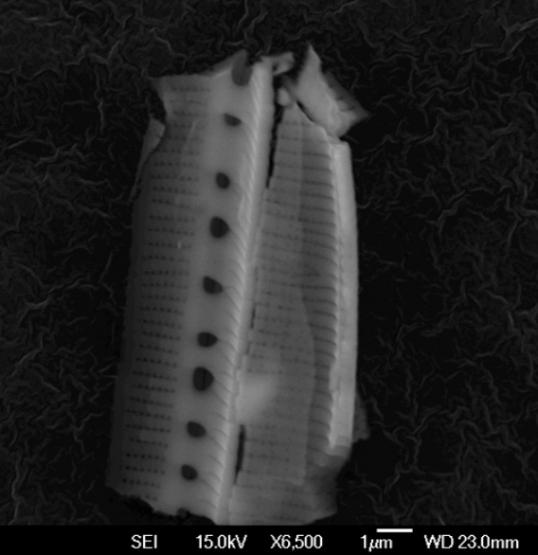
First, Plait notes, one member of the research team, Chandra Wickramasinghe, has claimed numerous times that he’s discovered diatoms – a type of phytoplankton found in meteorites – and this particular paper also includes similar diatom findings. Wickramsinghe also, according to Plait, has a long history of making dubious claims about extraterrestrial life, using less-than-thorough research.
Plait also noted that the Journal of Cosmology, where the paper was published, has a less-than-spotless reputation. In the past, the quality of peer review at the journal has been questioned, and they have also been accused of promoting fringe and speculative viewpoints on astrobiology, astrophysics, and quantum physics. Of particular concern is the journal’s apparent bias that the theory of Panspermia is established fact, which remains a theory.
But as to the scientific findings themselves, there’s the question of whether the diatom really came from space or became attached to the balloon as it transited from the surface into orbit. While the team claims that precautions were taken and the sample was too clean, extended testing may prove this conclusion to be wrong, and possibly premature.
Second, Plait disputes the conclusion that the diatom could not have been put up in the atmosphere by a volcanic eruption. Specifically, he noted that the researchers didn’t seem to take into account things like turbulence in the stratosphere that could have kept objects previously hurled up there by volcanoes floating around for quite some time.
Then there’s the claim that evidence points that the organisms came from a comet. The fact that it was “remarkably clean and free of soil or other solid material,” works against this conclusion, according to Plait. If indeed it came embedded in rock, there would surely be samples of soil, dust, ice or minerals attached to it, as these are things commonly found in a comet.
And finally, there’s the theory the researchers developed that these organisms are evidence that life actually began somewhere in space, then came to Earth. While Panspermia is a good theory, Plait claims that the scientists are going about arguing it in a way that is not strictly scientific:
Panspermia is worth investigating, but it’s worth investigating correctly. Outrageous claims on thin evidence with huge conclusion-jumping don’t comprise the best way to do it. Stories like this one are sexy and sure bait for an unskeptical media, of course. But at the very least they don’t help the public understand science and the scientific process, and I know some scientists take an even dimmer view of it.
But of course, the announcement was just made and there’s still plenty of checking to do. In the meantime, we can all certainly speculate, and I would like to hear from the people out there. What do you think? Does this discovery constitute a scientific breakthrough, or is it an elaborate hoax or a case of eager scientists jumping to conclusions?
And let’s not forget, this announcement comes not long after Professor Steven Benner’s similar announcement that new evidence connects the origin of life on Earth to life on Mars. No reason why Exogenesis and the Martian hypothesis can’t coexist now is there?
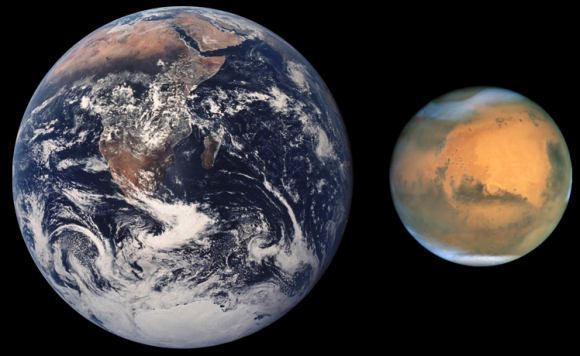
Men are from Mars, women are… also from Mars? That is the controversial theory that was proposed yesterday at the annual Goldschmidt Conference of geochemists being held in Florence, Italy. The proposal was made by Professor Steven Benner of the Westheimer Institute of Science and Technology in Florida and is the result of new evidence uncovered by his research team.
The theory that life on Earth originated on Mars has been argued before, but has remained contentious amongst the scientific community. However, Benner claims that new evidence supports the conclusion that the Red Planet really is our ancestral home by demonstrating that the elements for life here could only form on Mars, and came here via a Martian meteorite.
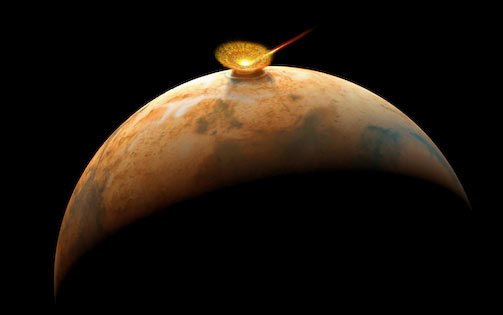
According to the theory, rocks violently flung up from the Red Planet’s surface during mammoth collisions with asteroids or comets then traveled millions of kilometers across interplanetary space to Earth. Once they reached Earth’s atmosphere. they melted, heated and exploded violently before the remnants crashed into the solid or liquid surface.
All that would be needed is for a few of those space born rocks to contain microbes from Mars surface. These building blocks of life would have to survive the journey through space and the impact on Earth to make this happen. But research into Exogenesis – the possibility that life was transplanted on Earth by meteorites – has already shown that this is possible.
What’s more, NASA’s Curiosity Rover was expressly created to search for the the environmental conditions that would support life. Less than half a year into its mission it accomplished just that, locating proof of the existence of water and a habitable zone. Between it and the Opportunity Rover, the search to determine if life still exists – in the form of organic molecules – continues and is expected to yield results very soon.
But of course, Benner was quick to point out that there is a difference between habitability (i.e. where can life live) and origins (where might life have originated). The presence organic molecules alone is not enough when it comes to the mystery of life’s creation, and when it comes to making the great leap between having the necessarily elements and the existence of living organisms, scientists remain hung up on two paradoxes.
These are known as the tar paradox and the water paradox, respectively. The former paradox addresses how life as we know it comes down to the presence of organic molecules, which are produced by the chemistry of carbon and its compounds. However, the presence of these compounds does not ensure the creation of life, and laboratory experiments to combine and heat them has only ever produced tar.
As he puts it, the origin of life involves “deserts” and oxidized forms of the elements Boron (B) and Molybdenum (Mo) – namely borate and molybdate. Essentially, these elements are the difference between the formation of tar and RNA, the very building block of life:
Certain elements seem able to control the propensity of organic materials to turn into tar, particularly boron and molybdenum, so we believe that minerals containing both were fundamental to life first starting. Analysis of a Martian meteorite recently showed that there was boron on Mars; we now believe that the oxidized form of molybdenum was there too.
The second paradox relates to water, which is believed to be intrinsic for life to flourish, but can be also hazardous to its formation. According to modern research, RNA forms prebiotically, requiring mineral species like borate to capture organic elements before they devolve into tar and molybdate to arrange the material to give it ribose – organic sugars, also intrinsic to life.
This can only occur in deserts, he claims, because water is detrimental to RNA and inhibits the formation of borates and molybdates. And from a geological standpoint, there was simply too much water covering the early Earth’s surface to allow for this creation process to take place:
[W]ater is corrosive to RNA, which scientists believe was the first genetic molecule to appear. Although there was water on Mars, it covered much smaller areas than on early Earth. Various geologists will not let us have these [borates and molybdates] on early Earth, but they will let us have them on Mars. So IF you believe what the geologists are telling you about the structure of early Earth, AND you think that you need our chemistry to get RNA, AND IF you think that life began with RNA, THEN you place life’s origins on Mars,
All of this has served to throw the previously-held theory – that life came to Earth through water, minerals and organics being transported by comets – into disarray. Based on this new theory, comets are a bad candidate for organic life since they lack the hot, dry conditions for borate and molybdate formation.
If the new theory is to be believed, Mars boasted the proper conditions to create the elements for life, while Earth possessed the water to help it flourish. If such a partnership is needed for the creation of organic life, then scientists will need to reevaluate the likelihood of finding it elsewhere in the universe. Between the existence of water and hot dry environments, life would seem to require more specialized conditions than previously though.
But of course, the debate on whether Earthlings are really Martians will continue as scientific research progresses and definitive proof is discovered and accepted by the majority of the scientific community. In the meantime, Curiosity is expected to rendezvous with Mount Sharp sometime next spring or summer, where it will determine if organic molecules and elements like Boron and Molybdenum exist there.
And on Nov. 18th, NASA will launch its next mission to Mars – the MAVEN orbiter – which will begin studying the upper Martian atmosphere for the first time, determining its previous composition, and where all the water went and when was it lost. So we can expect plenty more news to come to us from our neighboring Red Planet. Wait and see!
Two days ago, the Mars Rover known as Curiosity celebrated a full year of being on the Red Planet. And what better way for it to celebrate than to revel in the scientific discoveries the rover has made? In addition to providing NASA scientists with years worth of valuable data, these groundbreaking finds have also demonstrated that Mars could once have supported past life – thereby accomplishing her primary science goal.
And it appears that the best is yet come, with the rover speeding off towards Mount Sharp – the 5.5 km (3.4 mile) high mountain dominating the center of the Gale Crater – which is the rover’s primary destination of the mission. This mountain is believed to contain vast caches of minerals that could potentially support a habitable environment, thus making it a veritable gold mine of scientific data!
To take stock of everything Curiosity has accomplished, some numbers need to be tallied. In the course of the past year, Curiosity has transmitted over 190 gigabits of data, captured more than 71,000 images, fired over 75,000 laser shots to investigate the composition of rocks and soil, and drilled into two rocks for sample analysis by the SAM & CheMin labs housed in her belly.
On top of all that, the rover passed the 1 mile (1.6 km) driving mark on August 1st. Granted, Mount Sharp (aka. Aeolis Mons) is still 8 km (5 miles) away and the trip is expected to take a full year. But the rover has had little problems negotiated the terrain at this point, and the potential for finding microbial life on the mountain is likely to make the extended trip worthwhile.
But even that doesn’t do the rover’s year of accomplishments and firsts justice. To really take stock of them all, one must consult the long-form list of milestones Curiosity gave us. Here they are, in order of occurrence from landing to the the long trek to Mount Sharp that began last month:
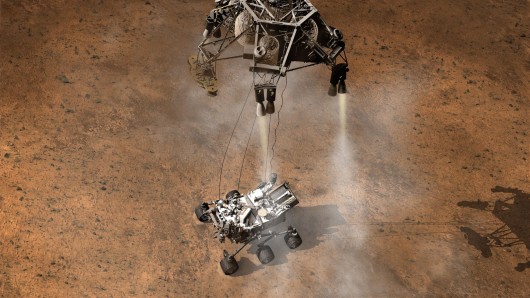
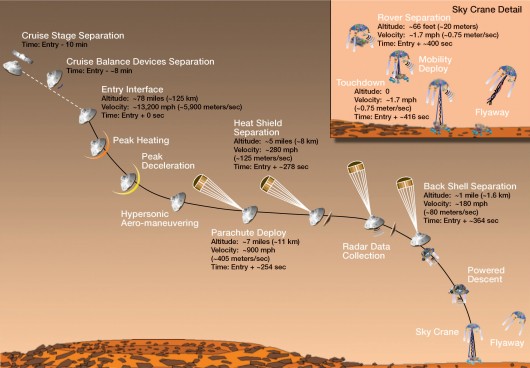
1. The Landing: Curiosity’s entrance to Mars was something truly new and revolutionary. For starters, the distance between Earth and Mars at the time of her arrival was so great that the spacecraft had to make an entirely autonomous landing with mission control acting as a bystander on a 13-minute delay. This led to quite a bit a tension at Mission Control! In addition, Curiosity was protected by a revolutionary heat shield that also acted as a lifting body that allowed the craft to steer itself as it slowed down in the atmosphere. After the aeroshell and heat shield were jettisoned, the rover was lowered by a skycrane, which is a rocket-propelled frame with a winch that dropped Curiosity to the surface.
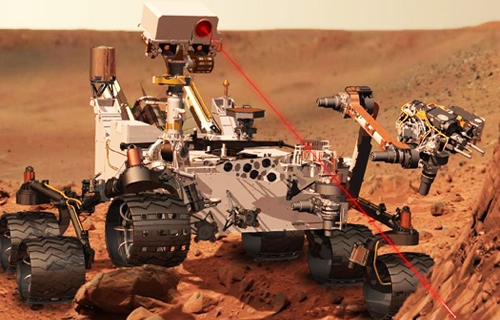
2. First Laser Test: Though Curiosity underwent many tests during the first three weeks after its landing, by far the most dramatic was the one involving its laser. This single megawatt laser, which was designed to vaporize solid rock and study the resultant plasma with its ChemCab system, is the first of its kind to be used on another planet. The first shot was just a test, but once Curiosity was on the move, it would be used for serious geological studies.3. First Drive: Granted, Curiosity’s first drive test was more of a parking maneuver, where the rover moved a mere 4.57 m (15 ft), turned 120 degrees and then reversed about 2.4 m (8 feet). This brought it a total of about 6 m (20 ft) from its landing site – now named Bradbury Landing after the late author Ray Bradbury. Still, it was the first test of the rover’s drive system, which is essentially a scaled-up version of the one used by the Sojourn and Opportunity rovers. This consists of six 50 cm (20-in) titanium-spoked aluminum wheels, each with its own electric motor and traction cleats to deal with rough terrain.
4. Streams Human Voice: On August 28, 2012, Curiosity accomplished another historical first when it streamed a human voice from the planet Mars back to Earth across 267 million km (168 million miles). It was a 500 kilobyte audio file containing a prerecorded message of congratulations for the engineers behind Curiosity from NASA administrator Charles Bolden, and demonstrated the challenges of sending radio beams from Earth to distant machines using satellite relays.
5. Writes a Message: Demonstrating that it can send messages back to Earth through other means than its radio transmitter, the Curiosity’s treads leave indentations in the ground that spell out JPL (Jet Propulsion Lab) in Morse Code for all to see. Apparently, this is not so much a gimmick as a means of keeping track how many times the wheels make a full revolution, thus acting as an odometer rather than a message system.
6. Flexing the Arm: Curiosity’s robotic arm and the tools it wield are part of what make it so popular. But before it could be put to work, it had to tested extensively, which began on August 30th. The tools sported by this 1.88 m (6.2-ft) 33.11kg (73 lb) arm include a drill for boring into rocks and collecting powdered samples, an Alpha Particle X-ray Spectrometer (APXS), a scooping hand called the Collection and Handling for In-Situ Martian Rock Analysis (CHIMRA), the Mars Hand Lens Imager (MAHLI), and the Dust Removal Tool (DRT).
7. Discovery of Ancient Stream Bed: Curiosity’s main mission is to seek out areas where life may have once or could still exist. Therefore, the discovery in September of rocky outcroppings that are the remains of an ancient stream bed consisting of water-worn gravel that was washed down from the rim of Gale Crater, was a major achievement. It meant that there was a time when Mars was once a much wetter place, and increases the chances that it once harbored life, and perhaps still does.
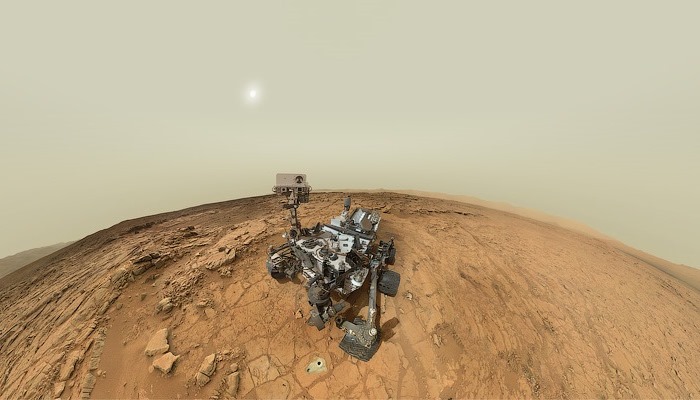
8. First Drilling: In February, Curiosity conducted the first robot drill on another planet. Whereas previous rovers have had to settle for samples obtained by scooping and scraping, Curiosity’s drill is capable of rotational and percussive drilling to get beneath the surface. This is good, considering that the intense UV radiation and highly reactive chemicals on the surface of Mars means that finding signs of life requires digging beneath the surface to the protected interior of rock formations.9. Panoramic Self Portrait: If Curiosity has demonstrated one skill over and over, it is the ability to take pictures. This is due to the 17 cameras it has on board, ranging from the black and white navigation cameras to the high-resolution color imagers in the mast. In the first week of February, Curiosity used its Mars Hand Lens Imager to take 130 high-resolution images, which were assembled into a 360⁰ panorama that included a portrait of itself. This was just one of several panoramic shots that Curiosity sent back to Earth, which were not only breathtakingly beautiful, but also provided scientists with a degree of clarity and context that it often lacking from images from unmanned probes. In addition, these self-portraits allow engineers to keep an eye on Curiosity’s physical condition.
10. Long Trek: And last, but not least, on July 4th, Curiosity began a long journey that took it out of the sedimentary outcrop called “Shaler” at Glenelg and began the journey to Mount Sharp which will take up to a year. On July 17, Curiosity passed the one-kilometer mark from Bradbury Landing in its travels, and has now gone more than a mile. Granted, this is still a long way from the breaking the long-distance record, currently held by Opportunity, but it’s a very good start.
Such was Curiosity’s first 365 days on Mars, in a nutshell. As it enters into its second year, it is expected to make many more finds, ones which are potentially “Earthshaking”, no doubt! What’s more, the findings of the last year have had an emboldening effect on NASA, which recently announced that it would be going ahead with additional missions to Mars.
These include the InSight lander, a robotic craft which will conduct interior studies of the planet that is expected to launch by 2016, and a 2020 rover mission that has yet to be named. In addition, the MAVEN (Mars Atmosphere and Volatile Evolution) orbiter as just arrived intact at the Kennedy Space Center and will be blasting off to the Red Planet on Nov. 18 from the Florida Space Coast atop an Atlas V rocket.
These missions constitute a major addition to NASA’s ongoing study of Mars and assessing its past, present and future habitability. Between rovers on the ground, interior studies of the surface, and atmospheric surveys conducted by MAVEN and other orbiters, scientists are likely to have a very clear picture as to what happened to Mars atmosphere and climate by the time manned missions begin in 2030.
Stay tuned for more discoveries as Curiosity begins its second year of deployment. Chances are, this year’s milestones and finds will make this past years look like an appetizer or a warm-up act. That’s my hope, at any rate. But considering what lies ahead of it, Curiosity is sure to deliver!
In the meantime, enjoy some of these videos provided by NASA. The first shows Curiosity’s SAM instrument singing “happy birthday” to the rover (though perhaps humming would be a more accurate word):
And check out this NASA video that sums up the rover’s first year in just two minutes:
Yes, the name is a bit of a attention-getter, but when you come to understand the purpose behind Lockheed Martin’s new spacecraft, the description does appear to be quite apt. It’s known as MAVEN, which stands for Mars Atmosphere and Volatile EvolutioN, and it is currently being produced in Lockheed Martin’s Martin Space Systems facility in Denver, Colorado.
People may recall how earlier this year, MAVEN was mentioned as part of the “Going to Mars” campaign. A project that is being organized by the University of Colorado at Boulder’s Laboratory for Atmospheric and Space Physics (CU/LASP), the Martian orbiter will be carrying a DVD featuring the names of everyone who applies, as well as three specially-selected haikus.
However, it is MAVEN’s larger mission which is now the focus of much interest. Later this year, NASA will be launching the orbiter to Mars for the sake of examine the atmosphere and answering some burning questions that remain about the planet. Thanks to evidence provided by Curiosity, Opportunity, and other missions, scientists now know that the Martian surface once boasted conditions suitable for life, including liquid water.
Hence, Maven’s ultimate purpose, which will be will to orbit the planet and examine whether the atmosphere could also have provided life support. Scientists working on the Maven mission want to understand what this atmosphere was like, and the processes that led to its destruction. As Guy Beutelschies, Maven Programme Manager at Lockheed Martin, put it:
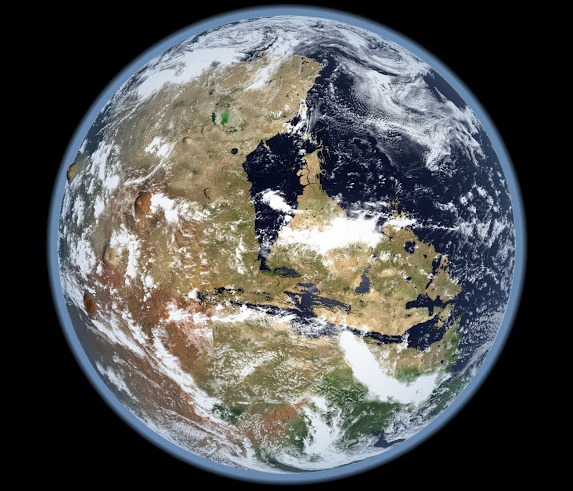
What we know from our missions looking at the surface of Mars is that there used to be water there. We can see the outlines of ancient rivers, the shorelines of ancient oceans. But water can’t exist there now – the atmosphere is too thin and too dry, any water would just evaporate or freeze.
So the big question is what happened to Mars’ atmosphere? Short of being able to travel back in time into the Martian past, how would anyone go about tackling these questions with a mission today? Beutelshcies explained it as follows:
[The atmosphere] used to be thicker, warmer, wetter, now it’s thin and dry. How did we get there? In a sense we are building a little bit of a time machine. What we’re doing is understanding the processes.
Just last week, evidence provided by the Curiosity rover supports the theory that Mars may have lost most of its atmosphere billions of years ago. Still, scientists remain skeptical that Mars once had an atmosphere comparable to that of Earth. Today, that atmosphere is roughly one-hundredth the thickness of Earth’s, made up mostly of carbon dioxide and a tiny fraction of water vapor. What little remains is being stripped away by the solar wind.
And unlike Earth, Mars does not have a magnetosphere to protect its atmosphere from being blown away – at least not anymore. Such a fragile, thin band around is now unlikely to support any sort of life, as far as we know. But the atmosphere in the past must have been more substantial to allow the formation of rivers, lakes and oceans.
Bruce Jakosky, the Principal Investigator for Maven who is based at the University of Colorado’s CU/LASP lab in Boulder, claims:
We think that Mars used to have a magnetic field. We see places on the surface that retain some remnant magnetism, they were imprinted when they formed with whatever magnetism was there. We think that some four billion years ago, when the magnetic field turned off, that turn-off of the magnetic field allowed [for the] turn-on of the stripping by the solar wind.
To investigate the processes taking place today, Maven will dip into the Martian upper atmosphere with each orbit, measuring the particles, sampling gases, monitoring the magnetic field and solar wind. Whereas the rovers have looked at the atmosphere from the ground up, MAVEN will look at it from the top down. At this point, both are needed to put together a picture of what’s controlling the Mars environment.
As well as filling in the blanks about Mars’ depleted atmosphere, Maven will also provide clues to the habitability of other planets beyond the solar system. As Jakosky said, the research conducted will have far-reaching implication for our understanding:
In trying to understand the distribution of life throughout the Universe, this is a really important indicator. Understanding the environmental conditions that allow [life] to exist, or don’t allow it to exist, is key to being able to extrapolate elsewhere.
What’s more, understanding what happened to Mars will provide some key insight into the history of our Solar System, and how it went from being a star with two planets that had oceans and atmospheres to just one. Knowing why things continued to operate on Earth, while on Mars they went horribly wrong, is likely to be quite the eye-opener, and make us all thankful we evolved here on Earth.
Ever since astronomers first looked up at Mars, they discerned features that few could accurately identify. For many years, speculations about irrigation, canals, and a Martian civilization abounded, firing people’s imaginations and fiction. It was not until more recently, with the deployment of the Viking probe, that Mars’ surface features have come to be seen for what they are.
Thanks several more probes, and the tireless work of rover such as Opptorunity and Curiosity, scientists have been able to amass evidence and get a first hand look at the surface. Nevertheless, they are still hard-pressed to explain everything that they’ve seen. And while much evidence exists that rivers and lakes once dotted the landscape, other geological features exist which don’t fit that model.
However, a recent report from Brown University has presented evidence that snowfall may be one answer. It has long been known that ice exists at the polar caps, but actual snowfall is a very specific meteorological feature, one that has serious implications for early Martian conditions. This is just another indication that Mars hosted an environment that was very much like Earths.
And this is not the first time that snow on Mars has been suggested. In 2008, NASA announced having detected snow falling from Martian clouds, but it was entirely vaporized before reaching the ground. The Brown researchers claim that snowfall in the past, and buildup on the surface leading to melting and runoff, could have created many of the tributary networks observed near tall mountain-ranges.
To back this claim up, the team used a computer simulation from the Laboratoire de Météorologie Dynamique called the Mars global circulation model (GCM). This model compiles evidence about the early composition of the red planet’s atmosphere to predict global circulation patterns. And since other models predict that Mars was quite cold, the program indicated the highest probability of snowfall over the densest valley systems.
Lead researcher Kat Scanlon also relied on her background in orographic studies (science for “studying mountains”) in Hawaii to arrive at this hypothesis. This includes how tall mountains lead to divergent weather patterns on either side, with warm, wet conditions one and cold, dry ones on the other. NASA’s Curiosity rover also was intrinsic, thanks to recent information that might explain why Mars no longer displays this kind of behavior.
In short, Curiosity determined that the planet is losing its atmosphere. It has taken detailed assays of the current atmosphere, which is almost entirely carbon dioxide and about 0.6% the pressure of Earth’s at sea-level. More notably, it has used its ability to laser-blast solid samples and analyze the resulting vapor to determine that Mars has an unusually high ratio of heavy to light isotopes — most importantly of deuterium to hydrogen.
The main explanation for this is atmospheric loss, since light isotopes will escape slightly more quickly than heavy. Over billions of years, this can lead to non-standard isotope levels the show a loss of atmosphere. One major theory that might explain this loss say that about 4.2 million years ago Mars collided with an object about the size of Pluto. An impact from this body would have caused a huge expulsion of atmosphere, followed by a slow, continued loss from then on.
All of this plays into the larger question of life on Mars. Is there, or was there, ever life? Most likely, there was, as all the elements – water, atmosphere, clay minerals – appear to have been there at one time. And while scientists might still stumble upon a Lake Vostok-like reserve of microbial life under the surface, it seems most likely that Mars most fertile days is behind it.
However, that doesn’t mean that it can’t once again host life-sustaining conditions. And with some tweaking, of the ecological engineering – aka. terraforming – variety, it could once again.
NASA’s Opportunity Rover is a special kind of vehicle. Not only did it set the record for longest distance driven on another world and discover the most compelling evidence for life on Mars thus far, it also surpassed its 90 day mission by a grand total of 3560 days, as of this past July 7th. In other words, the Opportunity Rover just celebrated its tenth anniversary, and people all over the world are marking the occasion by acknowledging the rover’s many contributions.
These include discovering the first meteorite found outside of Earth, a temperature profile of the Martian atmosphere, and uncovering a series tiny, iron-rich spheres known as “blueberries” that hinted at a time when Mars had water. In fact, Opportunity’s most important discovery may have come just last month.
This consisted of a rock that proves that Martian water was once drinkable, which in turn suggests strongly that life could once have thrived there. On top of that, it captured some amazing photos, long before Curiosity was sending back its hefty batch of panoramas. But of course, Opportunity had its share of trials and tribulations as well.
Foremost amongst these was the two months back in 2005 that it spent spent in a sand dune before its operators were able to wriggle it free centimeter by centimeter. And on the rover’s second day on Mars, it also experienced some shoulder joint problems, which proved to be the first of many, many mechanical problems.
And yet, all of that seems worth it now. After being eclipsed by its larger, more recent arrival – the Curiosity Rover – Opportunity has battled back with its incredible longevity. Who’s to say how much longer the little rover that could will remain in operation? And who’s to say what it will uncover. At this rate, its doesn’t seem unlikely that it will beat its cousin to the punch of finding the Holy Grail – organic particles on Mars!
And be sure to enjoy this video look-back at Opportunity produced by Space.com:
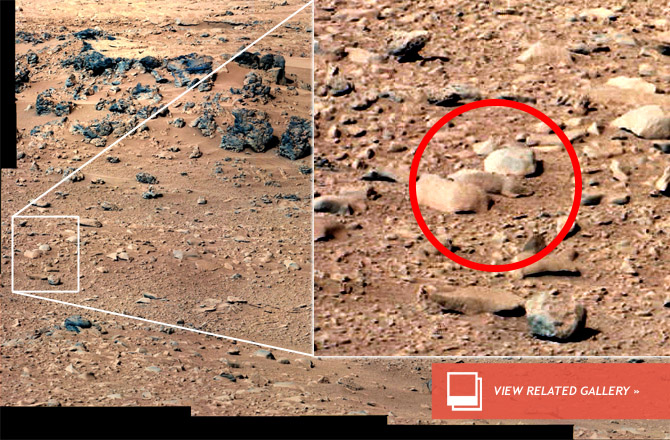
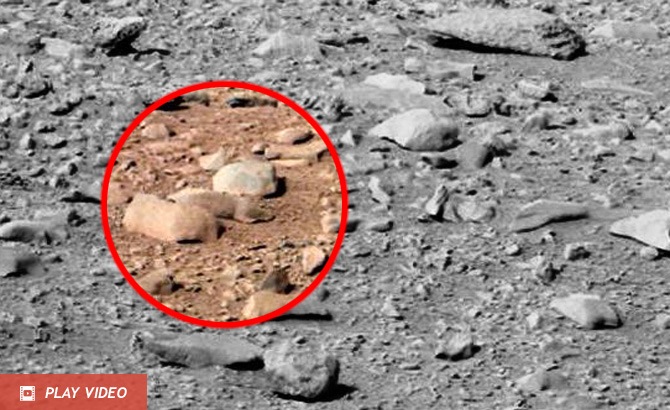
It seems that a new field of study was threatening to emerge with the “discovery” of what appeared to be a Martian rat. The technical term for it is Martian mammology, the study of mammals that are native to Mars. Luckily, proponents of this field did not manage to overpower the good people at NASA, who remain dedicated to serious scientific research. And now, the Curiosity rover is moving on to study bigger and better things.
Yes, the appearance of this would-be rodent did generate a lot of buzz on the internet of late, with some UFO buffs claiming that it may be an indigenous Red Planet lifeform or an Earth rodent Curiosity carried to Mars as part of a secret experiment. But Curiosity scientists were relatively certain that the rat, which was spotted in a zoomed-in portion of a photo taken by the rover in September 2012, was just a rock.
Curiosity deputy project scientist Joy Crisp, of NASA’s Jet Propulsion Laboratory in Pasadena, Calif., told reporters on Wednesday, June 5, what they believed the curiously-shaped rock was the result of:
Clearly, it results from, you know, a lot of things like wind erosion and mechanical abrasion and breakdown chemical weathering of the rocks, as to why they get these weird shapes.
Under the circumstances, NASA does not feel the need to conduct any further studies. And the window to do so will last just a few more weeks, as the Curiosity rover is set to begin an epic drive that will take it far away from the petrified rodent. At the moment, the robot is gearing up for a year-long trek that will take it to the base of Mount Sharp, a mysterious mountain that rises 5.5 km (3.4 miles) into the Red Planet sky.
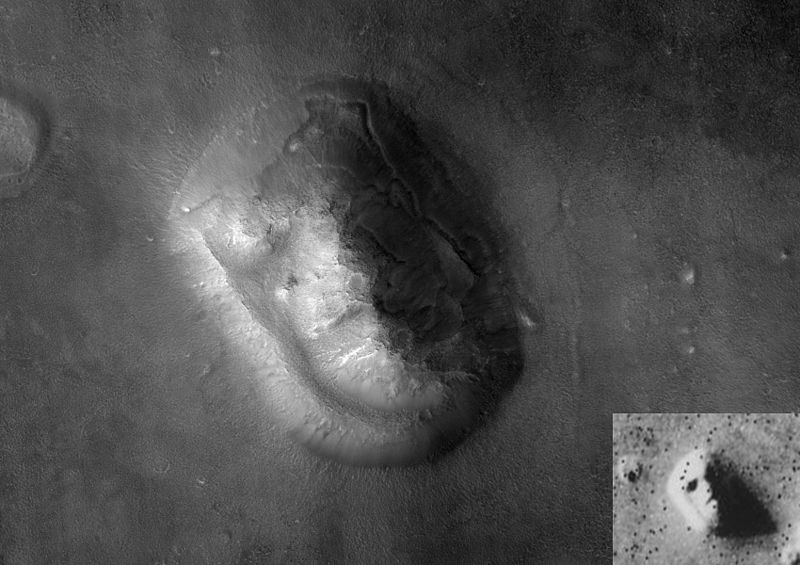
Curiously (no pun!), this is not the first time people have seen faced in the rock surfaces of Mars. Remember the elusive “Face on Mars”? Originally taken by the Viking 1 spacecraft in 1976, this low-resolution picture of the Cydonia region of Mars ignited the imaginations of people all over the world. For years, the face was mentioned in feature films, television series’, video games, comics, and even pop music.
Even after a series of high-resolution photos – taken some twenty years later by a succession of space craft – proved it to just be a simple rock formation, many people still insisted that the “face” was real and proved the existence of intelligent life on Mars. And such examples are hardly reserved to the Red Planet. Every year, there are stories of people witnessing “miracles” as divine visions appear to them in seemingly random objects, either of religious figures or personal heroes.
It’s whats known as pareidolia, a psychological phenomenon which refers to the human brain’s tendency to spot familiar things in random images. According to Crisp, this is not necessarily a bad thing. In truth, she claims NASA scientists get amused when this happens:
It’s fun in a way, too, in that it will attract a lot of the public to look at the images and learn a little bit about Mars by pulling them in this way.
So much like people seeing the Virgin Mary in a wall-stain, Mother Teresa in a cinnamon bun, or the face of Jesus and/or Elvis in their grilled cheese sandwich, the Mars Rat is likely to be with us for awhile yet. Perhaps he’ll go beyond the current internet meme and start a trend, with t-shirts and apparel for all. All he needs is a slogan: “Mars Rat Says ‘That’s My Cheese!'” …I’ll work on it 😉
As usual, the Red Planet is capturing the imagination of scientists and people all over the world, thanks in no small part to ongoing discoveries made by Curiosity and her predecessors. At the center of all the speculation is the big question: was there ever life on Mars? Recently, Curiosity Scientist Ashwin Vasavada sat down with the good folks from thinkrtv to discuss that questions and present some viable scenarios as to what that life might have looked like.
According to thinkrtv, this video is the first installment in an ongoing series called EPIPHANY which “invites impassioned thought leaders across all disciplines to reveal the innovative, the improbable, and the unexpected of their worlds.” Based on that description, I’m thinking they will be moving onto places like Europa, Titan, Dione and Enceladus next, all moons in our Solar System which may boast or be capable of supporting life.
Cool stuff, and some rather intriguing ideas presented here. Click on the video below or follow the link to see Vasavada’s interview:
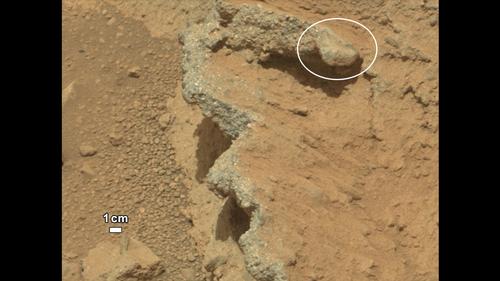
More news from the Red Planet! At a press conference held just yesterday, members of the Mars Science Laboratory announced that Curiosity discovered some interesting gravel patterns in the Gale Crater which would seem to indicate that water once flowed there. What more, according to William Dietrich (Curiosity’s co-investigator from the University of California, Berkeley) the water would have been flowing for some time.
“Too many things that point away from a single burst event,” he said in the press statement. “I’m comfortable to argue that it is beyond the 1,000 year timescales, even though this is very early on in our findings.”
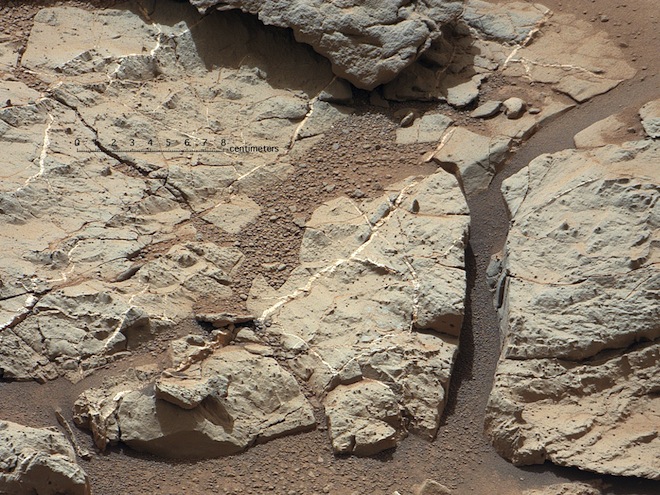
Specifically, what Curiosity found was outcroppings of layered rock that are the result of multiple deposits of gravel, which the science team claims could not have been laid by any other naturally occurring source, such as wind. What’s more, the sizes and shapes of stones offer clues to the speed and distance of a long-ago stream’s flow. Although initially classifying this as a “surprise”, the team inevitably claimed that they weren’t too surprised by the finding.
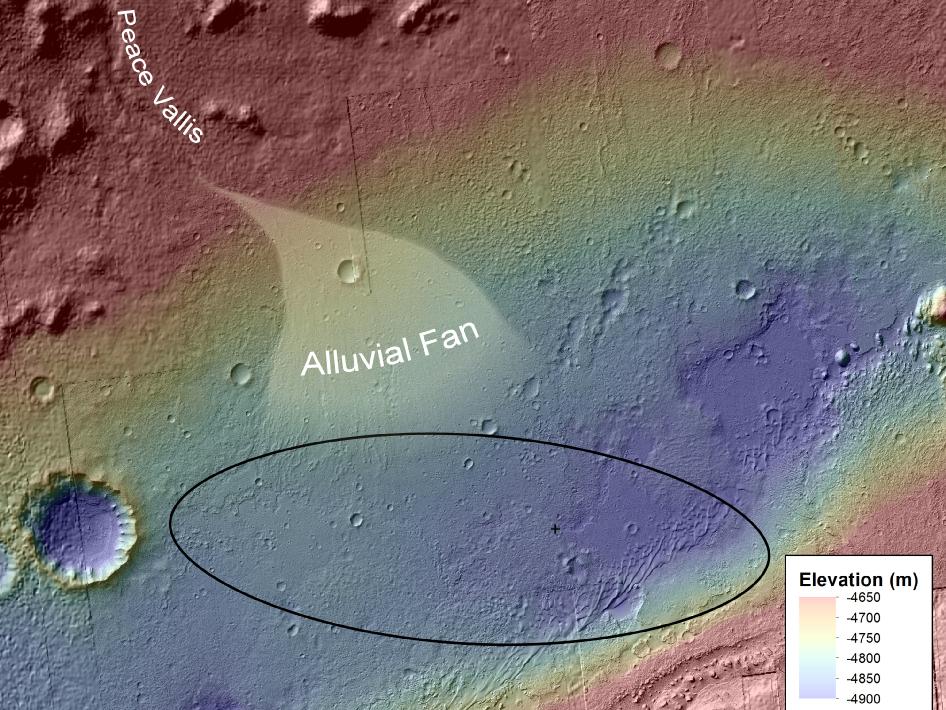
The location of the site lies between the north rim of the Gale Crater and the base of Aeolis Mons (aka. Mount Sharp), a mountain inside the crater. To the north of the crater, a channel named Peace Vallis feeds into the alluvial fan, where the abundance of channels between the rim and conglomerate suggests the presence of flowing water over a long period of time.
For some time, scientists have speculated about the existence of ancient rivers on Mars, based solely on observations from afar. In fact, the “canals of Mars”, as they were often known, have remained a source of inspiration for astronomers and fired the public imagination. The notion that there might be life on the Red Planet inevitably led some to suggest that there was such a thing as a Martian race that was responsible for their creation.
This, in turn, has led to generations of science fiction and storytelling, with images of little Martian men invading Earth in their terrible war machines (a la War of the Worlds) or as benevolent psychic begins who succumbed to disease and the onset of human colonization (i.e. The Martian Chronicles). Naturally, these fantastic notions died when it became known that the Martian surface is all but lifeless. However, evidence that Mars was once capable of supporting life remains; and thanks to Curiosity, continues to grow.
Stay tuned for more news from Curiosity! As of yesterday, it moved on from the Garland Crater and began its longest journey yet towards the Glenelg area, where it will begin taking soil samples and performing test drills. The goal here will be to find samples of preserved organic carbon, another step in the long mission to determine whether Mars really did support life in the past. Exciting times!

 It seems like weeks since the Red Planet has been featured in the news. But that’s to be expected when the two biggest news makers – the Opportunity and Curiosity rovers – are either performing a long drive or climbing a tall mountain. Not much in the way of updates are expected, unless something goes wrong. Luckily, these rovers always find ways to surprise us.
 Previously, Curiosity’s autonomous drives were only executed after finishing a drive planned by mission control on Earth using images supplied by Curiosity. These images would then be uploaded its on board computer, and the rover would compare them with images taken by its navigation camera to plot a safe path. The drive completed Monday is the first where the rover ended an autonomous drive on one day, then continued it the next day by itself.
 According to NASA, on Sunday, the new software allowed Curiosity to drive about 55 m (180 ft) along a path planned by mission control, then switched to autonomous mode and traveled another 38m (125 ft) with the rover selecting waypoints and the safest path. It then stored navigation variables in its non-volatile memory, then reloaded them on Monday to drive another 32 m (105 ft).
 According to Kevin Lewis of Princeton University, who spoke about the upcoming studies in “Cooperstown”:












 Stories by Williams