
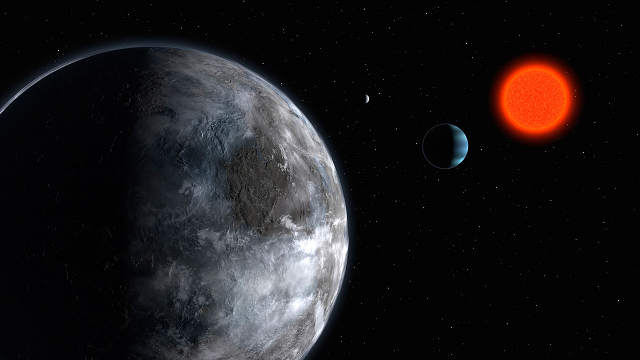
 And here we go again with another news story that comes to us from beyond our world, but curiously (no pun!), not from the Red Planet. It seems that the Earth-like exoplanet known as Gliese 581 g, aka. Zarmina (or Yuva to me and my writer’s group!) has been the subject of some interest as of late. In fact, two stories have emerged about this world, which ranks as number one on NASA’s list of Earth-like worlds beyond our system. And I think you’ll agree, these two stories couldn’t be farther apart.
The first sounds like something out of a novel by Carl Sagan: two years ago, while doing research for SETI, an Australian astrophysicist claimed he picked up a “suspicious signal” from the vicinity of the Gliese 581 system. Since that time, a number have websites have come forward that claim to have traced the signal back to the Earth-like exoplanet itself. The second story comes from the International Astronomical Union, which chaired a meeting this week and raised doubts about the actual existence of Gliese 581 g.
 For those who may not recall, the existence of Gliese 581 g has been featured in the news quite a bit of late, and not just on my site 😉 Discovered in 2010 astronomer Steven Vogt and a team of scientists working out of the Keck I facility in Hawaii. After locating the rocky world, they made two determinations based on their findings which set the astronomical community aflame.
On the one hand, the planet was roughly three time the mass of Earth but was believed to possess the same overall gravity. On the other, it was located within the system’s “habitable zone”, meaning it was warm enough to support life but cool enough to maintain water in a liquid state. Combined with its proximity to Earth, 20 light-years, this made Gliese 581 g the most likely candidate for eventual colonization.
To be clear, the astronomical panel did not dismiss the existence of Gliese 581 g out of hand, but did say that its existence cannot be confirmed as a scientific certainty. According to Francesco Pepe, an astronomer who works on HARPS data at the Geneva Observatory, “The reason for that is that, despite the extreme accuracy of the instrument and the many data points, the signal amplitude of this potential fifth planet is very low and basically at the level of the measurement noise.” So basically, the evidence put forth by Vogt and his team may have been nothing more than echoed signals. Bummer!
So what then are to we make of this news? Either Gliese 581 g does not exist, or it is home to an extra-terrestrial civilization that is sending out signals. In all likelihood, the doubts raised by the IAU are merely a setback, and it will be a few years before we are certain of the exoplanet’s existence. But then again, anything is possible. However unlikely it may be, we might be meeting “Zarminans” in a few generations time. Who knows? Maybe they’ll come find us, flying in tiny saucers and demanding we take them to our leader.
Personally, I hope it happens the way my group and I envisioned it, with colony ships going there within a century’s time and discovering alien life that does not resemble our own by any measure. Any other way is just plain crazy 😉

 Stories by Williams