LOTR: The Two Towers

Welcome back! Last time, I took a much overdue trip down memory lane with the Fellowship of the Ring. Hope you liked the trip too! And now, we come to the second volume in the tale of Lord of the Rings, which just happens to be my favorite installment in the series.

In addition to being my first exposure to Tolkien’s work, it was also action-packed and brought the plot to a fuller fruition, leaving the reader at a crucial point where things are both poised on a razor’s edge, yet with the knowledge that the greatest actions are still yet to come.

Oh, and I trust people noticed the artwork last time, which is the famed work of renowned Rings artist Alan Lee. In the full-length compendium of LOTR, where all six books appeared in a single volume, Lee was the man who provided the illustrations that brought Tolkien’s literary vision to life. I hope you all liked it last time, because there’s plenty more in this installment! I guess Lee felt particularly inspired by this volume…

Plot Summary:
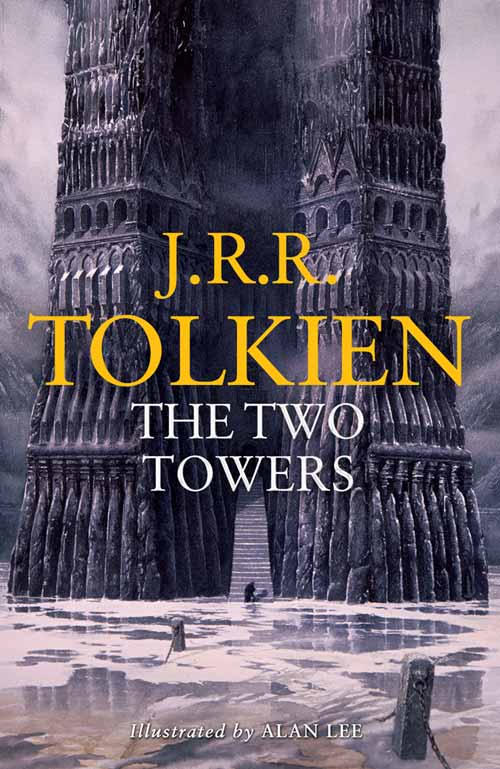
Aptly named The Two Towers, the title of this volume refers to the that events contained within revolved around the towers of Isengard and Barad-dûr. This included the deployment of Saruman’s Orc armies against neighboring Rohan, and Sauron’s first movements towards Minas Tirith and the Kingdom of Gondor.

Book III: The Treason of Isengard
This book story picks up with the aftermath of the Fellowship’s dissolution. Upon returning to their camp, Aragorn learns that Frodo and Sam have set out alone, that Boromir has been killed in battle, and that Merry and Pippin have both been taken prisoner. He is joined by Gimli and Legolas, who both lament the breakup of their union, but are given heart when Aragorn declares that they yet have a purpose: to save Merry and Pippin from capture.

After committing Boromir’s body to a boat and setting it down the river Anduin, they set out in pursuit of the Uruk-hai. Meanwhile, Merry and Pippin begin to contemplate their escape. They notice that two camps exist amongst the Orc – the Uruk-hai of Isengard and the Uruks of Mordor. They take their time and exploit the differences between them, but are ultimately set free when the Riders of Rohan attack and eliminate the Orcs. They flee into Fangorn forest shortly before Aragorn, Gimli and Legolas meet Eomer and the Riders and learn of how they killed the company of Uruk-hai .

Meanwhile, Merry and Pippin are taken in by an Ent named Treebeard. After learning about the Ents, an ancient race of tree-creatures, they tell Treebeard of what’s happening outside his door and ask for his help. He agrees to hold a council with the most ancient of the Ents and discuss what their involvement, if any, will be. After lengthy discussions, Treebeard manages to convince the others that they must go to war since Saruman is cutting down their forest to fuel his engines of war.

Aragorn, Gimil and Legolas track Merry and Pippins into the forest, where they spot a white wizard whom they assume is Saruman. When they reach him, however, they realize it is Gandalf, that he returned to Middle Earth after his ordeal with the Balrog and is now far more powerful. They then ride together to Edoras and the Golden Hall to meet with Theoden, King of Rohan, to ask for his help.
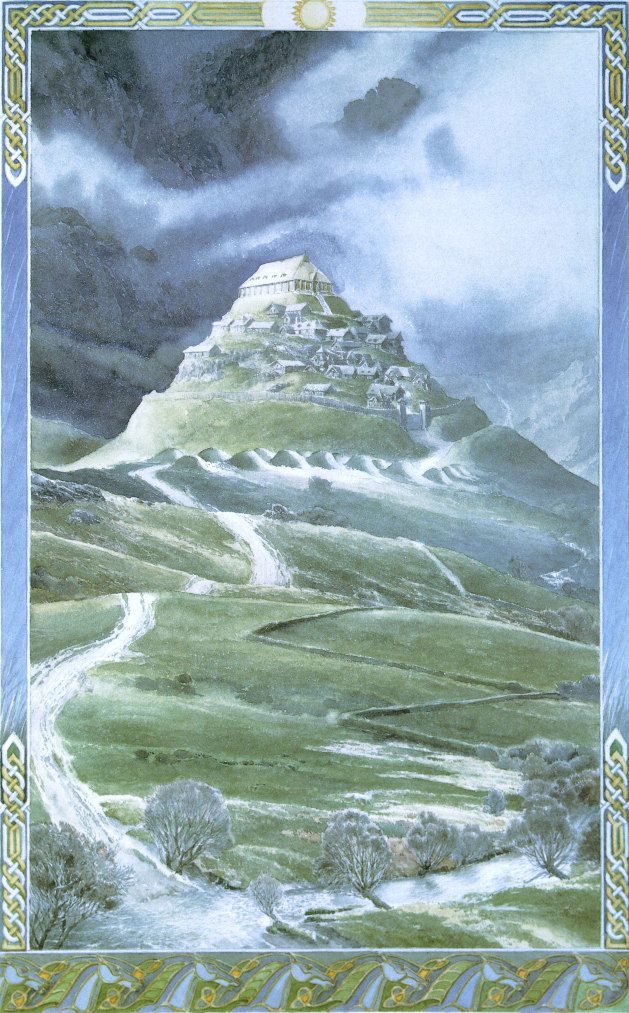
Once there, he finds that Theoden is a shell of his former self, and that his adviser, Grima Wormtongue, appears to be in control of the Kingdom. Gandalf reveals him of being Saruman’s spy, and unable to deny it, he spits on the floor and runs away. Theoden now realizes that the spell Saruman has been holding over him has now passed and he is once again strong and in control of his faculties. He agrees to help them and orders the Rohirrim (Riders of the Mark) to mobilize.

After rallying all available forces from Edoras, Theoden orders his army to march to the fortress of Hornburg in Helm’s Deep. Gandalf meanwhile rides out to find Erkenbrand and the rest of his riders, whom Saruman’s forces had previously routed. They ride to Helm’s Deep where they find the local garrison undermanned, but ready and willing to fight. After preparing the defenses, the entire host of Saruman’s Uruk-hai take the field and begin laying siege.

Initially, things go well for the defenders who are able to thwart attacks along the wall and against the Keep itself. However, things soon turn when Saruman’s forces deploy “devilry” to explode a hole in the wall. With the wall breached, the Uruk-hai surround and lay siege to the Keep, and all seems to have been lost. However, Aragorn addresses the Uruk-hai and warns them to withdraw before the sun rises; an offer they reject.

When the sun does rise in the east, Aragorn and the defenders of the Hornburg mount one last assault. The horn of Helm Hammerhand is blown, defeaning the Orcs, and the riders charge out to meet them. Just then, they see Gandalf emerge on the hills overlooking Helm’s Deep with Erkenbrand and the rest of the Rohirrim. They charge upon the Orcs faltering lines and break them, routing those that survive into the forest of Huorns, where they are slaughtered by vengeful Ents.

Together, Theoden, Gandalf, Aragorn and the rest ride to Isengard to confront Saruman. When they arrive, they find that an army of Ents have overrun Saruman’s defenses and have him cornerned in the tower of Orthanc. They are reunited with Merry and Pippin and all seems well. However, he warns them that Saruman still has much power and will try to use his “voice” to command them.

Despite Saruman’s arrogance and power, he is unable to sway Theoden into a peace settlement. Instead, Theoden demands Saruman’s surrender, and Gandalf urges him to renounce the power of the Ring and return to the light. When Saruman tries to walk away, Gandalf becomes angry and orders him back. In a display of his newfound power, he cast Saruman out of the Order of Wizards and the White Council and breaks his staff, thus destroying his power.

Grima, who is trapped inside with Saruman, throws something at Gandalf but misses. Pippin picks it up and is told to hand it over to Gandalf, as he knows that this object is one of the palantíri (seeing-stones). Pippin, unable to resist, looks into it the stone that night and encounters the Eye of Sauron. Luckily, he emerges unharmed and Gandalf realizes this might work to their advantage. Gandalf leaves with Pippin for Minas Tirith to oversee their preparations for the coming war while Théoden, Merry and Aragorn remain behind to muster Rohan’s forces to ride to Gondor’s aid.

Book IV: The Ring Goes East
After making their way across the Anduin River, Frodo and Sam begin walking through Emyn Muil, the impassable rocky mountains that seem to go on forever. They realize that Gollum is still following them, and lay in wait for him. Frodo manages to subdue Gollum with Sting, and they tie him up with elvish rope and take him prisoner. However, Frodo is pursuaded to let him go when Gollum agrees to help them find a way into Mordor.

Though Sam distrusts Gollum with a passion, Frodo feels sympathetic to him because his experience with the Ring mirrors Frodo’s. In time, Gollum also begins to trust in Frodo and remembers his old self and even his old name, Smèagol. Ultimately, Frodo hopes he can save him from the Ring’s influence.

After leading them out of Emyn Muil, he shows them the path through the Dead Marshes to avoid orc patrols. They learn that these Marshes are so named because they were the field of battle during the War of The Last Alliance. It was here that they defeated the forces of Sauron before moving on to lay seige to Barad-dur.

As such, the Marshes are littered with the bodies of dead men, elves and orcs, and haunted by their spirits. Gollum warns them not to state into the green lights, which are apparently the emanations of the dead themselves. Unfortunately, Frodo does just that and becomes drawn in, and is nearly lost in the process. Luckily, Gollum manages to save him, surprising both Sam and himself.

When they reach the Black Gate, they witness forces loyal to Sauron entering from the South. These men are called Southrons and are arriving by the thousands. Gollum warns them not to enter there and tells them of a secret entrance that lies the south through the province of Ithilien, which is still in the hands of Gondor.

When they arrive, the see another company of Southron men accompanied by the massive war Oliphants. The company is attacked by a group of unseen Rangers and Gollum flees just before Frodo and Sam are captured. The Rangers are led by a Faramir, Boromir’s brother, who informs them of Boromir’s death.
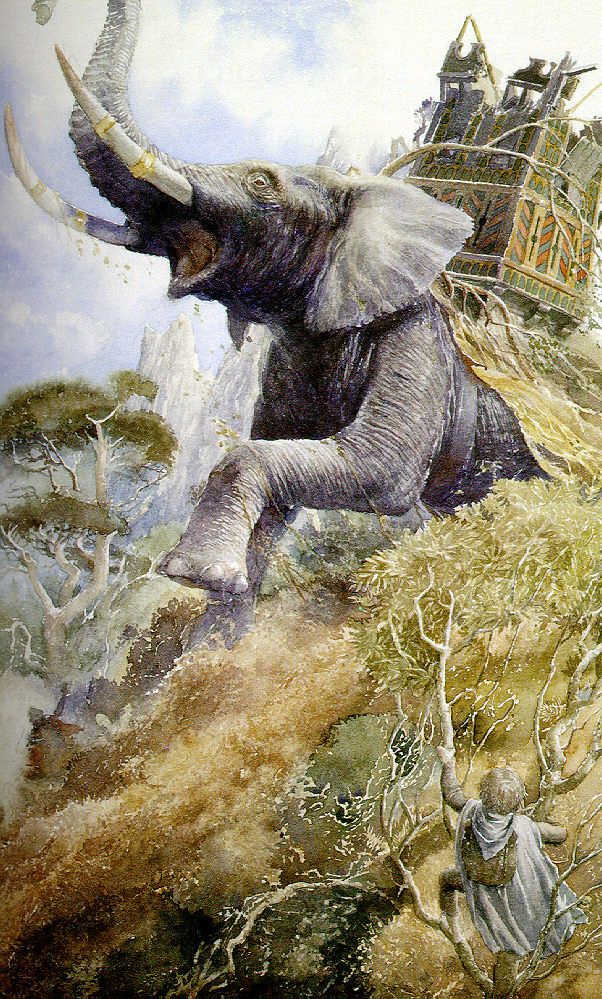
Faramir and the Rangers lead Sam and Frodo into a secret hideout and begins questioning them. In the course of things, Sam accidentally reveals to Faramir that Frodo carries the One Ring. Much to their surprise though, Faramir doesn’t want to take it from them. Unlike Boromir, he understands the dangers of the Ring and approves of their plan to take it to Mount Doom where it will be destroyed.

Later that night, Gollum is found diving for fish into the sacred pool, the penalty for which is death. Faramir’s archers are about to kill him, but Frodo admits that he is there companion and he need him to to get into Mordor. Though Frodo has saved his life, Gollum appears to feel distraught and betrayed by the incident. The following morning Faramir gives them some provisions and sends them on their way, but warns them that Gollum may know more about the secret entrance (Cirith Ungol) than he has been telling them.

Gollum leads them past the city of Minas Morgul and up a long, steep staircase of the Tower of Cirith Ungol. At the base of it lies a long tunnel which he claims leads into Mordor, one which the orcs don’t know about. His betrayal is soon revealed when an enormous spider named Shelob sneaks up on them. Gollum attacks Sam and prevents him from warning him before he’s stung. Sam manages to fend off Gollum and back into the spider’s cave where he manages to scare off Shelob with the light of Erendil.

After seeing Frodo lifeless and pale, Sam assumes that Frodo is dead and becomes despondent. He debates abandoning the Quest in favor of chasing after Gollum and killing him. However, he resolves to finish the Quest himself and takes the Ring from Frodo’s body. Unfortunately, a group of Orcs show up and take Frodo’s body away, and reveal in the process that Frodo is not in fact dead, but only unconscious. This is Shelob’s way, he learns, which is to paralyze her victims with poison before draining their blood. The story ends with Sam resolving to travel to Minas Morgul and save Frodo!

Summary:
As I might have said already, this book was my favorite of the three. The action starts immediately with the introduction of the Rohirrim and the march to war. And of course, things didn’t let up with the seige at Helm’s Deep, the decision of the Ents to get involved, and the reigning in of Saruman. But at all times, the action is made all the more poignant by the fact that everything is steeped in ancient lore and genuine cultural influences. I for one couldn’t get enough of Rohan’s culture and its Anglo-Saxon nature, nor the constant intrigue Tolkien sowed into the plot with all the spying, lying, influence and plotting.

And then things calm down just a bit for Frodo and Sam’s journey, which is characterized by fear, suspicion, and an in-depth analysis of Gollum’s split personality. Here is perhaps one of the best elements of the series, where we find a creature so perverted by evil and twisted by centuries of isolation that he seems barely human. But at the same time, there is still a spark of humanity that burns within him, one which Frodo feels he must harness and breathe new life into.

And of course, there’s Frodo’s own transformation as he becomes more and more consumed by the Ring’s power. Though they are already bound by mutual necessity, it is clear that Frodo and Gollum are bound by shared experience a swell. This gives another one of the story’s arguably best elements, which is the way the reader is left hoping that Frodo can endure, and torn between hoping for Gollum and suspecting him of treachery. This is a perfect device, in that it mirrors the dichotomy between Sam and Frodo perfectly.

On top of all that, there was more development in terms of the stories deep background and geography of Middle Earth. Seeing the Southrons for the first time was very intriguing, and reminded me just how inspired Tolkien’s literary creations are. Whereas the people of Rohan were clearly inspired by the Anglo-Saxon example, the Southrons clearly represented the armies born of West Asia that threatened the real-life “Men of the West – the Persians, the Carthaginians, and the Saracen Turks.

Film Adaptation:
It is perhaps for this reason, or the fact that I read the book first this time, that I found the movie quite inferior. All throughout, they made extensive changes which I felt were obvious, transparent, and just plain unnecessar. For example, several scenes were added that never took place in the book for the simple reason that Peter Jackson and the script writer’s felt it needed more drama. Aragorn never fell on the way to Helm’s Deep, there was no pitch battle between Saruman’s riders and the Rohirrim, and the battle at Hornburg was hardly as hopeless as they made it out to be.

And let’s not forget the cheese element that was pervasive in the film. In this installment, Arwen and Elrond had no page time, and yet they forced them both in with all the subtlety of a sledgehammer. Really, what was the point of those long, drawn out scenes where she and her father are discussing the consequences of her life choices, aside from ensuring they still had screen time? Perhaps it’s just the fact that I know they weren’t in the book, but it just seemed annoying and forced. The first film seemed to excel for me by leaving stuff out, not adding stuff in.

And that scene at Helm’s Deep where Legolas rides a shield like it’s a skate board down the steps? I know they felt the need to throw the kids the bone, but that was just plain cheese! Much of the action was pervaded by that in fact, like when Gimli told Aragorn to “toss him”, an obvious reference to the terrible sport. Whereas in the first movie Gimli was a brusque and tough soul, by this movie his antics have degenerated into cheap comic relief, and Legolas’ stunts begin to border on the completely unrealistic.

But I aint done yet! There were also the million and one changes that they made to the script which I couldn’t help but notice, being a newly graduated Rings geek. For one, the confrontation at the Golden Hall was all wrong! Saruman was not exercising direct control over Theoden, Grima was the one whispering poison in his ear to keep him weak and complaint. That was far more realistic than the scene were Gandalf “shoves” Saruman out of him. And what’s more, the scene totally did away with the way Gandalf gets mad in the book, summons lightening, and scares the shit out of Grima. That was literary gold!

In fact, the best parts in the series are where Gandalf get’s mad and the whole world begins to shake. And they left that part out too, where Gandalf grows tired of Saruman’s bullshit and breaks his staff. Not only did they not even show it in this movie, they made the scene where it happens totally calm and boring. But that’s something for next review…

The next big change I saw was in how Theoden marched to war. In the book, he agrees and mobilizes his forces to go to Helm’s Deep because its a natural fortification that stands in the way of Saruman’s advance. But in the movie, he is hesitant and rides to Helm’s Deep because Edoras is “vulernable”. That made no sense because anyone who has access to a map of Middle Earth will see that Edoras is much farther away from Isengard than Helm’s Deep, and its a freaking walled city. How is it vulnerable? If anything, marching his people through the wilderness to an old fort that’s located practically on Isengard’s doorstep was stupid strategy. But that’s such a Rings geek point to make!

Oh, and the way the Elves marched to their rescue? Heartfelt, but never happened. Theoden had a garrison at Helm’s Deep, and though it was understaffed and made up of too many old men and youths – recall the line “too many winters or too few” – they stood against the Uruk-hai on their own. They were rescued in the end, but by Erkenbrand and the Rohirrim, who had not riden away out of anger at Theoden, but because they had been routed by the Uruks while fighting in the Westfold.

Still not done! There was also the extended part where Faramir decides to take the Ring and makes Frodo and Sam ride with them to Osgiliath. This never happened, and it totally pitched Faramir as some unappreciated child who was eager to earn his father’s respect. True, his father didn’t appreciate him, but his whole character was built on the fact that he was the wiser of the two brothers and knew how to resist the Rings allure. And that scene where he and his Lieutenant roll out the map to discuss strategy? So obvious! It was nothing more than an excuse to give the audience a gander at what Middle Earth looks like and illustrate their strategy. Obvious, but I guess it was necessary seeing as how many viewers hadn’t read the book.

And unlike the first movie, in this case, they cut out the ending instead of dipping into the next book to strengthen it up. This includes the portion where Gandalf, Aragorn and Theoden ride to Isengard and where Frodo is attacked by Shelob. Some would say they needed to make cuts for the sake of time, but that doesn’t hold seeing as how they added in scenes which never took place in the book. Cutting real material that was well worth watching just to make room for obligatory scenes of Arwen crying and the forced drama of Aragorn nearly dying just seems silly.

Okay, all done! Next up is the final installment, where things come together with climactic war scenes and the last, desperate attempt to destroy the Ring. Stay tuned for The Return of the King!

Game of Thrones (Season 2, ep.9)

On this Sunday past, we came to it at last… the siege of King’s Landing! After eight episodes building up to the climactic battle, it finally got underway. And as expected, it was pretty damn epic and bloody! And more importantly, it last all episode, no breaks!

And as usual, I had some observation to make just as soon as the episode was over.

Blackwater:
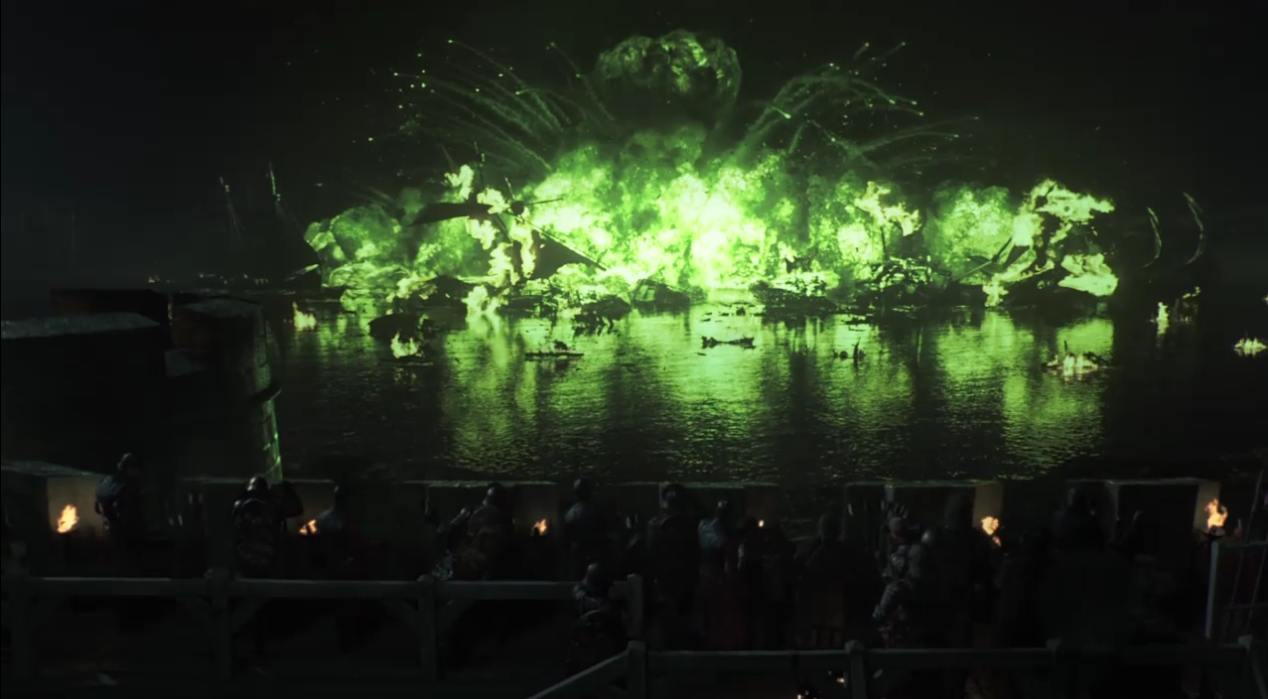
The episode opens on King’s Landing just as Stannis Baratheon’s galleons begin moving up the Blackwater towards the city gates. With so many ships and troops upon them, Tyrion and his right hand man, Ser Bronn, unleash their big surprise, wildfire that sets the water ablaze! Stannis responds by ordering his men ashore at the Mud Gate where they begin to lay siege.

Meanwhile, Cersei ferries Sansa and all the women retainers into a hall where they take shelter and waits things out. True to form, she has several cups of wine and begins acting like a total bitch, telling Sansa off and wallowing in self-pity about her life. Rather than let her son do his duty and defend the gates, she has Ser Kevan take him from the battle for his own safety. And then leaves the women to their fate when Ser Kevan says that the gates have fallen.

Sansa takes up her place as morale officer, but Shae tells her to take the opportunity to run. She returns to her room to find a drunk Ser Clegane who says he’s running off, and offers to take her with him. When she refuses, he seems hellbent on raping her, but instead fades off into the night without another word.

At the gates, Tyrion takes command of the city guard when Joffrey leaves and leads them into battle. They secure the gates, only to be beset by more of Stannis’ men. Things are desperate and Tyrion is nearly killed by one of his own, a member of the Kingsgaurd in Cersei’s employ. Luckily, his squire, Podrick takes the bastard down with a spear through the head and shelters Tyrion in his arms. Good ol’ Pod!

And wouldn’t you know it, help finally comes when the Tyrells, led by Ser Loras and Tywin Lannister, show up to drive the last of the Baratheon host off. Stannis yells at his men not to retreat, but between the loss of their boats and the outflanking maneuver, the siege has been broken. Tywin arrives in the King’s Hall to announce to his daughter that the battle has been won… Cue music and roll end credits!

Good Points and Bad:
I’ll just start with the obvious stuff. The battle was pretty freaking awesome. Some might be so bold as to compare it to Lord of the Rings and say they’ve seen better, but to them I would say it takes a lot to pull of an epic battle when you don’t have hundreds of extras and a whole lot of digital effects at your disposal. And given their limited budget, I’d say they pulled it off quite well.

My only complaint about the imagery would be the wildfire scene. I’m not sure, but somehow, all that green just reminded me of industrial light and magic, aka. artificial. It was faithful to the book, mind you. In the text, George RR Martin stipulated specifically that wildfire burnt green.
Still, I couldn’t help but feel like there was something inherently alien about it, like it was something out of Green Lantern (Which I refuse to see! Ryan Reynolds, what were you thinking?).

And of course, there were some changes that deserve mention. For starters, they left out the part where Tyrion deployed his other little surprise. You see, it was originally Cersei’s idea to use wildfire, something Tyrion would not get credit for in the end because of it. But Tyrion perfected the idea by commissioning the construction of a massive chain that would be lain across the mouth of the Blackwater.

When he gave the order, the lighthouses there pulled the chain up, thus preventing Stannis’ fleet from escaping from the river. THAT was when they unleashed the hellfire, only after Stannis’ many man boats had clogged the river. It was an ingenious plan, using Stannis’ own numbers against him, hence why I was disappointed that they chose to leave it out.

But beyond that, everything was done quite faithfully. Joffrey’s own incompetence and brattyness, the desertion of Ser Clegan, Cersei’s bitchiness in the face of death, Sansa’s attempts to play the innocent fool, Tyrion’s brave stand, the betrayal… All of it was downright faithful to the original novel. And the pacing and intensity of it was really awesome to watch.

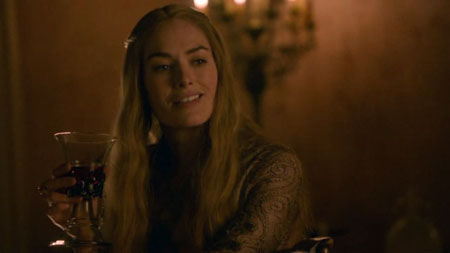
And let’s not forget Cersei’s outfit for this episode, an armored bustier. Already there’s been a lot of talk about this bit of wardrobe, and for good reason! Look at and tell me it’s not the perfect melding of medieval armor and high fashion chic!

Yes, with everything this episode had going for it, the hour just flew by and left me wanting to know how they would wrap things up next week. But of course, I didn’t want to wait when the episode was over, I wanted to know NOW! The mark of a great production if ever there was one 😉

Well, only one episode left to go, then I imagine all us GOT geeks will be in for another long wait until season 3 comes out. It’s a blessing really that Martin keeps on writing, otherwise we’d all know exactly when the show would be over. And I do wonder just how far they’ll go with the HBO adaptation. Probably until it becomes unprofitable! In the meantime, check out this video clip I stole of the big scene where wildfire meets the Blackwater:

Of Prequels And Why They Suck…

Of Prequels And Why They Suck…

Looking back, I’ve noticed a sort of thread running through some of the posts I’ve made. And in truth, this thing was quite influential when it came to what inspired me to write science fiction in the first place. It began with the infamous Star Wars prequels, the movies which ruined what used to be a very influential and nostalgic franchise. It was then reinforced by the odious Dune prequels, which tarnished the legacy that inspired me to write science fiction in the first place. Since then, I’ve noticed these same elements at work in any prequel I’ve chanced upon and the lessons only seem to get more concrete.

While I’m no expert on the fine art of writing, be it science fiction or anything other genre, by the time I started doing it I was pretty clear on what I wanted to create. Basically, I wanted to write something I would enjoy, something that emulated the greats I had come to know and admire. But when it came to what I DIDN’T want to do, I found prequels summed up a lot of it succinctly (especially the aforementioned examples). I’m sure I mentioned as much in previous posts, but today, I thought I might speak to these things specifically; outline why prequels can – and often do – suck!

1. No Surprises:
Whether it was the Star Wars prequels, X Men Origins: Wolverine, the Legends of Dune series, or anything else prequel-oriented, there was one undeniable problem they all had in common: we already knew what was going to happen. By stories end, we know that the characters are going to become whatever it is they were in the original story, and we know who’s going to live and who’s going to die. In some cases, we even know how, so there really are no surprises. The only real purpose of a prequel is to fill in the background, explain HOW things happened and how the characters and story we are familiar with came to be.

For example, in Star Wars, we know that Anakin becomes Darth Vader, that Palpatine is the villain and will take over the Republic, and that Amidala will give birth to Luke and Leia before dying. There are a host of other details which the more nerdy among us were familiar with as well, and we were all drawn to theaters back in 1999 hoping to see how they played out. But in the end, when all was said and done, I don’t think any of us came away satisfied. Seeing how things happened when you already know what will happen just seems to make for a disappointing experience.

2. Sense of Duty:
Another thing that brings down a prequel is the fact that things MUST be explained. In short, the writer, director, author, etc. has a list of things which need to be covered before the end. These things have to fall within an established framework – i.e. what has already been established by the original story – and cannot contradict or be inconsistent with them. So really, in addition to having a story where there really are no surprises, you also get a story where things have to proceed in an established fashion and often seem heavily contrived. The end result is not what would feel natural based on the story so far but based on what needs to happen for the sake of the original story.

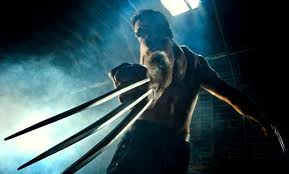
X-Men Origins will suffice as an example here. In this movie, the story had to show where Wolverine came from, how he and his brother (Sabretooth) had their falling out, and how his memory got erased. The result was actually pretty weak, in my opinion. Basically, Colonel Striker shot him in the head with Adamantium bullets, which he knew wouldn’t kill him but would erase his memory. Now, how did he know ahead of time that that would be the effect it would have? Second, why do that instead of lobbing a rocket-propelled grenade at him? Simple, because the story required it. Wolverine is supposed to be an amnesiac in the first movie, so this movie had to show how.

And while were on the subject, why didn’t Wolverine’s girlfriend kill Striker at the end when she had the chance? The woman had suggestive powers and had the man in her grasp, so why not tell him to march off a cliff? Again, because the story demanded it. Striker needed to live to see movie two, so instead she said some fluff about how she’d be no better than him and just told him to take a walk until his feet bled and he fell from exhaustion. I can’t speak for everyone, but personally, I was disappointed.

3. Less Is More
A lot of people insist that when it comes to back stories and background, the less we know, the better. After all, wasn’t Darth Vader scarier before we knew that he was once portrayed by Hayden Christensen? Wasn’t he a lot more menacing before he cried over the loss of Padme? I know for a fact that I’m not alone when I say that the whole “NOOOOOOO!” scene at the end of Revenge of the Sith brought him down in my eyes. What was once a titanic force of badassery was transformed into a whiney, bitchy child through the simple act of fashioning an origins story.

To use a non-prequel example, consider the Batman franchise. In the Tim Burton version, we got to see the Joker’s origin story, but in the Christopher Nolan version, we got nothing. And frankly, wasn’t Ledger’s updated take on the Joker much more scary than Nicholson’s because of it? Sure, his dialogue and acting were spot on at capturing the insanity and terror of the laughing psychotic killer, but wasn’t part of that assured by the fact that we had NO IDEA who he was or where he came from? The origins stories that he told – “wanna know how I got these scars?” – and how they kept changing was part of what made him so effective. As the audience, we wanted to know, how DID he get those scars? Why IS he so crazy? But by denying us this, I think we were kept wanting and we respected the movie more for it.

The same is true of Batman himself. In Burton’s, we got an exact reversal of what happened with the Joker. Aside from the fact that his parents were murdered, apparently by a young Jack Napier (who would go on to become the Joker), we knew nothing about him. Where he got his skills from, his equipment, and how he got started. This served to make him a much more mysterious character which in turn made him more interesting. In Burton’s Batman, he was the focal point whereas the Joker was his nemesis. But in Nolan’s updated version of The Dark Knight, the Joker was undoubtedly the focus while Batman was just the hero trying to stop him. I’d say what he knew – or in this case, didn’t know – about them was central to that.

4. The Audience’s Imagination Is The Writer’s Greatest Weapon:
I believe it was the famous photographer Duane Michals who said “I believe in the imagination. What I cannot see is infinitely more important than what I can see.” Okay, I Googled that, sue me! But the man had a point, and it applies doubly to movies since they too are a visual medium. What the readers and/or an audience can imagine based on snippets of a story is infinitely more powerful than what they can be shown with a few hundred pages of text or a two hour movie. This is why less is more. By giving the audience less to work with, they have more freedom to imagine and create. If you tell them what happened, detail for detail, then they have nothing except for what you’ve given them.

This, I think, is precisely why prequels are so often a disappointment, at least in my estimation. I’ve always considered myself to be an imaginative person. Given a blank canvas, or one with just a few details, I can create just about anything. And I’m hardly alone in that fact. Imagination is something everyone has – to varying degrees, sure – but it’s part of what makes us human and gives our lives meaning. Being able to express our inner life makes us happy, and there are few things more hurtful and insulting than having someone mock or dismiss that creativity. It’s also one of the cornerstones of a free society, the freedom to create and not be persecuted for it.

So it’s little wonder then why people are drawn to movies where books they’ve read are being adapted to film, or to prequels, where things that have been previously alluded to are acted out. People go to see them because they want to know if it will bear any resemblance to what they themselves imagined. Or, they go because they just want to see what the director’s own vision was. Either way, when you get around to seeing it for yourself, is it not a letdown no matter what? Isn’t that the real reason why people who’ve read the book constantly insist that the movie isn’t as good? That certainly seemed to be the consensus amongst LOTR geeks. And I should know; by The Two Towers, I was one of them! And isn’t that the real reason why the Star Wars prequels sucked as much as they did? We, the fans and audiences are active participants and create out of what we are given. Being told point blank what happened removes half the fun of it!

Some Tips For Writing:
Well, that’s all I got for now. Except to say that if someone is hoping to do a prequel, there are certain tips that I’ve come up with that can help. These are by no means established rules, just the result of my own amateur experience and observations. For one, a writer should take care not to give too much away when writing background. As always, less is more. It’s enough to let the background stay in the background and focus on the story. The more the reader/audience has to work with, the better. That way, when you are writing out the back story, you have much more freedom to work with, and don’t have to worry about staying within boundaries.

Second, a good idea is to write things out ahead of time. When I was thinking up Legacies, I began by writing out an outline for the entire background of the story. I didn’t do this because I was one day planning on writing a whole franchise worth of books, prequels included, but because I just wanted the story to be tight and know where everything fit. But because of that, I was able to pen several short stories that took place before the first novel. Rarely were the main characters and plot lines from that novel the focus of these stories, but they did serve as a solid backdrop which helped to advance things.

But don’t take my word on that, consider Lucas himself. He thought up the entire plot for Star Wars trilogy before making the first movie in the franchise, thus he knew exactly what he wanted to do ahead of time. Sure, he made changes and was forced to adapt along the way, but the end result benefited from this foresight. However, when it came to the prequels, he had only the bare bones to work with, and began writing each movie independently of shooting it. And it certainly showed, didn’t it? Rather than feeling like an ongoing story, each movie was a self-contained tale that was full of duty and contrivances. Nuff said? Plan ahead!

Last, but not least, remember that a story, ANY story, needs to tell its own tale. It cannot be written for the sake of filling in another. Its a bit of a vague point, I know, but a writer’s mentality is important when it comes to the creative process. At no point can you be thinking, “this needs to be explained, that needs to be explained”. It needs to be, “this is a story that needs to be told”. Every character has an interesting back story, and stories are living, organic things. They change over time, grow, and eventually die. Showing how they got to where they were going needs to be interesting and told with sincerity. So forget the duty, focus on the events and what made them interesting. If in the end its not a story that you yourself would enjoy, then don’t tell it! Simple as that…

V for Vendetta

Chances are, we all know people who are avid readers and swear up and down that a movie is never as good as an original novel. Man, those people can be annoying! However, as time goes on I find myself identifying with those people more and more. The difference between them and myself is, they read the books first and then see the movies. I, on the other hand, see the movie, listen to people complain about how “it wasn’t the same”, read the novel, and then join the chorus! Maybe this is a sign that I should read more, maybe its just dumb luck. But somehow, I find that with a lot of adaptations, I’m getting it all backwards.

The experiences tend to be pretty far between, but on the whole, I notice they are becoming more and more frequent. First, there was The Lord of the Rings, where I saw the first movie and then read the trilogy. By the time the trilogy was wrapping up, I was nitpicking all the omissions and changes with all the other Rings geeks! Then there was Fight Club, a movie I thoroughly enjoyed but then read the book and suddenly found reason to criticize. Then came Blade Runner, one of those rare instances where I liked the movie better. More recently, its been Game of Thrones – we’ll see how that turns out! – and, for the purposes of this review, V for Vendetta.

Yes, here too I saw the movie before I ever knew the source of inspiration. Then, having finally read it, I found myself having second thoughts about the movie. In truth, that’s not really fair, but it is kind of unavoidable. Regardless of what order you do it in, you can’t help but be very much aware of the fact that between the original story and the screen adaptation, things change. It might not always seem faithful, but a movie is not diminished simply because it’s different from the source material, nor can you fault director’s for taking creative liberties. And with adaptations that come years or even decades after the book was first released, you have to figure that changes will be made because they have to be. Things have happened between now and then, things which may make certain parts of the story impossible or at the very least unlikely. So with that in mind, let’s get down to V for Vendetta – the movie, the graphic novel, and everything in between!

(Background—>):
Since I knew in advance that V (the movie, not the sci-fi series) was based on an original graphic novel, I thought it only fair that I read it before giving the movie a review. After reading it, I was reminded of why I enjoyed Watchmen as thoroughly as I did. In both cases, Alan Moore was the creative mind, combining an obvious passion for politics, history and narrative depth with the usual subject matter of comic books (i.e. superheros). It was these same elements that Frank Miller would later emulate in order to create one of the best entries in the Batman franchise – The Dark Knight Returns. This is surprising, seeing as how V was apparently a side project of Moore’s, something he and illustrator David Lloyd did for fun more than anything else. The fact that it went on to become one of the most critically acclaimed series’ in history, eventually spawning a movie adaptation, was just a sign of its quality.

But of course, the graphic novel was released between 1982 and 89, covering events which took place towards the end of the 90’s. In it, a post-apocalyptic Britain has been spared the ravages of the nuclear holocaust, but then finds itself struggling to survive in a devastated world. It is then quickly taken over by a fascist government that uses the chaos of the outside world and the mentality of “Lifeboat Britain” to take power and justify its extreme policies. After many years of supposed peace and stability, a masked anarchist emerges who begins to slowly take apart the state, exposing its lies, secrets, and the crime that made him what he is.

Not only was this a chilling basis for a story, it also had an undeniably British flavor to it. The setting, the characters, and the mentality of it all just screamed Britain! In the movie, we get much the same feeling, but the elements are different. Rather than involving nuclear war, the plot revolves around the threat of terrorism and repression done in the name of security (something audiences in 2006 would find much more relatable). That, and a slew of other changes, made the movie more current, but also had the effect of watering it down somewhat.

(Content—>):
The movie opens almost exactly as the graphic novel does, except that for the sake of American audiences, the story of Guy Fawkes is first explained. Natalie Portman tells of the Gunpowder Treason, the man behind the plot, and the difference between ideas and the people who fight for them. However, the movie then moves to a near-future London at night, where both Evey (Natalie Portman) and V (Hugo Weaving) are getting ready to go out. In the background, the “Voice of London” – the regimes chief spewer propaganda – is delivering his latest spiel.

Evey then goes out for the night, on her way to meat her suitor and superior over at BTN (British Television Network) where she works. However, on her way she is intercepted by Fingermen (government spooks) who attempt to rape her. She is narrowly saved by a masked stranger who is in the habit of spouting poetry before wielding his knives and cutting his enemies to ribbons. He says his name is V, a name which he then cuts into one of the government’s posters. Thus begins Evey’s adventure with him, and the premise of the story.

He then takes Evey to the roof of a nearby building where a performance is about to begin. This “show” involves the destruction of the Old Bailey, the symbol of Britain’s justice system in London, done to the tune of 1812 Overture. During the display, he mentioned the 5th of November to her, and how that act, over 400 years old at this point, has been largely forgotten. As has the lesson. Through all this, we are made immediately aware that V is a revolutionary anarchist who has a score to settle with Britain’s fascist government. His theme: Guy Fawkes, and the Gunpowder Treason!

I should note that within these first few scenes, there are some notable differences between the book and movie. For one, Evey did not work in television, she worked in a munitions plant. And she was not out for a date, she was out trying to sell herself. Yes, this 16-year old (they never specified her age in the movie) had fallen on hard times since her job didn’t pay enough, was looking to make a little extra money and thought dabbling in prostitution might make up the difference. What’s more, in the movie V whooped the Fingermen’s asses but left them otherwise unharmed. In the book, he killed several, and used gas and an exploding hand, not knives!

What’s more, V did not blow up the Old Bailey in the opening scene, but Parliament itself! Much like the Old Bailey, this was an old government building that was no longer in use. Given the fact that the fascist party that had taken control had no need of parliamentary procedure, the building was essentially empty. But of course, it was the symbolic value that mattered. It was shortly thereafter in the book that V blew up the Bailey, but only after delivering an impassioned speech to the figure of Madam Justice on the subject of betrayal.

In any case, we then get a quick gander at the authorities who run Britain and their leader – the Lord High Chancellor Adam Sutler (John Hurt). Much like in the book he is a totalitarian and runs Britain through several branches known as the Eyes, Ears, Nose, Mouth and Finger – video, audio surveillance, regular police, propaganda, and secret police (echoes of 1984 with its four ministries!). But whereas in the movie they are known as the Norsefire party (a clear reference to their Nordic beliefs and action platform), the Party was never really named in the book. Regardless, they are of course determined to find the masked vigilante, and put out a spin story about a controlled demolition to cover up the terrorist incident. Since this is a criminal investigation, it falls to inspector Finch (Stephen Rea) to find him.

However, their attempts at spin control prove futile when on the 5th of Nov, V marches into the BTN network headquarters with a bomb and forces them to broadcast a manifesto of sorts. In it, he declares that the people of Britain have been robbed of their freedom by the Lord Chancellor and his goons, and were of course complicit in the process. And that, in one year’s time, he will resurrect the Gunpowder Treason by blowing up Parliament, and invites the people of Britain to come and watch. In the course of his escape, Evey comes to his rescue and is knocked unconscious. Unsure of what to do, he brings her back to his lair and they become acquainted.

In the course of this, Evey begins to tell V her story, how her parents were political dissidents who were taken away when she was young. However, her sympathies are soon spent when she realizes that he is killing people and she hatches a plan to escape. She puts this into action when V asks for her help in killing Archbishop Lilliman (Eddie Marsan), a Party member who was the Chaplain at Larkhill – now the Archbishop of Canterbury – and who just happens to be a pedophile. She knows that running away is dangerous since the police now believe she is his accomplice, but can’t stomach what he’s doing. This is also different from the book, but more on that later.

Shortly thereafter, V enters into phase two of his plan, which Evey becomes involved in. This includes him isolating members of the Party that run Britain, key personnel in the regime, who he then murders. The first is the Lewis Prothero (Roger Allam), otherwise known as the “Voice of London” (Voice of Fate in the book). But whereas in the book, V goes through the process of kidnapping him and bringing him to Larkhill – where he destroys his prized dolls (which he collects), in the movie, V enters his apartment and kills him with a poisoned needle. I notice a subtle reference to the doll collection though; in his bathroom, Prothero had a small collection up on his wall.

In the course of investigating, Detective Finch (Stephen Rea) – head of the Nose – discovers that Prothero was once the Commandant of the camp. His other victims all have similar ties to the place, one of whom was a doctor named Delia Surridge (Sinéad Cusack), the one who conducted the camps’ experiments and was responsible for creating V. When she is dead, V leaves her journal, in which she kept detailed notes about her time in the camp, for Inspect Finch to find. It is from this journal and their own snooping that the Nose men begin to see what’s going on. Like V, they’ve stopped believing in coincidences and suspect that everything in this case is connected. And since things have escalated, the investigation has been taken over by Creedy (Tim Pigott-Smith), head of the Finger, which is a blessing since it leaves Finch free to look into this conspiracy.

Things become increasingly desperate as things get closer to the 5th of Nov. The government, as predicted, begins to become more repressive, leading to increased resentment and backlash from the people. Into all this, V continues to point Finch and his investigators in the direction of the overarching conspiracy. This includes the creation of a biological weapon which the people of Norsefire unleashed on England in order to secure power and then pinned on some hapless Muslims as a terrorist incident. They realize that Arkhill was ground zero, and that V was a test subject who became changed as a result of the testing, then blew the place up and escaped! Whats more, they know that this can only end in bloodshed, and with the fall of the Party… unless they can find another way.

At this point, something crucial takes place. Evey, having run away from V, goes to stay with her friend Dietrich (Stephen Rea), who just happens to be the one she had a date with at the beginning. He is her superior over at BTN and takes her in, revealing that he too has secrets, being a liberal intellectual and gay to boot! He promises to jeep her safe. However, after an episode of his show that makes fun of Chancellor airs, the is taken in the night by Creedy and his men. Evey is forced to watch as he’s beaten and has a bag put over his head, thus reliving what happened to her parents. She tries to escape but is captured outside the house.

Afterward, she believes she is in a government camp, where she is tortured, interrogated, and locked in a tiny cell for weeks on end. During that time, she finds a note stashed in a rat hole written on toilette paper. The note is apparently written by a woman named Valerie (Natasha Wightman), a former actress who was an inmate on a count of her being a lesbian. Her story empowers Evey, and when asked to give up V, she refuses, choosing death instead. Her guards offer her one last chance, but when she again refuses, the guard says only “Then you have no fear any more. You’re completely free.”

Mystified by this statement, Evey leaves her cell and finds that she is still in V’s lair. It seems her conducted her torture and detainment as an elaborate ruse to help her come to terms with what happened to her parents, and to find the strength to fight the fascists and win. She is initially quite furious, but in time sees to see what he did as a good thing. It is at this time that he reveals that the woman Valerie was real, that she and V were both at Larkhill together, and he is doing what he’s doing to avenge her and everyone else they murdered. In fact, it was her love of roses that motivated V to use them as his calling card. Eve leaves, but she and V promise to see each other one last time before the 5th.

At this point, V makes a deal with Creedy to betray and kill the Chancellor. In exchange for overthrowing the man,
V will surrender willingly. Creedy agrees, mainly because he knows he’s not likely to be able to stop V otherwise, and that Sutler will have his head in that event. Meanwhile, Evey meets V one last time and he shows her the train that he’s loaded up with explosives and placed on a track that leads underneath Parliament, true to the original Gunpowder Treason! He leaves the controls to her, saying he must go do his final errand, and that she is to decide whether or not to blow up Parliament. She naturally tries to stop him, but he insists that he must go and leaves her.

Nearby, Creedy and his men show up, bringing the Chancellor with them as agreed. Creedy then shoots Sutler and demands V come with them, but V refuses. A gunfight ensues, but V is relatively unharmed and kills all Creedy’s men. He saves Creedy for last and then strangles him, but not before delivering one of the best lines of the movie. “Behind this mask lies more than flesh. Behind this mask lies an idea, and ideas are BULLETPROOF!” He then unstraps the metal vest that absorbed most of the bullets, but is still mortally wounded and lurches his way back to the subway. Once he gets there, he dies in Evey’s arms, and is followed shortly thereafter by Finch.

Not surprisingly, Finch does not stop her. He knows this must happen and lets her set the train off. Up above, the masses are converging on Parliament in anticipation for its destruction, each of them wearing a Guy Fawkes mask! Without orders and no word from the Chancellor or Creedy, the soldiers decide to do the right thing and stand down. The crowd is then in the perfect position to see the fireworks. And they do! The crowd whip off their masks, revealing everyone who’s been in the movie, even those who have died. This coincides with Evey explaining that V was every one of them, not just some masked vigilante inspired by Guy Fawkes.

(Synopsis—>):
Okay, now would be a good point to mention all the differences I had to skip over because believe me, there are a lot!
As I mentioned, the character of Evey was different in the book, being far more vulnerable and naive than she was in the movie. It was in this way that her transformation, which happened because of her contact with V, became all the more apparent. Making her character a stronger, more nubile and independent person who saves V at one point was clearly designed to appeal to post-modern audiences.

In keeping with this, she did not leave V during the commission of his murder of the Archbishop. In truth, he kicked her out shortly after this, thus forcing her to shack up with Deitrich, who was then murdered not by Fingermen, but by thugs. The reason for this was because in the book, Deitrich was involved in criminal activity and had nothing to do with broadcasting, nor was he gay. He and Evey had a sexual relationship for a time, and it was clear that Evey’s unresolved father issues had a part to play in that!

Moreover, the “Leader” (not Chancellor) did not work from some bunker and communicate with his lieutenants on some massive monitor. In fact, he worked from a central location called “The Head” where he was connected to all the other branches (Eyes, Ears, Nose, Finger, Mouth) through a computer named Fate. Strangely enough, he became increasingly obsessed and even enamored with this computer over the course of the story, leading to an eventual breakdown that led to the plot to overthrow him by Inspector Creedy. Speaking of which, the plot to overthrow was not spearheaded by V but occurred as a result of inter-Party politics, a lot of which was the result of Creedy’s wife who was scheming to make sure her lover the new Leader. V, of course, took advantage of all this and played the people against each other so that by the time the train was dispatched, they had all killed each other.

However, in another twist, this plot came to halt when the Leader was shot point blank by the wife of Creedy’s successor (Inspector Almond) during a parade. Her involvement was a side-story that was completely missing from the movie. As indeed was the confrontation that took place between Finch and V in the subway. Yes, in another change-about, that action scene at the end did not take place between V, Creedy and his Fingermen but between Finch and V alone. But similarly, it was this confrontation that caused V to be mortally wounded, right before he meets Evey for the last time and leaves it to her to dispatch the train.

But, as mentioned earlier, V didn’t blow up Parliament at the end, he’d already done that at the beginning. His target
was the Head, and Evey did not just send the train but adopted V’s persona and addressed the crowds of London before it went off. This, combined with a scene were Evey removes his mask and sees herself, her father, and many other faces (anyone but V’s true face) was meant to illustrate what V said: behind the mask is an idea. Behind the mask was anarchy and freedom, and it lives in the heart of all people. The Wachowski brothers illustrated this as well, but chose to have an entire crowd dressed up as V with Natalie Portman doing a voice over about how “he was all of us”.

But the biggest difference of all had to do with how England came to be a fascist state. In the book, WWIII takes place in the mid to late 80’s, England was spared a direct nuclear attack, but society goes to hell all the same. Then, in the early 90’s, the fascists took charge of the country, taking advantage of all the disorder and chaos. Once in power, they proceeded to round up all the political dissidents, minorities, gays, and placed them in concentration camps. And of course, they established a police state where everyone’s movements, words and actions were monitored.

And their slogan was “Strength Through Unity, Unity through Purity”, not Strength Through Unity, Unity through Faith“. Faith, after all, implies the presence of religion – i.e a state where religion and politics are not separate. Purity, on the other hand, implies a state that seeks singularity, which in the case of Fascism involves the active liquidation of minorities and other “undesirables”. This is in keeping with the fundamental character of the Party in the book, a ruthless, fascist organization that has no qualms about committing genocide. By contrast, the Norsefire party was somewhat more subdued, concerning itself with direct control and avoiding racial purity. Ironic, considering the fact that in the movie, they committed mass murder in order to obtain power!

Which brings me back to the different back story that was used in the novel, which I found far more realistic than the movie’s. With the movie, the Wachowskis needed to update things since the end of the Cold War pretty much meant that WWIII was no longer a likely event. And after Sept.11th and the advent of the “War on Terror”, what better angle was there than a government that turned totalitarian because of terrorism and the manipulation of people’s fear? True, it WAS more current, but it also a lot less realistic. The 9/11 Truth Movement’s opinions aside, are we really to believe that any government would be willing to commit mass murder just to get in power? And its openly alluded that the world outside was going to hell all same, even if it wasn’t specified from what (the US’s war is mentioned, but they do not go into detail). This alone would have been enough to create a the “Lifeboat Britain” mentality, why did they need to kill 80,000 people as well?

But aside from all this, the movie was quite faithful to the source material. And most of what was changed arose out of the need to shorten and condense the original ten volumes into a two hour movie. And dammit if they didn’t do a good job of it! Above all, the back story of V was treated faithfully. V being the Roman numeral for five, signifying the 5th of November, and also referring to the five V’s that make up “Vi Veri Veniversum Vivus Vici”, which is Latin for “By the power of truth I, while living, have conquered the universe”. This quote, which is attributed to Marlowe’s Dr. Faustus, has immense symbolic value since V himself is the product of a Faustian deal, though it was the state who forced him into it. The deal he makes with Evey is similar, that in exchange for his help, he forces her to undergo a painful transformation.

And of course the movie has undeniable signs of quality that is typical of the Wachowskis at their peak. The colors are vivid (in the Matrix everything was green and black, here it’s red and black), the direction and cinematography are very good, and the writing was both cool and faithful. In many places, the Wachowskis took liberties but still managed to capture the essence of the story and the characters. And I musn’t forget to mention how much the movie benefitted from an all-star cast! Hugo Weaving was especially good at capturing the magnetic personality of V, John Hurt is sublime as the ruthless High Chancellor, Stephen Rea was spot on as the straight and fearful detective, and Tim Pigott-Smith was very convincing as the evil “Creepy Creedy”. And Natalie Portman, wow! Those scenes where she is being tortured and humiliated in prison were made real by her powerful performances.

In the end, I think I’d file this movie under the same category as the Dune Miniseries. In short, it was different from the source material, but was faithful nonetheless. I highly recommend both the graphic novel and the movie, the one is inspired and interesting, while the latter is highly entertaining!

V for Vendetta:
Entertainment Value: 8/10
Plot: 8/10
Direction: 9/10
Total: 8.5/10

Updated Review List

Hello, and welcome to my updated review list. After many, many reviews and plenty of change-ups in the lineup, I decided it was time to revise my master playlist. I do this mainly for the sake of being succinct, seeing as how I put up three in the last two months. The first was dedicated to initial ideas for reviews, the second to all the ones I forgot, and a third for animes that I realized were being neglected. There was also the constant need to go back and alter these lists so that I could indicate which reviews were covered and when. So to simplify things, here is my new master list, with the titles that have already been covered listed first with the date of their review provided. As usual, I will try to stick to this lineup, but some of the later ones might be brought forward if it seems like its taking too long to get to them.

Enjoy! Oh, and fyi, suggestion are still welcome!

1. Terminator: Salvation – July 7th
2. Independence Day – July 9th
3. Blade Runner – July 10th
4. Alien franchise (movies 1 through 4) – July 10th, July 11th…
5. Dune (1984, and the 2000 miniseries) – July 14th, 16th, and 18th
6. 2001: A Space Odyssey – July 21st
10. Starship Troopers – July 28th
11. Akira – Aug. 2nd
12. The Terminator franchise (movies 1 through 3) – Aug. 7th, Aug. 13th…
13. Equilibrium – Aug. 14th
14. The Star Wars prequels – Aug. 24th and 25th
15. The Matrix Trilogy – Sept. 4th, 11th, and 17th
16. Strange Days – Oct. 18th
17. Ghost in the Shell
18. V for Vendetta – Oct. 21st
19. Avatar – Sept. 29th
20. District 9
21. I, Robot – Sept. 27th
22. Eternal Sunshine of the Spotless Mind
23. 28 Days Later – Oct. 28th
24. Ninja Scroll
25. A Clockwork Orange
26. Predator franchise (1, 2, and Predators)
27. Screamers (first in the Philip K Dick lineup)
28. Impostor
29. Paycheck
30. A Scanner Darkly
31. The Adjustment Bureau (finishing off the PKD segment)
32. Lord of the Rings (like I said, some fantasy will slip in, and allowances must be made for such classics!)
33. Willow (another fantasy honorable mention)
34. Solaris (the original and the Soderberg remake) – thanks to Tom Sharp for the suggestion!
35. Inception
36. Metropolis
37. Princess Mononoke
38. Vampire Hunter D.
39. Sunshine
40. Children of Men
41. The Watchmen – Oct. 12th
42. Tron (original, and Legacy)
43. Wall-E
44. Twelve Monkeys
45. Iron Man

Coming reviews!

Not long ago, I plotted a list of movies that I wanted to review in the coming weeks and months. Thus far, I’ve fulfilled on the two of the first three I promised: Terminator: Salvation and Independence Day. However, the third movie I planned to do (Transformers 2) has dropped from the list. Why review a movie so bad that even the director and lead star admitted that they thought it was a mistake? Especially when there are so many superior movies out there that are more deserving of attention? So, to simplify things, and give myself something that I can stick to, I’ve prepared the following list of sci-fi movies that I hope to review:

1. Terminator: Salvation – July 7th
2. Independence Day – July 9th
3. Blade Runner – July 10th
4. Dune (1984, and the 2000 miniseries) – July 14th, 16th, and 18th
5. 2001: A Space Odyssey – July 21st
6. The Terminator franchise (movies 1 through 3) – Aug. 7th, Aug. 13th…
7. Alien franchise (movies 1 through 4) – July 10th, July 11th…
8. A Clockwork Orange
9. Akira – Aug. 2nd
10. Starship Troopers – July 28th
11. Predator franchise (1, 2, and Predators)
12. Screamers (first in the Philip K Dick lineup)
13. Impostor
14. Paycheck
15. Lord of the Rings (like I said, some fantasy will slip in, and allowances must be made for such classics!)
16. A Scanner Darkly
17. Willow (another fantasy honorable mention)
18. Solaris (the original and the Soderberg remake) – thanks to Tom Sharp for the suggestion!
19. The Adjustment Bureau (finishing off the PKD segment)
20. Inception
21. The Star Wars Trilogy
22. The Star Wars prequels – Aug.24th and 25th
23. V for Vendetta
24. Avatar
25. District 9

That’s a tentative list for now. As the weeks go on, I might feel the need to revise or reshuffle the list, depending on new ideas or just my mood! And as I said earlier, suggestions are welcome and I’ll be sure to give a shout out to whoever puts an idea in my head or convinces me to include something I wouldn’t have thought of otherwise. In spite of my enthusiasm for science fiction and movies based on popular novels, there are still many authors and hidden gems I have not yet gotten into. So let me know what you think, and moving on! Next up, Blade Runner!