News From Space… ShipTwo!

spaceshiptwo-2nd-flightVirgin Galactic’s founder Sir Richard Branson has been working tirelessly for over a decade now in the hopes of realizing the dream of privatized space travel. And earlier this month, his company once again made history with the second rocket-powered supersonic test flight of its SpaceShipTwo craft. And in the process, it broke its previous records for speed and altitude, bringing it that much closer to its first commercial flight.

The flight test took place last Thursday at 8:00 am PDT, when the SS2 took off slung beneath the WhiteKnightTwo (WK2) carrier aircraft from Virgin Galactic’s Mojave Air and Space Port in California. The SS2 was then released from the carrier at 14,000 meters (46,000 ft) and the rocket motor burned for 20 seconds, pushing the spacecraft to an altitude of 21,000 meters (69,000 ft) and a maximum speed of Mach 1.43 (1,752 km/h, 1,088 mph).

spaceshiptwo-2nd-flight-6According to the company, the tourism spacecraft went through its full technical mission profile in a single flight for the first time, including the deployment of its “feathering” re-entry mechanism at high altitude. This took place after engine shutdown and involved rotating the tail section to vertical, which slows the ship down and allows the shuttle to glide back home. The craft then landed in a controlled, unpowered glide at Mojave at 9:25 AM.

This flight builds on the success of the first rocket-powered supersonic flight that took place on April 29. Designed out of carbon composite, the space craft is powered by a hybrid rocket motor that uses solid rocket fuel and nitrous oxide as an oxidizer. Once test flights are complete, it will begin carrying six passengers on suborbital flights and will also have the option of deploying research equipment such as micro-satellites into Low-Earth Orbit (LEO).

spaceshiptwo-2nd-flight-1Naturally, the CEO and founder, Sir Richard Branson, chose to mark the occasion with some choice words:

We couldn’t be more delighted to have another major supersonic milestone under our belts as we move toward a 2014 start of commercial service. It was particularly thrilling to see for the first time today the whole elegant system in action during a single flight, including the remarkable feathering re-entry system. It was this safety feature more than anything else that originally persuaded us that the overall design of the system was uniquely fit for purpose. Everything we have seen today just confirms that view.

Next year, if all goes well, Virgin Galactic will be conducting its first commercial flights, ferrying passengers into low orbit where they will experience several minutes of weightlessness before gliding back to Earth. In this, they are joined by such groups as KLM, Golden Spike and SpaceX in attempting to create the first set of commercial space flights which will one day bring people to and from orbit, and possible even the Moon.

spaceshiptwo-2nd-flight-2And of course, Virgin Galactic was sure to capture the test flight on tape using a tail camera. It captures the engine burn, and then the near-vertical acceleration, as the craft puts planet Earth in its rear view and heads for atmo! Quite cool! Check it out:


Source: gizmag.com
News from Space: Dream Chaser Begins Testing

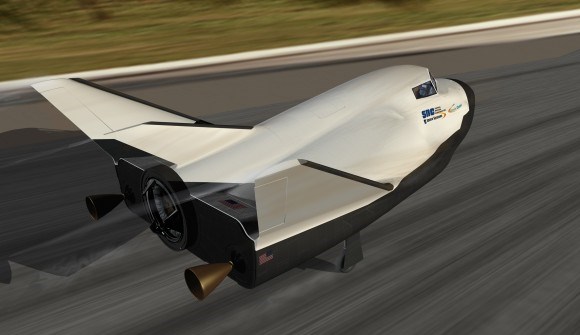
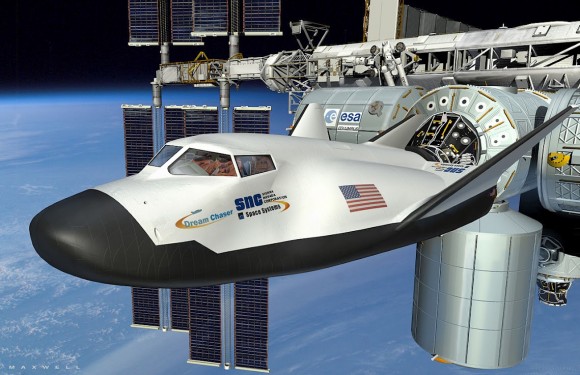
dream_chaserEver since their Space Shuttle program was forcibly shut down in 2011, NASA has been forced to look to the private sector to restore their ability to put human beings into orbit from American soil. This consists of providing the seed money needed for companies to develop a new race of “space taxis”.  One such program is the Dream Chaser, a reusable shuttle that will fly astronauts into low Earth orbit (LEO) and to the International Space Station (ISS).

Much like a standard Space Shuttle, the Dream Chaser is designed to launch atop a United Launch Alliance Atlas V rocket and land on a shuttle landing facility. And after lengthy periods of research and development, the Dream Chaser is now moving forward with a series of ground tests at NASA’s Dryden Flight Research Center in California that will soon lead to dramatic aerial flight tests throughout 2013.

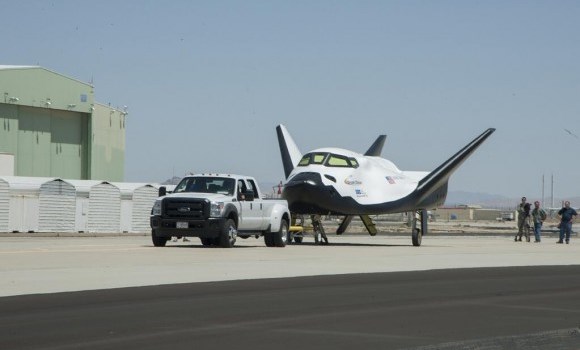
dream-chaser-testThis consisted of putting the shuttle together and then conducting a series of what’s known as “Pathfinding tow tests” on Dryden’s concrete runway. The purpose here is to validate the performance of the vehicles’ nose skid, brakes, tires and other systems to prove that it can safely land an astronaut crew after surviving the searing re-entry from Earth orbit. For the initial ground tests, the ship was pulled by a tow truck at 16 and 32 km/h (10 to 20 mph).

Later this month, the next leg of the test will consist of towing it up to speeds of 64 to 95 km and hour (40 to 60 mph). The next phases of testing will take place later this year in the form of airborne captive carry tests, where an Erickson Skycrane helicopter will fly the fuselage around to see how it holds up. Approach and Landing Tests (ALT) will follow to check the aerodynamic handling, which will consist of atmospheric drop tests in autonomous free flight mode.

dream-chaser-test1In an interview with Universe Today, Marc Sirangelo – Sierra Nevada Corp. vice president and SNC Space Systems chairman – spoke on record about the shuttle and where it is in terms of development:

It’s not outfitted for orbital flight. It is outfitted for atmospheric flight tests. The best analogy is it’s very similar to what NASA did in the shuttle program with the Enterprise, creating a vehicle that would allow it to do significant flights whose design then would filter into the final vehicle for orbital flight.

In short, the Dream Chaser has a long way to go, but the program shows great promise. And as already noted, they are not the only ones benefiting from this public-private agreement that seeks to develop commercial vehicles for the sake of kick starting space travel.

dream-chaser-dockedOther companies include Boeing and SpaceX, companies that were also awarded contracts under NASA’s Commercial Crew Integrated Capability Initiative, or CCiCap. All three have their own commercial vehicles under development, such as the Boeing CST-100, SpaceX’s Dragon, which are similarly designed to bring a crew of up to 7 astronauts to the ISS and docking with it for up to 6 months.

Dream_Chaser_launchBut of course, everything depends on NASA’s approved budget, which seems headed for steep cuts in excess of a billion dollars if a Republican dominated US House has its way.This is the third contract in NASA’s Phase 1 CCiCap contracts, who’s combined value is about $1.1 Billion and runs through March 2014. Phase 2 contract awards will eventually lead to actual flight units after a down selection to one or more of the companies. The first orbital flight test of the Dream Chaser is not expected before 2016 and could be further delayed if NASA’s commercial crew budget is again slashed by the Congress – as was done in the past few years.

But as William Gerstenmaier – NASA’s associate administrator for human exploration and operations in Washington – indicated in a statement, the larger goal here is one of repatriation. As it stands, US astronauts are totally dependent on Russia’s Soyuz capsule for rides to the ISS, which costs upwards of $70 million a trip. NASA hopes to change that by rekindling the “good old days” of space travel:

NASA centers around the country paved the way for 50 years of American human spaceflight, and they’re actively working with our partners to test innovative commercial space systems that will continue to ensure American leadership in exploration and discovery.

And I for one wish NASA luck. Lord knows thirty-years of post-Cold War budget cutbacks hasn’t been easy on them. And hitching rides into space above Cold War era rockets is not the best way of getting your astronauts into space either!

In the meantime, check out this concept video of the Dream Chaser in action, courtesy of the Sierra Nevada Corporation:


Source:
universetoday.com

Powered by the Sun: The Future of Solar Energy

Magnificent CME Erupts on the Sun - August 31Researchers continue to work steadily to make the dream of abundant solar energy a reality. And in recent years, a number of ideas and projects have begun to bear fruit. Earlier this year, their was the announcement of a new kind of “peel and stick” solar panel which was quite impressive. Little did I know, this was just the tip of the iceberg.

Since that time, I have come across four very interesting stories that talk about the future of solar power, and I feel the need to share them all! But, not wanting to fill your page with a massive post, I’ve decided to break them down and do a week long segment dedicated to emerging solar technology and its wicked-cool applications. So welcome to the first installment of Powered By The Sun!

spaceX_solararrayThe first story comes to us by way of SpaceX, Deep Space Industries, and other commercial space agencies that are looking to make space-based solar power (SBSP) a reality. For those not familiar with the concept, this involves placing a solar farm in orbit that would then harvest energy from the sun and then beam the resulting electricity back to Earth using microwave- or laser-based wireless power transmission.

Originally described by Isaac Asimov in his short story “Reason”, the concept of an actual space-based solar array was first adopted by NASA in 1974. Since that time, they have been investigating the concept alongside the US Department of Energy as a solution to the problem of meeting Earth’s energy demands, and the cost of establishing a reliable network of arrays here on Earth.

Constructing large arrays on the surface is a prohibitively expensive and inefficient way of gathering power, due largely to weather patterns, seasons, and the day-night cycle which would interfere with reliable solar collection. What’s more, the sunniest parts of the world are quite far from the major centers of demand – i.e. Western Europe, North America, India and East Asia – and at the present time, transmitting energy over that long a distance is virtually impossible.

NASA "Suntower" concept
NASA “Suntower” concept

Compared to that, an orbiting installation like the SBSP would have numerous advantages. Orbiting outside of the Earth’s atmosphere, it would be able to receive about 30% more power from the Sun, would be operational for almost 24 hours per day, and if placed directly above the equator, it wouldn’t be affected by the seasons either. But the biggest benefit of all would be the ability to beam the power directly to whoever needed it.

But of course, cost remains an issue, which is the only reason why NASA hasn’t undertaken to do this already. Over the years, many concepts have been considered over at NASA and other space agencies. But due to the high cost of putting anything in orbit, moving up all the materials required to build a large scale installation was simply not cost effective.

spacex-dragon-capsule-grabbed-by-iss-canadarm-640x424However, that is all set to change. Companies like SpaceX, who have already taken part in commercial space flight (such as the first commercial resupply to the ISS in May of 2012, picture above) are working on finding ways to lower the cost of putting materials and supplies into orbit. Currently, it costs about $20,000 to place a kilogram (2.2lbs) into geostationary orbit (GSO), and about half that for low-Earth orbit (LEO). But SpaceX’s CEO, Elon Musk, has said that he wants to bring the price down to $500 per pound, at which point, things become much more feasible.

And when that happens, there will be no shortage of clients looking to put an SBSP array into orbit. In the wake of the Fukushima accident, the Japanese government announced plans to launch a two-kilometer-wide 1-gigawatt SBSP plant into space. The Russian Space Agency already has a a working 100-kilowatt SBSP prototype, but has not yet announced a launch date. And China, the Earth’s fastest-growing consumer of electricity, plans to put a 100kW SBSP into Low-Earth Orbit by 2025.

space-based-solarpowerMost notably, however, is John Mankins, the CTO of Deep Space Industries and a 25-year NASA vet, who has produced an updated report on the viability of SBSP. His conclusion, in short, is that it should be possible to build a small-scale, pilot solar farm dubbed SPS-ALPHA for $5 billion and a large-scale, multi-kilometer wide power plant for $20 billion. NASA’s funding for SPS-ALPHA dried up last year, but presumably Mankins’ work continues at Deep Space Industries.

Cost and the long-term hazards of having an array in space remain, but considering its long-term importance and the shot in the arm space exploration has received in recent years – i.e. the Curiosity Rover, the proposed L2 Moon outpost, manned missions to Mars by 2030 – we could be looking at the full-scale construction of orbital power plants sometime early in the next decade.

And it won’t be a moment too soon! Considering Earth’s growing population, its escalating impact on the surface, the limits of many proposed alternative fuels, and the fact that we are nowhere near to resolving the problem of Climate Change, space-based solar power may be just what the doctor ordered!

Thanks for reading and stay tuned for the next installment in the Powered By The Sun series!

Source: Extremetech.com