The Empire Strikes Back or Happy Star Wars Day weekend!

Well, it’s officially the day after Star Wars Day, so now what? It’s the perfect time to review the sequel to the time-honored classic, that’s what! And I did promise to cover this rare example of a movie that managed to exceed the original, didn’t I? Hell, I would even if I hadn’t, its a freaking cool movie! And the nostalgia appeal alone makes it worth revisiting, time and time again.

And as I might have mentioned last time, The Empire Strikes Back benefited from several advantages which weren’t initially available during the shooting of the first film. This included help with direction, writing, and of course he had the musical score from the get go, which really didn’t suck! But on top of all that was the fact that in the second movie, things had a much darker and more mature feel.

Lucas acknowledged this in a series of interviews and indicated that this was his intention all along. Following the conventional three act formula, Act II is always the darkest of the chapters, where things go bad for the main characters and escalates the dramatic tension. As such, he needed to turns things on their head after the first movie’s happy conclusion, and threw in some big revelations and twists just to make the ride especially fun.

The Empire Strikes Back:
Plot Synopsis:
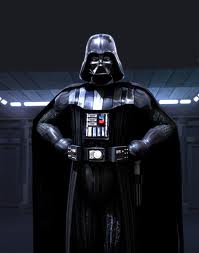
The opening crawl once again tells us what we need to know, that despite the destruction of the Death Star, its a dark time for the Rebels. The Empire is still a force the dominant power in the universe, after all, and since their loss at Yavin 4, they’ve been pursuing the Rebels without fail. At the same time, Darth Vader has taken an unhealthy interest in finding Luke Skywalker.

Cut to Hoth, where we see an Imperial probe landing on the surface, and Luke and Han who are out on patrol on the back of some weird looking beasts. Luke spots what he assumes is a meteor and tells Han he is going to check it out, but is unfortunately laid out when a big furry Wampa (aka. a Yeti) sets upon him.

Next we see the Rebel base, where Han checks in and let’s Rebel General Rieekan know that he’s got to leave. Essentially, his time with the Rebels have only made things worse with Jabba and his considerable debt. Rieekan is understanding, but his farewell speech to Leia leads to a rather serious argument. Seems she’s unhappy about his decision, and he’s convinced there’s something other than professional admiration motivating her feelings.

Luke wakes up later in the Wampa’s cave, and relies on his newfound knowledge of the Force to free himself and slice off the Wampa’s arm. He escapes into the frozen wastes, but nighttime is descending and the temperature is dropping! Han realizes that Luke hasn’t checked in and decides to head out into the cold to find him. After several hours, the Rebel base is forced to seal its doors and lock them out for the night. Luke and Han are on their own, and odds of their living through the night are slim!

Out on the frozen wastes, Luke is near death and experiences a vision. Obi-Wan comes before him and tells him he must go to Dagobah to learn the ways of the Force from Master Yodah. He passes out just as Han comes over the horizon to find him, but the two are kinda stuck when Han’s Tauntaun dies from exposure. Luckily, Han gets the bright idea to cut his beast open and stick Luke inside, thus keeping him warm and alive until he can build a shelter. Come morning, Rogue squadron finds them and picks them up! The boys are saved!

Back to the base where the Rebels learn that there’s an Imperial probe droid in their midst. Yes, that little spindly thing from the beginning has not only been getting around, it’s been taking footage of their shield generator and broadcasting it to the Imps! Han and Chewi manage to take it down, but it seems that the damage has been done. The evacuation begins…
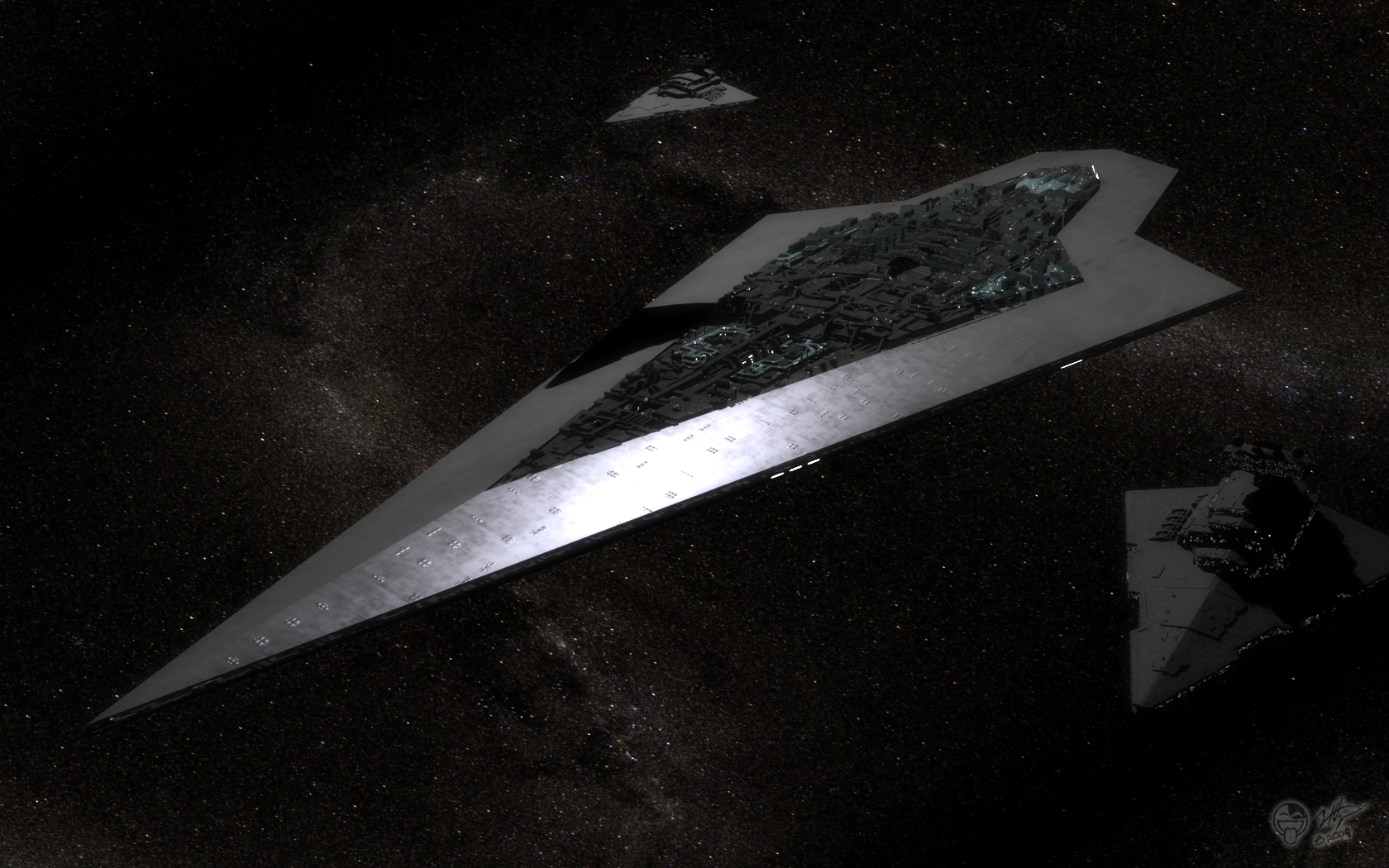
Then comes another moment in cinematic genius, the scene where the Imperial fleet is shown and the Executor (see More Cool Ships) is introduced. After seeing many massive Star Destroyers pass each other in the starry night, several of them are suddenly overtaken by a huge shadow. Naturally, the audience can’t help but wonder, what the hell is no big that it can cast a shadow capable of blacking out a whole fleet worth of Star Destroyers? A Super Star Destroyer, that’s what! We then cut to the bridge where Vader is watching the fleet, all to the tune of the evil Imperial music!

And of course, it seems the footage has reached them, and upon seeing it, Vader comes to life and orders the fleet there immediately. Admiral Ozzle, the aging stereotype of the arrogant and incompetent British officer, seems pissed at his subordinate for finding this out and gives him a hard stare. Oh we just know that’s going somewhere don’t we? Meanwhile, the Rebels are preparing to leave, and Han and Luke have an awkward moment as they once again say good-bye to each other and wish each other luck. Seems they’re always saying good-bye…

Shortly thereafter, the Imperial fleet arrives but has alerted the Rebels to their presence and have raised their planetary shields. Vader concludes that Ozzle jumped them in too close to the planet, and decides some disciplinary measures are in order. This consists of him choking him to death over a video conversation and promoting his immediate subordinate, Captain Piett, to the rank of Admiral. Here too, the scene was perfect! One man listening in, trying to ignore the fact that his superior is slowly asphyxiating and dropping to the floor, and appearing both flattered and terrified that he’s now in charge.
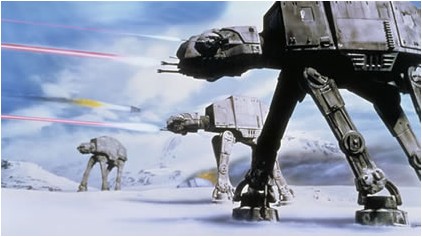
The first salvos begins as the Rebel ships begin to fly for deep space, X-wings and the planetary Ion cannon providing cover. Meanwhile, General Veers, commander of the Imperial troops, lands beyond the shield and begins sending his walkers into the fray. This is the first appearance of the AT-AT’s, and they were pretty chilling to behold. The Rebel troops meanwhile dig in while Rogue Squadron engages them in their attack speeders.
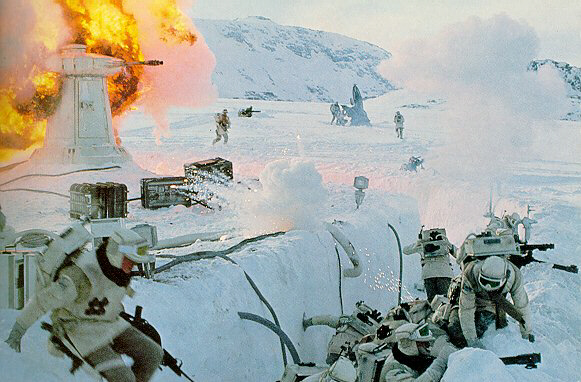
However, things don’t go so well. The AT-AT’s are too heavily armored to destroy with blasters, and the dug-in defenders weapons are similarly ineffective. Luke comes up with the bright idea to trip up the walkers using their tow cables, but this too begins to falter after the majority of Rogue Squadron gets shot down.

Luke himself is shot down and is forced to bail, taking out a second walker with a grenade from the underside. However, in time, General Veers walker gets in range of the shield generator and delivers the death blow to it. The Imperial forces move in and begin attacking the command center itself.

Back at said center, Vader and an Imperial garrison walk in virtually unopposed, and all forces are ordered to being a full retreat. Han grabs Leia, who is still at her post, and compels her to join him, Chewi and the droids aboard the Millennium Falcon. As the last ship to leave, they are barely out of the bay as Vader walks in. Luke similarly gets to his X-wing out on the wastes and dusts off from the planet. The Imperials have won, but the good guys have once again lived to fight another day.

Luke meanwhile tells R2 that they are not going to rendezvous with the fleet. Seems he’s got another destination in mind, the planet Obi-Wan told him to go to in his vision. Arriving at Dagobah, Luke’s ship is disabled by a storm and he crashes into a fetid swamp. He and R2 are unharmed – well R2 almost gets eaten! – but his ship is marooned and he now seems stuck on this new planet. In the course of setting up camp, he is snuck up on by a tiny little green man, an annoying little creature who seems to know who Yoda is. He promises to take Luke to see him, but only after they’ve had supper!

Meanwhile, it seems that the Imperial fleet has zeroed in on the Millennium Falcon. Han and crew try to escape them, but it seems that ongoing mechanical issues are preventing them from jumping into hyperspace. They pull a trick by pulling into an asteroid field and hiding on one of the larger rocks. Pulling into a cave, they set down to make their repairs.

Back on Dagobah, Luke discovers that the little green man is Yoda, and that his constant pestering was a way of testing his patience, a test he failed. However, Obi-Wan’s disembodied voice insists that he has confidence in the boy, but Yoda is unimpressed by Luke’s insistence that he’s not afraid. He insists, in a very chilling line, “You will be… you will be.” They begin his training, running through the woods as Yoda explains the mysteries of the force and the danger of the dark side.
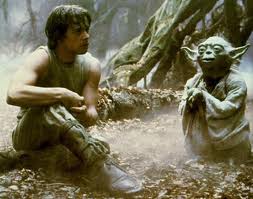
Luke confronts his first test when he senses a cave filled with dark energy nearby. Yoda tells him he must go inside, and that the only thing in there is “only what you take with you”. After crawling through creepy lizards, snakes and slimy walls, Luke comes face to face with his nemesis – Vader! They exchange blows with their lightsabers and Luke is victorious, cutting off Vader’s head and watching it roll to the ground. However, he is dismayed when the helmet blows open to reveal… Lukes own face! Dun, dun, dunnnnnn! Foreshadowing!

While in hiding, Han and Leia finally come to terms with their feelings for each other. After sensing that there was something going on there, only to see the sparks fly with fight after fight, the two realize that they actually love each other and have themselves a passionate kiss. Unfortunately, the moment is interrupted when a very rude droid announces that he’s found the problem with the hyperdrive and they can get it working again!
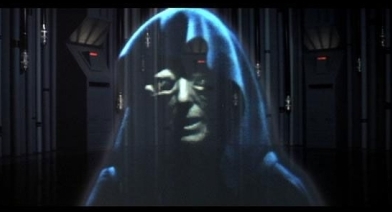
Meanwhile, Vader orders the fleet into the asteroids to pursue. Despite taking severe losses, he presses his commanders to keep on them. However, the Executor must pull out of the field when Vader is alerted that the Emperor himself is making contact. In the course of talking with the massive hologram of the Emperor’s hooded face, he learns the Luke Skywalker is officially a threat. The Emperor insists he must be dealt with, but Vader assures him he could be turned. He will do so, or kill him in the process, Vader insists.

Back in the cave, repairs are proceeding, but things get a little odd when they realize that their hiding place doesn’t react too well to blaster fire. They board again and make it out seconds before the “cave”, which appears to have teeth, closes on them. Back on the Executor, Vader has called in some added help, a slew of bounty hunters which includes Boba Fett. The Falcon pops out of the asteroid field and is once more pursued and can’t withdraw, so Han decides to pull a daring maneuver by charging the pursuing Star Destroyer. After slipping over the bridge, the Falcon “disappears”.

The Captain of the pursuing Star Destroyer goes to apologize to Vader, and is killed. Vader orders the fleet to break up and track every possible trajectory. However, seems the Falcon is actually mounted on the back the Star Destroyer’s bridge where its been hiding the whole time. Han plans to float off as soon as their host dumps its garbage before going into hyperspace, which is apparently standard Imperial procedure (not so environmentally conscious that!) They begin to float off with the junk, but it seems they have a tail… Boba Fett in his ship, The Bounty!

They set coarse for Bespin, to a place known as “Cloud City” –  a floating metropolis built around a gas mining platform, where Han has a friend who he thinks will shelter them. This “friend”, who goes by the name of Lando Calrissian (whom he won the Falcon from years back) appears to be running the place now. And despite their bumpy past, Lando seems happy to see him. Leia, however, has a hard time putting her trust in him.

In time, she realizes just how right she was not to! After C3P0 disappears and turns up in pieces, Lando invites them to a dinner banquet, and Vader appears to be the guest of honor! Turns out Boba Fett tracked them there and alerted Vader, who showed up just before they did and threatened to destroy the place unless Lando turned them over. The torturing begins! But it seems that Vader has a larger agenda than extracting information or punishing a few rebels. The real aim of this little “deal” is to prepare a trap for Luke, whom he knows will not be able to resist.

Back on Dagobah, Luke has a vision of the future in which Han, Leia and Chewi are suffering. He is unable to shake the vision and decides to leave. Yoda and Obi-Wan plead with him not to go, telling him he’s not ready and that he cannot hope to defeat Vader. But Luke is intransigent, insists he will come back, and that he won’t fall to the Dark Side. Once Luke leaves, Obi-Wan laments that they might lose their only hope, but Yoda reveals that there is another… hinteddy, hint, hint!

Meanwhile, Han is put into carbon freezing, a way of testing the process Vader intends to use to capture Luke. He is then handed over to Boba Fett to take back to Jabba. Having had all he can take of Vader’s treachery, Lando pulls a double cross and springs Leia and Chewi from capture. Chewi tries to take Lando’s head off, but stops when he tells them they can still save Han. They arrive too late, and Fett gets away… Luke has also arrived and Leia tries to warn him, but they are separated by too much blaster fire.
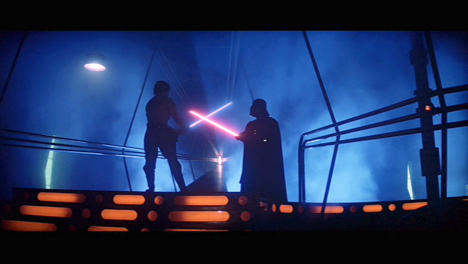
Luke continues to search the city, and finds his way to Vader. The two draw and begin dueling, and Vader is impressed by Luke’s growing abilities. However, before long, he wears Luke down and eventually takes his hand off. Beaten and helpless, Luke crawls to the end of a catwalk overlooking Bespin’s central mining shaft. Here, after much time and waiting, he learns the truth of what happened to his father and why Vader has been obsessed with finding him…

Vader did not murder his father, you see. Vader IS his father. More than that, he doesn’t want to destroy Luke, but to recruit him. Together, he believes they can destroy the Emperor and “rule the galaxy as father and son.” Luke is overwhelmed and possibly even tempted, but chooses death rather than surrender and capture. Jumping into the shaft, he falls but is pulled into a side passageway which dumps him outside. Hanging on for dear life on the edge of an antenna, Luke begs Obi-Wan for help. However, Obi-Wan already told him he wouldn’t be able to interfere if he confronted Vader. With no one else to call to, he reaches out to Leia, who appears to hear him. She order the Falcon to turn around and picks Luke up. They blast for orbit and prepare to make a daring escape.

However, the Executor is pulling into position and Vader reveals that the Falcon’s hyperdrive was disabled. They need only close in and board them now. However, R2 already found out about the hyperdrive from the station’s computer and zooms in to make a hasty field repair. He managed to put things back in order just in time, and the Falcon blasts off! Admiral Piett watches in horror as he sees them escape, and waits for Vader’s vengeance. But Vader, solemn and saddened, merely wanders back to his quarters…
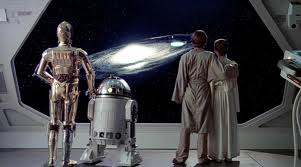
Back at the fleet, Luke and Leia are tending to his lost hand. Lando and Chewi have meanwhile hopped back onto the Falcon and are going off to find Han. The movie closes with a hopeful scene of Luke, Leia and the droids watching the Falcon leave against a backdrop of the Galactic Core. The shot widens to show the rest of the fleet as it drifts away. Though they’ve suffered a beating and many set backs, the good guys are still alive, and hope remains…

What Made This Movie Even Better!:
As every fan of Star Wars and classic cinema is no doubt aware, this movie is considered one of the few sequels that actually surpassed the original. The reasons for this are pretty plain and I’ve already gone over them, so I think I’ll skip them and get right to the specifics.

For starters, the cinematography was masterful. Again and again in this movie, the music, camera angles and dialogue all coincided to create the perfect atmosphere of tension and impending doom. The opening scene where the Executor is introduced, the build-up to the battle on Hoth, the sense of defeat as the Rebels are forced to retreat, the terror Luke feels as he confronts the Dark Side, the fearful moments as we wait for the trap to close around the main characters on Bespin, and the growing desperation as Luke fights Vader… All of it culminated in the massive revelation that Luke was in fact Vader’s on. It was one of the biggest twists in movie history, and it was absolutely awesome! Years later and I still get the willies just thinking about it.

And in the end, this movie really captured the essence of dark second act. After the introduction and brief victory of good over evil in the first movie, we get a dose of hopelessness and soul-shattering revelation in movie two. Not only did it chill the bones and impress audiences with its mature themes, it also made us wonder just how the good guys were going to turns things around in the end. And it was only because the two movies were so character driven that we cared about what happened so much. Luke’s coming of age, Han and Leia’s budding romance, Chewi’s fierce loyalty, and even the droids quirky antics; we all felt a sense of attachment to these characters and wanted to see them come out okay.

Little wonder then why audiences were on the edge of their seats for the next three years. And granted, the third and final installment had its share of weaknesses, by then the momentum and following had become so strong that it seemed like nothing Lucas did could be perceived as wrong. And honestly, the third and final movie was so climactic and emotionally involved that they really just disappeared didn’t they? But more on that next time.

Happy Star Ways Day Weekend everybody! Enjoy yourselves and… well, you know the rest 😉

May The Fourth Be With You!

Yes, it is now May 4th, making it officially Star Wars Day! And in honor of this momentous occasion, I’ve decided to dedicate the next few days to reviewing the classic movies which started it all. Yes, those movies, the ones that made Lucas filthy freaking rich and perverted his sense of creativity.

But I’ve already ranted enough about those… ahem, other movies. Today is all about honoring the good things about this franchise and pop culture phenomena. And it really was a phenomena wasn’t it? When it comes to setting trends, box office records, and inspiring an entire generation of movie makers and movie-goers, few things can measure up to Star Wars.

In fact, part of the reason the fanboys reacted so badly to the prequels was because they loved the originals so much. Were it not for the intense love inspired by the originals, the new ones would never have been able to inspire such hate. Funny how that works…

First up, and in honor of May the 4th, is the original Star Wars, or as its extended title reads:

Episode IV: A New Hope
Plot Synopsis:
The movie opens with a crawl that divulges the bare bones of the movie’s premise. Basically, there’s  an evil Galactic Empire, a band of Rebels, and things are pretty tense ever since the latter won their first victory against the former. But in truth, the audience got all they needed from the opening visual sequence, a touch of cinematic genius if ever there was one!

For starters, we see a small ship running for its life, being pursued by a very large ship that is chasing it down. This tells us two key things: the Rebels are a small but committed band that are fighting for their existence against a very large, very powerful foe. The massive ship and the way it is making a slow, lengthy crawl over the camera lets us see the power and reach of the Empire, and establishes some dramatic tension which last well past the first few minutes.

Meanwhile, the ship is disabled and boarded. Imperial troopers, decked out in their white suits of armor, very clinical and faceless looking, board and kill all the defenders. Then in walks Darth Vader, who stands a head taller than the rest, is clad all in black, and very clearly means business! Cut to the droids odd-couple, C3P0 and R2D2, who’ve been scurrying around since the action started. Though we don’t know who she is at first, we see Princess Leia giving something to the latter, which under the circumstances, is of obvious importance. Shortly thereafter, they eject in an escape pod to the planet Tatooine, located below.

Leia gets her formal introduction after Vader kills the ship’s Captain and brings her forward to demand answers. She’s a member of the Imperial Senate, and apparently also a member of the Rebel Alliance. The reason their ship was boarded was because a certain set of plans, pertaining to the Death Star, were stolen and traced to their ship. After getting nothing from her, the Imperial officers deduce that the escape pod must have contained them and pursue it to Tatooine’s surface.

In time, C3P0 and R2D2 wind up becoming the property of a moisture farmer named Owen Lars. His nephew, a young man named Luke, quickly establishes himself as the movie’s protagonist. In addition to wanting to get off Tatooine, he also dreams of being a pilot and finding out more about his father, a man whom he knows virtually nothing about. Like all classical heroes, his will be a journey of self-discovery which will take him across the galaxy and fundamentally change him.

Naturally, his surrogate parents are afraid to let him go, alluding to the fact that his father’s legacy is not something they want him to be a part off. But in the meantime, Luke has a more immediate problem on his hands. After seeing a fragment of the recording of Princess Leia and learning that R2 was intended to meet a man named Obi-Wan Kenobi, a man whom Luke suspects is actually Ben Kenobi who lives in the deep desert. After hearing of this, R2 runs off, forcing Luke and C3P0 to run after him…

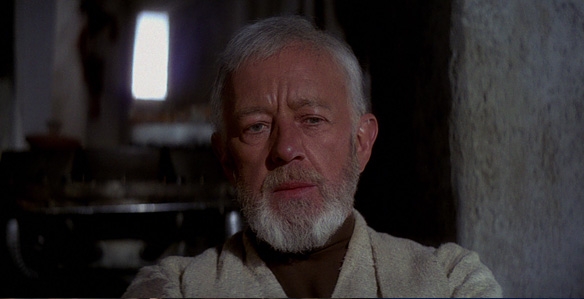
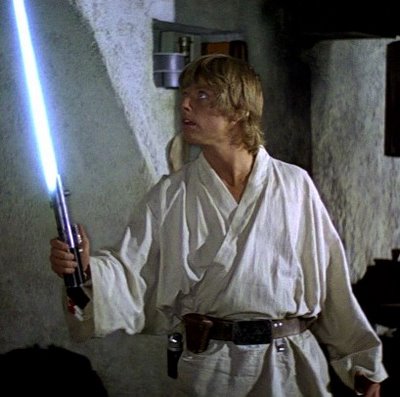
They find him, and Ben Kenobi, after a near-death encounter with some Sand People. After chasing them off and tending to Luke, Ben reveals that he is in fact Obi Wan, and takes Luke and the droids back to his pad to talk. Luke learns, much to his delight, that Obi-Wan knew his father and that he was in fact a war hero and a Jedi Knight. His lightsaber is still in Obi-Wan’s possession, which he gives to Luke to play with. This was audiences first glimpse of one of the coolest weapons in sci-fi history, and impressively, it was done on a rather meager budget!

In any case, Obi-Wan sees R2’s recording in full. Leia reveals that she has come into possession of the Death Star plans, intended to deliver them to her father on Alderaan, but was intercepted in transit. R2 now holds them, and they still must be delivered. The recording ends with her pleading with Obi-Wan to help the Rebels. He asks Luke to accompany him so he can learn more about The Force and his father, but Luke is naturally reluctant. He can’t leave so long as he has ties and family on Tatooine that need him… Ooh, foreshadowing!

Cut to the Death Star, the infamous Imperial weapon of terror. Its commander, Grand Moff Tarkin, makes his first appearance, as do the other senior commanders. After some exposition on just how freakishly powerful the Death Star is, it is also revealed that until the plans are found, there is a danger. On top of that, there’s also the consensus that the Death Star needs to be tested by blowing up its first planet. Also, with Leia aboard and not talking, Tarkin concludes that they can kill two birds with one stone.

Luke and Ben meanwhile find a wreck in the desert, a Jawa landcrawler which had been destroyed by Imperial troopers. Luke quickly realizes that the Imperial troops were searching for his droids. He rushes home to find his uncle and aunt dead and their home destroyed. He then returns to Obi-Wan to tell him that he will come with him after all. The two then travel to the planet’s spaceport, Mos Eisley, to find a spacer who will take them off planet.

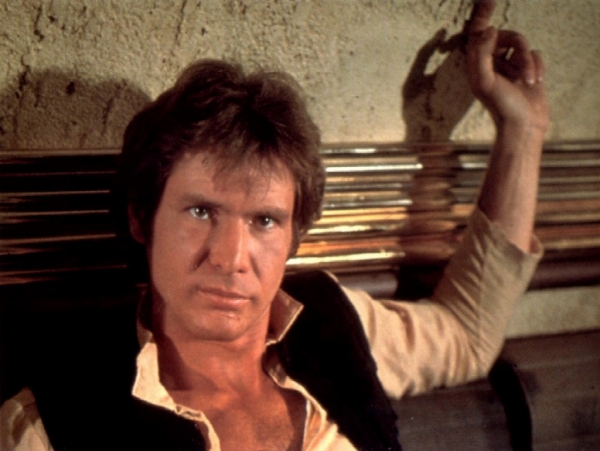
After getting past Imperial guards, they are forced to contend with some tough barfolk. Obi-Wan quickly dispatches them with his own lightsaber, and they meet Han Solo shortly thereafter. After being treated to some not so idle boasts about his ship (the Millennium Falcon), Obi-Wan determines that Han’s the man to take them to Alderaan. We, the audience, also learn that he clearly has some debts, and an angry creditor named Jabba. Before he can leave to check on his ship, he’s forced to gun down one of the men Jabba sent to collect.

Getting into orbit and away from the planet prove a might bit difficult given the presence of Imperial troopers and Star Destroyers. But Han wasn’t bullshitting when he said his ship was fast. They dust off, jump into hyperspace (another cool visual experience) and elude their Imperial chasers.

Meanwhile, Takin has the Death Star parked in front of Alderaan, which he threatens to destroy if Leia won’t divulge the location of the Rebel base. She does, telling him their on Dantooine, but Tarkin orders Alderaan destroyed anyway. Seems Dantooine is too remote to provide an effective “demonstration”. But it’s okay, since she was lying through her teeth. When Tarkin learns of this, he’s naturally pissed and orders that Leia be executed.

However, this order coincides with the arrival of the Millennium Falcon. Since their destination has been blown to pieces, the crew fly into a complete and utter debris field, and soon find themselves face to face with the Death Star itself. After getting nabbed with a tractor beam and brought aboard, they are forced to stow away in the Falcon’s secret compartments, where Han usually puts his “special” cargo. After popping out and sneaking past more Imperial troopers, they learn that Leia is aboard the station. Obi-Wan heads off to disable the tractor beam, while Luke convinces Han to take part in a daring rescue. Hijinx ensue!

First, we have Han, Luke and Chewi’s rather clumsy attempt to get Leia out of her cell block. The first phase, getting in, goes off without much trouble (unless you count all the shooting). Unfortunately, phase two, getting out, proceeds less smoothly. After being cornered my reinforcements, Leia orders them to jump into the trash compactor to escape. Only the timely intervention of R2 and 3P0 prevent them from being mashed.

Second, Obi-Wan succeeds in shutting down the tractor beam, but comes face to face with his old apprentice, Darth Vader. A lightsaber duel ensues, crossed beams providing a metaphor for the internal struggle between the righteous teacher and the student who went bad. As they head for the ship, Luke sees Obi-Wan locked in this duel, and is forced to watch as Obi-Wan puts up his blade and lets Vader kill him. But of course, he warns Vader that this will only make him more powerful… something we will understand very soon.

Ultimately, the good guys get away, short on crew member, but it seems their escape was allowed to happen. Knowing that they will set course of the Rebel Base, Vader has a tracking device placed aboard the ship, and the Death Star follows them to a small moon called Yavin 4.

Once there, Leia meets with the Rebel command staff and shares the plans. Knowing that the Death Star is likely en route, they prepare a desperate plan to destroy the Death Star using the one weakness they can discern. An exhaust vent located along the station’s central axis, at the end of a long, well-defended trench! Some two dozen Rebel pilots suit up for the mission, Luke volunteering to help, and asking Han to do the same. But, having been given his reward and eager to pay off his debts, Han says good luck and leaves with Chewi.

After slipping past the Death Stars shields, the Rebel pilots begin fighting it out with the station’s defenses and defenders. However, the assault on the vent itself does not go well. One wing of pilots is shot down trying to make the run, and the one pilot to get off a shot misses and is killed shortly thereafter. It now falls to Luke and what’s left of the attack wing, which includes his old friend Biggs Darklighter. Biggs is killed covering Luke, and he himself appears about to be gunned down by Vader’s own fighter, until someone new shows up and saves his ass!

Seems Han had a change of heart, and after blowing up Luke’s tails and sending Vader’s ship into a tailspin through space, Luke fires off his ordinance and hits the vent dead on! They break off and get away just in time to avoid the massive shock wave that blowing up such a massive station produces! The Rebel Alliance is saved, and the Empire has been dealt a mighty blow. However, as we see, Vader is still alive and makes it away, letting us know that the war (and movie franchise) will go on…

What Worked So Well About It!:
Where to begin. You know, its always at this point that critics and fanboys say what was so good about the original movies by comparing them to the new ones. To avoid this needless cliche, and perhaps to be a good sport, I’ll keep comparisons to a minimum. Suffice it to say, part of the reason why the first movie was such a smashing hit was because it tapped in to a certain need which was becoming apparent in the movie-going community. In terms of science fiction, audiences were becoming just the slightest bit tired of dystopian stories and dark visions of the future.

After so much technophobia and misanthropy, the stage seemed set for something positive and heroic to come along and renew people’s faith in humanity and the future. So in a way, Lucas’ masterpiece benefited from good timing, arriving exactly when people needed it to. Such timing had not been seen since the arrival of the Beatles to America, an event which came after the assassination of JFK when young people were looking for something happy and joyful to focus them onto new and positive things.

Another thing which worked in its favor was the fact that Lucas had to contend with limited budgets, an largely inexperienced cast and crew, and just about every mishap imaginable. Being in the position of the underdog, having little expected of him, and having to contend with all kinds of difficulties, what came out of it all is best labelled “art from adversity”. There’s just something so purifying about a noble effort which succeeds despite difficulty, isn’t there? It was like Lucas’ movie was living out its own plot, the committed band of Rebels fighting an evil Empire being a metaphor for Lucas’ own fight with the studios and production companies.

The Weak Parts:
But of course, Lucas also benefited from a great deal of help, which came from the highly experienced and talented hands of John Williams, the cinematography of Gilbert Taylor, and a host of editors who helped clean up his movie once the raw footage was slapped together. Arriving just a few months shy of the films theatrical release, these people saved production of the film in many ways, and demonstrated to Lucas that when it came to shooting and dialogue-writing, he needed some help to make it all work (something he forgot in more recent years!)

In fact, it was because these individuals had arrived late to the production that many weaker elements of the movie survived and became part of the original movie. In several scenes, actors and extras made mistakes which Lucas didn’t notice because he was not accustomed to shooting films. Two prime examples are when a Storm Trooper walks head first into a sliding door on the Death Star, and Mark Hamil yells “Carrie!” to actress Carrie Fisher while they were shooting. These were never edited out, as was some of the lazier acting and poor dialogue.

In fact, Lucas gained a reputation for writing wooden dialogue as he was making this movie. During their initial readings, many of the actors complained that it was unrealistic, unnatural, and completely awkward. These sentiments were brilliantly captured by Harrison Ford when he confronted Lucas and told him, “George, you can type this shit, but you sure as hell can’t say it!”.

The Enduring Legacy:
Of course, I could get into all the cultural and cinematic influences that were apparent and helped make the movie such a box office hit. But let’s face it, that’s been done to death! I shall just say that in the end, Lucas knew where to borrow from and could make it all work together. Combining elements like westerns, samurai movies, and allusions to ancient and modern history with an epic story of good versus evil, Lucas’ creation tickled all the right bones and gave audiences what they wanted when they wanted it.

And really, it was one of those rare movies where people felt that there truly was something for everyone. It was not strictly a kids movie (despite what Lucas would later claim) because there was simply so much material and attention to detail which no child would have been able to appreciate. So while the kids (and kids of all ages!) were dazzled with shoot outs, dogfigths and lightsaber duels, the adults were able to appreciate aesthetics borrowed from such classics as The Good, The Bad and The Ugly, Seven Samurai, Metropolis, and costumes and themes alluding to WWII and Nazi Germany.

And of course, with its smashing performance at the box office, Lucas and his crew now had the freedom and the street cred to make some follow up movies and see his vision through to completion. And in no time at all, all the studios and production companies which had doubted him or told him no were lining up to imitate him and finance whatever Star Wars clone they could find. Lucas, I imagine, got a real kick out of that!

Anyhoo, having spilled so much metaphorical ink on this movie, let me just wrap things up by saying Happy Star Wars Day and be sure to check back soon. Next up, I will be covering the even more famous The Empire Strikes Back, one of the few movies in cinematic history to ever be credited as being “better than the first”. In the meantime, check out this shot from the blooper reel. Keep your eye to the right as the Stormtroopers walk in…


Even More Cool Ships!

Dang it, this is fast growing into a theme of its own, outgrowing the whole “conceptual” thing by leaps and bounds! But there are always more contenders, and people have been nice enough to leave suggestions with me. So the list must go on, taking into account more spaceships, aircraft an assorted vehicles that come to us from a variety of franchises. Some are fast, some are scary, some are just really, really neat to look at! But they all have one thing in common, they are all cool!

Here’s the latest, as assembled by me and with the help of some helpful suggestions!

Cylon Base Ship:
cylon_basestarIn my first post, I mentioned the Galactica and how it had evolved from its original self to become the aged but enduring vessel that we saw in the new series. Well, when it came to the Cylons, the artists seemed to go in the opposite direction. Rather than making the Cylon Base Ships less advanced-looking, they opted instead for designs that looked sleeker, updated and more organic.

This was in keeping with the updated concept of the Cylon race. Whereas in the original series, the Cylons were slow, lumbering robots who simply followed orders and sounded very machine-like, the new Cylons were fully organic beings that could easily pass for humans.

The Centurions, much like their predecessors, remained loyal robots, but were also a hell of lot more streamlined and dynamic in appearance. The Base Stars were said to be constructed out of a cartilage-like material that was soft and organic, but became solid and super-tensile once it hardened. And of course, the Cylon Raiders were themselves equipped with organic parts, living brain tissue inside a metal hull.

Of course, the new Base Ships were downgraded in one respect. Much like the Galactica, the new designers decided to forgo the idea of lasers for something a little more realistic. In the case of the Cylons, this meant missiles instead of flak guns and cannons. However, everything else was significantly more advanced than the original, including the appearance and the scientific foundation on which it rested. Basically, the new Base Ships looked organic because they were organic. Instead of being built in a shipyard, they were grown in them. That’s some advanced shit right there!

All of this were quite ingeniously attributed to technological evolution. The old Base Star and Centurion designs were said to have been what the Cylons looked like during the previous war. Toasters was the term used to describe them, given their chrome exteriors and campy-retro look. Their new designs were the result of over twenty years of progress, going from constructions of metal and silicate materials to biometric tissue which was grown in vats. A very cool concept, and in keeping with the latest updates in the fields of science and science fiction 😉

The Discovery:

Discovery, front view

Cue classical music soundtrack! The Discovery is sailing by… in excruciatingly slow motion! Yes, I’m sure I speak for all those who have seen 2001: A Space Odyssey when I say that the story was brilliant, the cinematography superb, but dammit, did they have to do so many long, drawn out space sequences? Well, as someone very wise said, this movie was made back when people still had attention spans!

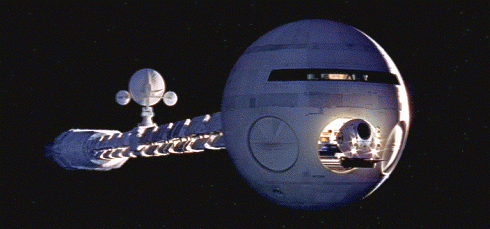
But on the plus side, the long sequences allowed audiences to truly appreciate the design and concept of this ship, and many others in the film. In what can only be described as a caterpillar (or ball and chain) type design, the Discovery was originally designed for cargo hauling, but was converted to deep-space exploration when Earth scientists needed to mount a manned mission to Jupiter in a hurry.

One can see without much effort how these concepts overlapped in the design. Being made up of many segments, the spine of the ship was clearly designed to hold detachable cargo pods, whereas the crew and navigation team would hold up in the spherical section at the front. Once converted, this frontal section was given pod-bay doors, a compliment of small explorer craft, and a large scanner array mounted along the dorsal section. The engine compartment at the rear was built for heavy thrust, alluding to the fact that this craft was intended for deep-space missions.

rear view

In addition to all that, the ship came equipped with vast stores of food, cryogenic pods, and an onboard AI known as the HAL 9000. During the better part of its deep space missions, the crew would be kept in cryogenic suspension, HAL would pilot the ship, and they would be thawed once it came close to its destination, or in case an emergency situation arose. Also, its contained rotating sections which would become active once the crew was in a waking state, ensuring that they didn’t succumb to muscular atrophy due to weightlesssness.

Simple, straightforward and technically practical, The Discovery was everything one would expect from the future of space travel, at least from a 1960’s standpoint. And granted, we weren’t exactly building ships like this when 2001 rolled around. But we weren’t exactly fighting the Cold War or discovering aliens on the Moon either. In either case, you’d be hard-pressed to find hard sci-fi like this anywhere today. RIP Arthur C. Clarke. You too, Kubrick! You’re genius is sorely missed!

Draconia 1:
Credit for this one goes to Victor of Victor’s Movie Reviews. Initially, I was hesitant when he suggested I post something from the Buck Roger’s universe, but quickly changed my mind when I saw it. Thanks for the suggestion and the links man! Enjoy this one!

Just to be clear, I got nothing against Buck Rogers, I’m just relatively ignorant about the franchise. And after combing through a couple databases, I’m still pretty ignorant. Whereas I thought this was just a popular movie and tv series from the 80’s, I’ve since learned that its roots go way deeper than all that! Originally, Buck Rogers was a novella named Armaggedon 2419, a dystopian story that appeared in an issue of Amazing Stories in 1928. Since that time, the story has been adapted to comic books, radio, television, and with the success of Star Wars and Battlestar Galactica in the late 70’s and early 80’s, a feature film and a TV spinoff.

Known more popularly as “Buck Rogers in the 25th Century”, it is from this point in the series that this megalithic ship known as a Draconian battleship comes to us. Named in honor of the empire that built it, Draconia 1 was the flagship of the Draconian armada and the flagship of the franchise’s chief protagonist, Princess Ardala. , to conquer Earth and make Buck Rogers her consort. And given its size and imposing nature, I’d say the artists captured these intentions quite perfectly. With a name like Draconi 1, you gotta figure the ship is going to look stern, sharp, and geared up for war!

Earth Force Thunderbolt:
ThunderboltAnother happy contribution from the Babylon 5 universe! An upgraded model that was meant to replace the older Starfury-class fighter, Thunderbolts were two-person aerospace fighters that were had boasted extra firepower, better navigation, updated systems, and the ability to navigate inside atmospheres. Yes, unlike the earlier models, these things could operate in space and in the air.

This was made possible by the addition of extendable airfoils which were attached to the ship’s four engine mounts. In addition, the hard mounts on these wings were capable of holding up to ten missiles. These, combined with its four uni-directional pulse cannons, gave it a serious firepower advantage over its predecessor!

Making their debut in the second season of the show,  the Thunderbolt would play a pivotal role in the Earth Alliance civil war, which broke out shortly thereafter. Thanks to a shipment that arrived on the station before B5 declared its independence, and the addition of several squadrons of defectors from the Earth Force destroyers Alexander and Churchill, Sheridan and his forces were not at a disadvantage when President Clarke’s forces came knocking!

According to the B5 Wiki, the Thunderbolt represented the third incarnation in the Starfury series. In terms of design, they were clearly inspired by their namesake, the P-47, and other WWII aircraft like the P-51 Mustang. In addition, inspiration was probably owed to the F4 Phantom of the Vietnam Era, which also boasted a two-seat configuration and also had the same mouth and bared teeth design on the front. A good thing too, for credit should always be given to the classics!

The Eclipse:
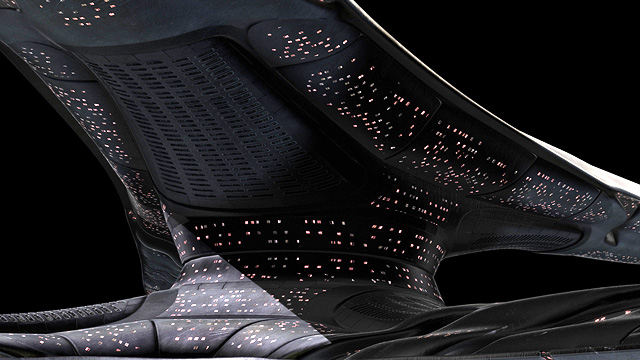
What could be more terrifying than a Super Star Destroyer? THIS, that’s what! And like a Super Star Destroyer, it comes to us from the expanded Star Wars universe. Known as the Eclipse, and taken from the Star Wars: Dark Empire comic series, this vessel was the latest incarnation of Imperial terror technology at its best (or worst)! Originally intended as the resurrected Emperor’s new flagship, the Eclipse II quickly became the symbol of resurrected Imperial might in the comic series, dwarfing even the Executor and all other classes of Super Star Destroyer that preceded her.

Little wonder then why they called it the Eclipse. Park it in orbit over a planet, and boom! Lights out! And much like the Death Stars and Executor-class Super Star Destroyers that preceded her, the Eclipse was nothing short of a vanity project by Emperor Palpatine, its size and awesome power reflecting his megalomania and maniacal ambitions. But regardless of how overcompensating it seemed, this ship was still a behemoth and a real slugger when it came to firepower!

Measuring 17.5 km in length, the Eclipse was absolutely fearsome in terms of its overall displacement, tonnage, and raw firepower. In addition to over 1000 turbolasers, laser cannons, and ion cannons, the ship also came equipped with a superlaser that was mounted on its prow. In essence, this ship was like a mobile Death Star, capable of destroying an entire planet as well as an enemy’s armada. On top of all that, it also came equipped with 50 squadrons of TIE fighters and bombers, 100 tractor beams (the better to capture you with!), and its own gravity-well generators.

These last items are devices which appear quite frequently in the expanded SW universe, usually on Interdictor-class Star Destroyers. Basically, they allow a ship to generate a gravitational field which, when activated, prevents an enemy from jumping to hyperspace. So in addition to being impregnable, this ship could also prevent enemies from withdrawing from a battle. Hmmm, can’t beat her, can’t run away. Not exactly built for a fair fight, was she? But much like her terrifying predecessor, she was eventually destroyed in circumstances which couldn’t help but be embarrassing. I guess the old adages are true: the bigger they are…  etc, and pride cometh before a fall! Or in this case, a really big explosion!

The Nebuchadnezzar:

picture by Aquatium at deviantArt

Now here’s a franchise that hasn’t made the list yet. Taken from the Matrix franchise, the Nebuchadnezzar is a hovercraft and, along with others like her, the primary means of transportation and resistance for the people of Zion. Named after the (in)famous Babylonian Emperor who conquered the Levant, this ship made its first appearance towards the end of Act I, right after Neo was unplugged and had to be rescued.

According to Morpheus, her Captain, the ship is their means for reaching “broadcast depth” in the underground tunnels and hack into the Matrix. Beyond this basic role, it is also a primary defender whenever the sentinels begin to venture too close to Zion. In the first movie, its only means of defense was its EMP. However, in the second and third movie, it was upgraded to include defensive gun turrets.

The second and third movie also introduced many other versions of this hovercraft. Apparently, every ship is unique, each one boasting its own structure, profile, and size; variations on a theme rather than based on a standardized model. Clearly, nobody is Zion believes in assembly lines, at least not where their ships are concerned!

SA-43 Hammerhead:
HammerheadTaken from Space: Above and Beyond, the Hammerhead is an aerospace fighter and the mainstay of the future US Navy and Marine Corps. Named because of its configuration, front and back, this ship is not only cool to look at, but is quite practical from a hard science standpoint.

For example, the front and rear wings are not strictly for artistic purposes. In addition to serving as weapon’s mounts, they are the platform for the ship’s many retro-rockets. In the course of the show’s many action sequences, you always see these ships moving about as if they are truly operating in vacuum. In other words, they don’t swoop around like regular jets or have to roll to turn around. In space, all you got to do is fire your lateral rockets and let your axis spin around!

In terms of armaments, the Hammerhead packs a rather impressive array. A forward mounted laser turret is supplemented by a dual one mounted at the rear, giving the ship a near-360 degree range of fire. It also has hard mounts under its wings for missiles, bombs and rockets. These come in handy when facing down multiple squadrons of smaller, faster, but less heavily armed Chig fighters.

The Excalibur:
excalibur_2Back to the B5 universe yet again! Don’t blame me, they make a lot of cool ships. Anyhoo, this time around, the ship in question is the prototype White Star Destroyer The Excalibur. Designed to be a bigger, heavier version of its predecessor, the Excalibur was similarly based on Vorlon and Mimbari technology, incorporating organic hulls and Mimbari energy weapons.

A joint venture between the Earth Alliance and Mimbari governments, the interior of The Excalibur resembles that of most Earth Force ships. It’s controls are human-friendly, making it a quick study for crews who are used to serving on Earth Force vessels. This came in handy on its maiden voyage, when Sheridan and a crew of EF personnel were forced to commandeer it and its sister ship, The Victory.

It’s weapon consisted of multiple turret mounted beam cannons mounted all over the hull, but concentrated near the front and rear. On top of that, it also boasted a massive energy cannon similar to the kinds found on Vorlon warships. Unfortunately, this weapon was such a drain on the ships power that it could only be fire once in any battle, since its use would result in a systems blackout that could last several minutes. In addition, its ample bays could hold multiple squadrons of Starfuries and Thunderbolts, which were deployed by a pylon that extended from the hull.

In addition to playing a key role in defeating the Drakh, The Excalibur and its crew were also tasked with finding a cure for the plague they viciously unleashed on Earth. Though this spinoff series (Crusade) was cancelled partway through its first season, sources from the expanded universe indicate that it was eventually successful. So in addition to being able to kick some serious ass, this ship was also a capable exploration vessel and a mobile research station.

Spaceball One:
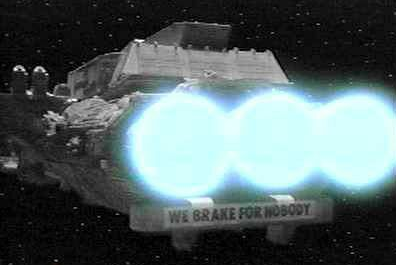
spaceballs6ts4uwDespite odd name and it’s whacky nature, Spaceball One is actually a pretty cool ship! In addition to being able to exceed the speed of light and go both “Ridiculous Speed” and “Ludicrous Speed”, the ship is capable of converting into a giant, robotic maid which, when armed with its megavac, is capable of sucking up an entire planet’s atmosphere. Tell me that aint a terror weapon!

A parody on the Star Destroyers from the very movie it was meant to parody, the design elements of this ship also seemed to pay homage to a few other unlikely sources. One suggested influence is The Discovery from 2001: A Space Odyssey, while another is the Nostromo from Alien. Given the comedic references to both these movies – the alien bursting out of a guy’s chest and performing a little ditty over lunch, or the “plaid” scene in space – this shouldn’t come as a surprise.

Thanks to Rami Ungar for (repeatedly) suggesting this one. We consider the matter closed, please stop sending hate mail! I kid of course, keep sending it! We like to hear from you ;)!

UD4L Cheyenne Dropship:
DropShipLast time, it was the USS Sulaco that made the list as a example of a cool ship from the Alien universe. This time around, I thought I’d look a little closer, specifically to its cargo bays. Because it is here that we find those cool Cheyenne-class dropships, the ones that carry Marines, APC’s, and a f***load of munitions to their targets.

Capable of atmospheric and space flight, the dropships are typically deployed from high orbit and extend their wings once they hit the atmosphere in order to maintain lift.The Cheyenne serves primarily as a troop transport, a role it is well suited for since it can take off and land vertically from unprepared areas.

However, it’s nose mounted gatling gun, weapons pods and large compliment of rockets also mean it can attack in a supporting role, namely as a gunship. Once its deployed its compliment of Marines, typically inside of an M579 Armored Personnel Carrier, it will retire to a safe landing zone or offer active support until all enemies in the area have been suppressed.

X-wing:
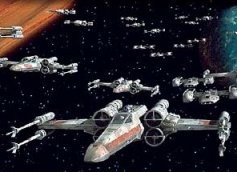
X-wing_SWGTCG“The Incom T-65 X-wing is the fighter that killed the Death Star. An almost perfect balance of speed, maneuverability, and defensive shielding make it the fighter of choice for Rogue Squadron.” This is how General Carlist Rieekan described the final entry on my list, the venerable X-wing starfighter!

Based on captured designs and built by specialists who defected to the Alliance, the X-wing played a pivotal role in the Galactic Civil War and would form the backbone of the Alliance’s Starfighter Corps. Possessing deflector shields, a hyperdrive, an R2 astromech for repairs and navigation, and a complement of proton torpedoes, the X-wing allowed the Rebellion to launch raids deep into Imperial space and stand toe to toe with its TIE fighter squadrons.

In addition to providing escort to Alliance vessels and conducting raids on Imperial ships and installations, its long list of accomplishments include destroying the first Death Star, proving cover for escaping Alliance ships after the Battle of Yavin and at the Battle of Hoth, and defeating overwhelming Imperial forces at the Battle of Endor. After the formation of the New Republic, the X-wing would go on to play a pivotal role in many subsequent battles and engagements, mainly against the remnants of the Empire.

Featured heavily in the original movies, the X-wing would also go on to become the only Star Wars fighter to get a videogame named after it! Not bad for the little “snub fighter” that could!

Final Thoughts:
And wouldn’t you know it, it seems I have actually have some insight to offer today. Must be on a count of how many ships I’ve reviewed by now. For starters, I think that while aesthetics and artistry count for a lot, some serious props need to be given for a hard sci-fi foundation. Ships that incorporate realistic features, like retro-rocket mounts, wings that only deploy if you’re expecting atmosphere, and practical hull designs, are usually what make the biggest impact. Not that we don’t all love freaky looking spacecraft, it’s just that dropships, hammerheads and starfuries seem somewhat more plausible than saucer sections and mega-dreadnoughts.

At the same time, its fast becoming clear to me that when it comes to designing cool sci-fi ship concepts, the only limits are those imposed by our own imaginations. Really, there are no rules or strictures when your painting with an open canvass, and sci-fi has always been the perfect forum for venturing into the realm of the implausible and impossible. And given the exponential rate at which technology is progressing, dreaming big doesn’t exactly seem unrealistic anymore. If anything, our dreams seem to be coming true faster than we could have imagined. So really, with the possible exception of FTL, nothing we can imagine right now should seem too farfetched. If anything, we should encourage dreamers to dream!

Until next time, and keep those suggestions coming! And maybe come up with some original designs, I’m feeling in the mood for evaluating something new and inspired here 😉

Cool Weapons!

Last time, I spoke (at length) about all the awesome firearms that come to us from a variety of science fiction franchises. But let’s face it, there’s a lot more than just guns to speak of! In fact, part of the genius of sci-fi is in how it is constantly inventing entire arsenals of weaponry, tools, and the various nicknacks that make the world go round. Any director or writer who show attention to detail will make sure that their characters come equipped, looked the part, and that their settings have plenty of believable gadgetry taking up space in the background. Here are just some of the cool examples:

Claws:
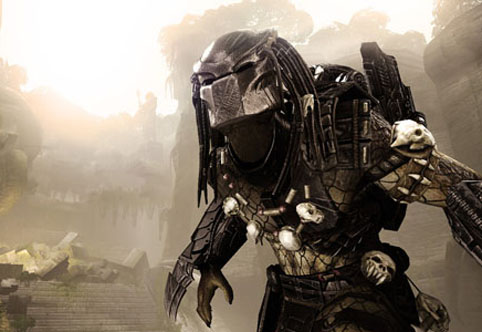
Predator_clawsAlong with the burner/plasma caster, these weapons are the most basic of Hunter weapons in the Predator universe. According to tradition, every Hunter must distinguish themselves in battle by confronting an enemy in single combat using no other weapon than their claws. Based on the two non-crossover films (Predator and Predator 2), this is apparently done once all lesser prey are eliminated and only the top prey is left. When that occurs, the Hunter will ensure that this finale opponent has been deprived of any additional weaponry, and then will shed every other weapon in their arsenal and engage them in hand to hand combat.

Combi-Stick:
Part of the Hunters arsenal, this weapon comes from the Predator universe and is part of their wider arsenal of cool weaponry. The name refers to the fact that this staff serves multiple functions. Collapses, it serves as a sort of quarter staff. However, the stick has telescoping sections with a blade like end, which when deployed turn it into a spear. In Predator 2, a hunter used his stick on multiple occasions. Against a group of the Jamaican gang members, it was used strictly for impaling, but during a later scene, it was used as a throwing spear against Danny Glover’s character.

Crysknife:
The Fremen weapon of choice, made from the tooth of a Maker (i.e. a Sandworm). The name and design of the weapon are based on the kris, a ceremonial dagger that was traditionally used in Indonesia and is associated with many cultural legends.

A testament to Herbert’s ability to incorporate historic and cultural elements into his stories, the kris is an enduring symbol of the Dune universe and was used by Fremen for warfare, duals, and ceremonial purposes, much like the real thing! In addition, the Fremen had very strict rules about the use and exposure of these knives. According to the Shadout Mapes – the Fremen housekeeper in Dune – who gives one to Jessica: “Who sees that knife must be cleansed or slain!” And as Leto II remarked in Children of Dune: “The crysknife dissolves at the death of its owner.”

Lasgun:
This weapon was the brainchild of Frank Herbert, and is a familiar weapon in the Dune universe. According to Frank’s many novels, the lasgun was a continuous-wave laser projector weapon that when fired emitted a constant, narrow beam of photons. Though it was able to cut through just about anything and was the weapon of choice in the Old Imperium, it had since fallen into disuse by the first Dune novel.

This apparently had to do with the invention of personal shields. Rather than protecting against a lasgun burst, the interaction of the two would cause a reaction that rivaled that of an atomic explosion. Hence, attacker and defender would both be killed instantly if either ever came into contact. Much like the prohibition against the use of nukes in Herbert’s universe, one would get the distinct impression that he was commenting on the futility of nuclear deterrents and arms races.

But that’s another matter. The lasgun, from its first appearance in Dune, has gone on to inspire many a sci-fi franchise. One that immediately comes to mind is Akira. In this movie, riot squads and the military employed large, external cell powered weapons to fire focused beams of light on a large mob, hewing off limbs and burning holes straight through some people! The main character Kaneda also commandeered one and used it to fight his psionic friend, Tetsuo, near the end of the movie.

Lightsaber:
Just what is it about lightsabers that make them so unbelievably cool? Is it that warm glow? The otherworldly feeling one gets from seeing one being activated? Could it be that crack, hiss sound they make when they clash, or that warbling noise when they’re spun around? Or could it just be the fact that they deflect blasters and cut through anything? Well yes! It’s all of the above, clearly! Yet another brainchild of George Lucas, meant to call to mind scenes of swashbuckling and chivalry from old samurai movies, the lightsaber has since gone on to occupy a central spot in the collective unconscious of an entire generation. It is a staple, perhaps THE staple, of pop culture’s take on sci-fi.

Making its debut appearance in the first Star Wars movie, the lightsaber was the established weapon of the Jedi. In addition to being their mainstay, lightsabers were also highly personalized, every Jedi being tasked with building one as part of their training. Originally, the only two designs were that of the blue and red, the former being associated with Obi Wan and Anakin Skywalker (which Luke then inherited), and the latter being associated with Darth Vader. However, Luke went on to create his own and fashioned a green beam. With the expanded universe, significance has been given to different colors, each one associated with a different class of Jedi, and indicating whether they are a member of the Sith or the Jedi Order.

For starters, blue is the color of the Jedi Guardian, the warrior class of the order who focus on combat training and fighting. Green is used by the Jedi Consuls, people who focus more on the force and accumulating wisdom and insight. Yellow represents a sort of middle ground, belonging to those Jedi who focus on a combination of both and are usually called upon to settle disputes and act as arbiters. When it comes to the Sith, only one color appears to be used, and that is red. However, purple, orange, and other closely related colors have popped up from time to time in various places as well. In addition, Mace Windu, the Jedi Master portrayed by Samuel L. Jackson, wielded a purple lightsaber as well. However, this was apparently due to Jackson’s insistence that his character have a purple weapon, as well as the initials BMF etched onto the side!

Ma’Tok Staff:
Coming to us from the Stargate universe, the Ma’Tok is a combination laser gun, club staff that is used by Jaffa warriors (the specially-bred human servants of the Goa’uld). According to the Stargate Wiki, the Ma’Tok relies on a plasma discharge to strike and cauterize the enemy, causing severe damage and intimidating resistance. It takes its power from an internal cell that employs a liquified mineral (Naquadah) to generate plasma energy. This liquid mineral gives the staff a virtually indefinite shelf life, making it the perfect blend of aesthetics and lethality!

Monomolecular Wire:
Here’s an idea that comes in various forms, but for the purposes of this post, I shall stick to the examples that I know best. The first one comes in the form of the Yakuza enforcer from Johnny Mnemonic! Anyone who’s seen this movie (or read the short story it was based on) will remember the main badguy who had an artificial thumb that contained a long filament of glowing wire. When he pulled that thing out and started whipping it around – LOOK OUT! – things began to get lopped off and sliced up! Another example of this being used as a weapon is from the Japanese anime Hellsing. In that show, the butler of the namesake character had monomolecular wires attached to each finger which he would break out whenever there was a crisis. Perhaps they were fashioned from silver, I really can’t recall. Would make them more effective against vampires though!

Plasma Sword:
And we’re back to the Halo universe for another example of cool gear! And today, the item in question is the plasma sword. As gamers are no doubt aware, this weapon is melee weapon of the Elites, but can be employed by humans as well since it’s your basic hand-held weapon. And much like lightsabers and lasguns, it can cut through just about anything and makes short work of any opponent. In many ways, its even more effective than the ballistic and energy weapons in the game. Whereas those can take several shots to take down an enemy (especially someone infected by the flood) one good hit from this baby will turn them into pulp! And if you see an enemy approaching you with one, be sure to hang back and unload your weapon in their direction!

Stone Burner:
Doubling down on the Dune universe, the next example of cool weapons comes in the form of Stone Burner. As a tactical nuke of limited yield, this weapon was the only form of nuclear device that was not prohibited by the Great Convention. This body, in addition to banning all forms of AI’s, also put a stop to the use of nuclear weapons, though it did not forbid the Great Houses from owning any. In any case, Stone Burners, when used strategically, could have a devastating effect on an enemy.

This weapon makes only one appearance in the Dune saga. In Dune Messiah, Paul Atreides is lured into a trap in the old quarter of Arrakeen where a stone burner is set off, which leads to the loss of his eyes.  Though physically blinded, Paul was not deprived of his vision (i.e. his prescience). This all had to do with a larger plot to force Paul to surrender his power as Emperor in order to save his children. And I think we can all agree, any plot that involves a tactical nuke and blinding your enemy Samson-style is pretty badass!

Throwing Disc:
Another Hunter weapon, this particular one made its first appearance in the second Predator movie and then went on to become a regular part of the Hunters’ arsenal. Much like their other weapons, the throwing disc appears to have many variations and may even be personalized to an extent. This may be the result of constant upgrading, or it may be that individual Hunters have a hand in designing their own gear. In either case, many types of throwing discs have appeared. Some employ simple curved blades, blades with spikes, or even shuriken-like appendages (as the picture at right demonstrates). In each and every case, the result generally involves hewed limbs and decapitations!

Thermal Detonator:
“Because he’s holding a thermal detonator!” Yes, whenever a bounty hunter pulls one of these out, you know they mean business! This weapon, which comes to us from the Star Wars universe, made its first appearance in Return of the Jedi. Since that movie came out, the device has been mentioned and referenced countless times in the expanded franchise. Apparently, thermal detonators are the grenades of the future, using plasma charges that when detonated, cause a large explosion that will burn through just about anything. Always be sure to bring one to a negotiation, just be sure to get the ones with the fail-safe triggers!

Vibroblades:
My third and final act of doubling down on a single franchise! Vibroblades are an integral part of the Star Wars universe, but also appear in a number of other franchises. In each case, the weapon revolves around melee weapons that are powered by ultrasonic devices. This increases the weapons cutting effectiveness, and makes them almost as dangerous as a lightsaber. Well, more like a distant second! But non-Jedi’s got to settle for what they can get.

In the video game Knights of the Old Republic, vibroblades and melee weapons are used due to the introduction of personal shields. Some might call this a rip-off of the Dune universe, but in this case, its not so much a matter of necessity as practicality. If an enemy can absorb your blaster fire, then rushing and attacking them with a sword kind of makes sense. And it gives the characters some practice with melee combat before they learn to harness their Jedi abilities.

Last Word:
Okay, I got nothing! Yep, after looking through all the aforementioned examples of cool weaponry, I really couldn’t find any particular patterns that were worthy of comment. Basically, it all comes down to things that augment or go beyond the usual arsenal of guns. It’s only where the swords and knives come into the mix that I see anything beyond simple coolness. And just about all that drinks from the cup of Frank Herbert, a man who merged the ancient and futuristic in order to make a point about technology and how one could find the past in the future and the future in the past. Yeah, that stuff was deep!

As for the rest of it, it’s just plain cool to behold… and fantasize about! Yeah, twenty years later and I still want a lightsaber of my own! 😉

Cool Guns!

I’m getting hooked on writing conceptual posts, mainly because it gives me the chance to explore a lot different franchises of sci-fi without being too constrained. Not only that, I really like digging into subject matter of finding the common elements; in this case, the stuff that makes cool stuff cool! So far, I’ve covered the concepts of Galactic Empires, Planetkillers and Ancient Aliens. But today, I thought I’d tackle something a little simpler that’s been known to make sci-fi geeks experience collective nerdgasms! Today the topic is: COOL GUNS!

BFG 9000:
Starting off this review right is the BFG (Big F***ing Gun) that comes to us from the Doom universe. Fans of that old franchise know this one by heart, and I’m sure they remember with some nostalgia what it was like firing this thing. Given that Doom was like most first-person shooters, this weapon would turn up late in the game as a way of dealing with the more tenacious evil critters. And it worked! One shot released a big cloud of green plasma which killed everything in the vicinity. Unless it was a boss, in which case, it might take two or three… Apparently, Quake II and Quake III Arena pay homage by including their own version, known as the BFG10K.

“Blow Dryer”:
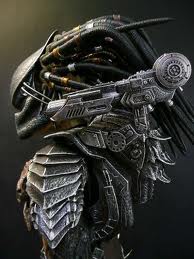
Also known as a “burner” or plasma caster, this weapon was the mainstay of the Predator aliens and is featured in the many movies, comics, video games, and novels of the franchise. Mounted on the shoulder, this weapon would discharge a ball of red-hot plasma into objects, causing damage akin to an explosive device, but with none of the messy shrapnel. Though the standard model is shoulder mounted and aimed using a heads-up-display and laser sight, the Predators in later movies were also known to carry wrist-mounted versions of this weapon as well. Like their claws and wrist bombs, they were embedded in the cuffs and served as a backup. One of these makes an appearance in Predator 2 during the meat locker shoot-out.

BR55 Battle Rifle:
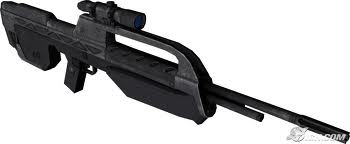
This baby is a Halo universe invention, and is the mainstay of the UNSC infantry. Aesthetically, this rifle is based on several bull-pup assault rifles designs from the modern era, a design which is clearly growing in popularity. Some potential sources for inspiration include the Austrian-made Steyr AUG, the French FAMAS, the British L85, the Belgian F2000, and the experimental PAPOP design. Like all bull-pup rifles, this gun loads from the rear and can cut through Covenant opposition with ease! Even when I’m playing as the Covenant, this was my second favorite weapon to be carrying (the first was either two submachine guns or two pistols, or a combinati0n thereof!)

Blade Runner Gun:
In the classic move Blade Runner, Detective Rick Deckard was responsible for locating and “retiring” replicants. And the weapon he used to do just that is featured here. This is the model of a Blade Runner service revolver, for which little information exists, but whose appearance and performance pretty much speaks for itself. Based on a standard service revolver with several extra bits added on for effect, this gun pretty much screams cyberpunk.

In addition, there are several scenes in the movie where Deckard’s gun turned flesh (artificial though it was) into mush! Recall the scene where Deckard uses this gun to punch several holes in Zhora? Or how about the scene immediately thereafter where Leon is beating the crap out of him, and Rachael manages to save him by using his own weapon? Yeah, whenever this gun was brought out of his holster, some big holes resulted!

Blasters:
When asked about his idea for a “Galactic Empire”, George Lucas said that he wanted to create something that was as aesthetically similar to Nazi Germany as possible. This was reflected in the weapons as well. Numerous guns that were modified and used as props in the movie were based on WWII vintage weapons. The first and most recognizable is Han’s blaster, aka. the DL-44. Based on the German C96 Mauser pistol, this weapon was apparently a popular item amongst smugglers and traders, being very powerful and compact. It was also quick on the draw, which comes in handy when in a bar and looking down the barrel of a bounty hunter’s gun (Han shot first!)

The next was the standard issue blaster used by both the Stormtroopers and the heroes, especially in the first movie during their daring breakout from the Death Star. This blaster, known as the E-11, was based on the Sterling submachine gun of WWII. Simple, consisting of little more than a barel, a handle, and a side-mounted magazine, the gun was easily altered with a few pieces of molded plastic and a scope that made it look suitably futuristic.

The heavier T-21 Blaster Rifle was yet another WWII adaptation. Built around a Lewis machine gun, it was featured in the first movie during the Mos Eisley scene where Stormtroopers were seen walking through the streets searching for Luke and Obi Wan.

Last, there was the DLT-19 Heavy Blaster, the heaviest infantry weapon in the Star Wars franchise. In keeping with his love of WWII kit, Lucas’ set designers used a German MG42 to fashion this one. This blaster appeared aboard the Death Star in the hand of the search party that went over the Millenium Falcon, and again when Chewy commandeered one to take out the remote blasters and cameras in the cell block.

GE M134 Minigun Handheld:
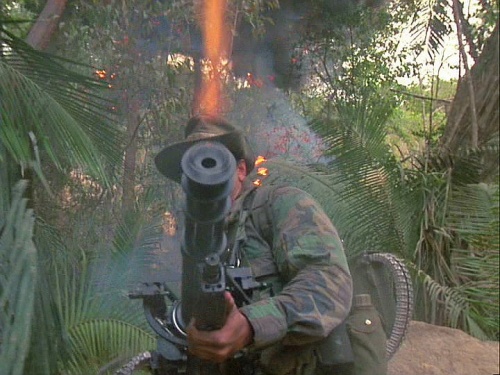
How could I have forgotten this one? I mean really, is there a better visual representation of sheer badassery than the handheld minigun from Predator? Sure, the mere idea of a man carrying a minigun around by hand is so unbelievable its makes me want to laugh out loud. Considering the weight of the weapon, even before you factor in all the ammo, coupled with the killer recoil that no human could withstand – all of this makes the physics totally implausible! But what the heck? It was fun to watch! I can’t imagine anyone not feeling the hair on the back of their neck stand on end as those barrels started whirling and the bullets streamed out, so fast it sounded like a turbine! And I know from talking to actual pilots who’ve seen this baby in action that if you add tracers to the mix, its like watching a laser show. WHURRRRRRRRRRRR! Total carnage!

Grammaton Cleric Pistol:
Though it was not my favorite movie, there were undeniably cool aspects to the movie Equilibrium. One of which was all the cool Gun Kata moves pulled by Christain Bale, Angus Macfadyen, and the other Grammaton Clerics with their special pistols. These guns were clearly souped-up versions of the Beretta 92FS. They clearly fire in both semi-automatic and automatic bursts, and were retrofitted in one scene with impact hammers on the handles.

In addition, some rather curious reloading tricks were devised. One involved arm-rails that would deliver fresh magazines from inside the cleric’s sleeve. Another included magazines that could be balanced upright, which gave the cleric the ability to simply slam his gun down on the fresh magazine once the empty ones had been ejected and go right on shooting. It’s all about rate of fire in this movie, making sure the bullets (and dust) keep flying!

The Lawgiver II:
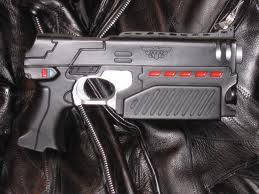
Also known as the Judge Dredd gun, this pistol is also a modified version of the Beretta 92FS, with molded plastic and LED lights giving it a future-city look. In addition to a rapid-fire setting, the gun also boasts a grenade launcher, signal flare launcher, and a special dual round known as the “double-whammy”. It also has a taser device built into the handle so that only a Judge can operate it, and a DNA tagging system that ensures that every slug fired can be traced back to the person operating it.

M41A Pulse Rifle:

The franchise Alien gave so much to the world of sci-fi geeks, not the least of which came in the form of cool guns. And the Pulse Rifle was arguably the mainstay of that contribution. In fact, it was this gun that inspired entire generations of futuristic weapons, and the name itself has been used many times over to refer to energy and slug-thrower weapons in sci-fi franchises.

This is an important disctintion seeing as how “pulse”, to most sci-fi acolytes, refers to weapons that fire out pulsing beams of energy (most likely plasma). But in this case, it referred to pulses of caseless ammo, big bursts of projectiles that would tear through acid-spewing aliens by the dozen. And let’s no forget the grenade launcher that was attached to the underside, how cool was that? The signature, click-click, BOOM! combination was as pleasing to the ears as it was to the eyes.

But in addition to being just so freaking cool to look at, the amount of creative energy and ingenuity that went into making it was quite impressive. For example, the people in charge of set design wanted a prop that would actually fire, so they built their rifle concept around the M1A1 Thompson submachine gun, a WWII vintage weapon that was small and sturdy enough to get the job done. To simulate the grenade launcher, they attached a cutdown Remington 870 shotgun beneath it and mounted the foregrip of the SPAS 12 shotgun on top of that. Then, they applied pieces of molded plastic and a little LED display to the side to make it look especially badass! Remember that scene where Ripley used it to level that room full of egg’s with the Alien queen inside? Iconic!

M56 Smart Gun:
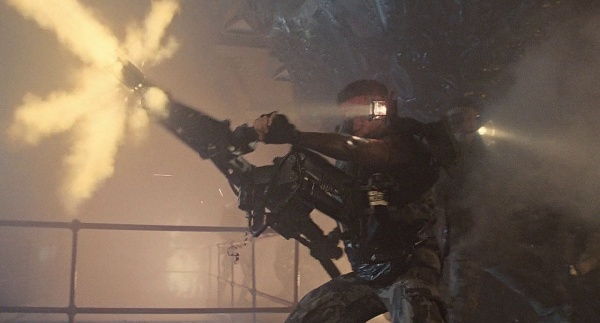
I know, I’m shoving two examples from a single franchise into one post. But I think it’s worth it. And for fans of Aliens and sci-fi junk, you just can’t make a list of cool guns and not include the Smart Gun! Much like the Pulse Rifle, this weapon was the perfect marriage of aesthetics and ingenuity.

To fashion it, the set designers for Aliens used another vintage WWII weapon (like Lucas, they used the German MG42 machinegun) some motorcycle handles, and the arms from a Steadicam mount. The result, once again, was pure badassery! And the name, according to the expanded Aliens universe, comes from the fact that these weapons could aim themselves. Marines would simply employ their eyepieces and helm cameras, and the guns would pick up movement and target it. Oh, and that scene where Vasquez opens fire in the Alien lair… classic! “Let’s roooooock!”

PPG’s:
The PPG, or Phased Plasma Gun, is the standard weapon of security officers and soldiers in the Babylon 5 universe. According to franchise sources, the PPG fires a small charge of superheated helium which retains its shape and small volume via a residual magnetic field. Upon impact with an object, the magnetic field is dissipated and the heat discharged. PPG bolts also cause visible distortion as they travel through air, hence the blurred effects when people in the show fire off their weapons.

The PPG comes in several standard models. First, there’s the service pistol which every security officer and member of station personnel. The heavier rifles are busted out during riots and times of war, along with the vests and riot helmets. In two episodes (S01E20 Babylon Squared and S05E19 Wheel of Fire ) Garibaldi has scenes where he busts out the BFG version.

Reason:
This weapon is both deadly and cheekily-named, and is taken from Neal Stephenson’s smash-hit novel Snow Crash. This picture doesn’t quite do it justice, but its a close approximation. In the novel, Reason was a gatling gun that was the property of Uncle Enzo’s Mafia, an organization that ran a series of franchulates along the west coast of the former US. But unlike your conventional gatler, it fired caseless depleted-uranium slugs, bullets that are incredibly dense and very heavy. Hence, the weapon packed a massive punch and a mad recoil.

During one of the later chapters, Enzo’s men use the gun to take out a pirate yacht while firing from a life raft. A single burst demolished the pirate ship, but the recoil sent their boat about fifty meters in the opposite direction! This scene also had a hilarious set up when the mafiosos first broke it out, saying that if they ran afoul of any privateers, they were sure they’d “listen to Reason.”

Phaser Rifle:
Over the years, Star Trek has been a source of many weapons designs. However, some were arguably more cool than others, at least in my opinion. These came largely from the later spinoffs and movies, in particular DS9 and Voyager. Prior to this, phaser designs were either too boxy, too bulbous, or just too… Buck Rogers-y! When you’re repelling boarders, or on an away mission, one thing you want is a kick-ass weapon to bolster your confidence and inspire fear in your enemies.

These requirements were met by a new model of weapon, known as the type 3 Phaser Rifle. This weapon went through many variations throughout the course of the show. The first design was very boxy-looking, whereas later models tended to be more sleek and menacing (as shown above). Then came a whole new design, known as the Compression Rifle (seen below), which was apparently an even more powerful model. These weapons were specifically created for use on starships where heavy combat was expected, or in times of war.

Final Thoughts:
Man, that was a long list! But that’s the thing with cool ideas, they tend to get around. And as usual, I noticed some key patterns in the mix which I think should be pointed out. In all of these cases, there were apparently two classes  that each weapon fell into.

  1. Directed-Energy Weapons: Arguably the more science-fictiony of the two. These weapons first made their appearance in Saturday morning serials like Buck Rogers from the 1950’s. They come in many forms – ray guns, death rays, beam guns, blasters, laser guns, and phasers – but the core concept is the same. Phased or directed energy, usually in the form of plasma, that is focused into a tight beam and then emitted. The ironic thing is, since the 1950’s, sci-fi franchises have moved away from these seemingly farfetched devices and come to rely on ballistic weapons designs more and more. Meanwhile, Directed Energy Weapons have become more and more feasible, with several prototypes being explored by military contractors today.
  2. Ballistic Weapons: In the context of sci-fi, these often take the form of weapons that use caseless ammunition, electromagnetically-propelled ammunition, or just standard bullets. But in each case, the weapons that use them are adapted to look more futuristic. Interestingly enough, the future seems to be coming sooner than we thought. In just about every developed nation, firearm technologies are being explored under the banner of the “Future Soldier” program. Having studied many of these, I can tell you that they put much of what was shown in Aliens to shame, especially where Heads-Up-Displays and portable computers are concerned! Again, the future seems to be coming sooner than we thought!

Of Prequels And Why They Suck…

Of Prequels And Why They Suck…

Looking back, I’ve noticed a sort of thread running through some of the posts I’ve made. And in truth, this thing was quite influential when it came to what inspired me to write science fiction in the first place. It began with the infamous Star Wars prequels, the movies which ruined what used to be a very influential and nostalgic franchise. It was then reinforced by the odious Dune prequels, which tarnished the legacy that inspired me to write science fiction in the first place. Since then, I’ve noticed these same elements at work in any prequel I’ve chanced upon and the lessons only seem to get more concrete.

While I’m no expert on the fine art of writing, be it science fiction or anything other genre, by the time I started doing it I was pretty clear on what I wanted to create. Basically, I wanted to write something I would enjoy, something that emulated the greats I had come to know and admire. But when it came to what I DIDN’T want to do, I found prequels summed up a lot of it succinctly (especially the aforementioned examples). I’m sure I mentioned as much in previous posts, but today, I thought I might speak to these things specifically; outline why prequels can – and often do – suck!

1. No Surprises:
Whether it was the Star Wars prequels, X Men Origins: Wolverine, the Legends of Dune series, or anything else prequel-oriented, there was one undeniable problem they all had in common: we already knew what was going to happen. By stories end, we know that the characters are going to become whatever it is they were in the original story, and we know who’s going to live and who’s going to die. In some cases, we even know how, so there really are no surprises. The only real purpose of a prequel is to fill in the background, explain HOW things happened and how the characters and story we are familiar with came to be.

For example, in Star Wars, we know that Anakin becomes Darth Vader, that Palpatine is the villain and will take over the Republic, and that Amidala will give birth to Luke and Leia before dying. There are a host of other details which the more nerdy among us were familiar with as well, and we were all drawn to theaters back in 1999 hoping to see how they played out. But in the end, when all was said and done, I don’t think any of us came away satisfied. Seeing how things happened when you already know what will happen just seems to make for a disappointing experience.

2. Sense of Duty:
Another thing that brings down a prequel is the fact that things MUST be explained. In short, the writer, director, author, etc. has a list of things which need to be covered before the end. These things have to fall within an established framework – i.e. what has already been established by the original story – and cannot contradict or be inconsistent with them. So really, in addition to having a story where there really are no surprises, you also get a story where things have to proceed in an established fashion and often seem heavily contrived. The end result is not what would feel natural based on the story so far but based on what needs to happen for the sake of the original story.

X-Men Origins will suffice as an example here. In this movie, the story had to show where Wolverine came from, how he and his brother (Sabretooth) had their falling out, and how his memory got erased. The result was actually pretty weak, in my opinion. Basically, Colonel Striker shot him in the head with Adamantium bullets, which he knew wouldn’t kill him but would erase his memory. Now, how did he know ahead of time that that would be the effect it would have? Second, why do that instead of lobbing a rocket-propelled grenade at him? Simple, because the story required it. Wolverine is supposed to be an amnesiac in the first movie, so this movie had to show how.

And while were on the subject, why didn’t Wolverine’s girlfriend kill Striker at the end when she had the chance? The woman had suggestive powers and had the man in her grasp, so why not tell him to march off a cliff? Again, because the story demanded it. Striker needed to live to see movie two, so instead she said some fluff about how she’d be no better than him and just told him to take a walk until his feet bled and he fell from exhaustion. I can’t speak for everyone, but personally, I was disappointed.

3. Less Is More
A lot of people insist that when it comes to back stories and background, the less we know, the better. After all, wasn’t Darth Vader scarier before we knew that he was once portrayed by Hayden Christensen? Wasn’t he a lot more menacing before he cried over the loss of Padme? I know for a fact that I’m not alone when I say that the whole “NOOOOOOO!” scene at the end of Revenge of the Sith brought him down in my eyes. What was once a titanic force of badassery was transformed into a whiney, bitchy child through the simple act of fashioning an origins story.

To use a non-prequel example, consider the Batman franchise. In the Tim Burton version, we got to see the Joker’s origin story, but in the Christopher Nolan version, we got nothing. And frankly, wasn’t Ledger’s updated take on the Joker much more scary than Nicholson’s because of it? Sure, his dialogue and acting were spot on at capturing the insanity and terror of the laughing psychotic killer, but wasn’t part of that assured by the fact that we had NO IDEA who he was or where he came from? The origins stories that he told – “wanna know how I got these scars?” – and how they kept changing was part of what made him so effective. As the audience, we wanted to know, how DID he get those scars? Why IS he so crazy? But by denying us this, I think we were kept wanting and we respected the movie more for it.

The same is true of Batman himself. In Burton’s, we got an exact reversal of what happened with the Joker. Aside from the fact that his parents were murdered, apparently by a young Jack Napier (who would go on to become the Joker), we knew nothing about him. Where he got his skills from, his equipment, and how he got started. This served to make him a much more mysterious character which in turn made him more interesting. In Burton’s Batman, he was the focal point whereas the Joker was his nemesis. But in Nolan’s updated version of The Dark Knight, the Joker was undoubtedly the focus while Batman was just the hero trying to stop him. I’d say what he knew – or in this case, didn’t know – about them was central to that.

4. The Audience’s Imagination Is The Writer’s Greatest Weapon:
I believe it was the famous photographer Duane Michals who said “I believe in the imagination. What I cannot see is infinitely more important than what I can see.” Okay, I Googled that, sue me! But the man had a point, and it applies doubly to movies since they too are a visual medium. What the readers and/or an audience can imagine based on snippets of a story is infinitely more powerful than what they can be shown with a few hundred pages of text or a two hour movie. This is why less is more. By giving the audience less to work with, they have more freedom to imagine and create. If you tell them what happened, detail for detail, then they have nothing except for what you’ve given them.

This, I think, is precisely why prequels are so often a disappointment, at least in my estimation. I’ve always considered myself to be an imaginative person. Given a blank canvas, or one with just a few details, I can create just about anything. And I’m hardly alone in that fact. Imagination is something everyone has – to varying degrees, sure – but it’s part of what makes us human and gives our lives meaning. Being able to express our inner life makes us happy, and there are few things more hurtful and insulting than having someone mock or dismiss that creativity. It’s also one of the cornerstones of a free society, the freedom to create and not be persecuted for it.

So it’s little wonder then why people are drawn to movies where books they’ve read are being adapted to film, or to prequels, where things that have been previously alluded to are acted out. People go to see them because they want to know if it will bear any resemblance to what they themselves imagined. Or, they go because they just want to see what the director’s own vision was. Either way, when you get around to seeing it for yourself, is it not a letdown no matter what? Isn’t that the real reason why people who’ve read the book constantly insist that the movie isn’t as good? That certainly seemed to be the consensus amongst LOTR geeks. And I should know; by The Two Towers, I was one of them! And isn’t that the real reason why the Star Wars prequels sucked as much as they did? We, the fans and audiences are active participants and create out of what we are given. Being told point blank what happened removes half the fun of it!

Some Tips For Writing:
Well, that’s all I got for now. Except to say that if someone is hoping to do a prequel, there are certain tips that I’ve come up with that can help. These are by no means established rules, just the result of my own amateur experience and observations. For one, a writer should take care not to give too much away when writing background. As always, less is more. It’s enough to let the background stay in the background and focus on the story. The more the reader/audience has to work with, the better. That way, when you are writing out the back story, you have much more freedom to work with, and don’t have to worry about staying within boundaries.

Second, a good idea is to write things out ahead of time. When I was thinking up Legacies, I began by writing out an outline for the entire background of the story. I didn’t do this because I was one day planning on writing a whole franchise worth of books, prequels included, but because I just wanted the story to be tight and know where everything fit. But because of that, I was able to pen several short stories that took place before the first novel. Rarely were the main characters and plot lines from that novel the focus of these stories, but they did serve as a solid backdrop which helped to advance things.

But don’t take my word on that, consider Lucas himself. He thought up the entire plot for Star Wars trilogy before making the first movie in the franchise, thus he knew exactly what he wanted to do ahead of time. Sure, he made changes and was forced to adapt along the way, but the end result benefited from this foresight. However, when it came to the prequels, he had only the bare bones to work with, and began writing each movie independently of shooting it. And it certainly showed, didn’t it? Rather than feeling like an ongoing story, each movie was a self-contained tale that was full of duty and contrivances. Nuff said? Plan ahead!

Last, but not least, remember that a story, ANY story, needs to tell its own tale. It cannot be written for the sake of filling in another. Its a bit of a vague point, I know, but a writer’s mentality is important when it comes to the creative process. At no point can you be thinking, “this needs to be explained, that needs to be explained”. It needs to be, “this is a story that needs to be told”. Every character has an interesting back story, and stories are living, organic things. They change over time, grow, and eventually die. Showing how they got to where they were going needs to be interesting and told with sincerity. So forget the duty, focus on the events and what made them interesting. If in the end its not a story that you yourself would enjoy, then don’t tell it! Simple as that…

Star Wars Episode III: Last Chance…

Last time, I believe I left off with a passing mention of how the Clone Wars weren’t exactly given their due in Lucas’ prequels. Correct me if I’m wrong, but it was my understanding that that was what they were supposed to address, and with a name like Attack of the Clones, I don’t think that would be an unrealistic expectation. But Lucas seemed more concerned with addressing the back-story of Anakin’s fall to the dark side and the love story between him and Padme/Amidala. Everything else was pushed to the side or parceled out between obligatory scenes of (ahem) romance and Anakin bitching about how angry he was and unfair his life is. The end result was a movie that hopped all over the place, moving along with a sense of duty rather than an intriguing story that took its time to build, and with dialogue and character development that was basically info-dumping and pure exposition.

In short, it sucked! But between movies two and three, Lucas appeared to sit up and take notice. Whereas Phantom Menace and Clones were chock full of indications that Lucas held the fan’s feelings in contempt, Revenge of the Sith seemed to contain within it a feeling of humility. It was as if Lucas saw the writing on the wall and realized that if the third movie was to be a critical flop, the Star Wars franchise might forever be ruined. That, I think, was enough to get him to realize that he was still mortal.

Still, the final entry in the franchise suffered from the same weaknesses as the rest. Nobody missed Jar Jar Binks, the cheesy romantic element was toned down (somewhat), the action was a lot better and more relevant, and the motivation was a lot more believable. But the same basic problems of duty, pacing and rushing were there all around. About the best thing you could say about it was that it was salvageable. Not great, but enough to ensure that the whole trilogy didn’t totally suck. But I’m getting ahead of myself here…

Star Wars Episode III: Revenge of the Sith
Prior to the movie’s release, Lucas did his usual round of interviews and gave the fans a bit of an inside look at the plot and his process. In the course of this, he admitted that he had to force himself to commit to writing every day, eight hours at a stretch, in order to get the script banged out on time. Now that’s not something you EVER want to admit to as a writer! Automatically it makes people think that what they are about to see is a second-rate effort, done out of a sense of obligation and devoid of any heart. And yet, it was better than the first two, even if it managed to retain their weaknesses.

The War: As I said in the last review, the war happens between movies. We catch the very beginning of it in Clones and the tail end of it in this one, but that’s it. Despite the fact that they are of extreme importance to the story, the war (or wars) are really more of a backdrop against which the main story – Anakin’s fall to the Dark Side, takes place. That only drives home the point of how the prequels are dominated by a sense of duty, meant to explain rather than tell their own story. If anything, it should have been the other way around. The war happens, it is the means through which Palpatine seizes power, and in the course of it, Anakin becomes a great hero, falls in love with Padme/Amidala, and then succumbs to temptation. It’d be a lot more fun, more subtle, and more entertaining that way.

Anakin and Dooku, take two: Here was a fight scene that was due, and it was enjoyable to see Anakin take down Dooku. But it was pretty much a total rehash of the first time these two fought, sans the ridiculous walk-on by Yoda. As predicted, Dooku has to take out Obi Wan in order for him and Anakin to duke it out between themselves. And its perfectly contrived, the way he tossed him aside with the Force and uses a gangplank to pin him down. It’s also perfectly contrived that Obi Wan would thusly be unconscious and totally unaware of how Anakin kills Dooku. That was another problem I had with this fight scene. After cutting off Dooku’s hands, Anakin is told by Palpatine to execute him. This is in keeping with the whole Sith thing: “you beat my apprentice, now take his place”. But what is so stupid about it is how Anakin beheads him with barely a second thought.
It’s like “You know, I really shouldn’t…”. “Do it, Anakin! He’s too dangerous.” “Okay!” Slit! “Gee, That felt wrong.” “It’s okay Anakin, he had it coming!” And then, barely another word on the subject. As if to remind us how this has happened before, Palpatine brings up how Anakin wiped out all those Sandpeople. Once again, it seems like the Jedi have no clue and Anakin has got away with cold-blooded murder.

The Love Story: We’re fortunate not to get an earful of awful, cheesy dialogue between Anakin and Padme in this one, but there’s still enough to bring the bile to the edge of your throat. For what its worth, the two seem to have a little more chemistry in this one, but it still feels forced. “You are so beautiful” says Anakin. “That’s because I’m so much in love,” she replies. Ugh!

Grievous: Here is a character who is not bad, as far as conceptuals go. But the fact that he’s introduced in this last movie where he then dies, that’s kind of weak. You can’t expect to introduce characters who are central to the plot in the third act and expect people to develop some kind of attachment to them. What’s more, in this movie, Grievous sounded oafish and really wasn’t that threatening. In the Clone Wars cartoon (the original by Genndy Tartakovsky, not the crappy Lucas remake!) Grievous was a frightening, bad-ass mutha who took down multiple Jedis at once. His voice was deep, cold, and metallic, and he had some truly bone-chilling lines! “Run, Jedi run! You have only prolonged the inevitable. But I will give you the honor of a warrior’s death.” Did I mention he’s also a master of psychological warfare?

Yes, that’s what’s wrong here! Between the cartoon and the third movie, Grievous goes from being an unstoppable malevolent force to a veritable heel! This was the guy who cut his way through clone troopers and Jedi alike and even managed to kidnap Palpatine in his own capitol building. And yet, we’re to believe that Obi Wan is able to take him down all by himself. There’s even a joke that fans made about this: Right before their big fight, Grievous turns to Obi Wan and says “It’s a good thing this is the movie and not the cartoon version, otherwise you’d be right fucked!” Ha! It’s funny because it’s true.

Anakin kills kids: Okay, really? I mean I know Lucas is trying to establish that Anakin’s turned evil, but are we seriously to believe that he’s gone from being conflicted and afraid about joining Palpatine to murdering children? How exactly does the Force work? Do one bad thing and BOOM! You’re an evil psychopath? If it’s that easy a transition, no wonder the Jedi are so pedantic. What’s more, I loved Padme’s reaction when she finds out about his crime. “No! Not Anakin! He couldn’t…” she says. What, this surprises you? You barely batted an eye when he told you that he slaughtered women and children, now you’re surprised he murdered some Jedi younglings? A more fitting reaction would be, “Not again! Christ, that boy’s incorrigible!” Not saying I approve, but if you’re going to have such a casual attitude the first time your hubby commits mass murder, you kind of forfeit the right to be surprised when he does it again. Or is Lucas trying to say indiscriminate murder is okay when it’s Sandpeople? Dude… that’s racist!

Anakin and Obi Wan’s big fight: Now, it’s been well-established at this point that Anakin is a better swordsman than Obi Wan, right? I mean, Dooku kicked Obi Wan’s ass twice with little effort, and Anakin kicked Dooku’s ass with energy to spare. So… how is it that Obi Wan was able to stand toe-to-toe with Anakin for like ten minutes straight and then beat him? Seriously, this fight scene makes no sense! Just like with his one-on-one with Grievous, Obi Wan, who’s been a bumbling dope up until this point, seems to suddenly acquire some mad fighting skills and saves the day. What’s more, this fight scene drags on forever! The choreography is beautiful, like watching fire dancers do their thing, but there’s no real tension. Not like there was between Vader and Luke in Empire. That fight scene went on for awhile, but it was well-paced and punctuated by terror. You could see how Vader was slowly beating Luke down and you feared for him. This time around, it was just a lot of visuals with little to no emotional content. And the fact that we knew ahead of time that Obi Wan would win removed any sense of anxiety from it.

“Nooooo!”: Now I know for a fact that few among us thought Hayden Christensen could possibly fill Vader’s shoes. The whiny, bitchy stride he struck in movies two and three hardly seemed consistent with the Darth’s deep voice or malevolent nature. Still, that scene at the end, where Anakin/Vader asks the whereabouts of Padme and then emits a pained shriek when Palpatine tells him she’s dead… painful! Not to mention kind of dumb. It goes without saying that if Anakin is truly going to cross over, Palpatine needs to make him sever all ties to his past. But telling him he killed his own love, strange, but I’d think that’d have the opposite effect. The whole reason he sided with Palpatine was to save her. Now that she’s dead, there’s really nothing to hold them together. Not only that, but in light of Padme’s death, all the sacrifices he’s made to earn Palpatine’s help would seem like they were done in vain. Personally, I’d be pissed! Rather than commit wholeheartedly to Palpatine’s plan, I’d want to kill Palpatine and take his whole plan apart piece by piece! Or, in keeping with the whole Sith thing, kill Palpatine and take over the whole operation myself. That’d make way more sense than serving him like a slave, “I must obey my master,” and all that. Really, what’s he done for you Darth?

Well, that about covers it. To be fair, I’d like to point out that there were some things I actually liked in this movie. Unlike the others, it wasn’t saved merely by its action. No, this one actually had a little depth that managed to justify the expense of seeing it. The fact that Anakin’s fall was born of fear, that he did it because of the promise of powers that would make him what he wanted to be (powerful enough to prevent death) actually made sense. Knowing that Lucas had to force himself to get this script out didn’t help things much, I knew in the back of my head as I saw it that he kind of pulled it out of his ass. But like most critics, I was willing to forgive this. It seemed like we were all pulling for him because we didn’t want to see Star Wars fail. After growing up with it and spending so much time and money on the toys, books, etc, we just weren’t prepared to abandon ship!

However, I personally feel that enough time has passed so that we might finally able to put the prequel trilogy and everything else Lucas has done in perspective. Despite his weaknesses as a writer/director, Lucas has an undeniable talent for borrowing elements from different genres and combining them in just the right way with some classical mythology and history to create an enjoyable experience. The original movies called to mind all kinds of things that the audience could relate to. The Battle of Hoth was like Dunkirk, the (first) assault on the Death Star like the Doolittle raid, and I don’t think anyone wasn’t on the edge of their seat with the final battle! Luke’s journey to find himself and learn the truth of his ancestry was like the Odyssey, the redemption and sacrifice his father made like something out of Greek tragedy.

It’s ironic then that Lucas himself would succumb to the temptation and allure of money, fame and power. In the end, they led him to believe that he was the master of Star Wars and that he alone knew what it was all about and what made it great. He was wrong, of course. One of the most enduring powers of Star Wars was its mass-appeal, how it could snatch up the youth and adult vote in one swoop. By snubbing advice and letting his age-old fans know that he didn’t care what they thought, he ended up churning out two movies that were almost universally panned and nearly cost him his legacy. It was only in listening to the critics and accepting his limitations that he was able to create a passable third and thereby “redeem” the franchise before it was too late. Yeah… irony!

But alas, Lucas appears to be up to his old tricks again. No sooner had Tartakovsky’s Star Wars: Clone Wars begin to garner critical acclaim that he snatched it up and began making his own version. It seemed that he was perfectly happy to let someone else tell the story of the Clone Wars until they began to do a better job of it than him. Then, I’m guessing ego or greed got the better of him and he came out with a cartoon movie and a series! And of course, they are just like his first two prequels – kiddy, cheesy, and razor thin in terms of plot. And it seems as though he isn’t finished just yet. Word is, he’s thinking of making sequels; that is, movies that pick up where the originals left off! If so, I’d say he has an opportunity on his hands to do what all the fans want – i.e. get back to what made the originals great and stop churning out the kind of crass, commercial crap that’s been spewing from Lucasarts for so many years.

So on behalf of all fans everywhere, I’d like to make a plea to Lucas. Dear Sir, I urge you to consider the lesson of the prequels and incorporate it into your future work. First, check your ego at the door. You created Star Wars, but that doesn’t mean you’re infallible. Second, ditch the adulators who are keeping you from hearing the truth. It’s always a true friend who’ll tell you what you need to hear even if you don’t want to hear it. Those who tell you flattering things with shit-eating grins plastered on their faces will only bring you down. Third, your foresight to retain the merchandising rights may have made you filthy-fucking-rich, but it’s also what’s been polluting your mind. There are things more important than money, merchandise, spin-offs, re-releases, and digital remastered editions! In the end, it should be about the story, not the returns. Fourth, get back to your fan base and really try to connect with them. I know, who are they to question you, right? Simple, they’re the ones who grew up watching Star Wars and made it the success that it was. Had they not paid their hard-earned money to see your movies and buy your paraphernalia, you’d have spent the last thirty years writing fan fiction and paperback space opera out of a studio apartment in downtown LA. Whether you like it or not, the franchise does in part belong to them. As its creator you can make it good, but only they can make it great! Without your fans, there is no phenomenon, so take what they say seriously.

That’s all! And as cheesy finish, let me just say “May the Force be with you” and not worry about reprisals ;)!

Star Wars Episode III: Revenge of the Sith
Entertainment Value: 6/10
Plot: 5/10
Direction: 7/10
Total: 7/10