NASA’s Next-Gen Spacesuit

NASA_suitIt’s like something Buzz Lightyear would be seen in, minus the death ray laser. It’s called the Z-1 spacesuit, a prototype that NASA hopes to incorporate into their equipment lineup by 2015. Not only does this new design offer a wide range of advantages compared with the space agency’s previous suit – the Extravehicular Mobility Unit (EMU) spacesuit – it also represents the first major overhaul in spacesuit technology since 1998.

For example, it boasts a rear-entry hatch which lets an astronaut put on the suit from the back, as opposed to putting on the top, bottom and helmet separately. This hatch also coincides with a feature known as the suit port, which allows the suit to be attached to the outside of a vehicle (such as a rover), thus allowing the astronaut to simply enter the suit from inside the vehicle. This is a big step from the current space suits which must be stored and put on internally.

I don't see a resemblance, do you?
I don’t see a resemblance, do you?

On top of that, the Z-1 excels in the areas of mobility and visibility. The former arises from the fact that the suit comes as a single piece rather than being made up of multiple segments. The larger, bubble dome helmet is what ensures that the astronauts has a better field of view. And finally, NASA plans to address the issue of life support through the portable PLSS 2.0 which condenses all life support systems into one package and does not need external components.

The PLSS 2.0 design also incorporates a massive bonus in the form of the Spacesuit Water Membrane Evaporator temperature regulator, which would actually make it possible for future astronauts to comfortably walk on extraterrestrial planets. According to NASA’s PLSS engineer Carly Watts, the PLSS 2.0 “can be used in a Martian environment. It can be frozen without damaging the unit, and it’s not particularly sensitive to contamination.” Good news for the astronauts heading to Mars in 2030, assuming the budget environment remains friendly after President Obama is no longer in power.

Check out this video of NASA Public Affairs Officer Brandi Dean talking with Cristina Anchondo, Z1 spacesuit test director, about the Z1 spacesuit at the Johnson Space Center.


Source: news.cnet.com

NASA Makes Appearance at 2013 Inauguration

2013_inaugural_nasaThe 2013 Inaugural Parade on January 21st – my birthday, fyi – was quite the sight to see. In addition to the President and First Lady, many floats, and thousands of onlookers, the good folks at NASA also made an appearance. Specifically, two floats featuring the Orion deep space capsule and the Curiosity Rover were part of the parade, passing in front of the White House and the official reviewing stand while President Obama, VP Joe Biden, their families and numerous dignitaries smiling and waving.

The life-sized models were greeted with plenty of fanfare and fair weather as they floated near the front of the procession, and it is estimated that over a million people were on hand to witness the event. NASA was the only federal agency to be asked to take part in the inaugural parade, which goes to show you how important the administration considers their efforts. But given all that NASA has accomplished as of late, that should come as no small surprise.

In the few short months since it landed, Curiosity has uncovered very compelling evidence that water once flowed on Mars, and the Orion capsule is expect to take astronauts back to the moon and father into space than ever before. What’s more, the Obama administration has already granted the funding for NASA to go ahead with its plans to establish an outpost on the Moon in the next few years, as well as a manned mission to the Mars by 2030. In short, NASA and the Obama administration are pretty tight; and if you ask me, both are stronger for it!

Check out the video below of the procession, or go to NASA Flickr page for more photos of the inaugural parade.


Source:
Universe Today.com

More Plans to Colonize Mars!

mars_lifeFolks may recognize the name SpaceX, the private aerospace company that in May of last year launched a module into space to resupply  the International Space Station. An historic occasion, that was the first time a private spacecraft has has ever docked with the ISS, and signaled a growing trend in the development in commercial space travel. Well, it seems that the company’s founder has more ambitious plans now.

Yes, in a bid to make sure his company is not left behind in any future space endeavors, CEO and billionaire Elon Musk has announced plans to colonize the Red Planet with a population of 80,000. The announcement came back in November at the Royal Aeronautical Society in London, where Musk appeared to receive the Society’s gold medal for helping to advance the commercial space industry.

The first phase of the program, which is contingent on the development of reusable rocket that can take off and land vertically, would start off modestly with only a handful of explorers leaving Earth at a time. To make it happen, SpaceX has already started to work on their next-generation reusable Falcon 9 rocket, known as “Grasshopper”. This rocket has already made two short flights, including one in which it reached a height of 2 meters (6 feet), and another in which it leaped to a height of  5.4 meters (17.7 feet). Small beginnings, as they say!

The projected cost for each colonist looking to make the trip would be roughly $500,000. In short, those who are not rich or extremely adventurous need not apply! What’s more, he estimated that the entire program would cost about $36 billion, an inevitable expense to set up the initial infrastructure and transport. But once that is done, he believes enough people will be interested and find it within their means that the venture will pay for itself.

In an interview with Space.com, Musk’s vision for sending people to Mars was described as follows:

“Accompanying the founders of the new Mars colony would be large amounts of equipment, including machines to produce fertilizer, methane and oxygen from Mars’ atmospheric nitrogen and carbon dioxide and the planet’s subsurface water ice.

“The Red Planet pioneers would also take construction materials to build transparent domes, which when pressurized with Mars’ atmospheric CO2 could grow Earth crops in Martian soil. As the Mars colony became more self sufficient, the big rocket would start to transport more people and fewer supplies and equipment.”

So save your pennies and prepare for the day when tickets go on sale! Hard to say exactly when that will be, but chances are, it will be either feasible or abandoned by 2030. That’s when NASA plans to mount manned missions to the Red Planet. And like I said, men like Musk don’t want to be left behind!

Source: space.com

News From The Red Planet!

mars_lifeIt’s been quite the busy month for NASA and the Curiosity Rover Team. In addition to the hectic research schedule and the excitement over all the potential finds, there’s also been a lot of planning as to what future mission will be like. Already, NASA announced that they plan to send another rover (InSight) to Mars in 2016, this one for the purpose of conducting interior planet studies. But given the success of Curiosity thus far, NASA announced recently that the multi-year, robotic rover program will continue, and will include an additional launch in 2020.

Apparently, this has much to do with the reelection of Barack Obama, whose commitment to space exploration also means that NASA can go ahead with its plans to create an outpost on the Moon. According to NASA Administrator Charles Bolden, this and the planned 2020 launch will ensure that “America remains the world leader in the exploration of the Red Planet, while taking another significant step toward sending humans there in the 2030s.”

The planned mission portfolio includes the Curiosity and Opportunity rovers, two NASA spacecraft and contributions to one European spacecraft currently orbiting Mars, the 2013 launch of the Mars Atmosphere and Volatile EvolutioN (MAVEN) orbiter to study the Martian upper atmosphere, the Interior Exploration using Seismic Investigations, Geodesy and Heat Transport (InSight) mission, and participation in the European Space Agency’s 2016 and 2018 ExoMars missions.

That alone is pretty exciting  news. But in and around these grand announcements, the Mars Science Labs also released some information a week ago concerning the Martian soil samples which were thought to contain organics. Though the samples did prove to be “earthshaking” as was hoped, they did present some rather interesting findings which are now being released.

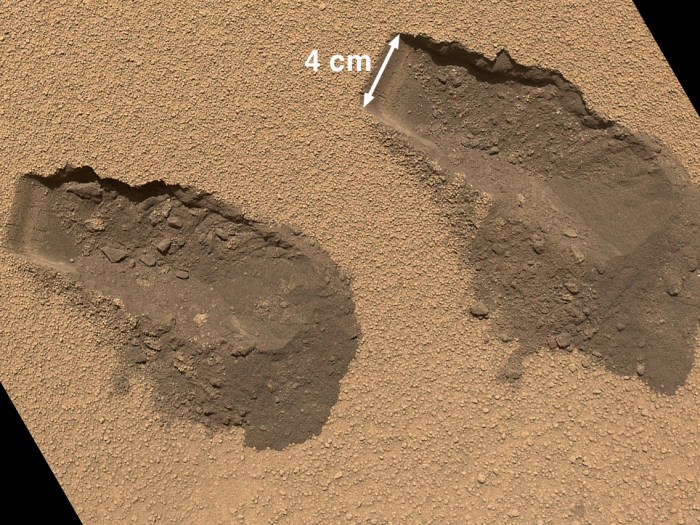
curiosity_samplesApparently, the samples taken with the “Rocknest” inside the Gale Crater showed signs of water, sulfur and chlorine-containing substances, among other ingredients, that were delivered by Curiosity’s arm to the analytical laboratory inside the rover. Lamentably, this does not confirm the existence of organic compounds, as the team hoped. But the find does confirm what Curiosity team and NASA scientists have been postulating for some time – which includes the existence of water on Mars and the existence of complex chemical compounds.

Also, it’s important to note that this kind of soil surveying was not possible with any previous rovers or exploratory missions in space. Curiosity is the first Mars rover that is able to scoop soil into analytical instruments and conducts tests in the way it has, so really, any findings should be considered a windfall. Detection of the substances during this early phase of the mission also demonstrated the ability of the rover laboratory to analyze diverse soil and rock samples, which will continue over the course of the next two years.

And as the team was sure to mention in a Tweet made shortly after the “earthshaking” discovery did not materialize, there’s still plenty of time to find all that they are looking for. Curiosity’s mission is far from over, and she will hardly be the last surveyor – man-made or manned – that will be roving the landscape of the Red Planet.

Source: NASA Jet Propulsion Laboratory

“Earthshaking” News From the Red Planet?

In an interview with NPR earlier today, John Grotzinger – the Principal Investigator for NASA’s Mars Science Labs – said a recent soil sample test with the SAM instrument (Sample Analysis at Mars) shows something”‘earthshaking.” Like any good scientist (or a terrible tease), Grotzinger and his team are awaiting confirmation before announcing just what it is they’ve found. Nevertheless, the announcement of a potential discovery which could be “one for the history books” has fueled speculation and put many on the edge of their seats.

Thus far, the smart money has been on the discovery of organic molecules in the Martian soil, which is precisely what Curiosity has been up to for the past few months. This is because the very purpose of the SAM instrument to examine the chemical and isotopic composition of the Martian atmosphere and soil, specifically to determine if anything organic is capable of living there. If so, it will end the age-old argument of whether or not life can exist on the surface Mars, even if it doesn’t currently.

It will also prove to be a boon for those who are seriously looking ahead, and plotting manned missions to the Red Planet with the intent of making it habitable for humans. As I’m sure all people are aware of by now, there are plenty of people who are monitoring Curiosity’s findings and hoping they will help determine whether or not terraforming can be carried on the the planet, with the long-term goal of creating a “Green Mars” where terrestrial species can live and thrive, crops can grow, and oceans and rivers can once again exist.

I think I speak for them and myself when I say, “Grotzinger, best of luck to you, and this better not be some kind of media stunt!” Oh, I can’t wait to hear what they find!

Source: Universe Today