A Curiosity Christmas!

marsHey all! It’s a new year, a new day, but hopefully, there’s still some holiday cheer to go around! And in that spirit, I thought I’d share some news which came in over the holidays concerning Curiosity’s mission to Mars. For the rover, Christmas was celebrated at a location dubbed “Grandmas House”. Well, technically it spent it at Sol 130, a designated point in an area known as “Yellowknife Bay”. This area is a small depression located in the geographic region known as Glenelg, some 400 meters from “Bradbury Landing” where it first put down.
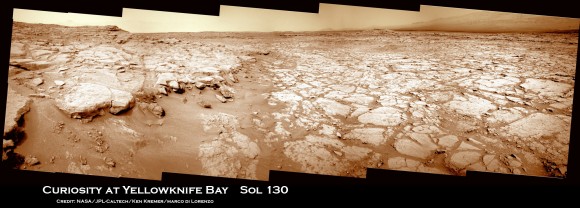
Curiosity-at-Yellowknife-Bay-Sol-130_3a_Ken-Kremer-580x208It is in Yellowknife Bay that Curiosity has been engaged in searching for its first target site to drill for a rock sample. The purpose of this to test out the rover’s high powered hammering drill, a test which has been put off because the Mars Science Team feared that the rock samples at other locations were not optimal. But the Glenelg area – which lies at the junction of three different types of geologic terrain – features a different type of geologic terrain compared to what Curiosity has driven on previously.

Curiosity-Yellowknife-Bay-Sol-125_2c_Ken-Kremer-580x151While there, Curiosity snapped a series of panoramic pictures of the area, which NASA compiled into the photos seen here and at the top. The rover also used its the APXS X-ray mineral spectrometer, ChemCam laser and MAHLI hand lens imager to gather initial science characterization data on the region and its rocky outcroppings. As you can plainly see, Yellowknife Bay was aptly named, being quite similar in appearance to its namesake here on Earth.

Hard to say what Curiosity will find once its begins drilling, but NASA is sure to be raving about it, either way. Everyone knows those Mars Science Laboratory people can’t keep anything a secret, even when they’re not sure they’ve got anything. Yes, MSL, that was a veiled reference to that “Earthshaking news” story you got us all excited about. And to answer you’re next question, no, I haven’t gotten over it yet. Can’t you tell?

Stay tuned for more news from the Red Planet! And while you’re at it, check out the video below where MSL team member Colette Lohr, the Tactical Uplink Lead, provides the latest video update on the Curiosity rover.

Source: Universetoday.com, (2)
News From The Red Planet!

mars_lifeIt’s been quite the busy month for NASA and the Curiosity Rover Team. In addition to the hectic research schedule and the excitement over all the potential finds, there’s also been a lot of planning as to what future mission will be like. Already, NASA announced that they plan to send another rover (InSight) to Mars in 2016, this one for the purpose of conducting interior planet studies. But given the success of Curiosity thus far, NASA announced recently that the multi-year, robotic rover program will continue, and will include an additional launch in 2020.

Apparently, this has much to do with the reelection of Barack Obama, whose commitment to space exploration also means that NASA can go ahead with its plans to create an outpost on the Moon. According to NASA Administrator Charles Bolden, this and the planned 2020 launch will ensure that “America remains the world leader in the exploration of the Red Planet, while taking another significant step toward sending humans there in the 2030s.”

The planned mission portfolio includes the Curiosity and Opportunity rovers, two NASA spacecraft and contributions to one European spacecraft currently orbiting Mars, the 2013 launch of the Mars Atmosphere and Volatile EvolutioN (MAVEN) orbiter to study the Martian upper atmosphere, the Interior Exploration using Seismic Investigations, Geodesy and Heat Transport (InSight) mission, and participation in the European Space Agency’s 2016 and 2018 ExoMars missions.

That alone is pretty exciting  news. But in and around these grand announcements, the Mars Science Labs also released some information a week ago concerning the Martian soil samples which were thought to contain organics. Though the samples did prove to be “earthshaking” as was hoped, they did present some rather interesting findings which are now being released.

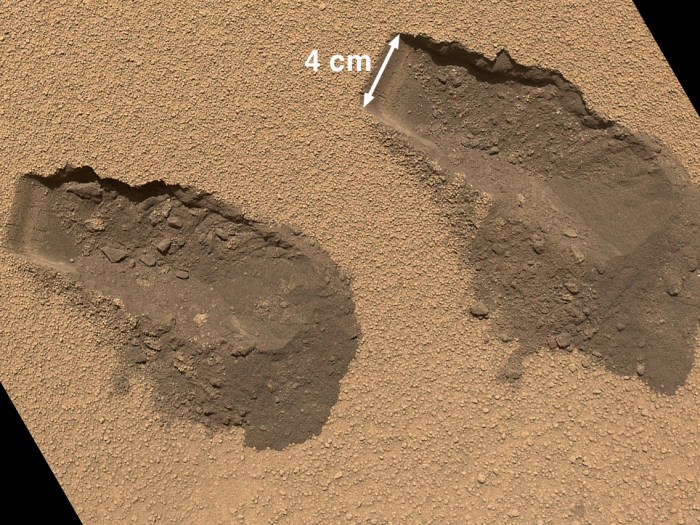
curiosity_samplesApparently, the samples taken with the “Rocknest” inside the Gale Crater showed signs of water, sulfur and chlorine-containing substances, among other ingredients, that were delivered by Curiosity’s arm to the analytical laboratory inside the rover. Lamentably, this does not confirm the existence of organic compounds, as the team hoped. But the find does confirm what Curiosity team and NASA scientists have been postulating for some time – which includes the existence of water on Mars and the existence of complex chemical compounds.

Also, it’s important to note that this kind of soil surveying was not possible with any previous rovers or exploratory missions in space. Curiosity is the first Mars rover that is able to scoop soil into analytical instruments and conducts tests in the way it has, so really, any findings should be considered a windfall. Detection of the substances during this early phase of the mission also demonstrated the ability of the rover laboratory to analyze diverse soil and rock samples, which will continue over the course of the next two years.

And as the team was sure to mention in a Tweet made shortly after the “earthshaking” discovery did not materialize, there’s still plenty of time to find all that they are looking for. Curiosity’s mission is far from over, and she will hardly be the last surveyor – man-made or manned – that will be roving the landscape of the Red Planet.

Source: NASA Jet Propulsion Laboratory

“Earthshaking” News From Mars!

Curiosity-RocknestCancel the champagne! Turns out what we have here is a tentative conclusion made by some overzealous scientists. According to an update made earlier today, scientists working for NASA indicated that no organic molecules were found in the sample of Martian soil taken by Curiosity nine days ago. The news first appeared on NASA’s Twitter feed as follows:

“Everybody, chill. After careful analysis, there are no Martian organics in recent samples.”

This was followed shortly thereafter with:

“Why the wait? We’re moving at the speed of science. My team needed time to analyze the data.”

Uh, yeah. Because that’s what we were concerned with; the wait, not the getting of our hopes up! But last but not least, there some words of reassurance:

“Turn that frown upside down: We’re fewer than four months into a multi-year mission. We’ve only just begun!”

To be fair, this announcement doesn’t rule out the possibility of organic molecules on the Martian surface. It’s just that no organic molecules have been found yet. Unfortunately, having thought that they had detected some traces in their samples, Grotzinger conveyed the team’s excitement about the possibility of a discovery and triggered a bit of a media frenzy. Understandable, but frankly, I have a bit of a bone to pick with Grotzinger himself.

Dude, you had to know we’d all get excited and start hanging on your every update with baited breath. But in the end, we were like a bunch children on Christmas morning, desperately waiting to rip into our presents, only to find that Santa had stuck us with an IOU! Or worse, a note saying: “There are plenty more Christmas’s coming! Be happy!” Turn my frown upside down, Grotzinger? You owe me restitution!

Okay, now that I’m ranted out, I sincerely hope the mission meets with the results they are looking for soon. Granted, Curiosity still has many more years before her mission is complete, but I don’t think I can stand this kind of suspense! And frankly, I’d like to hear about some definitive proof that terraforming is possible on a planetary scale. Get on it, NASA! You got a planet to prep for colonization!

Animation of Curiosity’s 1st “Touch and Go” Maneuver

In the days leading up to Thanksgiving in the US, Curiosity performed her first “touch and do” maneuver. This was the process whereby the rover drove up to and inspected an interesting looking rock using the Alpha Particle X-Ray Spectrometer (APXS) on its arm, then moved onto the next point of interest on the same day.

This latest maneuver now puts Curiosity inside the ‘Glenelg’ geologic formation. The NASA science team selected this as the first major science destination because it lies at the intersection of three diverse types of geological areas that will help unlock the secrets of Mars’ ancient watery history and evolution to modern times.

What makes this historic is that it is the first time the rover has conduct a touch and go maneuver on the same day. Ordinarily, the rover performs these duties separately. According to Curiosity Mission Manager Michael Watkins (of NASA’s Jet Propulsion Laboratory in Pasadena, Calif), “[this] is a good sign that the rover team is getting comfortable with more complex operational planning, which will serve us well in the weeks ahead.”

In honor of this event, NASA scientists created a animation of the maneuver using the same software they do to plan the rover’s movements. Beginning with the examination it made using its arm sensor, the animation then shows (with painful accuracy) the rover making the 25.3 meter (83 foot) transit to its next location.

“Earthshaking” News From the Red Planet?

In an interview with NPR earlier today, John Grotzinger – the Principal Investigator for NASA’s Mars Science Labs – said a recent soil sample test with the SAM instrument (Sample Analysis at Mars) shows something”‘earthshaking.” Like any good scientist (or a terrible tease), Grotzinger and his team are awaiting confirmation before announcing just what it is they’ve found. Nevertheless, the announcement of a potential discovery which could be “one for the history books” has fueled speculation and put many on the edge of their seats.

Thus far, the smart money has been on the discovery of organic molecules in the Martian soil, which is precisely what Curiosity has been up to for the past few months. This is because the very purpose of the SAM instrument to examine the chemical and isotopic composition of the Martian atmosphere and soil, specifically to determine if anything organic is capable of living there. If so, it will end the age-old argument of whether or not life can exist on the surface Mars, even if it doesn’t currently.

It will also prove to be a boon for those who are seriously looking ahead, and plotting manned missions to the Red Planet with the intent of making it habitable for humans. As I’m sure all people are aware of by now, there are plenty of people who are monitoring Curiosity’s findings and hoping they will help determine whether or not terraforming can be carried on the the planet, with the long-term goal of creating a “Green Mars” where terrestrial species can live and thrive, crops can grow, and oceans and rivers can once again exist.

I think I speak for them and myself when I say, “Grotzinger, best of luck to you, and this better not be some kind of media stunt!” Oh, I can’t wait to hear what they find!

Source: Universe Today

How To Get To Mars…

A new video has been making the rounds recently. In this full-length compilation video, we get a glimpse of what the flight and deployment of Spirit/Opportunity Rover to Mars looked like, using CGI animation of course. In between, real footage from NASA is spliced in to provide real-time background to the simulated events. We see the navigators eagerly awaiting the landing and recovery of the rover’s signal, and the first photographs sent back by that rover. The arrival of this footage is very timely of course, coming soon after the arrival of Curiosity. Enjoy!

Mars Lander Mission, 2016

With all the news coming back from Curiosity rover since its deployment, one would get the impression that Mars is a pretty happening place. Blue sunsets, wide open vistas, tall mountains and extensive plains. All the while, our collective fascination with the planet has been growing apace. And it seems that this trend is destined to continue…

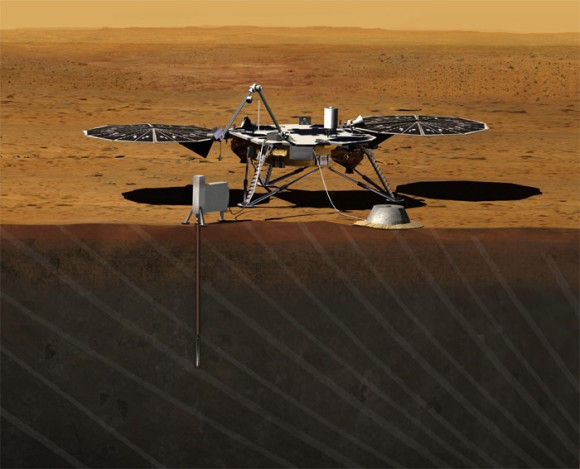
After looking at several low-cost options for their next major mission, NASA scientists decided to once again return to the Red Planet, this time to do some interior planet studies to determine whether Mars has a solid or liquid core, and determine the planet’s basic structure.

Known as the InSight lander, this mission won out over two equally enticing proposals. The first called the for the deployment of the Titan Mare Explorer (TiME), a floating high-tech buoy which would be sent to Saturn’s moon Titan. Once there, it would study the methane lakes of Titan, examining their composition and interaction with the atmosphere. Thanks to the Cassini probe, these lakes have attracted a great deal of interest of late, particularly since they may be able to support life. Understandably, many can’t wait to study them up close and see if this holds true.

The second potential mission called for the deployment of “Chopper”, a proposed Comet Hopper mission that would put a lander on comet 46P/Wirtanen where it would study the comet’s composition. This comet, which was originally discovered in 1948, belongs to the Jupiter family of comets and orbits the Solar System once every 5.4 years. Studying its make-up would go a long way to helping scientists understanding how Solar comets behave and provide clues as to the early formation of our Solar System.

But scratch those! With 2016 on the way, budget limited and Mars the happening place, InSight will be the one to go. What’s more, it’s research is likely to prove very useful in settling some ongoing arguments, not the least of which is whether Mars possesses liquid water beneath its surface. If this should prove true, it might mean terraforming could be a go sometime down the road…

People can dream! And speaking of which, check out the NASA simulation of what InSight will look like once deployed.


Source: Universe Today

Time-Lapse Footage of Curiosity Rover Landing

Amongst the awesome footage which is coming back from Mars, courtesy of the Curiosity Rover, is this lovely compilation. Using the many photos snapped by the rover as it made it’s decent, the enterprising folks over at Spaceflight 101 have created a time-lapse video of what the landing looked like.

Taken by the the Mars Descent Imager (MARDI), the images capture the separation of the heat shield from the rover and then its powered descent. Well worth watching, and stay tuned for more updates from Curiosity as it continues its journey across the Martian Landscape.

Curiosity Has Landed!

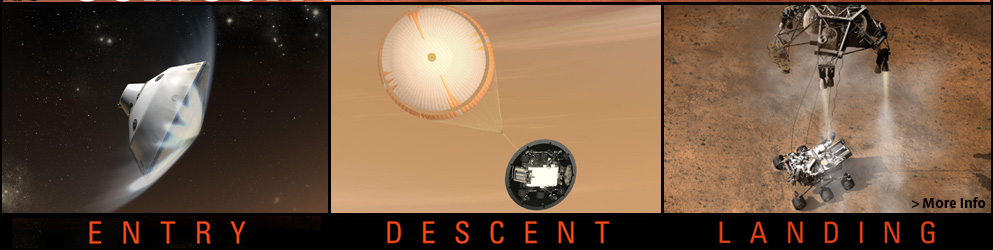
Yesterday, at precisely 10:23 pm Greenwich Mean Time, NASA announced the successful landing of the Mars Curiosity Rover! After blazing through Mars’ atmosphere at over 21,000 km/h, Curiosity’s unique landing system deployed and brought the rover in for a nice, controlled landing.

Needless to say, pandemonium ensued at NASA’s Jet Propulsion Lab, where the landing was being monitored. All those on hand began jumping, hooting, hollering and hugging each other, much as they used to do whenever a successful launch was made or men touched down on the moon. Times may have changed, but the basic goal remains the same: to conquer the unknown and take the next big leap. And when that happens, you can expect the people who work so hard to make that happen to get a little giddy 😉

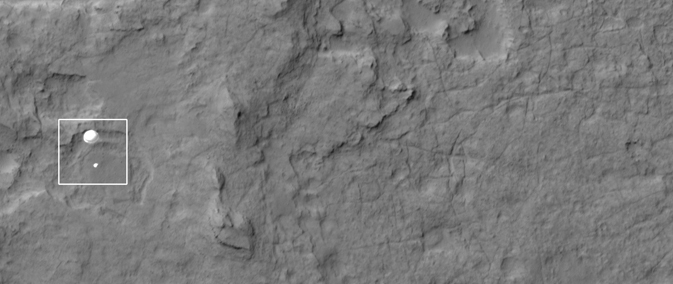
In addition, the HiRISE team (High Resolution Imaging Science Experiment), caught this beautiful and perfectly-timed photo from the Mars Reconnaissance Orbiter (MRO). The photo shows Curiosity at left deploying its chute and descending to the surface.

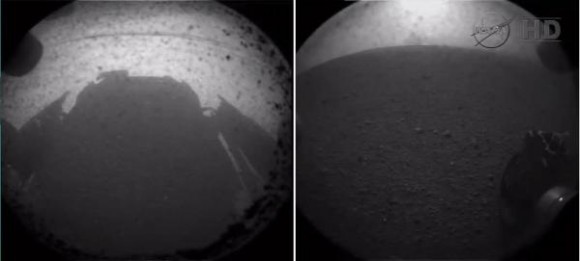
Immediately after touching down, Curiosity began sending photos back to NASA of Mars surface. The first two were of its landing zone in Mars’ Gale Crater, shown here:

To mark this momentous occasion, President Obama had this statement to make:

“Tonight, on the planet Mars, the United States of America made history.

The successful landing of Curiosity – the most sophisticated roving laboratory ever to land on another planet – marks an unprecedented feat of technology that will stand as a point of national pride far into the future. It proves that even the longest of odds are no match for our unique blend of ingenuity and determination.

Tonight’s success, delivered by NASA, parallels our major steps forward towards a vision for a new partnership with American companies to send American astronauts into space on American spacecraft. That partnership will save taxpayer dollars while allowing NASA to do what it has always done best – push the very boundaries of human knowledge. And tonight’s success reminds us that our preeminence – not just in space, but here on Earth – depends on continuing to invest wisely in the innovation, technology, and basic research that has always made our economy the envy of the world.

I congratulate and thank all the men and women of NASA who made this remarkable accomplishment a reality – and I eagerly await what Curiosity has yet to discover.”

Yes, this is certainly is history in the making. Needless to say, Curiosity is expected send back some interesting finds as it wanders the Martian surface, takes soil samples, and scans them to determine what secrets and mysteries the surface holds. In time, all this information could become intrinsic to settlement and terraforming, the creation of human civilization on a planet other than Earth! Exciting times we live in!

In the meantime, check out this compilation video of the landing paired with footage take from NASA’s Jet Propulsion Lab:

Via: Universe Today

Virtual Mars Rover Landing Party!

As you all may know, the Curiosity Rover is on its way to Mars and due to land in just a few days. And it just so happens that my buddy and mentor, Fraser Cain of Universe Today, is hosting a virtual party to mark the event. He and his crew will be in Pasadena for the event, surrounded by NASA officials and people in the know and conducting interviews, while the rest of us will be able to watch through live video.

This is an historic occasion and I for one feel privileged that I know someone who has inside access 😉 Below is a copy of the original invitation inviting people to come by Google+ to join in the party. It promises to be a very informative time so I highly recommend people check it out any way they can. I also included the link to the NASA simulation (the shortened one this time) which shows what the deployment of the Curiosity Rover will look like. Enjoy!

“To celebrate the landing of NASA’s Curiosity Rover – the Mars Science Laboratory – we’ll be running a special live hangout. 

In conjunction with +CosmoQuest. We’ll have all your favorite space/astronomy journalists on hand to discuss the mission in depth, and celebrate the landing live, when it happens.

Over the course of this 4-hour Google+ Hangout on Air, we’ll interview members of the Curiosity team live in the hangout, as well as other special guests from the +The Planetary Society and the +SETI Institute.

+Scott Lewis and +Amy Shira Teitel will be on location at the Jet Propulsion Laboratory to interview members of the engineering team, and show you what it’s like to be at NASA during this amazing moment.”