
 And we’re back from Mars with another slew of updates and breaking news! It seems that ever since the Curiosity Rover landed back in early August, the revelations and interesting facts have been pouring in non-stop. With each bit of news, we learn a little more about the Red Planet’s composition, its history, and how both are so similar to our own.
And in recent weeks, ever since Curiosity moved into Yellowknife Bay, there have been a number of interesting developments. One came back in January when the Rover found a series of calcium-rich deposits, similar to the kind observed here on Earth. These types of deposits are observed wherever and whenever water circulates through cracks and rock fractures. This is just the latest in a long string of discoveries which support the conclusion that Mars was once home to vast rivers.
 The images above show the similarity between the sulfate-rich veins seen by Curiosity rover to sulfate-rich veins seen on Earth. The view on the left is a mosaic of two shots from the remote micro-imager on Curiosity’s Chemistry and Camera (ChemCam) instrument which were taken on Dec. 14, 2012, or the 126th sol (Martian day) of operations. The image on the right is from the Egyptian desert here on Earth, which a pocket knife included for scale.
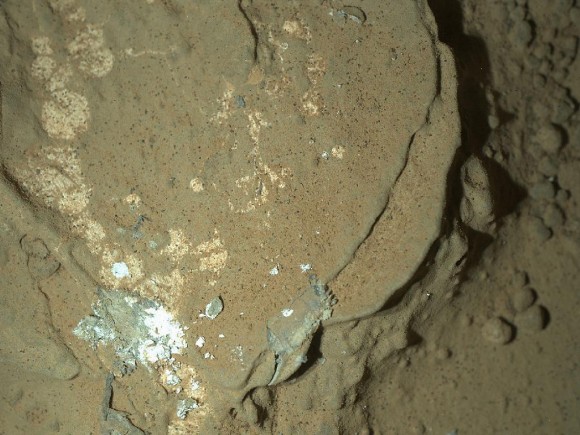 The next bit of news came on January 25th when Curiosity’s high resolution robotic arm camera – also known as the Mars Hand Lens Imager (MAHLI) – snapped its first set of nighttime images. The images were illuminated by both an ultraviolet and white light emitting LED’s (shown above and below). The rock outcropping – named “Sayunei”, located at the site of the “John Klein” outcrop – was just one of many to be found in Yellowknife Bay where Curiosity has been conducting ongoing surveys.
 In this case, it was breaking the rock apart in an effort to try and expose fresh material, free of obscuring dust. Once exposed, the pictures were meant to determine the internal makeup of the rock. “The purpose of acquiring observations under ultraviolet illumination was to look for fluorescent minerals,” said MAHLI Principal Investigator Ken Edgett of Malin Space Science Systems, San Diego. “If something looked green, yellow, orange or red under the ultraviolet illumination, that’d be a more clear-cut indicator of fluorescence.”
In addition, certain classes of organic compounds are also fluorescent. Yes, that search continues!
 And last, but not least, came the news at the end of January that indicated that Curiosity’s long-awaited test of its high-powered drill will finally be taking place. This first drilling operation entailed hammering a test hole into a flat rock at the John Klien formation for the purposes of making sure everything works as needed. If things pan out, then the team would conduct many more tests and collect the drillings for analysis by the Rover’s CheMin and SAM analytical labs in the coming days.
In anticipation of the planned drilling operation, the rover carried out a series of four ‘pre-load’ tests on Monday (Jan. 27), whereby the rover placed the drill bit onto Martian surface targets at the John Klein outcrop and pressed down on the drill with the robotic arm. Engineers then checked the data to see whether the force applied matched predictions. The next step was an overnight pre-load test, to gain assurance that the large temperature change from day to night at the rover’s location would not add excessively to stress on the arm while it is pressing on the drill.
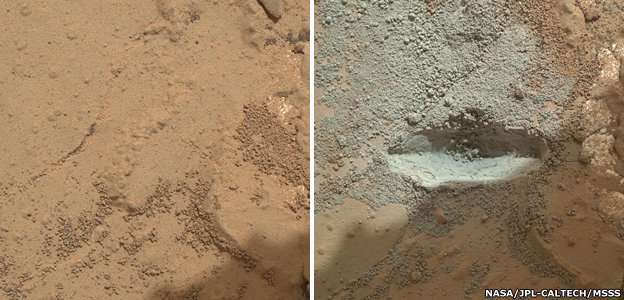 The photo above shows the before and after shots of the rock where the drill conducted its hammering. And as you can see, the rock powered and is of a different color inside – slate gray as opposed to rust red. If the MSL lab deems the slab suitable, a number of test holes are likely to be drilled – using the rotation as well the percussive action – before a powdered sample is picked up and delivered to Curiosity’s onboard laboratories.
And so far, according to Curiosity project scientist John Grotzinger, things are looking good:
“The drilling is going very well so far and we’re making great progress with the early steps. The rock is behaving well and it looks pretty soft, so that’s encouraging,” he told BBC News.”
Ultimately, the purpose of the rover’s mission is to try to determine whether Gale has ever had the environments in the past that were capable of supporting bacterial life. Detailing the composition of rocks is critical to this investigation as the deposits in the crater will retain a geochemical record of the conditions under which they formed. Drilling a few centimetres inside a rock provides a fresh sample that is free from weathering or radiation damage, both of which are common to the Martian surface.
There is more to follow, for sure. And in the meantime, check out this video of the Mars Science Labs providing the latest Curiosity Rover Report explaining their finds for the month of January and plans for February.
Source: universetoday.com, (2), (3), BBC.co.uk, nasa.gov

 Stories by Williams