Good news! My second article, which deals with the development of deep-space hibernation, just went public over at Universe Today! This one was especially fun to research, since it deals with a subject that is science fiction gold! Whether it’s from 2001: A Space Odyssey, the Alien franchise, Halo, Avatar, or the literature of Alastair Reynolds, the idea of astronauts going into cryogenic suspension has been well-explored over the past few decades.
And now, NASA is collaborating with a private aerospace company called SpaceWorks to research the possibility of using such a procedure when it sends astronauts to Mars and beyond. The advantages are numerous, from cost-cutting to ensuring that astronauts don’t go all nutter-butters during the many, many months (or even years) that it takes to drift through space.
As seems to be the case more and more these days, researchers and planners are getting serious about it. Much like manned missions to Mars, colonizing Mars, a settlement on the Moon, the Space Elevator, or exploratory missions to Europa, science fiction is fast becoming science fact. Man, am I happy to be alive right now!
As part of their desire to once again conduct launches into space from US soil, NASA recently awarded commercial space contracts worth $6.8 billion to Boeing and SpaceX. But beyond restoring indigenous spaceflight capability, NASA’s long-term aim is clearly getting a manned mission to Mars by 2030. And in assigning the necessary money to the companies and visionaries willing to help make it happen, they just might succeed.
As per the agreement, Boeing will receive $4.2 billion to finance the completion of the CST-100 spacecraft, and for up to six launches. Meanwhile, SpaceX is receiving $2.6 billion for its manned Dragon V2 capsule, and for up to six launches. NASA expressed excitement its collaboration with both companies, as it frees the agency up for bigger projects — such the development of its own Space Launch System (SLS).
One person who is sure to be excited about all this is Elon Musk, SpaceX founder, CEO, and private space visionary. With this big infusion of cash, he has apparently decided that it’s time to bring his plans for Mars forward. Ever since 2007, Musk has indicated a desire to see his company mount a manned mission to Mars, and now he may finally have the resources and clout to make it happen.
These plans include flying astronauts to Mars by 2026, almost a decade before NASA thinks it will. By late 2012, he even spoke about building a Mars Colony with a population in the tens of thousands, most likely established sometime during the 2020’s. As of this past year, he has also revealed details about a Mars Colonial Transporter (MCT), an interplanetary taxi that would be capable of ferrying 100 people at a time to the surface.
Fan concept art of the MCT
And then in February of this year, SpaceX began developing the MCT’s engines. Known as the Raptor, this new breed of large engine reportedly has six times the thrust of the Merlin engines that power the second stage of the Falcon 9 rocket. Now that the company has the financial resources to dream big, perhaps the MCT might move from the development stage to prototype creation.
And there is certainly no shortage of desire when it comes to sending people to the Red Planet. Together with Mars Society president Robert Zubrin, and Mars One co-founder Bas Lansdorp, crowdfunded organizations are also on board for a manned mission. The case for settling it, which Musk himself endorses, is a good one – namely, that planting the seed of humanity on other worlds is the best way to ensure its survival.
And as Musk has stated many times now, a manned mission Mars is the reason there is a SpaceX. Back in 2001, while perusing NASA’s website, he was perturbed to find that the space agency had nothing in the way of plans for a mission to Mars. And the best time to go is probably in about 15 or 20 years, since Mars will be at its closes to Earth by then – some 58 million kilometers (36 million miles).
During this window of opportunity, the travel time between Earth and Mars will be measured in terms of months rather than years. This makes it the opportune time to send the first wave of manned spacecraft, be they two-way missions involving research crews, or one-way missions involving permanent settlers. Surprisingly, there’s no shortage of people willing to volunteer for the latter.
When Mars One posted its signup list for their proposed mission (which is slated for 2025), they quickly drew over 200,000 applicants. And this was in spite of the fact that the most pertinent details, like how they are going to get them there, remained unresolved. Inspiration Mars, which seeks to send a couple on a round trip to Mars by 2021, is similarly receiving plenty of interest despite that they are still years away from figuring out all the angles.
In short, there is no shortage of people or companies eager to send a crewed spaceship to Mars, and federal agencies aren’t the only ones with the resources to dream big anymore. And it seems that the technology is keeping pace with interest and providing the means. With the necessary funding now secured, at least for the time being, it looks like the dream may finally be within our grasp.
Though it has yet to become a reality, it looks like the first Martians will actually come from Earth.
The rocky surface of Mars has turned up some rather interestingly-shaped objects in the past. First there was the Martian rat, followed shortly thereafter by the Martian donut; and very recently, the Martian thighbone. And in this latest case, the Curiosity rover has spotted what appears to be a perfectly-round ball. Even more interesting is the fact that this sphere may be yet another indication of Mars’ watery past.
The rock ball was photographed on Sept. 11 – on Sol 746 of the rover’s mission on Mars – while Curiosity was exploring the Gale Crater. One of Curiosity’s cameras captured several images of the centimeter-wide ball as part of the stream of photographs was taking. The scientists working at the Mars Science Laboratory based at NASA’s Jet Propulsion Laboratory (JPL), immediately began to examine it for indications of what it could be.
As Ian O’Neill of Discovery News, who spoke with NASA after the discovery, wrote:
According to MSL scientists based at NASA’s Jet Propulsion Laboratory (JPL) in Pasadena, Calif., the ball isn’t as big as it looks — it’s approximately one centimeter wide. Their explanation is that it is most likely something known as a “concretion”… and they were created during sedimentary rock formation when Mars was abundant in liquid water many millions of years ago.
Curiosity has already found evidence of water at a dig site in Yellowknife Bay, which took place shortly after it landed in the Gale Crater two years ago. In addition, this is not the first time a Mars rover has found rocky spheres while examining the surface. In 2004, NASA’s Opportunity rover photographed a group of tiny balls made of a ferrous mineral called hematite. Opportunity photographed still more spheres, of a different composition, eight years later.
The spheres likely formed through a process called “concretion”, where minerals precipitate within sedimentary rock, often into oval or spherical shapes. When the rock erodes due to wind or water, it leaves the balls of minerals behind and exposed. If in fact concretion caused the Mars spheres, then they would be evidence there was once water on the planet. However, some scientists believe the rock balls might be leftover from meteorites that broke up in the Martian atmosphere.
Curiosity is now at the base of Mount Sharp (Aeolis Mons) – The 5.6 km-high (3.5 mile) mountain in the center of Gale Crater – scientists are excited to commence the rover’s main science goal. This will consists of more drilling into layered rock and examining the powder so scientist can gain an idea about how habitable the Red Planet was throughout its ancient history, and whether or not it may have been able to support microbial life.
Mission managers will need to be careful as the rover has battered wheels from rougher terrain than expected. Because of this, the rover will slowly climb the slope of Mount Sharp driving backwards, so as to minimize the chance of any further damage. The Mars Reconnaissance Orbiter (MRO) will also be on hand to help, photographing the route from above to find the smoothest routes.
Despite the wear and tear that the little rover has experienced in its two years on the Martian surface, it has discovered some amazing things and NASA scientists anticipate that it will accomplish much more in the course of its operational history. And as it carried on with its mission to decode the secrets of Mars, we can expect it will find lots more interesting rocks – spherical, rat-shaped, ringed, femur-like, or otherwise.
Regularly scheduled trips to the Moon are one of many things science fiction promised us by the 21st century that did not immediately materialize. However, ideas are on the drawing board for making it happen in the coming decades. They include regular rocket trips, like those suggested by Golden Spike, but others have more ambitious plans. For example, there’s LiftPort – a company that hopes to build a space elevator straight to the Moon.
When he was working with NASA’s Institute for Advanced Concepts in the early 2000s, LiftPort President Michael Laine began exploring the idea of a mechanism that could get people and cargo to space while remaining tethered to Earth. And he is certainly not alone in exploring the potential, considering the potential cost-cutting measures it offers. The concept is pretty straightforward and well-explored within the realm of science fiction, at least in theory.
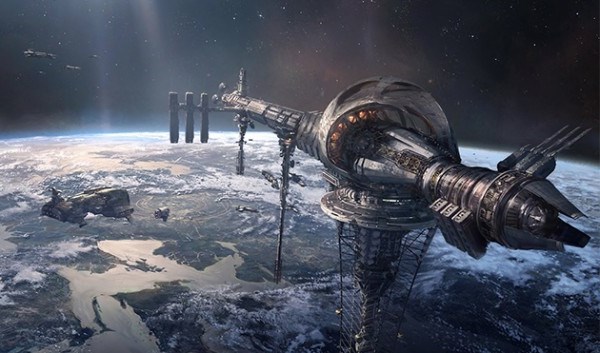
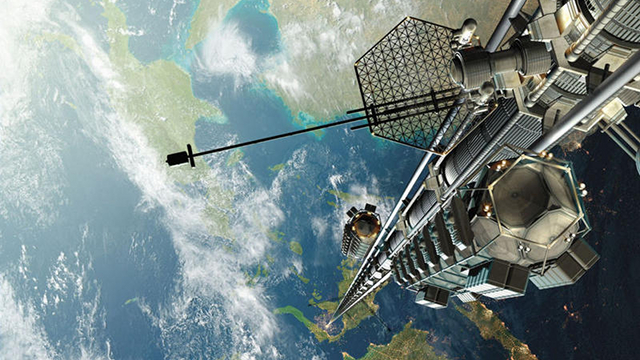
The space elevator concept is similar to swinging a ball on a string, except it involves a tether anchored to the Earth that’s about 500 km long. The other end is in anchored in orbit, attached to a space station that keeps the tether taut. Anything that needs to be launched into space can simply be fired up the tether by a series of rocket-powered cars, which then dock with the station and then launched aboard a space-faring vessel.
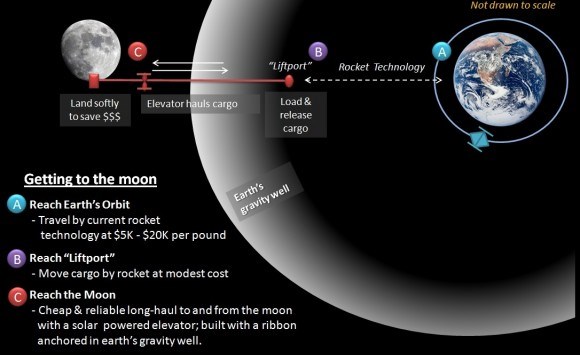
Compared to using rockets to send everything into space, the cost using the elevator is far less (minus the one-time astronomical construction fee). And while the materials do not yet exist to construct 0ne, suggestions have been floated for a Lunar Elevator. Taking advantage of the Moon’s lower gravity, and using the Earth’s gravity well to stabilize the orbital anchor, this type of elevator could be built using existing materials.
One such person is Laine, who believes the capability exists to build an elevator that would reach from to the Moon to a distance of 238,000 km towards the Earth. Hence why, started two and a half years ago, he struck out to try and bring this idea to reality. The concept behind the Moon Elevator is still consistent with the ball on the string analogy, but it is a little more complicated because of the Moon’s slow orbit around the Earth.
The solution lies in Lagrangian points, which are places of gravitational equilibrium between two bodies. It’s here that the gravitational pull of both bodies are equal, and so they cancel each other out. Lagrangian point L1 is about 55,000 kilometers from the Moon, and that’s the one Laine hopes to take advantage of. After anchoring one end of the “string” on the Moon’s surface, it will extend to L1, then from L1 towards Earth.
At the end of the string will be a counterweight made up of all the spent pieces of rocket that launched the initial mission to get the spike into the Moon. The counterweight will be in the right place for the Earth to pull on it gravitationally, but it will be anchored, through the Lagrange point, to the Moon. The force on both halves of the “string” will keep it taut. And that taut string will be a space elevator to the Moon.
What’s more, Laine claims that the Moon elevator can be built off-the-shelf, with readily available technology. A prototype could be built and deployed within a decade for as little as $800 million, he claims. It would be a small version exerting just a few pounds of force on the anchor on the Moon, but it would lay the groundwork for larger follow-up systems that could transport more cargo and eventually astronauts.
To demonstrate their concept, LiftPort is working on a proof-of-concept demonstration that will see a robot climb the tallest freestanding human structure in existence. This will consist of three large helium balloons held together on a tripod and a giant spool of Vectran fiber that is just an eighth of an inch think, but will be able to support 635 kilograms (1,400 pounds) and withstand strong winds.
Vectran is the same material was used by NASA to create the airbags that allowed the Spirit and Opportunity’s rovers to land on Mars. Since it gets stronger as it gets colder, it is ideal for this high altitude test, which will be LiftPort’s 15th experiment and the 20th robot to attempt an ascent. Laine doesn’t have a prospective date for when this test will happen, but insists it will take place once the company is ready.
Regardless, when the test is conducted, it will be the subject of a new documentary by Ben Harrison. Having learned about Liftport back in 2012 when he stumbled across their Kickstarter campaign, Harrison donated to the project and did a brief film segment about it for Engadget. Since that time, he has been filming Liftport’s ongoing story as part of a proposed documentary.
Much like Laine, Harrison and his team are looking for public support via Kickstarter so they can finish the documentary, which is entitled “Shoot the Moon”. Check out their Kickstarter page if feel like contributing. As of the time of writing, they have managed to raise a total of $14,343 of their $37,000 goal. And be sure to check out the promotional videos for the Liftport Group and Harrison’s documentary below:
For decades, the dream of quantum computing – a system that makes direct use of quantum-mechanical phenomena, such as superposition and entanglement, to perform operations on data- has been just that. Much the same is true of principles that expand on this concept, such as quantum encryption and a quantum internet. But thanks to ongoing studies and experiments by researchers and scientists, that dream may be closer to fruition than ever.
This time the progress comes from a research team out of Professor Nicolas Gisin lab’s in the physics department at the University of Geneva. The team achieved the teleportation of the quantum state of a photon – this time, the photon’s polarization – to a crystal-encased photon more than 25 kilometers (15.5 miles) away. The distance breaks the previous record of 6 kilometers (3.7 miles) set 10 years ago by the same team using the same method.
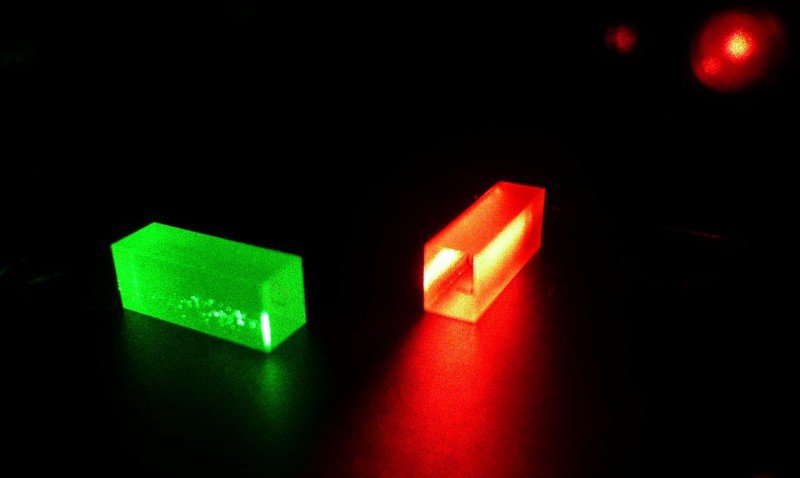
This is the latest in a series of experiments the group, led by physicist Félix Bussières, have conducted over the last decade in an effort to better understand quantum data transfer. In this particular experiment, the researchers stored one photon in a crystal, essentially creating a solid-state memory bank. They sent another photon of a different wavelength 25 km away through optical fiber, whereupon they had it interact with a third photon.
Because the first two photons were entangled – a quantum property whereby particles can speak to each other across an infinite distance – the interaction sent the data to the photo stored in the memory bank, where the team was able to retrieve it. Or as the team explained, using pool balls as an anology:
It is a bit like a game of billiards, with a third photon hitting the first which obliterates both of them. Scientists measure this collision. But the information contained in the third photon is not destroyed – on the contrary it finds its way to the crystal which also contains the second entangled photon.
This is all in keeping with the concept of quantum teleportation – the moving of quantum data from one location to another without having to travel the distance between them. That means that the speed at which data moves isn’t necessarily limited by the constraints of space and time. In that sense, it’s easier to think of this kind of teleporting not as a “beam me up” scenario, but as a kind of instantaneous awareness between two points.
While this may not sound as exciting as Ursula K. Le Guin’s Ansible communicator, the Alcubierre warp drive, or the “Star Trek”-style transporter, it opens up startling possibilities. For instance, in addition to bringing us closer to hard drives that can store quantum bits (aka. qubits), this is a major step in the direction of a quantum internet and encryption- where information is sent around the world instantaneously and is extremely secure.
This also opens doors for space exploration, where astronauts in space, rovers on Mars, and satellites in deep space will be able to communicate instantly with facilities here on Earth. For non-quantum physicists, the novel aspect of this experiment is that the team achieved teleportation of data across the kind of optic fiber that forms the basis of modern-day telecommunications, which means no major overhaul will be needed to make quantum internet a reality.
As physicists continue to push the boundaries of our understanding about the quantum world, we’re getting closer to translating these kinds of advancements in market applications. Already, quantum computing and quantum encryption are making inroads into the sectors of banking security, medical research and other areas in need of huge computing muscle and super-fast information transfer.
With the rise of a potential quantum Internet on the horizon, we could see the next jump in communication happen over the next couple of decades. So while we’re a long way off from trying to pry quantum teleportation and entanglement from the grip of the theoretical realm, scientists are making headway, if only a handful of kilometers at a time. But every bit helps, seeing as how routing stations and satellites can connect these distances into a worldwide network.
In fact, research conducted by other labs have not only confirmed that quantum teleportation can reach up to 143 km (89 miles) in distance, but that greater and greater properties can be beamed. This distance is especially crucial since it happens to be close to what lies between the Earth and a satellite in Low-Earth Orbit (LEO). In short, we humans could construct a quantum internet using optic cables or satellites, mirroring the state of telecommunications today.
And when that happens, get ready for an explosion in learning, processing and information, the likes of which has not been seen since the creation of the printing press or the first internet revolution!
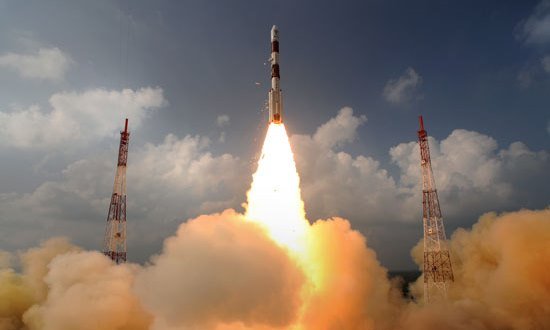
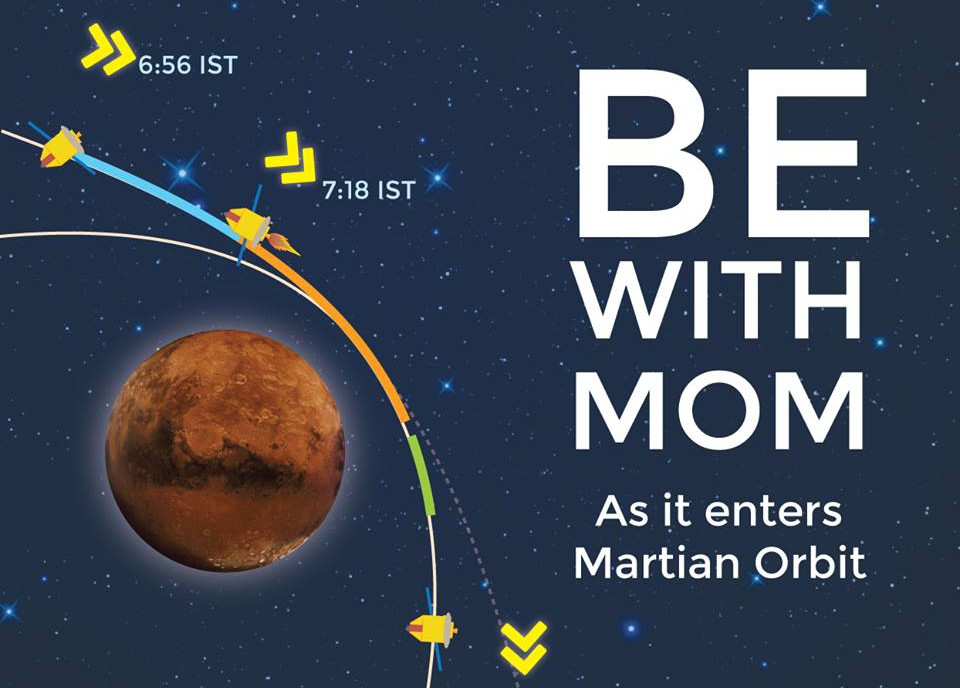
History was made this week as India’s Mars Orbiter Mission successfully fired its braking rockets and arrived in Mars’ orbit. The arrival of India’s maiden interplanetary voyager was confirmed at 7:30am, India Standard Time (02:00 UTC, or 8:00pm EDT in the U.S. on Tuesday, Sept 23rd). MOM is the nation’s first attempt to explore the Red Planet, and represents a new era is space exploration.
By putting a probe in orbit around Earth’s neighbor, India has officially joined the elite club of only three other entities who have launched probes that successfully investigated Mars – i.e. Russia, the United States, and the European Space Agency (ESA). It also represents an expansion in the space exploration, a competition once confined to two superpowers, to five major participants – the US, Russia, ESA, India and China.
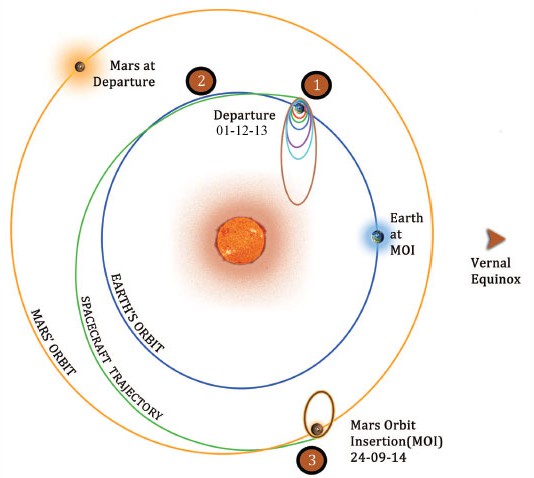
It took over ten months for MOM to cross the roughly 225 million kilometers (140 million miles) of interplanetary space that lie between Earth and Mars. Nevertheless, the 12.5 minutes that it took for the signal to reach Earth were far more intense and exciting. And the good news, which arrived at 10:30pm EDT (Sept. 23rd) or 8:00 IST (Sept. 24th) was met with wild applause and beaming smiles at India’s Bangalore mission control center.
MOM’s Red Planet arrival was webcast live worldwide by the Indian Space Research Organization (ISRO), India’s space agency which designed and developed the orbiter. ISRO’s website also gave a play by play in real time, announcing the results of critical spacecraft actions along the arrival timeline just moments after they became known. Indian PM Narenda Modi was watching the events unfold at ISRO’s Telemetry, Tracking and Command Network (ISTRAC).
Upon the announced arrival, Modi addressed the team, the nation and a global audience, lauding the accomplishment and outlining the benefits and importance of India’s space program. In a speech that echoes John F. Kennedy’s own from 50 years ago, Modi also implored the team to strive for even greater space exploration challenges:
India has successfully reached Mars! History has been created today. We have dared to reach out into the unknown and have achieved the near-impossible. I congratulate all ISRO scientists as well as all my fellow Indians on this historic occasion… We have gone beyond the boundaries of human enterprise and imagination. We have accurately navigated our spacecraft through a route known to very few. And we have done it from a distance so large that it took even a command signal from Earth to reach it more than it takes sunlight to reach us.
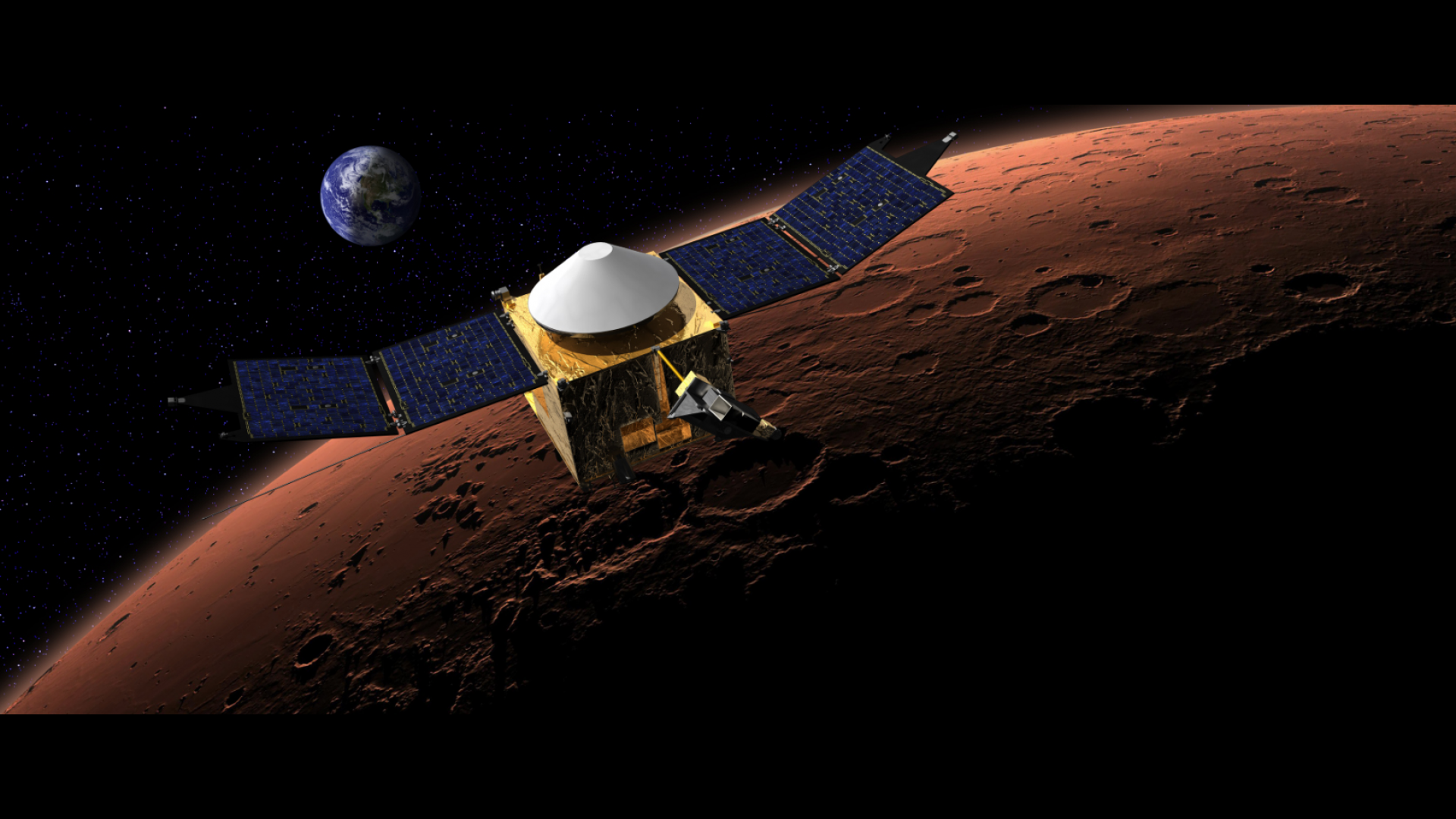
MOM’s success follows closely on the heels of NASA’s MAVEN orbiter which also successfully achieved orbit barely two days earlier on Sept. 21. Together, they will assess the extent to which Mars’ atmosphere decayed over the course of billions of years, and hopefully be able to reconstruct what it once looked like, and how it came to deteriorate. From all this, scientists hope to learn whether or not Mars once hosted life, and still is in some form.
MOM now joins Earth’s newly fortified armada of seven spacecraft currently operating on Mars surface or in orbit – which includes MAVEN, Mars Odyssey (MO), Mars Reconnaissance Orbiter (MRO), Mars Express (MEX), Curiosity and Opportunity. Bruce Jakosky, MAVEN Principal Investigator, related well-wished on behalf of NASA in a post on the ISRO MOM Facebook page:
Congratulations to the MOM team on behalf of the entire MAVEN team! Here’s to exciting science from the two latest missions to join the Mars fleet!
MOM was launched on Nov. 5, 2013 from India’s spaceport at the Satish Dhawan Space Centre, Sriharikota, atop the nations indigenous four stage Polar Satellite Launch Vehicle (PSLV). The flight path of the approximately $73 Million probe was being continuously monitored by the Indian Deep Space Network (IDSN) and NASA JPL’s Deep Space Network (DSN) to maintain its course.
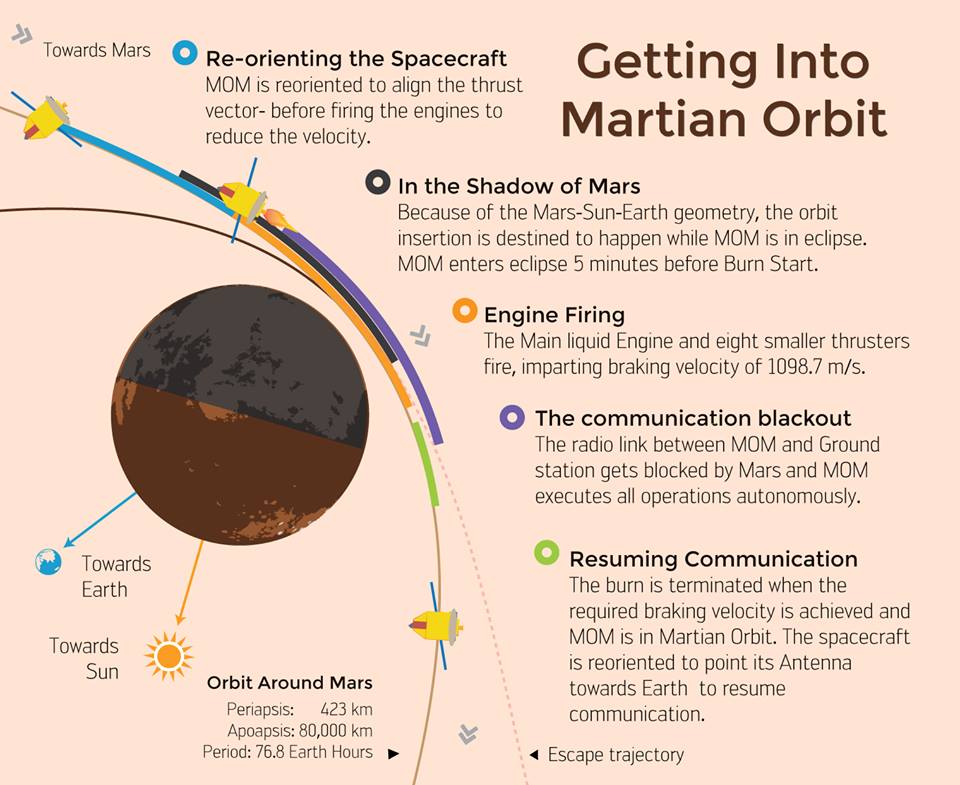
The do-or-die breaking maneuver that put MOM into orbit, known as the Mars Orbital Insertion (MOI), involved the craft’s engines firing for 24 minutes and 13 seconds. The entire maneuver took place autonomously under the spacecrafts preprogrammed sole control due to the long communications lag time and also during a partial communications blackout when the probe was traveling behind Mars and the signal was blocked.
As the ISRO said in a statement:
The events related to Mars Orbit Insertion progressed satisfactorily and the spacecraft performance was normal. The Spacecraft is now circling Mars in an orbit whose nearest point to Mars (periapsis) is at 421.7 km and farthest point (apoapsis) at 76,993.6 km. The inclination of orbit with respect to the equatorial plane of Mars is 150 degree, as intended. In this orbit, the spacecraft takes 72 hours 51 minutes 51 seconds to go round the Mars once.
MOM is expected to investigate the Red Planet for at least six months. Although it’s main objective is a demonstration of technological capabilities, it will also study the planet’s atmosphere and surface using five indigenous instruments – including a tri color imager (MCC) and a methane gas sniffer (MSM). Methane on Earth originates from both geological and biological sources – and could be a potential marker for the existence of Martian microbes.
Both MAVEN and MOM’s goal is to study the Martian atmosphere , unlock the mysteries of its current atmosphere and determine how, why and when the atmosphere and liquid water was lost – and how this transformed Mars climate into its cold, desiccated state of today. This will shed light not only on whether or not Mars supported life in the past, but if it still does in some form, and could possibly do so again.
This is an exciting time for space exploration, when ground-breaking news is happening on a regular basis and promises to lead to potentially Earth-shattering news in the future! And in the meantime, be sure to check out this video that recap’s MOM’s historic mission and arrival, courtesy of WorldBreakingNews:
It certainly has been a momentous few weeks for space exploration! Between the final weeks of August and the month of September, we’ve seen the Curiosity rover reach Mount Sharp, the Rosetta spacecraft created the first full map of a comet’s, the completion of the Orion space module, and the MAVEN orbiter reach Martian orbit. And before the month is out, India’s Mars Orbiter Mission (MOM) will also arrive in orbit around the Red Planet.
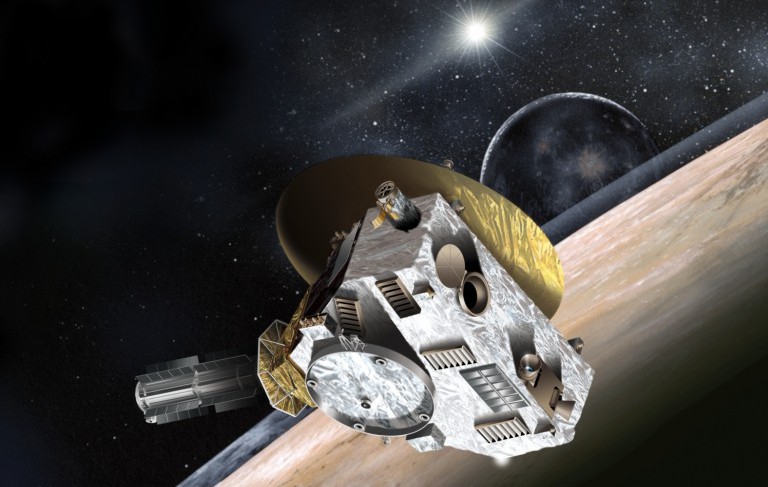
Despite all these developments, that occurred (relatively) close to home, there was even more news to be had, coming all the way from the edge of the Solar System no less. At the tail end of August, NASA announced that the New Horizons space probe passed Neptune orbit and is on its way to Pluto. Launched back in 2006 for the purpose of studying the dwarf planet, the probe is expected to arrive on July 14th of next year.
NASA says that the the craft passed the Neptunian orbit at 10:04 pm EDT on Monday August 25th, which coincided with the 25th anniversary of Voyager 2’s flyby of Neptune in 1989. But where Voyager came within 4,950 km (3,080 mi) of the gas giant, the New Horizons craft passed by at a distance of 3.96 billion km (2.45 billion mi). The spacecraft is now almost 4.42 billion km (2.75 billion mi) from Earth, and is the fastest man-made object ever sent into space.
Nevertheless, New Horizons’ Long Range Reconnaissance Imager (LORRI) was still able to capture images of Neptune and its giant moon Triton. As you can see from the image below, Neptune appears as the large white disc in the middle, while Triton is the small black dot passing in front and sitting slightly to the ride. NASA says that Triton may be very similar to Pluto and the information gathered by Voyager 2 may prove helpful in the coming encounter.
Ralph McNutt of the Johns Hopkins University Applied Physics Laboratory.
There is a lot of speculation over whether Pluto will look like Triton, and how well they’ll match up. That’s the great thing about first-time encounters like this – we don’t know exactly what we’ll see, but we know from decades of experience in first-time exploration of new planets that we will be very surprised.
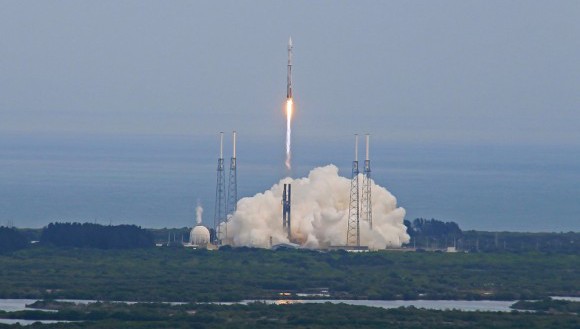
The first mission in NASA’s New Frontiers program, the New Horizons mission was launched on January 19, 2006 atop an Atlas V rocket from Cape Canaveral, Florida. It broke the record for the fastest man-made object on lift off with a speed of 58,536 km/h (36,373 mph). The 478 kg (1,054 lb) spacecraft was sent on a 9.5-year mission to fly by Pluto – a distance so far that radio signals from the nuclear-powered probe take four hours to reach Earth.
Sent on a slingshot trajectory using the gravitational pull of Jupiter, which tacked on another 14,480 km/h (9,000 mph) to its speed, New Horizons will pass Pluto in July of next year at a distance of 13,000 km (8,000 mi). After this encounter, it will continue on out of the Solar System, during which it will be in the distant Kuiper belt studying one or more Kuiper belt objects (KBOs).
Though this will still not rival Voyager 1’s accomplishments, which left our Solar System last year, New Horizons promises to gather far more information on the Outer Solar System and what lies beyond. All of this will come in mighty handy when at last, humanity contemplates sending manned missions into deep space, either to Alpha Centauri or neighboring exoplanets.
In November 2013, NASA launched the Mars Atmosphere and Volatile Evolution (MAVEN) space probe from Cape Canaveral. Described as a “time machine” for Mars, the orbiter would spend the next ten months traversing space, assuming an orbit around the Red Planet, and look for an answer as to how Mars went from being a planet with an atmosphere and water to the dried out husk that we know today.
And this evening, after trekking some 711 million kilometers (442 million-mile) across our Solar System, MAVEN will have arrived in orbit around Mars and will begin its year-long mission to study the planet’s upper atmosphere. The arrival will be broadcast live, courtesy of NASA TV and Space.com. The live webcast will run from 9:30 p.m. to 10:45 p.m. EDT (0130 to 0245 GMT), and if all goes well, MAVEN will enter orbit around Mars at 9:50 p.m. EDT (0250 GMT).
As David Mitchell, NASA’s MAVEN project manager at the Goddard Space Flight Center in Greenbelt, Maryland, said in a statement:
So far, so good with the performance of the spacecraft and payloads on the cruise to Mars. The team, the flight system, and all ground assets are ready for Mars orbit insertion.
Though plans to study Mars’ atmosphere in detail have been in the works for years, the MAVEN program received a big push from the ongoing efforts from the Curiosity rover. During its ongoing mission to study the surface of Mars, Curiosity was able to confirm that Mars had extensive surface water billions of years ago. This revelation came very early in the mission, and indicated some rather interesting things about Mars’ past.
For instance, although Mars is now too cold for flowing water today, it might have had a thicker atmosphere in the past that warmed its surface and allowed the liquid to remain stable on the surface. And while scientists have a pretty good idea how it was lost (i.e. too far our Sun, too low a gravity field), the rate of loss and when it disappeared are just some of the questions that MAVEN will attempt to answer.
Much of what scientists know about Mars’ upper atmosphere comes from just a few minutes’ worth of data from the two Viking landers that took measurements as they made their way to the Martian surface in the 1970s. This time around, NASA will be able to collect data for an entire year, gathering far more data than either the Viking landers or any other spacecraft has since had the opportunity to do.
As Bruce Jakosky, the mission’s principal investigator at the University of Colorado, Boulder’s Laboratory for Atmospheric and Space Physics, explained it:
The MAVEN science mission focuses on answering questions about where did the water that was present on early Mars go, about where did the carbon dioxide go. These are important questions for understanding the history of Mars, its climate, and its potential to support at least microbial life.
NASA scientists understand that Mars’ upper atmosphere acts as an escape zone for molecules floating dozens of miles from the planet’s surface. They theorize that as the solar wind hits the atmosphere, the radiation strips away the lighter molecules and flings them into space forever. To test this hypothesis, MAVEN will be examining the state of Mars’ upper atmosphere, and ionosphere to determine its interactions with the solar wind.
In so doing, NASA hopes to determine what the current rates of escape are for neutral gases and ions, and thus get a better picture of how long it took for the atmosphere to degrade and when it began degrading. The upper atmosphere of Mars likely changes as the sun’s activity increases and decreases, which is why MAVEN investigators hope to run the mission for longer than a year.
MAVEN will began making science measurements around Nov. 8, due to it taking a short break from its commissioning phase to watch Comet Siding Spring pass close by on Oct. 19. The $671 million MAVEN spacecraft is one of two missions that launched toward Mars last November and which are making their arrival this month. The other probe is India’s Mars Orbiter Mission, which launched just before MAVEN and will arrive at the Red Planet this Wednesday (Sept. 24).
It is an exciting time for space exploration, and the coming years are sure to be characterized by an escalating and accelerating rate of learning. Be sure to head on over to Space.com to watch the arrival broadcast live. And be sure to check out the following videos – the Mars Arrival trailer; NASA Goddard Center’s “Targeting Mars” video; and the NASA MAVEN PSA, hosted by LeVar Burton:
With numerous plans for a manned mission to Mars, some of which are scheduled to one-way settlement projects, the question of how and what people on Mars will eat is an important one. What will the Martian diet look like? How will they grow their food? Will it people subsist on endless supplies of freeze-dried rations, or will they get all the veggies, fruits and protein they need from hydroponic produce?
Well, according to Dutch ecologist Wieger Wamelink, the Martian settlers might just be able to grow their food in the local soil. In a series of experiments using soil tailored to fit extra-terrestrial environments, Wamelink was able to make a mustard seed sprout. The soil was provided by NASA, a sample which they had collected from the desert, dried out, and cleansed of certain nutrients that’s meant to replicate what Martian and lunar soil would be like.
Wamelink had ordered more than 100 pounds of each type to his research greenhouse in the Netherlands to see what kinds of plant life might prosper in greenhouses on other planets. He and his team planted tomato seeds, stinging nettle, carrots, rye, and a host of other wild species in the soils in a series of 840 pots, then published their results in PLOS One late last month.
As Wamelink, who works for the Alterra Institute at the University of Wageningen, explained:
I think we’re really the first to do that. We have looked at how plants see what [nutrients are] available in these soils, and it was unknown to NASA. They were very happy when we sent our results.
What was perhaps most impressive about the results was how well some plants fared in the imitation Mars soil. Some seeds germinated after just 24 hours and flowered within 50 days, something Wamelink had never expected. He knew that nitrogen might not be available in alien soils, but when he analyzed the Martian soil compared to nutrient-poor sand from the banks of the Rhine, he found that Mars actually had much more going for it than he thought.
The Martian atmosphere contains nitrogen, and gusts of gases from the sun charge the nitrogen into a form that is digestible for plants. The planet also contains phosphorus, ammonium, and nitrates – all essential for plant growth. Field mustard and a tough, wild Dutch species called “reflexed stone crop” produced some of the best results. Lunar soil, by contrast, didn’t provide very friendly turf for earthling plant species.
Soil on the moon is thin, dusty, and full of aluminum and other heavy metals. Martian soil also contains lots of heavy metals, but it is aluminum that most plants don’t do too well in the presence of. So for the time being (or rather, if and when we settle the Moon), Lunar greenhouses will have to look to imports of Earth soil while Martian settlers can simple scoop the soil they need from outside their airlocks.
However, there are a few snags. For starters, even though Wamelink’s study provided some of the first evidence that species of Earth plants can grow on planets other than Earth, it still doesn’t show how eating those plants might affect humans. The Martian surface experiences lots of radiation, and eating radioactive plants full of heavy metals might not be the best idea for the human digestive system.
Nevertheless, Wamelink believes that some aspects of the Martian climate might actually be beneficial for plant growth. On a planet with a third of the gravitational pull of Earth, he suspects that plants might be able to grow taller than they ever would on their home planet. In his mind’s eye, he pictures plants encased in skyscraper Martian greenhouses. Alas, not all scientists agree with him, and he admits its an unresolved issue.
Still, its an exciting one that is loaded with potential. And who’s to say that after a little processing and decontamination, Martian soil would have everything the settlers need to grow their own food? The very fact that it is being considered and examined so seriously shows our commitment to making an enduring human presence on Mars a reality someday. And as that day get’s closer, more and more questions are likely to be addressed.
And figuring out how to grow our own crops in Martian soil will provide inevitable feedback on how we could use Earth plants to one day convert the ecology of the Red Planet and make it into something a little more suited to full-scale habitation. Who knows? In a few centuries time, Red Mars may become Green Mars. And perhaps even Blue Mars. Oh, Kim Stanley Robinson, you daring dreamer, you!
NASA’s return to manned spaceflight took a few steps forward this month with the completion of the Orion crew capsule. As the module that will hopefully bring astronauts back to the Moon and to Mars, the capsule rolled out of its assembly facility at the Kennedy Space Center (KSC) on Thursday, Sept. 11. This was the first step on its nearly two month journey to the launch pad and planned blastoff this coming December.
Orion’s assembly was just completed this past weekend by technicians and engineers from prime contractor Lockheed Martin inside the agency’s Neil Armstrong Operations and Checkout (O & C) Facility. And with the installation of the world’s largest heat shield and the inert service module, all that remains is fueling and the attachment of its launch abort system before it will installed atop a Delta IV Heavy rocket.
The unmanned test flight – Exploration Flight Test-1 (EFT-1) – is slated to blast off on December 2014, and will send the capsule into space for the first time. This will be NASA’s first chance to observe how well the Orion capsule works in space before it’s sent on its first mission on the Space Launch System (SLS), which is currently under development by NASA and is scheduled to fly no later than 2018.
The Orion is NASA’s first manned spacecraft project to reach test-flight status since the Space Shuttle first flew in the 1980s. It is designed to carry up to six astronauts on deep space missions to Mars and asteroids, either on its own or using a habitat module for missions longer than 21 days. The development process has been a long time in the making, and had more than its share of bumps along the way.
As Mark Geyer, Orion Program manager, explained:
Nothing about building the first of a brand new space transportation system is easy. But the crew module is undoubtedly the most complex component that will fly in December. The pressure vessel, the heat shield, parachute system, avionics — piecing all of that together into a working spacecraft is an accomplishment. Seeing it fly in three months is going to be amazing.
In addition to going to the Moon and Mars, the Orion spacecraft will carry astronauts on voyages venturing father into deep space than ever before. This will include going to the Asteroid Belt, to Europa (to see if there’s any signs of life there), and even beyond – most likely to Enceladus, Titan, the larger moons of Uranus, and all the other wondrous places in the Solar System.
The two-orbit, four and a half hour EFT-1 flight will lift the Orion spacecraft and its attached second stage to an orbital altitude of 5,800 km (3,600 miles), about 15 times higher than the International Space Station (ISS) – and farther than any human spacecraft has journeyed in 40 years. It will be an historic occasion, and constitute an important step in what is sure to be known as the Second Space Age.
And be sure to watch this time-lapse video of the Orion Capsule as it is released from the Kennedy Space Center to the Payload Hazardous Servicing Facility in preparation for its first flight:


 As seems to be the case more and more these days, researchers and planners are getting serious about it. Much like manned missions to Mars, colonizing Mars, a settlement on the Moon, the Space Elevator, or exploratory missions to Europa, science fiction is fast becoming science fact. Man, am I happy to be alive right now!
















 Stories by Williams