
Saturn has certainly been seen in the news a lot as of late. And you have the Cassini space probe, which was deployed from Earth back in 1997, to thank for all of that. Having completed the first leg of its mission back in 2008, its mission was extended to 2010, when most of the new photos and startling discoveries that are now being announced were made. Now, the healthy spacecraft is seeking to make exciting new discoveries in a second extended mission called the Cassini Solstice Mission.
 But alas, the news! First, there was the announcement back in February that Saturn’s two largest moons – Titan and Rhea – were captured together in the same photo by the Cassini space probe. Considering that Saturn has 66 moons and Cassini was flying past at the time, this was no small accomplishment! What’s more, Titan’s atmosphere, which is fully developed (the only Saturnine moon to have this) was captured perfectly the shot.
 But the news didn’t stop there. Shortly thereafter, in March to be specific, a report published in the Geophysical Research Letters announced that a thin layer of oxygen was discovered around Saturn’s moon of Dione. Once again, this discovery was made by the Cassini space probe as it passed by this other satellite of Saturn’s two years ago. This finding is proving to be quite the exciting one within the astronomical community.
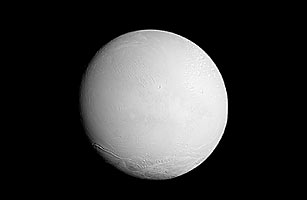 Shortly after that, NASA announced that the moon of Enceladus did indeed have its own ocean. Named the Enceladan Ocean, this natural body of water has been known about for some time, but what is now known is the water contains carbon dioxide, carbon monoxide, potassium salts and other organic materials. On top of that, it is now understood that it is situated above some volcanic jets, which means the water is most likely warm. Warm water, combined with organic minerals, makes the Enceladan Ocean a good candidate for life!
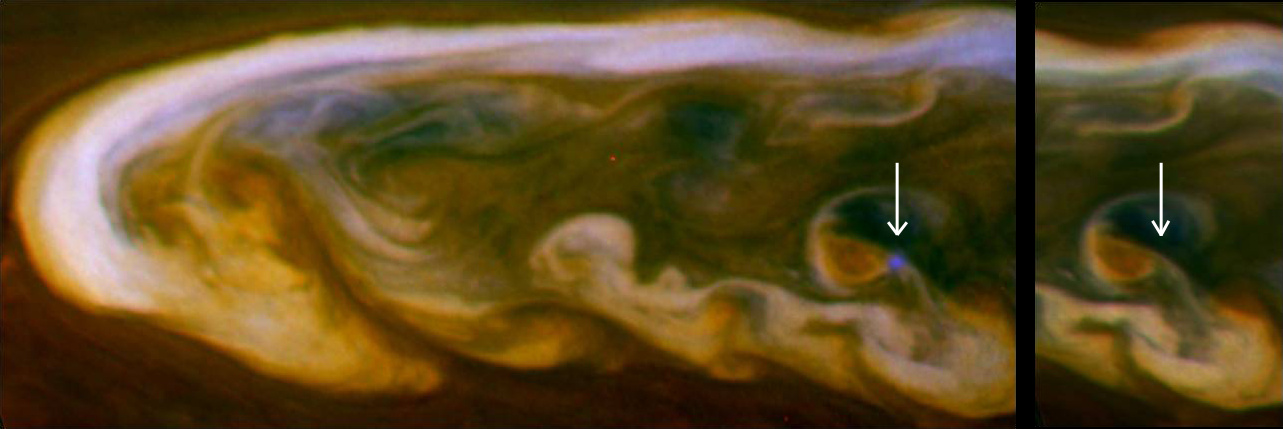 And then, in late July, images released by NASA showed that Cassini also caught a glimpse of a thunderstorm happening on Saturn’s surface. As all residents of Earth will surely agree, a thunderstorm is an impressive sight to behold. Especially when it’s seen happening on another planet! Apparently, what made this sighting most impressive was that it was visible on Saturn’s day side – aka. in broad daylight – from a range of 4.5 million km (2 million miles). That’s one humungous light show!

And less than a week ago, more information emerged as a result of the Cassini space probe, this time in relation to Saturn’s moon of Iapetus. After getting a good glimpse of the moon, scientists at NASA have determined that it is home to the largest ice avalanches in the Solar System, and is rivaled only by Mars. Take that Mount Everest! You too Olympus Mons!
 Already, scientists had Iapetus pegged as the most intriguing moon in the Solar System. For starters, it has a Ying-Yang color pattern, looks like an inverted Death Star (check that image, no Photoshopping!), and has a long ridge running almost perfectly along Iapetus’ equator, a feature which earned it the nickname “the walnut moon”. I guess it wasn’t happy with just that, it also wanted to be the most dangerous place to downhill ski!
And you thought Jupiter did some badass things. Well, it does. But judging from all these findings, Saturn is going to be a pretty happening place someday. I can envision settlements on Titan, skiing on Iapetus, and terraforming on Dione. And for those who like to sight-see, there will be shuttle services that take you to the dark side of Saturn to witness the light show from space. Ooooh, I got goose bumps!
Via: BBC, IO9, Nature Geoscience, CICOPS, Time Science, and NASA

 Stories by Williams