News from Space: New Horizons Passes Neptune

new-horizons-neptuneIt certainly has been a momentous few weeks for space exploration! Between the final weeks of August and the month of September, we’ve seen the Curiosity rover reach Mount Sharp, the Rosetta spacecraft created the first full map of a comet’s, the completion of the Orion space module, and the MAVEN orbiter reach Martian orbit. And before the month is out, India’s Mars Orbiter Mission (MOM) will also arrive in orbit around the Red Planet.

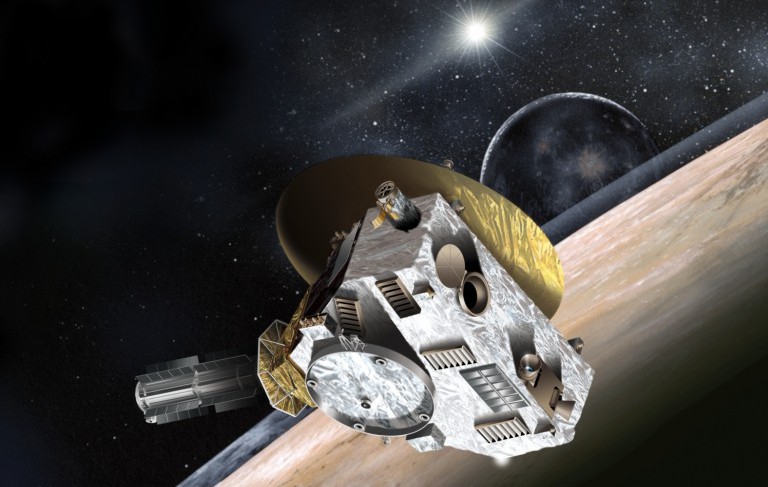
Despite all these developments, that occurred (relatively) close to home, there was even more news to be had, coming all the way from the edge of the Solar System no less. At the tail end of August, NASA announced that the New Horizons space probe passed Neptune orbit and is on its way to Pluto. Launched back in 2006 for the purpose of studying the dwarf planet, the probe is expected to arrive on July 14th of next year.

new-horizons-neptune-8NASA says that the the craft passed the Neptunian orbit at 10:04 pm EDT on Monday August 25th, which coincided with the 25th anniversary of Voyager 2’s flyby of Neptune in 1989. But where Voyager came within 4,950 km (3,080 mi) of the gas giant, the New Horizons craft passed by at a distance of 3.96 billion km (2.45 billion mi). The spacecraft is now almost 4.42 billion km (2.75 billion mi) from Earth, and is the fastest man-made object ever sent into space.

Nevertheless, New Horizons’ Long Range Reconnaissance Imager (LORRI) was still able to capture images of Neptune and its giant moon Triton. As you can see from the image below, Neptune appears as the large white disc in the middle, while Triton is the small black dot passing in front and sitting slightly to the ride. NASA says that Triton may be very similar to Pluto and the information gathered by Voyager 2 may prove helpful in the coming encounter.

new_horizons_plutoRalph McNutt of the Johns Hopkins University Applied Physics Laboratory.

There is a lot of speculation over whether Pluto will look like Triton, and how well they’ll match up. That’s the great thing about first-time encounters like this – we don’t know exactly what we’ll see, but we know from decades of experience in first-time exploration of new planets that we will be very surprised.

The first mission in NASA’s New Frontiers program, the New Horizons mission was launched on January 19, 2006 atop an Atlas V rocket from Cape Canaveral, Florida. It broke the record for the fastest man-made object on lift off with a speed of 58,536 km/h (36,373 mph). The 478 kg (1,054 lb) spacecraft was sent on a 9.5-year mission to fly by Pluto – a distance so far that radio signals from the nuclear-powered probe take four hours to reach Earth.

new-horizons-neptune-7Sent on a slingshot trajectory using the gravitational pull of Jupiter, which tacked on another 14,480 km/h (9,000 mph) to its speed, New Horizons will pass Pluto in July of next year at a distance of 13,000 km (8,000 mi). After this encounter, it will continue on out of the Solar System, during which it will be in the distant Kuiper belt studying one or more Kuiper belt objects (KBOs).

Though this will still not rival Voyager 1’s accomplishments, which left our Solar System last year, New Horizons promises to gather far more information on the Outer Solar System and what lies beyond. All of this will come in mighty handy when at last, humanity contemplates sending manned missions into deep space, either to Alpha Centauri or neighboring exoplanets.

Sources: gizmag.com, nasa.gov

News from Mars: MAVEN Orbiter Arrives!

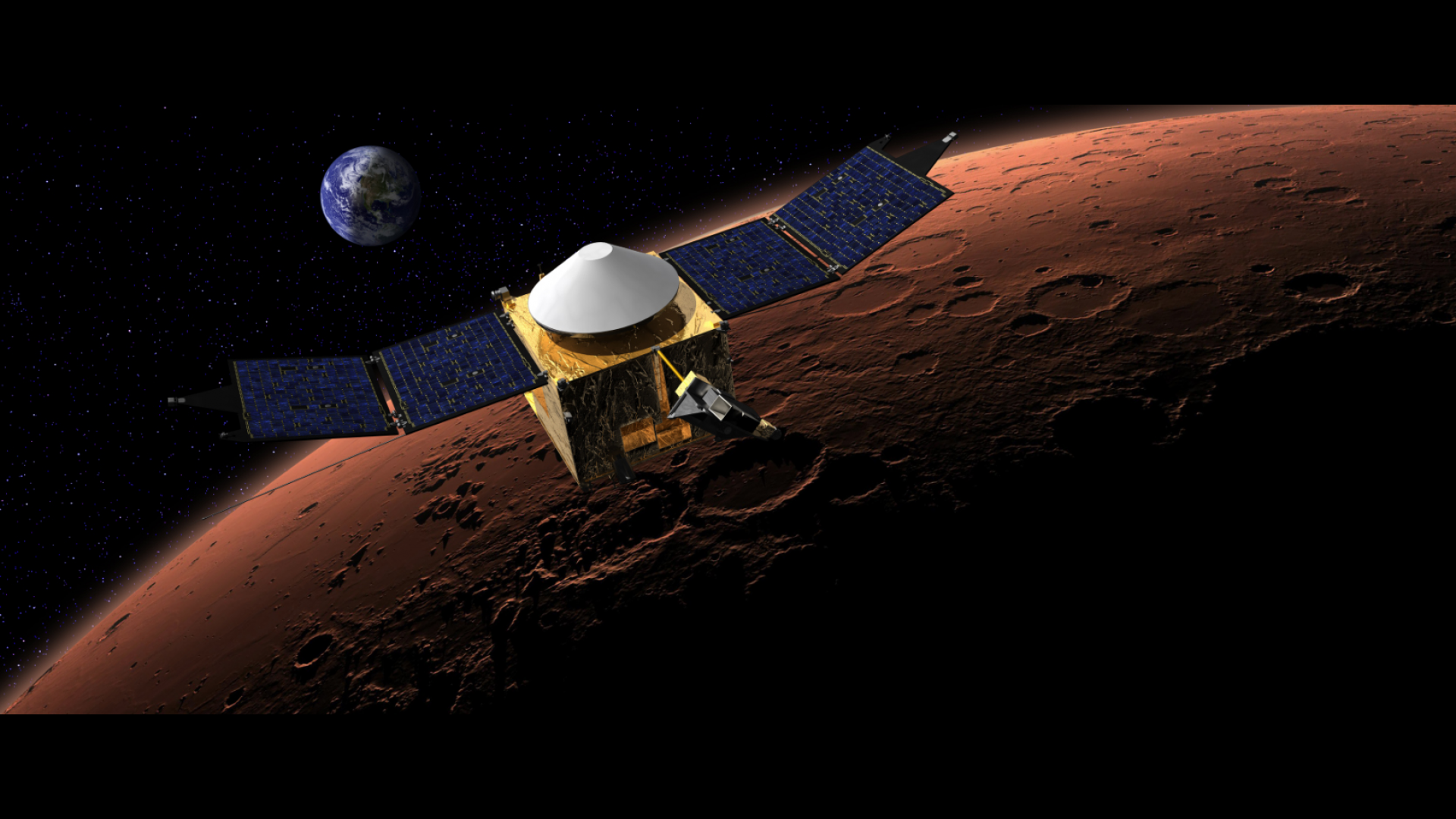
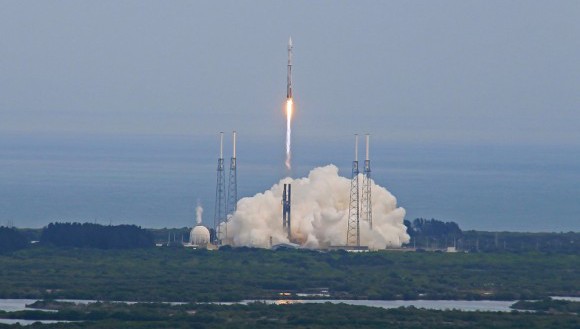
maven_tv_backdropIn November 2013, NASA launched the Mars Atmosphere and Volatile Evolution (MAVEN) space probe from Cape Canaveral. Described as a “time machine” for Mars, the orbiter would spend the next ten months traversing space, assuming an orbit around the Red Planet, and look for an answer as to how Mars went from being a planet with an atmosphere and water to the dried out husk that we know today.

And this evening, after trekking some 711 million kilometers (442 million-mile) across our Solar System, MAVEN will have arrived in orbit around Mars and will begin its year-long mission to study the planet’s upper atmosphere. The arrival will be broadcast live, courtesy of NASA TV and Space.com. The live webcast will run from 9:30 p.m. to 10:45 p.m. EDT (0130 to 0245 GMT), and if all goes well, MAVEN will enter orbit around Mars at 9:50 p.m. EDT (0250 GMT).

maven_launchAs David Mitchell, NASA’s MAVEN project manager at the Goddard Space Flight Center in Greenbelt, Maryland, said in a statement:

So far, so good with the performance of the spacecraft and payloads on the cruise to Mars. The team, the flight system, and all ground assets are ready for Mars orbit insertion.

Though plans to study Mars’ atmosphere in detail have been in the works for years, the MAVEN program received a big push from the ongoing efforts from the Curiosity rover. During its ongoing mission to study the surface of Mars, Curiosity was able to confirm that Mars had extensive surface water billions of years ago. This revelation came very early in the mission, and indicated some rather interesting things about Mars’ past.

Mars-snow-header-640x353For instance, although Mars is now too cold for flowing water today, it might have had a thicker atmosphere in the past that warmed its surface and allowed the liquid to remain stable on the surface. And while scientists have a pretty good idea how it was lost (i.e. too far our Sun, too low a gravity field), the rate of loss and when it disappeared are just some of the questions that MAVEN will attempt to answer.

Much of what scientists know about Mars’ upper atmosphere comes from just a few minutes’ worth of data from the two Viking landers that took measurements as they made their way to the Martian surface in the 1970s. This time around, NASA will be able to collect data for an entire year, gathering far more data than either the Viking landers or any other spacecraft has since had the opportunity to do.

maven_atmo1As Bruce Jakosky, the mission’s principal investigator at the University of Colorado, Boulder’s Laboratory for Atmospheric and Space Physics, explained it:

The MAVEN science mission focuses on answering questions about where did the water that was present on early Mars go, about where did the carbon dioxide go. These are important questions for understanding the history of Mars, its climate, and its potential to support at least microbial life.

NASA scientists understand that Mars’ upper atmosphere acts as an escape zone for molecules floating dozens of miles from the planet’s surface. They theorize that as the solar wind hits the atmosphere, the radiation strips away the lighter molecules and flings them into space forever. To test this hypothesis, MAVEN will be examining the state of Mars’ upper atmosphere, and ionosphere to determine its interactions with the solar wind.

maven_atmosphereIn so doing, NASA hopes to determine what the current rates of escape are for neutral gases and ions, and thus get a better picture of how long it took for the atmosphere to degrade and when it began degrading. The upper atmosphere of Mars likely changes as the sun’s activity increases and decreases, which is why MAVEN investigators hope to run the mission for longer than a year.

MAVEN will began making science measurements around Nov. 8, due to it taking a short break from its commissioning phase to watch Comet Siding Spring pass close by on Oct. 19. The $671 million MAVEN spacecraft is one of two missions that launched toward Mars last November and which are making their arrival this month. The other probe is India’s Mars Orbiter Mission, which launched just before MAVEN and will arrive at the Red Planet this Wednesday (Sept. 24).

It is an exciting time for space exploration, and the coming years are sure to be characterized by an escalating and accelerating rate of learning. Be sure to head on over to Space.com to watch the arrival broadcast live. And be sure to check out the following videos – the Mars Arrival trailer; NASA Goddard Center’s “Targeting Mars” video; and the NASA MAVEN PSA, hosted by LeVar Burton:

MAVEN Mars Arrival Trailer:


Targeting Mars:


LeVar Burton Shares MAVEN’s Story:


Sources:
space.com, (2), nasa.gov

News from Mars: Soil Good for Growing!

Mars_GreenhouseWith numerous plans for a manned mission to Mars, some of which are scheduled to one-way settlement projects, the question of how and what people on Mars will eat is an important one. What will the Martian diet look like? How will they grow their food? Will it people subsist on endless supplies of freeze-dried rations, or will they get all the veggies, fruits and protein they need from hydroponic produce?

Well, according to Dutch ecologist Wieger Wamelink, the Martian settlers might just be able to grow their food in the local soil. In a series of experiments using soil tailored to fit extra-terrestrial environments, Wamelink was able to make a mustard seed sprout. The soil was provided by NASA, a sample which they had collected from the desert, dried out, and cleansed of certain nutrients that’s meant to replicate what Martian and lunar soil would be like.

martian_plantWamelink had ordered more than 100 pounds of each type to his research greenhouse in the Netherlands to see what kinds of plant life might prosper in greenhouses on other planets. He and his team planted tomato seeds, stinging nettle, carrots, rye, and a host of other wild species in the soils in a series of 840 pots, then published their results in PLOS One late last month.

As Wamelink, who works for the Alterra Institute at the University of Wageningen, explained:

I think we’re really the first to do that. We have looked at how plants see what [nutrients are] available in these soils, and it was unknown to NASA. They were very happy when we sent our results.

MarsGreenhouse2What was perhaps most impressive about the results was how well some plants fared in the imitation Mars soil. Some seeds germinated after just 24 hours and flowered within 50 days, something Wamelink had never expected. He knew that nitrogen might not be available in alien soils, but when he analyzed the Martian soil compared to nutrient-poor sand from the banks of the Rhine, he found that Mars actually had much more going for it than he thought.

The Martian atmosphere contains nitrogen, and gusts of gases from the sun charge the nitrogen into a form that is digestible for plants. The planet also contains phosphorus, ammonium, and nitrates – all essential for plant growth. Field mustard and a tough, wild Dutch species called “reflexed stone crop” produced some of the best results. Lunar soil, by contrast, didn’t provide very friendly turf for earthling plant species.

apollo_11_bootprint-e1405838911229Soil on the moon is thin, dusty, and full of aluminum and other heavy metals. Martian soil also contains lots of heavy metals, but it is aluminum that most plants don’t do too well in the presence of. So for the time being (or rather, if and when we settle the Moon), Lunar greenhouses will have to look to imports of Earth soil while Martian settlers can simple scoop the soil they need from outside their airlocks.

However, there are a few snags. For starters, even though Wamelink’s study provided some of the first evidence that species of Earth plants can grow on planets other than Earth, it still doesn’t show how eating those plants might affect humans. The Martian surface experiences lots of radiation, and eating radioactive plants full of heavy metals might not be the best idea for the human digestive system.

mars_growopNevertheless, Wamelink believes that some aspects of the Martian climate might actually be beneficial for plant growth. On a planet with a third of the gravitational pull of Earth, he suspects that plants might be able to grow taller than they ever would on their home planet. In his mind’s eye, he pictures plants encased in skyscraper Martian greenhouses. Alas, not all scientists agree with him, and he admits its an unresolved issue.

Still, its an exciting one that is loaded with potential. And who’s to say that after a little processing and decontamination, Martian soil would have everything the settlers need to grow their own food? The very fact that it is being considered and examined so seriously shows our commitment to making an enduring human presence on Mars a reality someday. And as that day get’s closer, more and more questions are likely to be addressed.

terraformingAnd figuring out how to grow our own crops in Martian soil will provide inevitable feedback on how we could use Earth plants to one day convert the ecology of the Red Planet and make it into something a little more suited to full-scale habitation. Who knows? In a few centuries time, Red Mars may become Green Mars. And perhaps even Blue Mars. Oh, Kim Stanley Robinson, you daring dreamer, you!

Source: fastcoexist.com

The Future of Flight: Hybrid-Electric VTOL Aircraft

nasa-greased-lightning-10-foot-drone-640x480It may look like something a dedicated hobbyist built, and sound like something cheekily named, but NASA’s new electrical vertical take-off and landing (VTOL) machine is a very serious venture. Known as the GL-10 Greased Lightning, this unmanned hybrid-electric aircraft is the agency’s proposal for a vehicle that one day replace the reigning champion of VTOL – the helicopter.


The G-10 is in part the result of the recent strides made in electric propulsion, which is made possible thanks to the growing power and energy density of batteries allows for some very efficient hybrid-electric aircraft designs. With eight prop engines mounted on the two main wings and another two mounted on the tail, the vehicle swivels them into vertical position for takeoff and landing, and then horizontal for conventional flight.

nasa-greased-lightning-prototype1While it’s not particularly hard to create an aircraft capable of VTOL, it has so far proven to be very tough to create an aircraft that can also efficiently cruise through the air after taking off vertically. The helicopter is the only common example of a VTOL aircraft that can also cruise acceptably, but at a cost. Compared to other aircraft, an everyday helicopter has a much lower-lift-drag ratio, which means it burns more fuel, has less range and can carry less weight.

However, electric propulsion allows for much more efficient designs, since vehicles no longer have to accommodate large fossil fuel-powered engines or manage the mechanical stress across the airframe. Instead, they can rely on smaller, more efficient, optimally placed electric motors, and without the mechanical complexity of big jet engines, it suddenly becomes a lot easier to have wings and propellers that can swivel between horizontal and vertical.

https://i0.wp.com/www.extremetech.com/wp-content/uploads/2014/08/nasa-greased-lightning-ground.jpgWhile pure-electric aircraft do exist – in the form of quadcopters – hybrid-electric designs with longer range are generally of more interest to military and commercial groups. In the case of NASA’s Greased Lightning, there are two small diesel engines in the body of the aircraft that turn electric alternators that constantly recharge the lithium batteries. This theoretically gives the GL-10 the same range and duration as a modern plane alongside its VTOL capability.

Interestingly, NASA also says that such a hybrid-electric design is “scale free” — meaning the same principles could be used to revolutionize everything from helicopters, to military UAVs, to massive jetliners. Much like hybrid-electric cars, the concept is set to revolutionize an entire fleet of aircraft designs that could be far more efficient than they currently are. One party who is sure to be interested in the possibilities is the US military, with its ever growing fleet of UAVs.

For now, Greased Lightning only has a wingspan of 3 meters (10 feet), and on its first test flight  – which took place on National Aviation Day, August 19 – it was tethered. Untethered flights are planned for later in the year, an event which is sure to be a media sensation and produce some viral videos!


Source: extremetech.com

News from Space: Orion Spacecraft Completed

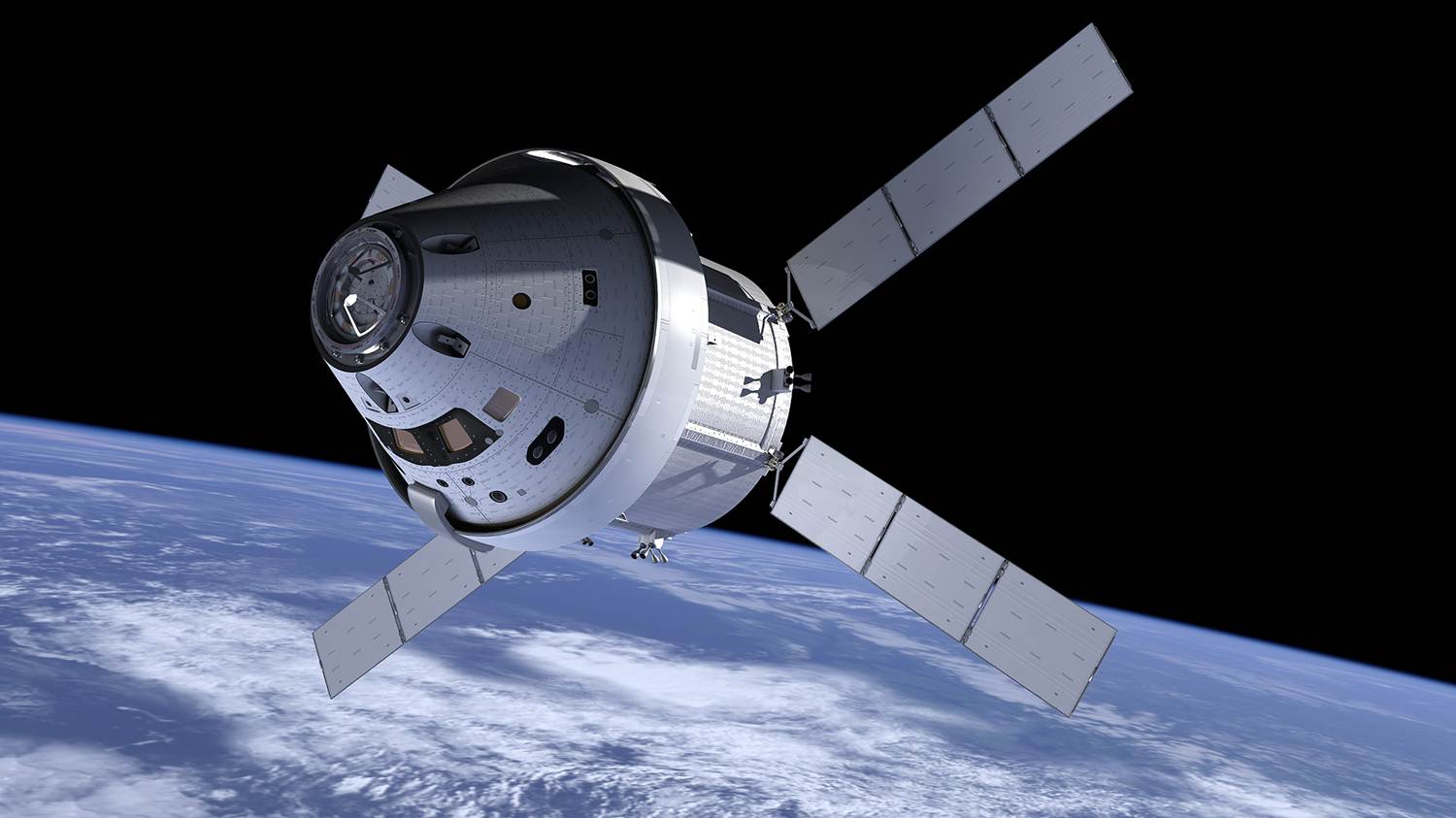
orion_arrays1NASA’s return to manned spaceflight took a few steps forward this month with the completion of the Orion crew capsule. As the module that will hopefully bring astronauts back to the Moon and to Mars, the capsule rolled out of its assembly facility at the Kennedy Space Center (KSC) on Thursday, Sept. 11. This was the first step on its nearly two month journey to the launch pad and planned blastoff this coming December.

Orion’s assembly was just completed this past weekend by technicians and engineers from prime contractor Lockheed Martin inside the agency’s Neil Armstrong Operations and Checkout (O & C) Facility. And with the installation of the world’s largest heat shield and the inert service module, all that remains is fueling and the attachment of its launch abort system before it will installed atop a Delta IV Heavy rocket.

Orion-at-KSC_Ken-KremerThe unmanned test flight – Exploration Flight Test-1 (EFT-1) – is slated to blast off on December 2014, and will send the capsule into space for the first time. This will be NASA’s first chance to observe how well the Orion capsule works in space before it’s sent on its first mission on the Space Launch System (SLS), which is currently under development by NASA and is scheduled to fly no later than 2018.

The Orion is NASA’s first manned spacecraft project to reach test-flight status since the Space Shuttle first flew in the 1980s. It is designed to carry up to six astronauts on deep space missions to Mars and asteroids, either on its own or using a habitat module for missions longer than 21 days. The development process has been a long time in the making, and had more than its share of bumps along the way.

Orion-at-KSC_Ken-Kremer1As Mark Geyer, Orion Program manager, explained:

Nothing about building the first of a brand new space transportation system is easy. But the crew module is undoubtedly the most complex component that will fly in December. The pressure vessel, the heat shield, parachute system, avionics — piecing all of that together into a working spacecraft is an accomplishment. Seeing it fly in three months is going to be amazing.

In addition to going to the Moon and Mars, the Orion spacecraft will carry astronauts on voyages venturing father into deep space than ever before. This will include going to the Asteroid Belt, to Europa (to see if there’s any signs of life there), and even beyond – most likely to Enceladus, Titan, the larger moons of Uranus, and all the other wondrous places in the Solar System.

oriontestflightThe two-orbit, four and a half hour EFT-1 flight will lift the Orion spacecraft and its attached second stage to an orbital altitude of 5,800 km (3,600 miles), about 15 times higher than the International Space Station (ISS) – and farther than any human spacecraft has journeyed in 40 years. It will be an historic occasion, and constitute an important step in what is sure to be known as the Second Space Age.

And be sure to watch this time-lapse video of the Orion Capsule as it is released from the Kennedy Space Center to the Payload Hazardous Servicing Facility in preparation for its first flight:


Sources:
gizmag.com, universetoday.com

News from Space: Rosetta Maps Comet Surface

Rosetta_and_Philae_at_cometLast month, the European Space Agency Rosetta’s space probe arrived at the comet known as 67P/Churyumov–Gerasimenko, thus becoming the first spacecraft to ever rendezvous with a comet. As it continues on its way to the Inner Solar System, Rosetta’s sensing instruments have been studying the surface in detail in advance of the attempted landing of it’s Philae probe.

Because of this, Rosetta has been able to render a map of the various areas on the surface of the comet, showing that it is composed of several different regions created by a range of forces acting upon the object. Images of the comet’s surface were captured by OSIRIS, the scientific imaging system aboard the Rosetta spacecraft, and scientists analyzing them have divided the comet into several distinct regions, each characterized by different classes of features.

rosettamap-1All told, areas containing cliffs, trenches, impact craters, rocks, boulders and parallel grooves have been identified and mapped by the probe. Some of the areas that have been mapped appear to be caused by aspects of the activity occurring in and around the nucleus of the comet, such as where particles from below the surface are carried up by escaping gas and vapor and strewn around the surface in the surrounding area.

So detailed are these images that many have been captured at a resolution of one pixel being equal to an area of 194 square centimeters (30 square inches) on the comet surface. Dr. Holger Sierks, OSIRIS’ Principal Investigator from the Max Planck Institute for Solar System Science, puts it into perspective:

Never before have we seen a cometary surface in such detail. It is a historic moment – we have an unprecedented resolution to map a comet… This first map is, of course, only the beginning of our work. At this point, nobody truly understands how the surface variations we are currently witnessing came to be.

Rosetta_and_Philae_at_comet_node_full_imageThe newly-generated comet maps and images captured by the instruments on Rosetta will now provide a range of detail on which to finalize possible landing sites for the Philae probe to be launched to the surface . As such, the Rosetta team will meet in Toulouse, France, on September 13 and 14 to allocate primary and backup landing sites (from a list of sites previously selected) with much greater confidence.

At the same time, Rosetta has revealed quite a bit about the outward appearance of the comet, and it aint pretty! More often than not, comets are described as “dirty snowballs” to describe their peculiar composition of ice and dust. But Rosetta’s Alice instrument, which was installed by NASA, has sent back preliminary scientific data that shows that the comet is more akin to a lump of coal.

Rosetta_Artist_Impression_Far_625x469Alice is one of eleven instruments carried aboard Rosetta and one of three instrument packages supplied by NASA for the unmanned orbiter. Essentially, it’s a miniature UV imaging spectrograph that looks for thermal markers in the far ultraviolet part of the spectrum in order to learn more about the comet’s composition and history. It does this by looking specifically for the markers associated with noble gases, such as helium, neon, argon, and krypton.

The upshot of all this high-tech imaging is the surprising discovery of what 67P/Churyumov-Gerasimenko looks like. According to NASA, the comet is darker than charcoal. And though Alice has detected oxygen and hydrogen in the comet’s coma, the patches of barren ice that NASA scientists had expected aren’t there. Apparently, this is because 67P/Churyumov-Gerasimenko is too far away from the warmth of the sun to turn the ice into water vapor.

rosetta-1Alan Stern, Alice principal investigator at the Southwest Research Institute in Boulder, Colorado, had this to say about the revelation:

We’re a bit surprised at just how unreflective the comet’s surface is and how little evidence of exposed water-ice it shows.

Launched in 2004, Rosetta reached 67P/Churyumov-Gerasimenko by a circuitous route involving three flybys of Earth, one of Mars, and a long detour out beyond Jupiter as it built up enough speed to catch up to the comet. Over the coming months, as the Rosetta spacecraft and comet 67P move further into the solar system and approach the sun, the OSIRIS team and other instruments on the payload will continue to observe the comet’s surface for any changes.

alice-first-findings-3Hence why this mission is of such historic importance. Not only does it involve a spacecraft getting closer to a comet than at time in our history, it also presents a chance to examine what happens to a comet as it approaches our sun. And if indeed it does begin to melt and breakdown, we will get a chance to peer inside, which will be nothing less than a chance to look back in time, to a point when our Solar System was still forming.

Sources: gizmag, (2), jpl.nasa.gov, nasa.gov

News from Mars: Curiosity Arrives at Mount Sharp

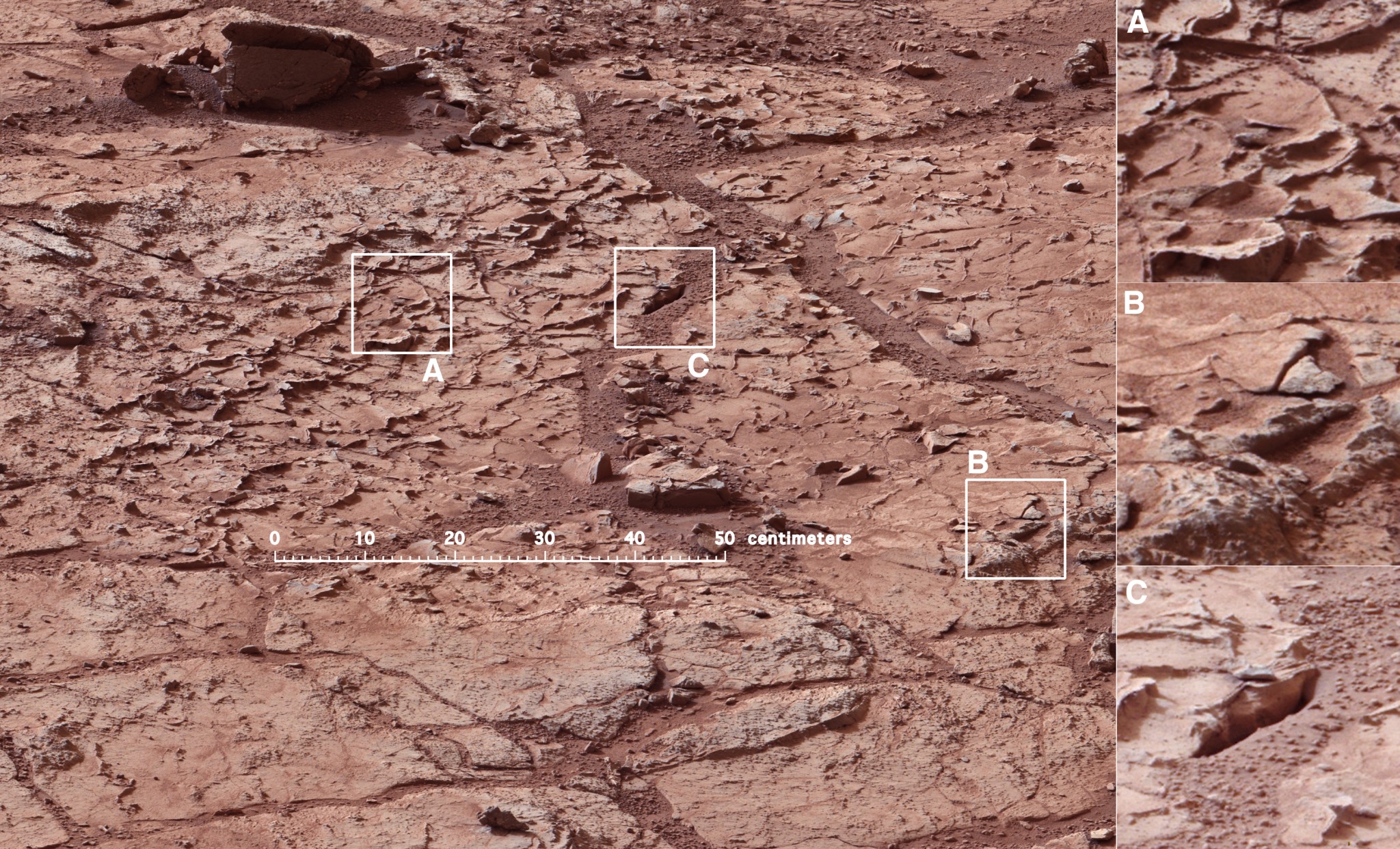
curiosity-mars-self-portrait-crop-640x353After two years exploring the Martian surface, the Curiosity Rover has finally reached its primary science destination – the foot of Mount Sharp, officially known as Aeolis Mons. Now that it’s there, it will begin its ascent of the rock formation, drill into rocks and analyze the different strata in the hopes of learning more about the history of the Red Planet. This is an event a long time in the making, and may prove to yield some of the greatest scientific discoveries ever made.

Located in the heart of the Gale Crater, Mount Sharp is like a layer cake, holding a chronology of past events reaching back billions of years. Because of this, it is an ideal place to find evidence that the Martian surface and atmosphere were once capable of supporting life. It took two years and one month for Curiosity reach the foot of this mountain, which lies some 5500 meters (18,000 feet) above the floor of Gale Crater.

MarsCuriosityTrek_20140911_AThe mountain is the central peak in a crater that measures 154 km/96 miles in diameter and which was formed when a meteor impacted the surface between 3.5 and 3.8 billion years ago. Beyond a certain size, and depending on the gravity of the planet, craters like this all have a central peak. But Mount Sharp represents something much more, otherwise NASA and the Jet Propulsion Laboratory wouldn’t be bothering with it.

Basically, Mars scientists believe that after its creation, the Gale crater was completely filled with sedimentary material from a series of huge floods, or by dust and ice deposits like those that happened at the Martian polar caps. The deposition over 2 billion years left a series sedimentary layers that filled the crater. Following the deposition of the layers, there was a long period of erosion which has finally led to the condition of the crater today.

mountsharp_galecraterThe erosion by some combination of aeolean (wind) forces and water (additional flooding), scooped out the huge crater, re-exposing most of the original depth. However, covering the original central peak are many sedimentary layers of debris. Gale crater’s original central peak actually remains completely hidden and covered by sedimentation. And it is this that attracted scientists with the Curiosity rover to the base of Mount Sharp.

Within the sedimentary layers is a sequential record of the environmental conditions on Mars going back over 2 billion years. While at the base, Curiosity will be able to examine the oldest sedimentary layers; but as it climbs the flanks of the mountain, it will be able to step forward in time. Each layer and its age will reveal information such as how much water was present, whether the water was alkaline or acidic, if there is any organic compounds.

john_klein_curiosity-2The discovery of organic compounds on Mount Sharp could be “Earth shaking”, since the discovery of organics is of very high importance to this mission. Already, over the two year trek, Curiosity has seen numerous signs of the flow of water and sedimentation. Interestingly enough, evidence began to turn up way back in Yellowknife Bay — one of its first destinations, which it visited almost two years ago. But as of yet, signs of organic compounds have remained illusive.

What’s more, Curiosity sadly lacks the necessary equipment to look for evidence of microbial fossils or other signatures of life. Fortunately, the next rover – the Mars 2020 rover – will be equipped with the necessary tools to work out whether Mars ever harbored life. In any case, because of the lack of organic compounds in Yellowknife, NASA decided to continue to Mount Sharp, which is currently the best place to dig up scientific data about Mars’ past.

MSL_TraverseMap_Sol0743-2048Curiosity is currently at the base of Mount Sharp, in a region called the Pahrump Hills, where it will continue on to the Murray Formation. Once there, it will take a drill sample of some rock and then continue up Mount Sharp towards the Hematite Ridge where two drill sites await. This farthest site is about 8 km (5 mi) away from its present position, and Curiosity has driven only 9 km since it landed in 2012. So there’s plenty of trekking and work ahead!

One of the greatest challenges is finding a path that will reduce the stress on Curiosity’s wheels, which have been put through some serious wear and tear in the past two years. Because of this, the rover is being driven in reverse for the time being, and the team is looking the path with the least amount of sharp rocks. However, the Mars Curiosity remains confident that the mobility system will be capable of surviving the ten year life span of the rover’s power supply.

And be sure to check out this “Curiosity Rover Report” that talks about this historic accomplishment, courtesy of NASA’s Jet Propulsion Laboratory:

Sources: universetoday.com, extremetech.com, jpl.nasa.gov, space.com

News from Mars: ExoLance Project to Hunt for Life

exolance-2The search for life on Mars has been ongoing, and predates the deployment of the Curiosity rover by many years. However, it is becoming increasingly clear that if signs of life are to be truly found, they won’t turn up by scratching around on the surface. Beyond Curiosity’s own slated inspection of Mount Sharp (where it just arrived!) NASA has some long-range plans that reach deeper.

Outside of NASA’s InSight Lander, which is set to launch in the spring of 2016, there’s Explore Mars’ plan to look for signs of life beneath the surface. A private organization made up technologists and former NASA engineers, their plan is to drop supersonic lances onto the planet that will penetrate deep into the Martian soil to seek out protected, potentially wet strata where life might still exist.

exolanceKnown as ExoLance, the project is designed to take up where the Viking missions of the late 1970s left off. In these first successful Mars landers, there was an experiment on board that looked for signs of life in the Martian soil. This consisted of the Viking lander scooping up soil, depositing it inside the automatic laboratory in the lander, squirted a nutrient solution into the sample, and analyzing the gases given off that might indicate the presence of life.

The Viking experiment did give off gases that seemed like they were due to living organisms, but it later discovered that these were due to chemical reactions due to the extremely dry conditions and constant bombardment of UV radiation. Because of this, NASA has preferred to focus more on geology to gain a better understanding of the Martian environment rather than looking for life directly.

exolance-3But Explore Mars wants to go back to the direct approach by combining an experiment similar to the Viking lab with a delivery system based on the US Air Force’s bunker-buster weapons. They also hope to incorporate technology developed for the Curiosity rover, which includes reusing the aeroshell that protected the Curiosity rover as it made its descent to the Martian surface in 2012.

When the shell reaches Mars, it will open up to reveal a delivery vehicle similar to the Skycrane that delivered Curiosity to the surface by hovering under rocket power while it winched the lander down. In the case of the ExoLance, the vehicle – which is appropriately called a Quiver – will hover in place. But instead of lowering a rover, it will fire multiple penetrator probes at the ground.

exolance-1These perpetrators, called Arrows, are small, lightweight versions of the bunker-buster bombs that were developed by the US forces during the 1991 Gulf War. However, instead of exploding, the Arrows will strike the surface at supersonic speeds to bore deep into the ground and (similar to NASA’s Deep Space 2 probe) split in two to deploy a cache of scientific equipment packed into the nose.

While the tail section remains on the surface to act as a transmitter back to Earth, the nose bores about 5 m (16 ft) into the surface to find protected layers that may contain water, but which are shielded against the deadly surface radiation. Once in position, the Arrow activates its experiment, which is designed to not only detect signs of living organisms, but also to determine if the life signs are those of microbes similar to those found on Earth, or have a completely different origin.

exolance-4The mission is the subject of an Indiegogo crowdfunding campaign aimed at raising US$250,000. The group says that within a year of raising its Indiegogo funding, it would develop and build Arrow prototypes and test them in the Mojave Desert by dropping them from aircraft. The idea is not only to see if the experiments can survive the impact, but also to make sure that the penetrators don’t dig in too deep or too shallow.

In addition, the group expects the design to change as they deals with problems, such as the volume of the cylinder, batteries, deploying the tether linking the two segments, and making sure the components can withstand the impact. In the second year, the group plans to enact Phase II, which would concentrate on developing the microbial experiments. If this is successful, they plan to approach NASA or commercial companies to arrange delivering ExoLance to Mars.

The crowdfunding campaign will run until September 29th, and has raised a total of $15,680 of their projected goal. To check out this campaign, or to contribute, click here. And be sure to check out Explore Mars’ promotional video below:


Source:
gizmag.com, exploremars.org, indiegogo.com

News from Space: Space Launch Systems Good to Go!

SLS_goNASA’s Space Launch System, the US’s first exploration-class spacecraft since the Space Shuttle, is a central component in the agency’s plan to restore its ability to independently launch missions into space. An after a thorough review of cost and engineering issues, NASA managers formally approved the mammoth rocket past the whiteboard formulation stage and moved it into full-scale development.

As the world’s most powerful rocket ever built and is intended to take astronauts farther beyond Earth into deep space than ever before possible. This includes the first-ever manned mission to Mars, the Asteroid Belt, and perhaps other planets and moons throughout the Solar System as well. The first SLS mission should lift off no later than 2018, sending the Orion capsule around the Moon, with asteroid and Mars-bound missions following after 2030 or 2032.

Space_Shuttle_Atlantis_launchNASA began the SLS’s design process back in 2011. Back then, the stated goal was to try and re-use as many Space Shuttle components and get back into deep space as quickly and as cost effectively as possible. But now that the formulation stage has been completed, and focus has shifted to actually developing and fabricating the launch system’s millions of constituent components, what kind of missions the SLS will be capable of has become much clearer.

At a press briefing that took place at their Operations Mission Directorate in Washington, Aug. 27th, NASA officials shared  details about the maiden test launch. Known as EM-1, the launch is targeted for November 2018 and will involve the SLS  carrying an uncrewed Orion spacecraft on a journey lasting roughly three weeks that will take it beyond the Moon to a distant retrograde orbit.

Orion_with_ATV_SMPreviously NASA had been targeting Dec. 2017 for the inaugural launch from the Kennedy Space Center in Florida. But the new Nov. 2018 target date has resulted from the rigorous assessment of the technical, cost and scheduling issues. The decision to move forward with the SLS comes after a wide ranging review of the technical risks, costs, schedules and timing known as Key Decision Point C (KDP-C).

As Associate Administrator Robert Lightfoot, who oversaw the review process, said at the briefing:

After rigorous review, we’re committing today to a funding level and readiness date that will keep us on track to sending humans to Mars in the 2030s – and we’re going to stand behind that commitment. Our nation is embarked on an ambitious space exploration program. We are making excellent progress on SLS designed for missions beyond low Earth orbit. We owe it to the American taxpayers to get it right.

spaceX-falcon9The SLS involved in the test flight will be configured to its 70-metric-ton (77-ton) version. By comparison, the Saturn V — which took NASA astronauts to the Moon — had a max Low-Earth Orbit (LEO) payload capacity of 118 metric tons, but it has long since been retired. SpaceX’s Falcon Heavy, which is a much smaller and cheaper rocket than the SLS, will be able to put 55 metric tons into LEO.

With the retirement of the Space Shuttle, there aren’t really any heavy lift launchers in operation. Ariane 5, produced by commercial spacecraft manufacturer Arianespace, can only do 21 metric tons to LEO, while the Delta IV (United Launch Alliance) can do 29 metric tons to LEO. In short, NASA’s Space Launch System should be by far the most powerful operational rocket when it arrives in 2017-2018.

CST_Main_Header2-process-sc938x350-t1386173951SpaceX could decide to scale-up the Falcon Heavy, but the rocket’s main purpose is to compete with United Launch Alliance and Arianespace, which currently own the incredibly lucrative heavy lift market. A payload capacity of 55 tons is more than enough for that purpose. A capacity of 150 tons is only for rockets that are intended to aim at targets that are much farther than geostationary orbit — such as the Moon, Mars or Europa.

The SLS’s primary payload will be the Orion Multi-Purpose Crew Vehicle (MPCV), though it will undoubtedly be used to send other large spacecraft into deep space. The Orion capsule is what NASA will use to land astronauts on the Moon, captured asteroids, Mars, and any other manned missions throughout the Solar System. The first manned Orion launch, to a captured asteroid in lunar orbit, is scheduled to occur in 2021.

mars_roverCombined with SpaceX’s crewed Dragon spacecraft, Boeing’s CST-100, and a slew of crowd-funded projects to place boots on Mars and Europa in the next few decades, things are looking up for human space exploration!

Source: universetoday.com, extremetech.com

News from Mars: Beam Me to Mars

marsIn the latest ambitious plan to make space exploration accessible to the general public, Uwingu has unveiled a new campaign where people can send messages and pictures to the Red Planet. It’s called “Beam Me to Mars”, and the company is inviting people to contribute, for a fee, to a “digital shout-out” that will send messages from Earth to Mars on Nov. 28 — the 50th anniversary of Mars exploration.

The first successful Mars mission, NASA’s Mariner 4 – launched on Nov. 28, 1964 – performed the first flyby of the Red Planet and returned the first pictures of the Martian surface. This was the first time that images were captured of another planet and returned from deep space. and their depiction of a cratered, seemingly dead world largely changed the view of the scientific community on life on Mars.

beam-me-to-mars-uwinguAccording to representative from Uwingu, “Beam Me to Mars” celebrates that landmark effort in a new and original way by inspiring people to get on board with Martian exploration. Other goals include raising lots of money to fund space science, exploration and education (Uwingu’s stated chief purpose) and letting policymakers know how important space exploration is to their constituents.

As CEO Alan Sterm, a planetary scientist and former NASA science chief, said in an interview with Space.com:

We want it to inspire people. There has never been an opportunity before for people of Earth to shout out across the solar system their hopes and wishes for space exploration, for the future of mankind — for any of that… We want to make an impression on leaders. The more messages, the bigger impression it makes. If this thing goes viral, and it becomes the thing to do, then it’ll make a huge impression.

ESO2For $4.95, people can beam their name (or someone else’s) to Mars, whereas $9.95 gets people a chance to beam a name and a 100-character message. $19.95 gets a 1,000-character note instead of the shorter one, and for those willing to spend $99 will be able to send their name, a long message and an image of their choosing. All messages submitted for “Beam Me to Mars” will also be hand-delivered to Congress, NASA and the United Nations.

Submissions must be made via uwingu.com by Nov. 5. And the company – whose name means “sky” in Swahili – and its transmission partner, communications provider Universal Space Network, will use radio telescopes to beam the messages at Mars on Nov. 28 at the rate of 1 million bits per second. The transmission, traveling at the speed of light, will reach the Red Planet on that day in just 15 minutes.

mariner-4-poster-art.enFor comparison, it took Mariner 4 more than seven months to get to Mars a half-century ago. The probe didn’t touch down, but its historic flyby in July 1965 provided the first up-close look at the surface of another planet from deep space. Mariner 4’s observations revealed that Mars is a dry and mostly desolate world, dashing the hopes of those who had viewed it as a world crisscrossed by canals and populated by little green men.

Already, several celebrities have signed on to the campaign, including actors Seth Green and wife Clare Grant, George (“Sulu”) Takei of Star Trek fame and his husband Brad, Bill Nye “The Science Guy”, astronaut and former ISS commander Chris Hadfield, commercial astronaut Richard Garriott, former NASA senior executive Lori Garver, Pulitzer winning author and playwright Dava Sobel, and Author and screenwriter Homer Hickam.

Uwingu-CelebritiesThis is not the first Mars effort for Uwingu, which was founded in 2012. In February, the company launched its “People’s Map of Mars,” asking the public to name Red Planet landmarks for a small fee. To date, people have named more than 12,000 Mars craters, and Uwingu has set aside more than $100,000 for grants. And when it comes to getting the general public involved with space science and travel, they are merely one amongst many. The age of public space exploration is near, people!

Sources: space.com, uwingu.com, (2)