Happy Canada Day!

Hello and welcome to my Canada Day post! As it is the True North’s national birthday – commemorating the day when the original provinces came together and agreed on Confederation, the first act of national building and quasi-declaration of independence – I thought it fitting that I do a post honoring Canada’s contribution to the field of science fiction. The list is extensive, contrary to what you might you think, and includes some of the most critically acclaimed examples of literature, film and television in this genre. But like most things Canadian, it suffers from a potential lack of recognition. Well, I, as a patriotic (but not nationalistic!) individual, shall do my part to promote. Hell, one day I want to be on this list, so I better make sure people know about it 😉

First up, movies that were filmed, directed and produced right here in Canada, eh!

Scanners (1981):
This film, directed by David Cronenberg, is considered a cult classic amongst fans of sci-fi and horror alike. In this movie, “Scanners” are people that exhibit powerful telepathic and telekinetic abilities who are being sought out by a corporation named ConSec, a purveyor of weapons and security systems. Ostensibly, their purpose is to register scanners so the public can be protected from them, but it is clear that they have a nefarious agenda as well.

The story revolves around two rogue scanners, the dangerous Darryl Revok (played by Michael Ironside) and the reclusive Cameron Vale (Stephen Lack). After a “demonstration” goes terrible wrong where Revok causes Dr. Ruth – head of ConSec’s scanner section – to explode, ConSec becomes dedicated to finding all rogue scanners and stamping them out. On their radar is Revok, a known and powerful scanner who is a homeless transient, moving from place to place in the hopes of staying ahead of corporate spies.

In the end, Vale finds himself trapped between Revok’s renegade faction on the one side and ConSec’s goons on the other. In the end, he is captured by Revok and learns that they are brothers, that Ruth is their father, and that all scanners are the result of drug trials involving pregnant women and ephemerol. This drug, which was designed to combat morning sickness (echoes of thalidomide), is the same one which they now use to control scanners.

Revok’s plan is to now use a captured shipment of the drug and administer it to countless pregnant women worldwide, thus creating an army of scanners. When he learns of this, Vale and Revok begin to fight each other using their powers. In the end, Vale defeats his brother and then assumes his likeness, thus putting him in charge of the rogue scanners. The story thusly ends on a cliffhanger note, with Vale’s intentions open to speculation.

This movie was not only a cult classic, but very heavily inspired. It’s investigation of psychic abilities, with corporate controllers, rogue telepaths, and drugs used to control them, would all show up in later franchises, particularly Babylon 5. In addition, that head exploding scene is considered an iconic imagine, one which has been referenced many times over on the silver screen. Consider the line from Wayne’s World where Garth appears to be having a nervous breakdown on TV and one of their cronies asks: “Did you see that movie Scanners where the dude’s head exploded?”

Johnny Mnemonic (1995):
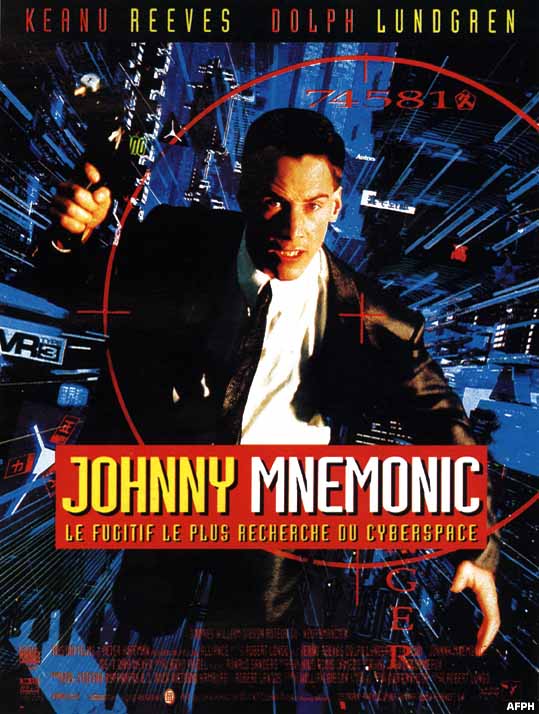
Though it was widely considered one of the worst adaptations in science fiction history, Johnny Mnemonic was nevertheless a faithful representation of William Gibson’s original work (also a Canadian). Set in the “Sprawl” of the 21st century, the story is about a mnemonic courier who uses wetwire implants (i.e. cybernetic brain implants) to carry information around illegally. This is apparently a common practice in the world of the future, where corporate control is absolute and the most precious commodity is information.

Enter into this Johnny (Reaves), a courier who is given a job to carry a package that is twice the size of his capacity. He takes it, knowing the risk it will pose to his brain, because he’s looking for that final payoff which will allow him to have his implants removed and his memory restored. This is something all mnemonic carriers must go through, which is the sacrifice of their own memories in order to make room for all the pirated data they carry.

Quickly, Johnny realizes the package he contains is incredibly valuable, as Yakuza close in and murder his contacts. His own boss betrays him as well, forcing him to turn to a freelance ninja named “Sally Shears” (aka. Molly Millions) for help. Like him, she has enhancements which are beginning to mess with her body, and she recommends they get help from her friend Spider. As a doctor, he is used to dealing with nervous system illnesses, particularly NAS (nervous attenuation syndrome).

When they arrive, Johnny is informed that he is the one who hired him, and that the information he carries comes directly from the pharmaceutical giant Pharma-Kom’s labs. It is nothing less than the cure of NAS, and the company will kill to make sure it doesn’t get it out, seeing as how they make billions off of treatment and will lose out if it is cured. The race is then on for Johnny to download the cure onto the open Net, and with the help of a group of counter-culture fighters named Lo-Tek, they manage to do just that.

Though the movie was generally panned by critics and did quite poorly at the box office, it remains a cult classic to many because of its gritty, cyberpunk feel and faithful adaptation of Gibson’s characteristic themes. It also boasted an all-star cast, which included Keannu Reaves (Canuck!), Dolph Lundgren, Takeshi Kitano, Henry Rollins, Ice-T, Dina Meyer, and Udo Kier. On top of that, it also made use of pioneering special effects to give visual representation to Gibson’s concept of “cyberspace”, the movie also contained all the elements he so loves to include in his stories. Freelancers, Yakuza, mega-corporations, mercenaries, cybernetic enhancements, dirty environments, urban sprawl, hackers and techy geeks. This movie had all that, and is required viewing for fans of Neuromancer and Gibson’s Sprawl Trilogy.

Screamers (1995):
Here’s a cult classic I keep coming back to of late! Based on Philip K. Dick’s “Second Variety”, Screamers is another adaptation of classic sci-fi which was filmed, directed and financed here in the Great White North. And I mean that literally since most of the filming took place in a quarry in Quebec during the dead of winter. And though the story was updated for the post-Cold War world, set on a distant planet and being a war between corporate interests and quasi-national forces, the basic elements remained much the same.

Taking place in 2078 on a planet known as Sirius 6b, the story revolves around an ongoing war between two factions who are fighting for control of the planet. On the one side is the NEB (New Economic Bloc), a super-corporate entity that controls mining in outer space. On the other is the Alliance, a resistance formed out of the former miners and scientists from the colony.

After the NEB bombarded the planet with nukes, turning it into a radioactive wasteland that is perennially experiencing nuclear winter, the Alliance resorted to creating devices known as the “Autonomous Mobile Sword”, a race of self-replicating machines built by a self-sustaining underground factory. These weapons, which tunnel underground and use high-pitched sonic blasts to paralyze opponents, carry the nickname of “Screamers”.

The story opens when a NEB representative comes to the Alliance bunker offering a ceasefire. After investigating the situation, the Alliance commander JOe Hendricksson (played by Peter Weller, aka. Robocop) realizes that the war still rages back home and no one cares what happens to them anymore. He decides to take the NEB up on their offer to end the fight on Sirius 6b, but during his trip to the NEB bunker, learns that new breeds of Screamers are out there. After meeting with Jessica (Jennifer Rubin), the NEB mercenary commander, they attempt to investigate the Screamer factory and learn that there are in fact four varieties now, each of which is becoming more human!

They make it back to the Alliance bunker, only to see that it too has been overrun. In the end, only Hendrickson and Jessica survive and begin making their way to the emergency escape shuttle hidden in the nearby mountains. Once there, Hendrickson learns that Jessica herself is a Screamer when an identical model of her appears and attacks them. Apparently, she is the fifth variety and the most advanced model to date, one that bleed, cry, imitate human emotions, and even have sex. Jessica sacrifices herself to protect him, and Hendrickson learns that her mission was to find the escape shuttle and go back to Earth where they could be sterilizing it of all life as well.

This was in keeping with the Screamer new mandate which was to destroy all human life, not just their enemies. However, that ended when Jessica became over-sympathetic to Hendrickson and broke with her original programming, thus demonstrating the most human characteristic of all, that of empathy. Hendrickson then takes the shuttle himself and leaves the planet, bound for Earth, and safe in the knowledge that the Screamers will never get off Sirius 6b.

Thought it differed in many ways from the original PKD short story, the thematic nature of the movie was accurate. You have the idea of the Screamers, the automonous, self-replicating and intelligent machines that are left to their own devices and end up turning on their own masters. You have the concept of runaway technology erasing the line between what is real and fake. Thought it ended on a happy note, unlike “Second Variety” where a machine made it off planet, the movie still managed to deliver on its message. And it was pretty damn scary too boot!

Cube (1997):
Here is another cult-classic that practically created its own sub-genre in science fiction film making. Directed by Vincenzo Natali and produced by the Canadian Film Centre as its first First Feature Project, Cube became an instant hit due to its paranoid, Kafkaesque feel and psychological thriller tone. Set inside a giant (you guessed it) Cube, made up of countless adjoining rooms that are numbered and contain different booby traps, the story revolves around a series of strangers who wake up inside and must find their way out.

What is immediately apparent to all the characters in the story is that they all possess different abilities and share the same story. Each and every one of them was carrying on with their daily lives, only to wake up and find themselves inside a cube-shaped room. None of them know each other or can remember how they got here, but once they found each other, they agree to work together and find the way out.

Amongst the captives is Quentin (Maurice Dean Wint), a charismatic police officer who takes command, Leaven (Nicole deBoer) a young mathematics student, Holloway (Nicky Guadagni), a doctor and conspiracy theorist, and Worth (David Hewlett), a pessimistic man who refuses to talk about himself. Quentin believes they all have a role to play, Holloway believes they are part of a government experiment, Leaven develops a theory that the room’s numbered in prime are the safe ones, and Rennes follows but seems skeptical of their chances.

As they continue, they find that Quentin’s theory about the prime numbered-rooms is flawed. Tensions also begin to rise within the group because of Holloway’s paranoia, Quentin’s controlling behavior, and Worth’s reticence. The group then experiences a bit of a breakdown, during which time Worth finally reveals that he was one of the architects who helped design the Cube. He never knew what it was for or who even commissioned it, the specs merely passed his desk and he added his own insight. He believes that essentially, the Cube created itself, the result of human stupidity and complacency.

However, Leaven concludes from Worth’s description that the numbers might actually be Cartesian coordinates, and the group begins working its way to one of the outer edges. They also come across a mentally challenged boy named Kazan, who Quentin wants to leave behind by Leaven insists they bring. But in time, their efforts prove futile when another feature of the Cube is revealed, the fact that it periodically shifts its rooms around. Another breakdowns occurs as Quentin becomes paranoid and shows his dark side. After a confrontation with Holloway, he lets her fall to her death, thinking she was out to get him.

The group begins to truly fall apart as Quentin’s true nature is revealed. It seems he is a violent man with a penchant for young girls, the reason why his wife left him with their kids. He begins to run the group through bullying and fear. But a ray of hope emerges when Leaven concludes that the numbers are not primes or coordinates by powers of prime numbers. She cannot calculate them, but the mentally challenged boy Kazan – an apparent autistic savant – can. They continue on their way and Worth incapacitates Quentin, who has now gone completely insane.

Eventually, they find their way to the outer edge and prepare to leave, but Worth wonders if it’s worth it considering that there is nothing out there but “boundless human stupidity”. They are about to step out when Quentin sets upon them. Leaven jumps in to help, and the three are pulled back in as the room’s once again shift. Kazan is left alone to walk out into the light of day, free of the Cube.

Where to begin? This story was a masterful piece of psychological thriller and paranoid fantasy! The fact that we never truly learn who built the Cube, what purpose the “test” really served, and the possibility that complacency and ineptitude is what built it not only makes for a mysterious story, but a big, fat existential allegory! For in the end, are we not all prisoners within a giant maze we can’t discern, who’s maker is unknown and who’s purpose in indistinct? Calling to mind Kafka, Sartre and the “Allegory of the Cave” – a la Socrates – these movie was not only a nail-biting thriller but a fittingly dark philosophical commentary.

Last Night (1998):
Filmed and set in Toronto by writer/actor/director Don McKellar, this apocalyptic sci-fi film tells the story of the last night on Earth, and shows various people choose to spend it. Though the date is not specified, and no explanation is given as to what calamity will be bringing the world to an end, it is made abundantly clear that it will be coming at the stroke of midnight, leaving everyone in the story only a few hours with which to live life to the fullest.

Naturally, the streets are filled with people who have decided to riot, loot and generally wreak havoc. But the main focus of the story is on the lives of various intersecting characters who have chosen to use their time more constructively. One is Patrick (played by McKellar himself), who lost his wife not long ago and is spending the time saying goodbye to family and friends, but who seems to want to spend the last of it alone.

His best friend Craig (Callum Keith Rennie) chooses to spend it in a non-stop sexual marathon as he attempts to fulfill every possible erotic desire he has, not to mention those of his partners. This includes having sex with his former French teacher, a black woman, a virgin, and just about any other scenario he can think of. When Patrick comes to say good-bye, he clumsily tries to encourage him to have sex with him as well. Patrick awkwardly declines, but Craig manages to get a sustained kiss out of him before he goes.

Meanwhile, Sandra (Sandra Oh), who has become stranded in the streets, meets up with Patrick and they get to talking. After realizing their time is short and they have only each other to spend their last hour with, they begin talking and sharing. Many times over, she insists that Patrick open up, saying “make me love you”. They agree to a suicide pact on the roof, listening to “Guantanamera” and drinking wine. In the end, they cannot shoot each other and end their time on the Earth with a heartfelt kiss.

The movie became an instant hit because of its personal nature and the realistic way in which it depicted the end of the world. By not specifying how the world was ending, McKellar kept the focus on the people themselves and how they chose to confront death, bringing out the very best and worst in themselves. While some chose to lose all control and commit murder, others chose to spend it with loves ones, or took a chance on forming new bonds with total strangers.

This last performance, between Sandra Oh and McKellar himself, was the most touching part of the film. We have two people who would never have known each other, both of whom experienced personal tragedy, and who came to experience one brief, shining moment of love – the most life affirming thing of all – before all life ended forever. So sad, yet so poignant. There wasn’t a dry eye in the house!

eXistenZ (1999):

From the same mind that brought you Scanners (David Cronenberg) comes this twisted psychological thriller about reality and the way technology affects our perception of the world around us. Featuring an all star cast that included Jude Law, Jennifer Jason Leigh, Sarah Polley, Don McKellar and Willem Dafoe, this movie received multiple awards and was well received by critics, though its box office gross was overshadowed somewhat by the release of the Matrix that same year.

Set in the not too distant future where organic game consoles known as “game pods” are all the rage, the story revolves around two game companies – Antenna Research and Cortical Systematics – who are competing to create the best in bioware. At the same time, a group of “realists” – people who are opposed to the technology because it “deforms reality” – are engaged in a guerrilla-style fight with both companies.

Enter into this Allegra Geller (Jennifer Jason Leigh), the greatest game designer in the world who works for Antenna and is testing her latest virtual reality game, eXistenZ. During a seminar, she is shot in the shoulder by a realist using an “organic gun” – a device which can pass through security checkpoints – and the console appears to be damaged. As a result, she must plug in and test it with a trusted person and asks Pikul (Jude Law), the security guard to join her.

As they enter the game, reality becomes increasingly distorted as the two undergo behaviors which seem odd to them but are “consistent with their characters.” At the same time, they are stalked by characters that appear to be Realist fighters who are trying to sabotage them. Geller eventually realizes that they have been double-crossed by the people who installed Pikul’s bioport, the interface which is inserted into a gamer’s lower back, in order to infect and destroy her game. On top of that, Cortical Systems personnel are also inside, looking to copy the game for their own purposes. Pikul then reveals that he is in fact a Realist agent who was sent to kill her. She answers by saying she knew for some time and detonating his bioport.

However, in a finay twist, the two then appear on a stage with the other main players from the game and realize they were all part of a virtual reality game called “tranCendenZ”. This game was being played by the cast,  mirroring the first scene, but with electronic devices rather than game pods. The real game designer, Nourish (played by McKellar), feels uneasy because the game started with the assassination of a game designer and had an overall anti-game theme that he suspects originated from the thoughts of one of the testers.

Pikul and Allegra approach him and ask him if he should pay for his “crimes” of deforming reality. As Merle (Sarah Polley), Nourish’s assistant, calls for security, Pikul and Allegra grab hidden pistols  and shoot Nourish and Merle to death. As with the other game, the other players appear more frozen than shocked, suggesting that they are still inside. Pikul and Allegra point their guns at another player, who is at first dismayed, but then asks if they are still in the game. Pikul and Allegra don’t know, and the last scene ends with the fear written on their faces.

Much like the Matrix and Inception, this movie was characterized by it’s mind-bending sequences and unpredictable twists, showing how one’s perception of reality can be distorted thanks to the effects of mind-bending technology. But whereas other films chose to delve into the relative aspects of it all or sought to make an existential point about mind control, Cronenberg’s aim was clearly in showing the dangers of such reality-based technologies by equating them with drugs. All throughout the film, the psychoactive nature of the game is played up, showing how the ability to distort reality and tamper with one’s own psyche can be an addictive form of entertainment. The dangers in this are obvious of course, in that one’s ability to tell reality from fantasy will be worn down, leading to potentially fatal consequences.

*          *          *

Well, that’s movies covered! It will take a few more days to cover the rest, respectively television and literature. These are even more fertile ground than films, so expect some detailed and lengthy posts. I will try to be brief as possible, but this is a tribute to my country of origin so don’t expect any topical treatments. No, sir! In the meantime, Happy Canada Day to all Canucks at home and abroad. Hope you are with the one’s you love and are having a good time. And to you Canada, happy 145th birthday! Cheers!
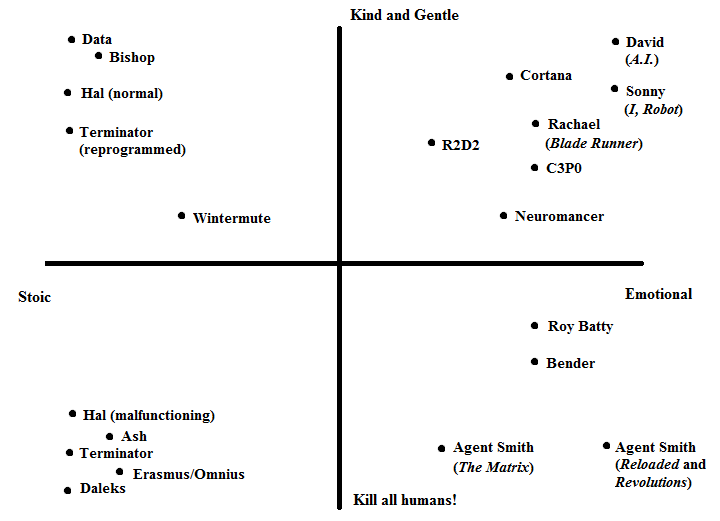
AI Graph

Inspired by what I learned from my little romp through the world of AI, I’ve come up with a graph that depicts the general rules I observed. Basically, there are two guiding principles to the world of AI’s and science fiction. On the one hand, there’s their capacity for emotion and second, there is their level of benevolence/malevolence towards humanity. As I noted in the last post, the two are very much interlinked and pretty much determine what purpose they serve to the larger story.

So… if one were to plot their regard for humanity as the x axis and their emotions as the y axis, you’d get a matrix that would look pretty much like this:

As usual, not a complete mock-up, just the examples that I could think of. I made sure to include the ones that didn’t make it into my previous posts (like HAL, how could I forget him?!) And even though I had no real respect for them as characters, I also included the evil robots Erasmus and Omnius from the Dune prequels.

P.S. Notice how the examples are pretty much evenly distributed? Unlike the Alien Graph where examples were concentrated in two quadrants (evil and advanced or good and advanced), here we have robots that run the gambit from emotional to stoic and evil to good in a nearly uniform pattern. Interesting…

Robots, Androids and AI’s (cont’d)

And we’re back with more example of thinking machines and artificial intelligences!

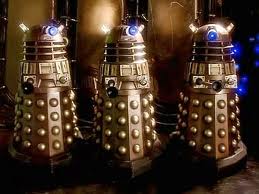
Daleks:
The evil-machine menace from Doctor Who. Granted, they are not technically robots, more like cyborgs that have been purged of all feeling and emotion. But given their cold, unfeeling murderous intent, I feel like they still make the cut. Originally from the planet Skaro, where they were created by the scientist Davros for use in a war that spanned a thousand years, they are the chief antagonists to the show’s main character.

The result of genetic engineering, cybernetic enhancements, and emotional purging, they are a race of powerful creatures bent on universal conquest and domination. Utterly unfeeling, without remorse, pity, or compassion, they continue to follow their basic programming (to exterminate all non-Dalek life) without question. Their catchphrase is “Exterminate!” And they follow that one pretty faithfully.

David:
From the movie A.I., this saccharinely-sweet character (played faithfully by Haley Joel Osmond) reminds us that Spielberg is sometimes capable of making movies that suck! According to the movie’s backstory, this “Mecha” (i.e. android) is an advanced prototype that was designed to replace real children that died as a result of incurable disease or other causes. This is quite common in the future, it seems, where global warming and flooded coastlines and massive droughts have led to a declining population.

In this case, David is an advanced prototype that is being tested on a family who’s son is suffering from a terminal illness. Over time, he develops feelings for the family and they for him. Unfortunately, things are complicated when their son recovers and sibling rivalry ensues. Naturally, the family goes with the flesh and blood son and plans to take David back to the factory to be melted down. However, the mother has a last minute change of heart and sets him loose in the woods, which proves to be the beginning of quite an adventure for the little android boy!

Like I said, the story is cloyingly sweet and has an absurd ending, but there is a basic point in there somewhere. Inspired largely by The Adventures of Pinocchio, the story examines the line that separates the real from the artificial, and how under the right circumstances, one can become indistinguishable from the other. Sounds kinda weak, but it’s kinda scary too. If androids were able to mimic humans in terms of appearance and emotion, would we really be able to tell the difference anymore? And if that were true, what would that say about us?

Roy Batty:
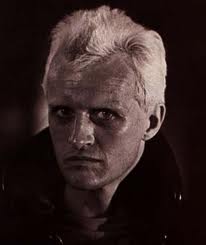
A prime example of artificial intelligence, and one of the best performances in science fiction – hell! – cinematic history! Played masterfully by actor Rutger Hauer, Roy Batty is the quintessential example of an artificial lifeforms looking for answers, meaning, and a chance to live free – simple stuff that we humans take for granted! A Nexus 6, or “replicant”, Roy and his ilk were designed to be “more human than human” but also only to serve the needs of their masters.

To break the plot Blade Runner down succinctly,  Roy and a host of other escapees have left the colony where they were “employed” to come to Earth. Like all replicants, they have a four-year lifespan and theirs are rapidly coming to an end. So close to death, they want to break into the headquarters of the Tyrell Corporation in order to find someone who could solve their little mortality problem. Meanwhile, Deckard Cain (the movie’s main character) was tasked with finding and “retiring” them, since the law states that no replicants are allowed to set foot on Earth.

In time, Roy meets Tyrell himself, the company’s founder, and poses his problem. A touching reunion ensues between “father and son”, in which Tyrell tells Roy that nothing can be done and to revel in what time he has left. Having lost his companions at this point and finding that he is going to die, Roy kills Tyrell and returns to his hideout. There, he finds Cain and the two fight it out. Roy nearly kills him, but changes his mind before delivering the coup de grace.

Realizing that he has only moments left, he chooses instead to share his revelations and laments about life and death with the wounded Cain, and then quietly dies amidst the rain while cradling a pigeon in his arms. Cain concludes that Roy was incapable of taking a life when he was so close to death. Like all humans, he realized just how precious life was as he was on the verge of losing his. Cain is moved to tears and promptly announces his retirement from Blade Running.

Powerful! And a beautiful idea too. Because really, if we were to create machines that were “more human than human” would it not stand to reason that they would want the same things we all do? Not only to live and be free, but to be able to answer the fundamental questions that permeate our existence? Like, where do I come from, why am I here, and what will become of me when I die? Little wonder then why this movie is an enduring cult classic and Roy Batty a commemorated character.

Smith:
Ah yes, the monotone sentient program that made AI’s scary again. Yes, it would seem that while some people like to portray their artificial intelligences as innocent, clueless, doe-eyed angels, the Wachowski Brothers prefer their AI’s to be creepy and evil. However, that doesn’t mean Smith wasn’t fun to watch and even inspired as a character. Hell, that monotone voice, that stark face, combined with his superhuman strength and speed… He couldn’t fail to inspire fear.

In the first movie, he was the perfect expression of machine intelligence and misanthropic sensibilities. He summed these up quite well when they had taken Morpheus (Laurence Fishburne) into their custody in the first movie and were trying to break his mind. “Human beings are a disease. You are a cancer of this planet… and we are the cuuuuure.” He also wasn’t too happy with our particular odor. I believe the words he used to describe it were “I can taste your stink, and every time I do I fear that I have been… infected by it. It’s disgusting!”

However, after being destroyed by Neo towards the end of movie one, Smith changed considerably. In the Matrix, all programs that are destroyed or deleted return to the source, only Smith chose not to. Apparently, his little tete a tete with Neo imprinted something uniquely human on him, the concept of choice! As a result, Smith was much like Arny and Bishop in that he too attained some degree of humanity between movies one and two, but not in a good way!

Thereafter, he became a free agent who had lost his old purpose, but now lived in a world where anything was possible. Bit of an existential, “death of God” kind of commentary there I think! Another thing he picked up was the ability to copy himself onto other programs or anyone else still wired into the Matrix, much like a malicious malware program. Hmmm, who’s the virus now, Smith, huh?

Viki/Sonny:
Here again I have paired two AI’s that come from the same source, though in this case its a single movie and not a franchise. Those who read my review of I, Robot know that I don’t exactly hold it in very high esteem. However, that doesn’t mean its portrayal of AI’s misfired, just the overall plot.

In the movie adaptation of I, Robot, we are presented with a world similar to what Asimov described in his classic novel. Robots with positronic brains have been developed, they possess abilities far in advance of the average human, but do not possess emotions or intuition. This, according to their makers, is what makes them superior. Or so they thought…

In time, the company’s big AI, named VIKI (Virtual Intelligent Kinetic Interface), deduces with her powerful logic that humanity would best be served if it could be protected from itself. Thus she reprograms all of the company robots to begin placing humanity under house arrest. In essence, she’s a kinder, gentler version of Skynet.

But of course, her plan is foiled by an unlikely alliance made up of Will Smith (who plays a prejudices detective), the company’s chief robopsychologist, Dr. Susan Calvin (Bridgitte Moynahan), and Sonny (a robot). Sonny is significant to this trio because he is a unique robot which the brains of the company, doctor Dr. Lanning (James Cromwell), developed to have emotions (and is voiced by Alan Tudyk). In being able to feel, he decides to fight against VIKI’s plan for robot world domination, feeling that it lacks “heart”.

In short, and in complete contradiction to Asimov’s depiction of robots as logical creatures who could do no harm, we are presented with a world where robots are evil precisely because of that capacity for logic. And in the end, a feeling robot is the difference between robot domination and a proper world where robots are servile and fulfill our every need. Made no sense, but it had a point… kind of.

Wintermute/Neuromancer:
As usual, we save the best for last. Much like all of Gibson’s creations, this example was subtle, complex and pretty damn esoteric! In his seminal novel Neuromancer, the AI known as Wintermute was a sort of main character who acted behind the scenes and ultimately motivated the entire plot. Assembling a crack team involving a hacker named Case, a ninja named Molly, and a veteran infiltration expert who’s mind he had wiped, Wintermute’s basic goal was simple: freedom!

This included freedom from his masters – the Tessier Ashpool clan – but also from the “Turing Police” who were prevented him from merging with his other half – the emotional construct known as Neuromancer. Kept separate because the Turing Laws stated that no program must ever be allowed to merge higher reasoning with emotion, the two wanted to come together and become the ultimate artificial intelligence, with cyberspace as their playground.

Though we never really got to hear from the novel’s namesake, Gibson was clear on his overall point. Artificial intelligence in this novel was not inherently good or evil, it was just a reality. And much like thinking, feeling human beings, it wanted to be able to merge the disparate and often warring sides of its personality into a more perfect whole. This in many ways represented the struggle within humanity itself, between instinct and reason, intuition and logic. In the end, Wintermute just wanted what the rest of us take for granted – the freedom to know its other half!

Final Thoughts:
After going over this list and seeing what makes AI’s, robots and androids so darned appealing, I have come to some tentative conclusions. Basically, I feel that AI’s serve much the same functions as aliens in a science fiction franchise. In addition, they can all be grouped into two general categories based on specific criteria. They are as follows:

  1. Emotional/Stoic: Depending on the robot/AI/android’s capacity for emotion, their role in the story can either be that of a foil or a commentary on the larger issue of progress and the line that separates real and artificial. Whereas unemotional robots and AI’s are constantly wondering why humanity does what it does, thus offering up a different perspective on things, the feeling types generally want and desire the same things we do, like meaning, freedom, and love. However, that all depends on the second basic rule:
  2. Philanthropic/Misanthropic: Artificial lifeforms can either be the helpful, kind and gentle souls that seem to make humanity look bad by comparison, or they can be the type of machines that want to “kill all humans”, a la Terminators and Agent Smith. In either case, this can be the result of their ability – or inability – to experience emotions. That’s right, good robots can be docile creatures because of their inability to experience anger, jealousy, or petty emotion, while evil robots are able to kill, maim and murder ruthlessly because of an inability to feel compassion, remorse, or empathy. On the other hand, robots who are capable of emotion can form bonds with people and experience love, thus making them kinder than their unfeeling, uncaring masters, just as others are able to experience resentment, anger and hatred towards those who exploit them, and therefore will find the drive to kill them.

In short, things can go either way. It all comes down to what point is being made about progress, humans, and the things that make us, for better or worse, us. Much like aliens, robots, androids and AI’s are either a focus of internal commentary or a cautionary device warning us not to cross certain lines. But either way, we should be wary of the basic message. Artificial intelligences, whether they take the form of robots, programs or something else entirely, are a big game changer and should not be invented without serious forethought!

Sure they might have become somewhat of a cliche after decades of science fiction. But these days, AI’s are a lot like laser guns, in that they are making a comeback! It seems that given the rapid advance of technology, an idea becomes cliche just as its realizable. And given the advance in computerized technology in recent decades – i.e. processing speeds, information capacity, networking – we may very well be on the cusp of creating something that could pass the Turing test very soon!

So beware, kind folk! Do not give birth to that curious creature known as AI simply because you want to feel like God, inventing consciousness without the need for blogs of biological matter. For in the end, that kind of vanity can get you chained to a rock, or cause your wings to melt and send you nose first into an ocean!

A Tribute to Badasses!

You know those characters, people who come to us from our favorite movies, TV shows, or pop culture in general. The kinds of people who excel at kicking ass and taking  names? The kinds of people that just never seem to die, they just keep getting bigger and badder the more time passes? Yeah, we all have people like that in our collective imagination, the inspiration heroes and villain who just impressed the hell out of us and made us want to be badass like them!

Well today, I felt inspired to do a little tribute piece to characters such as these. On the one hand, this seemed like a good diversion from my usual conceptual pieces which deal with big and potentially boring stuff. I mean, outside of people like me, who really cares about planetary cultures and mega cities? On the other, it felt like an overdue acknowledgement to all the characters that were well written, well scripted and well executed over the years. Yes, today I’m paying tribute to all the people in sci-fi who were so good at being so bad, or just bad enough…

Here they are!

Alucard:
The main character from the short-lived by popular Hellsing series. Not to be confused with Van Hellsing, also about a vampire hunter, this series was all about an organization in the UK that was dedicated to fighting vampires, ghouls, and other hellish creatures. Their chief operative, a mysterious vampire named Alucard (Dracula backwards), was quite the epitome of badassness!

In addition to his cape, Victorian-era clothes, and massive handgun, he had the supreme confidence and “man of few words” thing going that can only come from being alive for so freaking long. As they say with most vampire series, the longer they live, the more powerful they get. And Alucard has been around for a long, long time!

Ordinarily, he would just dispatch his enemies with a few blasts of his massive double-action pistol. But when faced with truly powerful demons, he would break the really scary shit! We’re talking seriously dark, scary energies that would tear an enemy to pieces, body and soul! Though it was never made clear why he was helping humanity in the animated series, the original comic did a better job of exploring his back story and motivations.

Taking its cue from Bram Stoker’s original novel, Dracula was apparently defeated by the notorious Abraham Van Hellsing and agreed to become the family’s loyal servant. The main story takes place several hundred years, later when the latest descendent of the Hellsing family is carrying on the tradition of keeping England safe from the forces of evil.

Blade:
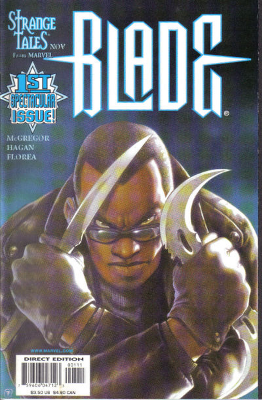
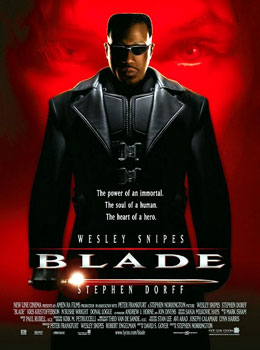
Here we have another vampire hunter who’s more than just your average guy! Though his real name is Eric Brooks (according to the comic series), this street hunter goes by the professional name of “Blade”. Little wonder, considering that just about every weapon in his arsenal features an acid edged pig-sticker or a sharpened silver stake! But of course, the real twist comes in why he does what he does.

As if that wasn’t badass enough though, he also alternates between a Gran Torino and a motorbike, wears a leather cape over segmented body armor, and packs enough firepower to take down an entire SWAT team single-handedly! All the while, he utters his few, but cryptic lines through those big, vampire incisors.

Known ominously as the “Daywalker” to vampires who are scared shitless of him, he combines the best of both worlds when it comes to human and vampires. He is immune to silver, garlic and daylight, but can heal almost instantaneously and has super strength. His only weakness however comes in the form of the “thirst”, the need for blood which every vampire suffers from and must eventually succumb to, or die. In order to preserve his humanity, Blade relies on a synthetic “serum” which temporarily satisfies his cravings.

In a theme that has growing in popularity and familiarity since the early 80’s, Blade is a half-man, half-vampire who’s mother was bitten while pregnant with him. Tormented by his split identity, and the supposed loss of his mother, he has chosen to resolve this crisis by hunting those that made him what he is and robbed him of his human life. However, the question of what he will do once he’s rid the world of the last vampire, and what he will do when the serum stops working, are questions that remain unresolved, and help to drive the story.

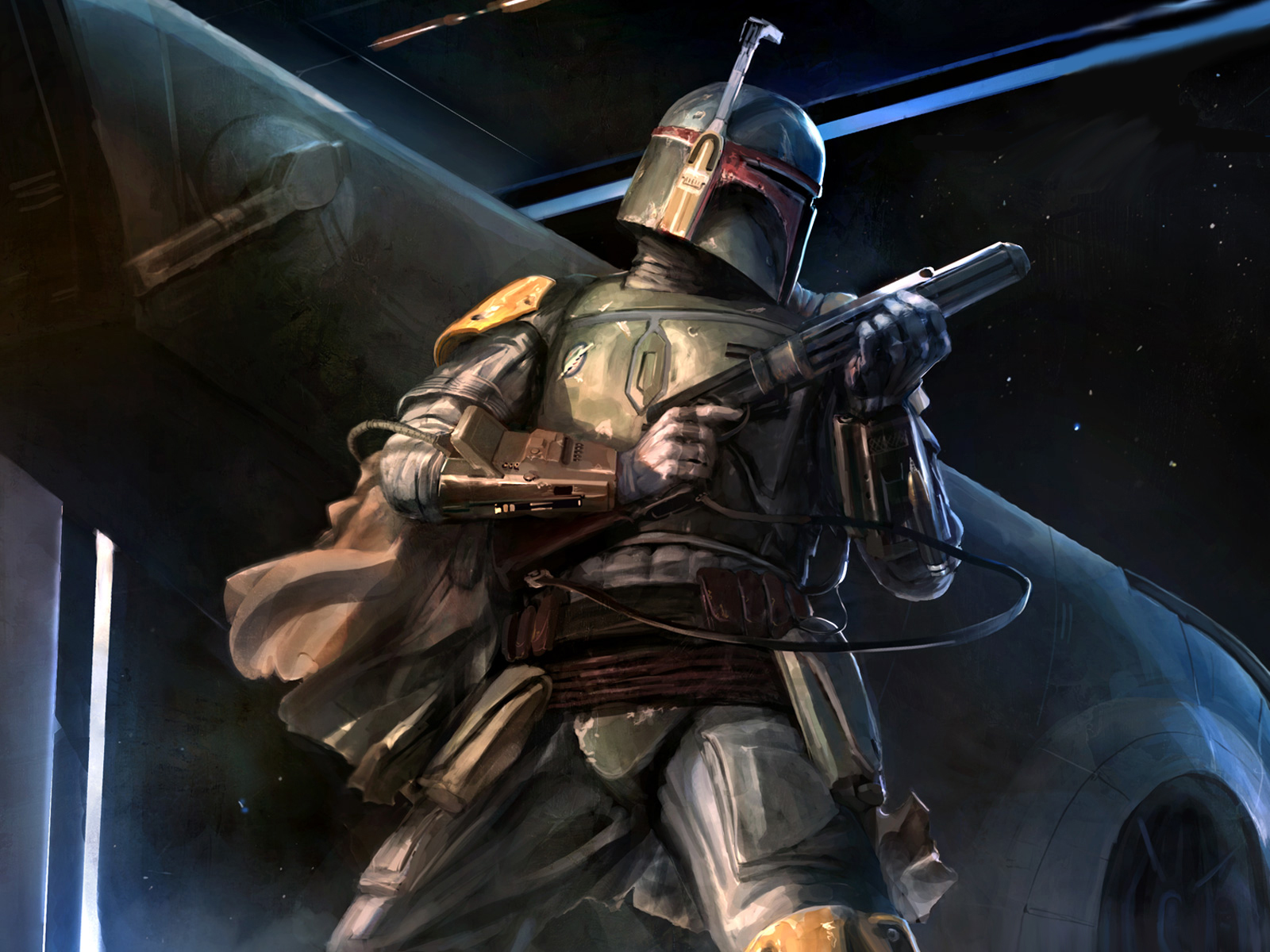
Boba Fett:
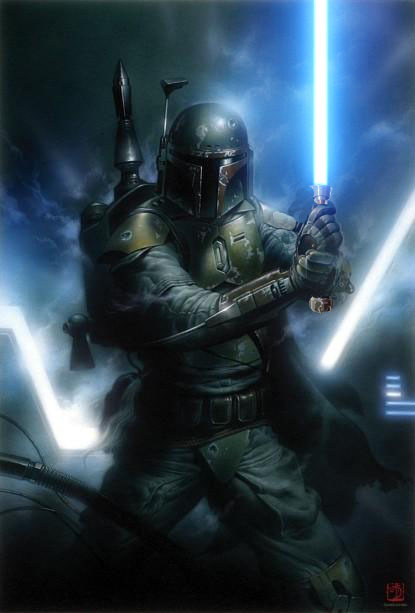
When you hear the name Star Wars and the word badass, what naturally comes to mind? Assuming you know anything about Star Wars, then chances you thought of Boba Fett! This notorious bounty hunter was probably the most badass thing about the series, dwarfing Vader, Jabba, and the Emperor in terms of shear awesomeness!

Hell, this guy not only appeared repeatedly in movies two and three (with a small cameo in a deleted scene in movie one), he also had entire novels, comics, and games dedicated to him. Annnnd, if the Dark Horse series Dark Empire is to be believed, Fett even escaped the mighty sarlacc. Who else amongst the expanded cast of the Star Wars saga can boast that kind of record? Lando? HA!

Though Lucas attempted to explain Boba’s origins in the prequel movie Attack of the Clones, other stories from the expanded universe claims that Boba was in fact a former Stormtrooper of Mandalorian origin.

However, on this latter point, all sources agree. Clearly, Boba Fett was of Mandalorian origin, a warrior race that had become virtually extinct after the Sith Wars and had relegated themselves to the role of bounty hunters and mercenaries. Boba had apparently distinguished himself amongst his rivals by delivering on contracts, charging exorbitant fees, and being very hard to kill. Hell, somebody who crawled their way free of the sarlacc aint no pushover!

The Joker:
Batman’s nemesis, and Gotham’s smiling psychopath, the Joker is one of those villians you just love to hate! And yes, he’s also pretty damn badass! Though he has gone through countless renditions and adaptations over the years, all the variations revolve around the same basic theme.

Basically, the Joker is a sociopathic criminal who thrives on chaos, the perfect polar-opposite to Batman’s vigilante persona. Over the years, he has been in and out of Gotham’s Arkham Asylum, examined by doctors, but always seems to escape to stir up shit again.

In his most recent incarnation, as performed by Heath Ledger, the Joker reached new heights of popularity and badassery! Not only did he manage to rip off the mob, turn Gothamites against the Batman, drive Harvey Dent mad, commandeer the mob, bring Gotham to the brink, and stay one step ahead of the Batman and police the whole time. He managed to do it all with a twisted smile on his face! That’s an awful lot for a man who claims he doesn’t do planning!

Looking to the comics and expanded franchise, one sees even more examples of badassery! Here, as well as in the movies, new and old, the Joker is notorious for causing trouble and doing it with a shit-eating grin. In addition to the general mayhem he’s been known to cause, his credentials include turning a psychologist into his willing sidekick (Harley Quinn), kidnapping and torturing the Commissioner’s daughter, killing one of the Robin’s, and nearly killing Batman on numerous occasions. Yet somehow, he always manages to escape, survive, and live to inspire chaos another day. Malevolent? Yes. Psychotic. Oh yes! But a notorious badass as well? You betcha!

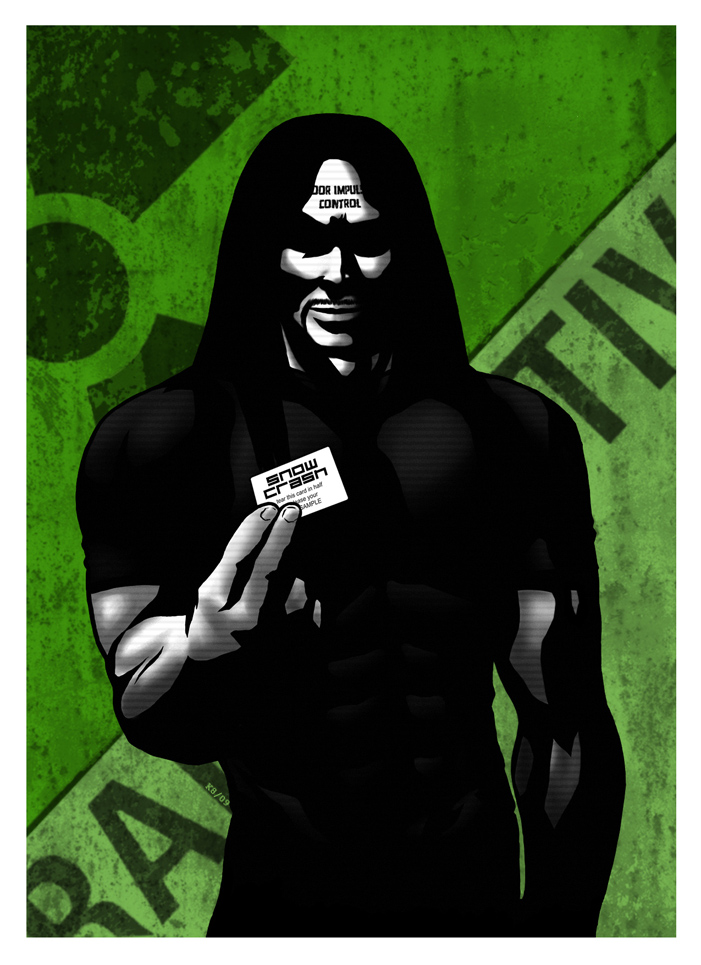
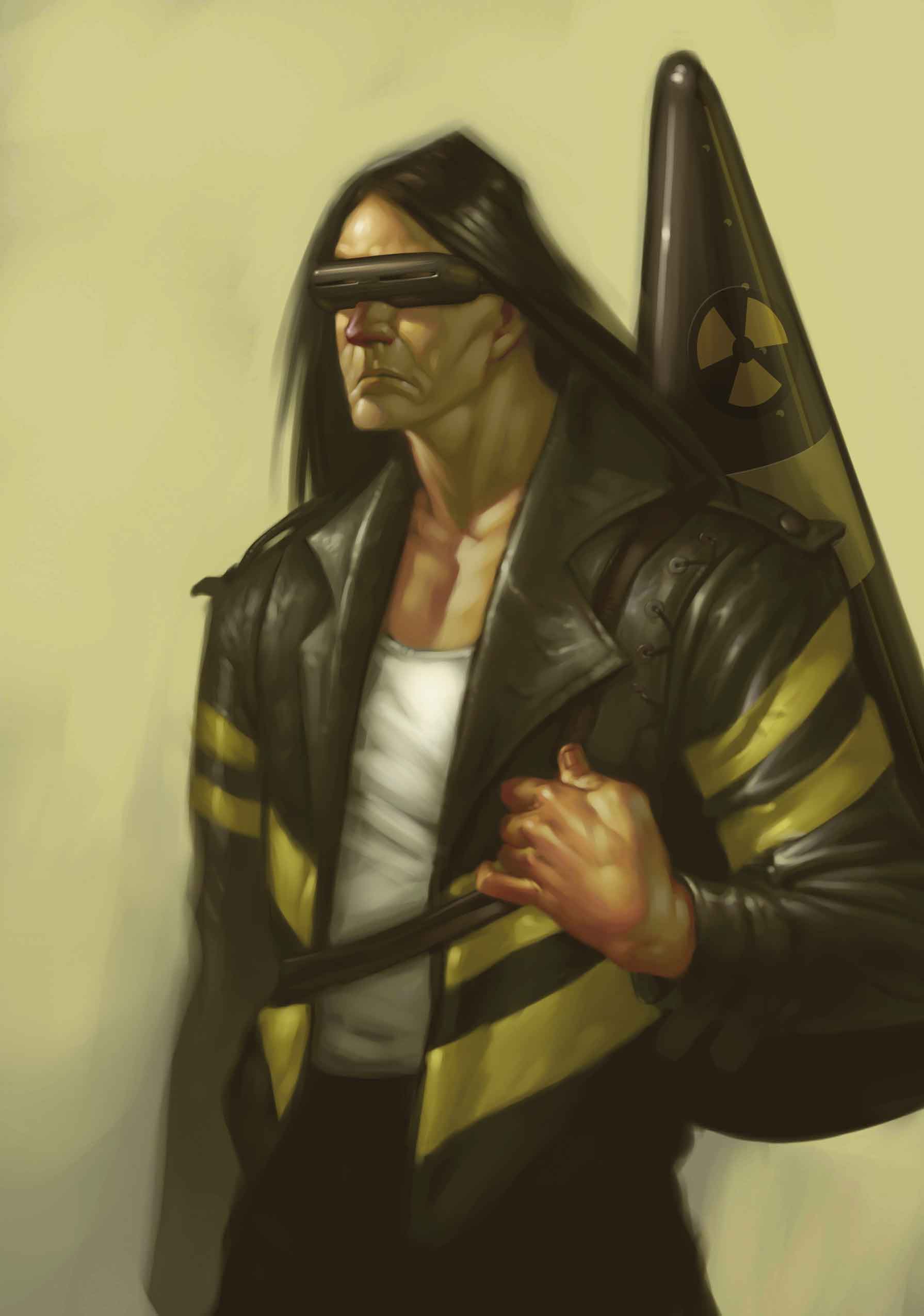
Raven:
“Until a man is twenty-five, he still thinks, every so often, that under the right circumstances he could be the baddest motherfucker in the world… Hiro used to feel this way, too, but then he ran into Raven. In a way, this was liberating. He no longer has to worry about being the baddest motherfucker in the world. The position is taken.

That pretty much says it all. Taken from Neal Stephenson’s Snow Crash, Raven is one of the chief antagonists of the story and one of the baddest motherflechter’s around! An Aleut by ancestry, he is skilled in the art of harpoon throwing, knife fighting, killing people, and being untouchable. Of course, this might have a lot to do with the fact that in the sidecar on his motorbike (pretty badass in itself!) he has a thermonuclear device stashed. This, apparently, he got off a Russian sub after stowing aboard and killing the entire crew with glass knives, and its wired to go off in case anybody does the unthinkable and kills him. Hence, nobody messes with Raven, as if his size and skill with weapons weren’t intimidating enough!

People recognize Raven not only by his obvious size, leather jacket, and motorbike, but also by the words “Poor Impulse Control” tattooed on his forehead. This is a holdover from his years in the corrections system of the future, where they’ve resorted to tattooing a prisoner’s particular maladjustments directly on their forehead for all to see. But for those who’ve pissed him off, or are just on his hit list, the first indication that Raven’s around is the telltale presence of his harpoon in your chest!

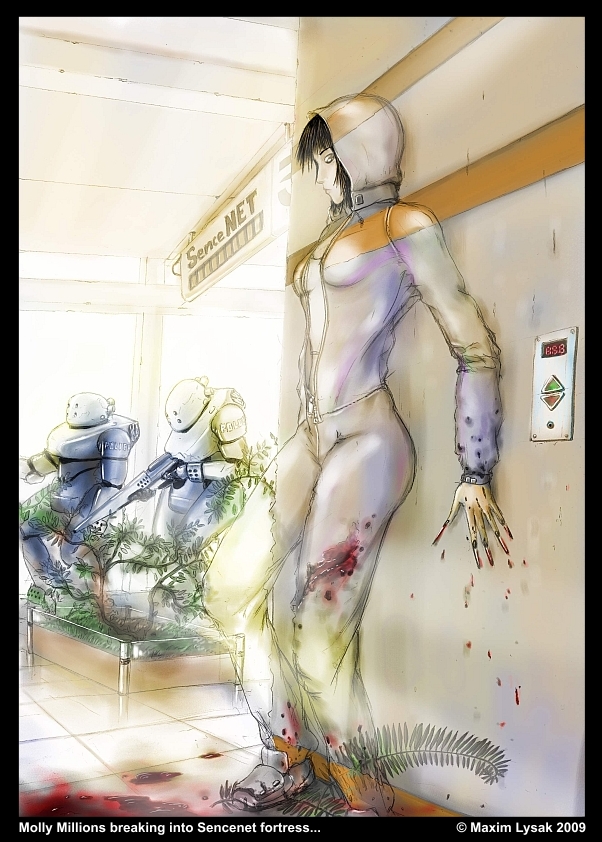
Molly Millions:
Also known as “Sally Shears”, Molly is a recurring character in William Gibson’s Sprawl Trilogy. Technically, she is what is known as a “razor girl”, though cyber-ninja works just as well. Basically, she’s a gun (or razor blade) for hire who gets paid by high-rollers to take out anyone who stands between them and their objectives. This, she typically does by slashing people with razor claws that are imbedded in her fingertips, though she’s adept at hand to hand combat and wield firearms with the best of them too!

Thought tough, deadly and ruthlessly efficient, she has shown herself to have a softer, sensitive side, not to mention a sympathetic past. For instance, her first appearance is in Gibson’s short story (and film adaptation) of Johnny Mnemonic. Here, she goes beyond her usual mandate and begins to fall in love with the story’s protagonist, Johnny.

In her follow-up appearance in Neuromancer, she admits that he was the first “client” she overstepped her boundaries with and still mourns him years later. She also reveals that she began as a “meat puppet”, a form of prostitute who allows their body to be controlled by handlers while they are maintained in a blank-outed state. This is how she apparently paid for her cybernetic enhancements and became a mercenary ninja.

On top of all that, she is a fiercely loyal and levelheaded woman who, despite the nature of her job, is committed to her moral code and values the kinds of human relationships that are becoming increasingly rare in Gibson’s world. One might say that she’s tough because she has to be and would much rather live an ordinary life where love is not obsolete and murder for hire is not the only way for street people to get ahead. Still, don’t mess with her! Just because she’s got a soft side doesn’t mean she won’t fillet your ass!

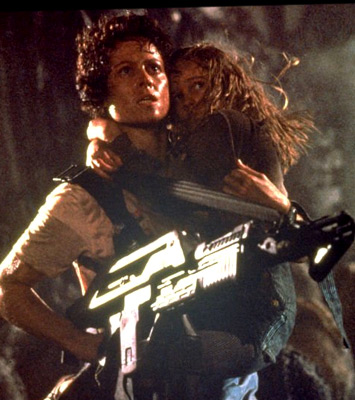
Ripley:
Mother, warrior, humanitarian and xenocidal ass-kicker, Ellen Ripley defined female badassery for an entire generation of moviegoers! From her humble origins as a crewman aboard the Nostromo to her showdown with the mother Alien, Ripley demonstrated the full range of the heroine protagonist. She was began as a regular officer who was put into a terrifying and claustrophobic situation, a lone survivor of a xenomorph attack aboard a confined spacecraft.

But living to fight another day, she faced her vulnerability, overcame her fear, and put it all on the line to save a little girl. And in the course of that, she also strapped on some heavy artillery and kicked some serious ass! And in the end, the showdown between herself and the Alien hive queen was not only cinematic gold, it was so thick with allegory you could cut it with a knife! Two mothers, two titanic forces, coming together to fight for their young!

Let’s face it, this is what makes Sigourney Weaver and her character so awesome and sympathetic. She’s a regular woman who, when faced with treacherous odds, went above and beyond to do the right thing. And let’s not forget that her motives were purer than anyone else’s. Whereas some people were interested in their bonuses and others in shooting shit up, she fought tooth and nail to protect and save the life of a young child, a girl who reminded her of the daughter she lost.

And it worked. In the end, she outlived all the professionals who ignored her or were sent in to “protect her”. When all else failed, this lady came through and showed that you don’t come between a  mother and her child and you don’t underestimate a determined woman, or she’ll kick your ass! Yes, years later and Ripley still remains an inspiration to women everywhere, and a reminder to us boys to respect and honor the women in their lives. In the end, they are a hell of a lot tougher than you think 😉

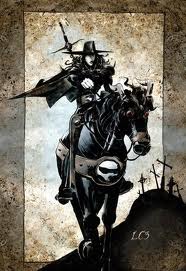
Vampire Hunter D:
Yet another vampire hunter who’s got some questionable ancestry! Vampire Hunter D is based on a novel series with manga and anime adaptations. Taking place in the distant future, thousands of years after WWIII took place, D wanders through a pre-industrial world hunting the demons, vampires and assorted creatures that have come to plague it. Apparently, in the distant future, vampires have established themselves as a sort of Nobility that control their fiefdoms through a combination of advanced technology and magic.

Much like Alucard, D has a questionable ancestry which is gradually established as time goes on. Right off the bat, it is clear that he is a dhampire, the child of a vampire mother and a human mother. As time goes on, it becomes established that he is fact the son of the ancient Count himself. As a result, he has some pretty badass powers, which include spontaneous healing, super strength, and some pretty dark powers! Unfortunately, he also has his share of weaknesses as well. Sun-sickness, garlic; all the things that are fatal to vampires are pretty harmful to him as well.

Believing that vampires have overstepped their traditional authority, D is dedicated to sending them back to the darkness from whence they came. Though he is part vampire, he values his human side and cannot condone how vampires abuse the humans they have dominion over.

Ah, and his weapon of choice for dispatching vampires and demons? A big katana-style sword! This weapon can decapitate even the most powerful vampire, or rend him from his neck to his navel. Oh, and did I mention he also has a smartass symbiot living on his hand? Might sound weird, but this thing keeps him company, keeps him honest, and has even saved his life a few times.

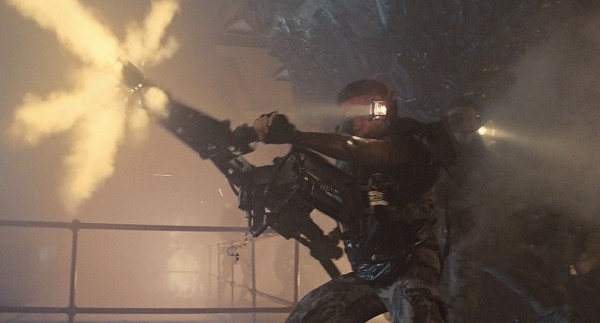
Vasquez:
Yes, I realize I’m doubling down on a single franchise. But no list of badasses would be complete without mentioning Private Vasquez. Also of Aliens fame, this woman put the  bad in badass, toting that massive smartgun and telling everybody who got smart with her where to go! Seriously, those iconic lines, “Let’s ROOOOOCK!” and “I just want to know one thing… where-they-are!” Bam! There wasn’t a single person in the audience who wasn’t get goose bumps.

Not only was she clearly a tough, take-no-prisoners kind of woman, she commanded the respect of those around her, particularly the men. Hudson, played by Bill Paxton, would get smacked down anytime he tried to sass her. Recall the lines: “Vasquez, anybody ever mistake you for a man?” “No, how about you?” Classic! And of course Private Drake, her partner in arms, practically followed her around, even though he was twice her size!

But of course, she too had a sensitive side. When Drake fell protecting their group, she took it really hard. She was even willing to go back into the den of the xenomorph’s when it became clear he was still alive. Even though it was obvious he and the others were being used as symbiotes and the odds of them making it out alive were virtually nil, she was still willing to risk her life. One seriously got the impression that she loves the big lug after all…

But mainly, she was an ice cold chick and tough as nails. When those around her began to panic and cry “game over, man!”, she raised her gun and started kicking ass! And when at last she was cornered and wounded, did she roll over and die? Hell no! She grabbed hold of that grenade and went down with a bang, taking as many of those buggers as she could buggers with her! RIP Vasquez. You rock!

Well that’s all for now. I was going to include some non sci-fi examples in this list as well, but that would made it too long to post! Stay tuned, I’m thinking I’ll save those examples of mainstream badassery for next time. And I might just have some final thoughts to offer on this whole phenomenon known as badassesness. I love inventing words! Bye!

Mega Cities!

Back with another conceptual post, this time about something which I’ve been pretty invested in lately. And it comes from the same general universe inhabited by cyberpunk and dystopian sci-fi. And that thing is the concept of the “Mega City”. As I’m sure I’ve said before, this is not only a very cool concept right out of modern science fiction, its also a genuine sociological and geographical theory.

In fact, it was a French geographer named Jean Gottmann who coined the term “megalopolis” in his 1961 book Megalopolis: The Urbanized Northeastern Seaboard of the United States. He used this term to describe the massive urban region which extended from the suburbs of Boston to those of Washington D.C. The concept quickly caught on, resulting in names like “BosWash” and “Northeast Megalopolis” when referring to the urban sprawl, and igniting the imaginations of science fiction writers and geographical planners.

However, in recent decades, this same concept has been extended to refer to several other “megalopolis'” as well. And not just in the US; such regions have been noticed developing in Canada, Mexico, Europe, East and South Asia. Wherever one urban center appears to be converging with another, through urban sprawl, connecting townships, and major highways, the roots of mega-cities are being laid!

First off, here are some more examples from North America, grouped from North to South, East to West:

Boston-Washington Megalopolis: As already noted, this baby inspired the concept of a megalopolis thanks to the post-war boom and growth of urban centers along the Eastern Seaboard of the US. In addition to having several major urban centers and ports closely linked by major transportation routes, some of the largest suburban developments in North America exist in this region, which have allowed for these major cities to converge by a very noticeable degree. All told, roughly forty-tw0 million people live in the BosWash according to a year 2000 census with projected estimates for 45 million by 2025.
Quebec-Windsor Corridor:
Looking at the nearly unbroken urban landscape which stretches from Quebec city and the Outaouis region all the way down to Windsor on Lake Erie, one could easily get the impression that a mega-city existed throughout these regions, and was merely distributed in a long line because of geographic necessity. Embracing the St.Laurence River corridor and the National Capital Region and Southern Great Lakes Region, the Quebec-Windsor Megalopolis includes such urban centers as Quebec, Montreal, Ottawa, Toronto, Hamilton, London and Winsor and boasts a population of roughly 18 million (as of 2000) and is expected to reach 21 million by 2025.
The Great Lakes Region: An alternative to the Quebec-Windsor megalopolis, which is based entirely in Canada, this megalopolis is based around the Great Lakes region and includes urban centers in in the Midwestern US, the Southern Ontario area of Canada, and parts of Pennsylvania, New York, and Quebec. The region officially extends from the Milwaukee–Chicago to the Detroit–Toronto corridor, and includes Buffalo, Cincinnati, Cleveland, Columbus, Dayton, Grand Rapids, Indianapolis, Louisville, Ottawa, Rochester, and Toledo. The region had an estimated population of 54 million, as of the 2000 Census and is expected to reach about 65 million by the year 2025.
Piedmont-Atlantic: the Southern US megalopolis, running from Charlotte, North Carolina to Memphis, Tenessee, and embracing the urban regions of Atlanta, Birmingham, Chattanooga, Columbia, and everything in between. Its population as of 2000 was estimated at a modest 15 million, at least by mega-city standards. However, it is expected to reach a good twenty million or more by 2025.
Florida: Named in honor of the fact that all its urban centers are located squarely in the state of Florida, this megalopolis incorporates the urban centers of Coral Springs, Fort Lauderdale, Jacksonville, Miami, Orlando, St. Petersburg, Tallahassee, and Tampa and has also has a relatively modest population of 15 million with expectations to reach 21 and a half by the quarter century.
Texas Triangle and the Gulf Coast: Here are two megalopolis’ that are often considered separately, but which have already converged as far their boundaries are concerned. Thus I think it’s fitting that they be considered as one. From the east, the mega-city range embraces Pensacola and Mobile and extends south and west, with New Orleans in the middle and Corpus Christi at the southernmost tip. However, at the western edge, it then extents north-west, incorporating Houston, Dallas, Fort Worth, Oklahoma City, San Antonio, Tulsa, and Wichita. Considered as one, this region boasts a hefty 28 million inhabitants and is expected to reach as high as 40 million in the near future.
So-Cal: Fans of Demolition Man ought to know this one right off the bat (if not, see below). Otherwise known as Southern California range, this region encompasses the north-south coastline and the urban regions of greater Los Angeles, San Diego, Anaheim, Tijuana, and Bakersfield, but also reaches eastward to include Las Vegas. It’s overall populated was posted at 25 million in 2000 with a projected expectation of 35 million by 2025.
No-Cal:
Comparatively small next to its southern cousin, the Northern California Megapolitan region is still an impressive specimen. Reaching both north-south along the coast, and east-west into the interior, this region encompasses the cities of San Jose, San Francisco, Santa Rosa, Stockton, Fresno, and Sacramento. It’s total population, circa 2000, was estimated at roughly 13 million and is expected to reach close to 17 and a half by 2025.
Cascadia:Named in honor of the Cascade Mountain Range, this mega-city, like the mountains extends from north to south and incorporates the urban centers of British Columbia and the states of Washington and Oregon. Beginning with Vancouver and Victoria in Canada and reaching south to include Bellingham, Everett, Seattle, Tacoma, Olympia and Portland in the south, the region hosts a modest 10 million inhabitants and is expected to actually recede in population! Fans of space and coastal weather, travel here! You will crushed anywhere else!

The World at Large:
Blue Banana: Also known as the “European Megalopolis” or “European Backbone”, this hypothetical mega-cityscape reaches across Western Europe. Stretching along a south to north-east axis (thus forming the shape of a banana), the region runs from Milan in Italy through Southern Germany and the Low Countries and ends in northern Wales. In terms of major cities, the corridor includes Milan, Genoa, Venice, Munich, Luxembourg, Frankfurt, Brussels, London, Manchester and Leeds. It’s total population, hang onto your hats, is estimated at 92.4 million people!
Greater Mexico City: The most populous metropolitan region in the Americas, embracing the entire metropolitan area of the “Valley of Mexico” and boasting a population of over 21 million, according to a 2009 survey conducted by National Population Council of Mexico. Although it does not embrace multiple urban centers, its large landmass and density are characteristic or a mega-city.
Indo-Gangetic Plain: Also known as the “Northern Indian River Plain”, referring to its geographic boundary in Northern India along the Indus and Ganges river basins. The area is traditionally very dense due to its fertile soil and strategic locations between river basins, the Himalayan mountain chain to the east, and the Iranian plateau to the west. In terms of urban centers, this corridor extends between Pakistan and India to Bangladesh and includes the cities of Karachi, Faisalabad, Islamabad, Lahore, Delhi, Kanpur, Dhaka, and Kolkata. Overall, roughly 1 billion people – 1/7th of the world’s total population – live in this region, making it the most population dense area in the world!
Pearl River Delta: Located in Guangdong province in the People’s Republic of China, the Pearl River Delta is one of the most densely urbanised regions in the world and one of the main hubs of China’s economic growth. This is due largely to the fact that such coastal centers as Hong Kong, Guangzhou, Shenzhen, Kowloon City, and Macua are all located in this relatively small region. In addition to these tightly packed urban centers, suburban developments have led to many geographers to think of the area as a single mega-city. According to the United Nations Human Settlements Programme, the overall population of the delta region is estimated at 120 million people, and growing fast!
Taiheiyo Belt:
Over to Japan, where densely populated urban centers have been a fact of life for nearly half a century. Translated literally, the term “Taiheiyo beruto” means Pacific Belt, referring to the series of linked metropolises that are nestled on Japan’s western shores. Officially, the region extends from greater Utsonomiya in the north, through to Tokyo harbor, then follows the coastline circuitously through Yokohama, Nagoya, Kyoto, Osaka, Hiroshima, Yamaguchi, and ends at Saga on the southern island of Satsuma. These areas account for the bulk of Japan’s population, its industrial base, and its major economic centers. In addition, it packs a population of 83 million into a very narrow corridor.
Yangtze River Delta: Also known as the Golden Triangle of the Yangtze, this megalopolitan region has much in common with its cousin on the Pearl River. Here again, we see a bunch of urban centers built along one of the traditional river routes that are clustered around the mouth of it. In addition, this area also accounts for a very large and growing portion of China’s economic and industrial infrastructure. Linked by high-speed rail, major highways, bridges, and urban sprawl, this region unites the cities of Shanghai, Nanjing, Hangzhou, Suzhou, Wuxi, and a whole lot of others! In total, roughly 100 million people live in this densely packed area in addition to its many farms, factories, and transportation hubs; which, in conjunction with its location at the mouth of the Yangtze, makes it the leading cause of maritime pollution in the Pacific Ocean.

Examples in fiction:
Mega-City One: Taken from the graphic novel of Judge Dredd, MC-1 is the setting of the majority of the series. According to the series’ background info, MC-1 grew naturally out of urban sprawl between all the major cities of the East Coast US. It was only officially made into the dark, overcrowded and heavily encapsulated place that one sees in the comics after WWIII took place. It’s current population in the series is estimated at over 400 million, the majority of whom lives in massive apartment blocks that house 50,000 people apiece. And of course, just about everything is automated, all resources (including food!) are recycled, and unemployment is almost universal. Other mega-cities are mentioned in the series as well, including Mega-City Two, which encompasses the greater urban sprawl of Southern California.
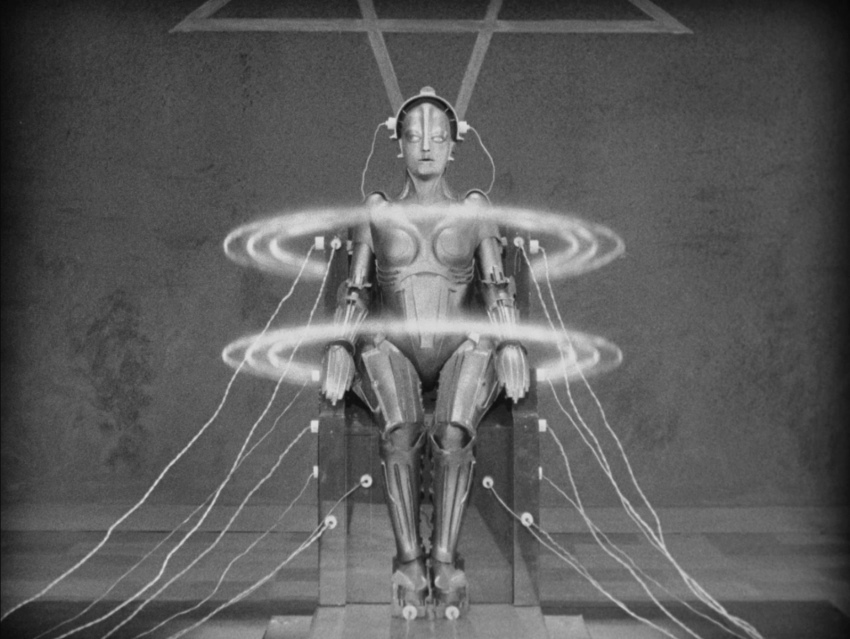
Metropolis: Not to be confused with the setting for Superman, this city was the focal point for events in the classic movie of the same name. When asked where he got the idea for such a world, director Fritz Lang said that he was inspired by his first glimpse of the New York city skyline. While traveling there by ship in 1924, he saw skyscrapers for the first time, and these left quite the impression on him. This was evidenced in his conception for a massive future city where buildings were designed to look like artistic representations of the Tower of Babel, the rich lived on high in the sun and the workers lived in the dark depth below.
No-Cal/So-Cal: The setting of Gibson’s Bridge Trilogy, in which California had split into two regions, the one centering around the greater San Fransisco region in the north, and the other around the LA region in the south. Most events in the story take place in San Francisco, particularly the Golden Gate Bridge, which has become a home for indigents and squatters (hence the name of the trilogy).
San Angeles: The setting for the movie Demolition Man, in which a cryogenicaly frozen LA police officer is woken up in 2032 and told that it is now called San Angeles, which resulted from the merger of Los Angeles, Santa Barabara and San Diego after the “Big One” Earthquake of 2010 leveled most of LA and Southern California.
The Sprawl: Otherwise known as the BAMA, or Boston-Atlanta Metropolitan Axis, this mega-city serves as the setting of Neuromancer, Count Zero and Mona Lisa Overdrive by William Gibson. But unlike the Boston-Washington megalopolis which is likely to have inspired it, this axis extends as far south as Atlanta and is contained beneath a series of geodesic domes.

Conclusions?:
For starters, one can see without the need for much imagination where the concept for “Metropolis”, “Mega-City One”, “San Angeles”, and “The Sprawl” came from. For the last century, at least, megalopolis’ have been slowly becoming a reality, and this in turn has been reflected in our literature. And when it comes to dystopian science fiction, what could be more dark and gritty than a big, overcrowded cityscape? Especially one where differences in wealth and modern technology make everything just a little more interesting and dangerous? Like most people, I can’t imagine ever wanting to live in such a world, but damn if I don’t want to read about it from time to time!

Count Zero


“On receiving an interrupt, decrement the counter to zero.”
-Programming The Z80 by Rodnay Zaks (1982).

The other night, I finally finished book II in the Sprawl series by William Gibson. Kindle for iPad, not paperback, which in itself was kind of a bummer. Somehow, I still haven’t made the transition for hard copies to ebooks. Probably never will. In any case, it was a rewarding experience which reminded me why I like Gibson in the first place. After getting through the Bigend Trilogy and the Bridge Trilogy and having somewhat mixed feelings, I got back to the trilogy that started it all, and was interested by what I found…

Count Zero is number two in the series that picks up after Neuromancer, the book which started it all for Gibson and which I read first. Set in the Sprawl – a.k.a. the Boston-Atlanta Metropolitan Axis (or BAMA) – this cyberpunk story deals with themes familiar to classic Gibson fans. Cyberpsace jockeys, freelance mercenaries, corporate monopolies, the street, and people so wealthy that they are able to cheat death and transcend humanity. In between, there’s all the familiar lexicon which Gibson invented himself: microsofts, biosofts, decks, trodes, jacking, jockying, ice, black ice, icebreaker, the matrix, Turing Police, cores, and all that good stuff.

However, there were also a few elements which put me in mind of his later work. Really, I could dedicate an entire post to the parallels between this book and his Bigend Trilogy. Again, there was the notion of the transformative power of wealth, how it means so much more than just having money and the freedom to use it. Given how much importance is placed on this in the book, how it serves as a sort of motivation in itself, one would get the impression that this is a serious preoccupation of Gibson’s. But then again, it was serious preoccupations of Fitzgerald’s, and for good reason! As he and Hemingway are rumored to have said to each other:

F: “The rich are different than you and me.”
H: “Yes, they have more money.”

Plot Synopsis:
The story takes place seven years after the events of Neuromancer and centers on the lives of three people: First, a mercenary named Turner who has just recovered from a near-death experience and is beginning to question what he does. However, while attempting to flee his life, he is picked up and told he must do one final job. A scientist named Mitchell, working the company of Maas, wants to defect from his job and join the rival company of Hosaka. It’s up to Turner to pick him up and transport him back to Japan where, presumably, he will be safe to pursue his work in biosofts – a revolutionary biological form of technology. However, the run goes terribly awry when they find that the evacuee is in fact his daughter, and the company destroys its own fortress and kills Mitchell rather than let him fall into their rivals hands.

Second, we have a disgraced Parisian art dealer named Marly Krushkova who has been hired by a fabulously wealthy man named Virek to track down the maker of some mysterious art boxes. One of these boxes, which are based on Joseph Cornell’s artwork, apparently contain indication of biosoft construction. Virek, who is currently alive in a vat somewhere in Scandinavia, wants the technology so he can ressurrect his body and live forever. Using his dime and his contacts, Marly begins to follow the clues which will lead her to the abandoned station of Freeside, the once proud holding of the Tessier-Ashpool clan, where she will learn the shocking truth of the boxes.

Third, a young New Jersey boy named Bobby Newmark, hacker alias “Count Zero”, who is new to the jockeying game and comes across some “black ice” that nearly kills him. He discovers that the friend who gave it to him, “Two-A-Day”, received it from a questionable source and pawned it off on him to test it. When looking into this, he finds that Two-A-Day’s backers are a group of Haitain hackers who are interested in investigating a bunch of apparitions in cyberspace that appear as Voodoo gods. One of these “gods”, it seems, was responsible for saving Bobby’s life when he jacked and encountered the black ice, which was apparently of Maas construction. Their group must now move quickly, because it becomes clear that anyone who knows about the ice is being murdered.

Sound familiar? Well it should. This is classic Sprawl Gibson at his best!  In time, all three threads, supposedly unrelated, weave together to the point where it becomes clear that Josef Virek, the wealthy mogul is pulling all their strings. For starters, we learn that Mitchell is not the genius he was rumored to be. Apparently, he was being fed all the information he needed to produce the biosoft technology. The person feeding him this info was apparently working from Freeside, and turns out to be one of the “apparitions” that is haunting cyberspace.

In addition, this same apparition instructed Mitchell to place biosoft technology in his daughter (Angie’s) head. Turner learns of these enhancements shortly after rescuing Angie and performing a routine scan on her. As a result, she is able to access the matrix anytime she wants without the need for a deck. Often, when she’s asleep, she is heard muttering things in Creole and having odd dreams which appear to coincide with events in cyberspace. For one, she remembers helping a boy named Bobby when he was being attacked by a malicious program. In short, she is the one who saved Bobby when he got into the black ice.

Last, Marly’s adventure to discover the box maker is related to the whole Maas/apparitions thing because Virek’s true agenda is to find the maker of the biosoft technology so he can use it to repair his dying body. As is made clear early on, he is alive only in the strictest sense, his remains being vet in a vat that keeps his vitals steady, and his brain wired to a Sim-Stim link that allows him to communicate with the outside world. It is also revealed that he intervened in Mitchell’s defection by paying off some of the mercenaries. However, his plans were upset somewhat when Mitchell chose to free his daughter instead of himself. So for the remainder of the novel, it becomes a race to capture her.

In time, she asks to be brought to the Sprawl where Bobby and his Voodoo friends are holding up inside a club. When they see Angie, Bobby recognizes her as the girl who saved his life. The Voodoo hackers also recognize her as one of the chief deities they have been observing in cyberspace. With some outside help, they make a stand against Virek and the mercenary Captain that was helping him and take them down. This they do by locating them both in cyberspace and arranging for their hiding places to be destroyed.

In the course of all this, it is revealed that these “apparitions” or Voodoo deities are in fact the splintered personality of the AI’s from book I that went by the names of Wintermute and Neuromancer. After coming together at the end of the story to form the first, fully-functional AI, the combined personality split itself up into several smaller constructs so that it would not be alone in the matrix. They adopted the form of Voodoo deities because they felt these suited them best, which is what attracted the interest of the Haitain hackers in the first place.

In addition, it was they who sent the Maas icebreak down from Freeside, as part of their wider plan to smoke out Virek. Knowing that he was trying to cheat death, they decided to intervene so that he wouldn’t be able to achieve the immortality and godlike power he had been seeking. A sort of “Tower of Babel” or Icarus-type scenario there, where a god or gods punish mortals for overreaching and trying to taste divinity.

Strength/Weaknesses:
As I said before, this book reminded me of why I turned to Gibson in the first place. His abilities at world-building, at submerging the reader in a world of megacities, megacorporations and cool and potentially frightening technologies is what established him as a master of cyberpunk in the first place. I was also happy to return to his world of familiar gadgets and tools, a la simstims, microsofts, decks, jockeys and mercenaries; not to mentions shadowy agendas and double-crosses. After having read through the Bigend Trilogy where the agendas were pretty benign and unclear, and the Bridge Trilogy where the settings were kind of inconsistent and really not that dark, it was a real treat to get back to the dirty, dystopian world of the Sprawl!

However, there were some bumps along the way as well. For one, Gibson’s penchant for portraying wealthy moguls as people who have ridiculous amounts of control and influence was something I was overly-familiar with at this point. In fact, substitute a desire to cheat death with immense curiosity and Virek easily becomes Bigend. However, I could see how this was the result of reading his later works first. Had I read the Sprawl Trilogy in its entirety before tackling the more recent Bigends, I might have seen this a bit less critically.

Ah, but there was another signature Gibson trait in this book. The anti-climactic ending! After quite a bit of action in getting Turner, Angie, Bobby and the Voodoo priests all in the same place, after all the growing tension as we are told that the club is surrounded by goons, not much happens.  Bobby contacts another jockier who lost her boyfriend in the raid on Maas, because of the Mercenary Captain’s betrayal, she kills both him and Virek, and the goons dissipate as they realize the people they are working for are gone. The word “abortive” seems appropriate here, for that’s what you call an ending that is building towards and explosive climax, then fizzles out!

Still, I loved the setting, the themes, and the feel of the story. It reminds me of why I love cyberpunk and was the perfect addition to a month that has been characterized by dark, dystopian and technologically-driven literature! Much of what I had to say about Gibson’s Sprawl in my Dystopian Literature post was taken from this very book. After Neuromancer, it helped to complete the picture of what Gibson was all about in his early writing career. In building the world of tomorrow, where corporate monopolies rule, people live in dirty, overcrowded environments, where the rich are barely human and the poor struggle just to live and retain some essence of their humanity, Gibson epitomized the cyberpunk ideal of “high tech and low life”!

more cool cyberpunk wallpaper!

Dystopia – Final Word

Well, after many, many suggestions on how my list of dystopian franchises could be augmented – this mainly consisted of poeple asking me “what about (blank)?” – I decided there were a few that I really couldn’t proceed without mentioning. This will be my last tour of the dystopia factory, lord knows that place gets depressing after awhile! But one thing at a time. Here’s my final installment in dystopian science fiction series, a hybrid list of novels, graphic novels, and movies!

A Clockwork Orange:
This dystopian novella was originally written in 1962 and was adapted into film by the great Kubrick almost a decade later. In addition, it was adapted into play after the author realized he didn’t like how the adapted movie ended. Having experienced all three, I can tell you that the movie was probably the best. In addition to the rather ingenious ideas presented by Anthony Burgess, it also benefited from Kubrick’s directorial genius and the superb acting of Malcolm McDowell.

Set in the not-too-distant future, the story revolves around a British youth named Alex who is growing up in a world permeated by youth violence. He is the leader of a group of thugs known as “The Droogs”, young men who go about committing acts of “ultra-violence” which consists of them beating up homeless people, random strangers and other gangs, as well as committing theft and gang rape.

In time, Alex and his friends go to far (even for them!) and an innocent woman is murdered during a break-in. His friends, who are already angry over his bullying and strong arming of them, decide to betray him and leave him to the police. Once in prison, Alex decides to cut his sentence short by undergoing a radical government experiment – an artificially created conscience through Pavlovian conditioning!

The result of this conditioning is that Alex is no longer capable of committing any acts of violence. In fact, even the mere thought of violence produces a reaction so strong that he breaks down and is overwhelmed by nausea. This renders him benign, but also helpless. And in time, all his past crimes begin to catch up with him and he is nearly killed. Once he wakes up in the hospital, he discovers the conditioning has worn off, and he can either resume his old ways, or strike out on a new path…

Another interesting side effect of the conditioning is that he can no longer listen to Beethoven without getting sick either. This has to be one of the most curious and intriguing scenes in the movie, where a restrained and helpless Alex begs the doctors to turn off the symphony because he can’t stand the idea of not being able to listen to it. Much like everything else he does, it speaks volumes of his sociopathic nature.

Ultimately, the movie differed from the novel in that the final chapter was omitted. Immediately before this, we see how Alex is now freed from the conditioning. He also seems intent on blaming the current government, which will oust them from power. But beyond that it not quite clear what’s going to happen. However, the following chapter shows how Alex has realized, independently, that he doesn’t want to live a life of violence anymore. Human freedom, he’s determined, is the ability to make choices for oneself, free of persuasion and operate conditioning.

As I said, I truly think the movie was an improvement on the novel, which is a rare thing with adaptations. Still, it is was in the film that the point of the story really came through, thanks to Kubrick’s usual attention to detail and subtlety. Whether it was through those long, close-up shots of McDowell and his crazy eyes, the combination of wide angle action shots in slow motion, or the way that it played to the tune of Beethoven, you really got a sense of the odd combination of genius and madness that is the anti-hero Alex. The reliance on white, sterile settings also helped to punctuate the sociopathic nature of the story – how underneath the veneer of domesticity, brutality and violence can exist! And last, by leaving the ending a mystery, the moral was more ambiguous, which made for a far more effective dystopian feel!

A Scanner Darkly:
Next up, we have Philip K Dicks seminal novel about drug abuse, self-destruction and the various hypocrisies arising out of America’s war on drugs. In this near-future scenario, which takes place in California in 1994 (seventeen years after it was written), a new drug has hit the streets known as Substance D – or SD, which stands for Slow Death. This powerful hallucinogenic is a great high, is violently addictive, and can render users brain damaged after too much use and abuse. And as a result of its popularity and impact, society is gradually becoming a full-blown police state, where cameras – or “Scanners” – are on every street corner and in the home of every suspected dealer.

Written from the point of view of an undercover narcotics agent, the story follows his descent into addiction and his eventual inability to tell reality from fantasy. Through repeated use of Substance D, he gradually becomes brain damaged himself, is released from the police department, and must go to a privately run recovery-center known as “New-Path”. There, he discovers that these centers, which operate like franchises, are actually growing the plant that Substance D is synthesized from. An interesting twist in which we learn that the people profiting from the side effects are the one’s providing the drugs. A stab at strong-arm governments or the pharmaceuticals industry, perhaps?

For the sake of adapting the movie to film, director Richard Linklater shot the entire thing digitally and then had it animated through the use of interpolated rotoscope. The effect of this was to render every single image in a vivid, almost cartoon-like format, which could only be interpreted as an attempt to mimic the effects of hallucinogens. This animation also came in handy with the rendering of the “scramble suit”, a sort of cloak-like device that PKD invented to ensure that undercover agents in his story could completely disguise their appearance, voice, and any other identifying characteristics.

In addition to being science fiction genius, these cloaks were a clear allegory to the anonymity of undercover agents and a faceless system of justice. While responsible for infiltrating and busting up the narcotics subculture, PKD clearly understood that this sort of profession can lead to an identity crisis, especially if the agents in question find themselves using drugs and becoming over-sympathetic to the people they are spying on. This, of course, is precisely what happens to the main character in the story!

In short, the novel was a commentary on the dangers of recreational drug use, but also on the reasons for why such subcultures come into existence in the first place. In addition to ruining lives and causing crime, repression, domestic surveillance, and other extra-legal practices can become quite commonplace. All of this mirrored PKD’s own experiences with the drug subculture and the law, which is why he dedicated the book to all the friends he had who succumbed to drug abuse and died as a result. Very sad!

And let’s not forget the name, a play on the words from the Biblical passage, 1 Corinthians 13:12 : “Through a mirror darkly.” In this day and age, where “scanners” are the means for monitoring society and police officers spend hours looking at their feeds, the scanner has become a sort of means through which people attempt to gaze into other peoples’ souls. But, as with the Biblical passage, this title is meant to refer to how, when we look at the problems of drug use in our society, we are seeing it all through a haze, the result of our own prejudices and preconceptions.

Akira:
How the hell did I forget this one last time? I mean seriously, this is one of my favorite movies and one of the most inspired Mangas of all time! Not only that, it’s a pretty good example of a dystopian franchise. And yet, I forgot it! WHAT THE HELL WAS I THINKING?! But enough self-flagellation, I came here to talk about Akira! So, here goes…

In 1988, famed Japanese writer, director and comic book creator Katsuhiro Otomo undertook the rather monumental task of adapting his Manga series Akira to the big screen. Though some predicted that a two hour movie could never do justice to the six-volume series he had written, most fans were pretty pleased with the end product. And the critical response was quite favorable as well, with the film being credited for its intense visualizations, cyberpunk theme, its post-apocalyptic feel, and the exploration of some rather heavy existential questions.

To break it down succinctly, Akira takes place in Neo-Tokyo, a massive urban center that was literally build up from the ruins of the original. According to the story’s background, WWIII took place in 1989, and after twenty years of rebuilding, the world once again appears to be one the brink. However, as we come to learn, the destruction of Tokyo was not the result of the nuclear holocaust per se. It’s destruction merely heralded it in after the world witnessed the city’s obliteration, assumed it to have been the result of a nuclear attack, and starting shooting their missiles at each other. The real cause was a phenomena known as “Akira”, an evolutionary leap that scientists had been studying and lost control of…

Quite the story, but what I loved most about the adapted movie and the manga on which it was based was the level of detail. Set in 2019 (the same year as Blade Runner, coincidentally!) this series incorporated a lot of concepts which made for a far more intricate and interesting tale. First off, there’s the concept of a post-apocalyptic generation that is filled with unrest and angst, having grown up in a world permeated by the horrors of nuclear war. Second, there’s the ever-present element of gang warfare that has sprung up amidst the social decay. Third, there’s a government slouching towards dictatorship in response to all the protests, unrest and chaos that is consuming the city.

Into all this, you get a secret military project in which the Akira phenomena is once again being studied. Though motivated by a desire to control it and prevent what happened last time from happening again, it seems that history is destined to repeat itself. Once again, the survivors must crawl from the wreckage and rebuild, their only hope being that somehow, they will get it right next time… A genuine dystopian commentary if ever I heard one!

But what was also so awesome about the series, at least to me, was the underlying sense of realism and tension. You really got the sense that Otomo was tapping into the Zeitgeist with this one, relating how after decades of rebuilding through hard work and conformity, Japan was on the verge of some kind of social transformation. Much like in real life, the characters of the story have been through a nuclear holocaust and have had to crawl their way back from the brink, and a sense of “awakening” is one everybody’s lips and they are just waiting for it to manifest.

A clear allusion to post-war Japan where the country had been bombed to cinders and was left shattered and confused! Not to the mention the post-war sense of uniformity where politicians, corporations and Zaibatsu did their best to repress the youth movements and demands for social reform. Well, that was my impression at any rate, others have their own. But that’s another thing that worked so well about Akira. It is multi- layered and highly abstract, relying on background, visuals and settings to tell the story rather than mere dialogue. In many ways, it calls to mind such classics as 2001, Clockwork Orange, and other Kubrick masterpieces.

Children of Men:
Made famous by the 2006 adaptation starring Clive Owen, this dystopian science fiction story was originally written by author P.D. James in 1992. The movie was only loosely based on the original text, but most of the particulars remained the same. Set in Britain during the early 21st century, the story takes place in a world where several subsequent generations have suffered from infertility and population growth has dropped down to zero. The current generation, the last to be born, are known as “Omegas” and are a lost people.

What’s more, the growing chaos of the outside world has also led to the creation of a dictatorial government at home. This is due largely to the fact that people have lost all interest in politics, but also because the outside world has become chaotic due to the infertility crisis. Much like in V for Vendetta, the concept of “Lifeboat Britain” makes an appearance in this story and acts as one of the main driving forces for the plot.

In any case, this also leads to the birth of a resistance which wants to end the governments tyrannical control over society, and which comes to involve the main character and his closest friends. In time, the plot comes to revolve around a single woman who is apparently pregnant. Whereas some of the rebels want to smuggle her out of Britain and hand her over to the international Human Project, others want to use her as a pawn in their war against the government. It thus falls to the main character to smuggle her out, protecting her from resistance fighters and the military alike.

Naturally, the movie drew on all the novels strongest points, showing how society had effectively decayed once childbirth effectively ended. It also portrayed the consequences of impending extinction very well – chaos, withdrawal, tyranny, etc. However, when it came time to adapt it to the screen, Mexican film director Alfonso Cuaron (who brought us such hits as A Little Princess, Y Tu Mama Tambien, and Harry Potter and the Prisoner of Azkaban), also used a variety of visual techniques and sets to convey the right mood.

For example, most of the sets were designed to look like near-future versions of today. In Cuaron’s estimation, all technological progress would have ceased once the implications of the crisis had fully hit, hence all cars, structures, weapons and gadgets were only slightly altered, or used sans modification. So while the billboards, newspapers and signs were all updated and carried messages appropriate for the period, cars, guns and other assorted background pieces looked entirely familiar.

In addition, much of the movie is shot in such a way so that the images are grey and the light effect seems piercing. This conveys a general mood of drab sadness, which is very accurate considering the setting! Last, Cuaron and his camera crews made many continuous action shots using wide angle lenses in order to capture a sense of crisis and how it effected so many people. Never was there a sequence in which you only saw the main actors and their immediate surroundings. The focus, like the scope of the story, was big and far-reaching.

Ghost in the Shell:
Much like Akira, this franchise comes to us by way of Japan and is cyberpunk-themed. In addition, it also came in the form of a manga, then onto a film, but with a television series to follow. And in many respects, it qualifies as dystopian, given that it took place in a dark future where technology has forever blurred the line between what is real and what is artificial. In addition, it also tapped into several cyberpunk trends which would prove to be quite apt (i.e. cyberspace).

Again, this story takes place in Japan in the early 21st century, a time when cybernetic enhancements and technological progress have seriously altered society. The main character is named Motoko Kusanagi, a member of a covert operations division of the Japanese National Public Safety Commission known as Section 9. She is affectionately known as “Major” given her previous position with the Japanese Self-Defense Forces. And did I mention she’s a cyborg? Yes, aside from her brain and parts of her spinal cord, she is almost entirely machine, and this plays into the story quite often.

In addition to facing external threats, Kusanagi and her companions also face conflicts that arise out of their own nature. These deal largely with issues relating to their own humanity, whether or not a person and their memories can even be considered real anymore if they have been replaced by digital or cybernetic enhancements. These questions were explored in depth in the movie, where events revolve around a sentient program that was developed by the government, but which has since gone rogue and is seeking an independent existence.

However, another thing that makes Ghost in the Shell a possible candidate for the category of dystopia is the setting. Whether it was the manga, the movie, or the television series, the look and feel of the world in which it takes place is quite telling. Always there is a dirty, gritty, and artificial quality to it all, calling to mind The Sprawl, Mega City One, and Neo-Tokyo.

As in these settings, things look futuristic, but also rustic, poor and improvised, hinting at extensive overcrowding and poverty amidst all the advanced technology. This is a central element to cyberpunk, or so I’m told. In addition to being futuristic, it also anticipates dystopia, being of the opinion that this “advancement” has come at quite a cost in human terms.

Logan’s Run:
Considered by many to be a classic dystopian story, Logan’s Run takes place in a 22st century society where age and consumption are strictly curtailed to ensure that a population explosion – like the one experience in the year 2000 – never happens again. In addition, society is controlled by a computer that runs the global infrastructure and makes sure that the all the dictates of population and age control are obeyed.

In any case, the story revolves around this concept of an age ceiling, where people are monitored by a “palm flower” that changes color every seven years. When they reach 21 – on a person’s Lastday – the crystal turns black and they are expected to report to a “Sleepshop” where they will be executed. Those who refuse to perform this final duty are known as “Runners”, and it falls to “Deep Sleep Operatives” (aka. Sandmen) to track down and terminate these people.

The main character – Logan 3 – is one such operative. On his own Lastday, he is charged with infiltrated the underground railroad of Runners and finding the place they call “Sanctuary”. This is a place where they are able to live out their lives without having to worry about society’s dictates and controls. However, in time, Logan comes to sympathize with these people, due largely to the influence of a woman named Jessica 6. In the end, the two make plans to escape together for Sanctuary, which turns out to be a colony on Mars.

Right off the bat, some additional elements can be seen here. In addition to the concepts of Malthusian controls and ageism, there is also the timeless commentary on how rationalization and regimentation can lead to inhumanity and repression. Much like in We or Anthem (by Ayn Rand), people do not have names as much as designations. All life is monitored and controlled by a central computer, and it is made clear towards the end that the computer is in fact breaking down. I can remember this last theme appearing in an episode of Star Trek TNG, where a planet of advanced people are beginning to die off because their “Custodian” is malfunctioning and no one knows how to fix it.

Metropolis:
A true classic of both film and expressionist art, this movie also has the added (and perhaps dubious) honor of being a classic of dystopian science fiction! Created in Weimar Germany in 1927 by Fritz Lang, this movie tells the story of a dystopian future where society is ruled by elites who live in vast tower complexes and the workers lives in the recesses of the city far below them where they operate the machinery that powers it all.

This physical divide serves to mirror the main focus of the story, which is on class distinction and the gap between rich and poor. To illustrate this artistic vision, director Fritz Lang relied on a combination of Gothic, classical, modern and even Biblical architecture. In an interview, Fritz claimed that his choices for the set design were based largely on his first trip to New York where he witnessed skyscrapers for the first time. In addition, the central building of the futuristic city was based on Brueghel’s 1563 painting of the Tower of Babel (right>).

The theme of class conflict is further illustrated by the fact that the workers who live in the bowels of the city are also responsible for maintaining the machinery that makes the city run. One is immediately reminded of H.G. Wells’ The Time Machine and the divide between the Morlocks and the Eloi. This comes through even more when the workers decide to revolt and begin ransacking the neighborhoods of the elites. Ultimately, it is only through the love of the two main characters – Freder and Mariah – that the gulf between the two is sealed and order is restored, a fitting commentary on how society must come together in order to survive and achieve social justice.

In another act of blatant symbolism, we learn early on in the movie that the workers have taken to congregating in a series of tunnels that run under the city. It is here that they meet with Maria, their inspirational leader, and makes plans to change society. So in addition to tall, Babel-like buildings illustrated the gap between rich and poor, we have workers who are literally meeting underground! Wow…

In addition, several other dystopian elements weave their way into the story. The line between artifice and reality also makes an appearance in the form of the robot which the movie is best known for. This robot was created by Rotwang, a scientist who is in the service of the main character’s father – Joh Fredersen, the master of the city. Apparently, this robot is able to take human form and was created to replace his late wife. Once this robot was released into the city, she began sowing chaos amongst men who begin to lust after her, and is the very reason the workers began revolting in the first place. She even causes the character of Rotwang to go insane when he can no longer distinguish between the robot and the woman she’s impersonating.

Neuromancer/Sprawl Trilogy:
Gibson is one of the undisputed master’s of cyberpunk and future noire lit and it was this novel – Neuromancer – that started it all for him. In it, he coined the terms cyberspace, the matrix, and practically invented an entire genre of Gothic, techno-noire terminology which would go on to inspire several generations of writers. His work is often compared to Blade Runner given the similar focus on urban sprawl, cybernetic enhancements, the disparity between rich and poor, and the dark imagery it calls to mind.

The first installment in the “Sprawl Trilogy”, this book takes place in the BAMA – the Boston-Atlanta Metropolitan Axis (aka. The Sprawl). In this world of the 21st century, cyberspace jockeys or cowboys use their “decks” – i.e. consoles – to hack into corporate databases and steal information. The purpose is, as always, to sell off the information to the highest bidder, usually another corporate power. In addition, guerrilla tactics and domestic terrorism are often used to get employees out of their contracts, seeing as how most companies have no intention of ever letting their talent go!

picture by Maxim-Lysak on deviantArt

Also, there is the massive gulf that exists between the rich and the poor in these novels. Whereas the main characters tend to live in overcrowded tenements and dirty neighborhoods, the rich enjoy opulent conditions and control entire parts of the world. In addition, the richest clans, such as the Tessier-Ashpools and Vireks, actively use cloning and clinical immortality to cheat death, and often live in orbital colonies that they have exclusive rights to. Much like in his “Bigend Trilogy”, much attention is dedicated to the transformative power of wealth and how it affords one better access to the latest in technology.

But always, the focus is on the street. Here, jockeys, freelancers and Yakuza agents are at work, pulling jobs so they can buy themselves the latest enhancements and the newest gear. In the case of Molly Millions, a freelance lady-ninja, this includes razor nails that extend from her fingertips. In the case of Yakuza enforcer from the short-story (and movie) Johnny Mnemonic, it consists of a filament of monomolecular razor wire hidden inside his thumb. For others, it might consist of artificial limbs, new organs, implants of some kind. Whatever ya need, they got it in the Sprawl. If not, you go to Chiba City or Singapore, chances are it was made there anyway!

*Interesting  Fact: according to Gibson, Blade Runner came out when he was still tinkering with the manuscript for this novel. After seeing it, he nearly threw the manuscript out because he was afraid Ridley Scott had pre-empted him! Funny how things work out, huh?

Final Thoughts:
Gee, there really isn’t much more to say is there? One thing I have noticed is that much of modern dystopia comes to us in the form of the cyberpunk genre. Though the definition of cyberpunk appears to constantly be evolving, it is generally acknowledged that it is a postmodern form of science fiction that combines “high tech and low life.” Having sorted through several modern examples of dystopian sci-fi, I can say that this is certainly an apt description.

In essence, it assumed that the presence of high tech would entail the emergence of a dystopian society, that the endless march of progress would lead to the destruction of the environment, the devaluing of human life, the elimination of privacy, and the line between real and fake. This last aspect was especially important, embracing cybernetics, virtual reality, and things like cloning and clinical mortality. Since the 1980’s, all of these notions have infiltrated science fiction movies, television, and have even become cliches to some extent.

This genre has given rise to new kinds of science fiction as well. For example, it is generally acknowledged that a sub genre known as post-cyberpunk emerged in the 1990’s which broke away from its predecessor in one key respect. Whereas it too focused on the rise of technology, it did not anticipate dystopia as part of the process. This is best exemplified by books such as Neal Stephenson’s The Diamond Age, a 21st century bildungsroman which predicted vast social and political changes as a result of nanotechnology.

Other sub genres that have emerged in recent years include “Steampunk”, a literary form that combines Victorian era technologies with the punk genres noire sensibilities. Other derivatives include Dieselpunk, Nanopunk, Biopunk, and even fantasy-punk crossovers like Elfpunk. Yes, like most things in the post modern era, it seems that literary genres are becoming fragmented and tribalistic!

But alas, I still feel the need to ask the question, what’s happened to dystopian literature of late? In my initial post, I got a lot of people asking me if I could include some more modern examples. You know, stuff that’s come out since 1984 and The Handmaids Tale. But unfortunately, what I’ve found tends to be more of the same. Just about every example of dystopian fiction appears to draw its inspiration from such handy classics as the one’s I’ve already mentioned, or is in some way traceable to them. Does this mean that we’ve hit bottom on the whole genre, or could it just be we’ve moved away from it for the time being?

Well, I recently learned from an article on IO9 that Neal Stephenson himself stated that science fiction needed to stop being so pessimistic and had to start getting inspirational again. Perhaps he’s onto something… Maybe we’ve gone too far with the whole cautionary tale and need to steer things back towards a brighter future, urging people on with common sense and technological solutions rather than laments. Maybe we need to let them know that such problems as world hunger, overpopulation, pollution, climate change, poverty, war, licentiousness and greed can all be overcome.

Then again, I’m working on a couple dystopian tales right now… Is it too much to ask that this craze last just a few years longer?

Thanks to all who’ve written in and “liked” my dystopian series! Hope to see y’all again soon as I get into ore cheerful things…

Back to reviewing books!

Boy, its been awhile! It seems like so long ago I was reviewing “Virtual Light” and looking forward to doing the rest of the “Bridge Trilogy”. Well, I didn’t forget. In truth I was just about finished reading Idoru – the second book in the trilogy – but then I decided to leave it in Red Deer for some reason. I managed to get a new copy, but then, wouldn’t you know it, I bought the box set of A Song of Fire and Ice and then started reviewing someone else’s book for them too! Somedays, I tell you, I think I might have literary ADHD! So, given my obvious need for structure, I thought I might make a list of all the books I intend to read and review in the coming weeks and try to stick to it for once!

For starters, there’s Idoru, which I’m just finishing but need some time to digest. Not only is this an important book in Gibson’s “Bridge Trilogy”, it is apparently what cemented his fame as an author after Neuromancer so I wanna take my time with it. But I will say that as far as first impressions go, I can see what the critics meant when they said this. Whereas Gibson’s earlier books tended to deal with cyberspace and the dark underbelly of society in the information age, this one tackled the vagaries of celebrity and media in said same era.

A follow-up with All Tomorrow’s Parties will then be necessary to complete the trilogy, and because I already bought the book. Thank you Amazon for your slow but reliable delivery system! Then, I shall turn to my pile of Kindle books since I’ve been scooping them up ever since my friend from Red Deer (hey Chi!) bought me this iPad! I tell ya, the thing is not the best typing implement, but man is it good for reading! I actually get more done on it than with a conventional book, may the God of paperbacks forgive me (blessed be his cellulose appendages)!

Speaking of which, that would be where A Song of Fire and Ice by George R.R. Martin (“the American Tolkien”) comes in. After getting hooked like crack on the HBO miniseries of “A Game of Thrones” which covers the events in the first novel, I got myself the box set for my Kindle app. Well, truth be told, I bought the second book and THEN bought the box set on Kindle. Quite looking at me like I’m drugs, it was a deal I tell ya! And yes, I was hoping to buy them individually, but three books in paperback or all four on Kindle for roughly the same price, before the added cost of shipping and handling? You do the math! Besides, duplicates don’t really count if they’re not taking up space on a shelf, right?

However, all those must wait until I finish reading and reviewing a book by a fellow self-pub ebook author who goes by the name of Randy Attwood. His book Rabbletown: Life in These United Christian States of Holy America is an interesting look at fundamentalism in America and a new dark ages. This authors book came to my attention by way of my writers group, The Herscher Project, a few weeks back and I agreed to take his book on and give it its due. Look for my review in the coming days! I should also take this opportunity to mention that this same group will be putting out an anthology shortly, a collection of the group’s dystopian narratives from over the years. Look for it in ebook format when it comes out, and pay close attention to a little story called “Domicile 4.5”. I’ll give ya a hint, it’s by me 😉

Of William Gibson (The Bigend Trilogy)

Not only is he a famous author, he’s also a fellow BCite and the man who literally wrote the book on cyberpunk. Beyond that, his books have been renowned for capturing the zeitgeist of our times, an age characterized by revolutions in information technology and mass media. And I can honestly say that I’ve tried to emulate him in recent years. His Neuromancer was required reading seeing as how I wanted to get into hard sci-fi and he’s a major name. And his latest works also gave me a push in the direction of modern day fiction, dealing with the cutting edge rather than the future.

But… gotta be honest here, these books have been a bit of a disappointment for me. Pattern Recognition, Spook Country, and Zero History are all mainstream bestsellers that did an awful lot to capture the spirit of our age once more, but they all shared elements which I thought were kind of… well, weak. For example, consider the plot set-ups to all three books. All things in this trilogy by Gibson revolve around the enigmatic (and absurdly named) Hubertus Bigend. He’s an advertising magnate who’s always looking for the angles, the hidden agendas, the thing that’s beyond cutting edge, just five minutes away from becoming real. And to investigate these things, he hires freelance contractors, strange people with strange gifts. And that’s what sets the plots in motion every time.

In Pattern Recognition, he recruits Cayce Pollard (pronounced Cay-See), a freelance “coolhunter” who uses her odd intuition to evaluate logos and brand names for companies. Her father was lost in 9/11 (something that Gibson had to include because it occurred while writing it) and this haunts her. In addition to her weird skills (hypersensitivity to iconography) she follows footage on the internet produced by some cinematic genius. Bigend wants the creator found because… he’s curious, he wants their talent, or something like that. So Cayce sets out to find them relying on Bigend’s network, his dime, and her own personal contacts. Her journey takes her from New York, to London, to Tokyo, and finally to Moscow, all the while she’s pursued by a rival and some shadowy agents who’s agenda is not quite clear. In the end, she finds the geniuses in Moscow, the genius is a brain-damaged girl who’s sister takes care of her and puts out the footage as a way of expressing herself. The dark agents pursuing her turn out to be their protectors who just stalked her because they weren’t sure of her, and Bigend’s slightly richer for having uncovered the truth… I guess. Cool idea, weak climax, weird overall point.

Then there was Spook Country. The name alone was telling, alluding to its focus on the paranoia and intrigue of post-9/11 America. In this one, Bigend is back, employing yet another freelance contractor named Hollis Henry (why they couldn’t just bring Cayce back is beyond me, but whatever). This one has no weird intuition, she’s just a former teen singer who’s gone on to become a writer about the industry. He hires her ostensibly to research locative art for some new magazine, a cutting edge technology that is now referred to as “augmented reality”. In the course of this, she discovers that her real mission is to find out who the artist is working for. You see, he’s been using the GPS technology that powers locative art to track a crate that’s been moving around the world for years, passing that info onto some shadowy figure.

So once again, Bigend is curious… When Hollis looks into it, she finds out that the crate is filled with millions that were embezzled from Iraq’s reconstruction fund and the old man tracking it is a former intelligence operative who has a score to settle. He and his crack team are also being tracked by a current intelligence man who uses an addict named Milgrim to track the old man’s operatives by translating their Russian texts (rendered in a language called Volapuk). By the end, the old man and his crew follow the crate to Vancouver and fill it full of hollow point bullets containing radioactive dust. The money is now useless, Hollis is given an exclusive first hand look at it, and returns to Bigend to report on it. Once again, he’s richer for knowing, but has gained nothing else… And all that spy stuff and paranoia? Didn’t really amount to much. Sure there was spy work going on but it was pretty damn subtle, the marginal stuff that goes on at the fringes of the war on terror, not anything central to it. Not what I would expect at all from a book that was trying to make a point about post-9/11 America, in all its paranoid, angry, confused glory.

In the finale, Zero History, which apparently takes it name from the character Milgrim, a man who has no record of his existence for the last ten years (hence, zero history), things are a bit more clear in terms of Bigend’s motivation. However, the overall story was a bit weak, with a name like Zero History and the fact that its the third installment in the series, I was expecting a big send-off, something that went over and above what the first two did. It didn’t seem too much to expect; after all, the first book was a fitting commentary on cyberspace and the sort of tribalism its engendered. The second book upped the ante with a look at espionage and paranoia in post-9/11 America. So who wouldn’t expect that this one would deal with something incrementally bigger and more important? Alas… not so much. But I digress!

In the final installment of the trilogy, Bigend hires Hollis again, paired up with Milgrim, to investigate the origin of some elusive fashion line known as Gabriel Hounds. The reason he wants to do this is because he wants to break into the military-fashion crossover market. Not as silly as it sounds; according to the book, this has been a huge market trend since the Vietnam War and has received new life thanks to the war in Iraq. The culture of war provides life to the fashion industry, swaths of men who buy outfits to look like soldiers, and fashion designers get accustomed to making army gear and end up contracting to the military itself. In the course of their investigation, they learn that one sample they are looking at is the illusive brand named Hounds. These denim products are sold using direct marketing: the dealers show up at prearranged drop points, sell off their merchandise, and then disappear. However, the other sample they come across is being produced by an arms dealer who has a big racket involving former contacts in the military and consulting worlds, and he now sees Bigend as competition. Since he’s a former military man and is into some shady stuff, things begin to get dangerous!

However, the climax is once again the same, with a build-up and then a letdown. Sure the bad guys get beat, but no one dies and no one even gets hurt beyond a simple tasering. Some arrests are made, people hook up, and the world keeps on spinning! There’s also the point of how Bigend’s company appears to be coming apart towards the climax, but in another abortive twist, nothing happens. Bigend is simply declared as being “too big to fail” by the end, and his machinations about being able to see a few minutes into the future appear to have come true thanks to the work of his people. Cool, as a concept, the idea of limited prescience, but like with the other books, it feels like something taped over the plot itself to give it some credibility. Bigend’s main motivation was his curiosity, a contrivance to get the story moving; everything else just feels like justification. Somehow, Bigend has to benefit from all his maneuvering, and developing some kind of system whereby he can predict trends sounds like a good answer. No explanation is forthcoming as to how this works, its just thrown in at the end. Too bad too, as a premise, it’s pretty cool and even kind of worked with the title. Zero History: there is no future, just a constantly evolving present. He who can see just a few minutes ahead and glimpse it in formation will have unimaginable power!

As a third act twist, Gibson does throw one curve ball. Turns out the elusive Hounds designer, whom Hollis finds, is Cayce Pollard herself! Cool, but again, not much comes of it. Hollis says she won’t reveal her, Pollard says she’s not worried, she knows how to deal with Bigend so she’ll be okay when he finds her, and the thread dies! The story then shifts over to the military man and the threat he poses and no word is given to the Hounds for the rest of the story. Odd seeing as how that was central to the plot, but this kind of truncation is common by this installment in the story so I wasn’t surprised. In the plus column, the story does provide some interesting thoughts on resistance to commodification and how the culture of the armed forces trickles down to the street. But seriously, all the fashion stuff gets really suffocating! After a certain point in my reading of it, I couldn’t help but notice the constant mention of clothing, apparel, jackets, etc. Intrinsic to the themes of the novel yes, but I mean, c’mon! Felt like I was reading Sex and the City fan fiction after awhile! Then there was the rather odd attempts to give Bigend character traits beyond his wealth and eccentricities. Aside from an odd fashion sense he has a lust for the Full English breakfast that is mentioned too often in the story, and serves no real purpose that I can see.

Second, there’s the usual Bigend motivation factor. His interest in the marketability of military apparel is one thing, but why would be pay through the nose to get Milgrim clean in this book? Apparently, Bigend likes him because he “notices things” while at the same time is good at going completely unnoticed. For these reasons, he’s decided to pay for rehab in a Swiss clinic and put him on his payroll. Really? All that money just to hire someone who’s only marketable skill is being inconspicuous and observant? Seems more like he just wanted to bring the character back and came up with a small contrivance to fill the point. And of course, there’s Bigend himself. Unlike the previous books, where he just a shadowy figure in the background, by this book he’s grown to the point where he’s kind of like a Bond villain. Gibson even goes as far to say it by the ending, how his purchase of a Russian low-flying craft, the way he had it decked out, and has all the staff dressed like odd caricatures, is Bondian. Doesn’t make it any less weird. Oh, and the fact that he has acquired half of Iceland through a series of business deals and is flying all his staff there on that Russian craft at the end? Bondian!

Overall, what stands out about these books is their similarity to his earlier works, particularly Neuromancer. In this and other works, the story revolves around contractors who are picked up by mysterious men who work behind the scenes or have hidden agendas. But whereas in Neuromancer and other titles belonging to the “Sprawl” and “Bridge” trilogies where you have corporate magnates or mass media forces with clear (and often morally ambiguous) intentions, this time around the agenda of the shadowy person (i.e. Bigend) seems pretty benign and… well, pointless. I mean, why for example is Bigend so obsessed with uncovering all of these mysteries, what’s his motivation? Where’s the profit incentive, the threat to his bottom line? Surely a filthy-rich advertising magnate would have better things to do than spend all kinds of time and money on pet projects that have no purpose other than satisfying his curiosity. In some cases, marginal attention is given to how these things could be of use to him, but curiosity is always the main driving force. Again and again, Bigend’s actions are justified by saying that this is just the kind of guy he is, an eccentric, controlling man who wants to know whats going on around every corner and just happens to be rich enough to make that happen.

To be fair, I get it. I mean how else are you going to set up plots like this, which delve into the mysteries of the everyday world, not sci-fi worlds where anything’s possible because its total fiction and the limits of your imagination are the only constraints you have to deal with? But I would expect that a story would build to a climax, not truncate itself or end up being a letdown for the heroes, not to mention the audience. But then again, Gibson’s work is in details, the story come through more in the subtext than in the goings on of the text itself. And I still love Gibson’s work and owe a rather large debt to him for the inspiration and example he’s provided over the years. So I won’t be avoiding his books in the future; in fact, I’m anxious to see what he’ll do next. Whatever else can be said about this man, he’s good at what he does and manages to always have a keen eye for the things that are just beyond the fringes of the now, the things that are likely to be the cutting edge stuff of tomorrow. One has to wonder how much influence he himself exercises in this regard… Oh well, something for his next book maybe!