Happy Anniversary Curiosity!

curiosity_sol-177-1Two days ago, the Mars Rover known as Curiosity celebrated a full year of being on the Red Planet. And what better way for it to celebrate than to revel in the scientific discoveries the rover has made? In addition to providing NASA scientists with years worth of valuable data, these groundbreaking finds have also demonstrated that Mars could once have supported past life – thereby accomplishing her primary science goal.

And it appears that the best is yet come, with the rover speeding off towards Mount Sharp – the 5.5 km (3.4 mile) high mountain dominating the center of the Gale Crater – which is the rover’s primary destination of the mission. This mountain is believed to contain vast caches of minerals that could potentially support a habitable environment, thus making it a veritable gold mine of scientific data!
curiosity-anniversary-1To take stock of everything Curiosity has accomplished, some numbers need to be tallied. In the course of the past year, Curiosity has transmitted over 190 gigabits of data, captured more than 71,000 images, fired over 75,000 laser shots to investigate the composition of rocks and soil, and drilled into two rocks for sample analysis by the SAM & CheMin labs housed in her belly.

On top of all that, the rover passed the 1 mile (1.6 km) driving mark on August 1st. Granted, Mount Sharp (aka. Aeolis Mons) is still 8 km (5 miles) away and the trip is expected to take a full year. But the rover has had little problems negotiated the terrain at this point, and the potential for finding microbial life on the mountain is likely to make the extended trip worthwhile.
curiosity-anniversary-20But even that doesn’t do the rover’s year of accomplishments and firsts justice. To really take stock of them all, one must consult the long-form list of milestones Curiosity gave us. Here they are, in order of occurrence from landing to the the long trek to Mount Sharp that began last month:

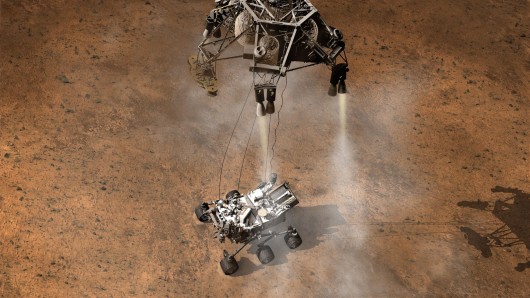
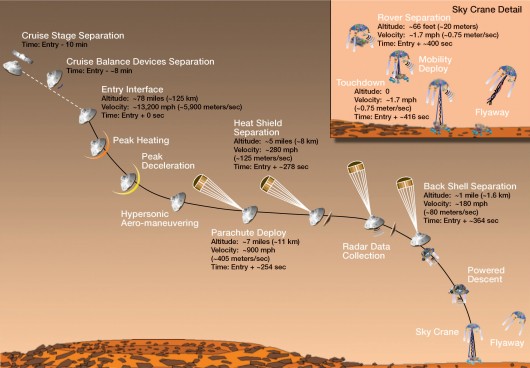
1. The Landing: Curiosity’s entrance to Mars was something truly new and revolutionary. For starters, the distance between Earth and Mars at the time of her arrival was so great that the spacecraft had to make an entirely autonomous landing with mission control acting as a bystander on a 13-minute delay. This led to quite a bit a tension at Mission Control! In addition, Curiosity was protected by a revolutionary heat shield that also acted as a lifting body that allowed the craft to steer itself as it slowed down in the atmosphere. After the aeroshell and heat shield were jettisoned, the rover was lowered by a skycrane, which is a rocket-propelled frame with a winch that dropped Curiosity to the surface.

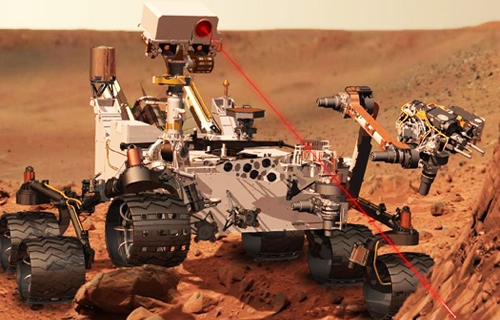
2. First Laser Test: Though Curiosity underwent many tests during the first three weeks after its landing, by far the most dramatic was the one involving its laser. This single megawatt laser, which was designed to vaporize solid rock and study the resultant plasma with its ChemCab system, is the first of its kind to be used on another planet. The first shot was just a test, but once Curiosity was on the move, it would be used for serious geological studies.Curiosity-Laser-Beam3. First Drive: Granted, Curiosity’s first drive test was more of a parking maneuver, where the rover moved a mere 4.57 m (15 ft), turned 120 degrees and then reversed about 2.4 m (8 feet). This brought it a total of about 6  m (20 ft) from its landing site – now named Bradbury Landing after the late author Ray Bradbury. Still, it was the first test of the rover’s drive system, which is essentially a scaled-up version of the one used by the Sojourn and Opportunity rovers. This consists of six 50 cm (20-in) titanium-spoked aluminum wheels, each with its own electric motor and traction cleats to deal with rough terrain.
4. Streams Human Voice: On August 28, 2012, Curiosity accomplished another historical first when it streamed a human voice from the planet Mars back to Earth across 267 million km (168 million miles). It was a 500 kilobyte audio file containing a prerecorded message of congratulations for the engineers behind Curiosity from NASA administrator Charles Bolden, and demonstrated the challenges of sending radio beams from Earth to distant machines using satellite relays.

curiosity-anniversary-45. Writes a Message: Demonstrating that it can send messages back to Earth through other means than its radio transmitter, the Curiosity’s treads leave indentations in the ground that spell out JPL (Jet Propulsion Lab) in Morse Code for all to see. Apparently, this is not so much a gimmick as a means of keeping track how many times the wheels make a full revolution, thus acting as an odometer rather than a message system.

6. Flexing the Arm: Curiosity’s robotic arm and the tools it wield are part of what make it so popular. But before it could be put to work, it had to tested extensively, which began on August 30th. The tools sported by this 1.88 m (6.2-ft) 33.11kg (73 lb) arm include a drill for boring into rocks and collecting powdered samples, an Alpha Particle X-ray Spectrometer (APXS), a scooping hand called the Collection and Handling for In-Situ Martian Rock Analysis (CHIMRA), the Mars Hand Lens Imager (MAHLI), and the Dust Removal Tool (DRT).
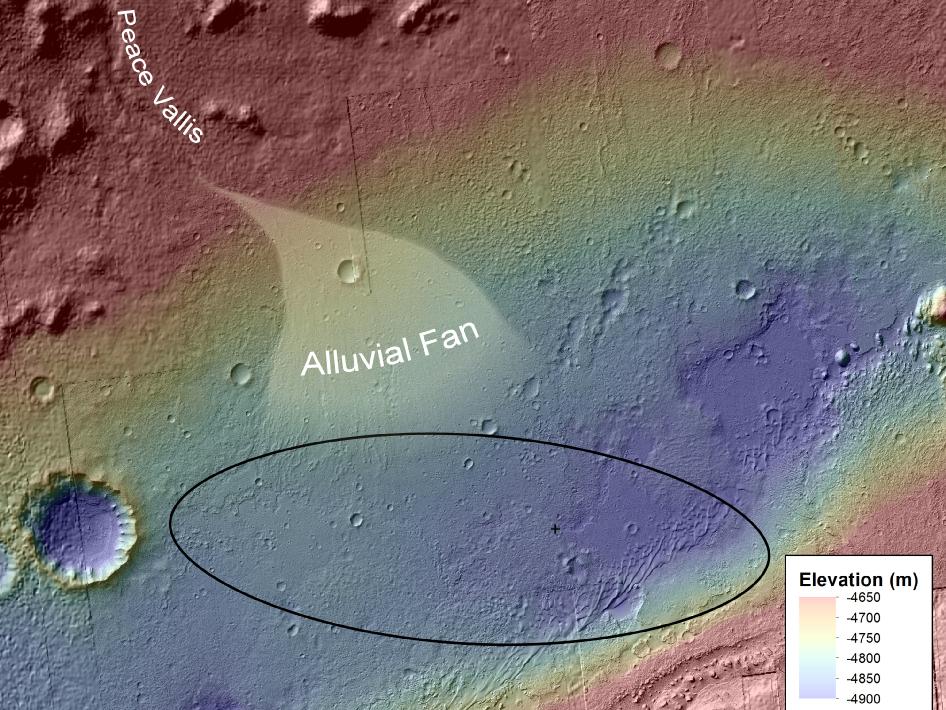
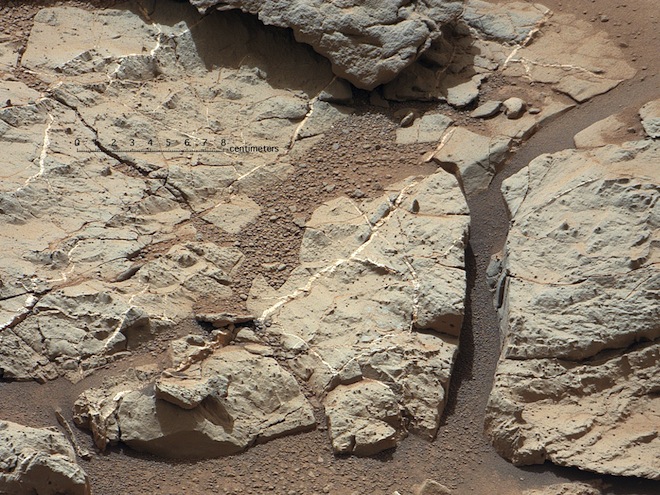
curiosity-alluvialplain7. Discovery of Ancient Stream Bed: Curiosity’s main mission is to seek out areas where life may have once or could still exist. Therefore, the discovery in September of rocky outcroppings that are the remains of an ancient stream bed consisting of water-worn gravel that was washed down from the rim of Gale Crater, was a major achievement. It meant that there was a time when Mars was once a much wetter place, and increases the chances that it once harbored life, and perhaps still does.

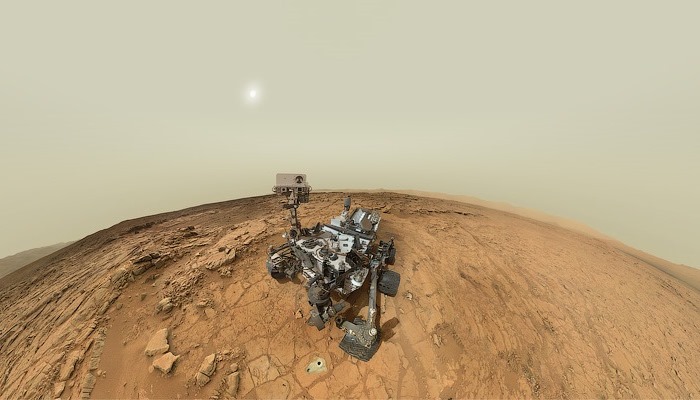
8. First Drilling: In February, Curiosity conducted the first robot drill on another planet. Whereas previous rovers have had to settle for samples obtained by scooping and scraping, Curiosity’s drill is capable of rotational and percussive drilling to get beneath the surface. This is good, considering that the intense UV radiation and highly reactive chemicals on the surface of Mars means that finding signs of life requires digging beneath the surface to the protected interior of rock formations.Curiosity_drillings9. Panoramic Self Portrait: If Curiosity has demonstrated one skill over and over, it is the ability to take pictures. This is due to the 17 cameras it has on board, ranging from the black and white navigation cameras to the high-resolution color imagers in the mast. In the first week of February, Curiosity used its Mars Hand Lens Imager to take 130 high-resolution images, which were assembled into a 360⁰ panorama that included a portrait of itself. This was just one of several panoramic shots that Curiosity sent back to Earth, which were not only breathtakingly beautiful, but also provided scientists with a degree of clarity and context that it often lacking from images from unmanned probes. In addition, these self-portraits allow engineers to keep an eye on Curiosity’s physical condition.

10. Long Trek: And last, but not least, on July 4th, Curiosity began a long journey that took it out of the sedimentary outcrop called “Shaler” at Glenelg and began the journey to Mount Sharp which will take up to a year. On July 17, Curiosity passed the one-kilometer mark from Bradbury Landing in its travels, and has now gone more than a mile. Granted, this is still a long way from the breaking the long-distance record, currently held by Opportunity, but it’s a very good start.

curiosity_roadmapSuch was Curiosity’s first 365 days on Mars, in a nutshell. As it enters into its second year, it is expected to make many more finds, ones which are potentially “Earthshaking”, no doubt! What’s more, the findings of the last year have had an emboldening effect on NASA, which recently announced that it would be going ahead with additional missions to Mars.

These include the InSight lander, a robotic craft which will conduct interior studies of the planet that is expected to launch by 2016, and a 2020 rover mission that has yet to be named. In addition, the MAVEN (Mars Atmosphere and Volatile Evolution) orbiter as just arrived intact at the Kennedy Space Center and will be blasting off to the Red Planet on Nov. 18 from the Florida Space Coast atop an Atlas V rocket.

maven_orbitThese missions constitute a major addition to NASA’s ongoing study of Mars and assessing its past, present and future habitability. Between rovers on the ground, interior studies of the surface, and atmospheric surveys conducted by MAVEN and other orbiters, scientists are likely to have a very clear picture as to what happened to Mars atmosphere and climate by the time manned missions begin in 2030.


Stay tuned for more discoveries as Curiosity begins its second year of deployment. Chances are, this year’s milestones and finds will make this past years look like an appetizer or a warm-up act. That’s my hope, at any rate. But considering what lies ahead of it, Curiosity is sure to deliver!

In the meantime, enjoy some of these videos provided by NASA. The first shows Curiosity’s SAM instrument singing “happy birthday” to the rover (though perhaps humming would be a more accurate word):


And check out this NASA video that sums up the rover’s first year in just two minutes:
News From Space: MAVEN’s “Time-Machine” for Mars

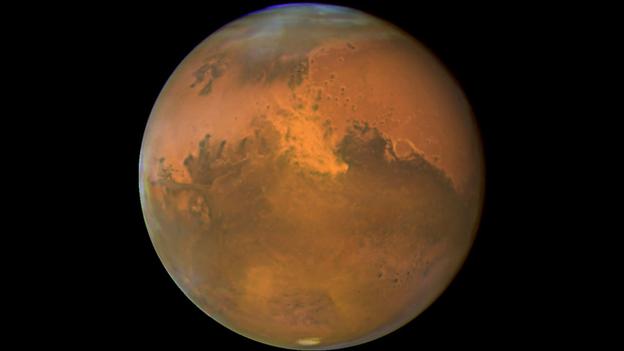
marsYes, the name is a bit of a attention-getter, but when you come to understand the purpose behind Lockheed Martin’s new spacecraft, the description does appear to be quite apt. It’s known as MAVEN, which stands for Mars Atmosphere and Volatile EvolutioN, and it is currently being produced in Lockheed Martin’s Martin Space Systems facility in Denver, Colorado.

People may recall how earlier this year, MAVEN was mentioned as part of the “Going to Mars” campaign. A project that is being organized by the University of Colorado at Boulder’s Laboratory for Atmospheric and Space Physics (CU/LASP), the Martian orbiter will be carrying a DVD featuring the names of everyone who applies, as well as three specially-selected haikus.

However, it is MAVEN’s larger mission which is now the focus of much interest. Later this year, NASA will be launching the orbiter to Mars for the sake of examine the atmosphere and answering some burning questions that remain about the planet. Thanks to evidence provided by Curiosity, Opportunity, and other missions, scientists now know that the Martian surface once boasted conditions suitable for life, including liquid water.

maven_orbitHence, Maven’s ultimate purpose, which will be will to orbit the planet and examine whether the atmosphere could also have provided life support. Scientists working on the Maven mission want to understand what this atmosphere was like, and the processes that led to its destruction. As Guy Beutelschies, Maven Programme Manager at Lockheed Martin, put it:

What we know from our missions looking at the surface of Mars is that there used to be water there. We can see the outlines of ancient rivers, the shorelines of ancient oceans. But water can’t exist there now – the atmosphere is too thin and too dry, any water would just evaporate or freeze. 

So the big question is what happened to Mars’ atmosphere? Short of being able to travel back in time into the Martian past, how would anyone go about tackling these questions with a mission today? Beutelshcies explained it as follows:

[The atmosphere] used to be thicker, warmer, wetter, now it’s thin and dry. How did we get there? In a sense we are building a little bit of a time machine. What we’re doing is understanding the processes.

maven_atmosphereJust last week, evidence provided by the Curiosity rover supports the theory that Mars may have lost most of its atmosphere billions of years ago. Still, scientists remain skeptical that Mars once had an atmosphere comparable to that of Earth. Today, that atmosphere is roughly one-hundredth the thickness of Earth’s, made up mostly of carbon dioxide and a tiny fraction of water vapor. What little remains is being stripped away by the solar wind.

And unlike Earth, Mars does not have a magnetosphere to protect its atmosphere from being blown away – at least not anymore. Such a fragile, thin band around is now unlikely to support any sort of life, as far as we know. But the atmosphere in the past must have been more substantial to allow the formation of rivers, lakes and oceans.

mars_sunsetBruce Jakosky, the Principal Investigator for Maven who is based at the University of Colorado’s CU/LASP lab in Boulder, claims:

We think that Mars used to have a magnetic field. We see places on the surface that retain some remnant magnetism, they were imprinted when they formed with whatever magnetism was there. We think that some four billion years ago, when the magnetic field turned off, that turn-off of the magnetic field allowed [for the] turn-on of the stripping by the solar wind.

To investigate the processes taking place today, Maven will dip into the Martian upper atmosphere with each orbit, measuring the particles, sampling gases, monitoring the magnetic field and solar wind. Whereas the rovers have looked at the atmosphere from the ground up, MAVEN will look at it from the top down. At this point, both are needed to put together a picture of what’s controlling the Mars environment.

maven_atmo1As well as filling in the blanks about Mars’ depleted atmosphere, Maven will also provide clues to the habitability of other planets beyond the solar system. As Jakosky said, the research conducted will have far-reaching implication for our understanding:

In trying to understand the distribution of life throughout the Universe, this is a really important indicator. Understanding the environmental conditions that allow [life] to exist, or don’t allow it to exist, is key to being able to extrapolate elsewhere.

What’s more, understanding what happened to Mars will provide some key insight into the history of our Solar System, and how it went from being a star with two planets that had oceans and atmospheres to just one. Knowing why things continued to operate on Earth, while on Mars they went horribly wrong, is likely to be quite the eye-opener, and make us all thankful we evolved here on Earth.

Source: bbc.com


News from Mars: Evidence of Falling Snow

Mars-snow-header-640x353Ever since astronomers first looked up at Mars, they discerned features that few could accurately identify. For many years, speculations about irrigation, canals, and a Martian civilization abounded, firing people’s imaginations and fiction. It was not until more recently, with the deployment of the Viking probe, that Mars’ surface features have come to be seen for what they are.

Thanks several more probes, and the tireless work of rover such as Opptorunity and Curiosity, scientists have been able to amass evidence and get a first hand look at the surface. Nevertheless, they are still hard-pressed to explain everything that they’ve seen. And while much evidence exists that rivers and lakes once dotted the landscape, other geological features exist which don’t fit that model.

curiosity_rocksHowever, a recent report from Brown University has presented evidence that snowfall may be one answer. It has long been known that ice exists at the polar caps, but actual snowfall is a very specific meteorological feature, one that has serious implications for early Martian conditions. This is just another indication that Mars hosted an environment that was very much like Earths.

And this is not the first time that snow on Mars has been suggested. In 2008, NASA announced having detected snow falling from Martian clouds, but it was entirely vaporized before reaching the ground. The Brown researchers claim that snowfall in the past, and buildup on the surface leading to melting and runoff, could have created many of the tributary networks observed near tall mountain-ranges.

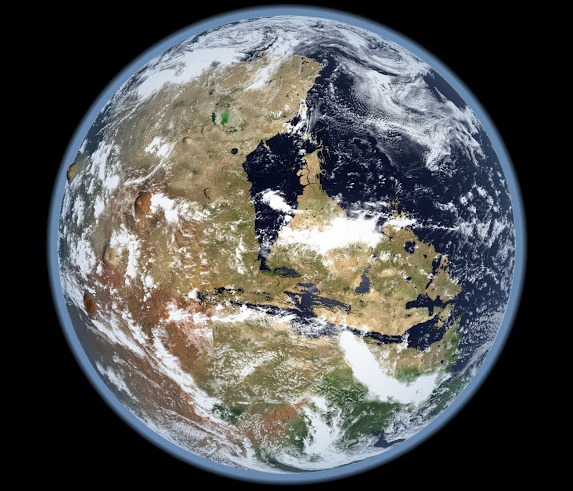
mars_atmoTo back this claim up, the team used a computer simulation from the Laboratoire de Météorologie Dynamique called the Mars global circulation model (GCM). This model compiles evidence about the early composition of the red planet’s atmosphere to predict global circulation patterns. And since other models predict that Mars was quite cold, the program indicated the highest probability of snowfall over the densest valley systems.

Lead researcher Kat Scanlon also relied on her background in orographic studies (science for “studying mountains”) in Hawaii to arrive at this hypothesis. This includes how tall mountains lead to divergent weather patterns on either side, with warm, wet conditions one and cold, dry ones on the other. NASA’s Curiosity rover also was intrinsic, thanks to recent information that might explain why Mars no longer displays this kind of behavior.

Curiosity-Laser-BeamIn short, Curiosity determined that the planet is losing its atmosphere. It has taken detailed assays of the current atmosphere, which is almost entirely carbon dioxide and about 0.6% the pressure of Earth’s at sea-level. More notably, it has used its ability to laser-blast solid samples and analyze the resulting vapor to determine that Mars has an unusually high ratio of heavy to light isotopes — most importantly of deuterium to hydrogen.

The main explanation for this is atmospheric loss, since light isotopes will escape slightly more quickly than heavy. Over billions of years, this can lead to non-standard isotope levels the show a loss of atmosphere. One major theory that might explain this loss say that about 4.2 million years ago Mars collided with an object about the size of Pluto. An impact from this body would have caused a huge expulsion of atmosphere, followed by a slow, continued loss from then on.

All of this plays into the larger question of life on Mars. Is there, or was there, ever life? Most likely, there was, as all the elements – water, atmosphere, clay minerals – appear to have been there at one time. And while scientists might still stumble upon a Lake Vostok-like reserve of microbial life under the surface, it seems most likely that Mars most fertile days is behind it.

However, that doesn’t mean that it can’t once again host life-sustaining conditions. And with some tweaking, of the ecological engineering – aka. terraforming – variety, it could once again.

Living-Mars.2Source: extremetech.com

News from Space: Opportunity’s 10th Birthday!

opportunity_bdayNASA’s Opportunity Rover is a special kind of vehicle. Not only did it set the record for longest distance driven on another world and discover the most compelling evidence for life on Mars thus far, it also surpassed its 90 day mission by a grand total of 3560 days, as of this past July 7th. In other words, the Opportunity Rover just celebrated its tenth anniversary, and people all over the world are marking the occasion by acknowledging the rover’s many contributions.

These include discovering the first meteorite found outside of Earth, a temperature profile of the Martian atmosphere, and uncovering a series tiny, iron-rich spheres known as “blueberries” that hinted at a time when Mars had water. In fact, Opportunity’s most important discovery may have come just last month.

Blueberries_eagleThis consisted of a rock that proves that Martian water was once drinkable, which in turn suggests strongly that life could once have thrived there. On top of that, it captured some amazing photos, long before Curiosity was sending back its hefty batch of panoramas. But of course, Opportunity had its share of trials and tribulations as well.

Foremost amongst these was the two months back in 2005 that it spent spent in a sand dune before its operators were able to wriggle it free centimeter by centimeter. And on the rover’s second day on Mars, it also experienced some shoulder joint problems, which proved to be the first of many, many mechanical problems.

Burns_cliffAnd yet, all of that seems worth it now. After being eclipsed by its larger, more recent arrival – the Curiosity Rover – Opportunity has battled back with its incredible longevity. Who’s to say how much longer the little rover that could will remain in operation? And who’s to say what it will uncover. At this rate, its doesn’t seem unlikely that it will beat its cousin to the punch of finding the Holy Grail – organic particles on Mars!

And be sure to enjoy this video look-back at Opportunity produced by Space.com:


Sources:
gizmodo.com, space.com

News from Mars: Oxygen-Rich Atmosphere

marsEver since the Opportunity and Curiosity Rovers began their research stint on the red planet, evidence has been pouring in that indicates that the planet once supported life. And now, by examining the compositions of Martian meteorites found on Earth and data provided by the Mars rovers, Scientists from the Department of Earth Sciences at the University of Oxford have determined that the planet once boasted an oxygen-rich atmosphere.

The key determinant was the fact that the Martian surface rocks were five times richer in nickel than the meteorites found on Earth, a find which cast doubt on whether the meteorites were typical volcanic products. Whilst it is possible that the geological composition of Mars varies immensely from region to region, the team believes that it is more likely that the differences arise through a process known as subduction – in which material is recycled into the interior.

mars_oxygenThe scientists suggest that the Martian surface was oxidized very early in the history of the planet and that, through subduction, this oxygen-rich material was drawn into the shallow interior and recycled back to the surface during eruptions 4 billion years ago. The meteorites, by contrast, are much younger volcanic rocks that emerged from deeper within the planet and so were less influenced by this process.

As Professor Bernard Wood, the senior author of a study that appeared in Nature magazine, put it:

What we have shown is that both meteorites and surface volcanic rocks are consistent with similar origins in the deep interior of Mars but that the surface rocks come from a more oxygen-rich environment, probably caused by recycling of oxygen-rich materials into the interior. This result is surprising because while the meteorites are geologically young, around 180 million to 1.4 billion years old, the Spirit rover was analyzing a very old part of Mars, more than 3.7 billion years old.

In addition to evidence that Mars once had a sizable amount of surface water, in the form of rivers and lakes, this latest study demonstrates that Mars was once very much like Earth. In all likelihood, it would have been home to countless forms of bacteria, single-celled organisms, and possibly larger creatures as well. But being at the edge of our Sun’s habitable zone, it was unable to maintain the conditions for life to thrive.

terraforming-hswmarsSad news, but encouraging when it comes to the prospect of making Mars able to sustain life again. And in the coming years and decades, that’s precisely what a number of space agencies, private companies and citizens want to do. And if these plans are to succeed long term, the planet will have to be converted into something that can independently support life.

In short, the colonization of Mars requires that the planet become something akin to its old self.

Source: sci-news.com

The Arkyd 100: Crowdfunding Space Exploraiton

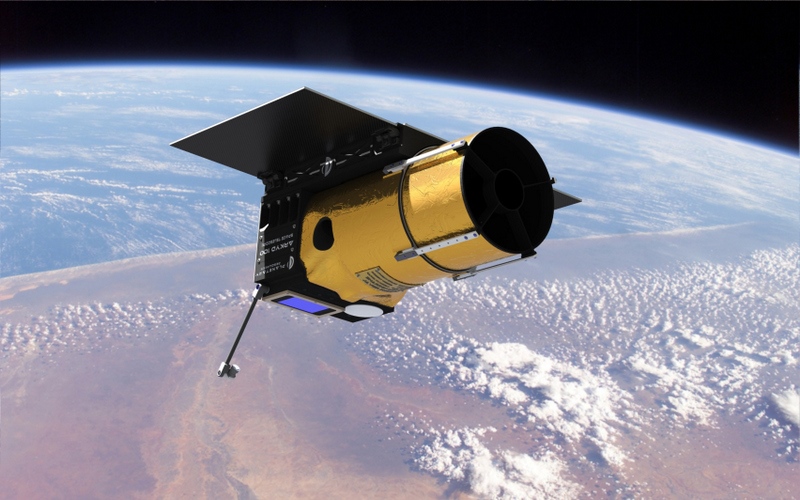
ARKYD-in-SpacePlanetary Resources made quite the impression last year when they announced their plans to begin prospecting near-Earth asteroids with in the intention of mining them in the near future. Alongside such companies as SpaceX and Golden Spike, they are part of a constellations of private interests looking to establish commercial space travel and tourism. But their latest proposal goes a step further, bringing crowdfunding and the realm of space exploration together.

That’s the idea behind a Kickstarter campaign that the company began to raise money for a crowdfunded space telescope. Known as the Arkyd 100, the company claims that this new telescope will provide unprecedented public access to space and place the most advanced exploration technology into the hands of students, scientists and a new generation of citizen explorers.

asteroid_miningTo make their campaign successful, they need to raise $1 million in Kickstarter pledges by the end of June 2013. Once the telescope is up and running, it will allow them to better map the asteroid belt, thus assisting them in finding the rocks they want to mine for precious metals and trace elements. And with public financial backers making it happen, anyone pledging money will be able to own a piece of the prospector!

During a webcast on May 28th to announce the Kickstarter campaign, Chris Lewicki, President and Chief Engineer for Planetary Resources, gave a rundown on the details of the telescope. And interestingly enough, the Planetary Resources’ technical team that designed it also worked on every recent U.S. Mars lander and rover. So if you do choose to invest, you will do so with the knowledge that the same people who helped build the Opportunity and Curiosity rovers are behind this project. If that doesn’t inspire investor confidence, I don’t know what will!

ARKYD-Space-SelfieA wide array of scientists, space enthusiasts and even Bill Nye the Science Guy have voiced their support for Planetary Resources’ new public space telescope. And those who invest will have the chance of recouping certain rewards, depending on how much they choose to pledge. Those pledging the minimum donation of $25 will receive the “Your Face in Space” benefit, where you will have you picture placed on the Arkyd and receive a picture of said photo the telescope with Earth in the background. Higher pledges will provide access to the telescope for students and researchers worldwide.

After less than 2 hours into their campaign, Planetary Resources had raised over $100,000. And as of this article’s writing, just one day shy of a week, the campaign has reached $710,945 of their $1 million goal, and they still have 27 days left. I guess people want a piece of this project. And who can blame them, since it is a scientific and historic first!

Check out the promotional video for the Arkyd and Planetary Resources below. To make a donation or get information about the Kickstarter campaign, visit the campaign page here.


Source:
universetoday.com

Opportunity Finds Evidence of Life!

opportunityThe Opportunity Rover is at it again! A little over a week ago, it set the record for longest distance traveled by a vehicle on another planet. Well it seems that NASA’s longest-running rover wasn’t finished hogging the limelight just yet. Yes, after ten years of service on what was originally planned to be a three-month journey, Opportunity struck gold by discovering the strongest evidence to date for an environment favorable to ancient Martian biology.

It began just two weeks ago, when Opportunity conducted an analysis of a new rock target named “Esperance”. According to a statement released by NASA, the rover confirmed that the rock target was composed of a “clay that had been intensely altered by relatively neutral pH water – representing the most favorable conditions for biology that Opportunity has yet seen in the rock histories it has encountered.”

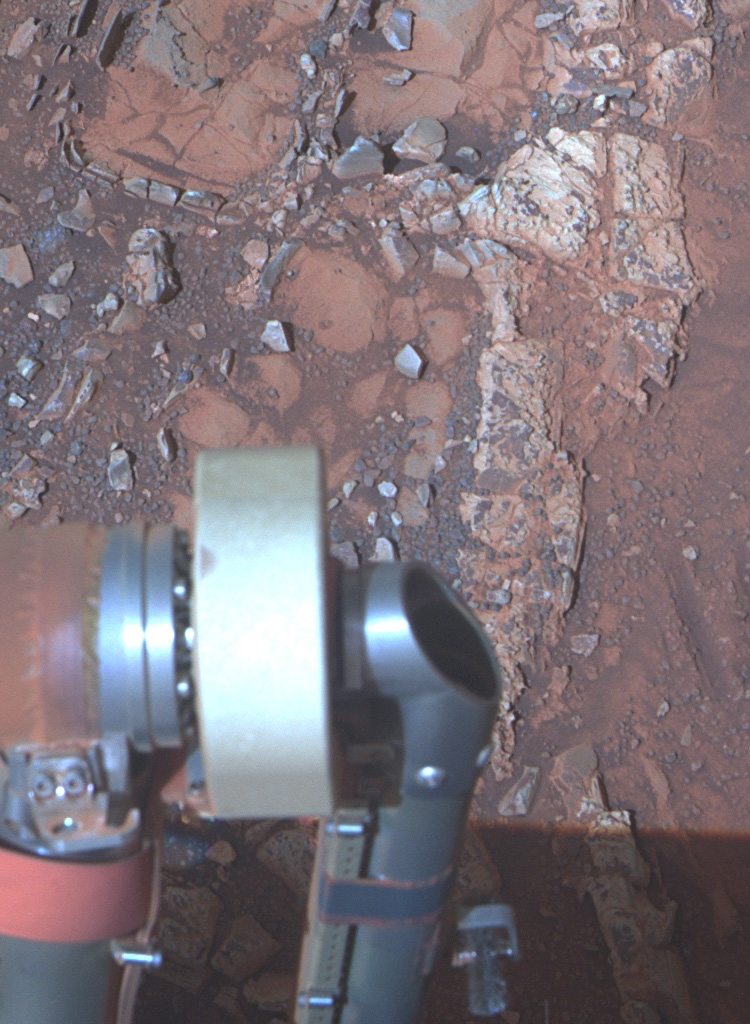
Opportunity-Sol-3309_Aa_Ken-Kremer-580x288The process involved Opportunity using it still-functioning Rock Abrasion Tool (RAT) to expose the interior of Esperance and then examine it with its microscopic camera and X-Ray spectrometer, both of which that are mounted at the end of her nearly 1 meter (3 foot) long robotic arm. Inside, it found a rock surface loaded with clay minerals that was clearly formed with the help of flowing liquid water.

The robot made the discovery at the conclusion of a 20 month long science expedition circling around a low ridge called “Cape York”, a region of great important to Mars scientists. Scott McLennan of Stony Brook University, a long-term planner for Opportunity’s science team, explained why:

What’s so special about Esperance is that there was enough water not only for reactions that produced clay minerals, but also enough to flush out ions set loose by those reactions, so that Opportunity can clearly see the alteration.

opportunity_esperanceEsperance is unlike any rock previously investigated by Opportunity, containing far more aluminum and silica which is indicative of clay minerals and lower levels of calcium and iron. Most, but not all of the rocks inspected to date by Opportunity were formed in an environment of highly acidic water that is extremely harsh to most life forms. Clay minerals typically form in potentially drinkable, neutral water that is not extremely acidic or basic.

These findings amount to the discovery of an environment in which life could have thrived, which amounts to a scientific home run for the senior rover. As Prof. Steve Squyres of Cornell University, the mission’s principal scientific investigator, put it:

Water that moved through fractures during this rock’s history would have provided more favorable conditions for biology than any other wet environment recorded in rocks Opportunity has seen.

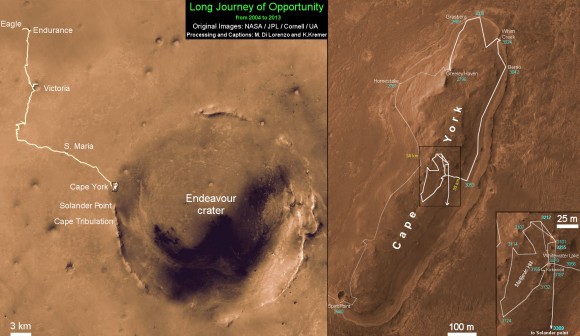
What’s next for Opportunity? Well, now that she’s finished at Cape York, Opportunity has set sail for her next crater destination at “Solander Point”, an area about 2.2 km (1.4 miles) south of the Cape. Eventually, she will continue further south to a rim segment named “Cape Tribulation” which holds huge caches of clay minerals. Along the way, there’s likely to be plenty more evidence of what Mars looked like many millions of years ago.

You know, with all this Opportunity-related news coming in, I’m beginning to wonder what Curiosity is up to. While it’s nice to see her partner-in-crime breaking records and turning up such important finds, I do wonder if Curiosity is likely to feel a little left out. At this rate, one might think a game of one-upmanship could break out between the rovers teams!

Source: universetoday.com

News From Space: Opportunity Hits New Record!

opportunityWith the Curiosity Rover blazing a trail across Mars to find evidence of what the planet once looked like, people often forget about it’s venerable predecessor – the Opportunity Rover. Luckily, Opportunity recently broke a record that put it back in the public eye and into the history books. After nine years into what was initially meant to be a 90 day mission, Opportunity smashed yet another space milestone this week by establishing a new distance driving record.

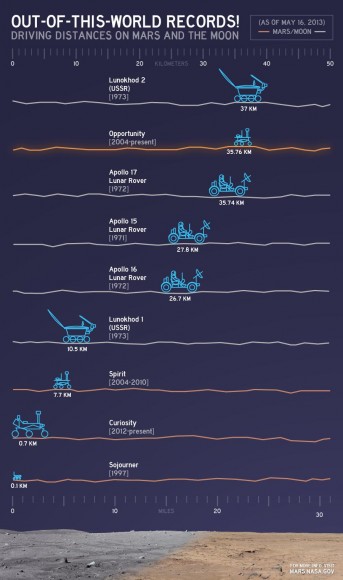
On Thursday, May 16, the Opportunity rover drove another 80 meters (263 feet) on the Martian surface, bringing her total odometry since landing on the 24th of January, 2004 to 35.760 kilometers (22.220 miles). This effectively put her ahead of the 40 year old driving record set by the Apollo 17 astronauts Eugene Cernan and Harrison Schmitt back in December of 1972.

Apollo_17_lunar-rover-577x580On that mission, Cernan and Schmitt performed America’s final lunar landing mission and drove their Lunar Roving Vehicle (LRV-3) a total of 35.744 kilometers (22.210 miles) over the course of three days on the moon’s surface at the Taurus-Littrow lunar valley. And interestingly enough, Cernan was a very good sport about his record being broken. In a statement made at NASA’s Goddard Space Flight Center in Greenbelt, Md, he said:

The record we established with a roving vehicle was made to be broken, and I’m excited and proud to be able to pass the torch to Opportunity.

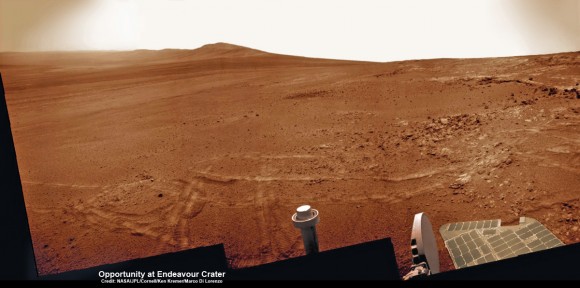
And since Opportunity still has plenty of juice left, it is now eying the ‘Solar System World Record’ for driving distance on another world, a record that is currently held by the Soviet Union’s remote-controlled Lunokhod 2 rover. In 1973, Lunokhod 2 traveled 37 kilometers (23 miles) on the surface of Earth’s nearest neighbor. With Opportunity setting course for her next crater rim destination, named “Solander Point”, she is likely to overtake Lunokhod 2’s record in short order!

Opportunity-Route-Map_Sol-3309_Ken-Kremer-580x336Thereafter, Opportunity will rack up ever more distance as the rover continues driving further south to a spot called “Cape Tribulation”. This point is believed to hold caches of clay minerals that formed eons ego when liquid water flowed across this region of the Red Planet. In so doing, Opportunity will not only establish a new record that will last for years to come, it will also be obtaining data that will assist in Curiosity’s own efforts to determine what life was like on Mars in the past.

Far greater than this record-breaking news is the fact that Opportunity has lasted so far beyond her design lifetime, 37 times longer in fact than her initial 3 month “warranty”.

And be sure to check out the full list of record holders for “out-of-this-world” driving, below:

out-of-this-world_recordsSources: universetoday.com, news.cnet.com

Update on Curiosity

More news from Mars! It seems that after a full month of being on Mars, running routine checks on its equipment and snapping some breathtaking photos, Curiosity is ready to begin the first leg of its study mission. This consisted of finding a Martian rock, the first sample in Curiosity’s extensive contact surveys.

And, after a week of searching, the NASA team piloting the rover found a pyramid shaped rock that they feel will be perfect for their surface analysis. The rock is described as a pyramid-shaped hunk, likely composed of basalt, which they nicknamed “Jake Matijevic” after one of the rover engineers who died back in August.

The sample was located just three meters from Curiosity’s landing zone, now known as the “Bradbury Landing” in honor of the late, great Ray Bradbury, author of the Martian Chronicles. On Saturday, it will extend its arm, take possession of the rock, and begin chemical analysis to determine the rock’s primary mineral and precise composition.

Another important aspect of Curiosity’s mission began this week, as the rover set it’s camera eyes to the skies and captured photos of Phobos making a Solar transit. To be fair, this was not the first time a Martian eclipse was captured on camera. In fact, the Opportunity and Spirit rovers both snapped similar images back in December of 2010 and 2005. However, the images taken by Curiosity were of such high resolution that experts will be able to estimate the consistency of the interior of Mars itself for the first time.

Apparently, this is done by measuring the tidal forces these moons exert on Mars, examining how the planet changes shape ever so slightly as a the moons orbit about it. By measuring this “deformation bulge”, along  with the precise spatial orientation provided by Curiosity’s photos, experts at NASA and abroad will be able to conjecture what the core of Mars is made of based on how much the planet deforms. I always wondered how scientists were able to guess what lay at a planet’s core. Now I know, go figure!

Stay tuned for more news from the Curiosity and the Red Planet!

Source: Popular Mechanics

How To Get To Mars…

A new video has been making the rounds recently. In this full-length compilation video, we get a glimpse of what the flight and deployment of Spirit/Opportunity Rover to Mars looked like, using CGI animation of course. In between, real footage from NASA is spliced in to provide real-time background to the simulated events. We see the navigators eagerly awaiting the landing and recovery of the rover’s signal, and the first photographs sent back by that rover. The arrival of this footage is very timely of course, coming soon after the arrival of Curiosity. Enjoy!