
 It certainly has been a momentous few weeks for space exploration! Between the final weeks of August and the month of September, we’ve seen the Curiosity rover reach Mount Sharp, the Rosetta spacecraft created the first full map of a comet’s, the completion of the Orion space module, and the MAVEN orbiter reach Martian orbit. And before the month is out, India’s Mars Orbiter Mission (MOM) will also arrive in orbit around the Red Planet.
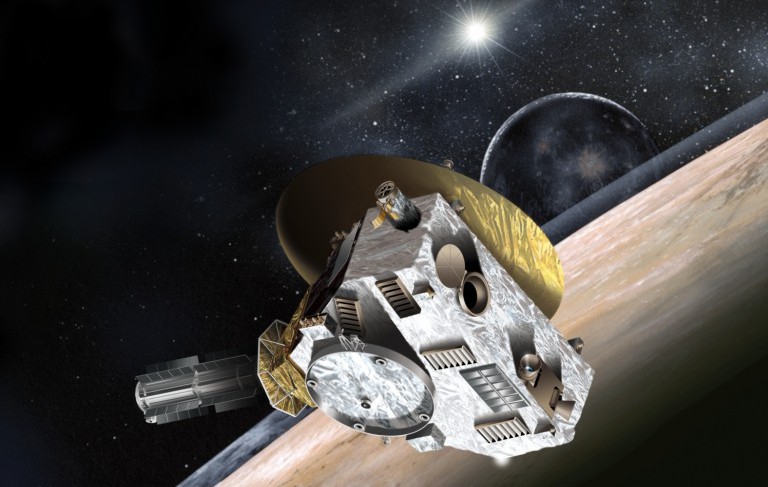
Despite all these developments, that occurred (relatively) close to home, there was even more news to be had, coming all the way from the edge of the Solar System no less. At the tail end of August, NASA announced that the New Horizons space probe passed Neptune orbit and is on its way to Pluto. Launched back in 2006 for the purpose of studying the dwarf planet, the probe is expected to arrive on July 14th of next year.
 NASA says that the the craft passed the Neptunian orbit at 10:04 pm EDT on Monday August 25th, which coincided with the 25th anniversary of Voyager 2’s flyby of Neptune in 1989. But where Voyager came within 4,950 km (3,080 mi) of the gas giant, the New Horizons craft passed by at a distance of 3.96 billion km (2.45 billion mi). The spacecraft is now almost 4.42 billion km (2.75 billion mi) from Earth, and is the fastest man-made object ever sent into space.
Nevertheless, New Horizons’ Long Range Reconnaissance Imager (LORRI) was still able to capture images of Neptune and its giant moon Triton. As you can see from the image below, Neptune appears as the large white disc in the middle, while Triton is the small black dot passing in front and sitting slightly to the ride. NASA says that Triton may be very similar to Pluto and the information gathered by Voyager 2 may prove helpful in the coming encounter.
 Ralph McNutt of the Johns Hopkins University Applied Physics Laboratory.
There is a lot of speculation over whether Pluto will look like Triton, and how well they’ll match up. That’s the great thing about first-time encounters like this – we don’t know exactly what we’ll see, but we know from decades of experience in first-time exploration of new planets that we will be very surprised.
The first mission in NASA’s New Frontiers program, the New Horizons mission was launched on January 19, 2006 atop an Atlas V rocket from Cape Canaveral, Florida. It broke the record for the fastest man-made object on lift off with a speed of 58,536 km/h (36,373 mph). The 478 kg (1,054 lb) spacecraft was sent on a 9.5-year mission to fly by Pluto – a distance so far that radio signals from the nuclear-powered probe take four hours to reach Earth.
 Sent on a slingshot trajectory using the gravitational pull of Jupiter, which tacked on another 14,480 km/h (9,000 mph) to its speed, New Horizons will pass Pluto in July of next year at a distance of 13,000 km (8,000 mi). After this encounter, it will continue on out of the Solar System, during which it will be in the distant Kuiper belt studying one or more Kuiper belt objects (KBOs).
Though this will still not rival Voyager 1’s accomplishments, which left our Solar System last year, New Horizons promises to gather far more information on the Outer Solar System and what lies beyond. All of this will come in mighty handy when at last, humanity contemplates sending manned missions into deep space, either to Alpha Centauri or neighboring exoplanets.
Sources: gizmag.com, nasa.gov


 Stories by Williams