
I’m getting hooked on writing conceptual posts, mainly because it gives me the chance to explore a lot different franchises of sci-fi without being too constrained. Not only that, I really like digging into subject matter of finding the common elements; in this case, the stuff that makes cool stuff cool! So far, I’ve covered the concepts of Galactic Empires, Planetkillers and Ancient Aliens. But today, I thought I’d tackle something a little simpler that’s been known to make sci-fi geeks experience collective nerdgasms! Today the topic is: COOL GUNS!
BFG 9000:
 Starting off this review right is the BFG (Big F***ing Gun) that comes to us from the Doom universe. Fans of that old franchise know this one by heart, and I’m sure they remember with some nostalgia what it was like firing this thing. Given that Doom was like most first-person shooters, this weapon would turn up late in the game as a way of dealing with the more tenacious evil critters. And it worked! One shot released a big cloud of green plasma which killed everything in the vicinity. Unless it was a boss, in which case, it might take two or three… Apparently, Quake II and Quake III Arena pay homage by including their own version, known as the BFG10K.
“Blow Dryer”:
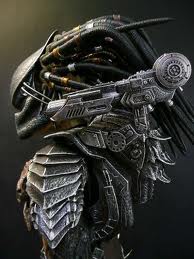 Also known as a “burner” or plasma caster, this weapon was the mainstay of the Predator aliens and is featured in the many movies, comics, video games, and novels of the franchise. Mounted on the shoulder, this weapon would discharge a ball of red-hot plasma into objects, causing damage akin to an explosive device, but with none of the messy shrapnel. Though the standard model is shoulder mounted and aimed using a heads-up-display and laser sight, the Predators in later movies were also known to carry wrist-mounted versions of this weapon as well. Like their claws and wrist bombs, they were embedded in the cuffs and served as a backup. One of these makes an appearance in Predator 2 during the meat locker shoot-out.
BR55 Battle Rifle:
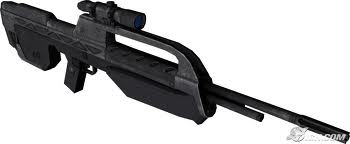 This baby is a Halo universe invention, and is the mainstay of the UNSC infantry. Aesthetically, this rifle is based on several bull-pup assault rifles designs from the modern era, a design which is clearly growing in popularity. Some potential sources for inspiration include the Austrian-made Steyr AUG, the French FAMAS, the British L85, the Belgian F2000, and the experimental PAPOP design. Like all bull-pup rifles, this gun loads from the rear and can cut through Covenant opposition with ease! Even when I’m playing as the Covenant, this was my second favorite weapon to be carrying (the first was either two submachine guns or two pistols, or a combinati0n thereof!)
Blade Runner Gun:
 In the classic move Blade Runner, Detective Rick Deckard was responsible for locating and “retiring” replicants. And the weapon he used to do just that is featured here. This is the model of a Blade Runner service revolver, for which little information exists, but whose appearance and performance pretty much speaks for itself. Based on a standard service revolver with several extra bits added on for effect, this gun pretty much screams cyberpunk.
In addition, there are several scenes in the movie where Deckard’s gun turned flesh (artificial though it was) into mush! Recall the scene where Deckard uses this gun to punch several holes in Zhora? Or how about the scene immediately thereafter where Leon is beating the crap out of him, and Rachael manages to save him by using his own weapon? Yeah, whenever this gun was brought out of his holster, some big holes resulted!
Blasters:
 When asked about his idea for a “Galactic Empire”, George Lucas said that he wanted to create something that was as aesthetically similar to Nazi Germany as possible. This was reflected in the weapons as well. Numerous guns that were modified and used as props in the movie were based on WWII vintage weapons. The first and most recognizable is Han’s blaster, aka. the DL-44. Based on the German C96 Mauser pistol, this weapon was apparently a popular item amongst smugglers and traders, being very powerful and compact. It was also quick on the draw, which comes in handy when in a bar and looking down the barrel of a bounty hunter’s gun (Han shot first!)
The next was the standard issue blaster used by both the Stormtroopers and the heroes, especially in the first movie during their daring breakout  from the Death Star. This blaster, known as the E-11, was based on the Sterling submachine gun of WWII. Simple, consisting of little more than a barel, a handle, and a side-mounted magazine, the gun was easily altered with a few pieces of molded plastic and a scope that made it look suitably futuristic.
 The heavier T-21 Blaster Rifle was yet another WWII adaptation. Built around a Lewis machine gun, it was featured in the first movie during the Mos Eisley scene where Stormtroopers were seen walking through the streets searching for Luke and Obi Wan.
Last, there was the DLT-19 Heavy Blaster, the heaviest infantry weapon in the Star Wars franchise. In keeping with his love of WWII kit, Lucas’ set designers used a German MG42 to fashion this one. This blaster appeared aboard the Death Star in the hand of the search party that went over the Millenium Falcon, and again when Chewy commandeered one to take out the remote blasters and cameras in the cell block.
GE M134 Minigun Handheld:
 How could I have forgotten this one? I mean really, is there a better visual representation of sheer badassery than the handheld minigun from Predator? Sure, the mere idea of a man carrying a minigun around by hand is so unbelievable its makes me want to laugh out loud. Considering the weight of the weapon, even before you factor in all the ammo, coupled with the killer recoil that no human could withstand – all of this makes the physics totally implausible! But what the heck? It was fun to watch! I can’t imagine anyone not feeling the hair on the back of their neck stand on end as those barrels started whirling and the bullets streamed out, so fast it sounded like a turbine! And I know from talking to actual pilots who’ve seen this baby in action that if you add tracers to the mix, its like watching a laser show. WHURRRRRRRRRRRR! Total carnage!
Grammaton Cleric Pistol:
 Though it was not my favorite movie, there were undeniably cool aspects to the movie Equilibrium. One of which was all the cool Gun Kata moves pulled by Christain Bale, Angus Macfadyen, and the other Grammaton Clerics with their special pistols. These guns were clearly souped-up versions of the Beretta 92FS. They clearly fire in both semi-automatic and automatic bursts, and were retrofitted in one scene with impact hammers on the handles.
In addition, some rather curious reloading tricks were devised. One involved arm-rails that would deliver fresh magazines from inside the cleric’s sleeve. Another included magazines that could be balanced upright, which gave the cleric the ability to simply slam his gun down on the fresh magazine once the empty ones had been ejected and go right on shooting. It’s all about rate of fire in this movie, making sure the bullets (and dust) keep flying!
The Lawgiver II:
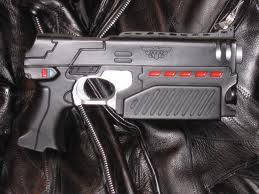 Also known as the Judge Dredd gun, this pistol is also a modified version of the Beretta 92FS, with molded plastic and LED lights giving it a future-city look. In addition to a rapid-fire setting, the gun also boasts a grenade launcher, signal flare launcher, and a special dual round known as the “double-whammy”. It also has a taser device built into the handle so that only a Judge can operate it, and a DNA tagging system that ensures that every slug fired can be traced back to the person operating it.
M41A Pulse Rifle:
 The franchise Alien gave so much to the world of sci-fi geeks, not the least of which came in the form of cool guns. And the Pulse Rifle was arguably the mainstay of that contribution. In fact, it was this gun that inspired entire generations of futuristic weapons, and the name itself has been used many times over to refer to energy and slug-thrower weapons in sci-fi franchises.
This is an important disctintion seeing as how “pulse”, to most sci-fi acolytes, refers to weapons that fire out pulsing beams of energy (most likely plasma). But in this case, it referred to pulses of caseless ammo, big bursts of projectiles that would tear through acid-spewing aliens by the dozen. And let’s no forget the grenade launcher that was attached to the underside, how cool was that? The signature, click-click, BOOM! combination was as pleasing to the ears as it was to the eyes.
But in addition to being just so freaking cool to look at, the amount of creative energy and ingenuity that went into making it was quite impressive. For example, the people in charge of set design wanted a prop that would actually fire, so they built their rifle concept around the M1A1 Thompson submachine gun, a WWII vintage weapon that was small and sturdy enough to get the job done. To simulate the grenade launcher, they attached a cutdown Remington 870 shotgun beneath it and mounted the foregrip of the SPAS 12 shotgun on top of that. Then, they applied pieces of molded plastic and a little LED display to the side to make it look especially badass! Remember that scene where Ripley used it to level that room full of egg’s with the Alien queen inside? Iconic!
M56 Smart Gun:
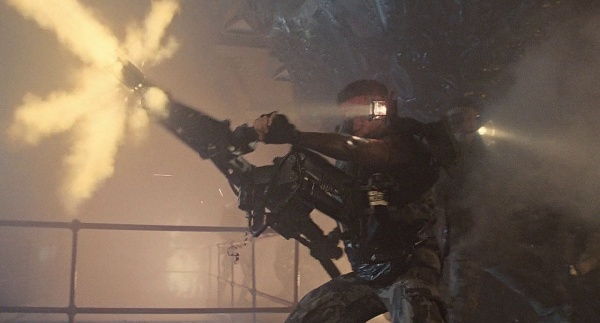 I know, I’m shoving two examples from a single franchise into one post. But I think it’s worth it. And for fans of Aliens and sci-fi junk, you just can’t make a list of cool guns and not include the Smart Gun! Much like the Pulse Rifle, this weapon was the perfect marriage of aesthetics and ingenuity.
To fashion it, the set designers for Aliens used another vintage WWII weapon (like Lucas, they used the German MG42 machinegun) some motorcycle handles, and the arms from a Steadicam mount. The result, once again, was pure badassery! And the name, according to the expanded Aliens universe, comes from the fact that these weapons could aim themselves. Marines would simply employ their eyepieces and helm cameras, and the guns would pick up movement and target it. Oh, and that scene where Vasquez opens fire in the Alien lair… classic! “Let’s roooooock!”
PPG’s:
 The PPG, or Phased Plasma Gun, is the standard weapon of security officers and soldiers in the Babylon 5 universe. According to franchise sources, the PPG fires a small charge of superheated helium which retains its shape and small volume via a residual magnetic field. Upon impact with an object, the magnetic field is dissipated and the heat discharged. PPG bolts also cause visible distortion as they travel through air, hence the blurred effects when people in the show fire off their weapons.
The PPG comes in several standard models. First, there’s the service pistol which every security officer and member of station personnel. The heavier rifles are busted out during riots and times of war, along with the vests and riot helmets. In two episodes (S01E20 Babylon Squared and S05E19 Wheel of Fire ) Garibaldi has scenes where he busts out the BFG version.
Reason:
 This weapon is both deadly and cheekily-named, and is taken from Neal Stephenson’s smash-hit novel Snow Crash. This picture doesn’t quite do it justice, but its a close approximation. In the novel, Reason was a gatling gun that was the property of Uncle Enzo’s Mafia, an organization that ran a series of franchulates along the west coast of the former US. But unlike your conventional gatler, it fired caseless depleted-uranium slugs, bullets that are incredibly dense and very heavy. Hence, the weapon packed a massive punch and a mad recoil.
During one of the later chapters, Enzo’s men use the gun to take out a pirate yacht while firing from a life raft. A single burst demolished the pirate ship, but the recoil sent their boat about fifty meters in the opposite direction! This scene also had a hilarious set up when the mafiosos first broke it out, saying that if they ran afoul of any privateers, they were sure they’d “listen to Reason.”
Phaser Rifle:
Over the years, Star Trek has been a source of many weapons designs. However, some were arguably more cool than others, at least in my opinion. These came largely from the later spinoffs and movies, in particular DS9 and Voyager. Prior to this, phaser designs were either too boxy, too bulbous, or just too… Buck Rogers-y! When you’re repelling boarders, or on an away mission, one thing you want is a kick-ass weapon to bolster your confidence and inspire fear in your enemies.
 These requirements were met by a new model of weapon, known as the type 3 Phaser Rifle. This weapon went through many variations throughout the course of the show. The first design was very boxy-looking, whereas later models tended to be more sleek and menacing (as shown above). Then came a whole new design, known as the Compression Rifle (seen below), which was apparently an even more powerful model. These weapons were specifically created for use on starships where heavy combat was expected, or in times of war.

Final Thoughts:
Man, that was a long list! But that’s the thing with cool ideas, they tend to get around. And as usual, I noticed some key patterns in the mix which I think should be pointed out. In all of these cases, there were apparently two classes that each weapon fell into.
- Directed-Energy Weapons: Arguably the more science-fictiony of the two. These weapons first made their appearance in Saturday morning serials like Buck Rogers from the 1950’s. They come in many forms – ray guns, death rays, beam guns, blasters, laser guns, and phasers – but the core concept is the same. Phased or directed energy, usually in the form of plasma, that is focused into a tight beam and then emitted. The ironic thing is, since the 1950’s, sci-fi franchises have moved away from these seemingly farfetched devices and come to rely on ballistic weapons designs more and more. Meanwhile, Directed Energy Weapons have become more and more feasible, with several prototypes being explored by military contractors today.
- Ballistic Weapons: In the context of sci-fi, these often take the form of weapons that use caseless ammunition, electromagnetically-propelled ammunition, or just standard bullets. But in each case, the weapons that use them are adapted to look more futuristic. Interestingly enough, the future seems to be coming sooner than we thought. In just about every developed nation, firearm technologies are being explored under the banner of the “Future Soldier” program. Having studied many of these, I can tell you that they put much of what was shown in Aliens to shame, especially where Heads-Up-Displays and portable computers are concerned! Again, the future seems to be coming sooner than we thought!

 Stories by Williams